



Abstract
The purpose of this study is to identify profiles based on the reasons adults have for being physically active. A secondary purpose was to examine how profiles differ on motivational regulation and physical activity (PA). A total of 1275 (46.5 ± 16.8 years) participants were solicited from a hospital-affiliated wellness center, social media promotions, and a research volunteer registry. The Reasons to Exercise (REX-2) scale, International PA Questionnaire, Behavioral Regulation in Exercise Questionnaire-3, and demographic questionnaire were utilized to assess variables of interest with a cross-sectional survey. Using SPSS Version 26, K-cluster analysis was used to identify profiles based on the reasons for exercise that individuals identified as important. Multivariate analysis of variance (MANOVA) was used to assess profile differences followed by ANOVA. Four profiles were derived based on reason for exercise scores: a multi-reason positive (N = 361), a multi-reason negative (N = 232), an autonomous-focused (N = 259), and a control-focused cluster (N = 382) (p < .001). These unique clusters differed significantly (p < .001) from each other with respect to motivation to be active and PA. The multi-reason positive cluster engaged in higher levels of total moderate and vigorous PA minutes/week compared to the other clusters. Therefore, adult’s motivation for PA may be likely to be affected by a combination of different informal goals and valuing a number of goals that are both extrinsic/controlling (e.g., to look good) and autonomous/intrinsic (e.g., to feel good), may promote greater autonomous motivation regulation and greater PA levels than highly autonomous/intrinsic goals alone.
Introduction
Adults have many reasons for being physically active. These reasons are key to identifying the sources of motivation and the quality of motivation associated with physical activity (PA) engagement. Motivation research findings suggest that both “what” people pursue (i.e., goal contents) and “why” they pursue it (i.e., motives) are important when predicting engagement in PA (Deci & Ryan, 2000; Lindwall et al., 2016; Wang, Morin, Ryan, & Liu, 2016). An ongoing challenge for researchers is how to best represent these aspects of motivation in a way that captures the multidimensionality of the construct. Additionally, the dynamic nature of goals and the pursuit of multiple goals at the same time creates a complex issue for researchers and practitioners. While research findings have reported that different goals towards exercise often naturally co-exist in the same person (Lindwall et al., 2016; Teixeira et al., 2012; Valenzuela et al., 2021) a gap in the literature remains as to which clusters or groups of reasons lead to higher or lower levels of PA engagement.
According to Achievement Goal Theory, whether or not individuals want to invest themselves in a particular activity (e.g., exercise or PA) depends on what the activity means to them (Maehr, 1984; Maehr & McInerney, 2004; Nicholls, 1984), and such meaning(s) determines personal investment. Furthermore, in pursuit of goals is the desire to demonstrate consistent attainment of valued goals while avoiding goal failure (Pastor et al., 2007; Wang, Morin, Ryan, & Liu, 2016). While exercisers can define success differently, consistent attainment of valued goals (i.e., success) should allow individuals to feel successful and thereby enhance motivation (Roberts & Treasure, 2012; Segar et al., 2008). During this process, a number of goals may be operative in guiding how people invest their time and energy (Hsu et al., 2022; Teixeira et al., 2012; Wang, Morin, Chian, & Chian, 2016). For instance, embracing multiple goals may provide more opportunities to make meaningful progress towards success and avoid failure, with more valued goals providing more opportunities to experience success than fewer valued goals. Few researchers (Lindwall et al., 2016; Segar et al., 2008; Valenzuela et al., 2021) have chosen to probe more deeply into the dynamic nature of goals, such as the process of pursuing multiple goals and the way in which the environment affects goal adoption, and PA engagement. More specifically, there is a need to consider the type, value, and meaning of the goal, as well as the combination of the goal with other goals.
Self-Determination Theory (SDT) is Deci and Ryan’s (1985) theory of human motivation which provides a more holistic picture of motivation for PA that extends the achievement-centered constructs of Achievement Goal Theory in our understanding of motivation (Hsu et al., 2022). SDT postulates that there are different types of motivation regulation, each one reflecting the extent to which a behavior has been internalized along a continuum based on the degree of self-determination (Ryan & Deci, 2017). Extrinsic goals such as appearance and weight management are experienced as controlling and thus contribute minimally to PA participation, whereas intrinsic goals such as personal challenge and social affiliation are experienced as autonomous and thus, contribute positively to long-term PA participation (Ryan & Deci, 2017; Valenzuela et al., 2021). Empirical studies support using the “intrinsic-extrinsic” goal content distinction when differentially predicting PA outcomes (Friel & Garber, 2020; Lindwall et al., 2016; Teixeira et al., 2012).
The idea of adopting multiple goals simultaneously is not new to the field of goal orientation research (Lindwall et al., 2016; Teixeira et al., 2012; Valenzuela et al., 2021) as the multiple goal perspective suggests that an individual is optimally motivated by endorsing more than one goal orientation. However, there is ongoing debate regarding which combination of goals leads to the most adaptive outcomes, and how the effects of multiple goals are identified (Castonguay & Miquelon, 2017; Friederichs et al., 2015; Friel & Garber, 2020). The present study aimed to address two key limitations in the literature. First, studies utilizing cluster analysis conducted on individual goals are limited, and generally such investigations group individuals based on motivation regulation (Castonguay & Miquelon, 2017; Friederichs et al., 2015; Friel & Garber, 2020). Few attempts (Lindwall et al., 2016; Segar et al., 2008; Valenzuela et al., 2021) have been made to understand the individual differences in goal patterns on motivational constructs when looking across a comprehensive profile of scores. A person-centered approach is of potential relevance to investigating people’s goals because it is likely that people endorse and are motivated by multiple goals and there may be consistencies among individuals with regards to the pattern of goal endorsement. Therefore, such an approach may yield a more holistic account of goal pursuits and associated PA outcomes.
Second, due to the motivation instrument employed, numerous studies do not involve the whole spectrum of motivation regulation in profiles construction. Very few studies have employed the BREQ-3, encompassing all behavioral regulation motivations, to inform profile construction (Miquelon et al., 2017; Zhong & Wang, 2019). To our knowledge, no studies have attempted to identify profiles based solely on participatory reasons for exercise, described as informal goals in this study, nor have they explored the full range of motivation regulation constructs hypothesized to influence PA. Therefore, the purpose of this study is to use cluster analysis to assess whether the reasons people exercise can be captured by a limited number of naturally occurring profiles in recreationally active adults. Greater understanding of this phenomena may also facilitate the targeting of interventions towards individuals who may be at motivational risk, in particularly if certain profiles are associated with detrimental motivational or behavioral outcomes related to PA participation. A secondary purpose examines how these profiles differ on motivation regulation and PA levels. Our overall hypotheses aimed to determine (a) whether the protocol was able to create unique profiles based on the reasons people have for exercise, (b) the ability of the profiles to explain differences in motivation regulation variables and PA levels. In line with previous findings (Kercher, 2017), it was hypothesized that REX-2 subscales competition, health concerns, weight management, appearance, and preventative health would individually be experienced as more extrinsic/controlling and participate in lower levels of PA, whereas mood enhancement, solitude, social, and fitness would be experienced as being more intrinsic/autonomous and participate in higher levels of PA in this sample of adults (see Supplemental Figure 2).
Methods
Design
Upon receiving ethical approval for recruitment from the corresponding author’s university Institutional Review Board, an online survey was developed using Qualtrics and distributed to the three convenience samples: a hospital-affiliated wellness center, social media advertisements, and research volunteer registry. Adults of at least 18 years of age were eligible to participate in the survey study. Participation was voluntary and confidential. Informed written consent was obtained from all participants who volunteered to participate in the study. All participants responses were deidentified.
Hospital Wellness Center
First, participants were recruited in-person at a large hospital-affiliated wellness center. A table was set up in the main entrance of the facility for 2 days where people were asked to complete an 8–10-minute survey electronically with a tablet. Members who agreed to participate were given a tablet to complete the survey electronically.
Social Media
Second, social media promotions were used to invite participants. Participants interested were sent email invitations that included a URL to access the online Qualtrics survey and the researcher’s contact information.
ResearchMatch
Third, a large population of volunteers were recruited on ResearchMatch, a research volunteer registry supported by the National Institute of Health, through and email announcement informing them of the nature of the study. Only those who agreed to participate on the study were sent email invites that included a URL to access the online Qualtrics survey and the researcher’s contact information.
Participants
A total of 1604 participants were recruited from a hospital-affiliated wellness center (N = 186), social media promotions (N = 464), and research volunteer registry (N = 954). For the purposes of this study only participants that expressed interest in being a part of the study were included in this data set resulting in a total sample of 1275 (79.5%) participants excluding (N = 329) from the original sample. Participants consisted of 531 males (41.6%), 743 females (58.3%), and one respondent (0.1%) who did not indicate gender. The average adult was middle-aged (M = 46.5 years; SD = 16.8) with 693 participants holding at least a high school diploma or associates degree (45.7%). A total of 537 adults (35.5%) reported no history of sports participation.
Measures
The survey was comprised of four instruments, including: (a) the Reasons to Exercise scale (REX-2) Version 2, (b) Physical Activity Demographic and Background Questionnaire, (c) International Physical Activity Questionnaire (IPAQ), and (d) the Behavioral Regulation in Exercise Questionnaire-3 (BREQ-3).
REX-2
The REX-2 scale contains nine factors represented by 36 items including: (a) fitness, (b) competition; (c) solitude; (d) social; (e) appearance; (f) weight management; (g) health concerns; (h) mood enhancement; and (i) preventative health. Items included a standardized stem (i.e., “To you, how important is this reason for exercising and/or being physically active?”) followed by content statements evaluated using a 6-point Likert scale, ranging from 1 (not at all important) to 6 (extremely important). The validity and reliability of the REX-2 has demonstrated good psychometric properties in adult exercisers (Kercher, 2017).
Physical Activity Demographic and Background
Participants were asked to self-report their age, gender, ethnicity, sport history, and education background.
Physical Activity
Physical activity was assessed using the International Physical Activity Questionnaire (IPAQ). The IPAQ has demonstrated adequate validity and reliability in assessing overall levels of PA in adult populations (Craig et al., 2003). Participants were asked about the type, duration, (minutes/day) and frequency (days/week) of PA during the past 7 days. Total scores require duration (in minutes) and frequency (days) from activities such as sitting, walking, moderate-intensity and vigorous-intensity activity to provide a general measure of an individual’s PA during the most recent seven-day period (Craig et al., 2003).
Motivation Regulation
The BREQ-3 (Markland & Tobin, 2004) measures external, introjected, identified, integrated, and intrinsic forms of regulation of exercise behavior using a 5-point Likert scale, ranging from 0 (not true for me) to 4 (very true for me) based on Deci and Ryan’s (1985) SDT continuum conception of extrinsic and intrinsic motivation. The validity and reliability of the BREQ-3 has demonstrated good psychometric properties with adult exercisers (Markland & Tobin, 2004). Additionally, a single score was derived by summing subscale scores to provide an index of the degree to which respondents feel self-determined (i.e., higher motivation quality) to measure ‘relative autonomy index’, or RAI.
Analysis
All analyses were conducted using SPSS Version 26. Screening for missing data, outliers, and univariate and multivariate normality were performed. Internal consistency reliability (i.e., Cronbach’s alpha) was assessed for each construct. Descriptive statistics, (i.e., means, standard deviations, and bivariate correlations) were calculated to provide a descriptive profile of the sample. Hierarchical clustering (Gore, 2000; Tan et al., 2006) was used to get the range of clusters to be analyzed (i.e., 2–5 clusters) and non-hierarchical cluster analysis created the extracted clusters. This 2-step approach allowed researchers to form clusters with high internal and external homogeneities (Hair & Black, 2000). Prior to conducting the cluster analysis, REX-2 scores, motivation regulation, and PA scores were transformed into z-scores. Because hierarchical cluster analysis is sensitive to outliers, multivariate outliers (individual with Mahalanobis Distance >18.47, p < 0.001) and univariate outliers (scores of more than three SD below or above the mean) were removed from the dataset. The hierarchical cluster analysis was conducted using Wards’ method based on squared Euclidian distances. Ward’s method (Friederichs et al., 2015) was used because it trivializes the within-cluster differences that are found in other methods. The extracted initial cluster centers were used as non-random starting points in an iterative k-means clustering procedure. The numbers of clusters were derived from the agglomeration schedule, by locating the largest increase in coefficients. Due to the data-driven nature of cluster analysis, two approaches were used to assess the stability of the potential motivation profiles and addressed in the results section.
To examine the relationship between the profiles to the reasons for exercise scale (i.e., REX-2), motivational regulation (BREQ-3), and physical activity (IPAQ), four types of analysis were conducted, including: (a) correlational analysis for all dimensions, (b) cluster analysis to develop profiles, (c) multivariate analysis of variance (MANOVA) to assess profile group differences for REX-2, motivational regulation (i.e., external, introjected, identified, integrated, and intrinsic motivation regulation), relative autonomy index (RAI) scores, PA level (i.e., vigorous, moderate, and walking PA), sitting behavior outcome variables, and (d) analysis of variance (ANOVA) follow up was performed if Wilks’ lambda was significant. All analyses were evaluated using a significance level set at p < 0.05.
Results
The means, standard deviations, and correlations between the REX-2, BREQ-3, and PA levels are shown in Supplement Table 1.
Cluster Results for Reasons to Exercise (REX-2) Subscales
The final cluster analysis solution revealed a four-profile solution that was deemed the optimal model with substantive interpretation as it represented both ‘autonomous-controlled’ and ‘high-low’ profiles based on reasons participants had for exercising. Based on the scores on the REX-2 subscales of each profile, the clusters were named (see Figure 1). Four profile solution Z-scores for the nine Reasons to Exercise (REX-2) subscales.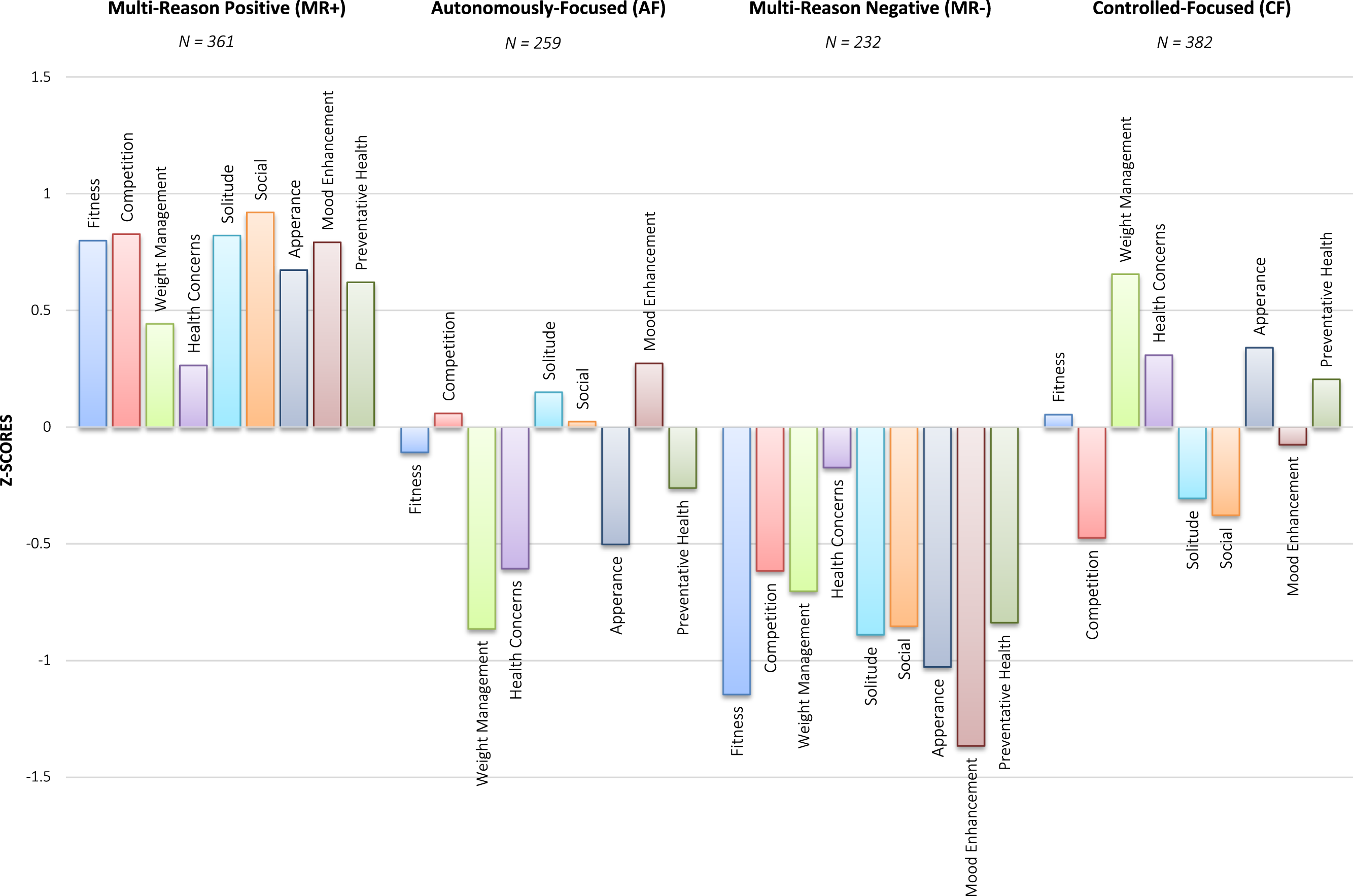
Cluster 1
A “Multi-Reason Positive (MR+)” profile (N = 361) represented 29.2% of the participants due to high scores above the mean on all nine REX-2 subscales with low scores in more control-focused REX-2 subscales (i.e., weight management and health concern reasons).
Cluster 2
An “Autonomous-Focused” profile (N = 259) represented 20.9% of participants characterized with scores slightly above the mean in more autonomous REX-2 subscales (i.e., mood enhancement, solitude, competition, and social reasons) and high scores below the mean in control-focused REX-2 subscales (i.e., weight management, appearance, health concerns, and preventative health). The control-focused REX-2 subscales exhibited lower scores compared to the more autonomous-focused REX-2 subscales.
Cluster 3
A “Multi-Reason Negative (MR−)” profile (N = 232) represented by 18.8% of the participants, which was characterized by low scores below the mean in all nine REX-2 subscales, although not as low in the REX-2 subscale health concern compared to all other REX-2 subscales.
Cluster 4
A “Control-Focused” profile (N = 382) included 30.9% of total participants, which represented the highest scores in the four most control-focused REX-2 subscales (i.e., weight management, appearance, health concerns, and preventative health).
Differences Between Four REX-2 Profiles for Motivation Regulation
MANOVA Results Comparing the REX-2 Profiles for Motivational Regulation and Physical Activity Categories.
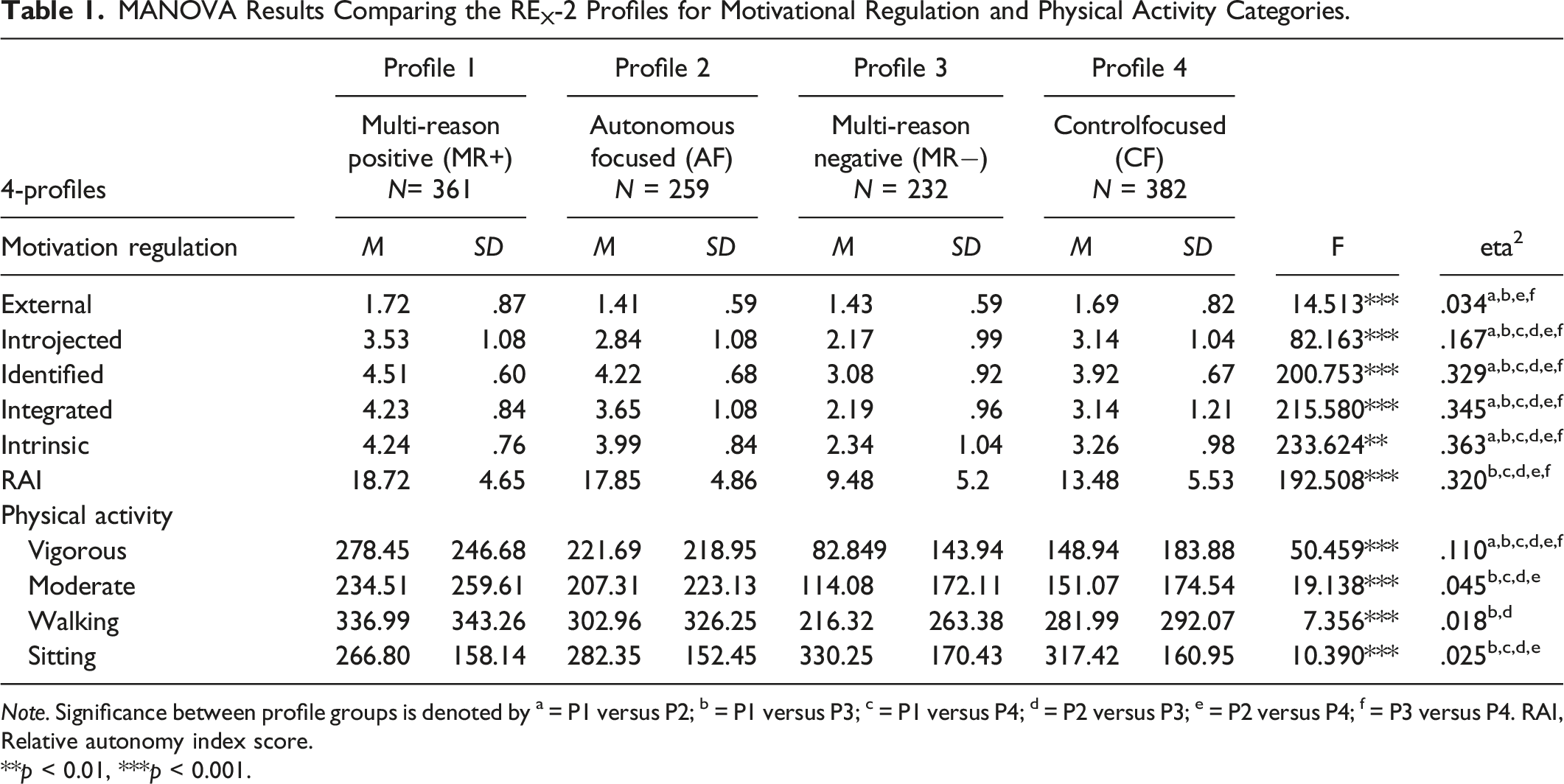
Note. Significance between profile groups is denoted by a = P1 versus P2; b = P1 versus P3; c = P1 versus P4; d = P2 versus P3; e = P2 versus P4; f = P3 versus P4. RAI, Relative autonomy index score.
**p < 0.01, ***p < 0.001.
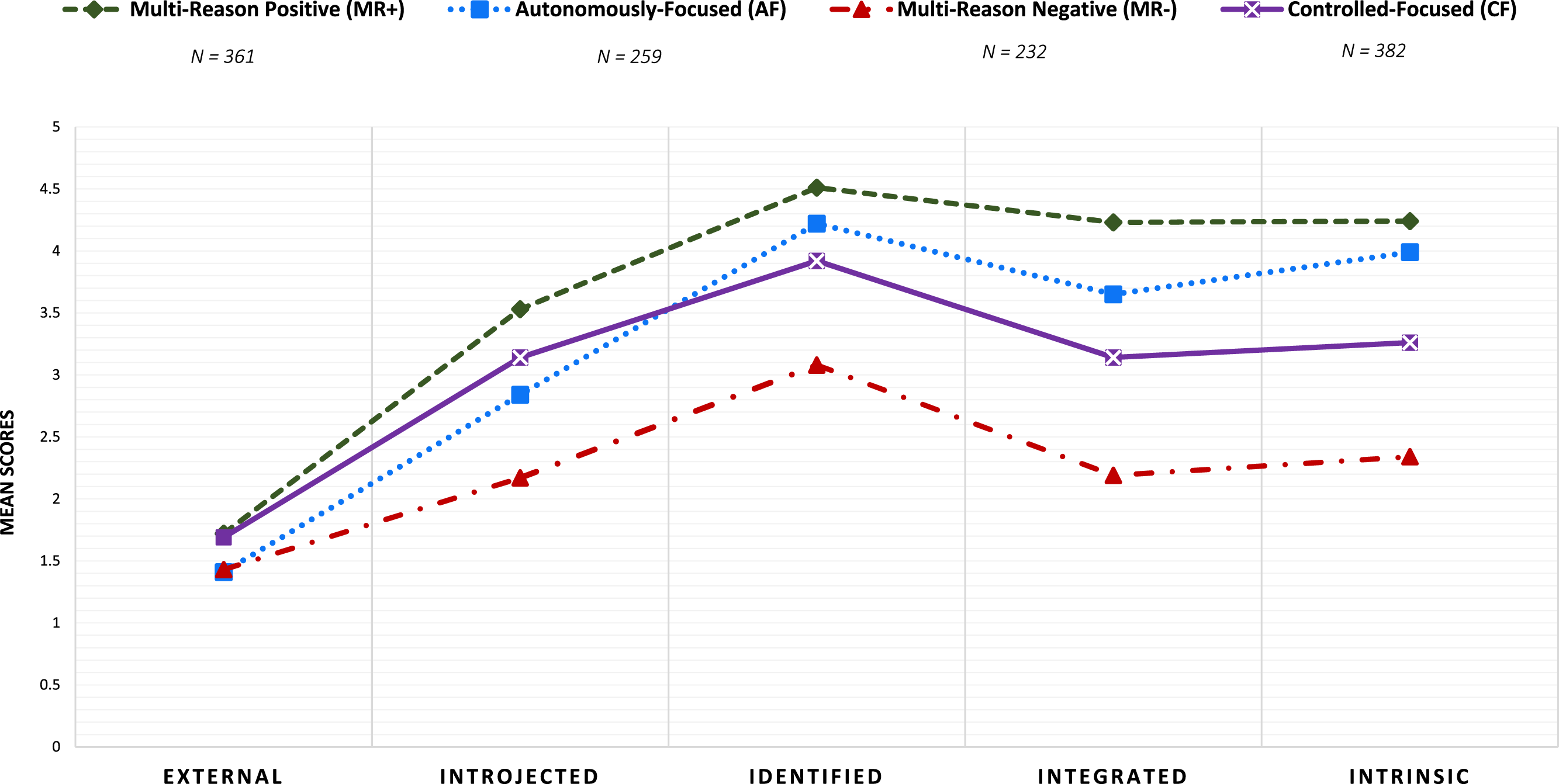
Four profile solution for the Reasons to Exercise (REX-2) subscales and motivation regulation (BREQ-3) subscale scores. Note. The mean average score is based on each subscale in the BREQ-3 scale based on the continuum conception of motivation regulation.
Differences Between REX-2 Profiles for PA Levels
Multivariate analysis of variance results compared PA levels on the four-profile solution and revealed there was a statistically significant multivariate main effect. Follow-up ANOVA results indicated that all levels of PA measures differed across the four cluster groups in total accumulated minutes per week, in vigorous-intensity PA, moderate-intensity PA, walking, and sitting (see Table 1). According to Bonferroni post-hoc tests, Multi-Reason Positive and Autonomous-Focused clusters reported the highest scores for engagement in vigorous and moderate intensity PA compared to the other two clusters. The Multi-Reason Negative cluster represented the lowest amount of time spent in all forms of PA (e.g., vigorous, moderate, and walking) and the highest sitting scores compared to the other clusters (see Figure 3). Compared to Multi-Reason Negative and Control-Focused cluster members, Multi-Reason Positive and Autonomous-Focused clusters reported significantly lower amount of time spent sitting, with Multi-Reason Negative cluster representing the highest sitting scores, and the Multi-Reason Positive cluster reporting the lowest amount of sitting. These results revealed that people who identify multiple reasons as highly important for exercising reported more favorable levels on motivation regulation and PA whereas those with multiple reasons for exercising with lower importance reported less favorable scores. Four profile solution for the Reasons to Exercise (REX-2) subscales and physical activity engagement. Note. PA = Physical Activity Intensity based on the IPAQ; Total scores require duration (in minutes/day) and frequency (days/week) from activities such as sitting, walking, moderate-intensity, and vigorous-intensity activity during the most recent seven-day period.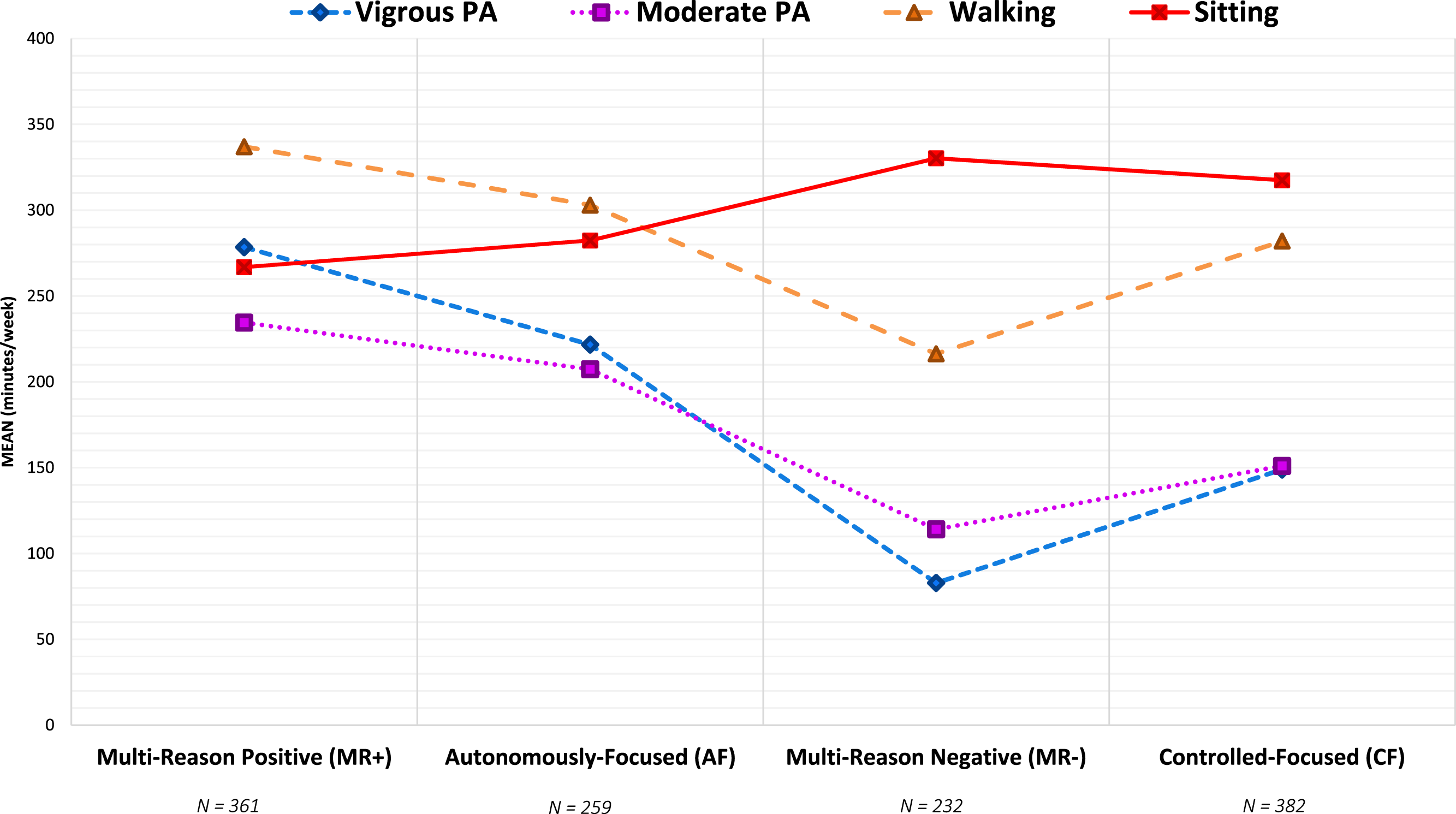
Discussion
The current study utilized cluster analysis to examine the reasons people may have for exercising by exploring naturally occurring profiles in recreationally active adults and examined the utility of this approach for understanding and explaining motivation and PA engagement. The findings from this study further support, yet also expand on research investigating goals, which we refer to as reasons (e.g., informal goals) to understand motivation in the PA context. To expand on previous work, this study utlized cluster analysis to explore the multidimensionality tied to the many reasons people may have for exercising to understand motivation in the PA context. Exploring the multiple reasons that may co-exist for people in their approach to exercising provides valuable information that may help health professionals identify the best approaches to support adaptative strategies to overcome the maladaptive consequences that influence motivation and PA. The present study demonstrated that cluster analysis assisted in identifying groups of individuals based on their reasons for exercising through the emergence of four distinct clusters reflecting the Multi-Reason Positive, Multi-Reason Negative, Autonomous-Focused, and the Control-Focused profile.
For the Autonomous-Focused profile– participants in this cluster identified mood enhancement, solitude, competition, social, and fitness reasons as most important reasons for compared to exercising for fitness, preventative health, appearance, health concerns, and weight management reasons. In comparison to the Autonomous-Focused, the Multi-Reason Positive profile was more advantageous in promoting desirable scores on motivation regulation subscales. For example, the Multi-Reason Positive profile revealed a greater, positive impact on autonomy supportive subscales than the Autonomous-Focused profile. This finding suggests that individuals may be well served by developing multiple reasons for exercise rather than just one, regardless of how autonomous that one reason may be. Additionally, the Multi-Reason Positive profile resulted in more favorable relationships among PA than did the Autonomous-Focused profile. These findings are supported in other work (Chazan et al., 2022; Friederichs et al., 2015; Lindwall et al., 2016; Roberts & Treasure, 2012) highlighting how the number of goals also relate to how one invests their time and energy with the notion that highly valued goals may provide more opportunities to experience success than when people have goals that are not viewed as important, and therefore influence our approach or avoidance to PA. Additionally, adults who have experienced success in reaching a goal has been shown to increase feelings of mastery, perceived competence which are key to sustained motivation. Contrary to this, previous experience related to either goal failure or low success in reaching an exercise goal may lead to maladaptive behaviors that result in avoiding PA or negative regard influencing the meaning behind one’s reason that leads PA avoidance. The findings from this study support other findings that PA-related goals have different psychological meaning for adults, and as a result, differently impact their motivation, and engagement. Because behavior can be better understood by identifying the combination of goals to which that behavior is attached, health professionals and exercisers may benefit from developing ways to inquire about the type of goal one has, experiences of success or failure in such goals, the meaning behind why these goals were selected, and the impact that can be associated with multiple valued reasons.
The Control-Focused profile represented participants that identified extrinsic reasons including weight management, appearance, health concerns, and preventative health, as highly important reasons for exercising compared intrinsic reasons for exercising. A consistent theme attesting to capturing combinations of reasons was demonstrated through the motivation regulation subscales. As expected, extrinsic reasons (i.e., weight management, health concerns, and appearance) were experienced as controlling, whereas intrinsic reasons (i.e., mood enhancement, solitude, social, and fitness) were experienced as being more autonomous, and therefore contributed greatly to the distinctions among the four clusters.
In comparison to the Control-Focused profile, the Multi-Reason Negative profile was more advantageous in promoting desirable scores on motivation regulation subscales. For example, the Control-Focused profile revealed a greater, positive impact on autonomy supportive motivation regulation subscales than the Multi-Reason Negative profile. This finding suggests that individuals may also be well served by developing extrinsic reasons for exercise that are highly and personally important, rather than holding multiple reasons for exercise that may not all be perceived as important.
This study highlights two important results in line with Achievement Goal Theory (Hsu et al., 2022) and Self-Determination Theory (Ryan & Deci, 2017). The first is that a person can have multiple reasons that are both intrinsic/autonomous (e.g., to feel good) and extrinsic/controlled (e.g., to look good) that may lead to more PA engagement. The second is dependent on what the goal means to the person and how much they value the goal, which determines how likely the individual is to personally invest in a physically active lifestyle (Hsu et al., 2022; Maehr & McInerney, 2004; Roberts & Treasure, 2012). For variables expected to promote positive PA, such as individuals exhibiting more intrinsic/autonomous-focused reasons (i.e., Multi-Reason Positive and Autonomous-Focused profiles), results were significant and consistent. For example, in the Multi-Reason Positive and Autonomous-Focused profiles, PA levels were signficantly higher in all PA intensities (i.e., vigorous, moderate, and walking), whereas sedentary behavior (i.e., sitting) was significantly lower compared to profiles exhibiting more extrinsic/control-focused reasons for exercisisng (i.e., Multi-Reason Negative and Control-Focused profiles). These findings support that both the number of valued reasons for exercising and the quality of reason (e.g., autonomous vs. controlled nature of reasons) lead to higher or lower PA engagement. In otherwords, the meaning behind one’s reasons for exercise, or “the why” determines how likely a person is going to engage in a physically active lifestyle (Chazan et al., 2022; Maehr, 1984; Segar et al., 2008).
The emergence of the specific pattern of the four profiles supports previous study findings among adult samples that explore motivation regulation in isolation (Castonguay & Miquelon, 2017; Friederichs et al., 2015; Guerin & Fortier, 2012). With regard to Self-Determination Theory, the findings from this study support that people who identify more intrinsic reasons for exercising have higher scores in autonomy and engaged in higher levels of PA than would extrinsic reasons, which was confirmed in this study. Contrary to previous study findings, one distinct difference from other work was the utilization of Achievement Goal Theory, which suggests embracing multiple goals provides more opportunities to experience success and thereby enhance motivation, compared to fewer valued goals that may attribute to avoiding goal failure. Despite the important implications from this study, the generalizability of the findings can only be made for this sample of participants.
Strengths, Limitation, and Future Directions
The present study has several strengths, limitations, and implications. First, this study illustrated that cluster analysis is a useful method for differentiating between the combination of reasons that people have for exercising as well as PA levels in a large sample of active adults. This approach provides more unique information compared to studies focusing on motivational profiles which categorize individuals as only high or low in autonomous and/or controlling forms of motivation. Rather the results of this study provide additional support for the importance of autonomous and controlling forms of motivation in the context of the reasons people have for being physically active. From this perspective, health professionals should not limit their focus to producing immediate increases in PA behavior in their clients by focusing on autonomous reasons for exercise, but also attempt to increase the overall number of valued reasons one has for exercising.
As with any study, there were limitations in this study. First, limitations exist when conducting research using an online survey associated with ethical procedures and quality of responses (Alessi & Martin, 2010; Buchanan & Hvizdak, 2009; Denissen et al., 2010). To support the ethical standard limitations, the purpose of the study, the benefits, and the types of questions that would be represented, and steps that would be taken to support confidentiality and anonymity, were provided to all potential participants. Second, despite the steps taken to ensure online survey quality, limitations always exist as we could not control the environment where the survey was taken.
Third, the design of the study is cross-sectional, which limits exploration of the longitudinal interplay between the profiles and physical activity behavior. Future longitudinal research designs are recommended. Additionally, a convenience sample was used and therefore, it is not possible to infer causal relationships from the results. Since this is a group of primarily recreationally active adults, inactive adults should be included in the samples of future research to confirm the results herein.
Next, since self-reports were used in this study, objective measures of PA should be used in the future when assessing the same variables. Lastly, it must be emphasized that the subscales utilized in the REX-2 Scale are the reasons recreationally active adults have for exercising and/or being physically active. Therefore, whether the reason identified in the REX-2 are the same reasons non-physically active adults would report is unknown. Moreover, such research would offer an opportunity to inspect whether the four profiles that resulted in the present study are replicable (Zhong & Wang, 2019). Finally, self-reported PA measurement was adopted by the IPAQ. Despite that the IPAQ has been proved to be reliable tool used widely (Craig et al., 2003), it is subjective and suffers from recall biases.
Conclusion and Practical Implications
Motivation plays a fundamental role in shaping PA behaviors as it influences how and why individuals engage in activities, affecting the quality of their engagement and ultimately their adherence (Ryan & Deci, 2017). Understanding the reasons that people engage in physical activity may be an important part of motivation and critical to the promotion of engagement and persistence in physical activities. Particpants from this study that identified reasons for exercising related to enhancing their mood, for the solitude, or for socializing with others through activity or competion were more likely to exhibit positive physical activity behaviors. The findings from this study also support that both the number of valued reasons for exercising and the quality of reasons (e.g., autonomous vs. controlled nature of reasons) are important and both associated with different levels of physical activity engagement. More specifially, greater motivation quality (i.e., higher levels of autonomy) and higher levels of PA were exhibited in adults from this study endorsing both intrisnic (e.g., to feel good) and extrisnic (e.g., to look good) reasons for exercise than profiles with intrinsic reasons only, as long as they deemed them as being personally important to them. The findings in this study have important implications for theories of motivation because it indicates that the directive focus of goals (i.e., contents) and the dynamic process underlying goals (i.e., motives) each makes a difference in people’s lives and the physical activity context. Because behavior can be better understood by identifying the goal to which that behavior is attached, health professionals may be more likely to facilitate long-term PA participation in adults by considering the type of goal activated, the value of the goal, the meaning of the goal in efforts to engage in PA, and the coordination of the goal with other goals.
Supplemental Material
Supplemental Material – Profiling Physical Activity Motivation Based on Reasons for Exercise: A Cluster Analysis Approach
Supplemental Material for Profiling Physical Activity Motivation Based on Reasons for Exercise: A Cluster Analysis Approach by Vanessa M. Kercher, Damon Burton, Michael A. Pickering, and Kyle Kercher in Psychological Reports
Footnotes
Acknowledgements
We thank Dr. Stoll (University of Idaho), Dr. Baker (University of Idaho), and Dr. Silvers (Whitworth University) for their guidance and support of the work done in this study. We thank Dr. Brad Roy (Kalispell Regional Medical Center) for permitting participant recruitment in a certified medical fitness center (The Summit Medical Fitness Center) for the purposes of this project. We also thank Dr. Amanda Start and William DeViney for assisting in the data collection.
Declaration of Conflicting Interests
The author(s) declared no potential conflicts of interest with respect to the research, authorship, and/or publication of this article.
Funding
The author(s) received no financial support for the research, authorship, and/or publication of this article.
Ethical Approval
Adults of at least 18 years of age were eligible to participate in the survey study. Participation was voluntary and confidential. Informed written consent was obtained from all participants who volunteered to participate in the survey study. All protocols for recruitment and participation were reviewed and approved by the University of Idaho’s Institutional Review Board (IRB # 15-962) and the Kalispell Regional Medical Center Institutional Review Board.

Supplemental Material
Supplemental material for this article is available online.
Author Biographies
References
Supplementary Material
Please find the following supplemental material available below.
For Open Access articles published under a Creative Commons License, all supplemental material carries the same license as the article it is associated with.
For non-Open Access articles published, all supplemental material carries a non-exclusive license, and permission requests for re-use of supplemental material or any part of supplemental material shall be sent directly to the copyright owner as specified in the copyright notice associated with the article.
