




Abstract
Research into the effects of mindfulness meditation on behavioral outcomes has received much interest in recent years, with benefits for both short-term memory and working memory identified. However, little research has considered the potential effects of brief mindfulness meditation interventions or the nature of any benefits for visual short-term memory. Here, we investigate the effect of a single, 8-minute mindfulness meditation intervention, presented via audio recording, on a short-term memory task for faces. In comparison with two control groups (listening to an audiobook or simply passing the time however they wished), our mindfulness meditation participants showed greater increases in visual short-term memory capacity from pre- to post-intervention. In addition, only mindfulness meditation resulted in significant increases in performance. In conclusion, a single, brief mindfulness meditation intervention led to improvements in visual short-term memory capacity for faces, with important implications regarding the minimum intervention necessary to produce measurable changes in short-term memory tasks.
Introduction
Working memory (WM) is a multicomponent system, bringing together short-term memory (STM) and attention (Cowan, 2016), and has a limited capacity, varying between individuals (Ortells et al., 2016). Having a particularly low or high capacity can affect people in many different ways, impacting daily life (Richmond et al., 2015).
Low WM capacity has been linked to inattentive behavior, which can increase the difficulty of everyday tasks and activities requiring sustained attention (Kofler et al., 2017; Zhang et al., 2018), while STM capacity may, for example, explain individual differences in learning (Frensch & Miner, 1994), mathematical performance (Swanson & Kim, 2007), and reading comprehension (Haarmann et al., 2003). Specific courses designed to improve WM have been implemented using different techniques and with varying levels of success (Klingberg et al., 2002; for a review, see Morrison & Chein, 2011). Methods targeting the improvement of STM specifically have included rehearsal (Broadley et al., 1994), visual imagery (de la Iglesia et al., 2005), creating stories from the information to be remembered (McNamara & Scott, 2001), and grouping of the items into conceptual categories (Carr & Schneider, 1991).
One promising avenue for improvement has been the introduction of mindfulness meditation (MM), gaining popularity in recent years and triggering substantial research (Keng et al., 2011). Mindfulness-based interventions have become common, owing to their affordability, ease of learning, and growing evidential support for benefits in mental health and cognitive function (Davis & Hayes, 2011). The term MM can describe several practices and states, with the main goal of reaching a state of awareness that maintains attention in the present moment (e.g., on changing sensory and mental states) while avoiding the intrusion of outside factors (Baltar & Filgueiras, 2018).
Chambers et al. (2008) assessed individuals after they had attended a 10-day MM camp, finding that WM capacity (specifically, backward digit memory span) had improved. Indeed, several studies have recently demonstrated similar improvements on various measures of WM, including the adaptive n-back task and operation span, although no improvements in STM (e.g., forward digit span) were found (e.g., Mrazek et al., 2013; Zeidan et al., 2010). In contrast, Lykins et al. (2012) found no improvements in WM (letter-number sequencing; Wechsler, 1997) while identifying group differences (experienced meditators vs. controls) in measures of STM (both short delay free and cued recall; Delis et al., 1987).
While studies appear to have demonstrated relationships between MM and improved WM and STM capacities, the length of the MM intervention involved has been variable, ranging from one to eight weeks. Shorter intervention periods are generally preferred to longer ones due to their ease and convenience (Bergen-Cico et al., 2013). However, there are some cases in which brief interventions have been shown to be marginally less effective than longer ones (Basso et al., 2019). In terms of implementation, there is a clear demand for research surrounding the effectiveness of MM in even shorter sessions, such as a single sitting (Chiesa et al., 2011). It is also worth noting that the motivation to practice MM can decrease over time and across sessions (Hafenbrack & Vohs, 2018). As such, the main aim of our study was to investigate whether a single, brief session of MM could lead to a measurable improvement in STM capacity.
There are many ways to study the impact of MM on STM capacity, and the specific task used to quantify STM can vary. With previous research involving STM capacity focusing on verbal paradigms (e.g., Lykins et al., 2012), the effects of MM on visual STM have yet to be investigated, which is perhaps surprising since this can be assessed reliably and is critical for the online use of visual information. One method of testing visual STM is through a delayed nonmatching-to-sample paradigm, where participants are tasked with distinguishing between previously seen items and a novel item (e.g., using faces—Crook & Larrabee, 1992). As such, identification of the novel item requires that previously seen items are maintained in STM.
There are many explanations as to why MM improves memory, with the most widely accepted explanation being through a reduction of anxiety. For instance, Eysenck et al. (2007) suggested that the attentional control aspect of the central executive is impaired by anxiety. Specifically, the inhibition function of the central executive can no longer effectively redirect attention away from task irrelevant stimuli. This, in turn, means that people find difficulty in completing tasks that require sustained attention as they become distracted. A link between attentional control and memory has been established as a result of this, due to the completion of memory tasks requiring effective attentional control in order to maintain attention to goal-relevant information (Shipstead et al., 2014).
Researchers have suggested that attention and memory processes are closely related forms of cognitive control, with both likely to be influenced by MM (Jha et al., 2010). Furthermore, both short- and long-term memory are largely dependent on present-moment direction of attention (Cowan, 1997). Therefore, in line with previous work (Lykins et al., 2012), it is important to determine whether MM can improve performance on STM tasks. In the current study, we utilize a single, brief MM intervention, lasting only a few minutes. In addition, we focus on visual STM specifically, given the lack of previous research investigating this particular domain.
Method
Participants
A total of 90 undergraduate students (age range, 18–25 years; 61 women; 83 self-reported as White) participated in exchange for course credits. Data from one additional participant were excluded due to a failure to complete all the tasks. Sample size (N = 30 per group) was chosen to be comparable with previous research in this area (for a systematic review, see Chiesa et al., 2011).
The university’s research ethics committee approved the experiment presented here, which was carried out in accordance with the provisions of the World Medical Association Declaration of Helsinki. Participants provided written informed consent before taking part and were given both a written and verbal debriefing upon completion.
Materials
Participants completed two measures of mindfulness during everyday life. The Mindfulness Attention Awareness Scale (MAAS; Brown & Ryan, 2003) consists of 15 items that are rated on a 6-point Likert-type scale from 1 (almost always) to 6 (almost never), where the mean rating across all items represents the final score, with higher scores reflecting greater mindfulness. The Five-Factor Mindfulness Questionnaire (FFMQ; Baer et al., 2006) consists of 39 items that are rated on a 5-point Likert-type scale from 1 (never or very rarely true) to 5 (very often or always true). Mean ratings (after reverse scoring specific items) are calculated for each of five facets: observing, describing, acting with awareness, nonjudging of inner experience, and nonreactivity to inner experience. Again, higher scores reflect greater mindfulness.
Given that the FFMQ is derived from a factor analysis of several questionnaires including the MAAS, we would predict at least some correlation between participants’ scores on these instruments. However, since such relationships are far from perfect (Baer et al., 2006) and both measures remain popular, we decided to include both questionnaires in the current study.
In the listening task, participants in the audiobook group listened to the beginning of “The Hobbit” (Tolkien, 2005). Those in the meditation group listened to a “mindfulness of body and breath” exercise (Williams & Penman, 2011) designed to focus their attention on the movement of the breath in the body. We selected an audiobook for comparison since it requires a similar amount of attention and concentration to the meditation task, although the focus of attention in the two tasks was necessarily, and importantly, different. Both of these audio segments have featured in previous research (e.g., Kramer et al., 2013). Finally, for the control group, participants were simply asked to sit quietly and fill their time however they wished. (In the majority of cases, this involved the use of personal smartphones.) The audio recordings were presented using closed-back headphones.
For the face memory task, 450 images of White faces (225 women) were downloaded from an online database (www.facity.com), which contained around 2000 high-quality photographs of faces, taken front-on and with neutral expressions, hair pulled back, and minimal make-up. We selected only faces with no jewellery and who were aged approximately 18 to 40 (year of birth was available in the majority of cases). Images were already cropped below the hairline, and we additionally cropped them just below the chin, and close to the sides of the faces, using Adobe Photoshop CS software.
Procedure
Participants were tested individually in a quiet laboratory room, first completing both questionnaires, along with demographic information. Following this, participants performed a face memory task adapted from previous work (Crook & Larrabee, 1992), presented on a desktop computer using custom MATLAB software. On each trial, a single facial photograph was initially displayed onscreen, which the participant was instructed to select with the mouse. Next, this face and a second face appeared onscreen, and the participant was required to select the new face. If the correct response was given, this process would continue, each time introducing a new face, until a maximum of 45 faces were displayed (see Figure 1). Within each trial, all faces were of the same sex. Trials terminated when an incorrect response was given, and the number of correct responses was recorded. Importantly, after every response, the new display of faces was randomized with respect to spatial position onscreen, meaning that participants could not use location information to inform their decisions. Participants completed five trials in the first session, with the sex of faces alternating across trials. No face appeared in more than one trial.
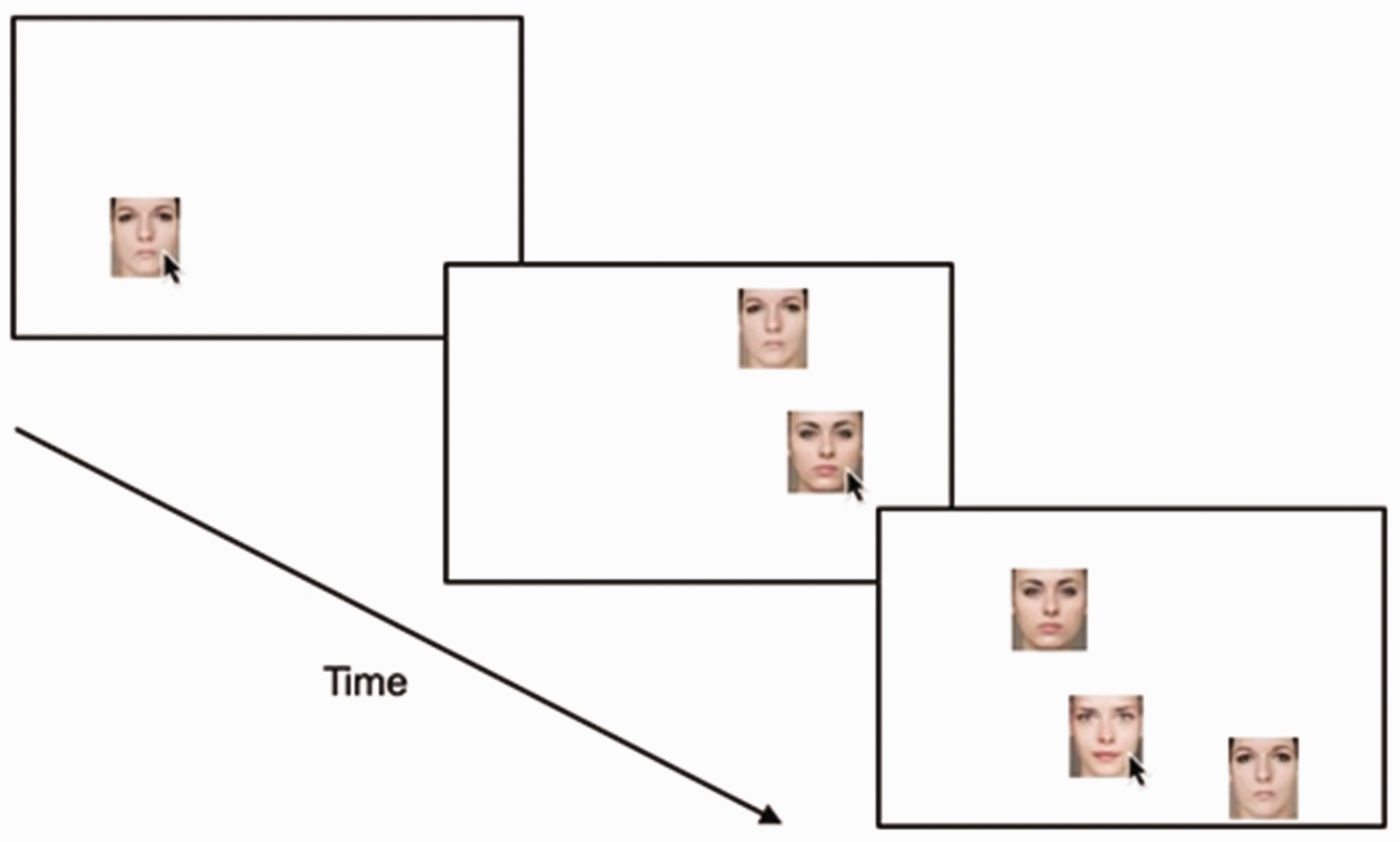
Illustration depicting the face memory task. In this example trial, the participant responds correctly to the first three displays. (Images not to scale.)
Upon completion, participants were randomly allocated to one of three groups. Those in the audiobook (11 men and 19 women) and meditation (12 men and 18 women) groups then listened to an 8-minute audio recording with instructions to follow along as best they could and to inform the experimenter when it finished. Those in the meditation group were presented with a breathing exercise, while those in the audiobook group listened to a neutral recording. Participants in the control group (6 men and 24 women) were instructed to fill their time however they wished and were given 8 minutes for this task. In all cases, the experimenter remained in the room but did not interact with the participant. The assignment of participants to groups was randomized.
After the listening/control task, participants completed the face memory task again (second session). The procedure was identical to earlier although only face images that had not appeared in the first session were presented.
Results
Preliminary analyses
Participants’ scores on the MAAS and FFMQ were calculated, and the associations between these measures are summarized in Table 1. As expected, we found some significant overlap between the two questionnaires as well as among the five facets of the FFMQ. Most notably, we found a large positive relationship between scores on the MAAS and the “acting with awareness” facet of the FFMQ.
Correlations between questionnaire measures.
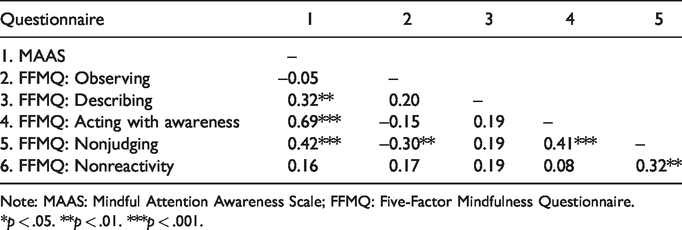
Note: MAAS: Mindful Attention Awareness Scale; FFMQ: Five-Factor Mindfulness Questionnaire.
*p < .05. **p < .01. ***p < .001.
In addition, we compared participants across the three groups. We found no group differences in FFMQ Describing scores, FFMQ Nonjudging scores, and FFMQ Nonreactivity scores (in all cases, F < 2.64, p > .077,
However, we found a significant difference in MAAS scores, F(2, 87) = 4.28, p = .017,
In two of these results, group differences suggested higher baseline mindfulness in the control than in the audiobook participants, which had no bearing on the hypothesized benefit of our mindfulness task over the other two groups. However, we also found that participants in the meditation group scored higher on baseline FFMQ Observing in comparison with control participants prior to any listening task. Perhaps reassuringly, this difference comprised only 0.48 on a 1 to 5 scale, and we found no difference between the meditation and audiobook groups. As such, we could be confident that any benefit for the MM group during the listening task was not the result of baseline differences between the three groups. In addition, we included these scores as covariates in our analyses (see below).
Improvements in face memory
For each participant, we calculated the mean score across the five trials of the memory task for each session separately. We then calculated the difference between sessions (second minus first), providing us with a measure of the improvement due to the listening (or control) task. The difference scores were then analyzed as follows.
Initial consideration of the difference scores revealed nine data points (meditation group–1; audiobook group–4; control group–4) that were classified as outliers (identified using boxplots produced with IBM’s SPSS Statistics software v25), defined as values further than 1.5 times the interquartile range from the nearer edge of that range. It is worth noting that four of these outliers showed extreme negative difference scores while the remaining five demonstrated extreme positive differences, suggesting no particular pattern of performance across this subsample. As a result of identifying these outliers, we decided to carry out two types of analyses on our data.
Parametric analysis: One-way ANOVA
Since both the group means and variances are sensitive to outliers, their presence violates the assumptions of an analysis of variance (ANOVA) by reducing the validity of the results. We therefore excluded the above-mentioned nine data points and then carried out a one-way (Group: control, audiobook, meditation) between-subjects ANOVA. We found a main effect of group, F(2, 78) = 9.83, p < .001,
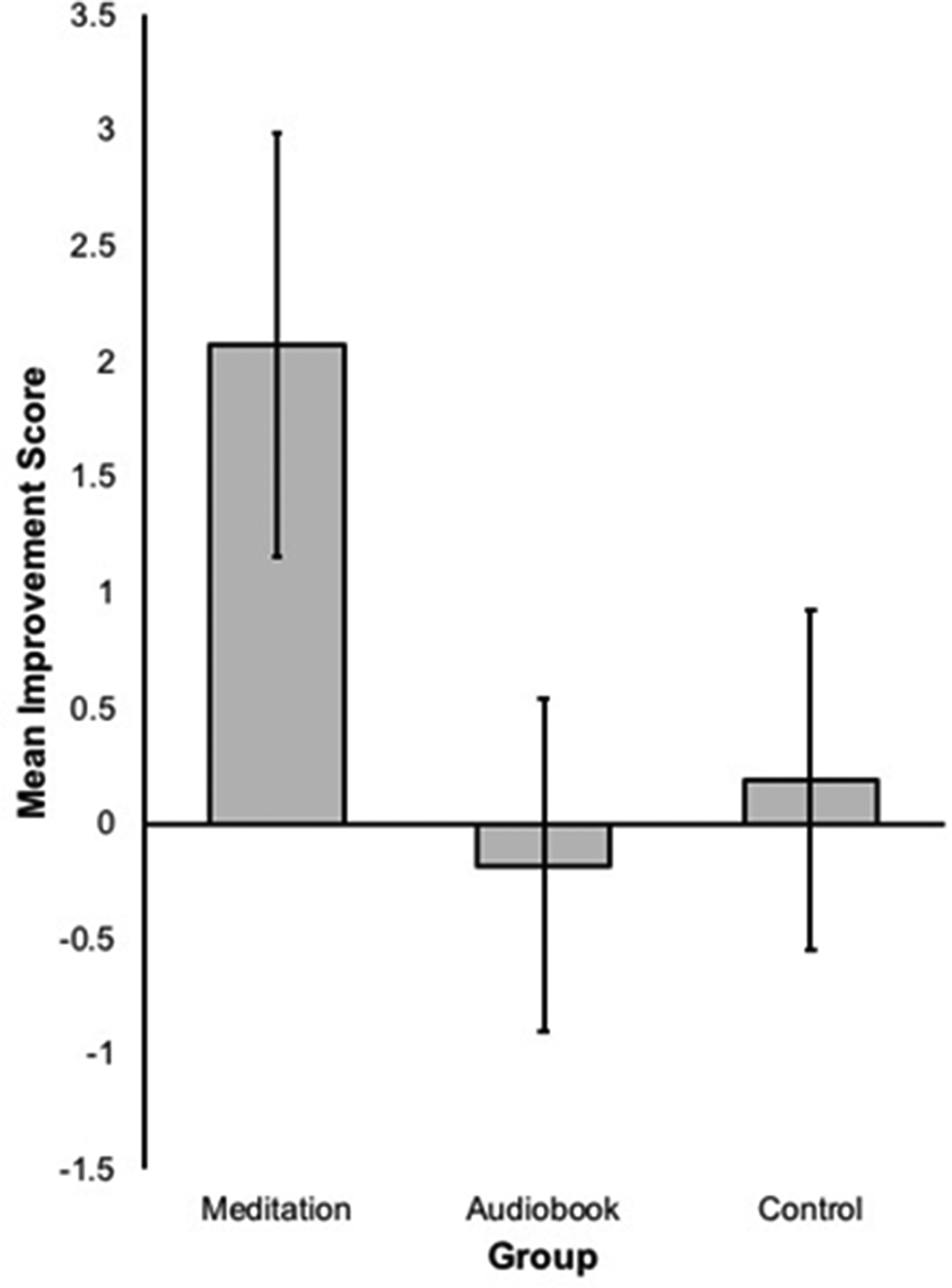
Mean improvement scores for the three groups. Error bars represent 95% confidence intervals.
In addition, we compared mean improvement scores to a value of zero for each group separately. For the meditation group, we found a nonzero improvement, t(28) = 4.63, p < .001, Cohen’s d = 0.86. In contrast, improvements did not differ from zero for both the audiobook group, t(25) = 0.53, p = .603, Cohen’s d = 0.10, and control group, t(25) = 0.52, p = .609, Cohen’s d = 0.10.
Our preliminary analyses revealed significant differences between participants across our three groups with regard to three of their questionnaire scores: MAAS, FFMQ Observing, and FFMQ Acting with Awareness. As such, we repeated the above analysis while including these three scores as covariates. Again, we found a main effect of group, F(2, 75) = 10.66, p < .001,
Nonparametric analysis: Kruskal–Wallis test
We also carried out a nonparametric equivalent of the above analysis, allowing us to include all data points since ranked data are far less sensitive to outliers. The Kruskal–Wallis test found a significant difference between groups, H(2) = 7.74, p = .022. 1 Follow-up comparisons using Mann–Whitney tests 2 showed larger difference ranks for participants in the meditation group in comparison with those in the audiobook group, U = 285.50, z = 2.43, p = .015, r = 0.31. In addition, those in the meditation group also showed higher difference ranks than those in the control group, U = 294.50, z = 2.30, p = .020, r = 0.30. These latter two groups did not differ from each other, U = 406.50, z = 0.64, p = .525, r = 0.08.
Discussion
The goal of this research was to investigate whether a single, brief MM intervention could improve STM capacity. Our results demonstrated a significant improvement in visual STM for our MM group. In contrast, those who listened to an audiobook or filled their time however they wished failed to show an improvement. The increase in performance on the face memory task as a result of MM extends previous research demonstrating that MM can improve various components of STM (Lykins et al., 2012).
That an 8-minute MM intervention was effective is an important result, building upon earlier research showing that MM sessions as brief as 10 minutes can improve attentional control and reduce psychological stress (Norris et al., 2018), two aspects considered important in WM performance (Kane et al., 2001; Schoofs et al., 2008). Our results are also consistent with research showing that time spent on a MM task may not be correlated with the strength of subsequent improvements, suggesting that the majority of MM benefits may occur early on in one’s practice (Carmody & Baer, 2009).
One explanation as to why MM might improve STM capacity is that during task performance, part of STM is occupied by task-irrelevant information. MM could then improve (relevant) STM capacity by reducing this information, freeing up cognitive resources to be put to work on the task at hand. Previous research has shown that anxiety can inhibit central executive processes (Berggren et al., 2016; Park et al., 2016), and with MM reducing anxiety (Hoge et al., 2014), this could provide a potential mechanism through which MM can improve STM. In addition, MM encourages the acceptance, rather than avoidance, of thoughts and emotions as they pass through awareness. Evidence suggests that MM improves the acceptance of emotional states, resulting in greater executive control (Teper & Inzlicht, 2013; for a review, see Malinowski, 2013). Again, this may be why our MM participants showed increases in visual STM in the current experiment. However, we acknowledge that the specific mechanism through which MM affects STM has yet to be identified.
Here, for practical reasons, we presented an audio recording for our MM intervention rather than a face-to-face session. Along similar lines, recent evidence has suggested that participants can benefit from completing their own MM practices via the use of a smartphone application (Walsh et al., 2019), representing the possibility that a greater proportion of the population might benefit from access to MM through solo practice. If further research supports this idea, more people might be willing to incorporate MM into their daily routines if additional costs and time constraints, typically associated with organized classes and sessions, are not required.
To conclude, this study demonstrates that a single, brief MM intervention improves performance on a STM task. Our focus on visual STM, as well as the use of only minimal MM with our participants, represents important extensions to the literature with regard to measurable effects that MM has on behavioral outcomes.
Footnotes
Author Biographies
Declaration of Conflicting Interests
The author(s) declared no potential conflicts of interest with respect to the research, authorship, and/or publication of this article.
Funding
The author(s) received no financial support for the research, authorship, and/or publication of this article.
