



Abstract
Presenting a world-first data set of 2,831 constitutive organizations of history's largest far-right interorganizational network, this article presents a new explanation for far-right normalization: organizational diffusion. Providing, for the first time, empirical evidence of the large network characteristics of the Indian far right, this article paints a picture of what this network actually looks like, how far it has spread, and what explains its success. In doing so, this explanation unearths a far-right strategy of covert civil society expansion that has largely evaded the party-focused extant study of global far-right electoral mobilization. Identifying this strategy of organizational diffusion, this article argues that it produces three effects that produce broad, flexible, and durable mobilizations: segmented representation, reputational control, and leadership accommodation. Organizational diffusion, present in far-right mobilizations as diverse as Ma Ba Tha, Nippon Kaigi, and the Thai military, presents an important far-right mobilizing tool that exhorts scholars to refocus on covert civil society expansion as a key mechanism of far-right normalization.
Seeking to explain varying measures of far-right success, traditionally revolving around electoral outcomes, scholars propose a kaleidoscopic diversity of reasons for why the far right wins, when it does. However, a growing scholarship rejects an electoral focus in favor of the normalization of far-right organizations, networks, and ideas as the measure of far-right success. Arguing that far-right electoral success is predicated on far-right normalization, 1 that electoral loss does not mean the far right stops mobilizing, 2 and that electoral success is not the primary aim of every far-right mobilization, 3 there are increasing calls to center normalization as a key measure of far-right success. 4
Far-right success—by which I mean the normalization of far-right claims-making—is traditionally explained by exogenous factors. Scholars have explained far-right normalization by pointing to the collapse of dominant political systems; 5 cultural backlash against the ambivalences of globalization and liberalization; 6 international crises like large movements of refugees that present discursive opportunities for far-right actors; 7 and the durability of systemic bigotry. 8 Alternatively, external actors like the media, elites, or mainstream parties making far-right concessions to remain competitive become explanatory variables for far-right success. 9
However, prioritizing exogenous explanations suggests that the most significant feature of far-right activity are their ideas—to which societies may be more or less receptive—and reifies the internal operational workings of far-right mobilizations as unknowable or irrelevant. 10 Reasons for far-right failure—particularly electoral—are often described as endogenous, 11 but I take as my starting point that these endogenous explanations are critical to explain success as well. 12
In this article, presenting a world-first data set of 2,831 constituent organizations of the world's largest far-right network, I propose one explanation for far-right success: a far-right organizational network strategy that I refer to as organizational diffusion. I define organizational diffusion as the strategic creation of a large number of proxy civil society organizations through which central network executives can covertly organize sophisticated divisions of labor. These elaborate, but covert, divisions of labor ensure far-right presence in many sectors simultaneously; reaching more diverse audiences, opening opportunities for constituency expansion, and creating the false public image of ostensibly independent organizations organically seeking the same goals in coalition. This sense of broad organic coalition facilitates claims to a popular mandate that are critical to normalization processes. In proposing this explanation, I examine the case of the Indian far right, perhaps the world's most successful far-right mobilization. By the Indian far right, I mean the network of organizations—that I refer to collectively as the Sangh—that emerge from, and are accountable to, the Rashtriya Swayamsevak Sangh (National Volunteer Corps, RSS). 13
The core of this network is uncontroversially considered a key global far-right mobilization that operates around the central nativist and authoritarian tendencies of, an often violent, Hindu nationalism. 14 The Sangh demonstrates high levels of far-right success in a variety of measures. Organizationally, it has proved exceptionally durable and resilient to schism, allowing it to spread into an unparalleled diversity of sectors. This century-old network includes the world's largest labor union, student union, and the world's largest—and one of its richest—political parties; the Bharatiya Janata Party (Indian People's Party, BJP). In terms of electoral success—a key symptom of normalization—this network has been winning elections since 1990, has produced forty-nine state governments and has ruled since 2014 decisively at a federal level over roughly 18 percent of the world's population. However, it is in the vocabulary of normalization where the Sangh finds perhaps its greatest successes. The Sangh's vast service provision apparatus, ideological proselytization campaigns, as well as its international and corporate funding models have earned it widespread legitimacy both domestically and overseas. 15 If far-right success is measured through normalization, the Sangh has unequivocally succeeded to the extent that far-right politics in India is no longer contentious politics, but is now the language of governance, civil society, and the judiciary. 16 While significant resistance pushes back on this normalization, 17 there are few national alternatives electorally, opposition parties strategically mimic Hindu nationalist vocabularies, dissent is violently repressed, and the ideological assumptions of the Indian far right have diffused far beyond the Sangh, shaping the broader public sphere. 18 Such a durable achievement—which pre-dates the BJP's electoral victory in 2014—in the world's largest democracy marks the Sangh as the critical case of success to be explained in the study of the global far right.
In this article, I argue that a far-right strategy of networked organizational diffusion produces three political effects that make far-right networks more expansive, more flexible, and more durable. These three effects in turn produce normalization by reaching broader audiences, recruiting from nontraditional support bases, and ensuring a sustained presence in the public sphere. The first effect I describe is—to borrow Luna's terminology—one of segmented representation. 19 By producing large numbers of proxy organizations in many different (largely civil society) sectors, far-right networks can simultaneously appeal to multiple audiences; saying all things, at all times, to all people; greatly expanding their constituencies and resource bases into otherwise mutually exclusive audiences. The second effect is one of reputational control. Through what I describe as a switchboard mechanism, the production of diffuse interorganizational networks allows for the episodic obfuscation and revelation of interorganizational ties, enabling far-right actors to strategically distance themselves from violence and illicit activities in their networks, while also taking collective responsibility for legitimizing activities like charity or service provision. The final effect is one of leadership accommodation, in which the creation of large numbers of organizations in a network allows for the diffusion of leadership positions that far-right network executives can offer to internal challengers to pacify potential leadership disputes.
This article offers three main contributions: the presentation of a world-first data set of the constituent organizations of history's largest far-right network, an explanation for the largest and most critical case of global far-right success, and the theoretical proposal of organizational diffusion as one endogenous explanation for the success of far-right networks. That the Sangh has a vast network of organizational appendages is widely known. 20 We also know that this network has extended well beyond a central limited interorganizational family, and that this organizational spread has been critical in normalizing the Sangh. 21 However, we do not know how, why, or to what extent this network has spread, a critical question given that this spread has been strongly associated with Sangh normalization. 22 Using this data set that maps, for the first time, large parts of the interorganizational network of the largest far-right mobilization in history, this article attempts to answer these questions.
Civil society has not featured heavily as an investigative focus in the scholarship on far-right networks 23 —instead largely operating as an explanatory variable for Western European (or more recently Global South) populist radical right political party success. 24 Some scholarship discussing movement parties seeks to incorporate nonelectoral mobilization into the study of far-right success. 25 These analyses still center parties in far-right mobilization, likely missing those elements of civil society organizing only indirectly tied to electoral contestation.
I begin this article with an outline of my concept of organizational diffusion, moving on to explain how it is different from other patterns of far-right expansion, before touching on key theoretical and methodological issues of studying far-right interorganizational networks. Following this theoretical review, I detail the methodology I used to trace organizational diffusion in the Sangh and suggest that there are some key differences with traditional network mapping methods. I then offer a descriptive statistical analysis of the Sangh network, demonstrating that the Sangh pursues a strategy of organizational diffusion. Finally, I outline the three effects that this strategy has that enables Sangh normalization, that is, success.
Organizational Diffusion
Organizational diffusion is the intentional creation of large numbers of proxy organizations through which a central network executive, exercising authority clandestinely, can produce sophisticated divisions of labor. The networks created through organizational diffusion are covert networks; however, they differ from typical covert networks in that it is the ties between organizations, rather than the organizations themselves, that are primarily concealed. For organicist, and aspirationally hegemonic mobilizations like the Sangh, 26 the appearance of many supposedly independent organizations working for the same ideological goals produces an informational effect that lends credence to the image of a national upsurge of ideological consensus.
Organizational diffusion is not simply network expansion. Organizational diffusion departs from common patterns of network expansion in that its networks expand by nodes founding their own subsidiary organizations, not by building coalitions with existing organizations. 27 Within organizationally diffused networks, founded organizations are encouraged to, in turn, found their own subsidiary organizations, so that the network becomes a snowballed self-sustaining expansionist one, in which peripheral organizations’ ties to the center are mediated through, often multiple, bridging nodes (organizations that connect different clusters of organizations who would otherwise not be well connected). It is this mediation that offers the most significant strategic opportunities to these networks, which I will discuss in detail below.
That this expansion is strategic, considered, and intentional is visible in much of the literature produced by the Sangh. In one Ekal Vidyalaya textbook,
28
the author writes that the aim of the Sangh is to expand so extensively that each and every individual and traditional social institution like family, caste, profession, educational and religious institutions are all to be ultimately engulfed into this system. The goal before the Sangh is to have an organized Hindu society in which all its constituents and institutions function in harmony and coordination, just as in the body organs.
29
Organizational diffusion further departs from simple network expansion in that the expansion it facilitates produces network structural characteristics that in and of themselves are valuable to a network beyond simple expansion. So, for example, the fact that many Hindu nationalist organizations commit violence is less remarkable than that most of these organizations exist in a mediated organizational relationship with the RSS. The RSS could, as a violent mass organization with a purportedly devoted cadre, commit violence on its own, but the fact that the central Sangh outsources its violence to peripheral organizations suggests that for the RSS, there is a strategic value in having others commit violence. What becomes important is the distance from and mediation of links to violent actors enabled by organizational diffusion.
This strategy is only possible when its center of network gravity is located within civil society. It is not feasible to create a vast network of nominally separate but centrally accountable political parties. Nor is it feasible to create violent militias on the scale required to achieve the benefits of organizational diffusion. We may expect then to see organizationally diffused networks in places where the far right cannot, or need not, primarily contest electorally or organize paramilitarily.
In this article, I am arguing that organizational diffusion has been key to the success of this network: the Sangh. This is not to say that it is an explanatory factor for every far-right mobilization. Still, organizational diffusion represents a set of processes largely unattended to in the literature on global far-right network expansion. This omission is curious considering that it goes far to explain the success of the world's largest, richest, and most successful far-right network.
There is much scholarship discussing the importance of civil society—specifically of service provision organizations—in the consolidation of terrorist, and Islamist, movements. 30 However, I extend this knowledge by consolidating its use in the study of the far right. With notable exceptions, 31 this knowledge in social movement studies and security studies has not effectively translated into a research agenda examining the role of extended far-right civil society networks. This becomes critical when we know that service provision is an important tool for harvesting far-right support, 32 but less than half of the network of the Sangh, as I will demonstrate, is devoted to service provision. What does the rest of the Sangh's civil society do? Organizational diffusion extends existing knowledge of civil society networks by refocusing on what the effects of these networks are. Existing scholarship broadly suggests that civil society networks of service providers in political mobilizations gain support by offering services that others do not, offer club goods to a select group to consolidate sectarian support, or seek to undermine government legitimacy. 33 I extend this by suggesting it is not just service provision but the structure of the network in which it occurs that determines its benefits to a political mobilization. For example, it is not the provision of services by a Sangh organization itself that produces the desired effects (e.g., votes for the BJP), but rather these effects are produced by the fact that the organization exists in a mediated relationship within the Sangh network that shapes how gratitude for service provision can transform into reputational capital for the BJP.
Existing explanations for the success of the Sangh almost entirely revolve around the BJP. These explanations prioritize a political process model of collapsing Congress party hegemony, 34 legitimation of Sangh resistance work during the Emergency, 35 and the proliferation of Sangh small service providers, proselytizing for the Sangh. 36 However, these explanations struggle to account for how the Sangh was able to take advantage of these opportunities as they arose. So instead, we turn to endogenous explanations that are important, but which are usefully subsumed under organizational diffusion, as it is organizational diffusion that, in many senses, makes these strategies possible. 37
The Sangh can tell us something about the far right, but what is right-wing about organizational diffusion? Many of the logics visible in this strategy are also observable in the left. For example, the Partido dos Trabalhadores in Brazil, like many labor movements in Europe, grew out of strategies of intentional civil society network expansion. 38 Civil society network expansion directed by a strong centralized authority is analogous to state-founded pseudo–civil society proliferation in the Soviet Union. I do not suggest that mechanisms of organizationally diffused network expansion visible in the far right are invisible elsewhere. Nor that all far-right mobilizations use organizational diffusion. My argument is tighter: that organizational diffusion is one explanation of the most important global case of far-right success.
There are, however, some particularities to organizational diffusion that I argue make it more likely to appear in right-wing movements. Most importantly, organizational diffusion relies on an ideological commitment to organicism, which is a fundamentally right-wing idea. 39 Organicism views society as a natural, integral, and systemic organism, which makes it right-wing insofar as this assertion requires the belief in a people natural to a society and a people unnatural to a society. This produces a set of hierarchies foundational to the core of right-wing thinking. 40 The presence of unnatural or foreign people in this organism becomes viewed as an existential issue of social health and well-being, requiring treatment, which may be pacification, subordination, or expulsion. This treatment requires a number of things: substantial social organization, which requires a clear authoritative executive; willingness to use violence; and for the image of the integral natural self-organizing society to remain internally coherent, this treatment must appear to be the will of the people. The strategy of organizational diffusion is a direct response to these requirements.
First, organizational diffusion is a strategy of targeted and managed expansion in which members have the authority to found their own organizations while remaining accountable to a strong central executive. This authoritative central executive is a key differentiating factor that makes organizational diffusion right wing. While left-wing mobilizations may have similar strategies of civil society expansion, their central executives are often more focused on corralling. In part, this is because left-wing movements are characterized by an, at least theoretical, imperative to build broad social alliances meaning that left-wing movements are inclined—again theoretically—to attempt to attract coalition partners to strengthen their mobilization. This is a fundamentally different question to organizational diffusion that gives birth to, and continuously reproduces, its own civil society.
Second, far-right mobilizations are more likely than left-wing mobilizations to conceal ties within a network. One main reason for this is that the far right are more likely to use publicly delegitimizing strategies like violence to pursue their goals. At the core of our definitions of the far right is the authoritarian willingness to use violence as a way of enforcing boundaries between purported natives and foreigners. 41 However, even for the far right, extreme violence risks delegitimization. This poses a problem for the far right, for whom violence is a key world-building strategy but contains significant reputational risks. The solution here is to have networks where ties to violent actors are concealed, and tied organizations are not. Additionally, for organicists, societies are naturally self-organizing, but paradoxically must also be intensely organized by far-right actors, this requires the image of natural, spontaneous nature far-right mobilizations, while also ensuring regimented discipline. One way of doing this is by producing networks in which the nodes are visible but the ties are concealed. What this means, for example, is that a coordinated and choreographed mobilization of dozens of different organizations in the same network appears to be an authentic eruption of popular will.
Left-wing networks are less likely to conceal their network ties because left-wing networks rarely use exclusionary and publicly delegitimizing violence that requires concealing. Additionally, left-wing claims-making does not rely on an imagined organic society but rather emphasizes coalition building and social organization. In this context, left-wing movements may actually draw sustenance from the visibility of ties between network constituents. Of course, this is not a universal rule, and we can see exceptions to this particularly in authoritarian left-wing states who seek to obfuscate state involvement in the choreography of a supportive civil society. 42
Indeed, these states offer perhaps the strongest comparisons to organizational diffusion. Examples of civil society networks produced by authoritarian states are a little bit different in that state-led civil society in these contexts is largely used as a way to manage and monitor society rather than create it in the sense that organicists propose. 43 In strategies of organizational diffusion, the creation of civil society organizations is designed to produce an ideal society by changing the fundamental conditions and assumptions of social organization. For right-wing organicists, the end goal is not state capture but rather organic social transformation. Certainly, being in control of the state is a useful tool to pursue this agenda, but it remains simply a useful instrument. This stands in direct contrast to left-wing civil society expansion strategies of the kind visible in Communist states that have the idea of the state as the manifestation of the will of the people at their core.
What this discussion makes clear is that ideology is not indispensable. Indeed, a commitment to organicism presents the most significant difference between organizational diffusion as a right-wing strategy and comparable left-wing strategies of civil society expansion. However, in recognizing this, we must walk a very fine tightrope because ideological commitment can only tell us so much. This project departs from other far-right analyses by deemphasizing an ideological rubric to chart far-right networks that can only capture a committed core cadre, giving the false impression that that cadre represents the extent of far-right network organizing. Below, I elaborate on what this distinction between a professionalized and ideological set of Sangh professionals—pracharaks—and ordinary organizational members actually looks like.
While ideology can be usefully used to grasp the commitments of core far-right actors, and principles of network governance, this tells us relatively little about what this means in network peripheries, or in the granular activities of networks that are designed to bring in new non-ideologically committed members to convert them and bolster their ranks. We must differentiate between ideology as a way of understanding network-organizing patterns, and ideology as a way of understanding network size, strength, and behavior. Ideology can give hints as to the patterns we expect to see in network expansion, but it is not good at telling us how far these networks expand. When comprehending far-right networks, ideology tells us that X marks the spot but it does not tell us how far to dig.
As with most political forces, far-right organizations mobilize through ideologically ambivalent networks, 44 in which vast numbers of people will hold different, vernacularized, and variably strong ideological commitments, meaning strong ideological ties are often absent or weak. While this ambivalence is well noted, this acknowledgement has not produced the next logical step, which is complicating ideology's centrality in our understanding of far-right networks. If ideological commitment is uneven, reversible, and sometimes invisible, these networks are better understood as bound through material operational ties. It is these ties that I center. To understand how the far right succeeds, we must understand its material manifestations more deeply alongside its ideological ones because far-right ideological commitment requires vast noncommitted organizational apparatuses to be politically successful.
Within organizationally diffused networks, analysts are likely to see ideological commitment at the core of the network, but in their peripheries, as the distance from the center gets greater, mediated through bridging nodes and weak ties, this commitment is likely to grow weaker in a way untethered to material embeddedness. While this is true of any network with a polar center, it is important to re-state in the study of the far right, where, despite common knowledge of ideological ambivalence, ideological commitment is still broadly used as the key measure of far-rightness rather than network embeddedness. For example, we know that commitment to the far-right Hindu supremacy of Hindutva is not consistently held throughout the Sangh, 45 and we also know that many of the small service provision organizations within which there is weak commitment to Hindutva are critical for the material success of the Hindu far right. 46 However, these two pieces of information have not translated into a systematic materialist research agenda that maps these noncommitted organizational support networks that critically produce far-right success. Any network analysis must deal with problems of boundedness, 47 but in the case of the Sangh, I suggest that the boundaries around the network should be drawn in reference to material ties, rather than ideological cohesion.
Success, Normalization, and Networks
In this article, I emphasize nativism, authoritarianism, and antidemocratic sentiment as three core features that makes an idea, a person, an organization, or a movement far right. 48 These features strongly overlap with most alternative definitions of the far right, suggesting that despite iterative definitional debates, a high degree of consensus exists among scholars of the far right as to what the far right is. 49 The Sangh is uncontroversially nativist, authoritarian, and antidemocratic and thus falls into this category. 50
Following Ruth Wodak on the far right, I understand normalization as a shifting of the public discursive boundaries between the sayable and the unsayable, 51 where what was previously unsayable becomes representative of an aspirationally new order. 52 Normalization does not then simply refer to a change in what is acceptable; rather, it points to the gradual discursive legibility of new claims to legitimate social order. Whether through discursive shifts or mainstreaming, 53 far-right normalization is a process whereby previously reviled opinions, strategies, and organizations become legitimate parts of public life through processes of recontextualization and resemiotization. 54 Fundamentally, normalization refers to a process by which what was illegitimate becomes legitimate, 55 although following Wodak's distinction, 56 I recognize the differences between this process appearing as a sudden state imposition, and this process manifesting as a step-by-step hegemonic creep. It is the latter I address in this article.
Normalization is a specific process within broader hegemonic processes. In a Gramscian sense, hegemony refers to both the end goal of consensual domination by making certain forms of class domination common sense, as well as constituting a challenge to this domination with claims to a new common sense. 57 The Sangh's normalizing creep through the “trenches” of civil society bears resemblance to these hegemony-building strategies. 58 Normalization represents one mechanistic stage in this civil society hegemony building: a stage in which a claim to a new vision of society transitions from something unsayable to something sayable. 59 Hegemony building both precedes and endures after processes of normalization, which is a more specific mechanistic process.
I use normalization as the key marker of far-right success for two reasons. First, for many far-right mobilizations, normalization is a key precursor to the acquisition of public resources. Most prominent among these resources are the votes sought by far-right political parties, which they win because voters are protesting other parties; 60 because they best capture latent xenophobia and racism; 61 or because cultural backlash against the perceived effects of neoliberal globalization (immigration and multiculturalism) lead to the same. 62 Endogenous factor explanations tend to focus on strategic party positioning or the role of charismatic leadership. 63 These explanations are important but cannot precede some forms of normalization. You cannot vote for a far-right party if it is not yet thinkable to do so. Explanations for normalization then must precede other explanations for far-right success.
Second, for many far-right actors the ultimate strategic goal is normalization, not electoral success. Rather than simply winning elections, groups such as the Rashtriya Swayamsevak Sangh in India or the Groupement de Recherche et d'Études pour la Civilisation Européenne in France seek to reform the societies in which they operate. 64 These organizations span the traditional radical/extreme right distinction, and, while they may operate through or with political parties, do not consider these parties as the sine qua non of their success. By overfocusing on strategies for which normalization is a tool (e.g., elections), we ignore those far-right actors whose goal is the organicist transformation of society.
It is rare to see far-right networks as an explanation for normalization. 65 This is a challenge because the materiality of far-right organizing is best comprehended through a study of interorganizational networks. However, the study of far-right networks is dominated by research on far-right extended party networks and online networks of individuals and social media pages/websites. 66 While these studies are essential, they emerge from contexts in which far-right networks are usually small-scale networks of individuals working covertly to escape the surveillance of liberal democratic states, or in which the center of far-right gravity is the populist far-right party, or alternatively in which far-right organizing is primarily online to preserve the physical safety of far-right members. These approaches struggle to capture far-right mobilizations thriving in civil society. Organizational diffusion provides one analytic lens through which such civil society mobilization can be usefully comprehended.
The dynamic that I am referring to as organizational diffusion has, to my knowledge, yet to receive significant scholarly attention, particularly in far-right studies. The study of interorganizational networks remains centered in organizational management sciences. From this scholarship, we learn much about interorganizational network expansion and governance, namely, that there is no “most efficient” way to organize or expand an interorganizational network. 67 However, because in this field, networks are usually large coalitions of separate business or administrative actors, many of the logics observed in far-right organicism—namely devolved self-spawning—remain uninterrogated. Perhaps the closest examination of the dynamics under study here is in the study of the Japanese keiretsu business model, in which vast interorganizational networks exist under the same rubric of network purposiveness, discipline and, to some level, control. However, these studies are largely descriptive. 68 Some scholarship—again in organizational management science—on network organizations also comes close to some of the mechanics at play in organizational diffusion but remain analytically distinct through their a priori assumptions of horizontal network structures in network organizations, 69 whereas organizationally diffused networks definitionally have strong, formal hierarchies, with centers from which to diffuse. The study of terrorist and criminal networks is also instructive in its presentation of the efficiency/security tension as definitional for covert networks like the one I study. 70 However, the nodes in the networks studied in this this discipline are usually interpersonal, rather than interorganizational, nodes, which also means that network expansion becomes a matter of external recruitment, 71 a fundamentally different dynamic than that which I study here.
Methodology
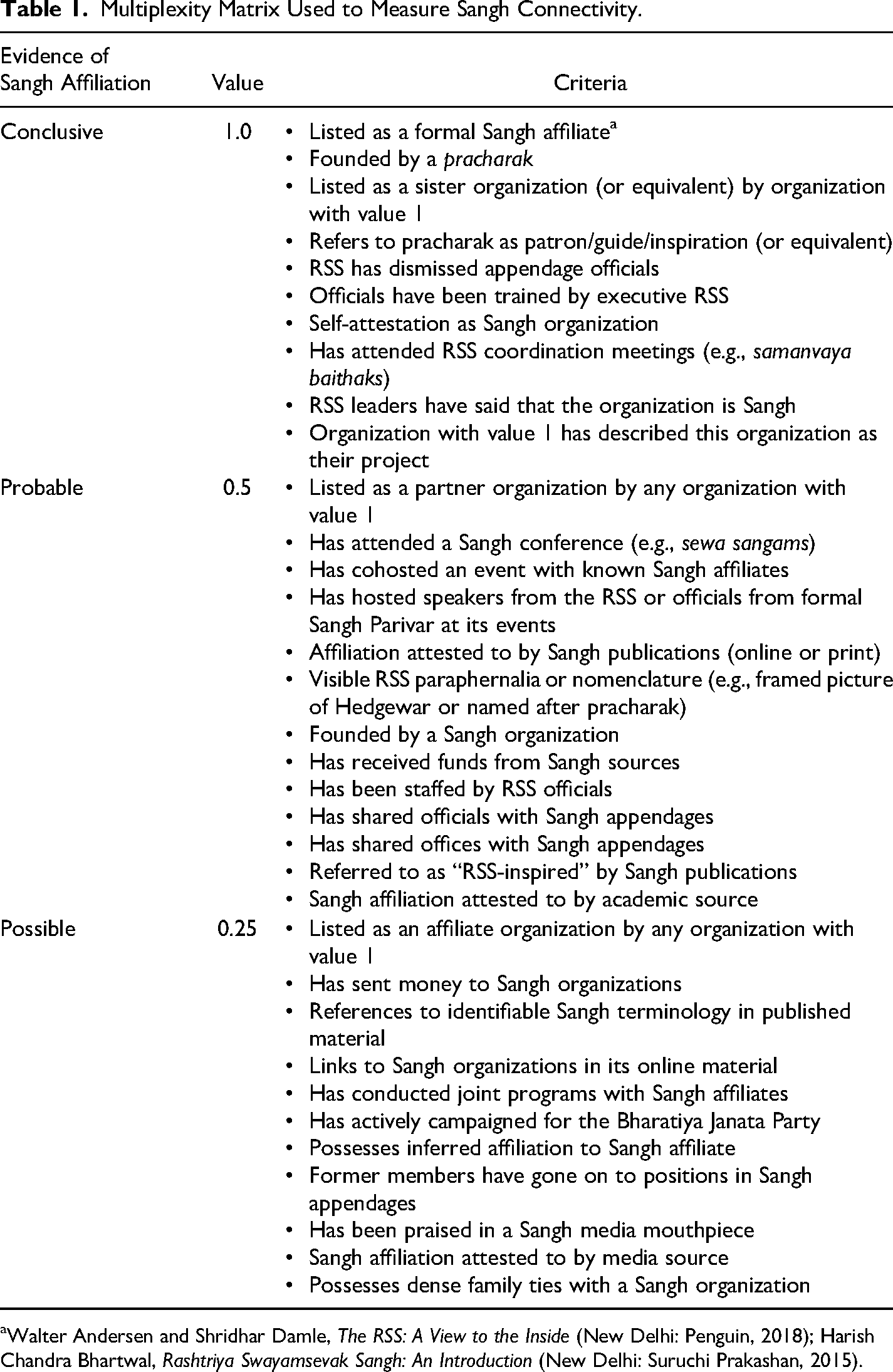
This project is an archival social network analysis relying on publicly accessible online data collection. 72 The task of this data collection was to identify organizations that may be tied to the RSS (nodes), assess them against a list of common patterns of Sangh network membership, and then verify this tie through multisource data triangulation. Over two years of consultations with academics, journalists, and grassroots pro-democracy activists in India, we designed a comprehensive and weighted multiplexity matrix (see Table 1) that was functionally a granular checklist of thirty-four different kinds of data points that suggested different strengths of Sangh linkage (e.g., founded by the RSS, displays photos of Sangh ideologues, cohosts events with Sangh organizations). These types of data points were identified iteratively through our expert practitioner interviews with academics, journalists, and activists who described to us the differing pieces of evidence they had identified in their careers substantively indicated imbrication in the Sangh.
Each kind of data point was coded into a three-tiered weighting scheme with values that marked definite (1.0), probable (0.5), or possible (0.25) ties to the Sangh. For example, if an organization declares that it is founded by the RSS that data point would be marked as 1.0, an organization displaying garlanded photos of RSS founders would receive a 0.5, and an organization listed as an affiliate of a Sangh organization would get a 0.25. The final value an organization receives (the strength of its connection to the Sangh), measured between 0.25 and 1.0, is the cumulative total of the value of the checked data points. An organization can reach a maximum value of 1.0 indicating an unequivocal connection to the Sangh, whereas an organization with only 0.25 would be considered only weakly tied to the Sangh. As with our data point identification, the coding of each data point as weighted 1.0, 0.5, or 0.25, was done in consultation with our practitioner experts. We corroborated this coding by identifying data points visible in organizations we already knew to be Sangh (e.g., the BJP) as observable patterns of Sangh linkage. We then searched for other organizations that displayed these patterns, and then identified what other patterns of linkage—data points—they displayed with the Sangh, which we were then able to cross-check with the information provided by expert interviews.
Using a realist sampling strategy—where the boundaries and contents of the network studied are self-identified and reported by network members—is definitionally limiting in a covert network like the Sangh. Instead, we prioritized snowball sampling, which is better suited to covert networks, 73 in which data on one node revealed another, previously unknown, node. These secondary organizations were then held as possibly Sangh awaiting verification through multisource triangulation. We began with core organizations who publicly attested to Sangh connections and, by systematically analyzing their published materials and media reports about them, were able to begin snowball identifying secondary organizations. Table 1 presents the matrix used to measure Sangh connectivity.
Multiplexity Matrix Used to Measure Sangh Connectivity.
Walter Andersen and Shridhar Damle, The RSS: A View to the Inside (New Delhi: Penguin, 2018); Harish Chandra Bhartwal, Rashtriya Swayamsevak Sangh: An Introduction (New Delhi: Suruchi Prakashan, 2015).
This project used the central principle of archival social network analysis data collection—that written sources can reveal network ties both directly and indirectly—for the study of a contemporary covert network. The use of archival data like media reports has already played a strong role in the mapping of covert networks. 74 We manually collected publicly accessible organizational data from an enormously wide set of sources, which broadly fall into the following categories: internal organizational documents, autobiographical accounts, far-right blogs, secondary academic sources, annual reports, financial records, regional news media, far-right media outlets, government documents, and photos or pamphlets posted on public social media pages. Many of the sources used in the creation of this data set are difficult to verify. For example, it is difficult to assess the veracity of a far-right blog discussing a remote school with no address or legal status. It is difficult to control for the propagandizing of far-right media outlets seeking to either inflate or minimize the scale of far-right organizing. To counter the thinness of individual sources, for all organizations we attempted to triangulate information on network connections, following others, 75 by seeking multiple data points from multiple online sources.
Despite the limitations of online archival research, we are confident that the data captured are a representative sample of patterns of Sangh network behavior insofar as our sample size is large enough (certainly the largest attempt to chart the Sangh) to reach theoretical exhaustion. No new types of organizations or network connections had been found for some time before concluding data collection. In addition, the existing data exceed many estimates of Sangh network size, and corroborates observations about Sangh behavior made by journalists, academics, Sangh defectors, and activists. However, despite this, we are aware that there are significant gaps in the data, although we are confident that the absent data does not represent new network patterns. 76
Each node is an organization with a unique name or legal identity. Ties mark interactions rather than relationships because the large scale of the organizations being studied, the incredible complexity of this network, and the paucity of available data on this covert network make relationships an impossible kind of data to collect systematically. What this means is that we were content to identify ties through single data points (e.g., two organizations cohosting an event), rather than seeking to establish the temporal dimension of an ongoing relationship (e.g., two organizations often cohosting events). The limitations of using interactions to measure complex relationships were ameliorated by using data triangulation and a granular multiplexity matrix of tie content.
We identified two kinds of ties: formal and informal. A formal tie is an acknowledged tie in which organization A formally founded, or operationally manages, organization B. An informal (unacknowledged) tie—a key mechanism of communicating authority, information, and resources in diverse networks—is one in which organization A collaborated and shared personnel, funds, or offices with organization B. These ties, which are not publicly declared, are usually revealed through fragments of information unintentionally shared. For example, we might discover an informal tie between two organizations because they are both registered at the same address. Ties are not coded as directional because the thinness of the data on such a covert network is insufficient for strong assessments of directional authority. This becomes less important in this study because the center of authority is already clear. 77
The persistent problem of weak or missing data on covert networks is usually mitigated using verified and robust sources provided by law enforcement officials. 78 Because we used online archival methods, this data set is skewed toward organizations with an online presence. This means that organizations without internet connectivity, the money to found a website, or the literacy skills to meaningfully engage with social media are less likely to turn up in our data. Accordingly, rural and remote organizations are probably underrepresented in this data. Having said that, small single-location organizations—of the kind we might be expected to miss—make up more than half of the data set. We suspect this is because of our extensive use of Sangh sources from large organizations that use the work of smaller organizations as useful publicity tools.
Where does a network end? If this project were to chart the connections between every single organization that snowball sampling threw up, this network map would grow to include almost all of Indian society, becoming analytically useless. This problem is deepened in organicist far-right networks for whom even small peripheral organizations are sites of contestation, and in networks with theoretical paradigms that emphasize interorganizational porosity. Accordingly, the goal of this project is not to capture every single Sangh organization. For reasons outlined above, this data collection will only partially capture this network (although this part will be substantially larger, more comprehensive and granular than any previous attempt). This does not pose a significant problem though in understanding the network patterns of the Sangh as the definition of the Sangh that I use is one that defines this network by its core, not by its peripheries. 79 As such, it is less important for us to know, for example, exactly how many cow shelters are run by the Sangh, than it is to know that there are shelters and that links of authority connect the RSS to these peripheries.
Another boundedness problem is the possibility that organizations that are not far-right will be captured by this methodology. For example, within this network, it is common for a large central node to have many affiliates. The affiliates or subsidiaries of these organizations sometimes associate very weakly. This means that within this data set there are organizations that seem bizarre to include in the world's largest far-right organizational network. For example, this methodology captured an ice-skating rink in New Delhi associated with Rashtriya Sewa Bharati, and a yoga studio in Melbourne affiliated with the Hindu Council of Australia. It seems ostensibly absurd to include these within a study on the far right. However, I argue that when studying far-right interorganizational networks, sometimes we must divest from far-rightness as an important analytic. In a similar logic to how Extended Party Network (EPN) theory tells us that parties gain sustenance from extensive nonparty networks, far-right organizations can gain information, financial, operational, reputational, and ideological sustenance from non-far-right organizations. Excluding these organizations, which might ally with far-right networks unknowingly, or because of social ties, or because they run fun events, excludes key avenues of far-right expansion, financial infrastructure development, and hegemony building. If the Sangh wants to penetrate and shape all aspects of society, limiting our analysis of its network to simply those organizations that are visibly far right precludes the possibility of measuring the success or the power of the Sangh. For this reason, the boundedness problem of including organizations into this network that are not far right is not a strong concern, and their inclusion is reflective of Sangh organicism and tells us something about how far-right networks can bleed out into society rather than function as discrete separate units.
Finally, this methodology risks the problem of potentially distorting the size of the network by placing certain organizations—for example, the world's largest political party and a small cow shelter—as morphologically commensurable. For example, while the BJP is one node, it has thousands of branch offices all over India. At the same time, an organization that may be only sporadically active is also represented through one node. As such, these data should be read as instructive in interorganizational network strategy and spread more than it should interorganizational network depth, or strength.
What the Sangh Looks Like
This data set provides, for the first time, empirical evidence of the large network characteristics of the Sangh. This network is dominated by a hub and spoke system in which a small number of central Sangh organizations are the sole connection between many organizations (between which there are few ties) and the Sangh. The Sangh is dominated by tiny, local, single-location organizations like schools, blood banks, and orphanages (53.12 percent), approximately two-thirds of which are service provision organizations. Organizations that work at multiple locations, but within a single state, are the next largest grouping (23.84 percent), while a roughly even number of organizations work across multiple states or nationally (11.34 percent), or operate outside of India (10.77 percent). 80 The picture that emerges is of a network strongly grounded at a micro, local level, rather than one dominated by large moving organizational pieces.
Geographically, the Sangh is dominated by organizations in four states: Uttar Pradesh (293), Maharashtra (293), Kerala (247), and Karnataka (225). Once national and international Sangh organizations are excluded, these four states comprise almost half of all Sangh organizations (47.62 percent). Below these mega Sangh states are a number of relatively clear groupings. There are those with a strong Sangh organizational presence, with between 50 and 150 organizations (Gujarat, Tamil Nadu, West Bengal, Odisha, Madhya Pradesh, Rajasthan, Andhra Pradesh, and Telangana); those with between 20 and 50 (Jammu and Kashmir, Delhi, Assam, Bihar, Chhattisgarh, Jharkhand, Haryana, Himachal Pradesh, and Punjab); and those with fewer than 20 organizations (mostly Northeast Indian states and the Andaman and Nicobar Islands).
Little of this is particularly surprising as it broadly tracks alongside population sizes. Considering Gujarat's reputation as a “laboratory of Hindutva” it is surprising to see that it is not a leading state for Sangh organizational diffusion, and considering Bihar's size, its numbers are somewhat surprising, although the hostility of Bihar's historical governing elite to the Sangh may go some way to explaining this. Perhaps the most surprising feature of this disaggregation is that Kerala, one of the states considered most hostile to Hindu nationalist organizing, is the state with the third largest number of Sangh organizations in India. One possible explanation for this is that Kerala has been, since independence, a key zone of conflict for the Sangh and one of the only places in India where the RSS has been consistently targeted as the subject of violent attacks (in this case by the Communist Party of India [Marxist]). I would suggest then that the number of Keralan Sangh organizations is related to the Sangh's long history in Kerala (since 1942), its efforts to establish a strong foothold in a key battleground state and attempts to build a network that appears unrelated to the RSS. Future comparative research would fruitfully compare the organizational trajectories of the Sangh in different states to understand far-right network development.
In terms of what the Sangh does, almost half (48.57 percent) of the Sangh is devoted to service provision. Within those organizations that provide services, 687 focus on education, 81 188 on health care, and importantly 592 offer services across more than one sector (e.g., offering both education and health care services). These organizations tend to be catch-all service providers seeking to be a one-stop shop for people in the areas they service. Other significant pools of organizations include those working on community outreach to historically excluded groups (227). Of these, the overwhelming majority target Adivasi communities (207). There are 90 organizations publishing media content, of which 27 are publishing houses. Importantly, only 45 organizations out of the entire network have reported connections to communal violence. Likewise, out of 141 religious organizations, only 45 relate to cow-protection agitation.
The fact that service provision organizations so overwhelmingly outnumber both religious and violent organizations in the Sangh reveals much about the structural priorities of this network, in turn, provoking questions about the overwhelming scholarly focus on communal violence and religious nationalist commitment when discussing the Sangh. Indeed, the dominance of service provision networks supports the findings of scholarship emphasizing the normalization role that Sangh service provision organizations play. By offering services in underserviced areas and communities, and by deemphasizing the role of Hindutva in the delivery of these services, 82 Sangh service provision organizations generate enormous volumes of goodwill that can be translated into votes or RSS recruitment. 83 Importantly, these small service provision organizations can also function as vectors of large amounts of funding coming from the diasporic Sangh in the guise of charitable donations. 84
The network structure of the Sangh is defined by two main morphological features. The first is the organization of the network into a center-periphery model. There is a relatively clear distinction between a densely connected group of organizations with high degree, betweenness, and eigenvector centrality—respectively meaning that they have ties to a large number of other organizations, that they are placed on the connecting pathways between many other organizations, and that the organizations it connects are important organizations—and an outer ring of peripheral organizations with few connections between them. Predictably, the central core of the Sangh is dominated by organizations traditionally understood as the Sangh Parivar (family of the RSS), with the addition of large international service provision organizations like India Development and Relief Fund and Support a Child USA. The links between core organizations like the RSS, Sewa Bharati, the BJP, Vishwa Hindu Parishad, etc. promote network robustness to individual node failure, while the separation of the core from the periphery highlights the importance of bridging nodes. The importance of bridging nodes is clearest when we see that 48.074 percent (1,361) of all organizations in the network are linked through only a single tie to the network. This means that almost half of the network is completely reliant on bridging nodes, without which they would be completely cut off from the Sangh. Indeed, this reliance on core bridging nodes is confirmed by an incredibly low mean betweenness centrality score (0.001), suggesting that most nodes do not have network pathways run through them, but rather that these pathways run through a small number of important organizations. This core-periphery network feature goes some way to explaining the extremely low network density when taken as a whole.
For many organizations in the Sangh, their bridging node is the core of one of the large hub and spoke systems that characterize this network. In a hub and spoke system, the central hub nodes are highly connected to multiple peripheral nodes between which there are few ties. Accordingly, peripheral nodes may rely on hub nodes for information and resource exchange, implying strong network centralization. The centralization of such a scale-free social network around several hubs demonstrates small-world network characteristics in which the distance between any two nodes is not great. Indeed, the average path length between a node and the network center, the RSS, is only 2.092.
The core-periphery and hub and spoke models of the Sangh demonstrate a commitment to hierarchical network structure that exist in tension with features of a highly diffused network like a low clustering coefficient, and a lack of declared ties or ideological coherence. However, at its core, this network is dominated by a series of features, discussed below, that make central command and control easy. These features make it possible to translate the reputational and financial harvest the Sangh produces in its peripheries into products like electoral victory and periodic mass mobilization. Organizational diffusion is the balancing mechanism between the impulses of an expansive diffuse network, which is not reliant on the failure or success of one node, and a highly centralized, hierarchical network.
How the Sangh Succeeds
The evidence from this data set suggests three effects that a strategy of organizational diffusion produces that consolidate normalization by (1) expanding the Sangh's audience into traditionally mutually exclusive audiences, (2) promoting a flexibility and agility that protects far-right mobilization from delegitimizing accusations, and (3) producing durability by warding off internal network schism. These three effects represent fundamentally dispersive forces that would appear to militate against purposive network cohesion. Before explaining these effects, what exactly is holding this network together?
I take issue with the proposition the Sangh's network glue is ideological commitment because there are large swathes of this network that do not strongly demonstrate a meaningful commitment to Hindutva. However, this is not the same as discarding ideology because the bureaucratic and governance apparatus of the Sangh remains ideologically motivated, and I argue it is this apparatus that keeps the ship afloat. Elsewhere, I have extensively detailed this Sangh bureaucratic governance, 85 but a few key points here on Sangh bureaucratic governance as the force that keeps the Sangh together.
Within the RSS is a key category of official—the pracharak (preacher), whose explicit role is to spread the influence of the Sangh. These pracharaks are full-time workers who have undergone extensive RSS training and are considered uniquely ideologically committed, taking vows of celibacy and rejecting marriage and other forms of work for the duration of their tenure as pracharak. For pracharaks, spreading Sangh influence involves founding, or encouraging the foundation of, new Sangh organizations and serving as the key managerial coordinator between Sangh organizations in a given location. In this sense pracharaks, who operate within clear lines of bureaucratic accountability to the RSS's akhil bharatiya prachar pramukh (All India Chief of Preaching) operate as the “iron frame” or the nervous system of a network where they rule Sangh appendages on behalf of the RSS by proxy. 86 Where pracharaks are not present, ordinary swayamsevaks may play similar—if weaker—roles of supervision and coordination.
However, not all Sangh organizations have much substantial contact with either pracharaks or swayamsevaks. These organizations remain embedded in Sangh bureaucracy by the genealogical accountability built into organizational diffusion. Organizational diffusion encourages organizational reproduction. In this context, peripheral organizations—regardless of pracharak presence—are accountable to their organizational parent who is often also their manager. Even if the child organization has never seen a pracharak, it is likely that their parent organization, or perhaps even their organizational grandparent, will be responsible to some form of RSS accountability. Certainly, this accountability gets weaker the further from a pracharak and the central Sangh an organization gets, but this reflects the way that far-right networks may fade into broader society more than it does the absence of cohesive governance mechanisms in the Sangh. 87
Segmented Representation
The first way that organizational diffusion is strategically useful for the Sangh is that it enables a complex multivocality that allows the Sangh to say all things at all times to all people, thus appealing to as many simultaneous constituencies as possible. For the Sangh, the creation of the broadest and most diverse possible base of support lends credence to their aspirationally hegemonic claims of societal representation. Juan Pablo Luna identified how political parties use highly segmented strategies in unequal social settings (especially when there is geographic segmentation) to appeal to multiple mutually exclusive electoral bases. 88 Building on Luna, I identify how this strategy is also visible in purposive civil society networks, here, those of the far right.
In large networks, there will always be ideological diversity. While there are certainly elements of strong cohesion within the Sangh, it quickly weakens and diversifies the further into the network peripheries one travels. Most Sangh organizational members are unlikely to have read anything by Golwalkar, or to have been to an RSS branch. 89 Instead, in the Sangh there are bitter disagreements between old guard officials who shun the public gaze in favor of grassroots organizing, and young Turks who see governance and communications strategies as keys to success. 90 Some Sangh leaders propose Muslims are integral partners in the construction of a future Hindu state, others propose that Muslims are Hindus, and yet others seek to violently expunge them from the Indian polity. Appendages openly critique others, usually around the tension between traditional trade protectionists and small Sangh industrialists. Ideological differences rage on the role of individual leadership, the nature of caste, linguistic integration, the role of Muslims in the movement, and so on. Beyond the core inchoate gesture of Hindu supremacy in India, there is no clear ideological consensus within the Indian far right on many issues, a fact Sangh thinkers boast of by saying, “Everything can be negotiated except hindu rashtra [a Hindu nation state].” 91 This internal diversity in the Sangh is not incidental but rather a managed and strategic diversity. The greatest evidence for this is that the internal diversity within the Sangh has led to almost no major internal organizational schisms within the Sangh. This suggests that internal diversity is not an organizational threat to the Sangh and is more than tolerable, but rather is central to Sangh strategy as a political solution to a political problem.
To persuade a public that might be alienated by naked bigotry, organizations like the RSS must publicly moderate. However, in doing so, these organizations risk alienating their core constituencies who remain committed to the original extreme positions. One resolution to this problem is founding many ostensibly independent organizations that can say whatever is strategically useful in their context, regardless of how (in)consistent it may be with core network ideological positions. By pursuing multivocality, far-right mobilizations can effectively tell everyone what they want to hear, vastly expanding their potential support bases. The outcome of organizational diffusion is large numbers of proxy civil society organizations, each with its own tailored messaging, designed to pursue complex divisions of labor. Accordingly, in the Sangh, we see publishing houses in many languages, Hindu nationalist militias tailored to regional contexts, Dalit outreach groups, Muslim outreach groups, environmental activists, textbook revision committees, disaster relief groups, temple committees, academic societies, think tanks, and industrial collectives.
These different organizations do not speak with the same voice, and they are not required or designed to. The strength of the Sangh is that it can prosecute this tailored multivocality without undermining its own network integrity. This is because it has, built within it, the strategic mechanisms that allow for a broad ideological church. This broad ideological church is, however, materially and financially committed to the central Sangh executive. We know that small, peripheral, service provision organizations help produce BJP-sympathetic electorates. 92 We know that textbook committees are stacked with RSS workers and seek to rewrite Indian history in favor of Hindu nationalists. 93 We know that diaspora groups funnel vast sums of money back to the Indian Sangh, even if they themselves are not vocal proponents of Hindu nationalism. 94 It appears that diffused multivocality does not preclude the centralized accumulation of resources—be they votes, money, information, or patronage.
This multivocality is also visible when we look at variable patterns of Sangh network development. As Figure 1 shows, temporal patterns of Sangh network organizational foundation emerging from data collected on dates of organizational foundation confirm well-known assumptions about Sangh development. 95 The rate of network expansion (founding new organizations) rapidly expands during the activist posturing of RSS chief Madhukar Dattatreya Deoras in the 1970s and reaches its peak in in the mid- to late 1990s during Indian liberalization and the Sangh's strategic pivot away from mass mobilization toward small service provision organizations.
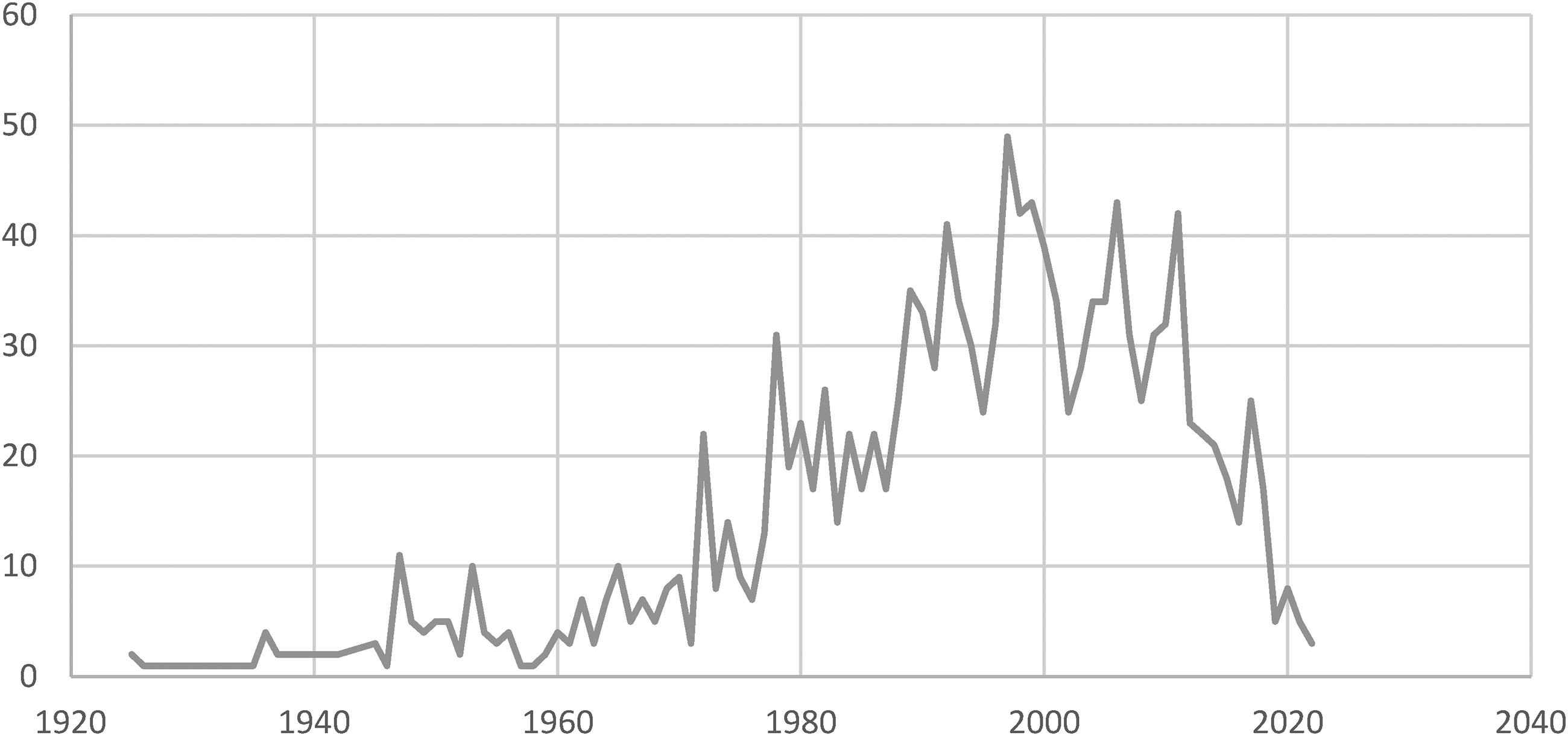
Number of Sangh organizations founded by year.
This story is different once we pull apart this network and zoom into state-level networks. In these state Sangh networks, we see a variety of structures, suggesting differential development. Where the Sangh has a very long history—like Maharashtra, Gujarat, Karnataka, and Uttar Pradesh—the RSS retains very high centrality measures that corroborate insights from historical accounts that in these states, the Sangh expands through the direct work of the RSS,. However, in states where the RSS consolidates later—Assam, West Bengal, Chhattisgarh, and Odisha—the RSS maintains relatively low centrality scores. So, for example, in Maharashtra the RSS is the most degree, between, and eigenvector central organization (unsurprising considering Maharashtra is the RSS's birth state), and in Karnataka and Gujarat is in the top three most central organizations on all centrality measures. However, it does not make the top three most central organizations on any centrality measures in Chhattisgarh or Odisha. Scraping through, in Assam the RSS is only the most between central organization, and in West Bengal it is the third most degree central organization. In the early-consolidated states, the networks are bigger, tighter, and more centralized, with the RSS occupying a central position. The later-consolidated states demonstrate smaller, less dense, less centralized networks in which the RSS does not consistently hold a central position. These low RSS centrality scores correspond with the suggestion that the Sangh does not always expand through the RSS. Rather, in places less receptive, Sangh expansion is indirect. For example, in Tamil Nadu, regionally specific organizations like Hindu Munnani have higher centrality scores than the RSS. In Odisha, the VHP has higher degree and betweenness centrality than the RSS, while in Assam, organizations like Support a Child USA take center stage.
Most useful then is perhaps eigenvector centrality or prestige score. An organization with a high eigenvector centrality is connected to nodes of influence, rather than just peripheral nodes. 96 For example, in Chhattisgarh, one high eigenvector-scored organization, the Bharatiya Kusht Nivarak Sangh—a seemingly innocuous anti-leprosy organization—was founded by and is staffed and run by RSS pracharaks and is funded by both the Indian Development and Relief Fund and Sewa International. Here, an unassuming organization can serve as a vector for the transfer of money, information, and resources through this network, without the reputational damage of public RSS association.
The Sangh does not spread uniformly. In less receptive states, it spreads through service provision, or it creates vernacularized. Here, organizational diffusion, allowing the Sangh to speak to multiple regional contexts at once, is visible in patterns of network development. The charting and explanation of variations in Sangh temporal and geographic variation provide a rich opportunity for future research in this area. These initial findings confirm much of the growing literature on Hindu nationalist vernacularization. 97 However, where they depart is in recognizing that this vernacularization is not only an organic transformation of ideology but a conscious political strategy of a material far-right network.
Reputational Control
Although most organizations in the Sangh have connections with more than one other Sangh organization (the average degree centrality of a Sangh organization is 1.657, meaning that the average Sangh organization has connections to 1.657 other Sangh organizations) this network consists of many weak ties. A low overall network density score (0.001) and a low overall clustering coefficient (0.009) are consistent with a network structure in which bridging nodes, or weak ties, play a key role. An overall network density score of 1.0 would suggest that every node is connected to every other node. A score as low as 0.001, which suggests that very few potential ties exist, indicates that most organizations do not have ties to most other organizations, meaning that the ties that do exist are directed in a concentrated manner through bridging nodes. A low overall clustering coefficient suggests that while organization A may have a tie to organization B, organization A has very few ties to any organizations that B has ties to. This measure again suggests that most organizations are tied to this network through only one organization, again indicating a reliance on bridging nodes and weak ties. These findings are further corroborated by the average path distance to the RSS in the Sangh (2.092), which strongly suggests that the average Sangh organization has its relationship with the central Sangh executive mediated by another organization. For example, organizational offspring of Sewa Bharati, Vivekananda Kendra, and the Vishwa Hindu Parishad are organizationally removed from other groupings of organizations—forming their own clusters—with few interperiphery ties and are tied primarily to the RSS through these bridging nodes.
However, this structural reliance on bridging nodes and weak ties does not indicate a thin network. On the contrary, the mean multiplexity score of ties between Sangh organizations is 2.957, meaning that the average organization has almost three separate types of data points corroborating a connection to the central Sangh. This score rises to 4.436 when we isolate the average multiplexity score of ties between Sangh bridging nodes and the RSS, with some nodes scoring as high as 18, meaning that we found eighteen different data points for an organization that suggests its connection to the Sangh. The higher multiplexity score of these bridging nodes suggests their centrality to Sangh organizational strategy.
Organizational diffusion obscures ties between network peripheries and centers by scrambling them through bridging nodes. This structural feature allows the Sangh to strategically claim responsibility for the actions of appendages when they are positive and deny responsibility for appendage actions when they are reputationally damaging. The scrambling that occurs through these bridging nodes provides the ambiguity necessary for the strategic recognition or denial of organizational ties to the RSS. What this means is that the RSS effectively manages a switchboard system in the Sangh where it can turn on or turn off its public connections with appendage organizations. This ability to strategically draw close, or distance itself, allows the RSS to manage a complex system of public legitimation and reputational management.
This switchboard effect is one way that the Sangh negotiates the secrecy-efficiency trade-off that characterizes the structure of covert networks. Covert networks must balance the need to maintain network secrecy to protect leaders and avoid censure—achieved through a decentralized network structure in which leaders are not closely connected to actors—and the need to maintain network efficiency, which is achieved instead with a more centralized network structure. 98 By changing the public acknowledgment of interorganizational ties, networked organizations like those in the Sangh can respond deftly to environmental threats and opportunities. 99
Strategic ambiguity is made possible by the preponderance of informal ties. These are ties that are often deniable and difficult to pin down as indicative of a deep organizational relationship. Much work on interorganizational network governance emphasizes the importance of informal and organic connections and collective decision making. However, while sharing some characteristics, the Sangh is significantly more hierarchical than models like network organizations or network governance structure. We might therefore think of this as a hybrid system with elements of informal network governance, and hierarchical network governance.
Within the Sangh, we identified a total of 5,574 ties between 2,831 organizations. Of these ties, 74 percent were informal ties (4,140) compared with 26 percent formal ties (1,434). The preponderance of informal ties is somewhat reflected in the legal makeup of the Sangh. Forty-four percent of the identified organizations were unregistered organizations with no distinct legal status, revealing that much of the organizational business of this network takes place outside the scope of legal NGO financial declarations or record-keeping rules. The informality of this network, baked into its structure, allows it flexibility and obscurity. By conducting much of its business through informal untraceable interpersonal relationships, the mechanisms of how power and money move through this network become somewhat inscrutable unless we actively search for informal ties. It is the plausible deniability of informal ties that is critical to the strategic ambiguity visible in a switchboard effect.
The switchboard is most visible in larger Sangh appendages because they receive more public and media attention and thus solicit comment by the central Sangh. For example, the Vishwa Hindu Parishad (VHP) was founded by the RSS and is considered one of the core units of the Sangh. RSS recognition of ownership is traditionally extended during times of popular mobilization but withdrawn when the VHP becomes too publicly controversial. Crucially, the extension or removal of acknowledged ties does not change the material embeddedness of the VHP in the Sangh. 100 Here, we can see an alternative to suggestions that successful far-right groups will cut ties with more extreme-linked organizations to win public support. 101 There is no need to cut ties when the network structure is such that they can be simply scrambled. When the RSS finds it strategically useful to self-describe as a humble provider of guidance and wisdom to Hindu nationalists, it disassociates itself from the service provision activities of the many subsidiary organizations of Sewa Bharati, the Sangh's main service wing. However, when it is useful to take credit for the services provided by Sewa Bharati organizations, these suddenly become RSS projects! 102
At a stroke, the central Sangh can obscure or reveal by turning a linked node on or off. For example, it becomes very easy for the RSS to deny involvement in the violence of Hindutva militias because the pathway from these militias often goes through the Bajrang Dal, to the VHP, to the RSS. By turning off the VHP, the RSS also turns off its connections to militia-based violence. Conversely, if the central Sangh switches, for example, Sewa International on, then it suddenly becomes the provider of services to thousands—a useful reputational tool. If we recognize that the central Sangh executive strategically acknowledges or denies linkages, then there must be unacknowledged links analysts are unaware of. Measuring and understanding the Sangh by those organizations over which it demonstrably exerts authority is therefore a compromised measure. Instead, we must view the Sangh, like other far-right mobilizations, as a covert network better understood through sites where it could exert authority.
Leadership Accommodation
Across far-right studies, a key explanation for far-right failure has been factionalism, schism, and splintering. 103 How has the Sangh managed to avoid this? Certainly, there are internal divisions like those between Hedgewarite old guard officials and a new technocratic generation of Sangh officials, or the divisions between pracharaks from different regions. We also know about RSS attrition and a small number of Sangh breakaway micro-organizations. 104 However, these divisions remain marginal to the Sangh's strength. The puzzle remains then, how is the Sangh internally governed in a way that ensures network organizational cohesion?
Organizational diffusion offers an opportunity to pacify officials who otherwise might harbor ambitions for internal challenge. The proliferation of bridging nodes, which grant their leaders access to the significant material and knowledge resources that bottleneck through these weak ties, implies the existence of a diversity of official bureaucratic positions. Offering an official the leadership of one of these organizations is not just a way to ensure that the central Sangh has efficient organizational control over the peripheries through bridging nodes, it is also a way to offer those leading officials in these nodes the material or reputational reward gained through control of these bridging nodes.
One of the benefits of organizational diffusion is its ability to produce a plethora of organizational positions of varying seniority that can distribute rewards to potential internal challengers and allow them to create their own personal fiefdoms and patronage networks as a way of placating them and heading off internal challenges at the gate. Opportunities on this scale are only possible in sprawling organizationally diffused networks where piecemeal titles are numerous. The relatively autonomous way that organizations operate—designed to allow the central Sangh plausible deniability, as well as being cost-effective—allows officials in the appendages to operate with some impunity, meaning that they can harvest the benefits of controlling the gates between the central Sangh and the peripheries. Occupying a niche position, like those enabled by complex bureaucratic division of labor, enables organizations to grow outside a realm of competition. 105 The complex division of labor between Sangh organizations, and their relative autonomy means that there is less need for organizational leaders to compete, and thus potentially fracture.
These fiefdoms often revolve around a dominant deputed official from the central Sangh who inspires significant reverence and emotive loyalty more than the central Sangh does. Many high-ranking central Sangh officials have built their own organizational network fiefdoms where they can corral many organizations under their patronage. The most obvious example of this is the organizational fiefdom created by Eknath Ranade through his Vivekananda Kendra. Ranade was the main competitor to Balasaheb Deoras for the leadership of the RSS following M. S. Golwalkar's death in 1973. However, despite Ranade's support within the organization, Deoras had been effectively controlling the RSS's organizational logistics since 1970. 106 Allowing Ranade to found and lead the Vivekananda Kendra from 1972, which operated with almost unique autonomy from the RSS at the time, was a convenient way to neutralize Ranade's claims to leadership by offering extensive organizational power through control of a semiautonomous network of organizations. 107 The Kendra network expanded to over twenty direct subsidiaries, with a vast cadre and network of organizations across the country loyal specifically to Ranade rather than displaying strong connections to the RSS. I hypothesize that this was only permissible to offer Ranade placatory appeasement to neutralize future leadership contests. 108
At a state level similar personable networks develop around powerful Sangh figures like the late Ajith Kumar and his Hindu Seva Pratishthana network, or Nanaji Deshmukh and his Deendayal Shodh Sansthan network. In Kerala, RSS pracharak P. Parameswaran founded at least six separate organizations, the largest of which refers to him as a living saint. 109 In the same state, pracharak Kummanam Rajasekharan has also been allowed to develop a highly personable network in which he has played key leadership roles in the Hindu Aikya Vedi, the Keralan VHP, the BJP, Janmabhumi, the Sabarimala Ayyappa Seva Samajam, and Hindu Munnani. There are likely to be many more of these potential internal challengers pacified with their own organizational fiefdoms, however, because the internal power struggles of the RSS are invisible (except for rare cases) to outsiders, it is difficult to build a systematic metric of analysis to assess when and where challengers are given fiefdoms.
While allowing the formation of personal fiefdoms offers the risk of schism, even the most authoritarian networks are required to develop sophisticated networks of delegated authority and offer the ability for agents to develop their own patronage networks. 110 To circumvent the risks of this principal-agent problem, the Sangh offers a long leash to organizational leaders, and holds only a minimalist set of non-negotiable core ideological positions—a commitment to Hindu supremacy and RSS authority—reducing the capacity for violation of these tenets. It is difficult for such a misalignment of interests to occur, as the organizational and ideological goals of the Sangh are intentionally flexible and capacious, allowing for a wide variety of actors to pursue their own interests within the Sangh framework. The current head of the RSS, Mohan Bhagwat, is quoted as saying as much when he commented, “Everything can be negotiated except the hindu rashtra [Hindu nation].” 111
Indeed, the importance of personable ties in the peripheries can be understood as strategically desirable to the central Sangh. Key to network management is internal network trust between actors. 112 This trust facilitates coordination, information, and resource exchange. Within the central Sangh, a key mechanism of trust building is either the shared experience of the shakha system within the RSS or ideological commitment—proxies for trust. These shared organizational experiences become rarer in network peripheries, and ideological commitment becomes more ambivalent. Encouraging personalized leadership of key hubs then produces a system of stratified trust, where peripheral organizations build network trust through a personalized relationship with hub leaders, and these hub leaders build network trust with the central Sangh through shared organizational experience and ideological commitment.
The fact that so many bridging nodes revolve around a highly personalized charismatic leadership reveals the central role that individuals play in Sangh network governance, contrary to Sangh assertions of depersonalized, rational bureaucratic governance. This forces analysts to ask questions about the actual strength of this network. What happens to an organizational fiefdom if the charismatic leader dies or defects? Who replaces these leaders, and how are their fiefdoms brought into the fold? Does the network's reliance on these personalized bridging nodes offer an opportunity for strategic disruption of this far-right network to those who seek to challenge it? We must disaggregate the public transcript of the Sangh that emphasizes its ideological uniformity, cultural homogeneity, and internal discipline in favor of understanding the nature, demographics, and interests of individual officials. How do caste or regional identities create internal competition within the Sangh?
Conclusion
In explaining the success of the global far right, it is beholden on scholars to explain the most successful case—that of the Indian far right. Analyzing the interorganizational network composition of the Sangh reveals patterns of far-right organizing that usefully point us in the direction of new forms of analysis. Organizational diffusion provides an opportunity to meet scholarly calls to extend the study of the far right beyond the political party and to analytically distinguish far-right organizing from far-right ideas. 113 Moving away from a strictly ideological definition of the far right, and embracing civil society–centric analyses, organizational diffusion as an analytic tool allows scholars the opportunity to more precisely locate the way that the far right bleeds into broader society.
The Sangh demonstrates how adopting strategies of organizational diffusion makes far-right mobilizations more expansive through segmented representation; how it makes them more flexible through complex systems of reputational control; and how it makes them more resistant to schism through mechanisms of leadership accommodation. These effects of organizational diffusion should be used as the starting point for a research agenda that seeks to find the far right, even when it does not look like the far right. These effects allow us to identify the far right through its diffusion and can usefully shed light on mobilizations like Nippon Kaigi in Japan, Thai military civil society networks, Ma Ba Tha in Myanmar, and even other, non-far-right, mobilizations like Hizbollah or Sendero Luminoso.
The data set I present in this paper, rich in both qualitative and quantitative data, is ripe for more in-depth study. Future data sets that have at their core the goal of mapping organizationally diffused networks will be well placed to answer a whole suite of future questions. Future studies using this kind of data might seek to examine the political economy of creating these diffused nodes. What kind of resources—material or affective—does a mobilization need to conduct this form of strategic expansion?
The existence of organizational diffusion requires scholars to expand understandings of what a far-right mobilization looks like. It is no longer sufficient to limit our analyses to Eurocentric, party-centric understandings of the far right but rather employ the same analytical creativity that the far right uses in its organizational manifestations. In the same way that icebergs carry large, invisible undercarriages, or that visible mold is simply the fruiting body of a larger mycelial network, far-right mobilizations are substantially more than simply their pointy ends. This offers both threats, in that far-right penetration into societies may be more extensive and undiagnosed than realized, and opportunities, in that extensive networks have extensive pressure points that challengers may disrupt. Either way, to grasp the threat or take the opportunities, organizational diffusion points us in the direction of new research agendas.
Footnotes
Acknowledgments
I would like to acknowledge the contributions of Paolo Sosa Villagarcia, whose assistance in thinking through methodological questions for this article was invaluable.
Declaration of Conflicting Interests
The author declared no potential conflicts of interest with respect to the research, authorship, and/or publication of this article.
Funding
The author(s) received no financial support for the research, authorship, and/or publication of this article.