




Abstract
Establishing new land rules is often a central part of how a modern state is constructed and sustained. In China, a state-led territorial process resulted in a set of land rules in 1962 that demarcated rural land in accordance with the production experience spaces of acquaintance communities and granted these communities key ownership rights over a fixed territory. These rights created structural conditions that encouraged village groups to establish their own operational rules, which in turn incentivized cooperation among group members on collective production and distribution. This system thus generated “quasi-voluntary” compliance, as farmers met their tax obligations in exchange for these land rights. This article explores how the 1962 land rules evolved and their role in producing the PRC's communal-owned land system, which still formally covers almost half of China's territory and population today, and the implications for the range of possible rural land governance arrangements in modern societies.
Keywords
In 2016, the 4th village group of Huyan village in China's Henan province sued its own village committee for illegally seizing and selling off the group's land. After a lengthy legal process, the final ruling by Henan Nanyang Intermediate Court in favor of the group offered a fascinating insight into the nature of communal-owned land rights in rural China. The court's finding hinged upon two crucial points: (1) The village group is a legally qualified subject of collective land ownership. The village group's land ownership derives from the land ownership system established during the collective era, namely: “three levels of ownership, with teams as the foundation” (sanjisuoyou duiweijichu); (2) The village committee has no right to dispose of land owned by the village group. … When a piece of land is determined to be owned by a village group, no other entity has the right to dispose of that land.
1
By upholding the village group's right to control its own land, the court's ruling essentially denied that right to the local governing agency, despite their administrative authority over the land. Since this is officially public land, the ruling represents a remarkable restriction upon the local political authorities—the village committee. Moreover, the court's core justification for defending the village group's land rights, the “three levels of ownership, with teams as the foundation” policy, derives from a policy originally proposed by Mao Zedong in 1959 as Chinese leaders struggled to restructure the People's Communes amid the deepening Great Famine. 2 This 2016 ruling was hardly an anomaly. In 2020, following a three-year national survey of all collective-owned assets, the central government announced that 45 percent of China's total land mass was officially “collective” land, mostly still “owned” by 2.385 million village groups, composed of some 800 million members. 3
This survey and ruling raise important questions. What does it mean that village groups in China collectively “own” local land? When, how, and why were these ownership rights established, and what effects did they have? How did they operate within China's planned economy and in the subsequent market economy? More broadly, what implications does China's process of adopting the 1962 land rules offer for our understanding of the range of possible rural land governance arrangements in modern societies?
Land rules are institutions, defined by North as “humanly devised constraints that structure political, economic and social interaction.” Composed of informal constraints and formal rules that evolve incrementally, institutions are devised to “create order and reduce uncertainty in exchange.” 4 Land rules generally result from human territoriality, which Sack describes as “the attempt by an individual or group to affect, influence, or control people, phenomena, and relationships, by delimiting and asserting control over a geographic area.” 5 Establishing such rules over land is often a central part of how a modern state is constructed and sustained. North, for instance, explains how the 1787 Northwest Ordinance played a crucial role in the United States’ early economic and political development, offering this case as an example of how institutional change shapes how societies evolve over time. 6 For the People's Republic of China (PRC), evolving rules over rural land from the mid-1950s through the early 1960s played a similarly significant role amid the Communist Party of China's efforts to build a modern state. However, the change of rural land rules in 1962 has been largely downplayed within China since it accorded with neither the socialist ideology of the collective era nor the market economy ideology dominant since the early 1980s.
Landmark studies on rural China from the 1960s and 1970s generally identify the 1962 measures as important responses that helped stabilize rural production and helped end the famine, but largely describe them as “restoring” production arrangements to the pre-1956 collectivization situation by downsizing collective production units while offering farmers small “private plots.” 7 Scholars in the 1980s tended to emphasize the temporary nature of these policy measures while highlighting market-oriented steps such as market exchanges and pricing systems. 8 Since the 1990s, most studies of collective-era rural China only briefly mention the 1962 policy measures. 9 While not disagreeing with these influential studies’ core empirical findings, this article attributes much greater significance to the process of how and why the rural land rules changed in 1962 and offers an alternative interpretation of their impact.
My diverging interpretation builds upon Skinner's and Shue's important studies of rural China. Skinner argues that nineteenth-century rural Chinese trading and social networks exhibited a “cellular” pattern that endured through China's collective era, though he described these networks as lacking “fixed” boundaries since “the size of a standard marketing area could vary inversely with density of population and it might change over time.” 10 Shue applies the “cellular” notion to administrative organizations in rural China. She identifies “a marked quality of boundedness and discreteness in the communities where peasants lived, worked, and participated in public life,” thus limiting the “reach of the state” into rural China through the collective era. 11 While both Skinner and Shue use cellular patterns as a cartographic notion to describe the structure of economic exchange and administration units in rural Chinese society, this study investigates a set of land rules that gave birth to an actual cellular structure: territorially bound rural groups nested within the state's administrative jurisdictions (i.e., communes or brigades).
This study shows that from 1953 to 1962, Chinese leaders engaged in a state-led territorial process that resulted in the creation of a new set of rural land rules that created a communal-owned land system. 12 These rules divided rural land in accordance with the “production experience spaces” of “acquaintance communities” and produced key ownership rights (rights of access, withdrawal, management, and exclusion) over both resources and output for each community within a fixed territory. These ownership rights also created structural conditions that incentivized village groups to establish their own operational rules, which in turn incentivized cooperation among group members on collective production and distribution.
For the Chinese state, creating millions of groups with a demarcated territory as viable taxable units greatly reduced the state's transaction costs in governance and revenue collection, as identified by Levi, namely, the costs of acquiring information about revenue sources, monitoring constituents, bargaining over a revenue production policy, and enforcing policy compliance. 13 In exchange for granting land ownership rights to small groups of farming families and allowing them the autonomy to make farming, allocation, and redistribution decisions regarding their land and harvest, the farmers paid taxes—in the form of meeting their assigned production quotas—to the state. This distinctive territorial strategy facilitated acceptance by Chinese farmers and rural communities, helping the Communist Party of China (CPC) secure what Levi defines as essential for all rulers to extract revenue from their population: “quasi-voluntary compliance” in which citizens pay taxes to the state. 14 The 1962 system thus helped central leaders integrate rural China into the overall planned economy while stabilizing the state's rural revenue base.
This article leverages theories of territoriality, human geography, and political economy to understand and explain the origins and operations of China's land rules. It first explores the contested, trial-and-error territorialization process by which the 1962 land rules emerged and were finally adopted as a national policy. This section draws upon archived CPC policy documents, government reports, and internal communications, primarily held within the People's Daily and Xinhua archives. The second section explains how and why the 1962 rules were accepted by local communities. The final section utilizes Ostrom's analytical framework, developed to capture how institutional structures can encourage cooperation between individuals in a common pool resource setting, to explore how the 1962 land rules encouraged village groups to develop their own operational rules, which in turn encouraged cooperation among group members on collective production and distribution. 15 My primary sources for the final two sections include unpublished work journals and account books from a Shandong province village, and the diary of a Shanxi accountant and farmer, augmented by my own field research across five regions of rural China. 16
Territorialization in Rural China: 1953–62
China's 1962 land rules can be usefully understood as a state-led territorial strategy designed “to affect, influence, or control people, phenomena, and relationships by delimiting and asserting control over a geographic area.”
17
For instance, Sack describes how the newly established United States deployed “political territorial partitioning . . . subdividing and segmenting former Indian [Native American] lands” to create “newly imposed political territories.” By using “territory to partition land into saleable parcels … [,] territorial partitioning became a primary vehicle for defining [private] property.”
18
Vandergeest and Peluso also apply territorial theory to show how the premodern state of Siam created territorial civil administrative units to administer land rights over aboriginal power structures. As they explain, All modern states divide their territories into complex and overlapping political and economic zones, rearrange people and resources within these units, and create regulations delineating how and by whom these areas can be used. These zones are administered by agencies whose jurisdictions are territorial as well as functional.
19
In Seeing Like a State, James Scott shows how modern states have used spatial standardization to create more “legible” territorial structures that facilitate state control over society. He describes state-led territorial standardization processes in the Soviet Union and Tanzania; in both countries, “officials took exceptionally complex, illegible, and local social practices, such as land tenure customs or naming customs, and created a standard grid whereby it could be centrally recorded and monitored.” 20 These techniques reflect North and Thomas's explanation of the state as “primarily an institutional arrangement that sells protection and justice to its constituents. It does so by monopolizing the definition and enforcement of property rights over goods and resources and the granting of rights to the transfer of these assets. In return for this service, the state receives payment in the form of taxes.” 21
China's rural territorial strategies from 1953 to 1962 included direct and indirect methods. A direct method means that the state establishes an ownership regime and explicit rules stipulating who can own what land and what they can do with that land. Yet changes in these fundamental regimes and rules are difficult and rare. Far more common are indirect methods: regulations on non-land-related activities that have an implicit or indirect effect on people's access to or utilization of land and its output, such as rules controlling markets or people's mobility.
Indirect Territoriality
Rural land in China historically included privately owned land, collectively owned land (e.g., owned by rural communities or clans), institutional land (e.g., owned by temples), and state-owned land. 22 Land was farmed individually, collectively, or lent out to tenants by large landholders or the state. During the Qing Dynasty (1636–1912), a mixture of landowners (of various-sized territories), officials, and scholars formed a local gentry class who served as a connection between the state and tillers of the soil by maintaining, monitoring, and enforcing land tax policies designed to ensure a sustainable revenue base for themselves and the state. 23 Toward the end of the Qing Dynasty and into the Republic era (1912–49) the central government began to strengthen its bureaucratic mechanisms for land tax assessment and collection while bringing the gentry class into its bureaucratic system. 24
During its long rise to power (1921–49), the Communist Party engaged in various land reform measures designed to redistribute farming land to rural residents. 25 After securing power in 1949, CPC cadres replaced the gentry class in assessing and collecting agricultural taxes while land distribution continued across China. 26 By early 1953, 90 percent of China's rural residents (87 percent of the total population) had been allocated some privately owned land. 27 Yet for many rural households, these small parcels of land proved inadequate to ensure their family's livelihood. 28 Families facing economic difficulties, or those who lacked farming skills or adequate labor, began to mortgage or sell off their farming land. 29 Meanwhile, party members and soldiers (many recently retired following the Korean War) began to emerge as a “new elite.” 30 Party documents warned that rural land sales were resurfacing, along with inequity and abuses, and that “new landlords” were buying up land while hoarding grain and speculating in grain markets. 31
Seeking to curtail these practices while retaining the private land ownership regime and sustaining state revenues, the CPC began its indirect territorial strategy. They instituted a state monopoly on the purchase and supply of all cereals and grains (tonggou tongxiao) in late 1953. 32 With the state controlling the price, trading locations, and timing of all grain sales, acquiring more land to bolster production became meaningless for farmers, since there were no markets to sell their products. 33 While controlling grain markets was primarily an economic policy designed to contain grain hoarding, it indirectly inhibited land trade while constraining farmers’ mobility and their use of farming land. By the end of 1954, the state controlled nearly 70 percent of all agricultural and subsidiary products nationwide. Local markets were replaced by state-run planned exchanges, accompanied by a centralized food ration system. 34 Instead of purchasing grains in the market, urban residents began receiving their food via their work units (danwei) or by purchasing it from state-run grain stations (liangzhan) based on their residential identification cards (hukou). 35 This policy restricted food access for anyone away from their residential city or rural township. In rural areas, households had to rely on their own resources, augmented by purchases from state outlets. This system of receiving food based on fixed addresses greatly limited mobility.
Party leaders expected that without market access to food, rural households would be more likely to retain their own land to meet basic nutritional needs while joining the voluntary cooperatives created in 1951. 36 This initially worked: neighboring households with varying capacities started to pool farming materials, animals, and labor to jointly utilize their adjacent farming lands. 37 However, counting such “inputs” as “shares” in the voluntary cooperatives, with distribution standards based on inputs, soon ran into problems. How much rice, for instance, should one family receive for lending their water buffalo to the cooperative versus another family's labor contribution?
Even following the good harvest in the fall of 1953, many cooperative members reported feeling “discouraged and bitter” at the “unfair” redistributions. 38 Households started to withdraw from the cooperatives. 39 Although the CPC issued several policies to address unfair distribution and standardize state procurement, rural contention and backlashes continued to spread. 40 The preemptive slaughter of farming animals by peasants reluctant to contribute their animals to cooperatives was particularly worrisome, as it undermined the cooperatives’ core objective of pooling scarce resources. 41 These failures undermined state authority and social order while reducing agricultural production, leading Chinese policymakers to adopt more ambitious, direct territorial methods.
Direct Territoriality
As an old Chinese saying goes, “There is no turning back an arrow once shot” (kaigong meiyou huitoujian). Once the PRC eradicated the grain market and adopted the Soviet economic model for their first five-year plan (1953–57), Chinese leaders had to figure out how to establish a planned economy to replace market mechanisms. 42 According to the Soviet model, a planned economy is based on public ownership; the state officially owns all territory. State agencies control all public assets, with responsibility for utilizing these assets and distributing resources to the public. A planned economy, Kornai adds, “is disaggregated according to addresses.” 43 Chinese economic planners had to identify which rural units would serve as the “addresses” for the plan. Rural territory thus had to be divided up geographically, with each territorial component represented by a bureaucratic body responsible for fulfilling a share of the central plan.
The direct territorialization process began in June 1956, when Chinese leaders officially transferred all rural households’ privately owned land into collectively owned land, thus formally turning all farming land into a publicly owned resource. 44 Private landowners were replaced by “high-stage cooperatives” (HSCs). HSCs were made responsible for managing economic and production plans, farm work, production, and distribution activities, along with welfare provision. 45 By the winter of 1957, China had established 753,000 HSCs, incorporating some 119 million member-households (about 90 percent of the rural population), with about 160 households in each HSC. 46
Several months later, in August 1958, the People's Communes were established. By November, all HSCs had been amalgamated into twenty-four thousand People's Communes. Virtually every rural household was now part of a commune, with each commune including about twenty-three thousand people (approximately five thousand households). 47 In December 1958, the communes were officially made the “owner” of all public resources within their allotted territory. Communes were now a territorial civil administrative unit with authority to administer land rights, manage labor, implement income and welfare redistribution, and secure revenue extraction for the state. 48
For central planners, having larger individual administrative units meant fewer units to plan for and fewer coordination difficulties. Having awarded these units “ownership” rights over resources within their administrative jurisdictions eased their efforts to establish production “contracts” with subordinate units and allocate “responsibility” among the state's bureaucratic branches. Party leaders also hoped that applying modern, socialist bureaucratic methods and financial systems between and within these units would bolster agricultural production while overcoming bottlenecks imposed by sectoral imbalances. 49 While this administrative decentralization expanded commune officials’ autonomy and authority over public resources, communes’ enhanced responsibility for meeting their “contractual responsibilities” (gongshe baogang) for production led commune officials to intensify their intrusions into rural residents’ daily lives. 50
Communes, as the “owner” of all public resources within their administrative jurisdiction, began conducting massive confiscation of farming materials and personal items from rural households, redistributing these resources across the commune under the policy of “flat transfers” (yipping erdiao sanshoukuan).
51
A utopian style of “communal life” rapidly intensified. Rural households’ daily lives were interrupted by mobilization for large-scale collective farming and by communal social services and activities such as child care, bathing, social gatherings, and communal dining halls.
52
Responsibility for specific farming plots was shifted among local communities based on commune officials’ production plans.
53
Stites notes how, in the Soviet Union, this type of utopian “communal life” diverged from traditional practices of rural households voluntarily collaborating for mutual advantage.
54
In China, the communes’ practices led to mass resentment and widespread local resistance. As Mao Zedong admitted in a party meeting, From the fall of 1958 and after the harvest, there were storms of shortages of grain, cooking oil, pork, and vegetables. This was a concentrated expression of resistance. … Almost all of the production teams and small production teams hid agriculture products and distributed them privately. They even hid agriculture products in deep and secret cellars, having people watch and guard their products.
55
Mao's comments illustrate how allocating resource ownership to administrative bodies alienated rural people who held de facto control over their customary resources. Just two months after communes had been declared the owners of all public resources within their allotted territory, in February 1959 during an expanded Party Central Committee meeting in Zhengzhou, Mao proposed a new type of public resource ownership within the communes: “three levels of ownership, with teams as the foundation” (sanjisuoyou duiweijichu). 56 Mao was suggesting that resource ownership could be divided among different levels of units within each commune, with the smallest production entities (“teams”) retaining “foundational” ownership rights. From an ideological perspective, Mao's proposal directly challenged Soviet doctrine on public ownership, which prohibited any individual or small-group ownership, particularly of land. 57 Moreover, the small ownership unit diverged from the large-scale economic model preferred by central planners.
Instead of hewing to socialist orthodoxy, Mao seemed more concerned with farmers’ willingness to participate in agricultural production and adhere to state policies. In a letter written two weeks after his “three levels of ownership” suggestion, Mao wrote that “it is important that local people agree with the delimitation of the ownership or base accounting unit. . . . It would be very dangerous for us to ignore the masses at this time, as we may fail to reach this year's production goal.” 58 As a veteran leader of peasant resistance, Mao likely sensed that rural conflicts were rooted in contention between state agencies and farmers over territorial control. Two days later, Mao wrote another letter suggesting that “meetings that include cadres at five levels (county, commune, brigade, production team, and small production team) should be held” in each county to discuss the issue of land ownership, warning that “we (the CPC) cannot break away from the people.” 59
In these two letters, Mao called for broad consultations with local groups regarding which entity within the communes should hold land ownership rights. It is unclear if the CPC actually conducted these local consultations. A week later, a resolution emerged from a Central Committee meeting in Shanghai watering down Mao's “three levels of ownership” proposal, redefining it as decentralizing administrative authority rather than shifting resource ownership to smaller entities. 60 Failing to even mention land ownership for production teams, the Shanghai resolution instead called for a contractual and responsibility system.
Part of the challenge in designing and implementing policy revision during this era was the straitjacket imposed by socialist vocabulary. The term “team” simply failed to capture the diversity of communities and agricultural production practices across rural China. In a remote mountainous region, for instance, a village with only 68 households might call themselves a “brigade” (shengchan dadui), while in a densely populated plain, a group with 68 households might be part of a brigade with 680 households and so call themselves a “production team” (shengchan dui), then subdivide themselves into two “small production teams” (shengchan xiaodui). Mao's use of the term “team” (dui) could conceivably refer to all three entities. As such, it remained unclear which entity Mao was proposing as the “owner” of public land. More broadly, even though administrative zoning was easy to draw on maps or denote with numbers, dividing land among agricultural producers who had long lived and worked on the land would be difficult. As Vaderveedest and Pelusio note, “Territorial land-use planning is often a utopian fiction unachievable in practice because of how it ignores and contradicts peoples’ lived social relationships and the histories of their interactions with the land.” 61
The Great Leap Famine and Its Aftermath
The consequences of restricting the market and human mobility, followed by the rapid collectivization, were tragic and severe. Wemheuer attributes the deaths of between fifteen and forty million people in the Great Leap Famine (1959–61) to the party's “radical and overambitious policies,” labeling it a “developmental famine.” 62 Explanations generally focus on the state's concurrent restrictions upon human mobility and/or on the extreme efforts to standardize rural society. 63 Undoubtedly, the rapid collectivization and resultant famine shaped the political context within which subsequent agricultural policies were debated, decided, and promulgated. 64 However, Teiwes's research offers evidence that the worsening famine and sharp leadership divisions halted any further open deliberations over the issue of land ownership within the communes from mid-1959 until late 1960. 65
In November 1960, the CPC signaled the resumption of commune reform efforts, including renewed deliberations over how best to decentralize land authority within the communes. 66 In June 1961, party leaders released the “Draft Regulations on the Work of Rural People's Communes.” 67 Consistent with party practices, the policy was issued as a “draft” to allow experimentation, debates, and revisions before issuing the final policy. While reiterating that bureaucratic units still represented the state in all land ownership and insisting that communes continue to rely upon “contractual responsibility,” for the first time, brigades were awarded land ownership rights. 68 Communes were now divided into brigades: subadministrative jurisdictions consisting of some 150–200 households. Each brigade was to be allocated a share of the commune's territory and population and given responsibility for fulfilling part of the commune’s quota under the plan. Brigades in turn should divide up their share of the quota and sign production “contracts” with their subordinate units (generally, production teams). Brigades were now a territorial civil administrative unit with the authority to manage farming land and labor, implement harvest and welfare redistribution, and secure revenue extraction within their allotted territory.
However, once some brigades began allocating their quotas to subordinate production teams in the spring of 1961, something very interesting happened. In Hebei and Guangdong provinces, some production teams negotiated a “grand contract” (dabaogang) under which team members (a group of households) secured authority over a share of brigade resources, including farming land. In exchange, the group agreed to meet the quota amount from their fall harvest. This local innovation demarcated specific territory to a small group of rural households, giving them authority to organize local labor, and manage production and distribution, while assuming responsibility for meeting state quotas. Most importantly, following the 1961 harvest, these groups largely met their pre-agreed quotas. 69
In contrast, as shown by reports sent to Mao, and as Mao wrote to other senior party leaders in September 1961, whenever brigades and communes relied upon signing complicated “work contracts” with subordinate units (under the “three contracts and one reward production” policy, shengchan sanbao yijiang), these tended to prove complicated, unrealistic, and disliked by production groups, and so they were rarely fully implemented in practice. 70 Mao thus urged “further research” into the possibility of offering production groups greater control over local resources while finally clarifying that “team” (dui) in his earlier “three levels ownership” proposal meant the smaller production teams and not the larger brigades. 71 This time, the party's Central Committee responded quickly, calling for all party cadres above the county level to identify a local village for field research. 72 Minister of Agriculture Deng Zihui, a senior party leader, went to Fujian province for his research. He reported back that the “grand contract,” demarcating land and granting territorial control to rural groups of twenty to thirty households, met popular demands. 73 Deng Zihui's report was soon forwarded to all province leaders.
Even as support grew among some party leaders, the ideological implications of granting land ownership to a group of rural households (rather than an administrative entity) were laid bare in a speech by PRC chairman Liu Shaoqi to seven thousand party members in January 1962: Socialist ownership by the whole people (quanmin suoyou) . . . means that property belongs to the whole people and the whole society; products belong to the state. Marxist-Leninist doctrine has always opposed the so-called local ownership or municipal ownership. It is absolutely impossible to divide the ownership of the whole people into departmental ownership, local ownership, city ownership, enterprise ownership, and small group ownership. The economy under ownership by the whole people is a unified whole, and at the same time, it is managed by different levels. All levels must implement management in accordance with the unified system and plan prescribed by the state.
74
Despite these ideological implications, in September 1962, the party formally issued its revised version of draft Article 60. 75 While nominally a revised version of the 1961 policy, this final version took the historic step of formally granting each production group “ownership” rights over a given territory of land. The resulting communal-owned land system represented a sharp break with socialist orthodoxy. In socialist systems, public property is controlled by bureaucrats. According to Kornai, any property rights allocated under the system are merely “nominal,” since “ownership” refers to “property of the whole people.” Instead of private property rights, socialist states rely upon what Kornai calls “administrative jurisdiction ownership,” namely, the “hierarchical division of responsibilities to exercise a specific set of property rights.” 76 In China, communes and most brigades were simply administrative units within the state bureaucracy; their land ownership rights (and their administrative authority, boundaries, and even names) remained nominal and subject to higher levels of bureaucratic approval. 77
In contrast, the 1962 rules moved away from administrative jurisdiction land ownership by vesting key property rights over a fixed territory with a group of families rather than a bureaucratic entity. Unlike the pre-1956 private land ownership or public land ownership under administrative jurisdiction, small groups of farming households as a community now “owned” a specific territory, generally their community's traditional farming lands. 78 Key policies during this territorialization process created public land ownership rules that offered different answers to three fundamental questions: Which entity is the primary “owner” of land? How large is the territory they “own”? And how many families are included within this collective entity? (See Table 1.)
Public Land Ownership Rules, 1958–62.
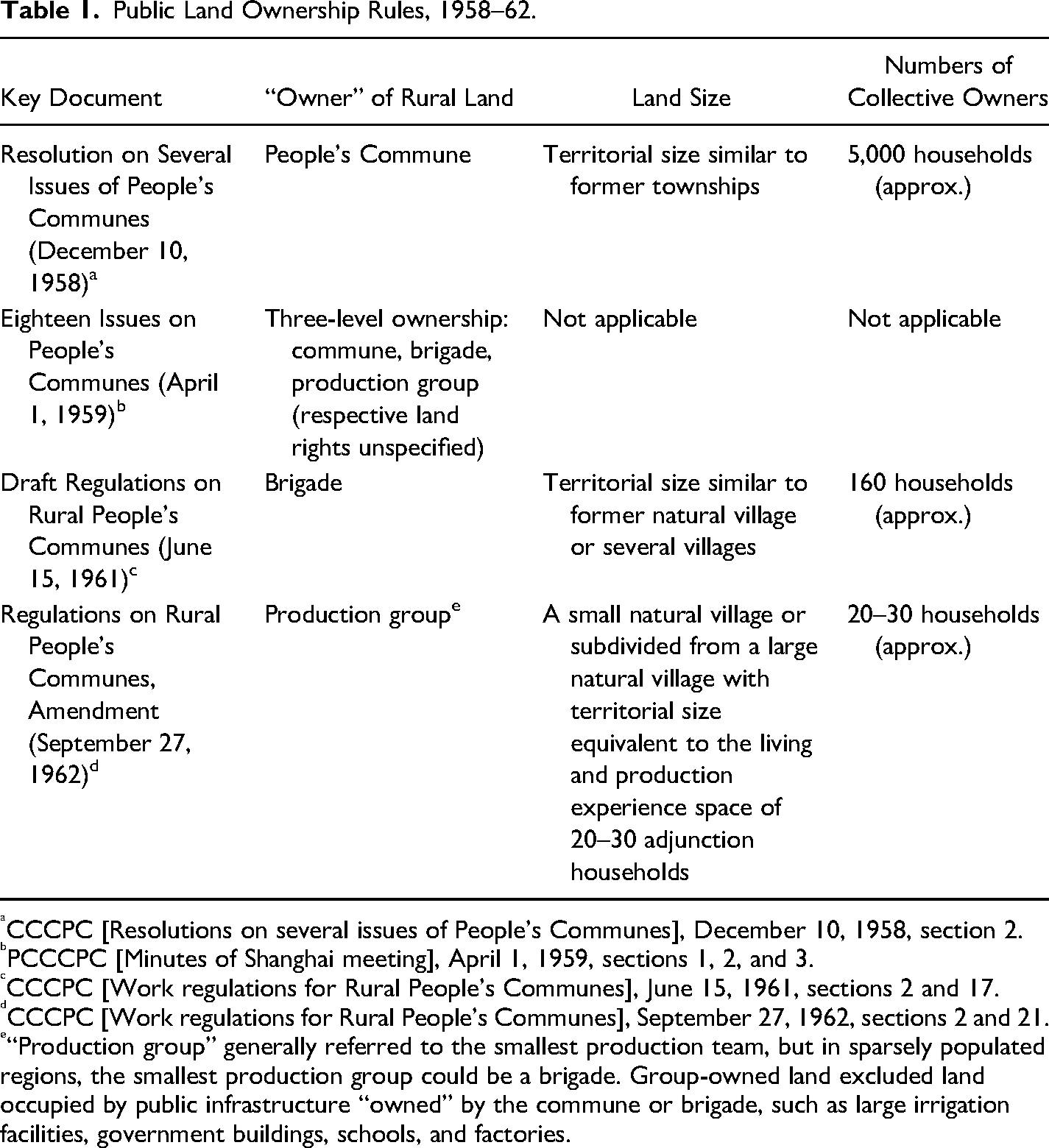
CCCPC [Resolutions on several issues of People's Communes], December 10, 1958, section 2.
PCCCPC [Minutes of Shanghai meeting], April 1, 1959, sections 1, 2, and 3.
CCCPC [Work regulations for Rural People's Communes], June 15, 1961, sections 2 and 17.
CCCPC [Work regulations for Rural People's Communes], September 27, 1962, sections 2 and 21.
“Production group” generally referred to the smallest production team, but in sparsely populated regions, the smallest production group could be a brigade. Group-owned land excluded land occupied by public infrastructure “owned” by the commune or brigade, such as large irrigation facilities, government buildings, schools, and factories.
These four policies from 1958 to 1962 created a set of rules that produced varying rights and obligations for communes, brigades, and production teams. Drawing on Schlager and Ostrom, these rights can be best understood as a bundle of four property rights over common property: (1) “access” rights to conduct agricultural production activities on a specific territory of land and “withdrawal” rights to obtain the “products” of a resource, such as agricultural products and residual income from the land; (2) “management” rights to regulate internal use patterns and transform the resource (e.g., setting production plans and distribution standards); (3) “exclusion” rights to determine who will have an access right, and how that right may be transferred, such as who can gain membership rights and how; and (4) “alienation” rights of members to sell or lease their membership or their share of land and/or its products. 79 These preceding rights created a set of corresponding obligations. Table 2 details the most significant rights and obligations assigned to each entity under each set of regulations.
Rights and Obligations of Communes, Brigades, and Teams, 1958–62.
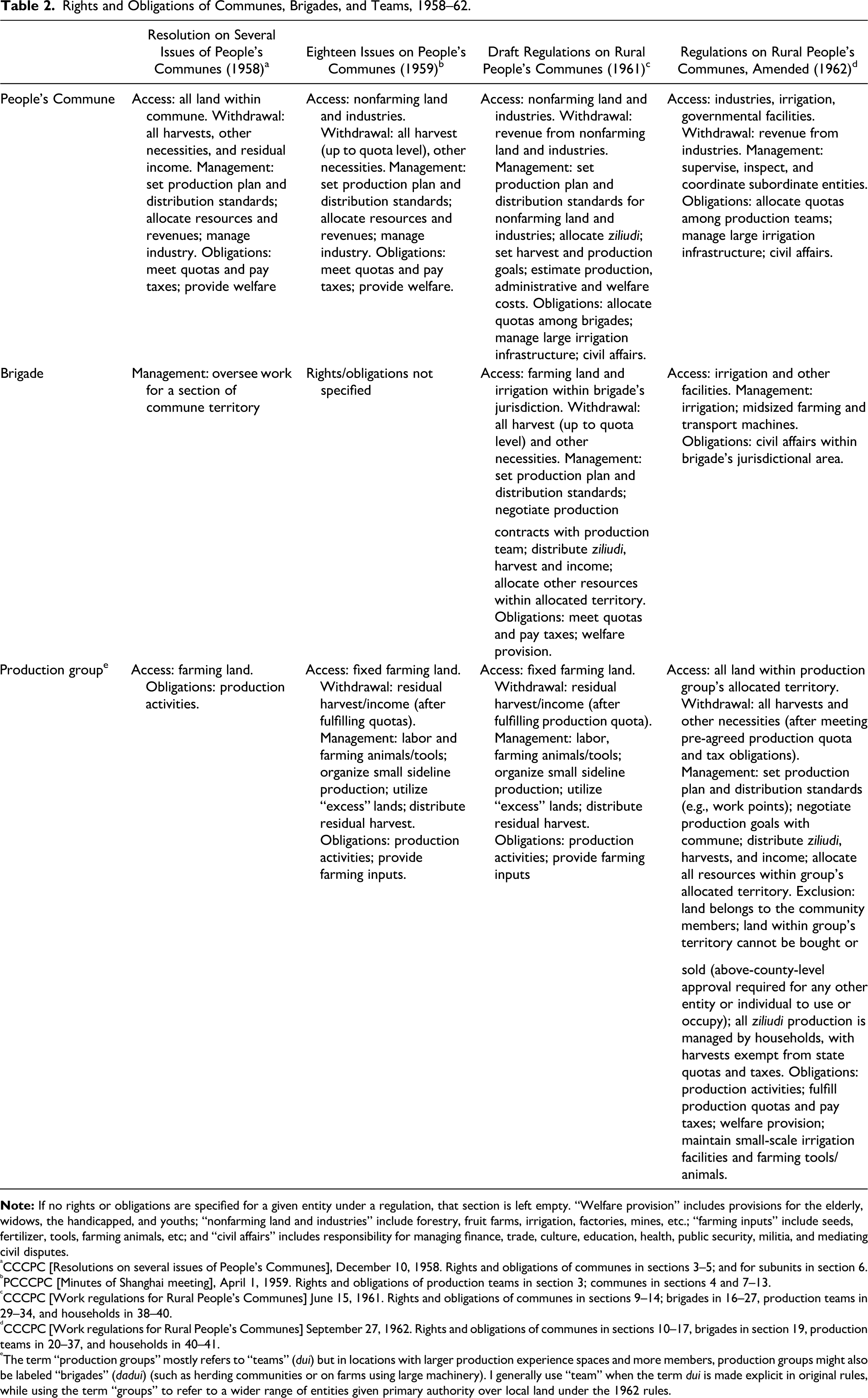
CCCPC [Resolutions on several issues of People's Communes], December 10, 1958. Rights and obligations of communes in sections 3–5; and for subunits in section 6.
PCCCPC [Minutes of Shanghai meeting], April 1, 1959. Rights and obligations of production teams in section 3; communes in sections 4 and 7–13.
CCCPC [Work regulations for Rural People's Communes] June 15, 1961. Rights and obligations of communes in sections 9–14; brigades in 16–27, production teams in 29–34, and households in 38–40.
CCCPC [Work regulations for Rural People's Communes] September 27, 1962. Rights and obligations of communes in sections 10–17, brigades in section 19, production teams in 20–37, and households in 40–41.
The term “production groups” mostly refers to “teams” (dui) but in locations with larger production experience spaces and more members, production groups might also be labeled “brigades” (dadui) (such as herding communities or on farms using large machinery). I generally use “team” when the term dui is made explicit in original rules, while using the term “groups” to refer to a wider range of entities given primary authority over local land under the 1962 rules.
By 1962, these regulatory changes led to the creation of a new type of land ownership: a communal-owned land system nested within rural administrative jurisdictions. 80 Under this system, all members of the production group would equally share part of the output and farming land (as ziliudi) within their allocated territory. 81 Crucially, under the 1962 rules, production groups secured four types of “enduring” (changqi bubian) property rights crucial for common property: rights of access, withdrawal, management, and exclusion. However, no entity (or individual) was awarded alienation rights to lease out, sell off, or forgo their land rights.
Dividing up the Land
To appreciate the significance of the 1962 land rules, we need to recall the core challenge facing Chinese leaders. Having eliminated both the market and private land ownership, how could China's farming land be divided up in ways that the rural population would accept as fundamentally “fair,” given that no two pieces of land are identical? Dworkin explores this problem through a hypothetical scenario in which a group of shipwrecked survivors tries to divide up an unclaimed island equally among themselves. He concludes that without a market mechanism, it is impossible to divide up land equally or even in ways accepted by the group as generally fair. 82 And yet securing farmers’ acceptance was essential since, as Sack reminds us, in settled agricultural societies with limited mechanization like rural China, farmers remain “the embodiment that makes the soil productive.” 83 How then did Chinese leaders solve this conundrum?
Production Experience Space
The key method used to divide up land among rural residents was to allocate a piece of territory to long-established “acquaintance communities” largely in accordance with each group's “production experience space.”
In 1950s China, almost all rural communities still embodied what the anthropologist Fei Xiaotong describes as “acquaintance communities.” “Familiarity,” Fei explains, “is the intimate feeling that occurs in time, in many ways, and often through frequent contact. This is also the feeling formed through countless moments of little conflicts.” 84 These close-knit rural communities shared what the human geographer Tuan Yi-fu describes as “intimate experiences,” which “lie buried in our innermost being so that not only do we lack the words to give them form but often we are not even aware of them.” 85 Chinese farmers’ intimate, repeated interactions created a shared experience of local territory, what Tuan calls a “common experience space”: a specific territory that members of the community know better than anyone else outside of the community. Members of the community also had living, social, and trading experience spaces that were different in size and might change over time, similar to the cellular conceptions developed by Skinner and Shue.
The territory where multiple rural families work closely together in utilizing land resources is what I call their production experience space. 86 In premodern societies like rural China, this includes the realm within which a group of families must cooperate to utilize local resources, such as constructing and maintaining farming fields, irrigation canals, and local paths, sharing large livestock, pooling their labor, and controlling insects. Generally, the number of families within these groups and the size of their production experience space is limited by the type of production (e.g., herding groups have more members and require larger territories than paddy rice growers). This space is, however, location specific. Unlike administrative jurisdictions, Chinese farmers’ production experience space was not abstract and homogeneous, but located, relative, and varied. As Tuan reminds us, while peasants generally do not use maps and are often unaware of the territorial boundaries of political jurisdictions, they know their living and production space, its boundaries, and their land's productive capacity quite well. 87
The production teams that received the primary land ownership rights under the 1962 land rules were generally composed of groups of 20–30 households, groups that were more likely to share the same production experience space than the 160 households that made up a brigade. My primary sources of work journals, account books, and a diary derive from two such typical villages: Qian Pangjiazhuang (QPJZ) in Shandong, and Lujing Township in Shanxi province. During collectivization, QPJZ was made a brigade with five production teams, while Lujing was divided into several brigades and subdivided into twenty-two production teams. 88 The majority of QPJZ households shared the clan surname of Pang. 89 Team members’ relationships were even closer, evident in their shared generational names, indicating they were either cousins or brothers in an extended family within the larger clan. 90 Many Lujing residents shared the surname of Hou and were very familiar with other members of their production team. For instance, Hou Yonglu's diary includes his production team's distribution plan, which listed only first names, indicating a high level of familiarity among team members. 91
Under the communal land ownership system, both QPJZ and Lujing followed similar patterns of team and land allocations. QPJZ village divided its one hundred families into five teams, allocating similarly sized (but not identical) territory to each team. Despite population growth, these family-based groupings and territorial allocations remained consistent through the late 1970s. 92 After 1962, Lujing divided its 680 households into twenty-two teams, with each team also allocated similar, but not identical, sized territory. 93 Like QPJZ, Lujing's teams and their territory allocations remained consistent through the late 1970s and beyond. 94
Other studies of Chinese villages during this period yield similar findings. 95 As Parish and Whyte found in their Guangdong sample, “The production team is a village neighborhood or a single small village. … A typical team contains 30–40 households (150–200 people) with 5–30 hectares of land. … The new collectives and the subsequent brigade and team units tended simply to enclose old villages and lineages.” 96 Chan, Madsen, and Unger similarly found that “in 1961, Chen village was divided into five production teams, each composed of forty neighboring families. Each of these teams received property rights over a fifth of the village's lands.” 97
Remarkably, maps were generally not used to indicate these land boundaries. Instead, villagers relied upon the traditional sizi method to indicate approximate boundaries. As a result, anyone not from the local area—including higher-level officials—would be unable to identify the territory allocated to each village group. For instance, in handwritten documents used in August 1964 by the Xincun Brigade (in Shandong province), brigade officials created and filled in forms that recorded the territory allocated to individual production teams. They created categories indicating the type of land allocated and its approximate size, while using the traditional Chinese sizi (or “four boundaries”) style to mark the group's territorial boundaries. For instance, the sizi report denoted the following boundary markers for “Production Team 3's cow shed”: East: “team's land”; South: “Mama Song's house”; West: “road”; North: “team's land.” 98
These handwritten records show local land allocation in process. The use of commonly accepted markers for approximate boundaries of each group's territory in ways that could only be understood by locals suggests a common understanding over territorial boundaries shaped by each parcel of land's distinctive attributes. 99 Land demarcation in line with these small groups’ established production experience space made it easier for local communities to understand, mutually recognize, and accept the land distribution as generally “fair”—despite the inevitable disparity across different parcels of rural land. 100 For instance, a rural group with thirty households that “owns” 250 mu (17 hectares) of land in Hunan province that they have farmed for a long time would, under this new system, not feel it unfair even if a thirty-household group in Inner Mongolia were allocated territory the size of Singapore.
By following such traditional groupings and territorial boundaries in allocation decisions, the CPC facilitated general acceptance of the communal-owned land system. As Rasmussen and Lund explain, “Rules seem more legitimate if they resemble already existing rules; then the work of legitimation has already been done.” 101
Exclusivity of Group Land Rights
While sustaining the overall public land ownership regime, the 1962 land rules offered village groups new “exclusivity rights” over their traditional territory. Property exclusivity, Kornai explains, means that “a non-owner may use an owner's property only by permission.” 102 Exclusivity requires that land is owned by a specific group of people. To help the group resist territorial claims by nonmembers, rights should be member-specific, with territory clearly demarcated and an official state record specifying the group's rights over its territory—all elements present in the 1962 land rules.
Before 1949, Chinese farmers’ primary risk of losing land—aside from wars and natural disasters—came from changes in their individual circumstances such as financial difficulties, poor weather, or loss of work capacity due to aging or sickness. Following the creation of a public land regime, farmers risked losing their land, its products, and any residual income because of administrative fiat. Bureaucrats could easily shift land from one entity to another, or even create entirely new entities. Yonglu's diary, for instance, describes how in 1956, one community's traditional land was transferred to another entity during the creation of higher-stage cooperatives. The dispossessed farmers responded by cutting down all fruit trees on that piece of land overnight. 103 The property rights produced by the 1962 land rules increased the difficulty of such administrative transfers.
Certainly, given the overarching authority of the state, the risk of bureaucratic intrusions remained. Yet the 1962 land rules bolstered farmers’ confidence that their group would retain authority over its allocated territory, strengthening group solidarity and encouraging inner-group cooperation. As Parish and Whyte conclude, “Collectivization gave all sorts of villages and neighborhoods a new degree of corporate interest in protecting what is theirs.” 104
Assessing and Paying Taxes
Having allocated territory and offered some autonomy to village groups, the state still faced a crucial challenge: assessing and collecting taxes. As Levi explains, given the limitations of relying exclusively upon coercion, all successful states must secure at least “quasi-voluntary compliance” with taxation obligations. 105 How then did the 1962 rules help to create and maintain Chinese farmers’ compliance with tax obligations?
Under the 1962 land rules, small groups of farming families secured substantial autonomy and control over an allotted territory in exchange for meeting a pre-agreed production quota set by the state. This production quota was essentially a tax, assessed on the total quantity of harvest produced by each group from group-owned land (usually an average over the past three to five years). As Parish and Whyte explain, “The amount of grain a team is obligated to sell within contract is set in negotiations every three to five years. On the basis of the amount produced in the preceding three to five years, the contract specifies what can reasonably be produced in the coming three to five years and turned over to the state.” 106 By 1967, Donnilthorne explains, commune leaders’ role in agricultural planning “now consist[ed] mainly of allocating these tax and sales quotas between the constituent units of the commune.” 107
Importantly, these tax (or quota) levels were based primarily upon the amount of productive land that had been allocated to the production teams. As Oi reports, “No one ever gave the agricultural tax as a percentage of production; it was always expressed as fixed amount per mu.” 108 Being allocated more high-quality farming land thus meant that a group had to pay more taxes, which undoubtedly reduced contention over groups’ land allocations. Further adjustments in each year's tax (quota) levels were possible through negotiations. As one villager told Shue, “Teams and brigades would argue back and forth (zhenglai zhengqu) to get their quota reduced a little.” 109
From the state's perspective, the post-1962 taxation arrangements greatly reduced its informational needs. Under the “grand contract” (dabaogang) system, each production group assumed responsibility for fulfilling their own quota obligations based on their allotted land. The state's bureaucratic system, which stopped at the brigade level, only needed to negotiate the annual production quota assigned to each group and so required far less information about individual practices and local conditions. QPJZ's files, for instance, show that while each group's account books included complicated planning and redistribution information, the brigade-level records contained only a summary of each group's population, resources, and production data. Products from ziliudi were not recorded at all. 110
For economic planners, being able to treat each group within their specific territory as a separate, autonomous entity greatly eased the informational challenges of implementing a planned economy within an agricultural sector—a particularly demanding task given China's disparate, diverse family farmers and settled rural communities. For centrally planned economies, these informational demands are incredibly high since, as Kornai reminds us, “the plan is a monumental piece of bureaucratic coordination aimed at prior reconciliation of the processes of the economy.” 111 Treating each group as a territorial, “taxable” unit not only greatly eased these informational challenges but also facilitated administrative coordination between different levels of the state bureaucracy on exchange and extraction decisions.
For production groups, the 1962 land rules provided them with autonomy to plan and organize farming practices within their local territory, to manage and distribute that land and its harvest among themselves, and to retain “excess” production beyond the state's quotas. These rights encouraged farmers to cooperate with their neighbors. As Hou Yonglu, the Shanxi farmer and group accountant, wrote in his diary, Now the production team finally has autonomy (zizhuquan). Since we have signed a “grand contract” (dabaogang) with the state, as long as [the group] meets the state's grain quota, group members can produce more, and retain more and eat more. This greatly increases everyone's enthusiasm for work.
112
In exchange for allowing small groups of farming families the autonomy to make farming, allocation, and redistribution decisions regarding their land and harvest, the farmers paid taxes—in the form of meeting their assigned production quotas—to the state. As Martin et al. explain, “In exchange for recognized valuable property rights in land and other entitlements, people recognize the political power of the institution by payment of tax in the form of money, tribute, labour, allegiance, or other resources.” 113
Rural Groups’ Operational Rules after 1962
The 1962 land rules also created structural conditions that encouraged village groups to establish their own operational rules, which in turn encouraged cooperation among group members on collective production and distribution. This dynamic is best understood by adopting Ostrom's analytical framework developed to capture how institutional structures can encourage cooperation between individuals in a common pool resource (CPR) setting. By examining the similarities among enduring, self-governing CPR institutions, Ostrom generated eight design principles that help explain the success of these institutions in sustaining the CPRs and securing compliance by “appropriators”—people who utilize the common resources.
Although Ostrom does not include farming land as an example of a CPR, the attributes of the groups she studied that sustained cooperation in using CPRs are remarkably similar to those of Chinese rural “acquaintance communities.” 114 Ostrom found that these communities were generally stable, enduring populations who lived and worked within uncertain and complex natural environments. “These individuals,” she notes, “share a past and expect to share a future. They live side by side and farm the same plots year after year. They expect their children and their grandchildren to inherit their land. In other words, their discount rates are low.” 115 They generally develop extensive norms defining appropriate behavior, enabling individuals to live in close interdependence without excessive conflict. Participants also tend not to vary significantly in assets, skill, knowledge, ethnicity, race, or other variables that could strongly divide a group.
Given the group similarities and their similar need to cooperate in using shared resources, we would expect to also find Ostrom's eight principles evident in the operating rules developed among Chinese rural groups after 1962. Her design principles are (1) clearly defined boundaries, (2) congruence between appropriation and provision rules and local conditions, (3) collective-choice arrangements, (4) monitoring, (5) graduated sanctions, (6) conflict-resolution mechanisms, (7) minimal recognition of rights to organize, and (8) nested enterprises. 116
For Ostrom, “defining the boundaries of the CPR and specifying those authorized to use it can be thought of as a first step in organizing for collective action. For any appropriators to have a minimal interest in coordinating patterns of appropriation and provision, some set of appropriators must be able to exclude others from access and appropriation rights.” 117 As explained above, the 1962 rules demarcated specific territories to rural acquaintance communities according to their production experience space, thus meeting Ostrom's first “foundational” design principle. The remainder of this final section explores other operational rules developed and applied by Chinese rural groups to assess if they conform to Ostrom's other design principles. The examples below are drawn from my own primary research as well as from a range of scholarly studies on rural institutions and individual villages across diverse regions of China. 118
Rules on Land Distribution
The major difference between land and other common pool resources is that land can be divided. As explained above, under the 1962 group land rules, teams were given the autonomy to allocate between 5 and 7 percent of the team's farming land to its members equally, labeled ziliudi (literally, self-retained land). The operational rules on distributing ziliudi generally conform to two of Ostrom's design principles: (2) congruence between local conditions and rules of appropriation and provision and (3) collective-choice arrangements. 119 For the China case, these principles suggest that land division decisions should reflect local conditions and that group members should collectively be involved in making these decisions. Both generally held true in group decisions over ziliudi.
First, each group decided which lands and what percentage of their farming land should be distributed to group members as ziliudi (from 5 percent to 15 percent), enabling them to adjust their provision rules to suit local conditions. 120 Second, production groups distributed ziliudi universally to all group members, regardless of individuals’ gender, age, capability, or class orientation. 121 This collective-choice arrangement ensured that distribution of ziliudi involved everyone in the group. This universal distribution of land generated what Ostrom labels “distributional effects” by helping encourage participation in collective farming while bolstering members’ collective identity within their group. 122
While no individuals received the exact same quality or quantity of allocated land, all rural residents gained—on the basis of their membership in a production group—universal and equal access rights to their group's land. Universalism and equity, Baldwin explains, are “solidaritistic” principles that tend to expand popular support for policymakers’ efforts to distribute public resources among different social classes. 123 In this case, universal and equal distribution of ziliudi encouraged farmers’ acceptance of the system.
For Yonglu, the ziliudi proved essential. As he wrote in his diary on February 24, 1962, We have six people in my family [Yonglu, his wife, mother, and three young children]. My mother can only cook and take care of the three children. My wife participates in collective agricultural production. She also makes and washes clothing along with all other domestic chores. According to the collective distribution standards based on work points, only my wife and I can gain work points through collective work. I have been worried that because my family has a small labor force, so our family would face great difficulties if the team only distributed food according to labor work points. … Then I thought about it again. The work point based allocation is only applicable for collective work, but ziliudi is allocated based on population and does not depend on ability, gender, age or class. Every man, woman, or child in the team gets 0.2 mu of land. Therefore, even though my children cannot earn work points, they will receive the same amount of ziliudi as adults. All ziliudi will yield similar levels of grain production, but children will consume less than adults. Therefore, if our family makes the full use of the ziliudi, these products will supplement our family's overall income.
124
After the demarcation of the production team's land and distribution of ziliudi to team members by the summer of 1962, Yonglu's family dramatically increased its agricultural production. By the fall of 1962, his family had produced more than 115 kg of wheat, 500 kg of sweet potatoes, and 70 kg of rice from his family's ziliudi. Their family was also allocated 1,000 kg of wheat and 910 kg of sweet potatoes from the production team. The harvest from their ziliudi thus accounted for one-third of their family's grain. 125 With this new system, his family finally had enough food to make it through the winter. 126 The ziliudi also encouraged greater participation in collective farming. As Yonglu wrote, “Production team members love this ziliudi system, and so production team leaders have almost no difficulty in ensuring that members work hard (to complete the production team's contractual obligations).” 127
Rules on Harvest Distribution
“Collectivization,” Parish and Whyte noted in 1978, “led to new patterns of cooperation. . . . Today by far the greatest amount of cooperation is simply within one's own production team. There is less need to mobilize kinsmen outside the village simply because the cooperation of fellow villagers is guaranteed by the collective interest everyone has in the success of the harvest.” 128 The reason for this shared interest is that the majority of the harvest was distributed within groups, after meeting state quotas and paying the agriculture tax. 129
According to QPJZ's records, the remaining harvest was divided in three ways: (1) distributing a percentage universally to all members (with adjustment for different ages of children); 130 (2) distributing a percentage based on the work points earned by group members; (3) keeping a small percentage in reserve for hard times, for seeds and animal feed, and other exigencies. These rules on collective farming and distribution accorded with Ostrom's design principles 2 and 3 (alignment with local conditions and collective participation in decision-making) in that these rules were related to group members’ capabilities and the group's harvest for the year, and since these decisions were made collectively at the group level.
Each group would decide the percentage of the harvest for each type of distribution based on their local situation. 131 In general, most groups seem to have distributed between 65 and 75 percent of the total remaining harvest via universal distribution. In QPJZ, for instance, after meeting the state quota, 70 percent of the primary agriculture products were distributed universally, even though only a small percentage of members participated in collective farming activities. The remaining 25 percent of products were distributed according to work points for members who did collective farming and other nonfarming tasks for the group, with 5 percent held back for emergencies the group might face. 132 This approach to distribution enabled the group to meet all members’ basic needs while rewarding more to families who contributed more labor to the collective. 133 Universally distributing part of the harvest would have had “solidaritistic” effects similar to the distribution of ziliudi, thus bolstering support among all members, while the distribution based on work points would encourage and reward contributions to collective farming tasks.
Each group also had to develop its own rules identifying various job roles, work points awarded for each task, and the associated level of agricultural outputs to be awarded each worker. 134 Li's study, for instance, shows how Number 11 Production Team of Qin village used the difficulty of the task to determine the work point standards awarded for twenty major tasks. 135
Naturally, not all members of a production group were laborers; many were elderly, children, or handicapped. In QPJZ, for example, only half of its members were counted as laborers, and only half of these laborers worked on collective agriculture production (the other half worked at home or on noncollective production tasks). 136 On average, each of QPJZ's five groups had only 20 percent of their laborers participating in collective agricultural production. Many members filled other roles. Team 1, for instance, recorded eleven different types of workers: chefs, teachers, medical personnel, salespeople, road repairers, veterinarians, forest managers, child care workers, kiln workers, woodworkers, and miners. Team 4 recorded the following positions: coal miner, station guard, gardener, house builder, carpenter, tailor, and midwife. Each group internally documented individuals’ contributions and allocated appropriate work points. 137
Local labor diversity also meant that, after fulfilling its share of the state quota, each team was able to fine-tune its production activities based upon its group's relative advantages and specific needs. 138 Within a small acquaintance community, such tasks could be more easily allocated in line with individuals’ capacity, with members accepting these allocations as generally fair. Having some members, such as women or the elderly, taking on child care and other household responsibilities would also be more easily understood as a labor contribution by extended family members and long-standing neighbors. 139
Having more local authority over farming decisions also improved efficiency, as groups could adjust their plans to suit local realities. QPJZ, for instance, had three types of land: mountains, hills, and lowlands. Although the brigade's five teams divided all three types of land roughly equally, each team's land quality still varied. Each team planted approximately ten nonmandated crops for internal distribution among their members, though the types and amounts varied based on their territorial and labor conditions. 140
Rules about Monitoring and Sanctions
Ostrom finds that communities that successfully share collective resources over a long time tend to develop means of monitoring and sanctioning implemented by the participants themselves, rather than by external authorities. “The appropriators in these CPRs somehow have overcome the presumed problem of the second-order dilemma,” namely, the problem of free riding (or, in this case, not working on collective tasks). 141 Interviews with farmers from different villages across China show evidence of diverse but effective approaches to mutual monitoring among villagers and their use of graduated sanctions. 142
Thaxton's interview with Bao Jieshi in Da Fo village (Henan province) provides a telling example of mutual monitoring and of how groups used norms to encourage cooperative behavior: Bao Jieshi: During the collective years, everybody on the production team knew everyone else, and everyone also knew how important and urgent the work in the collective fields was during the busy season. Most people depended on the collective for their grain; so during the busy season, one did not take days off without asking for permission. Still, one had to be reasonable; one did not work for the production team leader or for the state only. One worked for oneself. If you took days off and made money for yourself, that was alright. If you did too much of this kind of shrewd business activity and took advantage of your friends and neighbors, however, you could not expect respect from others.
143
Thaxton's example is mirrored by Parish and Whyte's 1978 finding that farmers pursue “cash income activities, but they do so for the most part outside of the time required for regular participation in team labor.” They thus concluded that “the collective sector does provide sufficient incentives to motivate peasants to meet their obligations there.” 144
Group members also developed various means to monitor group leaders and to sanction (through criticism) leaders when members sensed they were not being treated fairly. One of their most important concerns was the allocation of work points, because of its key role in determining agricultural output redistribution. One of Li's examples from Qin village (in Jiangsu province) illustrates this dynamic: All team members checked the bulletin frequently. Some women checked it almost every day to make sure that their hard-earned points were credited. Barely literate, they were nevertheless able to identify their name on the form or at least remember the line where their names were located. They also had no problem reading Arabic numerals and therefore could check their work points for any date. From time to time, the team members felt frustrated when they found that their points were missing or incorrect. It was no wonder that the members often complained at the meeting that “too many work points are missing.”
145
Work point allocation was also adjusted to suit local conditions by incentivizing certain essential tasks. These incentives (essentially the reverse of a sanction) were adjusted strategically by team leaders, as Li explains: It should be noted that in practice these standard rates only served as a guideline. When assigning tasks and recording work points, the team leader had to modify the rates, taking into account several other factors. One was the changing difficulty of the task. For instance, consider catching bollworms. During the first few days, when the bollworms remained out of control, team members earned one work point for every 100 worms caught. Later, as the worms became more difficult to locate, the rate was adjusted to 70 worms, and finally to 30 worms for one point. The distance of the worksite also affected work point rates. If a man delivered river sludge to a distant place, for example the reward would be increased from 7 to 8 points per cubic meter.
146
These incentives were often shaped by group leaders, who designed rules to reward collective participation. As one Da Fo village leader reported, Pang Tinghua recalls: During the Cultural Revolution years, I was the head of the third production team. At that time, I made a rule. Everybody was allowed to participate in the Cultural Revolution on one condition, which was that they had to do it at night. If they wanted to make revolution during the working hours, they would not get work points, and if they did not get their work points, they would not be able to get as much grain as those who worked in the fields. My rule did not intend to interfere with people's desire to make revolution, but I had to make sure that production was not adversely affected so that at harvest time every member of the team would get enough grain to survive.
147
Conflict Resolution Mechanisms
Ostrom also finds that communities that cooperate in utilizing common pool resources tend to develop ways to resolve conflicts within and across groups. As noted above, most Chinese villages were “acquaintance communities,” forged in part through “countless times of little conflicts.”
148
While some conflicts were not so little, the process of coming into conflict and then resolving the issue helped strengthen in-group collective identity while reinforcing boundaries and understandings with neighboring groups. Gao offers a poignant example of this dynamic in Jiangxi province: Gao Village's dispute with Lai Village was primarily over a small narrow ditch which channels rainwater from higher places to a lower paddy field that belongs to Gao Village. This had been the practice for generations. In 1970, Lai Village attempted to block the ditch so that the rainwater would flow in the opposite direction, to its own paddy fields. Each time this happened Gao villagers would clear away the blockage. This went on for some time until finally the two villages had a battle, fighting with fists, shoulder poles and shovels, with a dozen villagers on both sides wounded. . . . Eventually each village paid its own medical expenses and the ditch in question remained as it always had been.
149
In this instance, the ditch was the boundary marker between the two groups (using the traditional sizi methods explained above). The conflict between the two groups over this boundary was resolved by the two parties directly, without officials’ involvement, with the process and outcome reflecting local conditions and common understandings.
Groups as Nested Enterprises
As explained above, a core element of the 1962 rules was the principle of “three level ownership, [with the] team as the base.” While shifting key ownership rights over land down to the production team level, this policy acknowledged the important contributions made by commune- and brigade-level officials to managing larger collective resources (e.g., irrigation infrastructure or large farming machines). Even after 1962, production teams’ lands were embedded within these larger administrative jurisdictions and reliant upon them to maintain and ensure equal access to crucial natural resources. Among the most important resources were the irrigation canals essential for rice production throughout central and southern China. The ways in which production teams were “nested” within brigades and communes thus closely mirrors the Spanish Huertas, described by Ostrom as an example of “nested enterprises”: In the Spanish Huertas, the fundamental organizational unit is the tertiary canal. The cost of organizing a group of farmers living near to one another and appropriating directly from the same canal is considerably less than the cost of organizing a large group of farmers, many of whom never come into direct contact with one another. But once the smaller units are organized, the marginal cost of building on that organizational base is substantially less than the cost of starting with no prior base. Several of the Spanish Huertas are three or four layers deep.
150
In sum, Ostrom's framework helps explain when and why self-interested individuals can cooperate to utilize common pool resources. As she concludes, Appropriators who think that a set of rules will be effective in producing higher joint benefits and that monitoring (including their own) will protect them against being suckered are willing to make a contingent self-commitment to follow the set of rules they devised in all instances except dire emergencies if the rest of those affected make a similar commitment and act accordingly. Once appropriators have made contingent self-commitments, they are then motivated to monitor other people's behaviors, at least from time to time, in order to assure themselves that others are following the rules most of the time.
151
These conditions were reflected in the operational rules developed by Chinese village groups, helping to explain why villagers were willing to cooperate in collective farming after 1962. Village groups’ land boundaries and rights were clearly understood by adjunction groups and recorded by state authorities (Ostrom's principles 1 and 7). Within their allocated territories, villagers designed their own operational rules and conflict resolution mechanisms based on local conditions (2, 3, and 6); and enforced using graduated sanctions (5) by group members and/or by a team leader who is accountable to the group (4). By addressing the challenges of commitment and monitoring in an integrated manner, these operating rules created structural conditions that incentivized farmers’ participation in collective production and distribution.
Significantly, after 1962 China's grain production began to recover from the famine, first returning to 1957 levels and then sustaining modest growth over the next two decades.
According to official national data, rice yields (catties per sown mu) began falling from 359 in 1957 to 338 in 1958, then 319 in 1959, and reaching lows of 269 in 1960 and 272 in 1961, before beginning to rise again (312 in 1962, 355 in 1963, and 374 in 1964). From 1966 to 1977, yields ranged from 410 to 480, finally reaching 530 in 1978. Wheat yields show a similar pattern. 152 Eisenman also points out that rising agricultural production fed the fast-growing Chinese population, which rose from 830 million to 975 million during the 1970s. 153 As Parish and Whyte explain, “On the question of production output, it appears that, except for the Great Leap interregnum and for minor year-to-year variations in the 1970s, steady progress has been made. Though seriously interrupted by the Great Leap Forward, this pattern of growth is quite acceptable in comparison with that of other countries.” 154
Conclusion
Establishing new land rules is often a central part of how a modern state is constructed and sustained. Traditionally, imperial authorities in China relied upon bureaucrats and the gentry class to collect taxes by permitting and maintaining their control over land. In striving to establish a modern, socialist state, the CPC deployed a territorial strategy, using first indirect and then direct territorial methods to reshape land control in rural China. A protracted, contested policy process culminated with the creation of new land rules that established a new public property form: the communal-owned land system. Under this system, small groups of rural households secured substantial autonomy and control over an allotted territory in exchange for meeting a pre-agreed production quota set by the state. The key method used to divide up farming lands among rural residents was to allocate a piece of territory to long-established acquaintance communities largely in accordance with each group's production experience space.
Implementing the communal-owned land system created millions of groups as viable taxable units. It greatly reduced transaction costs in planning and administrative coordination for revenue extraction, helped restore agricultural production, and integrated rural society into the centralized planned economy. The 1962 land rules provided rural communities with meaningful rights over their customary lands while creating structural conditions that encouraged village groups to establish their own operational rules to encourage and reward cooperation among group members on collective production and distribution. Created amid an era of extraordinary instability, this system helped create a quasi-voluntary compliance situation, contributing to the restoration of agricultural production and rural social stability while facilitating the state's extraction of resources to support urban industrialization—all within the planned economy.
Examining China's tumultuous experience with adopting the 1962 land rules helps broaden our understanding of the range of possible rural land governance arrangements in modern societies. Two modes of land ownership have dominated rural land governance arrangements: private ownership and state ownership. The case of China's 1962 land rules points instead to the potential for communal-owned land ownership arrangements to facilitate effective governance, economic development, and community cooperation over land.
In premodern agrarian societies, rural communities generally have their own, unique production experience space and a set of shared unwritten rules regarding their land and other resources. When a modernizing state seeks to rapidly advance economic development across such rural regions, the state tends to create and impose new, standardized land rules, often designed to facilitate resource and/or revenue extraction, which clash with these established local practices. The distinctive aspect of China's 1962 land rules is that the central state created formal (de jure) land rules that aligned with preexisting informal common understandings by dividing rural land in accordance with local communities’ production experience space. The China case thus suggests that governance transaction costs amid modernization can be reduced if the state creates formal land rules that align with preexisting de facto local rules.
Demarcating rural land in accordance with traditional acquaintance communities’ production experience space and granting land rights to those communities also created structural conditions that enabled rural communities to develop their own operational rules that facilitated internal cooperation to utilize their land or resources and to share the output among themselves. The China case thus extends the conditions under which Ostrom's model for when and how people can cooperate to share common pool resources can be applied to explore the potential for people to share land and its resources.
Epilogue
This article has explored the origins of China's 1962 land rules and the operations of the subsequent communal-owned land system under the planned economy. By the early 1980s, as part of the era's dramatic changes in Chinese society, politics, and economy, the household responsibility system (HRS) was promulgated across rural China. 155 While the emergence, spread, and implications of the HRS have been widely studied, the degree to which the HRS was based upon the 1962 rules has largely been overlooked. 156
Crucially, the 1962 rules had already identified the group of member-households and the territory of land that could legitimately be allocated by the group to its members, and they had established a socially accepted distribution standard. 157 The HRS built upon this structure by dividing up each group's communal-owned farming land among all member-households, using the same allocation principles applied to ziliudi under the 1962 land rules (namely, that each group member received an equal share of the group's farming land), with individual households now responsible for managing the family's allocated piece of communal-owned land and for meeting the corresponding quota and tax obligations. 158 In 1961–62, the “grand contract” system (dabaogang) allocated key land ownership rights (namely, access, withdrawal, management, and exclusion) to village groups along with corresponding obligations. 159 The HRS transferred three of these four rights and obligations down to individual households while gradually permitting partial alienation (e.g., the right to lease out farmland). However, under the HRS, the right of exclusion remained at the communal level, which meant that nongroup members were still prohibited from receiving a distributed share of the group's communal-owned land. 160
Over the past forty years, the total amount of communal-owned land has shrunk while rural households’ four key rights over their communal land have been undermined by urbanization, marketization, and ongoing changes in land rules. The spread of urbanization across rural China—driving industrial and suburban growth on former farmlands—has largely been facilitated by first relabeling collective land as “state-owned land” and then issuing financial or other types of settlements to all group members in exchange for the loss of their group's land. 161 As important studies show, the Chinese government has also actively promoted the scaling up of agriculture, relying upon “a combination of market mechanisms and administrative measures to transfer farming land into the hands of large-scale operators—big households, agribusiness companies and nominal cooperatives—through inverse contracting, land trusts and the formation of land-based joint-stock entities.” 162 The amount of household farmland transferred to these companies more than tripled between 2009 and 2013, from 13 million mu to 39.2 million mu; by 2016, the proportion of farmland formally transferred to these large-scale operators reached over 415 million mu. 163 Many of these practices eviscerated land boundaries established under the communal-owned land system, disconnected community members from their living and production experience space, and eroded rural households’ rights of access, withdrawal, and management over their traditional land.
Despite these dramatic changes, the right of exclusion established under the 1962 land rules remains part of China's formal legal structure, as reflected in the court case that opens this article. 164 For rural households who have retained their communal-owned land, the land has played an important “shock-absorbing” role when rural-to-urban migrants face rapid, unexpected mass unemployment during economic crises. 165 The communal-owned land system also played an important role in helping rural China respond to COVID-19. 166
In 2016, the Chinese government announced its intention to begin a “Reform of the Rural Collective Property Rights Regime.” 167 As part of this process, the central government conducted a three-year survey (cited in this article's opening) that concluded in 2020 that 2.385 million village groups (with 800 million members) still collectively own some 45 percent of China's total land mass. 168 In 2021, the central government began to formulate new rules for rural collective economic entities. 169 This policy process is reengaging fundamental questions regarding collective rules and ownership, including what is a collective entity (e.g., village group, administrative village, township, and/or business cooperative) and who are its members, what types of collective property exist (e.g., land, facilities, and other resources), which entity owns what collective property, and what rights does an entity and its members have over its collective property? Policymakers’ answers to these questions, which are still emerging at this writing, will prove crucial for the future of social stability, community cooperation, and governance across rural China.
Footnotes
Acknowledgments
I would like to thank the editorial board of Politics & Society for their comments on earlier versions of this article, especially my coordinating editor Joel Andreas, which resulted in substantial improvements in this essay. I also profited from valuable comments and suggestions from Robert Ash, Timothy Cheek, Jane Golley, Mobo Gao, Bates Gill, David Goodman, Jamie Reilly, Frederick Teiwes, Wen Tiejun, and Jon Unger.
Declaration of Conflicting Interests
The author(s) declared no potential conflicts of interest with respect to the research, authorship, and/or publication of this article.
Funding
The author(s) disclosed receipt of the following financial support for the research, authorship, and/or publication of this article: The author received financial support from the School of Social and Political Sciences of the University of Sydney for initial field research for this study