




Abstract
Middle-income countries experience various types of migration: transients, emigrants, refugees, and returnees. Their domestic economy is especially influenced by refugees and returnees. Since returnees and refugees vary in access to social policy programs and in skill composition, different types of migration should vary in “threat potential” for social policy demands, with the low-skilled responding more negatively to refugees, while the high-skilled face greater competition from returning natives. We test our argument with original survey data from Mexico, distinguishing respondents’ concerns about two distinct streams of migration: Central Americans seeking refuge in Mexico and Mexicans returning from living in the United States. Surprisingly, we find that the low-skilled's welfare preferences suffer neither type of migration concern, whereas high-skilled Mexicans oppose expanding social welfare when concern about returnees is high. Social solidarity in the welfare state is most depressed by returning natives.
Migration to affluent democracies often seems unidirectional: public attention focuses on instances such as “the Caravan,” migrants from Central America who in late 2018 started traveling north to the United States, 1 or the European “refugee crisis” that escalated in 2015 and is still ongoing, with recurring horrifying tragedies in the Mediterranean. However, the pattern of global migration is variable, and in fact many countries experience a multitude of simultaneous migration streams: transients, emigrants, refugees, and also returnees. Some countries, such as Mexico, are heavy migrant-sending nations. 2 Nearly thirteen million Mexicans—which is more than 10 percent of the population—currently live abroad, and 97.8 percent of them emigrated to work in the United States, many of them sending home remittances or accumulating savings to take back upon return. 3 The migrant corridor between the United States and Mexico is one of the largest in the world and has always seen a circular movement, with a constant inflow and outflow. 4 At times now, Mexicans leaving to return home even outnumber those arriving. 5 As developing countries struggle to provide better social protection for their citizenry, 6 such countries with a “migration revolving door” face growing tensions over a national obligation to attend to returning citizens and the humanitarian obligation to provide for refugees, whose movements are growing in size. 7 Many refugees who come as transients to Mexico to then move further north end up staying because of stricter US border policies. 8 How, therefore, do such different types of migration flow affect sensitive support coalitions for the welfare state?
Empirical evidence on how migration affects public opinion on redistribution and social policies is mixed. Some find moderate support for the welfare chauvinism or economic risk hypotheses, which predict that an increase in immigration will suppress the demand for welfare. 9 But others have identified a positive effect of immigration on support for redistribution and welfare generosity. 10 Notably, though, these studies look at the impact of immigration in advanced democracies. Not only are welfare systems more generous in these cases but also refugee and migrant intake is still higher compared to middle-income countries, which prohibits an easy transfer of theoretical predictions to the welfare state-migration nexus in the Global South. Researchers have only just started to unpack the implications of migration on social cohesion and the welfare state in developing economies by looking at determinants of anti-immigrant sentiments, 11 the potentially destabilizing effect of refugees, 12 or, for instance, the consequences of emigration for the fiscal contract. 13 Nevertheless, some of the conflicting findings might derive from the diversity in migration flows, which has so far received only little attention.
Importantly and in contrast to rich democracies, middle-income countries in the Global South experience large shares of various types of migration simultaneously. In Mexico, emigration and return migration are particularly pronounced, with growing rates of refugee inflow. Not all types of migrants have the same access to public goods and welfare benefits; the composition of their skills varies, and they differ in their ability to access the formal labor market. 14 Mexicans who remigrate to Mexico are better educated and face no particular hurdles in entering the formal labor market, in contrast to refugees from Central America, who have no other option but the informal sector. 15 Mexicans who return have the same access to welfare programs as long-term resident Mexicans; refugees typically do not. Thus, different types of migrants carry different “threat potential” for differently competitive Mexican workers. 16 Factoring in such differences in labor market competition and access to social protection in middle-income countries, the specific question we ask is, How are the social policy attitudes of high-skilled/low-skilled workers affected by the inflow of refugees and Mexicans returning from the United States?
The dualization and welfare chauvinism literature leads us to expect that worries about the depletion of scarce public resources will underlie any reductions in social solidarity. Although a material self-interest rationale should cause individuals to support generous social policy programs if there are worries that increased migration will bring job losses or lower wages, 17 when migrants have access to these programs, costs of social transfers will increase and, at the same time, benefits will have to be shared with a larger group. Support for redistribution and welfare generosity will, accordingly, generally decline as migration increases, but the effect should vary by the type of migrant (refugee or Mexican returnee from the United States) and the skill level of the Mexican nonmigrant. That is, when concerned about US returnees, high-skilled Mexicans should be less supportive of redistribution and social policy expansion than low-skilled Mexicans. In turn, low-skilled Mexicans should be more opposed than high-skilled workers to redistribution and social policy generosity when worried about equally low-skilled refugees arriving.
To test our argument, we use original, randomized survey data on the actively working population from two subnational states in Mexico, Querétaro and Puebla, which are affected by returnees and refugees to the same extent. We exploited the high saliency of public discourse on immigration in Mexico—a classical “migration revolving door” country—in November 2018 to collect our data and asked respondents about their concerns regarding refugees and returning Mexicans from the United States.
Our regression results reveal a robust effect for high-skilled Mexicans (who are already less inclined to favor redistribution from a self-interest perspective): 18 the more concerned they are about US returnees, the less they support the welfare state. But, contrary to our expectation, the low-skilled do not reduce their support when concerns about refugees—the more visible out-group—are high. Our empirical results corroborate the dualization argument, especially for the high-skilled: social solidarity declines when individuals feel an increase in economic insecurity and depletion of scarce public resources. It is the returning natives (former in-group members) who most strongly depress support for the welfare state among the high-skilled, whereas worries about refugees do not reduce social solidarity, despite the potential increased burden on the tax and transfer system. Our study thereby sheds light on the so far understudied welfare implications of return migration.
Our findings imply that migration flows or, more precisely, the resident population's concerns about them, need to be studied more holistically to understand their impact on domestic attitudes toward social policy. As return migration is particularly, although not solely, a migration pattern experienced by middle-income countries, our study contributes to the nascent debate on the effects of migration in less-developed economies. 19 Moreover, because extensive reforms to provide more encompassing social protection programs still lack sufficient agreement, 20 our study identifies return migration as another challenge that may harden the divide within the population and thereby slow down welfare state development in middle-income countries in the long run.
Diversity of Migration
Migration flows to and from emerging economies are composed of various types. We focus on the welfare implications for the domestic economy of migrant inflow: refugees and returnees. 21 In order to theoretically derive the labor market “threat potential” of refugees and returnees for Mexicans, we need to understand the sociodemographic characteristics of the two groups. Borjas established the negative selection hypothesis: low-skilled immigrants will self-select into labor markets with a higher average skill (and earnings) distribution. 22 Migration from Mexico to the United States has grown continuously since the 1980s. Yet, in the 1990s and early 2000s, Mexican immigrants to the United States had above-average education levels, with those with ten to fifteen years of schooling being the most overrepresented cohort, 23 disproving the negative selection hypothesis for our context.
Mexican migration to the United States has always flowed both ways, 24 but the return rate of documented migrants has risen dramatically this century (from around 52 percent in the 1970s and 1980s to approaching 100 percent in 2010). 25 Illegal migrants, however, have become either more likely to stay in the United States—due perhaps to increasingly restrictive border policies 26 —or, for those who were deported, significantly less likely to return to the United States (Schultheis and Ruiz Soto report a decrease of the willingness to return by 80 percent from 2005 to 2015). 27 Education is positively associated with the likelihood of return, but the strongest driver for returns among documented migrants is better access to temporary visas. 28 Returnees, thus, frequently go back and forth, often as a response to domestic economic up and downturns, balancing out negative economic periods in Mexico with work in the United States. 29 Migratory trajectories have many underlying causes; hence, returnees are not a homogeneous group. 30 Migrants seeking to apply their foreign-acquired skill set and to profit from the wage premium at home most often return voluntarily, 31 whereas repatriation for political reasons is more often involuntary. Deportation is not the main return reason for Mexicans. 32 Only 13.5 percent of respondents who had returned from living in the United States indicated that they were deported; the majority (53.8 percent) wanted to reunite with their families. 33 Data from the Mexican Migration Project reveals that Mexicans are on average 40 years old when entering the United States on their last trip and stay around six years before returning. US returnees usually reenter the labor market, but only for a short period of time. 34
It is difficult to quantify returnee inflow, since returnees, as Mexican citizens, do not have to register with immigration offices. The Pew Research Center estimates that, between 2009 and 2014, one million Mexicans have returned from the United States, roughly 200,000 returnees per year. 35
In turn, the concept of refugee is defined by involuntary migration. Refugees do not follow the pattern of self-selection identified in traditional economic labor market models, 36 and they are mixed in terms of their skill sets. Migration from Central American countries through Mexico to the United States has sharply increased in recent years. Asylum applications filed at the US border by Salvadorans, Guatemalans, and Hondurans have soared by 800 percent, whereas applications by Mexicans are steadily decreasing. 37 Emigration from Latin America to the north is driven by poverty, and also network effects. 38 Mexico is currently experiencing an increase in migrants, most of them from Central America. 39 While immigration to Mexico declined steeply during the 1990s and early 2000s, there has been a spike since 2015. 40 Immigrants still make up only a small proportion of the Mexican population (see Figure A in the online supplement) and are few in number compared to returning migrants. 41 Most refugees aim to head north to the United States, but due to increasingly strict border controls, many spend a long period in Mexico before moving on; some even settle in Mexico. Although many refugees are registered and detained at Mexico's southern border, illegal immigration remains severe. In 2017, approximately 300,000 individuals passed illegally through Mexico to the US border. 42 According to census data, 1.2 million individuals were identified as foreigners in 2020, but the Mexican census does not clarify their exact immigration status. 43 The largest group is made up of US Americans; the second largest is Guatemalans, with around 56,000 individuals. 44 Apart from their immigration status, it is also unclear how long these individuals have lived in Mexico already. Although the number of refugees and immigrants settling in Mexico is below the size of migrant intake in advanced democracies, the topic of migration is highly salient and politicized in Mexico. 45
Anti-immigrant Sentiments and Social Policy Preferences
In response to growing waves of migration, the last two decades have seen an increase in research that scrutinizes attitudes toward immigrants, though only a few studies address the implications of migration in developing economies. 46 Four hypotheses to explain anti-immigrant sentiments have emerged: labor market competition, 47 welfare chauvinism, 48 sociotropic threat, 49 and racism. 50
According to the labor market competition hypothesis, opposition to immigration is nourished by the threat of greater abundance of labor and concerns about declining wages. 51 Depending on the skill level of immigrants, domestic high- or low-skilled workers respond with either more supportive or more hostile attitudes toward immigration. Hainmueller et al. emphasize the skill premium, with higher levels of education and training rendering immigrants more acceptable to the domestic population. 52 Malhotra et al. find that in the US labor market competition due to immigration differs in importance by economic sector, so the effect on public opinion is local rather than general. 53 With a large-scale, cross-country experimental study based on survey data, Valentino et al. sustain the finding of the skill premium, but also identify robust empirical support for the “sociotropic economic threat” hypothesis and racism toward Muslim immigrants. 54 The welfare chauvinism rationale, which predicts declining support for the welfare state as a response to increased immigration, too, finds some empirical support. Individuals are sensitive to changes in how tax rates and transfers adapt to the inflow of migration, and the effect is conditional on the skill level of the respondent. 55
Factors that drive anti-immigrant sentiments can similarly affect attitudes toward social policies, as immigration has implications for labor market competition, wages, and the tax and transfer system. In the United States, how individuals think about social policy is strongly determined by their views on immigration, 56 and Gilens identified racism as a powerful driver for attitudes toward the welfare state. 57 Increasing racial heterogeneity is associated with lower levels of public goods provision and dwindling support for welfare generosity. 58 Challenging the welfare chauvinism debate in the Organization for Economic Co-operation and Development (OECD) context, Brady and Finnigan reveal a robust positive effect of growth in immigration and foreign-born populations on support for redistribution in affluent democracies. 59 However, estimation results in Burgoon sustain the argument that redistributive preferences are curbed by migration influx, particularly by economic implications of immigration, but less so through its sociocultural effects. 60 Support for welfare policies can be undermined through fear that immigration affects fiscal costs, as migrants pay less into the system and rely more on social transfers. 61 The tax burden effect seems particularly important in Latin America, 62 where tax revenue is already limited. Racism based on nationality may be a weaker driver here, because of greater cultural and phenotypical similarities within the region and the prevalence of Spanish as a shared language. Racism might unfold more strongly along ethnic lines (e.g., against the indigenous), but anti-immigrant sentiments are undoubtedly present. 63
The accumulating evidence in the literature suggests that migration does not have a uniform effect on social policy preferences. Diversity of migration might be one of the reasons for the conflicting evidence. But, in contrast to rich democracies, social protection in middle-income countries is lacking for large parts of the population because of low tax revenue, weak distributive capacity, and fragile institutions. 64 Profound welfare state reforms that go beyond “easy” redistribution (e.g., through conditional cash transfers [CCTs], which have expanded), 65 such as universal pension and healthcare systems, lack agreement within the population. 66 As middle-income countries face the challenge of providing for the domestic population with scarce public resources, to cope with the poor's “diminished expectations” and withdrawal into the shadow economy, 67 migration puts further economic pressure onto those truncated systems.
Studying Syrian refugees’ impact on citizens’ immigrant perceptions in Turkey, Getmansky et al. find growing hostile attitudes. 68 Also Hangartner et al. detect an increase in anti-immigrant sentiments as a response to the European refugee crisis in economically strained Greece. 69 Economic uncertainty is driving xenophobia in South Africa. 70 Because of the proximity to crisis-torn countries, other developing countries host the largest refugee settlements, 71 which requires governments to provide humanitarian aid such as basic infrastructure, food, and water. In many cases, refugees who aim to travel further north end up staying in transit states such as Turkey or Mexico. 72
Next to the refugee population, transit or “transit-turned host” middle-income countries also need to tend to the mounting group of returnees. 73 Returning citizens are more demanding toward the state, expecting better schools and access to healthcare and they are more willing to voice their demands. 74 These remittance-receiving families stand out with a more critical view toward the state and public policies, 75 even before returning home. In this article we further refine the understanding of how migration affects domestic welfare preferences by disentangling the simultaneous pressure from two different types of migrants which are significant in middle-income economies: returnees and refugees.
The Argument: How US Returnees versus Refugee Concerns Affect Social Policy Preferences
Preferences for redistribution and social policy generosity are mainly driven by income, 76 demand for insurance, 77 and income insecurity. 78 Support for redistribution declines as income rises, but perceived risk and insecurity can also turn high-income earners into welfare state supporters. In less-developed democracies, more complex dynamics are at play, demanding adjustment of these explanatory models. Latin Americans are increasingly supportive of noncontributory programs, owing to high income insecurity and the exclusivity of social security programs. 79 But social fragmentation in the form of the informal sector also depresses social solidarity and support for public solutions. 80 Drawing upon the previous discussion and the political economy workhorse model of redistributive preferences, we expect migration inflow to influence support coalitions for the welfare state in Mexico, but in a more than unidimensional way.
While a compensatory logic in response to increased uncertainty due to immigration is plausible, 81 in Mexico we expect redistribution preferences and social policy attitudes to be negatively affected by increased immigration. Mexicans generally consider that public provision of social protection is already insufficient and ineffective, 82 so mounting risks (and costs) are likely to provoke exclusionary preferences. 83 But the mechanism of how preferences are depressed should vary by type of migration and the nonmigrant respondent's skill level.
Mexican returnees from the United States are former natives and, therefore, belong to the individual's in-group, unlike refugees from Central America. Returnees are typically more skilled than refugees and, as Mexican nationals, they have better access to the formal labor market and contributory social policy programs. In contrast, low-skilled refugees from Central America can increase labor market competition in the low-wage sector. The informal sector should suffer particularly fierce competition, as refugees typically lack work permits. 84 Similarly to the implications of trade, the consequences of labor migration depend on the abundance of factor endowments. 85 The Stolper-Samuelson theorem predicts that an influx of low-skilled labor will reduce wages in the low-wage sector when demand remains constant. The low-skilled then face greater risks of unemployment or stagnating wages. 86 This problem is further exacerbated in emerging economies, which typically foster a large informal labor market. Informal workers are even more vulnerable because of their lack of legal protection. Different types of migration flows, therefore, pose a different “threat potential” to differently skilled nonmigrants.
Depending on how well the local labor market can absorb immigrants, they increase the costs of transfers for all, might entail cultural costs, but can also have positive externalities for the political economy by increasing consumption. In a simplified model, the tax rate is then decided by expected costs to the welfare system, 87 and it will go up or down according to the skill level of the immigrant. Since we expect labor market competition to be occurring at different levels, we need to disaggregate migration implications for high- and low-skilled workers.
The tax burden matters for the high-skilled, who also have higher incomes, as the tax base tends to be relatively small in developing countries. High-income earners might therefore worry that an inflow of immigrants (both refugees and returnees) will increase taxes. According to the Stolper-Samuelson theorem, when migrants are on average better-skilled and thus depress wages among the high-skilled, 88 high-skilled Mexicans will then increase their demand for social insurance. 89 In fact, however, we predict the opposite effect.
First, when confronted with US returnees, high-skilled Mexicans should become less supportive of social policy and redistribution (even less than what their self-interest already dictates), because returnees represent free-riders who can benefit from social policy programs without having paid in to the system during their years of absence. 90 While Mexico's pension system has a defined-benefit structure and only 2 percent of individual retirement funds come from general taxes, retirees benefit from the infrastructure of the social system that is sustained through general taxes. Other social protection programs, such as healthcare and education, which are expensive to maintain, are even more likely to be jealously guarded by the nonmigrant high-skilled. López García and Orraca-Romano find that improvements in the Mexican healthcare system attract return migration from the United States. 91 Between 2001 and 2006 public healthcare was universalized, as Seguro Popular (SP). 92 Two additional public healthcare programs are maintained, which are solely accessible by formal and public sector workers. 93 Returnees have access to both if they enter the formal labor market.
Thus, despite being conationals and, therefore, former in-group members, and despite the increased economic risk from more labor market competition, returnees might be treated as out-group members and disdained by high-skilled nonmigrant Mexicans. Second, returnees’ access to social policy programs might raise program costs and reduce the share of the pie available to all. We expect that the anticipation of increased costs and the wish to exclude free-riders will outweigh the increased demand for security, and thus reduce support for social policy expansion.
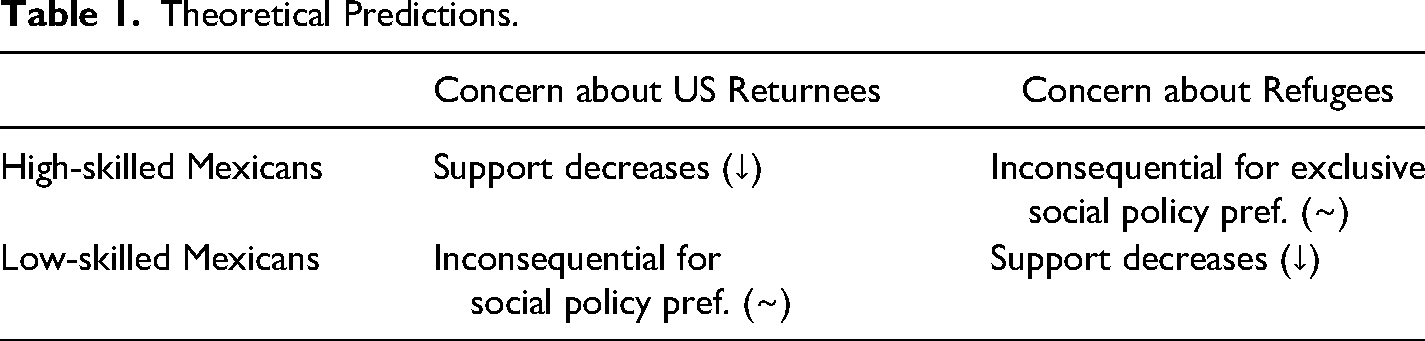
While high-skilled workers can be expected to be, on average, less supportive of redistribution than the low-skilled because of this labor market competition logic, concern about returnees should reinforce this negative effect among the high-skilled without affecting preferences among the low-skilled (see Table 1). Hypothesis 1: High-skilled workers worried about Mexican returnees from the United States are even less likely to support increased spending on social policies and more likely to oppose redistribution than low-skilled workers worried about returnees.
Theoretical Predictions.
Turning to the low-skilled, we assume that an inflow of refugees increases labor market competition for them. From an insurance rationale, low-skilled Mexicans should demand more redistribution to buffer the new risk from refugee arrival. But, again, against this labor market competition effect stand the increasing costs of the welfare system, which low-income earners also sustain through consumption taxes such as value added tax (VAT), and the possible depletion of the scarce resource pool. Welfare generosity is limited in Latin America, with barely any safety-net for the poor. 94 Despite growing efforts, the Mexican welfare system is still not very redistributive, 95 and the regressive tax system means that middle- and low-income earners, as well as informal workers, pay for the expansion of social protection programs. 96
Just as returnees pose greater costs and competition for welfare goods for the high-skilled, refugees present increased costs and competition for welfare goods for the low-skilled. Despite low-skilled workers’ own needs for social protection, worries about the tax burden and costs of the welfare system will, we assume, reduce support for any further expansion. In the past, even slight increases in costs for the poor have led to massive protests (e.g., a rise in VAT or higher gas prices).
97
We therefore expect the low-skilled to respond with a reduced demand, in comparison to the high-skilled, for redistribution and welfare generosity, particularly for social policy programs that are accessible for refugees. Hypothesis 2: Low-skilled workers worried about migration from Central America are less likely to support increased spending on social policies and redistribution when programs are accessible to refugees than high-skilled workers worried about Central American refugees.
Low-skilled Mexicans should not alter their social policy preferences when confronted with US returnees, as competition and suppression of wages should mainly occur for the high-skilled. If anything, they could perceive returnees as beneficial, since they expand tax resources through direct and indirect contributions. In turn, high-skilled Mexicans should not significantly alter their support for nonaccessible social policies when confronted with refugee inflow. Refugees are most likely to suppress wages in the low-skilled and informal sectors, with limited impact on the high-skilled, and they might also increase consumption, which maximizes overall welfare. It is only when it comes to accessible social policies that high-skilled Mexicans might respond to an increase in refugees by reducing their support for social policy expansion due to anticipated costs. 98 Table 1 summarizes the theoretical predictions.
Data and Model Specification
To test our argument, we use original standardized household survey data from a random sample at the state level in Mexico. 99 We conducted a face-to-face survey in Puebla and Querétaro (we refer to the data as PQMex Survey 2018) in November 2018. 100 Querétaro is slightly above and Puebla slightly below the national GDP per capita average. 101 Both states feature different industries and production sectors, allowing us to capture labor market variation. Both are centrally located and close to the capital, Mexico City, and do not share a border with a foreign country, which could otherwise bias responses to migration. 102 Refugees and US returnees are equally visible (or rather nonvisible) in both Querétaro and Puebla. We deliberately selected states that are less directly affected by refugees in order to be able to compare both streams of migration. The sample is representative at the state level for the major sociodemographic characteristics (gender and age). As our main theoretical interest is in workers, we oversampled the working population by conducting the interviews on weekends. Because of the oversampling strategy, we do not apply sampling weights in our main models. 103 The unweighted sample characteristics are similar to the national sample collected by the Latin American Public Opinion Project (LAPOP).
In November 2018, migration was extensively discussed in the media, due to the “Caravan” of Central Americans passing through Mexico on their way to the United States. Migration was therefore highly salient during the time of data collection. We focus on individual concerns about refugees and returnees rather than on the impact of contextual refugee and returnee shares, since objective levels and individual perceptions/worries do not always fully overlap. 104 The presence of returnees or refugees in one's neighborhood does not automatically raise concerns, as it depends on the nature of contacts and actual experience of “threat” or on media coverage. 105
Dependent Variables: Social Policy Preferences
We use support for social policy expansion in the form of a battery of six items (redistribution, public pensions, healthcare, primary/secondary education, CCTs, and regressive taxation) as dependent variables to capture attitudinal responses to different dimensions of social policy.
The Mexican welfare state is mostly financed through general taxes. VAT is a central source, which is paid by formal and informal workers alike. In 2018, 26 percent of Mexico's tax revenue was raised through VAT; personal income taxes amounted to only 22.4 percent and corporate tax revenue to 22.6 percent (OECD, own calculation). 106 The Mexican pension system is based on prior contributions through payroll deductions, and thus confined to formal labor. 107 The CCT program Prospera provides means-tested transfers to households below a certain income level and is generally accessible to migrant households. The public healthcare program SP is universal; it is financed through general taxes and extends coverage to informal-sector workers. Formal-sector workers are covered by the Instituto Mexicano del Seguro Social (IMSS), and public employees by the Instituto de Seguridad y Servicios Sociales de los Trabajadores del Estado (ISSSTE). 108 The employee contributes 0.8 percent of their monthly income, while the employer pays 6.8 percent and the state 3.5 percent (Instituto Mexicano del Seguro Social, 2018). Primary and secondary education is public and allows access to children from migrant families. Because of the universal nature of primary and secondary education as well as of healthcare, informally employed refugees have access to these policies as well. To measure general support for redistribution, independent of a particular social policy, we survey attitudes toward government efforts to reduce income differentials between rich and poor. We use the following wording for the social policy questions (the wording for the redistribution item differs), explicitly reminding the respondent that an extension or increase might be accompanied by a tax increase to finance it: “The Mexican government should increase spending on [healthcare services]. Consider that this may or may not imply an increase in taxes.” 109 The response scale ranges from 1 = disagree to 4 = agree. We use different response categories for the tax preference item, asking the individual to choose, out of 100 pesos, what proportion high-, middle-, and low-income earners should pay in taxes (50/30/20 = progressive option, 40/30/30 = moderately progressive option, or a regressive flat tax of 33/33/33). There is variation for all dependent variables (DVs; with standard deviations between 0.74 and 0.98; see Table A and Figure B). A majority favors social policy expansion and an increase of redistribution and tax progressivity.
Independent Variables: US Returnee and Refugee Concern
In order to operationalize concerns about Mexicans who return after living in the United States, we ask, “As you know, for the last couple of years it has become difficult to work in the United States and Mexicans felt obligated to return to the country or have had to return to avoid having problems with the American authorities. Tell me, how concerned are you about losing your job because of the return of other Mexicans that were living in the United States?”
As we are particularly interested in the impact of migration on job security, aiming to measure migration-related insecurity rather than anti-immigrant sentiments, we only ask this question of respondents who are part of the active working population. Only half of the sample (N = 757), therefore, answered the question. One could argue that we lead the respondent to think about both legal and illegal migrants who now return to Mexico. In fact, it is mostly those who had entered the United States legally who return to Mexico. 110 Illegal migrants might fear that it will be difficult to reenter the United States again once they left, given the increase in border security on the side of the United States. Moreover, our wording takes into account the increasing polarization of the Hispanic migration issue in the United States and the negative attitudes to which many Mexican immigrants are subjected. 111
The second independent variable focuses on refugees from Central America who pass through Mexico on their way to the United States and end up staying in Mexico because of increasingly restrictive US migration policy. We ask, “How concerned are you that more people from Central America will come to the United States and end up staying to work in Mexico?”
Both questions directly refer to labor market consequences and, therefore, have a comparable baseline. The item wording is shorter than the returnee question; however, given the saliency of the refugee movement, it was not necessary to further explain the question to the respondent.
Respondents answer both questions on a four-point scale from “not concerned at all” to “extremely concerned.” Responses vary along the categories and also in comparison to each other, as illustrated in Figure 1. We dichotomize refugee concern and US returnee concern to facilitate the interpretation of the interaction effects, coding the category 1 as not at all concerned (0) and categories 2–4 as concerned (1). 112 We apply an asymmetric dichotomization in which we compare lack of any concern to worries about the different migrant groups. Since the survey item could trigger in- and out-group thinking, as well as racism/xenophobia, the question might suffer from social desirability bias, meaning that respondents are less comfortable referring to greater “concern” categories in a face-to-face situation. The distribution between “not at all worried” and “somewhat worried” shows a spike in Figure 1, so that we distinguish between workers who are not worried at all and those who do have reservations. Estimation results with an alternative coding of refugee and returnee concern are discussed in the robustness section.
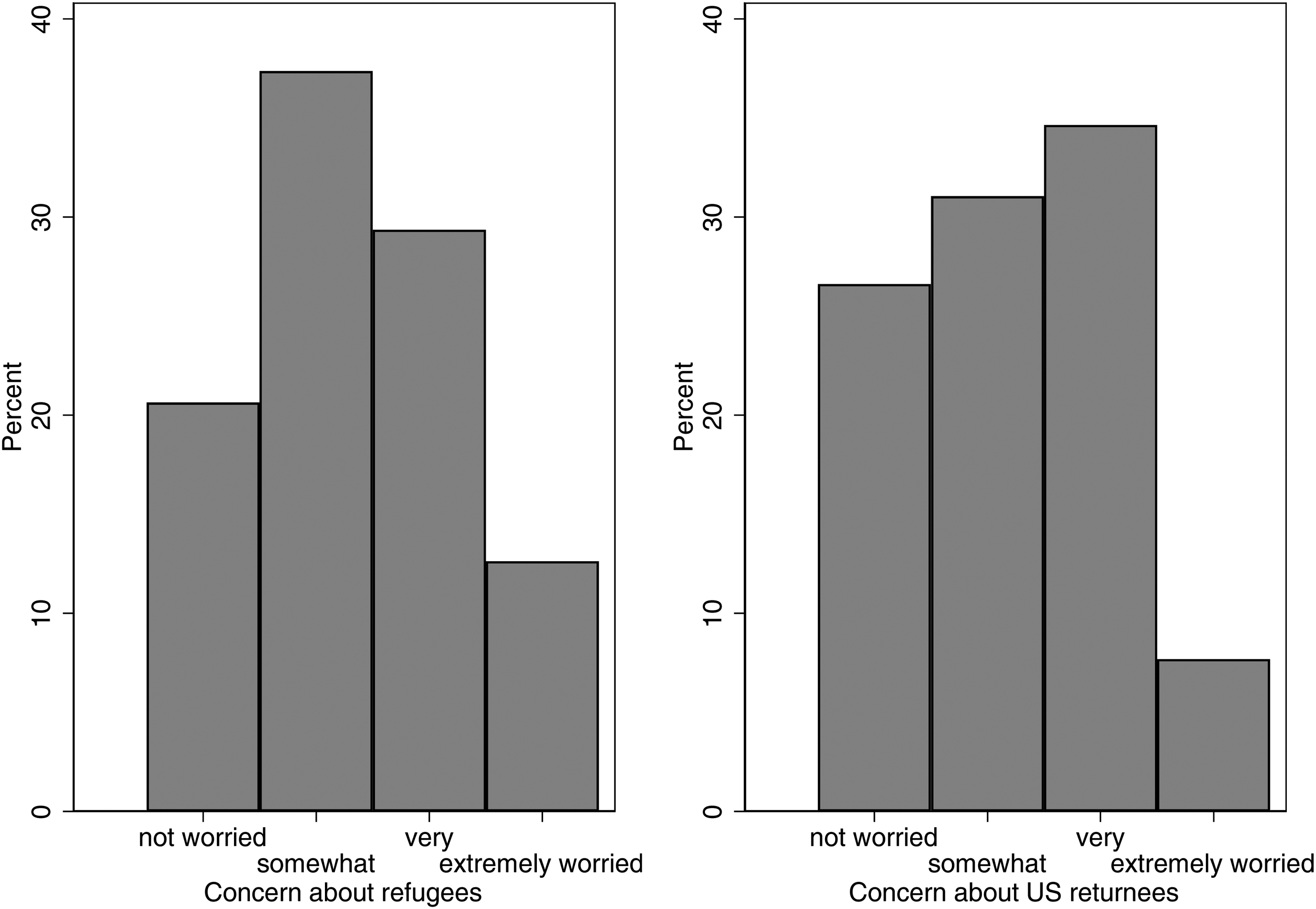
Worries about US returnees and refugees from Central America.
As we expect the impact of different types of migration on social policy preferences to vary across the respondents’ level of skill, we use a measure for respondents’ level of education, based on 10 education categories. 113 Roughly 20 percent of the sample are high-skilled (meaning above category 7, high school degree) and worried about returnees; and around 80 percent are low-skilled and worried about refugees. In addition, as education might not be sufficient to capture the concept of skill, 114 we use different proxies for labor market position as a robustness test. We asked respondents about their occupation as an open question and recoded the responses into the International Standard Classification of Occupations–08 (ISCO-08) scale from the International Labour Organization ILO. The indicator runs from 1 to 9, with higher levels capturing more skill-intensive jobs. 115 In addition, we operationalize formal- and informal-sector employment with the use of information on the respondent's legal work status and access to contribution-based social security programs. 116 We associate the status of formal labor with higher skills than being an informal-sector worker, and expect formal workers to be more concerned about returnees and informals about refugees. Estimation results are discussed in the robustness section.
Model and Control Variables
To test the hypotheses, we employ a linear ordinary least squares (OLS) regression analysis for i individuals. We add an interaction term for skill (education) with both independent variables in order to test our argument about variation in social policy preferences by skill level. The independent variables on migration type concern are added in separate models to avoid multicollinearity, as both variables are positively correlated (ρ = 0.648, p < 0.001).
117
Adding both concern variables jointly would therefore dilute the possible effect from each individual variable. Separate specifications yield more conservative estimates. We add a dummy variable η as control for state. The 
For sensitivity analyses, we employ different model specifications: a lean model that only controls for gender, age, and state (see Figure E, online supplement), a logistic regression based on dichotomized DVs, and an ordered probit regression analysis, which factors in that distances between categories can vary in length in the respondent's perception. 122 Finally, we add a proxy for political ideology (vote choice during the last presidential elections; see Figure F, online supplement). Descriptive statistics are displayed in Table A (online supplement).
Results
Before we add the interaction effects between skill and type of migration concern, we start with the average effect of both concerns about refugees and US returnees (as continuous variable) on our social policy battery for the average respondent (Figure 2). 123 Figure 2 illustrates the predicted probabilities—that is, the incidence rate—for an increase in each concern category for our DVs. The first and third columns show the effect of refugee concern, the second and fourth columns the effect of returnee concern, in order to compare the effects for each DV. The estimates for pension, healthcare, education, and CCTs, in particular, are highly significant for US returnee concern, with support significantly declining among average working Mexicans. The confidence intervals overlap for the middle categories, but not at the extremes. Interestingly, the impact of refugee concern is not significant for most social policies: the confidence intervals overlap across all levels of concern; only support for education expansion is significantly reduced. 124
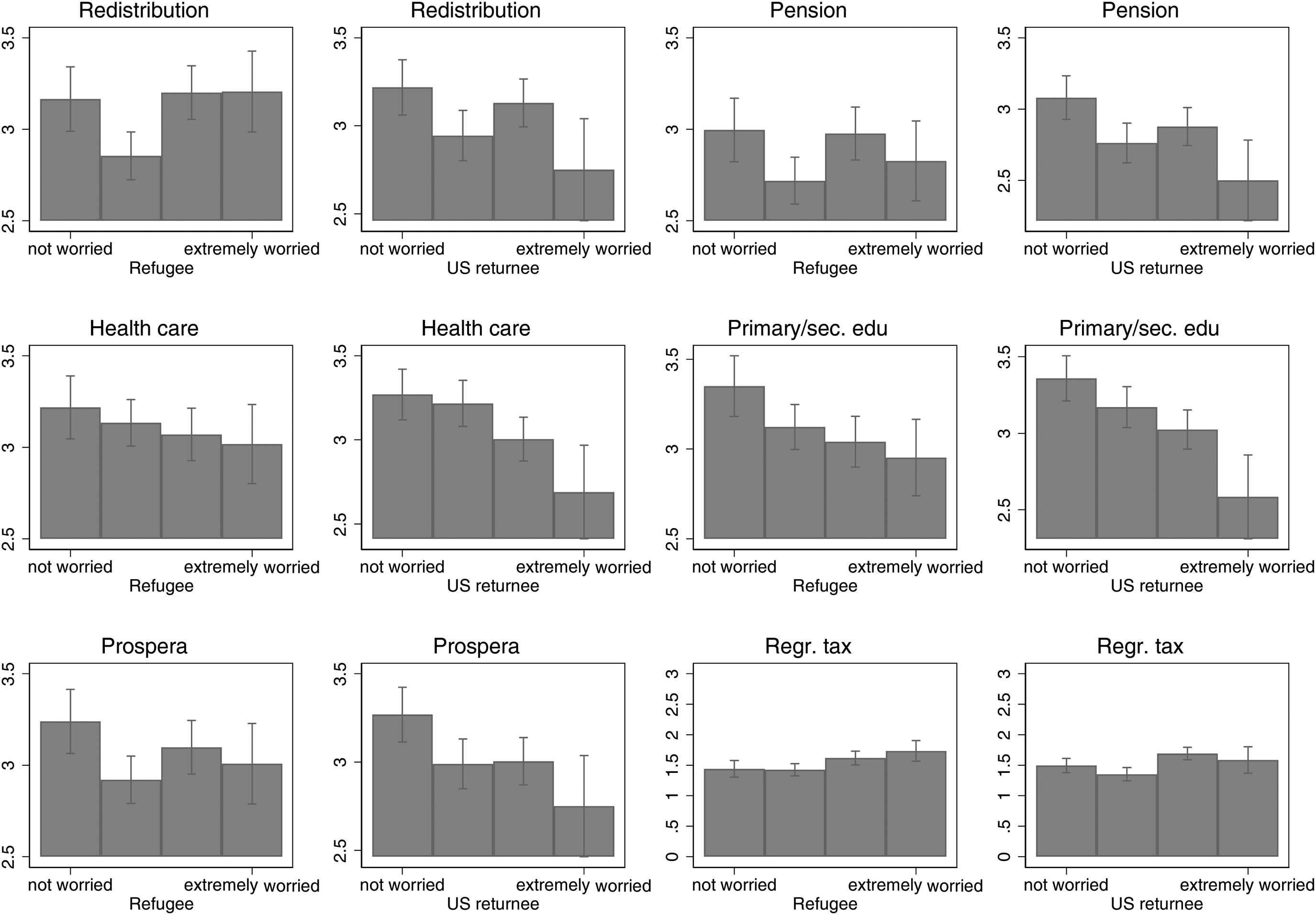
Predicted probabilities for concern about Central American refugees and US returnees to Mexico on six dependent variables (Table S5, M1–M12, online supplement).
We now add the interaction term and report the results of the OLS regression in Table 2. When high-skilled workers are worried about US returnees, we find a significant negative effect on our social policy battery, compared to low-skilled workers who are equally concerned. Support for social policy expansion is significantly lower for redistribution, healthcare, education, and CCTs when respondents perceive a threat to their personal employment security from Mexicans who return from the United States. Hence, it is especially universal and means-tested policies where returnee concern spurs a negative effect. Free-riding by US returnees might be particularly easy with these programs. In contrast, US returnees do not seem to be perceived as a threat to high-skilled nonmigrants regarding the contribution-based pension program, even though formally employed returnees also have access to it. As pensions only become acute at time of retirement and thereby have a longer temporal perspective, respondents, who are still actively working at the time of our survey, might be more concerned about immediate social policies such as healthcare or education.
Concerns about refugees from Central America in interaction with skill level do not show any significant results. Individuals, independent from their skill level, seem to have no particular or significant social policy preferences when they worry about refugees and their impact on the labor market. Our results show that being concerned about refugee inflow does not, therefore, affect the welfare preferences of differently skilled Mexican workers. Nor is support for redistribution affected by refugee concern. This is surprising, given previous findings from the welfare chauvinism literature and findings on anti-immigrant sentiments in transit countries. 125
OLS Regression on Social Policy Preferences and Types of Migration Flows Conditional on Skill.
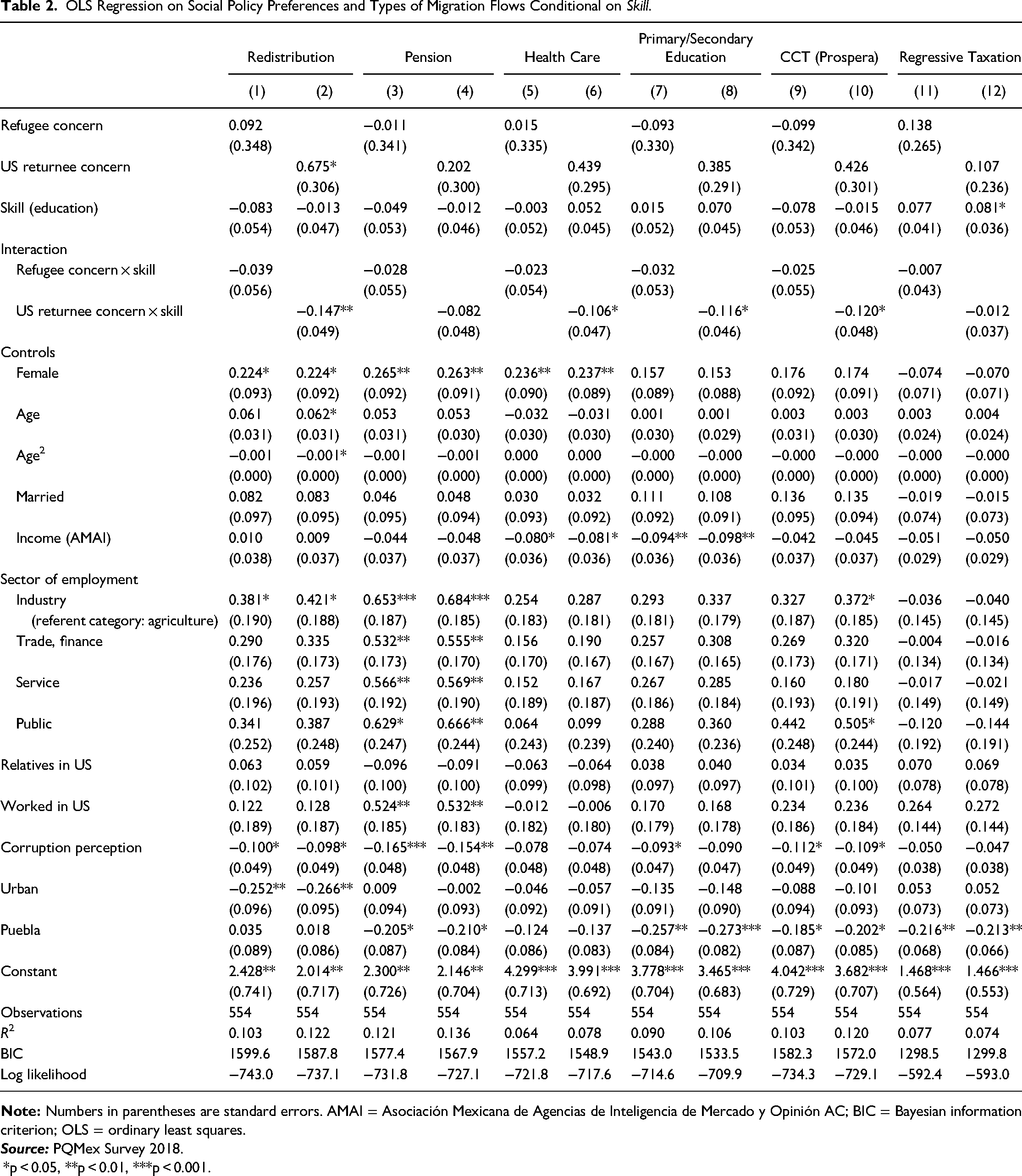
*p < 0.05, **p < 0.01, ***p < 0.001.
In order to facilitate the interpretation of the interaction terms, we visualize the estimation results as average marginal effects (average marginal effects [AMEs]) in Figure 3. 126 The plot illustrates the development of the slope over different education levels. High-skilled Mexicans (high school graduates or above) are less supportive of redistribution and social policy expansion when they worry about US returnees than the low-skilled. An increase in concern reduces support for more public spending on social policy across the board among high-skilled respondents. We find a similar tendency for the high-skilled when worrying about Central American refugees; however, confidence intervals always encompass the zero line and thus indicate an insignificant relationship. Only the missing effect for the high-skilled on pension preferences is in line with our expectations, as refugees cannot access the contribution-based program and should therefore be met with indifference. The low-skilled are almost supportive of more redistribution when concerns about US returnees are high (see second panel in Figure 3), but the effect is only at the fringes of significance for the least educated and quickly turns insignificant. 127 The negative association with refugee concern might be largely driven by decreasing support levels among high-skilled workers. Tax preferences are not significantly affected by either type of concern.
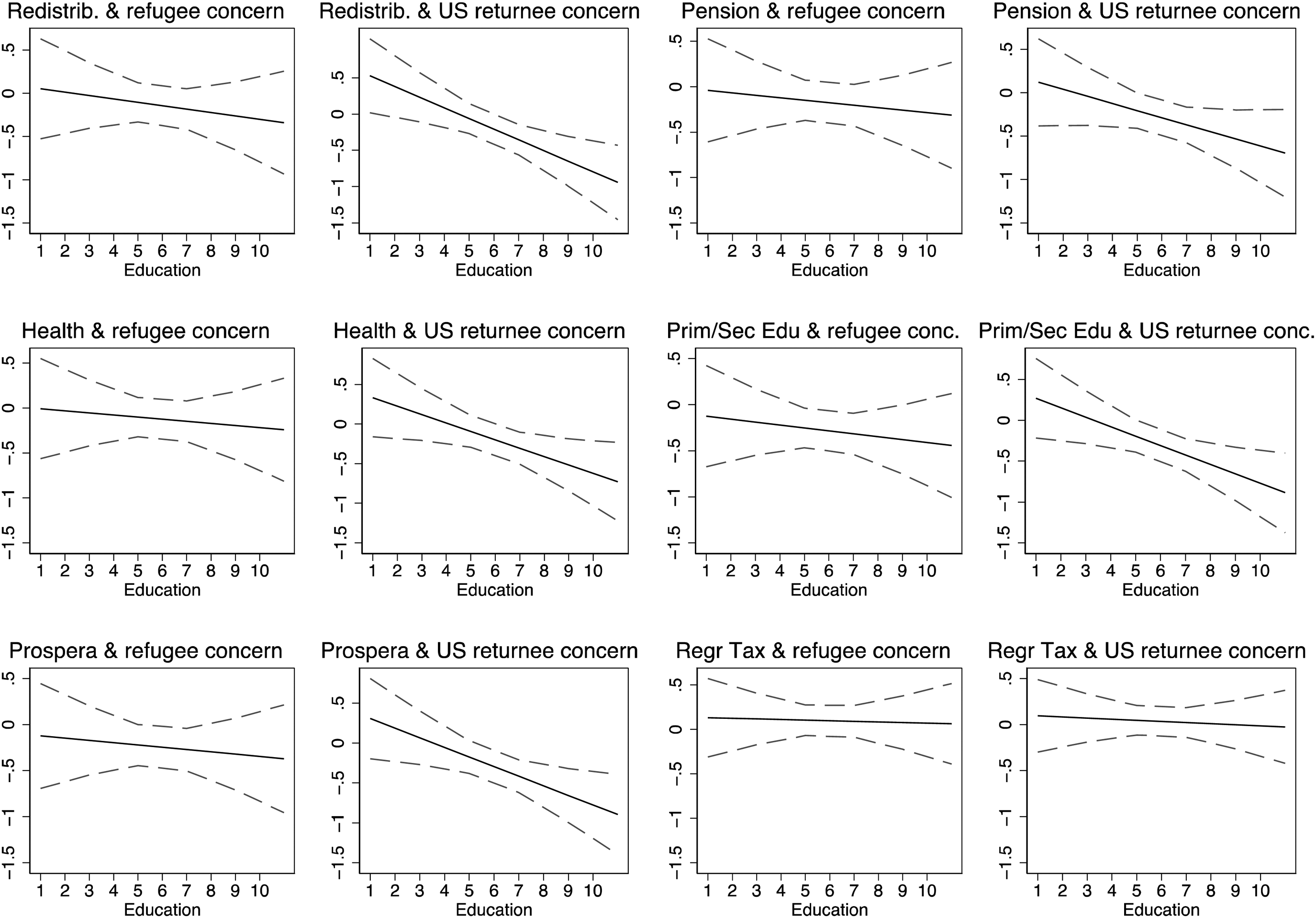
Average marginal effects of refugee and US returnee concern conditional on skill level (Table 2, M1-M12, online supplement).
In order to rule out the possibility that our concern measures are simply a proxy for education, income level, or political ideology, and that the effect in the interaction term is thereby artificially inflated, we regress sociodemographic variables on the two concern variables in a linear regression model (refugee and returnee concern are now used as continuous DVs; estimation results are shown in Table S4 in the online supplement). Education has no significant effect on US returnee concern (coeff. 0.068, with a standard error of 0.041) or refugee concern (coeff. −0.009, standard error 0.040), and neither does gender or age. We find significant effects for vote choice used as a proxy for political ideology. Individuals who voted for AMLO in the 2018 presidential elections are more likely to worry about both returnees and refugees (Table S4 in the online supplement). Since we find significant results for both concern variables, but particularly so for returnee concern in our main analysis (Table 2), ideology cannot explain the negative correlation between returnee concern and dwindling social policy demand. These results refute the caveat that education or political ideology simply overlap with migration worries.
Mexicans returning from the United States seem to affect high-skilled Mexicans in their demand for social policy expansion. Conationality, and thus in-group favoritism, does not seem to be at work here. To the contrary, we see the biggest reduction of welfare preferences aligned with concern about nationals returning. Access to social policies seems to be a driver. US returnees, if formally employed, theoretically have access to all Mexican social policy programs, but might not have contributed to them. The high-skilled might therefore feel justified in adopting a free-rider rationale: their lack of contributions should debar returnees from a piece of the pie. This is particularly supported by the significant findings for easily accessible policies (healthcare, education, and Prospera) to which also informally employed returnees have access. It is also possible that high-skilled Mexicans are better able to understand the cost implications for the welfare state. Alternatively, they might regard returnees no longer as “real” Mexicans, but part of the out-group, which should be excluded. While returnees tend to lift health and education levels in communities, 128 nevertheless “return migrants often come back to their homelands with a different vision of the world” that might be perceived as irritating or presumptuous by nonmigrants. Returnees are often more critical and demanding citizens because of their migration experience to a high-capacity country. 129 Mexican film and literature have often made pejorative references to US returnees, as in the “Pachuco” of the 1950s and 1960s, a type of Mexican dandy who had lived in the United States, whose speech, dress, and behavior stood out. Octavio Paz, a Mexican Nobel laureate, opens one of his best-known novels, The Labyrinth of Solitude, with a chapter on Pachucos—“Whether we like it or not, these beings are Mexicans, one of the extremes that Mexicans can reach.” 130 Such stigma may still persist today, driving our results on a cultural dimension. Migrants are also more prone to return to communities that are different from those that they left, that is, more prosperous regions with better employment opportunities, 131 suggesting that returnees are less deeply integrated into local networks. Moreover, returnees are a “mobile population” because of their prior migration experience and palpable likelihood to move again, either in Mexico or even back to the United States, where they still have social ties. 132 Thus, returnees’ weaker social integration, added to increased labor market competition for high-skill jobs, might account for nonmigrants’ reservations, especially among the high-skilled, and lack of solidarity toward returnees. A further plausible mechanism might work through perceptions of fairness and risk-taking. 133 Individuals who took the risk and went to the United States may, upon having returned, be perceived as failures, and having lost their gamble, not entitled to access social policies.
In contrast, the weak negative average effect for refugee concern (Figure 2) is possibly driven by anti-immigration sentiments and lower levels of solidarity with out-group members. 134 Interestingly, the average effect does not seem to follow from the low-skilled. 135 The lack of any particular negative attitudes toward refugees among the low-skilled shows again that the effect seems less linked to worries about the mounting fiscal and social transfer burden. Recent research has revealed that refugee inflow can also bring positive externalities in terms of local development, which might explain the missing effect. 136 Alternatively, the low-skilled might even feel sympathetic toward this group of people that is highly deprived and vulnerable, because of shared experiences of poverty. A further explanation could be that policies that seem de jure accessible by refugees might be de facto exclusive because of complicated bureaucratic processes, lack of knowledge about program eligibility, or discrimination by local authorities. The low-skilled might, hence, be indifferent toward this group of migrants who are neither entitled to most national welfare programs nor capable of accessing them when they are.
To summarize, we confirm hypothesis 1, which expects a decline in support for redistribution and welfare generosity among the high-skilled when worried about US returnees, compared to their low-skilled counterparts. The high-skilled do not alter their social policy preferences, for either inclusive or exclusive programs, when concerned about Central American refugees. This is surprising, given that an increase in refugees may entail higher costs for the fiscal state. We have to refute hypothesis 2, which expects declining social policy support among the low-skilled who worry about refugees, compared to the high-skilled. Contrary to our theoretical expectations, the low-skilled do not change their welfare attitudes in regard to both inclusive and exclusive welfare policies.
Some control variables of the estimations in Table 2 deserve further mention. Having previously worked in the United States goes together with greater support for public pensions but having relatives in the United States shows no significant results. 137 Finally, the more the respondent perceives corruption in the public system, the less favorable they are to increasing expenditure on pensions, confirming previous scholarly findings. 138
Robustness Tests
When using a balanced split of the categories of the independent variables (categories 1,2 = 0 and 3,4 = 1), we only find a significant negative effect for the high-skilled on preferences for public education and healthcare expansion (see Figure S4 in the online supplement). But such a dichotomization also artificially reduces the variance and averages the differences that are stronger at the extremes, showing that concern about returnees only moderates preferences among the high-skilled, when individuals move from no concern to concern, instead of a slight increase in average concern. Figure S5 (in the online supplement) displays the average marginal effects when using a dichotomous variable of 1 for extremely concerned (4) and 0 (categories 1–3) for the remaining categories for the two concern variables. The results for accessible social policies (education and healthcare) stay significant for high-skilled Mexicans in relation to returnee concern. We also see a negative significant effect for refugee concern on public education and healthcare support for the high-skilled. But the number of respondents who choose the “extremely concerned” category is also fairly small in this case, which explains the weaker results. In turn, the low-skilled are significantly more supportive of redistribution when they are extremely worried about refugee inflow compared to the high-skilled, pointing to a compensation rationale that further refutes our second hypothesis. The logistic and ordered probit regression analyses corroborate the findings for redistributive preferences and support for public education (see Table S9) and Prospera (Table S8). The impact of return migration only slightly misses conventional levels of significance for preferences for pension expansion, healthcare, and Prospera in the logistic analyses.
When using ISCO categories on type of occupation as measure for skill, we find a similar pattern to that of education. The interaction with ISCO-skill and refugee concern is never significant. In contrast, support for redistribution, healthcare, education, and Prospera declines among the ISCO high-skilled in comparison to the ISCO low-skilled, with high levels of returnee concern (see Figure S6 in the online supplement). Next, we approximate skill level through formal versus informal labor. Figure 4 shows the AMEs for formal- and informal-sector workers. 139 The results are in line with the findings above. Formal workers are less supportive of redistribution than informal workers, and less in favor of improving public pensions, healthcare, primary and secondary education, and also of expanding Prospera, when concerns about US returnees increase.
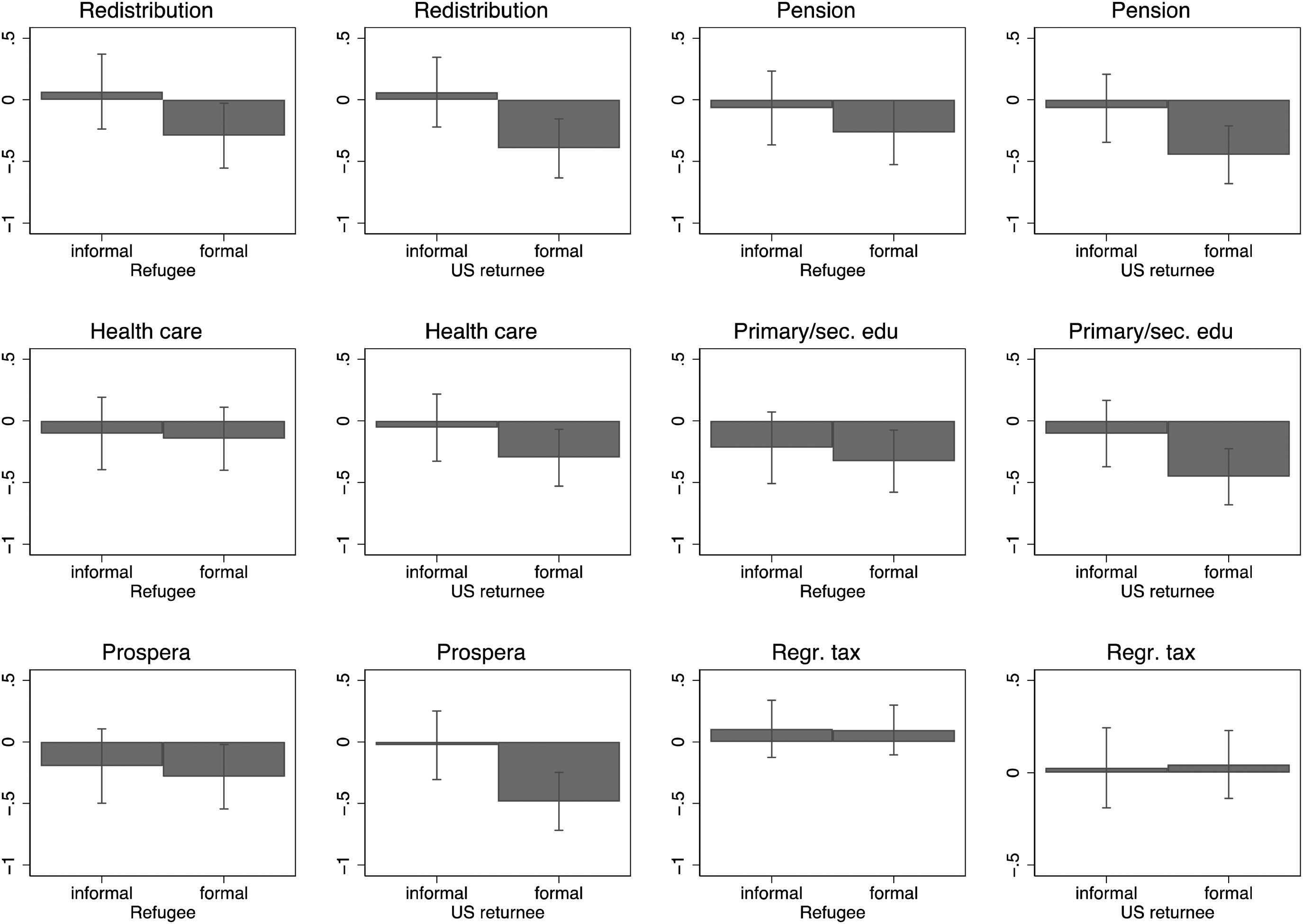
Average marginal effects of refugee and US returnee concern conditional on formal versus informal worker, ordinary least squares regressions (Table S7 in the online supplement).
Even though formal-sector workers are not significantly different from informal-sector workers (confidence intervals overlap in most cases and in some estimations also cover the point estimate), they are significantly different from zero. Just as we found for low-skilled workers, informal workers do not alter their welfare preferences in response to increased labor market competition from refugees. Tax preferences remain unaffected by either type of concern across these different specifications.
Conclusion
The scholarly debate around the implications of migration for the welfare state is vast and reflects the urgency that the age of migration has brought. Only recently have studies started to address the implications of migration in middle-income countries. 140 We contribute to the debate with a focus on “migration revolving door” middle-income countries, which are particularly challenged to provide sufficient social protection for the domestic population and to tend to the needs of migrants. Our study of the highly frequented Mexico-US migrant corridor adds a more nuanced analysis of different patterns of migration that are prominent in middle-income economies: returnees and refugees. Although return migration is a well-known phenomenon in middle-income countries, the literature has barely begun to consider its social and economic consequences. 141 We argue that different types of migrants have different consequences for social policy support coalitions, as returnees and refugees differ in skill composition and implications for the fiscal and transfer system, and that those effects will be moderated by an individual's own skill level. Because it is nearly impossible to calculate the net effect of migration for a political economy, we resort to individual perception and attitudes. 142 Making use of original survey data from two federal states in Mexico, collected during a period when migration was highly salient, we study how these two streams of migrants affect social policy preferences and support for redistribution among nonmigrant Mexicans. To our knowledge, we are the first to take returnees into account when considering migration and social policy preferences.
Our findings reveal that it is mostly concerns about Mexicans who come back from living in the United States who impact support for welfare state expansion. Throughout all model specifications and when analyzing different types of social policies, we find negative effects on social policy preferences when respondents are worried about US returnees (especially for easily accessible social policies). The main difference between US returnees and Central American refugees is nationality, which makes the welfare state more easily accessible to the former. While we find negative effects for both concerns on the average respondent in the policy fields pertinent to the respective group (education and health care for refugees; pensions for returnees), being high-skilled is a particularly powerful driver of decreasing support for redistribution and the welfare state in the nonmigrant Mexican. The refugee effect (albeit weak) is not moderated by skill.
One could argue that the comparison between refugees and returnees is, in essence, a comparison of attitudes toward in-group (nationals) and out-group (foreigners) members. If so, we would expect respondents to be more tolerant of and show solidarity with returnees when compared to refugees. However, we find the opposite. Mexican nonmigrants are more tolerant toward refugees than toward returnees in their social policy and redistributive attitudes. We can only speculate why this would be so, but can perhaps point to a free-rider, exclusionist rationale—though, notably, only among the high-skilled. Returnees might be perceived as economic competitors because of the skills they acquired while in the United States, but they also seem less well integrated into local communities because of their mobility and because they return home with new ideas and as more critical citizens. This might explain why they are met with leeriness or even antipathy by the high-skilled. Low-skilled Mexicans, perhaps, may identify more strongly with those who seek a better future up north, or do not directly associate refugees with costs. Furthermore, despite the widespread media attention paid to the “Caravan” of Central American refugees, typical Mexican nonmigrants might not have much contact with this group, while return migration is encountered much more often. Future research needs to investigate the quality and nature of contact that nonmigrants have with refugees and returnees to better understand the origin of their concern.
Our results have two important implications. First, while racism has drawn increasing attention in the literature, in- and out-group dynamics are not only a question of race or nationality. Individuals who lived abroad for some time and then decide to come back might also be perceived as a burden on the welfare state; those who remained in Mexico during hard times might be reluctant to share. Racism, thus, should also be put into context with nationals who lived outside of their emerging home country for a while. Therefore, nationality might be a less decisive mechanism for determining support for welfare state expansion in middle-income economies than expected. In future research, therefore, it will be important to consider various streams of migration. This might apply to all countries that experience multiple streams of emigration, immigration, and return migration, including advanced industrial democracies such as Spain or Portugal, where entire well-educated cohorts emigrated to neighboring countries following the 2008 financial crisis. This Southern European “brain drain” is slowly reversing, but we still know little about the possible impact of these returnees on domestic public policy preferences in advanced democracies.
Second, support for welfare state expansion varies by type of policy and accessibility. Return migration in Mexico has a particularly depressing effect on support for healthcare, education, Prospera, and general attitudes toward redistribution. These social policy fields are equally relevant for refugees, yet we do not find any significant change among the high-skilled that can be attributed to refugee concern. Restricting universal social policy in response to refugee inflow might, thus, be a solution to a misattributed problem. Low-skilled workers in middle-income countries seem much less susceptible to the welfare chauvinism logic in universal social policy programs than expected. Reduced support for accessible social policies among the high-skilled when concerned about former in-group members emphasizes the fragility of support coalitions for more encompassing protection. Scrutinizing deservingness considerations to access universal social policies for returnees and factors that might positively influence nonmigrants’ perceptions toward returning citizens (e.g., a possible “brain gain” via imported skills, the length of absence or prior remittances) are important avenues of future research.
Our findings are, however, limited by the small sample size, the focus on the actively working population and the Mexican case, which represents a heavy migrant-sending country. Results might be different for attitudes in society at large. Moreover, because of the lack of suitable survey questions, we cannot directly test the mechanism that drives the negative effect among the high-skilled responding to mounting concerns about US returnees. Beyond the self-interest-based explanation underlying worries about intensified labor market competition offered here, cultural predispositions seem underexplored. Drawing upon US findings, where racism, ethnocentrism, and cultural animosities are important drivers of welfare chauvinism, 143 future work also needs to explore how returnees are viewed along these dimensions in cases such as Mexico. Our analysis is therefore only a first step toward a disaggregated examination of different patterns of migration on social policy attitudes in developing economies, which face a much more diverse stream of migration than the Global North.
Supplemental Material
sj-pdf-1-pas-10.1177_00323292221130211 - Supplemental material for Moving North and Coming Back: How Concerns about Different Types of Migrants Affect Social Policy Demands among Low- and High-Skilled Mexicans
Supplemental material, sj-pdf-1-pas-10.1177_00323292221130211 for Moving North and Coming Back: How Concerns about Different Types of Migrants Affect Social Policy Demands among Low- and High-Skilled Mexicans by Sarah Berens and Franziska Deeg in Politics & Society
Footnotes
Acknowledgments
We are particularly grateful to Melina Altamirano, Philip Manow, and Björn Bremer for valuable suggestions and ideas. We also thank participants at the research seminar at the University of Bremen, the RC19 conference at Mannheim University, the NordWel conference in Bremen (2019), and the PhD workshop “Advances in Comparative Politics” at the University of Cologne for helpful comments.
Declaration of Conflicting Interests
The author(s) declared no potential conflicts of interest with respect to the research, authorship, and/or publication of this article.
Funding
The author(s) disclosed receipt of the following financial support for the research, authorship, and/or publication of this article: The project is funded by the Deutsche Forschungsgemeinschaft (DFG, German Research Foundation), project number 374666841-SFB 1342 (co-PI Sarah Berens).
Supplemental Material
Supplemental material for this article is available online.
Notes
Author Biographies
Supplementary Material
Please find the following supplemental material available below.
For Open Access articles published under a Creative Commons License, all supplemental material carries the same license as the article it is associated with.
For non-Open Access articles published, all supplemental material carries a non-exclusive license, and permission requests for re-use of supplemental material or any part of supplemental material shall be sent directly to the copyright owner as specified in the copyright notice associated with the article.
