




Abstract
Historians typically explain the Marshall Plan (1948–52) as an effect of a bipartisan embrace of liberal internationalism, which became the dominant ideology of US foreign policy. However, predominant accounts downplay interpretive contention, historical contingencies, and counterfactual possibilities that are very much in evidence. There was no bipartisan liberal internationalist consensus immediately after World War II; indeed, there were no “liberal internationalists” until 1947. The present analysis identifies two interconnected processes behind the Plan: the emergence of a new kind of political actor, the credibly anti-Communist New Deal liberal, and the coalescence of an unlikely coalition of Trumanites, New Dealers, and congressional conservatives. Together, these processes enabled the passage of a large-scale, Keynesian-style spending initiative that excluded Russia, despite the electoral weakness of New Dealers, and the consolidation of liberal internationalist ideology in American foreign policy—with significance for today's era of renewed great power competition.
In April 1948, Harry Truman signed into law the Marshall Plan, through which the United States would expend an unprecedented $12 billion ($151 billion in 2022 dollars) stimulating postwar economic recovery. The Marshall Plan is typically cast as central to the “liberal internationalist” order constructed by the United States and its allies after 1945. 1 As an ideology, liberal internationalism rejects isolationism and “implies . . . an agenda that involves promoting open markets, international institutions, cooperative security, democratic community, progressive change, collective problem-solving, shared sovereignty, and the rule of law.” 2 Liberal internationalism, however, also rested on a deeper, categorical way of thinking that pitted the liberal “West” against a USSR-led Communist sphere—an opposition built into the Marshall Plan's formulation. After 1949, the consequences became increasingly clear, as the United States pivoted toward military intervention in the name of “containment,” setting the stage for the Cold War. 3
Well attended in historical, political economy, and international relations (IR) literatures, with important exceptions sociologists have paid limited attention to the Marshall Plan. 4 This lack of input is striking. In addition to current sociological interest in transnational relations, empire, and colonialism, 5 the postwar period's resonance today is unmistakable. Increasing tensions between the United States and China bear eerie similarities to the events of 1944–48. Declarations of contemporary global politics entering a “new Cold War” render imperative accurate understandings of the first Cold War's onset. 6
America's embrace of liberal internationalism after 1945—the Marshall Plan at its core—is, admittedly, a historiographical commonplace. Yet, existing works fail to grasp the enduring puzzle of the Marshall Plan in the form and at the time of its creation, with implications for understanding liberal internationalism itself. For example, while some type of American aid to postwar Europe was highly likely, it was not at all inevitable that such an initiative would take the Marshall Plan's form of grants—focused on state-building and integrating parts of the working class—rather than loans like those provided after World War I through the Dawes and Young Plans. Moreover, existing accounts display hagiographic, reductionist, and teleological tendencies that a sociological approach is well equipped to remedy. Broadly speaking, existing accounts point to an array of variable-like causes: the foresighted efforts of charismatic actors; economic necessities; a clear Communist threat; spontaneous cross-partisan convergence on liberal internationalism; or some combination thereof. Yet, by treating the aforementioned as established social things, existing analyses tend to render the Plan inevitable, when it was anything but, downplaying counterfactual possibilities that were very much in evidence.
Indeed, as the historian Jonathan Bell has chronicled, 7 contra common wisdom, there were no discernible “liberal internationalists” until 1947, and no bipartisan liberal internationalist consensus before 1948—raising doubts about liberal internationalism's relationship to the Marshall Plan. After Franklin D. Roosevelt’s death in April 1945, Democrats’ foreign policy views were fractious: some hewed to FDR's hopes for cooperation with Russia; others soured on relations with Moscow. Before 1947, dominant New Deal Democratic politicians (including President Roosevelt) favored a “One World” foreign policy that rejected the sort of us-versus-them anti-Communist logic that underpinned the formulation of, and justification for, the Marshall Plan. 8 In short, between 1944 and 1948 the future of the Democratic Party, the New Deal, and New Dealers was very much in doubt; the meanings of economic interest, liberalism, internationalism, and Communism were matters of contention, not consensus; and the contours of postwar foreign policy were undefined. The period between FDR's reelection in 1944 and 1948 saw the emergence of novel political personas, organizations, and modes of thinking later read as stable historical facts. If the Marshall Plan appears in our rearview mirror as inevitable, it is only because certain ways of thinking and kinds of persons became settled in the interim.
It is here, in the making of new political persons—namely, the anti-Communist liberal Democrat—and novel coalitional possibilities—of those liberal internationalist Democrats with anti-Communist internationalist Republicans—that our article intervenes in the debate on the Marshall Plan's origins. We emphasize the puzzle of the Plan's creation by addressing a series of questions: How, despite FDR's insistence that New Deal foreign policy should favor cooperation with Russia, did a cadre of “New Deal” yet “anti-Communist” Democrats hawkish on Russia emerge? How, given the power of anti–New Dealers in the American Congress, did a massive Keynesian-inflected foreign aid program become law? How, despite the fractiousness of American politics between 1944 and 1948, did the period later appear as one of consensual “liberal internationalist” foreign policy?
In answering these questions, we foreground two interconnected processes: (1) the emergence of a new kind of political person on the American political scene in late 1946 and 1947, what we call the “credibly anti-Communist New Deal liberal” (or CANDL); and (2) the coalescence of unlikely coalitions made possible by the credibly anti-Communist New Deal liberal's arrival, here the previously unlikely bipartisan coalition between Democratic internationalists and those in the Republican-controlled Congress. By “new person,” to clarify from the outset, we do not mean new individuals entering office after elections. Instead, the concept is meant to grasp how, as political contexts change, political actors not only shift their views and strategies but adopt new styles, perspectives, and positions. Consider, to illustrate, the emergence of the “Trump Republican” in US politics since 2016—a new kind of political person, emerging but also distinct from previous sorts of conservative Republicans and willing to ignore a whole range of traditional Republican policies. However short-lived the Trump Republican's life in American politics may be, no account of events since 2016 is complete without recognition of its impact.
Conceptually, we show that the formation of new political persons and the novel coalitional possibilities they bring about are similar types of process: namely, relational struggles of a specifically political sort in which symbolic boundary-work produces new social things imbued with causal potential. 9 Just as the Trump Republican emerged from struggles within Republican networks—over what it means to be a Republican versus a “Republican-in-Name-Only” (RINO) 10 —we trace how contention inside Democratic Party networks produced a novel type of political person in 1946 and 1947. The core issue was support for Communism, both outside the United States and inside American labor organizations, with the “liberal” Democrat emerging as at-once credibly anti-Communist yet still pro–New Deal, in opposition to self-styled “progressives” willing to tolerate Communists in their ranks and seek to work with Communist Russia. Historians like Landon Storrs, Daniel Immerwahr, and Jess Gilbert have each detailed pressures on prominent New Dealers during the 1930s to assert their anti-Communist credentials during the McCarthyism of the late 1940s and early 1950s. 11 We highlight forerunning pressures on Democrats in and around the Truman administration to clarify the scope of their left-liberal commitments. By describing how they did so, and the emergence of the credibly anti-Communist New Deal liberal, it becomes possible to account for the unlikely passage through a conservative-dominated Congress of a large Keynesian-style aid initiative—despite the electoral weakness of New Dealers—and hence the longer-term consolidation of liberal internationalism in US foreign policy.
Analytically, our approach is historical, biographical, and relational. We draw on archival evidence, and especially first-person accounts, to map how shifting positions and oppositions generated new persons, meanings, and policy possibilities over time. We prioritize the identification of plausible counterfactuals overlooked in existing accounts. The resulting contribution shows that the Marshall Plan was a contingent outcome of symbolic boundary-work in a series of relationally organized contests that originated in Democratic Party networks and closed off a One World progressive foreign policy, inclusive of Russia, while setting in motion an era of US-led “liberal internationalist,” but divisive and increasingly militaristic, foreign policy.
We proceed in five parts. We first highlight the tendency of existing accounts of the Marshall Plan to treat persons and meanings as stable things rather than historical accomplishments. We then outline our analytical approach, paying special attention to how the Goffmanian concept of person production can enhance our understanding of the dynamics and causal significance of American parties. After describing our research design, we offer a historical analysis of the necessitation of the Marshall Plan. Finally, we discuss implications for contemporary US foreign policy and consider applications to non-US settings.
The Origins and Consequences of the Marshall Plan
On June 5, 1947, Secretary of State George Marshall told an audience at Harvard that America must “assist in the return of normal economic health in the world, without which there can be no political stability and no assured peace,” through a far-reaching foreign aid program. 12 Marshall deliberately omitted referencing a Soviet or Communist threat, despite Truman having invoked that rationale in February 1947 to promote aid to Turkey and Greece: failure to send aid, Marshall then argued, risked extending “Soviet domination to Europe, the Middle East and Asia.” 13 In June 1947, Marshall called for humanitarian assistance “directed not against any country or doctrine but against hunger, poverty, desperation and chaos.” 14
The ensuing flurry of activity speaks to the Plan's contingent nature. Marshall's speech was followed by extensive trans-Atlantic and cross-national negotiations; reports from various branches of government; a “massive campaign to mobilize public support”; and efforts “to convince Congress of the wisdom of aiding Europe.” 15 To ensure the Plan's passage despite a skeptical Congress, Truman “opened his foreign policy initiative to perhaps the most thorough examination prior to launching of any program” and cultivated a “rare process of close consultation between the executive and Congress.” 16 All this suggests the Marshall Plan was not an outcome of consensus; foreign threats, economic interests, and the principles of US foreign policy were contested, not settled. Alternatives were not just possible but entirely plausible.
On April 3, 1948, Truman signed the Economic Cooperation Act (Title I of the Foreign Assistance Act of 1948, P.L. 80-472) establishing the European Recovery Program (ERP), operational until 1952. The ERP remains the largest-ever grant of US foreign aid in any four-year period, to any region—including post-9/11 (Figure 1). Total aid, at 13 percent of the 1948 budget, exceeded “development and humanitarian assistance the United States provided from all sources to 212 countries and numerous international development organizations and banks in the four-year period 2013–2016.” 17
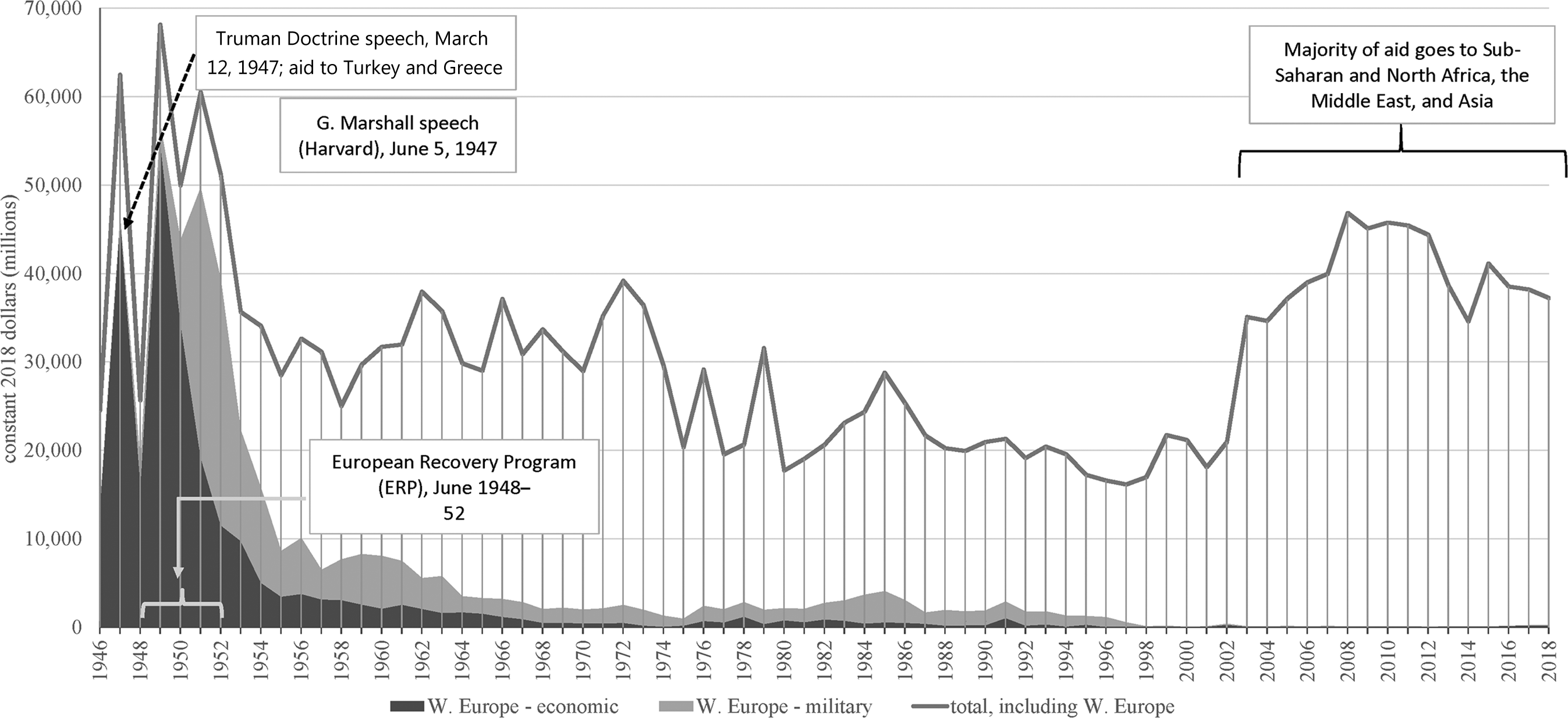
US overseas loans and grants, fiscal years 1946–2018. Source: US Agency for International Development (USAID) 2020, “U.S. Overseas Loans and Grants: Obligations and Loan Authorizations, July 1, 1945–September 30, 2018,” https://explorer.usaid.gov/reports, accessed April 22, 2020. In 1976 the government changed the fiscal year from July–June to October–September; data for 1976 include the adjustment period from July through September.
The Plan was also an important driver of the construction of the institutional architecture of the American-led postwar liberal international order (see Figure 2). In particular, the ERP was a direct forerunner of the US Agency for International Development (USAID), which solidified the Plan's shift from loans-based aid to the developmentalist model that would be central to US aid provision throughout the Cold War. By stimulating the formation of the Organisation for Economic Co-operation and Development (OECD), the Plan also helped bring about European unification.
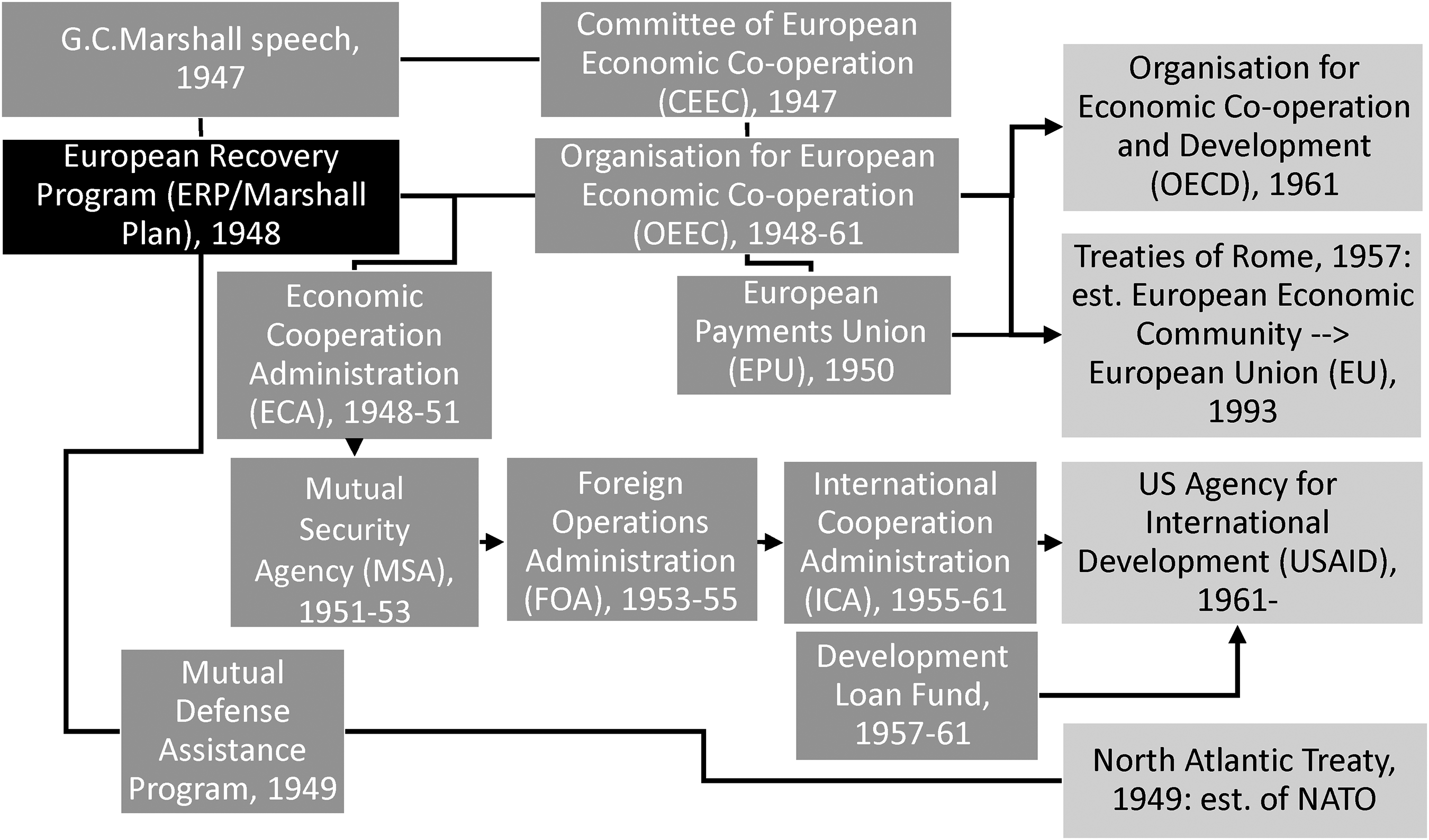
The Marshall Plan in the making of the American-led postwar international order. Authors’ elaboration. Sources: Curt Tarnoff, “The Marshall Plan: Design, Accomplishments, and Significance,” Congressional Research Service Report R45079 (2018); Kenneth Dyson and Ivo Maes, eds., Architects of the Euro: Intellectuals in the Making of European Monetary Union (Oxford: Oxford University Press, 2016), 13–14; OECD, G.C. Marshall Foundation, White House Office of the Historian; see also William Adams Brown and Redvers Opie, American Foreign Assistance (Washington, DC: Brookings Institution, 1953).
The Plan thus stands as a watershed in world history. Had it failed or appeared in an altered form (for instance, in the more Russia-friendly and Communism-neutral form preferred by FDR and Henry Wallace), postwar international history and US hegemony would have been very different.
Narratives of selflessness aside (for Winston Churchill, the Plan was “the most unsordid act in history”), 18 the new era of liberal internationalism in US foreign policy rested on a bedrock of anti-Communist militarism. As shown in Figure 1, ERP economic aid was followed by a second phase of military aid—a form Marshall himself feared would strengthen the influence of Communist propaganda. 19 Objections notwithstanding, congressional amendments to the ERP after the North Korean invasion of South Korea (June 1950) displaced the centrality of economic assistance, allocating $400 million in military aid. 20 The shift expressed the darker side of the ERP's underlying logic: that the central mission of US foreign policy was to manage a deadly opposition between the capitalist-democratic “West” and the Communist “East,” with dire consequences for the Global South. 21
What if the Marshall Plan took the One World form popularized by former presidential candidate Wendell Willkie and favored by former vice president Henry Wallace? 22 What if the dominant ideology underpinning postwar US foreign policy did not hinge on a world carved into opposing spheres? What if Marshall Plan institutions were UN-based, as progressives proposed? These are important counterfactual questions, downplayed in existing scholarship that too often affirms rather than historicizes Cold War logics of inevitability.
The Marshall Plan: Existing Accounts
Historical scholarship on the Marshall Plan is, to be sure, extensive, rendering efforts to classify existing accounts necessarily partial. 23 Nonetheless, four broad and non–mutually exclusive explanations are prominent: economic interests, leadership and ideology, experts and elites, and foreign threats. While meritorious individually, important gaps remain. The core problem is a tendency toward teleological explanations that deploy variable-type thinking without attending to the contingent historical processes that constitute causal social things.
In some scholarship, economic interest was central. Revisionist historical and world systems scholarship situates the Plan as a means of extending US economic power. 24 Postrevisionist historians as well as sociological political economists also highlight economic self-interest, 25 with good reason: with the postwar US economy unrivaled, the Marshall Plan was a solution to the problem “of creating enough world-effective demand for U.S. production.” 26 Still, as is often the case in Marxian-style explanations, this line of thinking tends to sideline the multiplicity of views of actors—including those who, like Marshall, foregrounded the Plan's humanitarian rather than economic impulses.
Another account foregrounds leadership and ideology, highlighting the importance of a supposed bipartisan liberal internationalist consensus in Congress, and the role of Truman and Republicans Arthur Vandenberg (R-MI) and John Foster Dulles, who reached across party divides to steer the country away from isolationism. 27 A related argument focuses on Southern Democrats’ backing of internationalist policies from the 1930s. 28
Leadership and ideology accounts complement others centered on experts, economists, and elites. 29 For Ikenberry, US support for a liberal world order was underpinned by an expert consensus among British and American Keynesian economists. 30 Michael Hogan situates the Marshall Plan as an effect of business elites’ search for a global corporate neocapitalism grounded in liberal principles: “an American political economy founded on self-governing economic groups, integrated by institutional coordinators and normal market mechanisms, led by cooperating public and private elites, [and] nourished by limited but positive government power.” 31 Stephen Wertheim, finally, shows how many of the guiding ideas were forged in wartime planning for American global supremacy at elite organizations such as the Council on Foreign Relations. 32
A final family of accounts explains the Plan as a response to foreign threat. One version, centering on Soviet Communism, can be found in accounts of historical players themselves: in the words of ERP director Paul Hoffman, “The real objective [of the Marshall Plan] was to stop the spread of Communism.” 33 This Soviet-threat perspective heavily informs “realist” IR takes. Here disagreements over promises made at Yalta in January 1945 about Eastern Europe, including Stalin's refusal to allow free elections in Poland, as well as burgeoning Soviet-friendly politics in countries including Italy, Greece, and France, led to an anti-Soviet foreign policy and hence the Marshall Plan. 34
A variation on the foreign threat account, finally, emphasizes both domestic ideological currents and geopolitical circumstances, situating liberal internationalism and the Marshall Plan as joint effects of war-induced “fading ideological divisions” and multiple foreign threats. For Charles Kupchan and Peter Trubowitz, liberal internationalism “was the product of both geopolitical and domestic developments. The threat posed by Nazi Germany, Imperial Japan, and the Soviet Union combined with the fading of ideological divisions . . . to enable Democrats and Republicans to coalesce around a common strategy.” 35 Here diverse foreign threats posed by dictatorial regimes accelerated the consolidation of bipartisan convergence on liberal internationalism. Yet, the centrality of a supposed threat from America's erstwhile ally, Russia, to the Marshall Plan—after the defeat of the German and Japanese enemies—hints at a certain fuzziness concerning the timing and process of “fading ideological divisions.”
Together, these accounts take economic interest, ideology, expertise, and foreign threat as settled, objective things with an intrinsic capacity to exert “forcing-cause” effects. And yet the Plan's oft-cited causes were accomplishments, not givens; only in retrospect did historically emergent causes acquire the veneer of natural facts. 36 Economic interests, for example, differ between classes and sectors and can be furthered in different ways. The constitution of an “expert” requires credentialing and recognition, both conditioned by the sociostructural location of would-be experts. A similar case can be made regarding national threats: in the absence of open warfare, what counts as a “threat” to the national interest is not self-evident and is usually a matter of the victory of some interpretations over others. If we do not understand how certain types of actors emerge and acquire political power, or how certain interpretations of facts and events become dominant, we risk taking for granted that which most needs explaining.
An Alternative Approach
Our analysis operates in the mode of what Daniel Hirschman and Isaac Reed call “formation stories,” where the key concern is how “social things come to be stable enough to force or be forced.” 37 In short, our aim is to explain how the oft-cited forces that necessitated the Marshall Plan—a recognition of the Soviet threat, elite consensus on the economic necessity of aid for Europe of a specifically New Deal–inspired type, and the existence of “liberal internationalism”—became the sort of social things that could cause something like the Marshall Plan. In ways that can easily slip from view, such processes are contingent, and consequential in that they close off some avenues and open up others.
We take as our unit of analysis symbolic boundary-work, or the making of “conceptual distinctions made by social actors to categorize objects, people, practices.” 38 The symbolic boundary-work that concerns us is, first, the making of particular kinds of political persons, and second, the production of coalitions based on shared frames concerning problems, issues, and realities. We center American party networks as the site for the production of new political persons—here the “credibly anti-Communist New Deal liberal,” or CANDL—who understand the political world in a certain way, and who then drive framing, policy formation, and coalition building.
Our inspiration is Erving Goffman. For Cahill, “the collaborative manufacture of public persons” was among Goffman's “abiding concerns.” 39 Starting from the Durkheimian principle that the social comes first and the person (understood as a category or representation, distinct from bodily individuals) second, a sociology of particular types of political person requires attention to “interpretive frameworks of accountability that individuals draw upon to produce and recognize actions that are indicative of one or another kind of personhood.” 40 Persons are contested cultural forms that, once crystallized, open up some “ways of thinking, feeling, and acting” and close off others, delineating counterpersons, creating new axes of difference and, at every step, new counterfactual possibilities.
Consider, for instance, how elections generate nationally visible partisan personas—think the “Trump Republican” or the “New Democrat.” The contours of the political field shift as politicians adopt person/counterperson stances (e.g., the “Trump” vs. the anti-Trump RINO). Meanwhile, in the broader cultural arena, media outlets, scholars, and pundits situate new persons relative to contemporaries and antecedents (e.g., is Biden the next FDR?). Similar processes occur between elections, as politicians and their associates link themselves, or are linked by others, with policy agendas (“New Deal Democrats”), social movements (“Tea Party Freshmen”), or expert cliques (“Brain Trusters”). Viewed in this way, the formation of political persons is crucial for which policy frames and hence coalitions are possible and impossible, and thus what policies become thinkable and operationalizable.
But often the mere availability of a given policy frame is not enough; frames with certain person-associations—especially factional ties—may, for counterpersons, be read as purely strategic, and thus inauthentic (e.g., a non-Trumpist Republican who embraces Trumpism in an election year). The trouble, in a Goffmanian way of thinking, is that frame-based coalition building requires credibility—and credibility requires proof. Commitment, or “the objective appearance of persuasive evidence that a proposed course of action has been unretractably entered upon,” is one form of proof. 41 Commitment involves giving up latitude to change one's course of action—say, by severing connections that might otherwise allow alternative alliances. Beyond public pronouncements, which may not do the trick, an alternative route is substantiating pronouncements by forming an organization on the basis of a person/counterperson stance (e.g., for anti-Trump Republicans, the Lincoln Project). In this case, person/counterperson dynamics become organizational positions and position-takings: “organizational actors distinguish themselves from others” via “symbolically meaningful position-takings—e.g., works, services, acts, arguments, products” that derive significance “from their difference vis-à-vis other such position-takings.” 42 Such organizational position-takings generate “openings . . . for innovative action,” including for the making of otherwise unavailable framing strategies. 43
The aim of this—necessarily brief—theoretical discussion is to reorient our gaze on the formation of the Marshall Plan away from large-scale forces such as economic interest toward the symbolic boundary-work involved in the production of particular types of persons in the specific contexts of a party's struggles for power. Following this way of thinking, below we describe the formation of a new figure on the political scene in 1947, one accepting the necessity to set the United States on a collision course with the USSR in order to advance their foreign policy objectives. We then highlight the coalition-building potential that underpinned a distinct kind of muscular internationalism in US foreign policy after 1948—liberal internationalism—the contested origins of which we recover at the individual, party-political, and state levels.
Data and Research Design
A formation story analysis centered on political person production requires evidence that allows the analyst to map out positions and position-takings in party networks over time. With this in mind, oral histories, memoirs, and biographies constitute our primary source of evidence, supplemented with obituaries and government reports. 44 We also draw on secondary historical works on diplomacy and the changing postwar political landscape. A note in defense of this approach is warranted.
Our formation story account is abductive, rejecting both pure inductive description and pure deductive theory-testing. 45 Instead, it moves back and forth between the generation of theoretical propositions and analysis of historical evidence. An ongoing process, in abductive research the conceptual framework and historical questions shift as one moves through sources and develops potential explanations. At every step, we formulate historical questions in terms of plausible counterfactuals evidenced in the evolving structure of persons and counterpersons in party networks, treating emergent patterns of opposition as the birth of new historical possibilities. 46
Theoretically, we began with the limited hunch that contingent circumstances and party-centered dynamics played more of a role in the Marshall Plan than present historiography suggests. Specific puzzles and the conceptual vocabulary needed to explain them crystallized as we developed our historical account, settling after a time on the centrality of boundary-work in political processes. Our empirical project also developed gradually, inseparably from theory development. In particular, our emphasis on first-person historical sources was based on a realization that a little-acknowledged but necessary factor in the making of the Marshall Plan was the arrival in late 1947 of an entirely new political person: the credibly anti-Communist New Deal liberal. Our analytical strategy hinged on first understanding how and why the CANDL emerged, and then following events from there. In so doing, we sought to demonstrate how biographically oriented, semiethnographic sensibilities enrich historical sociology—a subfield that tends to favor macroinstitutionalist modes of analysis in which persons and personal trajectories figure, in Mudge's words, as “interesting, but merely anecdotal, indicators of other, more important things.” 47
In terms of data, finally, a relational approach aiming to identify evolving patterns of opposition in a first-person perspective problematizes overreliance on “the” archive. While historical sociologists are right to assert that archival research should not be “left to the historians,” we should not take for granted that archival work is always the best means to evidentiary ends. 48 In particular, we are cognizant of the concern that archives may be arranged in ways that tend to reinforce reigning narratives—a concern directly relevant to the counterfactual analysis of an overdetermined event that we undertake here. 49 The Marshall Plan files at the National Archives, for example, begin in 1947—after what we consider many of the crucial events leading to the Plan's creation. 50 Thus, in the present case we found that memoirs, oral histories, and other first-person sources in digital archival collections proved sufficient basis for our claims, read alongside the exhaustive work of historians working in archives including the George Marshall Foundation and the Truman Library. 51
Once again, the Marshall Plan and the early moves toward the Cold War constitute one of the most intensively scrutinized periods in international history. Our claim to novelty in the following account lies less with what is factually new, than with what is seen in a fresh light through the lens of person production in intraparty contestation.
Necessitating the Marshall Plan
Our analysis of the Marshall Plan focuses on new political persons between 1944 (FDR's reelection) and January 1947 (the initiation of the 80th Congress), when two of the Plan's drivers emerged. First, there appeared on the American political scene for the first time the credibly anti-Communist New Deal liberal (or CANDL), a novel kind of person at the same time Democratic, a self-defined “liberal”—as opposed to progressive—and believably anti-Communist. The CANDL's appearance, second, closed off a renewed One World foreign policy coalition of liberals and progressives, at the same time as it made possible a coalition of liberal Democrats and Republican internationalists, who united around a bipartisan anti-Communist frame. Without these two drivers, the Marshall Plan, and liberal internationalism itself, would have been impossible.
Person/Counterperson Production in Party Networks, 1944–47
At the time of the 1944 election, and well into the year 1946, a Democratic New Deal–associated anti-Communist foreign policy initiative like the Marshall Plan was unthinkable. Before FDR's death, the framing of Communism as a transnational threat was a specifically Republican as well as conservative means of attacking Democratic New Dealers. Symptomatically, the 1944 Republican platform painted the New Deal as “Communistic” and un-American; another four years of FDR, it warned, “would centralize all power in the President . . . and this country could remain a Republic only in name.” 52 This “un-American” framing of Communism had a long lineage, reaching as far back as the Red Scare (1919–21), the Overman Committee (1919), and, during the New Deal years, the Congressional Dies Committee of 1938–44, the Hatch Act (1939), and the policing of Communist activity in organized labor, civil society, and the federal government. 53 Although Communism had the potential to mobilize as a transnational threat, under FDR it remained a partisan issue, not the sort of mobilizing strategy capable of underpinning a bipartisan effort like the Marshall Plan. 54
Indeed, anti-Communism, from Democratic New Dealers’ perspective, was not a very effective framing strategy in 1944. FDR dismissed Republicans’ Communist fearmongering, and the Democratic platform made no reference to Communism. Both FDR and his new running mate, Truman, rejected the notion that domestic organized labor or New Deal policies were “Communistic.” The FDR-Truman ticket won with more than 53 percent of the popular vote, and FDR pressed ahead with his New Deal agenda. Domestically, this meant the management and extension of the New Deal state, including bureaucracies like the Office of Price Administration (OPA) and initiatives such as the Economic Bill of Rights (unveiled early 1944). 55 In foreign policy, winning the war was the pressing task, followed by demobilization, economic reconversion, and maintaining international peace. Crucially, FDR was explicit that the New Deal position on Russia was to maintain cooperative relations.
Democratic Party strength under FDR, however, masked the increasing power of congressional conservatives and moderates and a growing fracture between Northern and Southern Democrats (Figure 3), with important implications for what might happen should FDR exit the political stage.
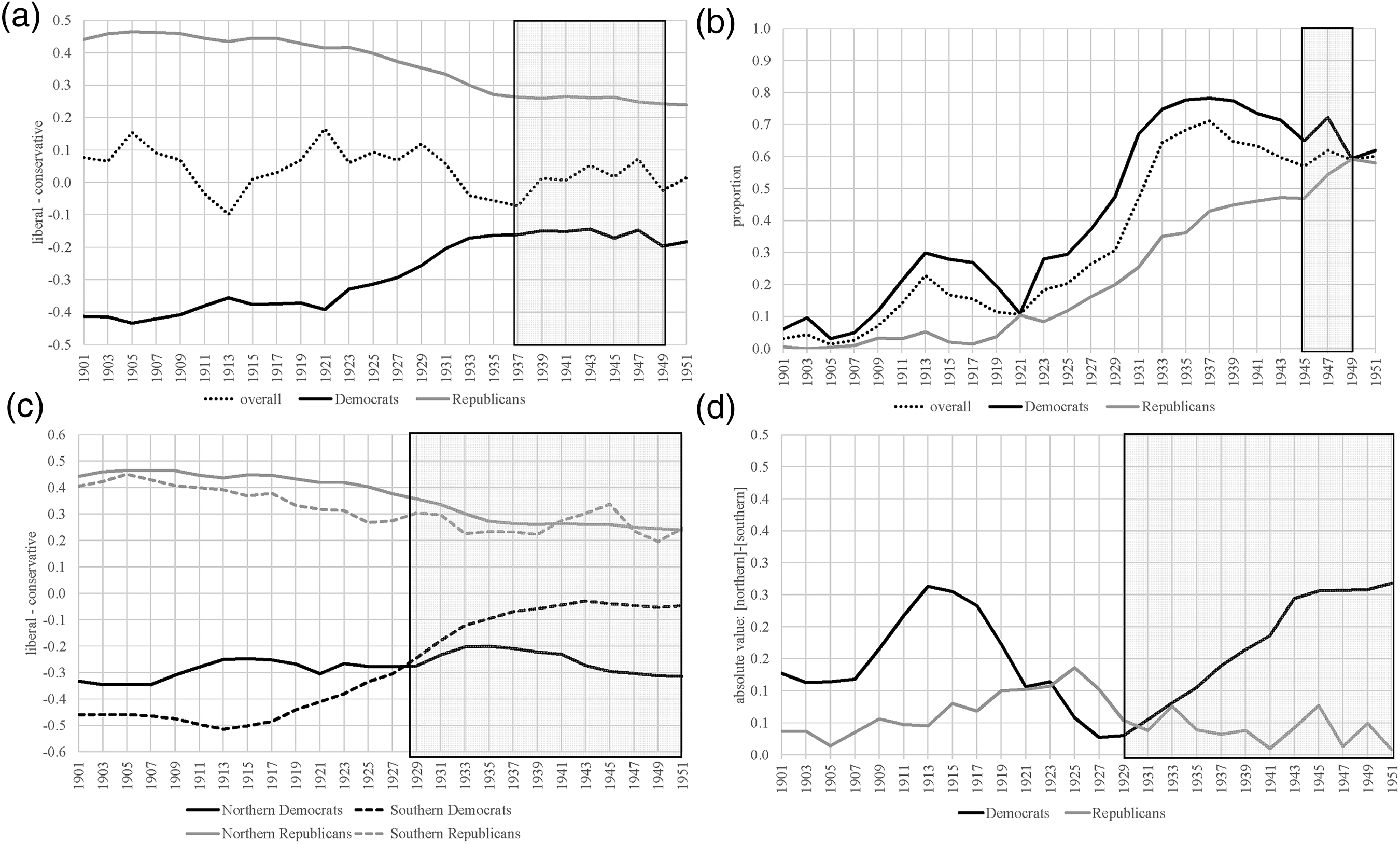
Increasing congressional conservatism and democratic intraparty fracture, 1901–51, US House of Representatives. (A) Polarization on the liberal-conservative dimension (higher = more conservative). (B) Proportion with a moderate score (−0.25 to 0.25) on the liberal-conservative dimension. (C) Intraparty regional polarization. (D) Difference in intraparty regional polarization, Democrats versus Republicans. Source: Nolan McCarty, Keith T. Poole, and Howard Rosenthal, “The Polarization of the Congressional Parties” (2016), accessed October 9, 2018, https://legacy.voteview.com/political_polarization_2015.htm.
Figure 3A shows that House membership was becoming more conservative, especially on the Democratic side, between 1944 and 1948. Likewise, Figure 3B shows a sharp uptick in bipartisan moderation in the House after the 1946 midterms. Finally, Figures 3C and 3D show that the Democratic Party was deeply fractured across the North-South divide throughout the 1940s.
Yet, despite growing conservativism in Congress, 1940s polling shows less than 40 percent of the US public viewed Russia as a definite threat (see Figure 4). From the late wartime period through late 1945, around two-thirds of Americans either viewed Russia as trustworthy or had no opinion on US-Russia cooperation. This shifted after the Potsdam conference in July–August 1945; still, about half of respondents remained unconvinced regarding a Russian threat. It was not until the spring of 1947—around the time of the Truman Doctrine speech (March 12)—that public opinion decisively shifted toward distrust.
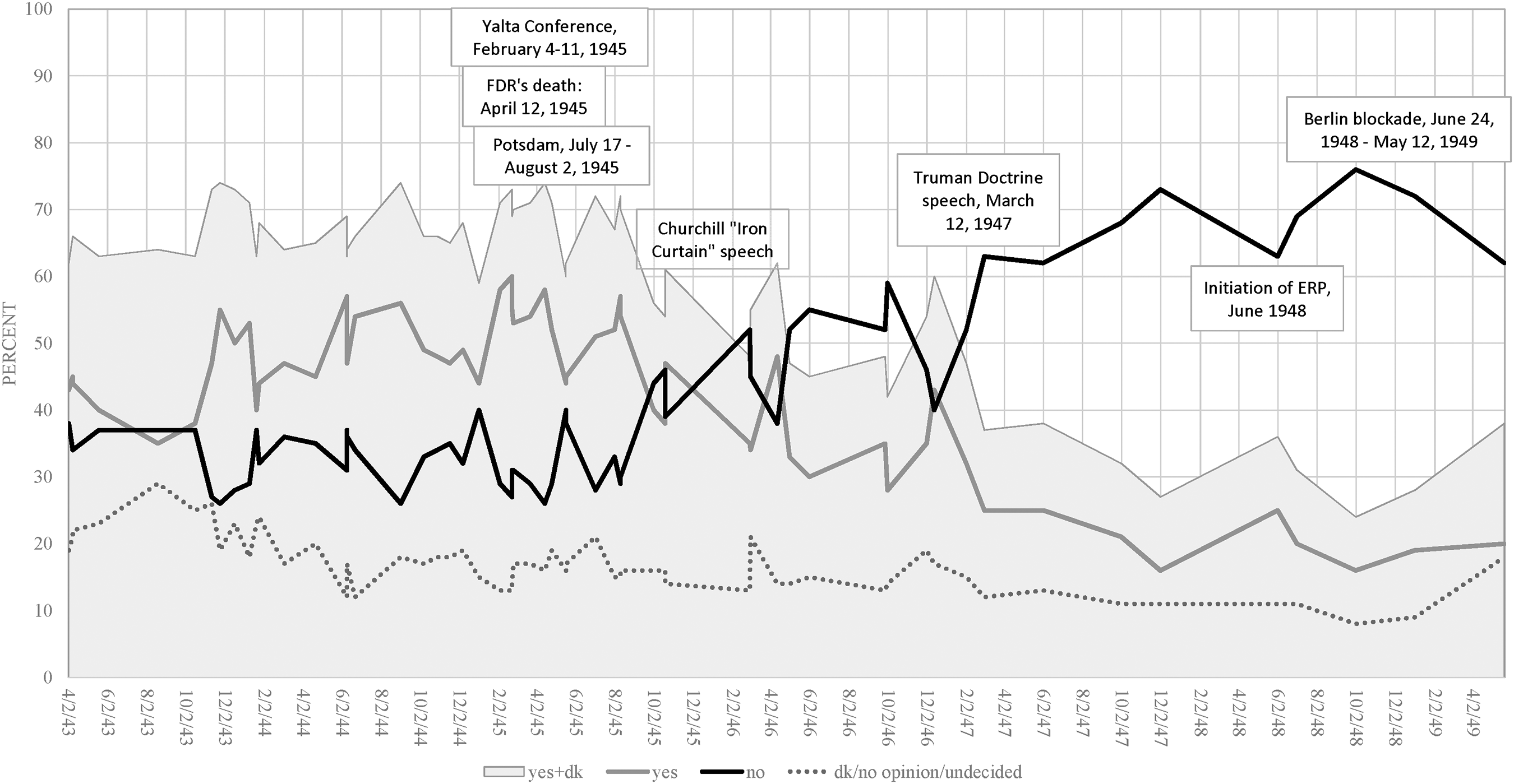
Trends in public opinion: Can Russia be trusted? Source: Roper Center, accessed April 22, 2020, https://ropercenter.cornell.edu/ipoll/. Survey questions are variations of “Do you think Russia can be trusted to cooperate after the war?”
In the interim, serious political and economic trouble set in centered not on the Depression-era problem of stimulating a lagging economy but reining in a strong one, featuring large wage and price differentials. The administration imposed unpopular price controls but did not rein in wages. As pent-up frustration resurfaced across industries, labor unrest turned sharply upward in mid-August 1945 (after Japan's surrender), peaked in January 1946, and spiked again in April–May (Figure 5).
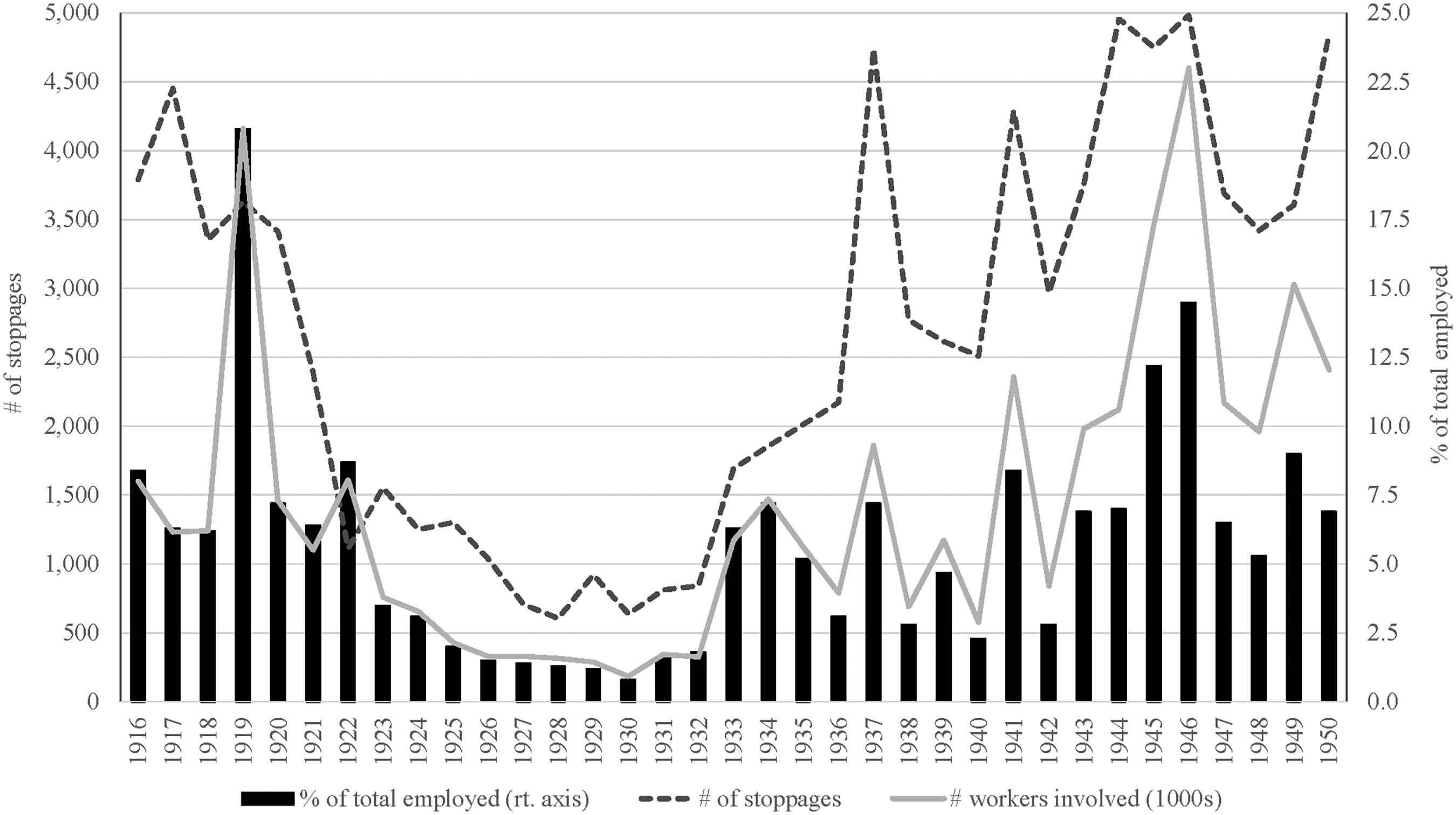
US labor unrest, 1916–50. Source: Department of Labor, July 15, 1951, “Analysis of Work Stoppages during 1950,” Bulletin No. 1035, United States Department of Labor, p. 2, Table 1.
Considering that the Labor Department's Conciliation Service “assisted in the adjustment of over 15,000 labor-management controversies in 1946,” official figures on stoppages underestimated the full scale of unrest. 56 “The first 6 months of 1946 marked the most concentrated period of labor-management strife in the country's history.” 57 In this context Democratic fractiousness deepened, giving rise to intraparty struggles that would, by early 1947, fundamentally alter the public character of “New Dealers,” opening up new framing and coalition-building possibilities.
Person-Differentiation in Democratic Party Networks
Between the 1944 election and January 1947, intraparty contestation drove two phases of person/counterperson production: first, between Truman and those loyal to him (hereafter “Trumanites”) and New Deal intellectuals; second, among New Deal intellectuals, between those true to FDR's vision of New Deal foreign policy and those who sought to make anti-Communism a credible New Deal stance. The result was a new partisan person porting a historically conservative frame: the credibly anti-Communist New Deal liberal or CANDL.
A first fracture rent a set of Trumanite loyalists from New Dealer holdovers from FDR. A North-South Democratic fracture and growing conservatism of congressional Democrats had already shaped FDR's choice of Truman as running mate. Truman was a compromise, “acceptable to all factions of the party,” 58 backed by an alliance of big-city machine bosses and conservatives who blocked a last-minute motion to reelect Wallace. 59 “Hardly an auspicious beginning for those who looked to a postwar expansion of the New Deal at home and to the creation of a world New Deal,” Truman's nomination was the first of a series of events that drove a wedge between Democratic Party loyalists, who saw Truman as one of their own, and New Dealers. 60 The opposition deepened after FDR's death on April 12, 1945. At first Truman pressed ahead with FDR's agenda, despite opposition from the anti–New Deal, fiscal, and “states’ rights” conservatives who dominated Congress. 61 Truman initially retained Roosevelt's cabinet; his first legislative proposals, including full employment laws, were a “comprehensive statement of progressive philosophy and a sweeping liberal program of action.” 62 On foreign policy, Truman supported FDR's cooperation-focused approach. 63
Truman, however, gradually displaced New Dealers between late 1945 and late 1946. Henry Morgenthau, Secretary of Labor Francis Perkins, and Secretary of Agriculture Claude Wickard left immediately; Harold Ickes at the Department of the Interior left the following year. In came former national chairman Hannegan as postmaster general, George Allen as the director of the Reconstruction Finance Corporation (RFC), and Edwin Pauley as the head of the Anglo-American-Soviet Reparations Committee. Cabinet positions went to James Byrnes (State), and Fred Vinson and subsequently John Snyder at Treasury, with James Forrestal retained as Navy Secretary. Truman also brought in a group of friends that included Harry Vaughan and James K. Vardaman.
The Trumanites were not “conservatives,” but neither were they New Dealers. They were party men, loyal to the Democrats and to Truman. “Cronies” for some, 64 the Trumanites shared five features: “they were . . . intensely loyal to Truman”; 65 all (except Byrnes) were from west of the Mississippi; they were “safe” Democrats; they were not liberal New Deal intellectuals (e.g., “there was no one who was notably brilliant or colorful or vociferously liberal”); 66 and all had strong links to Congress, which Truman hoped to rebuild after FDR's neglect. Many also had connections to Truman from shared service in World War I. 67
The Trumanites’ arrival thus crystallized a person/counterperson distinction in elite Democratic networks. The story of the replacement of Secretary of State Edward Stettinius, a longtime Democrat and aide to FDR, is illustrative. Byrnes, Stettinius’s Trumanite replacement, was among those FDR passed over for Truman in 1944, and Truman felt he owed Byrnes a prominent role in his administration. When Allen (another Trumanite) delivered the news of his ouster, Stettinius responded, “You Democrats are just trying to throw me out, and I’ve done a great job.” 68 Stettinius’s use of the phrase “You Democrats” is a clear discursive marker of person-differentiation: Stettinius was himself a Democrat, but not a Trumanite Democrat, and that made all the difference.
On the other side of the divide were the New Deal Democratic “liberals.” Like Trumanites, New Deal liberals had well-recognized positions and dispositions: they were academic, Keynesian, or “intellectual”; they were from the East Coast; they were more committed to principle than party (thus tending to eschew strategic compromise); they had affiliations with FDR and the New Deal; and they adopted certain policy stances. Clifford, for example, remarked that his differences with Truman's assistant John Steelman were not so much a matter of belief than a matter of “very different styles.” 69 Self-understood liberal Robert Nathan (formerly of FDR's Office of War Mobilization and Reconversion) would later emphatically affirm the Trumanite-liberal distinction: “Truman certainly wasn't the idol of the 100 percenters—you know, all or nothing. Now, this is a great problem with liberals. . . . When the liberals want something, they don't compromise.” 70
The Fracture Deepens: Trumanites’ Hardline Turn on Russia
As the 1946 midterms approached, New Dealers hoped to push the administration in a liberal direction. Hannegan held out hope of joining with Trumanites to develop “a pro-union, liberal identity for the national Democratic party, especially for gaining the support of CIO [Congress of Industrial Organizations] unions.” 71 But, as events related to Russia complicated this prospect, the question of foreign threat increasingly defined the Trumanite-liberal New Dealer opposition.
Initially Truman's foreign policy stance was a continuation of FDR's “grand design,” which rested on the view that as long as it refrained from exporting Communism, Russia's security needs could be met. 72 However, unlike the liberal New Dealers, Trumanites were not inclined to “bend over backwards” to achieve reconciliation. The Trumanite takeover of the White House thus brought a hardening of views toward Moscow. 73
Despite later accusations of being soft on Communism, early anti-Russian influences came strongly from the State Department, where the historian Daniel Yergin has charted the rise of the “Riga axioms”—a set of anti-Soviet views named after the US diplomatic post in Latvia. 74 As prominent diplomats either stationed there or who made frequent visits during the 1930s, Averell Harriman, George Kennan, and Charles “Chip” Bohlen came to share a suspicion of Russia. 75 Harriman was particularly influential, rushing back to Washington after FDR's death to urge Truman to adopt a “firm, but friendly, quid pro quo approach” on issues like Lend-Lease. 76 Harriman, Bohlen, and (later) Kennan's views found sympathetic ears among the hard-nosed Trumanites, where Byrnes pushed a “get-tough” approach that, by fall 1945, was official administration policy.
The fate of a potential loan to Russia demonstrates how Truman's hardline stance ruptured Trumanite–New Dealer relations. According to State Department economist Emilio Collado, New Dealer Treasury Secretary Henry Morgenthau was strongly in favor of a loan in spring 1945, as were Ickes, Wallace, Stimson, and Benjamin Cohen. 77 As Edwin Nourse later relayed, Cohen was “a Soviet loan guy,” telling hardliner Elbridge Durbrow that “you can't make an omelet without breaking some eggs” and “we don't like their system, but we can't change it either.” 78 On the other side, “Harriman took a rather powerful view against this,” as did Under Secretary of State for Economic Affairs Will Clayton. 79 For Durbrow, Cohen's reasoning was quixotic Keynesian thinking—“another unrealistic ‘beautiful thought’”—characteristic of intellectual New Dealers. 80 When the New Dealers’ loan idea papers ended up on Collado's desk in September 1945, “it was convenient to have them lost.” 81
The hardliners found plenty to support their concerns, including evidence of spying and a fiery speech by Stalin in February 1946 warning of inherent contradictions within capitalism. 82 The latter led Kennan to formulate his famous “long telegram,” 83 which urged a policy of what would later become “containment.” Kennan's message was echoed when Winston Churchill declared at Fulton, Missouri, the descent of an “Iron Curtain” between East and West, and when Senator Arthur Vandenberg asked Congress ominously, “What is Russia up to now?” 84
New Dealers’ hope for a modus vivendi hinged on Wallace, a charismatic New Dealer who, in characteristic liberal style, was unwilling to change his mind on cooperation. Trumanites like Edwin Pauley saw Wallace as typical of ideologically driven New Deal intellectuals—in Pauley's words, “Wallace was so involved in the Soviet [pro-cooperation] approach . . . that it was almost impossible to talk to him about it. His eyes were always looking to the stars; he felt he was right, and no one could tell him any different.” 85
As anti-Russian views gained acceptance among the Trumanites between mid-1945 and late 1946, prospects for a foreign policy alliance of New Dealers and Trumanites faded. The period witnessed “a movement into the anti-Soviet camp of aides and advisers who had staked no previous turf on foreign policy, people like Truman who were fundamentally centrists”—such as Fred Vinson, Secretary of Agriculture Clinton Anderson, and Clark Clifford. 86 “These individuals were above all party-oriented pragmatists, moderate liberals cognizant of political considerations first and foremost, but they all gradually came to the conclusion that no compromise with the Soviet Union was possible, sharing ‘Truman's own conceptual journey.’” 87 The effect was the opening of an unbridgeable divide between the Trumanites and the New Dealers.
Public Opposition to War: A Counterfactual Possibility
Between March and August 1946, as midterm elections approached, opinion polls suggested that the American public was, on the one hand, increasingly aware of the debates over Russia policy, opposed to the conciliatory position associated with Wallace, and favorable toward Byrnes’s “get-tough” stance—but, on the other, only supportive as a means to peace. 88 Truman knew the public was wary of conflict. Tellingly, when a September 1946 report on Russian adherence to wartime agreements (submitted by Clifford and naval aide George Elsey) summarized what was becoming commonsense to many Trumanites—that America should prepare for prolonged hostilities—the president worried that the public would not welcome the message. 89 While “pleased” with the report, Truman asked for all copies to be locked away. 90
Truman's concern suggests that in late summer of 1946 New Dealers confronted a strategic choice. One option was to capitalize on the public's desire for peace by making the case that anti-Soviet foreign policy would lead to war, putting pressure on Trumanite hardliners to stay true to FDR's vision. Given the New Dealers’ marginalization from the administration, the risk was a loss of influence in Washington. An alternative was to embrace the hardline position and seek an alliance with Trumanites, but this also presented risks: breaking with FDR's foreign policy would undermine New Deal alliances and lend credence to Republicans’ framing of Communism as a transnational threat, inclusive of organized labor and the New Deal. As we discuss in the next section, a fraction of New Dealers chose this route nonetheless.
Opening the Door to a “Liberal” Transnational Anti-Communist Frame
As noted above, the largest strike-wave in American history unfolded between mid-August 1945 and summer 1946. 91 Truman's initial response was to try to accommodate union demands. 92 He gave little credence to conservative notions that strikers were domestic subversives. In a May 24, 1946, radio address, at the apex of the rail workers strike, Truman made a clear distinction between “action by a foreign enemy” and strikers, whom he described as Americans “who place their private interests above the welfare of the nation.” 93 A common phrase in the White House was that “communism was a threat to America, but not a threat in America”—pushing against rhetoric that tied Communism to organized labor. 94
And yet, with Truman's popularity plummeting, administration insiders worried about how his response would play. Clifford questioned whether (in his words) Truman had “the personal strength and political power to deal with American labor.” 95 Still it is not quite accurate, as Bell argues, that “the sheer scale of industrial strife pushed Truman into an anti-union stance by April 1946.” 96 Rather, the push came from inside Truman's networks: in response to pressure from Trumanites, the president situated labor as overly powerful. Truman threatened to draft the railroad strikers, and later took the head of the United Mine Workers Union John Lewis to court for strikes on federally owned railways—resulting in a $3.5 million fine on the union and a $10,000 fine on Lewis. 97
Truman's tough stance increased his political capital as elections approached, 98 even as “the political right was coalescing around . . . opposition to any extension of the New Deal state,” in part by “using anti-totalitarianism as a weapon against liberal candidates.” 99 Conservative anti–New Deal rhetoric linked domestic and foreign Communism. 100 In this context, Truman's shift to a hardline stance on both Russia and domestic labor threatened conservatives’ hold on the framing of Communism as a transnational threat. The result was that “for the first time during an American era of peace, it was next to impossible to discern domestic problems coherently without having the points become entangled with foreign affairs.” 101 In the end, fiery White House rhetoric embraced the very framing Truman once rejected: a conflation of domestic Communism, subversion, totalitarianism, and Russia—a transnationalized Communist threat.
Truman's move generated dissent among New Dealers, who perceived Truman's embrace of a historically conservative framing device as conservative sabotage of the New Deal agenda. Among the dissenters was Wallace, the most prominent New Dealer in the cabinet by September 1946. On September 12, Wallace gave a speech contradicting Byrnes’s get-tough policy, and by extension undermining Truman's efforts to co-opt conservatives’ hardline stance. “Getting tough never brought anything real and lasting whether for schoolyard bullies or businessmen or world powers,” Wallace pronounced. 102 On September 20, 1946, Truman fired Wallace—setting in motion a new episode of person/counterperson production.
Still a lodestar for New Dealers, and convinced that “Cold War abroad meant the end of the promise of the New Deal at home,” 103 Wallace adopted an alternative transnational rationale: a “One World” policy that acknowledged multiple modes of socioeconomic organization, accepted the legitimacy of Russian interests in Eastern Europe, and notably avoided framing Communism as a transnational threat. The One World concept was neither new nor, historically speaking, strictly “pro-Communist” or pro-Russia. For former Republican presidential candidate Wendell Willkie, One World meant a broad vision of global equality, including the end of colonialism and world federalism. 104 Bohlen, an early hardliner on Russia, advocated for a less idealistic vision as recently as February 1946, when he acknowledged “the legitimate interests of the Soviet Union in Eastern Europe” in a report and called for support for the non-Communist left. 105 In the wake of the Truman-Wallace split, One World-ism was anathema for Trumanites.
Raising the specter of a challenge to Truman's bid for reelection in 1948, Wallace became a figurehead for the Progressive Citizens for America (PCA) in September 1946. The PCA's manifesto called for “winning the peace” and a return to the New Deal agenda, while Wallace criticized big business, the conservative press, and those undermining lasting peace with Russia. 106 With Democratic Party fractures on full display, conservative Republicans like Richard Nixon and Joseph McCarthy successfully used anti-Communist language to oust liberal-backed candidates. The Democrats, having controlled Congress since 1932, lost sixty-five seats and control of both chambers.
The Birth of the Credibly Anti-Communist New Deal Liberal
As a transnational Communist threat became a more bipartisan frame, and Wallace and the One World agenda crystallized in opposition to the administration, pro–New Deal Democrats confronted a choice: back Truman, creating a rift that would close off any chance of a New Deal coalition on foreign policy, or remain allied with Wallace and the PCA, rendering a coalition with Trumanites and congressional conservatives impossible. Given that Truman was seemingly on his way out, the latter strategy was plausible, but the former prevailed. True to the arguments of Goffman concerning the possibilities inherent in person-differentiation, placed in the specific context of state struggles, pursuing this strategy required more than New Dealers’ adoption of an anti-Communist and anti-Soviet New Deal Democratic foreign policy stance; that stance also had to be credible.
New Deal liberals’ credibility problem on the matter of anti-Communism was a topic of heightened debate in the wake of the midterms in late 1946. For instance, progressive Robert La Follette Jr.—founder of the Wisconsin Progressive Party turned Republican—despite his affinities with New Deal liberalism, made clear his position that “Communist activities in America” were both “a serious menace to democracy” and a core dilemma confronting liberals. In an article in Colliers, titled “A True Liberal Turns the Light on Communism,” La Follette argued that “LIBERALS MUST DIVORCE THEMSELVES FROM FELLOW
A new person-producing process thus ensued within predominantly Democratic networks, in which two otherwise weakly differentiated positions—liberal and progressive—became a stark opposition across a new axis: “liberal” became an anti-Communist, pro-containment, New Deal stance; “progressive” came to be associated with One World Communist-neutrality.
Wallace maintained that liberals must work together within the Democratic Party as long as the Democrats remained the party of the New Deal. 109 Appeals for unity notwithstanding, the PCA's challenge to the administration's foreign policy complicated marginalized New Dealers’ efforts to maintain influence in Congress and over the Truman administration. The response was the January 1947 formation of a liberal New Deal organization on an anti-Communist basis: the Americans for Democratic Action (ADA).
The ADA was a reincarnation of the earlier Union for Democratic Action (UDA, established May 1941), which had been derailed by conservative accusations of Communism. With the UDA's experience in the background, the ADA was initiated when James Loeb Jr. joined with other FDR New Dealers—Leon Henderson, Wilson Wyatt, Hubert Humphrey, and others—in a call for a Democratic progressive convention. Joseph Rauh, an ADA lobbyist, would later summarize the ADA's aims as “to separate the Commies from the liberals”—in other words, to delineate the CANDL, making anti-Communist New Deal liberalism credible. 110
Soon after its founding, the ADA explicitly disaffiliated from Wallace and the PCA, establishing “commitment” in Goffman's sense by closing off any possibility of an ADA-PCA alliance. 111 The CANDLs’ move against One World progressivism fractured the network of Democratic New Deal intellectuals for whom Wallace was once a central charismatic figure—and Truman an outsider. “Wallace was our hero,” Loeb later explained, 112 so “there was the kind of ideological split between President Truman, who was a non-intellectual, and the [ADA] intellectual liberals.” 113 Thus, with the making of the ADA, a new kind of partisan figure crystallized on the national political scene: the credibly anti-Communist New Deal liberal, or CANDL.
New Coalitions Inside and Outside the Democratic Party
The emergence of the CANDL did not lead by itself to the Marshall Plan. Indeed, Truman “suffered” the ADA “but he didn't believe in their movement.” 114 Partly for this reason, some characterize the ADA's founding as a strategic move that pulled “organized labor into a Faustian pact with the political language of the American right.” 115 However, by preempting a One World coalition, and situating themselves as credible allies for an embattled president with whom they had a history of mutual enmity, the CANDLs made two new coalitions possible, one inside the Democratic Party and another with internationalist Republicans anxious to develop a muscular postwar foreign policy for America.
Inside the Democratic Party, a network grounded in the administration, which consolidated in the wake of midterm losses, mobilized to show that Truman “was pitching for their [liberal] team.” 116 This self-styled “Monday Night Club”—whose members included Trumanite Democrats Clark Clifford, Leon Keyserling of the Council of Economic Advisers, and former Democratic National Committee (DNC) director Oscar Ewing—met on Monday evenings at Ewing's home, and built a case for Truman to make common cause with ADAers (i.e., CANDLs).
Considering issues like a possible presidential veto of the anti-union Taft-Hartley legislation (they were in favor) and civil rights issues such as armed forces desegregation, club members understood themselves as more pragmatic than CANDLs. As Clifford later recalled, they were “outnumbered by the conservatives within the Administration and misunderstood by most of the old New Dealers and ideological liberals on the outside.” 117 As such, they were well positioned to build a bridge between the two. Despite having excluded CANDLs (“We did not include in the group ‘professional liberals,’ whose ardor and search for ideological purity outweighed their discretion and their judgment”), 118 club members viewed Democrats’ midterm losses as an indictment of Truman's failure to stake his claim as a New Deal liberal. And so, “although no one realized at the time, [the election] shifted the equation within the Administration in favor of the liberals.” 119
Although Truman's freedom of domestic legislative action was curtailed after the midterms, with the backing of CANDLs the way was open for an anti-Soviet foreign policy with a (previously unthinkable) New Deal gloss. CANDLs’ willingness to embrace the framing of Communism as a transnational threat was key: with conservative, congressional Republicans in the majority, liberals “could not simply oppose; they had to take affirmative action.” 120 As Clifford later explained, armed with a transnationalized anti-Communism, “it turned out to be easier to fashion a bipartisan foreign policy with a coalition of Republicans and conservative Democrats than with Democrats alone.” 121
From the Truman Doctrine to the Marshall Plan, March to June 1947
On February 21, 1947, the British ambassador to Washington, Clark Kerr, informed the American government of his country's intention to cease military and economic aid to Greece and Turkey. Three weeks later, on March 12, in his famous “Truman doctrine” speech, the president called for America to replace British assistance and to “support free peoples everywhere.” 122 For the historian Jonathan Freeland, Truman's urgency was not a function of the situation in Greece and Turkey. 123 Since no aid would reach Greece until the fall of 1947, “the crisis of March 1947 had its origins in American politics.” 124 The British note offered the Truman administration an opportunity to seize the legislative agenda where he still could: on foreign policy.
Truman's forceful remarks thus signaled a foreign policy shift: out went the vague concept of “get tough” and in came the explicit containment of a transnationalized Communism. 125 The meat of this new policy was an ambitious interventionist foreign aid package designed to get ahead of Congress on European policy. 126 The crux of the issue was the fiscal burden on the American taxpayer of the occupation of a bankrupt Germany. Either the administration developed a plan for reducing the cost of the occupation, therefore, or the new Congress would, and the administration would most likely disapprove of its form and implications for foreign policy beyond Germany.
What Congress might have proposed is difficult to ascertain. Congressional leaders would have been placed in a similar position in squaring the circle of achieving savings in Germany, while not appearing soft on the Soviet Union. What is clear is what was increasingly off the table, namely, the universalist “grand plan” approach of FDR centered on a continuation of the United Nations Relief and Rehabilitation Administration (UNRRA). As the historian Hadley Arkes notes, the elections shifted the view in Washington of the UNRRA, as the “impartial and ‘universalistic’ criteria of the United Nations—the criteria that made no distinction between friends and enemies, between the decent and the corrupt—were no longer seen as neutral in their political effects.” 127 “Once the Greek-Turkish aid program was undertaken, once it was justified in doctrine and reinforced with the scheme of post-UNRRA aid, it was a much shorter step to the Marshall Plan.” 128
The shape of American commitments remained ill-defined at the time of Truman's speech, but cross-government planning was quickly initiated. At the new Policy Planning Staff, George Kennan set to work on the problem of the disarray in a European economy reeling from an especially harsh winter. 129 Kennan drew in part on Assistant Secretary of State for Economic Affairs Will Clayton's report on the dire situation after returning from a trip to Europe in April 1947, which played into thinking in Washington concerning the need for a comprehensive move on foreign aid to kick-start the European economy. 130 As Jones recalls, Clayton “believed that nothing less than full economic federation of Europe and massive United States aid in its support would save the situation, and he freely said so during the period.” 131 In seeing the problems of Germany and Europe as one and the same, Kennan and Clayton were thinking along the same lines as the State-War-Navy Coordinating Committee (SWNCC, pronounced “Swink”), an interagency committee also considering European policy, which submitted a report on April 21, 1947, urging large-scale assistance. 132 The purpose of US aid was thus to bolster countries—especially France and Italy—on the edge of political shifts that might “adversely affect the security of the US.” 133
The sum total of these inputs was a convergence on a large-scale New Deal-esque recovery package as offered by Marshall in early June. Bohlen, who wrote the speech, took sections directly from the memos floating around the department. In addition to Bohlen, Kennan, and Clayton, historical accounts have highlighted the important role of younger members of the State Department who saw the German question as an opportunity to restore the world economy along Keynesian lines, 134 which required getting Western Europe back on its feet, not just Germany. For Hogan, the Marshall Planners—individuals like Ben T. Moore, Miriam Camp, and Harold Van Buren Cleveland—“tried to transform political problems into technical ones that were solvable, they said, when old European ways of conducting business and old habits of class conflict gave way to American methods of scientific management and corporative collaboration.” 135
The Marshall Plan blended a set of seemingly incompatible policies from a set of opposed groups. The Plan managed to upload to the now firmly anti-Communist Trumanites a vision of foreign aid similar to the One World concept held by the progressives around Wallace. As State Department economist Willard Thorp recalled, “the economic group in the State Department was operating on a kind of ‘one world’ kind of concept.” 136 They maintained a Rooseveltian hope of cooperation: “Even the Greek-Turkish program did not shift as to a dominating Cold War policy.” 137
Yet the idealistic notions of the young planners were couched in the rhetorical cloak of anti-Communism, and the message that foreign aid was urgent and necessary was communicated to Congress by individuals—like the war hero Marshall himself—untainted by associations with the New Deal. The formation of that Marshall Plan was thus driven by a configuration of individuals across the administration, the State Department, and Congress, and in the broader political field that had at times strongly divergent goals but could agree on large-scale foreign aid justified in strongly anti-Communist terms. As Markowitz shows, the Marshall Plan, therefore, was a paradoxical policy “that made the division of the world into hostile power blocs an inevitable fact while appealing to those for whom dreams of One World and a World New Deal still had relevance.” 138
Conclusion
The Marshall Plan was not an inevitable outgrowth of a postwar bipartisan embrace of liberal internationalism, as common wisdom holds. The Plan was bipartisan only to the extent that some members from both parties supported it and Republicans like Vandenberg and Dulles were involved in its formation. 139 Cross-party support for aid was never guaranteed, opening fissures throughout its life along the opposition between the New Deal liberals and their allies and conservative members of Congress. For Senator Robert Taft, the Plan's leading critic, for example, the ERP was “a giant ‘European TVA [Tennessee Valley Authority].’” 140 The administration, Taft said, “can't get away from the New Deal principle that Government spending is a good thing in itself.” 141
The Marshall Plan emerged before the meaning of liberalism had solidified and its bearers had differentiated themselves from progressives, as an effect of intraparty struggles in the polarized context of postwar US politics. Truman's replacement of FDR's New Dealers with a group of moderate conservatives (the Trumanites) facilitated the rise to power of individuals willing to risk a diplomatic break with Russia to further European economic recovery. By 1947, crucially, they could draw on a transnationalized frame that tied Communism in one sense, as a Russian geopolitical challenge, with Communism in another sense, as domestic militant unionism. The rise of the Trumanites led to a split in New Dealer ranks, and the emergence of a specific figure: the credibly anti-Communist, New Deal liberal (CANDL)—pro-Truman, anti-Communist, and in favor of a large foreign aid package. The rise of the CANDL made possible a configuration of liberals, Trumanites, and internationalist Republicans that successfully steered the ERP through a conservative Congress.
Our account has implications for the sociology of foreign policy making, of the United States but we hope beyond too. Unlike familiar emphases on bureaucratic politics and interparty conflict, 142 our analysis points to intraparty struggles as a key site in which new actors and new coalitional possibilities are forged. In the United States, intraparty struggles become especially intense during transitional periods in and around elections and/or changeovers in factional control of government. During these periods, party actors invest resources in developing new factional power bases or augmenting existing ones. These processes demarcate new kinds of Democrats and Republicans able to adopt credible positions on contentious issues, producing the raw materials of novel coalitions.
The implications for our understanding of liberal internationalism are significant. Often considered the dominant ideology of US foreign policy, understanding liberal internationalism in monolithic terms represents an impoverished conceptualization. Supposedly able to explain such contradictory policies as the late 1990s embrace of interventionism, the neoconservative turn in the post-9/11 years that led to the wars in Iraq and Afghanistan, and President Barack Obama's continued use of special forces and drone strikes and restraint from using more large-scale military interventions, a more fine-grained approach—like the one developed here—would seem valuable.
The relational understanding of liberal internationalism we propose foregrounds the boundary-work involved in creating shifting coalitions within and across political parties, and the dual demarcation of particular types of actors and credible political stances—here the liberal Democrats with a strong anti-Communist stance. In the case of the ERP, central to those processes was the transnationalization of Communism as a threat to America—simultaneously meaning Russia as geopolitical competitor, the American Communist Party, and potential subversives in the United States, in the context over a struggle over the future of the labor-friendly New Deal.
Today, similar boundary-work is a feature of partisan struggles over the meaning of geopolitical challengers such as China and Russia that generate potential spaces for cross-party alignment or misalignment. Whereas Russian interference in the 2016 election renders unlikely cross-party agreement on Moscow, a space for alignment on China exists, notably on the Republican side, with prominent GOP members pushing a stance strongly critical of the Chinese Communist Party (CCP) over human rights violations in Xinjiang, Hong Kong's special status, and responsibility for the ongoing coronavirus pandemic. 143 Many Democrats, including Senate leader Chuck Schumer, have also voiced criticisms of Beijing, suggesting a potential anti-China stance for Democrats. 144 However, up to now, “playing the China card” remains a divisive interparty strategy. It may not stay that way. Nevertheless, at issue in American China policy is not whether the United States should or should not adhere to liberal internationalist ideology, or an isolationist alternative, but whether a durable and effective bipartisan alliance against China will emerge in relational party and state struggles.
Footnotes
Acknowledgments
The authors would like to thank the editors of Politics & Society for helpful comments on an earlier version of this article, in addition to audiences at annual conferences of the American Social Association, the International Studies Association, and the Social Science History Association.
Declaration of Conflicting Interests
The authors declared no potential conflicts of interest with respect to the research, authorship, and/or publication of this article.
Funding
The authors received no financial support for the research, authorship, and/or publication of this article.