




Abstract
To what extent organized employers and trade unions support social policies is contested. This article examines the case of work-family policies (WFPs), which have surged to become a central part of the welfare state. In that expansion, the joint role of employers and unions has largely been disregarded in the comparative political economy literature. The article posits that the shift from Fordist to knowledge economies is the impetus for the social partners’ support for WFPs. If women make up an increasing share of high-skilled employees, employers start favoring WFPs to increase their labor supply. Similarly, unions favor WFPs if women constitute a significant part of their membership base. Yet the extent to which changes in preferences translate into policy depends on the presence of corporatist institutions. These claims are supported with statistical analyses of WFPs in eighteen advanced democracies across five decades and an in-depth case study of Norway. The article thus demonstrates that the trajectory of the new welfare state is decisively affected by the preferences and power of unions and employers.
The transition from a Fordist to a knowledge-based economy has entailed an unprecedented surge in higher education enrollment and labor market participation among women. Yet, because of childbearing, establishing a family entails higher labor market risks—such as job and wage loss and skill depreciation—for women than for men. 1 Work-family policies (WFPs), including daycare services and parental leave, aim to reduce those risks by enabling both spouses to return to and participate in the labor market while having children. During the period of Fordism, lasting into the 1970s, political parties, trade unions, and employers’ associations almost without exception defended the male-breadwinner welfare state. 2 Despite initial opposition, however, advanced democracies have, with ample variation in both timing and magnitude, implemented WFPs over the last few decades. What can explain the variation in WFP instigation?
A series of incisive studies documents the importance of electoral politics—including the strength of left-wing parties; increasing political competition between blocs over working women’s votes; and women’s entrance into parties, parliaments, and cabinets—for the introduction and expansion of WFPs. 3 Others argue that in the context of extensive budgetary constraints, WFPs remain one of the few viable policies for which social democratic parties can claim credit. 4 The effect of the electoral channel on WFPs is thus well documented. Few studies, however, examine the preferences and influence of unions and employers, particularly how and why their positions on WFPs evolve over time. 5 Indeed, although women’s integration into education and the labor market is often seen as the driving force behind the changing political dynamics, it is commonly assumed that WFPs fall outside the realm of labor organizations’ interest and influence. We lack a systematic analysis of the social partners’ changing attitudes toward, and hand in, WFP reforms.
To that end, this article makes a theoretical and an empirical contribution to the literature. Theoretically, our study specifies the condition under which unions and employers change from opposing to proposing WFPs. We propose that the rise of knowledge economies—characterized by skill-biased technological change, increases in education levels, and the reversal of the gender gap in higher education 6 —is a key source of the changing cross-class coalitions underpinning the new welfare state. 7 As women begin to outnumber men in higher education, organized employers will call for expansion of WFPs to ensure that high-skilled, potential employees remain attached to the labor market after childbirth. For trade unions, preferences for WFPs is a question of their current and prospective membership base. Only unions in which women make up a significant share of the members or constitute a promising future avenue for recruitment will promote WFPs. 8 The gender gap reversal and women’s entrance into unions are, in other words, the sources of an emerging coalition between capital and labor in favor of WFPs. We thus provide a dynamic argument for understanding the social partners’ preferences in the new economic situation. Still, the social partners must be able to influence policy to see their new preference for WFPs realized. 9 Corporatist institutions organized at the national level—commonly labeled “macro-corporatism”—facilitate cooperation and coordination between social partners, as well as providing them with influence over policy. 10
By spelling out the mechanisms for employers’ and unions’ changing preferences for WFPs, this article also illustrates that analyses emphasizing and questioning employers’ proactive role in welfare state development can offer complementary rather than competing explanations. 11 Among skeptics, Korpi asserts that “employer-centered research has not yet presented empirical evidence indicating that employers have been protagonists with first-order preferences for major reforms extending social citizenship rights.” 12 The advocates, on the other hand, document how employers’ associations have had an active hand in the extension of key social policies, such as active labor market policies. 13 Our analysis shows that these two approaches can be squared by allowing social partners’ preferences to vary over time according to the composition of the labor force. 14
Our empirical contribution is to combine an econometric analysis of WFP expansion across advanced democracies from 1960 to 2010 with a case study tracing the political dynamics behind all major WFP reforms in Norway. 15 Corporatist Norway is particularly suited for a case-study analysis because it has gone from a laggard to a leader in both daycare coverage and paid parental leave. In the large-N analysis, we show that the reversal of the gender gap in higher education and the rise of women within unions are clearly associated with the expansion of WFPs in countries with centralized social partners but not in countries where these are weak and fragmented. This association holds even when we account for women’s parliamentary representation, government composition, economic and demographic pressures, high-skilled immigration, EU directives, and possible diffusion effects. In the case study, we use archival resources and interviews, historical statistics, newspaper articles, party manifestoes, and secondary sources to show that women have gone from having a marginal to a prominent role within unions and that the shift led labor to go from disfavoring to favoring WFP reforms. We document that employers later underwent the same shift. Up to the 1980s the employers’ associations were clearly hostile to WFP expansions, but as women’s share in key fields of higher education started to surge, they gradually came to prefer WFPs. For instance, we document that the massive paid parental leave expansion in the 1980s was initiated by the social partners through wage negotiations. Later, employers and unions have, in a united and coordinated fashion, called for further WFP expansions. The article consequently shows that unions and employers have made a U-turn on WFPs—a key component of the modern welfare state.
Social Partners, the Reversal of the Educational Gender Gap, and WFPs
What are organized employers’ and trade unions’ preferences for WFPs? The existing literature on their public policy stances shows that higher centralization of employers’ associations and trade unions increases their support for active labor market policies and redistribution. 16 First, centralization forces employers and unions with diverse preferences to reach common ground and enables them to solve collective action problems. 17 Second, instead of fragmented groups of firms and employees bargaining for the advancement of their individual benefits, centralized social partners take into account the productivity and sustainability of the national economy, as well as aggregate labor supply, in their bargaining policies. 18 Third, through regular participation in policy commissions, corporatist institutions allow the social partners a say in the formulation of social policy, which reduces concerns that social legislation will be insensitive to their preferences. 19 This pattern contrasts with pluralist countries, where both organized capital and labor are decentralized and fragmented.
These arguments about the role of corporatism in social policymaking, however, are static in the sense that they assume that unions’ and employers’ preferences do not change over time: in highly corporatist countries, the social partners are seen as having always been positive about social policy legislation. This view is problematic when trying to explain WFPs because neither unions nor employers have continually been supporters of these policies. Our study seeks to understand the sources of the shifts in the social partners’ preferences for, and influence on, this emerging part of the welfare state.
Employers and WFPs
We propose that the preferences of employers toward WFPs depend on the gender gap in higher education as well as the level of corporatism. WFPs pose significant costs to firms. Unless there are clear-cut benefits of having WFPs, firms will oppose their introduction. Parental leave implies significant nonwage costs in terms of finding temporary replacements for staff who are on leave, whether by employing replacement workers, reshuffling internal staff, or allocating the work to other employees. 20 Even with fully publicly financed leaves, there are extra search costs for companies, including the risk of not finding suitable replacements. The introduction of paid leave must additionally be financed by the businesses themselves or through increased taxation. Although financing through general taxation lessens the burden imposed on firms, it is still likely to affect their overall labor costs. An expansion of daycare services does not entail the same nonwage cost as parental leaves, as daycare services reduce the time away from work in relation to childbirth and child-rearing. Nevertheless, because affordable, full-time daycare services are much more costly and require an enlargement of the publicly funded service sector, they involve higher taxation and higher government spending. WFPs are, in short, costly to firms. In the absence of appreciable advantages, the default position of firms should therefore be to oppose WFPs.
With the rise of knowledge economies, however, we propose that the advantages of WFPs become more tangible to employers. A key observation for our argument is the massive reversal of the gender gap in higher education, as illustrated in Figure 1. The Anglo-Saxon liberal market economies and the Nordic countries have the highest gross enrollment rates. By the 1990s, women had higher enrollment rates in tertiary education than men, particularly in those countries. We can infer from these trends that women with higher education make up a significant and growing group of employees. As the gender gap in higher education closes and reverses, we suggest that firms in sectors relying on high skills become more interested in making sure that high-skilled women enter the labor market and also return to full-time work after childbirth. Such firms therefore shift from opposing to favoring WFPs.
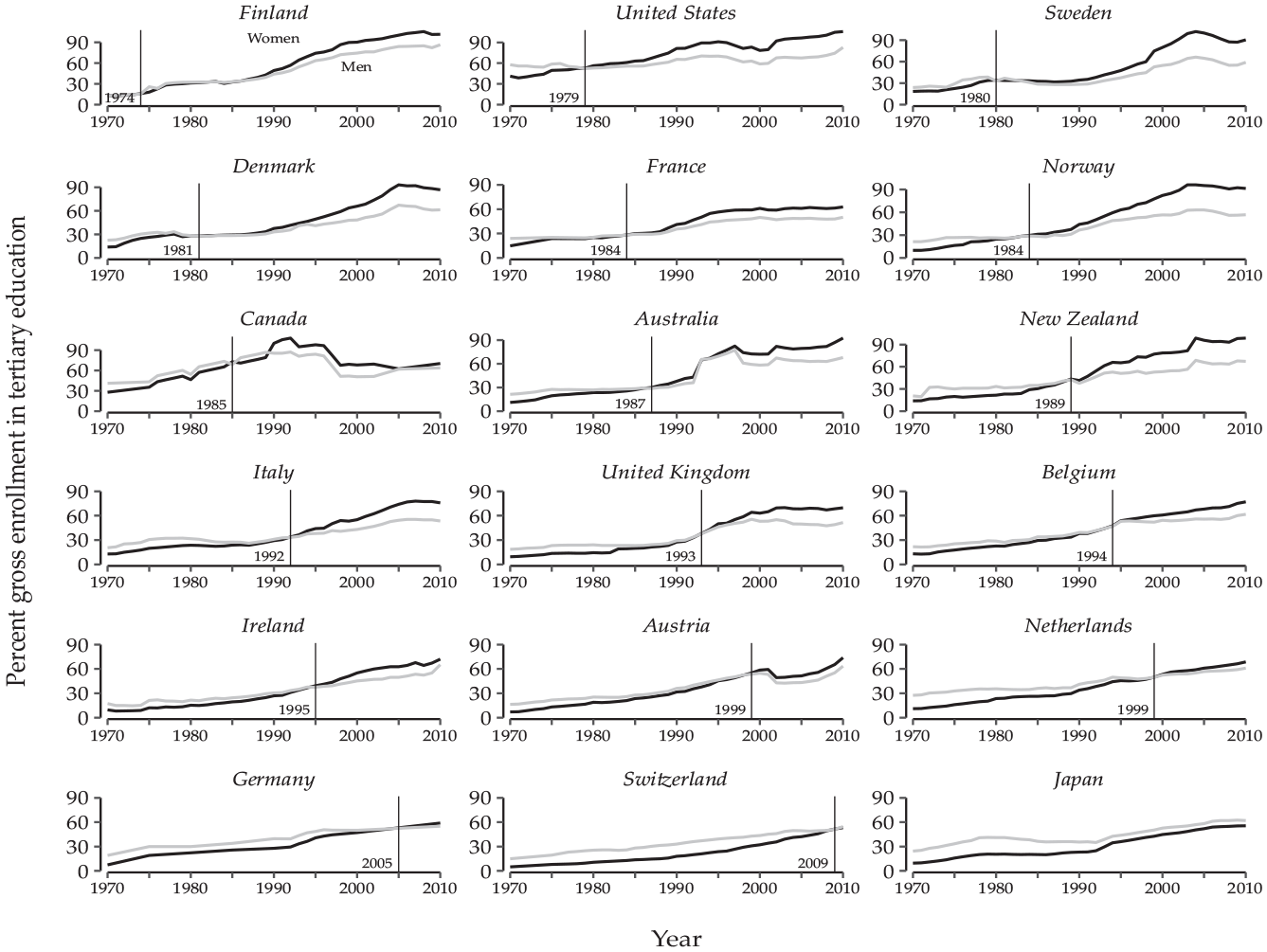
Gross enrollment rates in tertiary education, with countries ordered according to when the female enrollment rate surpasses the male. Vertical lines indicate the year of the reversal of the gender gap in enrollment. The gross enrollment rate is defined as the total number of students in higher education as a percentage of the population in the theoretical age group for this level of education. Data from UNESCO Institute for Statistics, in Marcus Samani et al., The QoG Social Policy Dataset, Version 4Apr12 (University of Gothenburg, Quality of Government Institute, 2012).
With regard to daycare services, firms will favor full-time services that suit dual-earner couples. In addition to childbearing, women still do a larger share of household work and childrearing than men. 21 Firms perceive that daycare services enable a faster return to employment after childbirth and decrease the risk that women permanently leave the workforce. Moreover, the availability of daycare makes it possible to combine full-time work with having small children, particularly for women, which again results in increased skill investment and job experience. 22 With regard to leave, we suggest that firms will prefer short and well-paid parental leaves with high wage ceilings to prevent high-skilled women from leaving the labor market altogether. They will also start favoring fathers’ quotas, by which a part of the paid leave is reserved for fathers, since it will increase the chance that high-skilled women return faster and do not permanently drop out of the labor market.
We also propose that employers in countries with highly centralized employers’ associations will be more favorable to WFPs. 23 As women’s skills increase, centralized employers’ associations are more likely than fragmented associations to focus on the benefits of WFPs for the nationwide economy. In economies that rely on high skills to innovate and grow, 24 WFPs become a vehicle for ensuring high employment and skill investment. Centralized federations, to a larger extent than fragmented employers, take into account the provision of collective goods and outcomes beyond the bottom line. 25 They are also more likely to favor state-funded and state-administered WFPs because such policies ensure that collective goals are achieved.
To summarize, we should expect to see employers becoming increasingly favorable toward WFPs as women outnumber men in higher education. This trend should especially be the case in corporatist countries, where employers’ associations’ policy influence is the largest.
Trade Unions and WFPs
We view trade unions as democratic interest organizations, with internal, democratic decision-making procedures and with leaderships focusing on long-term membership growth. 26 The policy positions of a trade union will therefore depend on the distribution of preferences among their individual members. 27 In addition, union leaders will support policies that can contribute to retaining and expanding membership. The policy stance of a trade union confederation will accordingly be a function of the distribution of policy preferences among the affiliated unions and leadership strategies to secure future growth.
Thus, if the female share of union members increases, we propose that the issue of WFPs will become one of contention within the movement, since these policies are more beneficial to employed women than men. There is a conflict particularly between highly educated women and male industrial workers (and their home-staying spouses). 28 Because trade unions affiliated with a confederation typically organize employees in different sectors and occupations, and because women’s entrance into paid work is predominantly segregated into service sectors, the increase in female education and employment rates will often pit affiliated unions’ interests and policy preferences against each other. Yet, as the share of women within its affiliated unions increase, the confederation will be more and more likely to come out in favor of WFPs and to use its influence to push for such policies.
An assumption of our argument is that there is significant variation in the gender composition of trade union members. Figure 2 shows that, when plotting women’s percentage of union members (
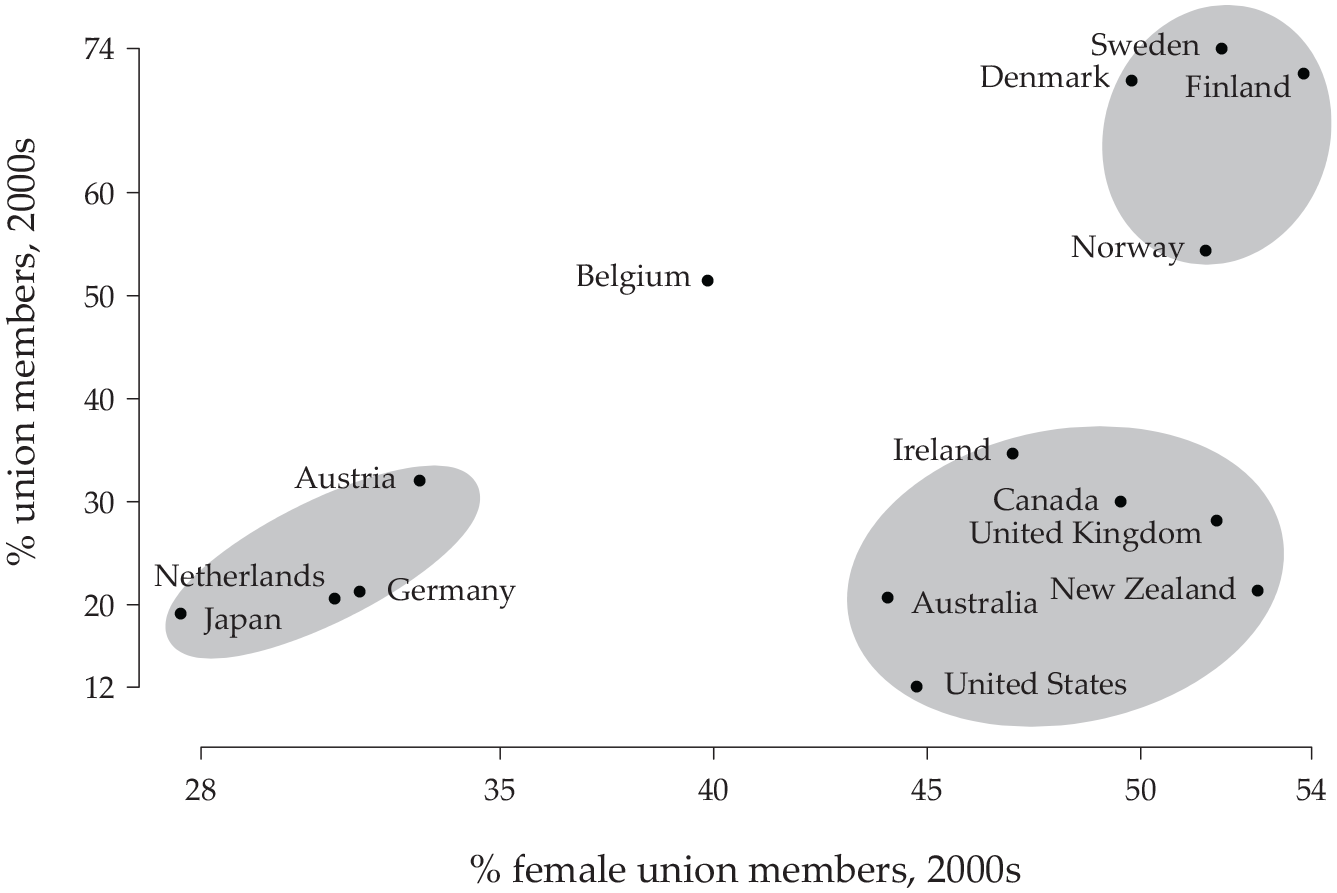
Cross-national variation in total union density and percentage of women union members in the 2000s. Union density is defined as the percentage of union members among employed wage and salary earners. Clusters are identified using cluster analysis with Ward’s method and a four-cluster solution. Data on female union members in the 2000s are missing for France, Italy, and Switzerland in the original source. Data from J. Visser, Data Base on Institutional Characteristics of Trade Unions, Wage Setting, State Intervention and Social Pacts (ICTWSS), 1960–2010, Version 3.0 (Amsterdam Institute for Advanced Labour Studies, University of Amsterdam, 2011); David Brady, Evelyne Huber, and John D.D. Stephens, Comparative Welfare States Data Set (University of North Carolina and WZB Berlin Social Science Center, 2014).
In our argument, we expect unions in the Nordic and the liberal clusters of countries particularly to favor WFPs but only the Nordic unions to be powerful enough to succeed, because the Anglo-Saxon unions lack the institutional frameworks to influence policymaking. In labor markets where female workers are struggling more to get access—such as in the coordinated economies of Continental Europe—unions should not be expected to promote WFPs.
The Prospect of Cross-Class Coalitions
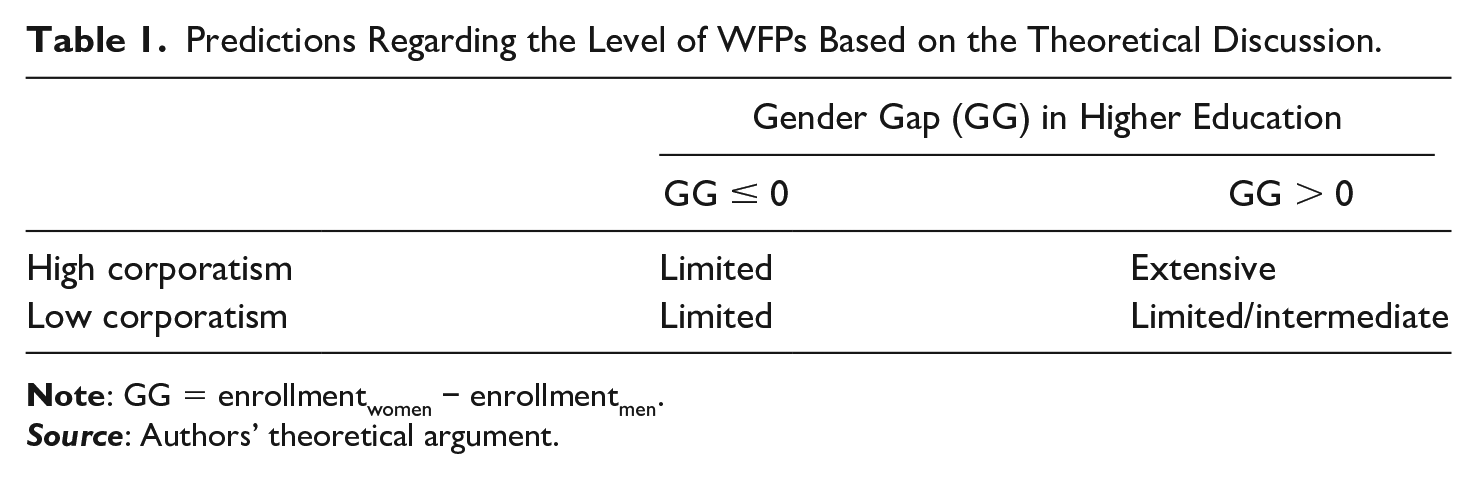
Our framework predicts that employers are increasingly likely to favor WFPs as the gender gap in higher education reverses in favor of women, and unions are increasingly likely to favor WFPs as the female share of union members grows. As employers pay a higher direct cost than trade unions for WFPs, we suggest that unions will start pushing for WFPs earlier than employers. Cross-class alliances in favor of WFPs—that is, instances in which unions and employers have a common interest in favoring WFPs and cooperate for their advancement—become viable when women outnumber men in higher education and have a dominant position in organized labor. Yet the probability and the effect of these cross-class coalitions on WFPs will depend on the presence of corporatist institutions. Where such institutions are present, the social partners will more easily coordinate their preferences, and they will have the power to influence policy. 31 The argument is summed up in Table 1. When men outnumber women in higher education, there should be little expansion of WFPs. As the gender gap narrows and reverses, WFPs should increasingly be enacted in countries with centralized social partners, and to a lesser extent in countries with less influential unions and employers.
Predictions Regarding the Level of WFPs Based on the Theoretical Discussion.
Examining the Social Partners’ WFP Preferences and Influence
To evaluate the predictions, we use several pieces of evidence. First, a fundamental macro implication of the argument is that the reversal of the gender gap should be associated with WFP expansion in countries with the highest levels of corporatism. To test this conjecture, we use data on WFPs, the gender gap in higher education, and corporatism for eighteen advanced economies from 1960 to 2009. Second, to investigate the mechanisms of the argument, we conduct a detailed case study of Norway. In particular, we assess (1) whether the social partners become supportive of WFPs as women outnumber men in higher education and as women rise within the unions; and (2) whether the organizations use their policy influence—through corporative channels, such as wage bargaining, and lobbying—to push for reforms. Norway is particularly suitable for an in-depth study, since it went from limited to generous WFPs and offers abundant temporal variation across more than five decades. Moreover, it has a centralized corporatist system, which enables us to evaluate whether the social partners have exerted influence on WFP development. Using a range of sources, the case study traces the role of the social partners in major WFP reforms since the 1960s.
Macro Evidence from Eighteen Advanced Democracies, 1960–2010
We have argued that the level of corporatism—that is, institutionalized bargaining and participation in policymaking—determines to what extent employers and unions are able to push for expansion of WFPs in the face of a reversal of the gender gap in higher education and women’s entrance into unions. In this subsection, we systematically test the prediction against data from eighteen advanced democracies between 1960 and 2010.
Empirical setup
The main independent variables are corporatism, the gender gap in higher education, and women’s share of union members. To measure the gender gap in higher education, we use the same data as in Figure 1: we take the gross enrollment of women in tertiary education and subtract the enrollment of men. More details and sources for this and the other variables are provided in Online Appendix A.1. To measure women’s entrance into unions, we use a variable measuring the percentage female trade union members. 32 Finally, we employ Martin and Swank’s measure of corporatism. 33 It is a standard-score index of the combination of employers’ organization, trade unions’ organization, and the level of collective bargaining. The variable thus captures both the centralization and the integration into policymaking of employers and unions, and it varies over time.
For parental leave, we have data for the full fifty-year period for eighteen countries. Paid parental leave generosity is measured as number of weeks of leave weighted by the leave’s wage replacement rate. For instance, if parental leave is available for twenty weeks with a benefit equal to 75 percent of the average wage, then parental leave generosity is fifteen—that is, the equivalent number of weeks with a 100 percent replacement rate, or the full-pay equivalent number of weeks of leave. Note that this also means that long parental leaves with low replacement rates, which may have a natalist aim but be unfavorable to women’s return to work, get low parental leave generosity scores. Unfortunately, for daycare, there are no reliable time-series cross-section data available. 34 We therefore restrict our analysis to parental leave. Of course, given that WFPs are most powerful in combination—for instance that generously paid parental leave is followed by access to full-time affordable daycare services—this is a limitation of our time-series cross-sectional analysis. In the case-study analysis of Norway, however, we provide a detailed examination of both daycare and leave reforms.
We expect a positive association between the gender gap and parental leave at high but not low levels of corporatism. To give initial visual evidence of these relationships, Figure 3 plots the change in parental leave generosity between the 1960s and the 2000s against the change in the gender gap in higher education over the same period. For the countries with corporatism scores above or equal to the median (in black), there is—as our framework suggests—a clear positive correlation between the gender gap and parental leave; for the countries with corporatism scores below the median (in gray), there is no such relationship.
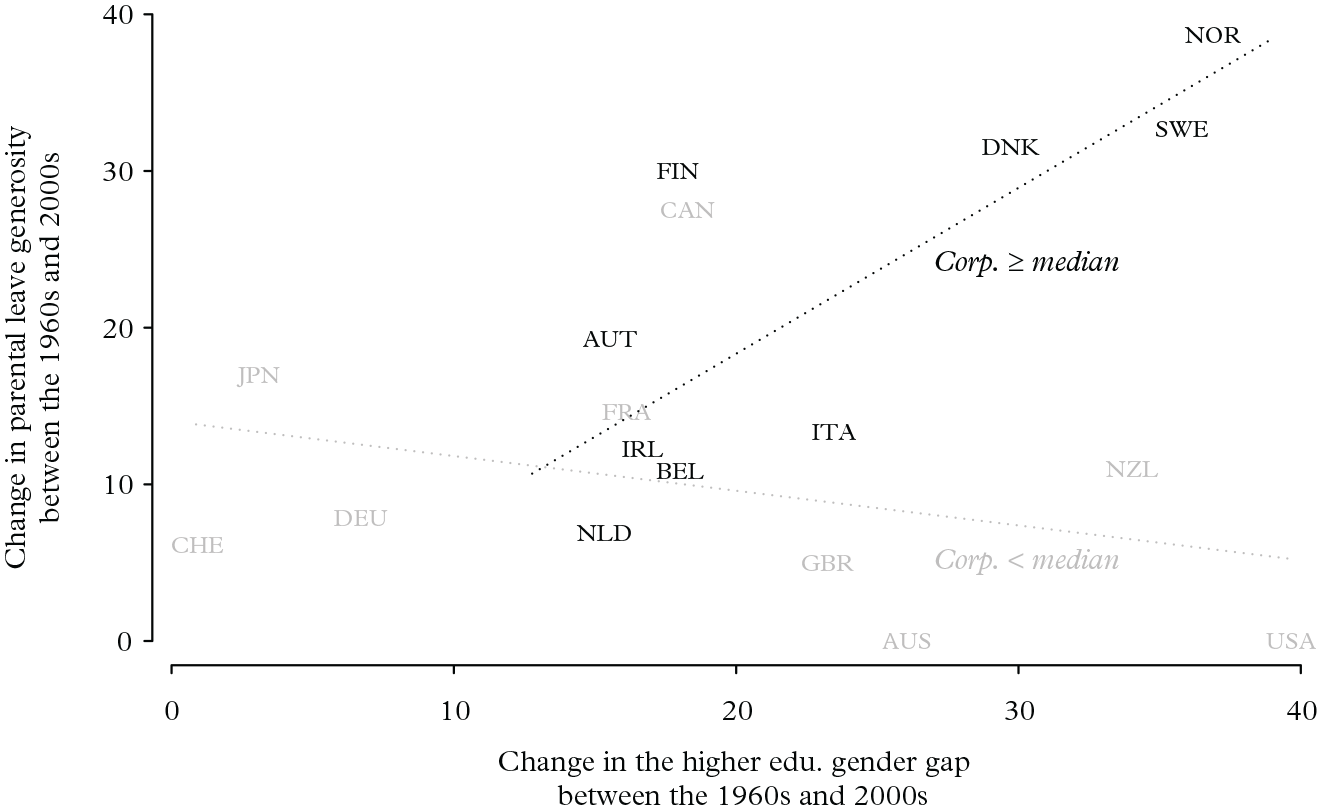
Association between parental leave generosity and the gender gap in higher education at high and low levels of corporatism (OLS fitted lines). Data sources are given in Figure 1 and Online Appendix A.1.
To test the relationship more rigorously, we use the following country and year fixed effects model:

We are interested in how the association between leave and the gender gap (denoted GG) depends on the level of corporatism (CORP). The model therefore includes a multiplicative interaction term, GG × CORP, between these two continuous variables. To enhance the interpretation of the interaction, we center both the gender gap and the corporatism variables at one standard deviation above their respective means. It permits a direct interpretation of
In addition to the main variables,
Second, the European Union in 1992 adopted Council Directive 92/85/EEC, which introduced fourteen weeks of paid maternity leave, and in 1996 adopted Council Directive 96/34/CE, which defined minimum standards for parental leave, including a minimum of three months of leave. As an alternative explanation to our model, the adoptions could suggest that member states with a low gender gap, weak corporatism, or both, were compelled to expand parental leave. All the EU countries considered here, however, already fulfilled the 1992 directive. Regarding the 1996 directive, it was the direct result of negotiations between the social partners at the European level.
37
In addition, the 1996 directive established only minimum standards and left crucial aspects of the leave—including whether or not it was to be paid and in what amount, as well as its duration beyond the minimum requirement—up to the member states and negotiations with social partners at the national level.
38
In consequence, only four countries had to make significant changes to their parental leave scheme to comply with the directive.
39
The reforms in those countries differed substantially: in Ireland, Italy, and the United Kingdom, the laws introduced were limited, particularly in terms of replacement rates during leave.
40
Only in Belgium did the reform mean a significant expansion of paid parental leave, with three months for each parent, although with a modest flat rate benefit (BEF 20,000 per parent).
41
The reform was the result of negotiations between the social partners that resulted in a nationwide collective agreement (Convention Collective de Travail
Beyond the controls for the 1996 EU directive and immigration, we include covariates that capture several factors highlighted by the existing literature on WFPs. Convincing research shows that women within parties have played a key role in expanding WFPs. 43 To control for the explanation that the effect of the gender gap runs through highly educated women entering parliament, we include the percentage of seats in the parliament held by women. Another potential confounding explanation is left-wing government power. To get the difference between having a right and a center or left government, we include two variables: left cabinet and center cabinet. By including these two variables, we compare them to right governments, as the left, right, and center variables together sum up to 100 percent. Finally, the unemployment rate, the log of GDP per capita, and the share of the population over 65 years are added to account for the fact that budgetary and demographic pressures may constrain the possibilities and willingness of social partners and governments to expand WFPs. As GDP per capita is seen as the key source of postmaterialistic values, it also controls for such values. 44
Results
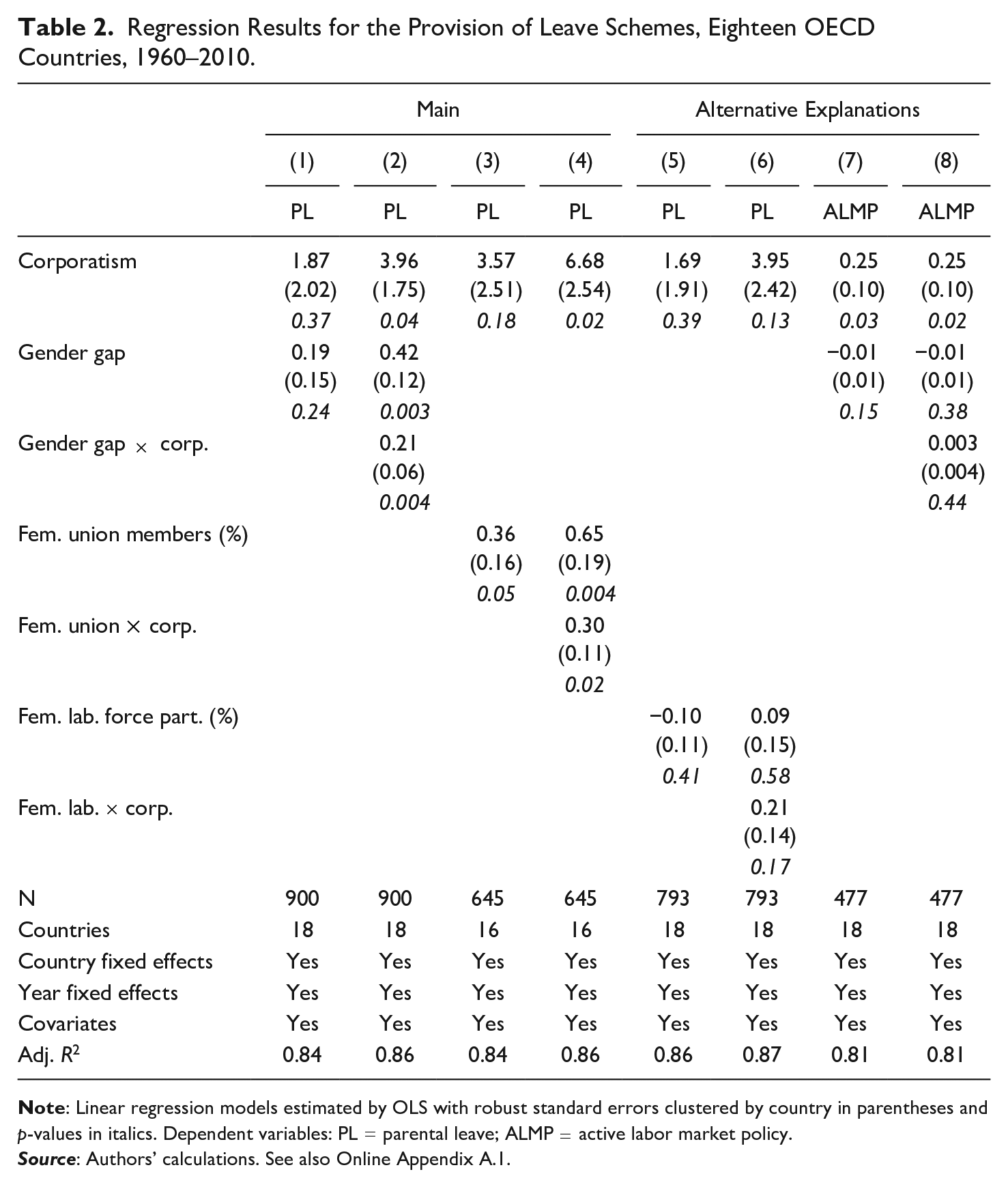
The estimated regression coefficients for Equation 1 are presented in Table 2. Model 1 gives the results without the interaction and Model 2 adds the interaction between corporatism and the gender gap. In the first model, the association between the gender gap and parental leave generosity is far from statistically significant. There is thus no discernible average correlation between the gender gap and parental leave generosity. In the second model, however, the interaction term between the gender gap and corporatism is highly statistically significant (
Regression Results for the Provision of Leave Schemes, Eighteen OECD Countries, 1960–2010.
To gauge the substantive magnitude of the interaction, we use the results from Models 2 and 4 and simulate the expected expansion of leave. The results are illustrated in Figure 4. Panel a displays the predicted increase in fully paid weeks of parental leave from a change of two standard deviations in the gender gap, or twenty-four percentage points. This amounts to about the change in the gender gap in, for instance, the United Kingdom and Denmark between 1985 and 2005. In a corporatist setting, such an increase in the gender gap should result in employers and unions using their policy influence to push for expansion of paid parental leave. The upper bar shows the predicted increase in parental leave when corporatism is one standard deviation above the mean level of corporatism, and the lower bar shows the increase when corporatism is one standard deviation below the mean. Under high levels of corporatism, the change in the gender gap is associated with a ten-week increase in fully paid leave, whereas under low levels of corporatism the two-week increase is not statistically significant. These are notable but plausible associations between the gender gap and parental leave under different degrees of corporatism. Panel b of Figure 4 illustrates that using a two-standard-deviation shift in the percentage female trade union members, or twenty-three percentage points, leads to very similar conclusions. There is thus clear evidence that countries with corporatist unions and employers respond to changes in the educated workforce and union members by expanding WFPs.
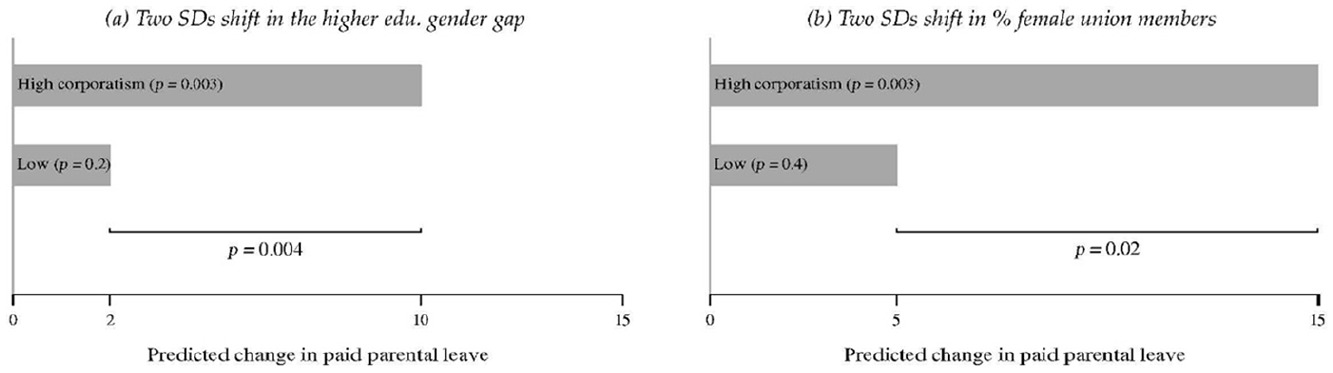
The predicted change in parental leave from a two-standard-deviation change in the gender gap and female union members, when holding corporatism constant at one standard deviation above and below the mean. Predictions based on Model 2 in Table 2 for the gender gap and Model 4 for the female union members.
Alternative explanations
While the covariates in our regressions control for a number of possible confounders, one alternative explanation for the strong findings might still be that what is driving the development of WFPs is female labor force participation more generally and not the more specific reasons that women outnumber men in higher education and enter into trade unions. 46 In Models 5 and 6, we evaluate this objection. The results indicate no discernible relationship between female labor force participation and parental leave, either directly (Model 5) or in interaction with corporatism (Model 6).
Another alternative explanation might be that the analysis is merely capturing a general time trend in corporatist countries to expand social investment policies. 47 In a “placebo” test in Models 7 and 8, we therefore use active labor market policy (as a percentage of GDP) as the dependent variable. 48 In line with our claim that organized employers and trade unions react to the gender gap by calling for WFPs, there is no association between the gender gap and active labor market policies.
Finally, even though we control for the 1996 EU directive, there may be more general spatial interdependence between our countries—for instance, that countries learn from or emulate other countries’ paid leave reforms—that may bias the estimated association between the gender gap and paid leave. 49 Existing welfare state research suggests that states learn from those in the same welfare state “family,” other EU members, close trading partners, and those geographically close. 50 In Online Appendix A.4, we show that the results presented below remain highly similar when we respecify the model using spatial regression to account for spatial confounding.
In summary, there is evidence of a clear country-level effect of the reversal of the gender gap in higher education and women’s entrance into unions on the expansion of paid parental leave in corporatist countries, as our argument implies. In the next subsection, we trace how employers and unions changed their stance toward WFPs and influenced reforms.
Evidence on Mechanisms from WFP Reforms in Norway
In Norway, parents can choose between forty-nine weeks of parental leave with a 100 percent replacement rate or fifty-nine weeks with an 80 percent rate, one of the most generous leave programs in the world. The leave is “tripartite,” which means that fifteen weeks are reserved for each of the parents and are nontransferable. Mothers have three additional weeks before childbirth and must take six of the fifteen weeks right after childbirth. The remaining sixteen weeks of the leave can be split as desired. As for public daycare services, 80 percent of one- to two-year-olds and 97 percent of three- to five-year-olds attended daycare centers in 2014, of which 97 percent attended for more than thirty-two hours per week. Full-time daycare is relatively cheap. For example, a family in which the parents earned 100 and 50 percent of average earnings paid 11 percent of net income in daycare fees in 2012, compared for instance to 34 percent in the United Kingdom. 51 Since 2009, parents have had a right to daycare for their children starting at age one.
In the early 1970s, however, Norway’s WFPs were limited, as illustrated in Figure 5 for parental leave and Figure 6 for daycare. Paid maternity leave was twelve weeks, with payment typically amounting to a third of previous earnings. Only 3 percent of children under school age attended daycare institutions, and merely 13 percent attended other forms of nonparental childcare. 52 Norway thus epitomized the WFPs found across advanced democracies at that time. Yet three waves of reforms—the first in the late 1970s, the second from the mid-1980s to the early 1990s, and the third from the 2000s and onward—introduced considerable expansions of WFPs.
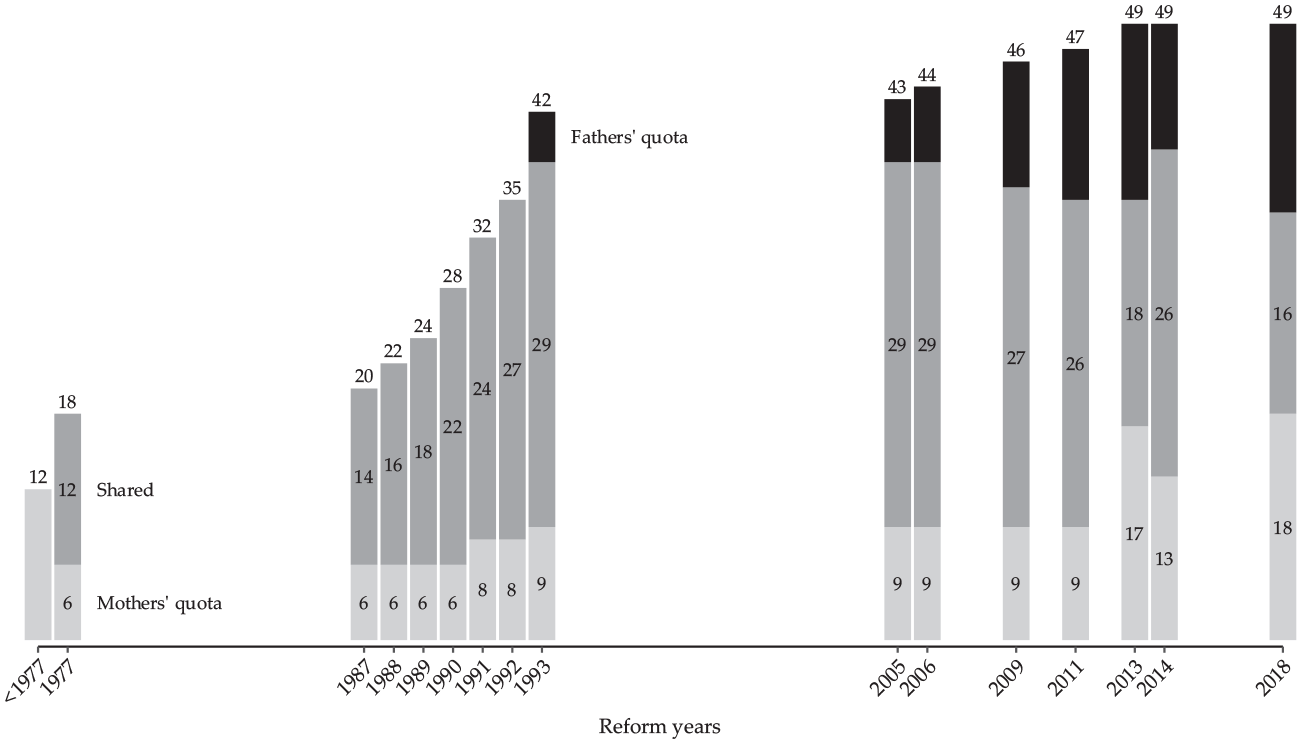
Development of paid maternity, paternity, and shared leave policies in Norway. Data from numerous documents from the Norwegian Parliamentary Archives. Details available upon request.
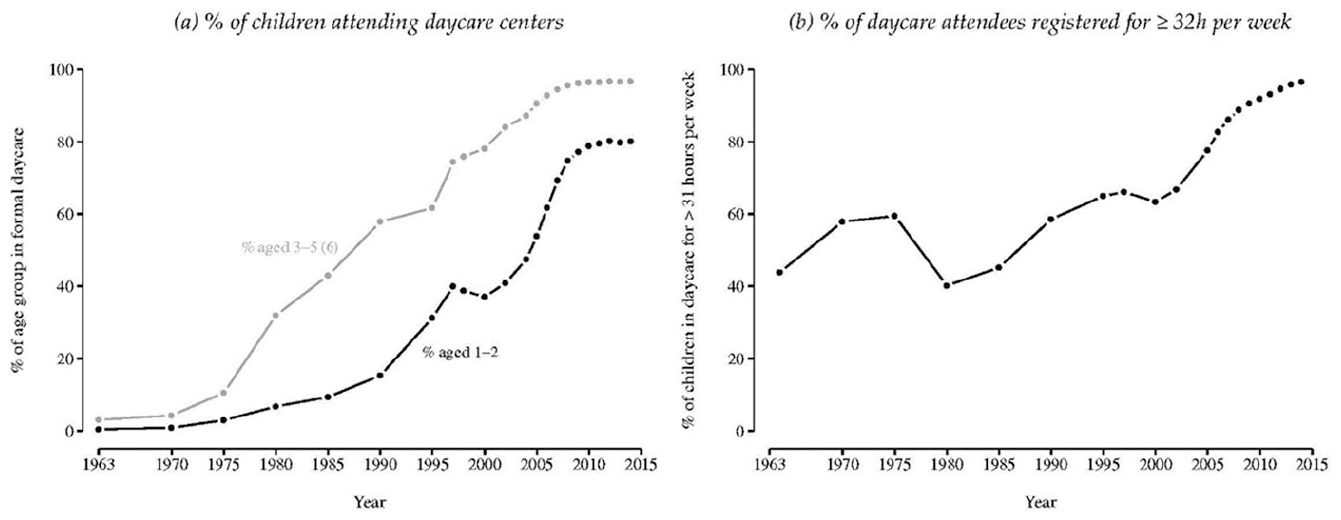
Children in daycare centers in Norway, 1963–2014. Data from Table 09169 from Statistics Norway, Barn i barnehager, etter alder, oppholdstid per uke og barnehagens eierforhold (K) 1999–2014 [Children in daycare centers, by age, hours of attendance per week, and the daycare centers’ ownership arrangements] (Oslo, 2015); and Lars Gulbrandsen, “Barnehageplass—fra unntak til regel [Place in a daycare—from exception to the rule],” in Mona Raabe, ed., Utdanning 2007—muligheter, mål og mestring, 50–67 (Oslo: Statistics Norway, 2007).
Turning to Norwegian labor market institutions, the country is highly corporatist. Centralized peak-level associations, which organize most firms and employees, participate in tripartite collective wage bargaining, with the state as the third part. The social partners participate actively in the development of labor market policies through wage bargaining agreements, official policy commissions, policy consultations, joint committees, regular meetings, and lobbying. The Confederation of Trade Unions (Landsorganisasjonen, LO) is the dominant federation. All unions affiliated with the LO typically organize workers in a specific trade, business branch, or public sector. 53 The LO hence organizes workers who are blue- and white-collar, skilled and unskilled, and employed in the private and public sectors. In 2014, the union density—the percentage unionized employees—was 52 percent. In the 2000s, about half of employed women worked in the public sector. On the employers’ side, the Confederation of Norwegian Enterprise (Næringslivets hovedorganisasjon, NHO, previously NAF) is the main employers’ association. Among employers, the share of private sector workers employed in an organized enterprise is 67 percent. 54 As we will show in the next subsections, which examine the WFP reform waves, first unions but later also organized employers helped to drive the shift from a male-breadwinner to a dual-earner regime with an extensive provision of WFPs.
The 1970s: Changing preferences for WFPs
The LO did not favor WFPs in the 1950s and 1960s. While the issues of equal treatment and the social rights of women had already been enshrined in the International Labor Conventions of 1951 and 1952, the LO was not making any concerted effort to promote these issues, even within its own organization. 55
By the early 1970s, however, policies supporting working mothers started to become an issue of contention, reflecting changes to the LO’s membership base. 56 Liv Buck was the first woman to enter the LO leadership, in 1971. As Figure 7, Panel a, shows, by 1975 one-fourth of the LO’s members were women, up from one-fifth ten years earlier. The same year, the women-dominated Norwegian Union of Municipal Employees became the largest union affiliated with the LO. The women within the trade union confederation called for more generous WFPs to help reconcile work and family life. 57 At the 1973 LO Convention, for example, several prominent women emphasized the need for expansion of daycare services and paid leave. 58 Despite voices in favor of putting WFPs on the agenda, women did not yet constitute a sufficient share of the membership base to make the LO actively promote WFPs.
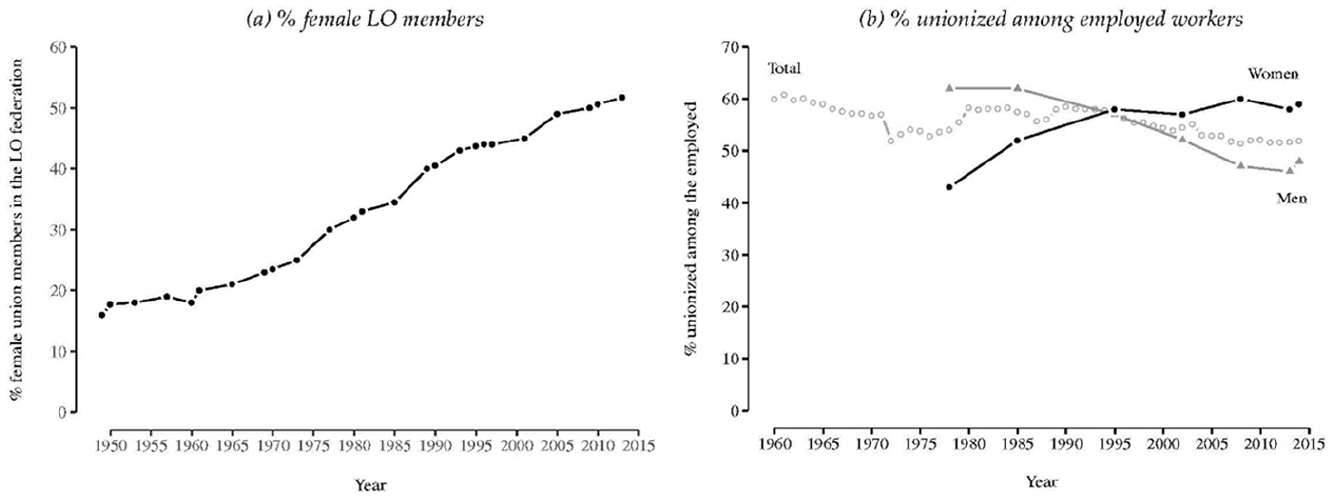
Working women’s participation in trade unions in Norway. Data from Visser, Data Base on Institutional Characteristics of Trade Unions; Kristine Nergaard, “Organisasjonsgrader, tariffavtaledekning og arbeidskonflikter 2014 [Organization rates, collective agreement coverage, and work conflicts 2014],” Fafo-notat 2016:07 (Oslo: Fafo, 2016).
On the employers’ side, the NAF resisted and was opposed to WFP reforms. The employers’ association voted against the ILO Equal Remuneration Convention of 1951, and a year later they confirmed their stance by voting against the ILO maternity protection recommendation. In 1963, the employers’ association argued that separate and lower average wages for women should be maintained, since working women generally had less experience, less job stability, and higher rates of absence from the workplace. 59 By 1975, the NAF had dropped that stance but still maintained that expanding WFPs was too costly. 60 There was thus little interest in, and even outright opposition to, WFPs from organized employers. In light of our framework, the employers’ policy stance makes sense. Figure 8, Panel a, shows that the percentage of the population aged twenty-five to thirty-nine with a higher education degree was almost 50 percent higher among men than women in 1970. The labor supply of high-skilled women was therefore not of great concern to the employers during the 1970s.
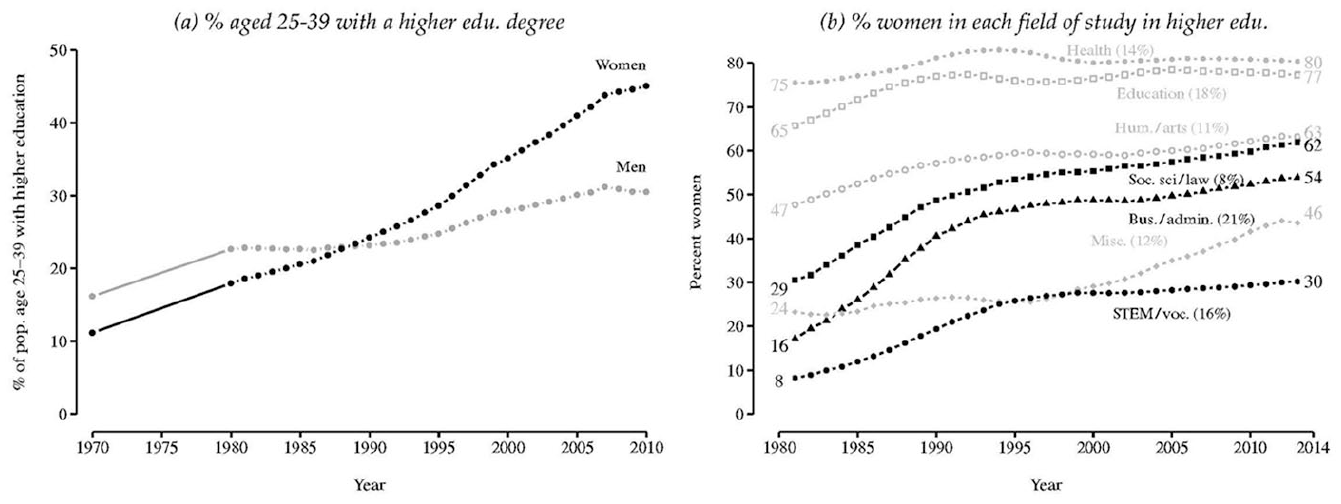
Higher education and gender in Norway, 1970–2015. Numbers in parentheses in Panel b are the percentage of students in each field in 2014. Data from Table 09429 from Statistics Norway, Personer 16 år og over, etter kjønn og utdanningsnivå [Persons age 16 and above, by gender and education level] (Oslo, 2015); Table 09430 from Statistics Norway, Personer 16 år og over, etter utdanningsnivå, fagfelt, alder, kjønn og innvandringskategori [Persons age 16 and above, by education level, field of education, age, gender, and immigration category] (Oslo, 2015).
Neither of the social partners hence wanted large-scale reforms. The expansions of WFPs that were agreed on by the political parties in the 1970s were also modest and passed unanimously in the parliament. In the parliamentary debates on the reforms, gender equality was not the main focus, and labor shortages went unmentioned. The leave and daycare reforms were instead predominantly favored on the grounds of being beneficial for child development. 61 It is also noteworthy that neither the LO nor the NAF was interested in demanding further WFP expansions. For instance, the social partners could have demanded that the two-week leave available to fathers right after childbirth became a paid leave. As Gerd Vollset, a former high-ranking official in the ministry in charge of WFPs, notes, it “should have been an easy matter for the LO to promote this as a demand and have it implemented, if this was something unionized fathers prioritized.” 62
All in all, this period marked the beginning of a shift in policy stances among unions, but female members were not (yet) sufficiently numerous to complete the turnaround. For employers, however, the need for highly qualified female labor had yet to emerge.
The 1980s and 1990s: Large parental leave reforms
Women’s share of unionized workers in Norway continued to increase throughout the 1980s and 1990s. Whereas 25 percent of LO members were women in 1980, the number was 35 percent by 1985 and 44 percent by the late 1990s. Despite opposition from the male-dominated unions affiliated with the LO, women within the trade unions continued to push for better availability of leave and daycare services. 63 Ultimately, they succeeded in raising the issue to the top of the agenda. In 1981 the LO Convention had gender issues as a central topic, and by the late 1980s “the growth in the women’s share [of LO members] produced an irresistible weight,” according to a prominent labor historian. 64 Moreover, in 1989, Esther Kostøl became the LO’s first female vice-president, furthering the focus on women’s issues within the confederation. Women had grown into a powerful group in the labor movement, and the LO completed a turnaround on WFPs during this period. The confederation became willing to use its political clout to push for reforms. For instance, corresponding directly with the Prime Minister’s Office in 1984, the LO demanded a considerable expansion of employees’ rights during childbearing and childrearing. To quote from the letter, the organization requested the following:
The paid share of the parental leave be expanded from 18 to 30 weeks.
6 weeks be reserved for mothers in relation to childbirth.
20 weeks be shared between the parents as preferred.
4 weeks be reserved for fathers.
The father’s right to 2 weeks of care leave in relation to childbirth be paid. 65
The letter concluded that there was a “need for an expansion of the [WFP] provisions” and that by “giving a fixed number of weeks reserved for the mother and the father, both parents’ care duties are being underlined.” 66
The union confederation also stressed the need for a faster expansion of daycare. At the 1981 Convention, the LO president, Tor Halvorsen, labeled the development of more daycare centers “crucial” for women’s labor market opportunities. 67 The LO regularly called for increasing the pace of the expansion throughout the 1980s and 1990s. Indeed, the newly elected LO president in 1988, Yngve Hågensen, was willing to prioritize daycare over pension reforms, which had long been a major policy issue for the organization. 68 And at the LO Convention in 1989, Esther Kostøl, the vice-president, made daycare expansion a primary policy demand of the labor movement. 69 Absent on their agenda only two decades earlier, WFP reforms had now become a priority for the trade unions.
Employers had opposed extensions of paid leave during the 1970s. In the 1980s, however, their position began to change, coincident with the closing of the gender gap in higher education at the end of the 1980s (see Fig. 8, Panel a). The largest changes in the higher education gender gap took place in fields particularly valuable to high-skill firms: business and administration; social science and law; and science, technology, engineering, and mathematics. The percentage of women in these fields more than doubled, as depicted by the black lines in Panel b of Figure 8.
We have proposed that an increasing number of women with the skills that businesses need will make organized employers more interested in gender issues and willing to agree to WFP extensions. In response to the proposed governmental Action Plan for Equality from 1980, the employers wrote the following: The NAF notes that a number of women who wish to do so have not been provided with the opportunity to utilize their resources in the workplace. Not only does this have negative consequences for each individual woman, but it also means that the employment market has not been able to enjoy the resources that this female work capacity represents.
70
The association went on to say that “a gender equality accord will have to build on agreements between the social partners.” 71 What is more, in 1982, the NAF cooperated with the LO to add a framework agreement on gender equality to the Basic Agreement. The framework required the social partners to work actively to promote gender equality (Supplementary Agreement IV). 72 To be sure, the framework agreement was voluntary and contained no promises regarding WFPs. It nevertheless signaled the growing willingness of employers to promote skilled women’s labor market opportunities.
The changing stances of the social partners meant that they became ready to use their wage settlements and political clout to set WFP reforms in motion. 73 Because women first became dominant in unions organizing public sector employees, paid leave was first expanded through wage negotiations for public employees in the mid-1980s. 74 The LO, moreover, included a demand for an increase in paid parental leave from eighteen to thirty weeks in the 1985 wage negotiations. 75 In the wage negotiations in the subsequent years, the confederation continued to press the government to expand leave for all employees, and employers grew less hostile to those demands. 76 In the words of Nergaard, Bråten, and Ødegård, “Parental leave was lengthened from 18 weeks in 1986 to 42 weeks in 1993 . . . and the expansion came as a part of the incomes policy cooperation.” 77
Through the corporatist institutions, employers significantly contributed to bringing about the leave reforms, but only after pressure from the LO. In the early 1990s, for instance, the NAF objected to further extensions being discussed, citing the already generous level of leave. The reason was not ideological opposition to WFPs, but rather that, given Norway’s difficult economic situation after the housing and credit bubbles burst, government policies on infrastructure should be prioritized. 78 Given that the number of women with higher education was still increasing and the gender gap was closing but not yet reversed (as Panel a of Figure 8 shows), this conditional support from employers is what we would expect.
Although our aim is to examine the preferences and influence of unions and employers, it is obvious that political parties were central to the major WFP reforms of the 1980s and 1990s. Parties’ promises to expand leave nevertheless came after the social partners had started to expand paid leave through wage negotiations and to push for national legislation on the issue. Deep conflicts within the parties made governments both to the left and right hesitant about reforms in the early 1980s: from 1977, when the Storting extended paid leave to eighteen weeks, until 1985, none of the parties in the Storting, with the exception of the minor Socialist Left, presented concrete proposals regarding paid leave. 79 The Labour governments in the early 1980s were, in principle, positive about extensions of paid leave. Labour’s 1981 white paper on family policy nonetheless concluded that “it [is] in the foreseeable future not possible to fit in these measures [i.e., leave] in the government budget.” 80 And when Labour’s Gro Harlem Brundtland briefly entered office as Norway’s first female prime minister in 1981, daycare subsidies increased only slightly. The subsequent Conservative single-party government (1981–83) maintained Labour’s levels of parental leave transfers and daycare subsidies, but under the center-right coalition (1983–86) the state subsidies decreased because of opposition from the Christian Democrats.
From the mid-1980s, however, parties grew more reform minded. Before the 1985 budget negotiations there was a “daycare rebellion” by young women within the Conservative Party, ensuring that daycare subsidies grew somewhat. 81 They also managed to make the Conservative Party Convention promise twenty-six weeks of paid leave in their 1985 election manifesto, as well as further daycare expansion. 82 The Labour Party promised thirty weeks of leave. Still, as we saw above, leave expansion was by then already underway in the corporative system, and the unions were demanding expanded daycare services and paid leave at the national level.
Both the social-democratic Brundtland governments (1986–89 and 1990–96) and the nonsocialist coalition government (1989–90) subsequently legislated extensions of paid leave, which together achieved a major increase from eighteen weeks before 1987 to forty-two weeks in 1993 (see Fig. 5). 83 In 1988, the Storting also stepped up its commitment to expand daycare. The Labour government proposed a national plan for daycare expansion but refrained from requiring municipalities to expand services (which reduced the reform’s breadth). 84 The reform passed without much parliamentary debate, since higher daycare subsidies were favored by a large majority of parties. The main parties converged on increased daycare provision and the expansion continued without much conflict during the governments of the 1990s. Importantly, these WFP reforms were initiated in close dialogue with the social partners. As PM Brundtland, for instance, later recalled, “We proceeded systematically and gradually in cooperation with the labor movement.” 85
One goal of leave expansion during this period was to make it possible for fathers to take more of the paid leave. In practice, however, few fathers made use of the leave opportunity. To address men’s lack of participation at home, an official commission on men’s roles (1986–1990) therefore supported the LO’s demand for a fathers’ quota. Before the 1993 incomes settlement, the union confederation repeated its request for a fathers’ quota, and the government signaled willingness to introduce the reform. 86 The policy proposal spurred left-right divisions, with the right-wing parties arguing that it infringed on parents’ freedom of choice in their care arrangements. Yet the Labor government, with the unions’ backing and the center parties’ parliamentary support, reserved four weeks of the forty-two-week leave for fathers in 1993 (see Fig. 5), arguing that it would increase gender equality at home and in the workplace.
The 2000s: Pushing for more reforms
By 2000, women made up 45 percent of the LO members, and by 2010 they were in the majority. In 2001, the LO elected its first female president, Gerd-Liv Valla, who was also the first LO leader with higher education. As such, she epitomized the LO’s turnaround on gender issues, from a male confederation favoring male-breadwinner policies to a gender-mixed confederation favoring WFPs.
With the leave reforms of the previous decade, the trade unions had achieved significant gains in WFPs. But they were still clearly dissatisfied with the length of the fathers’ quota and the overall daycare provision, which by 2000 lagged far behind parents’ demand. The organization called for the price of daycare to be reduced “while simultaneously demanding full daycare coverage with opening hours that are better adapted to the needs of businesses,” as Esther Kostøl, the LO’s vice president, put it in 1996. 87 The LO also teamed up with Labour in ardent opposition to the center government’s 1998 cash-for-care reform and commissioned a report for alternative use of the public funds spent on that scheme. Full daycare coverage remained a top priority for the trade unions, and the LO supported the major daycare compromise among the opposition parties in 2002, which considerably increased government subsidies to expand full-time, affordable daycare coverage (see Fig. 6). 88 Still, the confederation was discontent with the pace and size of the reform. At the 2005 LO Convention, Valla requested that “all children shall have a right by law to a place in the daycare center.” 89 Further daycare reforms were in strong demand from the LO.
The unions also pushed for further improvements of paid leave. In 2000 the social partners used the wage negotiations to agree that employees would get seniority while on parental leave, and in 2001 the LO Convention demanded further expansion of parental leave and particularly the fathers’ quota. 90 President Valla was definite about this demand: “We need to create gender equality both at home and in the workplace to achieve true gender equality. We want to expand the fathers’ quota.” 91 Later she added, “An expansion of the fathers’ quota [is] the most important measure for increased gender equality.” 92
The unions were increasingly joined by the employers’ associations in these efforts, as women now markedly outpaced men in higher education enrollment. By 2000, 35 percent of women age twenty-five to thirty-nine had a higher education degree, compared to 28 percent of men. By 2010, the numbers were 45 percent and 30 percent, respectively—that is, a 15 percentage-point gap in favor of women (see Fig. 8). As highly educated women were now a key source of labor supply, employers became increasingly vocal about new WFP reforms in the course of the 2000s. The NHO (previously NAF) had opposed the idea of a fathers’ quota in 1993. Seeing the effects of the 1993 expansion, however, they admitted that the effects of the reform had been advantageous for inducing men to take more of the leave. “These are moneys well spent,” Olav Magnussen, the NHO director, voiced in 1997. 93 The employers furthermore expressed their concern about the projected negative impact on women’s labor supply of the 1998 cash-for-care reform. Magnussen warned, “If it has already started to burn, it doesn’t take much before it all bursts into flames.” 94 The employers’ confederation stated that they would instead like to see men taking more of the leave and demanded an expansion of the fathers’ quota (without increasing the total leave period). 95 The NHO became more proactive also concerning daycare, pointing out in 2001 that, for businesses, it was problematic that families with young children avoided moving to municipalities where availability of daycare centers was low. 96 The employers favored the 2002–8 daycare reforms, which greatly increased daycare coverage (see Fig. 6), despite initially expressing concern about the increased government spending.
Unions and employers made it clear that they wanted further significant WFP reforms. When the center-right government expanded the fathers’ quota and the leave by one week in 2005 and the red-green government in office from 2005 did the same in 2006, unions and employers demanded that the governments step up the pace. The social partners underlined in unison the need for a “tripartite” leave, whereby the paid leave would be split in three equal parts—one for each of the parents and one that could be shared between them as they deemed best. Rita Lekang, the LO secretary, wrote an op-ed directed at the government in 2007. The LO’s position, Lekang stated, was that “the mother should have the right to the first 16 weeks after birth” and that “the father should have half of the remaining weeks, while the rest of the leave can be split as the mother and father agree.” 97 The social partners received additional support from the government-appointed Commission on Equal Pay in 2008, which made tripartite leave one of their key proposals for a more gender equal labor market. The NHO backed the commission: “A tripartition of the parental leave may cause women to return quicker to the workplace. This is a good measure for equalizing pay,” Sigrun Vågeng, NHO executive director for labor market and social affairs, argued. 98 The LO echoed the employers’ statements. A cross-class coalition of unions and employers was thus pushing for a tripartite paid leave.
The 2009 general election gave the red-green coalition, which had pledged to expand both the fathers’ quota and the total length of leave, four more years in government. In 2009 the leave was extended from forty-four to forty-six weeks and the fathers’ quota from six to ten weeks. But the social partners wanted a fully tripartite leave. In the LO-NHO 2010–2013 Basic Agreement they therefore agreed to prioritize a push for further leave reforms, arguing that “it is important to see the connection between working life and family life and to ensure a better distribution of parental leave between the parents.” 99 In addition, both unions and employers demanded improvements in the provision of daycare. The NHO, for instance, wanted to see compulsory and free daycare for five-year-olds: “The NHO is interested in this because Norwegian businesses are dependent on skilled labor. The educational system is the economy’s most important supplier,” argued Kristin Skogen-Lund, the first female NHO director general. 100
In sum, the social partners became close partners in pushing for WFP reforms during the 2000s. The NHO’s Skogen-Lund, for example, characterized parental leave, the fathers’ quota, and full daycare coverage as “milestones in the development of equality between women and men in the Norwegian economy.” 101 In a joint op-ed, the LO and NHO highlighted the combination of fathers’ quota and full coverage of affordable daycare as “unique” for both Norwegian workers and employers. 102
The 2010s: Unified defenders of WFPs
During the last period under study, the social partners coordinated a defense of the rich gains in WFPs achieved during the three previous decades. The Conservatives and the Progress Party entered the 2013 election with promises to make the whole leave shared, that is, removing the fathers’ quota. In an unusual move, Kristin Skogen-Lund warned the right-wing parties of the dangers of that position and repeated the employers’ support for the tripartite leave. 103 The LO did the same.
The red-green coalition lost the 2013 election, and the Conservatives and the Progress Party formed a minority coalition government, with parliamentary support from the Liberals and the Christian Democrats. In 2014, the right-wing government decided to follow up on their election pledge and cut the fathers’ quota to ten weeks. Reactions from the employers and trade union were forceful. The remarks made by Skogen-Lund are worth quoting at length, as they summarize the employers’ turnaround on WFPs: The NHO is an ardent supporter of the Norwegian parental leave scheme with a long fathers’ quota. Early on we spoke up for earmarking one-third of the leave period to fathers. We stand by this. Even though parental leaves are sometimes experienced to be a practical challenge to firms, the NHO is of the opinion that the fathers’ quota has been advantageous to the business sector. It promotes high female labor market participation and gender equality in the workplace. Norway has a modern family policy that serves our most important resource: the work capacity and the skills of both men and women. For the business sector and economy more generally this is of crucial importance.
104
Following intense pressure from unions and employers, among others, the government scrapped its plan to reduce the fathers’ quota further. What is more, after continuing criticism from the social partners, the right-wing government decided in 2018 to expand the fathers’ quota to fifteen weeks, one week more than the red-green government had done. Unions and employers consequently have not only coordinated their actions against the government but have also been largely successful in stopping WFP cuts that go against their interests.
To conclude, if we compare the unions and organized employers’ recent defense, support, and reform willingness with their stances in the 1960s and 1970s, their current positions on WFPs are hardly recognizable. Our framework helps to explain the turnaround. At present, half of union members are women, and Norwegian employers are heavily dependent on high-skilled labor, which is increasingly female. As we have documented in the case study of Norway, this reality has led the social partners to ask for WFP reforms, and they have used their political influence to achieve these demands.
Conclusions: The Continued but Changing Contribution of Corporatism
We started out by asking under what conditions trade unions and organized employers go from opposing to proposing work-family policies (WFPs). We have analyzed the development of WFPs and argued that corporatist institutions and social partners, which were pivotal in the expansion of classic welfare programs, are fundamental also in explaining the rise of WFPs. We have shown that the stances of the social partners are highly dependent on the reversal of the gender gap in higher education and the associated rise of women within trade unions.
Our empirical findings—based on an in-depth case study of Norway, as well as a quantitative analysis of eighteen advanced democracies from 1960 to 2010—support our theoretical claims. As women’s union membership rises and as women outnumber men in higher education, the social partners have become increasingly interested in expanding WFPs. Moreover, centralized trade unions and employers’ associations have actively used wage bargaining institutions and their policy influence to advance WFP reforms. By highlighting the possibility of such shifts in preferences and the possibility of cross-class coalitions, we show how long-lasting labor market organizations and institutions have become a vehicle for addressing the needs of dual-earner families.
Our article thus contributes to the literatures on unions’ and employers’ roles in welfare state expansion—where we show the conditional nature of their support—and the development of work-family policies—where we demonstrate that social partners are central actors of change. These are insights that have been overlooked in extant research.
By investigating the case of Norway, our study may moreover add fresh insights to the ongoing scholarly debate about whether the Nordic model of social and labor market policies, including WFPs, has adverse effects on gender equality in the labor market—often labeled the “welfare state paradox.” 105 In that argument, the combination of highly flexible public sector jobs in care professions and long parental leaves has made women less motivated to work in the private sector and caused private sector employers to discriminate more against women. 106 The result is a high level of gender segregation in the labor market. A growing set of studies, however, cast serious doubt on the empirical veracity of the paradox. In an extensive analysis of more than thirty advanced economies, Reisel, Østbakken, and Barth do not find higher gender segregation in Nordic labor markets. 107 That finding makes sense in the light of our study. With the reversal of the gender gap in higher education, centralized employers and unions have been concerned with expanding WFPs that are designed to facilitate, rather than prevent, high-skilled women’s return to full-time work after childbirth—including parental leave with generous wage replacement and a fathers’ quota, as well as full-time affordable daycare services. In short, the social partners may have been instrumental in ensuring that there is no welfare state paradox.
Given the critical role of the social partners in WFP expansion, an important area for future research is to delve further into the intraorganizational mechanisms by which unions and employers come to favor WFPs. For instance, since it is more difficult for small than large firms to find temporary replacements for workers on parental leave, a key question for further exploration is whether small firms are consistently more opposed to reforms of parental leave. In addition, our study has been concerned with the overall generosity of WFPs and has less to say about the precise implementation of those policies, such as whether the provision of WFPs is publicly funded or also publicly provided and how and to what extent markets are introduced in the provision of daycare services. A profitable path for research would therefore be to investigate the social partners’ preferences over such different designs of WFPs.
Another essential task for future studies is to investigate how our argument applies outside of advanced economies. In particular, our argument indicates that employers’ and unions’ preferences move toward favoring WFPs as women start to outnumber men in higher education. This prediction should be applicable across a broad set of economies with a significant welfare state across Latin America, Asia, and Africa. The weakness of centralized corporatist institutions outside advanced economies, however, makes employers’ and unions’ influence on the instigation of WFPs less clear-cut. Determining to what extent employers and unions find alternative strategies for influencing the passage of WFPs would accordingly be a highly valuable research agenda and would further illuminate the scope conditions of our findings.
Finally, our findings have implications for the future of the welfare state. In contrast to the new politics of the welfare state literature, which influentially argues that unions and employers have lost their sway over social policy expansion and retrenchment, 108 our study documents that the development of the welfare state is still shaped by the preferences and power of the social partners. Yet our findings also indicate that unions and organized employers are switching their focus from working-class men to high-skilled women. The welfare state will change accordingly.
Supplemental Material
sj-pdf-1-pas-10.1177_00323292211014371 – Supplemental material for Volte-Face on the Welfare State: Social Partners, Knowledge Economies, and the Expansion of Work-Family Policies
Supplemental material, sj-pdf-1-pas-10.1177_00323292211014371 for Volte-Face on the Welfare State: Social Partners, Knowledge Economies, and the Expansion of Work-Family Policies by Øyvind Søraas Skorge and Magnus Bergli Rasmussen in Politics & Society
Footnotes
Acknowledgements
For many helpful comments on previous drafts, we would like to thank Jack Blumenau, Laura Bronner, Charlotte Cavaillé, Jane Gingrich, Peter A. Hall, Sara Hobolt, Jonathan Hopkin, Torben Iversen, Carsten Jensen, Cathie Jo Martin, Nelson A. Ruiz, Mark Thatcher, David Soskice, and conference and workshop participants at Harvard, LSE, and the Institute for Social Research, Oslo.
Declaration of Conflicting Interests
The authors declared no potential conflicts of interest with respect to the research, authorship, and/or publication of this article.
Funding
The authors received no financial support for the research, authorship, and/or publication of this article.
Supplemental Material
Supplemental material for this article is available online.
Notes
Author Biographies
Supplementary Material
Please find the following supplemental material available below.
For Open Access articles published under a Creative Commons License, all supplemental material carries the same license as the article it is associated with.
For non-Open Access articles published, all supplemental material carries a non-exclusive license, and permission requests for re-use of supplemental material or any part of supplemental material shall be sent directly to the copyright owner as specified in the copyright notice associated with the article.
