




Abstract
This article conceptualizes the evolution of the German political economy as the codevelopment of technological and institutional change. The notion of skill-biased liberalization is introduced to capture this process and contrasted with the two dominant theoretical frameworks employed in contemporary comparative political economy scholarship—dualization and liberalization. Integrating theories from labor economics, the article argues that the increasing centrality of high skills complementary in production to information and communications technology has weakened the traditional complementarity among specific skills, regulated industrial relations, and generous social protection in core sectors. The liberalization of industrial relations and social protection is shown in fact to be instrumental for high-end exporting firms to concentrate wages and benefits on increasingly important high-skilled workers. Strong evidence based on descriptive statistics, union and industry documents, and twenty-one elite interviews is found in support of the article’s alternative perspective.
Keywords
The transition from Fordism to the knowledge economy has seen extensive structural and institutional change in the advanced democracies. It has been characterized by deindustrialization, the rise of mass systems of higher education, greater female labor force participation, more dynamic and differentiated product markets, increasingly global supply chains, and a weakening of unions and collective bargaining. 1 The foundational comparative political economy (CPE) work of varieties of capitalism (VoC) expects “coordinated” market economies to adjust to common pressures, such as globalization and technological change, by safeguarding the traditional coordinating institutions—regulated labor markets and generous social protection—that incentivize the acquisition of specific skills and underpin a comparative advantage in incrementally innovative industries (i.e., traditional manufacturing). 2
In Germany, the archetypal coordinated market economy in the VoC framework, however, the transition to the knowledge economy has come with major disruptions in political-economic institutions. CPE scholars have therefore turned their attention to assessing the far-reaching institutional changes that have taken place and the extent to which they undermine the “German model.” Two approaches have come to dominate the literature in this field: the dualization and liberalization perspectives. The former argues that institutional change has been largely confined to the service sector periphery and that traditional coordinating institutions still operate relatively unchanged in the core manufacturing sectors. 3 Conversely, the latter argues that sweeping institutional change in a liberal direction has been a key feature of both the service sector and the industrial core in recent decades. 4
The key site of contestation between these existing perspectives is the manufacturing sector, but both these perspectives are missing an important part of the story, as they fail to adequately account for the fundamental transformation that advanced manufacturing has undergone during the transition to the knowledge economy. The increasing importance of information and communications technology (ICT) to products and production processes in manufacturing means the sector has changed beyond recognition in recent decades. Take the global automobile industry as an example. While the ICT equipment and software in a typical car contained around 100 lines of computer code in the 1970s, that figure is close to 10 million today. It is also estimated that ICT now contributes 30–40 percent of total value added in automobile construction. 5 The changes on the production side have been no less dramatic, with the rapid proliferation of automation in the sector; between 2012 and 2017 alone, industrial robot sales to the global automotive industry increased by 14 percent per year on average. 6 As a leader in the global automobile industry, this transformation has profoundly affected the German manufacturing sector, with rising spending on product innovation, the creation of a large number of jobs in white-collar occupations and R&D, and an increasingly high-skilled workforce. 7
In this article, we propose an alternative perspective on Germany’s transition to the knowledge economy that seeks to address the crucial shortcoming of the existing literature. We argue that the evolution of the German political economy since the turn of the century is best captured through the lens of liberalization and technological change, which we conceptualize as skill-biased liberalization. Our approach draws on theories of technological change from labor economics. 8 In particular, we argue that (1) a surge in the ICT-intensity of manufacturing has shifted the skills needs of manufacturing firms toward workers with tertiary education, especially in STEM (science, technology, engineering, and mathematics) subjects; (2) the increased centrality of high-level general skills in advanced manufacturing has weakened the traditional institutional complementarity between specific skills, regulated industrial relations, and generous social protection; and (3) liberalization across the industrial relations and social protection arenas has been instrumental for high-end exporting firms to concentrate wages and benefits on highly educated workers.
In order to assess the empirical support for our alternative perspective, we explore changes in the German manufacturing sector and three key spheres of the German political economy (skill formation, industrial relations, and social policy) by drawing on descriptive statistics, industry reports and surveys, union publications and statements, and a set of twenty-one elite interviews with key stakeholders in German manufacturing. We find strong support for our alternative skill-biased liberalization perspective and demonstrate that it fits the empirical evidence better than the existing dualization or liberalization perspectives.
The article proceeds as follows. In the next section, we present the existing literature in greater detail and develop our alternative theoretical perspective. We then discuss our data collection, before presenting the empirical evidence in support of our argument. We first trace the changes that have taken place in the German manufacturing sector, with a specific focus on the increase in ICT intensity. We then examine institutional and policy changes in the three key spheres of skill formation, industrial relations and labor markets, and social protection. Last, we discuss the implications of our research for the CPE literature and provide concluding remarks.
The Transition to the Knowledge Economy in Germany: Dualization, Liberalization, and an Alternative Theoretical Approach
Explaining patterns of institutional change in Germany’s political economy has been a focal point of recent debates in CPE scholarship, owing to the centrality of the German case in seminal contributions to the discipline. The point of departure for much of the debate has been the varieties of capitalism framework and the dichotomy between liberal market economies (LMEs) and coordinated market economies (CMEs). 9 The VoC framework implied that CMEs—typified by Germany—would navigate the transition to the knowledge economy by doubling down on their comparative advantage in incrementally innovative sectors, owing to a specifically skilled workforce nurtured by a set of institutions that included regulated labor markets and generous social protection. 10 That proposition has been challenged by recent empirical developments, including a number of far-reaching reforms that have disrupted the core institutions of the “German model”—most notably, but not exclusively, the Hartz reforms of the early 2000s. The key question in the literature has thus become how to account for those disruptions and their wider ramifications. In providing different answers to the question, two approaches have come to dominate the debate: the dualization and the liberalization perspectives.
The central claim of the dualization literature is that Germany has indeed undergone profound change but that the change does not hold across the entire political economy: the service sector periphery was deeply affected, while the core manufacturing sectors were left relatively untouched. German manufacturing, according to this view, therefore still relies on much the same coordinating institutions championed by VoC, while the service sector has expanded in a more deregulated and liberalized fashion. 11 Scholars point to the organization of producer groups along sectoral lines as a crucial explanatory factor for continuity in the core manufacturing sector, alongside an increasingly deregulated periphery characterized by many of the features traditionally associated with labor markets in LMEs (e.g., precarious employment and low pay). The core theoretical and empirical tenets of the dualization thesis have been crystalized in the work of Kathleen Thelen. Descriptively, dualization manifests itself as a form of institutional change in which traditional institutions are resilient in form but shrink in coverage, leading to the growth of an “unregulated periphery” where firms and workers are “characterized by inferior status and protections.” 12 At the explanatory level, the dualization thesis identifies a cross-class coalition in core sectors as the engine of institutional change, whereby “an intensification of cooperation between labor and management in core firms and industries . . . leave[s] other firms and workers behind or outside.” 13
The dualization perspective adds a dynamic dimension to VoC as it offers to account for continuity (in core sectors) and change (in peripheral sectors) simultaneously, but it has been challenged on the grounds of overemphasizing stability in Germany’s industrial core. 14 A growing collection of work, which can broadly be categorized as “liberalization scholarship,” has argued forcefully that Germany’s institutional makeup has been radically transformed in a decidedly liberal direction in both peripheral and core sectors. Wolfgang Streeck’s contributions have been central to the growth and proliferation of liberalization scholarship. By analyzing long-standing developments in the realms of collective bargaining, intermediary organizations, social policy, corporate governance, and public finance, Streeck notes an overall movement “away from centralized authoritative coordination and control toward dispersed competition, individual instead of collective action, and spontaneous, market-like aggregation of preferences and decisions” across the German political economy. 15 Employers are found to have been at the forefront of this “common neoliberal trajectory,” 16 as they vehemently lobbied to liberalize labor markets, pushing for a weakening of collective bargaining institutions and a retrenchment of social protection schemes. 17
A notable consequence of continuous liberalization, it is argued, has been the emergence of growing segments of the labor market characterized by in-work poverty and casual employment as well as by harsh workfare measures in lieu of generous unemployment benefits. 18 Employer preferences for liberalization have typically been explained in terms of cutting labor costs to ensure export competitiveness in increasingly globalized markets. 19 Thus, the liberalization thesis stands in stark contrast to the dualization thesis on both empirical and theoretical grounds. Empirically, it illustrates the erosion of traditional coordinating institutions in both core and peripheral sectors; theoretically, where dualization scholars identify a cross-class coalition, liberalization scholars see class conflict, with employers attacking traditional institutions and unions struggling to defend them.
As hypothesized by liberalization scholars, processes of liberalization have indeed been profound in Germany—and especially throughout the 2000s. Figure 1 provides evidence in this respect. It shows the share of liberalizing—that is, market enhancing—reforms across the three main subspheres of the German political economy since the mid-1970s. 20 We can see that liberalizations make up a higher share of reforms in skill formation, industrial relations, and social policy as time goes on. In the 2000s, for instance, 72 percent of reforms in these subspheres were in a liberalizing direction, and nearly a third of these liberalizations were “major” in their significance and depth.
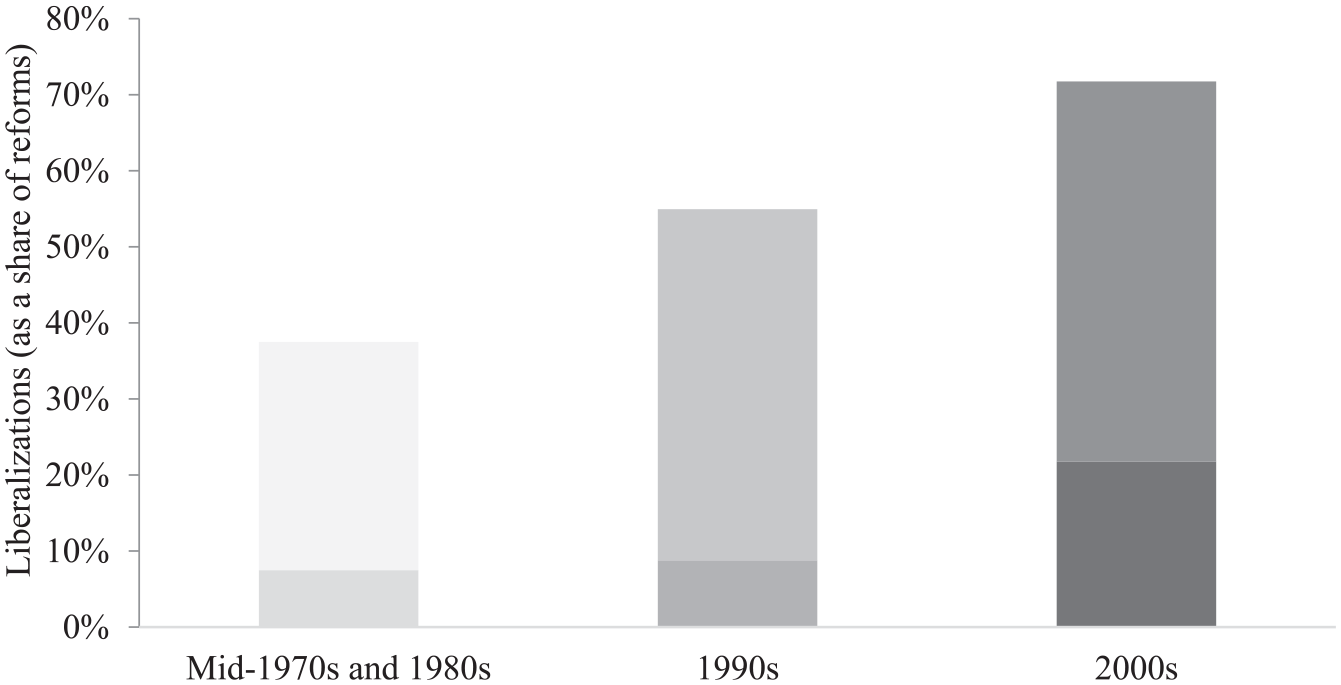
Share of liberalizing reforms in skill formation, industrial relations, and social policy in Germany from the mid-1970s to the 2000s. Darker parts of bars show proportion of major liberalizations. Authors’ calculations using data from Klaus Armingeon et al., Liberalization Database—37 Countries, 1973–2013 (Bern and Geneva, 2019), https://liberalization.org/. Data combine reforms in seven policy fields that map onto the three subspheres analyzed in this article as follows. Skill formation = education, excluding vocational training (edu) and vocational training (voctr); industrial relations = employment protection legislation (epl) and industrial relations (ir); and social policy = active labor market policies (almp), nonemployment benefits (neb), and pension policies (pen). Liberalization = removal of market barriers or loosening of restrictions on free markets. Liberalizing reform = permanent or temporary liberalizing change adopted by government/parliament or interest groups or court mandated that qualifies as a policy field discontinuity. Major liberalizations score 1 or above on the liberalization incisiveness index (lib), which aims to capture significance and depth of reform. Full definitions of policy fields and variables are available at https://liberalization.org/images/Codebook.pdf.
Although we agree with the liberalization view that core sectors have not been spared from marked institutional change, we contend that the liberalization perspective is incomplete. Liberalization is not the only phenomenon that swept across advanced capitalist countries during this period. In parallel to the sustained process of liberalization captured by Figure 1, the last two decades were also characterized by a trend toward knowledge-based growth. 21 Table 1 shows the changes in Germany since the turn of the century in the proportion of working-age individuals with tertiary education, the entry rate into tertiary education for those under age twenty-five, the number of researchers, and gross R&D expenditure.
The Shift into Knowledge-Based Growth in Germany, 2000–2018.

Taken together, Figure 1 and Table 1 suggest that the transition to the knowledge economy in Germany can hardly be captured through the lens of liberalization alone. Rather, it requires understanding how liberalization and knowledge-based growth codeveloped over the last two decades, given that the two phenomena have largely overlapped since the early 2000s. 22 To that end, we put forward an alternative perspective that integrates theories of technological change from labor economics, which posit that the adoption of ICT in workplaces has asymmetric effects on workers. The two eminent theories of technological change in labor economics are skill-biased technological change (SBTC) and routine-biased technological change (RBTC). 23 According to both, ICT is complementary to high-skilled workers, as it enables them to do their jobs more effectively, whereas it substitutes for workers lower down the skill distribution, particularly those who focus on tasks that can be easily replicated by computers or machines. Technological change therefore increases the relative demand for high-skilled labor, which leads ceteris paribus to an increase in the wage premia for university-educated workers. 24
More specifically, we argue—and demonstrate in the following section—that technological change has played a pivotal role in transforming the German manufacturing sector in recent decades. A surge in the ICT intensity of advanced manufacturing has shifted the skills needs of manufacturing businesses toward workers with tertiary education, especially in STEM subjects, which has further undermined existing institutional complementarities in the German political economy. In a context of liberalization and technological change, institutional changes in the industrial relations and social protection arenas have been instrumental for business to concentrate wages and nonwage benefits on increasingly important highly skilled workers. We refer to this as skill-biased liberalization.
Conceptualizing the transition to the knowledge economy in Germany as the codevelopment of liberalization and technological change allows us to advance a set of theoretical propositions that stand apart from the dualization thesis and that qualify the liberalization view. Our core contention is that—contra dualization and in line with liberalization—(1) profound changes did not spare core sectors of the German political economy and (2) these changes are best understood as the outcome of class conflict in which employers challenge traditional institutional arrangements and prevail over unions that, in turn, seek to safeguard them to little avail. However, by embedding technological change in our framework, we argue that employers’ preferences are likely to be more nuanced than hypothesized by the liberalization literature: on one hand, employers do push for deregulation and retrenchment in industrial relations and social protection; but at the same time they seek to redeploy these institutions to be able to reward and retain the highly skilled workers who have become vital for their production strategies in the era of knowledge-based growth. In our view, the transition to the knowledge economy is therefore best explained by taking into account the effects of technological change in increasingly liberalized political economies.
In a nutshell, we can thus identify a distinct logic of institutional adjustment for each theoretical perspective. In a dualization world, institutional change takes place predominantly in peripheral sectors, while continuity prevails in core sectors. A cross-class alliance between employers and unions is at the heart of this logic: both capital and labor get their way in core sectors, while labor in peripheral sectors sees its position compromised. In a liberalization world, deregulation of labor markets, decentralization of collective bargaining, and retrenchment of social protection take place in both core and periphery. The key actor driving this process is business, which successfully pushes for liberalizing reforms against the opposition of the unions. In a world of skill-biased liberalization, characterized by liberalization and technological change, institutional adjustment equally takes place in both core and periphery. However, it is marked by two parallel processes: while employers push for liberalization, they also seek to redeploy wages and nonwage benefits toward those workers whose skills are complementary to technology and who are therefore central to firms’ production strategies in the knowledge economy. In this scenario, capital and high-skilled workers stand to win, while labor lower down the skill distribution loses out.
As summarized in Table 2, we can derive a set of observable implications for each of these three theoretical approaches in relation to the three subspheres of the political economy that have been central to CPE scholarship and that will be analyzed in this article in depth, namely, skill formation, industrial relations and labor markets, and social protection. 25
Observable Implications of Dualization, Liberalization, and Skill-Biased Liberalization.

Before moving to the empirical analysis, a clarification of the role of unions in our proposed framework is warranted. Unlike the dualization perspective, both the liberalization and the skill-biased liberalization perspectives imply that employers drive change as first movers, while unions seek to defend the existing institutions and, by extension, their traditional constituencies (i.e., specifically skilled workers in the middle of the skill distribution). However, the increasing importance of knowledge-based growth (Table 1) suggests that a growing segment of the labor market is now made up of highly skilled workers who have traditionally been beyond the scope of union representation. This creates a dilemma: unions can either turn inward and prioritize the (shrinking) core of their membership that relies on the traditional set of institutional complementarities, or they can embrace the changed institutional landscape and adopt strategies to cater to nontraditional types of members. 26 The recent CPE literature suggests that labor unions in Germany (and beyond) have indeed revisited their strategies to avoid further marginalization. 27 We treat this as an open empirical question on which our analysis can shed additional light.
Data Collection and Analysis
Our empirical investigation is based on an in-depth case study of the German manufacturing sector, the key site of contestation between the existing theoretical perspectives on the evolution of the German political economy and our alternative approach. It therefore provides the appropriate testing ground to assess the empirical support for our argument. For in-depth, single-country case study research, it is well advised to draw on as broad a range of empirical material as possible, including statistical data, official statements and reports, and pertinent secondary sources. Where necessary and feasible, this material can be triangulated with supplementary data gathered through interviews with relevant stakeholders. Our article engages all of the above, in order to investigate recent changes in the German manufacturing sector as well as changes that have occurred in the key institutional spheres of skill formation, labor markets and industrial relations, and social protection. We leverage descriptive statistics from a wide range of sources, including the OECD, the Observatory for Economic Complexity, the EU KLEMS data set, the Federal Statistical Office of Germany, the Joint Science Conference of the German regions (Länder) and Federal Government (Bund), and the German Chambers of Industry and Commerce. We complement these with qualitative data from industry surveys and reports, the research outputs of industry-affiliated think-tanks, and labor union publications and statements. Finally, we triangulate insights from these sources with primary data gathered through twenty-one semistructured interviews with senior stakeholders in employers’ and workers’ associations and government ministries. Details of our methodology, the selection of stakeholders, and a full list of interviewees are provided in the Appendix.
German Manufacturing in the Knowledge Economy
The German export machine has been powered by a strikingly similar set of products for the past four decades. 28 Germany’s top exports in 2017 were cars and vehicle parts, which together accounted for nearly 17 percent of all goods exports (by value in US dollars). Germany has also maintained its global preeminence in the export of industrial goods, such as machinery and equipment that are used in the production of other goods. 29 On the surface then, the picture is one of continuity, but the stability of Germany’s export profile obscures the deep and transformational changes that have taken place in the manufacturing industry during the transition to the knowledge economy.
Take the German carmakers as an example, which have sharply increased expenditure on innovation in recent years, from €26.6 billion in 2009 to €47.4 billion in 2017. 30 They have also seen continuous growth of skilled labor, especially in research and development jobs. 31 In line with our argument on the importance of ICT to advanced manufacturing in the knowledge economy, and contrary to the expectations of the VoC framework, 32 innovation in the sector has also started to shift away from incremental forms of innovation and toward more radical forms of innovation. Since the mid-2010s, German vehicle manufacturers have registered as many patents that pertain to radically innovative technologies (in the areas of digitalization, electric mobility, and electronics) as those that pertain to conventional power trains (e.g., combustion engines and exhaust systems). 33
Against that backdrop, profound change has not been confined to the automotive sector alone, as technology has become deeply embedded across German manufacturing industries in general. Germany came at the top of the Bloomberg Innovation Index for the first time in 2020, owing to “top-five rankings in value-added manufacturing, high-tech density, and patent activity.” 34 German exports are heavily concentrated in advanced, high-technology goods; 52 percent of German exports were high-tech products in 2015, and another 31 percent were medium-high-tech products. 35 Germany is currently ranked third in the world on the Economic Complexity Index, which measures the knowledge intensity of the products a country exports. 36 Germany is also a leading producer of IT manufactured goods, which include computers, electronics, and optical products. The OECD calculates that Germany was Europe’s most “central” IT manufacturing hub in 2011, highlighting its influence in global and domestic production networks for IT manufactured goods. 37 The importance placed on innovation of German manufacturing firms is reflected in a substantial expansion in expenditure on R&D since the global financial crisis. Figure 2 shows that real business expenditure on R&D by firms in the manufacturing sector grew by over 33 percent in the decade after 2007.
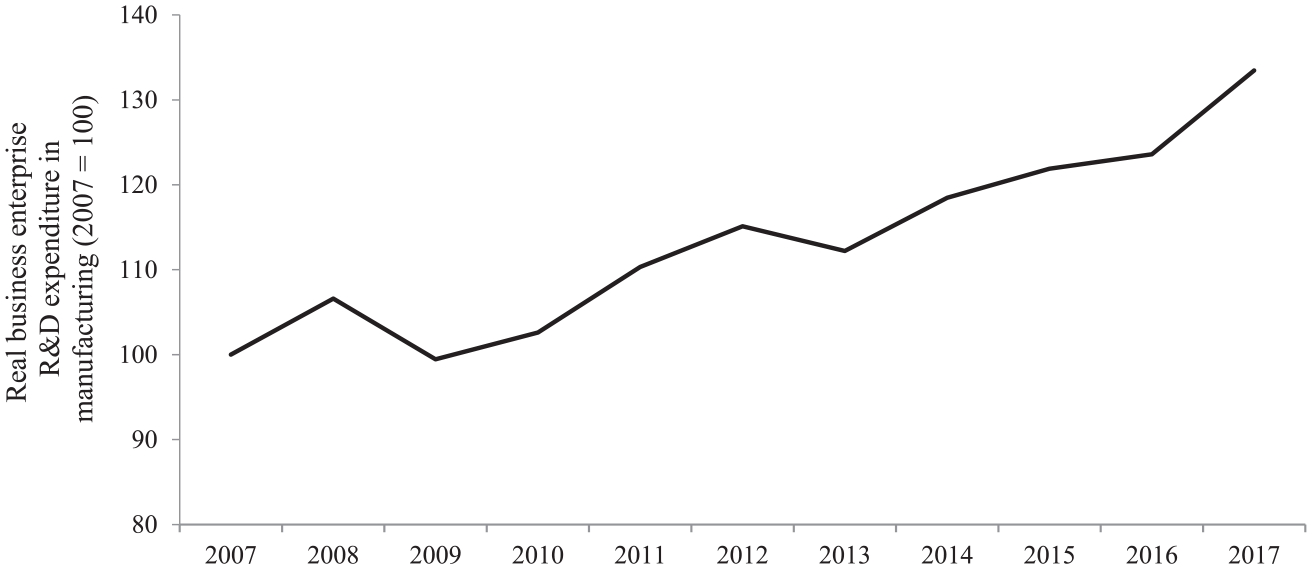
Real business enterprise R&D expenditure in manufacturing (2007 = 100) in Germany, 2007–17. Underlying data in 2010 US dollars, constant prices, and PPPs. Authors’ calculations using data from the OECD data set on business enterprise R&D expenditure by industry (as of October 2019), https://stats.oecd.org/.
Moreover, spending on innovation by the metal and electrical industries (Metall- und Elektroindustrie) now accounts for almost two-thirds of innovation spending in the German economy (62.9 percent in 2017, compared to 55 percent in 2010), as manufacturing firms grapple with the challenges and opportunities of the ICT revolution. 38 For a large number of our interviewees, for instance, the quest for “new business models” has become one of the key issues facing German industry in the digital age: greater service orientation and more focus on product individualization and customization are two common developments identified by interview partners. 39 In this context, manufacturers now increasingly seek employees with wider and more general skill sets in both mechanical or electrical engineering and information technology, so as to safeguard their innovative capacity. 40
Theories of technological change from labor economics would predict that the rapid diffusion of ICT during the transition to the knowledge economy would have substantial effects on the workforce in the German manufacturing sector. 41 As discussed in the theory section, we would expect to see greater demand for high-skilled workers due to their complementarity with ICT, as well as a movement away from the routine tasks that can be easily replicated by computers or machines and toward more complex, nonroutine abstract and analytical tasks. 42 In line with that hypothesis, Hugh Cassidy shows through a task usage shift-share analysis that manufacturing occupations were shifting away from manual tasks and toward interactive and analytical tasks as early as the late 1980s. 43
Alongside these changes, German manufacturing firms offshored a large amount of labor-intensive upstream production activity to Central and Eastern Europe and other emerging economies during the 1990s. 44 By the mid-2000s, nearly half of German automobile parts suppliers had begun overseas production in Central and Eastern Europe. 45 Sascha Becker, Karolina Ekholm, and Marc-Andreas Muendler study the effects of offshoring on the onshore workforce of German multinational companies and find that offshoring is associated with a significant shift toward more highly educated workers and more interactive and nonroutine tasks. 46 The manufacturing jobs remaining in Germany have been upgraded and focus more on R&D, management, and nonroutine aspects of the production process such as production engineering and quality services. 47
The rising importance of nonroutine tasks and service occupations in manufacturing workplaces has significantly altered the skill requirements of manufacturing firms: there is now greater demand for workers with the high-level general skills (i.e., university education) that are complementary to ICT. This chimes in with Dominik Boddin and Philipp Henze’s occupational analysis of the German manufacturing sector, which finds that the most skilled occupations saw the greatest employment growth between 1975 and 2010. 48 The single biggest employment expansion was for engineers, whose employment more than doubled over the period (+106 percent), followed by semiprofessionals (+66 percent) and professionals (+51 percent) in service occupations. 49 Those expansions are even more striking as they took place against a backdrop of shrinking employment in the manufacturing sector as a whole; manufacturing employment fell from 32 percent to 19 percent of total employment in Germany between 1975 and 2006. 50 It has also become more common for manufacturing workers to possess higher education; the share of workers with tertiary education in high- and medium-high-tech manufacturing rose from 25 percent in the mid-1990s to 33 percent in 2016. 51
Overall, ICT has increasingly become a cornerstone of the manufacturing sector in Germany. In line with theories of technological change from the realm of labor economics, the diffusion of ICT has taken place in conjunction with a shift toward high skills, service occupations, and complex, nonroutine tasks. The demand for university-educated workers, especially those with engineering and IT-related degrees, has increased dramatically as a result. The transition to the knowledge economy has evidently changed German manufacturing and rendered the recruitment and retention of high-skilled workers increasingly vital for continued success in the export of advanced manufactured goods.
Institutional Change in German Manufacturing
This section identifies the patterns of institutional change that have occurred alongside the technological transformation of Germany’s manufacturing sector since the second half of the 1990s and across the three core spheres of skill formation, industrial relations and labor markets, and social policy. 52 In particular, it assesses the extent to which the available evidence supports our argument about the mutually reinforcing relationship between liberalization and technological change in the German political economy during the transition to the knowledge economy.
Skill Formation
Following on the findings of the previous section, the widespread use of ICT in German manufacturing has altered the composition of jobs and skills in the sector. The centrality of intermediate skills has diminished in the context of the increasing importance of nonroutine tasks, which calls for higher-level skills. Since the mid-1990s—and with a stark acceleration from the mid-2000s—higher education has become the center of gravity of the German skill-formation system. 53 Enrollments at universities have skyrocketed, while the number of young people in the dual apprenticeship system has decreased (see Fig. 3).
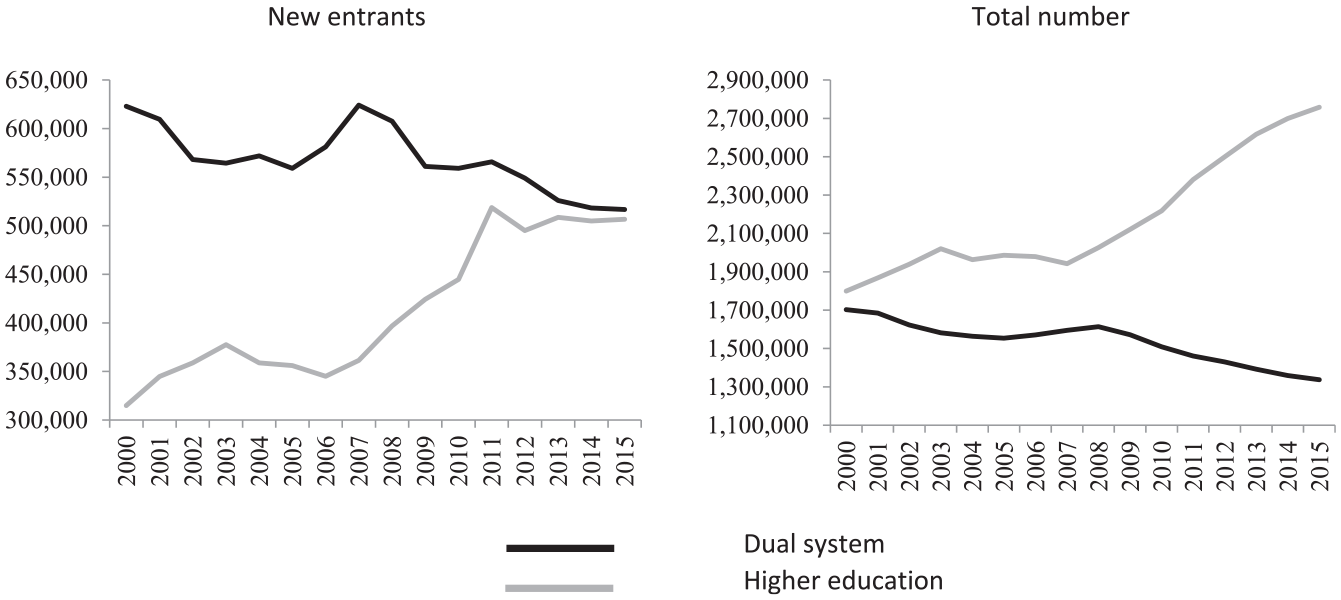
Size of higher education and dual vocational training systems in Germany, 2000–15. Adapted from Statistisches Bundesamt (Federal Office of Statistics), www.destatus.de.
The expansion of higher education in Germany does not simply reflect the expansion of employment in high-value-added services, as commonly assumed by the CPE literature. 54 It is also intimately linked with changes in advanced manufacturing, given that “industrial production has become increasingly digitalized, decentralized, and dependent on workers with high cognitive and analytical skills, causing demand for employees with university . . . degrees to rise, while VET training has become relatively less important.” 55 Remarkably, since the 2000s, employers in the manufacturing sector have pushed for a deregulation of the traditional apprenticeship system. The reintroduction of shorter, two-year apprenticeships in 2003 was achieved against the opposition of trade unions, who feared that lowering the quality of training would facilitate segmentation of the workforce in terms of collective bargaining and wages. 56 The deregulation of the apprenticeship system—which Marius Busemeyer and Christine Trampusch have described as “liberalization by exhaustion” 57 —originated, crucially, in the core manufacturing industries, and large export-oriented firms were among its most fervent supporters. 58
Yet manufacturing employers not only campaigned for—and eventually obtained—a deregulation of the apprenticeship system in the 2000s but also mobilized in favor of expanding higher education and the provision of STEM skills in particular. 59 Employers ran public campaigns emphasizing the urgency of creating a plentiful and stable supply of high-level skills to sustain the backbone of the export-oriented German economy. 60 The influential metalworking employers’ association (Gesamtmetall) and the employers’ peak association (BDA) funded biannual studies to monitor the supply of STEM skills (so-called STEM Trend Reports), as well as spearheaded a national STEM Forum. 61 Similarly, the National Academy of Science and Engineering (acatech)—a publicly funded organization advising policymakers on innovation policy and technological developments including “Industrie 4.0”—has been at the forefront of research on skills needs in the transition to the knowledge economy. The supply of STEM skills has been a central concern of acatech’s activities, including the publication of a yearly report co-commissioned by the entrepreneurs’ foundation Körber Stitfung and marketed as a “Barometer of Young Talents in STEM Subjects.” According to interviewees, at the heart of these efforts was the motivation to increase the supply of high-level skills in order to ensure that German companies reap the benefits associated with technological change, which led employers’ associations to become “massively engaged in higher education reform.” 62
Consequently, German higher education policy has come to reflect demands for an increased supply of STEM skills. 63 The federal government launched the Higher Education Pact (HEP) in 2007 to fund the expansion of the university sector, tying the disbursement of funds to the promotion of STEM subjects in particular, as these were seen as pivotal to a successful transition to the knowledge economy. 64 As a result, since the launch of the pact, intakes in engineering have—in relative terms—outstripped intakes in any other discipline (see Fig. 4).
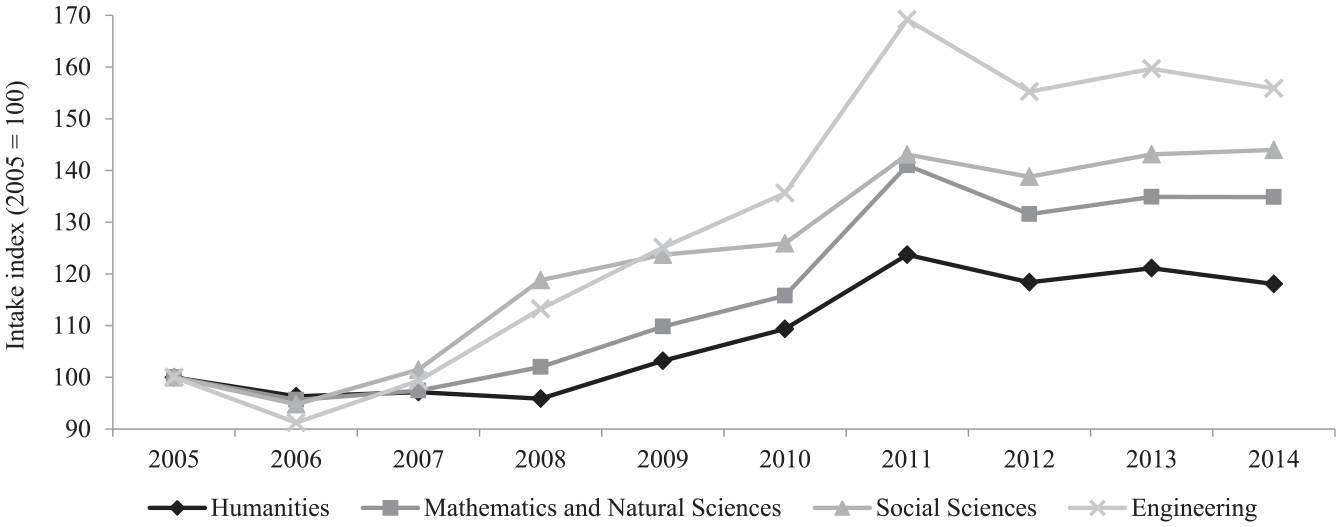
Relative intake of students by discipline in German higher education, 2005–14. From Gemeinsame Wissenschaftskonferenz, Hochschulpakt 2020 Bericht zur Umsetzung im Jahr 2014 (Bonn: Gemeinsame Wissenschaftskonferenz, 2016).
In some Länder, the HEP has also been used to fund so-called dual study programs. 65 Within these, students obtain regular university degrees (typically at the undergraduate level) and also extensive work experience in firms that enter a cooperation agreement with higher education institutions (usually universities of applied sciences). A main reason for employers to sponsor dual study programs is to tie students to the firm early on in order to minimize the risk of future skill shortages. 66 In the distribution of students in dual study programs, engineering stands out as the most popular discipline. 67 This fact reflects business preferences for certain graduate skills, given that firms—not universities—get to decide in which disciplines the degrees will be offered. 68 At present, around 100,000 students are enrolled in dual study programs—a relatively limited share of students across the German higher education sector. 69 Nevertheless, the rapid proliferation of dual study degrees over the last decade and their emphasis on engineering provides additional evidence for the vital importance of this particular set of higher-level general skills in the German political economy.
Trade unions in the manufacturing sector have not been idle bystanders in this sea change in Germany’s educational landscape, although they have embraced its implications somewhat belatedly. In line with earlier resistance to reform of the vocational training system, the dominant metalworkers’ union, IG Metall (IGM), for instance, continued up until the 2010s to stress in its annual reports that growth among apprentices remained one of its key targets. 70 Only from 2012 onward did the union begin to shift emphasis, when IGM board member Detlef Wetzel announced at the annual press conference, “We will care intensely about our work to attract students. Universities are the largest providers of training for the sectors that we cater to. We will be making offers to students in order to win them over as members of IG Metall.” 71
In the same year, the union launched an innovation fund which pledged some €20 million annually for the recruitment of members in “strategic future fields.” 72 The first results were reported a few years later, with new board member Christiane Benner declaring that the union had now become “particularly successful with prospective academics” and that it had “successfully addressed structural change and the trend towards academisation.” 73 According to IGM membership data, the union indeed managed to recruit around 45,000 additional student members between 2012 and 2019, although membership among students had been in decline throughout much of the preceding decade. 74 Equally telling, perhaps, IGM also came to inaugurate its own higher education institute in 2019, the so-called House of Labour (on the campus of Goethe University Frankfurt), whose offerings include “further qualifications in the area of digitalization.” 75 At the same time, what ultimately matters is not how many students may become union members but whether and how the union’s work is affected by the growing number of high-skilled graduates within its sectors of interest, to which we turn in the next section.
Taken together, recent developments in the realm of skill formation corroborate the argument for an employer-led destandardization. However, manufacturing employers not only worked toward the liberalization of the traditional apprenticeship system but also developed a keen interest in higher education policy. As ICT alters production processes in manufacturing in favor of nonroutine jobs, skill formation is “moving up” to a higher level. Universities are today at the core of skill formation in Germany, and policymakers—following business’s demands—have encouraged the higher education sector to provide the skills (STEM and engineering in particular) considered crucial for businesses to succeed in advanced, ICT-intensive manufacturing. Trade unions’ reactions to those developments came in two different phases. During the first decade of the 2000s, unions prioritized—with limited success—the preservation of the traditional pillar of skill formation in the form of the vocational training system. However, as vocational training gradually lost its centrality relative to higher education, unions underwent a process of internal adjustment that included a novel emphasis on the targeted recruitment of university students.
Industrial Relations and Labor Markets
Moving on to the realm of industrial relations, we see a broad consensus that the traditional German system of coordination has become substantially more decentralized since the end of the 1980s. 76 The extent of the liberalization is clear in the headline data; trade union density fell from 31 percent in 1990 to 17 percent in 2016, while collective bargaining coverage dropped from 85 percent to 56 percent over the same period. 77 These changes coincided with a steady decline in the sectoral (i.e., industry-level) collective agreements between trade unions and employers’ associations that were long considered the cornerstone of the German industrial relations system. 78
There is mounting evidence that these trends have been observed in the industrial core as well as the service sector periphery. Michael Oberfichtner and Klaus Schnabel, for instance, analyze firm-level data from the Federal Employment Agency’s IAB Establishment Panel and find that the proportion of manufacturing firms covered by collective bargaining agreements fell from 90 percent to 67 percent in Western Germany and from 69 percent to 46 percent in Eastern Germany between 1996 and 2015. 79 They also highlight the countervailing rise in establishments without any collective agreement at all.
Employers in the manufacturing sector have actively pushed for this transformation. The metalworking employers’ association (Gesamtmetall), for instance, lobbied heavily for the liberalization of industrial relations during the 2000s, not least through its pro-reform think-tank Initiative Neue Soziale Marktwirtschaft (INSM). Daniel Kinderman suggests that, in contrast to the expectations of the VoC framework, German manufacturing employers did not defend traditional coordinated institutions during this period. 80 Instead, they fought to give employers more discretion in labor relations. Beyond lobbying, Gesamtmetall took concrete steps that further eroded collective bargaining institutions, such as introducing a new membership option called Ohne Tarifbindung (OT)—translated, “without a collective bargaining agreement”—offering the full range of services to employers without the obligation to comply with the conditions set out in the sectoral agreement. The option has been popular; nearly one-half of all Gesamtmetall members (representing about 20 percent of employees) are now OT members. 81
Employers in manufacturing have gained both flexibility and discretion from the significant changes that took place in the industrial relations sphere from the mid-1990s. Three prominent trends that followed were the greater use of agency workers, the rise of domestic outsourcing, and the offshoring of a substantial number of low-skill production jobs to Central and Eastern Europe. 82 Agency workers are more insecurely employed and typically earn 25–30 percent less than regular staff. 83 They are also disproportionately located in the manufacturing sector in Germany (unlike in other countries, such as the United States, where they are more concentrated in the service sector) and are predominantly unskilled, male workers. 84 Along with employing more agency workers in low-skilled positions, German manufacturing firms began to rely increasingly on outsourcing services provided by low-skilled labor, such as cleaning, food, and security. Deborah Goldschmidt and Johannes Schmieder calculate that outsourced workers in Germany see a drop in wages of around 10 percent. 85 After the fall of the Iron Curtain, German manufacturing firms also took advantage of the opportunity to shift upstream production activities to nearby countries with similar institutions and education systems, but significantly lower labor costs, such as Poland and the Czech Republic. Offshoring reduced costs for manufacturing firms both directly, as foreign production workers were cheaper to employ, and indirectly, as the threat of offshoring reduced the bargaining power of the low-skilled production workers that remained in Germany, putting downward pressure on their wages. 86
What lies behind the dramatic changes that have been observed in industrial relations in the core manufacturing sectors since the mid-1990s? The CPE literature on Germany has almost exclusively focused on the desire of export sector firms to cut unit labor costs to safeguard their competitiveness in world markets. 87 While this is clearly an important part of the story, it is hard to reconcile with the empirical evidence that this period saw wage growth in manufacturing strongly outstrip that in the nontradable sectors, as well as a rise in the wage premia of workers in exporting (over nonexporting) firms. 88 What is missing from existing CPE explanations, then, is proper consideration of how high-skilled workers were affected by the transformation of the industrial relations system. We argue that the liberalization of industrial relations has provided manufacturing firms with the scope to concentrate their resources on the recruitment and retention of high-skilled workers, who have become central to the production strategies of export sector firms in the knowledge economy.
Table 3 draws on the EU KLEMS data set to show how the share of total labor compensation by skill group changed between 2002 and 2017 in the manufacturing sector. 89 We can see that compensation was reorientated over this period, with high-skilled workers gaining at the expense of unskilled workers. The numbers in parentheses in the table show the number of persons employed in each skill group. This highlights the sheer scale of the changes observed in the German manufacturing workforce since the turn of the century, with the sector adding over 400,000 university-educated workers between 2002 and 2017 alone.
Share of Total Labor Compensation by Skill Group in the German Manufacturing Sector, 2002 and 2017.

Turning back to compensation, university-educated workers gained the most during this period, with their share of total compensation rising 4.4 percentage points to 35.2 percent. Workers with intermediate skills also saw their share of labor compensation rise, but not as significantly as that of high-skilled workers. That workers with intermediate skills saw a moderate increase in their share of total labor compensation suggests that the flexibilization of labor relations in manufacturing has also benefited mid-skilled workers. Fabian Ochsenfeld provides a potential explanation for this. 90 He uses linked employer-employee panel data to explore the effects of subcontracting on the wages of core workers without a college education and finds the effects to be positive or neutral. Thus, the adjustments in labor relations in German manufacturing since the mid-1990s have allowed manufacturing firms to protect and reward their core mid-skilled workforce, alongside shifting resources toward ever more important highly skilled university graduates.
These dynamics can be substantiated further when exploring developments in wage inequality in the German manufacturing sector. We use the EU KLEMS data to calculate the wage compensation ratios between the three different skill groups. Table 4 shows how these measures have evolved since the early 2000s. Across the whole period, we see a substantial wage premium for university-educated workers over the other two skill groups. We see this premium rise rapidly in the period of economic expansion and skill shortage running up to the global financial crisis. We then see it come down gradually between 2008 and 2017, likely reflecting the marked expansion in the supply of university-educated workers after the Higher Education Pact of 2007 (as shown in the previous section).
Wage Compensation Ratios between Skill Groups in German Manufacturing, 2002, 2008, and 2017.

Empirical evidence from the extant literature also points to manufacturing firms increasingly concentrating compensation on the high-skilled workers at the center of their production strategies. Philipp Henze shows that the gap between the upper and lower quartile of real wages has risen over time and that a key driver of this trend is the shift within the manufacturing sector into service occupations (which draw heavily on high-level, general skills that are complementary to ICT). 91 We have also seen rising wage premia for workers with STEM qualifications, as well as high-skilled employees in exporting firms. 92
The rise in bargaining power of high-skilled workers in German manufacturing and the freedom afforded to employers through the liberalization of industrial relations has culminated in a major change in focus for employers, who are increasingly directing their efforts and resources toward the hiring and retention of university-educated workers. Werner Eichhorst argues that firms are increasingly competing with one another to recruit and retain high-skilled workers and that entry level wages for skilled graduates in occupations with a shortage of workers, such as engineering, have improved markedly in the post–financial crisis period. 93 The competition among employers is also increasingly stretching beyond remuneration, with firms competing on nonmonetary benefits including flexible working time and occupational welfare (as discussed further in the next subsection). 94
In its regular survey of 20,000 German businesses, the Association of Chambers of Industry and Commerce (Deutscher Industrie- und Handelskammertag, DIHK) finds that a growing number of employers aim to recruit and retain skilled workers by improving employer attractiveness in terms of both pay and job quality. 95 Among manufacturing businesses in particular, the survey charts an increase from 31 percent to 42 percent of those striving to increase employer attractiveness between 2011 and 2014 alone, leading the DIHK to conclude that “the situation on the labor market is turning around—employers are now competing more and more for scarce and well-qualified employees.” 96 Interviewees acknowledge this “war for talent” and suggest that skilled applicants “know their worth and thus make higher demands,” indicating that “the balance of power is tilting,” to an extent that “employees are now dominating the labor market” for STEM skills. 97 In the words of one respondent, “Firms keep telling us that it is not the case anymore that they can go and say ‘which applicant do we pick?’ but rather the other way around—the applicants now go and say ‘which firm do I pick?’” 98
The use of pecuniary and nonpecuniary benefits can be seen as an attempt by employers to solve the “new poaching problem” they face in the knowledge economy, which is to keep hold of their high-skilled, university-educated workers. 99 Holding on to STEM graduates is a particular challenge for manufacturers. These workers are not only highly skilled but also exceptionally mobile, as their skills are prized in both high-value-added manufacturing and high-value-added service sectors (e.g., finance, consultancy). 100 In contrast to the VoC view of the German economy, where solving the poaching problem for mid-skilled workers relies on coordinated wage bargaining, 101 solving the poaching problem in the knowledge economy is not reliant on the presence of traditional coordinating institutions. Rather, it appears to rely on the gradual erosion of those very institutions in order to make it possible for employers to attract, reward, and retain highly skilled workers as they deem fit.
How have trade unions in the manufacturing sector reacted to these incisive shifts? Similar to the case of skill formation, unions initially displayed hesitance toward embracing changes in the employment landscape, holding on to the position that technological change “must not merely provide perspectives for the employment opportunities of the highly qualified.” 102 At the same time they continued to “care more about existing members . . . at the expense of new workers” and found themselves “often involved too late in digitalization projects at the firm-level.” 103 This predisposition shifted once again over the mid-2010s. 104 IGM, for instance, acknowledged that “digitalisation, network technologies and big data will lead to more ICT experts, data analysts, engineers and community managers among our workforces. [This requires] an even more targeted approach towards these groups of employees.” 105
The union also again committed significant sums of funding to the cause, pledging to spend €191 million over the course of nine years from 2015 onward on recruitment projects as well as shifting activities and personnel from the board level to local units. 106 This commitment reflects the “dilemma” faced by the union in the knowledge economy, which stems from the fact that these groups of employees “are becoming an increasingly important part of the manufacturing workforce [because of] the expansion of highly skilled white-collar work in research and development, especially in the automotive industry.” 107 These are the same groups that have traditionally proved to be “very difficult to reach over the past decades” for IGM. 108
A pertinent illustration for just how central—as well as how difficult—the recruitment of highly skilled knowledge workers has become for unions is the case of a recent transformation project by a major German manufacturing company that seeks to create working and living facilities for some 20,000 workers in R&D. IG Metall has rented valuable office space on the project site itself in order to convince employees to join the union by means of a “politics of small steps,” which can only be described as an uphill battle, given that “most of these employees come straight out of university, have not been socialized in a union environment, and tend to believe that they will join the ranks of senior management in a couple of years anyways.” 109
Overall, the transition of the German manufacturing sector into the knowledge economy has seen IG Metall adopt a strategy that broadens the union’s perimeter beyond its traditional membership base, by actively attempting to bring in the type of high-skilled workers that have historically been underrepresented in the union. The eventual shift in strategy has started to bear fruits as of late: disaggregated membership data show that after a prolonged decline among engineers and other technical experts over much of the 2000s, IGM managed to increase membership among this group by nearly 27 percent in the 2010s (from 126,625 members at the start of 2010 to 160,791 members by the end of 2019). 110
In summary, the industrial relations system has become substantially more liberalized in the German manufacturing sector since the mid-1990s. Given the rapid pace of technological change, manufacturing firms have taken advantage of the greater discretion liberalization has offered by shifting labor compensation away from low-skilled workers (temporary workers, outsourced workers, offshored workers, etc.) and toward high-skilled workers, who have become indispensable in the knowledge economy. Manufacturing unions opposed liberalization but have recently sought to adapt to the increasing centrality of high skills in advanced manufacturing by aiming to attract more university-educated and white-collar workers into their ranks.
Social Policy
Comprehensive change has not been limited to the skill formation and industrial relations arenas. The realm of social protection has also been subject to radical transformation, most prominently since the early 2000s. The parallels between social protection and industrial relations in terms of both outcomes and underlying political agency—namely, on behalf of employers’ associations spearheaded by manufacturing employers—are striking. Despite its reliance on social insurance as the archetypal Bismarckian welfare state, the German social protection system reached “quasi-universalism” in its postwar settlement and ensured high replacement rates for both the unemployed and pensioners. 111 The quasi-universalist principles were, however, increasingly challenged during the 1990s and ultimately dismantled in the 2000s. As in the case of industrial relations and labor market policy, employers emerged as the key actors behind the liberalization of the social protection system.
Business lobbying in favor of welfare state retrenchment was primarily targeted at unemployment benefits and pensions, two of the largest items of German public spending. Timo Fleckenstein and Soohyun Christine Lee demonstrate how the peak employer association BDA formulated an increasingly hostile stance toward unemployment benefits through the second half of the 1990s. 112 Manufacturing employers, through the Gesamtmetall-funded think-tank INSM, were equally aggressive in heralding the need “for far-reaching market-oriented reforms” to be achieved with or without unions’ consent, as well as forcefully advocating for the “necessary retrenchment of the unaffordable welfare state.” 113 Employers targeted both the duration and the generosity of unemployment benefits, which they argued should be curtailed. Business preferences eventually came to dominate the Hartz commissions in charge of designing far-reaching labor market reforms, with employers’ representatives outnumbering unions’ representatives. 114 Accordingly, the Hartz reforms of 2003–4 led to a profound reconfiguration of the German unemployment insurance system. The maximum duration was shortened from thirty-two to eighteen months, and the long-term unemployed became “only entitled to a means-tested transfer at the level of social assistance, leading to a reduction in the net replacement rate from 54 per cent to 17 for a single with a previous average wage.” 115
Retrenchment had a discernible impact on both labor market insiders and outsiders—despite the latter’s being more strongly affected—and its most fervent supporters were employers in core sectors. 116 Strikingly, as in the case of industrial relations, much of the employers’ offensive against the generosity of unemployment benefits originated from the manufacturing sector, with the INSM think-tank once again being pivotal in the business campaign for benefit retrenchment. This poses a direct challenge to received wisdom in CPE, which suggests that the manufacturing sector, “with its reliance on industry-specific skills, should have been the one least interested in dismantling the German model and its social insurance system.” 117 Business preferences do not lend support to the proposition of dualization: indeed, employers’ behavior in the late 1990s and early 2000s matches more closely with the expectations of liberalization theories, challenging predictions of institutional stability in Germany’s core industrial sectors.
As far as pensions are concerned, an analogous development can be seen throughout the 1990s. Employers strongly advocated in favor of cuts to the public pension system, arguing that costs had reached unsustainable levels that would hamper German competitiveness in global export markets. By the end of the decade, and similar to the case of unemployment benefits, employers had emerged as the single most forceful actor setting the agenda for comprehensive retrenchment of the public pension system. 118 Despite unions’ vocal opposition in parliamentary hearings and beyond, employers dominated the public debate around the 2001 pension reform, which effectively slashed net replacement rates from 70 percent to 52 percent. 119
It is here that the parallels with the dynamic witnessed in the sphere of industrial relations become most evident. On the one hand, and as expected from a liberalization perspective, employers in core sectors stood behind welfare state retrenchment, which was chiefly motivated by concerns around rising costs negatively affecting German firms’ competitiveness. 120 On the other hand, however, a simple cost-cutting story provides an incomplete picture once again. Following the 2001 pension reforms, retrenchment in the public scheme was coupled with selective expansion of occupational pension plans—pension schemes provided directly by employers. Occupational pension plans differ crucially from statutory public pensions insofar as businesses have much greater control over their design and coverage, as they can “determine the conditions of such schemes or abstain from them.” 121 Thus occupational pensions increase employers’ discretion and can be deployed far more selectively. It is important to note that occupational pensions developed unevenly across skill levels and have benefited skilled workers more than unskilled workers and, among skilled workers, those with a tertiary degree more than those without. 122 Tobias Wiß’s detailed analysis of occupational pensions across countries and sectors—including German manufacturing—suggests that, in sectors relying on high skills, workers “can transfer their human capital into economic individual power, thereby negotiating generous occupational pensions with their employers which are in need of these skills (e.g. in finance and insurance and manufacturing).” 123 This conjecture is confirmed by interviewees, suggesting that the most highly prized workers in the knowledge economy, such as information technologists and data scientists, can “literally choose where to go” and under what conditions. 124
Whereas unions voiced concern over the uneven development of occupational pensions, employers did not perceive such heterogeneity in coverage to be much of an issue. 125 To the contrary, the BDA and BDI openly promote the selective nature of occupational pensions as a strategic device to “attract and retain” highly skilled workers, particularly those with STEM skills. 126 Similarly, major insurance companies increasingly advertise occupational pension schemes to German employers (especially in the Mittelstand) as a means to target much-needed skilled personnel, 127 often in the form of comprehensive packages including additional, targeted benefits such as occupational health care and accident insurance. In this vein, despite occupational welfare offerings’ being a universal right for German employees, manufacturing employers have become those who advertise them most proactively. 128
The relative lack of influence of manufacturing unions in the realm of social policy reflects broader trends in the union movement in Germany. IGM, among others, continues to insist that “work 4.0 requires a welfare state 4.0.”
129
On the other hand, Hassel and Schroeder detect a growing orientation among unions toward their core competencies (e.g., in the realm of pay and working place conditions), which suggests that “compared to previous periods during which unions engaged in many fields of politics, they now mostly have their say only in elementary questions of their field of competence.”
130
Nevertheless, manufacturing unions have discovered that they hold a number of social policy–related trump cards in their quest to convince high-skilled workers to join their ranks and sign up to collectively agreed settlements, relating, for instance, to flexible working-time arrangements that allow employees to make time for child and elder care.
131
Although many high-skilled manufacturing workers would naturally become außertariflich (AT) employees and thus be paid outside of the agreed wage settlement, that often also entails significantly longer working hours than those agreed on by the social partners.
132
Unions have identified this as an opportunity to cater precisely to these workers.
133
When, in 2018, IGM successfully agreed with employers to offer their workforces a choice between higher pay or eight additional days off, some 260,000 employees opted for the latter (of which 242,000 claims were granted by employers).
134
Such arrangements are deemed particularly attractive to high-skilled workers, who are assumed to strive for “a better work-life balance,” for instance, to dedicate time to family matters.
135
Employer organizations, in turn, were taken aback by the success of the initiative: Contrary to firms’ and our own expectation that people take the higher pay, many actually prefer the additional free time over more money. This only exacerbates the skills problem. . . . If I have scarce capacity of personnel, but high demand for work in my plants, how can I get people to work more hours rather than less?
136
In sum, over the past two decades German employers have vigorously mobilized against generous social protection delivered through social insurance, while simultaneously increasing the selective provision of occupational welfare. As others have noted, 137 the withdrawal of employers’ support for unemployment protection directly contradicts theories that posit continuity in the German political economy based on the persistent complementarity, at least in core sectors, between unemployment protection and investment in specific skills. Yet employers’ support for occupational welfare in the manufacturing industries does not fit with an unequivocal liberalization story either. Rather, it can best be understood in the light of the argument we put forward in this article: as the centrality of highly specialized but mobile workers—such as STEM graduates—increased, employers became supporters of selective social policies conducive to “locking in” their highly-skilled personnel. 138 Thus, employers’ preferences toward social protection in the context of the knowledge economy are concerned less with incentivizing individuals to invest in specific skills and more with selectively rewarding and retaining tertiary-educated workers with high-level general skills. As a result, forms of occupational and company-based welfare—characterized by higher employer discretion 139 —have become more widespread, while relatively more encompassing forms of social insurance have been increasingly challenged. In the area of social policy, too, we observe trade unions eventually adapting to the new environment by identifying initiatives, for example, in the realm of working time arrangements, that offer opportunities to cater to those highly skilled workers who would otherwise be difficult for them to attract.
Discussion and Conclusion
The question of how advanced democracies have transitioned from Fordism to the knowledge economy has been of growing interest to comparative political economists in recent years. As the archetypal coordinated market economy in the VoC framework, Germany holds a special place in this nascent literature, and competing perspectives have emerged concerning the degree of institutional change witnessed, as well as its implications for the “German model” of capitalism. In this article, we argue that the two leading CPE perspectives theorizing the recent evolution of the German political economy—the dualization and liberalization perspectives—miss a crucial part of the story, as they fail to take account of the transformative changes the ICT revolution has brought to the core manufacturing sectors. To address this shortcoming, we offer an alternative perspective—skill-biased liberalization—which conceptualizes the transition to the knowledge economy in Germany as a process shaped by both liberalization and technological change. We posit that technological change has meant that high-skilled workers, especially in STEM subjects, have become vital to the production strategies of advanced manufacturing firms. The centrality of this group of workers—highly specialized, but also highly mobile—has weakened the traditional institutional complementarities between specific skills, regulated industrial relations, and generous social protection.
In our skill-biased liberalization framework, institutional change takes place in both core and periphery and is driven by employers, including those in core manufacturing sectors that the dualization thesis predicts would try to safeguard traditional coordinating institutions. Employers pursue two parallel processes. On one hand, they push for liberalization to cut unskilled labor costs, and on the other they selectively expand wage and nonwage benefits for those highly skilled workers who are complementary in production to ICT. While the liberalization perspective sees capital as the winners of the transition to the knowledge economy and labor as the losers, our alternative perspective sees capital and highly skilled workers as the winners and labor lower down the skill distribution as the losers. Unions are change “takers” rather than change “makers” in this framework: employers drive change, often against opposition by unions, which eventually adapt their strategies when it becomes clear that they cannot prevent change. This dynamic is exemplified by IGM’s recent efforts to recruit more university-educated workers into their ranks and to place more emphasis on the types of nonwage benefits that are especially valued by the highly skilled.
Skill-biased liberalization has profound implications for the German political economy and for the CPE literature theorizing its evolution. Back in the 1970s, Paul Osterman noted that “the interesting question today is not whether the labor market is segmented, but rather along what lines.” 140 That question is thrown into sharp relief by Germany’s transition to the knowledge economy. While both the dualization perspective and our alternative perspective of skill-biased liberalization imply that there is segmentation in the labor market, we provide distinct answers about where the line can be drawn. The dualization perspective identifies sectors of employment as the main sites of segmentation, with well-paid and protected workers in core manufacturing sectors on one side, and low-paid and precarious workers in the service sector periphery on the other. By contrast, our perspective identifies skill level as the key dividing line in the German labor market. From this point of view, labor is divided by skill in both the manufacturing and service sectors as a result of technological change (we expect the skill divide in services to be particularly pertinent in knowledge-intensive service sectors such as finance, insurance, and business services). We see a growing peripheral workforce in the manufacturing sector (as documented by liberalization scholars), 141 but we also detect an ever-increasing centrality of high-skilled workers to advanced manufacturing (as is missing from the liberalization perspective) who obtain higher wages and nonwage benefits because of the complementarity of their skills to ICT and who thus increasingly stand apart from the rest of the workforce.
What are the implications in terms of changing patterns of coordination in Germany during the transition to the knowledge economy? Our analysis suggests that Germany is moving further away from the original VoC conceptualization of coordination—in which employers and unions coordinate, with the state providing the framework necessary for this coordination to take place—to a situation in which unions have become weaker and bilateral state-business relationships are more prominent. Our findings thus align with recent CPE contributions highlighting the importance of strong state-business relationships in underpinning growth regimes in the advanced democracies in the twenty-first century. 142
The extent to which the lens of skill-biased liberalization can be useful beyond the German political economy is a fruitful question for future research. Several recent contributions suggest that a number of CMEs in Europe—notably the Nordic countries and the Netherlands—have moved further out of traditional manufacturing than Germany and increasingly rely on high-value-added services and more ICT-intensive, high-technology manufacturing. 143 The logic of institutional change we have identified in this article might therefore be even more pronounced in those cases than in the German context. As scholars embark on these questions, our framework can provide a useful addition to the CPE toolkit. The theoretical propositions we have summarized in Table 2 have two important features: they are both specific enough to be tested against alternative CPE perspectives and general enough to be applied to the study of the transition to the knowledge economy of advanced capitalist democracies beyond the case of Germany and its core manufacturing sector.
Footnotes
Appendix
Acknowledgements
The authors would like to thank Donato Di Carlo, Fabio Bulfone, Chiara Benassi, Julian Limberg, Fabian Mushövel, Takuya Onoda, Arianna Tassinari, Sidney Rothstein, Peter Hall, David Soskice, Wendy Carlin, Lucio Baccaro, Jonas Pontusson, Dorothee Bohle, Anke Hassel, and Bruno Palier for valuable comments and suggestions. We would also like to thank the board of Politics & Society, the coordinating editor Fred Block, and participants at seminars and workshops at King’s College London, the European University Institute, the University of Oxford, and the University of Birmingham, as well as participants at the 26th International Conference of Europeanists and the WINIR Symposium 2019.
Declaration of Conflicting Interests
The author(s) declared no potential conflicts of interest with respect to the research, authorship, and/or publication of this article.
Funding
The author(s) disclosed receipt of the following financial support for the research, authorship, and/or publication of this article: Sebastian Diessner gratefully acknowledges funding for postdoctoral research by the Fritz Thyssen Foundation in the academic years 2019–20 and 2020–21; Niccolo Durazzi is grateful to the Deutscher Akademischer Austauschdienst (DAAD) for a Short Term Research Grant in 2016 (57214227); David Hope is grateful to the King’s College London Department of Political Economy for additional research funds to carry out fieldwork for this project.