




Abstract
Political violence is on the rise in Western democracies. The increase in violence against political actors is alarming because it clashes with fundamental democratic values. Political violence is also concerning because it does not affect all politicians equally. Existing research has primarily focused on the demographic characteristics of targeted politicians, while largely overlooking ideological factors. Using candidate survey data from the 2021 German federal election, we show that the polarization of electoral districts, as well as party and candidate extremeness increase the likelihood that politicians report being victimized. This is the case both for physical attacks and property damage.
Introduction
In an era of increasing societal polarization, violence against politicians is on the rise. Notable incidents, such as the assassinations of Walter Lübcke in Germany or Jo Cox in the UK underscore the seriousness of the problem. While extreme cases grab the headlines, political violence has become a widespread phenomenon in recent years. The rise in political violence is concerning, as it fundamentally clashes with norms of fair democratic competition. A core part of the democratic rules of the game is that conflicts should be resolved without resorting to violence (Keane, 2004). What is more, politicians suffering from violent attacks might be less motivated to participate in politics (Herrick and Franklin, 2019), such that violence against politicians can lead to the suppression of certain viewpoints.
Research on the recent surge in political violence reveals disturbing trends (Herrick et al., 2019). Rather than indiscriminate targeting, certain groups, particularly women (Akhtar and Morrison, 2019; Håkansson, 2021; Southern and Harmer, 2021), young politicians (James et al., 2016b; Thomas et al., 2019), and politicians with minority backgrounds (Collignon et al., 2022), are more likely to be victimized (Herrick and Franklin, 2019). At the same time, existing research has largely overlooked the ideological dimension of political violence. While some studies have included party membership of the victim as a control variable, an account for the link between ideology and political violence is still missing.
We argue that the increasing affective polarization in society, that is, the hostility between groups with opposing political views (Iyengar and Westwood, 2015), contributes to more frequent instances of political violence. Affective polarization involves deep emotional divides where individuals strongly identify with their own group, while harboring anger, resentment, and even hatred toward members of the opposing group (Iyengar and Westwood, 2015). Affective polarization intensifies hostilities between groups, such that undermining opponents can become more important than upholding democratic values. Ultimately, such emotional divides create an environment conducive to political violence.
We highlight two factors which reinforce affective polarization and increase the likelihood of political violence. First, high levels of political polarization diminish the acceptance of opponents and foster strongly negative emotions among the public, such that political actors are more likely to be victimized when polarization is high. Second, parties with extreme positions play a crucial role in amplifying polarization. They create a tangible gap between themselves and centrist parties, thus heightening affective polarization. Yet, while ideologically extreme parties contribute to affective polarization, representatives of extreme parties are also more likely to be victimized.
To empirically test our arguments, we rely on candidate survey data collected during the 2021 German federal election. Logistic regression models explaining property damage and physical violence against candidates confirm our expectations, as both party system polarization, as well as party and candidate extremeness increase the risk of candidates being victimized. The study sheds light on the complex dynamics between polarization and political violence, while offering new insights for countering this alarming societal trend.
Violence Against Political Actors
Existing research has shown that politicians suffer from different forms of violence. It can be physical, targeting politicians directly (Herrick et al., 2019; Thomas et al., 2019) or their property (James et al., 2016a). Violence can also be verbal, such as insults or threats—both in-person or on social media, which currently dominate the research (Akhtar and Morrison, 2019; Erikson et al., 2021; Farrell et al., 2020; Southern and Harmer, 2021).
Overall, a large share of politicians are targeted by violence. Using survey data, James et al. (2016a) find that four out of five British MPs have experienced aggression, one in two have been stalked, and one in five have been the victim of an attack or an attempted attack. Similar findings have been reported for parliamentarians in New Zealand (Every-Palmer et al., 2015), Sweden (Erikson et al., 2021), and Norway (Bjørgo et al., 2022). Findings at the subnational level paint a similar picture, with large proportions of respondents reporting exposure to various forms of violence (Blätte et al., 2022; Herrick et al., 2019; Herrick and Franklin, 2019; Thomas et al., 2019).
While violence against politicians is widespread, not all politicians are targeted equally. Among other factors, younger politicians are more likely to be victimized (Herrick and Franklin, 2019; Thomas et al., 2019), while incumbents, and thus mostly older and more prominent politicians, suffer from more severe incidents (James et al., 2016b). The effect of prominence and institutional power can also be observed at the local level. For example, Herrick et al. (2019) show that directly elected mayors are more likely to be targeted. The authors also find that US mayors with more institutional power are victimized more frequently than less powerful mayors. Thomas et al. (2019) come to the same conclusion while controlling for factors such as crime rate, education level, and city ideology.
A great number of studies show that female politicians are more likely to be victimized than their male counterparts. For example, female parliamentary candidates in the UK suffer more from harassment, abuse, and intimidation (Collignon and Rüdig, 2020; Collignon et al., 2022). Similarly, female mayors in the United suffer more from physical and psychological violence compared to male mayors (Thomas et al., 2019). Focusing specifically on harassment on social media, Akhtar and Morrison (2019) show that female politicians in the UK are subject to more incidents on social media (Akhtar and Morrison, 2019). While not all studies observe gender differences (Erikson et al., 2021; Southern and Harmer, 2021; Ward and McLoughlin, 2020), there is some evidence that women face different types of violence than men. In an analysis of abusive tweets, Southern and Harmer (2021) find that while men and women receive the same number of abusive tweets, female MPs are more likely to be subjected to tweets containing gender stereotyping, sexual objectification, misogynistic abuse, and to have their ability to lead questioned. Gender differences are also evident in the context of sexual harassment (Erikson et al., 2021; Schneider and Carroll, 2020). In addition, some of the other risk factors interact with gender: Female minorities and prominent female politicians are particularly likely to be targeted (Håkansson, 2021; Krook and Restrepo Sanín, 2020).
Overall, violence against politicians is mainly explained by gender, age, incumbency status, and minority background, while ideological factors have largely been ignored. This gap is surprising because ideological differences are obvious drivers of political tension. Only few studies have included party membership as a control variable without theoretical underpinning. In this paper, we expect ideological factors to play a crucial role for the emergence of violence against politicians. We address this research gap by theorizing the effects of party system polarization and ideological differences between parties.
Ideological Determinants of Violence Against Individual Political Actors
In the first part of this section, we begin by arguing that elite polarization has affectively polarized societies. We posit that the strong antagonism between (partisan) groups, characteristic of affective polarization, has the potential to undermine core democratic values, as party competitors are no longer perceived as legitimate opponents but as enemies. Hostile elite rhetoric, as well as the perceived illegitimacy and the danger of the opposing side coming to power seemingly justifies the transgression of the democratic rules of the game, raising the odds that some individuals will resort to violence against political actors. 1
In the second part of this section, we argue that instances of political violence do not occur at random but that we can identify ideological factors which increase the likelihood that political actors are victimized. Two factors are highlighted. First, since election campaigns arguably heighten existing political tensions while making the stakes of political competition more visible, we focus on violence against candidates for political office. We argue that candidates are more likely to be victimized when they run in a polarized environment, as indicated by the level of polarization in their district. Second, we argue that ideologically extreme parties not only contribute to polarization but that representatives of extreme parties as well as more individually extreme actors are more likely to be victimized.
Elite Polarization, Affective Societal Polarization, and Political Violence
Political elites in Western democracies have become increasingly polarized in recent years (Banda and Cluverius, 2018; Dalton, 2021; Vachudova, 2019, 2021). Ideologically extreme parties are key drivers for the increasing levels of political polarization: Either new parties have entered the party system, such as the AfD in Germany or the PVV in the Netherlands, or established parties have become more extreme, such as the Republican Party in the United States. Such elite polarization can spill over into society, leading to affective polarization, where the public increasingly view each other through a partisan lens and where the partisan identity becomes a dominant group identity with strict inter-group boundaries. Parties can even have an electoral interest in fostering affective polarization. A vivid illustration of how politicians deliberately increase affective polarization is the social media use of Donald Trump. His messaging significantly contributed to hostility among Trump supporters against the Democratic Party and specific social groups (Nacos et al., 2023) while simultaneously promoting a negative sentiment towards Republicans among Democrats.
We expect that an increase in affective polarization increases the likelihood of political violence. A plurality of opinions is vital for a functioning democracy. Therefore, a certain level of antipathy against competitors is a normal feature of democracy. However, strong hostility between partisan groups can lead to the erosion of democratic norms (Kingzette et al., 2021). When affective polarization increases, it can turn into hatred of the other parties, their representatives and supporters. Under such conditions, the desire to express this hate and to undermine and harm the representatives of the other parties can become more important than acting in accordance with democratic norms and may escalate into violence against politicians. 2 Violent acts against political opponents can be a potent tool for citizens to express their disdain, with a direct and symbolic impact on victims and the public. Such violence can also dampen political aspirations and discourage politicians from staying in politics (Akhtar and Morrison, 2019; Herrick and Franklin, 2019; James et al., 2016b).
Ideological Determinants of Political Violence
While affective polarization is expected to increase the overall likelihood that some individuals will turn to violence, we propose that some actors are more likely to be victimized than others. In the following, we highlight two factors which are expected to increase the odds of being targeted—one related to the political context of candidacies, the other related to the profile of parties and candidates.
The first factor associated with the likelihood that political actors become targets of political violence is the level of party system polarization. As polarization intensifies, the acceptability of positions held by other parties diminishes, giving rise to intense emotions such as fear and hatred toward the out-group (Webster and Abramowitz, 2017). As a result, the perceived danger of political opponents being in power becomes greater, and election outcomes seem more significant. While party system polarization is first and foremost a systemic feature, the local political context also matters. Whereas local political competition in some areas might be characterized by one dominant party, competition in other areas may be more distinctly bipolar or even multipolar. Not only that, it matters whether local party competition is dominated by centrist or fringe competitors. The upshot of the different types of local political competition is that candidates for political office run in different political contexts and that some of these contexts are more polarized and more conducive to political violence than others.
We expect that the general mechanism for political violence, sketched in the previous section, which links elite polarization to political violence via affective polarization, is stronger in more locally polarized settings. When local elite polarization is stronger and thus more visible and seemingly more consequential, we expect the local public to become more affectively polarized. As local affective polarization becomes stronger, more individuals may feel that overstepping the democratic rules of the game is justified, necessary even. Overall, the level of local political polarization is expected to raise the odds that candidates who run in more polarized contexts are more likely to be targeted by political violence, irrespective of their party affiliation:
H1: Candidates for political office running in more polarized electoral districts are more likely to be victimized by political violence.
While we posit that all candidates running in more polarized electoral districts are more frequently targeted, political violence is unlikely to be independent of the ideological profile of parties and candidates. We expect candidates affiliated with extremist parties as well as candidates endorsing fringe positions to be more frequently targeted by political violence than centrist competitors. By espousing policies far from the political mainstream, fringe competitors are key drivers of political polarization and thus key drivers of political violence. 3 Yet, by endorsing controversial policy positions, fringe competitors open themselves up to intense pushback. For the most part, such pushback will take politically legitimate forms, particularly among the political elite, like being shunned in parliamentary politics. At the same time, endorsing controversial policies will naturally make the prospect of fringe competitors coming to power seem more threatening, potentially legitimizing the use of violence against fringe competitors for some. We expect this effect to be particularly evident for populist (extremist) competitors whose rhetoric often explicitly promotes an us-versus-them mentality and thus a bipolarization of politics with the populist extremist competitor on one side and the other parties on the other.
While these arguments lead us to expect that candidates affiliated with fringe parties and especially candidates affiliated with extreme populist parties are more frequently targeted by political violence across the board, we expect a similar effect for individually extreme candidates. Even though individual ideological positions should not be terribly dissimilar from the party position in a party-centric parliamentary system—at least in the eyes of the public, as the public should be more aware of the party position than the position of individual candidates –, it is not impossible that highly visible candidates with unusually extreme policy positions will be especially polarizing and potentially subject to more frequent instances of political violence. This would be especially true in an analysis of local political competition during election season, when the policy preferences of the individual competitors would be most clearly on display. Overall, these arguments lead us to expect the following:
H2: Candidates affiliated with ideologically extreme parties are more likely to be targeted by political violence.
H3: Candidates promoting ideologically extreme political views are more likely to be targeted by political violence.
The questions of district polarization (H1) and of political extremism (H2, H3) are naturally tied to the question of the dimensionality of politics. In contemporary Western politics, cultural issues are frequently among the most polarizing, while class politics is often less salient. This pattern is also evident in German politics, our empirical case study. Among cultural issues, migration policy is currently the most polarizing issue. In German politics, this is evidenced by the electoral strength of the AfD and the recently founded BSW, both of which promote anti-immigrant stances, the AfD with a right-leaning economic profile, the BSW with more left-leaning economic stances. 4 While we can distinguish between polarization on an economic and a cultural dimension, the positions of the German parties largely fall along the main diagonal in two-dimensional policy space with more culturally liberal parties being the more economically left-leaning and vice versa. Consequently, we will consider polarization and extremism on a general left-right dimension, on a cultural left-right dimension, as well as regarding migration policies specifically in the empirical analysis.
Data and Methods
To test the expectations, we analyze experiences of violence among candidates for the 2021 German federal election using survey data collected by the German Longitudinal Election Study (GLES, 2023). German candidates are a suitable test case for several reasons. As in other countries, political violence is common in Germany (Blätte et al., 2022). Focusing on candidates allows us to assess potential incumbency effects. Previous studies have examined incumbency effects based on elected officials (Herrick et al., 2019; James et al., 2016b). Therefore, the inclusion of non-incumbent candidates is useful because non-incumbents are less familiar to the public than mandate holders, allowing us to assess the effect of prominence on political violence. Moreover, social conflicts are particularly salient during election season when they are on public display. Regarding party system polarization, Germany is a well-suited case because polarization varies greatly by region (see Figure A1 in the Online Appendix).
Germany has a multi-party system, which is well-suited for studying ideological factors. At the 2021 federal election, the German party system was composed of six main parties (in ideological order from left to right): The Left Party, the Green Party, the Social Democrats (SPD), the Free Democratic Party (FDP), the Christian Democrats (CDU/CSU) and the Alternative for Germany (AfD) (Jankowski et al., 2022). Of these, the AfD is the only populist extreme party. The AfD was founded in 2013 on a Eurosceptic platform. Especially during the so-called “refugee crisis” in 2015/2016, key members of the party supported or actively joined the Islamophobic and xenophobic PEGIDA movement. Some party members were later classified as extremists by the German Office for the Protection of the Constitution. Even though the most extreme party wing (Der Flügel) was formally disbanded, its members continue to exert influence in the party (Pautz, 2022). The party is currently classified as a suspected right-wing extremist party by the Office for the Protection of the Constitution (Nickschas, 2022).
The dependent variable for the analysis is experiences of political violence, as indicated by the candidates in their survey responses. We focus on physical violence, specifically on two subdimensions of physical violence: physical attacks on candidates and physical attacks on candidate property. Both variables were collected using an ordinal scale, where respondents could indicate whether they have never, occasionally, or frequently experienced this type of violence during the campaign. The variables were dichotomized (0 = no experience of violence; 1 = occasional or frequent experiences of violence). Since the dependent variables are dichotomous, we estimate logistic regression models. 5 Table 1 provides a descriptive overview of the dependent variable.
Descriptive Statistics of Political Violence.
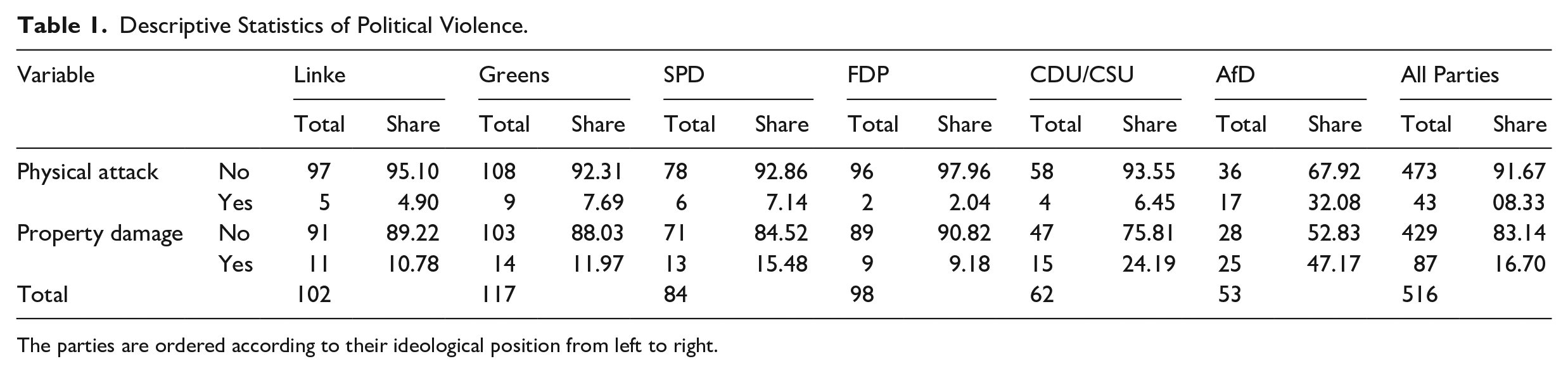
The parties are ordered according to their ideological position from left to right.
Local party system polarization captures the degree to which parties oppose each other ideologically. If parties with strong ideological differences are represented in the local party system with a considerable vote share, the system is considered highly polarized. Therefore, the measurement of party system polarization includes two elements: party positions and party vote shares. As a measure for polarization, we use Dalton’s Polarization Index (PI) (Dalton, 2008):

The index evaluates the polarization in electoral district j, PIi, by taking into account the position of party i (LRi) relative to the average party position (ALR). This value is weighted by the vote share of party i in district j (VSij). An increasing index value indicates a higher level of party system polarization in district j. To estimate the polarization of the local political context, we focus on the general left-right dimension and party preferences regarding migration policy. The party positions are taken from the 2021 Open Expert Survey (Jankowski et al. 2022), where higher values indicate a more right-wing position. We also calculated the polarization index for the cultural left-right dimension, as well as using party position data from the Chapel Hill Expert Survey. The results for the alternative polarization measures are provided in the Online Appendix. Overall, we expect candidates to experience more political violence when they run in a polarized political context (H1).
To study differences between centrist and fringe parties in their experiences of political violence (H2), we include party fixed effects. To assess the effect of individual extremism on the likelihood of being victimized (H3), we include the ideological positions of the candidates, which are estimated using eleven policy items, documented in the Online Appendix. Candidates were asked to evaluate several policy statements. We categorized the items as associated with an economic or a cultural conflict dimension. Four items were assigned to the economic dimension and seven were assigned to the cultural dimension. We then estimated two item response models, one for the cultural items and one for the economic items to derive a cultural and an economic position of the candidates (de Ayala, 2022; Muraki, 1992). Again, higher values indicate a more right-wing position. To explore whether candidates with extreme positions are more likely to be targeted, we include a squared term in the model. As a robustness check, we include the general left-right self-placement of the candidates in the analysis instead of the estimated positions (the results of the robustness check are reported in Table A7 in the Online Appendix).
We include several control variables. In existing research, women have often been shown to be more frequently targeted by political violence (Akhtar and Morrison, 2019; Håkansson, 2021; Ward and McLoughlin, 2020). The proportion of women also greatly differs between parties (Höhne, 2020). Therefore, the influence of gender on violent experiences could bias the effect of party affiliation. In addition, the incumbency status has been shown to have a positive effect on experiencing political violence (James et al., 2016a), which is why the incumbency status is also included as a control variable. In addition to the individual candidate characteristics, we include control variables at the district level. The East German electoral districts exhibit a significantly higher level of polarization, contrasting sharply with the rest of Germany (see Figure A1 in the Online Appendix). We include the population density, the gross domestic product, and the unemployment rate in the analysis, as they are expected to have an effect on both the party system polarization and violence against politicians. 6
There are different types of candidates in the German mixed-member electoral system. Candidates can be elected via lists or in single member districts or they can run on both tiers, leading to different kinds of candidates. Since we are interested in the effect of the party system polarization in the electoral district, we only include candidates who compete for a district mandate, that is, candidates only running in a district and dual candidates running in a district and on a list.
Results
We begin the analysis by focusing on the effect of district polarization on experiences of political violence (H1, Table 2 and Table 3), before turning to the effect of party extremeness (H2, Table 4) and candidate extremeness (H3, Table 5).
Logistic Regression: Explaining Physical Violence Against Candidates With Local Party System Polarization (General Left-Right Dimension).
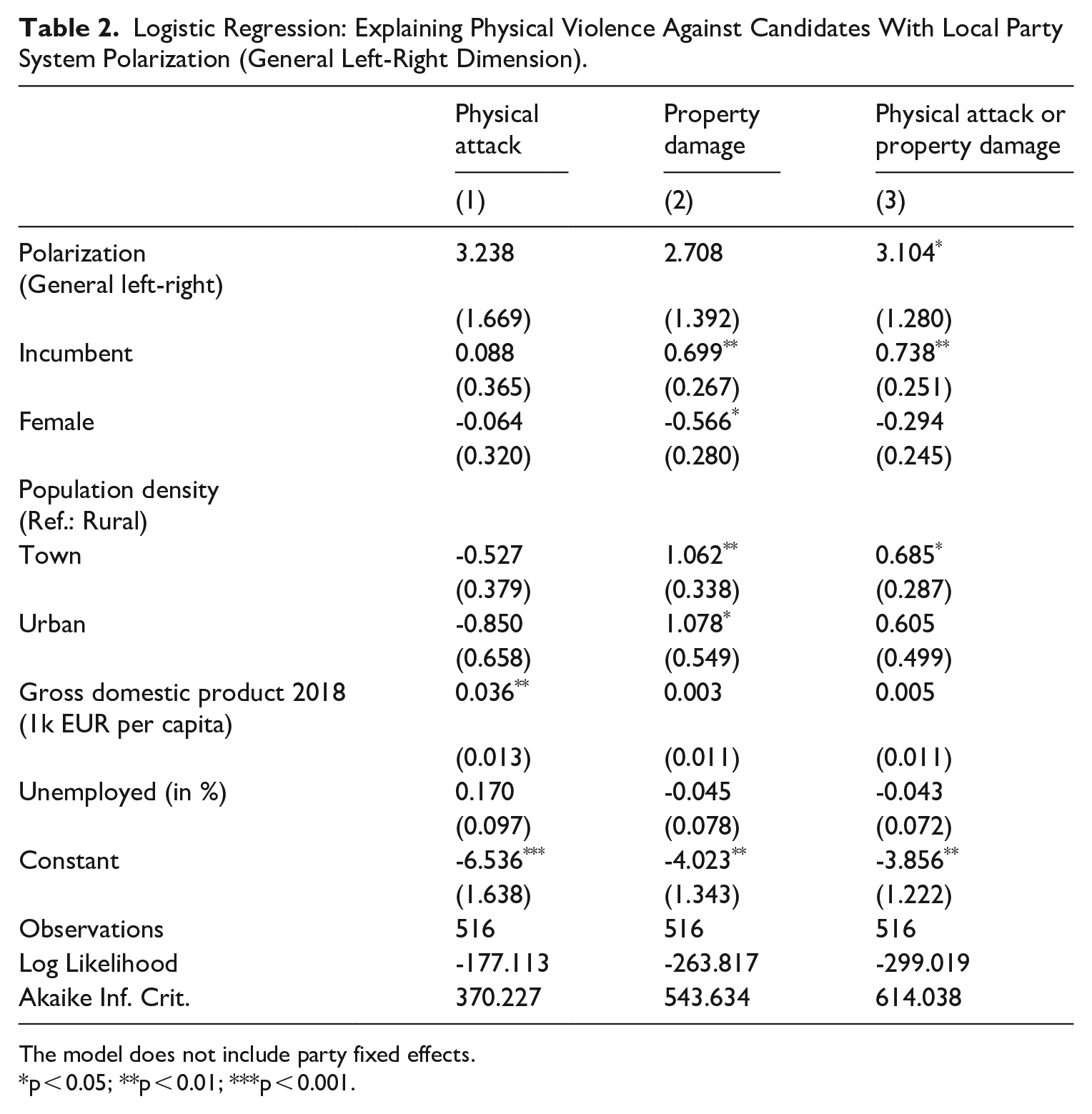
The model does not include party fixed effects.
*p < 0.05; **p < 0.01; ***p < 0.001.
Logistic Regression: Explaining Physical Violence Against Candidates With Local Party System Polarization (Migration Policy).
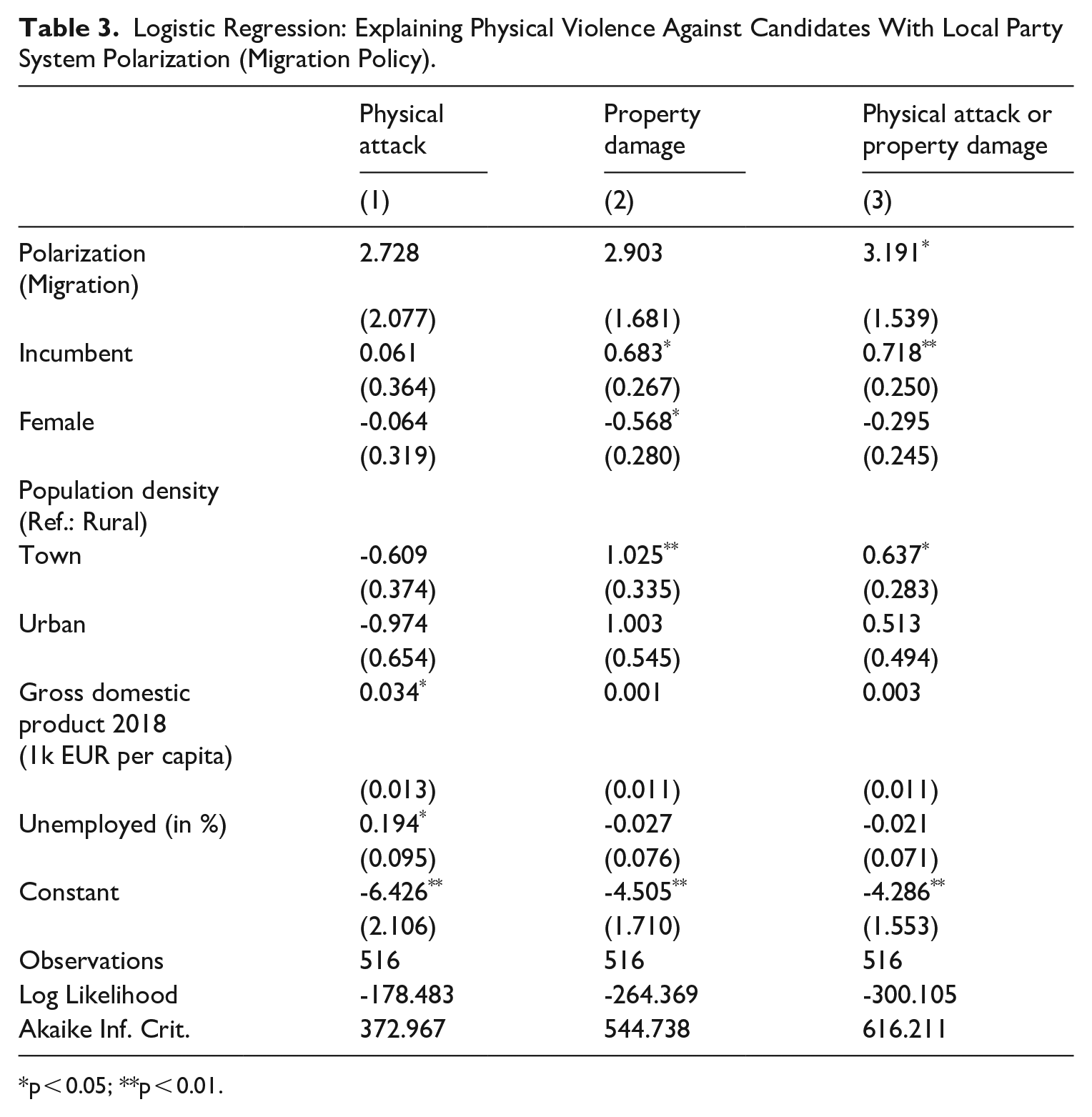
p < 0.05; **p < 0.01.
Logistic Regression: Explaining Physical Violence Against Candidates With Party Fixed Effects.
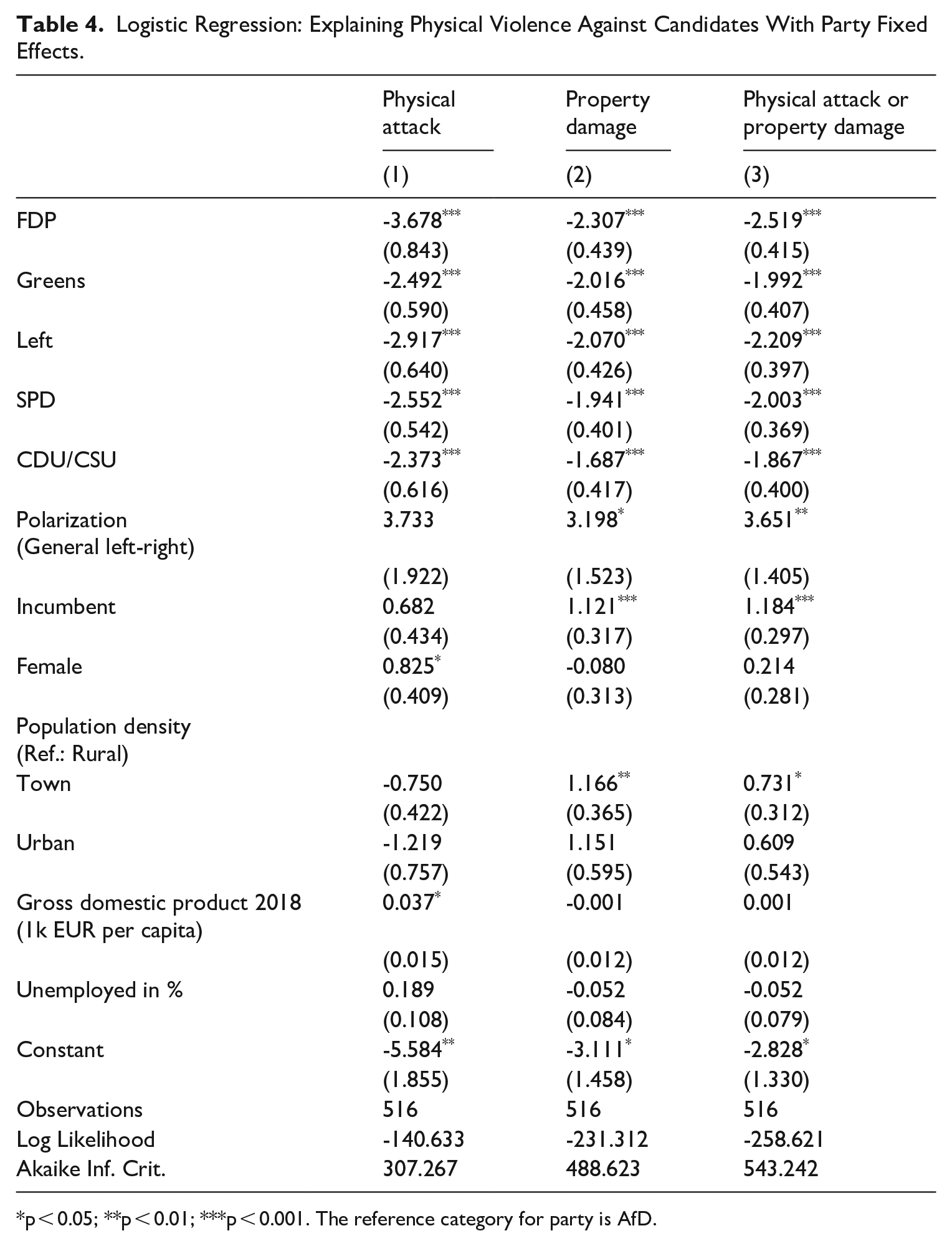
p < 0.05; **p < 0.01; ***p < 0.001. The reference category for party is AfD.
Explaining Physical Violence Against Candidates With the Estimated Ideological Position of the Individual Candidates.
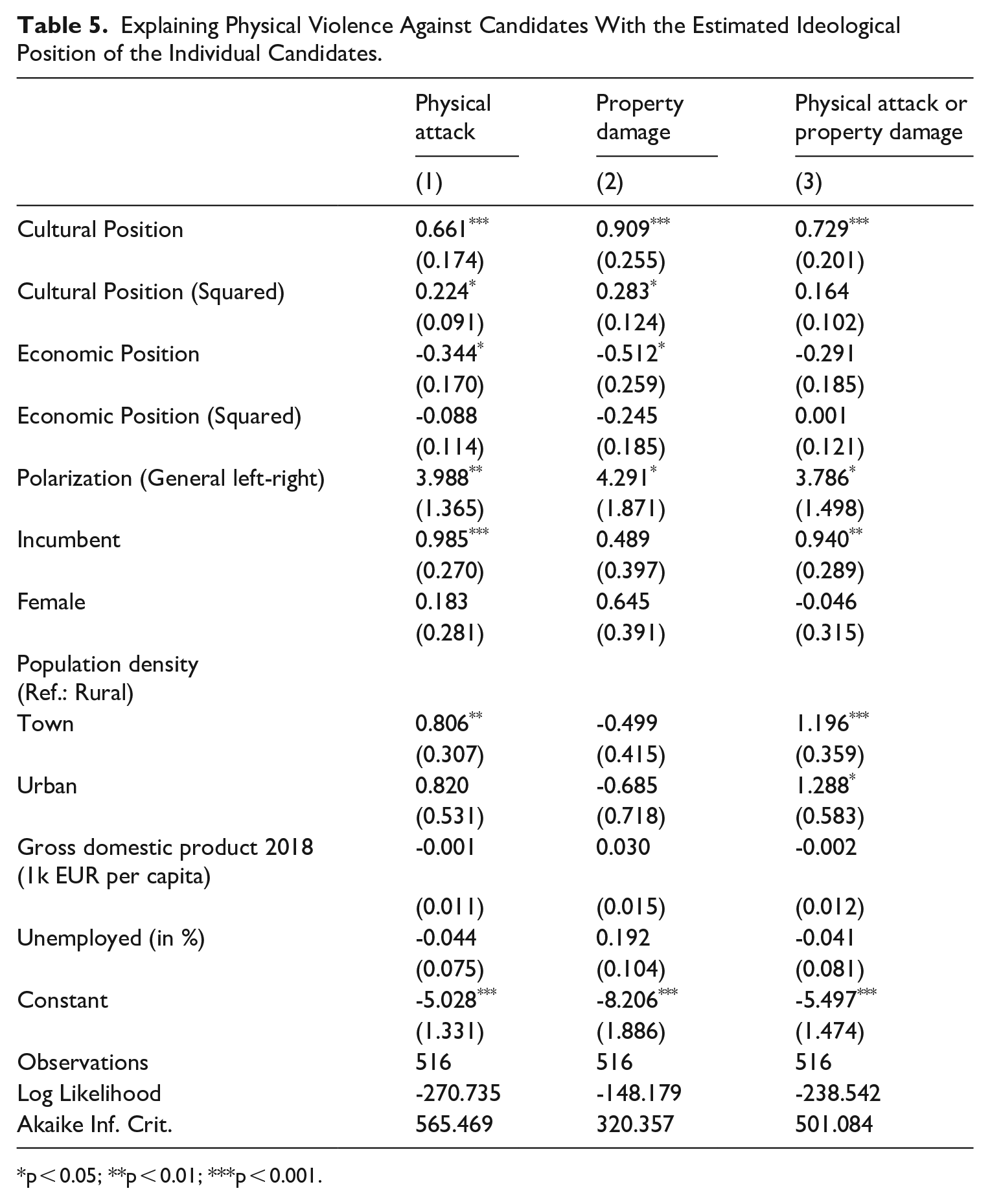
p < 0.05; **p < 0.01; ***p < 0.001.
We argued that an increase in the local party system polarization is associated with an increase in the aversion between the supporters of different parties. In other words, a higher level of party system polarization increases the affective polarization, which increases the likelihood that some members of the public feel it justified to turn to political violence. The coefficient for party system polarization in Table 2 is positive in all models and thus points in the expected direction. However, we observe a statistically significant effect only when considering both types of political violence at the same time. We observe largely similar findings when considering district polarization regarding the migration issue as opposed to a general left-right dimension, presented in Table 3, as well as when considering the cultural dimension and when relying on data from the Chapel Hill Expert Survey, presented in Tables A1–A4 in the Online Appendix. Overall, these results provide consistent evidence in favor of H1, suggesting that a more polarized political context leads to more experiences of political violence among all candidates running in such districts.
Table 4 adds party fixed effects to the models presented in Table 2, with the far-right AfD as the reference category for the party fixed effects. The results show that all other parties are significantly less likely to report having experienced political violence relative to the AfD, providing robust evidence for H2. Table A5 in the Online Appendix presents the results from the same models as presented in Table 4 while replacing the local polarization on the general left-right dimension with the polarization regarding the migration issue, with similar results.
In Table 5, we included the estimated ideological position of the candidates on the cultural and economic dimensions based on the item response models. 7 Since the radicalization of the AfD was driven by anti-immigration stances, the strong divide between the parties is mainly due to the cultural dimension and less due to the economic dimension. Thus, the ideological polarization in Germany is primarily driven by cultural matters. The results show that candidates with more right-wing cultural positions have a higher probability of reporting violence. Furthermore, there is a positive effect of the squared term. Thus, the effect is even stronger for candidates with extreme right-wing positions. In contrast, the economic position has no significant or even a negative effect on the likelihood of reporting experiences of political violence. In addition, there is no effect of the squared term. These findings are plausible because parties are closer to one another on this dimension and the mainstream parties FDP and CDU/CSU have similar economic positions as the AfD, while the gap on the cultural dimension is much greater among those three parties.
Figure 1 displays the predicted probabilities of reporting experiences of violence, based on Model 3 in Table 5. The other variables are held constant for the prediction. 8 The Figure highlights that candidates with left and moderate positions have a comparatively low predicted probability of reporting violence, ranging from 25 to 50 percent. Starting from an ideological value of 1, which represents the most right-wing third, the probability exceeds 50 percent and rises to over 75 percent for candidates with the most right-wing positions. While these figures are certainly alarming, it is by no means comforting that even at the low end of the scale, one in four politicians is predicted to be subject to some form of physical violence as part of their campaign.
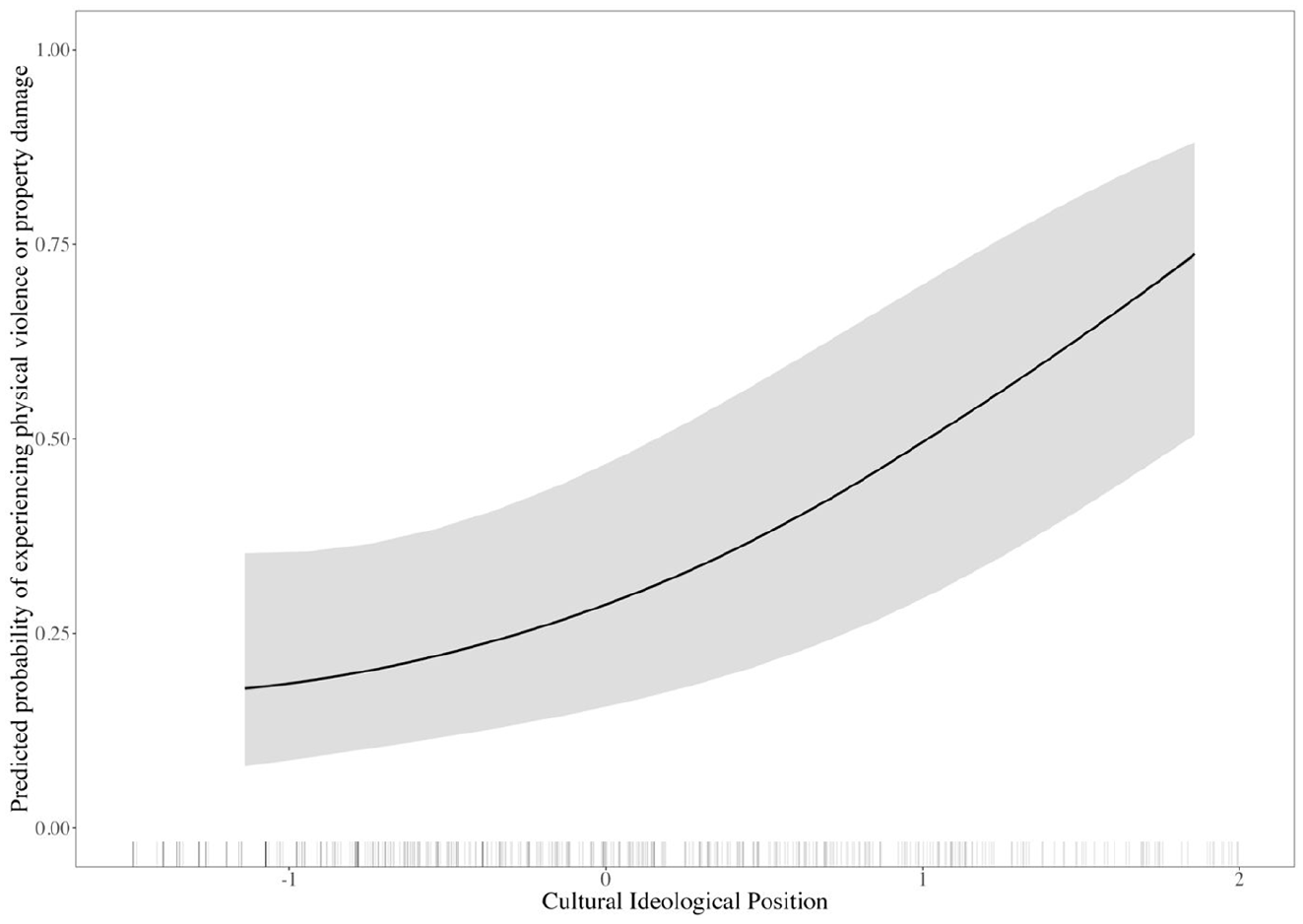
Predicted Probabilities of Reporting Violence Based on Model 3 in Table 5.
Conclusion
Several factors have been identified as influential in research on political violence, such as the age of politicians, their ethnic background, and especially their gender, while ideological factors have been under-researched. In this paper, we address this gap and theorized a link between elite polarization, affective polarization, and violence against politicians. We identified two factors that were expected to lead to higher levels of violence against politicians: (1) the level of party polarization in an electoral district and (2) the impact of party and candidate extremeness. Both factors can increase the hostility between supporters of different parties and can lead to a situation where undermining supporters of other parties becomes more important than acting in accordance with democratic norms.
Drawing on survey data collected as part of the 2021 German federal election, we empirically tested our expectations. The results substantiated our expectations, revealing a significant association between party system polarization and a heightened the likelihood that politicians report experiencing violence. Furthermore, our findings indicate that politicians from the far-right AfD face a greater risk of victimization, underscoring the impact of ideologically extreme parties on polarization and violence.
The analysis is not without limitations. First, it should be emphasized that the dependent variable, experiences of violence, is not directly observed but survey-based. This means that we need to assume that responses are comparable. This assumption is not as straightforward as it might seem, especially for AfD candidates. In other contexts the party tends to self-style as a victim (Niedermayer, 2018). Therefore, AfD candidates might use the survey to reinforce this image. AfD candidates may also perceive their exposure to physical violence systematically differently than candidates from other parties do. At the same time, questions about political violence only played a minor role in the overall survey and it was not apparent to participants that questions about political violence would be part of the survey, so it is unlikely that candidates systematically self-selected into the survey to make statements about political violence.
Despite these limitations, there are several ways in which this study contributes to the existing literature. We are among the first to shed light on the differences between parties and the ideological explanations for violence against politicians in an established democracy. Although party factors have been included in several studies, theoretical explanations have so far been missing. Furthermore, ours is one of the first studies to explore violence against politicians in Germany at the federal level.
Going forward, we advocate for continued research in this domain, addressing the identified gaps and refining our understanding of the complex interplay between polarization and political violence. To enhance the robustness of our findings, future studies should incorporate objectively observed violence acts and delve deeper into the motivations of the perpetrators. Advancing our knowledge in this area can better inform strategies to mitigate the alarming trend of rising political violence and safeguard democratic principles in the face of increasing polarization.
Supplemental Material
sj-docx-1-psx-10.1177_00323217251361347 – Supplemental material for How Polarization Shapes Violence Against Candidates: Evidence From the 2021 German Federal Election
Supplemental material, sj-docx-1-psx-10.1177_00323217251361347 for How Polarization Shapes Violence Against Candidates: Evidence From the 2021 German Federal Election by Morten Harmening and Dominic Nyhuis in Political Studies
Footnotes
Declaration of Conflicting Interests
The author(s) declared no potential conflicts of interest with respect to the research, authorship, and/or publication of this article.
Funding
The author(s) received no financial support for the research, authorship, and/or publication of this article.

Supplementary Information
Supplementary information may be found with the online version of this article.
Contents
Figure A1. Geographic Distribution of Party System Polarization.
Figure A2. Geographic Distribution of Respondents by Party Affiliation.
Table A1. Logistic Regression: Explaining Physical Violence Against Candidates With Party System Polarization (Cultural Left-Right Dimension Based on the Open Expert Survey).
Table A2. Logistic Regression: Explaining Physical Violence Against Candidates With Party System Polarization (General Left-Right Dimension Based on the CHES).
Table A3. Logistic Regression: Explaining Physical Violence Against Candidates With Party System Polarization (Migration Policy Based on the CHES).
Table A4. Logistic Regression: Explaining Physical Violence Against Candidates With Party System Polarization (Cultural Left-Right Dimension Based on the CHES).
Table A5. Logistic Regression: Explaining Physical Violence Against Candidates, Including Party Fixed Effects and the Polarization Index Based on Migration Policy.
Table A6. Logistic Regression: Explaining Physical Violence Against Candidates, Including the Estimated Ideological Position of the Individual Candidates and the Polarization Index Based on Migration Policy.
Table A7. Logistic Regression: Explaining Physical Violence Against Candidates, Including the Left-Right Self-Placement of Candidates.
Notes
Author Biographies
References
Supplementary Material
Please find the following supplemental material available below.
For Open Access articles published under a Creative Commons License, all supplemental material carries the same license as the article it is associated with.
For non-Open Access articles published, all supplemental material carries a non-exclusive license, and permission requests for re-use of supplemental material or any part of supplemental material shall be sent directly to the copyright owner as specified in the copyright notice associated with the article.
