




Abstract
Proportional representation electoral systems were long argued to increase the share of women, compared with majoritarian systems. However, recent studies provide strong evidence that, usually, less women are elected in open-list proportional representation than in closed-list proportional representation. In this study, we test whether open-list proportional representation is enough to increase the share of women in local legislative bodies. We examine a change from a first-past-the-post to an open-list proportional representation with gender quota in Polish municipality council elections. We exploit an arbitrary population threshold to use the difference-in-discontinuities and regression discontinuity designs and do not find sufficient evidence that this change affected women’s representation. We find little evidence for any effect on higher council fragmentation that could have harmed women’s chances, and, analysing simultaneously held regional elections, we find no effect of the reform on voter behaviour. We also show that women’s representation in Poland has been increasing over the past two decades, regardless of the electoral system changes. Thus, even substantial electoral reforms may have relatively little effect on women’s representation.
Keywords
Introduction
Women are grossly underrepresented in politics across the globe. Only around 25% of legislators are women, while women constitute roughly half of the population (Inter-Parliamentary Union, 2022). Thus, scholarship has been trying to identify obstacles to women’s representation. Some of them have been found in electoral systems (Krook, 2018).
There is a long-standing consensus that more women are elected to legislative bodies in proportional representation (PR) than in majoritarian electoral systems (Duverger, 1955; Norris, 1985; Paxton et al., 2010; Studlar and McAllister, 2002). However, recent studies cast doubt on the generality of this claim. Among PR systems, more permissive rules (which allow voters to choose their preferred candidate) are usually not as beneficial for female candidates as closed-list PR (CLPR) systems, in which voters do not choose candidates (Nowacki, 2023). Thus, it is uncertain whether proportional allocation of seats is sufficient or other elements are necessary for the system to increase women’s representation.
In this article, we test whether replacing a plurality system with a permissive PR system increases the share of women in legislative bodies. We study the effects of a change from a first-past-the-post (FPTP) to an open-list proportional representation (OLPR) system (with gender quota) in the Polish municipality council elections. To this end, we exploit an electoral reform. In 2014, all municipalities were covered by the FPTP. In the next elections, in 2018, the same system was applied below the arbitrary threshold of 20,000 inhabitants. In turn, the OLPR with gender quota was introduced in municipalities above this population threshold. The same rules were applied in the following election of 2024.
To estimate the effect of this electoral reform on female representation, we employ the difference-in-discontinuities approach (diff-in-disc) and regression discontinuity design (RDD). Further, following other studies (Bagues and Campa, 2021; Baltrunaite et al., 2014, 2019), we investigate the impact of this electoral system change on average age and education level of candidates and councillors. Overall, we find no significant difference between FPTP and OLPR with gender quota in terms of women’s share in the council. Although the latter system helped women to run in the elections, we cannot confirm that it resulted in a higher proportion of women in the local legislative bodies.
Furthermore, we try to answer why the effect of the electoral reform is so limited and explore two possible mechanisms behind this null result: voter bias and legislative fragmentation. Specifically, we find no evidence of any voter backlash against gender quota. However, voters use their preference vote to choose more male candidates. Moreover, we investigate whether OLPR (relative to FPTP) induced higher council fragmentation which may hinder women’s electoral success. We find little evidence in favour of this transmission channel. Finally, we show that the share of women in Polish legislative bodies has been consistently increasing across all levels of governance and electoral systems, implying that a broader and larger cultural change has been taking place. Hence, we conclude that even substantial and women-friendly electoral system changes might be less important than the socio-economic and other institutional changes occurring during the same time.
Literature
Proportional elections were long believed to favour women in comparison with plurality elections. This finding has been confirmed by a large body of literature from simple comparisons and correlations (Castles, 1981; Kenworthy and Malami, 1999; Matland, 1998; Matland and Studlar, 1996; Norris, 1985; Paxton et al., 2010; Reynolds, 1999; Rule, 1981; Studlar and McAllister, 2002) to more recent causal studies (Profeta and Woodhouse, 2022). In particular, PR may be a key factor influencing the representation of specific groups of women (Stockemer and Sundström, 2021). The positive impact of PR on women’s descriptive representation may be driven by several mechanisms. First, individual features play a smaller role in proportional systems. Second, the incumbent advantage is smaller than in majoritarian elections, which favours women, as long as they constitute a minority of incumbents. Third, particularly in larger districts, parties may offer more opportunities to run. They can try to attract a variety of voters with diverse candidates. Finally, proportional elections allow governments or parties (voluntarily) to adopt additional measures supporting female candidates such as gender quota or the zipper rule (placement mandates), enforcing an equal split of good positions on the ballot (Profeta and Woodhouse, 2022).
Those studies, however, focus generally on the national-level elections, as variation in the electoral system is typically not present in local elections. For municipal-level elections, the literature is quite scarce. Hinojosa and Franceschet (2012) show that more females were elected in councils, governed by PR elections, than in the plurality mayoral elections after the 2002 reform. Artiles et al. (2024) find, for the case of Canada, that women’s presence on municipal councils is higher in municipalities with at-large elections than in ward elections. We are, however, not aware of any studies at the local level with a set-up directly comparable to the design applied in our article.
Moreover, a growing body of literature consistently finds that the distinction between PR and majoritarian elections is too simplistic and other features of electoral systems may be more relevant for women’s representation. More women run and are elected in CLPR than in OLPR in municipal elections (Gonzalez-Eiras and Sanz, 2021). Gonzalez-Eiras and Sanz (2021) argue that women are less willing to run in more competitive systems. Similarly to FPTP, in CLPR, colleagues from the same party do not compete against each other. Nowacki (2023) finds that, in comparison with women, men enjoy a larger incumbency advantage in OLPR but not in CLPR. The CLPR closes the gender gap in incumbency advantage by not allowing voters to express their bias against women. A negative impact of voter bias on women’s electoral chances in more permissive systems has been found both in experimental studies (Dhima et al., 2021) and in actual elections (Bieber and Wingerter, 2022; Ragauskas, 2021). Yet, even when voters are not biased, open lists may harm women’s chances because women may get less funding and other kinds of support from their party (Wauters et al., 2010). On the other hand, parties may be more inclined to decentralize their candidate selection procedures and nominate more women, when competition is fiercer (Folke and Rickne, 2016).
District and party magnitude are other factors at the intersection of electoral systems and party behaviour. Both are expected to increase women’s electoral chances (Engstrom, 1987; Rule, 1987; Schwindt-Bayer, 2005). If a party expects to win only one seat in a district, it may nominate only the strongest (most powerful) candidate, who is more often a man. When PR replaces FPTP, district magnitude necessarily increases. However, when the party system is fragmented, that is no party wins many seats, the increase in district magnitude may not influence party magnitude and, in consequence, party behaviour (Matland and Taylor, 1997). The reform under study in the current article increased district magnitude from 1 to between 5 and 8. However, at the municipality (legislative body) level, a large party may get less seats under PR than under FPTP. This is because, typically, PR increases fragmentation relative to FPTP (Carey and Hix, 2011). Thus, even though districts become larger, the magnitudes of the largest parties decrease, which may negatively influence women’s representation. So far, the literature has ignored this conjecture.
The reform in question introduced not only an OLPR, but also a mandatory gender quota on party lists. Unlike reserved seats, candidate quotas do not guarantee that any share of women will ultimately be elected, but merely require that they are a part of the electoral process. Though not directly guaranteeing that females will be represented, gender quotas are believed to reduce gender bias in elections (Beaman et al., 2009), hence clearing the way for more females in politics (Baskaran and Hessami, 2018; Bhalotra et al., 2018). Positive spillover effects to other levels of government (Kaur and Philips, 2023; O’Connell, 2020) and lower hierarchy positions (Baskaran and Hessami, 2018) or other countries (Tripp and Kang, 2008) have been found. However, contrary results have also been observed (Bertrand et al., 2018; Ferreira and Gyourko, 2014; Joo and Lee, 2018). An introduction of gender quotas may incite a backlash among voters (Kim and Kweon, 2022). Górecki and Kukołowicz (2014) hypothesize that, even if some voters want to support women, the increased number of female candidates may lead to a dispersion of votes among female candidates, resulting in less women achieving top results and being elected. Although such a mechanism is possible in open-list elections, it is unlikely to have a large impact because voters strongly prefer candidates on the top ballot positions (Jankowski et al., 2019).
Furthermore, quotas might positively affect the quality of elected officials (O’Brien and Rickne, 2016). Besley et al. (2017) find that gender quotas help in replacing mediocre male candidates with more qualified female candidates. Other studies have found a positive link between (male and female) politicians’ education levels and quota implementation (Baltrunaite et al., 2014; Casas-Arce and Saiz, 2015). However, this result is not always confirmed (Bagues and Campa, 2021; Baltrunaite et al., 2019). Similarly, it is not certain whether quotas affect candidates’ age (Bagues and Campa, 2021). Allen et al. (2016) found that ‘quota’ female officials are no different from other elected officials and other papers show rather weak effects. Finally, the ‘contagion effects’ of electoral quotas have been found (Meier, 2004) – spreading from electoral quotas to party quotas. The effect of quotas may be not immediate. Wauters et al. (2014) show, for Belgium, that the quota initially negatively affects women and the positive impact materializes only during the third election after the introduction. O’Brien and Rickne (2016) show for Sweden that the effect of the (party) quota increases over time. In a related question, Park (2023) shows that the effects of the quota are reinforced through an increasing female representation.
Regarding Poland, according to Kunovich (2012), OLPR had a positive role in increasing women’s representation in the national parliament, as women performed better than their positions on electoral lists. Thus, at least until 2011, Polish voters had a more positive attitude towards female candidates than parties. In addition to the early descriptive papers by Flis (2011) and Millard (2014), who find no impact of gender quota on the number of women elected, the introduction of the gender quota in the Polish parliamentary elections resulted in a series of papers based on logistic regressions and simulations. Górecki and Kukołowicz (2014) claim that the effect of quota was ‘paradoxical’: female candidates performed on average worse (compared with their male counterparts) after the quota was introduced. In contrast, Jankowski and Marcinkiewicz (2019) find that gender quota ‘increased the number of women placed at promising ballot positions’, and were not counterbalanced by a negative impact of candidates’ gender. As a result, the quota helped women get elected. However, according to Gendźwiłł and Żółtak (2020), although the introduction of gender quota resulted in more women running in the elections, parties and voters modified their preferences to women’s disadvantage. The authors claim that the main obstacle that female candidate face is their lack of ‘electoral capital’, proxied by previous electoral experience and incumbency advantage. The differences between parties in attitudes towards female candidates after the introduction of the quota had been earlier suggested in a descriptive study by Gwiazda (2017). Only Górecki and Pierzgalski (2022) find a positive effect (of around 6 percentage points) of gender quota on the share of women in the Polish parliament by exploiting a synthetic difference-in-differences design, although some countries in the control group (not applying gender quota) are closing the gap as time is passing.
The Institutional Background, Data and Methods
Municipalities (Polish: gmina) are the principal units of administrative division in Poland. There are currently 2477 municipalities, varying in size between 1400 and 1.7 million inhabitants. The municipalities in Poland enjoy relatively high fiscal autonomy in terms of both what comes in and how it is spent (see Kantorowicz, 2017; Kantorowicz and Köppl–Turyna, 2019). Each gmina has a municipal council (rada gminy) or, in a town, a town council (rada miasta).
In 2014, the FPTP system was used throughout all municipalities in our sample. In 2018, the system changed to OLPR with gender quota in the municipalities larger than 20,000 inhabitants. The same electoral systems were used in 2024. 1 We exploit this threshold for our diff-in-disc analysis. The legally binding gender quota prescribes that on each list, at least 35% of the candidates must be female (and male). There are no restrictions on list placements for each gender. The preference vote is mandatory, that is the voters must choose a specific candidate. The councillors are elected in districts from five to eight seats. The d’Hondt method is implemented to translate votes into seats. We present the rules in Table 1. There was no other justification for the electoral reform than the will to ensure PR in the councils (Sejm, 2017). The system was well known to the voters and politicians from earlier elections to regional and national legislative bodies (see the ‘Dynamic changes in women’s representation’ section).
Electoral Systems in 2014, 2018 and 2024.
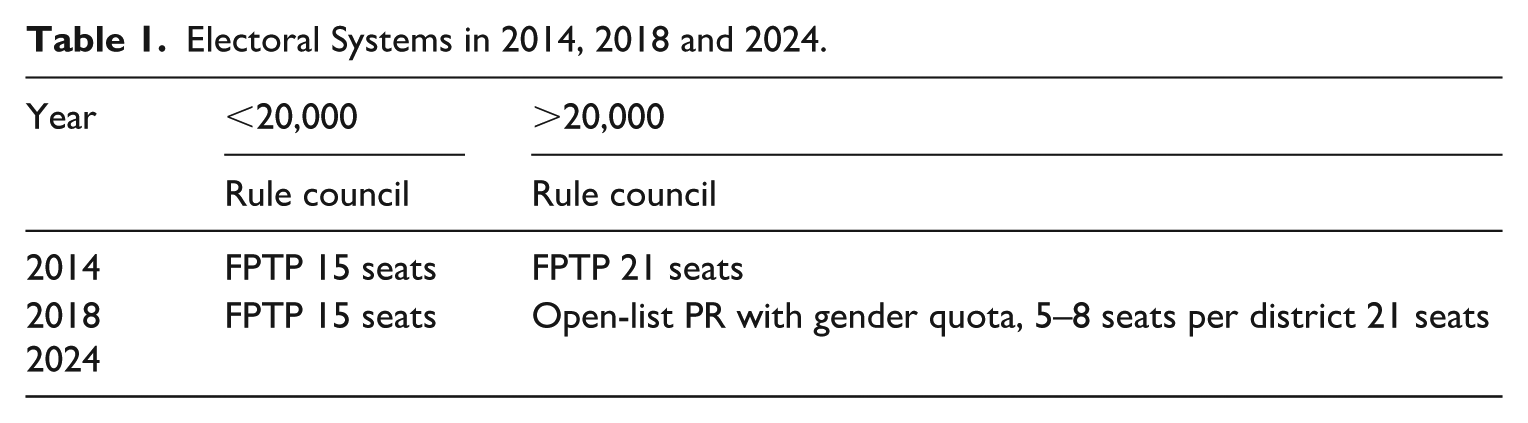
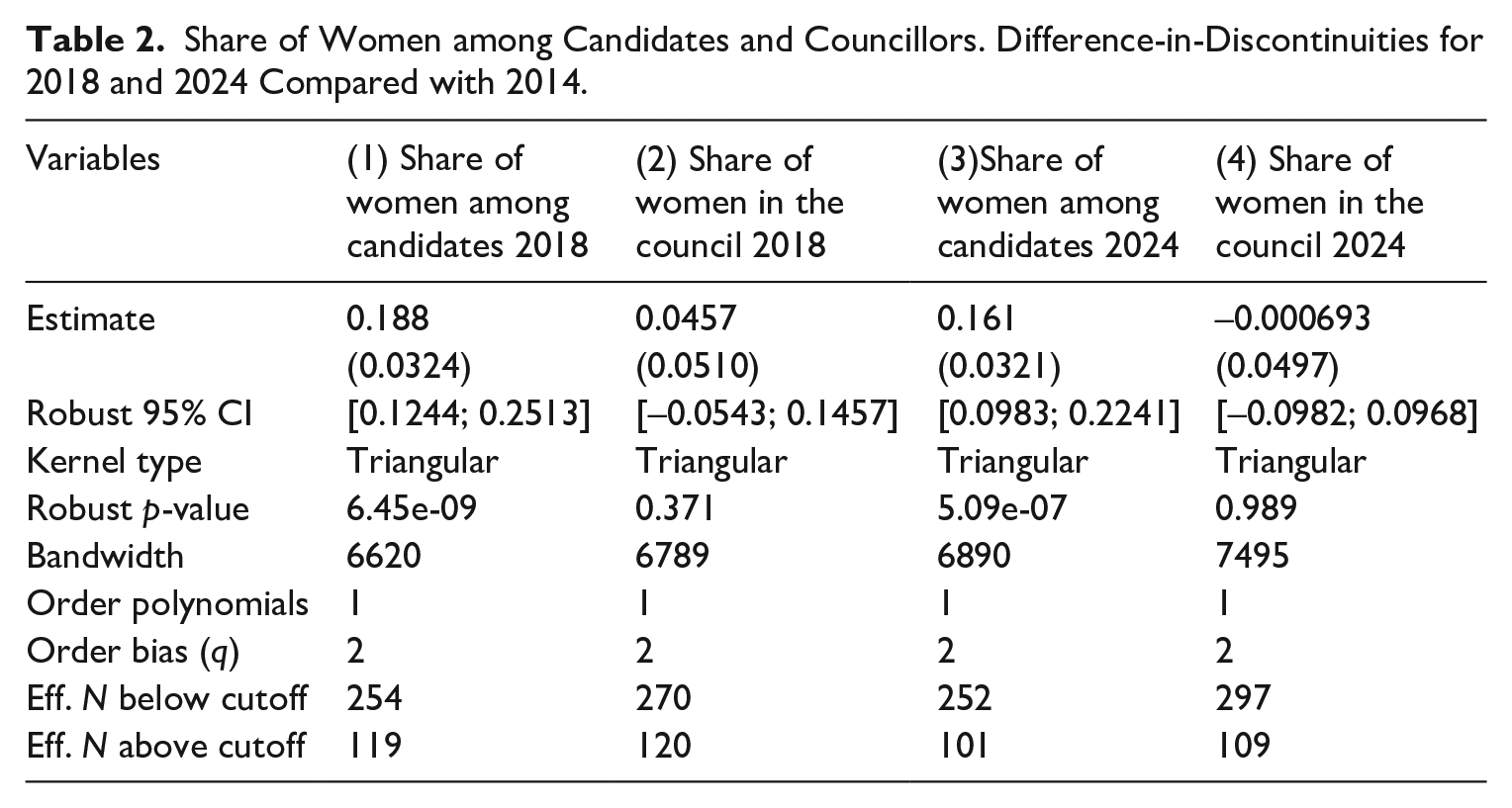
In 2014, the only relevant difference between the municipalities below and above the threshold of 20,000 was the size of the council. Smaller municipalities elected 15, while larger elected 21 councillors. As we show in the ‘Assumptions’ section, the size of the council does not matter for women’s representation. However, the enlargement or reduction of a council may increase or decrease competition in a municipality, and hence constitute a confounding treatment, irrespective of the remaining electoral rules. Therefore, we exclude municipalities that were on one side of the threshold in 2014, and switched to the other side in 2018. We also exclude municipalities larger than 50,000 inhabitants, which had even larger councils, and city-poviats (miasta na prawach powiatu), some of which are smaller than 50,000 but had proportional elections with gender quota already before 2018. As they are far away from the threshold, their inclusion or exclusion does not affect the results. Consequently, our sample includes 2368 municipalities in 2018 and 2342 in 2024. Within the bandwidth around the threshold, separately calculated for each regression, there are between 353 and 406 municipalities in the main results (Table 2).
Share of Women among Candidates and Councillors. Difference-in-Discontinuities for 2018 and 2024 Compared with 2014.
The electoral data used in this study come from the National Electoral Commission. 2 Over 130,000 candidates competed for almost 40,000 seats in both 2018 and 2024. In 2018, 51,975 women run in the elections and in 2024, 54,659 women. The quota above 20,000 resulted in a higher fraction of female candidates in these municipalities. In our sample, the fraction of female candidates was 33.8% in 2014, 35.3% in 2018 and 38.5% in 2024 below this threshold (under FPTP). Above the threshold, the share of female candidates increased from 29.9% in 2014 to 46.0% in 2018 and 47.0% in 2024. Thus, after the introduction of OLPR with gender quota, the share of women among candidates in larger municipalities increased by a half.
The main dependent variable is the fraction of females in the municipality council. We also show the results for the fraction of women among candidates, as well as the average age and share of tertiary-educated candidates and councillors. In this way, we follow Baltrunaite et al. (2014) and test whether an OLPR with gender quota affects the composition of councils in terms of basic observed characteristics beyond gender, that is age and education level.
To test the effect of the reform, we exploit the discontinuity at the threshold of 20,000 inhabitants. We use the diff-in-disc approach to compare the elections in 2014 with those in 2018 and 2024. We compare the OLPR with gender quota in larger municipalities with FPTP in smaller ones. While the system below the threshold remained the same, the system above the threshold changed from FPTP to OLPR in 2018 and remained unchanged in 2024. In other words, we show what happens if an FPTP system is replaced with an OLPR with gender quota.
Our main models are based on the diff-in-disc approach rather than the more common RDD for two reasons. First, there is a simultaneous treatment, that is the larger size of the council above the threshold, which was the same in all the years under study. Second, there are some discontinuities in population composition at the threshold in 2014 and 2018, which disappear when we compare those two years by using the diff-in-disc approach. Nevertheless, we present the results of RDD estimations for the main variables of interest in the Supplementary Materials.
The diff-in-disc approach can be summarized as follows. There are two time periods t = 0 and t = 1, with treatment determined by a threshold c on the running variable x, which is introduced sometime between t = 0 and t = 1. Furthermore, there can be a confounding treatment Vi at the discontinuity x0. The local causal effect of the treatment of interest Di can be found by comparing the difference in outcomes between pre- and post-treatment periods for units near the threshold, both for treated and untreated groups. This can be achieved by either the difference of RDDs at the threshold over time or the RDD of the differences over time, leading to equivalent results. Identification relies on standard assumptions of the RDD: continuity of outcomes and discontinuity of the treatment probability, as well as two assumptions concerning the confounding treatment: it must be time invariant and independent of the treatment of interest. Formally, suppose the potential outcome is Yi(Vi = v, Di = d). The observed outcome is:

where the effect of treatment of interest can be written as Yi(1, 1) − Yi(1, 0). If using only the treated group in t = 1 (Ti = 1), the identified treatment effect in RDD can be written as
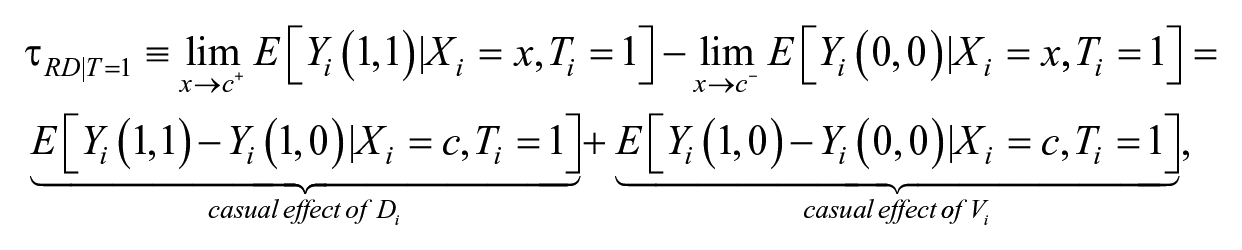
and equivalently for τ RD|T = 0. Under the above-mentioned assumptions, it is possible to eliminate the treatment effect of Vi using the ‘control group’ in t = 0 as follows

where the diff-in-disc is expressed as the difference of RDDs.
Our empirical setting allows us to focus on two mechanisms that may explain the limited, if any, impact of OLPR: voter bias and party magnitude. To assess the extent of voter bias, we look at the simultaneously held elections to poviat and voivodship councils (two higher levels of local government). The councillors to these two upper level councils are elected in an OLPR system, with gender quota applied since 2014. If voters reacted negatively to the gender quota introduced in municipal elections in 2018, we could expect the backlash to affect their candidate choice in the elections to poviat and voivodship councils. Namely, voters primed with the change of the system and the increased presence of women on electoral lists might decide not to support women. Thus, we employ RDD to those higher level elections with the same threshold of 20,000 inhabitants, which, in this case, does not delimit electoral systems. Voters in municipalities above the threshold see three ballots with the gender quota, while voters below the threshold see two ballots with and one without the gender quota. 3 Any effect on the share of votes received by women could be interpreted as caused by the system change in municipality council elections. We also provide descriptive evidence for the role of preference vote on women’s success (in comparison with a hypothetical closed-list vote). 4
Then, we check whether legislative fragmentation could limit the effect of the gender quota. For this purpose, we employ the same diff-in-disc approach. We operationalize legislative fragmentation as the share of seats won by (1) the single largest and (2) two largest parties in each council. This should capture the likelihood that candidates placed lower on the lists win a seat. There is no way of showing the impact of fragmentation on women’s representation at the discontinuity, so we present descriptive evidence for the association between fragmentation and women’s representation.
Our implementation of the diff-in-disc follows Grembi et al. (2016), who implemented it with a local linear (or polynomial) regression. The bandwidths are calculated using the Calonico-Cattaneo-Titiunik (CCT) (Calonico et al., 2014) method, which minimizes the mean squared error with a bias correction and robust standard errors. The non-parametric RDD follows the standards set by Calonico et al. (2016) and used in numerous political and economic studies examining the impact of various political institutions (Eggers et al., 2018). Thus, we do not elaborate on it here. If the OLPR with gender quota positively affects the fraction of elected females in the council, we would expect the coefficients to be positive and statistically significant. The unit of observation is a municipality. The identification assumptions are discussed in the ‘Assumptions’ section. We use the mdrd package in Stata for the diff-in-disc and the rdrobust package for the RDD.
Assumptions
Several conditions have to be met for the design to be valid or for the treatment to be considered randomized and hence results to be interpreted in a causal fashion. First, the assignment must predict the treatment – which is the case, as the law prescribes the allocation of municipalities to electoral systems. Second, no manipulation of the assignment should be possible. Third, the assignment must not be correlated with any outcome-determining factor and confounding factors at the threshold (which are eliminated in the diff-in-disc set-up) should not be present at the analysed population threshold, which is examined in the following section.
Thus, first, for the RDD assumptions to be valid, we need to establish whether sorting appears around the cutoff. We present the figures and tables in Supplementary Materials. Figure S1 presents the density tests for 2014, 2018 and 2024 and shows no evidence of sorting at the population threshold level.
Further, we need to make sure that the variables potentially affecting female representation – which are determined prior to the assignment into two electoral systems – have the same distribution just above and below the cutoff so that local randomization is present. In Tables S1–S4, we show a variety of continuity checks for several important variables. The population variables could affect the probability of voting for females independently of the electoral system: young people (defined here as the population between 18 and 29 years old) could vote more ‘progressively’ as opposed to the elderly population (defined as above 65 years old). Similarly, women may be more supportive towards female candidates, so the share of women in the population could matter. Denser areas (cities) could also be more positive towards females (Inglehart et al., 2003).
For 2018, we find discontinuities significant at the 5% level in population density, and share of population in post-productive age. However, there is no diff-in-disc in those variables, which constitutes another argument for focusing on this methodological approach. For 2024, we find both discontinuities and diff-in-disc that are statistically significant. Larger municipalities are inhabited by more older people and more women, which could influence the support for female candidates in opposing directions. Also, larger municipalities are more densely populated and less rural, which could work in favour of female candidates (and strengthen potential positive results of the OLPR). Thus, we run the regressions for the main dependent variables as in Table 2, but including those variables as covariates (Tables S19–S24), which provides further support for our conclusions.
Furthermore, two other assumptions must be met for the diff-in-disc approach: the confounding treatment (the council size) must be time invariant and independent of the treatment of interest, both of which is true in our case.
Another set of confounders are any pre-existing discontinuities in the outcomes of interest. In Table S5, we present the same RDD analysis as in Table 2, but for 2014. In that case, the only relevant difference in the electoral system between below and above the threshold of 20,000 was the size of the council: 15 and 21 seats, respectively. We show that it did not have any impact on the dependent variables, assuring that assumptions of the diff-in-disc approach are met.
Main Results
Figure 1 graphically shows the differences-in-discontinuities in the share of women among candidates and councillors in 2018 and 2024, compared with 2014. Under OLPR with gender quota, in relative terms, around 50% (18.8 percentage points in 2018 and 16.1 percentage points in 2024) more women ran in the elections than under FPTP (Table 2, Columns 1 and 3). However, this did not translate into a statistically significant difference in women’s representation in the councils (Table 2, Columns 2 and 4).
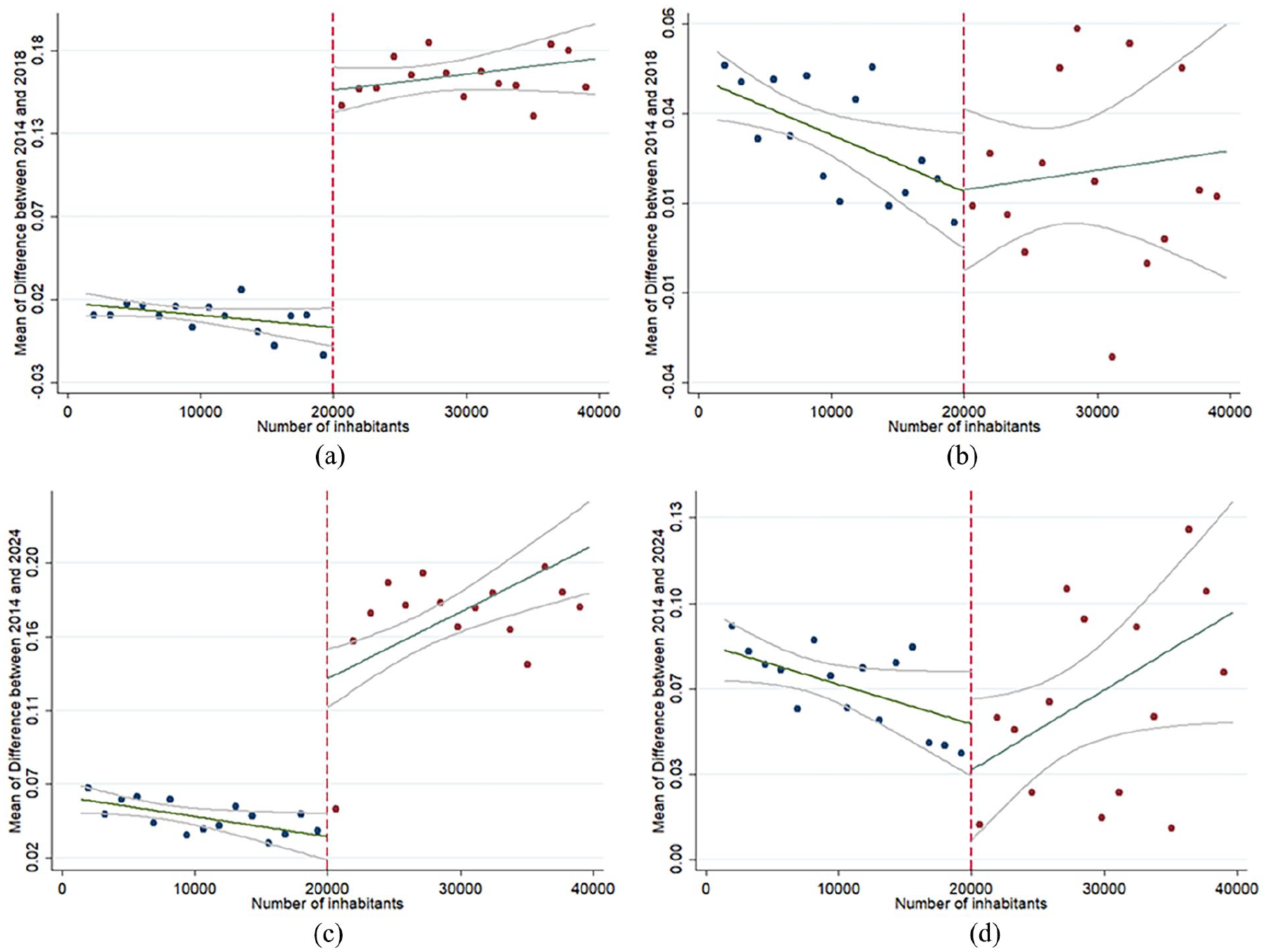
Difference-in-Discontinuities for the Share of Women among Candidates and Councillors in 2018 and 2024 (Compared with 2014): (a) Share of Women among Candidates, 2018, (b) Share of Women among Councillors, 2018, (c) Share of Women among Candidates, 2024 and (d) Share of Women among Councillors, 2024.
The introduction of the OLPR with gender quota may have decreased the mean age of candidates by 1.6 years (with p-value just above 0.05 in 2018, Table 3, Column 1). This change is entirely driven by female candidates, who were 5.3 years younger under OLPR in 2018 (Table S6, Column 1). That pattern reversed in 2024. Under OLPR, women were older by 7.6 years, and men were younger by 5.0 years than under FPTP (Table S7, Columns 1 and 2).
Mean Age of Councillors and Candidates. Difference-in-Discontinuities Estimations for 2018 and 2024 Compared with 2014.
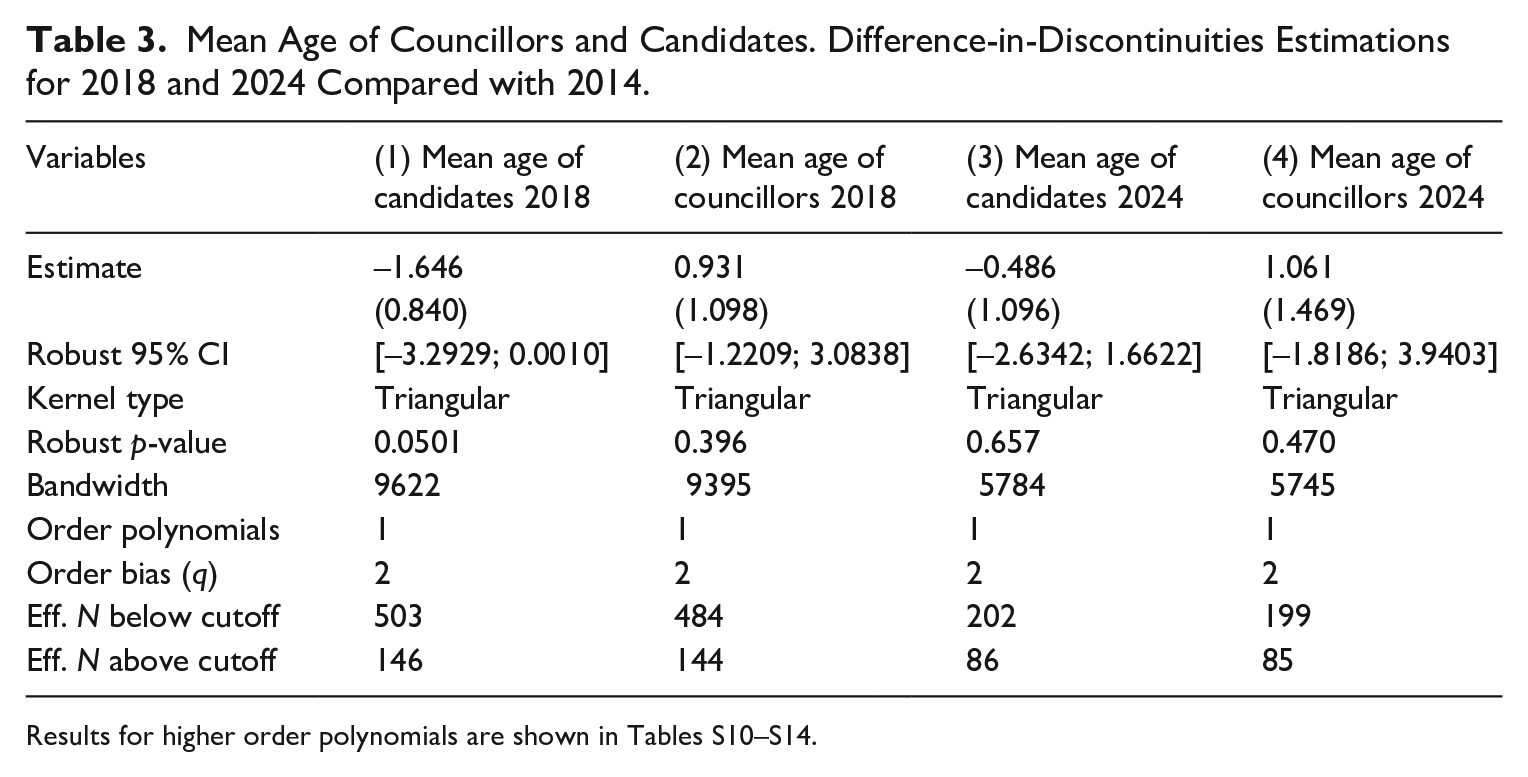
Results for higher order polynomials are shown in Tables S10–S14.
In contrast with the age of candidates, the mean age of female councillors under OLPR in 2018 was higher than under FPTP (Table S6, Column 3). This difference was no longer statistically significant in 2024 (Table S7, Column 3). The mean age of male councillors remained unaffected. The share of councillors with tertiary education was affected neither for both genders together nor separately for women and men (Table S8).
As a first robustness check, we present the results of RDD estimations in Table S9. They confirm the large increase in the share of women among candidates in 2018 and 2024, but not among councillors. Further, the diff-in-disc results may be sensitive to the choice of bandwidth around the threshold. A larger bandwidth increases the bias but reduces the variance. Thus, we present the results for the bandwidths between 1000 and 7000 inhabitants on each side of the threshold (Figures S4 and S5). Also, we check whether the results are not driven by a few outlying municipalities by excluding the observations within 200, 500 and 1000 from the threshold (not presented here). The results do not change our conclusions. They are also similar regardless of the choice of the polynomial order (Tables S10–S18) and kernels (not presented).
Finally, if we include municipalities that changed from one side of the threshold to another, the coefficient for the impact of the OLPR with gender quota on the share of councillors is nearly twice as large and statistically significant (not reported here). However, we do not consider this result as a causal effect of the electoral system change. These municipalities underwent a simultaneous change of council size: from 21 to 15 (i.e. 28.6%) or in the opposite direction (i.e. an increase of 40%). In the seven reduced councils, the share of women dropped from 24.5% to 22.9%. In turn, the share of women in the six councils that became larger in 2018 increased from 28.9% to 44.4%. Lack of any discontinuity in 2014 shows that the council size itself has little effect on women’s representation. However, the change in the council size may be relevant. The reduction of the council may increase competition and make it harder for women to succeed. When 21 incumbents can compete for only 15 seats, they need to sort. Some may be excluded from competition by their party, while others need to compete against other incumbents in one single-member district. The limited number of such municipalities does not allow for a more detailed quantitative and causal analysis. The effects of electoral system changes on incumbents are further explored in a separate article by one of the authors (Gulczyński, 2024).
In sum, after the introduction of OLPR with gender quota, many more (particularly young) women ran in the elections. However, on average, older women got elected. We do not find sufficient evidence for an impact of the reform on the number of women elected nor on the share of councillors with tertiary education. Most of these effects persisted until 2024. More women ran, but we cannot confirm that more women succeeded. This time, female candidates were on average older and male candidates were younger than under FPTP.
Explanations
Voter Bias
The main theoretical reason why OLPR is less effective than CLPR in increasing women’s representation is that voters can choose more male candidates than a party put on top of the list. In such case, female candidates would be ranked lower by the voters than their actual positions on the lists. There is no reasonable way to compare the list placement of women in OLPR and in FPTP, as every candidate in the latter is first on their own list. Yet, there is some evidence that voters are less favourable towards women than parties. Let us focus on the 230 municipalities above 20,000 inhabitants where 4830 councillors were elected in 2018, including 1297 women (26.9%). If seats were allocated according to the position on the lists (i.e. as if in a CLPR, holding numbers of seats won by each list constant), the number of elected women would have amounted to 1455. Thus, 158 more men than women were elected from a lower position than the number of councillors elected from their list in their district. Similarly, in 2024, in 210 municipalities in our sample, only 1375 women were elected instead of 1470 (for 4410 seats) who would have been elected if the position on the list decided instead of votes.
We get an additional confirmation of voter bias if we calculate the difference between women’s placement on the lists and rankings according to the number of votes received. The difference is small (4.63 on lists and 4.90 in the voters’ ranking) and not larger than in 2010 (under OLPR without gender quota) but still negative and suggests a limited voter bias against women. The difference was similar in 2024 with women’s mean position on the list equal to 4.58 and in the voters’ ranking amounting to 4.79.
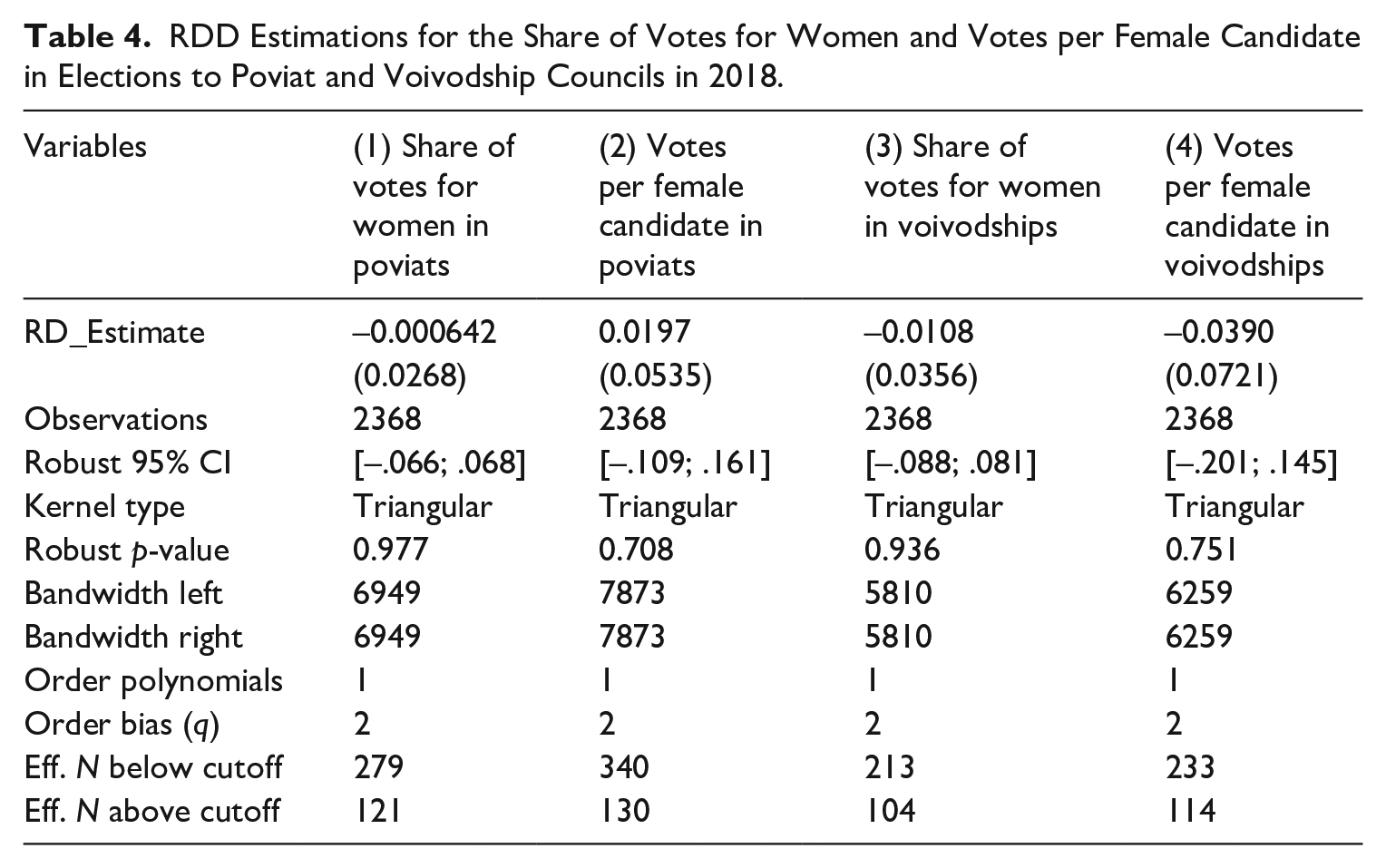
Was it caused by a backlash against the gender quota? If voters reacted in any way to the gender quota introduced in municipal elections in 2018, we could expect the negative or positive reaction to affect their candidate choice in the simultaneously held poviat and voivodship elections – two higher levels of local government. They are held on the same day as the elections to municipality councils. The councillors are elected in an OLPR system, with gender quota applied since 2014. Thus, we employ RDD to those elections with the same threshold of 20,000 inhabitants, which, in this case, does not delimit electoral systems. Any effect on the share of votes received by women could be interpreted as a backlash against gender quota, while a positive effect as a positive spillover. In particular, voters who encountered party lists in municipality elections affected by the newly introduced gender quota (with substantially more female candidates) could react by voting against women across ballots. However, we find no evidence in support of any such effect (Table 4). Thus, we can conclude that, on average, the quota most likely did not affect voters’ preferences regarding candidate’s gender (as also found by Beaman et al., 2009).
RDD Estimations for the Share of Votes for Women and Votes per Female Candidate in Elections to Poviat and Voivodship Councils in 2018.
Fragmentation
According to Moser (2001), a relatively low share of women elected under PR in post-communist countries may be due to the higher fragmentation of legislative bodies. This is in line with a larger body of literature suggesting that party magnitude is positively correlated with the share of elected women (Matland and Taylor, 1997). Since women occupy lower places on the electoral lists, 5 they are less likely to be elected if parties rarely win many seats in a district and only top-seeded candidates get elected.
Indeed, we find that largest parties introduce more women to the councils. In 2018, within each system, larger parties have higher shares of women among elected candidates. In larger municipalities, women make up 29.3% councillors of parties that won a majority (at least 11 seats). In turn, only 26.2% of the remaining councillors are female. The same pattern repeated in 2024 with 37.3% of single-party majorities were women, compared with only 30.3% councillors of other parties. Thus, if the introduction of OLPR reduced the relative size of the largest parties, we could suspect that it is an important mechanism reducing the share of women in the council.
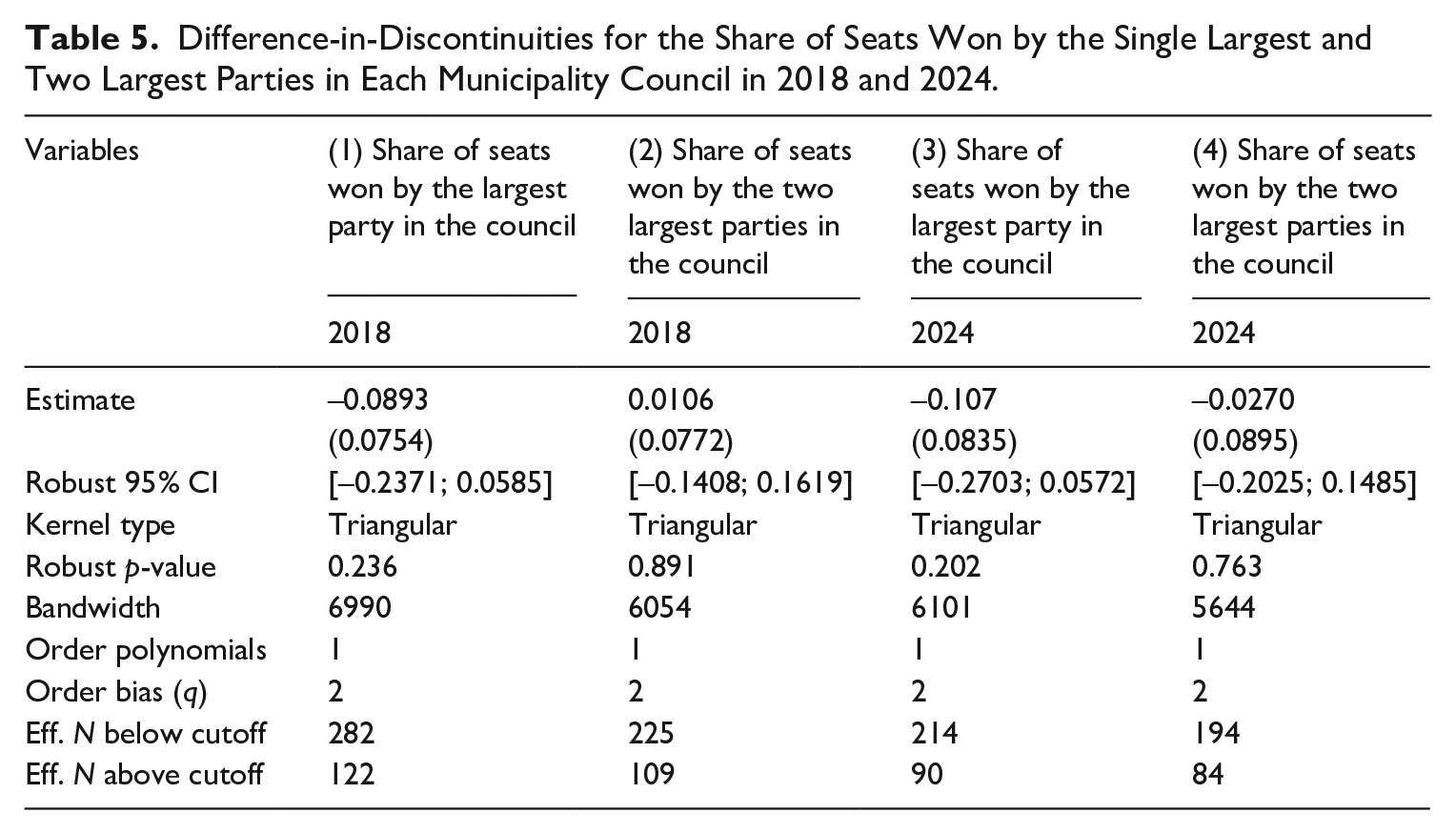
Figure 2 suggests that the largest parties got relatively more seats under FPTP than under OLPR. However, this observation is not statistically significant in the difference-in-discontinuity estimations presented in Table 5. The difference is smaller and also statistically insignificant if we sum the share of seats won by the two largest parties in each municipality. Thus, we cannot confirm that OLPR produces more fragmented councils, which would reduce the number of elected women.
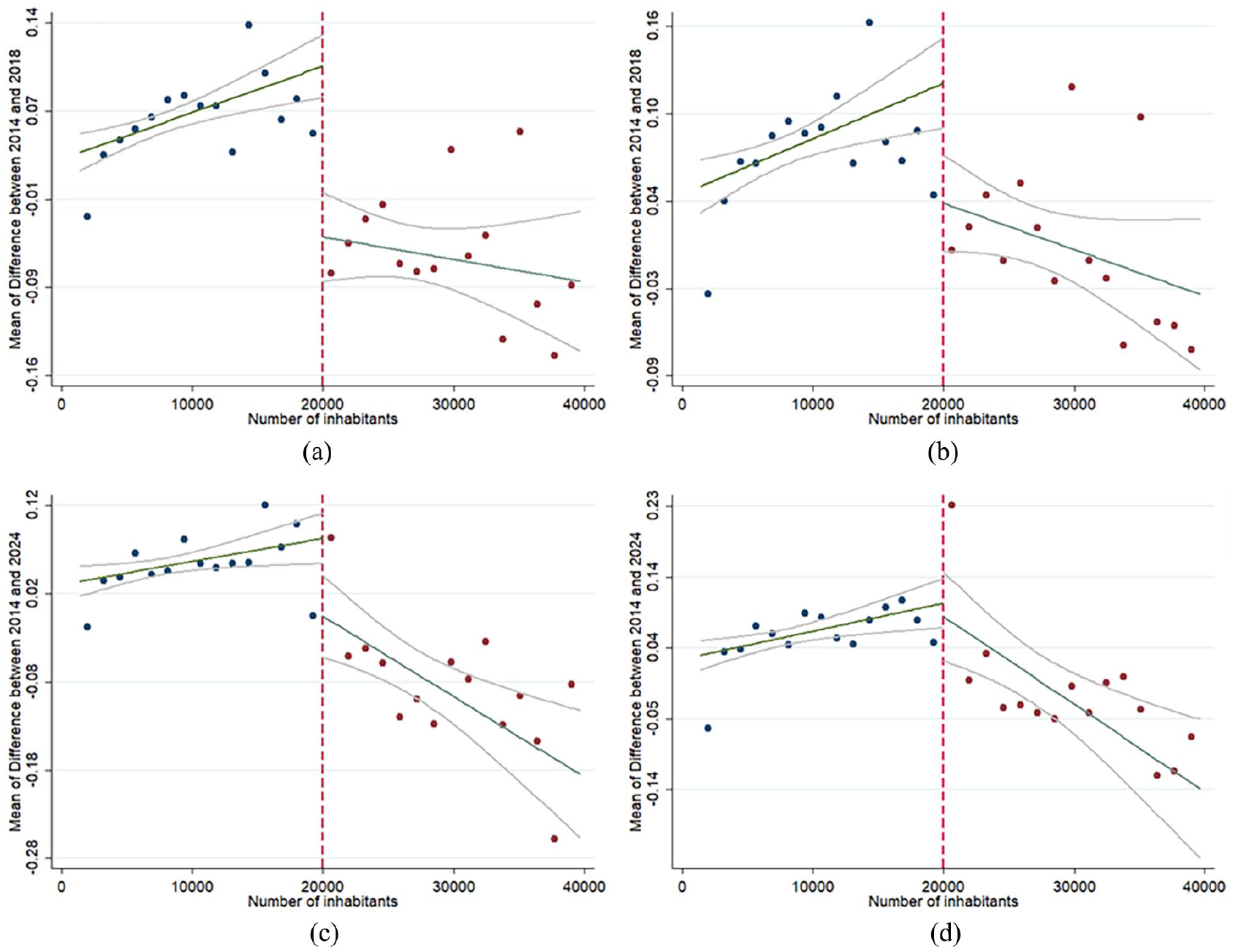
Difference-in-Discontinuities for the Share of Seats Won by the Single Largest and Two Largest Parties in Each Municipality Council in 2018 and 2024: (a) Single Largest Party, 2018, (b) Two Largest Parties, 2018, (c) Single Largest Party, 2024 and (d) Two Largest Parties, 2024.
Difference-in-Discontinuities for the Share of Seats Won by the Single Largest and Two Largest Parties in Each Municipality Council in 2018 and 2024.
Dynamic Changes in Women’s Representation
In this article, we do not find effects of electoral systems on women’s representation in municipality councils. To put our results into a broader context, we present a medium-term overview of women’s descriptive representation in Polish legislative bodies and among municipality mayors (Figure 3). The share of women has been consistently rising in all elections since 2007. The number of women in municipality councils rose from 7084 (out of 39,579) in 2002 to 13,538 (out of 39,416) in 2024, i.e. from 17.9% to 34.3%. During the same time, the share of women among candidates rose from 23.9% to 41.3%. Simultaneously, in Sejm (the lower chamber of the parliament), the share of women increased from 20% in 2001 to 30% in 2023. Importantly, the gender quota in elections to Sejm has been applied since 2011. However, there is no indication that if we followed an approach similar to Profeta and Woodhouse (2022), that is compared trends between municipality and Sejm elections before and after 2011, we would find a significant impact of the quota in the latter. In turn, women had least success in FPTP elections to the Senate (upper chamber of the parliament) and in two-rounds majoritarian elections for mayors.
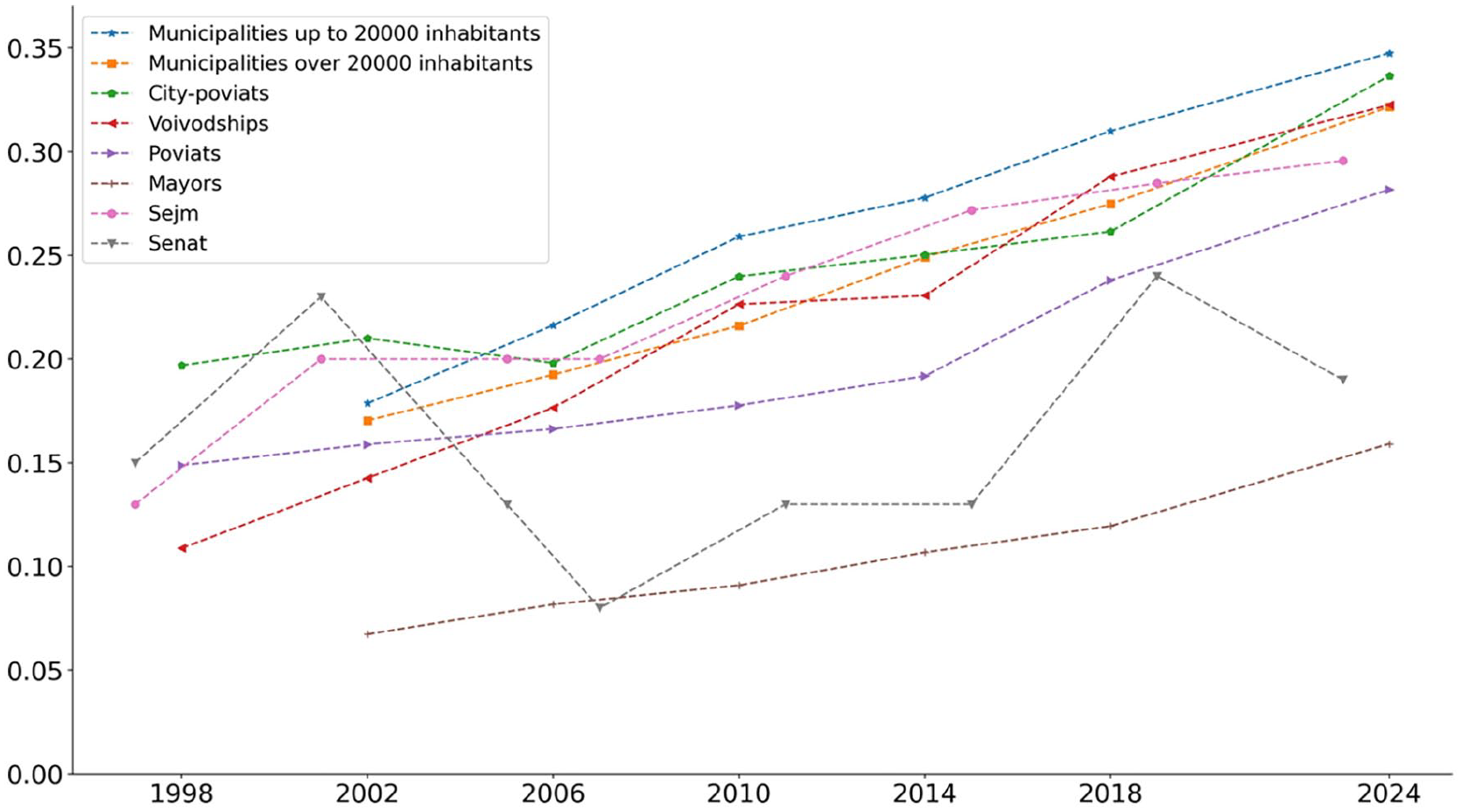
Shares of Women among Representatives Elected to Sejm, Senate, Municipality Councils and for Mayors, 1997–2024.
The share of women among councillors has been increasing in both larger and smaller municipalities despite electoral system changes. Before 2014, the municipalities with up to 20,000 inhabitants elected their councillors with a block vote. Each voter had as many votes, as there were seats assigned to the district where they were voting, that is between 1 and 5. In larger municipalities, an OLPR system was used. It was similar to that of 2018 but without the gender quota. However, there seems to be no clear change of the trends in women’s representation either in 2014 or 2018 when the electoral systems were modified.
We further explore these trends in municipality councils in Figure 4 presenting the share of women in municipality councils in relation to the number of inhabitants. This relation is curvilinear, with the highest shares observed in the smallest and largest municipalities. Generally, a steady increase in the share of women can be observed for all sizes of municipalities and regardless of the electoral system. For the municipalities with more than 20,000 inhabitants, the increase between 2010 and 2014 (with the change from OLPR without gender quota to FPTP) seems to have been of similar magnitude as between 2014 and 2018 (with the change from FPTP to OLPR with gender quota). Importantly, the share of women in the councils has increased the most in the smallest municipalities. The number of women elected there has almost doubled, despite the fact that those municipalities have experienced electoral system changes that could disfavour women (Baltrunaite et al., 2019): from block vote to single-member districts. Thus, the effect sizes of the electoral reforms, if any, are unlikely to be comparable with the socio-economic changes.
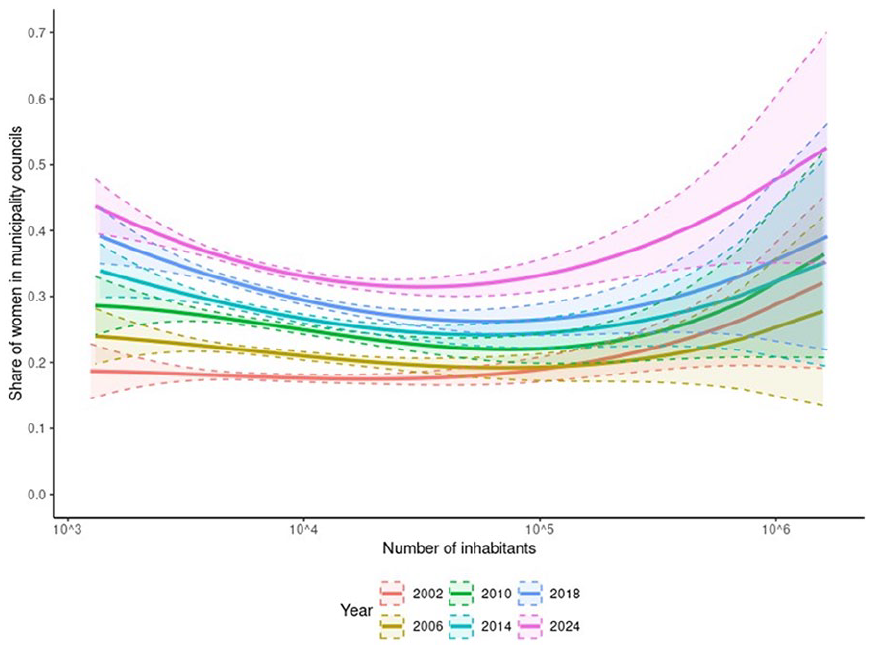
Share of Women among Councillors by Municipality Size, 2002–2024, Third-Order Polynomial.
Conclusions
We demonstrate that replacing an FPTP system with an OLPR with a legislated candidate gender quota without any additional rules regarding candidate placement substantially increases the share of women among candidates but it does not affect women’s representation in municipality councils, contrarily to some previous results regarding municipal (Hinojosa and Franceschet, 2012) and national-level elections (Profeta and Woodhouse, 2022; see also Cirone et al., 2024; Håkansson, 2021; Iversen et al., 2010, for further discussion of the obstacles posed to females in majoritarian systems). Thus, we confirm the findings from the literature (e.g. Dhima et al., 2021) that a PR system may not suffice to increase the share of women among elected politicians, even if introduced with a gender quota. However, it cannot be excluded based on the cited literature that the effects of the quota only appear in the longer term. We find some descriptive evidence that larger parties introduce more women to the council, but we could not confirm that OLPR induced higher fragmentation, which could have counterbalanced the effect of the quota. Furthermore, voters used the preference votes to choose more male candidates than would have been elected in a CLPR. Yet, voters do not seem to react to gender quota by shifting their preferences towards or away from women. Women’s representation in legislative bodies has been increasing in Poland regardless of the electoral system changes.
Our article adds to the existing literature on electoral systems and women’s representation in several ways. First, we provide causal evidence for the impact of OLPR on women’s representation among candidates to and councillors in municipality councils. We show that OLPR may not be effective in increasing the share of women because voters choose men. The natural experiment set-up used in the current study ensures high internal validity, and thus allows, unlike many other studies, to clearly identify the causal effect. Second, we look at the impact of the system change on other electoral outcomes: average age of candidates and councillors and share of councillors with tertiary degree. Third, we investigate the mechanisms possibly affecting women’s representation. Fourth, we add to the literature on the electoral systems in the Polish context. Former studies employing Polish data were predominantly interested in the effects of gender quotas at the central level. We show that the OLPR with gender quota has a similarly limited impact at the local level. Consistent with the findings by Sanches Corrêa and Souza Chaves (2020), our results confirm that gender quota has limited effects without a zipper rule or closed lists (Jones, 2004).
However, our study has some limitations. Most importantly, the statistical power is limited. The minimum detectable effect on the main outcome variable at 10% significance level was 8.0 percentage points in 2018 and 9.7 percentage points in 2024. Nevertheless, our results provide convincing evidence that the effect of the system change is not substantially larger than in previous similar studies (Bagues and Campa, 2021; Baltrunaite et al., 2014). As always in studies based on RDD or diff-in-disc, we estimate the local average treatment effect and we cannot extrapolate this result to municipalities far from the threshold of 20,000. However, Figure 4 suggests that – at least in 2018 – the increase of women’s representation in municipalities much larger than the threshold was not larger than in several previous elections.
Our study opens paths for further research. In particular, our descriptive evidence suggests an impact of the electoral system on women’s representation via fragmentation, which requires more detailed studies. We also encourage scholars to look at the effects of electoral system in comparison with the socio-economic changes occurring regardless of the laws.
Supplemental Material
sj-docx-1-psx-10.1177_00323217241308098 – Supplemental material for Limited Impact of Introducing Proportional Representation on Women’s Representation: Insights from a Quasi-Experiment in Local Elections
Supplemental material, sj-docx-1-psx-10.1177_00323217241308098 for Limited Impact of Introducing Proportional Representation on Women’s Representation: Insights from a Quasi-Experiment in Local Elections by Michał Gulczyński, Monika Köppl–Turyna and Jarosław Kantorowicz in Political Studies
Footnotes
Acknowledgements
The authors thank two anonymous reviewers for their helpful comments and suggestions which greatly improved the article. Michał Gulczyński thanks Paola Profeta and Alessandra Casarico for inspiration, and Ana Catalano Weeks, Adam Gendźwiłł, Katarzyna Grzybowska-Walecka, Lucy Kinski, Zuzana Papazoski, Ekaterina Rashkova, Resul Umit Yazici and Jens Wäckerle for their generous comments. Monika Köppl-Turyna acknowledges helpful comments from the participants of the Annual Meeting of the European Public Choice Society, in particular Zohal Hessami, and Mariana Lopes da Fonseca.
Declaration of Conflicting Interests
The author(s) declared no potential conflicts of interest with respect to the research, authorship, and/or publication of this article.
Funding
The author(s) disclosed receipt of the following financial support for the research, authorship, and/or publication of this article: The work of Michał Gulczyński on this article was supported by the funds from Bocconi University and from the European Research Council (ERC) under the European Union’s Horizon 2020 research and innovation programme (Grant 694262), project DisCont – Discontinuities in Household and Family Formation (PI: F. C. Billari).

Supplemental Material
Additional Supplementary Information may be found with the online version of this article.
Figure S1: McCrary density tests. Table S1: Difference-in-discontinuities of control variables, 2018. Table S2: Difference-in-discontinuities of control variables, 2024. Table S3: Discontinuity (RDD) of control variables, 2018. Table S4: Discontinuity (RDD) of control variables, 2024. Table S5: RDD estimations for the share of women among candidates and councillors, average age of councillors and candidates and share of councillors with tertiary education, 2014. Table S6: Difference-in-discontinuities estimations for the mean age of candidates and councillors by gender, 2018. Table S7: Difference-in-discontinuities estimations for the mean age of candidates and councillors by gender, 2024. Table S8: Difference-in-discontinuities estimations for the share of councillors with tertiary education, 2018. Table S9: RDD estimations for the share of women among candidates and councillors, 2018 and 2024. Table S10: Difference-in-discontinuities estimates for polynomials of orders 1–3, share of women among candidates, 2018. Table S11: Difference-in-discontinuities estimates for polynomials of orders 1–3, share of women among councillors, 2018. Figure S2: Descriptive representation among candidates and councillors in 2018 (RDD). Figure S3: Descriptive representation among candidates and councillors in 2024 (RDD). Figure S4: Descriptive representation among candidates and councillors in 2018, difference-in-discontinuities estimates for different bandwidths. Figure S5: Descriptive representation among candidates and councillors in 2024, difference-in-discontinuities estimates for different bandwidths. Table S12: Difference-in-discontinuities estimates for polynomials of orders 1–3, average age of candidates, 2018. Table S13: Difference-in-discontinuities estimates for polynomials of orders 1–3, average age of councillors, 2018. Table S14: Difference-in-discontinuities estimates for polynomials of orders 1–3, share of councillors with tertiary education, 2018. Table S15: Difference-in-discontinuities estimates for polynomials of orders 1–3, share of women among candidates, 2024. Table S16: Difference-in-discontinuities estimates for polynomials of orders 1–3, share of women among councillors, 2024. Table S17: Difference-in-discontinuities estimates for polynomials of orders 1–3, average age of candidates, 2024. Table S18: Difference-in-discontinuities estimates for polynomials of orders 1–3, average age of councillors, 2024. Table S19: Difference-in-discontinuities estimates with adjustment for the population density, 2024. Table S20: Difference-in-discontinuities estimates with adjustment for the share of women in the population, 2024. Table S21: Difference-in-discontinuities estimates with adjustment for the share of people in post-productive age, 2024. Table S22: Difference-in-discontinuities estimates with adjustment for the share of adults under 30, 2024. Table S23: Difference-in-discontinuities estimates with adjustment for the share of rural population, 2024. Table S24: Difference-in-discontinuities estimates with adjustment for population density, share of women in the population, share of people in post-productive age, share of adults under 30 and share of rural population, 2024.
Notes
Author Biographies
References
Supplementary Material
Please find the following supplemental material available below.
For Open Access articles published under a Creative Commons License, all supplemental material carries the same license as the article it is associated with.
For non-Open Access articles published, all supplemental material carries a non-exclusive license, and permission requests for re-use of supplemental material or any part of supplemental material shall be sent directly to the copyright owner as specified in the copyright notice associated with the article.
