




Abstract
Aid organizations spend considerable time lobbying for aid to be sent to refugees in poorer states, rather than campaigning for more refugees to be resettled to wealthy states. Lawmakers in wealthy countries similarly tend to focus on aiding refugees abroad, rather than resettling more refugees into their countries. One justification raised for focusing on aid rather than resettlement is that refugees prefer to remain in poorer neighboring countries so that they can quickly repatriate when the time is safe. Yet, few have established what refugees’ preferences are. Drawing upon an original data set of a representative sample of Syrian refugees in Lebanon, we find that most prefer remaining to resettling when the details of resettlement are not clarified, but roughly half prefer to resettle if offered certain types of resettlement. We further argue that organizations and states have reason to account for whether preferences are “adaptive.” Such preferences arise when refugees prefer remaining in neighboring countries to resettling only when resettling to other countries is not an option, but would prefer resettling if this option were available. We present a novel philosophical reason for not appealing to adaptive preferences as a justification for not resettling refugees. We further apply a novel experimental method for evaluating whether preferences are adaptive.
Introduction
Aid organizations spend considerable time lobbying for more aid to be sent to refugees in poorer states, rather than lobbying for more refugees to be resettled to wealthy states. For example, the United Nations High Commissioner for Refugees (UNHCR) (2022b) focuses considerable efforts on persuading the Japanese government to increase aid to refugees in lower-income countries, rather than persuading the government to resettle these refugees to Japan.
Organizations sometimes claim that focusing on aid is more politically feasible, as wealthy countries are willing to accept fewer than 1% of all refugees for resettlement (Betts, 2021). Yet, some organizations and scholars present another justification for focusing on aid: this is what refugees want. For example, in addition to UNHCR (2022a) focusing on lobbying Japan to donate aid to refugees abroad, it claims that refugees seek to repatriate as soon as possible, far easier if they remain in close neighboring states (Laub, 2019; UNHCR, 2005, 2022b).
UNHCR, and a growing number of scholars, are essentially making the following normative argument:
Most refugees prefer remaining in lower-income neighboring countries to relocating to wealthy countries.
Aid organizations ought to help refugees fulfill their preferences.
Therefore, aid organizations ought to help most refugees remain in neighboring countries rather than relocate to wealthy countries.
We call this the Preference Argument. 1 It is sometimes made on its own, and sometimes made alongside other arguments supporting a focus on aid in neighboring countries. For example, some scholars present an argument concerning probabilities: the probability that organizations can persuade governments to send aid is greater than the probability that they can persuade governments to accept most refugees for resettlement, and so focusing on aid instead of resettlement is justified (Betts, 2021; Betts and Collier, 2017; Brock, 2020). However, if it turned out that helping most refugees remain in their current countries is also what most refugees want, then this reasoning seems especially compelling: it seems especially justified to focus on what has the highest probability of success—in this case, sending aid—if this is also what most refugees want.
This claim about the importance of refugees’ preferences is not only relevant for organizations. It is relevant for lawmakers in wealthy countries. While lawmakers often justify not resettling refugees by claiming this is too costly (Beers, 2020), if most refugees also do not wish to be resettled regardless, perhaps states have an additional reason to not increase resettlement. Moreover, if it turned out that resettling most refugees to wealthy countries was not too costly, states might still claim they needn’t admit most refugees because most prefer remaining where they are. In other words, from a state’s perspective the Preference Argument is as follows:
Most refugees prefer remaining in lower-income neighboring countries to relocating to wealthy countries.
States ought to help refugees fulfill their preferences.
Therefore, states ought to help most refugees remain in neighboring countries rather than relocate to wealthy countries.
Given the relevancy of refugees’ preferences, a welcome development in refugee studies has been a focus on understanding what refugees’ preferences are. Extensive qualitative work provides deep insight into when, why, and whether refugees prefer to relocate to another country (Crawley and Hagen-Zanker, 2019; Crawley and Jones, 2021; Hagen-Zanker et al., 2017). However, there are few studies attempting to understand the prevalence of preferences to relocate among a refugee population as a whole. For example, Gillian Brock, Alexander Betts, and Paul Collier all claim that refugees generally prefer remaining in home regions, but provide no evidence supporting this claim (Betts and Collier, 2017; Brock, 2020). Even those not endorsing the Preference Argument sometimes presume that relocation is refugees’ least-preferred option (Lindsay, 2017). It is not clear it is.
This article considers how compelling the Preference Argument is, utilizing novel empirical data to tackle the argument’s first premise, and novel philosophical analysis to tackle the argument’s second premise. The first section presents data from an original 2018 survey conducted with a representative sample of 1751 Syrian refugees in Lebanon. Our aim is to present one example of how refugees’ preferences can be better understood to determine the truth of the Preference Argument’s first premise in a given context.
In some ways, the argument’s first premise is true in Lebanon: when Syrian refugees are asked if they prefer relocating to another country to remaining or repatriating, only around 20% say they prefer relocating. However, in order to explore preferences more fully, it is not enough to simply ask individuals if they prefer relocating. This is because relocating can take many forms, and some may prefer remaining only if relocating has certain features. If most refugees prefer relocating to a country with certain features, then organizations or lawmakers cannot claim that helping with relocation to a country with these features is not what most refugees want. We provide evidence that most Syrian refugees in Lebanon, if asked to imagine relocation with certain features they value—such as relocation that is legal, has low levels of abuse, and has high levels of employment—do prefer relocating over remaining or repatriating.
After interrogating the first premise, that most prefer to remain, we consider the second premise, that aid agencies and lawmakers ought to help refugees fulfill their preferences. We argue that even if most refugees prefer remaining to relocating, aid agencies and lawmakers ought to account for whether refugees’ preferences are “adaptive.”
Adaptive preferences, as we define them in the second section, occur when refugees prefer remaining in neighboring countries only because relocating to other countries is not possible, but would prefer relocating if this were possible. Such refugees are adapting their preferences to what is available. We defend the normative claim that states and organizations cannot justify making resettlement unavailable on the grounds that refugees do not wish to be resettled if they do not wish to be resettled precisely because resettlement is unavailable. In the third section, we present exploratory evidence from our survey that some refugees hold adaptive preferences.
In presenting the above analysis, we contribute to debates on refugee protection, providing empirical research of normative significance; while political philosophers note the value of understanding refugees’ preferences (Bender, 2024; Betts, 2021; Brock, 2020; Parekh, 2020), and social scientists present evidence of what these preferences are (Bellino, 2021; Betts, 2021; Crawley and Hagen-Zanker, 2019; Crawley and Jones, 2021; Shawaf and El Asmar, 2017; Van Heelsum, 2016), none have addressed whether refugees’ preferences shift if asked to imagine relocation with various features they value. Importantly, we present the first survey experiment providing exploratory evidence of adaptive preferences, and the first article to present a method for assessing whether preferences are adaptive more generally. While many philosophers have noted that individuals adapt their preferences to constrained options (Khader, 2011; Nussbaum, 2001; Sen, 1999; Terlazzo, 2016), none have considered what type of experiment would provide evidence of this phenomenon.
Finally, this article is one of the few to assess empirical aspects of a normative argument. While normative arguments are often made by political philosophers, and these arguments often include empirical premises, it is rare that these premises are examined using original data. Similarly, while political scientists sometimes reach normative conclusions, it is rare that the normative premises of their arguments are explicitly spelled out and interrogated. By delving into both the empirical question of what refugees’ preferences are, and the normative question of how these preferences matter for what organizations and lawmakers ought to do, we can assess both the duties these agents hold, and the relevancy of these duties in a given context.
The First Premise: Establishing Preferences
We evaluate the truth of the Preference Argument’s first premise in the context of Lebanon, a country with a total of approximately 4.6 million citizens, and hosting approximately 1.5 Syrian refugees. Most arrived after the outbreak of the Syrian civil war in 2011, when they were able to enter freely and work. However, in 2014 the government began blocking the entrance of new refugees, pressuring refugees to repatriate, and requiring many to live in enclosed settlements. Refugees could also no longer access work visas and a range of public services. Given these circumstances, refugees often faced a dilemma of whether to remain, repatriate, or attempt to relocate to another country (Janmyr, 2018; Kikano et al., 2021).
To understand refugees’ preferences in these circumstances, we asked a representative sample of 1751 Syrian refugees to complete a survey in June and July 2018. 2 Refugees were first asked a simple question: whether they preferred remaining, repatriating, or relocating. When asked this simple question, the Preference Argument’s first premise seemed correct: most Syrian refugees in Lebanon did not prefer relocating, with 52.48% wishing to return to Syria, followed by 27.13% wishing to remain in Lebanon. We call these preferences the “baseline preferences.”
Although these baseline preferences seem to confirm the first premise, it is not enough: what matters is not just whether refugees say they wish to relocate in general, but whether they prefer relocation of a certain kind. As a range of qualitative studies have demonstrated, many refugees prefer to relocate to another country on the condition that there is no abuse (Crawley and Jones, 2021; Shawaf and El Asmar, 2017), and that the relocation is legal (Crawley and Hagen-Zanker, 2019). Moreover, some studies find that refugees decide which countries they prefer relocating to, and whether to relocate at all, based on whether they are likely to find employment (Crawley and Hagen-Zanker, 2019; Crawley and Jones, 2021; Shawaf and El Asmar, 2017). While not all studies find evidence of employment being of great importance (Hagen-Zanker and Mallett, 2016), addressing the details of preferences is paramount for assessing the strength of the Preference Argument.
This is because, if there is a kind of relocation which most refugees prefer, as compared with either remaining or repatriating, then organizations and parliamentarians should not avoid focusing on making possible this particular kind of relocation on the grounds that most refugees do not prefer this kind of relocation. For example, the refugees in our study who stated that they preferred remaining would potentially change their mind if told they would be relocated to a country with likely employment. If most would prefer relocating with likely employment, then the parliamentarians of a country where refugees could likely obtain employment could not claim that most refugees do not wish to be relocated. While there may be other justifications for not relocating such refugees to their country (such as the high costs of doing so), this particular preference-based justification would fail.
We therefore strived to more fully understand whether most refugees do prefer relocation of a certain kind. To find this out we first asked a randomly-selected subsample of 402 respondents to complete a conjoint experiment. 3 A conjoint experiment involves asking people to choose from two options, with every option varying randomly along certain attributes. Conjoint experiments are used to assess which attribute levels (or features of an option) predict a particular choice: If respondents are more likely to select an option with attribute level X, even when the other options vary randomly along all other attributes, this is evidence that respondents value attribute level X. In our case, we asked respondents to imagine they were choosing between one of two countries to relocate to, with the features (attribute levels) of the countries varying randomly: some relocation options were legal, some were not; some had high levels of employment, others low; some involved being relocated to a country with many other Syrians, others not, and some had high levels of abuse, and others low. For example, an individuals might be asked to choose between relocating to a country with high levels of abuse but where they could arrive legally, and which had a large Syrian diaspora and likely employment, versus a country with low levels of abuse where they could arrive legally, with a small Syrian diaspora, and where ease of finding work was low.
By presenting respondents with pairs of options, and attribute levels varying randomly, we could then see if refugees were significantly more likely to choose one relocation option over another if it had certain attributes. For example, we could see whether, when refugees were given options to relocate to a country with a large Syrian diaspora, they were more likely to choose this country even in the presence of randomly varying attribute levels related to, for example, economic circumstances, legality, and abuse. For each subject, we asked them to choose between two countries five different times, resulting in a total of 1828 option pairs among all respondents.
We summarize the attributes, and how they varied, in Table 1.
Attributes and Levels.

After respondents selected their preferred relocation from a given pair, they were then asked a follow-up question: whether they preferred the option they had just chosen to repatriating or remaining. The answer to this question expressed what we call the post-conjoint preferences. 4
We then analyzed responses. We did this by first evaluating what refugees tend to prefer when deciding between two different relocation options in the conjoint, ignoring post-conjoint preferences. In particular, we examined which attribute levels were preferred when choosing between relocation options. For example, we examined whether relocation to a country with high levels of employment is likely to be selected or whether relocation to a country with low levels of abuse is likely to be selected. Figure 1 shows these results, estimated using marginal means (MMS; Leeper et al., 2020). MMs can be interpreted as the average probability that an alternative with a given attribute level is chosen, averaging across all other attribute levels (or ignoring all other attribute levels). 5 Coefficients that do not cross the 0.5 vertical marker significantly affect preferences—either positively (right-hand side) or negatively (left-hand side). If an attribute level partially or fully sits on the 0.5 marker, it does not significantly affect preferences. 6
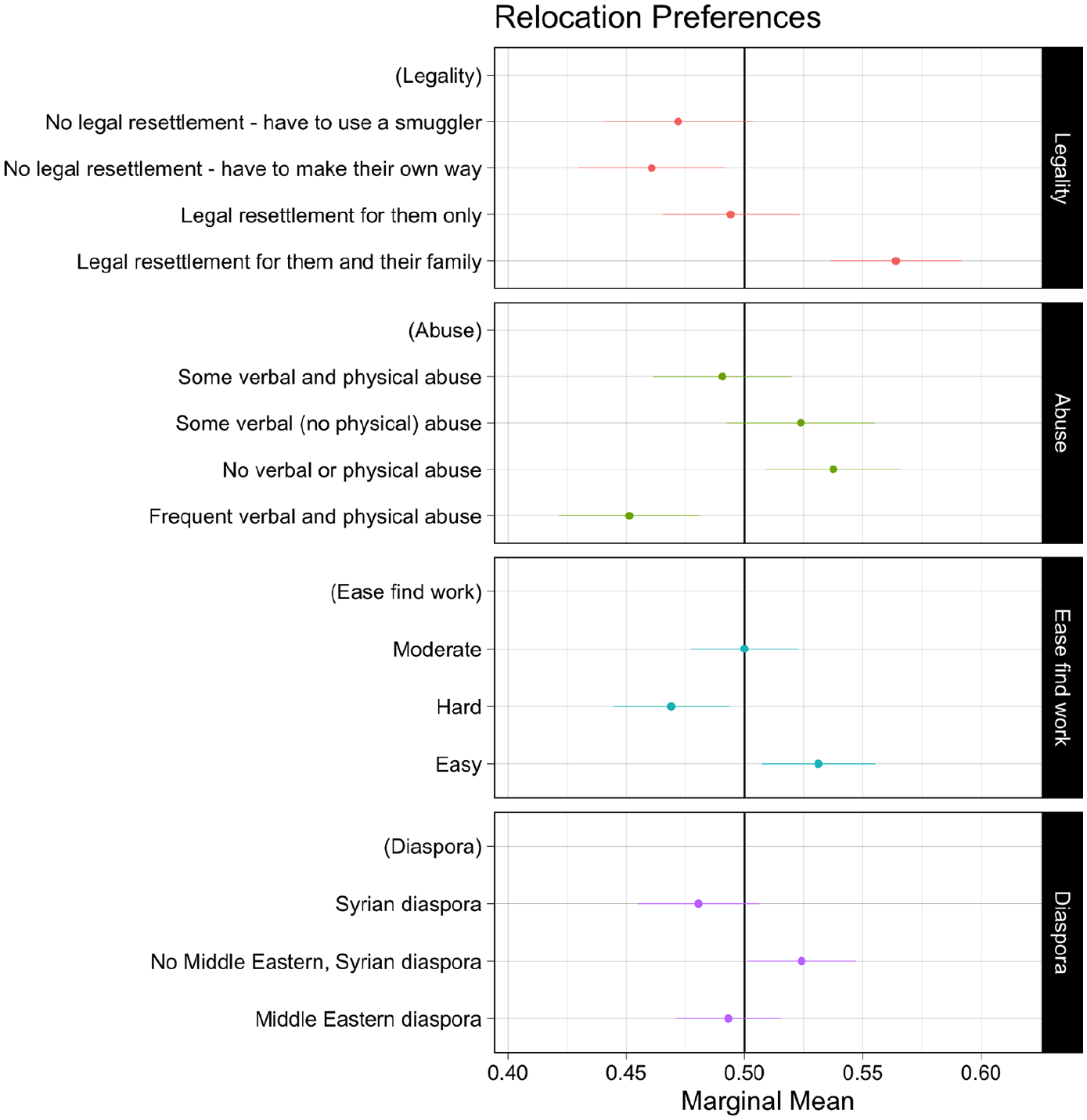
Marginal Mean Estimates of Preferences for Relocation Destinations.
We learned that ease in finding employment positively affected preferences. In other words, it positively affected the relocation option chosen, averaging over all other attribute levels. Difficulty in finding employment, on the contrary, negatively affected the relocation option chosen. Frequent verbal or physical abuse at the destination negatively affected the relocation option chosen, while an absence of this kind of abuse positively affected the relocation option chosen, averaging over all other attribute levels. The legality of the relocation option was also predictive of being selected: individuals were more likely to select relocation options that were legal for them and their family, and less likely to select those that were illegal with no smuggler. Surprisingly, the presence of co-nationals in the relocation country did not affect relocation choice (positively or negatively), and neither did the presence of other Middle-Easterners.
After having examined which features of relocation refugees prefer when choosing between relocation options, we then examined whether providing respondents with certain relocation conjoint pairs changes their preferences in the follow-up question (where we ask them if they prefer the relocation option just chosen to remaining or relocating), as compared with the earlier baseline question. The earlier baseline question asks respondents whether they aspire to relocate, return to Syria, or remain in Lebanon. We wanted to find out whether there is a shift to aspiring relocation over repatriation or remaining when asked about relocation with attribute levels refugees prefer in the conjoint on average, especially as compared with attribute levels they disliked in the conjoint on average.
To find this out, we analyzed the conjoint experiment in a different way. We pooled the pairs of options into various “good” pairs and various “bad” pairs, corresponding to the different attribute levels. Whether a conjoint pair is considered good or bad is derived from refugees’ aggregate preferences, as determined in the analyses we presented just above. Good conjoint pairs included an option with an attribute level that respondents preferred on average or that did not significantly predict relocation choices either way, as summarized in Figure 1. For example, a pair was considered “good” from the perspective of employment if at least one of the options in the pair included relocating to a country where the ease of finding work was high or moderate. This is because an option with a high or moderate likelihood of employment was preferred on average, so if a respondent received a choice between two countries and one had a high or moderate likelihood of employment, the choice was a relatively good one, as compared with a choice between two countries where both had only low levels of employment. We call this the “Work-Good” option pair. Similarly, an option pair was considered good from the perspective of abuse if at least one option was relocation to a country where frequent verbal or physical abuse was unlikely; we call this an “Abuse-Good” option pair. Finally, a pair was considered good if it included an option to relocate legally (with family or alone). These option pairs were called “Legal-Good.” 7
We then examined whether, when individuals were given good option pairs in the conjoint—in other words, when they were asked to choose between two options with at least one option having a good attribute level—they were more likely to then say they preferred the relocation option they had just chosen to remaining or repatriating, as compared with what they stated at the start of the survey (i.e. the “baseline”). For example, when individuals were asked to choose between relocation involving likely employment and relocation without likely employment, and they selected the relocation with likely employment, there is a question of whether they would then prefer this relocation to remaining or returning, even if at the start of the survey they said they would prefer remaining or returning.
We found that individuals were, indeed, significantly more likely to choose to relocate when presented with any of the good relocation pairs, than in the baseline question before the conjoint at the start of the survey. Moreover, close to half indicated a preference for relocating to remaining or repatriating when asked about any of these good relocation pairs. For example, when examining the subset of responses involving a conjoint pair where at least one of the two choices involved legal relocation, close to half of the responses indicated a preference for the relocation option they had just chosen in the conjoint to remaining or repatriating. In contrast, at the baseline only roughly 20% of respondents said they preferred relocating to remaining or repatriating.
We also compared whether preferences shifted more when refugees were given good relocation pairs as compared with what we call “bad relocation” pairs. Bad relocation pairs include two relocation options which both have an attribute level predictive of not being chosen in the conjoint, as per Figure 1. For example, individuals were choosing between two options in a “Work-Bad” pair if both entailed employment that is hard to come by in the relocation country. Similarly, individuals were choosing between two options in a “Abuse-Bad” pair if both options included likely verbal and physical abuse; and they were choosing between two options in a “Legal-Bad” pair if both options involved illegal relocation without a smuggler. We then examined whether significantly more respondents changed their mind after choosing between the good relocation pair as compared with the bad. This second examination is important, as even if a significant number changed their minds when given the good relocation pairs as compared with the baseline question at the start of the survey—even if many thought they did in fact prefer to relocate if given a good relocation option—it is necessary to understand if the good attributes explain individuals’ shift in preferences. We learned that they do for one type of good relocation: those which were legal. Individuals were significantly more likely to select relocating when given the relocation option pairs which included at least one legal relocation option, as compared with when given option pairs that included no legal relocation option. More to the point, they were significantly more likely to change their minds relative to the baseline, and select relocation rather than alternatives, when given the option pairs with a legal option as compared with when given the option pairs with no legal option. This suggests that, at the start of the survey before the conjoint when roughly 80% said they did not wish to relocate, some were selecting alternatives to relocation because they did not want to experience an illegal relocation, but would prefer relocating if it were legal.
We summarize these findings in Figure 2. For ease of interpretation, we estimate linear models, as recommended by Gomila (2021). In all models, standard errors are clustered by respondent, and we include fixed effects for governorate to adjust for the sampling strategy.
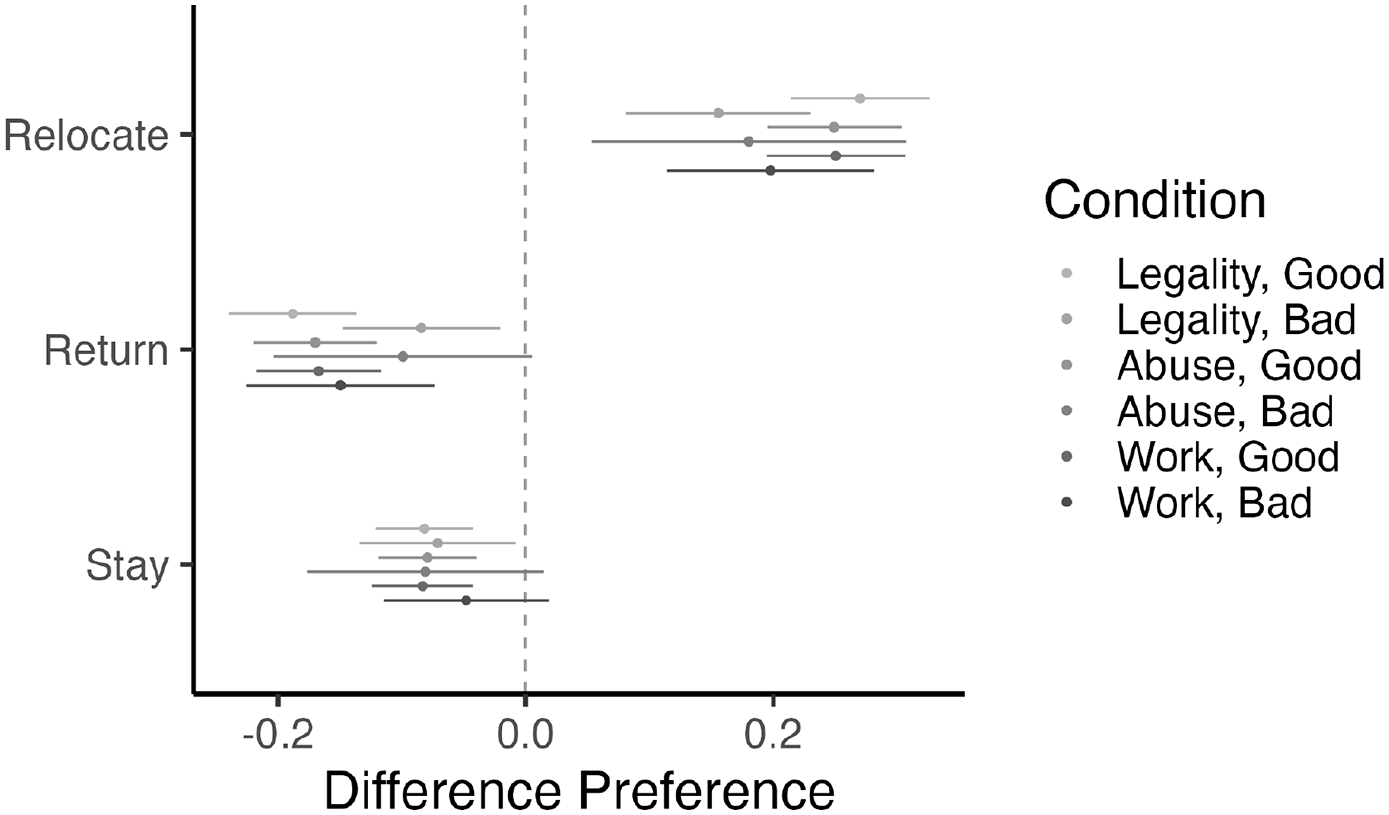
Difference Between Post-Conjoint and Baseline Preference for All Good and Bad Choice Sets.
The above findings establish what type of relocation refugees prefer when choosing between relocation options in the conjoint, but also whether the relocation options chosen in the conjoint are then preferred to repatriating or remaining. More generally, these findings indicate that understanding what types of relocation are considered desirable from refugees’ own perspective has value: it is valuable both to simply understand refugees’ perspectives, and to understand when and whether refugees prefer relocation to alternatives. Of the refugees given the conjoint, a plurality and roughly half prefer relocation to alternatives when the relocation is legal.
We also sought to understand if even more would prefer relocating to remaining or repatriating if examining an option with many good attributes. To find out, we pooled choice sets into what we call General Good and General Bad conditions. The General Good condition consists of choice sets where respondents had at least one generally attractive relocation alternative from which to choose. We define generally attractive as an option which only featured characteristics that refugees significantly favored (i.e. were predictive of being selected in the conjoint) or did not significantly affect preferences either way. For example, if refugees were selecting between two relocation options, and in one of the options the relocation was legal, had little abuse, and likely employment, then this was considered a “General Good” choice task. It was good because at least one option included attributes which were predictive of being chosen in the conjoint. We define the General Bad condition as that comprised of two unattractive alternatives, defined as two alternatives containing at least one attribute level that respondents significantly disfavored in the first-stage analysis. So, for example, if refugees were selecting between two relocation options, and in one of the options the relocation had little abuse and likely employment but was illegal, while the other option was legal, had little abuse, but with little employment options, then this was considered a “General Bad” choice task. It was bad because both options included attributes which were predictive of not being chosen in the conjoint. 8
Table 2 shows the construction of all choice task groupings (or “conditions”). The last two rows show the number of observations and the number of respondents per condition, respectively (recall that respondents were given more than one choice task). 9
Choice Task Groupings.

In Figure 3, we find that, not only is there a significant increase in those preferring relocation that is generally good as compared with the baseline, but a slight majority (51.4%) prefer generally good relocation to repatriation and relocation. 10 Surprisingly, most of the above shifts occurred among those who preferred repatriation at the baseline, despite the fact that we asked individuals to rank relocation against alternatives on the assumption that repatriation was safe. We also learned that there is a significant difference between those who shift to preferring relocation when given the General Good relocation choice pairs as compared with the General Bad choice pairs, though it is ultimately the legality that matters: there was no significant difference between those preferring relocation after given the General Good relocation pairs and those preferring relocation after given “Legality, Good” relocation pairs. Regardless, it seems that a slight majority prefer relocation of a certain kind.
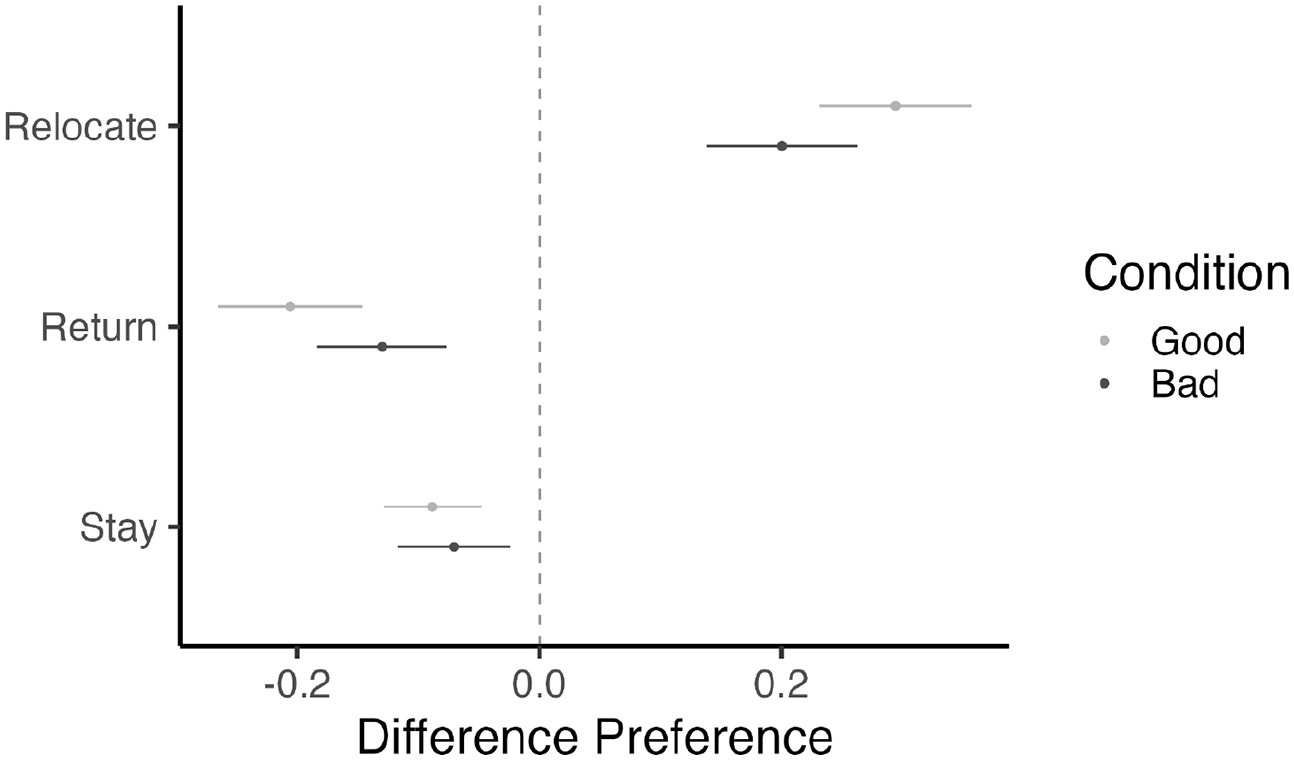
Difference Between Post-Conjoint and Baseline Preference for All General Good and General Bad Choice Sets.
All of the above findings have implications for the Preference Argument. The Preference Argument is meant as a justification for not focusing on relocation, but it is especially used as a justification for not focusing on legal resettlement to high-income countries. If this is the case, there is then a question of whether governments and organizations can claim that focusing on such resettlement should be avoided because most refugees prefer to repatriate or remain where they are. Our findings suggest that, at least in the case of a randomly selected subset of Syrian refugees in Lebanon, most do not prefer to repatriate or remain where they are as compared with legally relocating to a country with likely employment and freedom from abuse.
It is worth noting that the above findings—including what refugees value in relocation, and whether relocation they value is preferred to remaining or repatriating—are based on answers to hypothetical questions: we did not actually give refugees options to relocate, and so perhaps even if many stated that they preferred to relocate when this was legal, many would not relocate if they were actually given this option. Our choice to give only hypothetical questions was partly due to an obvious practical constraint—we could not actually give people the option to relocate (more on this in the following section). However, even though our findings are based on responses to hypothetical questions, they still have value: they demonstrate that simply asking refugees if they prefer to relocate is not enough, because many at least shift their stated preferences if asked about relocation with attributes they value.
The Second Premise
While the previous section considered whether and when refugees actually prefer to relocate, this section considers the Preference Argument’s second premise: that refugees’ preferences should be fulfilled. In this section, we suggest that one instance where organizations and policymakers ought to potentially avoid fulfilling refugees’ preferences is when these preferences are “adaptive.” We explain what adaptive preferences are and present a novel reason they matter for the Preference Argument. We then present exploratory evidence that some refugees in Lebanon hold adaptive preferences.
What We Mean by Adaptive Preferences
Adaptive Preferences can be defined in at least one of two ways:
A person has adaptive preferences if they develop preferences for Y over X because they are denied option X and only given option Y, telling themselves they would not want X even if it were available. This preference also continues even if X becomes available. For example, a refugee might be told for most of her life that she can never move to another country, and so develops a preference to remain where she is. She even tells herself she would not want to leave if she could, and this preference becomes deeply ingrained, such that even when she is finally given the option to leave, she continues to prefer staying where she is. 11
A person has adaptive preferences if they are denied X and so develops preferences for Y over X, telling themselves they would not want X even if it were available, but if offered X they would change their preferences and prefer X. For example, a refugee might be told she can never relocate to another country, and so develops a preference to remain where she is, even telling herself she would not want to leave if she could. However, when someone actually offers her relocation she re-evaluates her preferences and changes her mind, preferring to leave. 12
Some philosophers not only present a definition of adaptive preferences similar to one of the above, but make a normative claim: when individuals have adaptive preferences because of unjust constraints, their preferences ought to be given less weight in determining how individuals are aided compared with when preferences are not adaptive, all else being equal. Some endorse this normative claim because they hold that individuals denied options they are entitled to, and so who just don’t want these options, are not sufficiently reflecting on how their lives could improve if these options were available. Their preferences are “habituated” (Nussbaum, 2001) and “distorted” (Sen, 1999) rather than truly their own. Or adaptive preferences may lack autonomy if they arise from unjust constraints, even if fully reflected upon. This is because autonomy requires certain options, such as the option to access sufficient food, housing, and maybe even the ability to move to a safer country. If we think denying certain options decreases autonomy, then perhaps preferences arising from such denials are less autonomous as well (Enoch, 2020). If a refugee prefers to remain where they are because they are unjustly denied the ability to leave, we might think their preferences lack autonomy.
However, we don’t think the above views are quite right. As others have noted, individuals deprived of certain options can still reflect on decisions (Khader, 2011), and treating individuals as less autonomous because they were denied important options throughout their lives can be demeaning and patronizing, and so ought to be avoided (Enoch, 2020; Khader, 2011; Terlazzo, 2016). Instead, we propose a slightly different claim: when individuals have adaptive preferences like in case 2, though not 1, providing X (the option denied) respects the autonomy of the people they will be once X is provided. This is true even if their initial preferences before X is provided were autonomous and reflected upon. Or, put another way, we have a presumptive reason to respect individuals’ preferences, especially when they are disadvantaged (Bender, 2024; Montanaro, 2017; Rubenstein, 2015), which is why refugees’ preferences should be respected. However, when refugees will prefer options currently denied once they are provided, their preferences are respected in giving them the option currently denied, creating one moral reason to provide the option initially not preferred.
For this reason, if a government in a wealthy country decides to not provide very many resettlement opportunities for refugees living in lower-income countries, claiming most do not wish to be resettled, its justification is weakened if most do not wish to be resettled because resettlement has always been denied, and would want resettlement if it were available. If most would want resettlement once available, then providing resettlement fulfils the preferences most will have once resettlement is available. Similarly, if aid agencies are deciding whether to focus on relocation, they ought to take seriously refugees’ preferences, but this needn’t be limited to the preferences they hold prior to the provision of the option; preferences after the option is provided matter in what organizations have all-things-considered reason to do.
This is especially relevant when organizations are choosing between two policies, where each policy has certain advantages and it is unclear which is more desirable to implement. For example, UNHCR headquarters in Geneva must regularly decide how much time and resources to divert into helping refugees resettle to another country, versus providing aid to refugees in lower-income countries. The number it can help via lobbying for more resettlement versus more aid is mostly unknown (Betts, 2021; Roper and Barria, 2010), and even if UNHCR can deduce the effects of lobbying for aid versus resettlement, it may be ambiguous which policy is more justified in terms of objective welfare. This is because resettlement may help some refugees live far above the poverty threshold in wealthy countries, while focusing on aid in a neighboring country may help more refugees live better lives, but still below the poverty line. If it is ethically unclear what UNHCR ought to focus on, it may be justified in deciding by asking refugees not only weather they prefer resettling or remaining, but whether they think they would prefer resettling if this became available. If they would, then UNHCR has greater reason to divert time into helping obtain resettlement than had most refugees preferred to remain even if resettlement became available.
There is another important upshot for what various agents ought to do if refugees’ preferences are adaptive. In some cases, refugees may have the option of resettling if they take certain steps.
For example, under Canada’s sponsorship program, Canadian citizens can sponsor the resettlement of specific refugees, but these refugees must often reach out to those they personally know in Canada (if they know anyone at all), or communities in Canada interested in sponsoring refugees (Prantl, 2022). When refugees are unaware of how they can even try to obtain resettlement, and just presume it is impossible, they may adapt their preferences and prefer to remain. However, if some would have a high likelihood of being resettled if they knew the process, and would also prefer resettlement if they realized they had a high chance of being resettled, then organizations have reason to help refugees understand this process.
Of course, in cases where organizations can help refugees understand what options they have—including understanding what options they have for just applying for resettlement—there is one ethical worry: some refugees, upon learning that they have the option of applying for resettlement and a chance of being resettled, may then prefer resettlement but ultimately be unable to obtain it in practice. For example, an aid worker may connect a Somali refugee living in Kenya with an organization in Canada hoping to sponsor a refugee for resettlement, and the refugee may come to prefer resettlement as a result of learning how to apply via the private sponsorship route, but still have a low likelihood of not obtaining resettlement. In such cases, it is not clear if the aid worker acts ethically in helping this refugee understand the application process, given that this can contribute to the refugee holding preferences they are unlikely to fulfill.
While we lack the room to fully address this dilemma, for now we can at least conclude this: in cases where refugees really do have a high likelihood of obtaining resettlement, but refugees think these odds are low and so prefer to remain, organizations have reasons to inform refugees that they have a high likelihood of obtaining resettlement. While this is not relevant for the vast majority of refugees, it could be relevant for some. 13
The above claims—that it matters whether refugees’ preferences are adaptive, because it creates certain moral reasons and duties—has a further implication: whether preferences are adaptive matters even for options individuals have no right to obtain. For example, it is far from clear that refugees always have a right to be resettled, and leave the country they are currently residing in. Even if this is true, if their preferences hold some normative weight—in that they impact how an aid agency or state ought to act—then it matters what their preferences will be once relocation is made available. For even when refugees have no general right to leave the country they are residing in, if an agency or lawmaker has reason to provide assistance respectful of refugees’ preferences, the agency or lawmaker acts in accordance with these reasons in providing relocation that refugees will prefer once available.
The above is a normative theory about the role of adaptive preferences, but there is a related empirical question: why would individuals change their preferences when an option becomes available?
One possibility is that, before options are available, they are “psychologically distant.” Psychological distance describes people’s perceptions of objects or events that are either far away spatially, far into the future, or far from their own experiences (Liberman and Trope, 2008). When events or objects are psychologically distant, making them available may help individuals understand what experiencing them is like. For example, a woman might prefer remaining where she is to relocating to another country, but when given the option of relocating she understands what it feels like to have this option. Once she experiences this feeling, she might realize that moving to another country is what she prefers. Importantly, she might realize this even if she is perfectly capable of reflecting on her desires when only remaining is possible. Perhaps, when only remaining is possible, she is very good at reflecting on the values of creating community with her current neighbors, even if her ability to reflect on the value of leaving her community—such as the value of working in a job abroad, or meeting individuals in another country—is enhanced when leaving the country is an option. Her level of reflection is the same whether she has the option of relocating or not, it is simply that creating the possibility of relocating shifts her focus, shifting her preferences as well.
If it matters whether preferences will shift once relocation becomes available, there is then a question of how to find out if preferences will shift should relocation become available. Unfortunately, it is rarely possible for organizations and even many lawmakers to just give all refugees the option of resettlement, and see what they would prefer. However, it is possible to bridge psychological distance via another means: imagination. Within the field of psychology researchers strive to understand whether individuals would choose certain options if asked to imagine living through events they don’t currently experience, like future climate change (Lee et al., 2020) or the experience of being refugees (Adida et al., 2018), transgender people (Kalla and Broockman, 2020), and other negatively stereotyped outgroup members (Wang et al., 2014). These researchers generally try to understand the effects of subjects imagining they have fewer options than they currently have. However, a similar technique can be used to help individuals imagine having more options than they currently have. Or more precisely: a similar technique can be employed in cases where options are improbable. Relocation is improbable for Syrian refugees in Lebanon, and so if they are asked to imagine relocation is in fact possible, and asked what they would prefer in such a world, we can come closer to bridging psychological distance, and closer to understanding if preferences are adapted to the constraints refugees face.
We now describe this method in the context of the survey conducted in Lebanon.
Asking Refugees to Imagine Relocation
When individuals were given the conjoint, they were not just asked to choose between relocation options: they were asked to imagine actually having these options available. To explore the potential impact of the act of imagining relocation becoming available, we conducted an additional analysis of the data.
This analysis first involved returning to the analysis of the “General Bad” relocation options. Recall that General Bad option pairs involved a choice between options that were both unattractive, with unattractive defined as having at least one bad attribute. An attribute is bad if, when an option had this attribute, it was less likely to be selected from the pair during the conjoint. Or put a little differently, General Bad option pairs in the conjoint were comprised of two unattractive relocation alternatives, defined as two alternatives containing at least one attribute level that respondents significantly disfavored in the conjoint. These were relocation options where respondents might expect to experience unemployment or some kind of abuse, or would not be able to resettle legally with their family members.
After individuals were asked to imagine actually having the two (bad) relocation options, and to choose the relocation option in these bad choice sets within the conjoint, we then asked them if they preferred the relocation option just chosen in the conjoint to remaining or repatriating. As already noted, we demonstrated that significantly fewer people changed their mind and preferred relocation when given the bad relocation choice as compared with the good relocation choice, but we also hypothesized something else: significantly more would choose the bad relocation they were asked to imagine, and which was selected, as compared with the number who chose relocation at the baseline at the start of the survey.
We find that there was, indeed, a significant increase in those preferring relocation after the conjoint even when asked to imagine having the bad relocation options. In particular, as compared with the number who preferred relocating to remaining or repatriating at the baseline, we see 1.8 times as many responses indicating a preference for the bad relocation chosen to remaining or repatriating. 14
The fact that individuals shifted their preferences after asked to imagine that a bad relocation option is made available is important exploratory evidence of adaptive preferences. This is because, if individuals shifted their preferences when asked to imagine a bad relocation option, they were not merely shifting their preferences due to new details about how good an option was. When individuals shifted their preferences because the relocation was relatively good, this is not evidence of an adaptive preference; it is simply evidence that individuals prefer good relocation to remaining or repatriating (as already noted in the previous section). Put another way, even when refugees stated that they preferred to remain or repatriate when asked in the baseline question, and later stated they preferred relocation when given good options, this was likely because the baseline question did not clarify if the relocation was good (i.e. entail work, no abuse, and was legal). The fact that refugees were also more likely to prefer bad relocation options after asked to imagine these options being available could be because imagining an option is itself significant: merely being asked to imagine being offered relocation—however bad—means refugees were more likely to prefer this relocation to remaining or repatriating.
These results, which can be found in Figure 3, provide some evidence that refugees’ preferences to remain in Lebanon or return to Syria were adapted to the current context. When asked to imagine being given a resettlement option, we see a statistically significant increase in respondents who changed their mind and chose resettlement relative to returning or staying in Lebanon, even when asked to imagine a relocation that included attributes they did not value in the conjoint.
In addition to the above finding, we found further evidence that preferences to remain were adaptive: not only were individuals more likely to state that they preferred relocating after asked to imagine having the bad option of relocating in the conjoint, as compared with before the conjoint, but the difference between this post- and pre-conjoint preference was significantly greater among those who initially stated that they thought relocating was harder than alternative options. This would be expected if preferences were adaptive; if individuals were more likely to prefer not relocating when they thought relocating was not an option, but prefer relocating if they thought this was an option, then those who thought relocating was not an option in the baseline question would be more likely to change their minds if asked to imagine that relocation was an option. In contrast, those who thought that relocating was easier would be less likely to change their mind if asked to imagine relocation being an option. Their preferences would be less likely shaped by a belief that this option was not available, given that they thought it was—or at least easier to obtain.
The above finding, summarized in Figure 4, is also evidence that individuals were not changing their preferences merely because they were “primed” to think about relocation. In general, priming can occur when an individual is given information about an option, and then shifts their preferences simply because the option is now on their mind (Stern, 2019). It dawned on us that individuals may have changed their mind because they were asked to think about relocating, and not because they were specifically asked to imagine relocating was possible. In other words, they might have changed their preferences even if we just mentioned the word relocation, without asking them to imagine having certain relocation options. The above finding suggests otherwise, as both those believing relocation was the most difficult option, and those believing relocation was the easiest option, were asked to imagine having the option to relocate, and thus asked to think about relocating; it was those who thought relocation was very difficult at the start of the survey who were significantly more likely to change their mind if asked to imagine relocation being possible. This suggests it was the act of imagining a very different world, one where relocation was more possible, which impacted changes in preferences.
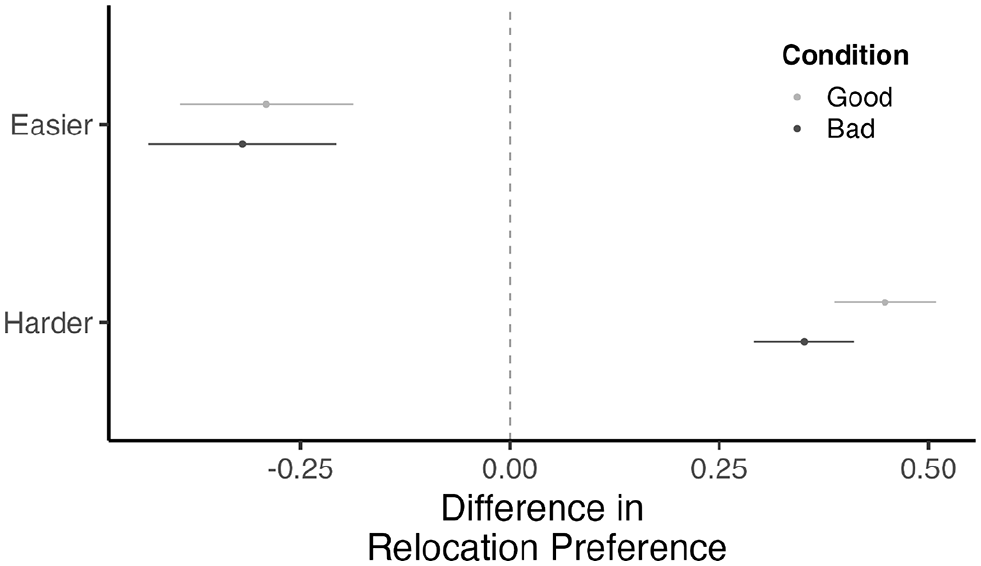
Post-Conjoint Versus Baseline: Ability.
There is an additional reason to suppose that individuals changed their mind not merely because they were primed to think about relocation. After individuals in the conjoint were asked to decide which imaginary relocation option they preferred, they were told:
Keep in mind the answer you just provided us. Now, I would like to consider a situation where you and your family can return to your hometown in Syria without fear of violence. Please note that it is OK to change your answer.
They were therefore primed to think about repatriating, and indeed exposed to a prime about repatriating that was more proximate to their answer compared with the relocation options, and thus seemingly more likely to impact their answer than relocation options. Moreover, the prime was positive: they were told repatriation was safe, while the bad relocation options they had just been given entailed hardships like abuse. Despite the repatriation prime being more proximate and positive, there was a significant increase in those choosing to relocate as compared with at the baseline. Individuals were therefore unlikely changing their mind simply because they were primed to think about relocation.
In addition to the above evidence against priming, we also conducted qualitative focus groups. These focus groups were conducted to understand the reasoning behind individuals’ choices and preferences, and they involved discussions about relocation. Despite these discussions encouraging more in-depth thoughts about relocation, individuals were never asked to imagine that relocating was possible. They also never shifted their preferences. If they were encouraged to discuss relocation, and still did not shift their preferences, this suggests that merely encouraging individuals to think about relocating is insufficient to encourage a shift in preferences. In contrast, in the survey we did ask individuals to imagine that relocation was possible, and such a shift did arise. 15
A Better Survey for Evaluating Adaptive Preferences
The above presented reasons for accounting for whether refugees have adaptive preferences in determining which policy to pursue, and tentative evidence that refugees in Lebanon held the sorts of adaptive preferences that should be accounted for in determining whether and how to assist with resettlement. However, future surveys could be improved to better assess whether preferences are adaptive.
In particular, future surveys could include a control group presented information about resettlement, but not asked to imagine that resettlement is available. If they are just as likely to increase their preferences for resettlement as those asked to imagine having resettlement options, this would suggest that it is not adaptive preferences impacting initial preferences at the baseline, but the lack of being primed to think about resettlement at the baseline. 16
Another way the experiment we conducted could have been improved is by asking respondents to imagine not only relocation options, but different options to remain or repatriate with enhanced aid. Our survey only evaluated whether individuals preferred resettlement if this became a live option, but remaining entailed continued poverty and rights violations. This is a problem for organizations and lawmakers determining to what extent they should focus on improving conditions in neighboring countries.
To be clear, the data we presented indicates that preferences are impacted by whether resettlement is available, and indicates that organizations and lawmakers ought to not determine their strategy by simply asking refugees what they prefer. However, this is not enough; to more precisely establish guidelines, a fuller range of preferences must be established. For example, the conjoint could include the option to remain with likely employment, with some respondents asked whether they prefer this option to resettling with likely employment. If most asked to compare remaining with likely employment to resettling with likely employment prefer remaining, this suggests that most would prefer remaining with employment if this option became available. If the above experiment were conducted, then organizations and lawmakers could gain further knowledge of refugees’ adaptive and non-adaptive preferences. 17
Conclusion
If refugees’ preferences matter, then it matters what these preferences are. 18 Preferences to remain may turn out to be merely preferences to remain if relocating is illegal or rife with poverty and abuse. If most refugees prefer to relocate when relocation is legal, safe, and with likely employment, then organizations and lawmakers cannot claim they are refusing to provide such relocation on the grounds that it is not what most refugees want. In the case of Syrian refugees in Lebanon, a slight majority do prefer this type of relocation to remaining or repatriating. Moreover, even when most refugees do not prefer legal relocation that is safe and with likely employment, preferences are not decisive reasons to deny resettlement when refugees would prefer resettlement if asked to imagine that it were possible.
While this article has been about refugees and their preferences, some of the claims we have made extent to a broader range of cases. It is not only refugees who may have a particular type of option in mind when stating that they prefer alternatives to this option, and not only refugees who desire certain options only if they are attainable. Perhaps everyone has preferences which are shaped by those they imagine are possible. Acknowledging this phenomenon has value; there is value in envisioning a life where constraints are removed, and to ask what one would want in such a life. A version of this process can occur via a survey experiment that is carefully designed, and which accounts for the ways that individuals change their minds when confronted with opportunities currently denied.
Supplemental Material
sj-docx-1-psx-10.1177_00323217241285914 – Supplemental material for Refugee Resettlement and Preferences
Supplemental material, sj-docx-1-psx-10.1177_00323217241285914 for Refugee Resettlement and Preferences by Mollie Gerver, Faten Ghosn and Miranda Simon in Political Studies
Footnotes
Acknowledgements
The authors thank the audience members at the UK Analytic Legal and Political Philosophy Conference held at Trinity College Dublin on 2 September 2022 and the Philosophy and Borders Conference held at Nuffield College, Oxford on 7 March 2022.
Declaration of Conflicting Interests
The author(s) declared no potential conflicts of interest with respect to the research, authorship, and/or publication of this article.
Funding
The author(s) disclosed receipt of the following financial support for the research, authorship, and/or publication of this article: The research was funded in part by award W911-NF-17-1-0030 from the Department of Defense and U.S. Army Research Office/Army Research Laboratory under the Minerva Research Initiative. The views expressed are those of the authors and should not be attributed to the Department of Defense or the Army Research Office/Army Research Laboratory.

Supplemental Material
Additional Supplementary Information may be found with the online version of this article.
A. Sampling Population and Survey Administration. A.1. Sampling Strategy. Table 1: Distribution of Survey Sampling Population for Syrian Refugees by Governorate-Pair. Table 2: Distribution of Surveys by Districts. B. Conjoint Results. Figure 1: Marginal Mean Estimates of Preferences for Relocation Destinations. B.1. Alternative Specifications. Table 3: Choice Task Groupings. Figure 2: Differences Pre- and Post, Alternative Specification of “Bad” Treatment. Table 4: Choice Task Groupings. C. Balance Tests. D. Logistic Regression Models. Table 5: Good. Table 6: Bad. Table 7: Legal. Table 8: Illegal. E. Ethical Considerations and Decisions. E.1. Minimizing Risk to Respondents. E.2. Data Security. F. Survey Questions (Abridged). F.1. Conjoint: Resettlement. F.2. Other Questions. G. Robustness Tests, Controls. Table 9: Models With Controls: Change in Preference to Relocate. H. Pre- Versus Post-Conjoint Descriptive Statistics. Figure 3: Percentage of Respondents Who Chose to Relocate, Stay and Return Pre- and Post-Conjoint, When Provided With Good Relocation Choice Sets. I. Priors. J. Qualitative Evidence Against Mere Priming. K. Why Even Primed Preference Shifts Can Matter. L. A Further Change for Future Surveys. M. Considerations Other Than Preferences.
Notes
Author Biographies
References
Supplementary Material
Please find the following supplemental material available below.
For Open Access articles published under a Creative Commons License, all supplemental material carries the same license as the article it is associated with.
For non-Open Access articles published, all supplemental material carries a non-exclusive license, and permission requests for re-use of supplemental material or any part of supplemental material shall be sent directly to the copyright owner as specified in the copyright notice associated with the article.
