




Abstract
This article explores how interest groups harness social media as a tool for either praising or pressuring their government. On one hand, social media provides an ideal platform for exerting external pressure on the government, enabling outreach to a wide range of citizens, journalists, and supporters. On the other hand, it offers interest groups the opportunity to support their allies and applaud government policies, fostering reciprocal trust and strengthening mutually beneficial long-term relationships with policymakers. The article argues that the positioning of interest groups on social media is driven by the political and policy opportunity structures in which they operate. Empirically, the article relies on an analysis of 3,897 hand-coded X-posts from prominent hospitality associations in nine Western democracies during the COVID-19 pandemic. The findings demonstrate that interest groups tend to employ pressure tactics when real-world conditions are advantageous to their cause, while turning to praise when favorable government policies are adopted.
Introduction
Matthias de Caluwe is the CEO of Horeca Vlaanderen, an interest organization representing the Flemish hospitality industry. Matthias is a communication and marketing specialist with a postgraduate degree in Digital Business Marketing. When scanning through Matthias’ social media posts, one can observe several pictures of him flanked by influential politicians—as if he were at a reunion with old friends. Matthias is an avid sports fan and positions himself as a team player in politics. In the midst of the COVID-19 crisis, he regularly complimented government officials for favorable policy measures taken. For instance, on September 29, 2020, he posted on X (then Twitter):
Every euro counts in this crisis. We are grateful to Minister @ducarmedenis for this new measure. This shows that consultation works! However, this crisis is not over yet. We will continue to consult to see what is needed for 2021 and fight on.
Social media have become indispensable tools in the strategic repertoire of contemporary interest group representatives, such as Matthias de Caluwe. While several important studies have examined when and why interest groups use social media (e.g. Brown, 2016; Chalmers and Shotton, 2016; McGregor et al., 2017; van der Graaf et al., 2016), the attention social media garner (Guo and Saxton, 2018), and the audiences they engage (Halpin et al., 2021), little is known about the content of social media advocacy and the strategic purposes it serves (but see Guo and Saxton, 2014). Moreover, no study to date has examined the opportunity structures that govern social media strategies. The academic literature has hitherto conceived of social media advocacy as part of advocacy groups’ “outside” or public-oriented lobbying tactics (Brown, 2016; Chalmers and Shotton, 2016). Following Schattschneider (1960), such outside tactics are often believed to stir up and “expand” conflict and are used by actors who want to pressure the government into changing the policy status quo (De Bruycker and Beyers, 2015; Halpin et al., 2021; Hanegraaff et al., 2016). Protest marches and strikes may be geared toward pressuring the government, but as the X-post above illustrates, public statements from interest organizations on social media need not be antagonistic. As in the example, social media statements may instead be geared toward applauding and encouraging policymakers and bolstering scheduled policy plans. Indeed, social media may be used as a forum to praise rather than pressure decision-makers.
The tendency of advocacy groups to publicly endorse pending or current policies has received scant attention in political science literature. This is surprising considering its integral role in everyday advocacy activities and contemporary interest group politics. Interest groups strategically opt for praise over pressure to gain support for their allies, cultivate mutual trust and respect, and cement mutually beneficial long-term relationships with policymakers (Beyers and Hanegraaff, 2017; Hall and Deardorff, 2006). As Dale Carnegie (1936), a celebrated influence expert, famously stated, “Be hearty in your approbation and lavish in your praise, and people will cherish your words and treasure them and repeat them over a lifetime” (p. 31). Numerous psychological studies have demonstrated the role of positive reinforcement for influencing human behavior (e.g. Skinner, 1965; Staddon and Cerutti, 2003), yet little attention has been devoted to praise in the context of political influence. While several studies recognize the value of political support extended by interest groups to decision-makers as part of a mutually beneficial exchange or political transmission (Beyers, 2008; Bouwen, 2004; Flöthe, 2020; Lucas et al., 2019; Rasmussen et al., 2018), no study has explicitly investigated how and when public support manifests. This article fills this gap by examining the conditions under which interest groups praise or pressure government policies on social media.
Interest organizations are presumed to praise or pressure decision-makers according to their constituents’ preferences. This transmission of preferences is, however, constrained or facilitated by the political opportunity structures in which interest groups find themselves. Neither praise nor pressure is considered the superior strategy. Rather, the anticipated success of praise and pressure varies according to the policy and polity context that characterizes any advocacy environment. Groups are expected to praise their government when favorable policies are adopted, while they are expected to turn to pressure tactics when policies are disadvantageous to their supporters. Moreover, the real-world policy needs that governments face will stimulate or impede praise and pressure. Finally, organizations in neo-corporatist countries are hypothesized to rely more on praise, while organizations in pluralist countries are expected to rely relatively more on pressure.
The article empirically tests these hypotheses by focusing on relatively similar hospitality associations in 9 established Western democracies in the case of COVID-19. The design allows for a critical test of how opportunity structures inform interest group strategies. Given its devastating impact, COVID-19 qualifies as a likely case for the hospitality sector to turn to pressure tactics in articulating the sector’s interests, regardless of the tactical and contextual environment. Conversely, never before was an issue so salient on the sector’s agenda, and hence clever advocacy tactics were essential and could make the difference between bankruptcy and survival for many restaurants, bars, and hotels (Crepaz et al., 2022).
Systematically examining the conditions under which interest groups praise or pressure their government helps in understanding the role of interest groups as transmission belts between their constituents and the government, and for democratic responsiveness more broadly. This study adds to the literature on advocacy strategies by examining how real-world societal problems affect interest group strategies. The article complements the literature on social media advocacy by focusing on the opportunity structures that govern the content of social media posts. Moreover, the focus on COVID-19 and the hospitality sector offers a unique perspective on how interest groups under extreme pressure position themselves in policy debates. The article proceeds as follows. It first conceptualizes praise and pressure strategies and presents an analytical framework and hypotheses of how these strategies are informed by opportunity structures. Second, the research design justifies the case selection and clarifies the analytical approach. Third, the results section presents the findings of the exploratory factor analysis and panel regression analyses. The article finally concludes with normative reflections and pathways for future research on interest group strategies, social media advocacy, and policy responsiveness.
Praise, Pressure, and Opportunity Structures
Praise and pressure are integral components of the strategic repertoire that interest groups can draw from to influence policy decisions. Praise involves the public declaration of support by an interest group for its government’s announced or existing policies. It can take the form of gratitude, flattery, or congratulations. Praise is a natural strategy for interest groups supporting the policy status quo. It can help strengthen the government’s position in policy debates and further cement the government’s choice for a particular course of action. Praise can also be a helpful tactic for fostering positive long-term relationships with policymakers. Politicians are constantly in demand of public support and recognition (Flöthe, 2020; Hanegraaf and De Bruycker, 2020), and public praise caters to these needs. Such praising statements carry the risk that the constituency no longer recognizes its association as vigilant and independent of the state. However, interest groups may publicly praise government policies to celebrate their success and signal to their members that they have achieved their policy goals.
Pressure, by contrast, means that an interest group expresses its discontent or disapproval of government policies. It may take the form of expressed frustrations, disappointment, and allegations. Pressure is the natural response of interest groups seeking policy change. By publicly expressing their opposition, interest groups seek to push policymakers away from the policy status quo. Pressure challenges the government’s competence and legitimacy and hence carries the risk of damaging the relationship between the interest group and government officials. Yet, an interest organization’s constituency will call for pressure if their interests are threatened, regardless of the long-term relational consequences or tactical circumstances. Pressure and praise are not mutually exclusive, and interest groups may include elements of both in their public communication. Nevertheless, the analytical distinction proposed here allows for systematically assessing under which conditions interest groups voice pressure and praise.
Praise and pressure, as conceptualized in this article, serve as rhetorical strategies through which interest groups engage with policymakers and the public. However, it is crucial to recognize that these rhetorical strategies are inherently linked to the positions taken by interest groups in favor of or against specific policy actions. An interest group taking a favorable position vis-a-vis a policy initiative implies praise, while criticizing policies implies pressure. Moreover, a deliberate positioning in public qualifies as a rhetorical strategy and this interplay between rhetoric and public positioning embodies the essence of the praise and pressure framework. Pressure and praise can be applied through a variety of tactics or communication channels employed by interest groups. In this article, I particularly focus on the utilization of social media tactics as a lens through which to examine the deployment of praise and pressure strategies by interest groups.
Pressure has received much more attention in the interest group literature compared to praise. Previous studies have, for instance, shown that pressure strategies are used more by civil society organizations than business groups and are typically employed when approaching elected politicians on salient policy dossiers (Beyers, 2004; Binderkrantz, 2005; De Bruycker, 2015; Halpin et al., 2021). Pressure strategies are often juxtaposed against tactics of inside lobbying or “access,” the latter involving tactics aimed at direct expertise-driven negotiations with policymakers behind closed doors (Beyers, 2004; Binderkrantz, 2005; Chalmers, 2013; Dür and Mateo, 2013; Junk, 2016). While this juxtaposition has led to important insights, it somewhat artificially suggests that pressure is reserved for the public realm, while consensus-oriented or cooperative statements are only expressed behind closed doors. The praise versus pressure framework supplements existing classifications of interest group strategies by explicitly acknowledging that interest groups’ public statements may be positively reinforcing and praising of government policies, while pressure may materialize through private and public communication channels alike.
To explain the conditions under which interest organizations express pressure or praise, this article draws from political opportunity structure theory (POS). The theory presumes that political actors’ success is contingent on the political and policy environment (i.e. the political structures) in which they find themselves (Della Porta, 2013; Kitschelt, 1986; Kriesi et al., 1992; Princen and Kerremans, 2008). Different policy environments require different approaches to navigate toward policy success. Similarly, praise and pressure will have different anticipated outcomes depending on the political opportunity structures in which these strategies materialize. It is, therefore, presumed that interest groups will carefully praise or pressure their government depending on the policy environment in which they operate.
Social media constitute a political opportunity structure by themselves (Engesser et al., 2017; Ernst et al., 2019), which may encourage pressure rather than praise. Following Schattschneider (1960), the interest group literature typically conceives of public or media-oriented tactics as geared toward expanding conflict and is mostly used by challengers of the status quo (Baumgartner et al., 2009). Binderkrantz (2005: 654), for example, argues that interest groups launch media campaigns to mobilize their members and “exert pressure on politicians.” Several other studies endorse the view that organized interests supporting the status quo will avoid the public spotlight as it may lead to countermobilization from opponents (De Bruycker and Beyers, 2015; Gamson and Wolfsfeld, 1993; Hanegraaff et al. 2015; Willems, 2022; but see Aizenberg and Hanegraaff, 2020). While no study to date has examined the policy positions of interest groups on social media, the same conflict-expanding logic arguably applies to social and traditional media alike. Moreover, since social media campaigns are relatively inexpensive, these are sometimes seen as “weapons of the weak” and hence more prone to attract pressure from disadvantaged interests (Halpin et al., 2021; van der Graaf et al. 2016). However, several studies have shown that resourceful “insiders” use social (and traditional) media more extensively and professionally—and may, therefore, attract praise from privileged interests (Binderkrantz et al., 2015; Chalmers and Shotton, 2016; van der Graaf et al., 2016). Even if praise is less prevalent in public settings, it is much more valuable to policymakers when interest groups applaud government policies in public rather than through private exchanges. Studying praise and pressure on social media is thus substantively important.
Hypotheses: Patterns of Social Media Advocacy
While social media constitute an essential advocacy arena, the tendency of interest groups to praise or pressure their government is expected to be influenced by the political opportunity structures in which these groups operate. Political opportunity structures can be situated at both the polity and policy levels. The early literature on new social movements primarily focuses on the structure of polities (e.g. open versus closed; weak versus strong states) to understand movements’ success and strategies (Kitschelt, 1986; Kriesi et al., 1992). Similarly, much of the early and contemporary interest group literature concentrates on state structures, particularly whether civil society is organized in pluralist, hybrid, or neo-corporatist settings (see, e.g. Binderkrantz et al., 2020; Rommetvedt et al., 2013; Varone et al., 2021).
Neo-corporatist states, such as Sweden and the Netherlands, integrate civil society as an integral part of the state apparatus. Such systems are characterized by a wide range of advisory councils in which a selection of privileged peak organizations is represented, advising the state on pressing policy issues (Eising, 2008; Fraussen, 2014; Heylen and Willems, 2019). Neo-corporatist systems prioritize consensus and exhibit low levels of interest group contestation and competition (Lijphart, 1999). Interactions between the state and interest groups in these systems typically manifest as cooperation, bargaining, and negotiations. The consensus-oriented nature of neo-corporatist systems leads interest groups to position themselves in a cooperative and diplomatic way, making them less prone to resort to antagonistic pressure strategies. Praise, on the other hand, may strengthen the long-term relationship between a policymaker and an interest group and can help secure or consolidate a privileged seat in an advisory council.
Pluralist systems, such as the United States or Canada, organize civil society independently from the state. Pluralist states typically do not engage in structured exchanges with institutionalized and privileged peak organizations and are characterized by high levels of interest group competition and conflict (Christiansen et al., 2010; Fraussen et al., 2014; Lijphart, 1999). Interest groups in pluralist settings are therefore less prone to partake in consensus-oriented negotiations or diplomatic bargains. They do not cultivate similar long-term advisory relationships with the government as in neo-corporatist settings, giving them more leeway for pressure politics. Conversely, interest groups are less incentivized to publicly praise their government since it will raise antagonism rather than result in a privileged position vis-à-vis the state. Nevertheless, under certain circumstances in pluralist systems, resorting to praise tactics may be advantageous, serving to appease gatekeepers and secure incidental access.
Moreover, as Vesa and Binderkrantz (2023: 1232) show, media efforts are more important for interest groups in pluralist systems to achieve visibility, due to “higher group density together with a lower and less robust hierarchy in the group system.” Pressure strategies are more promising for achieving media visibility and competing for media attention (De Bruycker and Beyers, 2015), therefore arguably resulting in a more intense use of this strategy in pluralist systems. Furthermore, pressure strategies are more promising for pleasing members than public praise. Praise may signal to groups’ members that their association is too easily satisfied and not sufficiently pressing for members’ interests. Such membership-oriented concerns are more salient in relatively denser pluralist settings, where interest groups compete more intensely for members (see, e.g. Vesa and Binderkrantz, 2023; Eising, 2008; Lijphart, 1999). In both pluralist and neo-corporatist systems, insider and outsider groups exist, and both pressure and praise strategies can be effective. However, I anticipate that the denser, more competitive, and less hierarchical environment of pluralist systems is better suited for pressure tactics, while the consensus-oriented and institutionalized nature of neo-corporatist systems is more conducive to praise strategies. This leads to the following hypotheses:
H1a: Interest groups are more likely to resort to praise in neo-corporatist settings.
H1b: Interest groups are more likely to resort to pressure in pluralist settings.
Opportunity structures are not solely situated at the polity level but also vary from one policy to another (Coen and Katsaitis, 2013; De Bruycker and Rooduijn, 2021). When interest groups are confronted with policies unfavorable to their members, they will naturally resort to pressure tactics to try and change their government’s position. Similarly, it can be expected that interest groups will praise their government when it adopts policies favorable to the interest groups’ members. While this expectation seems self-evident, it is valuable to empirically test it. Accurately articulating their members’ interests in the public sphere is key to interest groups’ functioning as transmission belts between society and the state (Albareda, 2018; Berkhout et al., 2017; Rasmussen et al., 2014). Moreover, interest groups may face a number of societal and organizational impediments that keep them from accurately responding to government’s policies in the public sphere. Therefore, this article tests the following hypotheses:
H2a: Interest groups are more likely to express praise when the government adopts policies favorable to the groups’ constituents.
H2b: Interest groups are more likely to express pressure when the government adopts policies unfavorable to the groups’ constituents.
One of the most evident but underexposed societal constraints interest groups face in influencing policy are a government’s exogenous policy needs. Governments are constantly confronted with a wide range of problems that need to be urgently tackled. Some of these are the result of political pressure, while others result from exogenous events, developments, or crises. Many of these “real-world” events inform a government’s agenda and lead to acute policy needs, even if parties, interest groups, or movements fail to address them politically (Birkland, 1998; Walgrave et al., 2008: 820). The digitalization of society created a need for new privacy legislation and for containing the economic influence of tech giants. The development of new revolutionary chemicals or medicines requires governments to revise outdated legislation. Incremental societal changes, natural disasters, financial crises, or a pandemic are real-world problems that governments need to solve—also in the absence of political pressure. Given its importance for the government’s agenda, such real-world policy needs have received surprisingly little attention in interest groups and advocacy studies. Yet, they constitute an essential part of the opportunity structures within which interest groups navigate.
Real-world policy needs are expected to affect whether interest groups resort to praise or pressure strategies. Policy needs are understood as the urgency a government experiences to act on a particular policy problem. As Birkland (1998) notes, real-world developments may lead interest groups to expand or contain conflict, depending on whether they seek to secure or change the status quo. Moreover, groups will resort to pressure tactics if policy needs evolve in a direction that bolsters the organizations’ advocacy goals. Groups then use real-world development as a window of opportunity to stress the urgency of their policy demands and as an argument to criticize the policy status quo. For instance, the increasing number of natural disasters bolsters climate activists’ demands for more stringent climate laws. But real-world policy needs may also evolve in a direction that weakens an interest group’s position. In such a situation, interest groups have little incentive to pressure governments. If real-world developments suggest a clear course of action and interest groups try to pressure its government to do the opposite, this can easily lead to credibility loss or reputational damage. Imagine the banking industry publicly pressuring governments for more liberal financial regulation right after the banking crisis of 2008. Rather than pressuring their government, interest groups will publicly express their praise in an effort to secure the status quo. Praise is then used to appease the government and relieve some of the urgency imposed by real-world events and counter pressures from opposing groups. Hence, this leads to the following hypotheses:
H3a: Interest groups are more likely to express pressure when real-world policy needs evolve in a direction that bolsters the organizations’ advocacy goals.
H3b: Interest groups are more likely to express praise when real-world policy needs evolve in a direction that jeopardizes the organizations’ advocacy goals.
Research Design
This study focuses on the case of the hospitality sector’s advocacy on Twitter (now X) for the COVID-19 issue in the year 2020. There is no doubt that the Covid pandemic has had an unprecedented and devastating impact on the hospitality sector. The sector made huge investments in hygiene and protection plans and optimized its working processes. Despite government support, a substantial wave of bankruptcies hit restaurants, bars, and hotels across Europe. Never before were the advocacy efforts of the hospitality sector so essential for their survival.
Next to its societal relevance, the focus on the advocacy efforts of the hospitality industry on COVID-19 presents a critical case to test the outlined framework and hypotheses. First, the case of COVID-19 is unlikely to have triggered government praise from the hospitality sector, given the devastating impact of lockdown measures for bars, restaurants, and hotels. What is more, hospitality associations were under constant strain of their members given the extreme salience of the issue and the government’s policies. Hence, hospitality associations were expected to pressure government with members’ concerns and experienced little leeway in strategically exploiting opportunity structures. Second, the case of Covid-19 allows for testing hypotheses related to policy change and real-world policy demands. Over the year 2020, many policy measures were taken and data about the severity of the pandemic were constantly monitored (Crepaz et al., 2022). The study takes a most similar system approach for selecting hospitality associations coming from relatively similar polities. All the selected countries are advanced Western democracies in which X/Twitter is a well-established deliberative communication channel. In each of the countries the most prominent and encompassing hospitality association was chosen. The case selection ensured variation across types of interest group systems, COVID-19 policies and real-world policy needs. Associations from Central or East European countries were not selected because they did not have a substantive presence on X in 2020 or lacked an X-account.
X was chosen as it is the most politically oriented social media channel (McGregor et al., 2017). It is intensely used by advocacy groups to target government elites (Halpin et al., 2021) and is predominantly text-oriented, which allowed for the coding of praise and pressure strategies. X may not be representative of the entire social media landscape, but it constitutes a relevant arena for studying the public advocacy strategies of interest organizations. The data collection commenced in early 2021 and was concluded in June 2021. I retrieved all X-posts or Tweets from the selected organizations from February 2020 to March 2021 using X’s public API. To keep the coding efficient, a random sample of 400 X-posts was drawn in case the corpus of X-posts exceeded 600 observations. Since the number of X-posts registered amounts to 1938 (UKH), 1346 (AHLA) or 1800 (Restaurant Canada), this sampling approach ensures a maximum margin of error of 4.37% with a confidence interval of 95%.
All the 3,897 X-posts were coded for the positions adopted in favor or against government action and other rhetorical elements of interest groups’ rhetorical repertoire, including expressions of success, self-declared access, policy cooperation, emphasis of members’ interests, and reference to news media appearances (see Table 1 for an overview). Only X-posts that related to the Covid crisis in a broad sense and which were expressed by the organization or one of its employees were retained. This selection resulted in 3,013 X-posts. Table 1 indicates the number of coded X-posts for each organization. Table 2 gives an overview of the variables coded, their relative frequencies and reliability scores. The selection of these variables is based on previous projects coding interest groups’ media statements (Beyers et al., 2015; De Bruycker and Rasmussen, 2021) and an exploratory pilot study of hospitality associations’ X-posts. Insufficiently reliable variables (Krippendorff’s alpha < 0.6) are not considered in this study.
Sampled Hospitality Associations.

Coded Variables at the Level of X-Posts (N = 3,013).

Inter-coder reliability scores calculated based on 374 double coded statements.
The variables in Table 2 (converted to counts) are incorporated in an exploratory factor analysis to inductively distill clusters of rhetorical strategies from the data. To capture corporatism and pluralism (H1) the sampled organizations were divided into three categories based on Jahn’s (2016) corporatism index. Countries with a Jahn index exceeding 1 were designated as neo-corporatist, those with an index falling below –1 were classified as pluralist, and those with an index between –1 and 1 were considered hybrid systems. To gauge policy responses (H2), I rely on the COVID-19 Stringency Index from the Oxford COVID-19 Government Response Tracker (OxCGRT; Hale et al., 2021). This index takes policies such as the canceling of public events, restrictions on gatherings, travel bans, movement restrictions, and so on into account and integrates them in a composite measure ranging from 0 (no restrictions) to 100 (maximum restrictions). If policies vary at the subnational level (e.g. Germany), the index shows the response level of the strictest subregion. It is assumed that more restrictive measures are disadvantageous to the hospitality industry, while relaxation measures are beneficial to the industry. To capture whether stricter or relaxation policies were adopted, I calculated the daily increase or decrease of the policy stringency index to test H2. According to H2a and H2b, an increase in policy stringency (unfavorable policy) would stimulate pressure, while relaxation measures (favorable policy) would stimulate praise.
The number of COVID-19 contaminations in a country was taken as an indicator of real-world policy needs. For this, also the OxCGRT data was used (Hale et al., 2021). The number of contaminations was divided by a countries population as to allow for a comparison and to avoid extreme values. Larger numbers of contaminations indicate real-world policy needs for stricter policies. Higher levels of contamination weaken the position of the hospitality industry and this industry is therefore expected to resort to praise to try and consolidate the status quo (H3a). A lower or stagnating number of COVID-19 contaminations, in contrast, alleviates real-world policy needs for stricter policies and is expected to stimulate pressure for relaxation measures. To be clear, should an industry with opposing interests have been selected (e.g. hospitals), pressure would have been expected in case of high levels of contamination and praise in case of lower contamination levels.
To account for potential confounding factors, the analysis included control variables such as age, staff size, and membership numbers based on website coding. However, due to multicollinearity concerns, only staff size was retained in the final model. The omission of these other variables did not alter the findings. In addition, a time trend was incorporated to capture any temporal patterns.
The results section presents a factor analysis to identify distinct categories of rhetorical strategies employed on social media. This is followed by a random effects generalized least squares panel regression, where countries and organizations form the panel structure and days constitute the time intervals. The data are aggregated at the level of days per organization (n = 3,825 = 425 days × 9 organizations) to align with the lowest observational level relevant for testing the hypotheses. This aggregation also facilitates time series analyses. Each unit in the dataset represents a day when an organization made no or one or more X-posts.
Results
To identify and understand the underlying patterns and relationships between the coded rhetorical features in Tweets, a factor analysis with principal component factors was conducted on all the variables presented in Table 2. Since the data were aggregated at the level of day-organizations, these dichotomous variables were converted into count variables, indicating the total number of X-posts from an organization that received a particular code on a given day. The Kaiser-Meyer-Olkin (KMO) measure and Bartlett’s test offer satisfactory results, 1 which indicates that a factor analysis is appropriate with this data. Only factors with an Eigenvalue of at least 1 were retained (Tabachnick et al., 2007). To simplify the expression of factors the orthogonal varimax rotation was applied. This analysis resulted in the three factors presented in Table 3. The first two factors reflect the conceptually outlined pressure and praise strategies, respectively. The pressure factor includes variables which signal policy opposition and call for policy change. It also involves a pronounced expression of the interests of members and such X-posts often comprise paraphrases or summaries of appearances in the news media. The second factor reflects praise strategies. It involves claims of approval or endorsement toward existing or scheduled policies and expressions that the organization’s policy goals were achieved.
Rotated Component Matrix.

Interestingly, a third factor reflects access strategies, where interest groups seek direct exchanges and establish cooperation, joint activities, or alliances between the organization and policymakers. This factor is not explicitly conceptualized, but reflective of what the interest group literature conceives of as “access” strategies (see, e.g. Beyers, 2004; Binderkrantz, 2005). The factor analysis suggest that praise constitutes an additional third strategy, next to strategies of pressure and access. The access strategy is not further pursued in this study as it does not serve the research question. However, future studies may want to consider a three-fold categorization of group strategies and/or how access strategies materialize on social media.
The praise and pressure factors served as the foundation for developing the dependent variables. To create scales for each factor, the mean of all unstandardized items was computed. This approach yielded Cronbach’s Alpha internal reliability scores of 0.67 and 0.68 for the praise and pressure scales, respectively—figures considered acceptable though not perfect. However, the internal reliability score for the access factor was relatively low, standing at 0.47.
To test the study’s hypotheses related to how opportunity structures inform pressure and praise, a random effects generalized least squares regression with the interest associations as panels and days as time intervals was performed. Hausman tests yield insignificant results, which indicates that random effects regressions are more appropriate than fixed effects regressions. The pressure and praise scales constitute the dependent variables and the variables listed in Table 4 the independent variables. The results are presented in Table 5. The table shows that praise is not significantly more likely in neo-corporatist systems. It was argued that such systems are more consensus-oriented and that interest groups take a more cooperative and diplomatic approach vis-à-vis their government. This hypothesis (H1a) finds no confirmation in the data. Moreover, I expected interest group to be more antagonistic and critical of their government in pluralist systems as such systems lack recurring and institutionalized negotiations between privileged peak organizations and the state. However, the findings do not show that pressure is more likely in pluralist systems (H1b). One potential explanation for this contra-intuitive finding is that the sampled organizations in neo-corporatist countries did not achieve the status of privileged exchange partner of the state and therefore resorted to pressure politics. This is evident in the comparison of mean values on the previously reported “access” scale across pluralist, hybrid, and neo-corporatist countries using a one-way Analysis of Variance (ANOVA) test. The results reveal no statistically significant differences in reported access levels (chi2(4) = 4.06, Prob >chi2 = 0.40). Moreover, institutionalized negotiation frameworks for group-government exchanges were arguably less applicable to the COVID-19 issue, due to its novel and unanticipated nature.
Variables in the Regression (n = 3825).

Random Effects Generalized Least Squares Regression.

p-values in parentheses * p < 0.05, ** p < 0.01, *** p < 0.001.
The second hypothesis concerns the political opportunity structures that exist within the policy environment in which interest groups operate. I anticipated that favorable policies would prompt praise, while unfavorable policies would elicit pressure. This hypothesis was validated for praise but not for pressure tactics. When the government implemented more stringent regulations, the hospitality sector was less likely to express praise, but this had no substantial impact on pressure. It is likely that the sector was restricted in its ability to criticize the government’s policies, as these policies were crucial for protecting citizens’ lives and other stakeholders such as hospitals and medical personnel were advocating for an opposite course of action. In contrast, praise was a less risky option that provided a more acceptable method to positively reinforce the government, safeguard the status quo, and inform members when policies were evolving in a desirable direction. Figure 1 below depicts the predicted level of praise for varying degrees of changing stringency in COVID-19 measures, demonstrating higher levels of praise when policies became less stringent and lower levels of praise when more stringent policy measures came into effect.
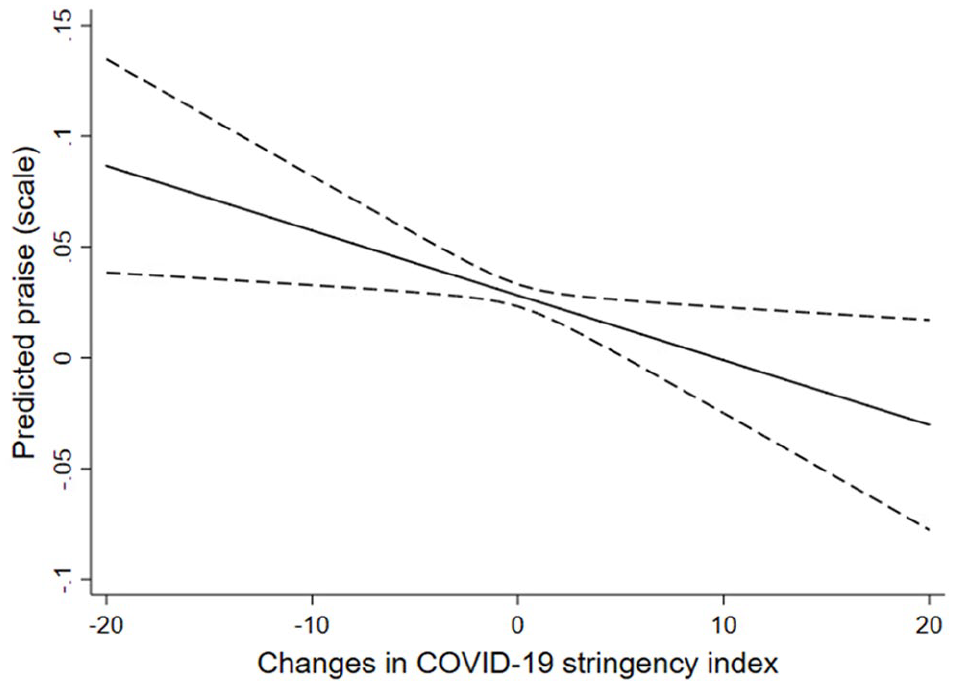
Predicted Praise for Different Levels of Changes on the COVID-19 Stringency Index Based on Model 1.
The third hypothesis explores real-world policy needs, which were quantified by the relative number of COVID-19 infections. I predicted that interest groups would employ pressure when real-world policy requirements were strategically advantageous, whereas praise would be initiated by real-world policy needs that compromised the organization’s policy objectives. Indeed, a rise in COVID-19 infections weakened pressure from the hospitality industry but pressure was reinforced when infections were lower. Figure 2 depicts the predicted levels of pressure for varying degrees of COVID-19 infections, showcasing higher levels of pressure when infections were low and lower levels of pressure when infections were high. The hospitality sector was less inclined to resort to pressure when COVID-19 infections were relatively high. Pressing the government for relaxation measures in the face of rising infection rates and fatalities would likely have resulted in a loss of credibility and reputational damage for the industry. However, when infections were low or stagnant, the hospitality sector seized the moment to pressure the government to relax its restrictions on society and the sector. As a result, H3b is corroborated by the data. Conversely, the data provide no evidence that hospitality associations employed praise to alleviate the pressure the government faced as infections surged. Hence H3a is refuted. It can be argued that praising the government in the face of high infection rates was perceived as inappropriate and inauthentic. Instead of openly praising governments to preserve the status quo and avoid stringent measures, hospitality associations opted for a silent defense of the status quo. This observation is corroborated by a positive and statistically significant correlation between the absence of hospitality associations’ communication on X and elevated levels of COVID-19 infections (r = 0.14, p < 0.01).
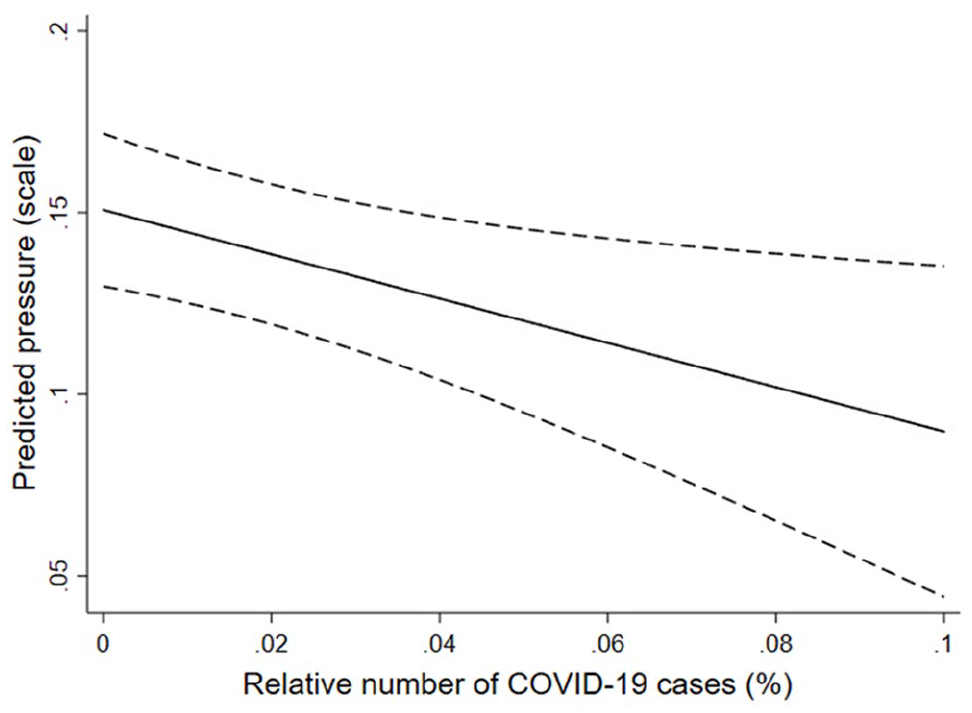
Predicted Pressure for Different Levels of COVID-19 Contaminations Based on Model 1.
Also the control variables yield interesting results. It seems that younger, less resourceful organizations are more likely to resort to praise, while older, more resourceful groups are less prone to praise their government. These findings endorse the classic membership versus influence paradigm (Bolleyer and Correa, 2022; Schmitter and Streeck, 1999): Young, forward-thinking and agile organizations with an influence-driven approach, exemplified by Matthias de Caluwe’s Horeca Vlaanderen, strategically employ praise as a pragmatic tool. Their objective is to establish a “foot in the door” with policymakers, utilizing positive reinforcement to subtly and constructively influence decision-making processes. In contrast, larger and more traditional member-oriented organizations such as Koninklijke Horeca Nederland exercise caution in adopting praise as a public strategy. The hesitancy may stem from concerns that overt praise may convey a perception of being insufficiently vigilant and critical of the state and a departure from the organization’s identity and commitment to interests of members and supporters. For larger organizations, maintaining a balance between asserting influence and upholding the expectations of their constituents becomes a more delicate yet vital consideration. While opportunity structures thus certainly inform how interest groups position themselves on social media, also an interest organization’s structure and identity inform strategic choice (Chalmers and Shotton, 2016; van der Graaf et al., 2016). Furthermore, the data reveal that pressure and praise are not opposite ends of a spectrum. Rather, hospitality organizations seem to employ pressure and praise depending on different organizational and contextual circumstances, selecting either tactic over maintaining public silence.
Conclusion
This article has investigated the conditions under which interest organizations employed pressure or praise toward their government on social media during the COVID-19 pandemic. It proposed a novel conceptual framework to understand the strategic maneuvering of interest groups. Praise, on one hand, was understood as the expression of gratitude, compliments, and endorsement of policy actions by interest groups toward their government. Pressure, on the other hand, involved the articulation of opposition, criticism, and calls for policy change toward the state. The analysis demonstrated that interest groups strategically leveraged praise and pressure on social media in response to the political opportunity structures that shaped their operating environment. This strategic approach highlighted that praise and pressure were not merely reflections of constituent interests but were employed judiciously based on the polity and policy landscape. Moreover, pressure and praise did not appear to be opposite sides of the same coin. Rather, interest organizations employ pressure and praise in different organizational and contextual circumstances, selecting either tactic over maintaining public silence.
The empirical analysis focused on the advocacy efforts of the hospitality industry on X in nine Western democracies during the COVID-19 pandemic. Data collection involved manually coding 3,897 X-posts to identify the positions and arguments expressed by hospitality associations. An exploratory factor analysis revealed three clusters of rhetorical strategies: pressure, praise, and access. The first two factors were employed as dependent variables in panel regressions to test the hypotheses. The findings demonstrate that praise is not more likely in neo-corporatist countries. Instead, it is expressed in response to favorable government policies that align with the interests of constituents. Pressure, on the other hand, is sensitive to real-world policy needs, such as COVID-19 contamination rates. It is not more prevalent in pluralist systems and is not significantly affected by policy fluctuations. The results suggest that interest groups strategically employ praise and pressure when opportunity structures are favorable, while adopting a more stealthy approach when facing unfavorable policy or real-world conditions.
This study breaks new ground in several ways. It is the first to explicitly recognize praise as an integral element of advocacy strategies and to investigate the conditions under which it emerges. While traditional interest group and advocacy literature, following Schattschneider’s approach, has primarily focused on conflict and contestation, this study highlights a different dimension of advocacy, where interest groups endorse and support favorable government policies and actions, akin to voters casting their ballots for their preferred candidates. Moreover, this study is among the first to acknowledge the significant role of real-world developments in shaping the opportunity structures within which interest groups operate. Unlike studies that have primarily focused on the internal dynamics of interest groups, this study recognizes that governments must also respond to a myriad of real-world challenges, and these external factors exert a powerful influence on how interest groups position themselves in public debates. In addition, this article contributes to the burgeoning literature on social media advocacy, building upon the work of researchers like Chalmers and Shotton (2016), Brown (2016), van der Graaf et al. (2016), Auger (2013), Guo and Saxton (2014, 2018), and Halpin et al. (2021). This study stands out by examining how the content of social media advocacy is influenced by the political and policy opportunity structures that define the advocacy landscape.
The study’s design presented a unique opportunity to test the hypotheses, focusing on the challenging context faced by the hospitality sector during the pandemic. Remarkably, this industry, even in its darkest hour, found ways to praise the government and adapt its public rhetoric to align with the prevailing policy circumstances. However, the generalizability of these findings remains limited. Future studies are needed to determine whether these results hold true for other types of organizations and across different policy domains. Research could explore the distinctions between business and civil society organizations and how politicization influences their pressure and praise strategies. This study also underscores the need for further research into how real-world problems shape interest group tactics, agenda-setting, and policy influence. Instead of operating as purely independent political actors, interest groups may serve as “gatekeepers” of real-world policy needs.
These findings carry significant normative implications. Contemporary neo-pluralist scholarship holds that interest groups play a crucial democratic role in conveying the policy preferences of their constituents and the broader public to policymakers (Albareda, 2018; Berkhout et al., 2017; De Bruycker and Rasmussen, 2021; Rasmussen et al., 2014, 2018). While this transmission, even on social media, tends to favor resource-rich insiders (van der Graaf et al., 2016), this article uncovers an additional flaw: interest groups strategically convey their societal concerns. Even if an interest group’s social media messages genuinely reflect constituent interests, the very act of expressing them is contingent upon the opportunity structures that shape those messages. While interest group representation undoubtedly has its merits in democratic decision-making, it is essential to acknowledge its biases, selectivity, and the strategic, contingent nature of this representation.
Footnotes
Declaration of Conflicting Interests
The author(s) declared no potential conflicts of interest with respect to the research, authorship, and/or publication of this article.
Funding
The author(s) disclosed receipt of the following financial support for the research, authorship, and/or publication of this article: The data collection for this article was supported by a Research Stimulation Fund (RSF) grant from FASoS—Maastricht University and a research grant from Stichting Universiteitsfonds Limburg/SWOL to Iskander De Bruycker.

Notes
Author Biography
Dr. Iskander De Bruycker is an Associate Professor in EU Politics and Policy at Maastricht University, where he currently serves as the Program Director of the MA European Public Affairs program. He is also the principal investigator of the NWO-funded VIDI project ACCESS4ALL. Iskander’s research focus spans EU lobbying, political communication, and interest group politics.