




Abstract
Previous research has found that attending university results in an individual being more socially liberal and less racially prejudiced, accounting for a variety of alternative explanations. Yet what is it about university that induces this change in political values? This is the question this article addresses, by investigating three variations in university experience – degree subject, geographic mobility and change in social context – through analysis of a British cohort study linked to Census data. Using panel estimation methods, it finds that graduates of arts, humanities and social science subjects become more socially liberal than those studying other subjects, even when accounting for institutional variation, mobility, contextual effects and time-invariant confounding. It therefore makes the case that the effect of university on political values should be considered in part a learning effect: whereby disciplines affect individuals’ worldviews during the ‘impressionable years’.
Introduction
The development of an individual’s underlying political values – stable and consistent aspects of cognition that motivate political behaviour (Rokeach, 1973; Schwartz, 1994) – is a topic of long-standing interest in political science. Recent evidence gives weight to socialisation theories: that political values are developed early on in life influenced by family, peer and institutional norms, in particular during the ‘impressionable years’ of political maturation in late adolescence and early adulthood (Neundorf and Smets, 2017), and then relatively stable from that point on (Kiley and Vaisey, 2020; Sears and Brown, 2013). For this reason – as well as the growing worldwide population with a tertiary education (Barro and Lee, 2013) and the emerging gap in political behaviour between graduates and non-graduates (Ford and Jennings, 2020) – the role of education, and higher education in particular, in developing political values is emerging as an important area of study.
There is a wealth of evidence regarding the effect of university on political values – indeed one of the earliest instances of political socialisation research consisted of a case study of the liberalising effect of attending an elite college in the United States in the 1930s (Newcomb, 1943). More recent, well-identified research using designs robust to the issue of confounding has found that increased years of education will result in an individual being less racially prejudiced, reporting less animosity to perceived racial outgroups (Cavaillé and Marshall, 2019; Gelepithis and Giani, 2021), and more socially liberal, understood as prioritising individual rights over social order (Apfeld et al., 2023; Broćić and Miles, 2021; Campbell and Horowitz, 2016). Yet few have looked at the effects of gaining a degree over the long term, using well-validated measures of political values. In addition, while there are exceptions (e.g. Mendelberg et al., 2017), there is limited research on the specific mechanisms at play in relation to the effect of university.
So what is it about university that induces this change in political values? This is the question addressed in this article, investigating variation in university experience to test competing explanations for the effect. These variations include the subject of study, the institution attended and the geographic mobility that often results from university attendance. Each of these provides a more developed understanding of the nature of the education effect, thereby contributing to our understanding of why education appears to be an increasingly important political dividing line in established democracies.
Decomposing the Education Effect
If, as previous research has generally found, selection is not enough to explain the effect of education on values, what remains? Weidman (1989) provides a framework for decomposing the various ways in which university might influence an individual’s political development, both in terms of the academic context, such as the subject of study and related curriculum content, and institutional influences. In addition, the geographic mobility often entailed by university attendance, and the resulting change in social context, could also influence an individual’s political values through exposure to new influences and norms. We will discuss these potential mechanisms in turn before describing how they will be tested in the empirical analysis.
Education Effects
Starting with factors more directly related to the university experience itself, we can begin with the learning effects of education, relating to the impact of the subject curriculum and approach to teaching. In looking specifically at the influence of higher education on economic values, and stressing the importance of ideas in this, Gelepithis and Giani (2022) call these the ‘top-down’ effects (in contrast to the ‘bottom-up’ influences of peer socialisation) and describe how these combine with the economic benefits of holding a degree to influence political values and thereby produce ‘inclusion without solidarity’.
One approach to observing the learning effects of higher education is through differences by subject while accounting for selection effects. Through analysis of British Cohort Study (BCS) data, and accounting for numerous potential confounders, Surridge (2016) finds that those who graduate in humanities and social sciences become most socially liberal between the ages of 16 and 30 as a result of their studies, while business graduates become most economically right-wing. Also looking at differential attitude change by degree subject, but this time in American college students over the course of their studies, Woessner and Kelly-Woessner (2020) find that those studying arts, humanities and social science subjects become more socially liberal and more opposed to racial prejudice (even accounting for institutional characteristics). A broader contribution in the European context (Hooghe et al., 2024) uses both cross-national and individual-level panel estimation to find that the field of education – or specifically, the relative proportion of cultural and communicative content in the subject studied – is positively associated with voting for more socially liberal parties (such as Green parties) and negatively associated with voting for authoritarian and nationalist parties. This is the case even when accounting for factors prior to and following the period of education (such as occupation), suggesting that the subject studied may be having a direct effect on political outcomes.
Peers and the institution may also play a role in secondary socialisation, as in the ‘impressionable years’ hypothesis, whereby political values (Hatemi et al., 2009) and racial prejudice (Henry and Sears, 2009) are subject to change in early adulthood when the immediate family influence is less strong. There is some evidence examining the role of peer socialisation at university directly – for example, one study (Dey, 1997) analysed this peer socialisation effect across four different cohorts of US college students (from the 1960s to the 1980s) and found consistently that students moved towards the mean political orientation of students attending the institution during their time studying there, while a study looking at a more recent cohort finds a similar effect (Woessner and Kelly-Woessner, 2020). A more robust quasi-experimental design, exploiting the random allocation of US college students as roommates (Strother et al., 2021), finds that while self-defined ideology does not change in aggregate as a result of attending university, first-year undergraduates do move closer to the ideological position of their roommates.
Yet it is difficult to tease apart the ‘top-down’ effects of subject learning and the ‘bottom-up’ influences of peer socialisation, as they often go together. However, the rich analysis by Mendelberg et al. (2017) does approach this directly. Their study examines the change in economic attitudes (measured as support for greater taxes on the wealthy) in US college students between their freshmen and senior years. It finds that the average level of affluence at the college was a powerful predictor for becoming more economically right-wing (while accounting for selection effects) and that this was more the case for those who were more socially active within the university, suggesting that peer socialisation may be having an influence. However, it also finds that those intending to major in business move more towards economically right-wing attitudes, even accounting for peer and institutional socialisation effects, suggesting a role for subject influence beyond these.
Mobility and Allocation Effects
The subject studied and the institution attended are not the only aspects of a university education that might precipitate a change in political outlook. Instead, we can hypothesise two additional dynamics: geographic mobility and geographic allocation. The relationship between geographic mobility and value change is a subject which has long received sociological attention. For example, in The Division of Labour in Society, Durkheim (1984: 240) describes how the growth of urban living and population densification may lead to a liberalisation of values, suggesting that it leads to value change through social dislocation and the breaking of existing social networks, in this way ascribing causal power to mobility itself. This is partly supported by recent empirical research (Lee et al., 2018), which found that the geographically immobile – those still resident in their county of birth – were more likely to support Leave in the United Kingdom’s referendum on membership of the European Union, perceived as the more socially conservative voting option (albeit only if their local area had experienced an increase in migration or economic decline).
This matters as a large number of those attending university in established democracies leave home in order to do so, although there is significant variation across countries. The United Kingdom remains relatively unique (alongside a handful of Northern European countries) in that tertiary education generally often means leaving the parental home and often travelling quite far afield (Whyte, 2019). In the most recent pre-pandemic academic year (2019/20), 19.3% of all HE students in the United Kingdom were living with their parents or guardians (HESA, 2021). In contrast, in the same year, 41% of American students were living in the parental home (Sallie Mae, 2019), with the European average being similar at 36% (Hauschildt et al., 2018). In this way, the United Kingdom makes for an interesting case, whereby the university experience generally still often involves being uprooted from one’s established social networks and therefore needing to form new ones in a new geographical environment.
Alternatively, mobility could lead to a change in values due to the new context in which an individual finds themselves, in a form of what Stubager (2008) calls an ‘allocation’ effect. For example, in Political Change in Britain, Butler and Stokes (1974) found that middle-class voters were more likely to support the Conservatives in areas where they were a larger proportion of the population, with this being attributed to the influence of local social networks. We can also draw on contact theory (Allport, 1979) to propose that this new social context may provide the positive intergroup contact (across social divides such as ethnicity) that has consistently been found to reduce prejudice (Pettigrew and Tropp, 2006), by taking an individual from a less to a more diverse locality. Scholars also argue that it is not only the social context that matters: the local economic picture, such as industry and employment, also influences voter behaviour (Johnston and Pattie, 2006: chap. 5). The influence of the local educational context specifically is given a unique historical perspective in analysis by Fielding (2018), finding not only that aggregate constituency attitudes are influenced by the relative size of the current university student population, but that this is in turn predicted by the presence of pre-modern educational institutions (measured as number of libraries prior to 1850). However, this contextual explanation is contested, as the observed difference may be attributable to selection effects. A longitudinal analysis estimating the extent of political contextual and selection effects on residential movers in the British Household Panel Study (Gallego et al, 2016) favours the selection explanation, finding that an individual’s partisan preference is a strong indicator of the political leaning of the area they move to, although it also suggests that the apparent effect is more likely a result of factors that correlate with both. This implies that if we limit our investigation to change within individuals (such as through panel estimation), the effects of changes in geographic context may be limited, which we will test in the empirical work to come. 1
Hypotheses
Based on this literature review, what are our expectations regarding each of these effects? First, regarding the learning effects of university, we might expect to see differences in post-graduation political values by subject grouping, with those studying arts, humanities and social sciences (AHSS) becoming more socially liberal and less racially prejudiced and those studying more technical subjects (such as science, technology, engineering and maths: ‘STEM’) becoming relatively less so. As a way of accounting for the influence of the university setting, we might also expect this subject effect to hold even accounting for variation at the institutional level. In addition, in terms of geographic mobility, we should expect those who move further away from their childhood home to demonstrate greater change in political values. Finally, in terms of geographic allocation, we have the expectation that those who move to areas that are more densely populated, particularly with more diverse, highly educated and less rural populations, become more socially liberal and less prejudiced.
These expectations can be formalised as hypotheses as follows:
H1: Liberal learning hypothesis: graduates of all subjects become more socially liberal and less racially prejudiced than non-graduates.
H2: AHSS learning hypothesis: AHSS graduates become relatively more socially liberal and less racially prejudiced compared with those of other subjects, even when adjusting for institutional, mobility and allocation effects.
H3: STEM learning hypothesis: STEM graduates become relatively less socially liberal and more racially prejudiced compared with those of other subjects, even when adjusting for institutional, mobility and allocation effects.
H4: Geographic mobility hypothesis: those who travel further away from their home county on reaching adulthood become less racially prejudiced and more socially liberal, even when accounting for degree and allocation effects.
H5: Geographic allocation hypothesis: those who, on reaching adulthood, move to more urban, cosmopolitan areas (with higher levels of population density, ethnic diversity, graduates and lower levels of agriculture) become less racially prejudiced and more socially liberal, even when accounting for degree and mobility effects.
These will be tested by applying panel estimation methods to two main sources of data. I will next describe the approach taken to the modelling and the data, before moving on to present the results.
Method
In this study, we are interested in understanding both whether the effects of gaining a degree on political values vary by subject of study (H2 and H3), and whether these differences (and by proxy the main effect of graduating (H1)) are influenced by the geographic mobility (H4) and differences in later life geographic allocation (H5) that often result from university study. Determining the causal effects of education is notoriously challenging, given a lack of randomisation and self-selection into educational pathways (Card, 1999). Yet a potential way forward is provided by leveraging longitudinal data with measures of political values before and after the educational experience of interest, as in Mendelberg et al. (2017) following the canonical approach of two-period difference-in-differences. In this approach, the estimated effect of the treatment (studying a particular subject in our case) is calculated by taking the average change in political values within individuals for each condition compared with the average change within those in the control condition. As such, all time-invariant, pre-treatment confounding is accounted for (Morgan and Winship, 2015: chap. 11).
The established approach to this estimation is to apply the two-way fixed effects (TWFE) estimator, whereby individual-level and time-period fixed effects are included alongside dummy variables for each treatment condition (Imai and Kim, 2021). However, to fully test our hypotheses, we need to extend this to account for variation at the HE institutional level, as well as the effects of time-variant covariates proxying mobility and allocation effects. As such, when fully specified we develop the following TWFE model:

Here y represents the outcome variable, while the subscripts i and t each denote individuals and timepoints. By including fixed effects for both the individual (
For some of our hypotheses (H1, H4 and H5), we are interested in how changes over time affect all individuals, whether graduates or non-graduates. In these cases, all degree subjects are modelled at once, where the control condition for the subject variable is non-graduates, and the sample is the whole population. For the differential subject hypotheses (H2 and H3) where the focus is the relative effects of the subject of study, we are restricted solely to the graduate population and estimate fully specified individual models for each degree subject grouping, where the control condition is any other degree subject.
Given the lack of as-random assignment (as in, e.g. Cavaillé and Marshall (2019)), this is not a causal estimate per se, but given it accounts for all time-invariant confounding it is far more rigorous than a cross-sectional or weighted inference approach, and has the additional benefit of estimating the effect for the whole population (rather than the treated subpopulation as in IV approaches). In addition, the simplicity of this implementation, whereby there are only two time periods, no individual is treated in the first time period, and treatment is irreversible, reduces the possibility for bias in the estimator as recorded in the recent econometric literature (Roth et al., 2023).
Data
This analysis primarily uses the 1970 BCS, supplemented with data from the UK Census on the compositional characteristics of counties where respondents were resident, to estimate contextual effects. In this section, I will first provide a brief description of the BCS and then the outcomes under investigation, before discussing in greater detail how the data is operationalised to test each of the hypotheses.
About the BCS
The BCS is a longitudinal study following those born in Great Britain during one week in April 1970 (Elliott and Shepherd, 2006), with an initial target population of 18,377, and 16,589 participants in the birth survey. The survey was originally health-oriented, but later waves included questions relating to social and political attitudes, among other topics. The study has just completed its 11th wave of data collection (the age 51 sweep), having interviewed cohort members and their parents throughout their childhood and later life. In this way, it has tracked a cohort’s development over time, enabling the study of various life-course phenomena without the reliance on participants’ recall.
Outcomes
The outcomes under study in this analysis are an individual’s social liberalism and racial prejudice, chosen both for their demonstrated prior relationship with education (Scott, 2022) and their relevance to contemporary political behaviour in Britain (Fieldhouse et al., 2020: chap. 9; Sobolewska and Ford, 2020). Indeed, these more ‘cultural’ values sit at the core of the ongoing realignment of political competition in Western Europe and beyond, driving the rise of radical right and socially liberal, Green parties on either side of the new divide (Hooghe et al., 2002; Kitschelt, 1994). Here social liberalism is understood as a preference for prioritising individual liberty over social order (Evans et al., 1996), while racial prejudice is defined as animosity to perceived racial outgroups (Kinder and Kam, 2010).
In accordance with our estimation strategy, the analysis is restricted to only those items asked in the survey waves prior to and following university attendance, at the ages of 16 and 30, respectively. 2 While there are a range of items tapping these constructs in both of these waves (Cheng et al., 2012), there is only one topic covered at both age points for each outcome: social liberalism is captured by opposition to the death penalty, while racial prejudice is proxied by opposition to interracial marriage. As such, these items are taken forward as the measures for each political values outcome in the analysis to come, with descriptive statistics presented in Appendix 1 of the Supplementary Material. To aid with interpretation and comparison across the different outcomes, prior to the modelling these items are standardised at both timepoints to have a mean of zero and a standard deviation of one.
Degree Subject and HEI
Testing the learning hypotheses requires a measure of subject studied at university. Cohort members were asked about this in both the age 30 and 42 waves of the cohort study. At age 30, this was presented as an open response question, which for the purposes of this analysis was coded against the 165 JACS principal subject codes (HESA, 2020) through a combination of fuzzy text matching (using the fuzzyjoin package in R; Robinson et al., 2020) and hand-coding, with 286 observations coded manually. At age 42, degree subject was recorded in a 50-level categorical variable – these were matched to a selection of the same 165 JACS subject areas as previously.
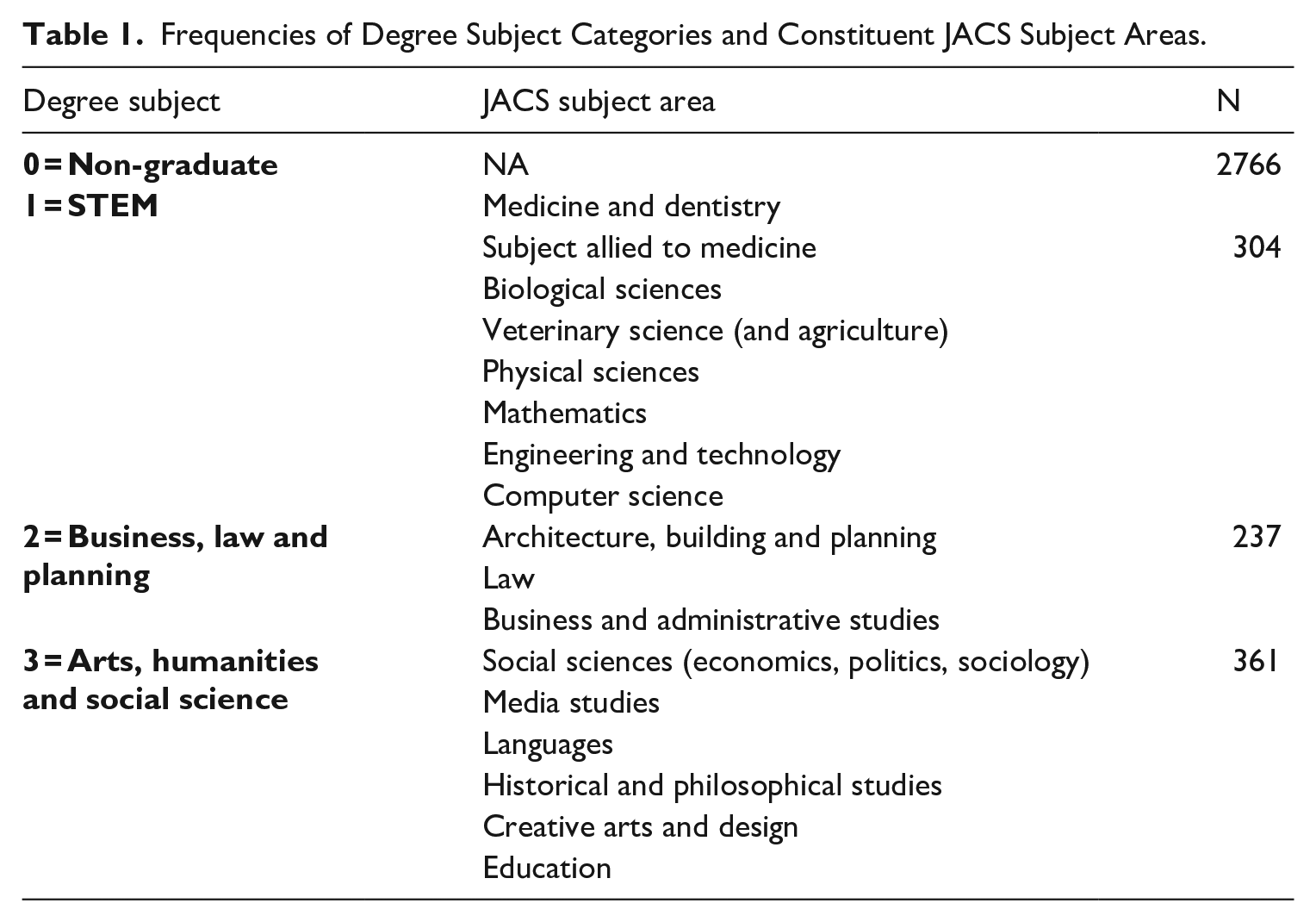
These were then combined to form one variable, where, conditional on the respondent having a degree at age 30 (whether reported at that age or in the age 26 sweep), any missing values in the age 30 data were replaced by the age 42 data, to ensure maximum completeness. In total, 115 distinct subject areas (e.g. botany or civil engineering) are represented among cohort members who were graduates at the age of 30. This was then further classified based on the JACS coding to the 19 subject areas and then to 3 categories (plus a residual ‘other’ category) based on proximity within the JACS schema (as presented in Table 1): STEM; business, law and planning and AHSS. This aggregation is necessary to provide a sufficient sample size for each group, with the balanced panel sample size for each treatment group at the age of 30 (as all are non-graduates at 16) presented in Table 1. Within our sample, 34 respondents named more than 1 subject across these categories, perhaps because they obtained a joint honours degree. In these cases, the first subject mentioned was coded as their primary subject, while the second subject is used instead in an alternative measurement presented as a robustness check in Appendix 4 of the Supplementary Material.
Frequencies of Degree Subject Categories and Constituent JACS Subject Areas.
In addition, we seek to test these hypotheses while accounting for the effects of HE institution, to proxy for the varying peer environment across different universities. Cohort members were asked to name the institution from which they received their degree in the age 42 survey of the BCS. This data was coded into a 166-level categorical variable, for which there were observations for 123 institutions in the final balanced panel. It includes all types of degree-awarding HEIs, including those which did not have university status at the time when respondents were studying (such as polytechnics and technical institutes, which in the United Kingdom formally became universities in 1992; see Mandler, 2020 for more on this). Given the preponderance of HEIs and the resulting small sample size for each category, main effects are not reported for these, with their inclusion as fixed effects in the modelling serving to account for any variation attributable to them.
Geographic Mobility and Allocation
From the BCS, we can develop geographic measures for each cohort member’s mobility between the ages of 16 and 30 and subsequent allocation based on the changes in the characteristics of the areas. To quantify this, special licence data recording each individual’s county of residence at these waves was accessed via the UK Data Service. Specifically, in England and Wales, this records the county of residence based on the schema used in the 1981 Census, which roughly corresponds to the historic counties. For those in Scotland, the recorded geography is based on the districts used in the 1981 Census. This leads to geographical units of varying size in terms of both territory and population, particularly in Scotland, where the units tend to be smaller than those in England and Wales (although not significantly so, see maps in Appendix 1). 3 Our measure of distance travelled was calculated by measuring the distance between the counties where each respondent was residing at 16 and 30, based on the county shapefiles available from the UK Data Service (and using the sf package in R (Pebesma and Bivand, 2023) to perform the calculation). In this way, if an individual stayed in the same county or moved only to a neighbouring one, the distance travelled was recorded as zero, but in any other case, it was measured as the shortest straight-line distance between the two counties.
To provide contextual measures to test the geographic allocation hypothesis, a respondent’s county at both age points was linked to summaries of Census data at the same level of geography, produced using the nomisr package in R (Odell, 2018) by aggregating from wards to the geographies available in the BCS. As the UK Census is carried out only every 10 years, data from 1981 is used for the age 16 wave, while 2001 data is used for the age 30 wave. I use the following Census measures which are broadly consistent over time to proxy for more urban, cosmopolitan areas likely to induce a more socially liberal, less prejudiced outlook: population density (measured as usual resident population per hectare); proportion of usually resident population who are non-UK born; proportion with degrees or equivalent professional qualifications; and proportion working in agriculture (as a proxy for rurality). Given our estimation strategy, the effects of these are estimated as change in these variables at the individual level – that is an individual could stay in the same county, but might still see change in these variables over time due to change in their locality. Descriptive statistics and choropleth maps for these measures are presented in Appendix 1 of the Supplementary Material. To both normalise by time period and aid with interpretation, these items (as well as distance travelled) are all standardised to have a mean of zero and a standard deviation of one for use in the modelling.
Missing Data
As a longitudinal cohort study, the BCS suffers from attrition, as well as differential response within waves. The result is that response rates decline over time, so that fewer cohort members responded to the age 30 survey than did the birth wave. In addition, some waves (and items within waves) experience particular issues: for example, the age 16 wave received relatively fewer responses than might otherwise be expected based on chronological order, in part due to a teacher’s strike during fieldwork (Mostafa and Wiggins, 2014). The result is that the inclusion of variables dependent on those waves in models leads to a reduced sample. This attrition is addressed using multiple imputation, to test whether the observed results are driven by differential missingness, as presented alongside the main results. The imputation was performed using the mice package (van Buuren and Groothuis-Oudshoorn, 2011) following the approach recommended by the Centre for Longitudinal Studies, who are the custodians of the BCS data (Silverwood et al., 2020), with more detail available in Appendix 2 of the Supplementary Material. While I will discuss each case in turn in the results section, in general, the estimated coefficients do not change significantly between the analysis of complete case and multiply imputed datasets, with results only becoming more precise, generating confidence that the findings are not driven by differential missingness.
Results
We can now move on to present the results of the analysis (carried out in R using the fixest and modelsummary packages; Arel-Bundock, 2022; Bergé, 2018), starting with an examination of these effects among the whole population. Figure 1 presents coefficients for each of the independent variables of interest in the fully specified version of the model set out previously, with both the complete case and multiply imputed samples presented. In addition, Figure 2 presents the estimated marginal means by age and degree subject from the complete case model, to provide a sense of the different trajectories of these groups over time. Recall that this model includes individual and timepoint fixed effects (presented as ‘age’ as this is collinear with time in cohort data), as well as fixed effects for HE institution. Here the reference category for degree subject is non-graduates. Full results, including simpler specifications presenting only the bivariate effects of degree subject, are presented in Appendix 3 of the Supplementary Material – however, the effect of degree subject does not vary especially based on the inclusion of covariates. As the outcome variables are standardised, the coefficients represent standard deviations, while the confidence intervals are calculated at the 95% confidence level with the standard errors clustered by individual.
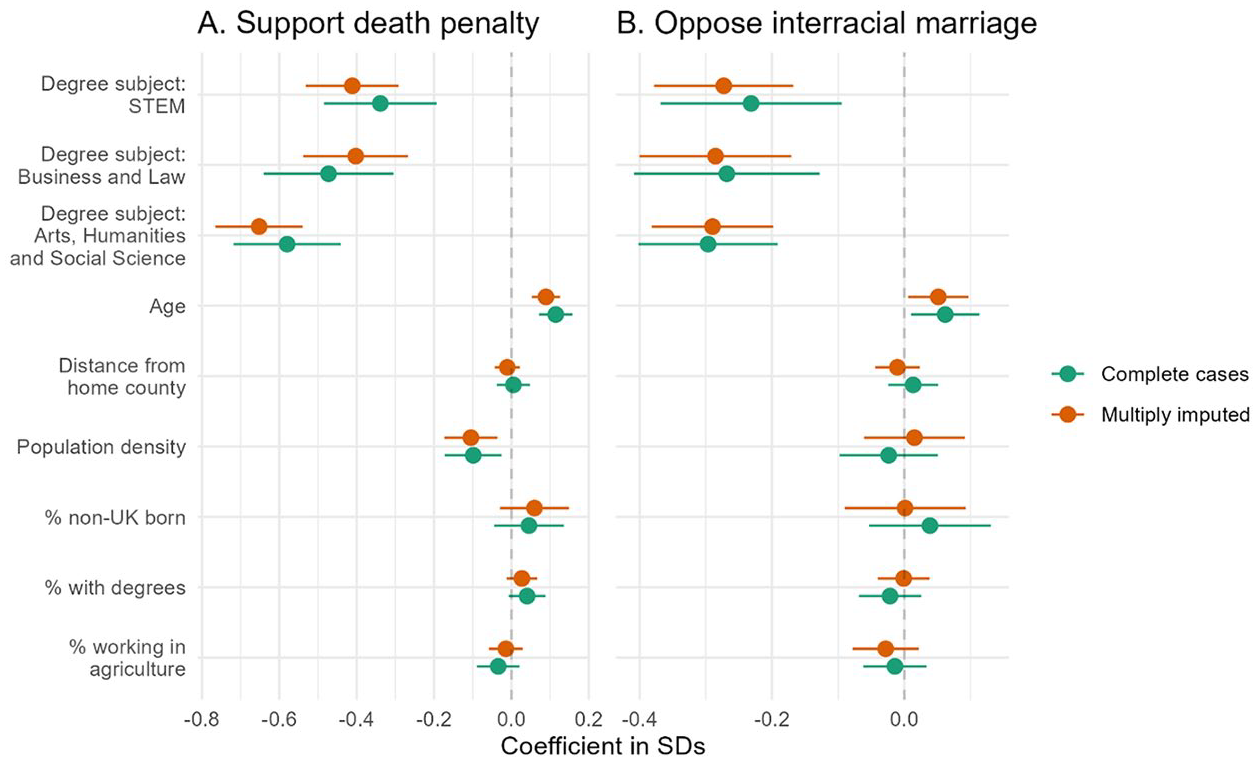
Effects of Degree Subject, Geographic Mobility and Allocation on Political Values.
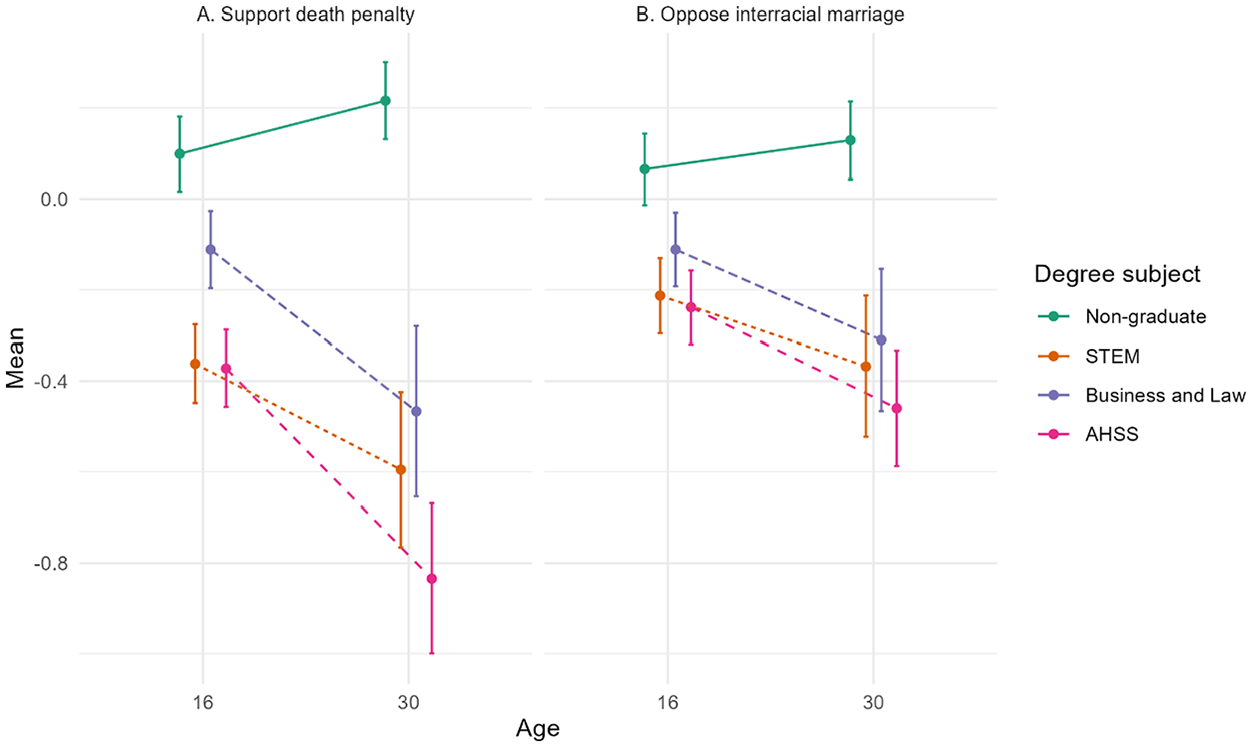
Estimated Marginal Mean Outcomes by Degree Subject and Age.
Learning Hypotheses
As a reminder, the liberal learning hypothesis (H1) set the expectation that all graduates become more socially liberal and less racially prejudiced no matter their subject of study, and we find evidence in support of this from our modelling as presented in Figures 1 and 2. In the case of death penalty support in particular (panel A), graduates of all subjects become more socially liberal than non-graduates, even when accounting for institution and geographic factors, and this is consistently the case for both the complete case and multiply imputed estimates. These are notably large effects – with AHSS graduates in particular seeing a reduction in death penalty support around 0.6 SD larger than that of non-graduates. For racial prejudice (panel B), the effects are smaller (around 0.3 SD) but consistent across the two data models, with graduates of all subjects becoming less prejudiced and very little to choose from between the subject groupings. Figure 2 provides greater detail on these dynamics, showing clearly that while there are some differences in the outcomes between the groups already present at the age of 16, graduates and non-graduates move in starkly different directions over time. This overall means that we can accept H1, albeit more strongly for social liberalism than racial prejudice.
Having reviewed these effects at the whole population level, we can now focus on the graduate population to review the differential effects of degree subject and thereby test our subject-specific hypotheses more directly. Figure 2 provides an illustration of these relationships, where we see substantial variation by subject grouping in terms of death penalty support, with those studying AHSS subjects becoming particularly strongly opposed when compared with those studying other subjects. However, more closely specified models featuring direct tests of the differences between subjects are presented in Figure 3, where the population is restricted to those who have a degree at the age of 30, and the reference category for each estimate of the subject effect is graduates in any other subject. The first of our subject-specific hypotheses, the AHSS learning hypothesis (H2), proposes that graduates in arts, humanities and social science subjects become more socially liberal and less racially prejudiced compared with other graduates. This is supported in the case of social liberalism, as AHSS graduates become statistically significantly less likely to support the death penalty than other graduates across both the complete case and multiply imputed samples. However, this is not the case for racial prejudice, where there are minimal differences between subjects, meaning that the AHSS learning hypothesis (H2) is only supported in part.
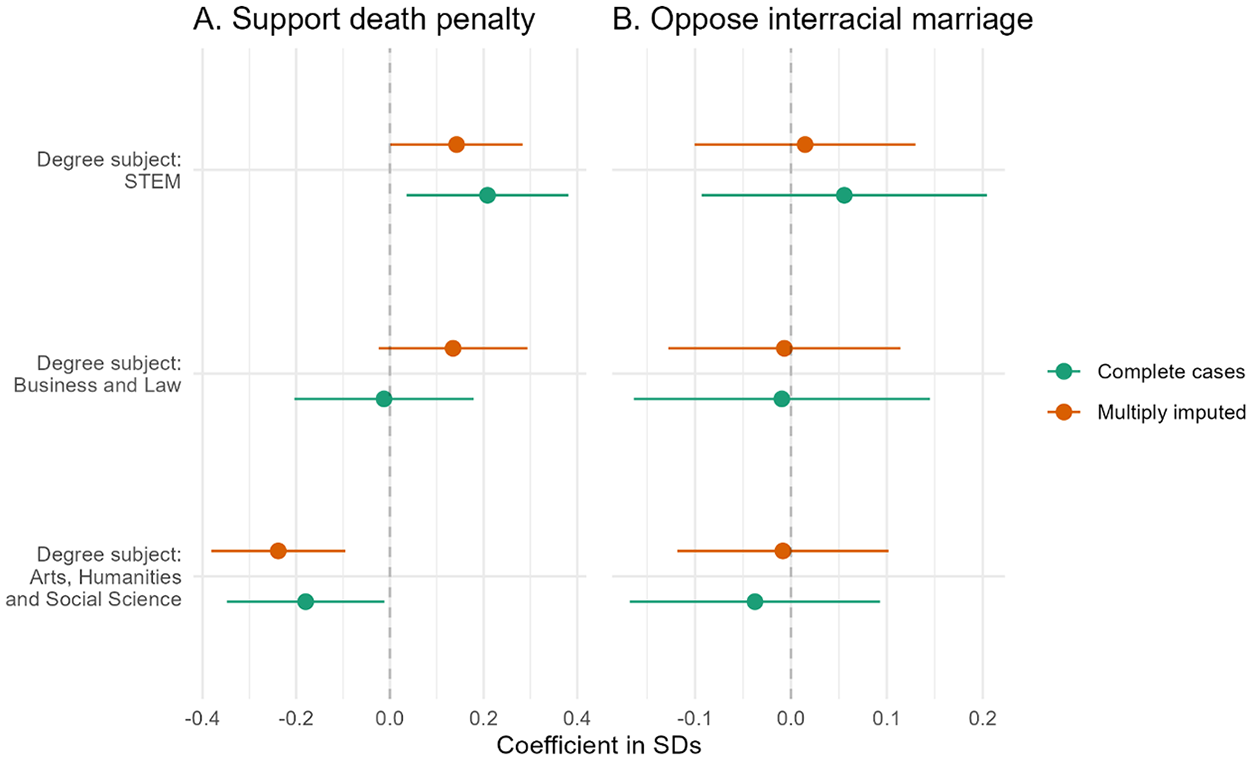
Differential Effects of Degree Subject on Political Values, Graduate Subsample.
With reference to the STEM learning hypothesis (H3), which proposes the converse relationship whereby graduates in STEM subjects become relatively more socially conservative (or as we saw in Figure 2, have a weaker socially liberalising trajectory than those studying other subjects such as those in AHSS), we find the same pattern reflected. Graduates in STEM become less socially liberal when compared with other graduates, with this relationship being significant at the 95% confidence level for both data models, while the lack of differentiation by subject of the effect of gaining a degree on racial prejudice persists. Therefore, as with H2, the STEM learning hypothesis (H3) is only partially supported. Finally, while, in both cases, this subject difference in the effect on death penalty support appears reasonably sized – in the AHSS case, it represents a difference of about 0.2 SD in the outcome or about a third of the overall effect of gaining a degree – it is not especially statistically significant in the complete case analysis, with a p-value only just below the conventional 0.05 threshold. As the multiply imputed estimates suggest, some of this might be driven by issues with statistical power, but even there the difference by subject is only significant at the 0.01 level. There is also some variation across data models which should be considered, with those studying Law and Business appearing to be particularly subject to differential missingness, as the multiply imputed estimates suggest that they become less socially liberal than otherwise thought. This should all be borne in mind in the interpretation: while we do find significant differences by subject, enhanced samples of graduates might demonstrate this more clearly.
Geographic Hypotheses
Next, we can move on to evaluate our geographic mobility (H4) and geographic allocation hypotheses (H5), by looking at the effects of distance travelled and change in social characteristics of the local context in the estimation. While the whole population results presented in Figure 1 provide tests of these while also accounting for degree status, Figure 4 presents these effects prior to the inclusion of the degree variable, to provide a fuller sense of their influence, with full results again available in Appendix 3.
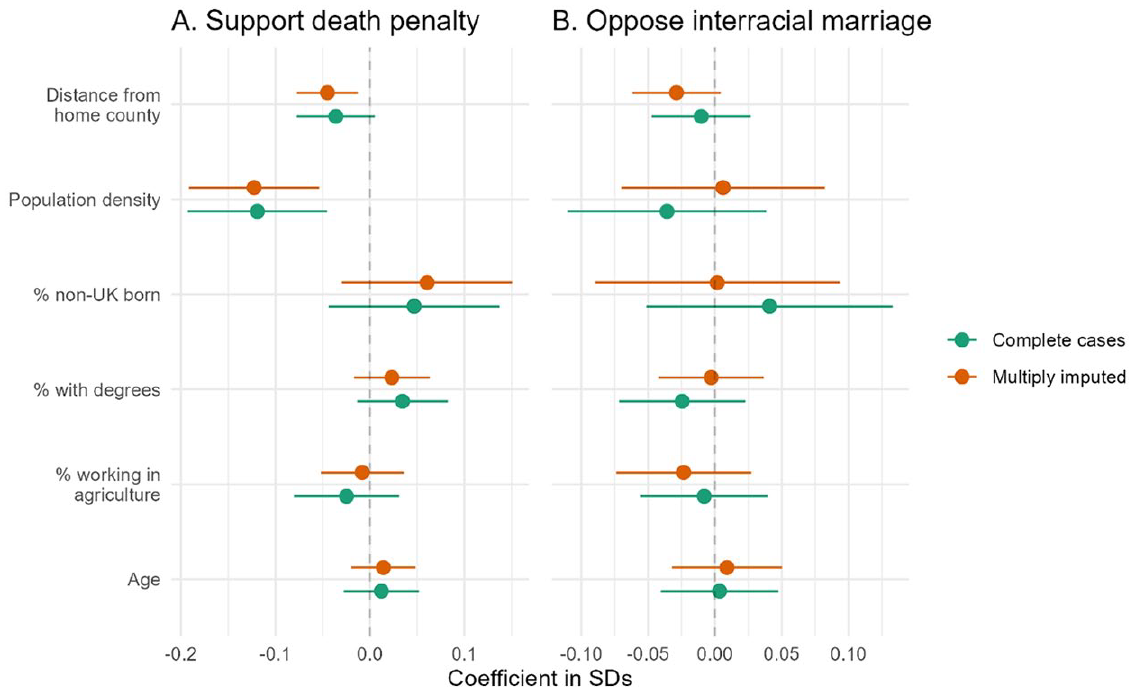
Effects of Geographic Mobility and Allocation on Political Values, Without Adjusting for Graduate Status.
To begin with geographic mobility (H4), we find a weak but statistically significant relationship between distance travelled from one’s home county at 16 and opposition to the death penalty, even when accounting for change in the local area’s characteristics. However, when we additionally control for gaining a degree (as shown in Figure 1), we find a null effect for both outcomes (and both data models), such that mobility does not appear to have an influence in addition to becoming a graduate on either death penalty support or opposition to interracial marriage. Therefore we can reasonably confidently reject this conditional hypothesis (H4), as the effect appears to be explained by gaining a degree and not mobility itself. Moving on to discuss geographic allocation (H5), we find that most of the contextual factors included similarly show null effects across the different outcomes, specifications and data models – there is apparently no effect of change in proportion of people born outside the United Kingdom, graduates or agricultural workers in one’s local county on these political values measures. However, there is one exception to this: an increase in population density has a small but statistically significant liberalising effect (even when adjusting for gaining a degree as in Figure 1), making an individual less likely to support the death penalty. This is true for both the complete case and multiply imputed sample, but is not the case for our measure of racial prejudice. In this way, the geographic allocation hypothesis (H5) is partly supported.
Discussion
By exploring variation in university experience, this article extends the previously developed understanding of the relationship between acquiring a university degree and political values. It tests a number of plausible hypotheses for the effect of university on values, demonstrating some of these effects in Britain for the first time.
The main contribution is the finding of a differential effect of degree subject on the effect of university on political values. Even accounting for time-invariant confounding, institutional effects and the influence of geographical factors, those who study arts, humanities and social science (AHSS) subjects become significantly more socially liberal (as measured by opposition to the death penalty) than those who study other subjects. The same pattern is evident in reverse for STEM graduates, who demonstrate a weaker liberalising effect when compared with other subjects. This is contextualised by the finding that all graduates become more socially liberal than non-graduates, implying that subject acts as a moderator of this effect: while all graduates become more opposed to the death penalty, the effect is almost twice as strong among AHSS students. This provides evidence for a learning effect of higher education, reinforcing previous literature on the topic (Hooghe et al., 2024; Mendelberg et al., 2017) that has suggested that at least part of the aggregate difference in political values we see between graduates and non-graduates is attributable to what is learned during higher education, as opposed to just selection effects or other influences attributable to university.
Understanding this differential effect of subject studied on political values is important, as not only is higher education participation expanding in much of the world (Barro and Lee, 2013), but also the mix of subjects studied is changing as a result of policy pressure, economic signals and individual preferences. For example, in the UK context under study in this analysis, there has been significant growth since 2019 in those studying business and computing, and large declines in those taking foreign languages, and historical and philosophical studies (HESA, 2023). If this change in the subject mix towards STEM and business and away from AHSS subjects continues, then we may see an overall reduction in the liberalising effect of university, with implications for the currently significant educational polarisation around the ‘cultural’ dimension of politics.
However, this finding is tempered both by somewhat small differences by subject on the death penalty outcome (if we judge it by the null hypothesis test results, which may be influenced by sample size) as well as the lack of a difference between graduates of different subjects in terms of reduction in racial prejudice: all graduates seem to have a small reduction in prejudice, and this is not stronger for the subjects that demonstrate a stronger effect on our other outcome, as was hypothesised. This latter highlights the importance of how concepts such as social liberalism are operationalised, as divergence in conclusions around the effect of degree subjects and university more generally (Apfeld et al., 2023; Simon, 2022) may in part be due to different ways of measuring this and related constructs (such as gender equality, social morality, religiosity, environmentalism etc.). Based on the evidence presented here, it seems as though university study (and AHSS subjects in particular) are particularly influential on those aspects of political values which relate to individual liberty and the state’s right to impose social order (as proxied by death penalty support), but less so (although still influential) on ethnocentrism. However, future work looking at this relationship with an enhanced sample of graduates for whom we have repeated measures of a wider range of political values measures would certainly add to our understanding of this question.
In addition, it is notable that for the most part, the hypothesised geographic explanations do not hold a great deal of explanatory power. Mobility measured as distance travelled between county of residence at 16 and 30 is not influential on either of our outcomes. While the same is true for the change in composition of the local area (whether proportion who are graduates, non-UK born or working in agriculture), change in population density does have an effect: an increase in local population density leads to increased social liberalism, even accounting for time-invariant confounding, the effect of gaining a degree and other geographical factors. It is therefore possible that this is partly proxying the effect hypothesised by Durkheim: that moving to and living in more urban areas in itself leads to a more cosmopolitan and individualist outlook, due to greater mixing with others and encountering a wider range of worldviews, aside from any other concomitant influences. However, it is perhaps surprising that the local population characteristics do not demonstrate stronger effects given the wider literature on contextual effects in political science discussed in the literature review. This is particularly true for the null effect of local diversity (measured as change in proportion of residents not born in the United Kingdom) on racial prejudice, given the strength of the evidence supporting social contact theory (Pettigrew and Tropp, 2006). Yet it may just be that when comparing change within individuals over time as done here, versus some of the pre-existing more cross-sectional analyses, these contextual effects do not hold up (in line with Gallego et al., 2016), while in turn the lack of a social contact effect could be explained by a lack of mixing between groups even in these more diverse areas, given that increased diversity does not necessarily entail increased mixing (Ramiah et al., 2015).
The cohort data analysed here provides a valuable longitudinal lens on the development of an individual’s political values, and the influence of university attendance in this process. However, in order to draw wider conclusions, future research should seek to generalise to the wider population beyond the cohort studied so far, as well as develop richer data to explore the within-university mechanisms in greater detail. It is not possible with this data to fully tease apart the effect attributable to the subject content and that of fellow students’ values – as it may be the case that those with certain values select onto particular courses and mutually reinforce one another’s value change. An approach to address this could take the form of a multi-country replication of the in-depth panel surveys of staff and students from the US literature (Dey, 1997; Mendelberg et al., 2017), which would reveal which relationships hold across settings, and which are specific to different political and educational contexts. For example, the subject effects found here could be particular to the British tendency to specialise relatively early on in one’s educational journey.
Much of the previous literature investigating the effects of university on values – with some notable exceptions (Gelepithis and Giani, 2022; Hooghe et al., 2024) – tends to underestimate the importance of subject of study. However, this analysis shows that this misses an important part of the story. I show differences between graduates in the extent of change in political values by degree subject, even accounting for competing explanations including time-invariant confounding, institutional variation and geographic influences. This matters as not only are more people going to university, but what they are studying is changing, which has implications for the significance of higher education in structuring future political preferences. This analysis therefore makes the case that the effect of university of political values should be considered at least in part a learning effect: whereby differing disciplines affect individuals’ worldviews during the ‘impressionable years’.
Supplemental Material
sj-pdf-1-psx-10.1177_00323217241266029 – Supplemental material for Why Are Graduates More Socially Liberal? Estimating the Effect of Higher Education on Political Values Through Variation in University Experience
Supplemental material, sj-pdf-1-psx-10.1177_00323217241266029 for Why Are Graduates More Socially Liberal? Estimating the Effect of Higher Education on Political Values Through Variation in University Experience by Ralph Scott in Political Studies
Footnotes
Acknowledgements
The author thanks Rob Ford, Ed Fieldhouse, Paula Surridge, Rosie Shorrocks, Jack Bailey, Nicole Martin, Jon Mellon, Chris Prosser and Phil Swatton, as well as colleagues at the 2021 EPSA and EPOP annual conferences, and two anonymous reviewers, for their valuable feedback.
Declaration of Conflicting Interests
The author(s) declared no potential conflicts of interest with respect to the research, authorship and/or publication of this article.
Funding
The author(s) disclosed receipt of the following financial support for the research, authorship and/or publication of this article: Support for this research was provided by the Leverhulme Trust and the Economic and Social Research Council through the North-West Social Science DTP (grant no. ES/P000665/1) and WISERD (grant no. ES/S012435/1).

Supplemental Material
Additional Supplementary Information may be found with the online version of this article.
Appendix 1: Descriptive Statistics
Table A1: Descriptive Statistics for Variables Used in the Analysis
Figure A1: Differences in the Means Between Non-graduates and Graduates of Different Subjects at 16 and 30
Figure A2: Choropleth Maps of Geographic Measures From the 1981 Census
Figure A3: Choropleth Maps of Geographic Measures From the 2001 Census
Appendix 2: Data Missingness and Multiple Imputation
Figure A4: Proportion of Observations Missing by Variable and Type
Appendix 3: Full Results
Whole population analysis
Table A2: Regression Results for Death Penalty Outcome, Complete Case Data
Table A3: Regression Results for Death Penalty Outcome, Multiply Imputed Data
Table A4: Regression Results for Interracial Marriage Outcome, Complete Case Data
Table A5: Regression Results for Interracial Marriage Outcome, Multiply Imputed Data
Graduate Population Analysis
Table A6: Regression Results for Both Outcomes, Complete Case Data
Table A7: Regression Results for Both Outcomes, Multiply Imputed Data
Geographic Variables Only
Table A8: Regression Results for Both Outcomes, Complete Case Data
Table A9: Regression Results for Both Outcomes, Multiply Imputed Data
Appendix 4: Extensions and Robustness Checks
Socio-economic Allocation
Table A10: Regression Results for Death Penalty Outcome Accounting for Adult Income
Table A11: Regression Results for Interracial Marriage Outcome Accounting for Adult Income
Alternative Handling of Joint Honours Degrees
Table A12: Regression Results for Both Outcomes for Graduate Population Analysis, Complete Case Data, Using Alternative Measure of Degree Subject
Scotland and Mobility Interaction
Table A13: Mobility Effects When Interacted With Scotland Residence for Both Outcomes
Notes
Author Biography
References
Supplementary Material
Please find the following supplemental material available below.
For Open Access articles published under a Creative Commons License, all supplemental material carries the same license as the article it is associated with.
For non-Open Access articles published, all supplemental material carries a non-exclusive license, and permission requests for re-use of supplemental material or any part of supplemental material shall be sent directly to the copyright owner as specified in the copyright notice associated with the article.
