




Abstract
Political authenticity is connected to higher levels of political trust from electorates and can influence political outcomes, but it is often overlooked as a relevant factor for electoral behavior. To date, discussions of how authenticity appears and changes in politics typically remain at the theoretical level and are rarely comparative. This article develops a framework to identify and compare how authenticity is performed in political discourses over time and across settings by politicians. To demonstrate the usefulness of the framework, this article investigates authenticity performances in 21,496 political texts of electoral debates, interviews, campaigns, and official speeches by presidents and presidential candidates in Brazil and the United States since 1988. The findings indicate that authenticity is generally performed with greater frequency by presidents and presidential candidates in Brazil than in the United States, though authenticity performances are not more prevalent during election years in either country.
Introduction
Political authenticity, as the perceived degree to which politicians appear to remain true to themselves (Luebke and Engelmann, 2022), is connected to higher levels of political trust from electorates (Stiers et al., 2021; Valgarosson et al., 2021) and is essential for a candidate’s success (Alexander, 2010; Fordahl, 2018). Perceptions of authenticity inform electorates about how politicians might act in contexts where the public is absent, giving them a compelling reason to choose certain politicians (Jones, 2016). Yet, authenticity is frequently overlooked as a determining factor in electoral behavior, for being deemed vague and contradictory as a concept (Varga, 2013). To date, discussions of how, when, and where authenticity appears and changes in politics usually remain at the theoretical level and are rarely comparative. This article develops a framework to identify and compare how authenticity has been performed in politics over time and across settings by politicians.
Authenticity is an integral part of a successful performance and is constantly performed in politics. Politicians perform authenticity discursively to connect with audiences by telling personal stories about their childhood, building narratives around how coherent they are as individuals and policymakers, alluding to civic traditions, and using “vulgarism,” among others (Alexander, 2010; Fordahl, 2018; Luebke, 2021; Seifert, 2012). By grouping these performances according to theorized pathways through which they work to produce authenticity perceptions, it is possible to systematically detect discursive patterns associated with them. Authenticity performances are broadly divided into two categories: about the self or about belonging. The former derives plausibility from the political performers themselves and includes claims of truth-telling, accusations that others are lying, accounts of taking responsibility for one’s actions and pointing fingers at others’ mistakes. The latter derives plausibility from the shared cultural knowledge connecting politicians and audiences. These performances include references to politicians’ origins, allusions to common sense, assertions of territorial knowledge, and anti-politically correct (PC) discourses. 1 The framework developed in this article provides various discursive displays associated with each of these authenticity performances.
To demonstrate the usefulness of the framework, this article investigates authenticity performances in 21,496 political texts of electoral debates, interviews, campaigns, and official speeches by presidents and presidential candidates in Brazil and the United States since 1988. Authenticity performances are identified using a purpose-built dictionary of terms that automates the coding of the displays associated with each performance theorized by the framework. The two cases, Brazil and the United States are federal presidential democracies in which presidents formally and informally shape the public policy agenda (Pereira et al., 2008; Morgenstern et al., 2013). However, Brazil’s extremely fragmented multi-party system stands in sharp contrast to the two-party system in the United States (Baker et al., 2020; Mainwaring, 1991, 1999). While there are geographical, historical, and cultural similarities between Brazil and the United States, each country’s unique political and economic history led to important societal differences that have implications for political discourses (see Marx, 1998).
The findings indicate that authenticity is generally performed with greater frequency by presidents and presidential candidates in Brazil than in the United States, though authenticity performances are not more prevalent during election years in either country. Brazil’s party fragmentation and weak partisanship provide incentives for presidents and candidates to display autonomous behavior that includes talking more about themselves rather than their party and, therefore, performing authenticity more frequently in comparison to the United States, where presidents and candidates are more effectively constrained by their parties. In both countries, debates have recently become the setting in which authenticity is performed most frequently by presidents and candidates, whereas interviews are the setting in which authenticity is performed least frequently. Debates are large-scale media events that produce “sticky” sound and visual bites charged with imagery that circulates more than ever in democracies. Social media platforms give presidents and candidates diverse outlets to interact directly with audiences, bypassing journalists in interviews. Moreover, presidential candidates in the United States perform authenticity more frequently than sitting presidents—to attract national attention and secure party nominations—whereas, in Brazil, authenticity is not performed at significantly different rates by elected presidents or presidential candidates. In both countries, however, presidents in office focus on performing only the authenticities that work best for them, while candidates are more diverse in how they perform authenticity.
This article lays down the foundations for comparative research on authenticity in political discourses. Conceptually, this article provides a framework for identifying and comparing diverse performances of authenticity in politics. Empirically, besides the sizable datasets of political texts by presidents and presidential candidates, this article provides the first comparative overview of how, where, and when authenticity has been performed by presidents and candidates in Brazil and the United States since 1988. In what follows this article is organized into four sections. The theoretical section discusses the literature on authenticity and performance in politics and presents the authenticity performance framework. The methodological section examines the comparison between Brazil and the United States and describes the data-gathering process and operationalization of the framework. The analytical section provides a visual and descriptive review of the findings. The article concludes by discussing the implications of using the authenticity performances framework and offers directions for further research.
Theory
Performing Authenticity in Politics
Democracy entails an institutional arrangement in which few individuals “acquire the power to decide by means of a competitive struggle for the people’s vote” (Schumpeter, 1976: 269). Electoral rules and social heterogeneity influence politicians’ behaviors (Grofman, 2004; Neto and Cox, 1997; Samuels and Shugart, 2010). Electoral systems with multiple parties and where the head of government is directly elected can, for example, be more conducive to autonomous behavior by politicians that differs from that of their parties (Mainwaring and Shugart, 1997). However, politicians can also act autonomously in two-party or proportional representation systems (Riker, 1982), particularly in cases where parties become organized around a single politician (Garzia et al., 2022). This means politicians’ behavior varies beyond the electoral systems and institutional environment they take part in Grofman (2004) and Siavelis and Morgenstern (2008) or the public policy positions they hold (Grofman, 2004; Nai et al., 2021). To be elected or remain in power, politicians must convince electorates that they will somehow represent them in office. 2 Politicians employ several material and discursive strategies to attract and maintain electoral support. These strategies range from producing television commercials and directing regional investments to making campaign promises and bonding with electorates. Many of these strategies can be contradictory and do not have direct policy implications but, nonetheless, matter for electoral outcomes.
Political discourses are fundamental to establish a connection between politicians and electorates, yet we know little about how politicians relate to electorates when speaking to them (see Lobo and Curtice, 2014). Political scientists regularly investigate how argumentative logics and issue framings persuade, or not, electorates on specific public policy issues (see Leruth and Taylor-Gooby, 2019; Schmidt, 2001, 2002). Since political arguments are complex and heterogeneous, other factors beyond the substance of the argument itself typically determine which arguments influence public opinion on various policy issues (Blumenau and Lauderdale, 2024). Beyond basic demographic characteristics such as age, gender, and race, political scientists have largely sidelined, for instance, how perceptions of politicians’ personalities matter for public opinion, engagement, and electoral decisions (Greenstein, 1992; Hibbing et al., 2011; Valgarosson et al., 2021). Even when political scientists look at perceptions of politicians’ personas, they usually do so for a single politician over time or focus exclusively on politicians’ competencies (see Catellani and Bertolotti, 2015; Cwalina and Falkowski, 2016). The personification of political parties and the increased attention audiences pay to the private lives of politicians, changed politicians’ relationships to electorates by making the political construction and perception of personality essential to electoral outcomes (Catellani and Bertolotti, 2015; McAllister, 2007; Seifert, 2012).
Being perceived as authentic helps politicians build political trust by demonstrating to electorates that they are in touch with ordinary people and their struggles (Stiers et al., 2021; Valgarosson et al., 2021). Taylor (1992) argues that authenticity is a modern ideal related to being in touch with one’s “original” inner self and achieving self-fulfillment. The modern ideal of authenticity also generates a widespread fear of the “replica,” the inauthentic (Varga, 2013). Authenticity, albeit frequently sidelined by social scientists for being considered contradictory and vague as a philosophical concept, shapes how we relate to ourselves, our goals, and others (Taylor, 1992; Varga, 2013). In politics, authenticity concerns appearing coherent with individual or societal values (Fordahl, 2018; Stiers et al., 2021; Valgarosson et al., 2021). Hence, political authenticity is understood as the perceived degree to which politicians appear as being and remaining true to themselves (Luebke and Engelmann, 2022). 3 Perceptions of authenticity inform electorates about how politicians might act in contexts where the public is absent and unable to influence decisions, giving them a compelling reason to choose certain politicians (Jones, 2016). This does not mean authenticity is static or constant in politics. Rather, authenticity is a malleable performance that demands constant contortion, adaptation, and repetition (Fordahl, 2018). Authenticity, therefore, is an integral part of a successful performance and is constantly performed in politics.
Performances are the projections of a situation when one appears before others who, “however passive their role may seem to be, will themselves effectively project a definition of the situation by virtue of their response to the individual” (Goffman, 1956: 3). Performances allow us to theorize that an audience’s interpretation hinges on factors beyond discursive content or a specific interpretation of message meaning, such as how things are said (Alexander, 2011; Alexander et al., 2006). Performances place agency both with electorates, watching and evaluating politicians, and with political performers “doing politics” (Alexander et al., 2006; Van Dijk, 1997: 35). This means changes in political discourses can be theorized to be intentional individual innovations or unintentional chattering by political performers, while political accomplishments reflect positive evaluations from electorates. Other factors like electoral rules, gender, race, economic crises, and cultural changes, become collective background representations to be explored in discursive politics and provide context for audiences’ interpretations (Alexander, 2011; Alexander et al., 2006: 46). Background representations shape politicians’ performances and audiences’ perceptions of authenticity. Incumbents’ competence levels, for example, are perceived differently by electorates in comparison to non-elected candidates, something incumbents are aware of and help construct when doing politics (see Cwalina and Falkowski, 2016). Belonging to a minority can also influence how politicians perform to “authentically” belong in society (see Alexander, 2010). Moreover, gender expectations constrain performances and audience perceptions of authenticity in politics (Goren, 2018), compelling women politicians to behave differently than men by disclosing more personal details, using distinctive types of anecdotes, and justifying choices further with concrete reasoning (Blankenship and Robson, 1995; Christine Banwart and McKinney, 2005; Franceschet et al., 2016; Wood, 1994).
Authenticity Performances: A Framework
Politicians perform authenticity discursively to connect with audiences by telling personal stories about their childhood, building narratives around how coherent they are as individuals and policymakers, alluding to civic traditions, and using “vulgarism,” among others (Alexander, 2010; Fordahl, 2018; Luebke, 2021; Seifert, 2012). Authenticity in politics is mediated by intermediary channels (e.g., the news) and perceived by audiences (Luebke, 2021). However, capturing how authenticity is mediated or perceived by certain audiences is not possible by looking only at texts of political discourses. 4 Politicians’ ability to radiate “truthiness” outwards when performing authenticity is ultimately bound by audiences’ interpretations (Alexander et al., 2006). However, by shifting our understanding of authenticity beyond a measure of performative success (see Alexander et al., 2006: 55) to performance itself, even if this performance does not radiate truthiness, we can develop a framework that allows us to identify and compare authenticity performances.
Politicians perform authenticity in different ways, but these performances normally share discursive patterns. The framework of authenticity performances focuses on mechanisms and displays related to authenticity performances. Mechanisms refer to theorized pathways by which a discursive display could produce authenticity perceptions. Displays refer to the shared discursive elements connecting similar performances. While the theoretical literature on authenticity (see Alexander et al., 2006; Luebke, 2021) and case studies of diverse politicians (see Alexander, 2010; Fordahl, 2018) mention performances of authenticity, these are usually attached to a single politician or detached from actual politicians. By regrouping these dispersed manifestations according to their mechanisms, we can analytically identify patterns in the discursive displays associated with them. When politicians recount stories about their childhood, for example, they habitually signal this in discourse by saying “when I was little” or “growing up.” The displays provided by the framework allow us to systematically detect these authenticity performances in politics.
Authenticity performances can be broadly divided into two categories: about the self and about belonging. These categories relate to the plausibility of a certain performance. Authenticity performances about the self derive plausibility from expectations about the political performer himself/herself or their opponent. In their most basic form, these performances include statements about telling the truth, being authentic, or claiming that others are lying or are inauthentic. When performing truth-telling, politicians might mention how they are “being honest,” while when performing lie accusations, they might say others are “being untruthful.” These performances can make politicians appear truthful regarding their beliefs or more sincere vis-à-vis others. Authenticity performances about the self can also manifest as claims of consistency or by pointing fingers at others. When performing consistency, a politician might mention to audiences how they can “check and see” for themselves what they have delivered previously. Taking responsibility for one’s previous actions, along with their positive or negative outcomes, illustrates to audiences how a politician is consistent with previously made promises. Alternatively, when pointing fingers at others, politicians may mention how they were “left to deal with” a certain scenario from previous politicians. By pointing fingers at others’ errors, politicians contend that others lack accountability based on previous actions.
Authenticity performances about belonging derive plausibility from cultural connections shared between audiences and political performers. These performances are essential to connect politicians to ordinary individuals and signal that they know the “real” issues people face. Authenticity performances about belonging include, for example, allusions to the politician’s origins to demonstrate their cultural connection to the nation. Origin performances include references to their own beginnings, how they were raised, and civic traditions. Politicians can also establish they authentically belong with allusions to shared common sense by stating that “everyone knows,” which implies they reason like the rest of the population. In addition, politicians can allude to “having been in many places” to show their knowledge of the territory and demonstrate that they understand regional differences. Finally, politicians can perform anti-PC to express that they “say what they think.” As an authenticity performance, anti-PC discourse includes references to speaking without filters, as they see fit, the denouncing of political correctness, and using politically incorrect language. These displays can make politicians appear less strategic and more genuine (Conway et al., 2009, 2017; Rosenblum et al., 2020). 5 Table 1, summarizes each authenticity performance, their displays, mechanism, and category.
Authenticity Performances, Displays, Mechanisms, and Category.
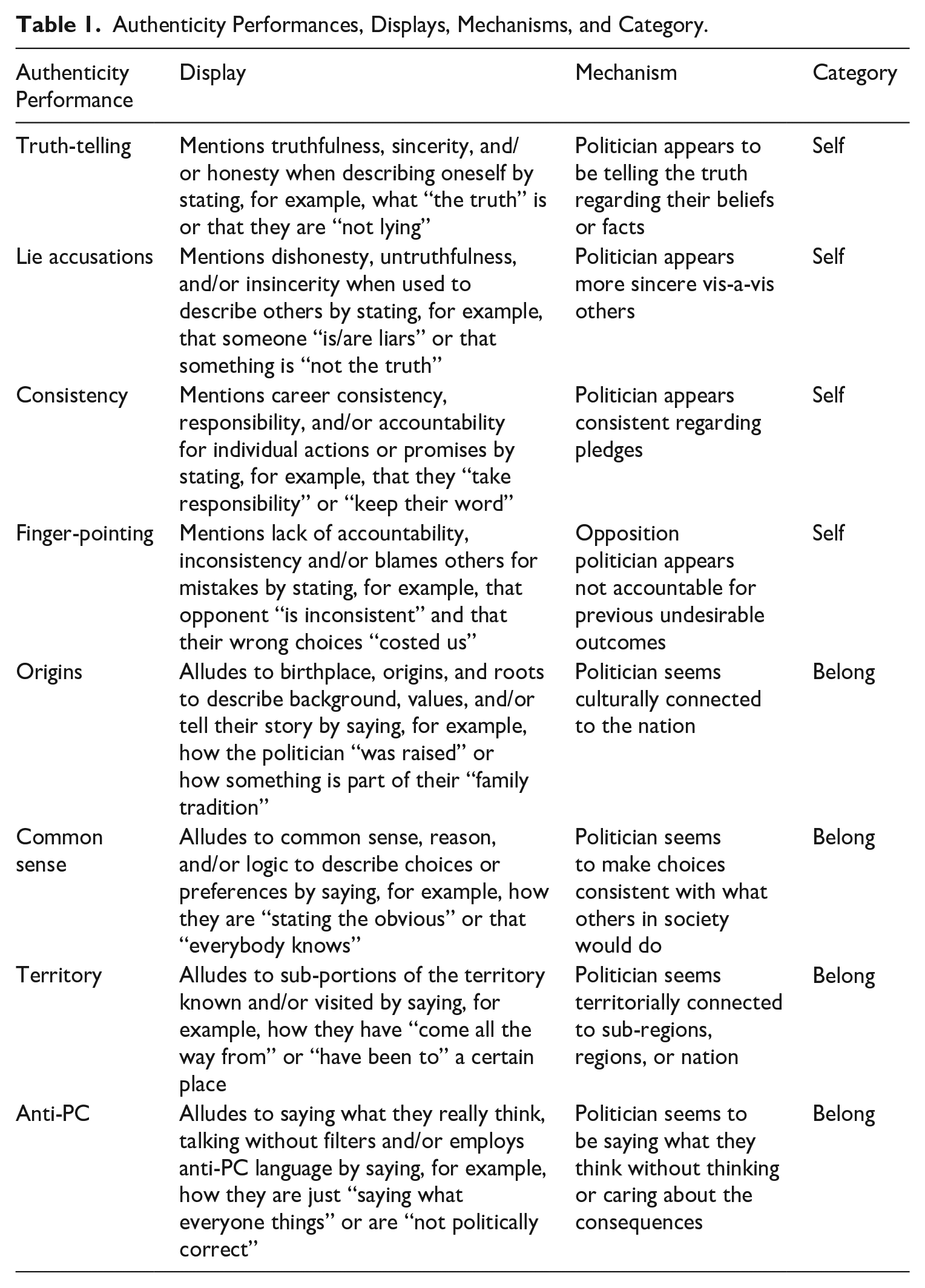
Authenticity performances are projected by politicians with diverse roles (e.g., candidates versus elected officials), across the various settings where politics gets done (e.g., debates or official speeches), and at different times (e.g., before/after an election). When in office, for instance, politicians can “cater to the majority” by adjusting political discourses to please the median voters in response to the periodic public opinion polls carried out by their government (Hager and Hilbig, 2020). Likewise, the various venues where the dialog between the public and a politician occurs generate expectations about how and where authenticity performances occur. Official speeches and campaign rallies are scripted by a politician’s staff and usually read to the public by politicians, in comparison to interviews and debates where language might be simpler, appear more natural, and focus on private themes (see Bull and Mayer, 1993; Wang and Liu, 2018). Alternatively, the political discourses of frontrunners can become more instrumental and less improvised around elections (Di Tella et al., 2023), while candidates at the margins are more willing to employ riskier discursive strategies such as directing negative attacks toward opponents (Haynes and Rhine, 1998). Politicians’ roles, settings, and timing provide expectations about authenticity performances in politics and guide patterns to be investigated in political discourse.
Methodology
Case Selection: Brazil and the United States
The role of authenticity in politics caught the public’s attention after the elections of Donald Trump, in the United States, and Jair Bolsonaro, in Brazil (see Fordahl, 2018; Kohl et al., 2021). However, authenticity has long been central to presidential elections in both countries. In the United States, Ronald Reagan’s unusually colloquial speech patterns and folksy storytelling helped him come across as familiar and trustworthy to electorates (Seifert, 2012). Barack Obama often alluded to his origins and civic traditions to demonstrate that he authentically belonged (Alexander, 2010). Trump’s authenticity perceptions were built through iconic breaks with political conventions, a willingness to engage in controversial topics, and vulgar representations of American traditions from his “straight-shooter dealmaker” persona (Fordahl, 2018). In Brazil, Fernando Collor’s persistent use of religious metaphors made him appear honest to electorates for upholding shared religious and moral principles (Tavares, 1998). Luiz Inacio Lula da Silva (Lula)’s perceived authenticity often revolved around his ability to construct himself as a regular working-class man by constantly recounting his personal story using “the people’s” language (French, 2022). Bolsonaro’s use of vulgar, direct, and contradictory comments on moral issues helped him appear as a simple and authentic “family man” to the electorate (Carlo and Kamradt, 2018; Feres Júnior and Gagliardi, 2021). Each of these accounts focus on specific authenticities performed by a single politician in selective samples of political discourses. Without a framework to identify and compare authenticity systematically we do not know, for instance, whether Trump or Bolsonaro performed authenticity more frequently or in significantly different ways than other presidents in Brazil and the United States.
Comparisons between Brazil and the United States, albeit frequent, can be tricky. Brazil and the United States experienced racialized nation building processes that led to heterogenous demographic compositions and cultural influences, but different types of socioeconomic inequalities (Marx, 1998). Both countries held the world’s two largest enslaved populations until slavery was abolished in each country, respectively. Brazil and the United States became settler states for hundreds of thousands of European migrants throughout the nineteenth and twentieth centuries. Nevertheless, previous comparative studies on race often relied on misguided narratives of racial democracy and integration that masked how, and the extent to which, race and racism were historically dealt with, and how it prevails in Brazil in comparison to the United States (Silva, 2020). In addition, there were considerable differences in the travel subsidies and assimilation incentives offered to migrant groups in these two countries (Ulyses Balderas and Greenwood, 2010). While there are geographical, historical, and cultural similarities between Brazil and the United States, each country’s unique political and economic history led to important societal differences that have implications for political discourses. This means, in practice, that comparisons between the two countries must be carefully contextualized to avoid misleading associations and provide useful insights.
Although Brazil and the United States have different electoral systems, both countries are federal presidential democracies where presidents are the primary players in formally and informally shaping the public policy agenda (Morgenstern et al., 2013; Pereira et al., 2008). Brazil’s extremely fragmented multi-party electoral system gives politicians strong autonomy and contributes to weak political parties (Baker et al., 2020; Mainwaring, 1991, 1999). Politicians in Brazil are less susceptible to broad pressure to conform and represent the interests of parties in comparison to the US electoral system with its two major parties. Parties in the United States are relevant for candidate nomination and campaign financing, making them more effective in limiting politicians’ behavior (see Bøggild and Pedersen, 2018). In addition, politicians’ perceived personality (e.g., authenticity perceptions) becomes more relevant for electoral decisions in countries where party identification is weaker (Nai et al., 2021). While factors beyond electoral systems affect politicians’ behavior (see Grofman, 2004; Siavelis and Morgenstern, 2008), Brazil’s electoral system could be more conducive to authenticity performances in comparison to the United States.
The spread and diversification of mass media in the late 1980s revealed unprecedented levels of information about politicians’ private lives—changing their image, presentation, and perceptions (Seifert, 2012). For the first time, politicians were able to reach and interact with the masses regularly in direct and immediate ways in places such as Brazil and the United States, making political communications resemble a state of permanent campaigning (Blumler and Kavanagh, 1999; Voltmer, 2004). In the United States, Ronald Reagan’s presidential terms introduced the “primetime presidency,” where television gradually became a means of governing and personality perceptions became as important as a political program (Denton, 1988). In Brazil, Fernando Collor’s sudden rise in the 1989 election, the first direct presidential election after the end of the military dictatorship, is attributed to his ability to communicate well on television during his campaign, rather than to his party affiliation, political capital, or policy program (Gibson, 1992). Even though audience perceptions about politicians’ personality have become increasingly important since the late-1980s in Brazil and the United States, scholars have paid relatively little attention to how authenticity appears and changes in these two countries until recently.
Data and Operationalization
Text data for discourses of presidents and runoff presidential candidates in official speeches, campaigns, debates, and interviews were gathered from 1988 to 2021 for Brazil and the United States. Runoff presidential candidates, in the case of the United States, represent the Democratic and Republican nominees in a presidential election. 6 In the case of Brazil, runoff presidential candidates represent the candidates that compete in the second round of the presidential election. 7 Restricting the sample to presidents and runoff presidential candidates helps to avoid the relatively small sample of texts for less relevant presidential candidates skewing the subsequent findings. The year of 1988 was chosen as the cutoff date since it was an election year in the United States and the year in which the current Brazilian constitution entered into force.
Settings represent the various venues where dialog between the public and a politician occurs (see Seifert, 2012). Official speeches, as a setting, include text data for all speeches delivered by elected presidents while in office. The debate setting includes text for debates after party nominations in the United States and second-round debates in Brazil. 8 The campaign setting includes text from campaign rallies and campaign commercials up to 2 years before the respective election that presidents and presidential candidates participated in. The interview setting includes text for interviews provided to traditional news media outlets (i.e., television, radio, newspapers, and magazines) for the period of 2 years around (i.e., prior to and after) the election year for presidential candidates. For elected presidents, interviews were gathered from the 2 years before their inauguration, during the time they held office, and the 2 years after they left office. 9 Beyond accounting for different settings, this approach allows us to compare presidents and presidential candidates before elections, as candidates, and in office (for winners). Table 2 lists the politicians for each country and the number of text observations by setting. In total, 21,496 political texts were gathered for Brazil and the United States. 10
Text Data for Brazil and the United States.
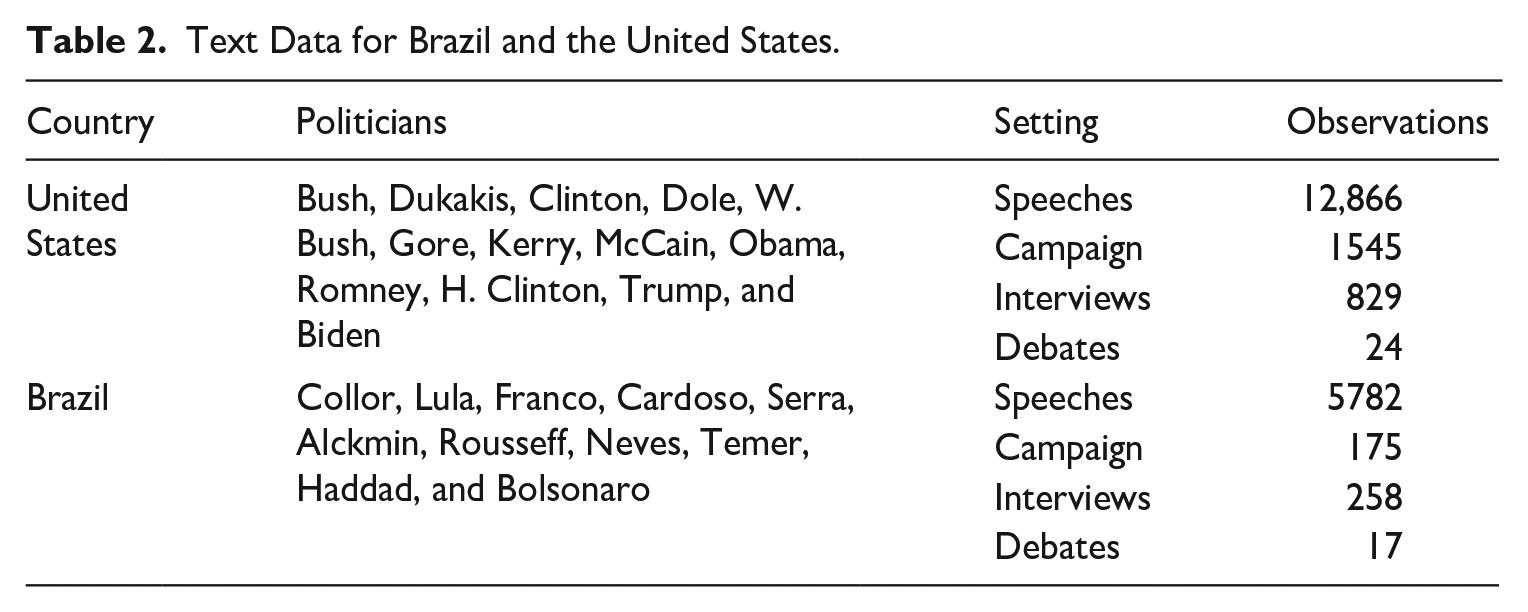
Texts for the United States were scraped from The American Presidency Project repository. The repository contains the most complete available data on American presidents and presidential candidates. Collecting data for Brazil was more challenging due to the lack of one central repository. For official speeches, a dataset containing all official speeches for Brazilian presidents since 1985 was used (Silva-Muller and Sposito, 2024). Text for debates, interviews, and campaigns in Brazil were scraped from subtitles automatically generated for YouTube videos. The number of videos available for later election cycles, especially after the 2000s, is considerably larger than earlier ones. In addition, some election cycles in Brazil were shorter due to a candidate winning in the first round, limiting the number of texts available for these election cycles. For these reasons, the number of observations in the text datasets for the United States is greater than for Brazil. 11 After collection, texts were cleaned by removing punctuation marks and accents.
Authenticity performances were operationalized using a purpose-built dictionary of terms that automate the coding of each performance in the framework (see Codebook in the online Appendix). The dictionary of terms was inductively developed by listening to samples of randomly selected speeches, campaigns, interviews, and debates from the datasets. 12 To enable comparisons, the dictionary has similar definitions in Portuguese and English in relation to the words and expressions searched for. The number of words included in the dictionary for each performance is similar for both languages. The dictionary of terms is designed to reduce the possibility of overlaps, even as some authenticity performances might share similar displays. 13 Directionality in the text is important to identify authenticity performances that talk about themselves or others, thus, no stop words are removed from texts. This means the dictionary of terms includes combinations of pronouns/determiners and verbs/nouns to avoid false-positive matches of authenticity performances.
Since the frequencies of authenticity performances can reflect the quantity of texts collected for a certain case, year, setting, or politician, the frequencies of authenticity performances are normalized by the total number of words in the texts they appear in. Normalization facilitates comparisons between Brazil and the United States, even as the number of observations within and between the two cases differs. In practice, normalization helps to account for differences in observations over time, between settings, or for disparities among presidents who held multiple mandates and candidates who appeared in a single election cycle. In the analysis, the normalized scores represent the proportion of words associated to one or more authenticity performances in relation to the total of words in a year and by setting per year. The scores were multiplied by 1,000 to facilitate interpretation; they represent the normalized proportion per 1,000 words in discourse.
The focus of the forthcoming analysis section is mostly descriptive and based on how projections of authenticity change over time and across settings by politicians. That is, how, where, and when authenticity is performed in Brazil and the United States. The analysis also employs fixed-effects regression models to explore the relationship between authenticity performances and politicians’ roles. The models are indexed by year, as events that take place for each case in a certain year can affect authenticity performances. In addition, as politicians interact, imitate, and respond to one another in any given year, they can influence when and how authenticity is performed. Fixed-effects models help control for year-specific and other unseen unit-unvarying characteristics (Allison, 2009). The dependent variables for models are the total frequency of authenticity performances or the diversity scores for authenticity performances. Diversity scores are calculated using the Herfindahl–Hirschman index of concentration, where scores closer to 0 represent a variety of authenticity performances occurring at similar rates, and scores closer to 1 represent concentrated performances around a single type of authenticity (see Rhoades, 1993). 14 The independent variables reflect the politicians’ roles as “candidates” (i.e., unelected presidential candidates or presidents before being elected for the first time), “in office” (i.e., elected presidents during the time they held office and incumbents taking part in an election), and “after office” (i.e., elected presidents after they leave office). Since politicians’ behaviors can be affected by their party, ideology, and other institutional constraints, the models control for politicians’ political party. 15
Limitations
There are five main limitations with the theoretical and methodological approach in this article. First, the literature on authenticity in politics predominantly covers democracies where electorates vote for politicians, rather than parties, and focuses on recognized politicians at the national level. As the authenticity performances framework builds upon this literature to identify mechanisms and displays, the framework is better suited to investigate and compare authenticity performances at the national level in democratic contexts where electorates vote for politicians, as is the case for presidents and presidential candidates in Brazil and the United States. Furthermore, the authenticities in the framework are operationalized using a dictionary of terms constructed by listening to randomly selected samples of audio and textual data collected for Brazil and the United States, thus the dictionary of terms is appropriate to capture authenticity performances in these countries. Adapting the framework to other presidential democracies, for example, requires updating the dictionary of terms that operationalizes authenticity performances.
Second, the conceptualization and operationalization of the framework does not capture the reception of authenticity performances. For this reason, 100 randomly selected texts from both cases were selected to verify how the authenticity performances coded using the automated dictionary related to the performances theorized in the framework. The operationalization was found to be highly effective in matching the theorized authenticity performances, but other more ambiguous performances of authenticity were missed. This means the operationalization errs on the side of caution when it comes to identifying and classifying authenticity performances and misses instances where interpretation is necessary or beyond what is theorized in the framework in exchange for scalability (e.g., being able to quickly classify thousands of texts).
Third, the framework and operationalization assume that identified authenticity performances are typically desirable and/or not hurtful. The framework conceptualizes authenticity as a performance; hence, politicians must constantly learn, adapt, and repeat performances to be deemed authentic. Even though diverse audiences might react differently to performances, by placing agency with both politicians and audiences, the framework assumes that politicians adjust performances of authenticity according to where, when, and to whom they speak. This means broadly undesirable authenticity performances are not repeated as various audiences and politicians interact over time and across settings. 16
Fourth, the text data gathered does not include social media settings where politics increasingly gets done (e.g., WhatsApp, Twitter, and Facebook). Social media, as a setting, can be conducive to authenticity performances as it helps display the routines and habits of politicians directly to audiences (Luebke and Engelmann, 2022). Audiences following politicians online can also perceive them as more authentic (Luebke and Engelmann, 2022). However, as political texts for this article have been collected since 1988—before social media was present or relevant in politics—social media settings are not included in the data collected. This choice prioritizes having a comparable dataset over time.
Finally, this article develops a broad framework that includes diverse authenticity performances. The specific relationships between certain types of authenticity performances and politicians’ ideologies, such as the relationship between populism and anti-PC, are beyond the scope of this article. Although populist repertoire can include patterns of communication such as plain-speaking and displays of “bad manners” (Brubaker, 2020; Moffitt and Tormey, 2014), these are not exclusive to populist politicians. Besides, the association between specific types of politically incorrect discourses and the populist (thin) ideology is often peripheral to theories of populism, unclear conceptually, and based on selective examples from a small sample of politicians, across different contexts, and with a variety of ideological commitments (see Mudde, 2004, 2007). Anti-PC, as an authenticity performance, goes beyond the usage of specific types of politically incorrect language in politics and broadly includes discursive displays related to “speaking what one thinks” without filters.
With these limitations in mind, the findings in the subsequent analysis section are careful when discussing the relationship between the frequencies of authenticity performances and political outcomes. Additional sources are used throughout the analysis to help corroborate and explain the findings. Despite these limitations, the authenticity performances framework offers a pathway to systematically identify and compare authenticity in politics.
Analysis: How Is Authenticity Performed in Brazil and the United States?
Authenticity Performances Over Time
Even though appearing authentic to electorates influences election outcomes (Stiers et al., 2021; Valgarosson et al., 2021), there is no systematic increase in the total frequency of authenticity performances by presidents and candidates in election years in Brazil or the United States over time (Figure 1). While there is no correlation between election years and authenticity performances by presidents and candidates in Brazil, election years correlate with a decrease in authenticity performances by presidents and candidates in the United States. 17 This suggests that certain presidential candidates in the United States (e.g., incumbents) are more careful about when authenticity is performed close to elections as political discourses become more instrumental and less improvised (see Di Tella et al., 2023; Haynes and Rhine, 1998; Mayhew, 2008).
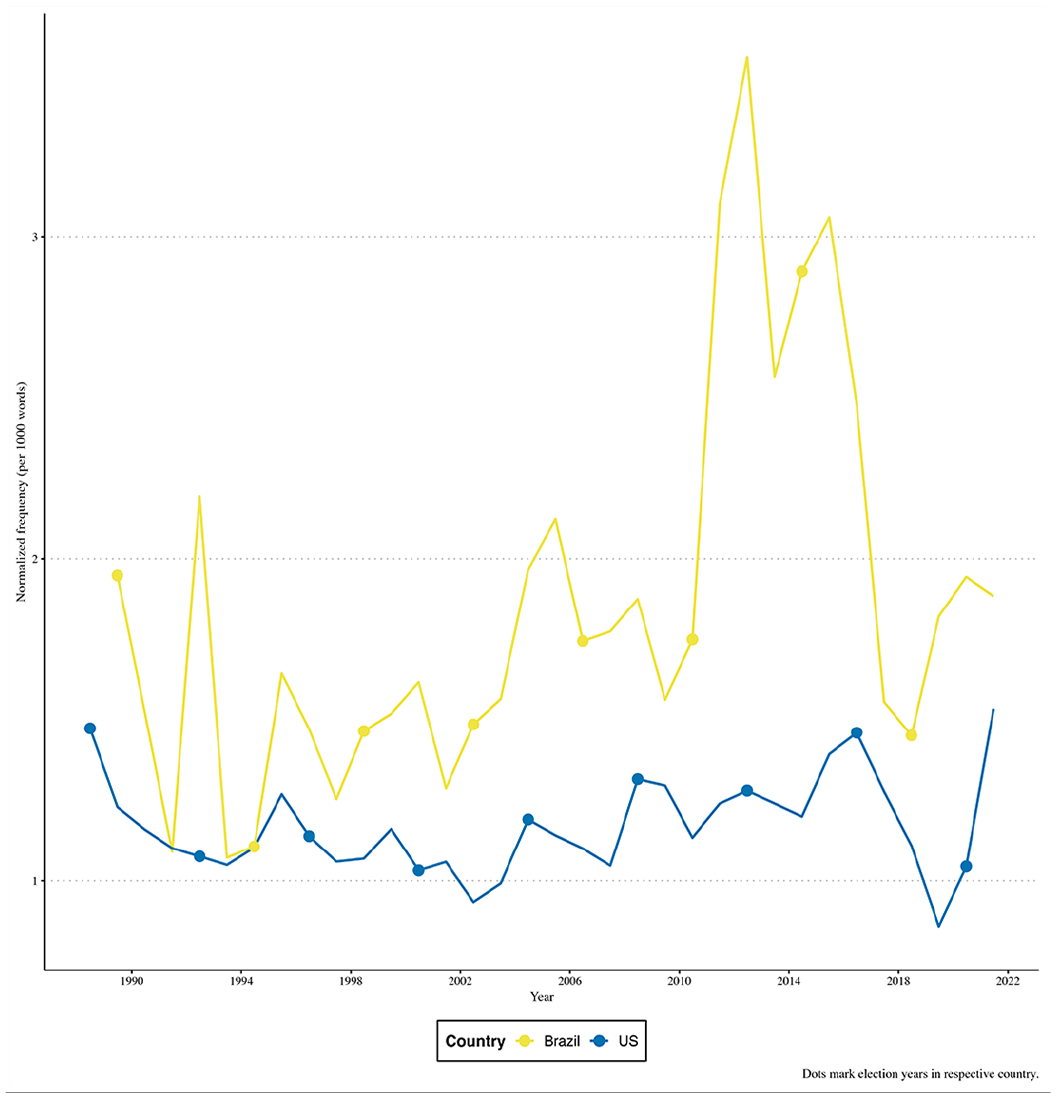
Authenticity Performances Over Time in Brazil and the United States.
Authenticity has been performed with greater frequency by presidents and presidential candidates in Brazil than in the United States. Brazil’s extreme party fragmentation provides incentives for presidents and candidates to display autonomous behavior (Baker et al., 2020; Mainwaring, 1991, 1999) that includes talking more about themselves rather than their party or policies and, as a consequence, performing authenticity more frequently in comparison to the United States, where presidents and candidates are more effectively constrained by their parties. As the importance of politicians’ perceived personality increases for electoral decisions in countries where party identification is weaker (see Nai et al., 2021), authenticity perceptions and performances are arguably more relevant to presidents and candidates in Brazil than in the United States.
Authenticity performances peaked in Brazil from 2011 to 2016 when Dilma Rousseff was president. 18 Rousseff habitually referred to “motherhood” and “women’s empathy” in political discourse while, at the same time, reinforcing her managerial experience, decision-making ability, and objectivity (Mendonça and Ogando, 2013; Pires, 2011). 19 Rousseff’s ability to strategically balance feminine and masculine stereotypes in discourse was vital in the 2010 elections (Mendonça and Ogando, 2013; Pires, 2011). As president, Rousseff arguably performed authenticity more frequently to connect with audiences and to justify her public policy choices to overcome negative gender stereotypes associated with her presidency (see Dos Santos and Jalalazai, 2021). Although the small number of women politicians in the data (i.e., Rousseff and Hillary Clinton) does not allow us to infer how gender and authenticity performances broadly correlate, authenticity performances could be an important aspect in helping women to walk the thin line between being liked and appearing competent in politics (see Schneider et al., 2010). Women’s distinct style in politics (see Blankenship and Robson, 1995; Christine Banwart and McKinney, 2005; Franceschet et al., 2016; Wood, 1994) might also include how, when, and where women politicians perform authenticity.
Allusions to origins and claims of truth-telling are the two most regularly performed authenticities by presidents and presidential candidates in Brazil and the United States over time (Figure 2). While origins is an authenticity performance about belonging, and truth-telling is an authenticity performance about the self, both authenticities promote the speaker instead of focusing on others. Unsurprisingly, presidents and presidential candidates speak mostly about themselves when doing politics. Authenticity performances that focus on others, such as lie-accusations and finger-pointing, are performed infrequently on average in both countries. 20 Although there is mixed evidence on the effect diverse types of negative campaigning have on electoral outcomes (see Fridkin and Kenney, 2011), character-based attacks such as lie accusations and finger-pointing are riskier for all politicians (Haynes and Rhine, 1998; Nai et al., 2022). Besides taking time away from self-promoting efforts, negative character-based attacks give the opportunity for political opponents to take center stage and counterattack (see Carraro et al., 2012).
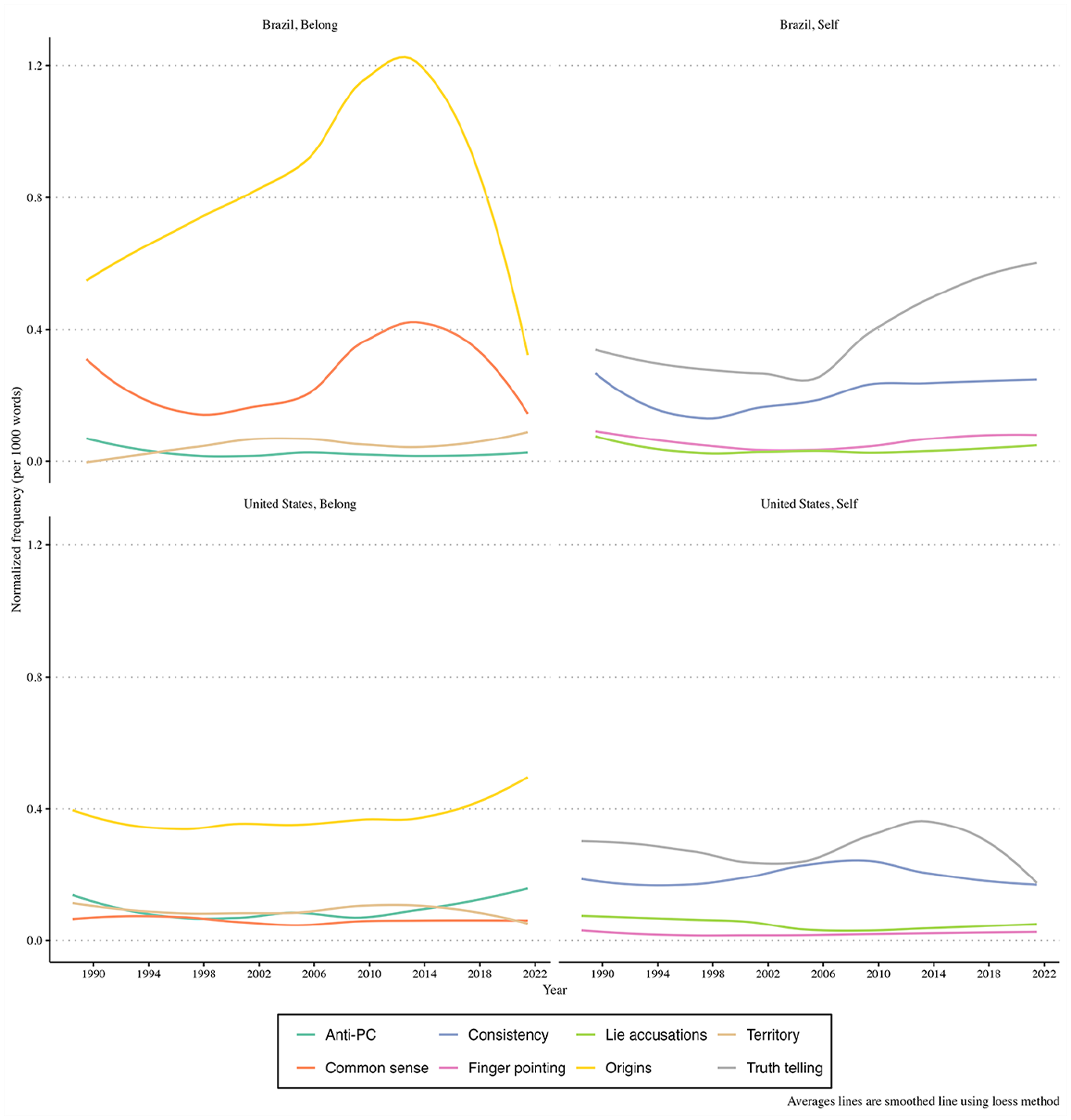
Authenticity Performances by Category Over Time in Brazil and the United States.
Authenticity performances about belonging were performed with greater frequency in Brazil by presidents and presidential candidates, especially in the forms of origins and common sense, during the period in which the Workers’ Party (PT) was in office (2002–2016). This trend began to change in the mid-2010s and by 2019, the first year of the Bolsonaro administration, we see a reversal of this pattern where authenticity performances about the self, especially in the form of truth-telling, surpass authenticity performances about belonging. The mid-2010s in Brazil were marked by recurrent corruption scandals in politics that arguably made discourses associated with PT less attractive to audiences, and, in turn, presidents and presidential candidates favored authenticity performances about the self. For example, Bolsonaro’s claims about the real and harsh “truth” in his discourse, in opposition to the “lies” and “manipulation” of previous governments, were central in portraying himself as the quintessential anti-PT candidate who would not betray the electorate’s confidence (see Rennó, 2020). 21
The frequencies of authenticity performances about the self and about belonging by presidents and presidential candidates remained relatively stable over time in the United States. Nevertheless, from the mid-2010s onwards there is a slight increase in authenticity performances about belonging, in the forms of origins and anti-PC, and an overall decrease in performances about the self, in the forms of truth-telling and consistency. The change in favor of authenticity performances that focus on shared cultural connections between presidents and presidential candidates and audiences arguably reflects a response to American electorates that feel unrepresented by politicians they perceive to be disconnected with the opinions of “ordinary citizens” (see Bøggild, 2020). Trump’s remarkable ability to culturally connect with the “ordinary citizen” and “forgotten man” in political discourses was decisive in the 2016 elections (see Berezin, 2017; Fordahl, 2018). 22 Similarly, Biden’s capacity to relate to the people by talking directly to them when recounting stories about his hometown and their shared values, a trick taken directly from Trump’s playbook, was vital in the 2020 elections (Hart, 2022). 23
Authenticity Performances Across Settings
In Brazil and the United States, debates have recently become the setting in which authenticity is performed most frequently by presidents and presidential candidates, whereas interviews are the setting in which authenticity is performed least frequently (Figure 3). In the United States, authenticity performances by presidents and candidates occurred most frequently in campaign settings until the mid-2000s but steadily decreased over time. 24 Conversely, in the case of Brazil, authenticity performances by presidents and candidates in campaigns, debates, and speeches generally increased until the mid-2010s. However, from the mid-2010s onwards we see a sharp decline in authenticity performances across these settings in Brazil. In both countries, debates recently became the setting in which authenticity is performed most frequently by presidents and candidates. As large-scale media events that require candidates to answer quickly to sometimes unpredictable questions, debates are an important source of “sticky” sound and video bites. Charged with imagery, these bites circulate on diverse media platforms and come to epitomize political cycles across democracies (see Coleman, 2000; Foley, 2012), making debates conducive to authenticity performances. Relatedly, interviews in both countries became the setting where authenticity is performed least frequently by presidents and candidates. The spread of social media gave presidents and candidates alternative outlets to interact directly with audiences, bypassing journalists and their filters in interviews, while performing authenticity directly to wider portions of the electorate (Alexander, 2011; Luebke and Engelmann, 2022). This suggests that, as the importance of social media in politics increases, traditional political settings might concentrate discussions about issues and policies while character-based politics, as authenticity performances, take place overwhelmingly in social media settings conducive to these performances (see Luebke and Engelmann, 2022).
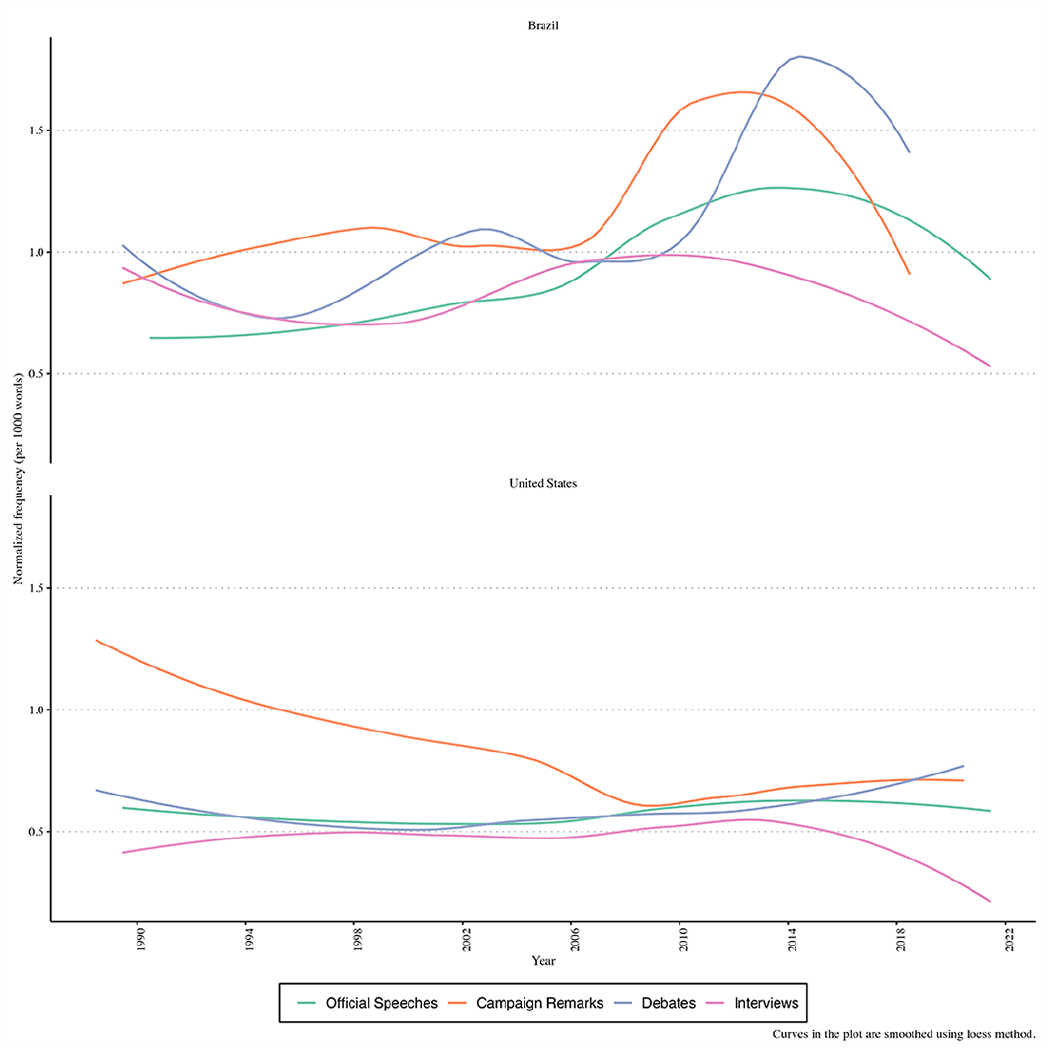
Authenticity Performances by Setting Over Time in Brazil and the United States.
Presidents and candidates in the United States are generally more consistent about the types of authenticities they perform, independent of the setting where they are speaking, in comparison to Brazil where settings are more likely to affect which types of authenticities are performed (Figure 4). In the United States, authenticity performances about belonging appear more frequently on average across all settings, especially in campaigns. In Brazil, authenticity performances about belonging appear more frequently on average in official speeches and interviews, while authenticity performances about the self appear more frequently on average in debates and campaigns. Nonetheless, this suggests that authenticity performances about the self and belonging are performed rather frequently across settings in both cases, whether presidents and candidates are reading from scripts or answering questions on the spot.
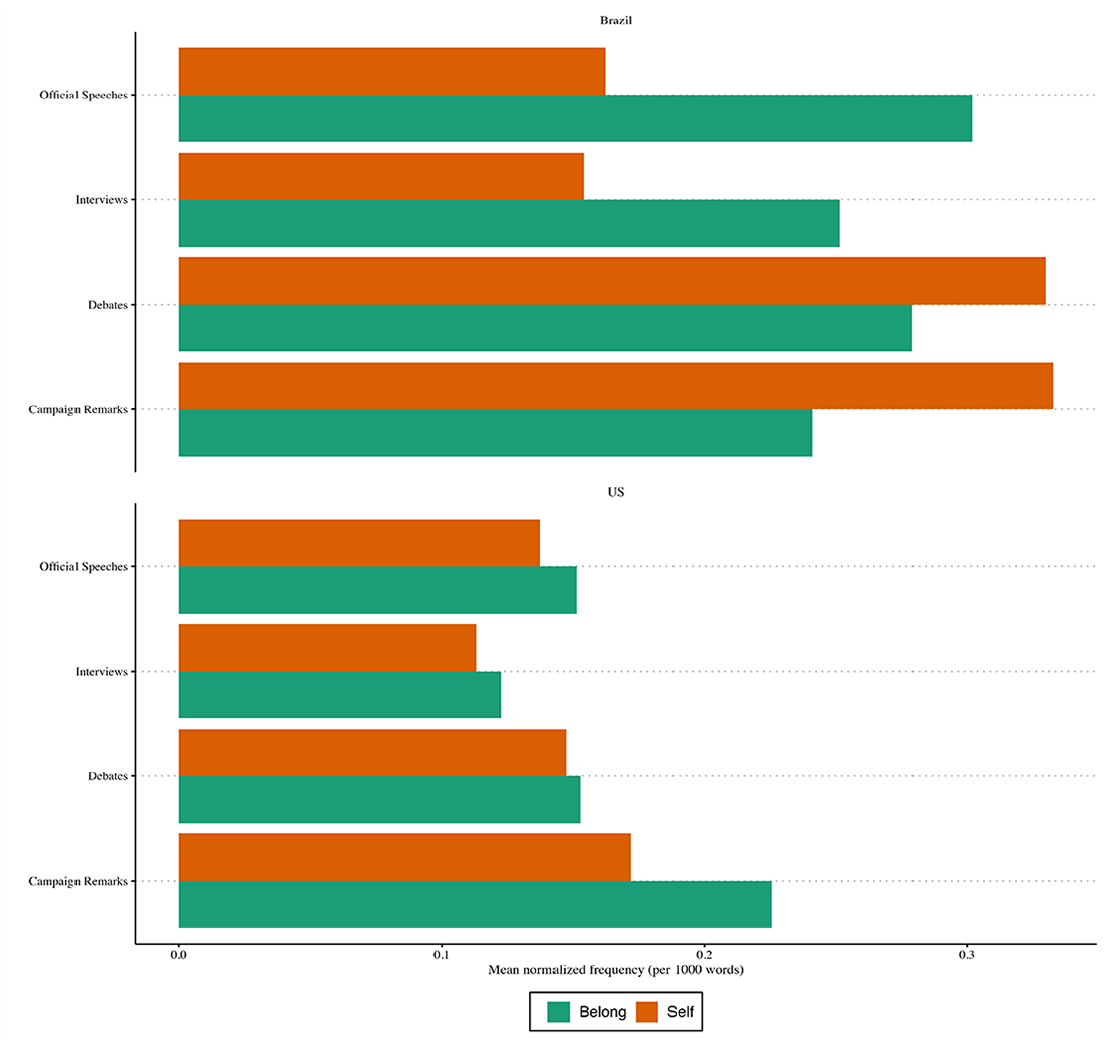
Authenticity Performances by Category Across Settings in Brazil and the United States.
Authenticity Performances and Politicians’ Roles
Presidential candidates perform authenticity more frequently than sitting presidents in the United States but not in Brazil. The relationship between politicians’ roles and both the normalized total for authenticity performances and the diversity scores for authenticity performances is illustrated in Figure 5. The x-axis represents the estimated coefficients by the fixed-effects models, and the y-axis represents the independent variable, politicians’ roles, and the control variable, political party. The horizontal lines in the figure represent the standard errors generated by each of the models. In practice, horizontal lines that do not touch the dotted vertical line symbolize a statistically significant relationship. 25 The models about the total frequencies of authenticity performances (US Total and BR Total) suggest that presidents in the United States perform authenticity significantly less frequently when in office compared to candidates, the reference category. First-time presidential candidates in the United States likely have to perform authenticity more frequently to attract national attention and secure party nominations. 26 Once in office, presidents perform authenticity significantly less in the United States. This helps explain why there is a negative relationship between authenticity performances and election years in the United States (Section 4.1)—incumbent presidents perform authenticity substantially less frequently. In Brazil, although authenticity performances by presidents and candidates are more frequent and diverse across settings (sections 4.1. and 4.2 above), authenticity is not performed significantly less frequently by elected presidents. In both counties, however, politicians’ roles have limited explanatory power regarding the variations in the total authenticity performances. Considering the models employ time-fixed-effects indexed by the year, this suggests that presidents and presidential candidates are largely coherent in how often they perform authenticity as they campaign, take office, or after leaving office in Brazil and the United States.
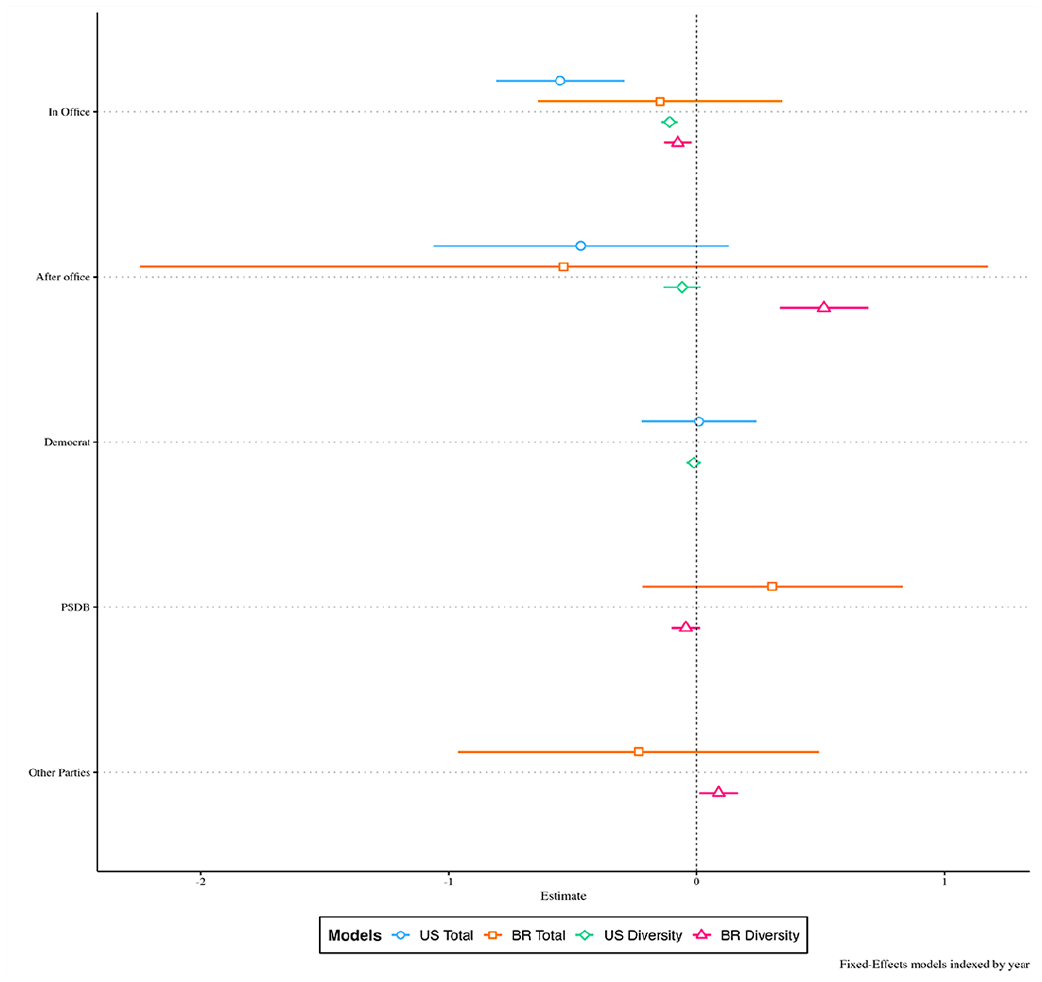
Fixed-Effects Models for Authenticity Performances by Politicians’ Roles.
Presidents in office are less diverse in the ways in which they perform authenticity in Brazil and the United States. The models about the diversity of authenticity performances (US Diversity and BR Diversity) illustrate the relationship between performing authenticity in concentrated (i.e., one authenticity performance predominates) or diverse ways (i.e., multiple authenticity performances) and politicians’ roles. In both countries, presidential candidates tend to perform multiple authenticities rather than concentrate performances around a single authenticity. However, once in office, presidents likely adjust the types of authenticity performed following public opinion and focus on performing authenticities that please the median voters (see Hager and Hilbig, 2020). In the United States, Clinton, W. Bush, and Obama, for example, used different language in their re-election campaigns in comparison to their first presidential campaign (Leuprecht and Skillicorn, 2016). When campaigning from office, these presidents improved their discourses by focusing on the influential language patterns that work best for them (Leuprecht and Skillicorn, 2016). 27 In Brazil, Lula’s discourses also evolved considerably, for instance, from the first time he was a presidential candidate in the 1989 election to the first time he was elected in the 2002 election and during his time in office (see Barros, 2022). Lula adapted his discourse by changing how he described himself, spoke to (and about) his political opponents, and the topics raised in discourse (Barros, 2022).
Conclusion
This article develops a framework to identify and compare how authenticity is performed in political discourses over time and across setting by politicians. The authenticity performances framework focuses on the theorized pathways by which shared discursive displays work to produce authenticity perception. To demonstrate the usefulness of the framework, this article investigates authenticity performances in 21,496 political texts of electoral debates, interviews, campaigns, and official speeches by presidents and presidential candidates in Brazil and the United States since 1988. The findings indicate that authenticity is generally performed with greater frequency by presidents and presidential candidates in Brazil than in the United States, though authenticity performances are not more prevalent during election years in either country. In both countries, debates have recently become the setting in which authenticity is performed most frequently by presidents and candidates, whereas interviews are the setting in which authenticity is performed least frequently. Moreover, presidential candidates in the United States perform authenticity more frequently than sitting presidents whereas, in Brazil, authenticity is not performed at significantly different rates by elected presidents or presidential candidates. In both countries, however, presidents in office focus on performing only the authenticities that work best for them.
This article lays down the foundations for comparative research on authenticity in political discourses. Conceptually, it provides a framework for identifying and comparing diverse performances of authenticity in politics. Empirically, this article provides the first comparative overview of how, where, and when authenticity has been performed by presidents and candidates in Brazil and the United States since 1988. Moving forward, future research should move beyond the frequency and forms in which authenticities are performed to consider how, when, and where each of these authenticity performances helps to build electoral trust from electorates (see Weinberg, 2023). Likewise, future research should adapt the framework to investigate authenticity performances in different types of political systems, such as electoral autocracies. This could be especially pertinent to understand how certain autocratic politicians discursively collect support from large portions of populations even when they might not be democratically accountable to them (see Guriev and Treisman, 2020). In addition, since authenticity is one of many forms of collecting and maintaining support when doing politics, future research should investigate how authenticity performances interact, affect, and change electorates’ perceptions of public policies. Finally, it is important to expand research on how gender and ethno-racial stereotypes mediate performances of authenticity to broad audiences in social media (see Welp and Ruth, 2017). Given the importance authenticity perceptions have for political outcomes, understanding the role of authenticity in politics could be essential to grasp why elected politicians frequently do not appear to be representative of their own electorates.
It is an enormous challenge for political scientists to understand when, why, and how political discourses matter for political outcomes in democracies. We have long known, for example, that the diffusion of mass media has not made electorates better informed about politics or about politicians’ governing programs (see Denton, 1988). Still, political scientists continuously engage with the meaning of what politicians say to explain electoral outcomes. A misplaced engagement with the logic of why electorates and politicians behave as they do contributes to furthering political polarization by passing on the blame for “undesirable” political outcomes to a lumped-together group of “old, rural, or uneducated” electorates. This is especially true for a significant portion of the literature on populism, which focuses on materialist explanations (i.e., economically left behind) for electoral behavior (see Schäfer, 2022), while frequently disregarding other important aspects of politics such as authenticity. Authenticity performances, as a framework, offers an alternative to understand what certain political discourses are, how they change over time, and why they might matter for political outcomes.
Supplemental Material
sj-docx-1-psx-10.1177_00323217241261229 – Supplemental material for Radiating Truthiness: Authenticity Performances in Politics in Brazil and the United States
Supplemental material, sj-docx-1-psx-10.1177_00323217241261229 for Radiating Truthiness: Authenticity Performances in Politics in Brazil and the United States by Henrique Sposito in Political Studies
Footnotes
Acknowledgements
I would like to thank Anna Zampa, James Hollway, and Yanina Welp for their help and support throughout the whole writing process. I would also like to thank Livio Silva-Muller, Mario Grangeia, Giles Pitts, and the two anonymous reviewers whose valuable comments were essential to improve this article.
Declaration of Conflicting Interests
The author(s) declared no potential conflicts of interest with respect to the research, authorship, and/or publication of this article.
Funding
The author(s) received no financial support for the research, authorship, and/or publication of this article.

Supplemental Material
Additional Supplementary Information may be found in the online version of this article.
Table 3: Text data by election and politicians’ cycle in the United States. Table 4: Text data by election and politicians’ cycle in Brazil. Table 5: Authenticity Performances Codebook. Table 6: Authenticity Performances and Election Years in Brazil and the United States. Table 7: Authenticity Performances by year in Brazil—Linear Model. Table 8: Average Normalized Proportion of Authenticity Performances in Brazil and the United States (per 1000 words). Table 9: Authenticity Performances by Category and Setting in Brazil and the United States—Fixed-Effects by Year. Table 10: Authenticity Performances by Setting, Category, Role, and Party in Brazil and the United States—Fixed-Effects by Year. Table 11: Authenticity Performances by Role, Setting, and Category, in Brazil and the United States—Fixed-Effects by Year.
Notes
Author Biography
References
Supplementary Material
Please find the following supplemental material available below.
For Open Access articles published under a Creative Commons License, all supplemental material carries the same license as the article it is associated with.
For non-Open Access articles published, all supplemental material carries a non-exclusive license, and permission requests for re-use of supplemental material or any part of supplemental material shall be sent directly to the copyright owner as specified in the copyright notice associated with the article.
