




Abstract
Gaining the attention of legislators in a crowded advocacy landscape is a key dilemma for organized interests. Yet, there has not been a great deal of direct analysis of whether groups are indeed recognized as important by politicians in the context of them advancing political arguments. In this article, we examine under what conditions interest groups achieve prominence among political elites. Drawing on a supervised machine learning approach to code prominence from legislative speech, we exploit variations in levels of prominence for the entire Australian interest groups system. We find that prominence is highly concentrated and that it covaries with the need to align with prevailing policy agendas and the logic of conflict expansion. Conversely, we do not find evidence of a strong partisan or ideological dimension of prominence. This contributes to our understanding of the responsiveness and representativeness of democratic political systems in which the interest group sector is expected to funnel public preferences into policymaking.
Keywords
Introduction
For interest groups, operating in an increasingly competitive organized interest system, being acknowledged by policymakers as relevant to the policy issues of the day is a prized asset. It does not guarantee the desired policy outcome, yet, it does deliver an invaluable intermediate dividend in the influence production process (Lowery, 2007)—namely, prominence in the policy debate. 1 Being prominent among political elites is of value for interest groups because it (a) allows them to inject their framing into elite discourse and thus shape the latter’s understanding of “social problems” (Hilgartner and Bosk, 1988); (b) confirms their credibility and reputation to journalists, thereby helping them gain media attention (Bennett, 1990); and (c) signals mission progress to internal stakeholders (Minkoff and Powell, 2006). Yet, scholars have consistently highlighted the difficulty in attracting any kind of elite attention, including prominence, reinforcing that their finite attention means that many actors will inevitably be ignored (Walgrave and Dejaeghere, 2017).
This study asks under what conditions interest groups gain prominence among political elites. This is key to our understanding of the responsiveness and representativeness of democratic political systems in which the interest group sector is expected to funnel the public’s concerns and interests into policymaking. If, for instance, some groups were recurrently shut out of elites’ policy debates while others were always prominent, this would undermine congruence between public preferences and policy outcomes, and ultimately forebode unequal representation (Traber et al., 2021). Specifically, in this article, we investigate prominence in the legislature, which, in a representative democracy, is the primary venue through which proposed policies are debated and made.
We contrast different explanations for interest group prominence. On one hand, demand-side accounts of lobbying (e.g. Baumgartner et al., 2011) hold that the prevailing policy agenda shapes elites’ need for lobbying inputs, suggesting that the match between a group’s advocacy agenda and the legislative agenda is likely to drive prominence. The literature on group–party relations, on the other hand, has a strong expectation that partisanship will predict prominence, in that parties of the right will form attachments with business or economic groups, while parties of the left will give prominence to citizen groups and unions (Allern and Bale, 2017; de Bruycker and Rasmussen, 2021). A third alternative argument suggests that the dynamics of conflict expansion shape the way legislators use groups in political debates. Opposition parties, so the logic goes, aim to expand policy conflict and challenge the government by giving greater prominence to citizen groups, given the latter’s propensity to oppose the status quo and appeal to large by-standing publics (Røed, 2022).
We test these alternative explanations in the context of Australia, a two-party parliamentary system with strong party discipline, and pluralist interest intermediation. Our dataset measures prominence for the entire Australian group population among Members of the Australian Parliament, tracking over 17,000 prominent mentions of 1453 national interest groups spanning a 24-year period (1996–2019). Methodologically, our study innovates in several ways. First, we expand on a supervised machine learning (SML) approach to collect observations where groups are used in legislative speech in a nontrivial way to bolster the speaker’s argumentation (Fraussen et al., 2018). Second, our approach enables us to connect group mentions in legislative speech to particular policy topic contexts and to the party affiliation of the speaker. Third, we examine prominence for the entire group system, rather than relying on surveys or interviews with a sample.
Our findings broadly support the demand-side account of interest groups and shed insights on potential sources of bias in interest representation. The degree to which group agendas align with legislative activity is the most important predictor of prominence. This suggests that, rather than introducing new viewpoints into the debate, groups are used as strategic resources by politicians wanting to make claims regarding ongoing government agendas (Baumgartner et al., 2011). Furthermore, we find little evidence for a partisan dimension of interest group prominence. All parties use groups to support their arguments, and no clear patterns are visible aligning certain group types with certain parties. Surprisingly, groups representing the professions struggle most to gain prominence, despite being the most trusted group type by politicians and the general public. Finally, we demonstrate that, in line with expectations, citizen groups are indeed more likely to be referred to by opposition politicians in support of their arguments.
The article proceeds as follows. The next section theorizes the drivers of interest group prominence, and develops three expectations as to what might explain variation in patterns of group prominence among legislators. We next introduce data derived from the legislative record of the Australian parliament and a dataset on the Australian interest group system. The fourth section presents empirical findings, where we first describe the distribution of interest groups’ prominence in legislative speech at the aggregate level, and second analyze the drivers of prominence via logistic and negative binomial regression models, simultaneously considering our proposed explanations. The final section highlights the key findings and implications of our study.
Elite Recognition of Interest Groups: Conceptualizing Prominence
Scholarship on interest intermediation accepts that elite recognition is a crucial resource for interest groups (de Bruycker and Beyers, 2015). Existing studies parse out such recognition from the count of group mentions in sources like the Congressional Record (Grossmann, 2012). Yet, the limitation of tallying mentions is that it makes no evaluation as to the substance of the mention. Is an interest group recognized only in passing, or is it recognized as an important participant in the policy process? In other words, is it merely visible or is it prominent?
We understand prominence as the degree to which a group is recognized as important by a given audience (e.g. political elites) in the context of them advancing political arguments (Halpin and Fraussen, 2017). It differs conceptually from attention or visibility as it denotes nontrivial forms of recognition, for instance, the selective referencing or “name dropping” of groups by policy elites in order to give more weight to their position. Recent work has investigated prominence by looking at whether politicians reuse text submitted by interest groups (Røed, 2022), or whether they mention groups in their legislative speech in a nontrivial way to bolster a political argument (Fraussen et al., 2018). In this article, we advance this latter approach further, because it directly taps into whether groups are “top-of-mind” with policymakers. Regardless of whether its purpose is persuasion on substantive policy issues or position taking by individual MPs and/or parties (Proksch and Slapin, 2015), we do know that legislative speaking time is a finite resource and the speeches legislators make are likely to be chosen strategically with some degree of care. As such, mentioning an interest group in a speech act is costly, and mentioning a group prominently—that is in a way that confers some weight in the argumentation to them—is even more costly. The concept of prominence thus taps the implicit evaluations of elite audiences through their public statements.
To illustrate our approach further, we briefly examine instances of prominent mentions in the context of our Australian case. A Coalition MP underlining the costs of the Labor party’s carbon tax proposals refers to the peak business lobby thus: “. . . as for the carbon tax and the impact on the economy, the Chief Executive of the Australian Chamber of Commerce and Industry, Peter Anderson, said this….” This can, of course, also work in the opposite partisan direction. A Labor Party MP used the Business Council of Australia’s public support for their criticism of the Governments Foreign Investment Review Board (FIRB) changes: “Labor’s position on the government’s FIRB changes has been supported by the Business Council of Australia …..” In both cases, the reference to group names adds weight to the policy and political arguments of political elites. 2
Not all mentions of groups are meaningful in this same way, which is why a straightforward tally of mentions in the parliamentary record is a poor indicator of prominence. For instance, some mentions simply note the functional role of a group: “. . . in the past, most research in this industry has been channelled through Meat and Livestock Australia.” Others refer to a group in passing, “. . . they should go and do an Australian Institute of Company Directors course or an Australian Institute of Management course and learn, as Senator Fierravanti-Wells knows very well, what the role of a board is.” Still others simply name-check a group in a very general sense in order to acknowledge the work they do, such as this example acknowledging “. . . the great work done by Save The Children Australia in aid, development and helping vulnerable children.” Other mentions may refer to groups in the context of MPs attending a local constituency-level meeting, a social function, or else mention groups as part of a long list of entities that are simply active in a policy area. None of these cases tap the concept of prominence, yet they would be included in a simple tally of mentions.
Explaining Interest Group Prominence in Legislative Speech
Being prominent among political elites in the way outlined above is a potent resource for interest organizations for several reasons. First, political debate is important for shaping the political agenda and framing public understanding of “social problems” (Hilgartner and Bosk, 1988; Kingdon, 1984). Group prominence in these debates matters, as it provides the mechanism to inject their perspective, frames, and problem definitions into the discussion, even where they are referred to negatively by opponents. Second, students of political communication and media studies often claim that journalists and commentators select sources based on their standing with political elites (Bennett, 1990; Cook, 1998). Thus, prominence among political elites means groups are also more likely to be viewed as credible or authoritative sources by the media. Finally, being referred to by elites can be valuable to groups in relation to demonstrating their value to internal stakeholders (i.e. members and Boards) and signaling reputation to their peers (i.e. other groups) (Minkoff and Powell, 2006).
As we know, however, the carrying capacity of individuals and institutions is limited, making prominence a scarce resource (Walgrave and Dejaeghere, 2017). Inevitably, some groups will become (very) prominent while (many) others do not. In the following, we draw on studies of agenda-setting, cleavage politics, and contentious politics to develop three broad expectations about the correlates of prominence.
Policy Agenda
The literature reports that lobbying tends to be driven by the changing priorities of government, as this creates a demand for advocacy in a given policy area (Gray et al., 2005). In the standard demand-side account of organized interest mobilization, government activity is the key explanatory variable of interest (Baumgartner et al., 2011). In other words, if the topics that interest groups focus on are the subject of legislation, groups are expected to seek policy. This effect would be stronger in cases, such as Australia, where the legislative agenda is very closely associated with the government agenda, owing to the ways in which legislative business is organized.
By the same logic, we reason that groups focusing on policy topics currently on the legislative agenda have a better chance of gaining prominence. An interest groups’ currency in the competition for prominence is the policy-relevant information they possess about the scope of social problems, the available policy solutions that may address these problems, and the political feasibility and acceptance of those solutions (Beyers, 2004). If this information is in higher demand because of legislative attention to a certain policy area, then there are also higher incentives for legislators to use interest groups active in that area as discursive resources to bolster their arguments. There are two reasons for this. First, it is simply a function of there being more overall discussion time devoted to these issue areas. Since groups will provide most information in the policy field that they themselves are most focused upon, they can thus capitalize on this broader bandwidth if and when that focus aligns with the policy agenda of the day. If a group’s policy focus is health, then we expect it to be more prominent when the share of the legislative agenda is disproportionately spent on health. Second, the stakes for speechmaking in an area of active legislative activity are higher for parliamentarians, as there will be more media attention focused on their messages, which, in turn, are also directly linked to an ongoing lawmaking process. They are thus likely incentivized to make the strongest possible case for their position, including leaning on the authority and expertise of interest groups.
We therefore expect that, all else being equal, an increase in legislative activity in a given policy area is associated with higher prominence of interest groups who also focus on that policy area (H1).
Partisan Alignment
Classic works in political science reflected the shared role of parties and interest groups as organized channels for the representation of social and economic interests, and highlighted that the latter often served as formal subsidiary organizations of parties (Duverger, 1959; Key 1942). Recent studies on the European Union (EU) have examined the “alignment” in the policy positions of EU parties and types of organized interest (Beyers et al., 2015), while others have focused on the interaction between groups and parties in several European countries (de Bruycker and Rasmussen, 2021; Rasmussen and Lindeboom, 2013). The presumption in this literature is that organized labor tends to support positions of left-wing parties and business that of right-wing parties.
Here, we transpose this same logic to the degree to which parties of different persuasions recognize different group types in their legislative speech. There is mixed empirical evidence on this hypothesis. Some studies find party ideology not to be a significant predictor of group-party contact (Chaqués-Bonafont et al., 2021), or even that the “vast majority of group-party interactions are ad-hoc in nature” (Rasmussen and Lindeboom, 2013: 282). On the contrary, there is some evidence that ideology structures party–group relationships. Populist parties, for instance, have fewer interactions with interest groups (Berkhout et al., 2021). And business groups cultivate closer contacts with right-wing parties while “social” interest groups interact with left-wing parties, particularly in political systems with frequent “wholesale alteration,” that is a change from a left-wing to right-wing party in government (Otjes and Rasmussen, 2017).
In the Australian two-party system, which is the empirical focus of this article, wholesale alteration is the norm. The rationale of partisan alignment thus makes particular sense, given groups exist “in the shadow of strong parties” (Matthews and Warhurst, 1993): the complexion of government is claimed to shape the immediate prospects of different sets of interests. We therefore expect that political elites will tend to choose sources from “their” groups, and that, all else being equal, being a business group or a professional group is associated with higher prominence among conservative parties—or parties of the political right—(H2a), and being a union or citizen group is associated with higher prominence among progressive parties—or parties of the political left (H2b).
Conflict Expansion
An alternative thesis holds that the dynamics of conflict expansion and containment are a major influence on legislative speechmaking, independent of ideological cleavages. Opposition parties are largely excluded from policymaking, depending on the specific institutional context, of course. They thus use time on the floor to criticize and scrutinize the government, and to offer policy alternatives (Proksch and Slapin, 2015: 6). Legislative speech may also offer an opportunity for the opposition to connect with their voters, so as to highlight specific policy problems of relevance to their constituents (Martin, 2011). Moreover, opposition parties do not have the benefit of input from the public service who provide the party in government with important expertise and knowledge to develop their policy positions. As such, opposition parties have a stronger reliance on other forms of policy input, such as from organized interests.
We argue that these factors also structure the demand for input from interest groups. Parliamentarians in opposition have a greater need for information on social problems that are neglected by the government and also for critical assessments of government policy. Both of these are routinely provided by citizen groups. Citizen groups claim to represent the public interest, or at least the interest of wide swathes of society beyond the particularistic interests of members. They also speak on behalf of those who cannot otherwise, be it politically unrepresented or underrepresented communities, the environment, or animals. In the context of public policymaking, they are more frequently challenger groups than on the side of the status quo, using advocacy, litigation, and public actions to draw attention to governance failures and inadequacies of prevailing government policy (Varone et al., 2017). It is apparent that this aligns well with the priorities of opposition MPs who strive to demonstrate that the government is out of touch with the public interest or want to signal to marginalized communities that they take their interests and preferences seriously.
Another aspect of the strategic alignment of opposition parties and citizen groups is the latter’s potential to expand policy conflicts to broader by-standing publics. One of the government’s most powerful ways to preserve status quo policies is to keep an issue off the political agenda altogether (Bachrach and Baratz, 1962). Any proponents of changes to the status quo—such as opposition parties—will therefore benefit disproportionally from media attention due to the sheer fact that this helps them set an issue onto the agenda in the first place. Citizen groups in turn engage frequently in outside lobbying strategies aimed at shaping public opinion on an issue, as they benefit disproportionately from public attention compared with other group types (Kollman, 1998).
Overall, for both opposition parties and citizen groups, the political logic of the opposition demands the expansion of policy conflict as a key variable, absent many other power resources. For the government, this is optional. There are thus incentives for legislators affiliated with the political opposition to make recourse to citizen groups, their arguments, and their frames. In sum, we expect that, all else being equal, being a citizen group is associated with higher prominence among parties that are not in government (H3).
Research Design and Data
We investigate these theoretical expectations through a study of prominent mentions of Australian interest groups in the debates of the national parliament. The Australian case is useful in that it represents a liberal democracy with a well-developed interest group sector. In comparative terms, it is a pluralist country (Siaroff, 1999), but unlike a system such as the US, its Westminster parliamentary system, with strong party discipline, means that group–party links may be weaker than in fully pluralist contexts.
While the analysis of legislative text has grown markedly in the past decade (see Bäck et al., 2021), to our knowledge few studies have yet focused on interest group recognition (but see Grossmann, 2012; Røed, 2022). The strength of our empirical strategy is that we (a) parse out “prominent” mentions from simple mentions of groups in the official legislative record; (b) examine the entire national interest group population, rather than a sample; and (c) denote the partisan and incumbency context of prominent group mentions. Our approach calls for first establishing a reasonable proxy for the Australian group population, and thereafter determining whether (and to what extent) they are mentioned prominently in the speech of Australian parliamentarians.
For the first task, we rely on updated population data on the Australia interest group system, as derived from the 2004 and 2012 edition of the Directory of Australian Associations (DoAA) (Fraussen and Halpin, 2016). 3 We use the resulting list of 1453 individual groups as an imperfect but robust proxy for the Australian population of interest organizations.
Measuring Prominence
Considering our focus on the legislative arena, we develop our measure of prominence from mentions of organizations in Hansard, the official record of proceedings of the Australian Parliament (both upper and lower houses). This unobtrusive approach to data collection means that we capture the way organized interests are deployed as a rhetorical resource in the normal routines of the legislative environment. We collected these data for the 38th–45th parliament (30 April 1996 to 11 April 2019) via a programmatic data mining approach that broadly involved three steps. First, we queried the Australian Parliamentary website for each of the 1453 organizations, within the specified date range, and for both houses of parliament. This generated a count of search hits for each group—what we hereafter refer to as raw mentions (as opposed to prominent mentions): this is the kind of data that have been used in the past to measure the visibility of groups (Grossmann, 2012). Second, we parsed the resulting HTML data to extract the full text transcript for each hit, date, time, electorate, party affiliation of each speaker, and so forth. The third step involved cleaning, sorting, and aggregating the data for analysis so that every row is a sentence equivalent—what we refer to as text fragment—where one of our organizations is mentioned.
While mentions alone might be a good method of measuring visibility of groups, not all mentions amount to prominence. As outlined above, prominence is generated for a group when parliamentarians mention groups as a political resource in their speech. This presents us with a crucial analytical task: how to parse out mentions that constitute prominence from those that do not, and to do so at scale. To this end, we adopted an SML approach, building on previous work (Fraussen et al., 2018).
While Fraussen et al. (2018) used a single algorithm (support vector machine) and standard “bag of words” feature engineering procedure as defined below, in this study we evaluated a broader scope of algorithms and feature engineering approaches. We envisaged that our model would be more accurate if we took advantage of newer neural network architectures—known as “deep learning”—and more semantically complex methods for encoding textual data—known as “word embeddings.” Broadly, the learning task was to train a model that, given a sentence extracted from the Hansard parliamentary records that mentions one or more target interest group organizations, could accurately classify the sentence as prominence or not.
Formally, we posed a two-class, binary text classification problem. First, we engineered a training dataset
Thus, we used a two-phase approach to model estimation and evaluation. First, we fitted three “traditional” SML algorithms—random forest, support vector machine, and neural network—using a standard bag-of-words approach where the presence or absence of words within a given text document is used as input to the models. The models were evaluated using fivefold cross-validation. This provided a comparative basis for the previous work (Fraussen et al., 2018) and a baseline to compare the deep learning models. Second, we fine-tuned the pretrained BERT and GPT2 models to the dataset
Our search request of the parliamentary web search engine yielded 51,268 raw mentions for our 1453 groups. Applying our “bert-base-uncased” fine-tuned model to detect prominent mentions, in total 65% of all group mentions in our dataset were coded as prominent. For our analysis, we select only those prominent mentions that were made in the context of debates over a specific Bill, given that we are concerned primarily with the connection between the policy topic of legislative activity and group prominence. Hansard records the “context” for each entry, and so we selected any mention which had a reference to Bill (and variations) in the context field. The final results of our SML coding of prominence identified 17,055 prominent mentions related to Bills.
Independent Variables
Recall that our first expectation is that groups are prominently mentioned because they have a policy identity fixed to their field of primary focus, and that this leads legislators to refer to them when that topic is high on the policy agenda. To tap this dynamic we use a measure of legislative attention from the Australian Parliament. We record the number of Acts passed across the 38th–45th Parliaments in each of 19 policy areas drawn from the codebook of the Australian Policy Agendas project (Dowding and Martin, 2016). We then match this to the policy focus of each group. For most groups this coding approach was straightforward, as they have a “home” policy domain: for instance, environmental groups would be “environment,” teachers’ associations would be “education,” and trade unions would be “labor,” and so forth. Where this was less clear, we coded a group into that policy code which matched its predominant focus: in that respect it has similarities to previous approaches in the literature (see Schlozman et al. 2012). We accept that some groups will be policy active across multiple domains, however, here we tap their primary policy focus. This indicator thus denotes a group’s alignment with the prevailing policy agenda as a proportion of all legislative activity.
To test our partisan alignment expectations, we code our groups by Type. We differentiate between four group types, deploying a standard set of definitions (Baumgartner and Leech, 1998): business groups (organizing business firms and industry sectors), citizen groups (organizing individual causes and identity groups), professional groups (organizing the professions, such as doctors and lawyers), and Unions (organizing workers). The reference category in our empirical models is business. In addition, we track the party affiliation of each speaker mentioning an interest group. Specifically, these are the center–left Australian Labor Party (ALP); the Coalition, a continuous alliance of the center–right Liberal Party of Australia and the National Party of Australia; the left-wing Australian Greens; and Others, including minor parties and independents. The expectation is that business groups and professional groups would achieve more prominence among the Coalition, while unions and citizen groups would be more prominent among the ALP and the Greens.
Finally, to gauge the explanatory potential of conflict expansion, we also code whether the party of each speaker mentioning an interest group was in government, in opposition, or on the crossbench. The latter term denotes independent or minor party members. 4 Although these may sometimes hold the balance of power by tolerating a minority government, they are not formally in a coalition and are thus coded separately. Nevertheless, due to the nature of Australia’s two-party system, only the Coalition and ALP alternate between government and opposition status, whereas Greens and Other are always crossbenchers. We expect that both the opposition and crossbench will make more reference to citizen groups.
Control Variables
We control for some of the standard explanations used in assessing the political activity of interest groups. Resources are frequently thought to shape the degree of influence organized interests achieve (Dür, 2008). We use the number of policy/research staff, log-transformed, as a proxy for resources, as more staff boosts an interest group’s capacity to develop legislative subsidies, such as policy-relevant information, that qualitatively differentiates it from its peers (Hall and Deardorff, 2006).
Next, we note whether an interest group has its headquarters in the Australian capital, Canberra (HQ in Capital), measured as a dummy in our models (yes/no). This may affect prominence as it manufactures more frequent opportunities for contact, even informal ones. This, in turn, may increase the familiarity of legislators with those groups, leading them to use them more frequently as strategic discursive devices.
Finally, we control for age measured as the number of years since formation of the interest group, as this is highly correlated with legitimacy. In their early years, organizations endure a “liability of newness” as they seek to legitimate their position with key audiences against more established groups (Stinchcombe, 1965).
Analysis
Our empirical analysis proceeds in two steps. First, we describe the distribution of interest group prominence in legislative speech at the aggregate level. We then explore the correlates of prominence via logistic and negative binomial regression models to assess the explanatory power of a set of independent variables tapping key expectations for prominence, while controlling for common alternative explanations. We run two separate sets of models: the first with the full dataset (Table 2), and the second with the dataset split by government/opposition status (Table 4). We discuss the results in turn.
Distribution of Prominence and Prominent Mentions
Table 1 reports the distribution of groups that are prominent and the volume of prominent mentions they account for. The results from our automated coding of prominence identified 17,055 prominent mentions. 5 Broken down by groups, the maximum is 923, the minimum is 0, the median is 0, and the mean is 11.74. In the table, these are disaggregated by group type, utilizing the standard typology described above. The first two columns report the overall distribution of organizations in the Australian interest group system. We see a numerical overrepresentation of business interests compared with other types. When contrasted with columns three and four, which reports the number of groups that are prominent in Parliament, it is immediately obvious that a large number of groups are shut out of elite recognition altogether. Of the 1453 groups in our population, 598 receive at least one prominent mention by parliamentarians. The proportions of each group type are not identical. We see that Citizen and Business groups are slightly overrepresented in the set of groups prominent in Parliament, while Professional groups are underrepresented. Unions are substantially overrepresented, but they are a very small subpopulation. Columns four and five report the total count of prominent mentions by group type. Here we see that the numerical dominance of business in the broader population is further multiplied when it comes to the volume of prominent mentions they receive. Business groups make up 41% of all groups but comprise 48% of all prominent mentions. Again, we see Unions, which compose just 2% of the groups in our population, yet account for 11% of all mentions. By contrast, Professional groups account for almost a third of all groups, but only a fifth of all prominent mentions.
Comparison of Prominently Mentioned Groups With Broader Population.
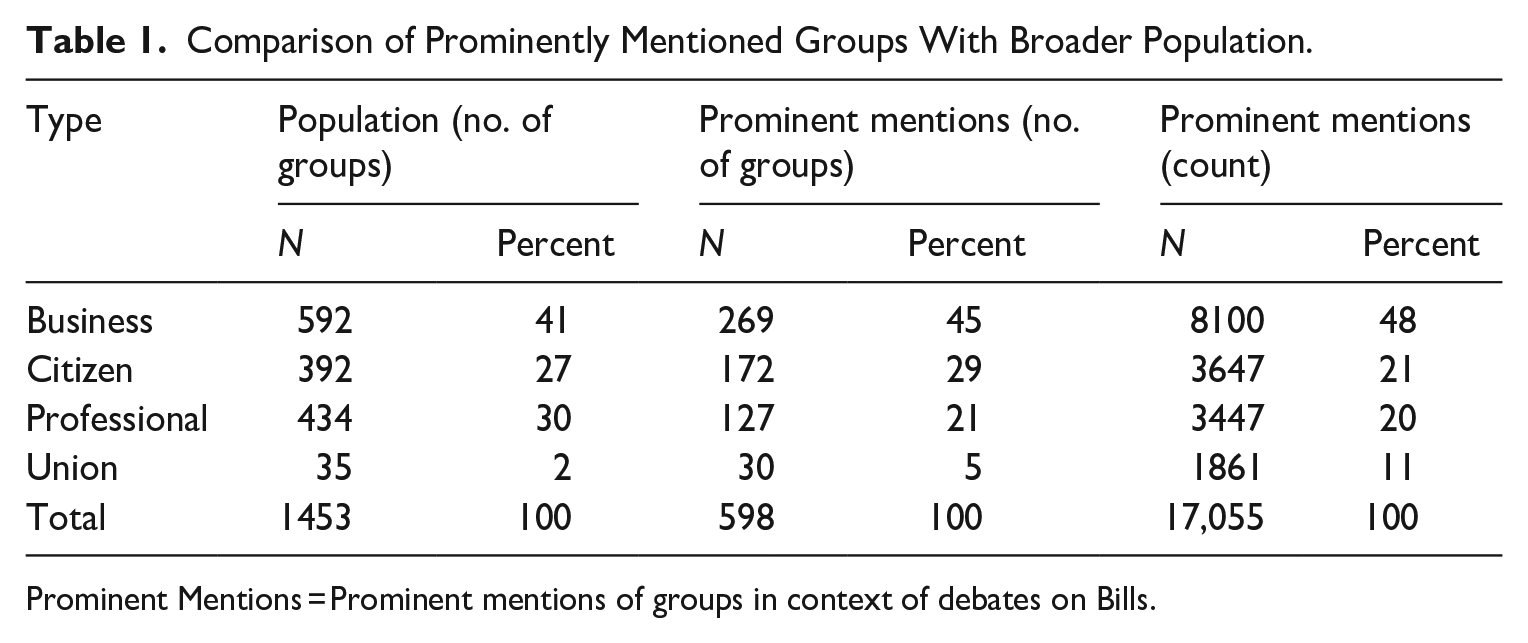
Prominent Mentions = Prominent mentions of groups in context of debates on Bills.
Our findings also illustrate that prominence among elite audiences is heavily skewed. Figure 1 reports the cumulative distribution of prominence across the 598 groups, plotting on the y-axis the number of prominent mentions, and on the x-axis the percentage of groups receiving less than a given count of prominent mentions. In essence, the very long tail of the distribution suggests that a small number of groups account for a large proportion of the prominent mentions in our data. A full 58% of groups are not mentioned prominently at all, while 20% receive between one and five mentions over the 24-year period, and only 5% receive more than 25 mentions. Put another way, it demonstrates that where members of the Australian Parliament refer to a group during parliamentary debates, they tend to draw on a relatively small pool of “top tier” groups. This suggests a core–periphery dynamic in the Australian interest group sector in relation to prominence among elite audiences, a pattern also found consistently using data on group involvement and access (LaPira et al., 2014; Pedersen et al., 2015).
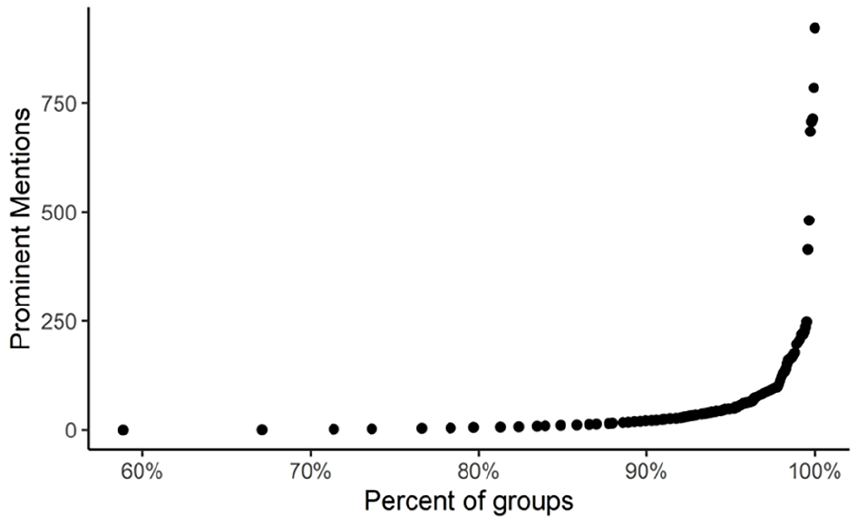
Cumulative Distribution of Prominent Mentions.
Demand for Lobbying Predicts Prominence
Moving to a more granular level of analysis, we find that among the top 20 most prominent groups are business groups (7), citizen groups (6), unions (4), and peak professional associations (3). 6 This may provide superficial clues that group type is not a salient predictor of prominence. But what factors, more broadly speaking, are associated with being among the strongly recognized groups? In Table 2 we estimate two models, one with prominence as a dependent variable—is the group ever the subject of a prominent mention? Yes or no?—(model M1) and one with the count of prominent mentions as the dependent variable (M2). For the former, we use a logistic regression model, and for the latter a negative binomial one. 7
Explaining Prominence and Prominent Mentions.
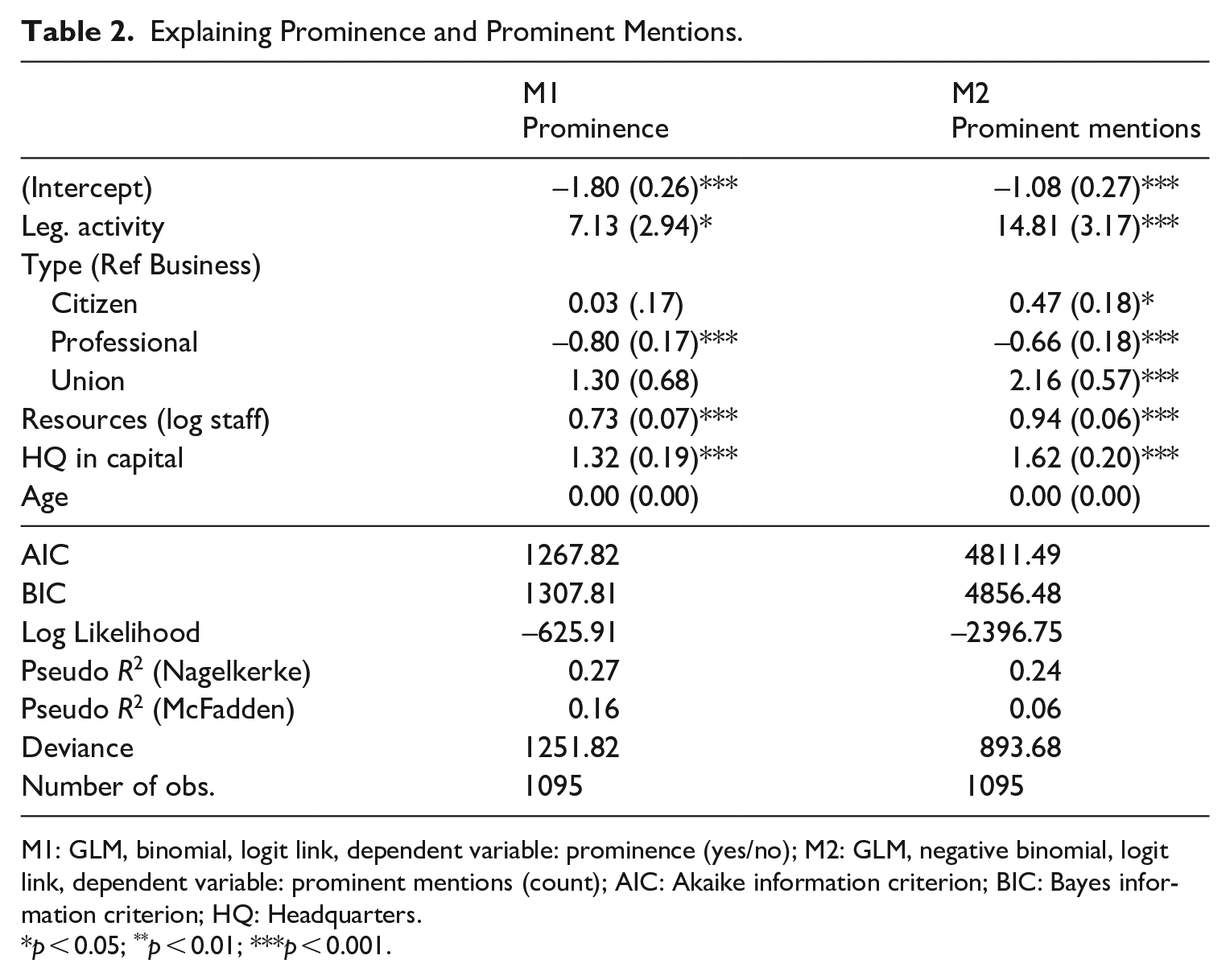
M1: GLM, binomial, logit link, dependent variable: prominence (yes/no); M2: GLM, negative binomial, logit link, dependent variable: prominent mentions (count); AIC: Akaike information criterion; BIC: Bayes information criterion; HQ: Headquarters.
p < 0.05; **p < 0.01; ***p < 0.001.
The results of both models are largely consistent, in that they lend support for the thesis that the alignment with the policy agenda is associated with a higher likelihood of attaining both prominence and prominent mentions (H1). Holding other things constant, the predicted probability of being prominent increases from 0.35 (95% CIs = 0.27, 0.43) where the policy area that a group mainly focuses on represents 1% of the total policy agenda, to a probability of 0.62 (95% CIs = 0.46, 0.76), where agenda alignment is 17%. Similarly, the predicted number of prominent mentions for marginally aligned groups is 1.77 (95% CIs = 1.19, 2.63), compared with 18.97 (95% CIs = 9.27, 38.85) for the most aligned ones. This suggests that as the amount of legislative activity in a policy area increases, those groups that have something important to say about this area—that is those that focus specifically on it—will also become more prominent.
The models control for some factors possibly associated with interest group recognition. Surprisingly, group type is not a very salient predictor of the likelihood of being prominent among political elites (M1). This changes, however, when looking at the number of prominent mentions, rather than the dichotomous indicator (M2). While being a professional group is associated with significantly fewer mentions than our reference category (business groups), citizen groups and unions both enjoy significantly more prominent mentions. Substantively, this means that citizen groups receive on average 17.4 more mentions than business groups, while unions attract 225.2 more mentions on average. This is counter to common accounts of a business bias in insider access. The fact that these two group types do not differ significantly from business interests when it comes to crossing the hurdle between obscurity and prominence, but do differ once that hurdle is crossed, suggests that groups most able to improve the social license of legislators’ proposals—as citizen groups are best placed to do—are most often name-checked in meaningful ways.
A Partisan Dimension?
The second hypothesis expected that business and professional groups probably face a more favorable political environment under a Coalition government (H2a), and citizen and unions under an ALP government (H2b).
Table 3 reports prominent mentions by party. The overall uneven distribution of prominence among parties is apparent. Speakers from the ALP deploy interest groups almost 1.5 times as often as Coalition MPs. This is despite the slight numerical advantage of the Coalition of 919 sitting legislators (both houses) over the parliaments we examined versus 755 Labor MPs. 8 The table also provides some descriptive assessment of the partisan alignment thesis. For instance, members of the Coalition refer to business groups 54% of the time they refer to any group. The Greens, in contrast, lend more prominence to citizen groups, whom they mention 41% of the time that they refer to a group. On the contrary, the table also shows that, counter to expectations, unions and professional groups have a remarkably similar percentage for each party.
Prominent Mentions by Party, Group Type.
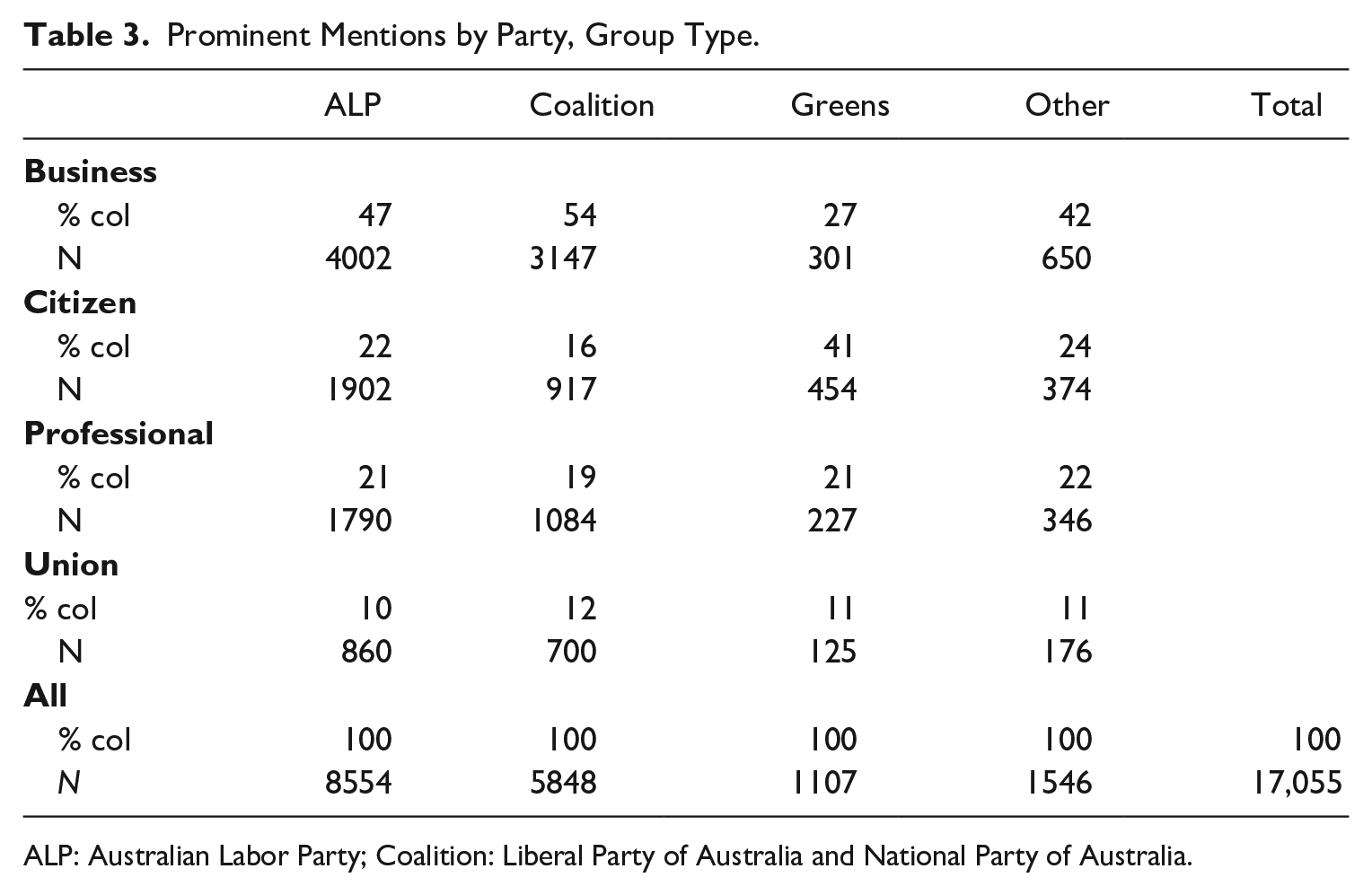
ALP: Australian Labor Party; Coalition: Liberal Party of Australia and National Party of Australia.
This mixed evidence for a partisan dimension to group prominence with legislators is replicated when looking at the group level. For each group, we calculated the percentage difference between the prominent mentions it received from the Coalition versus the ALP, then averaged these over our four group types, calculating confidence intervals. The results reported in Figure 2 do not support H2a/b. 9 We expected that unions would be mentioned more frequently by the ALP, and business groups more often by the Coalition. However, this is not the case, with the overlapping confidence intervals suggesting no statistically different likelihood of unions or business groups being mentioned by either party. Regarding professional groups, the results go exactly counter to our expectations. These groups are indeed mentioned 21% more often by ALP members. Only the net distribution of citizen groups—on average 37% more prominent mentions by Labor legislators—supports our first set of hypotheses. Overall, bivariate analysis is not suggestive of a strong partisan dimension of interest group prominence among political elites.
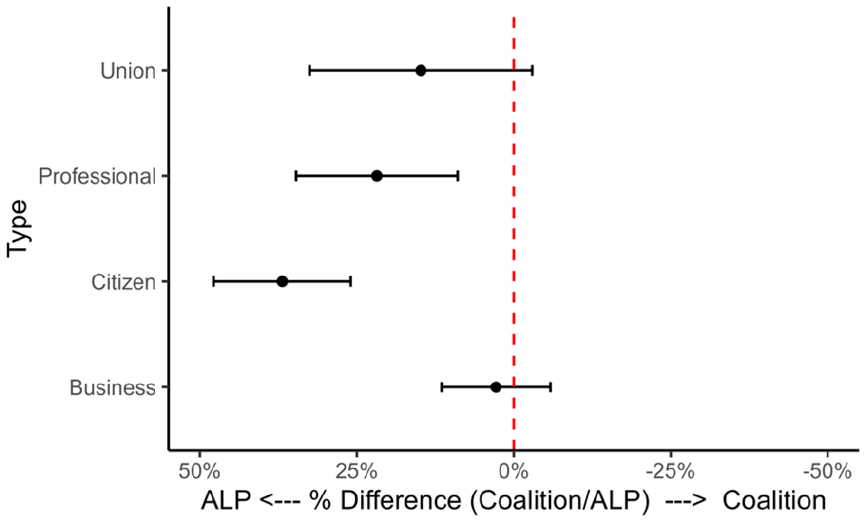
Percentage Difference between ALP/Coalition Prominent Mentions, by Group Type.
Exploring the dynamics of prominence further, Table 4 presents negative binomial models regressing the count of prominent mentions by each party over our independent variables. Furthermore, the dataset is split into three, depending on the status of the speaker as being part of the government, the opposition, or a crossbencher at the time of the mention. 10 Analyzing the results, it is most notable that group type—associated with our test of the Partisan Alignment hypothesis—is significant in most models. 11 Broadly speaking, the results of the aggregated dataset hold, in that unions are disproportionately more likely to receive many mentions by all parties, and professional groups receive fewer. The union finding may seem puzzling for a so-called pluralist system like Australia. Yet, as a two-party system, and one where unions are aligned clearly to ALP, there is value in both sides praising and/or criticizing them for partisan reasons. Our measure is not one of “strength” in terms of institutional position of unions vis-a-vis the state, but of the tacit value of the group to political debate (positive or negative). As noted above, prominence captures both positive and negative sentiments; thus it is less a surprise that Unions are prominent across all parties. Indeed, previous work has shown that unions in Australia have high levels of access and involvement in the policy system: with 4 unions in the top 10 on both measures (see Fraussen et al., 2018, table 6). Business groups, as the reference category, do not show any clear association with prominent mentions by Coalition members. All three observations contradict the Partisan Alignment hypothesis.
Explaining Prominent Mentions, by Party and Governing Status.
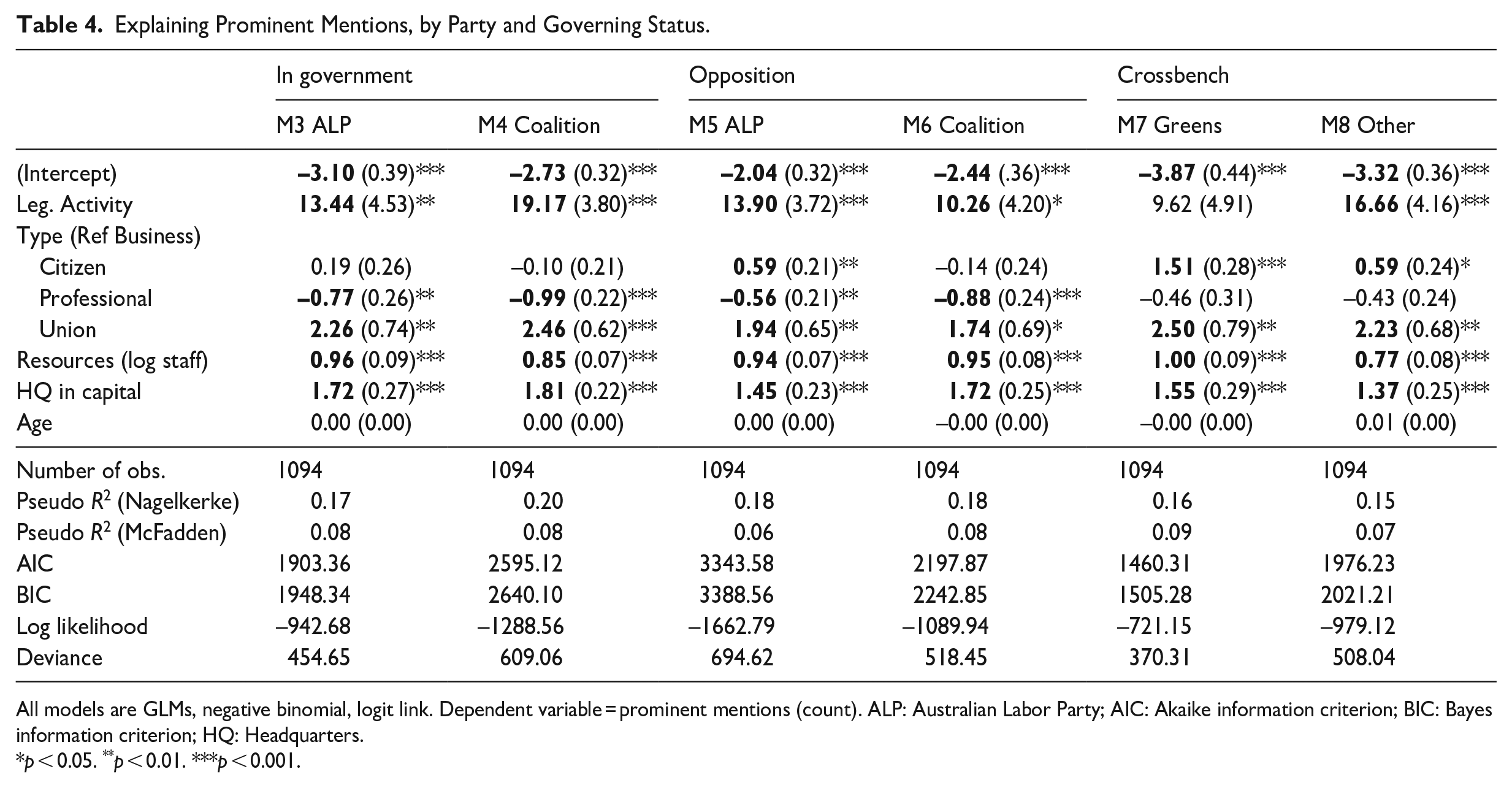
All models are GLMs, negative binomial, logit link. Dependent variable = prominent mentions (count). ALP: Australian Labor Party; AIC: Akaike information criterion; BIC: Bayes information criterion; HQ: Headquarters.
p < 0.05. **p < 0.01. ***p < 0.001.
Dynamics of Conflict Expansion
The third expectation is that citizen groups will be more prominent among opposition MPs, as their operating logics both call for the expansion of policy conflict to by-standing publics (H3). Incumbent parties, in contrast, might be more interested in containing conflict. The results shown in Table 4 above are broadly in line with this expectation. Citizen groups indeed enjoy on average more prominent mentions from legislators who are currently not in government (i.e. opposition or crossbenchers). The exception is the Coalition, which does not mention citizen groups more than business groups, even when in opposition (M6).
To better interpret these findings substantively, in Figure 3 we plot the predicted count of prominent mentions of citizen groups and business groups, conditional on party and government status. This plot is drawn from the estimates of models M3–M8 in Table 4, with all values of covariates held constant at median values. The y-axis shows the predicted number of prominent mentions, logarithmically transformed for better comparability. Each pane compares the predicted mentions for business groups (on the left) to citizen group (on the right). There are three noteworthy results.
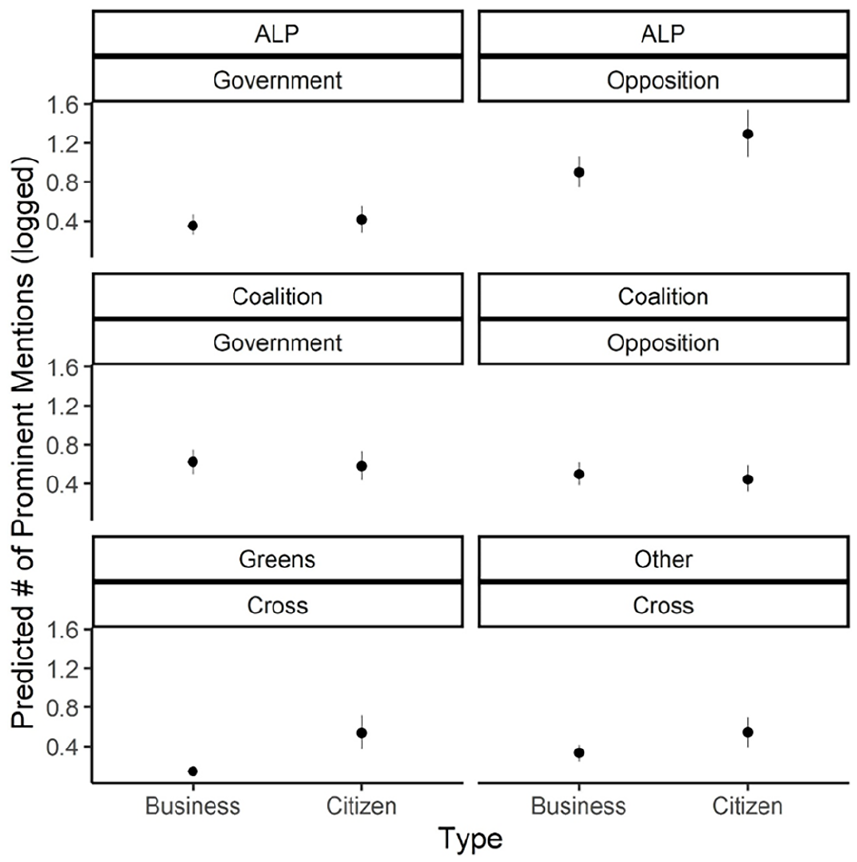
Predicted Count of Prominent Mentions, by Group Type and Governing Status.
First, legislators who are in government do not mention either business groups or citizen groups significantly more often, regardless of which party they represent. This lends some support to the opposition alignment thesis. As expected, citizen groups may not confer additional weight to the viewpoints of political elites when they are in government, at least not when compared with the additional value of business groups.
Second, being in opposition is associated with giving more prominence to citizen groups over business groups for ALP legislators, but not for the Coalition. Specifically, when Labor is in opposition, the average predicted number of prominent mentions for citizen groups is 2.64 (95% CIs = 1.89, 3.68), 12 whereas business groups are mentioned prominently only 1.46 times (95% CIs = 1.11, 1.88). Conversely, there is no significant difference in how often Coalition MPs in opposition mention citizen groups—0.56 times (95% CIs = 0.38, 0.79)—or business groups—0.64 times (95% CIs = 0.46, 0.84). In addition to that, the overall volume of predicted prominent mentions increases three- to fivefold for both group types when ALP legislators are in opposition, compared with when they are in government: from 0.42 to 1.46 for business groups, and from 0.50 to 2.64 for citizen groups. Again, the same is not true for the Coalition, where predicted mentions stay relatively flat, and are even lower for citizen groups when the Coalition is in opposition.
Third, crossbench MPs are more prone to giving prominence to citizen groups, compared with business groups. This is more pronounced for Greens legislators than for “other” partisans. The former are predicted to mention business groups 0.16 times (95% CIs = (0.10, 0.22)) and citizen groups 0.70 times (95% CIs = 0.46, 1.02), while predictions for the latter are 0.39 (95% CIs = 0.29, 0.54) for business groups and 0.72 (95% CIs = 0.51, 0.99) for citizen groups, respectively. This is also in line with the opposition alignment hypothesis. Crossbenchers are largely locked out of policymaking, even if they tolerate a minority government, and may thus have higher demand for the countervailing frames and damaging (for the government) information provided by citizen groups.
In summary, the empirical analysis of our speech data clearly supports the Policy Agenda hypothesis (H1), in that prominent mentions cluster in policy areas where a lot of legislative activity occurs. This result holds across all parties and regardless of governing status. Conversely, the findings lend little to no support to the Partisan Alignment hypothesis (H2). Unions are more prominent among legislators of all partisan persuasions, not only on the left, while professional groups are equally neglected in the prominent mentions of all parties. There is no evidence at all for any favorable prominence of business groups among conservative legislators either, which all suggests that H2a/b cannot be upheld. In contrast, evidence is consistent with the thesis of Conflict Expansion (H3). While in government, legislators tend to give prominence to citizen groups in proportion (roughly) to business groups. But when not in government, this holds true only for the Coalition. ALP, Greens, and other partisans mention citizen groups much more frequently in prominent context when in opposition (or on the crossbench).
Conclusion
Prominence is one way to conceptualize the political engagement of interest groups. Several developments, to our mind, render prominence as an increasingly important concept. The threshold for involvement and access in the political system is becoming continually lower. Groups often talk of over-consultation (and sometimes of course talk about being ignored), and in most political systems, elaborate processes for commenting on issues are available. Of course, not everyone will involve themselves, but certainly almost anyone can do so.
Yet, if involvement and access are ubiquitous, political elites are nevertheless selective in who they devote attention to, whose arguments they take seriously, and who they ultimately recognize as an important actor in policy debates. This is why prominence, the degree to which an interest group is recognized as important by political elites in the context of them advancing political arguments, is important for parsing out “who matters” in our political systems. It is coveted by groups themselves, as it conveys the ability to insert frames into policy debates, signals credibility to the media, and demonstrates policy relevance to their members. Prominence may also provide a crucial intermediate indicator of group influence. This article offers one method to measure prominence that is economical to employ and can be implemented at scale.
Exploring the predictors of prominence, our substantive findings contribute to the growing literature on groups and party systems. First, we show group prominence with MPs is concentrated—only a small number of groups account for most of the prominence, and there is a distinct skew toward business interests. This echoes longstanding scholarship on bias in interest representation, which has confirmed that most interests attain some kind of political organization, yet there is clear numerical dominance of business interests over others (Schattschneider, 1960). Work that has plotted the activities of groups involving themselves in policy advocacy has similarly noted the highly skewed nature of that across the group system (Pedersen et al., 2015). We show that similar dynamics hold for group prominence.
Second, our findings broadly confirm influential demand-side accounts of lobbying (Baumgartner et al., 2011). The alignment of a group’s policy focus with the prevailing policy agenda is a strong predictor of prominence. This suggests that interest groups are somewhat confined in their ability to provide new policy information and frames to policymakers, and to actively shape the agenda. Just as government attention creates the demand for groups to mobilize in the first place, it also seems to create demand among legislators to use them as discursive resources.
Third, we find little support for a partisan alignment explanation for variations in prominence in the legislative arena, as, surprisingly, parties across the political spectrum mention unions more often than any other group type, and business groups do not enjoy more prominence on the political right. While the party literature assumes groups will work most closely with the ideologically aligned (Allern and Bale, 2017) and the group literature consistently finds that groups most often lobby allies (Hojnacki and Kimball, 1998), we do not find evidence for this in our study. That parties of both sides refer to the same set of groups points to a tacit consensus on which groups matter, and as such explains why there is no merit in ignoring stakeholders who are consistently accepted as relevant (even if not of the same partisan disposition).
Finally, we identify that parties in opposition tend to rely more strongly on citizen groups to lend weight to their arguments than parties in government. However, this is not true for the political right—the Coalition in our Australian context. Our focus on legislator speech, and not institutionalized links or cooperation between parties and groups, suggests prominence is explained by a different set of relations. In speech, groups are a valuable resource, a rhetorical prop, to assist in making and sustaining arguments around proposed legislation. The opposition-citizen group alignment points to broader dynamics of conflict expansion and contraction which may after all provide opportunities for groups to insert new viewpoints into the debate.
How much is this an Australian story? We expect that key findings of our study around the concentration of prominence and the importance of prevailing policy agendas are less sensitive to context and should travel reasonably well. Corporatist as well as pluralist systems have been shown to produce similar patterns of group engagement across different arenas (Binderkrantz et al., 2020; Pedersen et al., 2015). The strong party discipline in the Australian Party system leads us to expect that the partisan alignment we view here may be stronger than that in multiparty systems, or indeed in the US case. In the context of European multiparty systems, Otjes and Rasmussen (2017) find that frequent wholesale alternation between left- and right-led governments leads to a partisan pattern of group-party collaboration, while partial alternations between large centrist parties do not. As such, Australia is a most-likely case for the partisan alignment hypothesis. Yet, our evidence is actually not consistent with the party alignment hypothesis. For instance, we see that members of both parties tend to refer to the same core set of groups. Thus, being referred to is more likely a function of the value of the group—even rhetorically—in mounting political arguments. These elites know who the key players are, and when they reach for sources to make their points, they tend to refer to the very same groups.
Several key questions stand out as relevant for future research on group prominence in the legislature. First, the availability of clean and organized records of legislative speech will enable future research to commence this kind of study with all the speeches of legislators in hand. In such an instance, researchers could then examine what drives specific legislators to mention or refer to specific groups, over time (or not to mention any at all). This dyadic data structure would open up new possibilities to explore how “citation” networks form among legislators and groups, and to explore links between elite careers and their propensity to refer to certain sources. Second, a logical next step is to engage in experimental work to test the mechanisms that rest in our findings. Our finding that opposition status renders citizen groups more attractive sources is suggestive, but we are not entirely clear why that might be. Finally, work could spend more time on the strategies that groups might take to increase (or maintain) their prominence. We do not have at hand variables that might tap the strategies that groups undertake to make themselves more amenable to being referenced in a meaningful way. Here we think of the role of frame congruence between groups and elites, and the role of the media in grabbing the attention of legislators.
Supplemental Material
sj-docx-1-psx-10.1177_00323217241232934 – Supplemental material for What Explains Interest Group Prominence in Parliamentary Speech? Policy Agenda, Partisanship, or Conflict Expansion
Supplemental material, sj-docx-1-psx-10.1177_00323217241232934 for What Explains Interest Group Prominence in Parliamentary Speech? Policy Agenda, Partisanship, or Conflict Expansion by Darren R. Halpin, Timothy Graham, Bert Fraussen, Max Grömping and Zhiheng Zhou in Political Studies
Footnotes
Data Availability Statement
All data and code necessary to replicate the analysis in the paper will be uploaded to the journal website on acceptance.
Declaration of Conflicting Interests
The author(s) declared no potential conflicts of interest with respect to the research, authorship, and/or publication of this article.
Funding
The author(s) disclosed receipt of the following financial support for the research, authorship, and/or publication of this article: The research reported here was supported by the Australian Research Council grant [DP140104097] to Professor Darren R. Halpin and the Australian Research Council grant [DP220100050] to Professor Darren R. Halpin and Dr Max Grömping.

Supplemental Material
Additional Supplementary Information may be found with the online version of this article.
Contents
Appendix A: The Australian Organized Interest Population
Appendix B: Measuring Prominence
B.1 Traditional models
B.1.1 Random Forest
B.1.2 Support Vector Machine
B.1.3 Neural Network
B.1.4 Traditional model results
Table B.1. Fold performance for prominence prediction of Random Forest model.
Table B.2. Fold performance for prominence prediction of Support Vector Machine model.
Table B.3. Fold performance for prominence prediction of Neural Network model.
Table B.4. Average performance for prominence prediction of Random Forest model (RF), Support Vector Machine (SVM), and Neural Network (NN).
B.2. Word to vector model (word embeddings)
B.2.1 Model Details
B.2.2 Deep learning model Results
Table B5. Accuracy for prominence prediction of BERT and GPT2.
Table B6. Intercoder reliability measures.
Appendix C: Partisan Composition of Parliaments
Table C1. Number of Parliamentarians, by Party.
Appendix D: Prominence of Interest Groups in Partisan and Policy Context
Figure D1. Distribution of Prominent Mentions, by Party.
Table D1. Twenty most prominent Interest Groups, by Party.
Appendix E: Model selection
Table E1. Summary Statistics of Model Variables.
Table E2. Comparing models explaining prominent mentions
Figure E1. Visual fit of models.
Table E3. Observed vs predicted zeros.
Appendix F: Temporal Dynamics of Prominence
Figure F1. Legislative Activity over Time, by Policy Area.
Figure F2. Cumulative Distribution of Prominent Mentions, by Policy Area.
Figure F3. Mean Prominent Mentions over Time, by Policy Area.
Table F1. Explaining Prominence and Prominent Mentions.
Figure F4. Predicting Prominence and Prominent Mentions.
Notes
Author Biographies
References
Supplementary Material
Please find the following supplemental material available below.
For Open Access articles published under a Creative Commons License, all supplemental material carries the same license as the article it is associated with.
For non-Open Access articles published, all supplemental material carries a non-exclusive license, and permission requests for re-use of supplemental material or any part of supplemental material shall be sent directly to the copyright owner as specified in the copyright notice associated with the article.
