




Abstract
Citizens must hold accurate beliefs about politically relevant facts to preserve democratic representation, accountability and legislation. We theorize that, abstracting from one’s background, schooling per se does not trigger the epistemological sophistication that is necessary to get a grasp of the political world. In this article, we study whether schooling improves the accuracy of factual beliefs about the share of foreigners and unemployed, later in life. We derive an appealing metric of belief accuracy, matching survey respondents’ beliefs with the corresponding real-world datum at the time of the interview in their country, retrieving high levels of inaccuracy in both issues. More educated individuals display higher belief accuracy, most likely due to selection, rather than causality: compelling otherwise-dropouts to stay in school by extending compulsory education does not entail a significant effect on belief accuracy, in both issues. Taken together, cross-sectional and causal estimates suggest that education is necessary, but not sufficient, to contrast inaccurate beliefs.
(If we cannot say that a) high level of education is a sufficient condition for democracy, the available evidence does suggest that it comes close to being a necessary condition.
Introduction
Education’s recurrent aim is to socialize youths to fit the socio-political context they were born in. Because such context changes, crafting “good citizens” means something different in different eras: “Democracy has to be born a new every generation, and education is its midwife” (Dewey, 1983: 139). Educators would train youths to blindly subordinate to the Republic in ancient Greece, and to God in the Middle Ages. In contemporary societies, instead, educators’ moral role is to transmit the kind of rationality that serves the modern state (Durkheim, 1956). From a political perspective, education needs to craft citizens that are active, knowledgeable and tolerant, in order to fulfill the goals of, resp., ensuring the quality of representation, preserving accountability, and respecting minorities. The conventional wisdom is that education has this potential: “Education presumably broadens men’s outlooks, enables them to understand the need for norms of tolerance, [. . .], and increases their capacity to make rational electoral choices” (Lipset, 1959: 79). Does education work as presumed?
Few doubt that education contributes to good citizenship in liberal democracies. Yet, it is both theoretically and empirically unclear whether education alone can activate those qualities irrespective of the context in which it is embedded. Locke thought that “of all the men we meet with, nine parts of ten are what they are, good or evil, useful or not, by their education.” (1887: 4), while Durkheim (1956: 82) insisted that “education doesn’t make a man out of nothing.” Extant empirical evidence does not conclusively tell whether education is a sufficient, or just another necessary, condition for “good citizenship”. While most individual-level analyses confirm a role for education in fostering democratic attitudes (e.g. Brady et al., 1995; Gelepithis and Giani, 2022; Hainmueller and Hiscox, 2007; Noury and Roland, 2020), the country-level picture tells a different story. For example, while education positively affects turnout at the individual-level, aggregate turnout has been declining worldwide, in a context of ever-increasing educational attainment (Kostelka and Blais, 2021).
A similar picture arises when focusing on the role of education in providing democracies with informed, knowledgeable and wise citizens (Dewey, 1916: 108). Just as educational levels are at their all-time high, pervasive levels of political innumeracy threaten democratic representation, accountability and the quality of legislation (Flynn et al., 2017; Nyhan, 2020). It is thus unclear whether education alone increases the accuracy of citizens’ knowledge, or whether further integrative conditions are simultaneously required.
In this article, we address this question by focusing on the potential role that education plays in improving the accuracy of politically relevant factual beliefs. In contrast with extant literature on the interplay between education and political misperceptions (Drummond and Fischhoff, 2017; Joslyn and Sylvester, 2019; Lee et al., 2021; Meirick, 2013; Stoeckel et al., 2023), we distinguish—both theoretically and empirically—“selection” from “causality,” seeking to answer the following question: can schooling causally improve belief accuracy, irrespective of individuals’ background?
We study how accurate citizens are in reporting their beliefs about the share of foreigners and the share of unemployed, at the time they happened to be interviewed across seven European democracies. We match their beliefs with real data on the exact same issue at the time of the interview to derive a precise metric of belief accuracy, and analyze the long-run effect of schooling on such index. Our cross-sectional specification indicates that educated individuals do hold more accurate factual beliefs, while our regression discontinuity approach reveals that such association most likely reflect selection into education.
Taken together, these findings suggest that schooling represents a necessary, but not sufficient, condition for developing accurate political knowledge later in life. They thus downplay the potential of educational opportunities, that policy-makers have expanded throughout the world following the Second World War, in fostering democratic accountability, by limiting the ability of the elected to tackle political issues based on their personal—rather than societal—objectives. Notwithstanding key contextual factors in our analysis, we believe that focusing on immigration, a salient political issue “owned” by the right, and on unemployment, another prominent issue, particularly during financial crises, traditionally “owned” by the left, lends further credibility to our findings.
The article is structured as follows. In Section “Education and Belief Accuracy,” we bridge the literature on schooling and learning attitudes with that on political misperceptions to construct our hypotheses. After discussing our data and main variables in Section “Empirical Analysis,” we present our findings across different designs in Section “Empirical Analysis and Results,” where we briefly address robustness issues that are extensively covered in the online Supplementary Information (SI). Section “Conclusion” concludes the article with a summary of our argument, and a discussion of the implications and limitations of our analysis.
Education and Belief Accuracy
When called to report beliefs about the state of the world, citizens will likely combine sporadic pieces of information directly acquired through the media and private conversations, with assumptions about the real world providing indirect ways to infer reality. As a highly compound experience, education provides an excellent proxy and reduced form for those mechanisms that participate to belief formation, as it affects the information we come across by inducing a specific structure of social and professional networks, media consumption and location choices. Education at the same time enhances, and is enhanced, by our socioeconomic outcomes and cognitive abilities: by liberating the mind from economic insecurity and sense of threat, it affects the process through which we come to make assumptions about the world. It also affects our values, and particularly on the “liberal-authoritarian” axis (e.g. Hyman and Wright, 1979; Lipset, 1959); it thus potentially shifts the educated citizen’s motivated reasoning to adopt biases that go in an opposite direction to the less educated one.
In this section, we borrow on an interdisciplinary body of literature to argue that educated individuals hold both intrinsic and instrumental motivations for prioritizing accuracy over directional goals in forming and reporting perceptions.
Correction Through Accuracy Motives
The process of information acquisition and elaboration is motivated by either accuracy and/or directional motives; that is, by the goal of reaching, resp., the correct or the preferred conclusions when forming and reporting perceptions about politically relevant facts (Kunda, 1990; Nir, 2011). Accuracy and directional goals can coexist, but individuals attach different weights to each, sensitive to contextual and individual factors (Flynn et al., 2017; Jerit and Zhao, 2020). We argue that educated individuals place a higher weight on accuracy over directional goals.
The first mechanism nudging educated individuals to weigh accuracy goals to a greater extent hinges on the interplay between cognition and epistemology, and points toward a causal role of formal education. Every additional year of schooling exposes individuals to increasingly complex cognitive challenges: higher educated individuals are better equipped to adopt a more time- and cognitive-demanding relationship with information, minimizing stereotypical thinking (Flynn, 2016; Schuman et al., 1997) and low-effort information heuristic in a number of knowledge-acquisition environments, including, most notably, the media (Chaiken, 1980; Hwang and Jeong, 2009). This process does not merely improve one’s factual knowledge of the world, but activates a deeper revision of extant standards of beliefs’ justification.
The second mechanism leading educated individuals to value accuracy goals more over directional ones has to do with social stratification. In this case, the causal role of education in improving accuracy takes a back seat, and we focus on a set of factors simultaneously affecting the strength of misperceptions and the likelihood of correcting them along the educational path. Being education a highly socially persistent phenomenon, the most important among such factors is arguably parental education. To this date, the correlation between parents’ and offspring’s education remains high all over the world (Black and Devereux, 2011). Especially at the schooling stage, educated parents forge their children’s relationship with both knowledge and educational attainment in several ways: by framing the former as an endowment (Bourdieu and Passeron, 1981 [1977]), by providing resources, including time, economic support, and surveillance (Houtenville and Conway, 2008), as well as though the byproduct of polygenic score and social environments (Liu, 2018).
While the family environment is key, broader societal dynamics can also play a crucial role. The labor market’s demand for formal analytical adroitness has risen spectacularly over time, and so has its ability to tell apart individuals on the basis of their skills (Autor, 2014), maintaining the positional character of education (e.g. Durst, 2021). As a result, more educated individuals may also be incentivized to improve belief accuracy by the social stratification that education brings upon. They end up in profile-matching social and professional networks in which cognitive performance is highly valued, where like-minded individuals hold them accountable to poorly grounded beliefs in the context of informal and professional discussions. 1
Extant literature leaves no doubt that higher educated individuals are likely to hold a more accurate knowledge. It is unclear, however, whether this is due to an improved ability to correct otherwise similar perceptions about reality, relative less-educated individuals, or rather to an increase in the accuracy of perceptions per se, that is, leaving ability unaffected. In other words, whether the association between educational attainment and accuracy of factual beliefs comes from causality or selection is an important, open question, which, to the best of our knowledge, this article is the first to address.
Selection versus Causality
Is education a cause of, or a proxy for, higher belief accuracy? While one may be tempted to entirely delegate the answer to data analysis, this remains first and foremost a theoretical question. Let us engage in counterfactual reasoning, and confine our focus on a subset of children from an unfavorable socioeconomic background. Let us assume that these children intended to dropout from school at the age of 13. Now suppose that some of them were randomly compelled—for example, by their parents’ will, perceived obligations, and so on—to remain in school, against their preferred choice. Would they develop more accurate factual perceptions over time, relative to those that were allowed to leave at 13?
One cornerstone of educational research is that schooling’s potential in fostering motivations for accurate knowledge cannot prescind from a positive attitude toward learning among pupils (e.g. Martin, 2003). Therefore, compelling teenagers to stay in school longer than they intended to requires turning negative attitudes toward schooling into positive ones, irrespective of parental and social background. Loosely put, schooling needs to breed its own support to causally affect motivations for accurate knowledge. Such boost may come from a gradual increase in compulsory schooling’s ceilings, especially among pupils that would otherwise dropout.
During the impressionable years of secondary school, one or two additional years may be enough to tilt some motivation boosters, including improved self-beliefs or strengthened learning focus, and reduce some motivation guzzlers, such as anxiety or self-sabotage, among otherwise-dropouts. 2 The causal effect of schooling on cognitive skills can sometimes be already detected after 10 extra days (Carlsson et al., 2015). Yet, for other youths, being forced into an activity that neither them nor their parents find worthwhile pursuing may lead them to withdraw from any positive attitude to learning to an even bigger extent. Therefore, compelling pupils to further schooling irrespective of their wish may fail to activate those positive learning attitudes that, in turn, foster motivation for belief accuracy. Schooling per se is unlikely to lead individuals to place stronger weight on belief accuracy.
While in this section, we have mostly focused on individual and parental motivations toward learning and education, this article also attempts to establish whether compulsory schooling can be a substitute for individuals’ motivations in inducing a desire for belief accuracy. Doing so has two advantages. First, it allows to study whether the purported association between schooling and accuracy of beliefs reflects selection into education, or a causal effect of education. Second, since Governments control compulsory attainments to a much greater extent than they control motivations to earn further education, our analysis directly assesses the potential of policy-making in fostering the citizen’s accuracy of perceptions.
Belief Accuracy in the Realm of Politics
So far, we have deliberately referred to a generic accuracy in factual knowledge, abstracting from the very nature of such knowledge. How well does the education-driven “taste” for accuracy just discussed should be expected to travel to the realm of politics?
On the one hand widespread motivated reasoning and the primacy of directional motives in processing information impairs accountability, representation and legislative outcomes (Flynn et al., 2017; Kahne and Bowyer, 2017). By virtue of placing more value on these societal outcomes, educated individuals should take a pro-democratic approach to political knowledge, that is, one prioritizing accuracy goals (e.g. Smith, 1948). The higher levels of trust recorded among educated individuals should reinforce this pattern, helping discarding implausible claims (e.g. Hetherington, 2005). Up until this point, focusing on political as opposed to, for example, scientific knowledge should not make much of a difference. On the other hand, educated individuals display an undesirable triad of the folloing: (1) salient political identities; (2) high consistency between beliefs and political identities; and (3) cognitive ability to discard counter-attitudinal information. Altogether, these may lead them to, resp., seek and rule out information that reinforces or destabilizes their preferences, activating motivated reasoning, thus threatening accuracy goals (Nyhan and Reifler, 2010; Taber and Lodge, 2006; Zaller and Feldman, 1992).
Higher politicization among more educated individuals could create some tension between accuracy and directional goals, particularly on salient, polarizing issues. 3 Yet, such tension arguably manifests itself only at high levels of accuracy. Politicization does not necessarily translate into lower levels of accuracy: it can indeed bring about hot debates, hence opportunities for learning, which are often—but not always—discarded in favor of directional motives among more educated individuals. Indeed, extant empirical evidence indicates that educated individuals do hold more accurate politically relevant perceptions than less-educated ones (e.g. Stoeckel et al., 2023) but that, at the same time, belief polarization is higher among knowledgeable people of different partisan identities, who are more able to defend mistaken beliefs (Drummond and Fischhoff, 2017; Joslyn and Sylvester, 2019; Lee et al., 2021; Meirick, 2013).
Our theoretical framework posits that education increases the weight individuals place on accuracy relative to direction motives in setting their political beliefs, either through its relationship with the socioeconomic context or in itself. We cannot directly test such mechanism, and we focus on its implications. We hypothesize that:
H1. Educated individuals hold more accurate factual beliefs than less-educated ones.
H2. More accurate factual beliefs among educated individuals reflect selection rather than causality.
Empirical Analysis
Data
To test our hypotheses, we combine three data sources. First, information on individual perceptions regarding the share of foreigners and unemployed in the country comes from the 10 rounds of the European Social Survey (ESS), running every 2 years between 2002 and 2020 and covering 33 European States.
The survey is constructed using strict random probability sampling and highly rigorous translation protocols, and has been widely used by social scientists. An ESS interview lasts for about 1 hour, is computer-assisted, and typically conducted face-to-face. 4 The ESS is relatively successful in minimizing attrition bias. While ESS’s ambitious target of 70% response rate falls short in several countries, most countries still fare above 50% (Koen et al., 2018). 5
As our focus is placed on schooling, we drop the small subset of respondents not reporting their age (N = 173), and those who are younger than 19, hence possibly still in school (N = 20,830). We then remove respondents born abroad who reported having moved to the country after the age of 6, when primary schooling starts in most nations (N = 39,152). The full sample is therefore constituted of 424,020 individuals, interviewed over the 10 ESS waves.
The two ESS survey items used to capture respondents’ beliefs are as follows:
Beliefs about the share of foreigners: “Out of every 100 people living in [respondent’s country], how many do you think were born outside [respondent’s country]?” Respondents could indicate any number between 0% and 100%.
Beliefs about the share of unemployed: “Of every 100 people of working age in [respondent’s country] how many would you say are unemployed and looking for work? Choose your answer from this card. If you are not sure please give your best guess.” Available options: 0–5, 6–10, [. . .], 50+. 6
Second, knowing the date in which the interview took place, we can then match each respondent’s beliefs to their real-life counterpart in their country, in the year of the interview, using EUROSTAT data. 7 We construct the indexes for the share of foreigners and unemployed using the following items:
Real share of foreigners: we divide the information on the “total number of foreign and stateless citizens in country in each year” by the “total number of citizens in country in each year.” 8
Real share of unemployed: here we look at the unemployment rate among the standard 20–64 age interval, generally covering working age population. In this case, we bin values to match the categories available to the respondents in the ESS questionnaire.
Finally, again leveraging the interview date of each respondent, we use data from ParlGov (Döring and Manow, 2021) to evaluate the association between the political environment in the respondent’s country and the accuracy of personal beliefs.
Dependent Variables: Belief Accuracy
Combining the data sources just discussed, we can construct our two main dependent variables as follows:


Taking the absolute value of the distance between beliefs and realities gives us a valid proxy of the accuracy of beliefs, abstracting from the specific direction of bias. 9 Figure 1 plots the distribution of beliefs on both outcomes among the respondents. The top-left sub-figure plots the accuracy of beliefs regarding the share of foreigners. It confirms the presence of widespread misperceptions in this domain, with the average belief in the sample being 17% points away from the real datum. When focusing on the direction of the bias (top-right sub-figure), consistently with the literature (Citrin and Sides, 2008; Herda, 2010; Sides and Citrin, 2007), the inaccuracy we record is driven by an overestimation of the share of foreigners in the country, by about 16%.
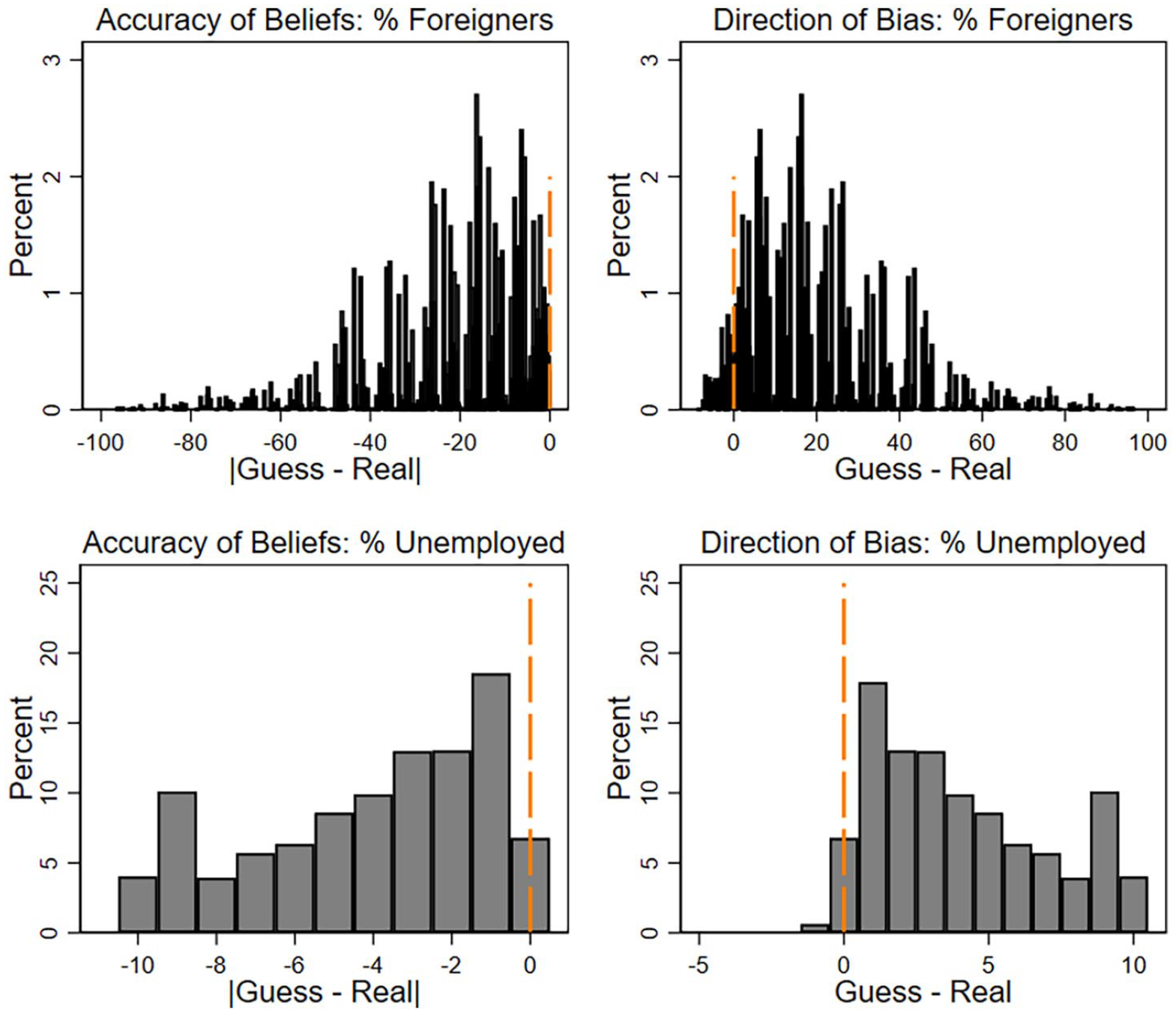
Distribution of Beliefs Among ESS Respondents.
The two bottom sub-figures in Figure 1 instead display the distribution of beliefs about unemployment. Overall, and despite some conceptual differences between the two issues, both in terms of politicization and of the ideological axis they pertain to, a very similar picture emerges. While about 10% of the respondents single out the correct range of unemployed in their country, beliefs are generally inaccurate and, again in line with previous findings (Geiger, 2017; Taulbut and Robinson, 2015).
It is worth pausing on two aspects relative to our dependent variables. First, notice how the survey questions are framed rather unambiguously; they explicitly refer to the share of foreigners (not “immigrants,” not “minorities”) and unemployed (not “people not working”), in the country (not “in your area”). Nevertheless, the reported beliefs are likely affected by local immigration or unemployment rates, as well as by some conceptual confusion conflating, for example, natives with a minority background with foreigners, or inactive people with unemployed. The potential of education to correct misperceptions therefore encompasses not only the factual knowledge/memory of the figures, but also the ability to properly interpret the questions.
Second, both the unconditional and conditional rates of non-response can be somewhat informative. We observe how 9.5% of respondents chose to abstain from guessing the share of foreigners, while 6.7% did the same with respect to the unemployed. Both figures are rather high, especially if compared to other political attitudes. 10 The different rates may compound differences in factual complexity and social desirability concerns—likely higher for the former—between the two issues. Interestingly, non-response rates are extremely sensitive to the respondents’ education level. Missing values with respect to the share of foreigners (unemployed) in the country account for 4.2% (2.4%) of the sub-sample of individuals with a graduate diploma, but jump to 21.1% (16.6%) among those having completed at most primary school. In other words, judging from the differential in the response rate, highly educated individuals feel substantially more confident about giving a correct answer.
Main Independent Variable: Years of Education
Our main independent variable is a continuous measure of education: the respondent’s self-reported years of completed full-time or part-time schooling. 11 This is a widely used metric in cross-country studies (Finseraas et al., 2018; Marshall, 2016), being independent of the idiosyncratic features of specific schooling systems. As a standard in our sampled countries, schooling lasts 13 years, in most cases beginning at the age of 5, and ending at the age of 18. In line with our focus, and in order to abstract from higher education effects, we cap years of education at 13, following Cavaille and Marshall (2019). 12 We show in SI that relaxing this restriction does not affect our results.
Empirical Analysis and Results
Cross-Sectional Specification
We begin by testing H1—Educated individuals hold more accurate factual beliefs than less-educated ones—using the following specification, which we fit through a (cross-sectional) ordinary least squares (OLS) regression: 13

where
Merging ParlGov data with the survey, we control for the distance between the interview date and the closest election in country c preceding the interview, as well as for the ideological orientation of the government in charge at the time. Depending on the outcome under scrutiny—share of foreigners or unemployed—we want to account for the role attitudes may play in the formation of beliefs, and on their accuracy. So, in the former case, we control for the item asking whether “Immigrants make country worse or better place to live” (0–10); in the latter, for the one asking how much the respondent agrees with the sentence: “Most unemployed people do not really try to find a job” (1–5). Finally, we include country
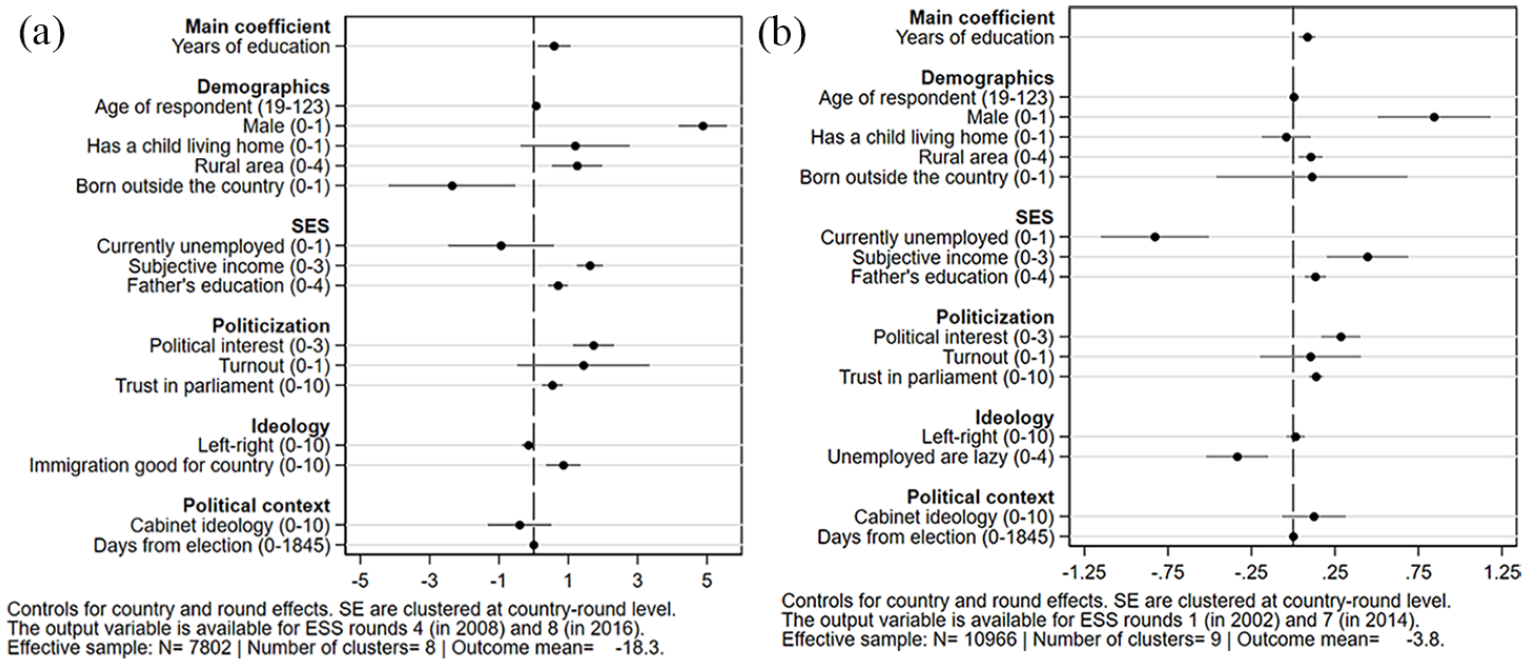
Years of Education and Belief Accuracy: Cross-Sectional Findings. (a) Accuracy: % Foreigners. (b) Accuracy: % Unemployed.
Accuracy % of Foreigners
We estimate that an additional year of schooling is associated with approximately 0.5 percentage points higher accuracy in guessing the right share of foreigners living in the respondent’s country (Figure 2(a)). On average, five additional years of education would improve one’s accuracy by about 2.5 percentage points. Recalling that the dependent variable takes the value of zero when accuracy is perfect and that the unconditional mean of (in)accuracy is 16%, this would amount to an accuracy improvement of approximately 15%. Calculating the marginal predictions from equation (1) for different levels of education, we see how the predicted average accuracy initially lays far away from the EUROSTAT figures. The gap between perceptions and reality then monotonically reduces, eventually closing at very high levels of education.
Consistently with our predictions, a higher socioeconomic status (SES) correlates with more accurate beliefs. Most importantly, higher (subjective) income and a more favorable socioeconomic background (i.e. a more educated father) strongly and positively correlate with belief accuracy on the share of foreigners in the country, while the same does not hold for the employment status at the time of the interview. To complete the picture, being a native, a man, and living in urban areas all correlate with reporting more accurate beliefs, suggesting that foreigners tend to overestimate the size of their group. The same, positive association holds for politicization, as proxied by retrospective turnout, institutional trust and political interest.
Unsurprisingly, holding anti-immigration attitudes is associated with lower accuracy in one’s guess about the presence of foreigners (driven by an upward bias). Once immigration attitudes are factored in, having a right-wing ideology does not instead significantly correlate with a stronger bias. Finally, we look at the role of the political context in forming accurate beliefs: both the political color of the incumbent and the distance in time from the closest national election spur new, possibly biased, information, thus altering one’s perceptions. Our estimates suggest that proximity to an election is associated with a slight increase in accuracy, possibly due to an intensification in exposure to political information.
Accuracy % of Unemployed
We now turn the attention to belief accuracy with respect to the share of unemployed in one’s country (Figure 2(b)). The relationship between years of education and belief accuracy on unemployment is again positive and statistically significant, and the improvement with respect to the unconditional mean is strikingly similar in magnitude as that reported for the previous variable. 14
Analyzing the association between accuracy of beliefs on the share of unemployed and other covariates, we obtain a nearly identical picture. The two major exceptions are that neither being a native, nor age, are associated with belief accuracy on unemployment, unlike when the focus in on the share of foreigners. As before, respondents that are part of the group that is the focus of the question—that is, unemployed—tend to be less accurate (due to overestimation) about the diffuseness of their status among the population. In this specification, the relevant ideological variable captures the stigmatization of unemployed workforce: as for the previous specification, those who exhibit disparaging attitudes toward the group under scrutiny (i.e. “unemployed are lazy”) fare worse in the accuracy of their guesses. Contextual political variables related with the proximity to elections, as well as the political color of the incumbent, are not significantly associated with belief accuracy.
Taken together, our findings indicate that more educated people have indeed a better grasp of reality when it comes to assessing the share of, resp., foreigners and unemployed in the country. We therefore do not reject H1: Educated individuals hold more accurate factual beliefs than less-educated ones. Section “Threats to Identification” details that this testing outcome is not sensitive to sampling choices including a wider set of countries or studying them one by one does not substantially affect our estimates. Moreover, this finding goes through when we consider further levels of education as well. That the positive association between years of schooling and belief accuracy survives after controlling for a large set of confounders may hint to a causal relationship between the two: a possibility we investigate in the following subsection.
Selection versus Causality: Compulsory Schooling Reforms
Since individual schooling choices may reflect both unobserved differences in sociodemographic background and early political attitudes, cross-sectional estimations may suffer from both omitted variable bias and reverse causality. We deal with selection bias by exploiting a set of seven reforms extending the length of compulsory education, implemented throughout the second half of the twentieth century, by means of a Regression Discontinuity
The approach consists of identifying the “pivotal” cohort that was first affected by the schooling reform, comparing the attitudes of cohorts just before and just after the pivotal one, controlling for a time-trend, and weighting individuals closer to the discontinuity more heavily. Following Cavaille and Marshall (2019), we restrict our sample to those countries where the reform successfully raised self-reported years of completed education among treated respondents, that is, affected by the reform. We recover significant (at least at the 10%) coefficients in the following five countries, which will be the focus of our RD: France, Italy, Netherlands, Portugal and the United Kingdom. 16 The compulsory increase in schooling implied by these reforms is of moderate magnitude. However, even one additional year of education at a key stage of life can be thought off as a compound treatment which does not affect the individuals’ cognitive development only by forcing additional schooling, but also by potentially inducing pupils to acquire even further education later on.
We define

As before,
Let us briefly outline the specification of our baseline RD design. First, in the absence of any strong theoretical priors regarding a potentially non-linear pattern of our dependent variable, we opt for a linear local estimator. This choice is consistent with recent econometric wisdom regarding the danger of using high-order polynomials (Gelman and Imbens, 2019). Second, we use default linear, triangular kernel weights to construct the local estimator. These have the advantage of weighing to a proportionally higher extent the observations closer to the discontinuity imposed by compulsory schooling reforms. They should therefore perform well in netting out cohort effects. Finally, RD bandwidths are chosen according to the default data-driven algorithm developed by Calonico et al. (2017). We check the robustness of our results to alternative RD specifications, reporting them briefly in Section “Threats to Identification”, and more extensively in SI C.
Figure 3 plots our estimates, and 95% confidence intervals, of the causal effect of schooling on belief accuracy, for both dependent variables. Accuracy on the share foreigners in one’s country increases among cohorts that were just compelled into compulsory schooling reforms (Figure 3(a)), but the effect is systematically insignificant at conventional levels, and across a number of specifications, discussed in detail in Section “Threats to Identification”. Similarly, compulsory schooling reforms did not significantly affect belief accuracy on the unemployment rate (Figure 2(b)): if anything, the sign of the coefficient is negative in this case.
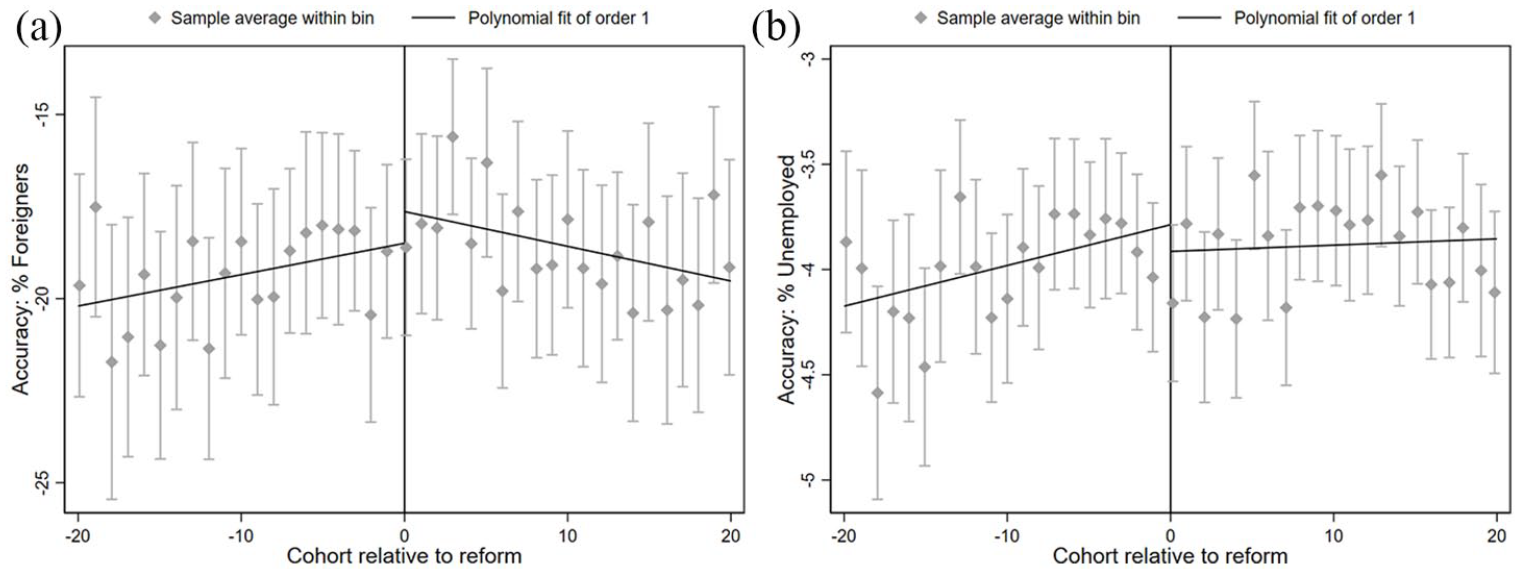
Years of Education and Belief Accuracy: RD Design. (a) Accuracy: % Foreigners. (b) Accuracy: % Unemployed.
Once again, the result is robust to a wide array of tests, outlined in Section “Threats to Identification”, and reported in more detail in SI C. This leads us to not reject H2: More accurate factual beliefs among educated individuals reflect selection rather than causality. Coupled with the testing outcomes of H1, this suggests that education is a necessary condition for belief accuracy, but not a sufficient one.
If it is indeed the case that schooling fails to activate belief accuracy later in life irrespective of one’s background, we should expect that the non-significant result presented above survives across both low- and high-SES strata, though for different reasons. Compulsory schooling reforms should affect belief accuracy only among those who would have otherwise decided to dropout, and thus across individuals from a low SES. Individuals from a high SES, instead, should be less sensitive to compulsory schooling reforms, since they would have most likely continued their education, even in the absence of such policy change. Hence, the non-rejection of H2 should apply within SES-based subgroups as well.
This is indeed confirmed by our analysis. We capture a respondent’s SES by means of the ESS item asking about paternal education, and construct an indicator variable equal to one if this is upper-secondary or above, else 0 (focusing instead on maternal education yields the same results). This proxy has the advantage of being determined before the treatment assignment, hence it cannot be affected by compulsory schooling reforms. In line with our reasoning, the effect of compulsory schooling on completed years of education is substantially higher, yet estimated with equal precision, among individuals with a low SES
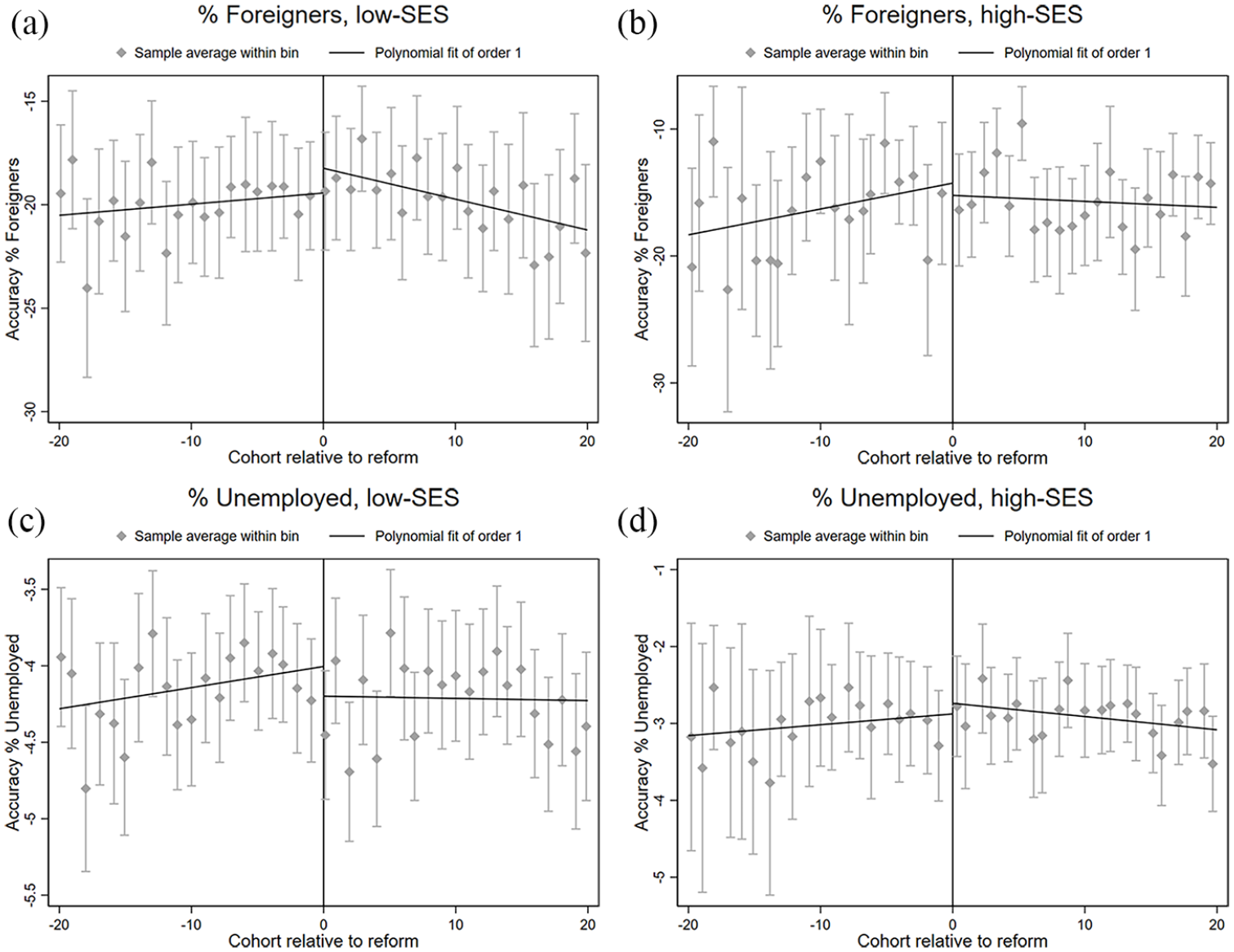
Years of Education and Accuracy of Beliefs: by SES Status. (a) Foreigners: Father Below Up-Sec, (b) Foreigners: Father Up-Sec or Above, (c) Unemployed: Father Below Up-Sec and (d) Unemployed: Father Up-Sec or Above.
Directional Motives
Our focus is placed on the interplay between education and the accuracy of beliefs. Such focus more directly speaks to the role played by education policy-making in fostering accountability. Yet, education may arguably change one’s directional motives, especially on immigration. A large body of the literature shows that educated individuals have more tolerant attitudes toward diversity (e.g. Gelepithis and Giani, 2021; Hainmueller and Hiscox, 2007). As a result, educated individuals may, in an attempt to adopt beliefs that best conform to their ideological priors, display systematically different misperceptions. Should education significantly affect on the directional bias regarding the share of foreigners or immigrants in society, this would call for a conceptual revision of our estimates of belief accuracy.
We address this issue in two ways. First, we use the same cross-sectional and RD designs for our main analysis to directly test whether schooling changes the sign of directional bias on our main dependent variables. Estimates presented SI D shows that a longer stint in education is associated with reporting a lower share of foreigners, as well as a lower proportion of unemployed people (Figure D1). Under the lenses of ideological interpretation, these findings would suggest that, relative to their less-educated counterpart, educated people consider both immigration and unemployment less of an issue. However, these associations do not hinge on the role education per se. Indeed, compulsory schooling reforms appear to have no effect on directional bias (Figure D2). This suggests that the directional channel through which education may affect misperceptions—that is, changing one’s ideological leaning—is not prominent in our context. A second set of analyses provides further support for this claim. In SI F, we show that schooling does not causally affect a set of ideological variables that could concur to shape beliefs on immigration and unemployment, including self-reported left-right positioning, attitudes toward immigrants and unemployed, political interest and turnout (Table F9).
Threats to Identification
In the SI, we begin by reporting descriptive information regarding compulsory schooling reforms (Table A1) and our survey data (Table A2). We also analyze which educational reforms effectively raised the number of years of completed education among affected respondents, confirming how the first-stage is valid, and comparable in magnitude, across the five countries under scrutiny.
We then proceed to check, in SI B, the robustness of our cross-sectional findings. Estimates of the effect of years of education on belief accuracy vary in magnitude, but remain significant, with the inclusion of individual controls, and country and ESS wave fixed effects (SI B1). Results are robust to the adding back further levels of education, over an expanded set of countries—relaxing the restriction intended to match the sample with the five-countries one in the RD analysis—and over a smaller sample of respondents, matching the one employed in the RD setting (B2). Furthermore, our findings appear to hold in each individual country, with the exception of Italy (the Netherlands) for the share of foreigners (unemployed; B3).
We analyze the robustness of the RD specification in several ways in SI C. We validate the design by performing standard density and continuity tests (Figure C1), which overall confirms the absence of sorting around the discontinuity while showing that individuals affected by the reform are more likely to have a father—but not a mother—holding a higher education degree, compared to those located on the opposite side of the reform date(s). Given that an inter-generational transmission of education attitudes is plausible, respondents experiencing a longer stint in education may be also ex ante more inclined to prolong their studies. Our RD estimates could therefore be underestimating the causal impact of the reforms on belief accuracy, hence these results should be interpreted with caution.
We then show that our estimates are robust to using alternative bandwidths (Figure C2), polynomial orders and weights (Figure C3). Also, our findings do not inadvertently compound substantial levels of heterogeneity into a non-significant result (Figure C4), and are robust to excluding one country at a time from the analysis (Table C5). Finally, we do not retrieve much of a difference in the estimated effect when artificially moving the reform dates within 5 years before and after the actual ones (Table and Figure C6).
One further concern may come from the fact that the sample in the RD analysis is substantially smaller than in the cross-sectional one. In the most restrictive OLS specification (Table B4 in SI B1), we exploit 7,802 and 10,966 respondents answering the question on, respectively, foreigners and unemployed. In the RD analysis—Table C6 (upper-half)—the sample is instead composed of N = 4,224 (N = 4,913) respondents who reached the eligible age in the 11 (9) years around the reform, and answered the question on foreigners (unemployed). We cannot thus rule out that the non-significant RD coefficients hinge on a relatively small sample size. The analysis performed in SI B2, however, suggests that the comparison between OLS and RD outcomes is meaningful, as our cross-sectional findings hold even in the restricted sample determined by the data-driven RD bandwidth selector.
A final, potential threat to identification comes from non-response bias. Certain types of respondents may be more (or less) likely to express their personal guess of the share of foreigners or unemployed in their country. In turn, such likelihood may be affected by their education level. In SI E, we demonstrate that schooling has some effect on the likelihood of a respondent making a guess (or not), that is, answering the questions on the share of foreigners/unemployed. The effect is small in magnitude, and only concerns the share of foreigners. This implies that the effective sample upon which our tests on belief accuracy over the share of foreigners are based might be subject to a non-response bias. What the direction of such bias would be is, however, difficult to predict, as it likely factors in personal predispositions that have little to do with the political world. For example, and perhaps unsurprisingly, we document that non-respondents are less interested in politics (
Conclusion
In this article, we study how schooling affects, later in life, the accuracy of factual beliefs about the share of foreigners and unemployed, focusing on five European democracies. In line with pre-existing literature, we find that more educated individuals hold more accurate beliefs than less-educated ones (Drummond and Fischhoff, 2017; Joslyn and Sylvester, 2019; Lee et al., 2021; Meirick, 2013; Stoeckel et al., 2023). We make an important step further in theorizing and showing that compulsory schooling has instead no effect on the accuracy of beliefs of those cohorts that were just compelled, against those that were just exempted: a finding that holds across different issues, countries, econometric specifications and cohorts. Education may activate the epistemological sophistication necessary to develop belief accuracy within those social strata in which schooling is considered intrinsically and instrumentally valuable, while it does not revert negative learning attitudes across individuals with a lower socioeconomic status.
This important qualification helps understanding the puzzling mismatch between micro-level findings indicating that educated individuals hold more accurate beliefs, and macro-level picture showing how increased misperceptions threaten democracy, just as educational levels are at their all-time high. Figuring out interventions that mitigate political misperceptions is considered a priority in the literature (Jerit and Zhao, 2020; Nyhan, 2020; Nyhan and Reifler, 2010). We suggest that boosting educational attainment is unlikely to produce any result, as long as the socioeconomic determinants of early school dropouts and the stratification that education produces later in life are factored out of the equation. This is an important result. It suggests that legal attainment requirements—a policy-tool that governments control to a much greater extent than individual’s motivation to study—is unlikely to correct misperpections and, as such, to improve democratic accountability.
Our paper has some important limitations. First, our observational setting does not contain sufficiently fine-grained information allowing us to qualify our theory-driven mechanisms whereby education fosters taste and scope for prioritizing accuracy over directional goals. As a result, our data analysis yields “reduced form” findings, which do not test directly the main theoretical mechanism. Second, the specific focus of our study restricts the generalizability of our findings. While focusing on schooling is appealing, we acknowledge that focusing on higher education may yield a different picture, due to its more diversified nature as well as its potentially larger role in shaping motivated reasoning. Furthermore, studying factual beliefs on immigration and unemployment has the major advantage of deriving sharp metrics of accuracy on two issues that, while differing in traditional party ownership, play an important role in contemporary Europe. The absence of substantial differences in the mapping between education and belief accuracy across the two political issues suggests that issue salience may not be a key moderating factor. Yet, our findings may well not hold across the whole issue space because education may affect the intrinsic interest citizen have to learn and report truthfully about a topic. Moreover, they may not generalize to other key forms of perceptions concerning policy platforms, policy performances, and other political knowledge. Finally, our analysis is based on European data, while most extant literature focuses on the US. Recent social developments, including most notably citizens’ response to policies tackling the COVID-19 pandemic (e.g. Bol et al., 2021; Druckman et al., 2021), have shown that polarization is nowadays a stronger force in the US than in Europe, limiting the extent to which our findings could travel elsewhere. Future research should overcome these issues to refine our understanding of why misperceptions proliferate in the most educated societies ever.
Supplemental Material
sj-pdf-1-psx-10.1177_00323217231222104 – Supplemental material for Does Schooling Increase Political Belief Accuracy?
Supplemental material, sj-pdf-1-psx-10.1177_00323217231222104 for Does Schooling Increase Political Belief Accuracy? by Riccardo Di Leo and Marco Giani in Political Studies
Footnotes
Acknowledgements
The authors thank the editor and reviewers for support and valuable feedback, as well as their colleagues and several participants at EPSA 2023 for valuable comments.
Declaration of Conflicting Interests
The author(s) declared no potential conflicts of interest with respect to the research, authorship, and/or publication of this article.
Funding
The author(s) received no financial support for the research, authorship, and/or publication of this article.

Supplemental Information
Additional supplementary information may be found with the online version of this article.
A: Schooling reforms and years of education. Table A1. Schooling Reforms under Scrutiny, by Country. Table A2. 1st Stage: Years of Education and Schooling Reforms (Full Sample). Table A3. Descriptive Statistics. Figure A1. 1st Stage: Years of Education and Schooling Reforms, by Country. B: Robustness of cross-sectional specification. B1: Full Regression Tables. Table B4. Years of Education and Belief Accuracy: Cross-Sectional Findings. B2: Alternative sampling. Figure B1. Years of Education and Belief Accuracy, all Years of Education. Figure B2. Years of Education and Belief Accuracy, all Countries. Figure B3. Years of Education and Belief Accuracy, Restricted RD Sample. B3: Analysis by country. Figure B4. Years of Education and Belief Accuracy, by Country. C: Robustness of the RD specification. C1: Continuity and Density Tests. Figure C1. Density of the Data Either Side of the Schooling Reform. Table C5. Placebo Effect of Schooling Reforms on Pre-treatment Variables. C2: Alternative bandwidths. Figure C2. Belief Accuracy on the Percentage of Foreigners and Unemployed, by RD Bandwidth. C3: Alternative polynomial orders and kernel function. Table C6. Accuracy of Beliefs on Percentage Foreigners and Unemployed, by Kernel. C4: Analysis by country. Figure C3. Accuracy of Beliefs on Percentage Foreigners, by Country. Figure C4. Accuracy of Beliefs on Percentage Unemployed, by Country. C5: One-country-out analysis. Figure C5. Accuracy of Beliefs on Percentage Foreigners, Removing One Country. Figure C6. Accuracy of Beliefs on Percentage Unemployed, Removing One Country. C6: Alternative reform dates. Figure C7. Placebo Reform Dates. D: Directionality Analysis. Figure D1. Years of Education and Belief Bias: Cross-Sectional Findings. Figure D2. Years of Education and Belief Bias: RD Design. Table D7. Years of Education and Beliefs Bias: Cross-Sectional Findings. E: Non-Response Bias. Table E8. Belief Bias and Non-Response Rate: RD Design. F: Ideology. Table F9. Political Participation/Views Add Years of Education: RD Design.
Notes
Author Biographies
References
Supplementary Material
Please find the following supplemental material available below.
For Open Access articles published under a Creative Commons License, all supplemental material carries the same license as the article it is associated with.
For non-Open Access articles published, all supplemental material carries a non-exclusive license, and permission requests for re-use of supplemental material or any part of supplemental material shall be sent directly to the copyright owner as specified in the copyright notice associated with the article.
