




Abstract
Street-level bureaucrats shape policy through using discretion in their interactions with citizens and service users in delivering public services. Discretion allows street-level bureaucrats to bridge between public policy and the complex, individual, human situations they encounter. Drawing on insights from feminist institutionalism, this article establishes gender as a relevant analytical category in understanding discretion. We set out three analytical propositions: street-level bureaucrats work in gendered institutional contexts that shape their discretion; street-level bureaucrats are gendered actors, whose discretion is shaped by their individual gendered dispositions; and street-level bureaucrats’ discretion has gendered effects. We investigate these propositions through a case study of the early implementation of the classification of misogyny as a hate crime among police forces in England and Wales. In addressing this analytical intersection between street-level bureaucracy and feminist institutionalism, we bring a gendered perspective to street-level bureaucracy, and a focus on how rules are interpreted to feminist institutionalism, forging new ground in public administration.
Introduction
In this article, we demonstrate the intersection between street-level bureaucracy and feminist institutionalism (FI) offering two original analytical contributions to public administration and political studies more widely. First, our analysis demonstrates the value of a gendered lens in understanding discretion within street-level bureaucracy; and second, it enriches the understanding of how institutional rules are interpreted (and with what effects) in policy implementation, a field relatively neglected by FI to date.
The concept of street-level bureaucracy – that policy is made as it is used and delivered – was a pivotal step-forward in understanding policy making (Lipsky, 1976). Rather than simply implementing rules, street-level bureaucrats utilise discretion – judgement, coping and improvisation – in order to interpret rules within the complex human situations they face in their everyday work (Lipsky, 1980). Here, we use FI to build upon emerging street-level bureaucracy literature which has aimed to ‘render visible the invisible’ (Rowe, 2007) by analysing how discretion is shaped by broader structural dynamics (Bishu and Heckler, 2021; Eseonu, 2021; Ray et al., 2023; Watkins-Hayes, 2011; Wilkins, 2007). We ask how gender matters for understanding discretion?
FI has drawn attention to how institutions shape behaviour and outcomes in gendered ways, showing how institutions both reflect and constitute the ways in which political actors (including public servants) perceive themselves, the roles they play and their interactions with others, including service users and citizens (Lowndes, 2020; Krook and Mackay, 2011; Waylen, 2017). Such work has established gender as a ‘relevant analytical category’ in institutionalist scholarship (Mackay, 2011: 181–193), but has yet to influence research on discretion in policy implementation and public administration. Here, we advance understanding of what Elinor Ostrom (1999) calls ‘rules in use’, and the gendered conditions under which rules ‘stick’ or ‘slip’ (Pierson, 2000) through the exercise of discretion.
In this article, we interrogate ‘the encounter between actors and institutional rules within particular political settings’ (Lowndes, 2020: 544) focusing on policy implementation, in order to consider how discretion may reflect and embed unequal gendered relationships, but also has the potential to disrupt such settlements. We use literature on street-level bureaucracy and FI to generate three analytical propositions on the gendered nature of discretion: that street-level bureaucrats (SLBs) work in gendered institutional contexts that shape their discretion; that SLBs are gendered actors whose discretion is shaped by their own gendered dispositions; and that the discretion of SLBs has gendered effects.
While our contribution is primarily analytical, these propositions are tested through a single case study of a change to what institutionalists call the ‘rules of the game’ concerning the policing of offences against women and girls in England and Wales – specifically, the local classification of misogyny as a hate crime (MaHC) – to leverage further insight. Using this strategic example, we are able to illustrate the value of recognising gender as relevant in shaping discretion, opening up a new research agenda in policy implementation and contributing to re-shaping public administration as a discipline.
Gendered Discretion: Three Propositions
In his pioneering work, Michael Lipsky (1980: 3) sought to draw attention to the policy-making role of SLBs, those ‘public service workers who interact directly with citizens . . . who have substantial discretion in the execution of their work’. Lipsky (1980: 3) argued that SLBs have profound and hitherto unexplored influence on policy making through their exercise of discretion. Rather than seeing implementation as ‘a series of mundane decisions and interactions’ (Van Meter and Van Horn, 1975: 445), Lipsky (1980: x) argued that ‘policy making does not simply end once a policy is set out’, but rather is ‘in important ways . . . actually made in the crowded offices and daily encounters of street-level workers’ (Lipsky, 1980: xii).
Discretion may be understood as choice, judgement or improvisation within recognised boundaries. Such discretion is required in order to address the ‘inevitable mismatch’ between policy and the complex situations that SLBs face in their everyday work (Maynard-Moody and Musheno, 2003: 19). Discretion is influenced by resource constraint and the need for SLBs to operate independently of supervision as they carry out their everyday work in the face of an ‘action imperative’ (Hupe and Hill, 2007) that demands discretion in order to respond to urgent situations. Discretion can also serve to promote SLBs’ self-regard, encourage those they are dealing with to believe SLBs ‘hold the key to their wellbeing’ (Lipsky, 1980: 15) and to limit bias, ensuring that clients are engaged with in a consistent manner in the face of resource constraint.
Lipsky (1976: 207) identified a number of techniques or strategies used by SLBs in exercising discretion including ‘routinising, modifying goals, rationing their services, redefining or limiting the clientele to be served, asserting priorities and generally developing practices that permit them to process the work they are required to do in some way’. As Gofen (2014: 473) has observed, such discretion ‘frequently results in outcomes that differ from those expected from formal policy’.
Lipsky’s ‘rational’ interpretation of discretion focusing on bureaucratic self-interest remains influential. However, others have suggested more expansive discretionary strategies in the face of contextual complexities amounting to what Maynard-Moody and Musheno (2003) call ‘pragmatic improvisation’. In a similar vein, Durose (2011: 979) argues that SLBs actively ‘work’ the spaces of governance that have emerged in contexts now characterised by complex multi-actor relationships, or where they are responding to multifaceted or ‘wicked’ problems. As well as self-interest (rational discretion) and complexity (relational discretion), there is acknowledgement that discretion is informed by SLBs’ professional knowledge, experience and culture (professional discretion) via the ‘internalisation of professional norms and service ethics’ (Cecchini and Harrits, 2022; Harrits, 2019: 197).
We advance this work on what influences discretion by using a feminist institutionalist (FI) approach to ask how the wider institutional environment shapes discretion (Blijleven and Van Hulst, 2021; Rice, 2019) and what the gendered nature of that institutional context means for discretion. FI builds on pioneering feminist scholarship that showed organisations to be more than ‘sites of male dominance’, as organisational structures themselves embody assumptions about gender (Acker, 1990: 139). MacKinnon’s (1983: 658) early work on feminist jurisprudence sought to reveal ‘masculinity as a specific position, not just as the way things are’, invisibilised in apparently neutral processes and procedures. From a political science perspective, FI aims to uncover the mechanisms that distribute gendered power inside institutions of governance, through a focus on the ‘rules of the game’. FI identifies the role of (a) ‘rules about gender’, which systematically allocate opportunities and/or benefits on basis of gender, and (b) ‘rules with gendered effects’, which appear neutral yet have gendered impacts because of the way in which they interact with wider institutional contexts and are themselves performed by gendered actors (Lowndes, 2020).
As such, FI adds value to work on gender and organisational culture by specifying focal points for empirical investigation (specific institutional rules), while tracing the interaction of rules within a particular public policy setting with wider institutional frameworks. A focus on rules has the additional merit of surfacing points for reform and intervention in pursuit of gender inequality, rather than relying on more diffuse notions of cultural bias. As Beckwith (2005: 133) argues, reform efforts can seek to ‘re-gender’ institutions by instating ‘practices and rules that recast the gendered nature of the political’. In this spirit, this article researches the impact of a new rule (on classifying MaHC) upon the exercise of discretion by public servants (specifically, police officers). FI recognises that the impact of new rules may be diluted by their interaction with wider institutional frameworks (within and outside specific workplaces) and by the agency of those ‘gendered actors’ who are charged with interpreting, enacting and enforcing new rules.
Following Beckwith (2005: 131–132), gender is understood in FI as referring to both a category and a process. As a category, gender refers to ‘the multidimensional mapping of socially constructed, fluid, politically relevant identities, values, conventions, and practices conceived of as masculine and/or feminine, with the recognition that masculinity and femininity correspond only fleetingly and roughly to “male” and “female”’. As a process, gender refers to the ‘differential effects of apparently gender-neutral structures and policies upon women and men, and upon masculine and/or feminine actors’, and also to the means by which ‘masculine and feminine actors (often men and women, but not perfectly congruent . . .) actively work to produce favourable gendered outcomes’ (Beckwith, 2005: 131–132). Using gender in these two ways enables FI researchers to map gendered rules and also study the dynamic processes whereby they reproduce power relations (but can potentially be disrupted). As Beckwith makes clear, gender is not seen as mapping onto biological sex in any uniform manner but as referring to socially constructed masculinities/femininities. 1
To date, FI has tended to focus on the gendered institutional dynamics of executives (Annesley et al., 2019) and legislatures (Childs, 2022), with frontline public services remaining under-researched. However, there is also emerging recognition of the ‘gender work’ involved in public administration (Bishu and Heckler, 2021) and that men and women may navigate public service settings in different ways (Wilkins, 2007) affecting how public services are perceived (Riccucci et al., 2014). By bringing an FI lens to the study of discretion, we argue that discretion is gendered because of the way in which SLBs (as gendered actors) interact with norms and expectations embedded in both service-specific and wider institutional environments. An SLB lens adds depth to FI by focusing not just on what the rules are, but how they are interpreted and enacted. We use insights from the street-level bureaucracy and FI literatures to develop three analytical propositions on how discretion is gendered.
Proposition 1: Street-Level Bureaucrats Work in Gendered Institutional Contexts that Shape Their Discretion
Across the governance landscape, institutional rules include not only formal laws, regulations and operating procedures but also informal norms that are relatively stable over time – what Elinor Ostrom (1999) calls ‘rules in use’. FI shows why these ‘rules of the game’ matter in distributing power and opportunities on gendered lines. 2 As Ostrom explains, institutional rules shape actors’ behaviour by stipulating what actions are prescribed, permitted or proscribed. In gender terms, institutional rules may operate in a ‘negative’ or ‘positive’ way for women. Negative examples include historical exclusions of women from voting or property holding in the UK, and more contemporary rules that limit women’s access to reproductive healthcare or trans women’s access to gender affirming healthcare. Positive examples include equalities legislation, diversity policies, affirmative action programmes and gender-specific service provision; such rules serve to promote gender equality or at least attempt to redress inequality (e.g. Krook and Norris, 2014). Debates over gender recognition rules (Jeffreys, 2008; McQueen, 2016) provide another illustration of the significance of institutional rules for shaping behaviour among decision makers, frontline public servants and citizens themselves.
Understanding how institutional rules shape behaviour in gendered ways requires that we distinguish between three mechanisms (Lowndes and Roberts, 2013; Lowndes, 2020), which may overlap and reinforce each other, or pull apart to create spaces for change. These are regulation, expressed via formally constructed and recorded rules and sanctioned via formal rewards and punishments; obligation, expressed through routinised practices demonstrated through conduct and sanctioned via social disapproval; and, persuasion, expressed through narratives (speech/images) creating familiar stories about appropriate action, with non-compliance sanctioned via incomprehension and ridicule. Being aware that rules shape behaviour through obligation and persuasion as well as regulation can lead to a richer appreciation of what is required to deinstitutionalise masculine privilege and, conversely, to institutionalise gender equality.
Institutional rules operate at different, interacting levels: constitutions and founding documents, legislative and policy regimes, and day-to-day operational arrangements (Kiser and Ostrom, 1982). By centring discretion, we focus on the operational level, where public servants are charged with applying rules formulated at ‘higher’ levels (laws, policies, guidance) and do so within the context of service-specific institutional expectations, influenced by the wider institutional environment. Our proposition is informed by the neglect of this context within street-level bureaucracy studies which has served to obscure the ways in which the gendered nature of institutions influences and informs discretion.
Proposition 2: Street-Level Bureaucrats Are Gendered Actors Whose Discretion Is Shaped by Their Own Gendered Dispositions
Charged with interpreting policy and interacting on a daily basis with citizens and service users, SLBs make choices informed by their personal, professional and institutional contexts, which influence their ‘judgement on the worth of the individual citizen’ (Maynard-Moody and Musheno, 2000). Street-level bureaucracy research has highlighted not only the gender of SLBs matters (Nielsen, 2015; Wilkins, 2007), but that the empathic abilities of SLBs shape discretion (Jensen and Pedersen, 2017) and that such discretion can be used in ways that are, for example, ‘biased’ against women (Wenger and Wilkins, 2009).
FI enables us to further probe the role of gendered actors in policy implementation. In all institutional settings, actors have to assign cases to rules in a manner similar to legal reasoning (March and Olsen, 1989). FI shows that those who interpret rules carry with them their own ‘gendered disposition’ (Annesley and Gains, 2010), that is, their identities, perspectives and experiences, which in turn influences the ways in which rules are applied in different situations and with different people, and how they are adapted, ignored or enforced over time (Gains and Lowndes, 2022: 23).
FI problematises the assumption of ‘administrative man’ highlighted by feminist organisation theory (Acker, 1990; Mastracci and Arreola, 2016). Instead, FI recognises that actors occupy male, female or non-binary bodies and (crucially) different positions on a masculine/feminine spectrum of values, attitudes and behaviours, in the context of intersectional identities (Beckwith, 2005). Feminist scholarship has researched the impact of getting more women into positions of power but also notes the lack of any definitive connection between ‘descriptive’ and ‘substantive’ representation (Mazur, 2002: 197). More analytical leverage can be gained by looking at how gendered actors work with institutional rules than focusing on women’s absence or presence alone (Lowndes, 2020: 558). 3 Indeed, moving beyond the classic question of feminist political science, ‘where are the women?’, FI enables us to focus on the over-representation of men and the operation of masculine privilege (Bjarnegård, 2018).
Whether male, female or non-binary, actors have more or less critical orientations towards power imbalances associated with any set of rules, depending upon their gendered disposition. The process of applying institutional rules in practice is mediated through gendered processes of interpretation, which may have positive or negative impacts for gender justice. Hence, we expect the exercise of discretion within policy implementation to be influenced by actors’ gendered dispositions.
Proposition 3: The Discretion of Street-Level Bureaucrats Has Gendered Effects
Rules that are specifically ‘about gender’ (Lowndes, 2020: 545) set out to re/distribute power along gendered lines (towards greater or lesser equality). At the same time, the interpretation and application of supposedly gender-neutral institutional rules may also have ‘gendered effects’ because of the way in which they interact with norms and expectations embedded in wider institutional environments regarding gender roles (Lowndes, 2020: 545–546; Mackay, 2011: 181). For example, given they so often carry primary caring responsibilities, public servants who are women may be disadvantaged by institutional rules regarding the timing and location of meetings, ‘presenteeism’ in the workplace, requirements to travel or work long hours at short notice. Wider social conventions may influence discretionary interpretations of what a ‘normal’ or ‘serious’ career path looks like, how leadership should be exercised, and how a whole variety of roles are to be carried out in public service workplaces. Women, trans and other people of non-conforming or marginalised gender may be disadvantaged by discretion in the structuring of these settings when seeking to access or influence public services, reflecting gendered norms about how citizens should behave and where public service priorities should lie. Formal rules (e.g. about access and eligibility) may be important but so is discretion influenced by ‘taken for granted’ understandings and expectations (e.g. about service users’ presentation, conduct, motivations and interests). Indeed, discretion based on such informal conventions may undermine or override formal commitments to gender equality or more inclusive ways of working (Waylen, 2017).
The recognition within FI of the potential for ‘gendered effects’ to flow from the structuring and norms of organisational contexts allows us to introduce a gendered perspective on the core concern within the street level bureaucracy literature: the discretionary routines and techniques that those at the frontline of public services use to deal with human situations and resource constraint. Tummers et al.’s (2015) systematic review of studies of discretion shows how these coping routines can shape the effects of discretion in three different ways: first, discretion may be exercised in the interests of clients (‘moving towards’); second, discretion may be used in a way that avoids meaningful interactions with clients (‘moving away’); and third, discretion may involve confronting clients’ interests (‘moving against’); drawing on FI helps us to analyse how such routines have gendered effects.
Street-level bureaucracy research also established that discretion is not necessarily an individual phenomenon but can be practised collectively (Gofen, 2014: 489). When groups of SLBs legitimise and promote particular discretionary actions, enduring patterns of policy change can arise (Gofen, 2014: 489; Tummers et al., 2015). Such collective behaviour can ‘reify dysfunctional group dynamics’ over time (Møller, 2021: 471), including embedding the gendered effects of discretion.
We now interrogate these propositions through a case study of a change in the ‘rules of the game’ on policing offences against women in England and Wales – before reflecting on the implications of a gendered perspective on discretion for public administration.
Methodology
Our analysis draws upon a single case study of the early implementation of what feminist institutionalists would refer to as a ‘rule about gender’ (Lowndes, 2020), specifically the local classification of MaHC in England and Wales. The introduction of this rule change has been the subject of academic research in law and criminology, focusing on its legal classification and feasibility (Barker and Jurasz, 2019; Duggan, 2021; Gill and Mason-Bish, 2013; Zempi and Smith, 2022). In considering this case within public administration, our focus is on how police discretion is shaping the early implementation of this rule change.
We utilise a single case not only as a means to test our propositions, and in doing so contribute to theory building, but also to provide the ‘force of example’, the value of which is often ‘underestimated’ in advancing knowledge (Flyvberg, 2006: 228). Our case selection is strategic in that it is intended to both produce an ‘exemplar’ and contribute to a wider ‘collective process of knowledge accumulation in a given field or society’ (Flyvberg, 2006: 242, 227). This strategic sampling allows us to use this case to generalise (Eckstein, 1975) through the testing of propositions (Flyvberg, 2006) and generation of theory (Walton, 1992; Yin, 2009).
Policing has emerged as a focal point for studies of street-level bureaucracy (Buvik, 2016; Maynard-Moody and Musheno, 2003; Rowe, 2007), with growing recognition that the institutional culture of policing shapes discretion (Buvik, 2016; Gardiner, 2012; Hoggett et al., 2020) in how officers cope with the challenges that confront them in their everyday work (Workman-Stark, 2015). Tummers et al.’s (2015) work establishes that police officers are more likely to ‘move away’ (or even against) clients, compared with other professions such as healthcare and education. For example, police officers are understood to rely more heavily on ‘rigid rule following’ as a discretionary tactic (Soss et al., 2011) and are less likely to ‘break the rules’ to benefit clients (Tummers et al., 2015).
Policing is increasingly recognised as a ‘gendered profession’ (Fagerlund, 2021: 90) existing within ‘gendered organisations’ (Workman-Stark, 2015: 766). An established organisational studies literature on gender and policing (Chan et al., 2010; Heidensohn, 2008; Westmarland, 2002) identifies policing as a ‘masculine occupation’ (Workman-Stark, 2015: 766), characterised by a ‘hyper-masculine’ culture which reinforces power dynamics through ‘subordination of women, heterosexism, uncontrollable sexuality, authority, control, competitive individualism, independence, aggressiveness, and capacity for violence’ (Prokos and Padavic, 2002: 442, cited in Workman-Stark, 2015: 767). This hyper-masculinity is then legitimated as officers then seek to demonstrate their value, fit in and avoid shaming (Ely and Meyerson, 2010; Workman-Stark, 2015). The landmark Casey Review (2023) offered further illustration of such insights in pronouncing London’s Metropolitan Police to be ‘institutionally misogynist’.
The organisational studies literature also evidences diverse ways in which policing devalues women, from mocking and insults to sharing sexist or explicitly sexual stories, jokes and remarks to sexual harassment (Workman-Stark, 2015: 767–768). Ely and Meyerson (2010) have also intimated how such organisational cultures can have gendered effects, for example, by ‘refusing to display evidence of mistakes or lack of knowledge and emotional detachment’ (Workman-Stark, 2015: 767). This gendered institutional context and hyper-masculine disposition is also acknowledged to negatively impact the policing of violence against women and girls (Andrews and Johnston Miller, 2013; Gains and Lowndes, 2022, 2021; Grant and Rowe, 2011; Mackenzie et al. 2019); with gender representation understood to impact how citizens judge the performance, fairness and trustworthiness of the police (Riccucci et al., 2014).
The campaign to classify misogyny – the hatred, contempt or prejudice against women – as a hate crime (MaHC), built upon on earlier activism in England and Wales ‘to criminalise violence in which men disproportionately target women, such as sexual assault, domestic violence and female genital mutilation’ (Duggan and Mason-Bish, 2020). This rule change has attracted support from UK Members of Parliament (MPs) across political parties, city-regional mayors in Liverpool, London, Manchester and Sheffield; public servants including some senior police officers; and the wider women’s movement both nationally and locally. Despite acknowledged challenges and limits in the implementation of hate crime legislation in the UK and internationally (Jenness and Grattet, 2005), campaigners have argued for misogyny to be included in order to reflect and highlight the historical and disproportionate impact of crimes upon women enacted by men, which is not reflected in existing ‘gender neutral’ criminal statute (Vera-Gray and Fileborn, 2022). Initially adopted by Nottinghamshire Police in 2016 as a ‘local qualifier’ to national hate crime legislation, the rule change to classify MaHC has since been adopted by a further six police forces nationally. However, growing recognition of mistrust in the police, particularly from women and other minoritised communities (Vera-Gray and Fileborn, 2022) and in the ability of the police to address misogyny, including within their own ranks (Casey, 2023; Independent Office of Police Complaints (IOPC), 2022), are perceived as likely to impact on implementation of the rule change.
To constitute our case study, we undertook a review of academic, policy and media coverage of the campaign and local implementation of the classification of MaHC from 2014 to July 2022. This was triangulated with a series of 17 semi-structured interviews with key stakeholders (10 of whom were women, 7 men) purposively sampled according to their insight into the introduction of MaHC as a rule change, and their role in its adoption and early implementation.
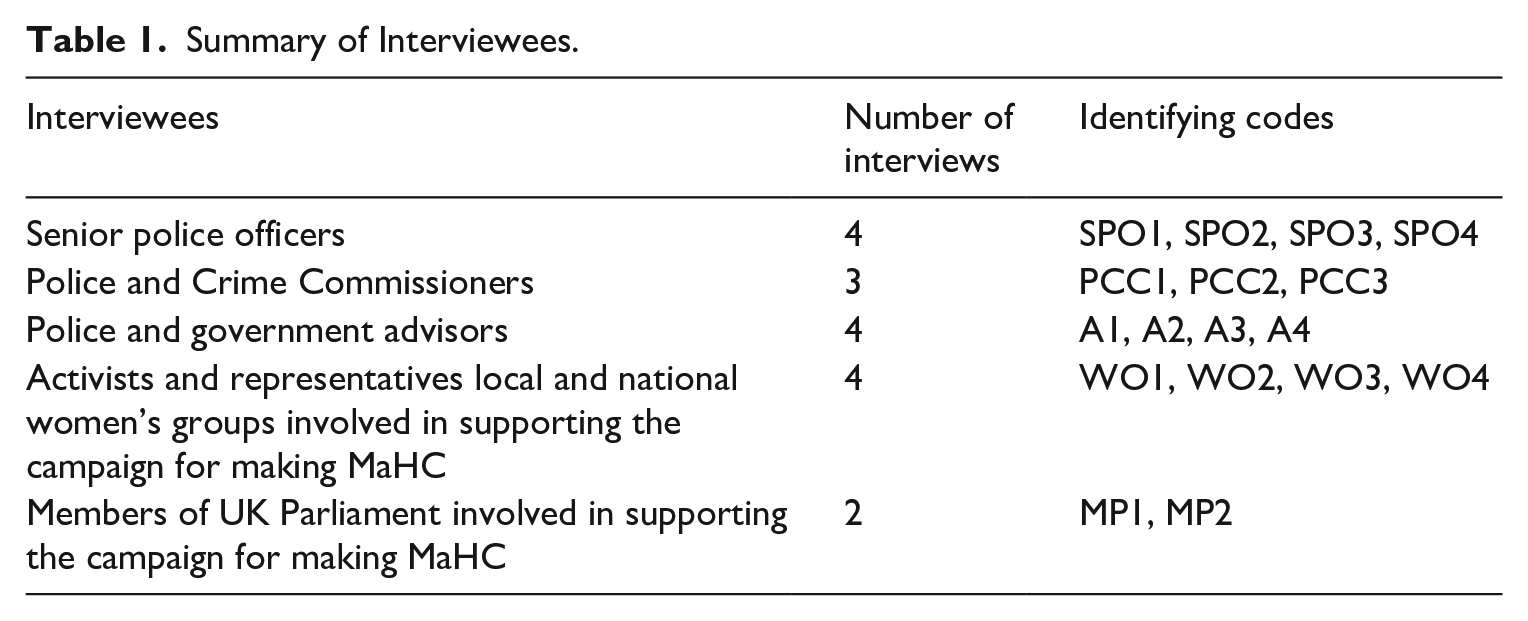
We interviewed senior police officers (4) directly involved in implementing MaHC, including two with operational responsibility for hate crime policing and one with a national-level brief within policing that included MaHC; these respondents were distributed across three police forces who were ‘early adopters’ of the new classification. We also interviewed Police and Crime Commissioners (PCCs) (3), directly elected politicians with responsibility for ensuring the efficiency, effectiveness and accountability of a given police force, including in terms of hate crime. Our PCC interviewees included one in an area where the police force had implemented the measure and who had been instrumental in its adoption, pilot and assessment, and two further PCCs in areas where the measure had been backed and were involved in incorporating it into city-regional strategies to address violence against women and girls. We also interviewed police and government advisors (4), including two who had worked locally with an early adopting force to implement MaHC, another working at a national level to advise government on the implementation and impact of hate crime classification, and finally a representative of the Law Commission, which at the time was conducting a review into the potential classification of offences motivated by sex and gender as hate crime. In addition, we interviewed representatives or activists within local and national women’s groups (4). These interviewees included two who had worked locally with an early adopting force to train police officers in the interpretation and implementation of MaHC. We conducted two further interviews with representatives of national women’s organisations, one of which had conducted extensive primary research on women’s experiences of the UK legal system and had acted as a national convenor of civil society action in support of MaHC, and another who had contributed to this action and to the Law Commission’s review. We also conducted interviews with UK MPs (2) from different political parties who had been instrumental in driving legislative efforts to introduce MaHC.
Table 1 summarises our interviewees, together with providing the identifying codes used.
Summary of Interviewees.
Our interview sample provides firsthand perspectives on the legal and policy context of MaHC and the institutional context of policing, along with diverse perspectives on the local adoption and early implementation of the rule change. The sample is appropriate to the framing of the case and the early stage of implementation of MaHC. We do however recognise the limitations of our empirical data, particularly with regard to frontline police officers.
Interviewees were asked about their involvement or perspective on the campaign to classify MaHC, its early adoption and implementation; how they perceived the value, significance and impact of the classification on the police; any barriers to the implementation of the rule change; and any wider change required for its meaningful implementation. Interviews were conducted online between May and July 2021, and lasted between 30 and 90 minutes. Interviews were recorded and transcribed, and all participants were given the opportunity to check their transcript.
We worked abductively to analyse the data adopting an ‘informed grounded theory approach’ (Thornberg, 2012). This allowed us flexibility and creativity in analysing the data, while acknowledging our familiarity with established bodies of literature and theoretical frameworks (Thornberg, 2012; Thornberg and Charmaz, 2014), specifically, our extant research on both Street-level bureaucracy (Durose, 2011) and FI (Lowndes, 2020).
We used a two-stage coding process, undertaking initial and then focused coding. We initially coded for what Wagenaar (2011) terms ‘meaning units’, or data that convey a given idea or perception. For example, coding for meaning units associated with the normalisation of misogyny, seriousness of police response to reporting of misogynistic offences, the framing of MaHC, the resistance of senior police officers to MaHC and its relation to workload. We started by coding each interview guide question in turn across each group from Table 1. This initial stage was double-coded by both authors. We then began to write memos to allow us to move further towards analysis by beginning to link and compare the codes and categories with our propositions (Charmaz, 2008; Thornberg and Charmaz, 2014). The propositions then provided the basis for focused coding, for example, using theoretically derived codes such as regulation, obligation and persuasion.
Below we outline the wider context for the introduction of MaHC before drawing upon our primary data to consider the propositions in turn reflecting on how each illuminates our research question concerning how discretion is gendered.
Implementing MaHC in England and Wales
When an offence – such as assault, harassment or criminal damage – is carried out against someone because of a specific aspect of their identity, it can be considered a hate crime in England and Wales, and receive particular designation by the police. Hate crime designation does not create a new crime, but instead aims to recognise the heightened impact of crimes based on identity on victims, while also serving to establish common motivating forces (e.g. racism) behind diverse offences. National hate crime law in England and Wales currently covers a number of different protected characteristics (race, religion, sexuality, transgender identity and disability). For these characteristics, designating an offence as a hate crime can lead to a sentencing uplift in the event of conviction (Law Commission, 2021).
Campaigning for the rule change to classify MaHC began locally in Nottinghamshire in the East Midlands of England in 2014, utilising the provision for individual police forces to introduce ‘local qualifiers’ to their recording of hate crime data. Individual forces had for example previously classified hate crimes against sex workers and alternative sub-cultures in response to local events and to generate specific data to inform priorities, but without the mentioned sentencing uplift. Following research on women’s experiences of street harassment and the evaluation of a local pilot of recording MaHC, Nottinghamshire Police began in 2016 to classify as hate crime a range of behaviours, including whistling, leering, groping, sexual assault, being followed home, taking unwanted photographs, upskirting, sexually explicit language, threatening/aggressive/intimidating behaviour, indecent exposure, unwanted sexual advances and online abuse (Mullany and Trickett, 2018).
This local rule change attracted significant national criticism, including assertions that the measure would unfairly persecute innocent men, and infantilise, patronise and disempower women (Brown, 2016; Firsht, 2018). However, the MaHC campaign gained momentum and profile through the media and legislative action and public support from a diverse coalition of political actors. In parallel, six further police forces adopted MaHC as a ‘local qualifier’ from 2017, 4 enabling the recording of misogynistic offences as hate crime.
However, national adoption has been resisted by national policing figures. In response to an open letter from leading civil society groups in July 2018, Sara Thornton (2019), then Chair of the National Police Chiefs’ Council (NPCC), 5 highlighted the additional pressures that national adoption of this rule change would add to police forces who were working with limited resources, 6 and questioned whether a criminal justice response is the right way to deal with the serious issue of misogyny. In November 2018, then London Metropolitan Police Commissioner Cressida Dick stated publicly that making misogyny a hate crime could distract from the police’s ability to handle serious violent crime, including against women and girls (Topping, 2019).
However, in the wake of the tragic murder of Sarah Everard in London in March 2021 (Rainbow, 2021), the proposed rule change gained new levels of support and attention. The Conservative government announced that from Autumn 2021, all police forces in England and Wales would be asked – on a trial basis – to record a series of different offences believed to be motivated by sex and gender as hate crime. By the time the national trial was due to commence, MaHC remained a prominent issue due to the conviction in September 2021 of a serving Metropolitan Police Officer for Everard’s murder, leading to greater focus on the issue of misogyny within the police itself. This has since accelerated dramatically with a slew of reports and revelations focusing on misogyny within London’s Metropolitan police (Casey, 2023; House of Commons (HoC) Library, 2022; IOPC, 2022).
Despite the government announcement of the national trial, no further guidance followed, and leading politicians including the then Prime Minister Boris Johnson spoke out against the classification of MaHC, arguing, ‘if you simply widen the scope of what you ask the police to do you’ll just increase the problem . . . What you need to do is get the police to focus on the very real crimes . . .’ (BBC, 2021). Such criticisms, together with Law Commission’s review (2021) cautioning against the adoption of sex and gender within hate crime law, prompted then UK Home Secretary Priti Patel to rule out any change to legislation for England and Wales. In contrast, a working group in Scotland led by Helena Kennedy QC recommended in March 2022 a Misogyny Act for Scotland to address street harassment, organised online hate and threats against women. While a change to national hate crime legislation is not imminent, local voluntary implementation continues.
Interrogating the Propositions
In this section, we draw upon our case study data to consider each of the propositions in turn.
Street-Level Bureaucrats Work in Gendered Institutional Contexts that Shape Their Discretion
We established earlier that institutional rules shape behaviour via three different mechanisms – regulation, obligation and persuasion (Lowndes, 2020). We now explore the role of each mechanism in introducing the rule to classify MaHC, in an attempt to shape the behaviour of the police. We also show how these mechanisms have been resisted, adapted and ignored on the ground through the gendered exercise of discretion.
Our interviewees recognised MaHC as an attempt to regulate behaviour in the police through formally constructed and recorded rules. The use of a hate crime framing was understood as applying ‘tried and tested’ set of rules for institutional change, given the police’s familiarity with identifying and recording hate crime, and as such easing the implementation of the rule change on misogynistic offending (WO3, SPO1, SPO2, SPO4). Recognising that the growing complexity of crime and limited nature of resources meant that the police needed to be ‘data rich’ (PCC1). The rule change was intended to enable data on a range of misogynistic offences to be collected (and connected) so as to better inform the priorities, resource allocation and operational deployment of the police (SPO1, SPO2, PCC1) and other agencies (WO1, MP3). These data were hoped to make clear the extent of, and patterns within, misogynistic behaviours. As one former senior police officer reflected, ‘if it’s named, it’s counted. It therefore counts and it matters’ (SPO4).
However, others raised concerns that a hate crime framing has had limited impact in other areas, such as racism, in part because police officers often lacked ‘understanding’ of the dynamics underlying such incidents (SPO2). A senior police officer with operational leadership responsibilities for hate crime (in a force that adopted MaHC early) highlighted that even within established hate crime classification, the question about whether hate was an aggravating factor was often not asked (SPO2), and this would likely be repeated with regard to misogyny (SPO2). He referenced a ‘huge gap in knowledge’ within the police, citing the example that many officers simply did not recognise that street harassment from men was ‘not wanted’ by women (SPO2). Others noted a lack of understanding within the police of hate crime more broadly, and misogyny specifically (SPO4, A2). Indeed, it was recognised that achieving for women, ‘the same degree of safety and security as they live their life as men’ (A2) was contingent on ‘professionals being well motivated, understanding of the nature of the problem, and ready to deal with the challenges’ (WO3). An interviewee from a women’s organisation who worked directly with the police on implementing the change agreed noting: a lot of the time it won’t be the woman saying, ‘I want you to record this as this’. It needs to be the police officer dealing with it to say, ‘Okay, I think this is misogynistic hate crime, so I’m going to put a tick in this box’. So, if the police didn’t get it, then it never works (WO1).
Alongside regulation, the classification of MaHC was also an attempt to obligate new forms of police behaviour, influencing how ‘gendered logics of appropriateness’ (Chappell, 2006) within the police operate through routines and practice, and how they are informally enforced. The use of a hate crime classification for misogyny was perceived as intending to ‘organise out’ (WO1) particular beliefs within the police, ‘draw a line in the sand’ (PCC2) as regards what was acceptable discretionary behaviour towards women, and set a ‘new norm’ or ‘standard’ (MP3) in recognising how severely offences like street harassment impact women. Interviewees argued that MaHC could lead to the police offering an ‘enhanced service’ to victims and survivors (SPO2), where they could be expected to use their discretion to be more ‘on the side of women’ (PCC2) and act in a more ‘empathetic’ way (SPO1, SPO2). As one women’s organisation activist put it, the intention was that women who have experienced misogynistic offending ‘be taken more seriously rather than just being brushed off’ (W01).
However, there was also recognition, including from within the police, that officers were ‘slow to change’ (SPO1), with one respondent explaining that such empathetic behaviour remained an ‘aspiration’ for a ‘perfect world’ (SPO2). While some felt that such change was simply a matter of time (MP2), others felt that strongly ‘dismissive attitudes’ towards MaHC from within the police (PCC2) had the potential to derail the impact of the measure (SPO2). For example, some police officers were seen to deride the need to record and generate data on misogynistic offences as ‘bureaucracy’ (PCC1). Some respondents argued that where the measure had been locally adopted, it had not always been taken seriously, with officers objecting to a ‘made up’ ‘new law’, which was ‘wasting time’ (SPO2) in a context where policing was overstretched, suggesting that police discretion was being used to bypass the measure.
The classification of MaHC was also an attempt to explain or persuade the police that women’s safety was a ‘real’ and ‘serious’ issue (WO3, WO4, A2). PCCs, senior police officers and representatives of women’s organisations all felt that MaHC had the potential to offer a ‘different narrative’ where the police were ‘struggling’ to ‘get it right’ (SPO2) on misogynistic offences, ‘open up a conversation’ (WO1) and begin to ‘shift’ attitudes within the police (SPO4). Many emphasised the importance of education and training for the police (WO1, PCC2). However, there were concerns from those who had conducted such training that understanding of misogyny as a social issue was difficult for many officers to grasp and did not connect with how the police perceived their core purpose (SPO3, WO2). However, others raised concerns that such training and education would not be prioritised, citing cost and the lack of such action with regard to rape (WO4).
Our data show how local forces introduced MaHC as a way of changing the ‘rules of the game’, with the aim of changing how police used their discretion in engaging with women facing misogynistic offending. For some, this rule change offered the opportunity to reframe misogynistic offending within the police and shift the institutional culture towards having greater empathy towards women. Despite employing mechanisms of regulation, obligation and persuasion to institutionalise the new rule, our data suggested that the extant gendered institutional culture of policing provided fertile ground for resistance to MaHC, legitimising forms of police discretion that undermined its potential impact. Specifically, there was evidence of a gendered institutional culture that allowed police the discretion to avoid engaging with the complexity of misogynistic crime, bypass recording processes, and deride or remain slow to recognise misogynistic offending as a core police concern.
Street-Level Bureaucrats Are Gendered Actors, Whose Discretion Is Shaped by Their Own Gendered Dispositions
Individual gendered dispositions (Annesley and Gains, 2010) and the capacity to reflect upon them (Gains and Lowndes, 2022) shape the interpretation of rules. We now consider how the identities, perspectives and experiences of police officers shape the implementation of the rule change to classify MaHC. We show how implementation of the rule change was mediated through the interpretation of police officers whose gendered dispositions influenced their use of discretion, including their level of empathy towards women experiencing misogynistic abuse and understanding of MaHC as a vehicle for change.
One senior police officer argued that the adoption of MaHC challenged the ‘white, male, straight, able bodied’ identity that dominated policing (SPO4). The prominence of this specific identity was perceived to have implications for discretion, influencing whether and how the rule change on MaHC was implemented, for example, on police recognition or perception of misogynistic crime reported by victims. While training could offer a ‘frame’ to challenge police assumptions about ‘what a victim looks and sounds like and is’ (SPO4), the dominance of this masculine identity was perceived to limit the ability of the police to recognise offending as being underpinned by misogyny and to empathise with victims of misogynistic crime (SPO4).
Others were, however, keen to challenge the perception of the police as institutionally misogynistic or sexist. Instead, one senior officer sought to emphasise how individual officers ‘don’t always get it right’ in engaging with women experiencing misogynistic offending (SPO1). Another former police officer and now advisor to government on hate crime dismissed ‘cultural barriers’ to MaHC within policing (A2). Other arguments included that misogynistic or sexist assumptions about the gendered dispositions of police officers were ‘out of touch’ with modern policing (SPO1), noting that a police force with an increasingly younger and more diverse profile (PCC2) would be more sympathetic to and understanding of misogyny.
Among PCCs and police officers interviewed who were supportive of classifying MaHC, their perspectives were often paternalistic. For example, drawing a connection between MaHC and the police ‘protecting’ the ‘vulnerable’ (SPO1, SPO2). Personal relationships to women were also repeatedly cited by those interviewees involved in policing as their motivation to support the change (PCC2, SPO3, SPO4). As one senior police officer put it: ‘I’m a son to a mother, I’ve got a sister, I’ve got a wife, and I’ve got a daughter, as well as female friends’ (SPO3). One PCC also linked his support for MaHC with having daughters who he wanted to be spared misogynistic harassment and abuse (PCC2). Such perspectives could be interpreted as only being able to be empathetic with regard to the impact of misogynistic offending through the lens of personal relationships and reflecting a limited understanding of the structural nature of misogyny.
There was also a sense that for those interviewees directly involved in policing, their backing for the rule change had been a ‘journey’ (PCC1), which reflected their shifting experiences, and often the opportunity to step away from frontline policing. One interviewee with a 30-year career in frontline policing, now involved in developing a city-regional strategy on violence against women and girls, reflected that his position had changed from believing such a rule change would be organisationally ‘too difficult’ to seeing it as something that needed to happen given the ‘breath-taking scale of the issue’ once exposed to it by engaging with other stakeholders, such as local women’s organisations (PCC1). Similarly, another PCC who oversaw an early pilot of MaHC emphasised the sheer extent and significance of misogynistic abuse, which became clearer to him when he became involved in consultations with women about their experiences (PCC2). A further senior police officer, another senior police officer who had led the early adoption of MaHC within their force, decided to back the change after listening to women’s ‘lived experience’ (SPO4). It was noted that many frontline officers would not have the opportunity to go through that same journey, due to resource constraints that have increased workloads, impacted on training budgets and limited partnership working with other stakeholders in addressing violence against women and girls (PCC1).
Indeed, those involved in local implementation of the rule change explained that backing the measure meant going ‘out on a limb’ (WO1) within policing. The national-level resistance to adopting MaHC from the NPCC was perceived by some to reflect the gendered disposition of these police leaders and a deliberate failure on their part to recognise the significance and severity of the misogyny experienced by women (SPO4). The NPCC were perceived to use ‘every excuse under the sun’ not to back the change (SPO4); this senior officer reflected further noting that ‘every time you overcame and gave them the evidence or the rationale about the mitigation of one thing, which they ought to have understood, I think, as police officers, they just saw there was another reason why not’ (SPO4). This perspective was supported by others, with one PCC noting that the position of the NPCC was ‘lamented’ by some policing (PCC1), with the NPCC perceived as ‘misinformed’ and at times ‘disingenuous’ (A2) in their resistance to adopting this rule change nationally. Another senior police officer highlighted that the failure of the largest local forces or ‘big hitters’ within the police to back the rule change – London’s Metropolitan and West Midlands, and Greater Manchester Police 7 – stymied the effectiveness of its implementation (SPO3).
It was further argued by some police officers that the opposition of senior police leaders to MaHC and this lack of national ‘traction’ (SPO2) was being used to legitimate gendered resistance to implementation of the rule change locally. One police officer with operational responsibility for hate crime in a force that adopted MaHC argued that the rule change was seen locally as a distraction from more serious priorities for the police (SPO2), echoing the arguments made by the NPCC. The gendered nature of such arguments was further substantiated at the frontline where, for example, a lack of insight or empathy into misogynistic behaviour was also repeatedly cited. For example, frontline police were understood widely to see MaHC as an unhelpful incursion into ‘sexual politics’ that would mean the police unfairly targeting ‘innocent men’ who were wolf-whistling or chatting up women, or that male victims would be ignored (SPO2). Another interviewee anticipated dismissiveness on the part of any officer sent to deal with what they were likely to perceive as a ‘slap on the bum’ (PCC1). A further interviewee cited an example of a female police officer ‘deliberately not understanding’ MaHC, who stated that if they received a comment about how they looked, they would choose to take it as a compliment (WO3). Another highlighted the reaction of female police officers who argued that public harassment is ‘just life’ for women, implying not only that change was unlikely or impossible, but that such matters should not be a focus for the police (SPO2, WO1).
The masculine identities, experiences and perspectives of police officers at a national and local level were seen to mitigate against the intended effect of the rule change to generate greater empathy for women experiencing misogynistic offending. While recognising that police officers may be gendered differently – as evidenced by the recognition by some of the need for the police to respond to misogynistic offending – the dismissal of or failure to recognise the significance of such offending demonstrated how the dominant gendered disposition within policing informed attempts to use discretion to marginalise, undermine and resist meaningful adoption of the rule change.
The Discretion of Street-Level Bureaucrats Has Gendered Effects
Tummers et al. (2015) identified how discretion can be exercised in different ways that have different effects on the interests of citizens, service users or clients. The intention of MaHC was to move the police ‘towards’ women, with discretion being used in the interests of women experiencing misogynistic offending. However, we found evidence of enduring routines of collective discretion, which meant that the police often defaulted to gendered discretionary routines or tactics that meant they moved ‘away’ or ‘against’ women, avoiding engaging with the interests of women or acting against them.
The impact of the rule change in supporting the police to move ‘towards’ women through more empathetic handling of misogynistic offending was deemed by one PCC to be ‘hit and miss’ (PCC1). In part, this was attributed to a wider recognition – even from some within policing – that policing and the criminal justice system more widely often failed to provide a meaningful voice for victims (PCC1), and in particular for women (WO4, SPO4). Such views acknowledged the limits of the police in providing a safe and conducive environment for those reporting misogynistic offending.
However, the limited impact of the rule change was also explained through the loss of resources within policing over the last decade (see footnote 4), which meant that the police were ‘overwhelmed’ (PCC1) and ‘increasingly stretched’ (WO3) with palpable impact on the capacity of frontline policing to engage with demands perceived to be new or different (PCC1). As noted, national police leaders asserted that the adoption of MaHC risked exacerbating demands on the police in a context of resource constraint, and reflecting this, the rule change was often seen locally as a potential ‘resource drain’ (A1). For example, local concerns were articulated about the resource implications of recording misogynistic crime, whether in raising expectations of an enhanced service, dealing with ‘non-crimes’ or incidents that did not meet a criminal threshold, providing appropriate follow-up to victims, or in analysing data about offences revealed by the MaHC ‘flag’ (PCC1). These concerns were interpreted as a legitimate basis to bypass recording processes (SPO2).
As implied, discretionary responses to such resource constraints can have explicitly gendered effects. Opportunities to better address misogynistic offending, for example, through training for frontline police, partnering with women’s organisations, restorative justice and offender diversion (WO2, SPO3, SPO4), were all understood to have been deprioritised and deemed not within the discretionary scope of policing (SPO2). Under-investment in such measures (PCC1) was perceived to result in the police becoming ‘reactive’ rather than ‘proactive’ with regard to women’s safety (A1).
Furthermore, this context of resource constraint was also used as a justification to reinforce attitudes within the police which minimised and derided adoption of the measure, demonstrating the gendered effects of discretion. One interviewee from a local women’s organisation involved in training the police in an early adopting force reflected on such attitudes and how the reality of misogynistic offending provided a counter-point: I got the perception that police feel they’re being pulled in so many directions all the time and they just don’t have the resources to deal with it. And I can see why they would say ‘this is just really trivial’. They’d seen all the media about it, ‘so what we’ve got to put police resources into women being wolf whistled, are you mad?’ I can completely see that. And it was good that in the early days there were some quite serious incidents that were phoned through and reported, so we could say ‘it’s not just about wolf whistling. Actually, these are quite serious things’ (WO1).
Alongside the challenge to engage with misogynistic offending in a context of resource constraint, and the struggle to engage with the complexity – or a lack of awareness of the complexity – of misogynistic offending (SPO2) itself, as noted earlier, police officers also raised concern about the lack of a clear and consistent process for police forces to follow to ensure effective reporting, recognition, recording and aggregation of misogynistic hate crime (A2, WO2). All of these challenges were perceived to have gendered effects in that police officers were seen to default to using their discretion not to raise or ‘flag’ misogynistic offending.
However, within early adopting forces, some frontline police officers were also involved in developing good practice guidance for implementing MaHC – including shared definitions and reporting standards – to disseminate among other forces beginning or considering adoption of the rule change (SPO1, SPO3, SPO4). Primarily operationally focused, this guidance was seen as having the potential to shape discretion in ways that would reflect the intended purpose of MaHC.
The underlying gendered nature of the institutional culture and the gendered disposition of police officers within it also shaped the gendered effects of discretion, meaning that the police struggled to move ‘towards’ women experiencing misogynistic offending. In a context characterised by resource constraint and a lack of clarity on implementation, exacerbated by the complexity of misogynistic offending meant that policing officers fell back upon discretionary coping that saw them move ‘away’ from or ‘against’ serving women’s interests, specifically by bypassing or ignoring new rules.
Discussion
Our case study has yielded rich and nuanced detail on the contested attempt to change the ‘rules of the game’ within policing through the early implementation of a ‘rule about gender’, specifically the classification of MaHC within policing, which allowed us to investigate our propositions on the gendered nature of discretion. In this section, we summarise our findings and reflect on their implications for understanding discretion and street level bureaucracy and their resonance for public administration as a discipline.
Policing has emerged as a focal point for studies of street level bureaucracy (Buvik, 2016; Maynard-Moody and Musheno, 2003; Rowe, 2007) given the necessity of discretion to deal with the often urgent and inherently complex interactions with citizens and communities that the daily work of frontline policing demands (Gardiner, 2012; Grant and Rowe, 2011; Mackenzie et al., 2019). Our empirical focus on policing here is strategic in the sense that policing is now widely recognised as a ‘gendered profession’ (Fagerlund, 2021: 90), which is also masculine and male-dominated (Chan et al., 2010; Heidensohn, 2008; Westmarland, 2002; Workman-Stark, 2015).
Growing recognition of these negative gendered effects of the institutional culture of policing in part informed attempts to introduce specific ‘rules about gender’ (Lowndes, 2020), such as MaHC, which aim in part to influence how discretion is used within policing. Such rule changes are an attempt to shift the institutional culture of policing so that those on the frontline of policing are more likely to ‘move towards’ (Tummers et al., 2015) women and girls as a category of clients. However, our data suggested that the gendered nature of institutional culture shows within policing, and the gendered disposition of individual officers mitigated against the impact of ‘rules about gender’ in the case of MaHC undermined efforts to reduce negative gendered effects. Importantly, that these institutional influences were manifested through the gendering of police discretion.
The data on our first proposition concerning the impact of a gendered institutional culture on discretion highlighted how mechanisms for institutional change were undermined by gendered discretionary police tactics including ignoring or failing to meaningfully engage with rules; using the complexity of misogynistic offending and the implementation of the rule change less as a spur to creative improvisation but more as a reason for disengagement or default to gendered routines which failed to empathise within women experiencing such offending; and minimising, distracting or ridiculing the severity and impact of misogynistic offending upon women. These discretionary tactics demonstrate how established institutional practices can mitigate against the impact of formal commitments or rule changes aimed to bring about greater equality (Waylen, 2017). This analysis of discretion brings a gendered perspective to how rules are interpreted, for example, nuancing the understanding ‘rigid rule following’ within policing highlighted by Tummers et al. (2015) and Soss et al. (2011).
Our data suggested that the gendered discretionary tactics employed by police officers were informed by their gendered dispositions, supporting our second proposition. Data indicated that police officers, as gendered actors, could struggle – due to their own positionality, lived experiences and beliefs – to identify or empathise with victims of crime, particularly women, and to identify or understand the gendered context in which offences took place. In practice, this could have gendered effects in the sense that police officers struggled to believe and support women experiencing or reporting misogynistic offending, and to establish positively gendered discretionary routines that would allow for the meaningful recording of MaHC. Our data on how discretion was exercised aligned with existing gender and policing literature further evidencing how women are devalued within and by policing (Workman-Stark, 2015).
Considering our third proposition that the discretion of SLBs has gendered effects, our empirical research supports and advances the extant organisational studies and street-level bureaucracy literature. For example, Tummers et al.’s (2015) analysis illustrates that the police were more likely to ‘move away’ or even ‘against’ clients when exercising discretion in comparison with other professions. Our research demonstrates that this ‘moving against’ has an important gendered dimension, and as such is not only informed by ‘rational’ and ‘relational’ influences on discretion, but institutional ones. As our data indicate, and wider evidence expounds (Casey, 2023; IOPC, 2022), the hyper-masculine nature of police culture (Workman-Stark, 2015) reinforces and reproduces dysfunctional group dynamics (Ely and Meyerson, 2010; Møller, 2021) and can prove highly resistant to change (Gofen, 2014).
For example, while issues of resource constraint were palpably real in impacting the discretionary scope available to police officers in dealing with misogynistic offending, it was also used to justify a default to established discretionary routines where women’s interests were ignored or misunderstood and to depart from delivering the outcomes intended from the rule change (Gofen, 2014). Yet, our research also suggested that local discretion has been used to curate efforts to re-shape discretion in positive ways for women through the adoption of MaHC and establish best practice around it. Our data, while limited, suggested that, alongside training, opportunities to gain experiences or collaborate outside of frontline policing were influential in changing gendered dispositions.
Our article reinforces the importance of centring discretion in how we understand policy implementation. The unavoidable gap between what policy can anticipate and offer guidance for, and the messy, human complex situations encountered by SLBs in their everyday work demands the exercise of discretion. Our gendered lens sheds new light on how to interpret the role and nature of discretion. Our data confirmed the continuing resonance of Lipsky’s (1980) notion of a ‘rational’ street-level bureaucrat navigating resource constraint through maximising control of those resources, pursuing their own utilities and self-regard. Our research brings nuance to this ‘rational’ interpretation by illustrating how self-regard and utility are understood and how resource constraint is navigated and gendered. The influence of professional norms (Cecchini and Harrits, 2022; Harrits, 2019) was also strongly evident in our research, and we were able to further interrogate the gendered character and effects of such norms through a feminist institutionalist perspective, which showed how norms can be entrenched and resisted through the mechanisms of regulation, obligation and persuasion.
Discretion has also been increasingly recognised in the literature as a useful resource in responding to complexity (Durose, 2011), allowing SLBs to develop bespoke and meaningful responses to challenges through creative improvisation. However, our data suggests that complexity in a context of resource constraint can bolstering rather than disrupt established norms, for example, reinforcing a dysfunctional masculine culture rather than challenging it. In this sense, discretion can be used to conserve entrenched institutional practices (Maynard-Moody and Musheno, 2003: 20, 21) and power dynamics, which through a gendered lens can reinforce discretionary tactics that move ‘away’ or even ‘against’ women (Tummers et al., 2015).
Our aim here is not to impose a judgement on policing – we recognise the limits of our data in this regard and also how our data revealed contingency and nuance in the approach of policing to MaHC – nor to claim that the police are singularly representative of frontline work or street-level bureaucracy. Instead, our purpose is to establish theoretically – by drawing on insights from FI and through empirical illustration – that gender is a relevant analytical category in understanding SLB and discretion. Bringing a gendered lens to discretion is valuable in deepening our understanding of how discretion influences and shapes policy implementation. An street-level bureaucracy lens also adds depth to FI by focusing not just on what the rules are, but how they are interpreted and enacted. Establishing the value and relevance of a gendered lens upon discretion, which scholarship has thus far neglected, offers us a critical analytical tool to leverage new insights for both street-level bureaucracy and FI, benefitting future research on policy implementation and public administration more broadly.
Conclusion
The primary contribution of this article lies in establishing theoretical propositions based upon insights from FI to bring a gendered lens to discretion within street-level bureaucracy. Our theoretical propositions were threefold: first, that SLBs work in gendered institutional contexts that shape their discretion; second, that SLBs are gendered actors, whose discretion is shaped by their own gendered dispositions; third, that the discretion of SLBs has gendered effects.
We used the case of the early implementation of classifying MaHC in England and Wales to illuminate the three propositions, showing how and why discretion is gendered. The article advances our understanding of how new institutional rules can be used to shape behaviour in more gender-just ways, and the gendered conditions under which such rules ‘stick’ or ‘slip’ (Pierson, 2000) through the exercise of discretion. Thus, we provide a theoretical frame to build upon a growing demand in the street-level bureaucracy literature to reveal the impact of broader structural dynamics, such as gender, upon discretion (Bishu and Heckler, 2021; Eseonu, 2021; Ray et al., 2023; Watkins-Hayes, 2011; Wilkins, 2007).
By drawing on FI, we have demonstrated that the discretion exercised by police officers in implementing MaHC happens within a complex institutional configuration, characterised by debate and contestation over gender relations. The efforts to re-shape discretion illustrated in our case used institutional rule-making creatively – the adoption of a ‘tried and tested’ framing such as hate crime – to influence discretion. Institutional change is more likely at moments of value contestation (March and Olsen, 1989) but can also play a part in constituting new value settlements. The contemporary debate over the routine harassment of women and girls, and whether such offences can be placed on a continuum leading to serious sexual violence, feels like one such moment. In this sense, rule change may offer an opportunity for discretion to be exercised in a creative way to advance reform in the interests of gender justice. However, our study also powerfully illuminates the ways in which policing is a highly gendered and indeed hyper-masculine institution (Workman-Stark, 2015), where discretion is used in an enduring and collective way to move ‘away’ or ‘against’ women. Our case study offers a fertile illustration of the ways in which a change to the ‘rules of the game’ can be interpreted and resisted by those charged with implementation, who are themselves gendered actors, in ways that serve to conserve and uphold gendered institutions.
Bringing insights from street-level bureaucracy scholarship to FI enables an exploration of the discretionary acts and judgements through which ‘rules about gender’ are applied (and the scope for challenging or changing them), and to apply FI to the under-researched domains of frontline work and policy implementation. In turn, FI offers the opportunity for street-level bureaucracy research to better understand how discretion at the frontline influences, and is influenced by, gendered rules and norms, hence addressing a gap in street-level bureaucracy literature. We offer a contribution to advancing the insights of street level bureaucracy by showing how acknowledged influences on discretion – resource constraint, professional norms and complexity of the policy encounter – are highly gendered. We also show how the ways in which discretion is exercised – moving towards, away or against clients – are not only informed by the gendered beliefs of those at the frontline of public services but also have gendered effects for those clients, here women and girls specifically.
This article has looked specifically at what Lowndes (2020) calls a ‘rule about gender’ (MaHC) within an institutional context (policing), the highly gendered nature of which is well established. In doing so, we aim to provide a resonant illustration of the gendered nature of discretion, as well as theoretical grounding for such claims, and to give further impetus to a conversation about gendered influences within policy making and implementation and public administration more broadly. Recognising that the primary contributions of our article are a theoretical one, and to the limited nature of the empirical testing of our propositions undertaken here, we welcome further interrogation and development of our propositions from different empirical standpoints. Specifically, ethnographic work on the gendered nature of discretion within public administration would broaden the scope of empirical illustration and mitigate against the biases of self-reporting. Such work could include research on the role of discretion in implementing rules that are intended to be ‘gender neutral’ but still have gendered effects and on the gendered dynamics of discretion in institutional contexts where gender dynamics have received less attention than in policing. In advancing the debate on how discretion is gendered, we provide fertile new ground for research on gender and public administration, and consolidate the analytical relevance of gender in political studies more widely.
Footnotes
Acknowledgements
An earlier version of this paper was presented at the Political Studies Association Annual Conference, 3–5 April 2023, Liverpool. We would like to thank colleagues at the Institute for Local Government Studies, University of Birmingham, and the Heseltine Institute for Public Policy, Practice and Place, University of Liverpool; together with Catherine Needham (University of Birmingham) and Francesca Gains (University of Manchester) for their useful comments on earlier versions of the paper. In addition, we would like to thank Temidayo Eseonu (University of Lancaster) for her research assistance. We would also like to acknowledge our interviewees for their thoughtful and candid contributions. Finally, we would like to recognise the constructive and considered engagement with this paper from the Editor and anonymous reviewers.
Declaration of Conflicting Interests
The author(s) declared no potential conflicts of interest with respect to the research, authorship and/or publication of this article.
Funding
The author(s) received no financial support for the research, authorship and/or publication of this article.
