




Abstract
Populism is often characterized as a rejection of scientific expertise and a key obstacle to societies’ ability to address the climate crisis today. I challenge this account, arguing for a more inclusive conception of populism and a more critical account of expertise. Consistent with this, I delineate a range of responses to the challenges of climate politics in populist times. In doing so, I have two primary aims: first, to highlight limitations of “anti-populist” responses among proponents of climate change action, and, second, to lean into populist criticisms of elite expertise, by delineating how some challenges to dominant forms of science and elite power are themselves expert knowledge and integral to promising movements that address climate change. This can allow expertise to be distinguished from elitism and to be recognized in caring relations to the subjects of knowledge. Here, expertise is not manifest as separation from the common world, but as immersion in it.
Introduction
While much has been written about the meaning and significance of populism in our contemporary political imaginary, less attention has been devoted to the implications of this for the politics of climate change. This is now changing, due to a growing recognition that those identified as populists often take high-profile positions on climate policy and politics (in addition to works discussed below, see special issues edited and introduced by Buzogány and Mohamad-Klotzbach (2021) and Marquardt and Lederer (2022)). Yet it remains uncommon, particularly among political theorists and political scientists, to examine closely the role played by experts and expert knowledge in populism. 1 Doing so here, I argue that the populist equation of experts with elites identifies a problem that is not as easily dismissed as anti-populists sometimes suggest and that, in addition to often-identified dangers, real inclusion of other forms of knowledge production can offer opportunities for a more democratic and just climate change politics.
Scholars in both political science and science and technology studies (STS) often characterize populism as equating experts with “elites” who are attacked in the name of “the people.” For example, Niels Mede and Mike Schäfer (2020: 481) argue that “science-related populism focuses on scientific elites, portraying them as antagonists of the ordinary people.” Harry Collins and his co-authors note that “the rise of populism in the West has led to attacks on scientific expertise,” and argue that “scientific expertise is one of the checks and balances in pluralist democracies and that is why populists attack scientific expertise” (Collins et al., 2020: 1–3). Matthew Lockwood (2018: 1) explains that for right-wing populism, “its antagonism between ‘the people’ and a cosmopolitan elite” leads to hostility toward climate science and climate policymaking because “climate change and policy occup[ies] a symbolic place in this contrast.” Amanda Machin and Oliver Wagener (2019) note that “in right-wing populist discourses, environmentalists often feature as part of the unresponsive international elites, accused of asserting policies that work against the interests of ‘ordinary people’ and their ‘common sense.’” Similar accounts of populist antagonism toward public health expertise during the CoVID-19 pandemic have been widespread. The association of experts and expertise with a distant, rootless, technocratic elite is clearly politically potent.
Because of the potency of this association, populism is often characterized as a key obstacle to societies’ ability or willingness to address the climate crisis and to govern in pluralistic and democratic ways. I challenge this account, arguing for the value of a more inclusive conception of populism and a more critical and plural account of expertise. In doing so, I have two aims. The first is to highlight profound limitations of a dominant “anti-populist” response to challenges to climate science. This response targets “ignorance,” reifies a one-dimensional account of scientific expertise and often a linear model of science advice, and is rooted in nostalgia for a past era of supposedly greater certainty and consensus on the truth. This anti-populist response is a trap. In David Runciman’s (2016) terms, it risks mistaking “a clash between one worldview and another” for a political divide “between knowledge and ignorance” (cf. Fuller, 2020; Hulme, 2015; Jasanoff and Simmet, 2017). My second aim is to lean into populist challenges to elite expertise, challenges that are otherwise rejected or neglected by many climate advocates. I do so by delineating how some of the diverse ways of knowing that contest dominant forms of science and elite power are themselves forms of expert knowledge. 2 These include Indigenous ecological knowledge, other forms of situated knowledge, and citizen science born in frontline communities most immediately affected by climate struggles and injustices. These ways of knowing are central to some of the most promising movements and actions to address climate change; understanding them through a populist lens can be illuminating.
Many have described twenty-first-century politics as integrally shaped by a “populist zeitgeist” (Mudde, 2004) or a “populist moment” (Cervera-Marzal, 2022; Galston, 2018; Gebhardt, 2021; Mouffe, 2018: 9–24). While the very meaning of these times has been interpreted in dramatically different ways, and while the term populism itself remains deeply contested, virtually all theorists and commentators have recognized that populism is centered upon a struggle between those deemed “the people” and others identified as “elites.” Jane Mansbridge and Stephen Macedo’s (2019: 60) survey of the extensive literature on populism leads them to conclude that its only core elements—in both theory and practice—are “pitting the people in moral battle against elites.” Like many others, Mansbridge and Macedo worry about additional elements that have been associated with populism—especially the dangers of a homogeneous and exclusionary conception of “the people.” But they argue convincingly that these are contingent features rather than necessary parts of the core.
Limiting the definition of populism to this core leaves the normative character of populism more open than it would be otherwise, allowing us to recognize that populism also taps into democratic politics’ “normative roots in the wants and needs of ordinary citizens. . . challenging, on egalitarian and justice grounds, elite political, economic, and cultural domination” (Mansbridge and Macedo, 2019: 60; see also Canovan, 1999: 11). Beginning here, I examine possibilities for positive change in populist times. In doing so, I aim to pursue what Robyn Eckersley (building upon Stuart Hall’s work) has described as conjunctural analysis. She argues that the aim of conjunctural analysis here is to identify the political opportunities (and dangers) that are presented for ecological transition, including sites within the state and civil society or intermediaries (parties, social networks, etc.) that hold the most potential for new transition initiatives (Eckersley, 2021: 255).
In the remainder of this article, I proceed as follows. First, I draw from an article by Mede and Schäfer to delineate the distinctive subjects of attention of what they term “science-related populism” (S-RP). These authors draw a valuable distinction between a populist critique of power claims by scientists and other experts—they label this a challenge to science’s “decision-making sovereignty”—and a populist critique of truth claims that challenges science’s “truth-speaking sovereignty” (Mede and Schäfer, 2020). Of course, populism often aims to advance an array of political and policy stances that have little direct bearing on science. But for Mede and Schäfer (2020: 475–477), it is these particular challenges to science’s decision-making and truth-speaking sovereignty that constitute S-RP. The delineation of these distinct science-related challenges is integral to my analysis, although I interpret them in a manner that departs from Mede and Schäfer’s interpretation. Focusing upon the roles of both truth and power claims, I sketch two variations of an anti-populist response, followed by two very different understandings of what science-related populism entails.
The first variety of anti-populist response, noted already, is the most simplistic and defensive—doubling down on claims of scientific objectivity and technocratic politics and thereby rejecting all manifestations of the populist critique. A second, more nuanced, form of anti-populism opens up the process of scientific autonomy over power claims, but aims to retain authority over truth claims. Harry Collins and his co-authors (2020) capture this response well; I draw upon their book to unpack and critically engage with it.
As understandings of S-RP, the second pair allows popular influence over power claims and truth claims, thus challenging perceptions of scientific autonomy over both. Yet, the approach that Mede and Schäfer label S-RP entails unified control over both power claims and truth claims by a homogeneous “people” claiming “common sense” as their guide. Here, Mede and Schäfer import into the S-RP framework an understanding of populism as inherently exclusionary and one that necessarily rejects expertise in any form, because it is perceived as a manifestation of elitism. Presented as such, it is unsurprising that they characterize S-RP as pathological.
Yet, this interpretation of S-RP is unsupportable and misleading. It forecloses recognition of the role played by other forms of knowledge—often characterized as counterknowledge or counterexpertise—within science-related populism. Scholars of right-wing and exclusionary populism have rightly differentiated counterknowledge claims from a simple rejection of expertise. While such substantive claims must be challenged, I argue that this must be simultaneous with a recognition that other manifestations of populist counterknowledge are integral to the pursuit of climate justice and related initiatives and movements to address the climate crisis. Here, experts can be differentiated from elites and knowledge can be rooted in relational practices of care.
Analyzing Science-Related Populism
Mede and Schäfer’s characterization of S-RP addresses the core elements identified by Mansbridge and Macedo. What distinguishes S-RP, they argue, is that participatory demands are extended beyond the state and official governance institutions to the realm of knowledge production itself, challenging scientific authority and epistemology (Mede and Schäfer, 2020: 480). They argue that it does so in two analytically distinct ways.
The first challenge is to what they term science’s “decision-making sovereignty.” Here, the focus is upon the scientific community’s control over resources, process, and agenda-setting priorities. What is researched, how is funding obtained and allocated, and other questions internal to decision-making power are central here. The populist claim is that “academic elites . . . hold such sovereignty illegitimately” and use this power to advance ideological agendas or even personal gain rather than their proclaimed “objective scientific norms” (Mede and Schäfer, 2020: 482). By contrast, from this perspective, it is “the people” who should have the power to make decisions about what science is funded or supported, rooted in “common sense” notions of practical relevance or significance (Mede and Schäfer, 2020: 483).
The second challenge is to science’s “truth-speaking sovereignty.” This cuts deeper into the self-understanding and epistemology of scientific inquiry, by challenging science’s autonomous authority to produce knowledge defined as “true.” Mede and Schäfer (2020: 483) argue that S-RP “perceives this as illegitimate, because scientific approaches to knowledge production do not prioritize the everyday experience and opinions of ordinary people, but [are formulated in] . . . the proverbial ivory tower.”
In sum, while the first populist challenge to scientific expertise focuses on power claims, the second focuses on truth claims. I use the first of these categories to illuminate the dimensions of anti-populist opposition, distinguishing between a simple and more critical and reflexive understanding of expert knowledge production. While Mede and Schäfer use these categories to describe the dimensions of what they label S-RP, I argue that they oversimplify by failing to recognize the significance of popular counterknowledge. Doing so is key to a critical and reflexive conception of truth-speaking sovereignty. I summarize these contrasting approaches to anti-populism and populism in Table 1.
Four Understandings of Expert Knowledge Production and “Science-Related Populism” (S-RP).
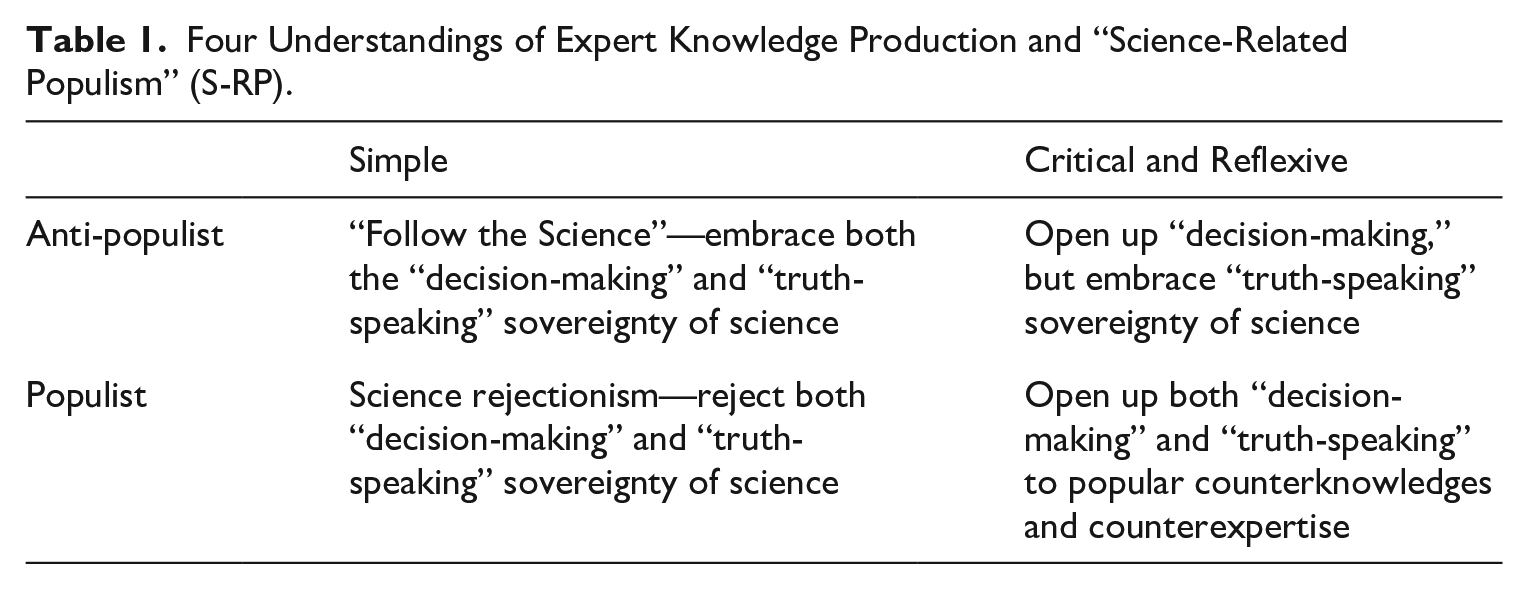
The first form of anti-populism is best captured in the slogan, “Follow the science.” The second approach qualifies this by taking seriously critiques of science’s “decision-making sovereignty,” and so offers a more reflexive and critical anti-populist account. Both can be understood as efforts to shore up trust in the dominant scientific enterprise. By contrast, both the third and fourth understand S-RP as a challenge to the truth-speaking sovereignty of science as well as decision-making sovereignty. Although Mede and Schäfer do not draw such a distinction, I argue that the third reflects their characterization that the populist challenge to truth claims is achieved simply through the rejection of science in favor of “common sense,” while the fourth can be understood as opening up critical and reflexive possibilities that draw upon situated knowledges and critical appraisals of dominant forms of science in practice.
By distinguishing these, science-related populism can offer possibilities for critique that are both different than and more insightful than science rejection. It can allow for the democratization of scientific decision-making while drawing upon a recognition of plural forms of knowledge and expertise itself. It is these possibilities that I aim to highlight. If we are indeed living in populist times, then it is these possibilities that seem to offer a more hopeful and constructive direction for the pursuit of populist climate action.
Anti-Populism
Criticisms of S-RP often reflect part of what Benjamin Moffitt, Tom Frank, and Yannis Stavrakakis have each described as a more general “anti-populist” stance, one yearning for a return to a more consensual politics grounded in civility, rationality, and strong institutions (Frank, 2020; Moffitt, 2018, 2020; Stavrakakis et al., 2018). Stavrakakis (2014: 506) argues convincingly that this vision of a return poses a threat to democratic participation and deliberation by reducing politics “to an administrative enterprise,” based upon “the supposedly objective instructions of experts and technocrats.” In this section, I delineate two variations of an anti-populist response to threats to scientific autonomy. The first of these doubles down on claims of scientific objectivity as a simple description of “reality” that is starkly contrasted with “politics.” The second is rooted in a more nuanced understanding of how science works and so a more critical account of power over scientific decision-making and policy advice, yet is equally emphatic in distancing this from what it perceives as the dangers of populism.
“Follow the Science”
This first variety of anti-populist response represents a wholesale rejection of the populist challenge to scientific autonomy. Here, S-RP is perceived as an existential threat to norms of objectivity and expertise, to funding for climate research, and to the autonomy of climate scientists. During the Trump administration, this led many proponents of climate action in the United States and elsewhere to participate in marches to defend “Science” and “Truth,” which aimed to resist the administration’s attempts to silence government scientists and others. Yet while resistance is certainly justified, this attempt to navigate a return to “the truth” is rooted in nostalgia. As Sheila Jasanoff and Hilton Simmet (2017: 763) have argued: Some marchers affirmed with handmade signs that “reality is not up for debate,” that the malaise of the current political moment is a simple fact, like “2 + 2 = 4,” and that “science is real.” These reassertions of singular reality and plain fact miss the deeper truth that the moment requires more a robust engagement with competing political visions than a facile call for trusting “the science.”
Here, the political defense of singular reality reflects a deeply rooted imaginary that scholars have described using a variety of names. Roger Pielke (2011) terms it the “linear model” of policy advice based on scientific findings (also Brown, 2016). John Dryzek, Richard Norgaard, and David Schlosberg (2013: 9) label it a “rational world” model, in which objective findings of an autonomous scientific community shape public opinion, which in turn directs the formulation and implementation of public policy by technocratic experts. They argue that it “underlies current global efforts to respond to climate change.” Sophia Rosenfeld (2019: 28) describes this as a conception of “democratic truth,” premised on the compatibility and complementarity of the “wisdom of the crowd” and “the judgments of a special, albeit nebulous elite made of the exceptionally educated, credentialed, and trustworthy.”
These authors delineate this model in order to draw attention to its limitations and transgressions. Neither they nor the anti-populists who embrace such a model are naïve enough to believe that it actually corresponds to the way scientific findings are received in most instances. It is nonetheless a powerful normative model that shapes expectations of the leading, autonomous, role for scientific and technocratic expertise. It promises the efficacy of “speaking truth to power” and is often a background assumption of those who complain that climate science has become “politicized,” or that experts must be returned to their proper decision-making roles at the top of a hierarchy.
Yet, a generation of scholarship in both science and technology studies and environmental political theory has highlighted the ways in which distance from this model cannot be explained simply by error, nor by economic self-interest or corruption alone. Instead, this scholarship has argued that the rationalist assumptions at the core of such an imaginary are inherently flawed and, therefore, misleading because they ignore or suppress underlying contests over meaning and value that are at the heart of politics (Hulme, 2015; Jasanoff and Simmet, 2017; Machin, 2015; Meyer, 2018). Why, then, does this model retain normative appeal for many? Surely, a “democratic objection” could be lodged “against the claim that scientists should enjoy a privileged political status” (Bellolio, 2022: 7). In this case, one would need to take sides. Yet, as Rosenfeld makes clear, at least part of the normative appeal is found in its promise of reconciling democracy and truth, masses and elites. Especially in the face of populist challenges to science and expertise, proponents often look back nostalgically to a pre-populist status quo, when expertise was seemingly granted greater trust and autonomy. By embracing a linear, rationalist imaginary, however, this trust and autonomy can be conceived as consistent with democratic ideals. To “follow the science” poses no tension or trade-off within a conception of “democratic truth.”
Opening Up Decision-Making Sovereignty (But No More)
In his essay, “Climate Science, Populism, and the Democracy of Rejection,” by contrast, Mark Brown examines popular mistrust of climate science, reading it insightfully as a reflection of long-standing “popular suspicion of organized power”; in this case the power of the scientific community. His focus is on those labeled climate denialists—or as he describes them more precisely, “climate science rejectionists.” While not minimizing the factual inaccuracy of many of their scientific (truth) claims, he argues that they nonetheless draw important attention to “the economic and political dimensions of climate science and its role in public policy,” which is often downplayed by climate advocates themselves (Brown, 2014: 129).
Climate science rejectionists raise normative questions about conflicts of interest among scientists, how societies should act in the face of uncertainty and risk, and about the social and economic consequences of proposed policies. These are vitally important questions, even when the rejectionists’ answers are implausible or unconvincing. As such, Brown (2014: 136) argues that they “rightly portray climate change as a distinctly political problem” in contrast to the linear, rationalist imaginary of science advice. The sort of questions raised focus on what Mede and Schäfer describe as “power claims,” which challenge the “decision-making sovereignty” of the scientific community. By recognizing the legitimacy of those outside the scientific establishment to address these normative questions, he is arguing for democratizing the decision-making process around climate science itself.
Brown illustrates his analysis with a discussion of the so-called “Climategate” release of hacked or leaked emails from climate scientists at the University of East Anglia in 2009. Climate science rejectionists and right-wing commentators sought to manufacture a scandal out of these emails, with claims—not supported by the evidence—of falsifying data. Yet, Brown notes that the emails do reveal an underlying desire to reinforce the rationalist, linear model. That is, the scientists discussed ways to finesse the presentation of their data for fear that indications of uncertainty or equivocation would otherwise weaken support for climate action (Brown, 2014: 139).
Precisely because they knew better, these scientists felt it important to present an airbrushed view of science in their public facing documents, in order to bolster its authoritative and autonomous power. Brown’s point is that both sides viewed a debate over the science as a proxy war for their real concern: a debate over policy. In this sense, the rejectionists’ tactics and focus was “a political reaction against those who would use truth to eliminate politics” (Brown, 2014: 141; cf. Machin and Ruser, 2019). If scientific sovereignty is opened up as Brown urges, the question becomes how far that opening extends. He follows Pierre Rosanvallon in arguing that a line must be drawn at the point where criticism “becomes infused with populism [and] distrust becomes pathological” (Brown, 2014: 136–137).
Where is that line? Brown doesn’t explicitly answer that question in this essay. 3 By contrast, Harry Collins and his co-authors are explicit in drawing a bright line around decision-making sovereignty. Unlike “follow the science” proponents, Collins et al. also recognizes limitations of the linear model of science decision-making and advice. As STS scholars, they note that the 1970s was a “watershed” moment in the understanding of science, which overcame a “cartoon” version of “how science must work, rather than examine how it did work” (Collins et al., 2020: 47). As a result, they accept the necessity of opening up the decision-making sovereignty of science, since they concede that “technocracy is a danger” (Collins et al., 2020: 6).
Having made this concession, their primary concern is nonetheless to prevent the challenge to science from going too far. They offer a very circumscribed definition of technocracy as “when scientific experts start to make political decisions,” while asserting that “putting a high valuation on scientific expertise does not lead to technocracy” (Collins et al., 2020: 6). Their explicit priority is upon tightly containing the influence of STS insights into how science actually works and also containing fears of technocracy, arguing that “if this kind of view ‘escapes into the wild’ . . . it could extinguish science’s role as a limit on the erosion of democracy.” This argument is motivated by the fear that “today, when the political environment is no longer as benign as it has been for the last 50 years,” the “escape” into public discourse of critical insights about science is akin to opening a Pandora’s Box that can fuel destructive populism (Collins et al., 2020: 8).
Offering a more nuanced understanding of science than the first variation discussed here, Collins and his co-authors’ fear of allowing it to transcend the academy and “escape into the wild,” epitomizes this second variety of anti-populism. It presumes that this understanding of science can only be properly handled by experts themselves. To expose a broader public to this view is characterized as a danger that must be avoided. To allow this exposure diminishes trust in science—even though, ironically, shielding the public from such exposure requires Platonic simplifications that cover up ambiguities in the process of truth-seeking itself.
Two Accounts of Science-Related Populism
Science Rejectionism
Mede and Schäfer (2020: 473) argue that S-RP is centered on “the elite illegitimately claiming and the people legitimately demanding both science-related decision-making sovereignty and truth-speaking sovereignty” (emphasis added). They characterize these demands as consistent with the rejection of science itself, to be replaced by the uninformed or ignorant claims of “the people.” As such, they portray it as inherently pathological. Critical of science’s decision-making sovereignty, in their account S-RP rejects the scientific establishment’s power as corrupt and driven by careerist and personal interest rather than the common good (Mede and Schäfer, 2020: 482). Consistent with the upending of truth-speaking sovereignty, moreover, S-RP is said to reject scientific knowledge and expertise in favor of “common sense, everyday experience, or even gut feeling” said to be shared among “the people” understood as “as a homogeneous collective” (Mede and Schäfer, 2020: 480–481; cf. Machin et al., 2017).
This rejection of the truth-speaking sovereignty of science is what Cristóbal Bellolio describes as populism’s “epistemic objection,” in which “individual experience is elevated as the only source of valid and politically relevant knowledge” (Bellolio, 2022: 9; cf. Saurette and Gunster, 2011). Mede and Schäfer associate only this absolutist and epistemic position of science rejectionism with populism because they uncritically accept an understanding of populism in which expertise is represented as irredeemably and irrevocably elitist and the people are represented as an undifferentiated whole. Yet, while there are certainly many anecdotes and illustrations that fit this epistemic objection, Bellolio (2022: 12) rightly notes that “it has been rarely deployed systematically by political actors labelled as populists.” Moreover, referring back to Mansbridge and Macedo’s account of the core elements of populism, nothing about these core elements requires that all expertise be elitist or that the views of the people be homogeneous. Empirical evidence from both populists and other popular movements suggests that it often is not. This is important because equating challenges to science’s truth-speaking sovereignty with the rejection of science itself distorts our understanding of the threats, while occluding our ability to recognize the opportunities, of S-RP. Instead, S-RP can be and often is reliant upon diverse ways of knowing that have been described as counterknowledge or counterexpertise.
Popular Counterknowledge as Science-Related Populism
Those who challenge the sovereignty of scientific “truth-speaking” extend the democratizing process beyond decision-making. Labeling such a position as populist is apt because it is critical of the sovereign claims of an elite, in the name of the people. In Mede and Schäfer’s (2020: 475) account, all critics of science that open up claims of truth-sovereignty are populist. My analysis is consistent with that interpretation, yet I argue that opening up scientific truth-sovereignty should not be understood as synonymous with science rejectionism, nor as inherently pathological.
S-RP can be constructive and democratic. With Mansbridge and Macedo, I recognize populism’s “normative roots in the wants and needs of ordinary citizens,” and with Simon Tormey (2018), I argue that populism can best be understood as “democracy’s Pharmakon,” alternately a poison or a remedy for what ails democratic societies. Attention to climate science denialism, or to those who have rejected scientific truth claims about vaccines, masking, and other public health measures during the pandemic, focuses our attention on the poison. Nonetheless, I argue that pathologizing S-RP prevents the recognition of its grounding in counterknowledge claims, which are also part of the remedy. As a result, it is important to consider challenges to the sovereignty of science with our eyes open.
In discussing science in relation to populism, Mette Marie Roslyng (2022: 212) notes that “debates about truth versus falsity are replaced by political struggles over who gets to define hegemonic science and knowledge.” In this context, “alternative knowledge can be seen as knowledge that challenges a hegemonic reading of science through the articulation of (populist) logics of antagonism” (Roslyng, 2022: 212). This alternative is not defined as necessarily “anti- or pseudo-scientific but rather counter-hegemonic in relation to established perceptions,” allowing Roslyng (2022: 221) to use this populist frame to make sense of the Danish Vegan Party’s use of scientific claims to challenge dominant perceptions of the central role of meat and dairy in healthy diets. Such political struggles do not have a consistent valence. Tuukka Ylä-Anttila conducted a careful study of Finnish media sources that have fed the rise of right-wing populism in that country. He finds that contrary to the expectations of many who assume that populism “eschews expertise altogether and seeks knowledge in the ‘hearts’ or experiences of the ‘common people,’” these sources are not based upon rejection of science per se. Instead, Ylä-Anttila (2018: 357) finds that these right-wing populists “claim to hold knowledge, truth, and evidence in high esteem.” They rely upon alternative sources of scientific knowledge and authority, though these cannot readily or consistently be described as “misinformation” (Ylä-Anttila, 2018: 361; cf. Roslyng, 2022: 210). He labels them instead as forms of “counterknowledge,” which stand apart from mainstream experts as sources of truth claims.
Considering climate science in particular, Michael Boecher and his colleagues find the same dynamic at work in their study of German parliamentary debates and the positions advanced by the populist radical right party, “Alternative für Deutschland” (AfD): “instead of generally rejecting climate science,” they conclude, parties like the AfD “appeal to ‘alternative climate expertise.’ They present their conspiracy theories as a form of important and serious ‘counter knowledge’ to mainstream climate science” (Boecher et al., 2022: 834–835; cf. Machin et al., 2017).
By politicizing scientific knowledge, Boecher and his colleagues argue, populists thereby “undermine democratic institutions for knowledge integration in climate governance.” Diagnosing the problem in this way, they call for “a clear separation between research and politics” (Boecher et al., 2022: 820), returning to anti-populist framings. While their desire to protect climate science from politics is understandable, the call for separation—the autonomy of science from politics—cannot restrain the distinct epistemic and affective response that they have identified.
In fact, Boecher et al. makes it clear that populism is distinguished by a different sort of separation: one between populist expertise and institutionally recognized elites. This separation does not rely upon the suspect claims of climate science rejectionists, but does highlight the power and presence of popular counterknowledge and counterexpertise. Reacting to this separation by defending the autonomy and power of these experts plays into the perception of this as a form of institutional elitism rather than as claims that must be engaged. This reaction is especially problematic because counterknowledge and counterexpertise can also have a central role in movements for environmental and climate justice.
In examining the Keystone XL and the Dakota Access Pipeline (DAPL) anti-pipeline protests in the United States, Kai Bosworth (2019: 586) describes “counterexpertise” as a process by which “populist discourse emerged from struggles over expertise” during environmental reviews of pipeline impacts. For example, counterexpertise was mobilized to argue that the high water table and hydrogeology of the region were not properly recognized in the proposed Keystone XL pipeline’s environmental impact statement (EIS) (Bosworth, 2019: 587). In the case of DAPL, countermapping efforts by pipeline opponents allowed them to identify legal violations (Bosworth, 2019: 588). A wide range of other expert claims regarding “aquifer boundaries . . . diluent chemical composition, cultural resources surveys, flow rates of heavy crude in water systems. . .” were also challenged by pipeline opponents (Bosworth, 2019: 589).
Through these struggles, “pipeline opponents came to understand a fundamental split—not between elite knowledge and local or lay experience but between a science in the interests of the state and capital and. . . what we might call a science for the people” (Bosworth, 2019: 589). To be clear, Bosworth finds that this split emerged not because of the political efficacy of mobilizing counterexpertise, but precisely the opposite: “The disheartening experience of going through the environmental review process and losing despite the obvious truth of their position reinforced the identities of resentment and resistance that composed populist politics” (Bosworth, 2019: 589).
This “science for the people” has been manifest under a variety of names, including popular epidemiology, street science, and many others (Davies and Mah, 2020: 10). A widely adopted term is citizen science. Yet, there is more than one meaning of citizen science. In some contexts, it describes a scientific project defined by credentialed scientists to which lay people merely contribute data or crowdsource observations (e.g. birdwatchers). The design of such projects doesn’t meaningfully challenge established notions of scientific power or truth. By contrast, another equally long-standing meaning aims to democratize science itself (Cooper and Lewenstein, 2016). Gwen Ottinger has refined this latter meaning as “social movement-based citizen science,” arguing that such practice requires research questions themselves to emerge from participants, with credentialed scientists serving as allies and advisors (Ottinger, 2016: 90–91; cf. 2017; Ottinger and Cohen, 2011). Understood in this way, citizen science is a challenge to dominant conceptions of science. It has been integral to the environmental justice movement from the beginning (Davies and Mah, 2020: 30), and remains so in movements and voices for climate justice today (Sultana, 2022). Ottinger (2016: 91) makes clear that this is neither a clearly bounded set of activities nor a panacea for social movements. Yet, its “explicitly political nature” (Ottinger, 2016: 91) challenges truth-speaking sovereignty.
Drawing together these diverse accounts makes it clear that a science for the people cannot be understood as univocal and is contested. Yet, it should also be clear that an effort to protect politics from popular counterknowledges excludes far too much. To do so reifies a particular type of science while marginalizing other relevant and necessary ways of knowing. Moreover, it can occlude our ability to see that the boundary that identifies some knowledge and expertise as “counter” or “alternative” is also porous. Here, Indigenous ecological knowledge provides a key challenge. This is popular knowledge emergent from deeply rooted knowledge of place, but it can only be cast as “counterknowledge” because of its divergence from a dominant science that fails to recognize or engage its insights.
Botanist and Indigenous scholar Robin Wall Kimmerer draws a distinction between notions of how science is said to work and how it can actually work. On one hand, she argues, is the “scientific worldview” that “uses science and technology to reinforce reductionist, materialist economic and political agendas . . . [thereby reinforcing] the illusion of dominance and control, the separation of knowledge from responsibility” (Kimmerer, 2013: 346). Kimmerer critiques a broad orientation to science that encourages illusions of “control” and knowledge devoid of “responsibility.” This orientation is integral to the practices that have led to ecological destruction and catastrophic climate change. By contrast, she argues for a radically different “practice of doing real science” that is consistent with Indigenous ecological knowledge. This practice brings the questioner into an unparalleled intimacy with nature fraught with wonder and creativity as we try to comprehend the mysteries of the more-than-human world. Trying to understand the life of another being or another system so unlike our own is often humbling and, for many scientists, is a deeply spiritual pursuit (Kimmerer, 2013: 346).
Such a science is compatible with humility, relationality, and responsibility. While the scientific worldview aims for impartiality and thus divorces itself from care, the approach that Kimmerer points to is careful.
This responsible science can cultivate a deeper understanding of effects upon communities and effective strategies for change. While a wide variety of examples could be mobilized here, an illustrative one is the immensely destructive consequences of multi-generational suppression of wildland fires, justified as based on the best available science. Yet, this justification refused the knowledge reflected in Indigenous burning, which embodies practices of care for the land, and which dominant science has only recently begun to recognize (Kimmerer and Lake, 2001; Trant et al., 2021).
Will Davies connects this sort of argument for a careful science to “green populism.” Consistent with the account of popular counterknowledge developed here, he begins by arguing convincingly that “some form of politicisation of science . . . is not only inevitable but arguably welcome,” and that “science must abandon its claim to be politically autonomous, without this generating a wholesale legitimacy crisis for scientific expertise. . .” (Davies, 2020: 648). Moving beyond Collins et al.’s opening up of decision-making power in the scientific community, Davies (2020: 654) describes a “blurred and shifting boundary between matters of fact and those of deliberative value judgment” in the relationship between science and politics, with the consequence that this blurring and shifting has a comparable effect upon efforts to endorse the democratization of power claims while simultaneously protecting a well-defined realm in which claims of truth are protected.
Davies draws insightfully upon Hannah Arendt’s exploration of a fundamental tension between science and politics. For Arendt, politics is an inherently “worldly” activity, rooted in a recognition of, and quest to transcend, human mortality. Modern Science, by contrast, builds upon and radicalizes a Platonic account, which “renounces the flux of politics in favour of the certainty of truth” (Davies, 2020: 652). In exchange for the promise of certainty, science is said to turn away from worldly activity and meaning, an abstinence that follows from a Weberian commitment to value neutrality, which requires a willful “obliviousness to the consequences of their actions” (Davies, 2020: 653).
One clear consequence of the rise of both social media and populism itself is the breaking of control by accredited gatekeepers (editors, broadcasters, etc.) over the circulation of public information (Fuller, 2020). In this context, affect is a particularly powerful means of mobilization and Davies (2020: 656) quotes Arendt again in arguing that it is hypocrisy not injustice that is most “likely to transform engages into enrages.” To make sense of populist rage, then it is necessary to see that “what is morally abhorrent about elites is not that they are flawed or self-interested as such, but that they purport to transcend personal interests or taste, because they purport to be acting in a representational capacity” (Davies, 2020: 656). It is this “phoney claim” to be acting on behalf of the public interest, he argues, that enrages many, whereas those who make no such pretense to objectivity often do not generate the same level of anger. He argues that populist criticism of scientific experts as elites can be cast in Arendtian terms as the claim that “those individuals who deal in facts and figures are exempting themselves from the common world of politics, in favor of attention to universal and eternal methods and rules” (Davies, 2020: 658; cf. Machin and Ruser, 2019).
This Arendtian interpretation of the hypocrisy of expert claims to “facts and figures” is reflected in the stance of climate science rejectionists, but also that of anti-pipeline protesters, movement-based citizen scientists, and practitioners grounded in Indigenous ecological knowledge. As Kimmerer’s distinction between a scientific worldview and scientific practice illuminates, there are long-standing, well-documented, and ongoing hierarchies of expertise rooted in claims of objective knowledge, which thereby marginalize the experience and knowledge of others as “merely” subjective. This distinction has a deep lineage in the work of scholars of feminism, race, and anti-colonialism (see Haraway, 1988; Liboiron, 2021; Plumwood, 1998; Stengers, 2018).
Situated knowledge (Haraway, 1988) is one of the more encompassing names for diverse ways of knowing that are marginalized by the “phoney claims” to objectivity and to standing above the common world. An appeal to these ways of knowing is distinct from STS insights into the way dominant forms of laboratory science actually work, characterized by Collins et al. as the 1970s’ “watershed.” Whereas that body of work focused largely on critique of idealized accounts of how science is done, here epistemologies and understandings that stand outside those of dominant forms of science are the basis for generating distinctive forms of knowledge and expertise.
Drawing upon counterknowledges, then, is emphatically not the same as rejecting science in favor of “common sense.” It entails a pluralization of the sorts of expertise and practices from which truth might be recognized as emerging. As Donna Haraway (1988: 583) long ago argued, “only partial perspective promises objective vision” (Stengers, 2018: 127). These perspectives supplant science’s view from nowhere with “views from somewhere” (Haraway, 1988: 590). “The standpoints of the subjugated are . . . least likely to allow denial of the critical and interpretive core of all knowledge,” she argues (Haraway, 1988: 584). Val Plumwood built upon Haraway’s analysis to argue that those least “remote” from ecological challenges are positioned with especially meaningful knowledge needed to address it. Yet, “remoteness” for Plumwood (1998: 195) cannot simply be a spatial relationship (i.e. living far from a problem), but also has temporal, consequential, communicative, and epistemic dimensions. In her essay on the topic, Plumwood (1998: 189) labels the science and knowledge generated by those who are remote in all these senses as that of “EcoGuardians” and—echoing Haraway—argues that relying on claims to objectivity to create a hegemonic “we” whose truth claims dominion over all others, the EcoGuardians construct a form of knowledge that is insensitive in the very area in which the main ecological threats present themselves, the area given news of by marginal voices, in speech from below.
Ways of knowing and forms of expertise are thus not singular. Some expertise is abstract—for example, science that detects climate patterns that might otherwise be opaque or causes of change that would otherwise be undetectable. Other forms of expertise are grounded and informed by knowledge that is generated in contexts where the various dimensions of remoteness are minimized. The former positions itself as superior, based upon claims of objectivity and neutrality, even when it appears evident that it falls far short of any such standards. The latter forms of expertise are not justified upon the basis of their objectivity or neutrality—not upon their separation from the common world, but by their immersion in it. This immersion is then characterized by an engagement and a caring relation to the subjects of its knowledge and action (Bochove, 2022; Kimmerer, 2013: 345; Liboiron, 2021: 129–34).
Key, here, is to recognize that both the more abstract forms of expertise and more grounded ones can be used for divergent social and normative ends. Advocates of climate action today emphasize the near-universal agreement among climate scientists regarding the human causes of climate change (Watts, 2021). But of course, dominant science—often in the service of corporate capitalism—has also been used to develop toxins and technologies that have caused widespread ecological destruction and community harm. Davies draws again upon Arendt who makes this precise point: The simple fact that physicists split the atom without any hesitations the very moment they knew how to do it, although they realized full well the enormous destructive potentialities of their operation, demonstrates that the scientist qua scientist does not even care about the survival of the human race on earth or, for that matter, about the survival of the planet itself (Arendt quoted in Davies, 2020: 653).
This is a careless science pursued “without any hesitations” and without “even care.” To pursue knowledge with care is “to dwell in the common world of action—where humans are born and die—rather than in a world of timeless, universal laws and immutable facts” (Davies, 2020: 658). It is this dwelling in the common world that leads Gregory Koutnik (2021: 9) to identify Rachel Carson—a credentialed scientist who had been previously employed by the US government—as “something of an ecological populist” nonetheless. It was her passionate engagement with and care for the subjects of her writing that was the foundation for her initial recognition of the destructive effects of pesticides, while Koutnik (2021: 9) notes that both her gender and her passion positioned her as an outsider from a overwhelmingly male scientific establishment.
A key characteristic of expertise that dwells in the common world is that here experts and expertise are disassociated from elitism. This separation can minimize perceptions of hypocrisy that can enrage. In addition to the examples already noted here, Davies suggests medicine as an engaged form of expertise in this sense; it is quite literally focused on the common world where humans are born and die. More than mere engagement is relevant here; it is literally careful. As a consequence, familiar hierarchies of knowledge are disrupted. While surely the surgeon or medical researcher is engaged in a practice of medical care, a more appropriate model is nursing or midwifery, where knowledge is intimately entwined with practices of care. Thus, Davies proposes “a possible populism, in which expertise becomes modelled around the ideal type of the nurse rather than of the classically modern scientist.” Here, “epistemic and political authority is therefore rooted in ideas of care and rescue” (Davies, 2020: 661).
There has been a growing body of work that connects climate crisis to a crisis of care, a line of thinking deeply imbued with insights from ecofeminism and environmental justice (Battistoni, 2020; Cohen and MacGregor 2020; Gottlieb, 2022; Klein, 2017 and 2020). Yet explicating this as a manifestation of populism remains less familiar, in part because of the threat posed by the account of populism as science rejectionism. By pressing outward on the conception of populism, this body of work can rightly take center stage. Whereas the anti-populist gambit insists on separation, in the name of a science that is presumed capable of settling debates and directing action, the epistemic and affective bases for popular counterknowledge have much to offer those aiming to challenge climate injustices and cultivate the understanding and affective connections that so often ground action in our world.
Conclusion
Opening up knowledge and expertise is emphatically not to suggest an equivalence of all knowledge claims. To assert that a challenge to the truth claims of the scientific community opens a Pandora’s Box that legitimates climate science rejectionism is no more compelling than to suggest such a challenge can only lead to recognition of Indigenous knowledge or the remoteness reduction that Plumwood (1998) calls for in her critique of the scientific rationality. It is possible—indeed urgently necessary—to tell the difference and to engage the different meanings and values that result from each. To the extent that S-RP is defined by a challenge of this sort, however, it is vital to recognize that the latter is a manifestation of the democratization of truth claims, and an urgently needed one.
Understood as a moral battle between “the people” and “the elites,” science-related populism presents dangers but also possibilities. It allows us to recognize the ways in which popular counterknowledges and counterexpertise are also populist. The point of doing so is not to unfurl the banner of “populism” as a compelling label for climate activism, though of course rhetoric of “the people” is already deeply imbued in climate justice movements. It is instead to help avoid the trap of anti-populist discourses that reify a vision of science and scientific advice that is dangerously misleading, careless by design, and exclusionary. By contrast, a careful approach, resonant with everyday lives, is a promising way forward. Taking knowledge and expertise seriously, it relocates this on “the people’s” side of this moral battle, rather than regarding it as the sole or even primary possession of “elites.”
Footnotes
Acknowledgements
Thank you to the Institute for Advanced Sustainability Studies (now: Research Institute for Sustainability), Potsdam, for their crucial wide-ranging support as a Senior Fellow from January–June 2022, during which I completed and revised this article. Thanks to Mark Brown, Lisa Ellis, and Gwen Ottinger for invaluable feedback and critical discussion on an early draft presented at the Western Political Science Association conference, to all the participants in a European Consortium for Political Research workshop organized by Carolin Zorell on “Changing societies meet political inertia: common grounds for climate activists and populists?” for an in-depth and illuminating conversation about a later one, and to the editors and anonymous reviewers for Political Studies.
Declaration of Conflicting Interests
The author(s) declared no potential conflicts of interest with respect to the research, authorship, and/or publication of this article.
Funding
The author(s) received financial support for open access publication of this article from the Research Institute for Sustainability-Potsdam.
