




Abstract
Elites forming a perception of what the public wants is an important way in which democratic representation comes about, the assumption holds. Yet very few are the studies that examine the effect of elite perceptions on politician action. This study sets out to revisit the matter, measuring actual public priorities, elite perceptions of public priorities and a wide range of representative actions with regard to a few hundred concrete issues. We find that elite perceptions matter for their representative behavior; elites are much more likely to take action on issues they believe citizens care about. The effect exists across the board; perceptions matter in three different political systems, for different types of political action, and for electorally safe and unsafe, trustee and delegate politicians alike. These results speak to the micro-level factors connecting public and policy agendas, and the conditions under which representatives are attentive to public issue priorities.
Introduction
Are the actions of elected representatives congruent with what the public wants? This has been a central question for scholars of politics for some time (Dahl, 1971). It is not surprising, then, that the literature on public opinion and representative behavior is enormous (e.g. Bingham-Powell, 2004; Erikson et al., 2002; Soroka and Wlezien, 2010; Stimson et al., 1995). This work has added much to what we know about the political venues, policy domains, and political institutions in which political action is more (or less) likely to respond to public preferences. We nevertheless have only a limited understanding of how the connection between people’s preferences and political action comes about. What exactly are the mechanisms that produce responsive political action?
The current study focuses on one likely answer to this question: elite perceptions of public issue priorities. Much of the representation literature draws on the notion that elites form a perception of what the public wants and then act accordingly. But few studies empirically measure elite perceptions and even fewer empirically assess the effect of perceptions on political action (e.g. Converse and Pierce, 1986; Miller and Stokes, 1963). We consequently contribute with a study examining the relationship between politician perception of popular preferences and politician action in three countries.
Note that this study also complements previous work, not by focusing on perceived positional preferences, but instead on priority preferences. Responsive policy-making not only implies that the direction of policies matches the positional direction of the public’s wishes but also that the issues and problems tackled by policies match citizens’ priorities (e.g. Baumgartner and Jones, 1993). Our emphasis is on the latter, that is, what one might call “priority representation.”
Our work is motivated in large part by Miller and Stokes (1963) foundational “Constituency Influence in Congress,” in which they suggest elite perceptions as one of the two paths bringing about policy congruence (see also: Fearon, 1999). We explore the nature of these elite perceptions and how they are connected with political action, drawing on novel evidence from elite and population surveys in Canada, Belgium, and Israel. In each case, we present elites and citizens with a few hundred media stories as bits of information which they might respond to or not. Elites are queried about their perception of how much they think the population as a whole wants politicians to undertake action in reaction to each story—this is the priority they think that citizens assign to political action on the topic of the story. Elites also indicate whether they have considered or actually undertaken any political action on each issue—this is the responsive action politicians may engage in. Citizens are asked about whether they personally think political action upon these same stories is needed—this is the real priority citizens attribute to a story.
Overall, we find that elites are much more likely to take political action on stories for which they perceive citizens as demanding political action. Our results thus confirm prior work in the United States and France by showing that elite perceptions of public opinion are strongly associated with elite action. Elite perceptions of public priorities are strongly related with elite behavior in all three countries. Moreover, we show that elite perceptions are associated with formal (e.g. voting) as well as informal (e.g. intra-party discussions) political action.
Elite Perceptions as a Mechanism of Democratic Representation
The idea that elite perceptions of public opinion matter for political action is a central assumption in the extant literature on democratic representation. Kingdon (1968: 55) writes, for instance, that “A full account of representation . . . must include representatives’ perceptions of their constituents as a variable intervening between the constituents and the behavior of the elected policy-maker.” Numerous other scholars have made similar claims (see e.g. Dexter, 1957; Fiorina, 1974; Fenno, 2003 (1978)). The large literature on congruence and responsiveness, too, builds on the notion that politicians somehow develop a perception of what the people want, and act accordingly. At the aggregate level, for instance, work on “thermostatic” (Wlezien, 2017) or “dynamic” (Stimson et al., 1995: 543) representation holds: “. . . that public opinion moves meaningfully over time, that government officials sense and that . . . those officials alter their behavior in response to the sensed movement.”
The existing literature on dyadic representation reflects a similar logic (e.g. Ansolabehere and Jones, 2011). This work finds that representatives’ roll call voting is—in some circumstances at least—responsive to what their constituencies want. There are several mechanisms that may produce correspondence between constituent preferences and legislative action, of course. Both the public and representatives may react to the same outside events or external shocks (e.g. Esaiasson and Holmberg, 1996; Green-Pedersen and Wilkerson, 2006); representatives may react to interest groups or lobbies (e.g. Burstein, 2014); or elites may simply persuade constituents of the adequacy of their policies (or policy preferences) (e.g. Broockman and Butler, 2017; Jacobs and Shapiro, 2000; Lenz, 2009). 1 Still, perceptions of public opinion are a possible, and quite likely a critical, driver of representation.
While elected officials’ perceptions of public preferences are central to many accounts of political representation, the relationship between these perceptions and elite behavior has been subjected to relatively little empirical investigation. Apart from Miller and Stokes’ (1963) initial study, we only know of four studies that directly assess elite perceptions and examine perceptions’ effect on what politicians do: a similar roll call study by Converse and Pierce (1986) in France, two narrative interview studies with US elites by Kingdon (1973, 1984), and the field-experiment by Butler and Nickerson (2011) in the United States.
In this small literature, we note several limitations:
The literature has tended to focus on just one aspect of representation, namely the direction of policy, in spite of a considerable literature demonstrating the importance of issue attentiveness and prioritization in policy-making and representation (see especially Baumgartner and Jones, 1993). This is recognized not just in the policy literature but also by Stokes (1963), in the same year in which he published his representation study with Warren Miller.
The literature is bounded geographically, focusing primarily on the United States, and exclusively on majoritarian systems.
The literature is focused on a relatively small number of carefully selected policy issues (see for a similar critique, Burstein, 2014: 13–14).
We have consequently accumulated only limited knowledge about whether representatives’ perceptions of public opinion are reflected in their actions. This is, we suspect, partly attributable to the methodological difficulty of measuring elite perceptions (Miler, 2007). The only way to tap elite perceptions is by getting direct access to individual elites and questioning them about their perceptions. Perceptions must be measured directly and cannot be derived from institutional output nor from observing individuals’ behavior. But individual political elites are very difficult to access (Bailer, 2014). Some accounts even suggest that their accessibility has further decreased since the pioneers fielded their studies in the 1950s and 1960s (Hoffman-Lange, 2008).
More than 50 years after Miller and Stokes’ pioneering work, then, this study offers a further investigation of the impact of elite perceptions on elite behavior. We do so with a few key issues in mind. First and foremost, we examine the degree to which perceptions of public priorities are connected with elite action; we look at policy priorities rather than at policy positions and do so in three countries with varying electoral systems; and we look, not at a few, but at many different issues.
Data and Methods
Elite Survey
Between March and August 2015, we conducted surveys of elites in three countries: Belgium, Canada, and Israel. Surveys were self-administered, in person, on a laptop brought by the interviewer. In Belgium, we questioned 113 members of the national parliament (75% response rate), 106 of the Flemish regional parliament (88% response rate), and 50 of the Walloon-Brussels regional parliament (53% response rate). In Canada, 45 national parliament members (15% response rate) and 31 members of the Ontario provincial parliament (29% response rate) were surveyed. In Israel, 65 members of the national parliament participated (41% response rate). 2 Although response rates in Canada are low, we include it in order to maximize systematic variance. Overall, we rely on 410 successful surveys and a global response rate of 46%. 3
The analyses we report are based on 397 politicians, as Belgian ministers were excluded from the sample to increase comparability across countries. Due to missing responses, the actual number of observations on the representative level is roughly 360, depending on the model. Our elite sample is not perfectly representative of the full population of politicians in these three countries, of course. That said, there is no observable difference in responses based on party ideology, nor according to a parties’ government or opposition status. Higher ranking politicians (e.g. party or caucus leaders) and politicians from large parties, however, were less likely to collaborate (see Walgrave & Joly, 2018).
The countries of Belgium, Canada, and Israel have widely diverging electoral systems. Canada has a first-past-the-post system, much like the original cases of the United States (Miller and Stokes, 1963) and France (Converse and Pierce, 1986). Each constituency is represented by a single member of parliament (MP). Israel forms the ideal-typical opposite case: it has only one, national electoral circumscription and all 120 Members of the Knesset are elected in the entire country. Belgium is the middle case: it has a proportional multimember district system with on average about 15 MPs elected per district.
Electoral systems matter for representation and responsiveness, of course. We are nevertheless unsure whether they affect the role played by politicians’ perceptions of public opinion. As explained below, politicians in the three countries are asked about whether they think the general population wants them to undertake action upon specific media stories. In Canada, politicians are not elected by the general population but in their district, while Israeli politicians are elected by the entire population. This does not preclude the possibility that Canadian politicians respond to their perceptions about the public at large, although that is a possibility. We consequently view our results as a useful test of the possibility that different electoral institutions encourage varying degrees of responsiveness to national (not local/regional) public priorities. Therefore, and because of elite responsiveness being dependent on different institutional characteristics and because of the selection of policy issues being country-specific (see further), the diversity of our country sample simply serves as a test of the robustness and generalizability of our findings across different political systems. In addition, our sample of countries thus includes one country that resembles the countries examined earlier but adds one country that has the most different electoral system possible (Israel) and one country that lies in between (Belgium).
News media form an important source of information for politicians (Van Aelst and Walgrave, 2016). We know from previous work that politicians react to media coverage by, for example, asking parliamentary questions or by publicly taking positions in response to media topics (e.g. Edwards and Wood, 1999; Soroka, 2002; Walgrave et al., 2008). There is plenty of work showing the media dependency of political elites across a variety of political systems (Sevenans, 2018; Walgrave et al., 2017). In this study, then, we consider news media stories as the trigger of potential political action by political elites. We do not assume that news media provide the most important signals of problems, of course. Politicians get many other signals from society that may draw their attention and trigger their actions as well—reports from interest groups, contacts with lobbies, information from civil servants, interactions with ordinary citizens, white papers from intra-party specialists, etc. We merely suspect that media signals are a useful case through which to examine elites’ responsiveness to public opinion. Media stories deal with current affairs, they are not overly technical, they are publicly accessible, and they regularly address issues the public cares about.
Our survey instrument presents each politician with seven different news stories that were prominent in the news—on the front page of a main newspaper in each country (De Standaard and Le Soir in Belgium, Montreal Gazette and Toronto Star in Canada, and Ha’aretz in Israel)—in the 5 weeks preceding each interview. Just a short summarizing title was shown to participants. Note that these titles were not necessarily the actual newspaper titles, but rather short summaries of the stories. A full list of story titles is provided in Online Appendix 1. Since the interviews took place over a period of several months, the design had a “rolling” structure: for every interview a new random sample of seven stories was drawn from the (rolling) population of all stories from the 5 weeks before the interview. Stories all dealt with domestic issues.
The selection of issues (or stories) that we use to examine the association between elite perceptions and elite action is random. Burstein (2014: 10) argues that looking into policy responsiveness can best be done by examining a very broad range of issues. Focusing only on issues that are highly salient to the public, in contrast, puts citizens and elites artificially on the same page producing an overestimation of elite responsiveness. We accordingly take all issues/stories that are at least minimally prominent in media coverage during the months that we were in the field.
Politicians were shown seven news stories, after which they were asked a series of related questions. After an initial question about whether they had seen, read, or heard about the story—in 2093 out of the 2870 stories (73%) the answer was positive—we asked politicians whether they had considered or actually undertaken any formal or informal type of political action in reaction to this particular story. In particular, we asked about the following seven types of action: (1) gather more info, (2) have an informal conversation with colleagues, (3) participate in discussion in party or caucus, (4) signal the news to a colleague, (5) take a public stance, (6) ask a parliamentary question or participate in parliamentary debate, and (7) write, co-sponsor, or amend a bill. These seven possible activities capture a broad range of potential behaviors, and form a rich indicator of the many things legislators can do in reaction to their perception of the public’s preferences. Responsiveness is not only a matter of acting publicly and formally, by submitting a bill, for instance. In countries with strong parties, working within the party to influence their positions or priorities is also an important aspect of responsiveness. (See, e.g. Öhberg and Naurin, 2016 on types of responsiveness.)
We add up responses (not considered = 0, considered but not done = 1, and done = 2) across all seven activities to produce a simple additive scale of Elite Action. 4 The seven action items were tested for their scalability, and test statistics show they form a strong scale; Loevinger H coefficient for all items was above 0.5. Elite Action is thus our dependent variable, capturing, on a 14-point scale, how many things a given politician undertook or considered to undertake following up on a specific story.
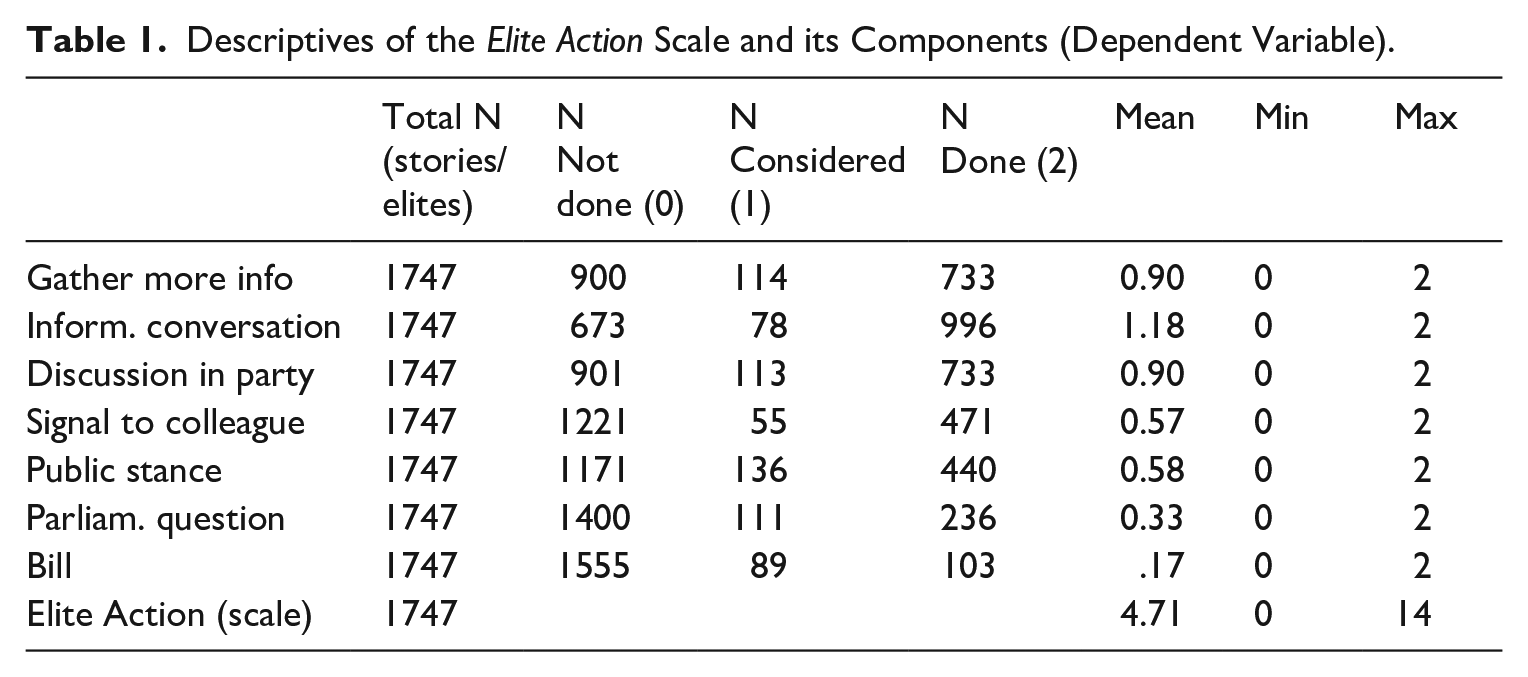
We use a pooled dataset in which media stories are nested within politicians, and accordingly estimate multilevel linear regression models. Due to missing answers on some of the action questions, the total number of cases in our analyses is roughly 1747 (instead of the 2093 stories they had seen, read, or heard). In Table 1, we provide the descriptives for the dependent variable and its seven components. As can be seen, there is a clear tendency for the most costly forms of action to be undertaken less frequently, but even the most intense form of action—bill writing—has been taken in quite a few instances (N = 103).
Descriptives of the Elite Action Scale and its Components (Dependent Variable).
Can we take politicians’ answers for granted? If they report having done something, can we be sure that this is actually the case? Since our dependent variable is reported behavior and not observed behavior, elites may exaggerate, or underreport, their degree of activity due to social desirability or simply recall error (see for a systematic discussion of biases in legislative surveys Bundi et al., 2018). We ground truth these messages with two tests. First, some of the actions reported by elites are on public record, and so we can validate whether those reporting that they undertook an action actually did so (See Bundi et al., 2018 for similar procedure). Concretely, we took a random sample of 22 parliamentary questions reported by Belgian MPs in our survey and examined the official parliamentary records for a formal trace of these alleged actions. In 20 of the 22 cases, we found formal proof of the question they claimed to have asked. A similar test of Canadian MPs (15 out of 21 cases correct) and Israeli MPs’ questions (18 out of 20 cases correct) shows similar reporting accuracy scores in the two other countries. As far as we can tell, then, there is only a limited degree of overreporting of the verifiable actions politicians undertook. Of course, we cannot be sure whether similar overreporting levels apply to the types of actions (e.g. informal conversation, gather more information, etc.) that we cannot validate by observational data. But we can say that respondents were guaranteed anonymity which should reduce any social desirability effect and that if social desirability played a role, it would probably not only work in favor of being responsive to public opinion. In fact, Tomz et al. (2018: 17) argue that representatives may take pride in the fact that they are autonomous actors making their own decisions drawing on their own expertise, and may emphasize their not being responsive to public opinion as well. 5
As a second validation, in an earlier study using the same design on members of parliament in Belgium, we embedded a number of fake stories—stories that we invented ourselves and that did not appear in the news media. Few politicians declared to have recalled inexistent stories and in only 0.5% of the cases did a politician state to have had the intention to take action on such an inexistent story (see Sevenans et al., 2016: 624). This offers additional circumstantial evidence that politicians, at least in Belgium, are speaking the truth when they say they acted or intended to act.
The key independent variable measured in the elite survey is Perceived Public Priority. It is measured by a question asking for each story: To what degree do citizens want politicians to take action (upon the story)? The answers could range from 0 (no action wanted by citizens) to 10 (action wanted by citizens). As noted above, the question gauges collective and not dyadic representation—it refers to citizens and politicians in general, and not the citizens of one’s own district, as was the focus for Miller and Stokes (1963) and Converse and Miller (1986). Focusing on constituency opinion is complex when considering different electoral systems, however. In line with the existing work, we expect that the more politicians estimate the general public’s demand for action on the story to be high, the more they effectively act.
Note that our question is more likely to tap into elite’s gut feeling and intuition about what the public wants than reflect actual learning by elites about the issues at stake. The stories/issues we confronted them with were very precise and polling information, at least in the countries we are talking about here, is often not available on such a fine-grained level on so many different issues. In addition, the lag between the news story breaking and the questioning of elites was often short, which reduces the chance that elites got the opportunity to really inform themselves about the public’s reaction to those stories. Instead of actual learning, elites probably have a number of implicit criteria of how to assess the public priority of an issue—what is the underlying issue, is it negative, are many people involved, etc.—and then apply those criteria to any event, problem, or story that passes by.
Perceived Public Priority is the key independent variable that we expect to be associated with our dependent variable Elite Action. Note, however, that we cannot rule out the possibility of reverse causation. It could be that elites do not base their behavior on perceptions of public opinion, but do exactly the opposite. Assessments of public opinion may be a rationalization, or even a justification, of representative action, or a lack thereof. To be clear, representatives’ post hoc reported action could guide their post hoc reported perception instead of the other way around. Since our study is not experimental, similar to most other studies studying elite perception (e.g. Converse and Pierce, 1986; Miller and Stokes, 1963), there is no way for us to definitively rule this out. We nevertheless proceed with models of behavior as a product of perceptions, for reasons we explain below. And we return to a discussion of causation in the conclusion.
Our analyses include a number of control variables. First, Opposition is equal to 1 for MPs who are not part of the governing party/coalition, since (1) opposition members will be constrained in their ability to take certain actions, and (2) work suggests that opposition members do react more strongly on media information than government party members do (e.g. Vliegenthart and Walgrave, 2011). We also include Age, Sex, and MPs’ self-designation on a scale from generalist to specialist, using the following question: Some politicians are interested in a small number of policy issues, others are interested in a large number of policy issues. Where would you place yourself on the following scale? (0 = small number of policy issues; 10 = large number of policy issues). Models include Country dummies to account for level differences across countries. It may be the case, for example, that due to institutional differences, the same institutional weapons (e.g. asking questions, drafting bills, etc.) are not equally available to all MPs in all three countries. Table 2 presents descriptives of all independent variables.
Descriptives of Independent Variables.
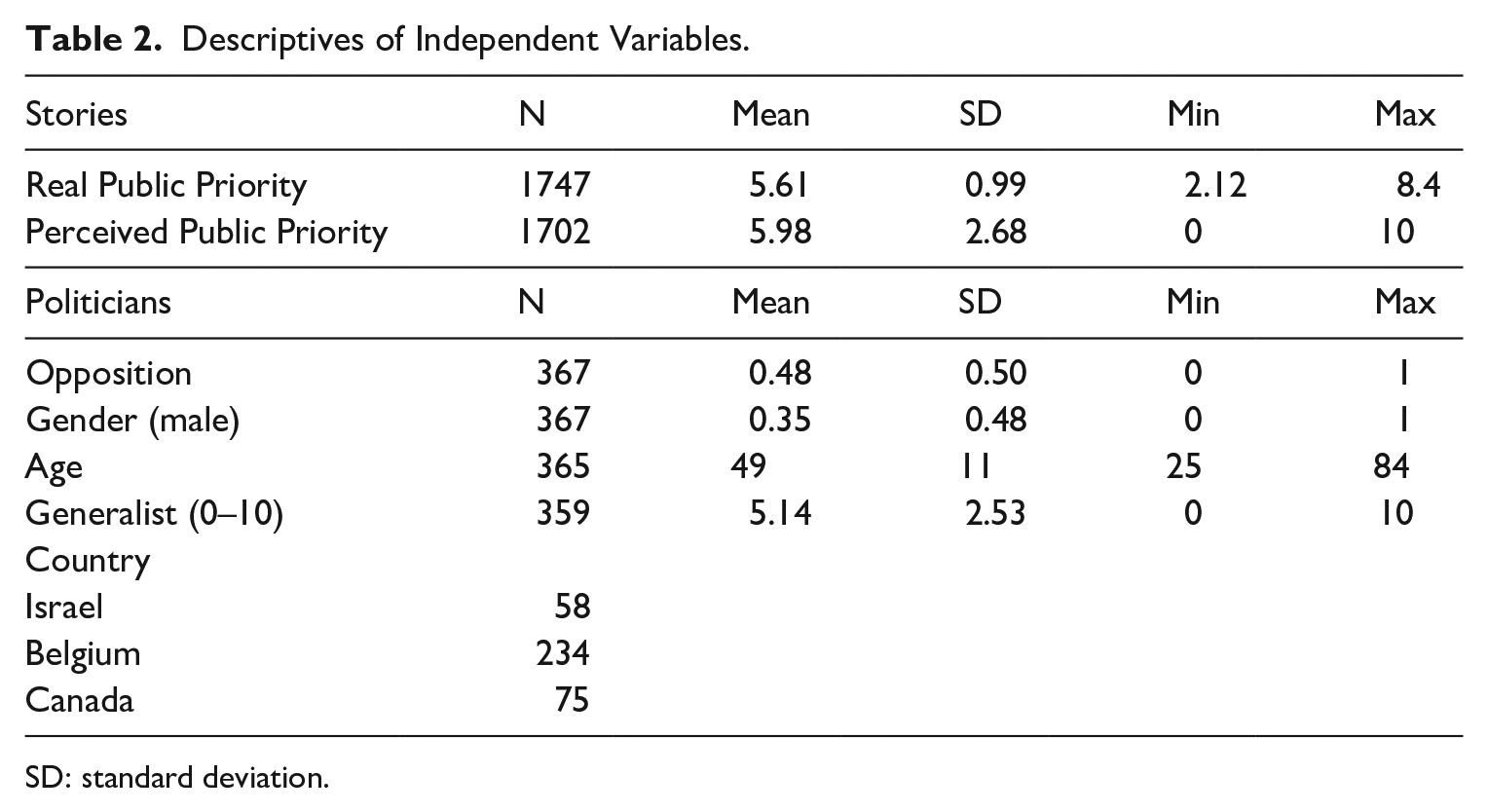
SD: standard deviation.
Citizen Survey
We implemented a random sample population survey in each country, at the same time as the elite surveys (rolling through the interview period), and asking citizens about the same media stories. In total, 6210 citizens were surveyed (Belgium: 2189; Canada: 2902; Israel: 1119). Sampling and surveying was done by SSI in Belgium and Canada and by iPanel in Israel. The samples are representative in terms of gender, age, and education level.
We use the citizen surveys to obtain a measure of the actual priorities of citizens, which we use as an independent variable in our models testing the effect of Perceived Public Priority on Elite Action. Doing so allows us to consider the effect of elite perceptions above and beyond actual public priorities. The question tapping what we will call Real Public Priority is as follows: To what extent do you want politicians to take action upon this topic? (0 = no action wanted; 10 = action wanted). This allows us to calculate, for every story, an average public demand for political action. Since the stories were spread over time and randomly attributed to citizens, the exact number of citizens rating the political priority of a story varies quite strongly. On average, each story was rated by 80 citizens, with a minimum of 10 and a maximum of 179.
Note that Real Public Priority is an estimation based on a limited number of observations which implies measurement error. Since the size of the error depends on the number of observations, we ran all analysis below again progressively dropping stories with fewer ratings. As one can see in Online Appendix 2, this did not change the results. Still, the estimated effect of Real Public Priority is likely biased downward due to measurement error.
Results
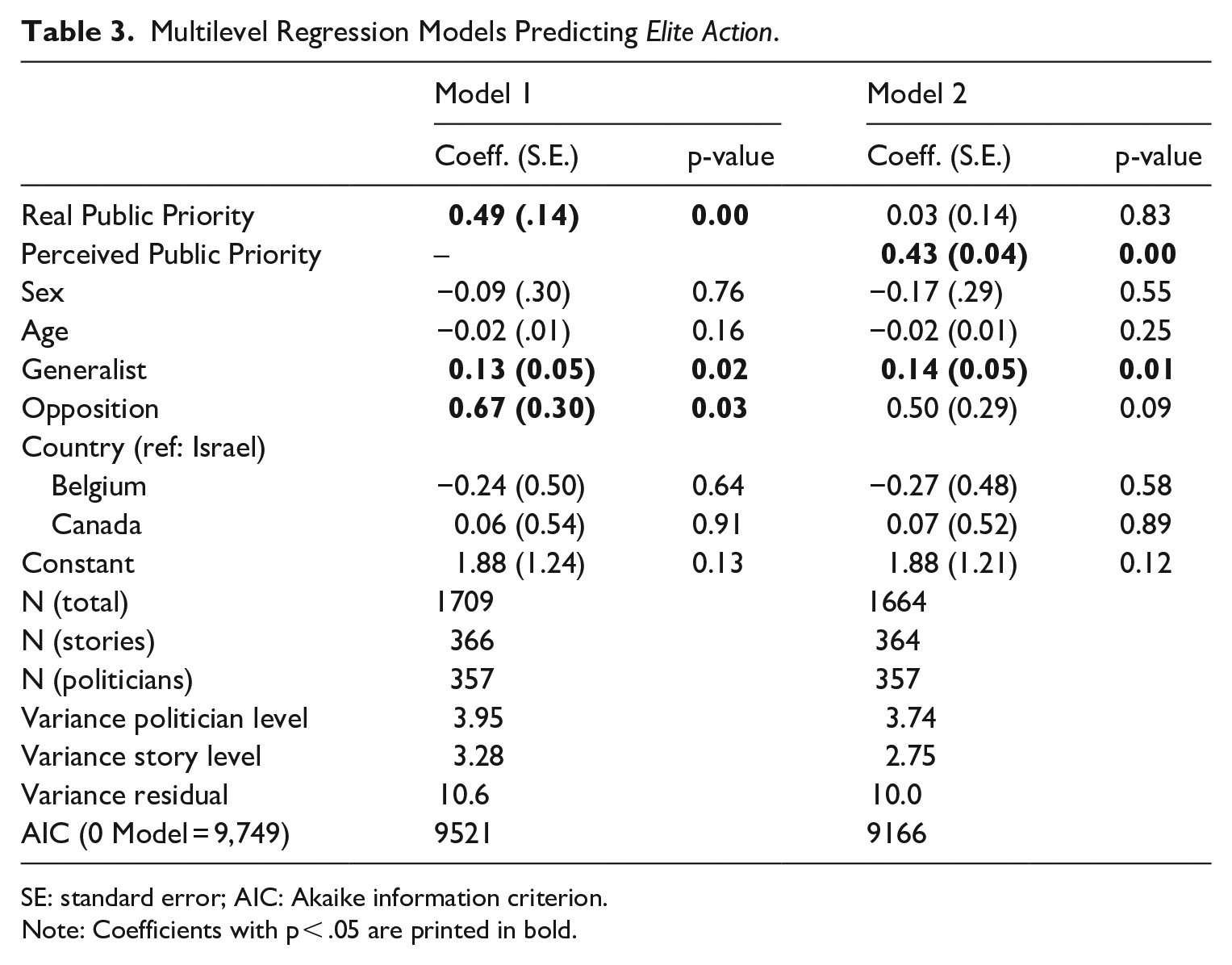
We estimate several multilevel, crossed-effects regressions, with random effects on the politician and story level to control for the fact that a politician rated seven different stories, and that stories were rated by several politicians. Effects are crossed because of the non-hierarchical structure of the data: each story could be rated by each politician. Table 3 reports the basic results. First (in Model 1), we explore the effect of Real Public Priority while leaving elites’ perceptions out of the picture. Real Public Priority is a significant predictor of elite activity. Elites react to what the public actually thinks, the evidence suggests; when people consider an issue to be a political priority, MPs do (intend to) act more on it. The effect is quite sizable as well—and it is probably an underestimation due to the measurement error of Real Public Priority. For each step upward on the public priority scale (0–10), the average politician’s degree of activity goes up by 0.49 on a 14-point scale.
Multilevel Regression Models Predicting Elite Action.
SE: standard error; AIC: Akaike information criterion.
Note: Coefficients with p < .05 are printed in bold.
Model 1 captures what a host of opinion-policy studies have found before: somehow, representatives take the public’s preferences into account. But the model lacks the mechanism that brings about the connection between what the people think and what politicians do. Model 2 consequently adds politicians’ Perceived Public Priority as an independent variable. This variable is a strong predictor of elite action, of roughly the same magnitude as Real Public Priority in Model 1. With every step on the 0–10 perceived priority scale, the average politician’s activity goes up by 0.43 on the 14-point scale. When politicians rate the public priority one step higher, they consider or actually undertake about half an action type more.
Note that the inclusion of the perception variable in Model 2 entirely removes the estimated impact of the actual public opinion measure, suggesting that although the two measures are associated, perceived public priorities matter more than actual public priority. Note also that we did not ask politicians about the priority they themselves attribute to the stories. We consequently cannot examine the impact of representatives’ own priorities on their actions, at least not directly. There is work suggesting that politicians project their own opinions on their perceptions of the public (e.g. Esaiasson and Holmberg, 1996; Holmberg, 1999; Pereira, 2020). But there is also work suggesting the oppositive direction of influence: that politicians’ perceptions of public opinion have a bearing on their own opinion (Sevenans, 2021). Either way, our results suggest that perceptions are strongly correlated with action.
Most of the additional control variables do not help explain elite action, with two exceptions. Politicians who define themselves as generalists undertake more action on any issue than politicians who consider themselves as specialists. This is an expected finding. Caring about a variety of different topics—which is what generalists do—leads to more responsiveness to topics that are covered in the media and that, by the very nature of media coverage, may not be very specialized. Second, compared to members of government parties, members of the opposition are more reactive to issues covered in the media, which is in line with the extant literature (e.g. Sevenans et al., 2015).
Results in Table 3 suggest that, across the three countries in our sample, elite actions are associated with perceptions of public priorities. We test the robustness of this finding by looking at the three countries separately, and by examining possible moderators of the public opinion perception―action relationship, and by testing different specifications of the dependent variable.
First, does the general pattern of responsiveness to one’s priority perceptions remain when we test it in the three countries separately? Note that in Israel (N = 58) and Canada (N = 75) the number of representatives is quite low and models are underpowered. Even so, in each country, Perceived Public Priority is a significant predictor of Elite Action (Coeff. in Belgium is 0.42 (p = 0.00), in Canada it is 0.53 (p = 0.00), and in Israel it is 0.28 (p = 0.01)). (Results are shown in Online Appendix 4.) These results suggest that it is not only in majoritarian systems that elected representatives are responsive to perceived public priorities, the same dynamic is evident in Belgium, and even the highly proportional Israeli system. That said, since the instrument we use in the different countries is not entirely the same—politicians and citizens were confronted with different media stories—it is hard to directly compare the strength of the relationship between perceptions and elite action across the different countries. Belgian and Canadian politicians, when looking at the size of the coefficients, seem to act more in line with their perceptions than Israeli politician―but we refrain from making much of this difference.
Second, is the relationship between politicians’ perceptions of public priorities and their actions stronger for some than for others? We examine two possible moderators—representatives’ role perception and their electoral safety. In fact, those who define themselves as delegates instead of trustees—the classic distinction made by Eulau et al. (1959) and followed by many others (e.g. Blomgren and Rozenberg, 2012)—could be expected to be more sensitive to public opinion and to display a higher congruence between perceptions and action. After all, delegates who declare that it is their task to translate the public’s preferences as directly as possible into policies should be more responsive to (their perception of) public opinion (or alternatively, to bring their perceptions of public opinion in line with their actions). Electorally vulnerable politicians could also be expected to be more eager to try to be responsive to (their perception of) public opinion (Mayhew, 1974).
These possibilities are tested in Online Appendix 5, by incorporating interaction effects in models predicting Elite Action. Note that our measures of electoral vulnerability vary across countries due to institutional differences and data limitations and we also suffer from limited degrees of freedom in Canada and Israel. We therefore proceed in a fragmented way, moderator by moderator, and in the case of electoral vulnerability country by country. In summary, results suggest that neither roles nor electoral safety play a significant role. The role perception politicians adhere to does not reinforce nor weaken the association between their public priority perception (Model 1) and political action, in none of the three countries (separate results not shown). The same applies to electoral safety (Model 2–4). In each country, it yields weak results suggesting that it hardly affects the strength of the relationship between public priority perceptions and elite action. Those who are uncertain about re-election do not seem to be more responsive. In sum, perceptions matter across the board. As far as we can tell, the association is not conditioned by the presence of specific characteristics of the representatives.
Third, we examine whether our results hold with different specifications of the dependent variable. In fact, Elite Action exists of eight different types of action, some are formal and more “expensive” (e.g. bill submission) while others are informal and do not require much investment (e.g. talking to colleagues). Also our decision to include the intention to undertake an activity and to give it half of the weight of actually doing the activity can be challenged. In Online Appendix 6 several models with alternative specifications of the dependent variable are presented. First, we only take the actual action politicians undertake into account and drop the intended action (this results in a 0–7 elite action scale). Results remain the same: regression results show that Perceived Public Priority is associated with Elite Action controlling for Real public Priority (Model 1). Next, we run a separate model looking only at position taking, parliamentary questioning, and bill drafting, the three most intense and formal activities representatives can undertake (0–6 scale) (Model 3). We similarly look separately at the informal activities—gathering more info, informal conversations, participating in internal discussion, and signaling the news to a colleague (0–8 scale) (Model 2). Again, results are very similar. For both types of political action Perceived Public Priority largely trumps the effect of Real Public Priority. That we find that perceptions of public priorities are significantly related to both informal and formal political actions alike partially alleviates worries that our main findings might be driven by the unverifiable and maybe exaggerated reporting by politicians about their informal actions. In sum, the specification of “elite behavior” does not affect our findings―perceptions are consistently related to action.
Conclusion
The literature on political representation suggests that elite perceptions of public priorities are an important driver of representative behavior. As we have outlined above, there is nevertheless limited research that empirically examines the relationship between elite perceptions of priorities and action. Hence, we lack knowledge about a major mechanism of representation. The path-breaking but limited work that exists mostly dates from a long time back, is not comparative, only looks at dyadic representation in majoritarian systems, focuses only on positional preferences and not priority preferences, and draws on a limited number of issues.
This study set out to add to this literature. We presented evidence about individual representatives in three different countries. Our data included elite perceptions of public priorities of the general population and a wide range of representative actions with regard to a few hundred concrete and randomly selected issues. Our results suggest that the basic intuition of the early literature was right: individual elites seem to act upon their perception of the public’s policy priorities or, more precisely, elites’ actions are correlated with their perceptions. We suspect our results are broadly generalizable, as the relationship between perceptions and elite action is remarkably similar across countries, notwithstanding the fact that the three countries under study represent different electoral and political systems. In each country, political action is significantly related to elites perceptions of what the public as a whole (and not just their district) cares about. This is not just true for formal legislative action such as voting in parliament and introducing bills, but also for informal, less observable action such as talking to colleagues. We also do not find the relationship between perceptions of public priorities and elite action to be conditional. It is not confined to politicians who adhere to a delegate role or who are electorally unsafe, for instance. We believe these results contribute to a better understanding of how representation works by highlighting one important mechanism.
One strength of this work is simultaneously an important limitation. The representational process is, of course, more complex than what we can capture in a survey. Apart from the perceptual path we scrutinized, there also is the “own opinion” path in which politicians follow their own opinion so that, in so far that the own opinion of politicians match citizens’ opinion, responsiveness is a consequence of citizens electing the “right” representatives (see Miller and Stokes, 1963). That second path was not covered here, as we lacked data about politicians’ own priorities. Furthermore, processes of projection (e.g. Esaiasson and Holmberg, 1996) and updating (e.g. Sevenans, 2021) mean that the own opinion and the perception of public opinion of politicians are mutually influencing each other which further increases the complexity of the responsiveness process. In addition, both mechanisms might not only be affected by actual public opinion (that elects politicians and that is perceived by politicians) but also by the objective severity of the problem at hand. Indeed, some problems (encapsulated in the media stories in this study) are simply more serious than others, in that they imply more hardship, victims, casualties, risks, damage, injustice, urgency, etc. This “real world” partially drives what people think should be the political priorities (real public opinion), but also influences politicians’ own opinion about what should be in priority dealt with (own opinion) and their perception of popular priorities (perception of public opinion). We fully acknowledge that representation entails all these diverse mechanisms, but we think to have demonstrated that there is a firm place for elite perceptions in the process.
Whether the place of elite perception is situated in the causal chain where we argued it is, that is, causing elite action and responsiveness, remains to be seen. The present study cannot rule out the possibility that actions are also driving reported perceptions and not only the other way around. We used a cross-sectional survey instrument to measure both actions and perceptions and are not sure whether one actually precedes the other. However, there are strong theoretical reasons to expect that it is politicians’ perceptions of public priorities that drive their actions rather than the other way around (at least this is what most previous research claims, see, e.g. Tomz et al., 2018). Empirical, experimental studies also suggest that perceptions drive action and not the other way around (e.g. Butler and Nickerson, 2011). In addition, narrative, ethnographic studies drawing on in-depth interviews with politicians about the relationship between their perceptions and their actions also find that perceptions affect elite behavior (see: Kingdon, 1973, 1984). What we can conclude from the present study, strictly speaking, is only that elite perception and elite action are consistently and robustly associated in different countries and across a random sample of issues.
The significance of perceptions makes clear the importance—in future work—of understanding how politicians develop these perceptions and why they differ from reality. In fact, we have only a vague sense for how politicians develop their perceptions, what sources they use, for instance. We know that political representatives spend a lot of time and effort in trying to get an idea of what the public wants (Herbst, 1998) but whether it is through interactions with constituents (e.g. Fenno, 2003 (1978) polls (Geer, 1996), media (e.g. Van Aelst and Walgrave, 2016), or simple intuition is not clear.
In closing, we hope our study helps to reinvigorate the interest in elite perceptions and their relevance for representation. Re-examining a forgotten line of research, we can see that elite perceptions are central to understanding how representation comes about. They deserve a prominent place on the representation research agenda.
Supplemental Material
sj-docx-1-psx-10.1177_00323217221105170 – Supplemental material for Revisiting Elite Perceptions as Mediator of Elite Responsiveness to Public Opinion
Supplemental material, sj-docx-1-psx-10.1177_00323217221105170 for Revisiting Elite Perceptions as Mediator of Elite Responsiveness to Public Opinion by Stefaan Walgrave, Stuart Soroka, Peter Loewen, Tamir Sheafer and Karolin Soontjens in Political Studies
Footnotes
Acknowledgements
The authors would like to thank the INFOPOL-team for the data collection effort.
Author’s Note
Stuart Soroka is now affiliated to Department of Communication, University of California, LA, USA.
Declaration of Conflicting Interests
The author(s) declared no potential conflicts of interest with respect to the research, authorship, and/or publication of this article.
Funding
The author(s) disclosed receipt of the following financial support for the research, authorship, and/or publication of this article: This work was supported by the European Research Council (Advanced Grant “INFOPOL,” No. 295735) and the Research Fund of the University of Antwerp (Grant No. 26827). Stefaan Walgrave (University of Antwerp) is the principal investigator of the INFOPOL project, which has additional teams in Israel (led by Tamir Sheafer) and Canada (led by Stuart Soroka and Peter Loewen).

Supplemental Material
Additional Supplementary Information may be found with the online version of this article.
Online Appendix 1: Full List of Stories
Online Appendix 2: Models Only Including Stories with +20, +30 and +50 Citizen Ratings
Online Appendix 3: Models without Israeli Ex-MKs
Online Appendix 4: Separate Country Models
Online Appendix 5: Interaction Effect Models
Online Appendix 6: Main Analyses with Differently Specified Dependent Variables
Notes
Author Biographies
References
Supplementary Material
Please find the following supplemental material available below.
For Open Access articles published under a Creative Commons License, all supplemental material carries the same license as the article it is associated with.
For non-Open Access articles published, all supplemental material carries a non-exclusive license, and permission requests for re-use of supplemental material or any part of supplemental material shall be sent directly to the copyright owner as specified in the copyright notice associated with the article.
