




Abstract
States support religion to varying extents. What is the effect of state support for religion on generalized social trust? The majority of previous studies of religion and social trust focus on individual-level factors, and none examines the impact of state support for religion. We argue that when a state chooses to support the majority religion, this creates increased levels of doctrinal homogeneity and conformity, which, in turn, cause higher levels of social trust within the majority religion. Drawing upon the Religion and State and World Values Survey datasets, we find that state support for religion is associated with higher levels of social trust.
Introduction
Social trust influences important political phenomena. It improves how societies function and increases trust in institutions and government as well as participation in politics and civic organizations. It is associated with the development of better functioning democratic institutions, economic growth, and lower crime and corruption. This study finds that a previously unexamined influence on social trust, levels of state support for religion, is associated with higher levels of social trust.
The social trust literature examines the influence on social trust using two levels of analysis: societal and individual. At the societal level, one influence heretofore not examined is state support for religion. Many states support religion through various means, including funding religious education, basing laws on religious precepts, and censoring antireligious press. We look at the implications of state support for religion on social trust while also accounting for both individual-level and other state-level influences, drawing primarily from two aspects of the social trust literature. The first are those who examine the impact of state- and regime-level factors on social trust. The second is the influence of religion on social trust. While, as we discuss in detail below, some previous studies examine the impact of religiosity and religious denomination on social trust, no previous study has looked at the influence of government religion policy on social trust.
There are different types of social trust, such as generalized trust and particularized trust (Uslaner, 2000, 2002). We define social trust as generalized trust or faith in people. It is a belief in the honesty, integrity, and reliability of others outside of your close family or friends (trust in strangers), particularly those who are not like you (Berggren and Bjørnskov, 2011; Uslaner, 2002).
We argue that when states choose to support religion, they tend to create a more homogeneous environment in terms of beliefs and values, rendering people more likely to trust one another. Even members of minority religions may be socialized into the dominant culture by state support for religion through policies like education. Importantly, we do not argue that increased social trust is the result of increased religiosity. Rather, the resulting homogeneity of identity, belief, and values leads to higher levels of social trust.
While drawing on the literature regarding religiosity’s influence on social trust, we argue that government support for religion’s influence on social trust is independent of any influence religiosity may have. While this influence can be described as a “top-down” factor, we do not argue that social trust is entirely determined or even mostly determined by top-down influences. Rather, our intention is to focus on a previously underappreciated influence on social trust, which happens to be a top-down influence.
Our analysis, which combines the Religion and State (RAS) and World Values Survey (WVS) datasets, supports this argument. Assessing the relationship between state support for religion and social trust while also controlling for individual and other country-level influences, we find that state support for religion is associated with higher levels of social trust among both members of the majority religion and religious minorities.
This study proceeds as follows. First, we discuss previous studies on religion and social trust. Second, we examine arguments that state-level factors including government policies and characteristics can influence social trust. Third, we discuss in detail why state support for religion can, in theory, increase levels of social trust. Fourth, we present our empirical analysis, which supports this argument. Finally, we discuss the wider implications of our findings.
Previous Studies of Individual Religious Traits and Social Trust
While there are no previous studies that examine the impact of state support for religion on social trust, the relationship between religion and social trust has received considerable attention (Alesina and La Ferrara, 2000; Daniels and Von Der Ruhr, 2010; Putnam, 1993, 2000; Rotter, 1967; Uslaner, 2002; Welch et al., 2004), producing a wide divergence of views and empirical results about the exact nature of the relationship. Much of it has focused on individual-level traits such as religiosity and religious affiliation.
The influence of religiosity differs depending on the particular measure (Hempel et al., 2012; Tan, 2006). The importance of religion to one’s life corresponds to decreased trust (Berggren and Bjørnskov, 2011). In contrast, findings generally support the contention that regular attendance at religious services promotes or increases social trust (Daniels and Von Der Ruhr, 2010; Hempel et al., 2012; Uslaner, 2002). Participation in religious organizations increases religious norms of solidarity and the belief that people are good and trustworthy, especially if participation occurs during one’s childhood. However, if the community is an exclusive one, such as is the case with many fundamentalist denominations, this trust will only be within the community and trust of those outside of it will decrease (Dingemans and Van Ingen, 2015; Hempel et al., 2012; Marshall and Olson, 2018). This speaks to the difference between particularized trust and generalized trust. 1
Some argue that religious affiliation influences trust levels (Bahr and Martin, 1983; Schoenfeld, 1987; Smith, 1997; Traunmüller, 2011). Other studies suggest that hierarchical religious affiliations impede trust while nonhierarchical religions encourage its development (Putnam, 1993; Wolfe, 1989). Still, Alesina and La Ferrara (2000) and Welch et al. (2004) make the argument that religious affiliation is largely inconsequential to tendencies to trust or not to trust.
We posit that one reason for these mixed results is that previous studies which include religious identity have generally failed to control for state support for religion. In one of the rare cross-country studies examining religion and social trust that controlled for religious identity, Delhey and Newton (2005) argue that Protestant countries are more trusting. However, four of the six “high trust” countries they list have official religions or had them in the recent past and all four of these state churches were Protestant. In contrast, only three of the 35 countries listed as having “low” or “no” trust had official religions. Thus, it is possible that religious identity was in practice acting as a surrogate for support for religion in this study. Thus, had this study controlled for this, it is likely the religious identity results would have been nullified.
Also, many studies of social trust focus on a single country or a small number of countries, and the cross-national studies use different subsets of countries (e.g. Delhey and Newton, 2005; Knack and Keefer, 1997; Newton, 2001; Paxton, 2002; Uslaner, 2003), this raises the possibility that some of the divergent results in the literature may be due to the differing loci where the surveys were taken.
This literature is important for two reasons. First, it established the principle that religion can have an influence on social trust. Second, it indicates that our study needs to control for religiosity to assure that any results based on state support for religion are not due to any covariance between religiosity and state support for religion.
Government Support for Religion and Social Trust
While much of the social trust literature focuses on individual-level and subnational influences on social trust, other research suggests that social trust is influenced by social systems or properties (society at large) and not just individual qualities or characteristics. From this perspective, social trust includes an important top-down element, which is the focus of this study. However, we by no means argue that individual-level influences are unimportant.
Several studies show that government policies and structure can influence social trust. For example, richer and more democratic nations are more trusting than poorer and less democratic ones (Inglehart, 1999; Knack and Keefer, 1997; Newton, 2001; Paxton, 2002). Delhey and Newton (2005) find that social trust can be increased by good government. Rainer and Seidler (2009) examine the impact of communism and democracy on trust using the German reunification as a natural experiment. They found that those who grew up under East Germany’s Communist regime had less social trust than did those who grew up under West Germany’s democratic regime, despite it being decades after reunification. Uslaner (2003) and Rothstein and Uslaner (2005) argue that government structures do not influence trust, but policies can, especially those that foster economic equality and equality of opportunity as opposed to means-tested policies which lead to less generalized trust as well as increased racial and class divisions. Policies aimed at equality of opportunity, such as strengthening public education (Knack and Zak, 2003) as well as labor market or skills training policies (Lee, 2013), also help promote social trust.
Some evidence suggests that ethnic homogeneity as well as income equality increases social trust in society (Knack and Keefer, 1997; Rothstein and Uslaner, 2005). This supports the argument that lower levels of societal polarization increase social trust. Finally, Putnam (2000) argues that a high level of voluntary organizations and associations generates social trust. While there are some empirical studies to support the role of voluntary organizations and associations (Brehm and Rahn, 1997; Stolle and Rochon, 1999), the results are highly criticized (Delhey and Newton, 2005; Knack and Keefer, 1997; Newton, 2001; Uslaner, 1999, 2000), and none of these studies address state support for religion.
All of these studies help to demonstrate that state-level, government-level, and group-level factors, all non-individual-level factors, can influence social trust. This supports our argument that government policy toward religion may influence levels of social trust.
The Rational Choice School of Religion and Politics
We argue that government support for religion is another type of government policy that can potentially influence social trust. 2 Specifically, we argue that the rational choice school of religion and politics explains not only why state support for religion would lead to increased social trust but also indicates that this may be an intended consequence of a state policy to support a national religion.
Gill (2008) argues that state support for religion is determined by the joint interests of politicians and the leaders of religious institutions. That is, politicians support a state religion precisely because it benefits them. Gill ascribes three primary interests to political leaders. First, politicians seek political survival which includes the desire to remain in power. Second, they “seek to maximize government revenue, promote economic growth, and minimize civil unrest” (Gill, 2008: 47). Third they “seek to minimize the costs of ruling” (Gill, 2008: 47).
Supporting a religious monopoly facilitates all three of these goals. That is, in return for government support for a religious monopoly, religious leaders and institutions provide a number of goods to the government. First, national religions support the legitimacy of the state. This reduces the economic costs of ruling by reducing opposition to and rebellion against the regime which can reduce the costs of repression. It increases the likelihood that the current leaders will remain in office. It also reduces the costs of patronage. As Gill (2008: 67) argues “to the extent that citizens agree that obedience to the government is morally correct . . . politicians need not devote resources to coercion or paying off constituents” 3 (Gill, 2008: 49).
Second, it reduces the likelihood that the national religion will be a basis for opposition. Third, the national religion will seek to increase the morality of the population which will create a greater level of law abidance by citizens, reducing costs for law enforcement, courts, and prisons (Gill, 2008). Thus, from a resource-based perspective, supporting a state religion can be a good investment.
This dynamic could also be present even in the absence of a religious monopoly as long as the elements of state support for religion and reciprocal support for the state are present. Fox (2008, 2015; Fox and Akbaba, 2015) documents that many states have no official religion but support one religion or multiple religions. This support can include various forms of financial support, preferred tax status, and religious education in public schools, among other forms of support. It is possible to expand Gill’s argument to include these supported intuitions, many of which represent minority religions, among those that support the state in return for this state support.
Many echo this argument. For example, Goldfrank and Rowell (2012) argue that in Latin America, churches criticize regimes when there is the separation of religion and state but not when the Church is linked to the state. Grzymala-Busse (2016: 11) argues that churches lower the costs of ruling in exchange for access.
Others have expanded on this argument positing additional benefits and nuances. Sarkissian (2015) and Koesel (2014) emphasize how even in autocratic states, governments benefit from increased legitimacy and reduced opposition. In addition, religious institutions often provide social goods such as charity and other forms of social welfare which reduce the need for governments to provide these services. They also emphasize that these types of arrangements are also present between governments and minority religions. Dekker and Halman (2003) similarly argue that participating in religious organizations increases charitable activity. Cao et al.: argue that local religious institutions decrease violence caused by local grievances. They do so in two ways: first, they provide local public goods; second, they provide an “information bridge” between the local population and the government, allowing for nonviolent management of potential discontent (Cao et al., 2018: 1).
We argue that an additional benefit for the government is increased social trust. There is some basis within the rational choice literature to argue that this is an intended benefit, however, it is unclear whether this benefit is intentional or unintentional. On one hand, while social trust is not central to his arguments, Gill (2008: 51) does acknowledge that “members of a religious community typically hold shared values and mutual expectations about behavior. This enhances trust among individuals, which in turn lowers the uncertainty associated with mutually cooperative behavior.” However, he does not develop this argument further. On the other hand, benefits such as increased legitimacy, homogeneity, and morality within a population are likely far more obvious to policymakers than increased social trust. Thus, it is also possible that social trust is an unintended consequence.
To establish this theory, we need to support two arguments. First, that increased social trust benefits the rulers. Second, that a state-supported religion can increase levels of social trust.
The Benefits of Social Trust
There is considerable evidence that social trust will benefit the political leadership, whether that benefit is intended or not. There is a wide range of research suggesting trust is positively related to how well societies function (e.g. Gambetta, 1988; Coleman, 1994; Braithwaite and Levi, 1998; Fukuyama, 1995; Putnam, 1993; Uslaner, 2002). People who believe that most other people can be trusted are more inclined to have a positive view of their institutions, to participate more in politics, and to be more engaged and involved in civic organizations (Putnam, 1993; Uslaner, 2002). Likewise, more trusting societies encourage the development of better working (democratic) institutions, economic growth, and less crime and corruption (Fukuyama, 1995; Knack and Keefer, 1997; Putnam, 1993; Zak and Knack, 2001).
Many argue that religion contributes important resources to maintaining civic society. Specifically, they argue that, in-group bonding social capital through faith-based activities creates trust and that skills learned through religious organizational activity. Both can spill over to the benefit of external groups within the larger community (Park and Smith, 2000; Putnam, 2000; Schwadel, 2005; Welch et al., 2007). 4 This suggests that bonding social capital created through religious in-group participation creates a bridge for social capital to extend into other areas of one’s community. Put differently, bonding social capital leads to bridging social capital. This argument goes back at least as far as De Tocqueville (2003). Nevertheless, the argument for a link between bonding social capital and bridging social is not universally accepted among all scholars. Some argue that religious in-group trust—with its shared beliefs and values—makes bridging social capital more difficult (Uslaner, 2002; Welch et al., 2004).
It is also important to note that while we argue that increased social trust is an intended benefit of state support for religion, it does not need to be an intended consequence for the causal mechanisms we describe below to function.
How State Support for Religion Increases Social Trust
We posit that this social contract between religion and the government also creates social trust in several interrelated ways. State-supported religions by their nature seek to create a uniform and homogeneous belief and value system among their members. Cesari (2014, 2018) argues that even in modern times, many state religions explicitly seek to reduce the diversity of belief within their religion. The goal is often to use the state religion to create a homogeneous national culture and nationalism which will support the state. However, she acknowledges that this homogenization effect occurs mostly within the religious majority and that it may cause tensions between members of the majority religion and those of minority religions.
Many of the advantages given to the state-supported religion but not to the several nonsupported religions explicitly further this goal. For example, supported religions are often given preferred and sometimes exclusive access to the state education system. This allows them to teach not only the unified religious values and ideology to the nation’s students who are members of the majority religion—as most states with religious education in public schools allow religious minorities to opt out—but also to socialize them into the dominant national culture (Cesari, 2014; Fox, 2008, 2015, 2020).
In some cases, the government represses some or all minority religions as well as other interpretations of the national religion. This makes the state-supported religion the only available option, or at least the most available option, for those majority religion members seeking to fulfill their religious needs. It may also encourage conversion to the national religion, especially in cases where this conversion involves switching denominations within the same religion rather than switching to a different religion altogether. In fact, many argue that a religious monopoly is not possible without such repression (Casanova, 2009; Froese, 2004: 36; Gill, 2008: 45; Grim and Finke, 2010: 70; Stark and Finke, 2000: 199).
Even in those rare cases with no repression of religious minorities, government support for religion tends to increase religious homogeneity. Finke (2013; Stark and Finke, 2000) argues that support for religion, such as financial support, creates an unfair advantage for the supported religion in attracting members even in the absence of repression of other religions. This is because religion has financial costs to its consumers. These include building and maintaining religious institutions, religious education, and salary for clergy, among other costs. Members of non-state-supported religions pay the full financial costs of religion while members of the state-supported religion receive services at a reduced cost or perhaps even for free. This makes the state-supported religion more attractive to religious consumers which increases levels of religious homogeneity. However, they emphasize that such switching is far more common between denominations within the same religion rather than across religious traditions.
This also applies to states that support multiple religions including minority religions. That is, most such states tend to support only one or a few state-recognized denominations at the expense of others (Fox, 2015). Thus, such a policy can increase doctrinal homogeneity within supported minority religions.
Many argue that social trust is higher within a single moral community. For example, Dingemans and Van Ingen (2015: 741) argue that “most religious ideologies incorporate values of social solidarity and respect for human beings.” In fact, the role of community voluntary organizations and associations provides the basis for the primary theoretical link between religion and social trust, which is best attributed to bonding social capital, which is inward-focused and exclusive to an in-group, as well as bridging social capital which extends between groups and is inclusive (Putnam, 2000). Bonding social capital develops in-group trust as a consequence of interaction with coreligionists promoting shared values, beliefs, and consensus through faith-based activities (Putnam, 2000). Basically, religious involvement promotes a community of shared beliefs, leading to greater in-group trust with that experience translating to external groups. 5
We emphasize that this argument is based on increased homogeneity of identity, belief, and values rather than religiosity or the specific content of a religious theology. Our argument is not that state-supported religions make people more religious or that their theologies tend to be exclusive. Nor is it that state-supported religions result in conversion to the majority religion, though this may also occur. Nor do we argue that social trust can only occur within a homogeneous religious culture.
Rather, we argue that state-supported religions are one factor among many that can increase social trust. Their primary influence is within the membership of the supported religion or religions. The majority of religions have a homogenizing influence on national identity, culture, belief, and values, primarily among members of supported religions. In the case of supported minority religions, this support has a similar influence on creating homogeneity within the religion and connecting people to the national identity through gratitude for state support and feelings of inclusion in the state culture and body politic. It also provides an official recognition of inclusion in the national culture that can be recognized by members of the majority religion. People who are more similar and identify with each other are more likely to trust each other. Shared fundamental norms and values make trusting strangers easier (Delhey and Newton, 2005; Knack and Keefer, 1997; Zak and Knack, 2001).
This increased homogeneity will increase social trust among those who share these homogenized characteristics. We also argue that this homogenizing influence will apply to most members of the majority religion, even those who are less religious because it derives from shared values, identity, and belief rather than the strength of these shared characteristics. Similarly, members of supported minority religions who are less religious will nevertheless also feel more included in the national culture and identity. Thus, this is basically a top-down argument where a national program supported by both the government and religious institutions will cause greater uniformity and feelings of inclusion in society. This dynamic will result in increased social trust, at least among members of the supported religion or religions.
There is some support for this in the social trust literature. For example, Marshall and Olson (2018: 474) argue that “even though most followers of a religious tradition may have little theological sophistication, a set of general orientations toward ‘the world’ filter down into followers’ thinking and orientations in ways that significantly affect their willingness to trust others.” That being said, under this rationale, those who attend religious institutions more often will be more influenced by these institutions. We posit that this helps explain why in previous studies religious attendance is positively correlated with social trust (Daniels and Von Der Ruhr, 2010; Hempel et al., 2012). 6
While we argue that this dynamic applies to both the supported majority religion and supported minority religions, the social trust literature is divided on what influence a national religion might have on religious minorities. Perhaps, this is because we consider the dynamics of how state support for a minority religion might influence social trust, while the previous social trust literature simply focuses on majority-minority dynamics without examining the role of state support for minority religious institutions.
On one hand, as noted above, many religious communities promote exclusivity (Dingemans and Van Ingen, 2015), which would limit trust across religious lines. In fact, exclusive support for the national religion will likely result in a clear distinction between members and nonmembers which will reduce social trust among members of minority religions toward members of the majority religion. If national culture is based on religious affiliation, those who do not belong to that religion will feel excluded because they are, in fact, being excluded (Cesari, 2018). Furthermore, the preferred treatment for the majority religion is likely to cause resentment against the majority religion among religious minorities. In addition, as noted, religious monopolies usually involve at least some repression of minority religions. Putnam (1993, 2000) similarly argues that religious activity is often directed inward rather than to the larger community, resulting in greater insularity.
On the other hand, Marshall and Olson (2018) argue that the strong presence of a religious culture can influence nonmembers living close to or within this culture. That is, the religious ecology “shapes the daily experiences of people who share the same county or city, even people who are not members of the numerically dominant religious group” (Marshall and Olson, 2018: 475). Put differently, religion creates and sustains a worldview that goes beyond doctrine and influences the culture at large in nonreligious or secular arenas (Wolfe, 2003). For this reason, in the empirical portion of our study, we examine the impact of state support for religion on social trust levels of the majority and minority groups separately.
It is also important to note that this relationship is made more complicated because many argue that there is a relationship between state support for religion and religiosity, which as we discussed earlier is an important influence on social trust. This “supply-side” argument posits that state-supported religious monopolies reduce attendance at religious services but not other elements of religiosity such as belief. This is because, in a religious monopoly setting, there are less religions available to choose from as opposed to an unregulated religious market where religious “firms” multiply to fill empty niches. In an unregulated setting, people are more likely to find a religious “product” they desire to “consume” and religious firms need to be attractive to their potential congregations because they depend financially on them. In contrast, state-supported religions receive much of their funding from the state and have less of a need to be responsive to congregants. Finally, people often resent being told what to do. This can decrease the popularity of state-enforced religions (Finke, 1990, 2013; Finke and Laurence, 1993; Froese, 2004; Iannaccone, 1995a, 1995b; Stark and Finke, 2000; Stark and Iannaccone, 1994).
Thus, there may be an indirect relationship counter to the increased social trust caused by the increased homogeneity engendered by a state-supported religion because these religions, according to the supply-side theory, may decrease attendance at religious services which, as noted, is associated with increased trust. This results in an indirect relationship where decreased attendance would reduce social trust. We address this potential complexity in our empirical tests by controlling for attendance.
Empirical Design and Results
To analyze the relationship between religious support and social trust, we draw upon the RAS 7 and WVS datasets. Our sample consists of all countries that were surveyed for the WVS between 1990 and 2014 with a majority religion. This results in 82 countries and 179 country years. 8 The online Supplemental appendix includes a list of the countries included in the analysis.
Our dependent variable is a binary measure of how individuals responded to the question, “Generally speaking, would you say that most people can be trusted or that you need to be very careful in dealing with people?” 9 coded as 1 if the respondent answers “most people can be trusted,” and 0 if the respondent answers “need to be very careful.” This is the standard measure used for generalized trust (Marshall and Olson, 2018; Uslaner, 2000) in the social trust literature.
The main independent variable is a continuous scale measuring overall state support for religion, drawn from the RAS data that includes 52 types of religious support. 10 Figure 1 shows the country-level correlation between state support for religion and social trust, using the mean level of state support across survey years and the mean level of trust across surveyed individuals across survey years in each country. It shows a positive correlation between state support for religion and mean levels of social trust.
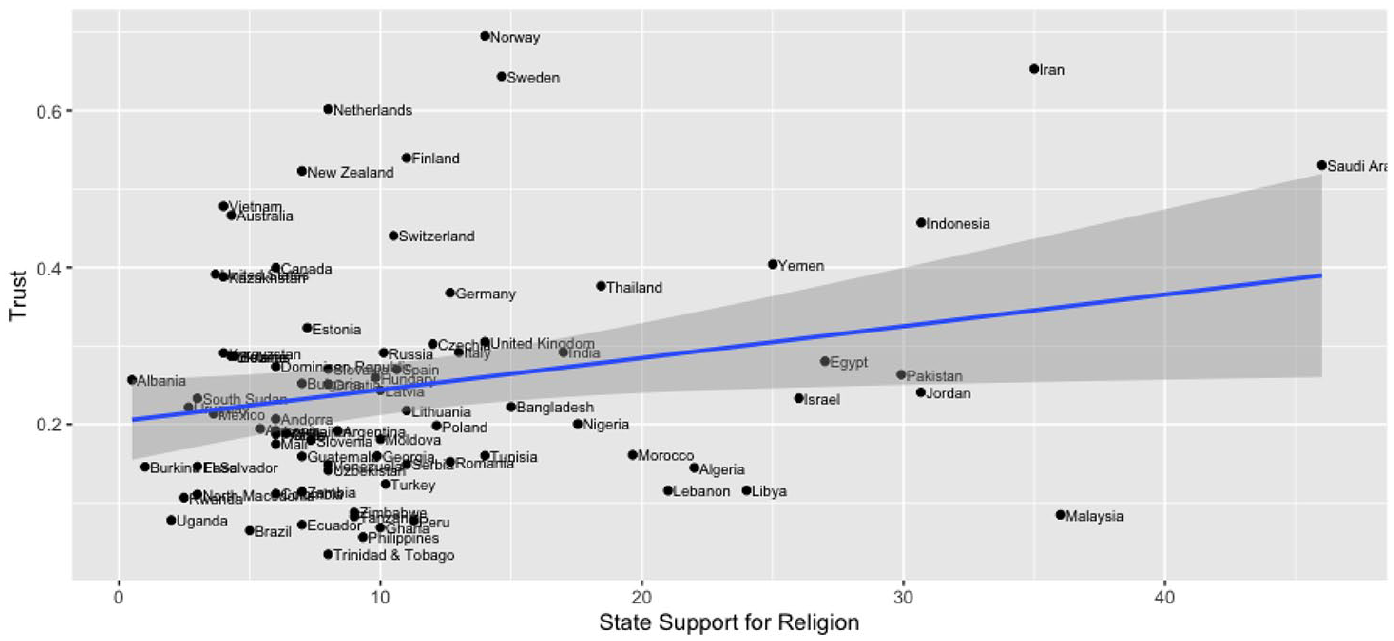
Correlation between State Support for Religion and Trust.
In modeling the relationship between state support for religion and social trust, we include a number of additional variables to control for alternative explanations, both at the individual and country levels. At the individual level, we control for whether the individual is a member of a minority religion, which may impact how state support for religion affects their propensity to trust others. 11 We include a measure of subjective well-being that is measured by how happy an individual describes themselves to be, which may be connected both to state behavior and individuals’ general level of trust. 12 We control for an individual’s level of religiosity using self-reported importance of religion as well as their frequency of religious service attendance, both of which may be a product of state policies toward religion and have been found to influence social trust (Berggren and Bjørnskov, 2011; Dingemans and Van Ingen, 2015; Hempel et al., 2012; Marshall and Olson, 2018; Welch et al., 2004). 13
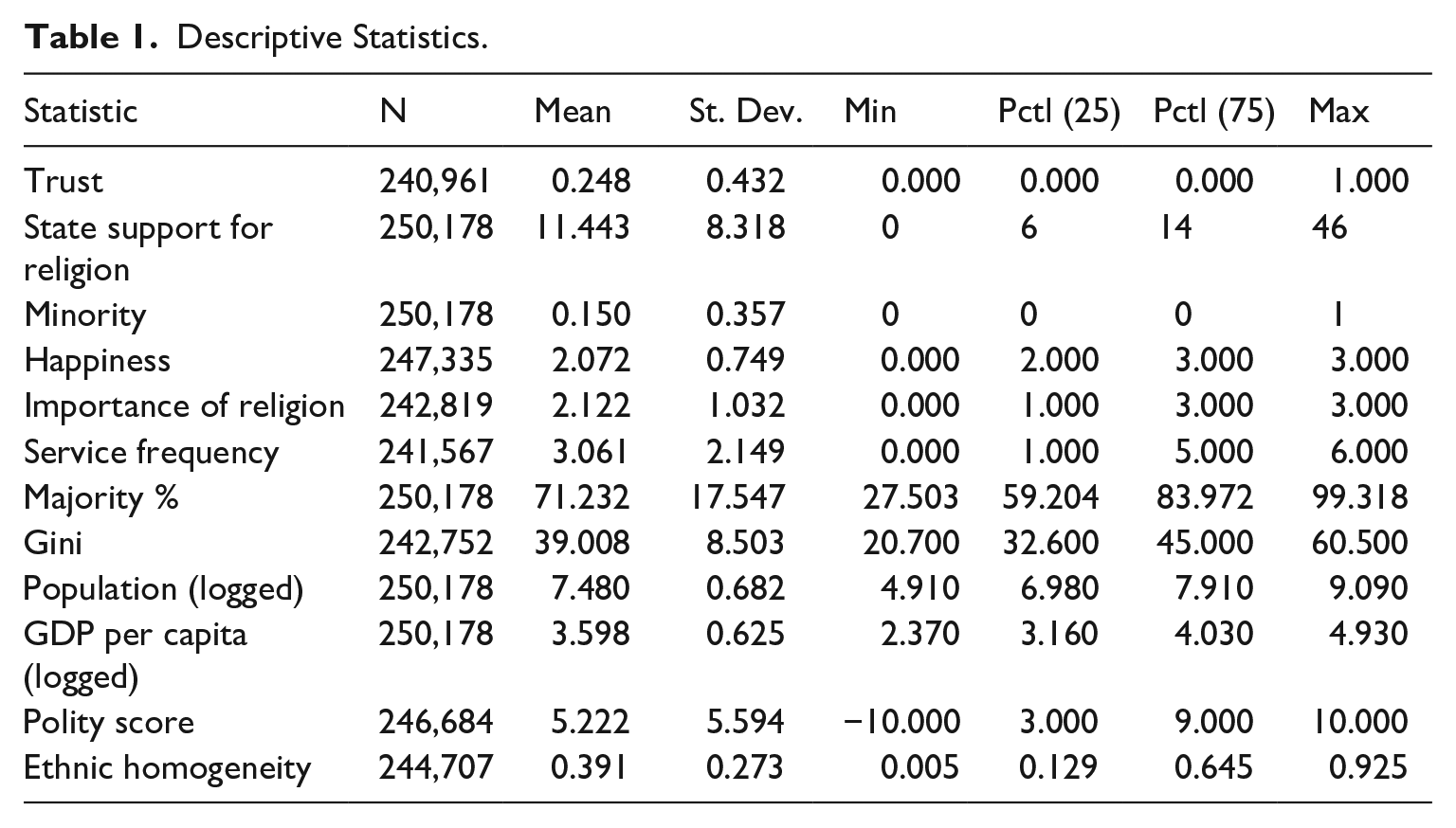
At the country level, we control for the percentage of the population comprised of the majority religious group, as larger religious majorities may lead to greater social trust as well as greater incentives for the government to support religion. We also control for the country’s Gini coefficient, logged population, logged GDP per capita, level of democracy, and ethnic homogeneity, 14 all of which may influence and be influenced by a country’s religious policies as well as shape individual levels of social trust. Table 1 shows the descriptive statistics of the variables used in the main analysis and additional tests.
Descriptive Statistics.
To estimate the cross-sectional associations between state support for religion and social trust while taking into account the clustering of observations within countries, we employ a multilevel modeling approach. Multilevel models are highly advantageous for analyses of complex data structures in which observations are grouped. In our case, an individual’s trust likely depends on the country in which they live. Due to the fact that the model’s key independent variable is a characteristic of the country, multilevel models are the most appropriate way to model the relationship between state support of religion and trust. 15 An ANOVA test confirms that there is a statistically significant difference between the countries’ mean level of trust.
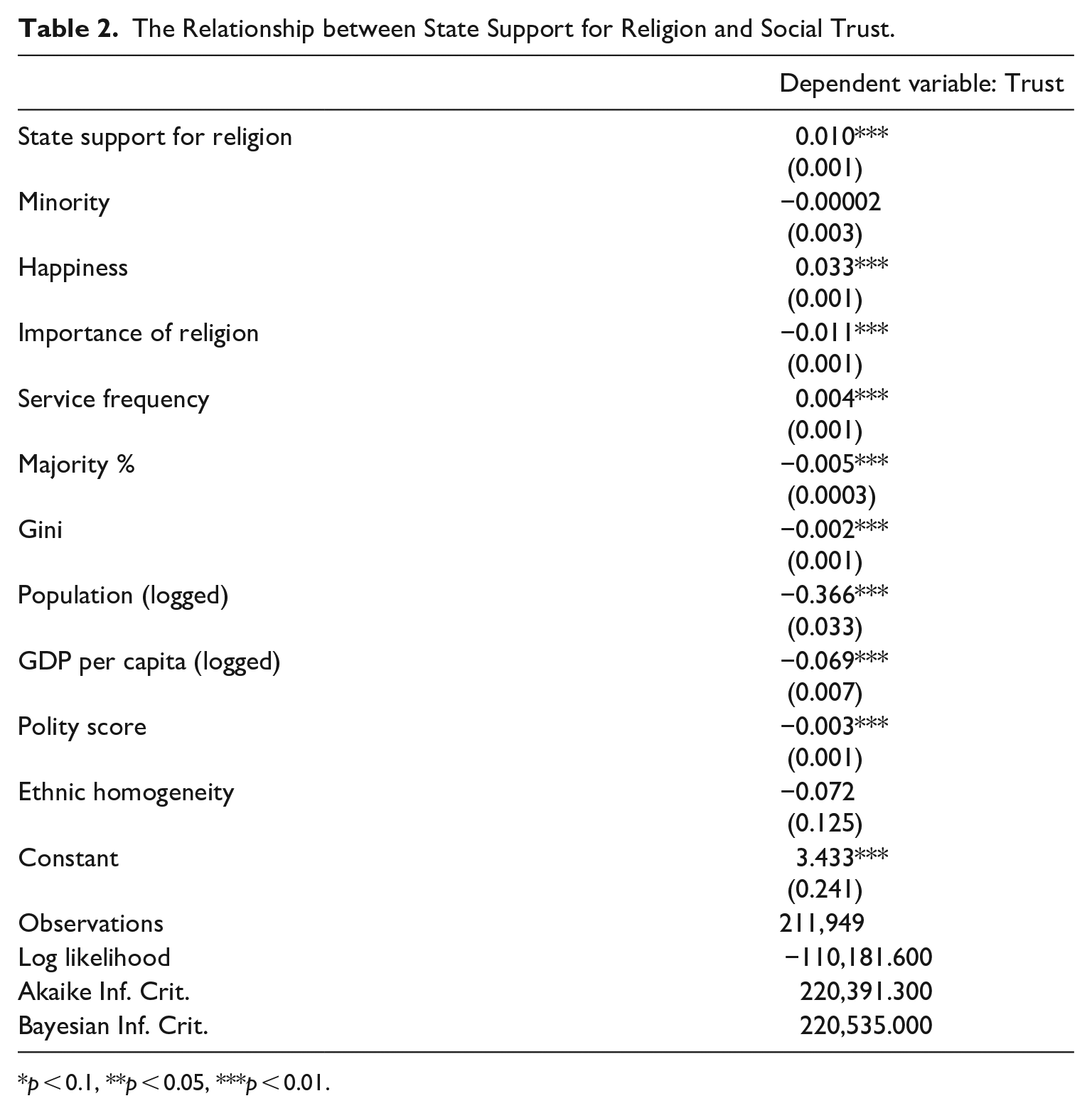
We use a linear mixed effect model that predicts the change in an individual’s belief that most people can be trusted as a result of a positive change in each covariate, allowing intercepts to vary between each country. 16 Even though our outcome variable is binary, we use linear mixed-effects models because some of the models failed to converge when using mixed-effects logistic regression, due to the complexity of the model. 17 The results are shown in Table 2.
The Relationship between State Support for Religion and Social Trust.
p < 0.1, **p < 0.05, ***p < 0.01.
State support for religion is associated with a positive and statistically significant increase in the likelihood of social trust. The more policies a state enacts that support religion, the more likely individuals in that state will believe that most people can be trusted. Figure 2 illustrates the predicted probability of trust at each level of state support for religion, based on estimations generated from Model 1. The predictions demonstrate that the effect is substantively significant, with the probability of social trust quadrupling from no state support to higher levels of state support.
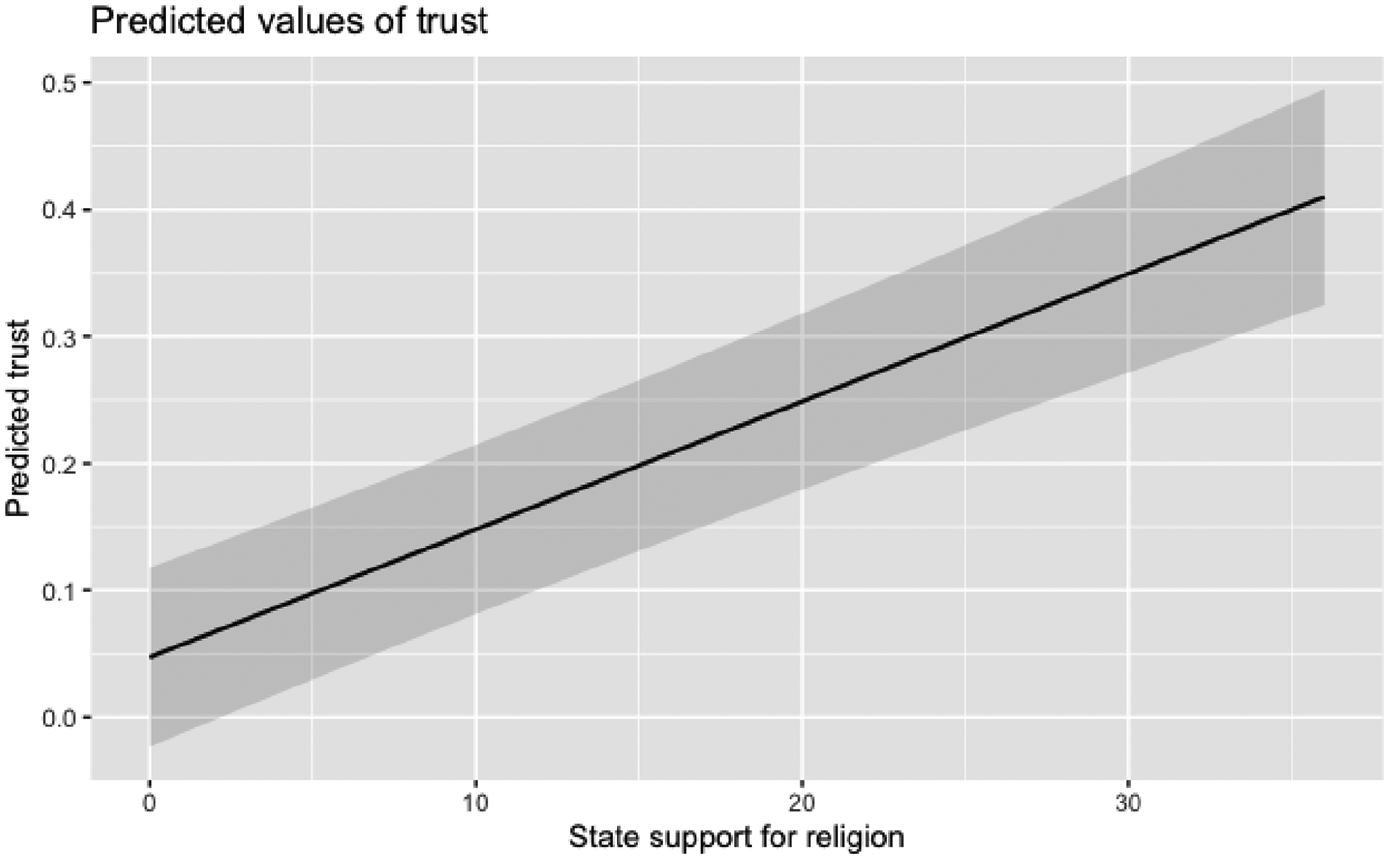
Predicted Trust, Based on State Support for Religion.
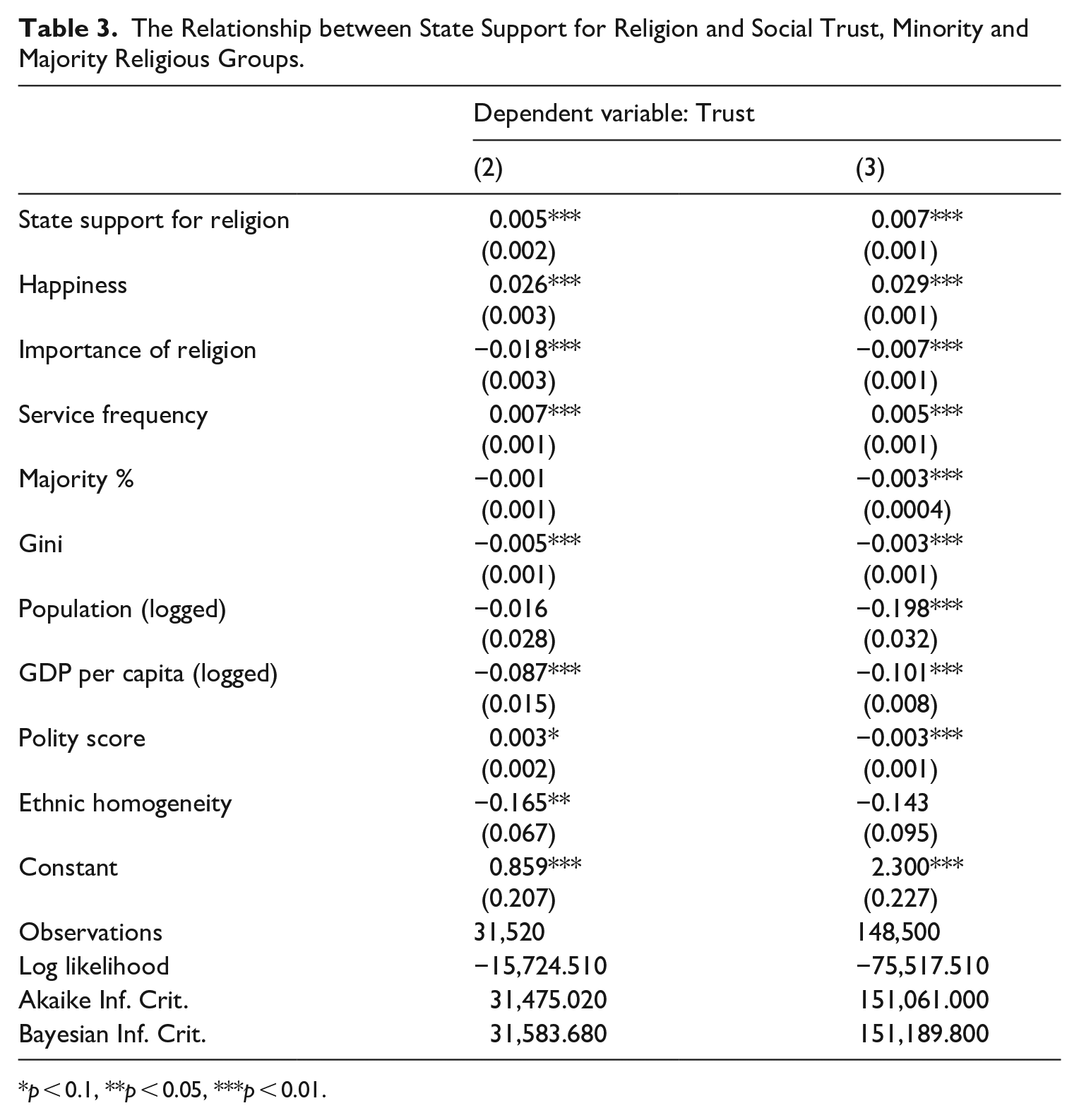
We further investigate the relationship between state support for religion and social trust by separating the analysis into members of the majority religion and members of minority religions. 18 Model 2 below narrows the sample to individuals who are members of minority religions while Model 3 narrows the sample to individuals who are not members of a minority religion, including both members of the majority and those who do not identify with a religious denomination. The results are shown in Table 3.
The Relationship between State Support for Religion and Social Trust, Minority and Majority Religious Groups.
p < 0.1, **p < 0.05, ***p < 0.01.
These models show little difference between minority and majority religious groups in terms of how state support for religion affects social trust. In both cases, state support for religion has a positive and statistically significant relationship to social trust. The predicted values generated from Models 2 and 3 illustrate that the substantive significance of the effect is largely the same, providing support for theories that suggest that the strong presence of a religious culture can even influence members outside of that religion (Marshall and Olson, 2018) (Figure 3).
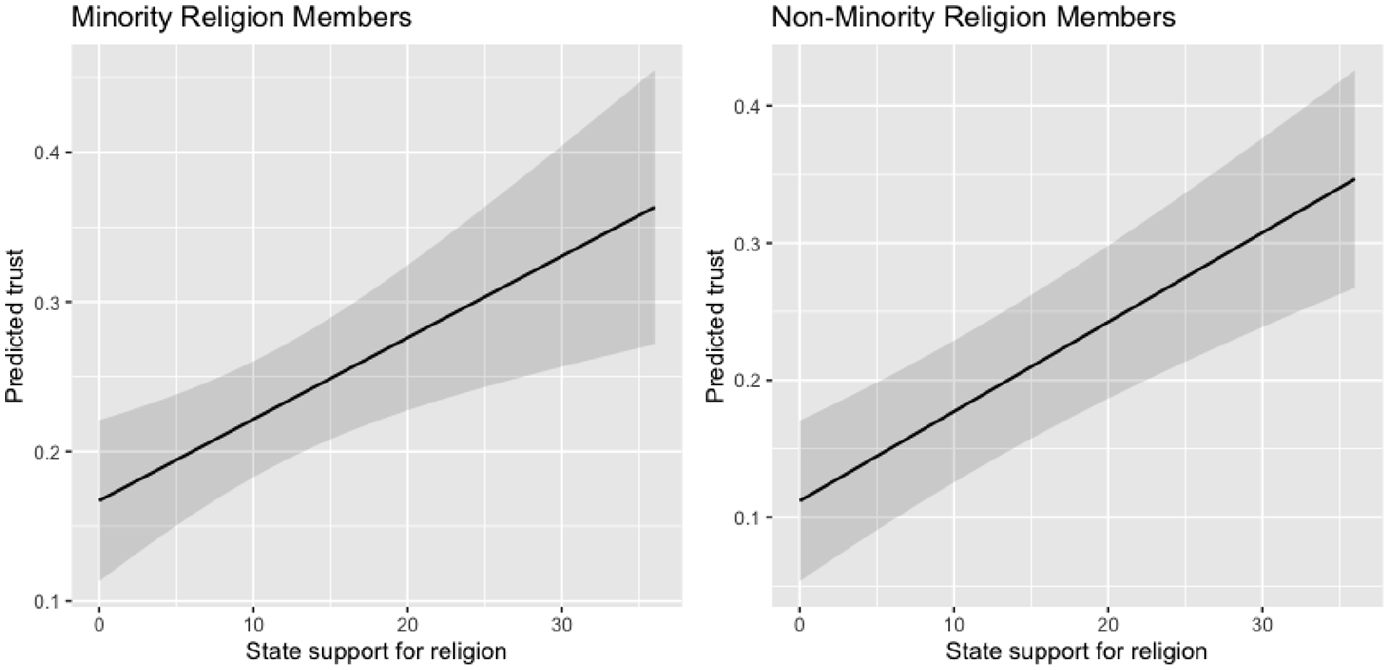
Predicted Value of Trust, Based on State Support for Religion.
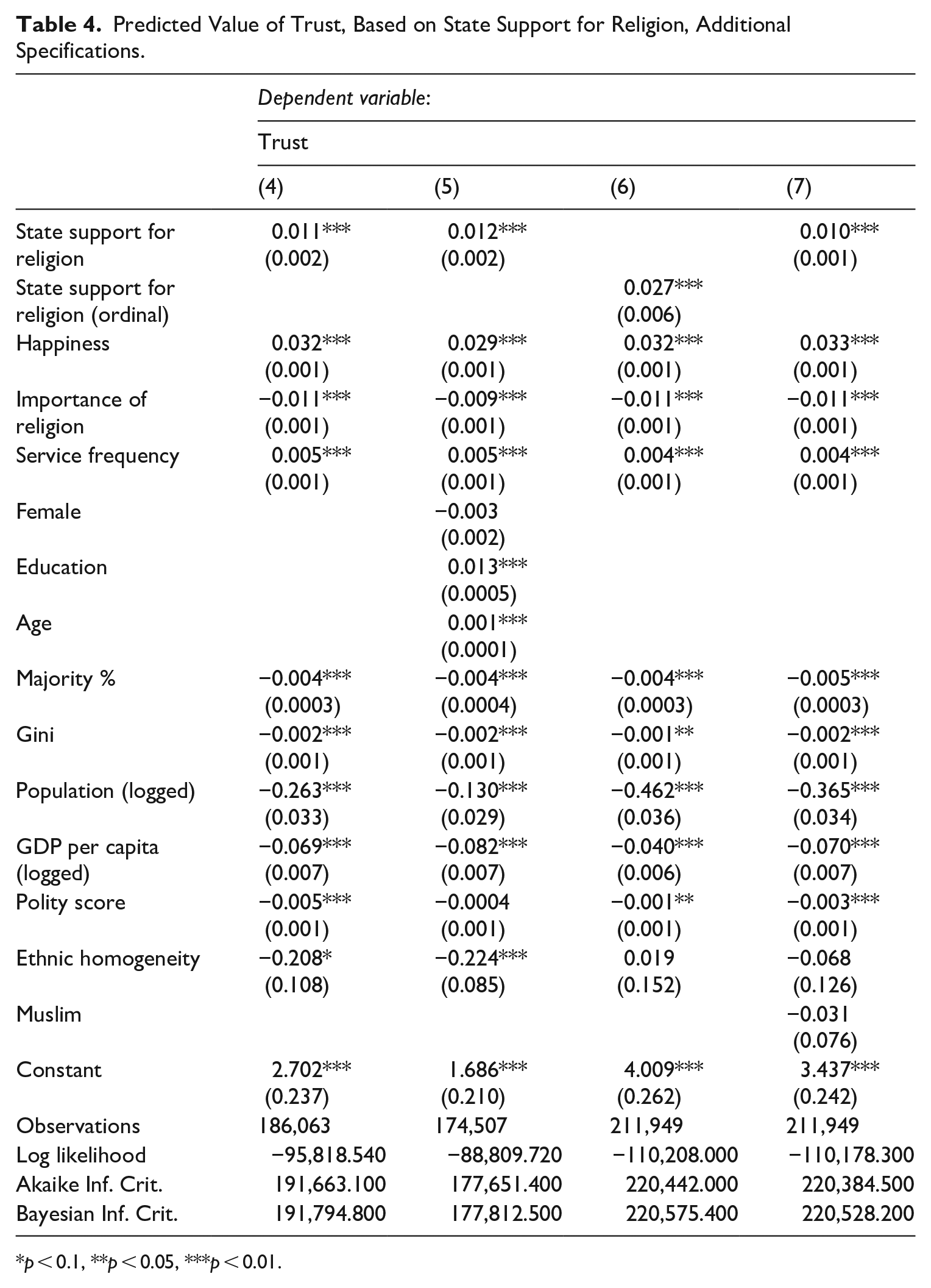
We next probe the results’ robustness using additional models. Model 4 investigates whether the results are driven by outliers, dropping observations that have a value of state support for religion that is more than one standard deviation above the mean (>20). Model 5 includes additional individual-level controls—sex, education, and age. While age and education have a significant relationship with trust, they do not change the positive and statistically significant relationship between state support for religion and social trust. In Model 6, we follow Henne et al. (2020) and rescale religious support to an ordinal variable that characterizes religious support as “low,” “moderate,” or “high.” 19 Religious favoritism is complex, and it is difficult to know whether a country with a value of 20 is actually more favorable toward the majority faith than a country with a value of 18. Indeed, in his discussion of measuring concepts, Goertz (2012) contends that additive measures are often inappropriate for concepts that are not in fact additive in nature. Finally, because Figure 1 shows that all countries that are both high in social trust and state support for religion are Muslim, we run Model 7 includes a binary indicator for whether the country is home to a Muslim majority, to account for the possibility that something about the Islamic faith makes both social trust and state support for religion more likely. The regression results shown in Table 4 confirm that the relationship between state support for religion and the average level of social trust is indeed robust to these specifications. 20
Predicted Value of Trust, Based on State Support for Religion, Additional Specifications.
p < 0.1, **p < 0.05, ***p < 0.01.
In sum, a range of model specifications provides support that state support for religion has a positive and statistically significant association with social trust. Those who live in states with higher levels of religious support are more likely to believe that most people can be trusted. This is true of not only majority religion members but minority religion members as well.
Discussion
Our findings show a positive correlation between state support for religion and social trust, which is consistently statistically significant across all models. This supports our contention that state support for religion fosters social trust.
Our findings also add some nuance to previous studies. We largely confirm previous findings both that religious attendance has a positive influence on trust at the individual level (Daniels and Von Der Ruhr, 2010; Hempel et al., 2012), and that the importance of religion to one’s life corresponds to decreased trust (Berggren and Bjørnskov, 2011). Previous studies have found mixed results for other religiosity variables (Bahr and Martin, 1983; Hempel et al., 2012; Schoenfeld, 1987; Smith, 1997; Tan, 2006; Traunmüller, 2011; Wolfe, 1989; Putnam, 1993). It is also important to emphasize that using both controls for religiosity does not impact our finding that state support for religion increases social trust. Thus, this finding is specific to state support for religion and cannot be attributed to state support for religion being covariate with religiosity.
Our findings on democracy add increased complexity to previous findings. Most previous findings show that those living in democratic countries have higher levels of social trust (Delhey and Newton, 2005; Inglehart, 1999; Knack and Keefer, 1997; Newton, 2001; Paxton, 2002). However, others question these findings (Rainer and Seidler, 2009) and argue that it is not democracies that foster increased social trust but the specific policies of some democracies (Rothstein and Uslaner, 2005; Uslaner, 2003). Our findings show a consistent negative correlation between democracy and social trust. In robustness checks presented in the online Supplemental appendix where state support for religion is removed from the model, this negative correlation remains. Thus, our results support the contention of Rainer and Seidler (2009), Uslaner (2003), and Rothstein and Uslaner (2005) that democracy does not necessarily foster social trust and that this relationship is not dependent on levels of state support for religion.
Previous studies also show that wealthier nations have higher social trust (Inglehart, 1999; Knack and Keefer, 1997; Newton, 2001; Paxton, 2002). Our findings show the opposite. In robustness checks presented in the online Supplemental appendix dropping the state support for religion variable, this relationship remains negative and significant at the individual level. 21 One of the reasons posited for why wealthier nations have been shown to have more social trust is the argument that those with more resources have less to lose by trusting while those with less resources cannot afford a higher level of trust (Banfield, 1958). It is possible that the presence of a state-supported religion, with its homogenizing influence on values and behavior, reduces that risk calculus.
Consistent with previous research, subjective well-being, as measured by happiness, demonstrates a positive and statistically significant influence on social trust across all models. This supports the contention that subjective well-being is one of the most important drivers of individual levels of social trust (Delhey and Newton, 2005). Age and education both increase social trust. These findings are consistent for both the influence of age (Patterson, 1999; Putnam, 2000) and education (Putnam, 2000). Our results suggest that women have more social trust than men, which is consistent with some research (Patterson, 1999), but other studies have contrary findings (Newton, 2001).
Conclusion
The rational choice school of religion and politics argues that states support religion to gain benefits that decrease the costs of ruling by increasing a government’s legitimacy and decreasing crime (Gill, 2008). We argue that social trust is an additional benefit of state support for religion that is rarely addressed in this literature. Existing research demonstrates that social trust can make governing easier and less expensive in a wide variety of manners. It contributes to a well-functioning society through creating a positive view of institutions, improved functioning of government institutions, increased political participation, social capital, and economic growth as well as lower crime and corruption. Thus, any factor which influences social trust can, in doing so, potentially influence a wide range of important political phenomena. We argue that state religions increase social trust through bolstering a unified value system and religious homogeneity. Our results show that state support for religion has a significantly positive influence on levels of social trust.
It is not our claim that state support for religion is necessarily the most important influence on social trust. Nor is it our claim that social trust is determined solely by top-down factors. However, state support for religion is a significant influence that has not been taken into account in previous studies. This has four important and inter-related implications. First, it supports previous studies which argue that state-level factors and particularly government policies can influence social trust. Second, it demonstrates that religious institutions, especially when incentivized to do so, can have a measurable impact on social trust. Both of these implications indicate the necessity of more research into the microlevel dynamics of when and how religious institutions bolster social trust.
Third, our results imply that everything we think we know about the correlates of social trust is suspect, especially state-level factors. This is because many of the state-level factors included in previous studies are correlated with state support for religion. This means that in previous studies these factors may have acted as surrogates for state support for religion. For example, as some studies show that Protestant-majority countries have a different pattern of support for religion than Catholic-majority countries (Fox, 2015), this calls into question results from previous studies which draw conclusions based on countries’ religious majorities. Thus, previous cross-country studies which failed to account for religious support may be missing a crucial factor that may influence their findings. Similarly, studies from a single country that focus on individual-level factors are not fully accounting for the environment in which their study is measuring social trust when interpreting their results.
Finally, this study adds a new dimension to the rational choice school of religion and politics. Specifically, it demonstrates that increased social trust may be part of a state-religion mutual-support compact, though further research is necessary to determine whether this is an intended or unintended benefit. That is, while our results cannot show whether or not this increase in social trust is an intentional result of the actions of religious institutions or simply an unintentional by-product of the use of a state religion to increase legitimacy, governability, and revenue, there is considerable evidence that increased social trust benefits rulers and, consequently, rulers who understand this may be more likely to seek to increase social trust. We suggest further testing the nature of this relationship is an important agenda for future research.
Supplemental Material
sj-docx-1-psx-10.1177_00323217221102826 – Supplemental material for State Support for Religion and Social Trust
Supplemental material, sj-docx-1-psx-10.1177_00323217221102826 for State Support for Religion and Social Trust by Jonathan Fox, Marie Eisenstein and Jori Breslawski in Political Studies
Footnotes
Acknowledgements
We would like to thank the editors and the anonymous reviewers for their insightful comments.
Declaration of conflicting interests
The author(s) declared no potential conflicts of interest with respect to the research, authorship, and/or publication of this article.
Funding
The author(s) disclosed receipt of the following financial support for the research, authorship, and/or publication of this article: This research was supported by the Israel Science Foundation (Grant 23/14), The German-Israel Foundation (Grant 1291-119.4/2015) and the John Templeton Foundation. Any opinions expressed in this study are those of the authors alone and do not necessarily reflect those of the supporters of this research.
Supplementary Information
Additional supplementary information may be found in the online version of this article.
Contents
Table A.1. Country-level Analysis.
Table A2. Sample Including Countries with “Mixed” or “Other” Majority (Not Possible to Control for Minority Religious Status).
Table A3. Covariates Only.
Table A4. Main Models using Mixed-effects Logistic Regression.
Notes
Author Biographies
 ). He has published extensively on religion and politics including government religion policy, religious minorities, and religions role in conflict and international relations. His recent publications include Why Do People Discriminate Against Jews? (Oxford university Press, 2021) and Thou Shalt Have No Other Gods Before Me: Why Governments Discriminate Against Religious minorities (Cambridge University Press, 2020).
References
Supplementary Material
Please find the following supplemental material available below.
For Open Access articles published under a Creative Commons License, all supplemental material carries the same license as the article it is associated with.
For non-Open Access articles published, all supplemental material carries a non-exclusive license, and permission requests for re-use of supplemental material or any part of supplemental material shall be sent directly to the copyright owner as specified in the copyright notice associated with the article.
