




Abstract
This article seeks to shed more light on the reasons for the regionally uneven distribution of populist attitudes. We take into account both individual-level and contextual drivers and focus mainly on the latter. We argue that regional peripheralization processes are a key contextual condition driving populist attitudes, especially in post-communist settings. The empirical analysis is based on a unique dataset combining comparable items from two representative surveys covering Germany (N = 2112) and the Czech Republic (N = 1000) with economic and demographic characteristics of relevant regional contexts in both countries (167 constituencies in Germany and 77 districts in the Czech Republic). Using multilevel regression models, the article shows that individual-level characteristics do not alone drive populist attitudes. In contrast, the results show that living in peripheral areas of the Czech Republic and eastern Germany increases the likelihood of having populist attitudes. These peripheries are characterized by unfavourable economic conditions in the Czech Republic and demographic decline in eastern Germany.
Introduction
In the past decade, there has been an intense scholarly debate about populism in both Western Europe (WE) and the post-communist region of Central and Eastern Europe (CEE). A significant part of this research has focussed on the sources of populist attitudes and the sources of populist vote choices, considering both individual-level (e.g. Rooduijn, 2014; Tsatsanis et al., 2018; Van Hauwaert et al., 2019) and contextual-level factors (e.g. Rydgren and Ruth, 2013; Savelkoul et al., 2017; Van Wijk et al., 2019). Holding populist attitudes or voting for populist parties may stem from individual-level attitudes and characteristics, but it may also be influenced by the environment people live in, observe and are exposed to. For example, holding populist attitudes may be caused by personal experience with unemployment. However, it can also be caused by observation of an unfavourable environment with high levels of unemployment in a given region, irrespective of one’s own current (un)employment status.
In this article, we focus specifically on contextual sources of populist attitudes and draw attention to an under-researched contextual source of populist attitudes. We hypothesize that it is a process of regional peripheralization, which contributes to populist attitudes, particularly in post-communist contexts. Peripheralization is a process of growing disparities between rising regions (centres) and those that are lagging behind (peripheries). Regional peripheralization has been a process that was assessed as particularly sharp in post-communist CEE countries (Lang et al., 2015). Living in these peripheral regions, we argue, contributes significantly to populist attitudes.
Our article is comparative and based on three macro-regions: Czechia, eastern Germany and western Germany. The two post-communist regions in the study have been hit by regional peripheralization, albeit to a different extent and in different ways. The case of eastern Germany is that of a macro-region severely affected by socio-spatial polarization, with numerous examples of shrinking regions and cities. Many regions within eastern Germany have suffered from depopulation and related economic problems. This is not only a result of socioeconomic transformation following the end of the communist regime but also an effect of German unification and the concomitant outflow of population to more prosperous regions of (western) Germany (Lang, 2012). In contrast, even though Czechia has also been hit by demographic decline, regional economic disparities have been emphasized as more challenging (Bernard and Šimon, 2017: 24–25). In other words, in both post-communist macro-regions, new peripheries have emerged, but the process of how these peripheries emerged was different. Finally, in western Germany, as in most WE countries, regional peripheralization has been regarded as less sharp compared with post-communist countries. We have included western Germany for two related reasons. First, the peripheralization effect within western Germany is not expected to be strong compared with the other two post-communist regions; therefore, the region acts as a control case. Second, a major migration process took place from eastern Germany to western Germany, and thus, it is possible to explore whether peripheralization manifests itself in Germany as such and not just within the eastern and western parts.
We propose studying the sources of populist attitudes based on this concept of peripheralization. We do not argue that peripheralization is the only source of populist attitudes, but claim that the process of peripheralization contributes, as a macrostructural and contextual effect, to these attitudes, especially in post-communist settings strongly affected by peripheralization.
In terms of methodology, our analysis approaches peripheralization in the sense of the ‘neighbourhood effect’ (Johnston and Pattie, 2006). We analyse how characteristics of constituencies/districts affect the attitudes of all inhabitants in terms of support of populist attitudes, irrespective of individual characteristics. Our analysis is based on a unique dataset that combines comparable items from two nationally representative surveys covering Germany (N = 2112) and Czechia (N = 1000) with socioeconomic and demographic characteristics of relevant regional contexts in both countries (167 constituencies in Germany and 77 districts in Czechia).
Populist Attitudes and Their Sources
In the past two decades, populism has become one of the most researched phenomena in political science. Populist forces have been successful in various countries and contexts. In some countries populism has gained strength but remained in opposition (as is the case of most WE countries). In other contexts, including numerous post-communist countries, populist forces have gained power and formed illiberal governments (Hanley and Vachudova, 2018). Therefore, there has been increased relevance to the study of populism.
Even though populism is often studied based on analyses of populist supply, its success cannot be understood only based on political supply. It is also important to analyse the prevalence of populist attitudes in society. Two general reasons have been given. First, populist parties and politicians do not create their (populist) positions and discourse ex nihilo, they need to resonate with the existing attitudes of the electorate (Elchardus and Spruyt, 2014: 112). Therefore, it is argued that populist attitudes exist as a latent demand (Hawkins et al., 2019) that becomes more or less salient depending on the circumstances. Populist politicians and parties act more as triggers rather than exclusive creators of populism. Second, voters have several reasons for choosing the parties they vote for, and equating populism with specific political parties may miss the specificity of populism (Spruyt et al., 2016: 336). For those reasons, there have recently been numerous efforts to measure populist attitudes specifically with the aim of analysing their unique sources.
These analyses of populist attitudes are typically informed by the ideational approach to populism (Akkerman et al., 2014; Hawkins et al., 2019). This approach views populism as a general attitude not tied directly to any particular ideology or political party. Populism, confirmed to exist as a latent attitude (Akkerman et al., 2014), is based on the assumption of the sovereignty and homogeneity of the people, the opposition of the people to the elites and a dichotomous division between these two (Mudde and Rovira Kaltwasser, 2012). In other words, it is an anti-establishment ideology that idolizes the people (conceived of as homogeneous) and vilifies the allegedly failing elites.
Existing research of these attitudes has mainly focussed on individual-level sources, in which several drivers of these attitudes have been identified in the literature. These analyses – mostly performed in WE countries – point to the effect of nativism and opposition to immigrants, extreme positioning on the left-right scale, Euroscepticism, issue positions within the economic and sociocultural dimensions, and economic hardship (Hameleers and de Vreese, 2020; Rooduijn, 2014; Tsatsanis et al., 2018; Van Hauwaert and Van Kessel, 2018). These findings on the demand side thus imply a variety of mechanisms that may lead to populist attitudes.
Importantly, these mechanisms are not mutually exclusive, and subjective attitudes may work in tandem with objective conditions. For example, Gidron and Hall (2017) argue that individual economic hardship has an impact on subjective social status and self-esteem, which in turn generates deep-seated concerns about defending and maintaining social boundaries. Bad material conditions may thus contribute to nativist attitudes, for instance. In other words, both subjective and objective factors can jointly contribute to the adoption of radical political attitudes.
The Effect of Context
It has been noted (Rydgren, 2007; Spruyt et al., 2016) that populism, on the demand side, usually stems from objective macrostructural processes that shape living conditions and increase discontent and grievances among the people. These processes include, for example, consequences of globalization and modernization such as heightened economic and cultural competition. The consequences of these processes, usually involving economic and social insecurities, translate into feelings of vulnerability and increase populist attitudes (Spruyt et al., 2016: 336).
It is reasonable to assume that these processes will not exclusively influence only those who are personally affected but that an unfavourable regional environment may affect everyone who lives under these conditions as well. In other words, regional context matters. For example, it may not just be the personal experience of being unemployed but also having the experience of living in regions affected by high unemployment which may lead to populist attitudes.
This idea about the role of context has recently been empirically explored in several ways. Here we note two lines of empirical research that have explored the role of context. First, how specific contextual (environmental) characteristics influence support and votes for populist radical right parties (PRRPs) has been analysed, mainly in WE countries. This line of research has revolved predominantly around two contextual factors: immigration / local ethnic composition and unemployment rates (Arzheimer, 2009). The reason why unemployment rates should matter generally stems from the ‘losers of modernization’ thesis. The argument is that those who are unable to cope with rapid modernization challenges should be those who have the most to fear from unemployment – either when an economic situation actually deteriorates or when people expect the labour market situation to worsen (Sipma and Lubbers, 2020). The reason why local ethnic composition should matter stems from the hypothesis that the perception of ethnic threat grows with the increasing size of ethnic minority groups (Savelkoul et al., 2017).Recent research has not only examined the direct impact of ethnic minority share, but also the so-called ‘halo effect’ hypothesis. This hypothesis is based on the assumption that support for PRRPs comes from people who do not live directly in regions with above-average ethnic-minority populations but within travelling distance from such regions, which may give rise to subjective feelings of threat and thus increase the likeliness of supporting PRRPs (see Evans and Ivaldi, 2020 for more details). In this approach, unemployment and the presence of foreign ethnic groups are perceived as characteristics of the environment, and they are tested as to their contribution to choices for PRRPs.
Analyses focussed on unemployment have yielded mixed results. A meta-analysis of the effect of unemployment, conceived of as a contextual variable, on the vote for PRRPs found only a small positive effect between the 1990s and 2014 (Sipma and Lubbers, 2020). The results of more recent analyses have also been inconclusive. Whereas some studies have claimed positive effects due to unemployment (De Blok and Van der Meer, 2018), other studies have found no effect (Van Gent et al., 2014). In terms of immigrant share or ethnic composition, measured as a contextual factor, the findings have been mixed as well. Some studies have found that the presence of ethnic minorities contributes to the choice of PRRPs (Savelkoul et al., 2017), whereas others have found no such effects (De Blok and Van der Meer, 2018; Van Wijk et al., 2019). The ‘halo effect’ hypothesis, which has been confirmed, for example, in the case of France (Evans and Ivaldi, 2020), seems to be a promising avenue for further research.
Although inconclusive, this research on the contextual sources behind voting for PRRPs raises the question of whether we could expect contextual effects also for populist attitudes. Despite a rich body of research about the effects of context on populist vote choices, relevant analyses focussing on populist attitudes have been rare (for an exception, see Van Hauwaert et al., 2019). 1
The second line of research has explored whether living in peripheral regions, that is, regions which economically and structurally lag behind compared with others, contributes to political discontent. Even though the effect of context on populist attitudes was not measured directly, it was found that unfavourable residential contexts also increase political discontent in countries where populism has been present and strong.
For example, the idea that there are contextual sources of political discontent has recently appeared in qualitative research (Cramer, 2016; Hochshild, 2016). Researchers have tried to explain the world views that led to the increased support for the Tea Party or to the election of Donald Trump. They point to regions that have been lagging behind structurally due to disparities in economic development. For example, using the notion of ‘rural consciousness’, Cramer (2016) argues that public opinion is also influenced by political cultures formed by everyday perceptions of economic disadvantage in rural peripheries. The urban-rural divide was found to be associated not only with high economic hardship and bad employment opportunities but also with demographic change, out-migration among young people, ageing and depopulation (Ulrich-Schad and Duncan, 2018).
The adverse impact of residential context was also mentioned in the case of eastern Germany. Focussing on the effect of local context in the German state of Thuringia, Salomo (2019) showed that residential characteristics of ageing populations and emigration (depopulation) work as important contextual sources of political discontent, anti-immigrant sentiments and nationalist attitudes. Salomo argued that this effect was mediated by perceived deprivation. In other words, unfavourable conditions stimulate subjective feelings of disadvantage which in turn seem to lead to radical attitudes (Salomo, 2019: 114–115).
If living in the periphery, regions that structurally lag behind, is associated with an adverse economic, social and demographic environment, and it evokes feelings of subjective disadvantage, it follows that living in such environments could also contribute to populist attitudes. Likewise, if unfavourable economic and social conditions lead to populist attitudes on the individual level (Spruyt et al., 2016), living in unfavourable environments could have this effect as well.
The Peripheralization Process
Peripheralization implies two related processes (Kühn, 2015): (1) a process of centralization, which means the emergence of central regions and (2) a process by which peripheries are established outside these centres. Post-communist countries have witnessed strong increases in socioeconomic disparities in regions within these countries. Even though the gap in overall economic growth compared with WE countries got smaller, socioeconomic disparities increased within these countries (Lang et al., 2015: 3).
Several reasons for this have been put forward: (1) demographic and economic discontinuities following the fall of communist regimes, (2) a decline in traditional industries worsened by the marginal status of CEE countries in the world economy, (3) growing numbers of regions marked by population decline and strong general and inter-regional migration, (4) neoliberal regional policies readily accepted in CEE region due in part to distrust in public sector interventions and (5) EU policies directing investments to selected regions (Ehrlich et al., 2012; Lang et al., 2015). In effect, post-communist countries have witnessed polarization into central (usually metropolitan) regions attracting an influx of people and investments while enjoying growth and peripheral regions with negative demographic and economic development (Ehrlich et al., 2012: 80).
The concept of peripheralization was introduced in the context of eastern Germany situational analyses after unification (Keim, 2006). Contrary to initial popular expectations and the promises of politicians, this region was hit by economic problems that were further fuelled by emigration, usually to the more prosperous western Germany and mainly among young and well-educated people. Eastern Germany represents one of the most serious cases of regional polarization with an impact on political discontent. As Weisskircher (2020) has argued, these economic and demographic processes, taking place since the 1990s, have become a breeding ground for radical political attitudes (Weisskircher, 2020: 618). Shrinking cities and regions characterized by low economic performance were first seen as a phenomenon specific to Germany and the special situation associated with German unification and structural changes caused by regime change. However, it was noted that these processes may not be specific to eastern Germany but potentially affecting other countries as well.
Still, the nature of the peripheralization process can differ based on context. Czechia faced similar challenges to other post-communist countries in terms of economic transformation but diverged from them in performance, doing better comparably than other CEE countries. Czechia has therefore been less affected by population out-migration than other countries in the region. Bernard and Šimon argue that Czechia did not follow the case of eastern Germany, where ‘after the unification an unprecedented migration occurred, leading to the creation of peripheral shrinking regions combining economic and demographic problems’ (Bernard and Šimon, 2017: 25). Even though demographic ageing and depopulation did take place in the country, they have been weaker and less severe compared with eastern Germany. Peripheralization was, however, driven mainly by economic forces. The structural transformation of the economy has resulted in a new regional concentration of economic problems, usually in border regions (the Sudetenland), and they are marked by low standards of living, high unemployment rates and high levels of social exclusion. Population decline has also affected some regions but was less serious compared with the economic challenges (Bernard and Šimon, 2017). In summary, new peripheries emerged in both countries due to socioeconomic transformations. However, the nature of these peripheries has been different.
Why should these processes involving economic and demographic decline affect populist attitudes? The effect of economic hardship has been established, including its effect on radical political attitudes. This stems from grievance theory, according to which economic inequalities and cleavages can lead to popular discontent. Its sources can be economic crises, lack of government response in times of economic downturn, discontent in structurally disadvantaged regions or combination of all of these. The central government and establishment is often viewed as responsible for these developments, and this leads to the strengthening of anti-establishment sentiments (Bermeo and Bartels, 2014; Kriesi, 2012). However, processes of demographic decline and depopulation have also been associated with political discontent. In the affected regions, it is usually those who are more educated and younger that leave, and those older and less skilled who stay. Shrinking population figures also very often mean decreasing municipal budgets, which leads to a deterioration in infrastructure and public services, a fall in housing prices (resulting in decreased possibilities for residential mobility), a decline in social capital (Daugirdas and Pociute-Sereikiene, 2018) and an overall lower standard and quality of living (Hospers and Reverda, 2015). In extreme cases, such as in post-communist Baltic countries or eastern Germany, these processes result in territorial polarization, where the depopulated regions suffer from serious economic hardship and social problems (Daugirdas and Pociute-Sereikiene, 2018).
Aims and Hypotheses
Pulling together the threads of the theoretical overview above, several hypotheses about the impact of contextual factors on populist attitudes can be formulated.
First, we include contextual measures of economic hardship measured through unemployment rates and income levels. We include income levels for the following reasons: Czechia (and other countries in CEE) has had one of the lowest unemployment rates in the European Union. The unemployment rate may also fluctuate substantially and low levels of unemployment in times of economic growth do not mean that the gap in the standard of living between regions has narrowed. In other words, income levels may describe the regional disparities in living conditions better than unemployment rates. Because the economic dimension of peripheralization has been noted in eastern Germany and Czechia, we expect this hypothesis to be valid for both of these regions.
H1a. People living in regions with a higher unemployment rate will have higher levels of populist attitudes.
H1b. People living in regions with lower levels of income will have higher levels of populist attitudes.
Second, we hypothesize that demographic decline, measured by population ageing, migration deficits and falling birth rates (Ouředníček et al., 2011) should be associated with populist attitudes. We expect this hypothesis to be valid mainly in the case of eastern Germany.
H2. People living in regions undergoing demographic decline will have higher levels of populist attitudes.
Third, it is argued that, in the United States, the urban-rural divide ( ‘rural consciousness’) contributes to populist attitudes (Cramer, 2016; Ulrich-Schad and Duncan, 2018). Similarly, in the context of eastern Germany, it is argued that living in (non)metropolitan areas contributes to and translates into political divisions (Salomo, 2019). The peripheralization process in CEE should also involve disparities mainly between metropolitan and non-metropolitan areas. Therefore, we hypothesize that population density will impact populist attitudes. We expect the urban-rural divide to have a significant effect in both eastern Germany and Czechia.
H3. People living in regions with low population density will have higher levels of populist attitudes.
These three hypotheses test different dimensions of the peripheralization hypothesis, reflecting the different nature of the process of peripheralization in Czechia and Germany.
The final hypothesis links populist attitudes to the number of foreigners in a given district. This variable was used principally in analyses of contextual sources of populist vote choices; however, for the sake of completeness, we have included it as it could play a role in western Germany. The statistical offices in the studied countries do not provide information about the number of immigrants and/or their ethnicity on the district level, so we have used the share of foreigners, which is available – populist attitudes have not only been associated with opposition to immigration but with opposition to foreigners in general (Ernst et al., 2016). We expected this hypothesis to be valid for western Germany rather than the post-communist region since, both in eastern Germany and Czechia, the share of foreigners and immigrants is rather small (Weisskircher, 2020).
H4. People living in regions with higher shares of foreigners will have higher levels of populist attitudes.
Our empirical strategy involves two steps: First, we test whether the context (all contextual variables combined) influences populist attitudes. Second, we identify the statistically strongest predictor(s) of populist attitudes at the contextual level.
We argue that the uniqueness of this study lies in its combination of individual and contextual data. This enables us to assess whether contextual factors have an impact in addition to individual-level drivers of populist attitudes. Whereas there are many analyses focussing on aggregate level data for the studied CEE countries (Havlík and Voda, 2016; Maškarinec and Bláha, 2014), these lack the individual-level data necessary to assess the unique impact of context.
Data and Methods
Case Selection and Context
For this analysis, we selected three regions: Czechia, eastern Germany and western Germany. The two post-communist regions have suffered through a substantial and sharp peripheralization process. Because the western part of Germany was often the target of internal emigration from the eastern part and can be perceived as a ‘central’ region relative to the eastern Germany, we included it was well. Moreover, it also constitutes a control case – in the sense that it is of a country without a communist past and it did not undergo a sharp regional peripheralization.
In all of the selected macro-regions, populism has been present. It has been argued that the post-communist contexts are prime focal points of strong populism due to long-term dissatisfaction with politics as well as low trust in political elites. Thanks to these reasons, the argument contends, populism may become a general and long-term feature of these political systems (Van Hauwaert and Van Kessel, 2018). Germany’s case has also been mentioned as a prime example of a context in which populist attitudes are influential (mainly) due to protest motives and anti-establishment sentiment. These in turn are driven by the existence of cultural anxieties, socioeconomic grievances and general dissatisfaction with politics (Loew and Faas, 2019; Steiner and Landwehr, 2018).
Populist attitudes generally also translate into voting behaviour and votes for populist parties (Akkerman et al., 2014; Loew and Faas, 2019; Van Hauwaert and Van Kessel, 2018). It can thus be expected that these attitudes will translate into votes for Alternative for Germany (AfD) or The Left in Germany and ANO 2011 or Freedom and Direct Democracy (SPD) in Czechia. As Loew and Faas (2019) note, it is then a question of interaction between these (latent) populist attitudes and party policy positions (context on the supply side) that leads to a particular vote choice. In this article, we are only interested in the association between context and populist attitudes, and we do not focus on how these attitudes translate to vote choices, for which there is an already existing, rich body of research (e.g. Van Hauwaert and Van Kessel, 2018).
In summary, our country cases allow us to test to what extent residential context, marked more or less by peripheralization processes, influences populist attitudes in the selected macro-regions. We chose these regions because both populist attitudes and regional peripheralization were argued to be strong and present in both Czechia and Germany. In this sense, our analysis is context specific. It is possible that in countries where regional peripheralization processes are less sharp, economic/demographic disparities between regions will not be as strong and the hypothesized effect will thus not be present.
Data Sources
The present analysis is based on several sources of data, both individual and contextual, from Germany and Czechia. First, in Germany, we use the 2017 GLES post-election survey, which was fielded in the aftermath of the federal parliamentary elections of September 2017. This was a representative survey that included a set of items to measure populist attitudes and vote choices, as well as a wide range of socio-demographic and attitudinal variables relevant to the explanation of populist attitudes. The Czech survey (2018) is a nationally representative survey designed to mirror key items of the German survey in terms of populist attitudes and several other attitudinal variables. 2
In addition to individual-level data, our analysis also includes contextual variables at NUTS3 district levels: at the level of Wahlkreise (N = 167) 3 in Germany and, in Czechia, at the level of okresy (N = 77). The average population size of these geographical entities is around 100,000 in Czechia and 260,000 in Germany. The size of these districts seems sufficiently small given that the effect of residential context was identified at the NUTS3 level in earlier studies (Salomo, 2019). However, some authors were able to use even smaller district levels (Van Gent et al., 2014; Van Wijk et al., 2019), while others (e.g. Van Hauwaert et al., 2019) used much larger units (NUTS2) and still identified the effect. The size of districts is adequate in term of the hypothesis tested. According to Kühn (2015), peripheralization can take place at three scales: the macro-level (countries), meso-level (regions) and micro localities. Since the peripheralization process in post-communist countries has been described as happening in meso-level regions (Ehrlich et al., 2012), we use medium-sized units as the second level of our analysis.
The contextual variables in Czechia were obtained directly from the Czech Statistical Office (https://vdb.czso.cz/vdbvo2/). This data does not, however, include information on income level for the districts used. We obtained information on the regional level of household income from a large nationally representative survey (n = 5000) commissioned by the public broadcaster, Czech Radio, which included detailed questions on household income and wealth. For Germany, we use data from the Esri website (http://opendata-esri-de.opendata.arcgis.com).
Variables
The key dependent variable is populism scale, a measure of populist attitudes based on a battery of items that stem from the ideational approach to populism (Akkerman et al., 2014). 4 We constructed a mean of these variables, and the reliability of the scales is sufficient, with Cronbach’s α being over 0.8 in both countries.
Two types of individual-level independent variables were included. The first type comprises five key socio-demographic variables: age, gender, unemployment, income and education. For the purpose of all statistical analyses, age has been recoded into a categorical variable with using the brackets 18–34, 35–59 and 60 +; this allows for a possibly non-monotonous effect of age on the dependent variable. The categorical variables income and education were measured differently in the Czech and German datasets. We aggregated the education levels into three broad categories that are both comparable across the countries and reasonably balanced in terms of their size. Similarly, we recoded income into four brackets from the original 14 for Czechia and 13 for Germany. Unlike the other demographic characteristics, data on income has some missing values. To avoid a substantial sample reduction, we followed Van Wijk et al. (2019) and recoded the missing values into a fifth category.
Second, we include political attitudes comprising attitudes to the European Union, attitudes to outgroups (immigrants and minorities) and position on the left-right scale. These variables measure the commonly emphasized attitudinal sources of populism. Left-right values are measured on a 10-point scale, and, in our model, we interpret the result in terms of closeness to far right-wing values (Mudde and Rovira Kaltwasser, 2012). Attitudes to outgroups are based on the following items: ‘Minorities should adjust to German/Czech customs and habits’, ‘The will of the majority should always take precedence’, ‘Immigrants are generally good for the German/Czech economy’ and ‘German/Czech culture is threatened by immigrants’. Existing research from Western European countries demonstrates a strong association of populism with nativism and negative stances towards outgroups (Rooduijn, 2014). The inclusion of attitudes to the European Union is warranted by research that shows an affinity between both right- and left-wing populism and Euroscepticism (Pirro et al., 2018). Euroscepticism was measured in the survey by answers to statements such as ‘European integration should be pushed further’ and ‘Germany/Czechia should provide support to EU members in trouble’. The α value for these scales in each country was above 0.6.
We include the following contextual characteristics: natural increase in population (births minus deaths) per 1000 inhabitants, net migration in the district, age structure (included in the analysis in the form of the share of population age 60 +), unemployment rate, population density, proportion of foreigners and household income. To facilitate interpretation and comparison across both countries and to tackle excessive skewness, all contextual variables with strictly positive values (i.e. all but natural increase and net migration) were transformed to log scales.
The chosen contextual variables test the hypotheses described above: The unemployment and household income variables measure the impact of economic conditions (H1). We include variables such as age structure, migration and natural increase to measure the effect of demographic decline (H2). Population density is used to measure the effect of the urban-rural divide (H3). Finally, we use the proportion of foreigners in the given districts to test the last hypothesis (H4).
In the three macro-regions under study, we use, for the sake of comparability, the same contextual variables. Where possible, we use the same variables on individual and contextual levels. This is the case for age, unemployment and income. For other variables, including emigration, population density and natural increase, there are no individual level counterparts. We view these as contextual effects related to the nature of the environment. Table 1 presents the descriptive statistics of all variables by the macro-regions.
Descriptive Statistics.
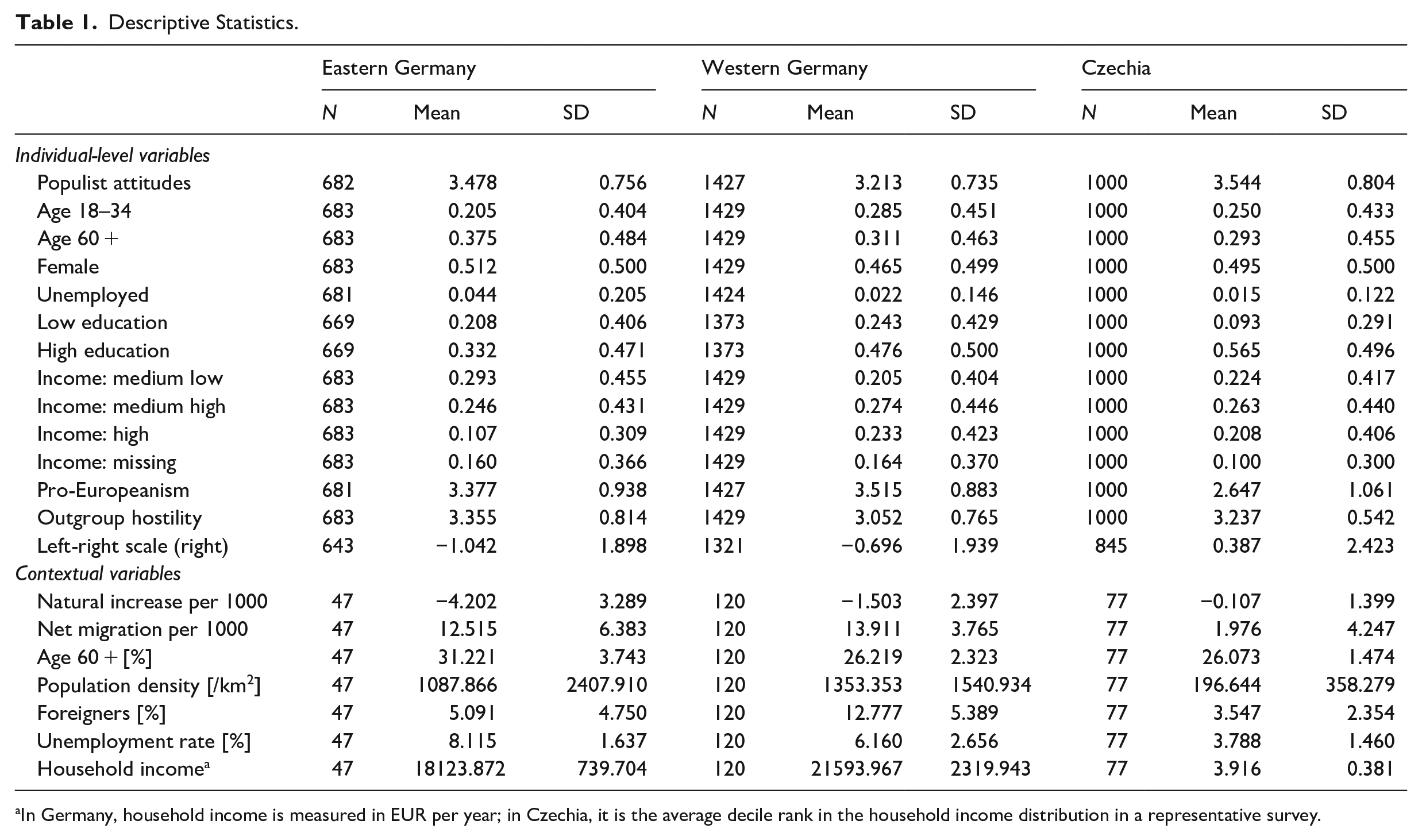
In Germany, household income is measured in EUR per year; in Czechia, it is the average decile rank in the household income distribution in a representative survey.
Statistical Analysis
Data for Czechia, eastern Germany and western Germany was analysed separately as we wish to capture potentially distinct mechanisms of the effects for these three macro-regions. In each of the macro-regions, we fitted a series of multilevel models explaining the respondents’ populist attitudes. The analysis proceeded in two steps.
In the first, we fitted a multilevel linear regression with district-specific random effects that included all individual-level and contextual variables. The presence of the context effect is tested by means of joint significance among the contextual variables. In other words, we test whether context matters as such. Inference about the effect of each of the contextual variables, however, is complicated by the presence of strong multicollinearity among contextual variables, manifested in large variance inflation factors (VIFs).
Therefore, in the second step of the analysis, we attempt to carefully and precisely identify the factors responsible for the effect of context on populist attitudes. We considered (and gradually tried) the three following methods of dealing with the multicollinearity: First, it is possible to keep only a reduced set of contextual variables. However, this leads to arbitrary selectivity and the inability to test all relevant mechanisms.
The second option is to use a principal component analysis (PCA). The problem with this option is that it yields, for the three regions under study, a great number of components with distinctive structures that are very difficult to interpret. 5 In addition, these components combine variables irrespective of their effect on the dependent variable, making it challenging to interpret what variable in the given component causes the effect. Moreover, concerns have been raised about the overall efficiency of principal components regression (Artigue and Smith, 2019; Hadi and Ling, 1998).
Therefore, we used a third option – an all-subsets-regression approach that identifies a smaller set of best performing predictors. The strategy of comparing the performance of models with all possible subsets of regressors dates back to Hocking and Leslie (1967). It is often used, for example, in ecology and wildlife biology (Arnold, 2010) and has proven useful for tackling multicollinearity issues (Jadhav et al., 2014). Our application consists of running regressions with all possible subsets of our seven contextual variables (i.e. 27 = 128 different models in total for each country and dependent variable) and then keeping only the variables contained in the model with the best (smallest) AICc value (Anderson and Burnham, 2002).
Empirical Findings
To account for the hierarchical (or multilevel) nature of the dataset, we include random intercepts at the level of individual districts and use cluster-robust standard errors clustered at the same level. Populist attitudes are modelled as a continuous variable, that is, using a mixed-effects linear regression model. The empirical analysis is organized based on the two countries and three macro-regions of interest.
Effect of Context on Populist Attitudes
The overall results are presented in Table 2. For each macro-region, there are two models. The first model includes all contextual variables. We test for the combined statistical significance of all contextual variables which are not affected by multicollinearity. The second model was computed based on the all-subsets-regression approach for the contextual variables. The method described above yields a selection of contextual variables that maximize the fit.
Mixed-Effects Regression Results Explaining Populist Attitudes.
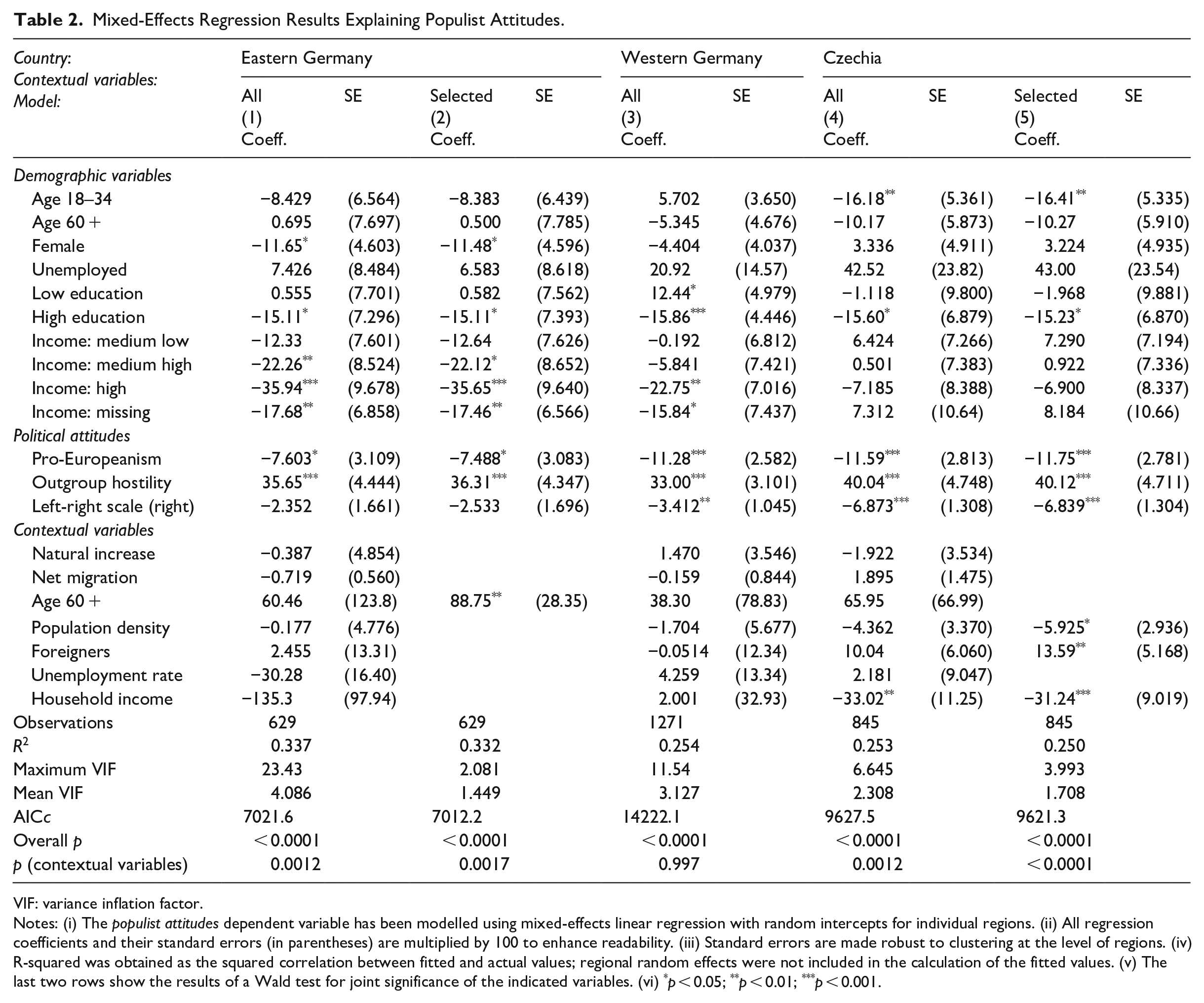
VIF: variance inflation factor.
Notes: (i) The populist attitudes dependent variable has been modelled using mixed-effects linear regression with random intercepts for individual regions. (ii) All regression coefficients and their standard errors (in parentheses) are multiplied by 100 to enhance readability. (iii) Standard errors are made robust to clustering at the level of regions. (iv) R-squared was obtained as the squared correlation between fitted and actual values; regional random effects were not included in the calculation of the fitted values. (v) The last two rows show the results of a Wald test for joint significance of the indicated variables. (vi) *p < 0.05; **p < 0.01; ***p < 0.001.
The first two models show the case of eastern Germany. In the first, the context, based on the combined test, is significant. This means that characteristics of the residential context influence populist attitudes on the top of individual factors. The second model shows that the variable measuring the proportion of those aged 60 and older is significant. In the first model, this variable is insignificant because it is strongly correlated with a low natural increase (correlation is 0.95), both of these variables having a VIF of about 20. 6 In this case, both indicators measure the same mechanism. In the case of eastern Germany, it is thus a low level of new births and ageing populations that contribute most significantly to populist attitudes. This supports H2 in the case of eastern Germany.
As for the individual level variables, men, the unemployed and those without a university education are more likely to hold populist attitudes. There is also a statistically significant effect of EU attitudes and hostility to outgroups. Since the coefficients are logged, interpretation of the substantive effects is not straightforward.
Figure 1 helps compare the effect sizes by showing how the predicted values of populist attitudes (5-point scale) change if the value of an independent variable moves from its sample minimum to the maximum, holding other variables constant. For brevity, we will refer to this measure as the maximum effect of a variable. For example, in the case of age 60 +, the maximum effect amounts to 0.4 and captures the difference in populist attitudes between the oldest and the youngest regions, after the differences in the remaining variables have been netted out. This is a stronger effect compared with the maximum effect of individual-level education (about 0.2), similar as the maximum effect of pro-EU attitudes (0.3), and weaker than the maximum effect of outgroup hostility (1.4). The contextual effect of the age 60 + variable seems thus reasonably strong.
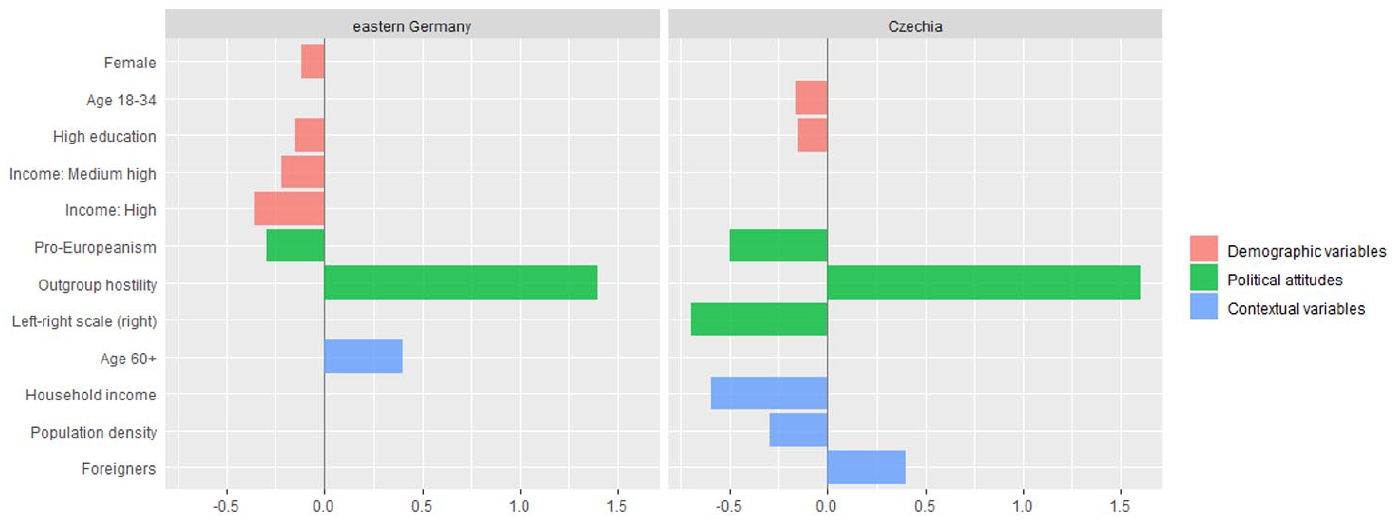
Size of Significant Effects.
Model 3 shows the results for western Germany. The data does not display a significant result for the overall effect of context, and therefore, the all-subset-regression approach was not used. Due to this, we did not identify any significant effects of context on populist attitudes.
Finally, the last two models show the results for Czechia. Model 5 shows that context has a significant effect. The final model shows that three variables were selected by the procedure: low levels of income, low population density and a larger share of foreigners. The maximum sizes of these contextual effects are (on a scale from 1 to 5) as follows: 0.3 for population density, 0.4 for foreigners and 0.6 for income levels. The effects of the individual-level variables work in the predicted direction. Older respondents, the unemployed and those without a university education are more likely to hold populist attitudes. In terms of attitudes, left-wing respondents, Eurosceptics and those who have negative attitudes to outgroups are more likely to have populist attitudes.
The maximum effect of contextual income levels, the strongest contextual predictor, is stronger than the individual effect of age (0.2), education (0.2) and Euroscepticism (0.5). As in eastern Germany, it is (individual-level) outgroup hostility that has the strongest maximum effect (1.6).
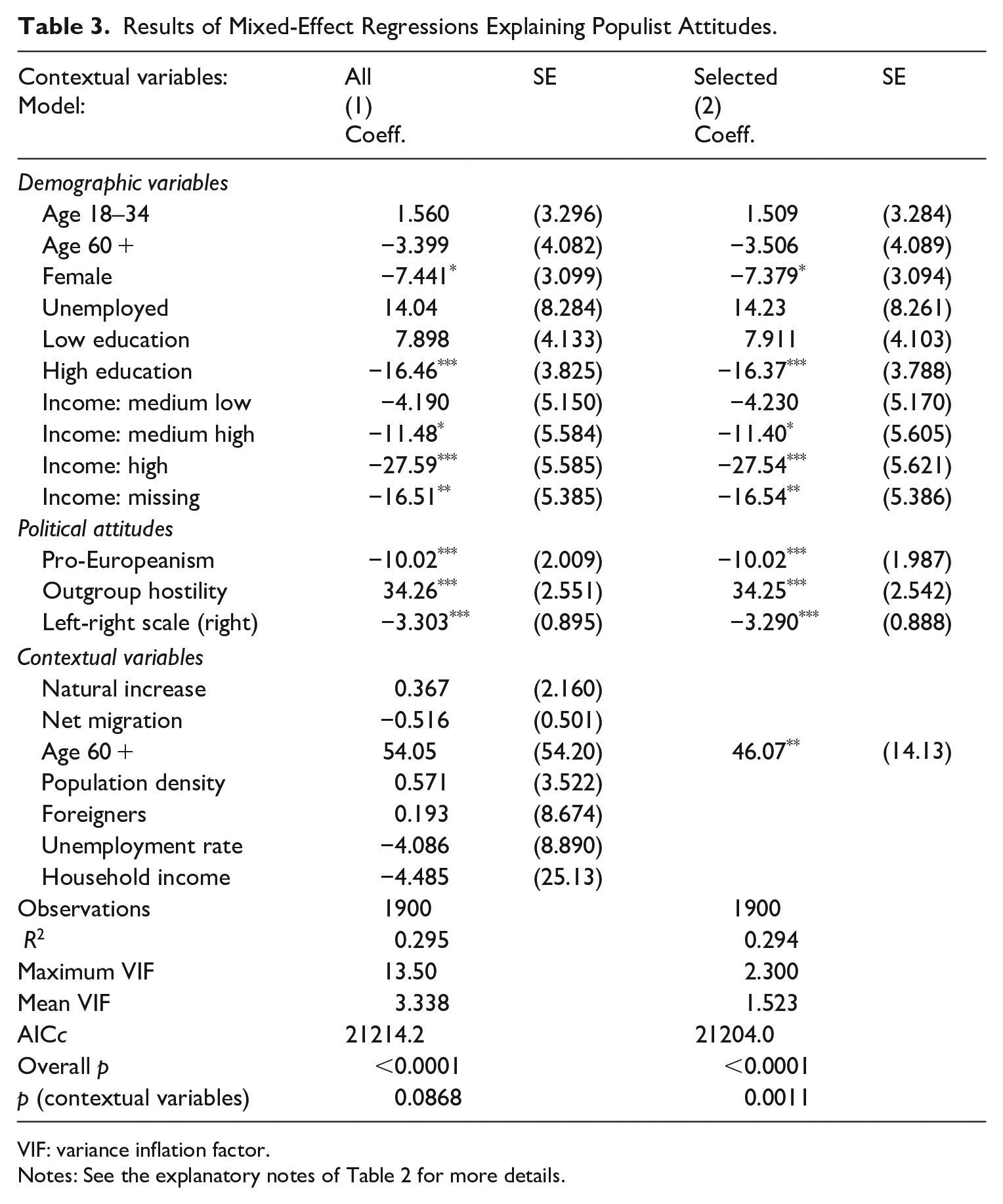
These results show that in eastern Germany residential context marked by ageing populations (and low natural increase) contributes significantly to populist attitudes more so, and irrespective of, individual-level variables. In other words, two identical individuals in terms of age, education, income, attitudes to the European Union and so on will be, to differing degrees, populist depending on the region in which they live. Demographic decline was the regional characteristic identified as statistically significant. In the final step of the analysis, we also ran the regression model on the whole of Germany (results in Appendix 1, Table 3) and not separately, on the eastern and western parts, as in the previous step. The results indicate the same pattern, with the age 60 + variable being significant. However, the effect is slightly weaker compared with the model done only on eastern Germany. This shows there are disparities within eastern Germany, where living in contexts with demographic decline increases populist attitudes. However, this mechanism also plays out within the whole of the country, probably due to the fact that the eastern regions have been more strongly hit by demographic decline compared with the western ones.
In Czechia, the strongest (contextual) predictor is income level. People living in regions lagging behind economically are more likely to hold populist attitudes. Two additional contextual variables were also significant in the country: high share of foreigners and low population density. Both characteristics correspond to the poor and struggling border regions of Czechia. These regions have a peripheral location characterized by low population density and, at the same time, an above-average number of foreigners live in these areas. This is explained by the fact that the regions are host to industrial enterprises, usually linked to the automotive industry and which employ foreigners from eastern EU countries (Romania) and non-EU countries (including the Balkans countries, the Ukraine and even Mongolia) for unskilled and low-paid work.
As mentioned previously, we did not identify any contextual variable as significant in western Germany. Since our analysis is mainly driven by the goal of analysing regional peripheralization, this shows that, within western Germany, these regional disparities may not be pronounced enough to contribute to populist attitudes. However, we emphasize that these results do not rule out the possibility that other contextual factors, which we do not measure, could play a role. For example, an analysis focussing specifically on ethnic composition and using small spatial units could identify the contextual effect of ethnicity. Or ‘halo effect’ (as in the French case, see Evans and Ivaldi, 2020) could be present in this case. Our analysis is not designed for the identification of such a mechanism, so we cannot rule it out.
Discussion and Conclusions
This article shows that living in peripheral regions increases the likelihood that people will have populist attitudes. However, the nature of peripheries may vary across countries. Our analysis shows that in Germany demographic disparities are the strongest predictor, whereas in Czechia it is the standard of living measured by income level. The two mechanisms discovered are consistent with the nature of regional peripheralization in both macro-regions.
We argue that the concentration of people with populist attitudes in certain regions cannot be explained exclusively by reference to individual characteristics. A region does not become a hotbed for populism only because it contains numerous people with socioeconomic and attitudinal characteristics that elicit populist worldviews, unfavourable contextual conditions in these regions push all individuals to adopt populist attitudes as well.
In eastern Germany, the results show that populist attitudes are driven by regional contexts with a low natural increase (birth rate) and ageing populations. This finding is in line with the work of Salomo (2019), who pointed out that regions (in Thuringia) marked by demographic decline are an ideal breeding ground for individual-level political discontent. It also supports some indirect evidence presented by Weisskircher (2020). Our analysis corroborates this pattern for the whole of eastern Germany and Germany as such. The results thus support the hypothesis emphasizing the general effect of demographic decline.
Our results did not show significant contextual effects for western Germany. In our data, western German patterns of populist attitudes could be explained entirely by individual characteristics. This suggests that some of the results of context effects from previous studies that purely analyse the aggregate data of regional voting patterns may have been driven by regional concentrations of people with individual characteristics driving populism. In addition, it could also point to systematic differences between the drivers of populist vote choices – in particular for PRRPs, the focus of most research thus far – and the factors that influence the emergence of populist attitudes. Finally, it is possible that mechanisms other than regional peripheralization, such as local ethnic composition (Savelkoul et al., 2017), the so-called halo effect (see Evans and Ivaldi, 2020) or others, drive these contextual effects. Our analysis is not appropriate for examining these (and other possible) hypotheses. Further research is needed to explore these themes in more detail.
The results for Czechia mainly point to regions with low levels of income, which have the strongest effect. Incomes are the lowest on the periphery of the country (the Sudetenland), located in border regions that used to be inhabited by a German minority of about 1.5 million people, expelled in the aftermath of World War II. It is a region that has not recovered economically as well as culturally since. The share of foreigners is above average in this part of Czechia, with a large share of foreigners from non-EU countries working in low-paid industrial jobs. 7 Finally, low population density also coincides with much of this region.
The fact that we have identified the effect of economic and demographic contexts in post-communist regions is consistent with research showing profound developmental differences in these countries between the well performing (usually metropolitan) regions and the rest. The diverging performance of different regions was argued to be much more significant in post-communist countries than in WE countries (Ehrlich et al., 2012: 77).
Finally, we do not argue that unfavourable environmental conditions are the only driver of populist attitudes; there are other individual-level sources, such as left-right positioning, attitudes towards immigrants or attitudes to the European Union. Many people may hold strongly populist values and live in prosperous regions without any hardship that would stem from unfavourable social conditions. The regressions for both post-communist macro-regions (Czechia, eastern Germany) also show that the effect of some individual-level variables, and attitudes to outgroups in particular, is still stronger than the effect of context. Nonetheless, the results presented here show that, holding individual-level variables constant, context does contribute significantly to populist attitudes, at least in post-communist contexts.
The main contribution of our analysis is that we focus on the regional level and show that the process of regional peripheralization increases populist attitudes in selected post-communist regions. Although the presence and nature of the peripheralization process in these regions is well known, we demonstrate that there is a link between this process and populist attitudes. The reason why the regional peripheralization process emerges as significant in post-communist regions may be that regional polarization has occurred relatively quickly here. The emergence of regional disparities and new peripheries was a relatively rapid development, beginning only in the first decade after the fall of the communist regimes. It is, therefore, not surprising that this process can have a major impact on the political attitudes of people living in these regions – people who have witnessed and been influenced by these changes. Finally, our analysis does not only point to the impact of peripheralization, it also emphasizes that the nature of peripheries can vary across countries and across contexts. While we generally expect that demographic and economic factors could play a role in other post-communist regions, we emphasize that it will depend on the exact nature of the process that leads to the creation of (new) peripheries.
Footnotes
Appendix 1
Results of Mixed-Effect Regressions Explaining Populist Attitudes.
| Contextual variables: |
All |
SE | Selected |
SE |
|---|---|---|---|---|
| Demographic variables | ||||
| Age 18–34 | 1.560 | (3.296) | 1.509 | (3.284) |
| Age 60 + | −3.399 | (4.082) | −3.506 | (4.089) |
| Female | −7.441* | (3.099) | −7.379* | (3.094) |
| Unemployed | 14.04 | (8.284) | 14.23 | (8.261) |
| Low education | 7.898 | (4.133) | 7.911 | (4.103) |
| High education | −16.46*** | (3.825) | −16.37*** | (3.788) |
| Income: medium low | −4.190 | (5.150) | −4.230 | (5.170) |
| Income: medium high | −11.48* | (5.584) | −11.40* | (5.605) |
| Income: high | −27.59*** | (5.585) | −27.54*** | (5.621) |
| Income: missing | −16.51** | (5.385) | −16.54** | (5.386) |
| Political attitudes | ||||
| Pro-Europeanism | −10.02*** | (2.009) | −10.02*** | (1.987) |
| Outgroup hostility | 34.26*** | (2.551) | 34.25*** | (2.542) |
| Left-right scale (right) | −3.303*** | (0.895) | −3.290*** | (0.888) |
| Contextual variables | ||||
| Natural increase | 0.367 | (2.160) | ||
| Net migration | −0.516 | (0.501) | ||
| Age 60 + | 54.05 | (54.20) | 46.07** | (14.13) |
| Population density | 0.571 | (3.522) | ||
| Foreigners | 0.193 | (8.674) | ||
| Unemployment rate | −4.086 | (8.890) | ||
| Household income | −4.485 | (25.13) | ||
| Observations | 1900 | 1900 | ||
| R 2 | 0.295 | 0.294 | ||
| Maximum VIF | 13.50 | 2.300 | ||
| Mean VIF | 3.338 | 1.523 | ||
| AICc | 21214.2 | 21204.0 | ||
| Overall p | <0.0001 | <0.0001 | ||
| p (contextual variables) | 0.0868 | 0.0011 | ||
VIF: variance inflation factor.
Notes: See the explanatory notes of Table 2 for more details.
Declaration of Conflicting Interests
The author(s) declared no potential conflicts of interest with respect to the research, authorship and/or publication of this article.
Funding
The author(s) disclosed receipt of the following financial support for the research, authorship and/or publication of this article: Grantová Agentura České Republiky: 19-06841 S.
