




Abstract
Content, messages and the way voters are contacted are all increasingly tailored to the individual. But are voters really contacted in the way they prefer? What actually drives campaign preferences? Who are parties tailoring these preferences to? For the first time, we address this gap in the literature. Our findings suggest that there is considerable heterogeneity in voters’ contact preferences. While some voters prefer not to be contacted, those who do prefer traditional methods (leaflets) and, in some cases, more personalised modes such as doorstep canvassing. Preferences are primarily driven by previous exposure to the mode, political interest, having an extraverted personality and age. We also examine preference ‘matching’ and find that parties are no more likely to ‘match’ a voter’s specific preference if they have contacted them before. Preference contact matching is significantly more likely to be targeted at women, middle-age voters and especially weak or nonpartisans.
Introduction
We now know a great deal about the changing character of campaigning in Britain. Campaigning is multifaceted, increasingly professionalised and managed at the national level through a number of key actors – campaign managers, advisors, speechwriters, communication experts, campaign strategists and political consultants – and jointly coordinated and operationalised with those on the ground. The ground campaign remains integral with input and responsibility for operationalising tactics, targeting and political messaging through a wide variety of campaign tools. From faxes to Facebook, campaigning is changing, but the goals of identifying potential voters, persuading and then mobilising them remain paramount (Arceneaux and Nickerson, 2009; Bhatti et al, 2017; Cutts and Johnston, 2015; Fisher et al., 2016b, 2019). We also know that leafleting (Fieldhouse et al., 2014; Townsley, 2018), telephone calls (Foos and de Rooij, 2017; John and Brannan, 2008) and door-to-door canvassing (Townsley, 2018) have been found to boost turnout in British elections, despite one study showing null effects overall and conditional effects by party identification (Foos and John, 2016). Moreover, it has been established that campaigning in Britain is more intense in close contests and that activism outside the official campaign period can prove fruitful. Campaigning can also generate spillover effects in neighbouring electoral arenas, and is most effective when the level of existing support is neither very low nor very high (Fisher et al., 2011, 2019).
In more recent British elections, campaigning has been characterised by the growth of digital technology and Big Data science techniques as campaign strategists seek to build latent voter profiles and determine persuadable contacts. Messages are increasingly micro-targeted with the actual content and frequency of contact both tailored to suit the individual recipient. Simply put, we know what parties do in British elections and what works. But do these correspond with what voters want? Despite the large scholarly literature on campaigning, we know surprisingly little about which forms of contact voters themselves prefer. We also know little about how successful parties are at contacting voters in the way they prefer, and what factors predict whether or not a voter gets the type of contact they want.
Here, we address this gap. Using 2016 Welsh Election Study (WES) data, we look, for the first time, at who prefers to be contacted, how and why. We examine whether these preferences correspond with what parties are actually doing to persuade and mobilise voters, and the factors that predict whether contact matches preferences. Our findings suggest that more than 60% of WES respondents prefer to be contacted by a particular mode, and that these preferences are primarily predicted by socio-demographics, levels of political interest, and mere exposure. We also find that parties are less successful when it comes to contacting voters using their preferred mode. However, parties tailor contact preferences to certain groups – women and middle-age voters – and those who exhibit weak or no partisan attachment. Put simply, those who are contacted via their preferred mode are significantly more likely to be undecided and less attached than strong identifiers. We find little evidence that being contacted previously or the electoral competitiveness of the seat has any impact.
Campaign Contact Preferences: Growing Evidence?
British elections are becoming more volatile. While party loyalty remains important, switching and abstention are increasingly common (Fieldhouse et al., 2020). As a result, campaigning is not only more vital but also more complex than ever. While mobilising partisans remains an integral part of the local campaign, parties also seek to identify potential switchers before and during the election campaign. Messaging is then adapted to either stem haemorrhaging support or persuade potential voters to switch sides. Geography continues to matter both in the selection of target seats and within constituencies through neighbourhood or district targeting to maximise support. Yet, parties increasingly target specific groups of voters within and across key seats who they feel could determine the outcome. Such micro-targeting is now a key part of the professionalised, multifaceted campaign covering fundraising, messaging and, crucially, which voters are contacted and how (Gerber et al., 2011; Hassell and Monson, 2014; Hillygus and Shields, 2008; Issenberg, 2012; Lovett and Peress, 2015; Monson and Oliphant, 2007).
With the battle to secure different groups of voters ever more intensive and fundamental to success, the way in which potential voters are contacted and targeted has become just as important. The use of different social media platforms by campaigns and rapid advances in technology has meant that parties theoretically have a wide variety of modes at their disposal. However, in practice, parties are increasingly hamstrung by resource and infrastructure issues, particularly at the local level. The capacity to run traditional grassroots, mode-led campaigning, for instance, varies considerably within and between parties, and by seat status. Given such resource constraints, it has become as much a practical necessity as a means to gain a competitive advantage to ensure that contact reaches the right voter. Getting the mode right is now a critical part of this process. To ensure both efficiency and effectiveness, there is growing evidence in the British context that campaigns are increasingly tailoring to certain groups the modes of contact through which they try to reach voters. The UK Conservative Party, for instance, utilised Facebook in the 2015 general election to target older voters who used the platform to communicate with their grandchildren (Fisher et al., 2016a). In 2017, Labour-supporting group Momentum combined text messaging and canvassing to mobilise young, urban voters (Fisher, 2017).
Parties increasingly recognise that to successfully engage with the electorate, it is important that voters are contacted in ways that suit them and their work–life demands. As such, voters themselves are likely to hold contact preferences that are tailored to their individual circumstances. Yet the literature remains fairly vague. Parties have found, for instance, that middle-aged voters are more amenable to communication by email (Fisher et al., 2016a). While it is no secret that younger voters are more likely to access political information through social media and generally be more responsive to short videos or audio rather than printed literature, it is clear that some younger voters will prefer different social media platforms to others. Facebook, for example, is increasingly a medium for middle-aged voters. Similarly, older voters may place more value on personal interactions such as phone calls or canvass visits, while younger voters – whose formative years coincided with the rapid expansion of social media – may reject face-to-face activities as intrusive. Of course, these preferences may, in turn, vary by socio-demographics, strength of partisanship and longevity of residence or sense of local belonging alongside numerous other individual and area-level factors. Put simply, while parties increasingly consider how to tailor specific campaign modes, political science research has largely ignored which forms of contact different types of voters prefer and why. As a consequence, little is known about whether there are possible ‘contact deficits’ in particular campaign modes, wherein demand for modes of contact (from voters) exceeds supply (from parties), or vice versa. And to whom parties are tailoring their mode preferences too.
Campaign Preferences and Conditioning Campaign Effects: Hypotheses
Why would one respondent prefer not to be contacted, while another opts for a canvass visit or an email? After detailing the demand for contact among the electorate and which techniques are most preferred, the first part of this article seeks to explain what predicts these preferences. Based on existing theory, we have four broad expectations.
We would expect electors’ preference for campaign contact to stem from a desire for further information about the election, the candidates and the issues at stake. Those who would seek further information about the election are likely to be interested in politics more widely – and vice versa. It is reasonable, therefore, to anticipate that preferences for contact would be higher among those who are interested in politics generally. Interest is a strong and consistent predictor of ‘political engagement, participation, and other types of political behaviour’ (Moeller et al., 2018: 1054). Existing research suggests that individuals are less likely to vote if they rarely follow politics (Denny and Doyle, 2008; Hadjar and Beck, 2010; Verba et al., 1995). Politically interested individuals are also more likely to discuss and follow politics closely (Sheerin, 2008), although the relationship between political discussion and interest in the election campaign is likely to be reciprocal and influenced by a respondents’ interest in political issues or topics (Huckfeldt, 2001; McClurg, 2003). Given the importance of political interest in predicting participatory behaviour, it is highly likely that interest will also account for whether or not voters want to interact with political campaigns. We expect, therefore, more politically interested individuals to be more likely to desire contact from parties at election time, to, for example, obtain information about the upcoming election. However, while political interest is likely to predict preferences for contact as opposed to no contact, why might some respondents opt for certain forms of contact over others? In truth, there is no clear rationale for why political interest would explain preferences for email as opposed to leaflets, or canvassing as opposed to telephone calls. It is possible that politically interested citizens may well prefer more personalised interaction with the local candidate or party canvassers perhaps to obtain answers to more detailed questions than the broad-based information provided by other tools such as leaflets or emails. However, it is also probable that politically interested electors will use other sources to gather information beyond that of just political parties. As a consequence, we propose a generic first hypothesis that is not specific to the mode of contact:
H1: More politically interested respondents will prefer all forms of campaign contact (and not specific modes) to not being contacted.
In addition to political interest, we also expect previous exposure to have some effect in terms of determining which modes of contact people prefer in particular. Our second theoretical expectation explaining contact preferences is drawn from the social psychology field and the study of preference formation. ‘Mere-exposure’ is a psychological mechanism developed by Zajonc (1968) whereby people develop preferences for certain objects or things simply because they are familiar to them. When asked to express preferences, individuals ‘canvass their memories for information . . . and use what they find to form preferences’ (Druckman and Lupia, 2000: 8). This is known as a memory-based process (Lodge et al., 1990). Druckman and Lupia (2000: 4) note that ‘the extent to which people hold preferences over types of objects depends on their prior experiences with related objects’. Zajonc (2001) speculates that mere exposure increases familiarity and signals that the stimulus is safe and benign (Kam and Zechmeister, 2013), which, in turn, leads to the formation of favourable preferences. Broadly speaking, there is strong evidence in support of mere exposure theory beyond the field of psychology. In consumer marketing, consumers are often more likely to consider purchasing a brand’s product if they have been previously exposed to the brand (Coates et al., 2004; Holden and Vanhuele, 1999). Evidence has also been found in political science in the process of evaluating candidates (Enelow and Hinich, 1984; Fishbein and Ajzen, 1975; Zaller and Feldman, 1992). In their quasi-experiment, Kam and Zechmeister (2013), for instance, test the effect of mere exposure to candidates’ names on their popularity among voters and find support for mere exposure theory. A logical expansion of mere exposure theory is that its effects will be stronger in an environment where the subject holds relatively weak prior attitudes to call upon when asked to express a preference. For instance, one can reasonably expect that voters do not hold strong prior attitudes regarding whether they prefer, say, a leaflet or a canvass visit from a political party. Applying this theory to the process of developing preferences for different forms of campaign contact suggests that previous exposure to a particular type of campaigning will be associated with preferences towards it. We therefore generate a second hypothesis:
H2: Preferences for a mode of campaign contact will be higher among those who have previously been exposed to that particular mode of contact.
Alongside mere exposure, it is also possible that citizens’ campaign mode preference may be associated with personality traits. Existing research – predominantly using the Big Five traits – suggests that personality has a direct effect on political participation (Denny and Doyle, 2008; Gerber et al., 2011; Mondak, 2010; Mondak and Halperin, 2008; Mondak et al., 2010), party preferences and political choice (Caprara et al., 2006; Gerber et al., 2010) and political discussion (Hibbing et al., 2011). A burgeoning literature also examines the effects of Big Five personality traits on political attitudes and liberal, left-wing or conservative leanings across different policy domains (Carney et al., 2008; Fatke, 2017; Gerber et al., 2011; Osborne and Sibley, 2012). Aside from assessing candidate traits (Catellani and Alberici, 2012; Fridkin and Kenney, 2011) and campaign content (Nai, 2019), the use of Big Data and other digital technologies where the psychological (including personality) profiles of voters are derived for micro-targeting political messages has become increasingly common in political campaigning (Krotzek, 2019; Roemmele and Gibson, 2020). From the voters’ perspective, it is certainly possible that personality traits could predict campaign mode preference. For instance, extraversion which includes traits such sociability, assertiveness and positive emotionality suggests a preference for more personalised contact such as doorstep canvassing. Electors with lower emotional stability are likely to prefer more impersonal contact. Similarly, those with higher levels of conscientiousness, who think before acting, plan and follow norms and rules, may not exhibit any significant campaign contact preferences as they gather information methodically and in a planned way from the sources available. Having openness to experience may suggest a preference for new, innovative mediums of contact, while those who exhibit pro-social and communal orientation and are sympathetic – agreeableness – could also be more prone to preferring traditional forms of campaigning. Given the impact of personality traits more generally on political behaviour, it would be surprising if this did not translate to campaign preferences. We therefore generate the following hypothesis:
H3: Personality traits will have a direct impact on campaign mode preferences even after accounting for other variables.
Our final hypothesis reflects the possible importance of socio-demographic factors on campaign mode preference. Earlier we noted that age may predict preferences with older electors more likely to favour traditional methods of contact, particularly those that involve personal interaction. Of course, controlling for political interest and mere exposure may somewhat dilute such relationships. However, other mechanisms may predict preferences for techniques that can be characterised as ‘traditional’ such as leaflets and doorstep canvassing as opposed to ‘modern’, such as telephone calls (Fisher and Denver, 2009). For instance, older electors may have a stronger sense of local belonging and embedded network relationships built over time through membership of local organisations and groups. It stands to reason that constituency-focussed literature, candidate qualities and local issues will be more salient; hence, information gathered through traditional forms of contact may well be preferred. For younger voters and those with a transient sense of belonging, work and lifestyle considerations may necessitate preferences for more flexible mediums of contact, which can be accessed at times and on technological platforms that fit around the individual. Similarly, changing work patterns mean that those in full- or part-time employment may prefer less intrusive forms of contact such as leafleting or email rather than direct interaction.
H4: Preferences for campaign modes of contact will significantly vary by individual socio-demographic characteristics such as age and employment status.
While some voters are getting the type of contact they want, many are not. In the second part of the article, we seek to address these questions. What factors predict whether or not voters receive the mode of contact they prefer? Who are parties tailoring campaign mode preferences to?
On the one hand, given existing theory on who votes, one might expect parties to contact older, more educated, politically interested voters who are strong identifiers (Blais and Daoust, 2020; Leighley and Nagler, 2014; Prior, 2019). With growing numbers of undecided voters, parties’ campaigning is increasingly tailored to identifying and persuading possible voters to support them (Bailey et al., 2016; Foos, 2018; Gerber et al., 2011). Yet the ‘bread and butter’ of mobilising existing supporters remains paramount and often holds the key to whether a party is successful or not. As a consequence, it is likely that those who are contacted with their mode preference would have been contacted before and are more likely to be in competitive seats. During campaigns, parties use party voter software that collates information about whether and how an elector has been contacted alongside current and historic vote preferences, prior turnout data and general socio-demographics (Hersh, 2015; Panagopoulos, 2017). In competitive seats, party agents and local organisers in collaboration with national party headquarters are consistently updating the local voter database – for new voters but also where parties undertake non-election campaign work or to collate data from second-order elections (Cutts, 2006; Cutts et al., 2012) – in preparation for the ensuing pre-election and election campaign period. Often party campaign headquarters will make local constituency funding and targeting decisions on the level of pre-election activism and preparation with the maintenance of an updated voter database part of this key criterion. Even if the margin at the previous election looks relatively hopeful on paper, a sustained period of local inactivity and poor campaign preparation can result in resources being sent elsewhere (Fisher and Denver, 2009; Fisher et al., 2011). It therefore stands to reason that a highly organised, ruthlessly efficient local campaign machine would use such prior contact information to maximise support and tailor resources in an effective manner.
On the other hand, parties know that older voters and those who identify strongly with a party are significantly more likely to be engaged and possess powerful normative reasons for voting. Parties therefore may be primarily concerned about contacting these voters rather than tailoring the mode preference to suit them. Similarly, it is possible that such voters just want to be contacted rather than prioritising particular modes over others. Alternatively, as noted above, younger respondents and those in full-time work are likely to have far more time constraints. Less partisan respondents are generally more undecided and less committed to politics. Alongside younger people, women are more likely to state that they are undecided in their vote choice before elections (Green and Prosser, 2018). For parties seeking to persuade and then mobilise these voters, they know that it is not about contacting them but making sure they compute and interact with the contact. Simply sending a leaflet may not register while doorstep canvassing becomes redundant if the voter is more likely not to be there. Gaining the attention of undecided voters is vital and parties’ ability to tailor the right mode of contact is a crucial weapon in engaging and perhaps persuading the respondent to support them.
H5a: Parties are significantly more likely to tailor campaign mode preferences to older, educated voters who are strong identifiers.
H5b: Parties are significantly more likely to tailor campaign mode preferences to younger voters, women and more generally those who undecided and have weak or no partisan attachment.
H6: Parties’ ability to tailor campaign mode preferences will be dependent on prior contact and the electoral competitiveness of the seat.
Data and Methods
To explore the attitudes of voters towards different campaign activities – and the success parties have at satisfying voters’ preferences – we use data from the 2016 WES. The 2016 WES is a three-wave representative panel survey (pre-election – March; during the campaign – April; post-election – May) examining political attitudes and political behaviour in the 2016 National Assembly Election in Wales (known as the Senedd election). 1 Each wave consists of around 3000 respondents. The sample was Internet-based, with fieldwork being carried out by YouGov. Alongside the staple election study questions are standard party contact and mode questions as well as a survey question asking how voters would prefer to be contacted by parties at election time. The preference question featured in the pre-election wave (Wave 1) of the survey and is stated as follows: Please rank in order of preference the three ways you would most prefer to be contacted by a party during an election campaign? (If you prefer not to be contacted, or if you wish to answer Don’t Know, please choose that option only): Telephone call; Leaflets; A personal letter delivered to your home; A visit to your home; Contact in the street; Email; Twitter; Facebook; Any other social network; Text Message (SMS); I prefer not to be contacted by parties during an election. 2 This survey question represents, to the best of our knowledge, the first time that voters have been asked questions on how they want – or do not want – to be contacted by political parties.
WES data shows that over half (51%) of respondents reported being contacted in at least one way by at least one political party during the 2016 election campaign. By far the most common form of contact was leaflets (36%). Telephone calls (8%), home visits by canvassers (4%) and personal letters (2%) were also reported by voters. Fewer than 2% of electors were contacted by either email or social media platforms such as Twitter or Facebook. But what forms of campaign contact do voters want?
Figure 1 shows the proportion of respondents who ranked each activity as their most preferred way of being contacted by political parties in 2016. While approximately one-third (34%) of respondents did not want to be contacted, the majority of electors expressed a preference for some form of contact. Interestingly, the WES reveals that there is significant variation in how voters want to be contacted. Leaflets are by far the most popular mode of contact – preferred by 31% of respondents. This is followed by email (11%), a visit at home (i.e. canvassing) (11%), and letters (9%). Telephone calls and street visits, as well as e-campaign modes such as text messages (SMS) and social media are the least popular modes of contact. Simply put, the data suggest that there remains a strong demand among electors to be contacted by traditional campaign activities such as leaflets and canvassing. The preferences for emails and target letters indicate a less intrusive but more personalised form of contact that serves the dual goal of fitting in with work–life demands and not being overly time consuming. Nonetheless, a significant number of electors do prefer personal interaction with potential candidates who are standing for office. Impersonal methods such as telephoning and various forms of e-campaign contact (e.g. Twitter, Facebook, SMS) are not the top preference of contact for many. The latter is chosen more often by respondents as one of their top 3 preferences, but with younger people more likely to select ‘no contact’ it is not surprising that there are few preferences for social media modes of campaigning.
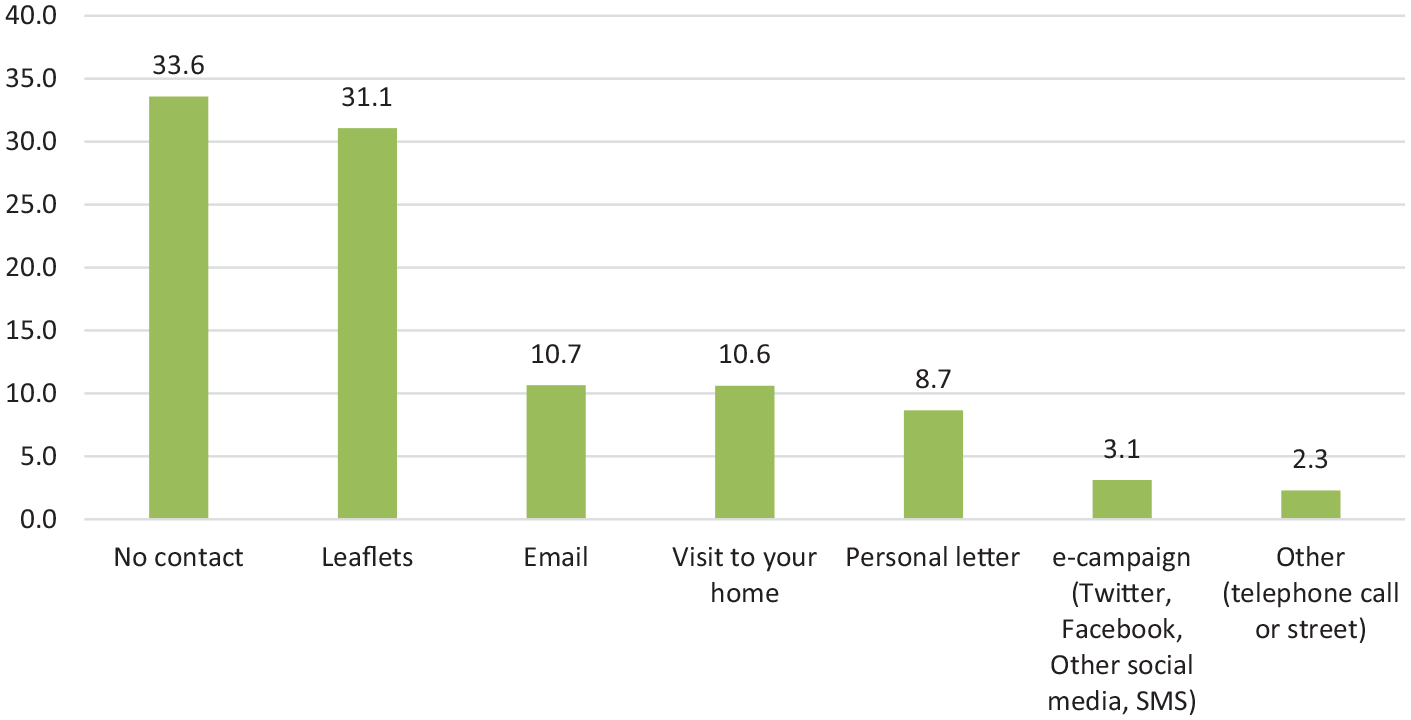
Voters’ Preferred Modes of Contact in the 2016 Senedd Election.
Modelling Campaign Preferences
So, what actually predicts campaign preferences? To address this question, we use the nominal variable preferences to measure which form of campaign contact the respondent prefers (including preference for no contact). Respondents chose from a list of 11 options, representing a wide variety of campaign modes as well as an option for ‘prefer no contact’. For the purposes of simplicity, we grouped together similar modes of contact and derived the following categorical variable: no contact, leaflet or letter, canvass visit, email or e-campaign, and other (including telephone call and contact in the street). Given the five-category structure of the dependent variable (preferences), we run a multinomial regression model, with those who were contacted by leaflet or letter as the base category. To test our hypotheses, we include respondents’ age, employment status (full and part time combined versus not in work), political interest and previous exposure. 3 The latter is a categorical variable derived from a series of pre-campaign questions asking if and how respondents had been recently contacted by political parties. To address whether personality traits influence mode preferences, we use the well-established 10-item measure (Ten-Item Personality Inventory (TIPI)) of the Big Five personality dimensions – two items for each of the five dimensions with each item rated on a 7-point scale (Gosling et al., 2003). 4 Finally, we include a number of socio-demographic control variables – sex, class, whether the respondent has a degree or not – and political predictors such as party identification and turnout in the 2015 general election.
The results of the multinomial logistic regression are shown in Table 1. Taking each hypothesis in turn, it is immediately clear that political interest has a significant positive effect on preferences for all modes of campaign contact except e-campaign when compared against leaflets and letters. Unsurprisingly, those who preferred no contact were significantly more likely to be politically uninterested. Put simply, the more politically interested the respondent, the more likely they were to prefer a canvass visit, a leaflet and other forms of campaign contact such as telephoning.
Multinomial Logit Model of Campaign Preferences.
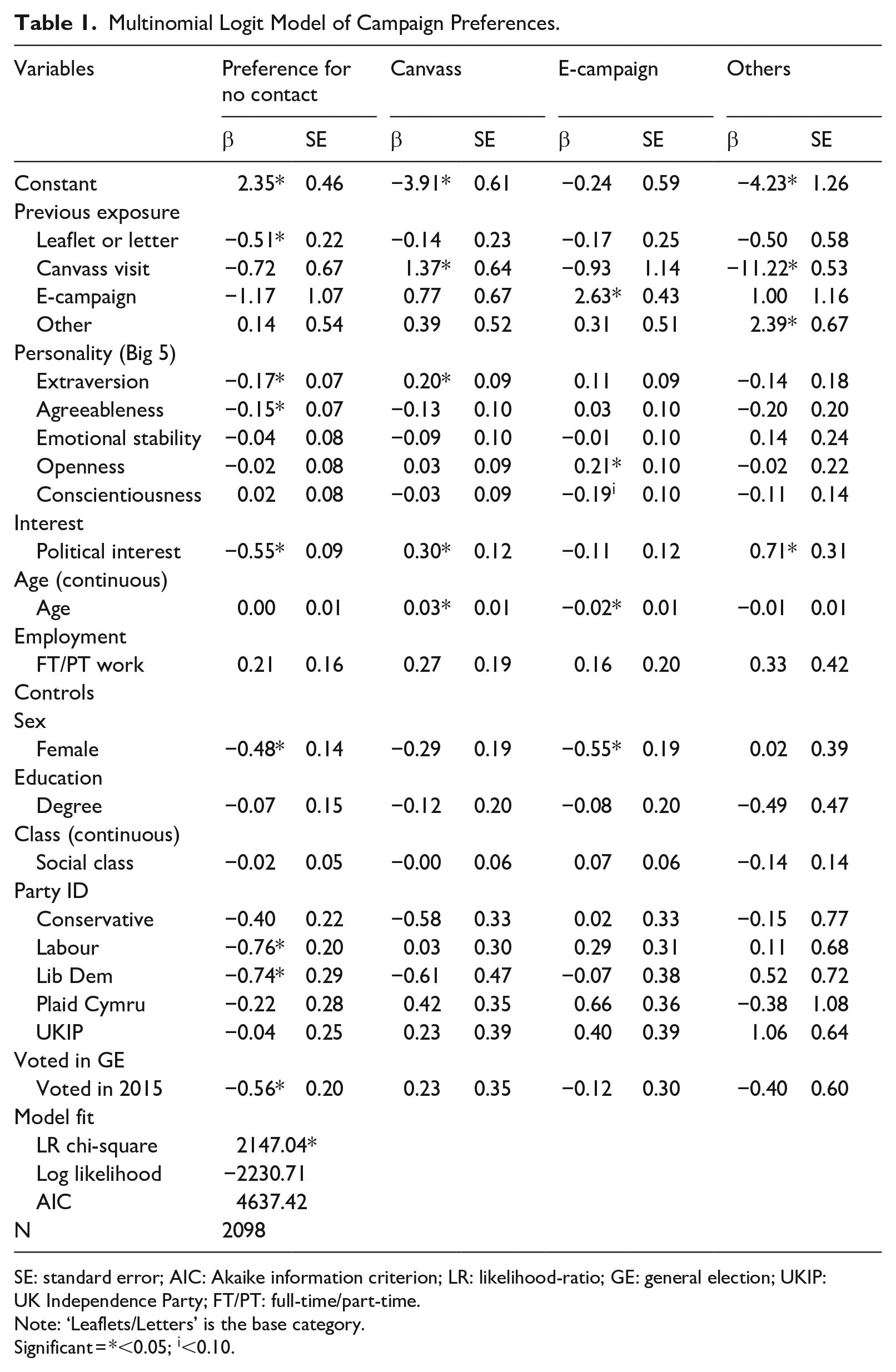
SE: standard error; AIC: Akaike information criterion; LR: likelihood-ratio; GE: general election; UKIP: UK Independence Party; FT/PT: full-time/part-time.
Note: ‘Leaflets/Letters’ is the base category.
Significant = *<0.05; ⁱ<0.10.
To illustrate this relationship, Figure 2 shows the predicted probability plots of preferences for each mode of campaign contact and no contact by levels of political interest, controlling for all other variables. Higher levels of political interest predict preferences especially for leaflets or letters (top-left) and canvass visits (top-right) and marginally for other forms of campaigning (bottom-right). As a consequence, H1 is predominantly met.
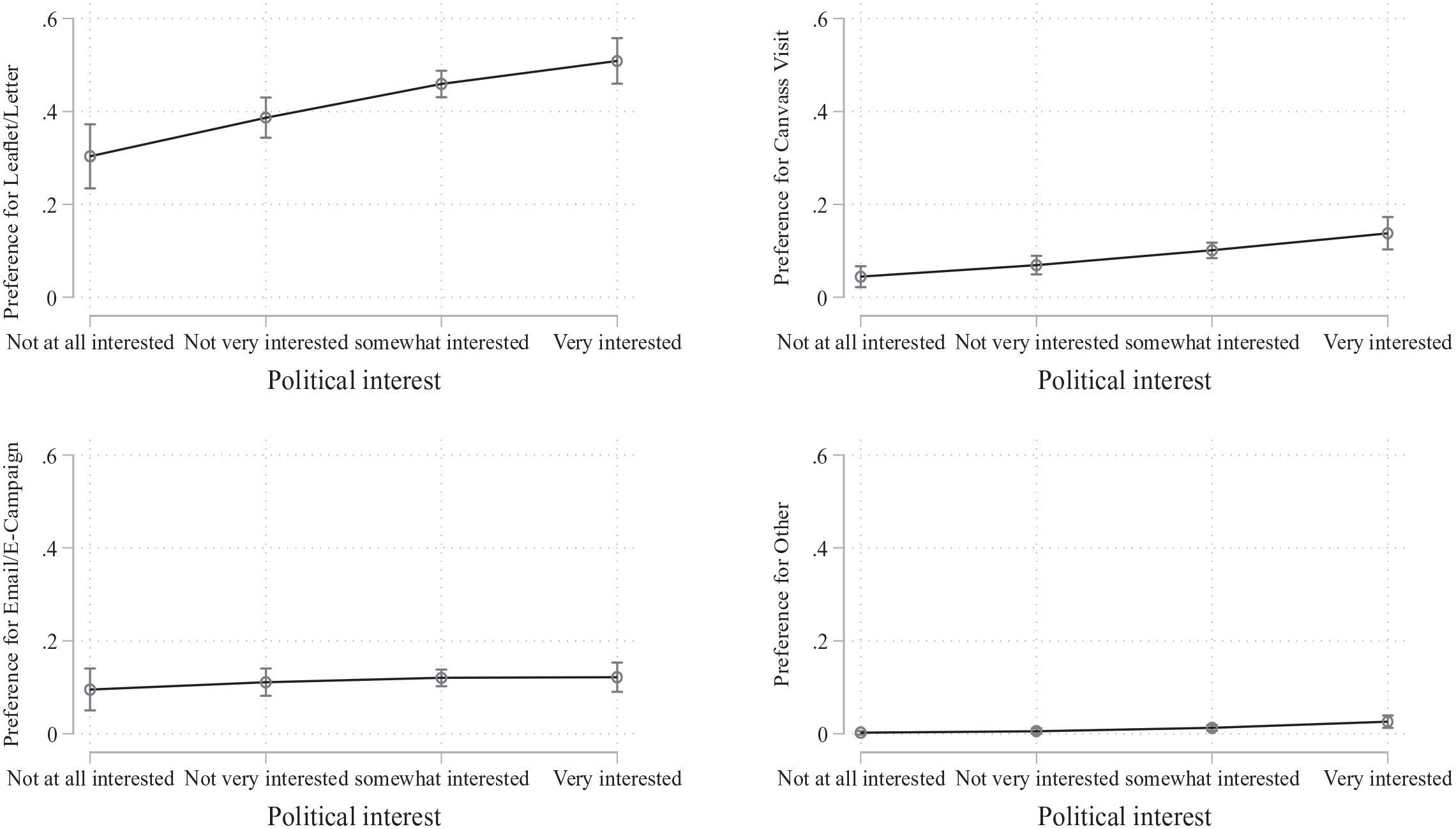
Predicted Probabilities of Contact Preferences by Political Interest.
A similar pattern also emerges for previous exposure. Generally speaking, there is clear evidence that previous exposure to a mode of campaign contact increases the likelihood of stating a preference for it. In other words, individuals appear to prefer what they know. For example, those who were previously canvassed were significantly more likely to prefer being canvassed, holding all other variables constant. Again, we can visualise this relationship using predicted probabilities of preferences for each form of contact by previous exposure to different forms of contact (see Figure 3). Previous exposure to (a) leaflets or letters (top-left), (b) canvass visits (top-right) and (c) email or e-campaigning (bottom-left) significantly predict preferences for leaflets or letters, canvass visits, and email or e-campaigning, respectively (H2). The results are particularly striking for e-campaigning, as previous exposure to emails or social media contact such as Facebook or Twitter substantially increases the likelihood of stating a preference for them.
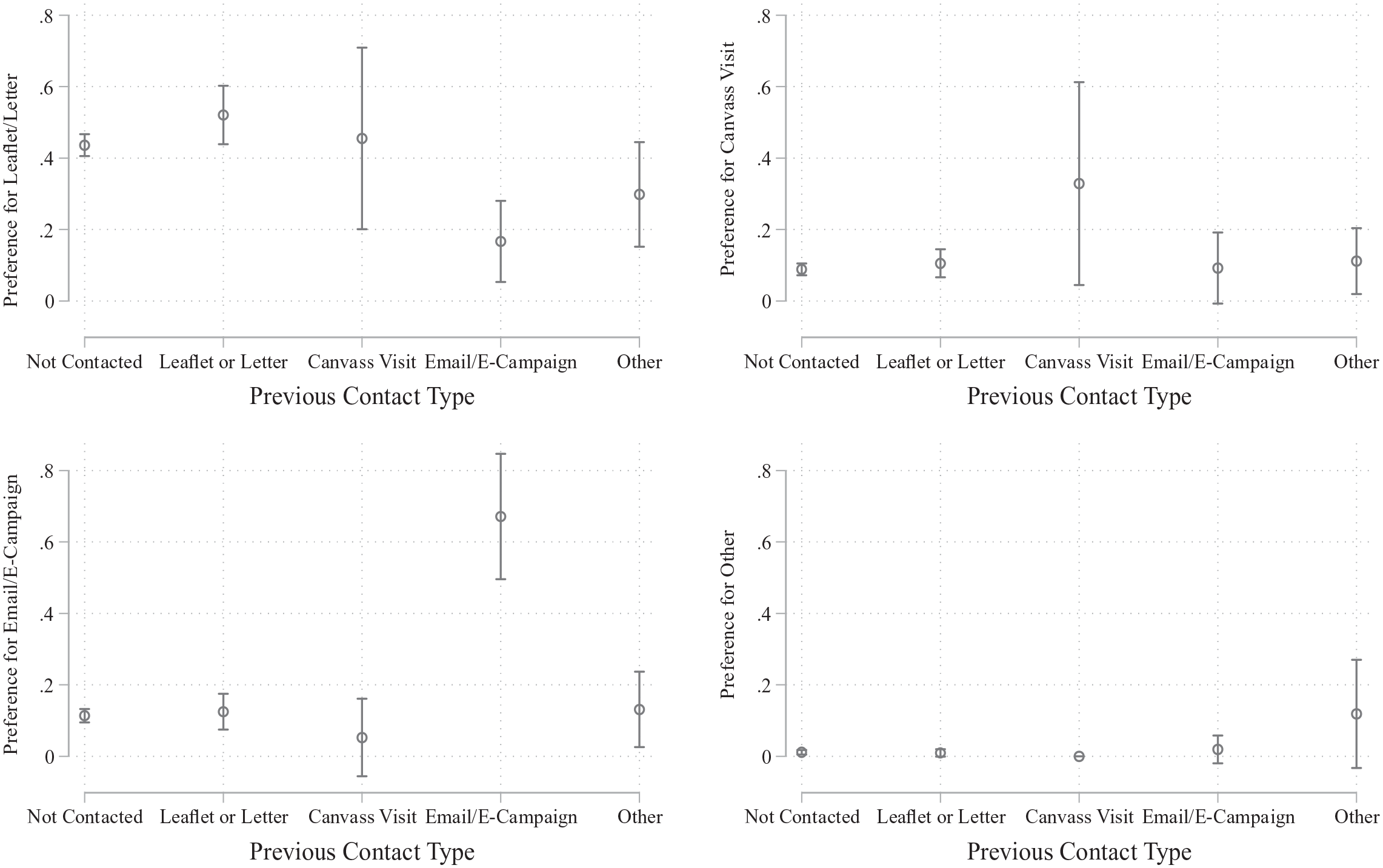
Predicted Probabilities of Contact Preferences by Previous Exposure.
Certain (but far from all) personality types also seem to matter (H3). Those who are enthusiastic and extraverted are significantly more likely to prefer contact by canvassing and less likely to desire no contact, while those electors who are more agreeable – sympathetic, warm and friendly – are significantly less likely to prefer no contact than being contacted by leaflets or letters, holding all other variables constant. There is also some evidence that electors who are creative and open to new experiences prefer being contacted by email or social media. Similarly those with conscientious traits – dependable, self-disciplined and organised – seem to advocate social media modes when compared with being contacted by a leaflet or letter.
Finally, our fourth hypothesis is only partially met. We find no evidence that campaign preference varies by employment status – in particular, being in full-time or part-time work. However, age seems to concur with expectations (H4). Those from older age groups prefer traditional and more personalised methods such as doorstep canvassing, while younger electors are significantly more likely to prefer contact through social media platforms, texting and email (see Figure 4). This may reflect socialisation, whereby age groups who are more accustomed in their lifetime to certain types of communication and party contact are more likely to prefer them.
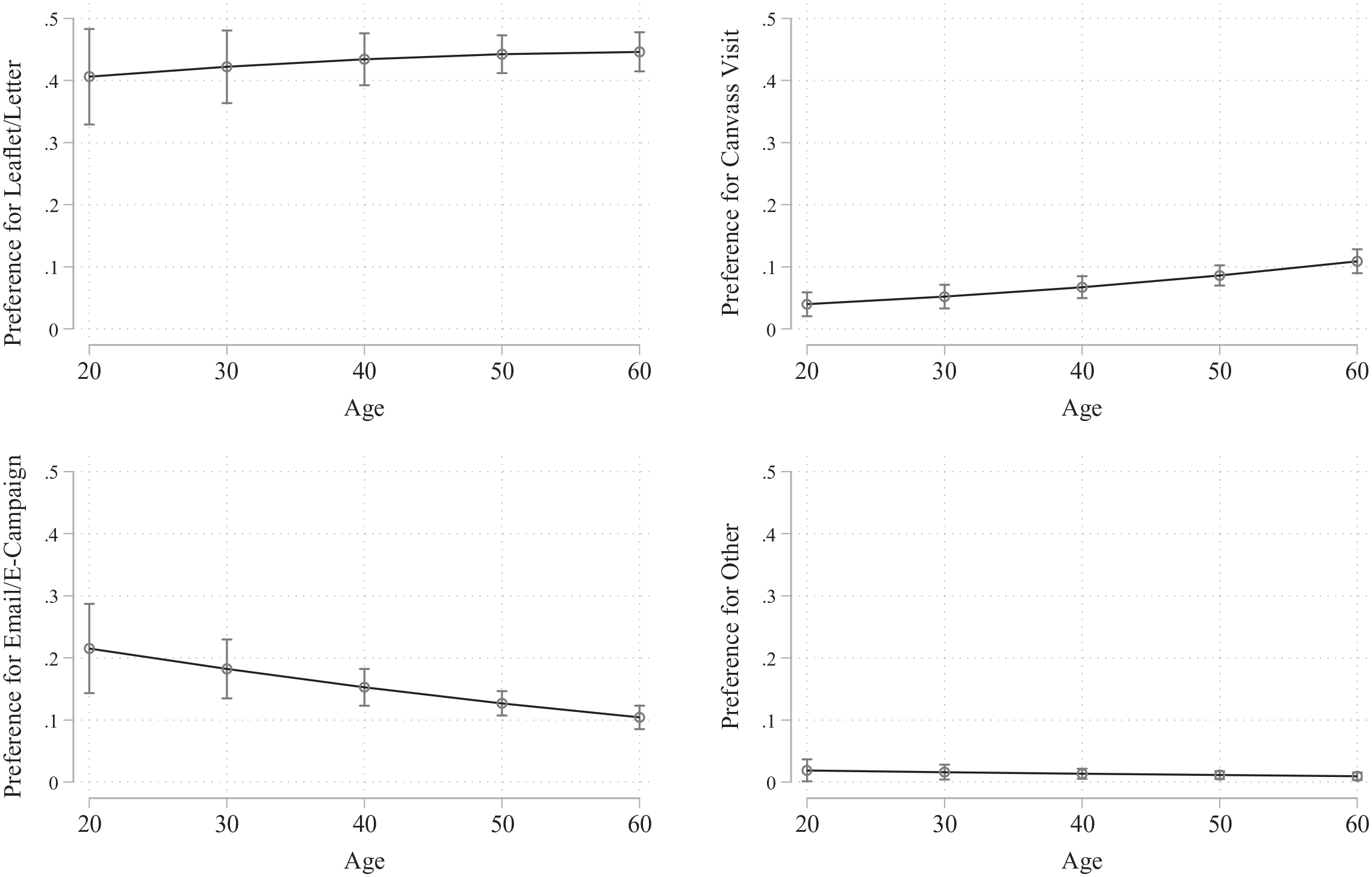
Predicted Probabilities of Contact Preferences by Age.
Of the remaining control variables, education and class were insignificant predictors of campaign preferences. Some gender differences arise, however, as females are significantly more likely to prefer modes such as letters and leaflets than males. And as a consequence, women are less likely to prefer no contact or e-campaign modes when compared with the base category. Those who voted in the 2015 general election were significantly more likely to prefer contact primarily through leaflets and letters than non-contact. There are also few partisan differences with only Labour and Liberal Democrat identifiers significantly less likely to prefer no contact. Both express a preference for contact by traditional modes such as leafleting. For the Liberal Democrats, this is unsurprising given their emphasis on grassroots campaigning and the use of local ‘Focus leaflets’ to get their message across.
Are Voters Receiving the Contact They Want?
So far, our evidence suggests that voters’ preferences for different forms of campaign contact are associated not only – as one would anticipate – with levels of political interest and age, but also with previous exposure to particular activities and individual personality traits such as extraversion or openness to new experiences. But did voters in the 2016 Welsh Election campaign get the campaign contact they wanted? And what factors predict whether or not voters receive the mode of contact they prefer?
Using the 2016 WES data, we compare voters’ preferences for contact with reported rates of actual contact during the campaign. As such we can determine whether voters are getting the campaigning they want and identify ‘contact deficits’ (if any), wherein voters want a particular type of contact but do not get it. Table 2 shows preferences for different types of contact among voters according to self-reported contact during the campaign (in Wave 3, post-election). 5 Given the sample sizes involved, we focus on the four most numerous modes, presented in Table 2 for an indication of the wider picture.
Self-Reported Voter Contact Versus Preferences, by Mode, 2016.
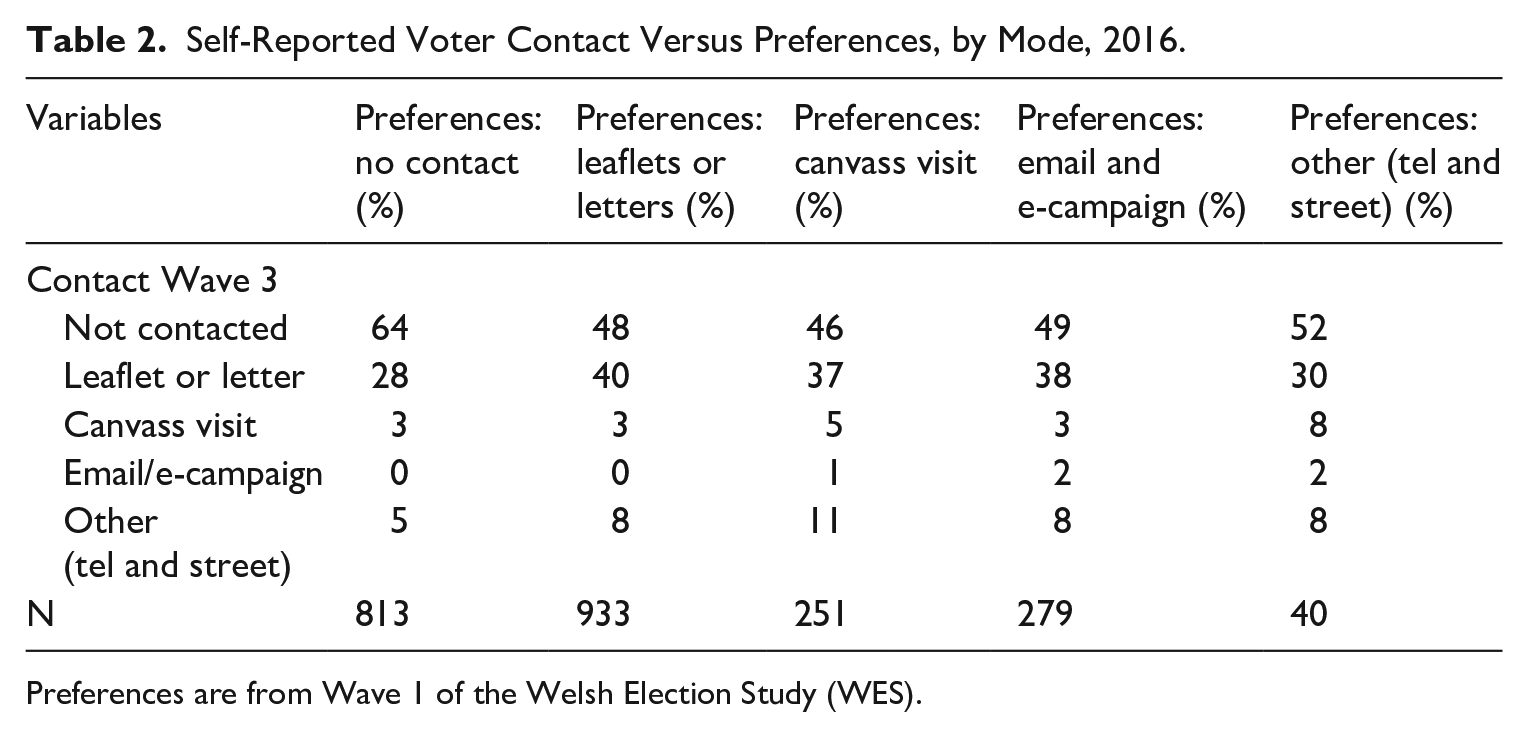
Preferences are from Wave 1 of the Welsh Election Study (WES).
Broadly speaking, while it is unlikely that parties hold reliable data on what forms of contact people prefer, they appear to be satisfying voters’ demands when it comes to being contacted or not. As Table 2 shows, preferences for no contact were highest (42%) among those respondents who were not contacted during the 2016 campaign. However, while respondents who were contacted are more likely to want some form of campaign contact, they are less likely to be contacted in the way they prefer. With the exception of those who prefer leaflets or letters, voters do not appear to be getting the particular modes of contact they prefer. For instance, while 46% of those who received a leaflet or letter preferred these forms of contact, only 2% of those who received a telephone call or street contact preferred these modes. Furthermore, only 17% of those who received a canvass visit preferred a canvass visit.
While some voters are getting the type of contact they want, many are not. But what factors predict whether or not voters receive the mode of contact they prefer? Who are parties tailoring their mode preferences to? To address these questions we run a multinomial logit model where contact by preferred mode and no contact is compared against the base category contact not by preferred mode. Put simply, this provides the toughest test for contact by mode preference. It allows us to take account of contact and differentiate specifically by whether the respondent received their preferred mode of contact or not. Based on the hypotheses outlined earlier, we include respondents’ age, employment status, sex, whether they have a degree and a combined measure of party identification and strength of partisanship. 6 Creating the prior contact variable is slightly more problematic. To do this, we matched 2015 British Election Study (BES) individual identifiers with those in the 2016 WES which enabled us to link 2015 general election campaign contact to these 2016 respondents. 7 The seat marginality was also merged into the data, thereby allowing us to take account of electoral competitiveness. 8
The results of the model are shown in Table 3. The first thing to note is the comparison between no contact and the reference category, contacted by not preferred mode. As expected, those who received no contact in the 2016 Senedd election were significantly more likely not to have been contacted in the 2015 general election. Such respondents were also significantly more likely to live in safe seats, not have a degree, and have weak or no partisan attachment. But do we find any evidence that parties cater mode preferences to certain types of potential voters? Our evidence suggests they do but much more in line with H5b than H5a. Interestingly, when compared against the reference category, respondents who are significantly more likely to be contacted with their preferred mode included those in the middle-age groups (age 45–64 at the 95% level; age 30–44 at the 90% level), women and electors with weak or no partisanship. It seems that parties are more likely to match contact to preference for those who are more undecided rather than strong partisan core voters. For differentiating between contact and non-contact, it is clear that being previously contacted and living in a marginal seat are important predictors. However, contrary to H6, we find little evidence that it matters for mode preference once other variables are taken into account.
Multinomial Logit Model of Contact by Mode Preference.
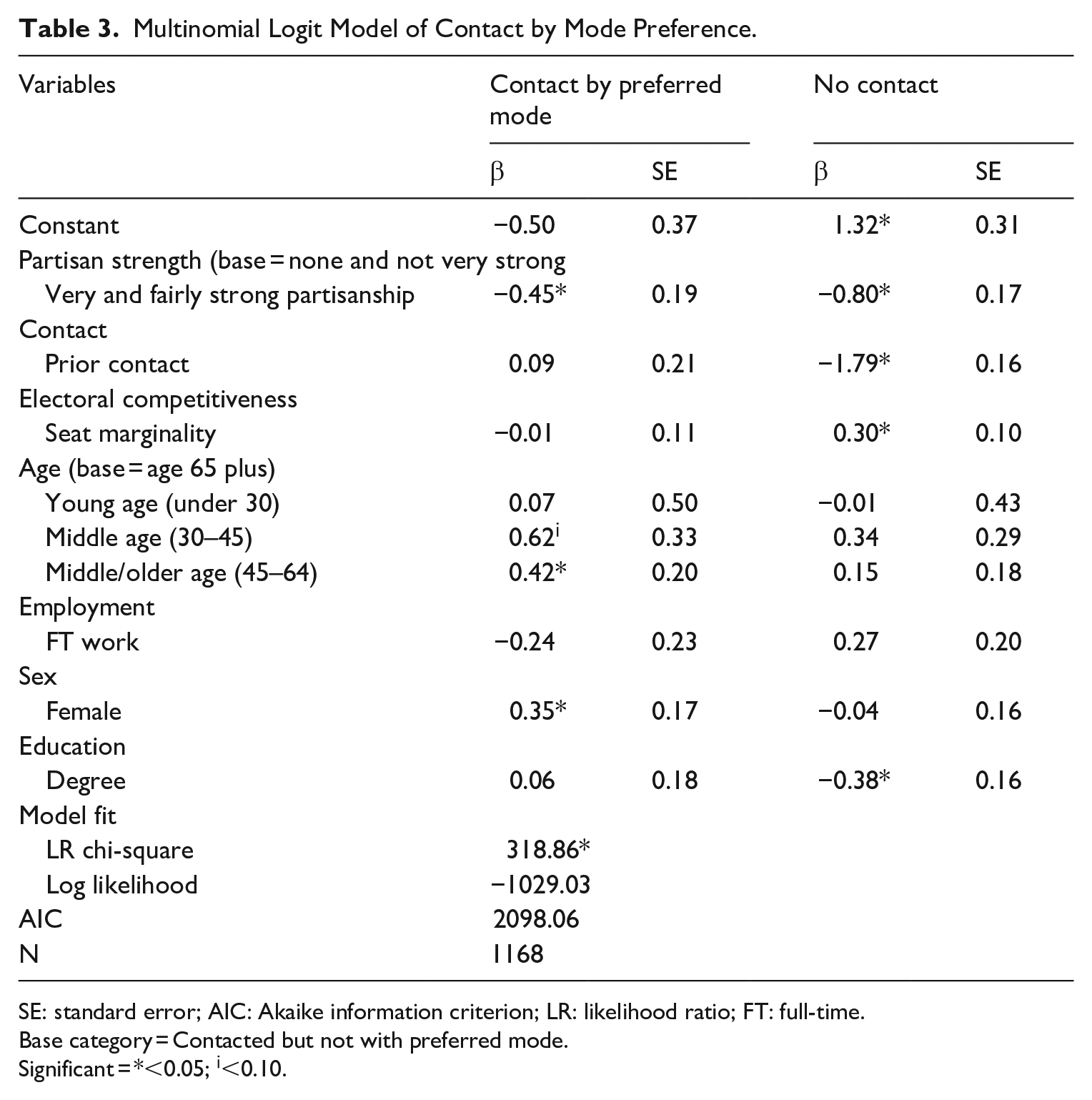
SE: standard error; AIC: Akaike information criterion; LR: likelihood ratio; FT: full-time.
Base category = Contacted but not with preferred mode.
Significant = *<0.05; ⁱ<0.10.
Conclusion
Increasingly, parties are using every available tool to gain a competitive advantage in election campaigns. With micro-targeting now commonplace, well-resourced campaigns are classifying ways in which they can identify, persuade and mobilise potential voters. While partisans may only require reinforcement through a gentle reminder, increasing volatility means that more voters are up for grabs. Contacting potential voters through a mode that they prefer, therefore, could determine whether the campaign message gets through or not and subsequently can influence whether an individual votes for that party. Yet, little is known about voters’ preferences – a lacuna that is addressed in this article.
For the first time, we examined voters’ campaign contact preferences and what explains them before assessing whether parties tailor contact to suit individual mode preferences and, if yes, to who. We present three main findings. First, there is considerable heterogeneity in voters’ preferences for campaign contact. Many voters do not wish to be contacted at all while a similar proportion prefer leaflets. There is also a substantial demand for canvassing and emails, but only minimal preference for other forms of digital campaigning such as social media platforms Facebook and Twitter. For the many voters who want to be contacted, there seems to be a preference for traditional forms of campaigning and in some cases (but not all) more personalised modes.
Second, we derived a number of theoretically driven hypotheses to ascertain what predicts these preferences. Three of the four hypotheses were largely met, while the fourth was only partially met. As expected, preferences for contact (versus no contact) are strongly associated with levels of political interest (H1), which reflects existing research that links low levels of political interest with low participation (Denny and Doyle, 2008). In line with ‘mere exposure’ theory, we also find strong evidence that preferences for particular modes of contact are associated with previous exposure to those modes (H2). Having an extraverted personality influenced contact preferences across two of the four modes (leaflets and canvassing). while those who are open to new experiences were significantly more likely to prefer online rather than offline party contact even when compared against leaflets and letters (H3). As expected, age was associated with preferences, with older voters preferring traditional, personal contact modes like canvassing, while younger voters prefer online and social media contact (H4). Meanwhile, preferences were not associated with employment status.
Finally, we examined whether parties matched contact to mode preferences for core, loyal partisans or for more undecided voters (H5a and H5b) and assessed whether this was conditional on prior contact and seat marginality (H6). Our findings provide some extremely interesting insights with H5b partially met. Put simply, certain types of voters, predominantly middle-age electors and women are significantly more likely to be contacted with their preferred mode. Of key importance though is that it is undecided weak partisans or even those with no attachment that parties seek to cater for rather than strong partisan loyalists. Presumably, loyalists just require reinforcement for mobilisation so contact preference is less of a priority. More and more voters are undecided, and winning them over is problematic. Ensuring that this group consumes the campaign message is paramount so it stands to reason that parties would seek to tailor the mode to maximise campaign impact. If they go to great lengths to target certain undecided voters it should not be a surprise that parties also seek to match their modes to meet such voters’ preferences. At first glance, it seems somewhat surprising that prior contact and seat competitiveness do not matter (H6). However, it seems evident that their impact is simply through the contact which is also specified in the comparator category not the preference. Part of the explanation may in itself be due to a lack of prior data about campaign preferences. One option would have been to simply assume that preferences in 2016 were similar in 2015 and merge mode contact data from the 2015 BES to derive a prior contact preference variable. Yet without a question on preferences, it is a ‘leap in the dark’ to assume that such contact preferences are fixed. Indeed it may be that contact preferences could differ by election order – in a general election it is being contacted that matters given its saliency so that respondents may have a preference for more generic modes such as leaflets because they wish to consume as much information as possible. Those who preferred no contact in the 2016 Senedd election may have a different preference in a first-order election. Moreover, voters may prefer more personal contact and have a stronger preference for a personal visit given they are voting for a Westminster MP. Parties therefore may cater differently for different types of elections. As such, a simple prior contact variable as used here is more prudent, but the findings come with caveats and there remains a need for further work on campaign preferences in first-order elections to determine whether our results hold.
Moving forward, future research needs to examine whether preferences condition the mobilising effect of campaign contact. Does contacting an individual with their preferred mode – compared with a non-preferred mode – increase their likelihood of voting? This could be extended to assess whether this actually differs for particular modes of contact. For instance, if a voter prefers phone calls, but receives a canvass visit, will the effect of the canvass visit be stronger? Researchers might also consider testing how preferences vary according to the party from which the hypothetical contact comes, and the partisanship of the recipient. This could open up research questions regarding cross-partisan contact. For instance, do preferences enhance campaign effectiveness when the preference is for contact from Party A, but contact comes from Party B?
While it would have been possible to use survey measures to assess the relationship between preferences and turnout (and perhaps how they vary by party although the ‘partisan neutral’ phrasing of the WES survey question in this article makes it impossible), the reality is that establishing any causal effect would have been problematic. Such an analysis would have been subject to false recall, whereby voters do not accurately remember whether, or how, they were contacted during the campaign. And this could be differential as a function of contact mode. Respondents may over-report participation due to the social desirability associated with voting. It is also the case that campaign contact is not randomly assigned, but is already targeted towards particular voters – for example, those who have a higher propensity to vote or those who self-select into contact because they are more likely to be at home when canvassed. These biases may work in a similar direction, thereby compromising any findings. As a consequence, using modelling from surveys to test and tease out these effects was simply a step too far for this article. But future opportunities exist through experimental work to address these unanswered questions and detect the presence and size of possible causal effects (Foos and John, 2016; Gerber and Green, 2017).
Further research is also needed to help establish whether campaign preferences differ in first- versus second-order contests. In this article, we have examined the latter and so cannot make comparisons between the two. This may be an avenue for future study, however, given what we know about campaigning in first- and second-order elections. We might expect preferences to be consistent – just as campaign effects between first- and second-order contests appear to be consistent (Trumm and Sudulich, 2018). However, given the differing voting behaviour of electors in second- and first-order elections (Cutts and Johnson, 2015; Lindstam, 2019), we might expect preferences also to differ. It is important to examine the extent to which our findings here apply in different electoral contexts.
Nevertheless, this study provides a vital first step in examining the predictors of campaign preferences, and how, and to whom parties tailor modes to suit the preferences of the elector. As technology improves, micro-targeting is likely to become even more sophisticated. It stands to reason that parties will strive even harder to match the mode with elector preference to ensure that their message gets through in the most resource-efficient way. As a consequence, monitoring campaign preferences and the factors that influence them is a new strand within the campaign literature, which requires further scholarly attention. In the short to medium term, more work needs to be done to establish the mobilising and persuasive effect of such micro-targeting.
Footnotes
Acknowledgements
The authors wish to sincerely thank the late Ron Johnston for his typical sage advice on the questions and topic area. They would also like to thank Roger Scully for allowing them to include these preference questions on the 2016 Welsh Election Study.
Declaration of Conflicting Interests
The author(s) declared no potential conflicts of interest with respect to the research, authorship and/or publication of this article.
Funding
The author(s) received no financial support for the research, authorship and/or publication of this article.
