




Abstract
Covid-19 has shocked governance systems worldwide. Legislatures, in particular, have been shut down or limited due to the pandemic, yet with divergence from one country to another. In this article, we report results from a cross-sectional quantitative analysis of legislative activity during the initial reaction to this shock and identify the factors accounting for such variation. Exploring legislatures across 159 countries, we find no relation between the severity of Covid-19 and limitations on legislatures’ operation, thus suggesting that legislatures are at risk of being shut down or limited due to policy “overreaction” and that a health risk may serve as an excuse for silencing them. However, we find that legislatures in democratic countries are relatively immune to this risk, while those in frail democracies are more exposed. In partially free countries, the use of technology can mitigate this risk. We also find that the coalitional features of the government may lead to legislatures’ closing.
Keywords
Introduction
The Covid-19 pandemic has been a shock to governance systems around the world (Ginsburg, 2020). Legislatures, in particular, have been significantly challenged, with some arguing that Covid-19 created an “unprecedented threat” to these institutions (Norton, 2020). Hence, legislatures’ capacity to continue operating during Covid-19 was recognized as an important test of the strength and durability of the democratic system (Ginsburg and Versteeg, 2020; Lührmann et al., 2020; Maerz et al., 2020; Murphy, 2020). More broadly, legislatures’ reaction to Covid-19 is an illustrative case of institutions’ responses to crisis, as well as institutions’ reactions to exogenous shocks more broadly.
The continued operation of legislatures during Covid-19 is not merely of academic interest, but a matter of crucial concern for governance itself, particularly in a context of worldwide democratic backsliding (Diamond, 2020). Indeed, one of the major worries within democratic organizations since the pandemic began, was whether (and how) legislatures would continue to operate during Covid-19. The Westminster Foundation for Democracy, for example, reported in early April that “parliaments everywhere are grappling with how to adapt to the emerging reality of the COVID-19 crisis,” and warned that if parliaments do not find ways to continue to function, they risk “depriving citizens of a vital democratic organ” (Hasson, 2020). At the same time, openDemocracy expressed “alarm” as they estimated that two billion people in the world had legislatures shut or limited due to Covid-19 (Provost et al., 2020). The V-Dem Institute similarly emphasized that it is vital that legislatures continue to operate, and warned that suspending their operation “constitutes a high risk” of democratic backsliding during the pandemic (Lührmann et al., 2020: 3).
Against this backdrop, this article presents the findings of a quantitative cross-national analysis, covering all 159 countries with a population of over 1,000,000, on the operation of legislatures during the first months of the Covid-19 pandemic. In particular, we assess whether parliamentary activity has been affected by the severity of the health crisis, the nature and institutional settings of each country, and being governed by populist leaders. We further explore whether the adoption of technological solutions, allowing legislatures to operate while maintaining social distancing, mitigated the decline in parliamentary activity.
We find that legislatures’ reaction to the crisis has been disproportionate to the local severity of the disease. We also show that the impact of Covid-19 on the functioning of legislatures is partly dependent on the state of democracy, on the strength of legislatures and on the existence of coalition governments. We further show that the impact of Covid-19 on the functioning of legislatures is dependent on the legislatures’ capacity to use technological means and devices, particularly in frail democracies. We thereby contribute not only to the study of legislative and comparative politics, but also to broader and diverse fields, including the evolving body of political science and social sciences studies of Covid-19 and its various societal and political impacts (Barberia et al., 2021; Conley and Johnson, 2021; Greer et al., 2021); the growing interest in the relationships between crises, political regimes, populism and autocratization (e.g. Maerz et al., 2020); ongoing debates on the potential of digitalization of representative democracy (Boehme-Nessler, 2020); and debates in the economic and political science scholarships on institutional change and institutions’ response to exogenous shocks (e.g. Acemoglu et al., 2021; Gerschewski, 2021; Meakin and Geddes, 2022).
The rest of the article is organized as follows. In the “Theoretical Background and Hypotheses” section, we discuss existing literature on governance and legislatures in times of crisis, and formulate a series of hypotheses. Our research design and methodology to test them are introduced in the “Methods” section. The “Results” section presents our results. In the “Discussion” section, these findings are discussed, and the “Conclusion” section offers conclusions.
Theoretical Background and Hypotheses
Governance and Legislatures in Times of Crisis and Pandemic
Crises, emergencies, disasters, or disruptive events are commonly regarded as capable of putting even the strongest institutional equilibriums at risk—and a rich body of research has developed to explore how such shocks impact policymaking, regulatory regimes, governance systems, and institutions more broadly (e.g. Gerschewski, 2021; Van Hooren et al., 2014). There is growing awareness that Covid-19 is “a truly seismic shock to public policy-making systems” (Mazey and Richardson, 2020: 561), and a “sudden shock to almost every political system in the world” (Greer et al., 2021: 4), with some arguing that it is “hard to imagine that there has ever been a shock that affected all governments in the world in such a short period of time” (Ginsburg, 2020: 1). It is a clear case of a sudden global exogenous shock, which enables a comparative study on the effects of shocks on institutions.
Traditionally, much of the scholarship on the impact of emergencies on governance and constitutional systems has focused on the executive branch (e.g. Posner and Vermeule, 2010). Notwithstanding this tendency, the importance of studying legislatures in crisis governance has been increasingly acknowledged. Ferejohn and Pasquino (2004), for example, have highlighted the development of the legislative model as a new model of emergency powers and crisis governance; and Stark (2010) has argued that legislatures constitute a powerful lens for the study of crisis management. Legislatures have essential roles to play in managing emergencies and crises, including passing emergency legislation, appropriating needed funding, ensuring oversight and cabining the executive from abusing the crisis, and providing representation, accountability, and legitimacy (Bassetti and Weiner, 2020; Murphy, 2020). Legislatures are said to be capable of legitimizing or putting constraints on the decisions taken by “operational” (typically executive) institutions during focusing-events as crises are. They are also often able to (re)politicize crisis management and, more broadly, aggregate various interests, particularly in such critical contexts. Through their legitimizing force, legislatures can contribute to compliance and therefore to the effectiveness of emergency measures (Weinberg, 2020). Overall, there is a growing body of literature that challenges the claim that legislatures have no role to play in crisis management, both on normative grounds and on empirical grounds (Ginsburg and Versteeg, 2020). Hence, there has been growing interest in exploring parliamentary activity under emergencies or exceptional circumstances—from wars (e.g. Peters and Wagner, 2011) to financial crises (Cooper and Smith, 2017) to pandemics (Ginsburg and Versteeg, 2020).
While we fully agree that it is important to investigate legislatures’ performance and management during crises, our argument is that there is a fundamental preliminary question that needs to be explored: the extent that legislatures are able to remain open and continue to operate during crises. We believe the Covid-19 pandemic has proven the germaneness and vitality of this question. As Judge and Leston-Bandeira (2021: 19) recently observed, the Covid-19 crisis magnified the importance of legislatures’ continued operation, highlighting the “powerful symbolism of continued parliamentary presence” and its crucial role in “sustaining throughput legitimation processes in a time of Covid-19.”
To be sure, many types of crises—from wars and terrorist threats to natural disasters—may disrupt legislatures’ ability to continue their operation. Yet, Covid-19 presents an especially powerful case study, for two main reasons. First, “as a global phenomenon, this is unprecedented” (Norton, 2020). Second, and more importantly, due to the unique ways in which the features of this crisis interact with the features of legislatures (Bar-Siman-Tov, 2020). Covid-19 is extremely infectious and particularly dangerous to older individuals (Weiss and Murdoch, 2020). Moreover, during the first wave of the pandemic, with no vaccine nor cure, most countries focused on non-pharmaceutical control measures, including social distancing, prohibitions on assemblies, quarantines, lockdowns, and travel bans (Hale et al., 2020). This is particularly challenging for legislatures, which, by their very nature, are large multi-member bodies whose operation requires its members to assemble. Furthermore, most legislatures have quorum rules, traditionally understood as requiring physical presence. Hence, the combination between the characteristics of Covid-19 and its risk factors, legislatures’ institutional features, and typical demographic traits of legislators, make the operation of parliaments institutionally difficult and potentially dangerous (Bar-Siman-Tov, 2020).
Furthermore, the pandemic, particularly at the initial shock stage, also featured all the characteristics identified by the risk perception scholarship as liable to lead to an overreaction due to excessive estimation of the risk: it was new and unknown, invisible, dreaded, involuntary, and uncontrollable, with catastrophic potential (Aven and Bouder, 2020). Hence, even though there were real operational risks for legislatures, there was also a risk of them being excessively deterred and opting to completely shut down rather than taking proportional and justified precautions (Bar-Siman-Tov, 2020).
And while legislatures were struggling to adapt to life under the threat of Covid-19, world leaders have been seizing extraordinarily broad emergency powers in the name of waging war on the coronavirus. Indeed, one of the features of the Covid-19 crisis is that it empowers and emboldens the executive, while challenging the very ability of legislatures to operate (Bar-Siman-Tov, 2020). Due to the combination of all these features of this global crisis, Covid-19 is a particularly interesting case for studying the operation of legislatures during crisis.
Hypotheses
Legislatures’ operations during crisis could be limited due to the intensity of the crisis, or in the case of the current crisis, the severity of the pandemic. Covid-19 constitutes a genuine challenge and health risk to the operation of legislatures. Therefore, we expect that:
H1. The higher mortality in a given country, the lower parliamentary activity during the Covid-19 pandemic.
The correlation between the severity of the health risk and the extent of limitation on parliamentary activity could indicate whether the legislative response to the risk was proportional or constitutes a disproportionate response (Maor et al., 2020), either due to exaggerated risk perceptions by legislatures or due to attempts at silencing legislatures under the pretext of dealing with the pandemic.
Several institutional features characterizing a given political system could impact the capacity of the executive to silence legislatures. The most obvious one has to do with the state of democracy. The closure of legislatures has been recognized as means for executives to “sabotage accountability” (Glasius, 2018), and as “an authoritarian practice in clear violation of democratic standards” (Maerz et al., 2020) and a risk factor associated with democratic backsliding (Kavakli, 2020). Hence, we expect:
H2a. The more democratic a country, the higher parliamentary activity during the Covid-19 pandemic.
The necessity for the executive to rest on a parliamentary majority constitutes another key criterion. Hence, we hypothesize that the closing of legislatures should be more difficult within “pure forms” of parliamentary regimes (see Blankart and Mueller, 2004):
H2b. Parliamentary activity should be higher within parliamentary regimes.
Finally, the general influence of the legislatures may impact their level of activity in times of crisis. From a procedural (rather than behavioral) understanding of the notion of strength (Sieberer, 2011), it is plausible to assume that strong legislatures may be able to resist attempts at silencing them as they are endowed with specific prerogatives regarding their functioning. Hence, we suggest:
H2c. The stronger a legislature, the higher parliamentary activity during the Covid-19 pandemic.
A macro-institutional perspective seems insufficient to explore the range of explanations for the potential disproportional reaction of legislatures to the Covid-19. Neo-institutionalist accounts have in particular noticed that the law-making capacity of any political regime is highly dependent on the number of veto players (Eskridge, 2012; Immergut, 1990). Specifically, the coalitional feature of the government (i.e. the number of parties forming it) appears to be a strong factor of legislative inertia (Tsebelis, 2002). As limiting or closing a legislature is a departure from the status quo, we can expect that:
H3a. Parliamentary activity is higher under Covid-19 when governments are made of several parties.
Another specific feature worth investigating is the presence of populist leaders—understood as politicians challenging the legitimacy of mediation between them and the people and the pluralism of citizens’ representations (Mudde and Rovira Kaltwasser, 2017). While there is much debate in the scholarship on the extent that populism is a threat to democracy in general (compare, e.g. Bugaric, 2019; Rummens, 2017) and parliaments in particular (Maatsch and Miklin, 2021), most scholars suggest a negative relationship between populism and various indicators of democracy and democratic institutions, including parliaments (Maatsch and Miklin, 2021). In the context of emergencies, it is commonly assumed that populist leaders would exploit the crisis for executive overreach and democratic violations (Kavakli, 2020; Pozen and Scheppele, 2020). Hence, we expect that:
H3b. When a country is ruled by a populist leader, legislatures tend to be less active under Covid-19.
Our last hypothesis deals with the capability of legislatures to adapt to Covid-19 through technology. The use of technological devices to organize remote voting or meetings in legislatures (in lieu of physical presence) is probably the most visible illustration of such capacity during the pandemic—and arguably constitutes a major organizational innovation that emerged from the crisis (Griglio, 2020; Rozenberg, 2020; Williamson, 2020). Here we expect that:
H4. The higher the use of technological devices in lieu of physical presence, the higher parliamentary activity during the Covid-19 pandemic.
Methods
A main challenge in investigating how legislatures around the world responded to the Covid-19 shock is choosing the appropriate timeframe and accounting for changes over time. Legislatures’ operation changed over time, for, as time passed, the initial shock effect waned, and legislatures had more time to reassess their initial risk perception and to adapt their operation. Moreover, Covid-19 hit different countries at different times, and for each country, its severity changed over time.
To meet this challenge, we employed a dual strategy. The first strategy was taking a snapshot of the operation of all legislatures during the same tightly defined timeframe. The rationale was that, given that legislative operation in the initial response to the shock is expected to be different than after many months of getting used to living with Covid-19, to ensure a valid comparison, all legislatures should be evaluated during the same defined period. Spring 2020 is recognized as the period in which Covid-19 administered the shock that had “governments around the world scrambling” to address this new and unknown threat (Greer et al., 2021: 3). As we wanted to capture legislatures’ operation in response to the initial shock, we focused here on legislatures’ operation during 23 March–6 April 2020. This was a crucial period in the first wave of the pandemic: 7 weeks after Covid-19 was declared a public health emergency of international concern and 2 weeks after Covid-19 was officially proclaimed a global pandemic by the World Health Organization (WHO) (2020). More importantly, mid-March to early April was the crucial period in which democracy organizations around the globe reported that “parliaments everywhere” are responding to the shock and “grappling with how to adapt” (Hasson, 2020; see also, Bassetti and Weiner, 2020; Inter-Parliamentary Union, 2020; Murphy, 2020; Provost et al., 2020). This was also the period in which public risk perceptions of Covid-19 were universally high and relatively similar around the world (Dryhurst et al., 2020), and there is basis to assume that this was the period in which legislatures’ risk perceptions were similarly universally and uniformly high (Bar-Siman-Tov, 2020).
While we identify the end of March and beginning of April as the crucial time to capture world legislatures’ initial response to the crisis, we realize that some legislatures’ response may have started earlier or later than others. We also realize that institutional adaptation may take time, and that legislatures’ operation may have changed, even within the first wave of the pandemic. Hence, our second strategy was employing time-series analysis capturing parliamentary operation during a longer period from February to June 2020. This strategy allowed us to dynamically map changes in the functioning of parliaments over time, while remaining within a relatively short and well-defined timeframe. This timeframe can still be considered as capturing the first phase of legislatures’ response to Covid-19, during the early phase of this ongoing pandemic (for a justification of focusing on a similar timeframe, see also Pedersen and Borghetto, 2021).
For our outcome measures, parliamentary activity and adoption of technological solutions, we developed novel indexes, designed specifically to capture parliamentary operation under Covid-19, while accounting for cross-country differences. Our parliamentary activity index (ParlAct Index) measures the level of parliamentary activity, that is, the extent that parliament continued to operate. On its 10-point scale, 1 indicates that parliament is completely closed and 10 indicates that it is functioning fully, with numbers in between representing various levels of reduced activity, either in the sense that only some of parliament’s organs (committee/plenum) operate or in the sense of reduced frequency of meetings. The second index measures parliamentary use of technological solutions during this period (ParlTech), where 1 indicates that no solutions were adopted and 4 indicates the use of technological solutions, such as videoconferencing and remote voting. We tested the reliability of our new indexes through two independent coders. Intercoder reliability calculated using Krippendorff’s alpha was at 0.81 (see Bar-Siman-Tov et al., 2021, for further details).
We used several primary sources for our outcome measures. The data for the snapshot of legislatures’ operation during 23 March–6 April are based on a novel comprehensive database we generated that captures the operation of legislatures in all 159 countries with a population of over 1,000,000 (Covid-19 and parliament’s dataset). To assure the comprehensiveness and quality of our database, we generated it using three different methods. The first was reaching out to an extensive network of leading academic experts on parliaments, which yielded information from 172 experts, mostly legal scholars and political scientists (see Supplemental Appendix 1). They were asked to complete a substantive report about the current operation of their legislature, and answer a short survey assessing the parliamentary activity and technological solutions’ usage in their country of expertise (Supplemental Appendix 2). Expert surveys are a well-established and widely used method in political research (see e.g. Chernykh et al., 2017). Yet, being aware that expert surveys may result in some bias (see Hooghe et al., 2010), we complemented our first approach with two additional methods. The second method was a collection of official reports by national and international parliamentary research centers about parliamentary activity in various countries during the same period (Supplemental Appendix 3). The third method was collecting reports from hundreds of daily newspaper articles and entries in legislatures’ websites (either in English, Spanish, French, or Hebrew, or using Google Translate) with information pertaining to the legislature’s functioning in each of our countries’ sample. The integration of these three sources of data was conducted by the first two authors. All authors participated in data and result verification.
For the time-series analysis of changes over time in parliamentary operation during February–June, we combined data from Inter-Parliamentary Union’s compilation of parliamentary responses to the pandemic with the original sources that were used for the INTER PARES’s data-tracker on parliamentary responses during Covid-19 (Murphy, 2020). Since these data summaries are abbreviated and tend not to report an accurate temporal measure, we went back to their primary sources’ list (both parliaments’ press releases, and reports and news articles) to explore each individual country and ascertain for ourselves the correct ParlAct and ParlTech scores at a given time.
While awareness of a global crisis and its risk perceptions were generally similar and universal during our timeframe, the actual severity of the health situation in each country differed. Hence, we used the number of deaths per million in each country to allow cross-country comparisons. We used cumulative mortality, since this measure is less affected by testing availability and policies (Subbaraman, 2020), but at any rate, we checked and found that replacing mortality with cumulative morbidity produced similar results, as did replacing mortality with cumulative excess mortality, percentage change in deaths in the last 7 days or R (Covid-19 reproduction rate, available at https://github.com/lin-lab/COVID19-Viz). For the cross-sectional model focusing on the snapshot of parliaments’ operation during 23 March–6 April, we used cumulative mortality as of 22 March. To account for the possibility of changes during this period and given the possibility of a lagged connection between Covid-19 cases and deaths, we repeated this analysis using cumulative mortality as of 10 April, and found that it produced similar results. To account for differences in the timing of exposure of the countries to the Covid-19 pandemic, we controlled for the amount of time (in days) passed from the initial outset of the pandemic in China and the first recorded morbidity in each country. For the time-series analysis of changes over time in parliamentary operation during February–June, we used updated daily data of cumulative mortality throughout that timeframe. For these hazard models, we took two separate approaches with respect to the definition of risk onset. One approach assumed a similar definition for all countries, starting at the beginning of timeframe for the measurement of changes in parliament activity (i.e. 1 February). The second approach replicated the analysis while defining risk onset for each country separately based on the first reported death in each country. Results from models using these two specifications were similar, and are reported below.
The analysis includes several additional independent variables: the degree of democratization, the parliamentary versus presidential type of regime, parliaments’ institutional strength, the presence of coalition government and the presence of populist leaders (see Supplemental Appendix 4 for details). Regarding the degree of democratization, we used the freedom house index (FHI). In our primary analysis (reported in Table 2), we use the original FHI scale, which runs from 0 (totally not free) to 100 (totally free). To examine potential interaction between the degree of democratization and the severity of the pandemic, we also employed a nominal scale in analysis reported in Table 3, which divides countries into three categories: free, partially free, and not free. FHI is one of the most widely applied indexes in comparative research on political regimes and democratization (Denk, 2013). Yet, as all indexes measuring democracy raise conceptual and methodological issues (Munck and Verkuilen, 2002) and potential biases (Bush, 2017; Giannone, 2010), we tested FHI with an alternative index, V-Dem liberal democracy index, and found they yielded similar results. Assessment of the independent variables using the variance inflation factor (VIF) did not reveal collinearity among them (i.e. we found an acceptable level of VIF at 2.5).
We also included several control variables. In addition to accounting for differences in the timing of exposure of the countries to the Covid-19 pandemic, for each of the countries, we also controlled for additional political and public health-related variables (i.e. the number of parliament members, population density, median population age, and medical spending per capita). Finally, due to the fact that more technologically advanced countries may mitigate the crisis’ effect on parliamentary activity by adopting measures like video conferencing, we use IP addresses per capita as a predictor of a nation’s technological capacity (see Supplemental Appendix 4 for details).
We used two primary statistical techniques for analyzing the association between ParlAct and ParlTech with the independent variables. The analysis of cross-sectional data documenting parliamentary activity and adoption of technology during 23 March–April was conducted using multivariate ordinary least squares (OLS) regression. We estimated the sensitivity of the results to the choice of statistical technique by additional estimating ordered logistic regression using the same dependent variables and multinomial regression models, where the dependent variables were replaced with categorical variables. In the multinomial models, we distinguished between parliaments that stopped operating, those whose operation was hampered but continued operating and those experiencing limited change. For the technology variable, we distinguished between those adopting no technological measures to assist with the operation of parliament, those adopting limited measures and those whose operation was greatly aided by technological measures.
These additional models produced results that were similar to those presented below. Hence, for ease of interpretation, we present below the results from the OLS regressions. We dealt with the occurrence of missing values for some of the variables using multiple imputation, assuming a multivariate normal distribution. In the presentation below, all tests are two-tailed and p-values of less than 0.05 were considered to indicate statistical significance. We additionally present effects sizes (η2) for each variable to assist in interpreting its substantive importance.
Analysis of temporal changes within countries during February–June was conducted using Cox proportional hazard model (Allison, 2014; Blossfeld et al., 2019). This model allows for the inclusion of both time invariant and time-varying covariates, hence affording a detailed look at the factors shaping the duration of the change in parliamentary activity or the adoption of technological measures, which are the events of interests in this article. Specifically, the model is generally specified as follows:

where h(t) is the hazard of transition, h0(t) is cumulative hazard function, t index days, k denotes the independent variables (e.g. the Xs), and b indexes the regression coefficients. The model addresses the main limitation of the cross-sectional analysis, which ignores differences between countries in the timing of the crisis. By contrast, the Cox proportional hazard model allows for a dynamic analysis of the factors that shaped the responses to the pandemic as they unfolded in real time. Our baseline Cox models separately examined any transition from a fully functioning parliament and any transition from a parliament that does not adopt any technological measures to assist in its functioning. We estimated the sensitivity of the results to the coding of the event in question for ParlAct by addressing two other options: transition only to a state where operation was hampered but continued operating and a transition only to a state where operation was fully stopped. Similarly, we also used two other options for the coding of ParlTech: transition only to a state indicating adoption of limited technological measures and a transition to a state where operation was greatly aided by technological measures. This sensitivity analysis additionally allows for the documentation of differences across countries in the degree of change. Finally, we took advantage of the opportunity to dynamically explore the response to the pandemic by examining the likelihood of rebound; that is, the likelihood of a transition from a state where operation is closed to a state where operation has (at least temporarily) resumed.
Results
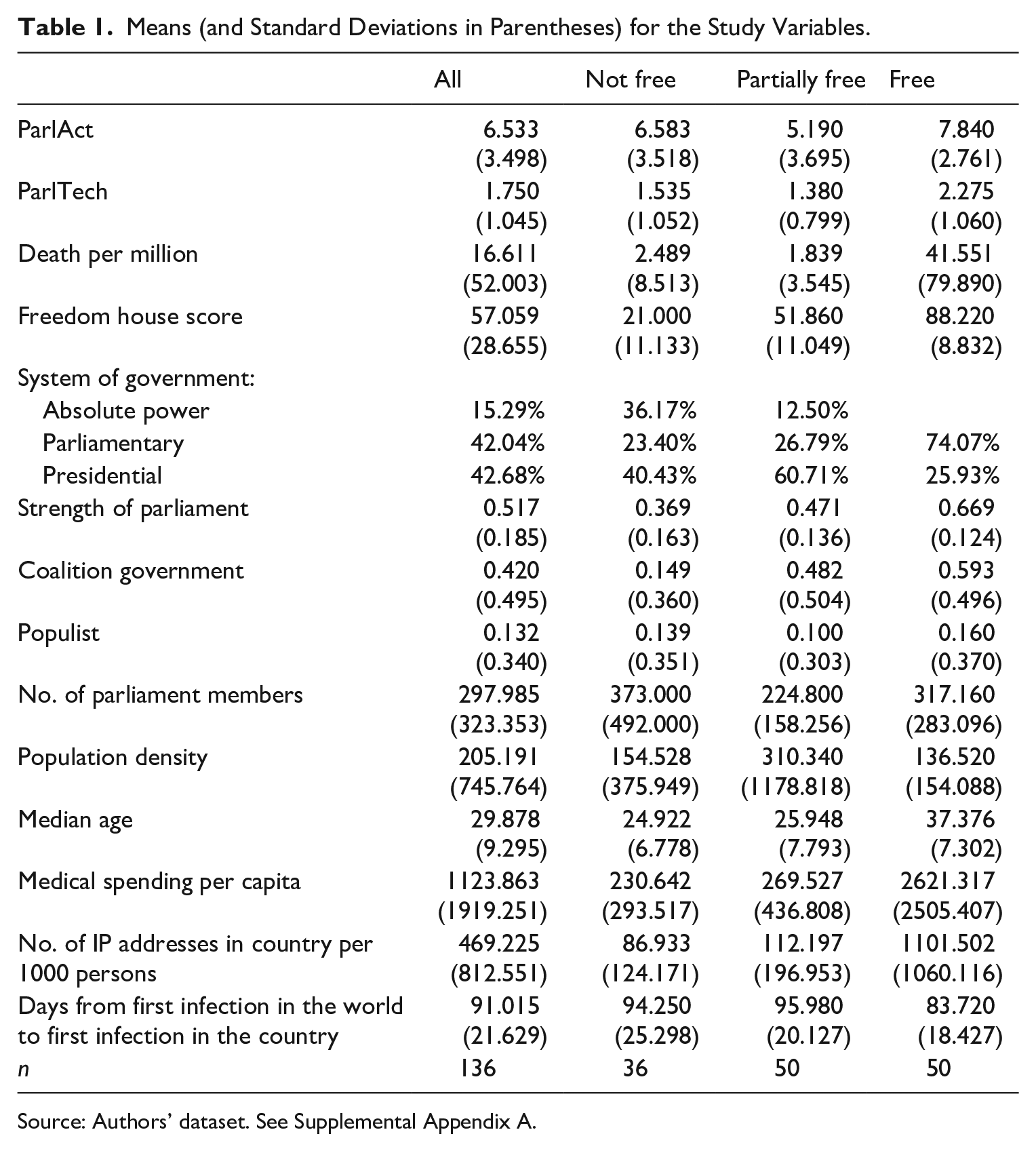
Table 1, and Figures 1 and 2 present descriptive statistics for our outcome measures, parliamentary activity (ParlAct) and adoption of technological solutions (ParlTech) and for the main independent and control variables used in the analysis. Anticipating the potential for differences in the association between mortality with the two outcome measures by the type of political regime in the country, we present the descriptive information for all country groups together, as well as distinguishing among countries that are not free, partially free, and fully free democracies (using FHI).
Means (and Standard Deviations in Parentheses) for the Study Variables.
Source: Authors’ dataset. See Supplemental Appendix A.
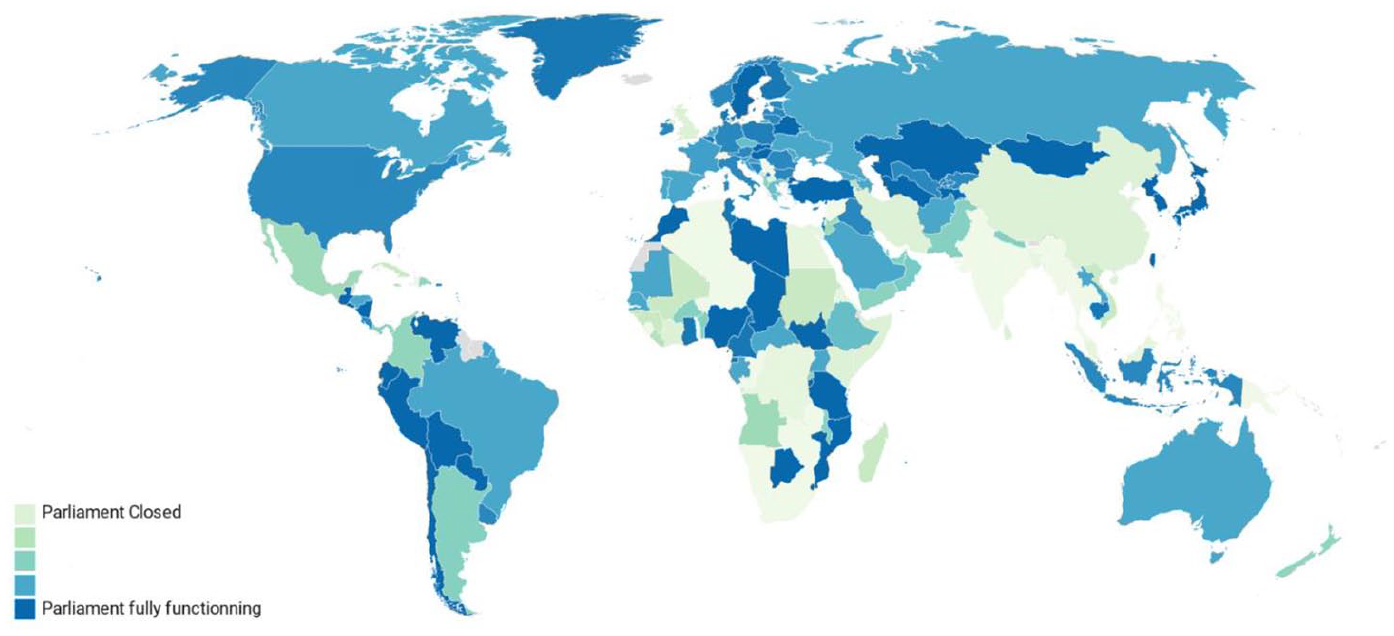
Parliamentary Activity Index (ParlAct Index) on 23 March–6 April 2020.
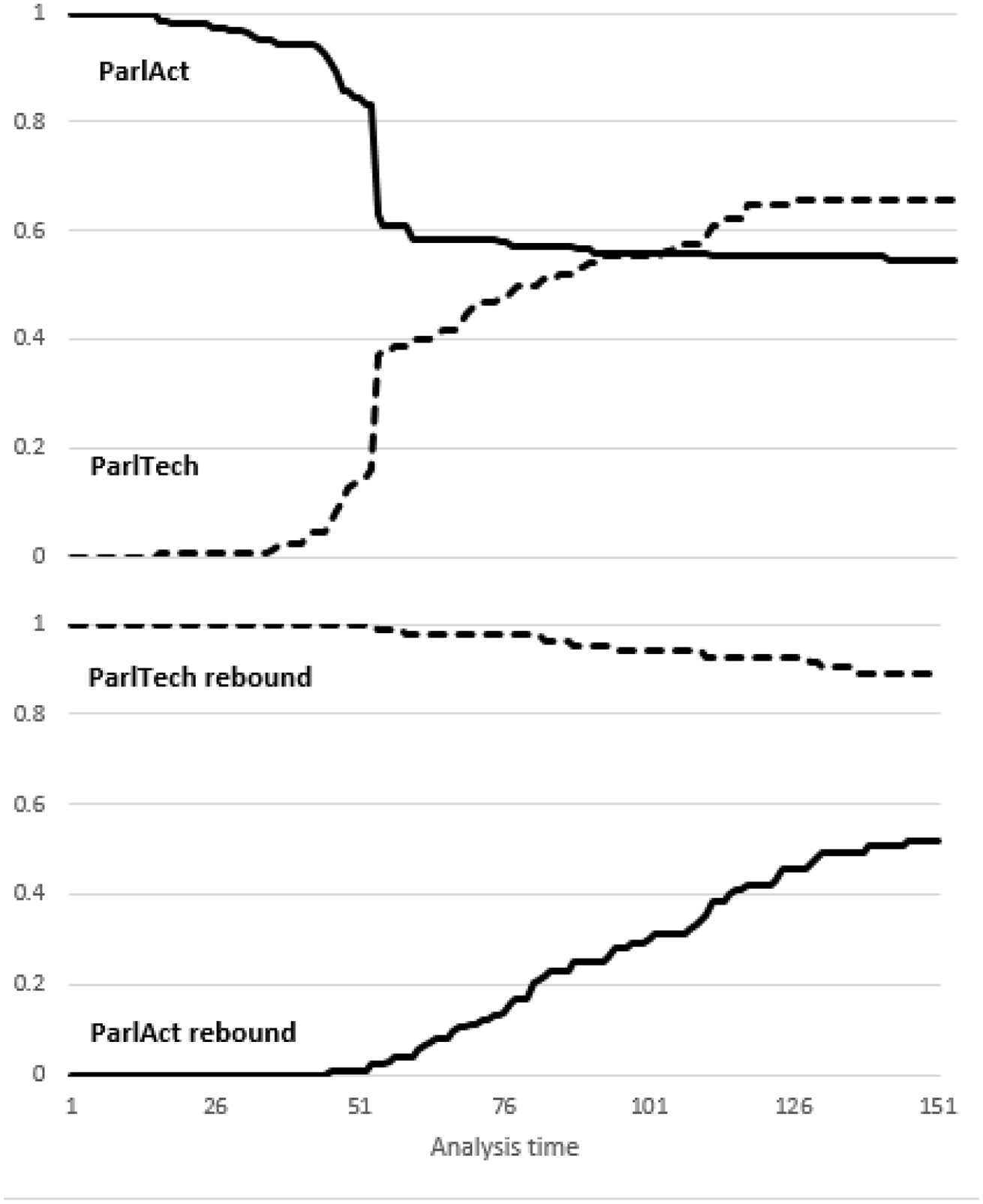
Kaplan–Meier Survivor Functions and Nelson–Aalen Cumulative Hazard Functions for ParlAct and ParlTech, February–June 2020.
Several important findings are notable in Table 1, and Figures 1 and 2. Generally, for all countries, the majority of parliaments remained functioning or partially functioning (Figure 1). Countries have also generally adopted modest technological tools in assisting their work. Figure 2 allows tracking changes in ParlAct and ParlTech across time using Kaplan–Meier survivor functions and Nelson–Aalen cumulative hazard functions and reveals that adoption of technological measures (which appears for about two-thirds of countries at some point during the timeframe) was more widespread than halting of parliamentary activity. Figure 2 also shows a minimal rebound trend for ParlTech alongside a more pronounced temporal trend for ParlAct. A similar picture appears when we produced a graph using the predicted hazard generated using the Cox models presented below. Table 1 shows that partially free countries have noticeably lower ParlAct scores than both full dictatorship and fully free democracies (which had the highest ParlAct score). By contrast, when looking at mortality, we see that fully free countries have experienced the greatest impact of the pandemic during the study’s timeframe. The table also documents notable differences in the strength of parliament and the existence of a coalition government, as well as common predictors of mortality, such as median age and medical spending per capita.
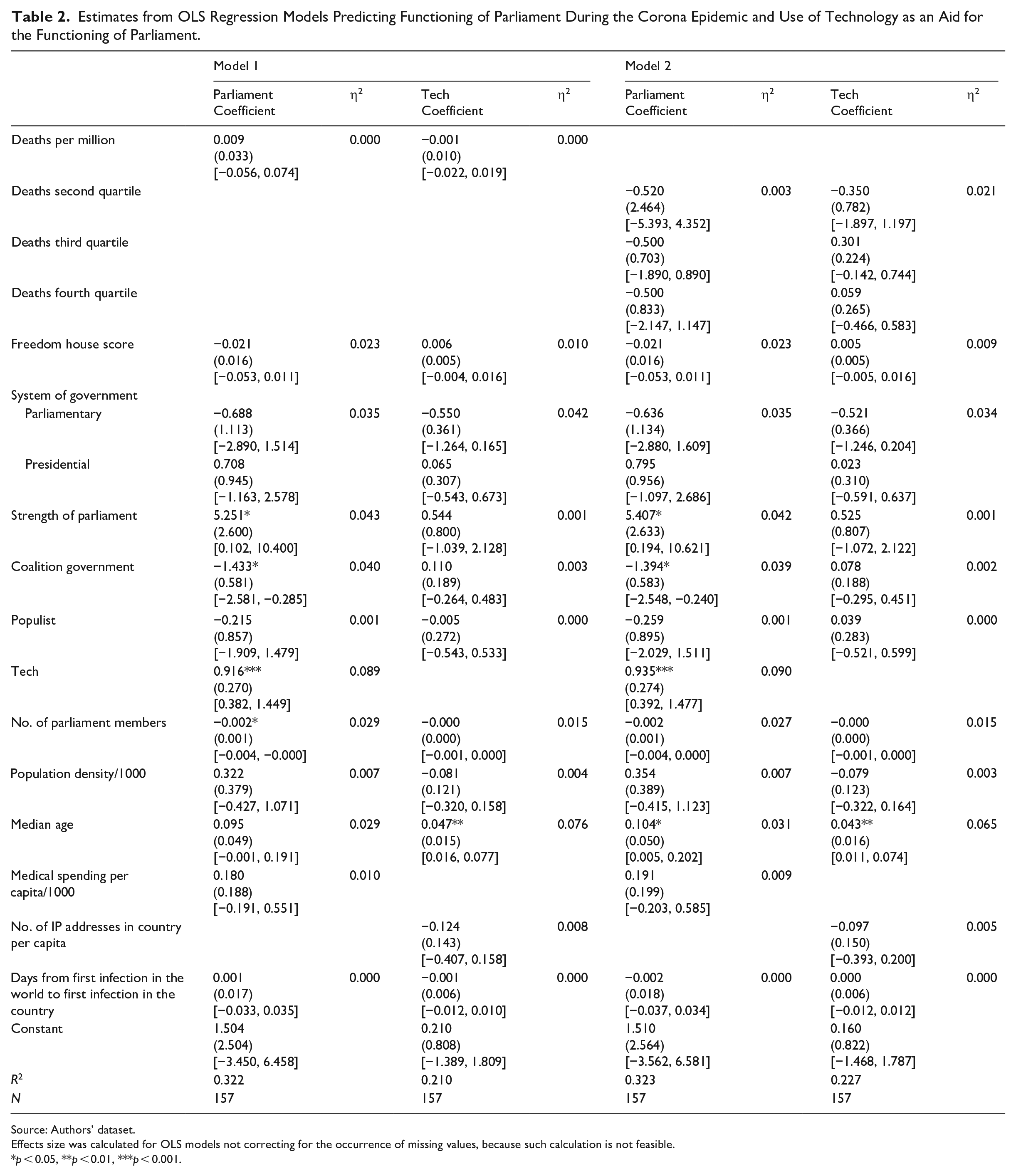
Table 2 presents an initial assessment of the association between mortality and both ParlAct and ParlTech using OLS regression, hence addressing H1. The table additionally provides insights on H2–H4, which relate to the association between the type of institutions, the contingent nature of the government and the use of technological devices with the functioning of parliament. The table contains results from two models. In the first model, mortality is measured continuously, whereas in the second model, we use a categorical measure for mortality to check for potential non-linearity in the association. Results from the Cox proportional hazard models appear in Supplemental Appendix 5. We also present results from an additional Cox model in Supplemental Appendix 8, where we changed the definition of risk onset from an equal point in time for all countries to a country specific point determined by the first reported death. Results from both Cox models were similar. In the text below we highlight similarities and differences between the OLS and Cox models.
Estimates from OLS Regression Models Predicting Functioning of Parliament During the Corona Epidemic and Use of Technology as an Aid for the Functioning of Parliament.
Source: Authors’ dataset.
Effects size was calculated for OLS models not correcting for the occurrence of missing values, because such calculation is not feasible.
p < 0.05, **p < 0.01, ***p < 0.001.
The first main result presented in Table 2 is that mortality does not significantly correlate with ParlAct, as is apparent in both models. Mortality is also weakly associated with ParlTech. Specifically, in model 1, the association between mortality and ParlTech is not statistically significant. In model 2, there is a statistically significant difference in ParlTech only for countries in the third quartile of mortality (p < 0.01), suggesting that association is not linear. Results from the Cox model likewise indicated that mortality is moderately associated with ParlTech. This result is illustrated in Figure 3, which plots the predicted survival function for not experiencing a transition by the level ParlTech. It is evident that parliaments adopting more advanced technological measures have a much lower probability of closing their parliaments.
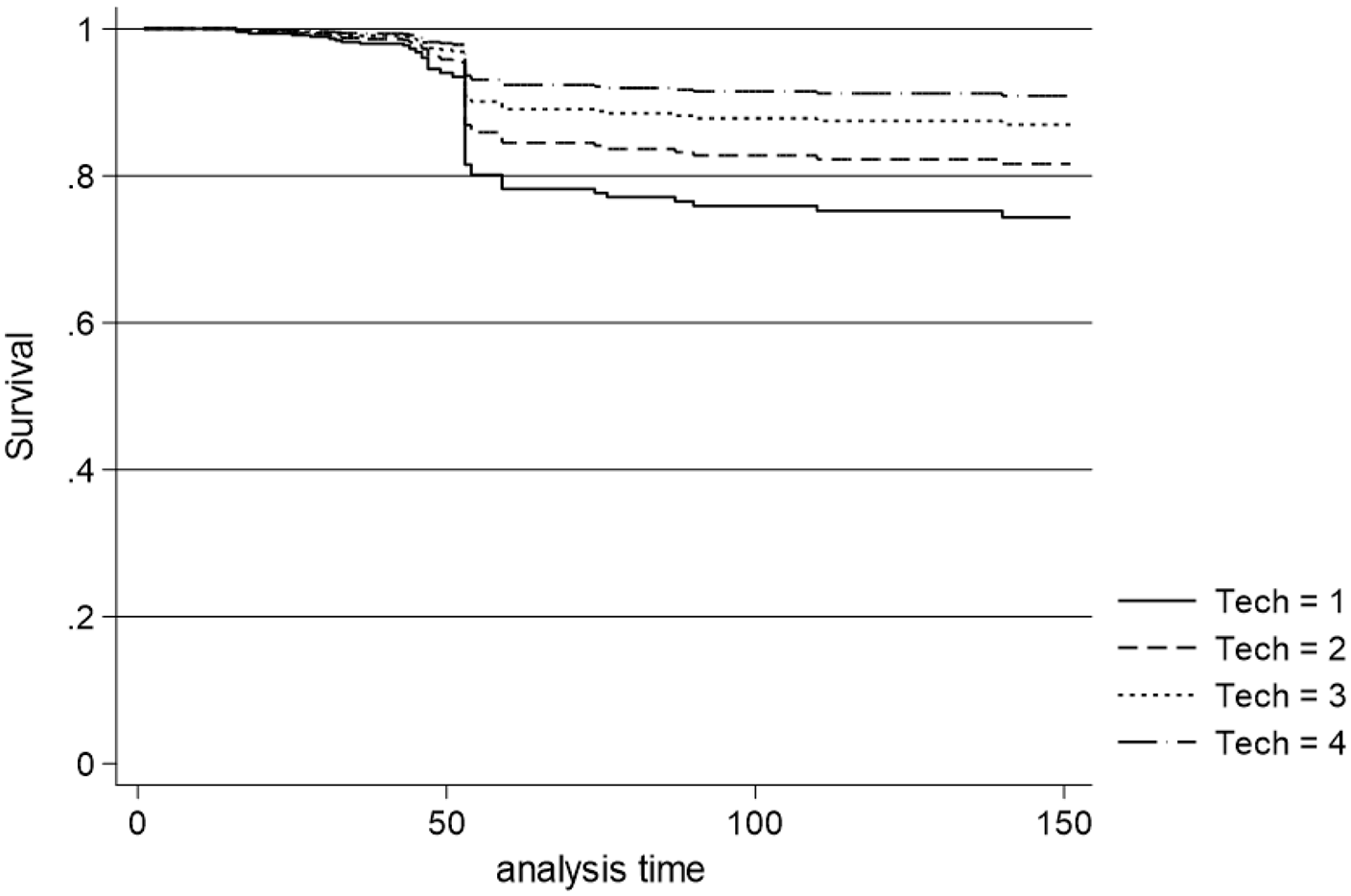
Predicted Survival Function for ParlAct, Showing Any Change from Full Parliamentary Activity, by Levels of ParlTech February–June 2020.
Likewise, FHI and the differences between the systems of government, representing H2a and H2b, are unrelated with ParlAct and ParlTech. By contrast, we do find evidence that the stronger the legislature the higher the parliamentary activity under the pandemic, supporting H2c. Results presented in Table 2 also produce a surprising outcome for H3: in contrast with H3a, parliamentary activity is in fact lower under Covid-19 when governments are made of several parties, while having a populist leader does not seem to shape ParlAct and ParlTech. Notably, we find that when we use ParlTech as a predictor for ParlAct, ParlTech is strongly and statistically significantly associated with ParlAct (p < 0.001). A standard deviation increase in ParlTech (i.e. 1.7) is associated with more than a 1.7 category increase in ParlAct, according to the results from model 2. Results from the baseline Cox model reported in Supplemental Appendix 5 did not show any significant associations when documenting any change in parliamentary activity relating to H2–H3. However, when we focused only on transitions to a state where operation was hampered but continued operating, we documented a lower likelihood of experiencing a transition for parliamentary structures (compared to those characterized by absolute power) and a higher likelihood of experiencing a transition for countries with a coalition government. In addition, in Supplemental Appendix 8, where the onset of risk is specific to each country, we do find a positive association of FHI with ParlTech. In summary, parliamentary activity during this period has been sensitive to the strength of the legislature, as well as to the composition of the government, with the use of technological devices in lieu of physical presence proving to be highly consequential. We turn to Table 3 to elaborate on some of these outcomes.
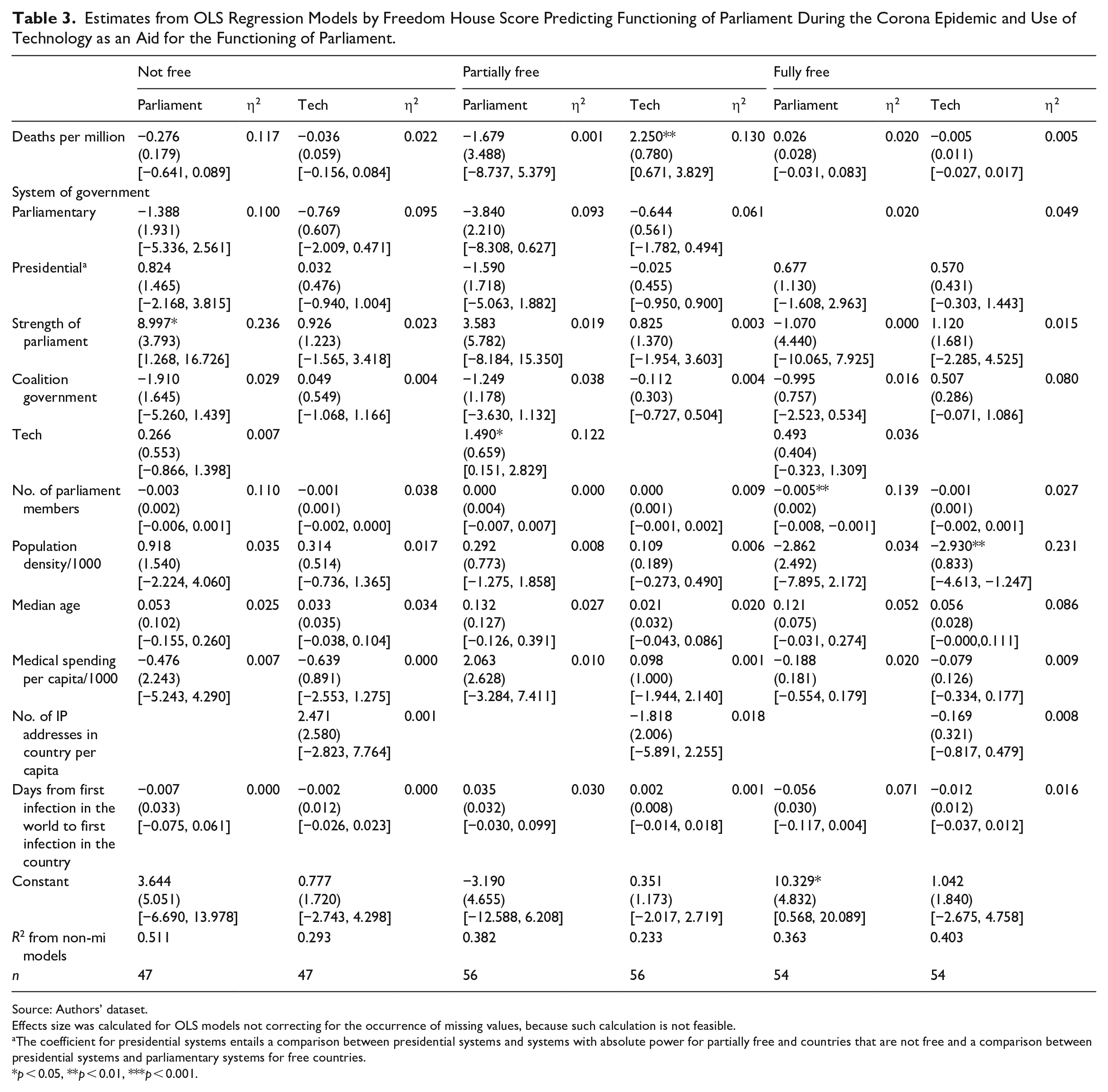
Estimates from OLS Regression Models by Freedom House Score Predicting Functioning of Parliament During the Corona Epidemic and Use of Technology as an Aid for the Functioning of Parliament.
Source: Authors’ dataset.
Effects size was calculated for OLS models not correcting for the occurrence of missing values, because such calculation is not feasible.
The coefficient for presidential systems entails a comparison between presidential systems and systems with absolute power for partially free and countries that are not free and a comparison between presidential systems and parliamentary systems for free countries.
p < 0.05, **p < 0.01, ***p < 0.001.
Table 3 presents results from models that replicated model 1 in Table 2 while distinguishing among countries that are not free, partially free, and fully free democracies. Supplemental Appendix 6 presents a corollary dynamic analysis using Cox proportional hazard models. Due to the small number of countries within each cell, very few coefficients are significant. However, several important findings do emerge. First, results from the OLS model show that ParlTech, but not mortality, is differentially associated with ParlAct, depending on the degree to which the countries are free democracies. Importantly, mortality is not statistically associated with ParlAct for all three types of regimes. Although the effect size for countries that are not free (at 0.128) is higher than that for partially free and free countries, the effect is not significant (p > 0.05). ParlTech, by contrast, is associated with ParlAct only for countries that are partially free. For these countries, the effect size is substantial (0.148) and the impact is positive (p < 0.01), showing that a standard deviation increase in ParlTech is associated with 2.04 change in ParlAct, which is quite substantial considering the mean for partially free countries (5.19). For free democratic countries, neither mortality nor ParlTech are associated with ParlAct. Finally, we see that the impact of the strength of parliament, in line with H2c, is restricted to countries that are not free.
Results from the Cox models differ slightly from those reported in Table 3. Similarly, to Table 3, mortality is not statistically associated with ParlAct for all three types of regimes. However, for partially free and free countries, mortality is positively associated in a statistically significant manner with the likelihood adoption of technological measures.
We performed an extensive set of sensitivity analyses to account for the role of several potential confounding variables (sources for additional variables are presented in Supplemental Appendix 4). As mentioned above, we re-estimated the model presented in Table 2 while replacing FHI with V-Dem liberal democracy index. Results from this model appear in Supplemental Appendix 9, showing a similar null association between V-Dem liberal democracy index and ParlAct or ParlTech. Similarly, we estimated a model replacing the continuous measurement of FHI with a set of dummy variables distinguishing between countries that are not free, partially free and free. We also estimated models where we separately added: a measure indicating whether a state of emergency was declared (Bjørnskov and Voigt, 2020), a measure tracking the stringency of the response of the government to the pandemic (Hale et al., 2020); and the country’s gross domestic product (GDP). We also estimated a seemingly unrelated regression model, where the errors for ParlAct and ParlTech were assumed to be correlated. An additional model excluded countries that are not free and countries with presidential systems.
These models produced results that were similar to those reported above. Specifically, the impact of mortality on the function of legislatures was not significant in all models, while the positive association of ParlTech with ParlAct remained statistically significant in all models, except for the model replacing mortality with excess mortality, potentially due to the limited number of countries for which excess mortality data are available. Finally, we replicated the Cox models while allowing for the coefficients of the independent to vary across time as the pandemic unfolded. Most coefficients remained stable across time, but two notable exceptions emerged in models predicting the hazard of change in ParlAct (results not shown): first, the association of ParlTech with ParlAct was much stronger early on during the timeframe but subsided over time. Second, early during the pandemic, populism was negatively and significantly associated with the hazard of halting parliamentary activity, but the direction of the association changes as time unfolded, becoming positive at later periods during the pandemic.
Discussion
The most important and surprising finding is that there is no apparent relation between the severity of the disease and the decision to close parliament or limit its operation. In other words, H1 is unsupported. The models in Table 3 and Supplemental Appendix 5 indicate that saliency of the health crisis is not statistically significant for any of the three groups of countries. In fact, the majority of the most severely inflicted democracies at the time, like Belgium, Germany, Italy, and the United States, kept legislative business as usual or close to it. In contrast, in countries like Gambia and Zambia, parliaments were suspended indefinitely, barely a day after confirming the first cases of the virus (Darboe, 2020; Frey, 2020). Our findings suggest that parliaments may be shut down too quickly, without a sufficiently rational, evidence-based risk assessment that will ensure that the extreme measure of closing parliament is a necessary and proportional response to the severity of the health risk. These findings fit the theoretical risk perception scholarship that argues that Covid-19 embodies many of the characteristics that are likely to lead to miscalculations (Alemanno, 2020; Chakraborty, 2020). As Aven and Bouder (2020: 3) explain, with the pandemic’s newness and dread “the risk is amplified, and there is a potential for overreaction.” Our findings are in concert with the broader policy studies literature about disproportionate policy responses, and particularly with the line of scholarship that focuses on psychological explanations for unintentional disproportionate policy responses (Maor, 2021). Yet, as we shall see, the results also support theories about intentional disproportionate policy responses in general, and theories about strategic exploitation of emergencies in particular (Maor, 2020, 2021), including recent theoretical claims about intentional executive overreaction in the Covid-19 context (Bjørnskov and Voigt, 2020; Maor, 2020).
In this regard, the case of the 56 legislatures in FHI “partially free” countries is especially interesting. These legislatures have suffered the most from the crisis (mean ParlAct score of 5.3). This may be explained by their vulnerability. On one hand, they do not enjoy the safeguards of established or fully free democracies. On the other hand, they tend to pose a greater constraint on their executives than in fully autocratic regimes, and may be the last institution standing in the way of leaders with autocratic tendencies from dismantling democracy. The Serbian President, for example, in violation of the constitution, proclaimed an open-ended state of emergency and suspended parliament, while seizing extraordinarily broad powers (Associated Press, 2020). The prime minister of Lesotho, under investigation for murdering his wife, shut down parliament despite having no Covid-19 cases in the country (Africanews, 2020). These findings corroborate scholarship arguing that disproportionate limitations on parliamentary activity may be viewed as intentional efforts to “sabotage accountability” (Glasius, 2018), and can be associated with authoritarian tendencies and democratic backsliding (Lührmann et al., 2020; Maerz et al., 2020).
This descriptive finding regarding “partially free” countries, as well as the descriptive finding that the group of 54 “fully free” democracies on FHI also had the highest ParlAct score (mean score of 7.9), is not surprising. This corroborates descriptive findings in the work of Ginsburg and Versteeg (2020: 23), who found “an important difference between democratic and autocratic countries” in the role played by legislatures during the pandemic.
In contrast, results for the 49 countries in FHI’s “not free” category are quite surprising. Legislatures in these countries were significantly more active (mean ParlAct score of 6.5) than in partially free countries. We offer two possible explanations. One is that leaders in these countries tend to be less transparent about the state of Covid-19 and even deny its existence (Larson, 2020). Suspending parliament would entail admitting a dire health situation. Indeed, several of the “not free” countries, such as Belarus and Turkmenistan, which received a ParlAct score of 10 in our study, were headed by autocratic leaders that are infamous “virus deniers” (York et al., 2020). The second explanation is that many dictatorial or quasi-dictatorial leaders are not constrained by their weak legislatures (Gandhi, 2008). Posing no threat to their leadership, these rulers may grant such parliaments the permission to continue business as usual. Yet, even within the “not free” group, there are some countries in which the mere existence of a legislature may be a source of constraint (Gandhi, 2008). This explains why some leaders embraced the opportunity to restrict parliamentary functioning, and why legislatures in this category are still significantly less active than in free countries.
While the descriptive findings for fully free and partly free countries (but not for not-free countries) suggest an association between the regime type and the operations of legislatures, our more detailed analyses via regression models suggest that, overall, the strength of democracy did not necessarily determine the level of operation of legislatures (with the exception that the model where the onset of risk is specific to each country, found a positive association of FHI with ParlTech). H2a regarding the state of democracy was not confirmed by these analyses. In this respect, our results are in concert with Maerz et al. (2020) who observed democratic violations during the pandemic “in dictatorships and democracies alike, with a high degree of heterogeneity within and across regime types,” finding “a weak association at best” between the level of democracy and democratic violations. It is also in line with Bjørnskov and Voigt (2020) who found that the level of democracy is not a significant predictor for declaring a state of emergency during Covid-19 (albeit democracies are less likely to repress media freedoms during the state of emergency).
Overall, our findings are mitigated regarding the impact of institutional variables on the functioning of parliament. None of the three hypotheses related to H2 were confirmed in our models: be it the state of democracy (H2a), the parliamentary nature of the regime (H2b) or the global strength of the parliament (H2c). All things being equal, institutional factors do not seem to be determinative in the decision to limit parliamentary activities. Yet, the descriptive results for Table 1 draw a subtler picture. Legislatures from the intermediary group in terms of democratic development are the most affected by the pandemic. It also appears that the stronger a legislature the more its activity remained opened. Last, parliaments are more active within parliamentary regimes only within totally free countries. All this suggests that subtler processes are at play within countries, such as interactions between the FHI measure and additional institutional variables, including the degree of institutionalization of a given legislature, its preexisting institutional capacities and technological capabilities, and the flexibility and adaptability of its legislative rules, and so on (Bar-Siman-Tov, 2020). Another possibility is that the regime type and other institutional variables account for a partial share of this variation, because they are relevant to only one of the threats we identified to the operation of parliaments during the pandemic. That is, the regime and institutional variables may impact the vulnerability of legislatures to the executive’s exploitation of the crisis to sabotage accountability. However, even strong legislatures in stable democracies are not immune from biased risk perceptions and excessive fears that may lead them to adopt disproportionate limitations on their operation. At the same time, even weak legislatures in non-free countries may remain open due to autocratic leaders’ short-shrifting the severity of the pandemic.
Results regarding the contingent type of executive power (H3) are mixed. We expected that it may be harder for coalition governments to close their parliament (H3a). Our models indicate exactly the opposite. This may be due to the fact that health crises are probably different in nature from other kinds of legislative decisions. Risk perceptions and positions about policy responses to risks differ across cultural and political groups and as a function of their variety (Kahan et al., 2006). Hence, while in regular times, a multi-party coalition government leads to moderation and the status quo (Eskridge, 2012), facing questions of life and death, including the life and death of MPs themselves, any of the coalition parties has veto power to limit legislative activities. Moreover, legislators tend to be inherently risk-averse, because of their motivation to insulate themselves from blame and because they are more likely to be blamed (and suffer electoral repercussions) for under-reaction to risks than to overreaction (Finn, 2009). The rational anticipation of a future blame gives a disproportionate influence to the parties supporting to reduce legislatures’ activities.
Our findings about the populism hypothesis (H3b) are complex and generally not confirmed. The baseline Cox models showed that having a populist leader does not seem to lead to decreased parliamentary activity. However, Cox models that allowed for the coefficients of the independent variables to vary across time did confirm that populism was negatively and significantly associated with the hazard of halting parliamentary activity early during the pandemic, but became positive as time progressed. These finding challenge common assumptions in the literature that populism increases the risk of democratic backsliding, particularly during crises (see Kavakli, 2020). We offer two possible explanations for our finding. First, it in fact supports recent arguments that during the Covid-19 crisis, many populist leaders, like Trump and Bolsonaro, exhibited executive under-reach rather than overreach (Pozen and Scheppele, 2020). Growing literature suggests that populist leaders around the world tended to underplay the risk of Covid-19 and resisted calls for taking health measures to meet the risk (e.g. Falkenbach and Greer, 2020). A populist leader’s dismissive view of the pandemic should also reduce the risk of his exploitation of the pandemic as an excuse to shut down the legislature, since it necessitates admitting the severity of the health crisis—something many populist leaders are reluctant to do. A second possible explanation is that even if some populist leaders, such as Orbán, do show signs of executive overreach and democratic backsliding, they do not necessarily shut down legislatures; either because they have firm control over parliament (Drinóczi and Bień-Kacała, 2020), or because they prefer other means to sabotage accountability, namely, restrictions on media and government misinformation (Bjørnskov and Voigt, 2020; Kavakli, 2020; Kenny, 2020; Maerz et al., 2020).
Last but not least, H4 on the use of technological devices has been confirmed by our models. All else being equal (including whether a country is highly connected to the Internet or not), legislatures that have been able to organize themselves through remote digital devices tend to be more active. For “partially free” countries, our models indicate that the capacity of these legislatures to operate through technological means constitutes a key factor in maintaining at least partial parliamentary operation. This finding fits nicely with recent scholarship that highlights the central role of digital solutions in enabling legislatures to adapt to the pandemic (Griglio, 2020; Rozenberg, 2020; Williamson, 2020).
Generally, our study demonstrates the resilience and adaptability of legislatures in the face of crises. As Figure 1 demonstrates, during the main period of the initial shock, about 10% of legislatures worldwide shut down completely, while many more reduced their activity. Yet, as time passed, we see in Figure 2 a clear rebound of legislatures reopening and resuming activity. This demonstrates legislatures’ resilience, and bolsters recent theoretical claims in the scholarship that legislatures are resilient institutions (Benoît and Rozenberg, 2020). Our study also demonstrates parliament’s adaptability, as they learned to operate under the Covid-19 threat. This adaptation is clearly manifested in our study in legislatures’ use of technology, and its role in resuming parliamentary activity. This is an important finding, as it challenges traditional accounts of legislatures as traditionalist institutions that are slow and reluctant in undertaking institutional changes, and particularly reluctant in adopting technological solutions (Goodwin and Atkins, 2018).
More importantly, our findings provide a nuanced contribution to debates on institutional change and arguments about the role of crises, shocks or critical junctures (for recent reviews of these debates, see Gerschewski, 2021; Meakin and Geddes, 2022). On one hand, our findings on the quick and relatively widespread adoption of technological solutions in response to Covid-19 provides a powerful demonstration that exogenous shocks can play an important role in triggering and facilitating change. These findings provide particularly illustrative support to claims that crises can help overcome resistance to change, because parliaments are a prime example of organizations where digitalization is significantly hindered by bureaucratic culture and resistance to change (Bar-Siman-Tov, 2020; Fallon et al., 2011; Koryzis et al., 2021).
On the other hand, our findings on the factors influencing ParlAct lend strong support to critics of neo-institutionalism who emphasize the limits of exclusively exogenous accounts of institutional change (Meakin and Geddes, 2022). We showed that the continuation of activity within legislatures obeyed first to internal logics, such as pressure from coalized groups, rather than external ones. Especially, we have demonstrated that there is no systematic relation between the severity of the health threat and the functioning of legislatures. For some, it would mean that parliaments are resilient institutions, able to resist external shocks, while for others, it means that executive leaders may make an opportunistic use of the crisis: forcing legislatures to close when it is not deemed necessary. At any rate, we believe that our study provides support to the view that studying legislative behavior, and institutions more broadly, requires a nuanced approach that examines the interactions between exogenous shocks, internal institutional factors and broader institutional settings.
Conclusion
Covid-19 posed a significant global shock to governance systems and a particular challenge for legislatures. In general, our comparative analysis of the functioning of legislatures worldwide during the first wave of Covid-19 in 2020, tends to contradict the gloomy warnings issued at that time: many legislatures remained open, others re-opened rather quickly after the initial shock, and many were keen to adopt technological solutions to continue working despite the health risks. Yet, this rather optimistic conclusion should not hide other ones, more worrying from a democratic standpoint. Even in stable democracies, some legislatures were prone to overestimating the risk and to policy overreaction. In fragile democracies, some authoritarian leaders used the excuse of the pandemic to silence or limit their legislatures. Others avoided going in that direction not because parliaments were fighting back to remain active but as these leaders wanted to avoid publicly recognizing the spread of Covid-19. These results, as well as the negative effect of coalition cabinets, suggest that the very functioning of legislatures may constitute, for the majority, a signal tool targeting public opinion. A further theorization of the politics of opening (and closing) legislatures could be therefore developed integrating not only health crisis but also wars and terrorist attacks. There is indeed a symbolic dimension to closing or opening parliament, which partly explains the lack of proportionality of the institutional answers to the threat caused by an external chock.
Our study offers a nuanced contribution to debates on institutional change and to arguments about the role of crises, shocks or critical junctures, while also providing interesting findings on the role of digitalization in parliamentary activity and legislatures’ surprising receptiveness to adopting technological solutions. Our study further suggests that the relationship between parliamentary activity and factors such as the state of democracy, the strength of legislatures, the existence of coalition governments, and populism, might be more complex than initially expected.
Future studies can further investigate the complex interactions between exogenous shocks, internal institutional factors and broader institutional settings. Future studies can also explore the longer-term effects of Covid-19 after the initial shock has waned. It would be interesting to examine, for example, to what extent changes in procedures and the increasing use of digital solutions would persist after Covid-19. Additional studies could complement our large-scale quantitative study by undertaking case studies of legislatures in specific jurisdictions, allowing a more in-depth investigation of how legislatures performed their various functions after they were able to resume operation. Covid-19 has certainly provided an unprecedented opportunity for such studies.
Supplemental Material
sj-docx-1-psx-10.1177_00323217221090615 – Supplemental material for Should I Stay (Open) or Should I Close? World Legislatures during the First Wave of Covid-19
Supplemental material, sj-docx-1-psx-10.1177_00323217221090615 for Should I Stay (Open) or Should I Close? World Legislatures during the First Wave of Covid-19 by Israel Waismel-Manor, Ittai Bar-Siman-Tov, Olivier Rozenberg, Asaf Levanon, Cyril Benoît and Gal Ifergane in Political Studies
Footnotes
Acknowledgements
The authors wish to thank the 172 experts who sent them reports about their countries. For helpful comments and advice, they thank Ori Aronson, Reuven Cohen, Johannes Freudenreich, Lanny W. Martin, Moran Ofir, Oren Perez, Roy Rosenberg, Yaniv Roznai, Ayelet Sela, Ronit Waismel-Manor, the anonymous reviewers, and participants in the annual conference of the Israeli Association of Legislation, the public law workshop at Bar Ilan University, the public law workshop at the Hebrew University, the public law workshop at the Interdisciplinary Center (IDC), and the faculty seminar at the IDC. They are grateful to their research assistants: Tair Ben Zeev, Itay Cohen, Ori Harari, Itamar Hashash-Daniel, Eyal Kanfi, Chani Kot, Yuval Maor, Evgeny Saburov, and Nina Stepanets.
Declaration of Conflicting Interests
The author(s) declared no potential conflicts of interest with respect to the research, authorship, and/or publication of this article.
Funding
The author(s) disclosed receipt of the following financial support for the research, authorship, and/or publication of this article: This research was supported by a research grant from the Israeli National Institute for Health Policy Research (#2020/553).

Supplemental Material
Supplemental material for this article is available online.
Appendix 1: List of Experts.
Appendix 2: Questions for Experts’ Substantive Report About the Current Operation of Their Legislature and Follow-Up Survey Assessing the Legislative Activity in Their Country of Expertise According to ParlAct and ParlTech Indices.
Appendix 3: Comparative Reports from International and National Parliamentary Research Centers on Parliamentary Activity During the Covid-19 Outbreak.
Appendix 4: Description and Source of Information for the Study’s Control Variables.
Appendix 5: Estimates from Cox proportional hazard models predicting the hazard of changes in ParlAct and ParlTech, February 2020–June 2020.
Appendix 6: Estimates from Cox Proportional Hazard Models Predicting the Hazard of Changes in ParlAct and ParlTech by Freedom House Score, February 2020–June 2020.
Appendix 7: Predicted Survival Function and Cumulative Hazard Functions for ParlAct and ParlTech, February 2020–June-2020.
Appendix 8: Estimates from Cox Proportional Hazard Models Predicting the Hazard of Changes in ParlAct and ParlTech While Defining Risk Onset for Each Country Based on the First Reported Death in Each Country, February 2020–June 2020.
Appendix 9: Estimates from OLS Regression Models Predicting Functioning of Parliament During the Corona Epidemic and Use of Technology as an Aid for the Functioning of Parliament, While Replacing FHI Scores with V-Dem Liberal Democracy Index.
Author Biographies
References
Supplementary Material
Please find the following supplemental material available below.
For Open Access articles published under a Creative Commons License, all supplemental material carries the same license as the article it is associated with.
For non-Open Access articles published, all supplemental material carries a non-exclusive license, and permission requests for re-use of supplemental material or any part of supplemental material shall be sent directly to the copyright owner as specified in the copyright notice associated with the article.
