




Abstract
Ideas about what makes a ‘good citizen’ continue to evolve alongside the digitalisation of political participation. We examine these interrelated trends through an in-depth analysis of the normative basis for contemporary online petitioning. This article uses original survey data in Australia and Germany to confirm the emergence of distinctive ‘contribution’ citizenship norms which emphasise the importance of sharing content through networked communications infrastructures. We then examine the relationship between these novel citizenship norms and online petitioning, differentiating online petitioning along two dimensions of mode (signing versus sharing) and frequency. First, we find ‘contribution’ norms are more associated with sharing online petitions than signing them. Second, ‘contribution’ norms are more associated with high-frequency sharing and signing, as opposed to more casual instances of participation. In combination, these findings show that contribution norms are distinctively associated with more intensive forms of online petitioning (e.g. frequent sharing), while more casual forms (such as casual signing) are supported by a more diverse range of normative orientations. We conclude that the way citizens engage with online petitions reflects, in part, their normative orientation to contributing information towards networked communication infrastructures.
Petitions have long been one of the most common ways for people to expressively participate in democratic politics and collective action, even more so over the later decades of the twentieth century (Norris, 2002). This form of collective action has grown in popularity for citizens and increasingly takes place online (Cameron and McAllister, 2020; Sheppard, 2015). The digitalisation of petitioning is produced by a wide range of actors reacting to the new opportunities presented by low-threshold online participation: governments attempting to increase responsiveness and build legitimacy (Bochel and Bochel, 2017; Wright, 2012); companies like Change.org pursuing a revenue model based around user growth; citizens seeking new ways to influence politics (Wright, 2016); and organisations running campaigns to mobilise their supporters (Chadwick and Dennis, 2017). Some core features of petitions in the transition from offline to online remain constant, in that they articulate collective demands addressed to decision makers, often on behalf of disadvantaged groups (Tilly, 2008). Yet online petitions are also shaped in particular ways by their digital communications context. For example, the cascading diffusion of online petitions relies heavily on a social media logic of sharing (Margetts et al., 2016), and is enabled by intentionally designed digital petition platforms that have proliferated over the last decade or so (Karpf, 2016).
In any explanation of the prevalence of particular forms of political participation, one of the key factors alongside demographics is an individual’s expectation of what it means to be a ‘good citizen’ – namely, their citizenship norms. However, just as participatory affordances have evolved in recent years, so too have citizenship norms and their academic conceptualisations, with evidence for a shift from ‘dutiful’ to ‘engaged’ citizenship (Bennett, 2008; Dalton, 2008). For advanced democracies, this implies a development away from delegation of politics to elites to the desire for political self-expression, and valuing a commitment to voluntarily helping others and communities. This shift in citizenship norms is often found to be generationally specific; young people generally tend more towards engaged norms and individualised and social movement-driven forms of political engagement (e.g. Ahmadu et al., 2016; Coffé and Van der Lippe, 2010; Copeland, 2014; Dalton, 2008). According to this framework, petitions in general have been firmly identified as driven by engaged rather than dutiful citizenship norms.
Current research about the relationship between norms and petitioning faces a challenge in capturing possible change along both dimensions within the same study. On the one hand, studies focusing on citizenship are often sensitive to different and novel norms while referencing ‘petitioning’ as a static act without differentiating between offline and online forms (e.g. Dalton, 2008; Oser and Hooghe, 2018). In part, this is a natural consequence of the path dependency of survey design, since items in major surveys like the European Social Survey have continued to ask for many years about simply ‘signing a petition’. The consequence, however, is some ambiguity about the case of online petitioning. Is it petitioning, or online activism, which is often measured by separate survey items and assumed to follow its own particular dynamics, especially with regard to citizenship norms? On the other hand, studies focusing on participation sometimes differentiate between online and offline petitioning but tend to either not discuss citizenship norms at all (e.g. Cantijoch et al., 2016; Gibson and Cantijoch, 2013), or else treat norms in a relatively undifferentiated way, such as Theocharis and Van Deth’s (2018) sole predictor of the norm of ‘being active in politics’, with the result that explanatory models focus on demographic factors. We take the position that demographic-based explanations may be limited in explaining the recent popularity of online petitioning, given its appeal is closely tied to its low-threshold entryway to action. Rather than demographics alone, we expect this form of digitally networked action to be motivated in part by novel norms expressing a general commitment to horizontal relationships of mutual exchange and political expression.
Just as Theocharis and Van Deth take an ‘expansive’ view of political participation, we hope to take a similarly expansive view of citizenship norms, thereby enabling a clearer picture of how these two fields relate to one another. In particular, we argue that norms are shifting under conditions of habitual and intensive social media use for political information (Newman et al., 2020). Mass and interpersonal forms of communication coalesce through social media use, and individual engagement with politics happens under the constant observation of fellow users, in turn shaping users’ expectations of citizenship. Embedded in a communication system that provokes and rewards sharing of content, we develop the argument that citizens conceive that ‘good citizens’ share meaningful information in social media environments, similar to obeying laws, or contacting a politician. A central aim of this article is to look for evidence of these novel norms and explore the impact that a new understanding of citizenship as active contribution and sharing can have on signing online petitions.
Our study is designed, then, to more fully understand the factors behind online petitioning by analysing their relationship with citizenship norms. This design enables us to test, for example, whether we observe this increasingly common, digitally networked form of participation driven in particular by networked citizenship norms of contribution, or whether the mainstreaming of online petitioning means that it expresses a broad range of citizenship norms. We have developed a theoretically driven framework, building on political participation literature, including the known influence of political predispositions and socio-economic status on political behaviour. We then test this framework via original survey data and apply a comparative design through conducting the study in two advanced democracies, Australia and Germany. Our comparative research design allows us to examine similarities and differences in online petitioning between advanced democracies with relatively higher uptake of social media use (Australia) and relatively lower uptake (Germany). In this way, our results contribute more generalisable findings to the debate on shifting explanations for political participation given that we would expect some differences in participatory behaviour between countries but broader similarities in the latent structure of citizenship norms.
Our findings show that the role of citizenship norms depends on the form of the online petitioning. In particular, we differentiate between more and less demanding forms of online petitioning according to two dimensions: the action (signing versus sharing) and the frequency (casual versus frequent). We observe that in its least demanding forms, online petitioning is positively predicted by a wide range of citizenship norms. In its most demanding forms, such as high-frequency sharing, contribution norms are the strongest positive predictor, while autonomy norms are negatively associated. We argue that these findings demonstrate the particular role for novel contribution norms in the intensive forms of digitally networked participation, as well as the utility of differentiating between the specific uses of digital affordances for contemporary participation research.
Literature Review and Theoretical Framework
The Development of Novel Citizenship Norms
A key assumption in existing research is that an individual’s norms about what constitutes good citizenship will influence their political participation. Exploring individual norms has a long history in comparative survey-driven political culture research, inspired by Almond and Verba’s book published in 1963, The Civic Culture. The most influential conceptual framework for understanding contemporary citizenship norms is Dalton’s (2008) operationalisation of ‘dutiful’ and ‘engaged’ citizenship, which has been adopted, tested and debated widely (e.g. Ahmadu et al., 2016; Coffé and Van der Lippe, 2010; Copeland, 2014). In short, Russell Dalton (2008: 79–82) explains that citizenship norms are a set of attitudes or predispositions individuals have about what it means to be an active citizen within democratic polities. Dutiful citizenship norms include positive attitudes towards voting in elections as well as maintaining the social, institutional order through obeying laws, reporting crimes and serving on a jury. In contrast, engaged citizenship norms focus on positive attitudes towards active forms of political participation, working in solidarity with others in voluntary groups, including supporting those worse off; as well as autonomously forming opinions, that is, independently of others. The emergence of engaged citizenship norms that are more participatory and expressive has been heralded as a shift towards individualised and direct forms of political action (Dalton 2008: 86). Studies have already found a relationship between engaged citizenship norms and petitioning (Chang, 2016; Dalton, 2008), as well as between engaged norms and interactive digital media use in general (Bennett et al., 2011; Shehata et al., 2016).
However, the model of dutiful verses engaged citizenship has been challenging for researchers to operationalise consistently. In particular, researchers have aggregated and disaggregated sub-categories of engaged norms in a variety of different ways. Even when Coffé and Van der Lippe (2010) operationalise one engaged norm factor, they note that it incorporates two norms which will become particularly relevant for our study: solidarity (typified by valuing showing support for others) and autonomy (particularly emphasising forming an independent opinion). Kotzian (2014) meanwhile disaggregates engaged and solidarity norms into separate factors. At the most granular level, Bolzendahl and Coffé (2013) model the influence of individual norm survey items after finding that the Dalton model did not fit their data. Mindful of this diversity of approaches, we do not introduce this literature to set up a particular model to validate, but rather to set up the conceptual landscape into which novel citizenship norms might enter.
Our main focus, then, is our expectation around the growth and impact of novel ‘contribution’ citizenship norms, which may be developing alongside shifting media use habits around social media platforms, and their potential influence on online petitioning. Users experience social media through what they perceive as ‘being possible’ with platform-imposed technological features, otherwise known as platform affordances (Bucher and Helmond, 2017). For example, the ‘share’ button viewed from one perspective offers social engagement with peers and from another perspective offers the possibility of mobilising citizens in community engagement or wider social action (information sharing and getting involved in a reciprocal relationship are key drivers of content sharing on social media; see, for example, Kümpel et al., 2015). Neither are perceptions of technical platform features, but instead illustrate how users imagine what social media can actually enable in terms of diverse goals related to entertainment, information or, in this case, for social change and democracy. Such affordances enable what Picone et al. (2019) have called small acts of engagement (see also Halupka, 2018 on ‘clicktivism’).
In a study based on qualitative interviews with young social media users in Germany, participants generally appreciated social media for opening up the discourse (Gagrcin et al., 2020). Based on their daily social media experiences, the study identified new standards and valuations of what young users expect from civic communication on social media. Some of those standards are backed by a deep commitment to a culture of sharing (John, 2017) and are rooted in the norm of contribution. This means that sharing content is, first of all, generally perceived positively. However, this novel norm is more complex than simply circulating news and other political items indiscriminately. Participants were also concerned with too much content polluting the online environment, especially if content that individuals posted or shared was believed to be destructive, uncivil or spreading disinformation. Thus, individuals supportive of contribution norms emphasised that a ‘good citizen’ should take care about the political content he or she wants to share, for instance, through paying attention on how nuanced and well-argued their shared opinions are (Comunello et al., 2016). Contribution thus includes a behavioural side in terms of sharing political content and a cognitive side in terms of checking and elaborating such content. Both sides were regarded as potentially contributing to the public discourse. In terms of the current article, following the norm of contribution could mean perceiving petition signing and sharing as enriching information and opinion formation under social media conditions, such as through networked campaigns organised around easy-to-share hashtags, videos or calls to action. Citizen expectations around the potential efficacy of aggregated micro-acts of participation are very relevant to online petitioning, given the interpenetration of petition platforms and major social media sites, especially Facebook.
The rise of contribution norms is an expectation that needs to be empirically validated, particularly in terms of estimating their prevalence. However, we do not expect contribution norms to be a feature particular to the digital avantgarde only. Instead, as social media use becomes the new normal (Newman et al., 2020) and even very basic experiences with social media and their affordances form democratically relevant expectations of a ‘good citizen’, we expect that contribution norms can be adopted by broad sections of the population. Contribution norms may, however, share some similarities with other norms. In particular, similarity with engaged citizenship is evident through contribution norms’ emphasis on individual expressive action outside formal institutional political arenas. In addition, dutiful citizenship norms and contribution norms may share some common ground through an implicit sense of responsibility to a wider good, whether taking care about what to share online (as with contribution norms) or feeling obliged to follow institutionally set rules (as with dutiful norms). Although contribution norms are distinctively associated with changing patterns of media use and a resulting commitment to distributed agency via networked media, empirical validation should therefore remain sensitive to the possibility of significant relationships between norm types.
Against this background, our theoretical model seeks to distinguish between contribution norms and other kinds of citizenship norms. Given that contribution norms place value on sharing meaningful content among wider publics, we hypothesise contribution citizenship norms will be more predictive of signing and sharing online petitions, compared with other kinds of norms (H1).
Other Factors Explaining Online Petitioning
In addition to underlying citizenship norms, we expect that social media use itself will be predictive of online petitioning. This partly reflects the primary mechanism for exposure to online petition content. While users can visit petition websites or respond to email links, social media is important for leveraging motivation and social visibility, enabling the reach of online petitions (Margetts et al., 2016). The more frequently an individual engages with social media platforms, especially Facebook, the more likely they will be exposed to online petition content. The corollary has also been found to be true, namely that limited access to digital media will be associated with lower rates of online petitioning (Elliott and Earl, 2016). In addition to this concrete exposure mechanism, social media use has been found to be associated with increased political participation in general (Gil de Zúñiga et al., 2014), and digital media use can shape an individual’s general preferences for participation in more expressive and cause-oriented activism (Copeland and Feezell, 2017; Shehata et al., 2016). Based on both concrete exposure mechanisms and broader participatory preferences, we therefore include several control variables measuring social media to isolate the role of citizenship norms.
While online petitioning is a popular political action across the globe, different national contexts may influence engagement in online petitioning. Furthermore, much of the existing systematic research into the efficacy and development of online petitioning as individual political participation is based on the dominant cases of the UK and USA. In this article, we compare and contrast signing and sharing online petitions in Australia and Germany; two advanced democracies that have core differences around both the adoption of, and attitudes towards, digital technologies, and the political context for the development and consolidation of online petitioning. We conceptualise the impact of context in terms of both the demand for and supply of online petitioning. In terms of the demand side, we can expect higher use of digital media to create higher overall demand for online petitioning among individual users. Specifically, Australians are online and use social media more than Germans. The Digital News Report shows that 77% of Australians use Facebook compared with 49% of Germans, while 19% of Australians use Twitter compared with 13% of Germans (Newman et al., 2020). While Australians have been early and enthusiastic adopters of digital technologies, Germans have been comparatively more reluctant, given their specific privacy concerns about sharing data online, and a more heightened conversation about and history of surveillance (Hucal, 2016; Prince and Wallsten, 2020).
In terms of the supply side, each country has a different collection of platforms which enable online petitioning. In particular, Germany has since 2008 had a well-established and successful parliamentary online petition site, which has long been the subject of both popular debate and academic research (e.g. Escher and Riehm, 2016; Jungherr and Jürgens, 2010; Puschmann et al., 2017). In contrast, Australia has newer and less developed governmental online petition sites, with a small online portal started by the national-level House of Representatives in 2018; consequently online petitioning is more concentrated in non-government platforms such as Change.org (Halpin et al., 2018). We expect these country-level differences to influence the overall frequency of online petitioning; however, we do not expect it to significantly affect the role of citizenship norms which we expect to be fairly stable across similarly advanced democratic societies (Bolzendahl and Coffé, 2013). For this reason, our two-country comparative design allows us to provide greater generalisability to findings about the emergence and influence of newer contribution norms. We also control for additional demographic variables which are identified in the literature as influential in predicting online petitioning such as age, gender, education and efficacy (Escher and Riehm, 2016; Mellon et al., 2017; Sheppard, 2015).
Finally, this article conceptualises the key outcome of online petitioning behaviour as differentiated along two dimensions of mode and frequency. By mode, we mean whether an individual engages with an online petition by signing or sharing it. Research has confirmed that the diffusion of online petitions through social media is key to their function in contemporary political communication (Margetts et al., 2016), replicating the importance of sharing personalised calls to actions in digitally networked connective action more broadly (Bennett, 2013). Yet even though online petitioning is premised on a combination of signing and sharing, these two acts can be expected to operate differently at the individual level: particularly when it comes to the role of citizenship norms, the difference between consuming and producing information has long been a key dividing line separating different normative orientations (e.g. Bennett et al., 2011). In addition to mode, previous research has found that individual signing patterns separate into different categories based on frequency of signing, which has implications for their strategic approach to online petitioning as well as the kind of topics they petition about. For example, Jungherr and Jürgens (2010) distinguished between casual petitioners as ‘single issue stakeholders’, whereas more frequent petitioners could be ‘hit and run activists’ focusing on a smaller issue repertoire over a short time, ‘new lobbyists’ focusing on a narrow repertoire over a longer time or ‘activism consumers’ petitioning over a wider agenda over a longer time period. Puschmann et al. (2017) additionally found that serial petitioners were different to single signers both in terms of their demographics and their issues of interest, with single signers more likely to focus on issues tied to professional or interest groups rather than other issues like the environment. For these reasons, the following analysis will separately assess online petition signing and sharing, and additionally differentiate between more casual and more frequent online petitioning behaviour. We finally ask the following: How do citizenship norms affect the two dimensions of online petitioning behaviour, mode and frequency (RQ)?
Data and Method
Comparative Survey in Australia and Germany
To test our hypotheses, we conducted national surveys in Australia and Germany. Australian data were collected as part of the Australian Cooperative Election Survey. This survey was fielded between 18 April and 12 May 2019, collected through the YouGov online panel. Data collection in Germany took place between 19 June and 28 June and was run by the Respondi online panel. Both surveys applied quotas regarding age, gender and state (given both are federal countries). The final dataset included 2127 responses in Australia and 2014 responses in Germany. Data analysis was performed using R-software (Version 3.5.0), psych package (Revelle, 2018) for Principal Component Analysis (PCA) and the base stats package for regression analysis.
Measures
Our main dependent variables measured frequency of online petition signing and sharing. All respondents were initially asked whether they had participated in a range of different types of actions including petitioning. The first dependent variable signing online petitions asked, ‘How often in the last year have you signed an online petition (via a website or email)’ with possible responses including ‘Never’, ‘Once’, ‘At least 2 or 3 times’, ‘Between 4 and 10 times’ and ‘More than 10 times’. The second dependent variable sharing online petitions asked, ‘How often in the last year have you shared a petition on social media, via Facebook or Twitter’ with the same response options available.
Our empirical measurement on citizenship norms aimed to reflect two of our theoretical perspectives. First, it should apply an instrument able to catch some of the diversity of norm conceptions and, second, it should provide space to identify a potentially emerging citizenship norm around what we have previously observed as ‘contribution’. Addressing our first aim, we wanted to apply an instrument that asks about up-to-date and differentiated notions of good citizen behaviours. In previous research (Hooghe and Oser, 2015; Oser and Hooghe, 2013), the International Civic and Citizenship Education Study (ICCS) items on citizenship norms were successfully applied to compare such conceptions across many countries. But even more important, the items consistently reflect the diversity of citizenship norms that we theoretically highlighted. We also argue that the ICCS items present up-to-date notions of citizenship norms as they put a particular emphasis on normative expectations on engagement in environmental issues, which have become particularly agenda-setting in both Germany and Australia (Infratest dimap, 2019; Markus, 2019). Although the ICCS items were used for research on student populations, the content of the measures applies to broad adult populations as well, and the items show a consistent reliability across countries (Schulz and Friedman, 2016) which we consider promising for the underlying comparative study.
The original ICCS measurement includes 17 items, including items such as ‘voting in every national election’, ‘taking part in activities to protect the environment’ or ‘supporting people who are worse off than you’. We selected 10 out of the original 17 ICCS items of citizenship norms due to space considerations and in order to make room for four new items measuring contribution norms such as ‘sharing media stories about politics that you find important’ or ‘explaining political issues in the media in your own words’. 1 These items aimed to reflect different aspects of the contribution norm as found by previous qualitative investigation of social media users, which include a behavioural side of sharing political content and a cognitive side of checking and elaborating political content (Gagrcin et al., 2020). The question on the overall citizenship norms measure read: ‘There are different views on what makes a good citizen. To what extent are the following activities important?’ with possible responses ranging from 1 = not important to 7 = very important.
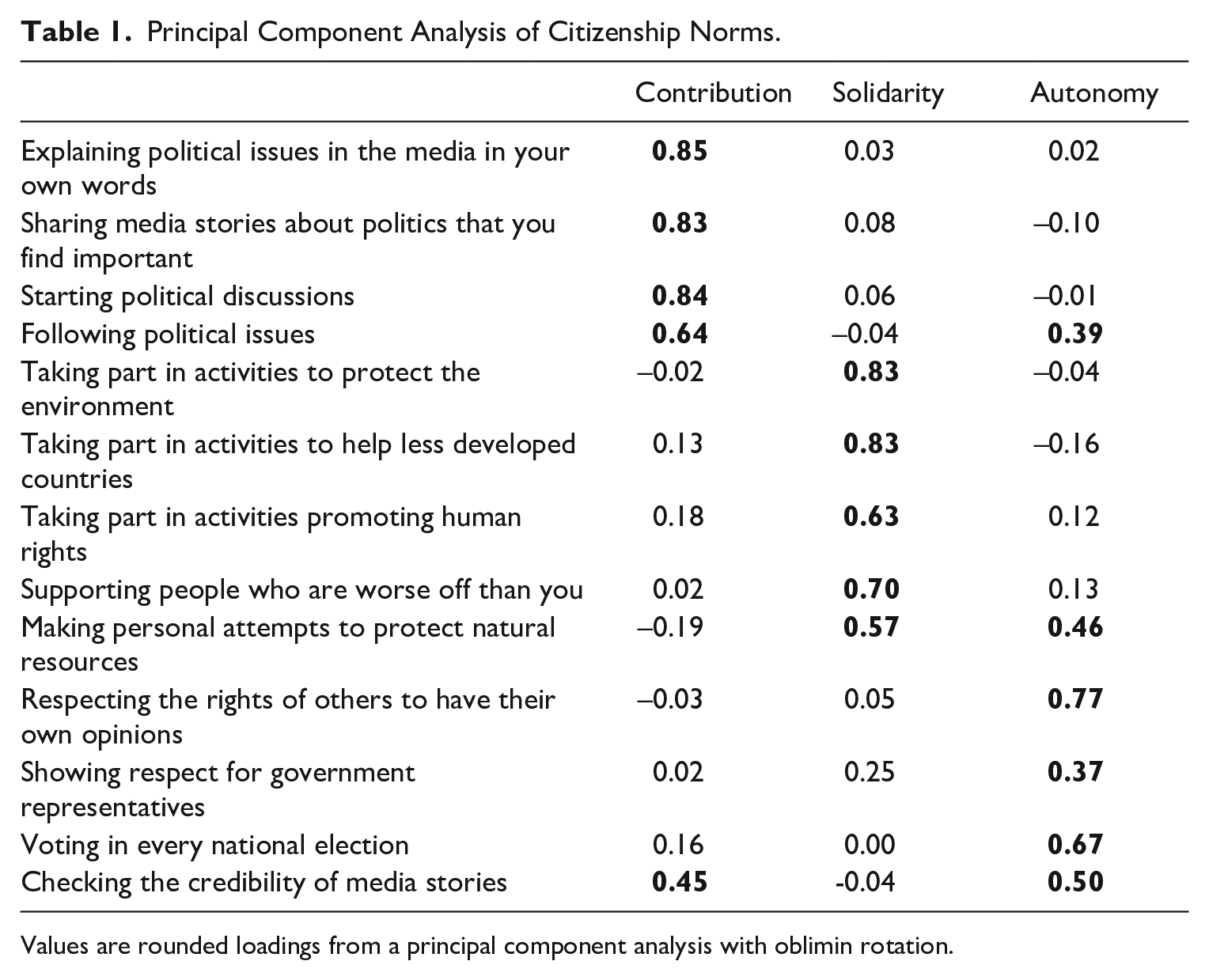
The number of components has been estimated over the combined datasets using the psych package’s parallel analysis function, suggesting three components underlying all the citizenship norms’ items (separate country PCA models available in the Online Appendix). We use a PCA with oblimin rotation, in order to account for potential correlations between different norm types (the orthogonal solution is included in Table A4 in the Online Appendix, demonstrating higher item complexity). Our oblimin solution reduced 13 survey items to three components, explaining 61.28% of variance with a root mean square residual (RMSR) of 0.07. 2 The loadings are reproduced in Table 1 below, with values greater than 0.3 bolded to reflect loading on to a dimension.
Principal Component Analysis of Citizenship Norms.
Values are rounded loadings from a principal component analysis with oblimin rotation.
The exploratory rather than confirmatory nature of PCA, which generally dominates as a methodological approach in the citizenship norm literature, is particularly suited to reducing the dimensionality of a new combination of norm survey items as in our present study. This requires, however, a partly inductive approach to interpreting and labelling the three components in our model, informed by our previously described theoretical expectations. The first component, contribution, is particularly characterised by sharing media items about politics that are perceived as important, explaining political issues in the media in one’s own words, and starting political discussions (five items accounting for 23.29% variance, α = 0.85). Solidarity norms include taking part in activities to protect the environment, help less developed countries and promote human rights, as well as supporting people worse off than oneself (five items accounting for 21.94% variance, α = 0.82). The final component is more challenging to interpret: theoretically, it combines items which have previously been associated in the literature with different norms; empirically, it displays slightly weaker overall loadings and stronger cross-loadings (six items accounting for 16.05% variance, α = 0.75). The strongest loading item around respecting the rights of others to have their own opinions is usually treated as a measure of the norm of autonomy (Coffé and Van der Lippe, 2010; Dalton, 2008). Voting, on the other hand, has sometimes been viewed as expressing an allegiance to the state typical of the dutiful citizen (Dalton, 2008); however, we argue that the individualised act of voting within a framework of liberal democracy also expresses an established norm around ‘the autonomous subject’ (Blühdorn and Butzlaff, 2020). We therefore label our third norm component as autonomy, while noting the theoretical and empirical evidence that it may be partly a measure of multiple related norm constructs. The relationship between different components also does not support a binary division between components aligned with ‘engaged’ norms on the one hand, and ‘dutiful’ norms on the other, since all components are moderately positively correlated: contribution with solidarity (0.33) and autonomy (0.30), and solidarity with autonomy (0.30).
In terms of the independent variables used in analysis, we opt for using PCA component scores computed by the psych package’s regression approach rather than an additive index of survey item responses, due to the different loading strengths and the three cross-loadings reported in Table 1. We provide two robustness checks to this approach. First, we test the correlation between component scores and additive indices, which have been compiled from those items loading onto only one component (full details described in the Online Appendix Table A5). This check shows extremely high correlation between an additive index and component scores for contribution (0.97) and solidarity (0.98), as well as high correlation for the autonomy component scores (0.86). Second, we reproduce our regression models using the alternative index measures as predictors in the Online Appendix in Tables A8 and A9.
Figure 1 compares the distribution of component scores across countries, in order to illustrate that German respondents tended to return higher ratings across all categories. This difference is greatest for contribution norms (Germany: M = 0.23, standard deviation (SD) = 0.88, Australia: M = –0.22, SD = 1.05) followed by autonomy norms (Germany: M = 0.18, SD = 0.93, Australia: M = –0.16, SD = 1.04) and finally solidarity norms (Germany: M = 0.06, SD = 0.97, Australia: M = –0.06, SD = 1.03). Boxplots for individual survey items are reproduced in the Online Appendix in Figure A1.
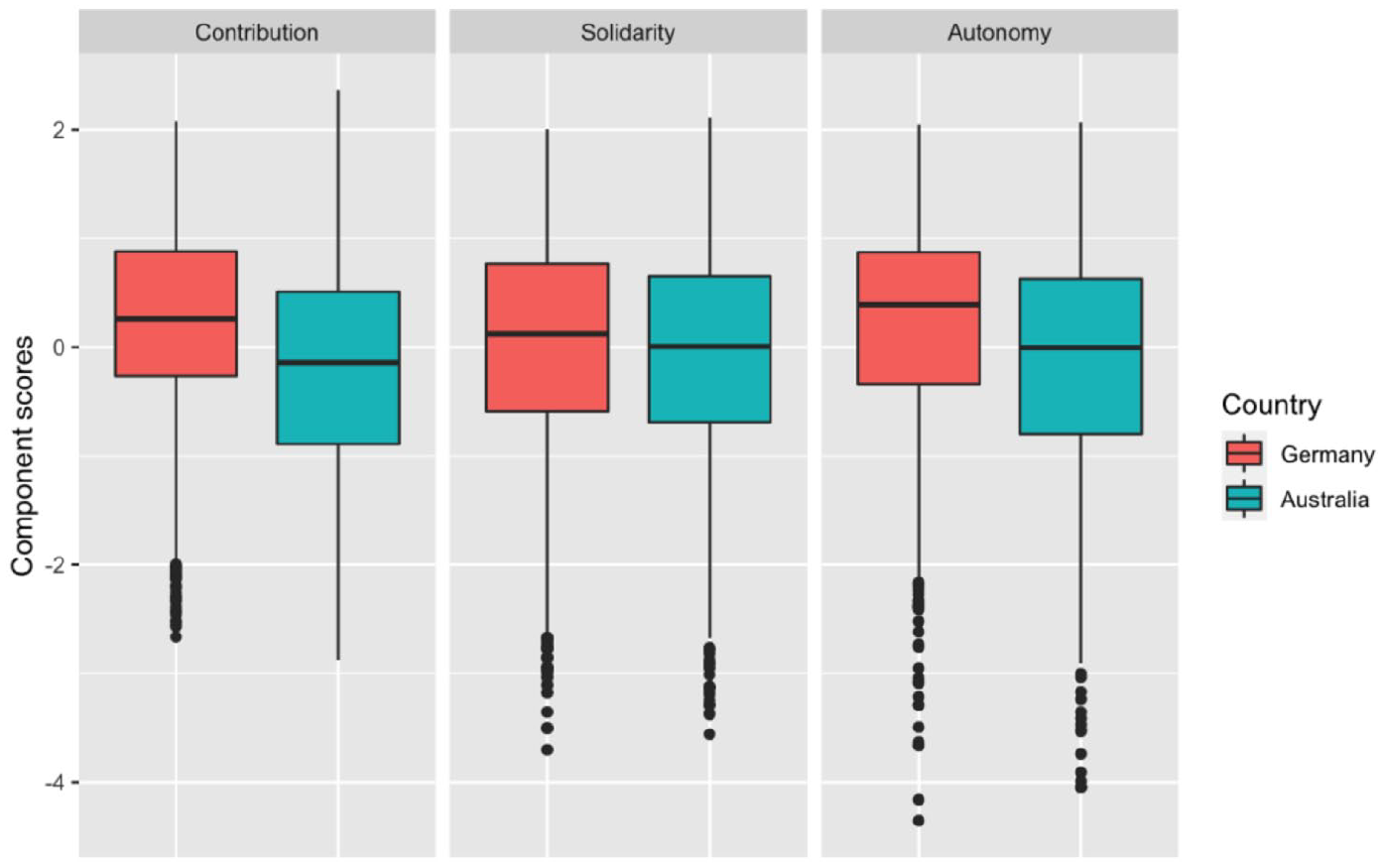
Distribution of Norm Component Scores Across Countries.
A key set of control variables measure the degree of social media use. These measures included two survey items asking respondents how often they use social media platforms Facebook and Twitter. Response options were ‘Every day’, ‘A few times a week’, ‘A few times a month’, ‘A few times a year’, ‘Hardly ever’ and ‘Never’. Responses were reverse-coded, so that 1 corresponded with no use and 6 with daily use (Facebook: M = 4.42, SD = 2.03, Twitter: M = 2.07, SD = 1.73). Our survey data show higher general rates of social media usage compared with other published data such as the Digital News Report (Newman et al., 2020), which may reflect our online panel survey collection approach. Specifically, in Australia, 85% of our respondents reported at least some Facebook usage, and 40% at least some Twitter usage (compared with 71% and 19%, respectively, in the Digital News Report). In Germany, the figures for our survey were 71% for Facebook use and 28% for Twitter use (compared with 49% and 13% in the Digital News Report). Although social media use is higher than expected in our data across all categories, the key relative quantities align with our expectations. Namely, Australian respondents use both platforms more than German respondents, and in both countries, Facebook is more frequently used than Twitter.
Additional control variables were drawn from existing studies around antecedents for political participation, aiming to control for both demographic constraints on political action as well as attitudinal drivers. In terms of demographic constraints which have frequently been used to predict political participation levels, we controlled for gender (binary variable with value of 1 for female, n = 2087); education (binary variable with value of 1 for university educated, n = 1387); and age (M = 47.95, SD = 17.21). In terms of attitudinal drivers towards politics which may have causal relationships with both citizenship norms and participation, we controlled for satisfaction with democracy (from 1 indicating ‘not at all satisfied’ to 4 being ‘very satisfied’, M = 2.48, SD = 0.81), as well as a score ranging from 1 to 5 for internal political efficacy (M = 3.40, SD = 0.95). 3 In line with the existing studies around citizenship norms and participation, we assume that norms form relatively stable antecedents to political participation, which can therefore be used as predictors in recursive models.
Results
Figure 2 below plots the incidence of petition signing in general (not differentiating between online and offline petitions) and suggests two clear findings. The first is that petition signing is a common activity: less than 15% of respondents say they ‘would never’ sign a petition. Our survey also asked respondents about 13 other common political actions, such as attending a demonstration, and found that petitioning was the most common action taken in the past 12 months in Germany (33%), and the second most common action taken in Australia (31%). The widespread frequency of petitioning among citizens is accompanied by a perception of their normalcy as an expression of democratic politics: when asked to respond to general statements about petitions on a scale of 1 (strongly disagree) to 7 (strongly agree), respondents were more likely to agree that ‘Petitions are a normal part of democracy’ (German mean = 5.55, SD = 1.38, Australian mean = 5.05, SD = 1.44), than that ‘Petitions are not representative of the political views of most ordinary people’ (German mean = 3.84, SD = 1.61, Australian mean = 4.06, SD = 1.56).
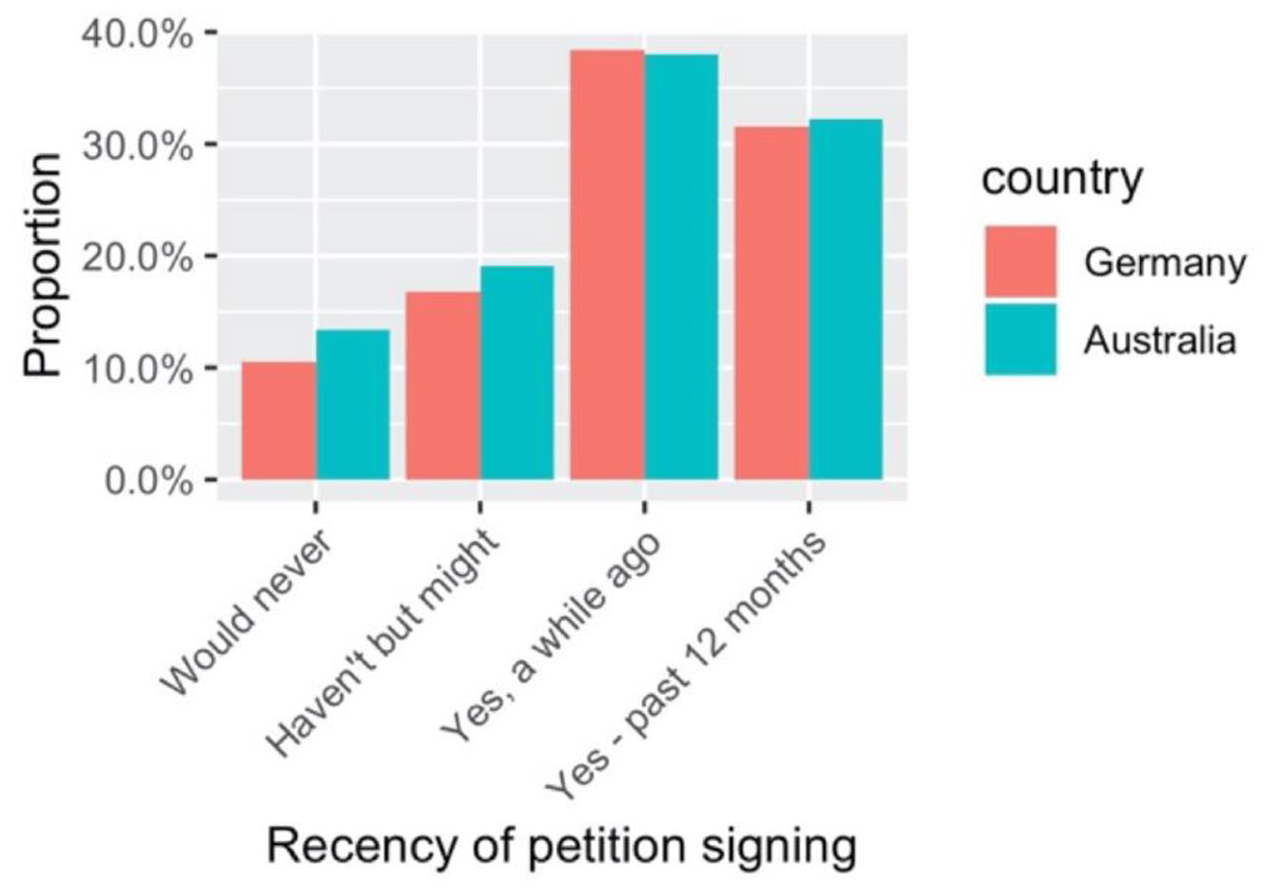
Petition Signing Overall.
When looking instead at specifically online petitioning (Figure 3), and comparing that with offline petitioning (Figure 4), clear differences emerge both between countries and types of petitions. Even though the total number of petitioners was very similar across the two countries, Australian petitioners were more likely to sign online whereas German petitioners were more likely to sign offline. In Australia, 89% of petitioners had signed online and 61% had signed offline, whereas 78% of German petitioners had signed online compared with 87% offline. In addition to the difference between countries, there is a difference between the distribution of frequencies between online and offline petitioning. In both survey items, the ordinal response categories group progressively larger frequency ranges. For offline petitioning, this is reflected in the two highest ordinal categories having the lowest proportions in both countries. Yet for online petitioning, there are larger proportions in these two highest ordinal categories: more Australian respondents said they had signed 10 or more online petitions in the past year (19%) than they had signed one (16%).
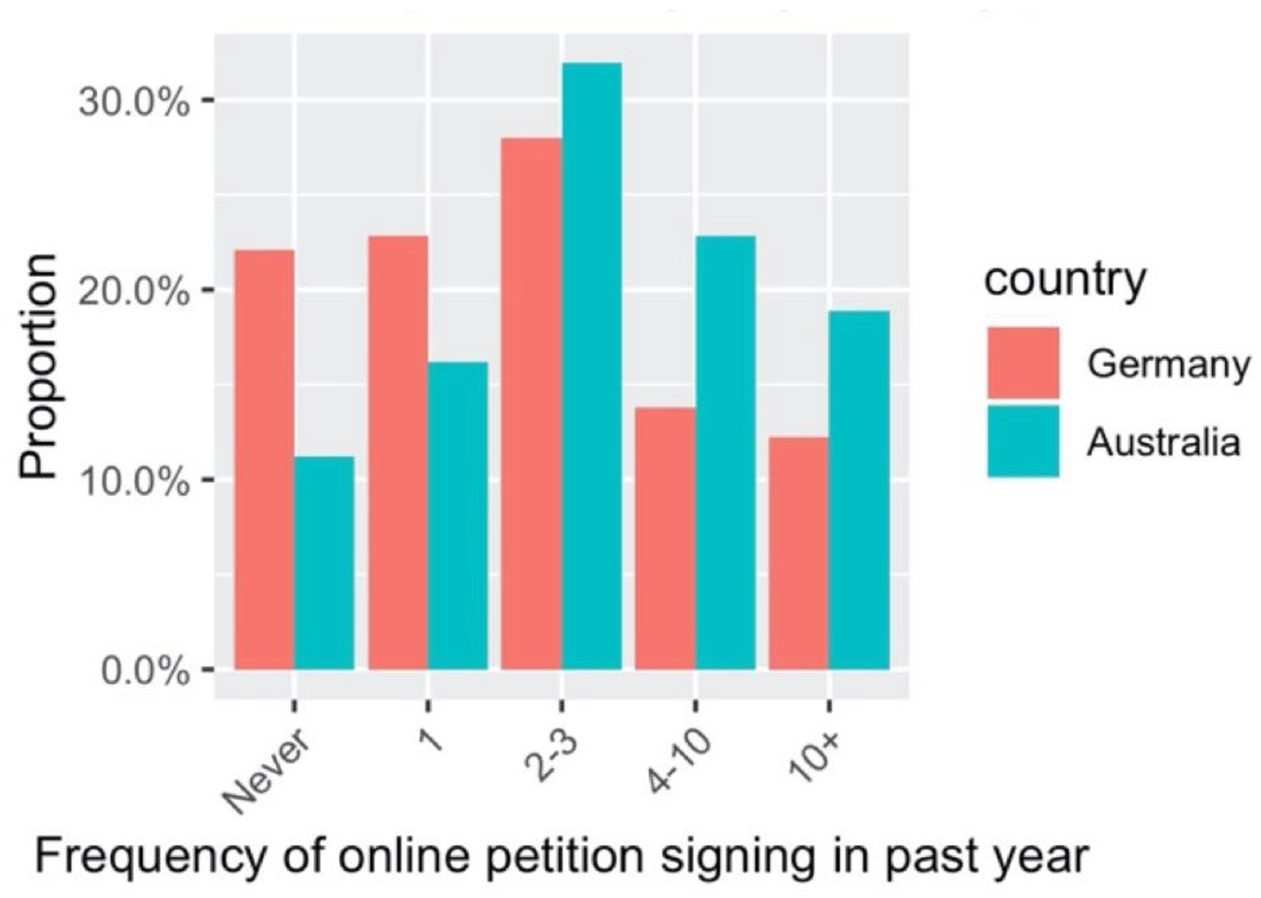
Online Petition Signing in the Past Year (Among Online and Offline Petitioners).
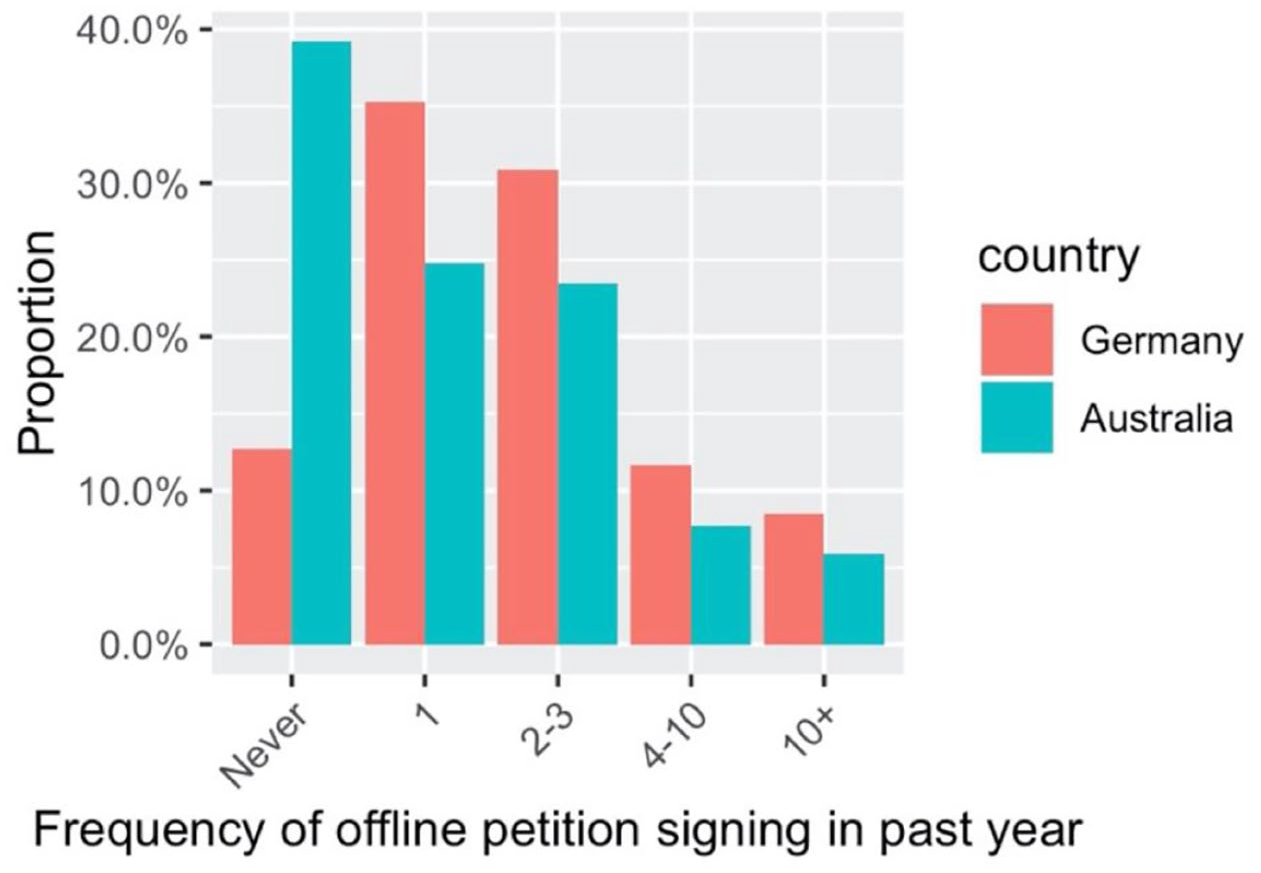
Offline Petition Signing in the Past Year (Among Online and Offline Petitioners).
Turning now to online petition sharing, Figure 5 below suggests that it is a much higher threshold act than signing. Most German respondents (65%) and a large minority of Australian respondents (46%) said they had not shared a petition on social media in the past year.
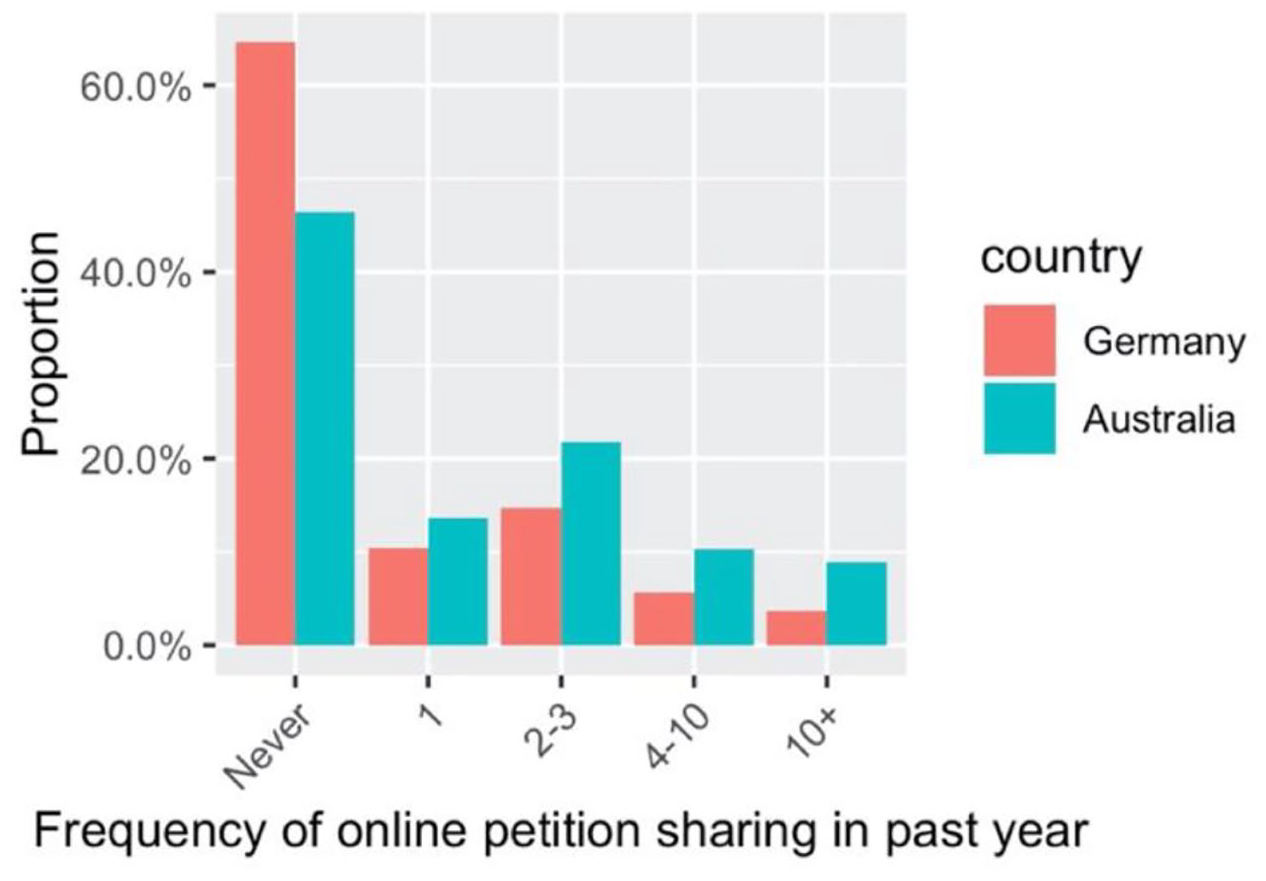
Online Petition Sharing in the Past Year (Among Online and Offline Petitioners).
Similar to the distribution of signing in Figure 3, Figure 5 suggests that there are country differences where engaging with online petitions is more widespread and frequent in Australia than Germany. A Mann–Whitney test confirmed that frequency of petition sharing was significantly greater for Australian respondents (Mdn = 2) than for German respondents (Mdn = 1, W = 263000, p < 0.01).
Regression Analysis
We then tested our hypotheses with two regression models. First, to assess the factors distinguishing non-petitioners and petitioners, we conducted binary logistic regressions (n ≈ 2100 in each country) with the outcome variable whether someone signed or shared an online petition in the past year. Second, to explore what factors are predictive of variation in frequency of petitioning, we conducted an ordered logistic regression, drawing on data from only those who had signed or shared a petition at least once in the past 12 months (n ≈ 650).
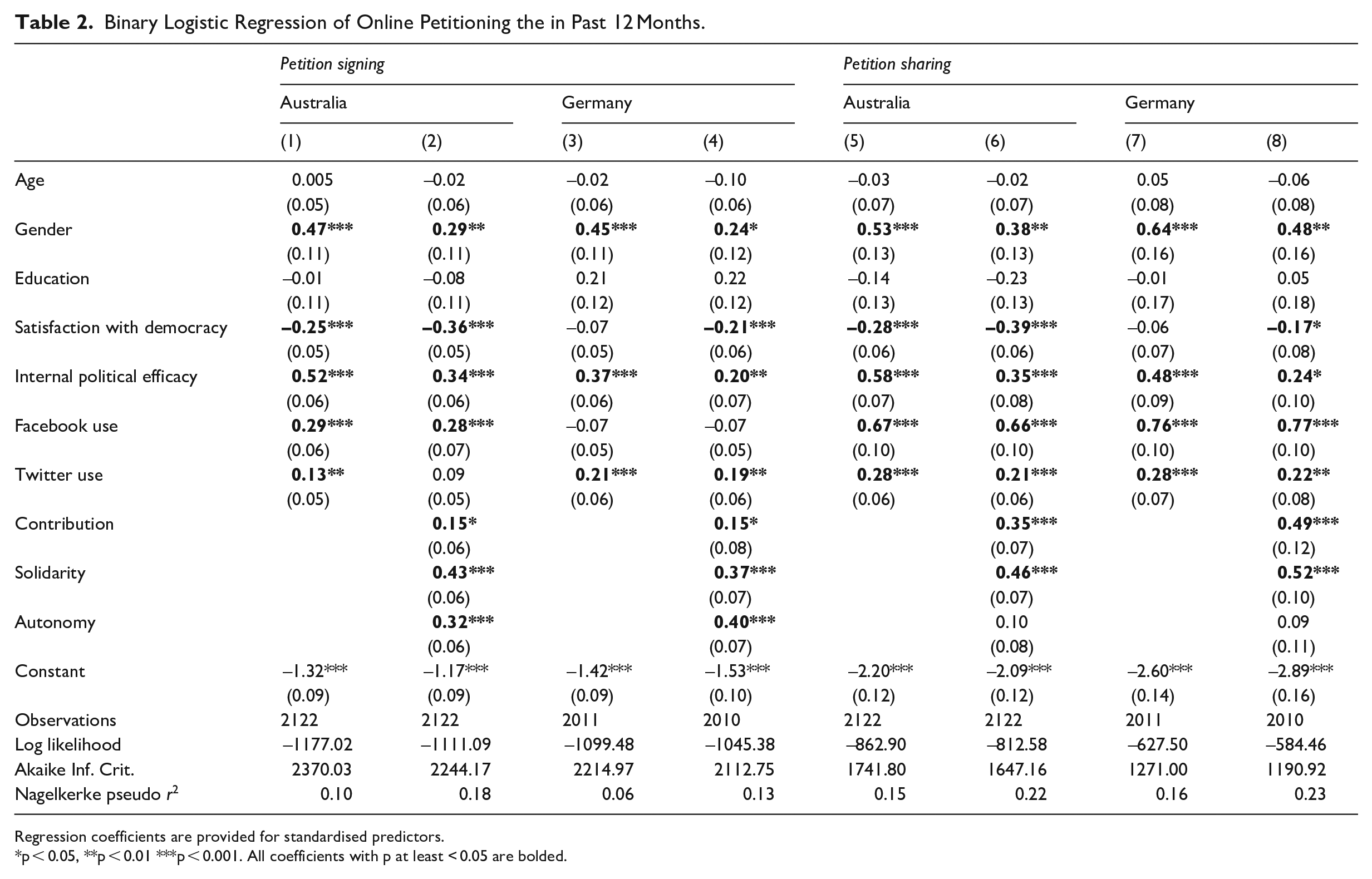
Table 2 records the standardised regression coefficients of the binary logistic regression, where the dependent variables record whether respondents had signed or shared an online petition in the past 12 months (1) or not (0). Coefficients indicate the change in the log odds of the dependent variable for every SD change in the predictor variable.
Binary Logistic Regression of Online Petitioning the in Past 12 Months.
Regression coefficients are provided for standardised predictors.
p < 0.05, **p < 0.01 ***p < 0.001. All coefficients with p at least < 0.05 are bolded.
The results provide some mixed support for our hypotheses. Controlling for demographic, attitudinal and social media use variables, we see significant effects from citizenship norms. Contribution norms are significantly predictive of signing (Australian β = 0.15, German β = 0.15, p < 0.05) and even more strongly predictive of sharing (Australian β = 0.35, German β = 0.49, p < 0.001). Solidarity norms are even more positively predictive of both signing (Australian β = 0.43, German β = 0.37, p < 0.001) and sharing (Australian β = 0.46, German β = 0.52, p < 0.001). Autonomy norms are predictive of signing (Australian β = 0.32, German β = 0.40, p < 0.001) but are not significantly predictive of sharing in either country.
Social media use is significantly predictive of online petitioning: perhaps unsurprisingly, the relationship is strongest between Facebook use and sharing (Australian β = 0.66, German β = 0.77, p < 0.001), with similarly consistent relationships between Twitter use and sharing (Australian β = 0.21, German β = 0.22, p < 0.001), whereas the significance for petition signing is less consistent across countries. Although social media use of some kind is a precondition for sharing online petitions, the ordinal values in our data illustrate the relationship between social media use frequency and online petitioning behaviour.
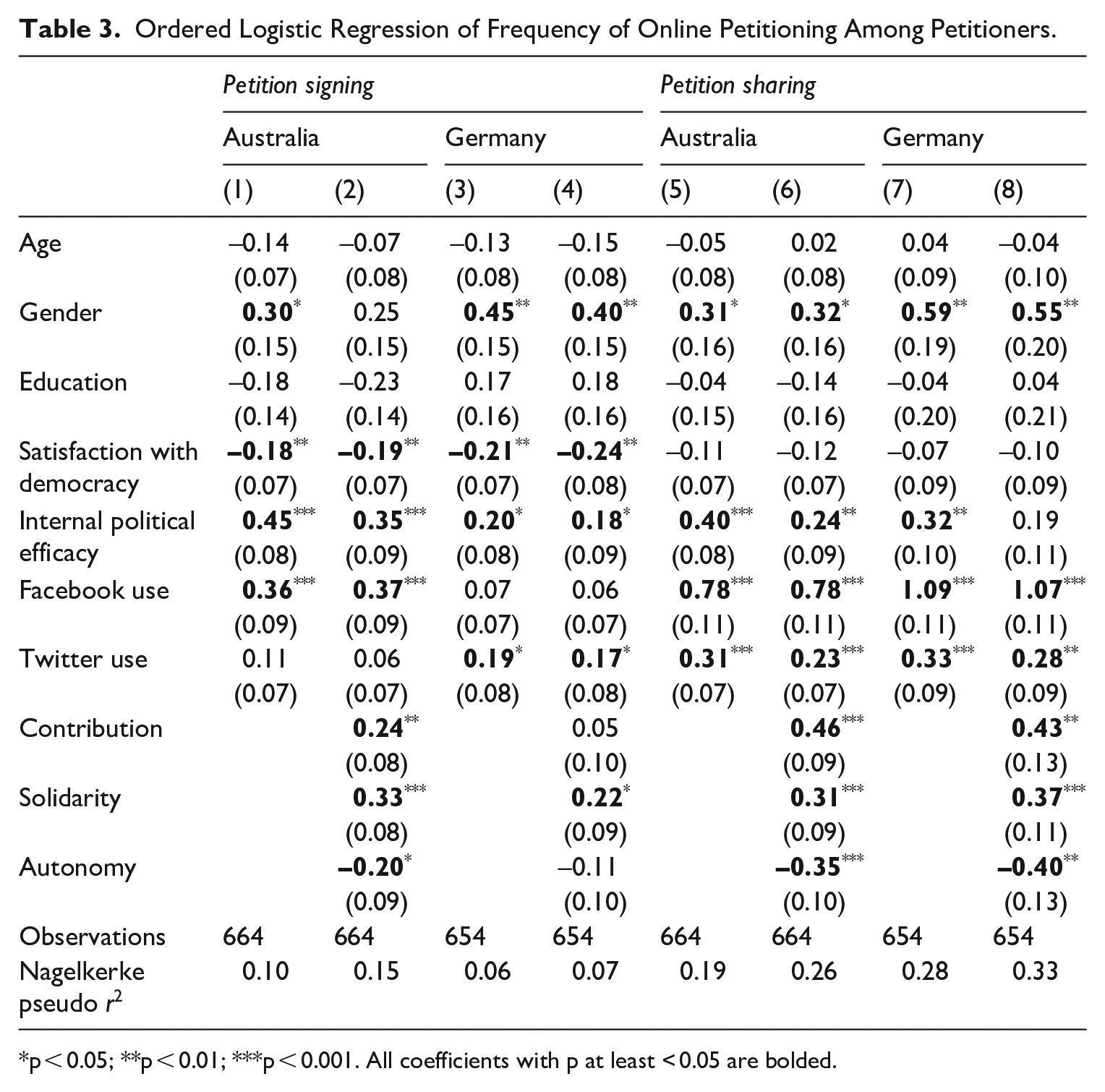
Table 3 below shows the standardised coefficients for the ordered logistic regression: the sample is reduced to respondents who indicated they had signed a petition of some kind in the past 12 months, and the dependent variables measure the frequency of taking that activity in the past 12 months in five ordered categories. 4
Ordered Logistic Regression of Frequency of Online Petitioning Among Petitioners.
p < 0.05; **p < 0.01; ***p < 0.001. All coefficients with p at least < 0.05 are bolded.
Moving away from the motivation to sign and share online petitions, to explaining why one does so frequently rather than casually, we found some similarities and differences with the previous analysis (Table 3). There is some support for H1, given that contribution norms are more predictive than autonomy norms, which are in fact negatively predictive across all cases (although failing to achieve significance in the case of German petition signing). This suggests that while autonomy norms may be predictive of more marginal engagement with online petitioning (as per Table 2), the direction of influence changes when distinguishing between more and less active petitioners. Contribution norms are the strongest predictors for sharing (Australian β = 0.46, German β = 0.43, p < 0.01), while the relationship is only significant for signing in the Australian data (β = 0.24, p < 0.001). Social media use is again largely predictive of frequency of online petitioning: generally, the influence is strongest again for Facebook and sharing (Australian β = 0.78, German β = 1.07, p < 0.001) followed by Twitter and sharing (Australian β = 0.23, German β = 0.28, p < 0.001), with variation between platform effects when considering petition signing.
Figure 6 below summarises the influence of citizenship norms from our regression models, organised along two dimensions: first, the mode of action (signing versus sharing), and, second, the frequency of engagement (binary regression differentiating between petitioners and non-petitioners versus ordinal regression differentiating between low and high-frequency petitioners). We view these dimensions as both representing low- and high- intensity forms of engagement in online petitioning, meaning that signing a single online petition can be seen as the least demanding form of engagement, with sharing multiple petitions in contrast the most demanding.
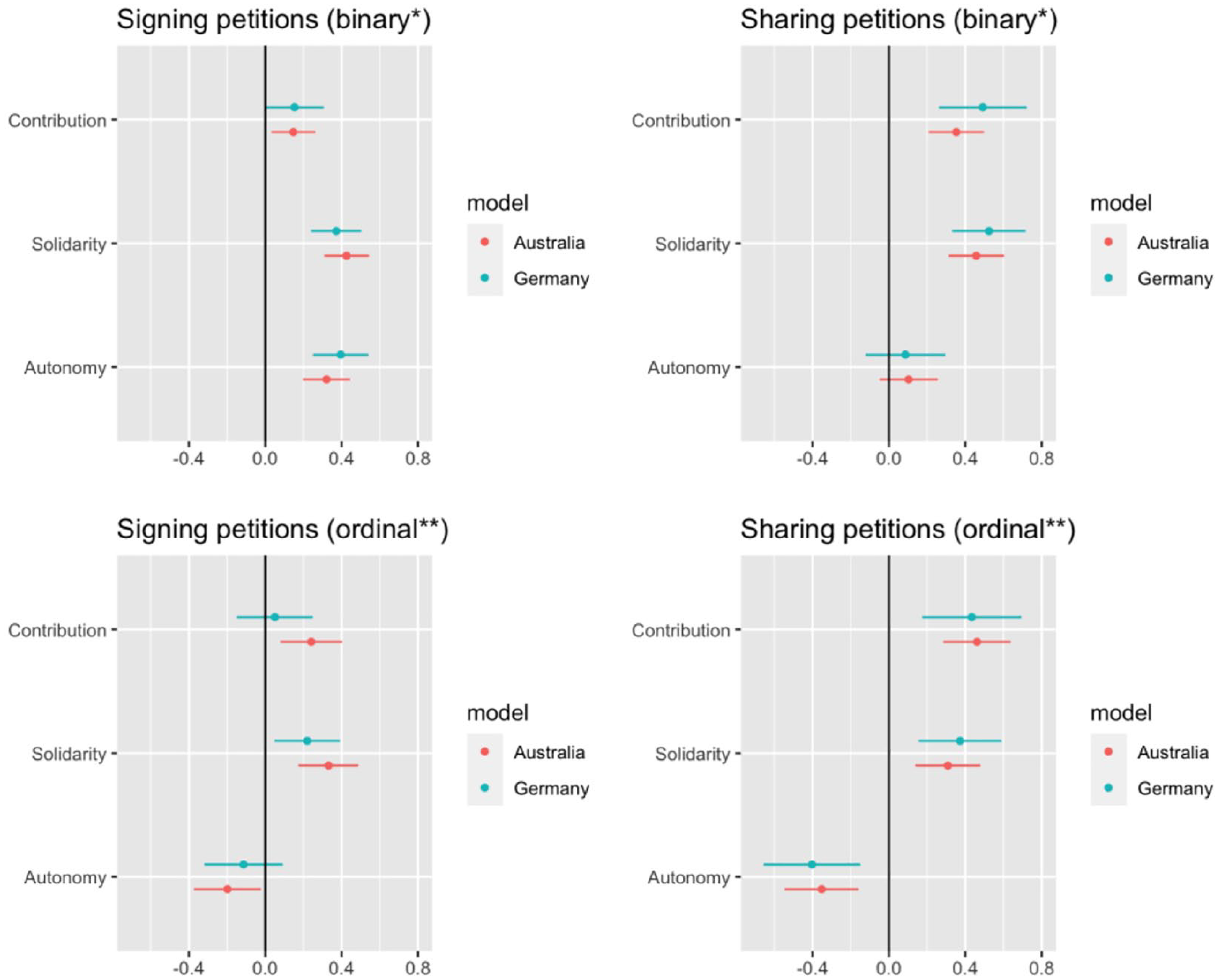
Overview of the Influence of Citizenship Norms on Online Petitioning.
This overview helps to interpret the overall pattern in the data, where the influence of citizenship norms is more differentiated for higher intensity forms of online petitioning. When considering the lowest threshold form of online petitioning, namely signing at least one petition in the past 12 months, all citizenship norm types are predictive (although notably contribution norms display the smallest effect). The most intense form of online petitioning, frequent sharing, in contrast shows the strongest positive influence by contribution norms, and a negative influence by autonomy norms. The role of contribution norms varies most clearly according to the mode of participation, that is, sharing rather than signing. This finding makes intuitive sense, given that sharing petitions involves a higher degree of engagement in networked communication infrastructures than petition signing, which can also be accessible in other and more individualised ways, such as email or web browsers.
Discussion and Conclusion
Our study supports three sets of findings which we discuss below: the emergence of new citizenship norms; patterns of online petitioning; and the relationship between them.
Regarding citizenship norms, we confirm that there are a set of ‘contribution’ norms which emphasise the importance of expressing one’s own views about politics, sharing political media content and starting political discussions. These contribution norms can be clearly differentiated from other types drawn from the norm literature, in particular, solidarity norms around supporting others, and autonomy norms around voting and respecting the views of others. We interpret these contribution norms as emerging partly as a consequence of perceived threats of ‘polluting’ the discourse as well as perceived opportunities to meaningfully engage with it. Today, citizens are increasingly accustomed to participating in horizontal networks of relationships which facilitate more expressive, smaller forms of action. Contribution norms, thus, reflect the changing nature of politics. While contribution norms share some key features in common with existing conceptualisations of engaged citizenship, particularly in their emphasis on self-expression, our data demonstrates that there are also key differences from other engaged norms like solidarity and autonomy.
Regarding patterns of petitioning, we confirm that this is one of the most common forms of political engagement in both Germany and Australia, but find differences when it comes to petitioning online versus offline. Even though Germans and Australians sign petitions at remarkably similar rates, Australians are more likely to sign online rather than offline, more likely to do so more frequently, and also more likely to share online petitions on social media. This suggests first that Australia’s higher relative uptake of digital communications technologies, as described previously, is reflected in a higher rate of online petitioning. Second, there may be a substitution effect between online and offline petitioning, given that the overall rate of petitioning is constant in the two countries despite differing levels of their online and offline forms.
Turning to the central research question for this article, we found that citizenship norms were related to both signing and sharing online petitions, and that different normative expectations of the ‘good’ citizen affected online petition participation differently. That is, norms that highlight citizens’ emphasis on their own contribution and sharing were generally more effective in influencing online petitioning than the norms around citizens’ autonomy – although this was more consistent with petition sharing than petition signing, and more significant when distinguishing between more and less highly active petitioners rather than petitioners and non-petitioners. This finding indicates that simply signing a single online petition has already become such a normalised act of political participation in advanced democracies, involving such a low threshold of participation, that it is expressive of a wide range of citizenship styles in contemporary politics. Yet different citizenship norms become more significant differential influencers of behaviour, the higher the participation threshold of the digitally networked action being analysed. This is particularly evident with online petition sharing, which is more distinctively associated with contribution citizenship norms, especially when differentiating highly active sharers.
Social media use further played a role for signing petitions; however, some differences emerged between platforms and countries. As reported, the influence of both platforms was stronger in predicting sharing than signing, likely reflecting the particular role of social media in the act of sharing content (compared with the act of signing, which although often enabled by social media is nevertheless still accessible via alternatives such as websites and email). We also demonstrate that Facebook use is associated more strongly with petition sharing than Twitter use across both countries. We interpret this as evidence that mechanisms driving the viral distribution of online petitions, such as social visibility (Margetts et al., 2016), are particularly enabled by digital platforms which prioritise mutual social observation like Facebook, rather than the distribution of content via weaker social ties like Twitter. In contrast, when considering the act of petition signing, the role of platforms was more mixed: Twitter promoted petition signing in Germany, while in Australia, it was Facebook use, suggesting that the different overall adoption levels of the different platforms reported previously may also shape their influence on online petitioning behaviour. Future research on online petitioning which analyses social media data can usefully reflect on the ways in which specific platform affordances intersect with nationally divergent communities of users to shape individual behaviour.
We note that even as data such as ours show the increasing prevalence of online petitioning as a form of citizen engagement, recent research has also found political elites reacting to online petitions with apathy and even antipathy (Matthews, 2021). We believe that research has a role to play in informing political representatives with an evidence-based citizen perspective, in particular, by demonstrating how individuals can view contributing and sharing digital content as ways of performing good citizenship, and that these novel citizenship norms shape particular patterns of intensive online petitioning. The comparison between Australia and Germany provided greater external validity to our conclusions about the influence of citizenship norms, given these relationships were largely consistent across the two countries. This cross-national comparison also highlighted, however, that the digitalisation of petitioning is playing out in different ways and at different speeds depending on national context, and interacts with nationally specific use of the range of available social media platforms.
Finally, our approach still has some limitations. Primarily, our analysis investigates the relationship between variables rather than actors, and so we are unable to be more precise about different profiles of actual citizens engaging in online petitioning. This is particularly important for citizenship norm studies where survey items are rated separately rather than ranked alongside one another, meaning some citizens may rate all norms as significant and others none (as argued in Hooghe et al., 2014). Our study also decontextualises online petitioning to some degree, and further research is needed to investigate the influence of other important factors driving variation in citizen behaviour and attitudes, such as the choice of particular petition platforms, issue agendas or the presence of intermediary organisations and campaigns. Finally, a limitation of our cross-sectional data is increased uncertainty around endogeneity in the relationship between citizenship norms and participation; although there is a theoretical basis established in prior political participation research for viewing norms as relatively stable antecedents to action, this assumption is potentially more open to critique when considering a set of citizenship norms which are by definition novel. Although these limitations can only be overcome in future research, our study provides initial evidence for the significant role of novel citizenship norms around contribution in online petitioning, particularly in its more intensive forms.
Supplemental Material
sj-docx-1-psx-10.1177_00323217221078681 – Supplemental material for The Role of Novel Citizenship Norms in Signing and Sharing Online Petitions
Supplemental material, sj-docx-1-psx-10.1177_00323217221078681 for The Role of Novel Citizenship Norms in Signing and Sharing Online Petitions by Michael Vaughan, Ariadne Vromen, Pablo Porten-Cheé and Darren Halpin in Political Studies
Footnotes
Acknowledgements
The authors would like to thank the anonymous reviewers and journal editorial team for helping to improve the argument in the manuscript.
Declaration of Conflicting Interests
The author(s) declared no potential conflicts of interest with respect to the research, authorship and/or publication of this article.
Funding
The author(s) disclosed receipt of the following financial support for the research, authorship and/or publication of this article: This work was supported by the German Federal Ministry of Education and Research, funding codes 16DII114 and 16DII125, and the Australian Research Council, grant DP160102551.
Supplemental Material
Additional Supplementary Information may be found with the online version of this article.
Principal Component Analysis
Table A1: citizenship norm survey items used in Principal Component Analysis (PCA)
Table A2: pairwise correlation of citizenship norm items
Figure A1: boxplots of country responses to citizenship survey items
Figure A2: parallel analysis for number of components
Table A3: PCA component variance and correlations
Table A4: PCA with alternate Varimax rotation
Table A5: correlation of component scores with alternative additive index
Table A6: PCA model using individual country data
Regression models
Table A7: VIF for logistic regression models
Table A8: logistic regression with norm index predictors
Table A9: ordinal regression with norm index predictors
Table A10: ordinal regression with partial proportional odds model

Notes
Author Biographies
References
Supplementary Material
Please find the following supplemental material available below.
For Open Access articles published under a Creative Commons License, all supplemental material carries the same license as the article it is associated with.
For non-Open Access articles published, all supplemental material carries a non-exclusive license, and permission requests for re-use of supplemental material or any part of supplemental material shall be sent directly to the copyright owner as specified in the copyright notice associated with the article.
