




Abstract
Liberal nationalists argue that identification with the nation promotes feelings of mutual obligation, including support for redistribution. Existing attempts to test this hypothesis have focused on whether the higher sense of national identity among the majority increases support redistribution. We argue for a twofold shift in focus. First, beyond the majority’s own national identity, we need to explore their perceptions of whether minorities share this identity. Second, we need to shift from one-dimensional ideals of ‘identity’ to more complex ideas of attachment and commitment. Do members of the majority view minorities as committed to the nation and willing to make sacrifices for it? Drawing on a custom-designed online survey in Canada, we show that three salient out-groups (Aboriginal peoples, French-speaking Canadians and immigrants) are seen by majority respondents as less committed to Canada, and that this is a powerful predictor of support for general and inclusive redistribution.
What are the wellsprings of social solidarity? What conditions nurture the willingness of individuals to support redistributive social programmes that help the poor and the vulnerable? The most common answer to this question is that solidarity is ultimately sustained by an ethic of social membership, a sense of belonging to a shared community. In the oft-quoted words of T.H. Marshall (1950: 96), the welfare state rests on ‘a direct sense of community membership based on loyalty to a civilization that is a common possession’. Historically, this sense of community membership has been tied to ideas of nationhood: a nation marks the boundaries of membership, defining the community within which solidarity is expected and nurturing the emotional sense of obligation to support each other in times of need.
This linking of solidarity to nationhood has come under scrutiny, due in part to immigration and ethnic and religious diversity. Anxiety about the impact of diversity on solidarity and support for the welfare state has been a recurring theme in both academic scholarship and public debates around immigration and multiculturalism. Ethnic ideas of nationhood – ‘blood and soil’ nationhood – tend to exclude newcomers and ethnic minorities and cannot generate the inclusive sense of ‘us’ that is needed in the context of contemporary diversity. However, liberal nationalists argue that a thinner form of nationalism – one animated not by a historic ethnicity but by a shared political culture – can sustain a sense of community and mutual obligation. This thinner form of nationalism, in this interpretation, can sustain a generous welfare state in a diverse society. 1
In our view, the question of whether nationhood can continue to provide the basis for social solidarity is of fundamental importance. Critics argue that efforts to create inclusive conceptions of nationalism have continually faltered (Antonsich and Petrillo, 2019), and that the dream of a truly diversity-respecting nationalism may be a mirage. Defenders of liberal nationalism respond that efforts to create post-national forms of solidarity have equally faltered, that the dream of a post-national future has been revealed as an illusion, and that we have no choice but to keep working towards inclusive nationalisms (Nodia, 2017).
Our aim in this article is not to definitively resolve this controversy, but to refine the terms of the debate, and to improve our tools for measuring the prospects and limits of inclusive nationalism. As we shall see, previous research on the liberal nationalism hypothesis has focused on the national identity of the majority population, measuring the nature and/or intensity of respondents’ own sense of identification with the nation, and asking whether those with a stronger sense of national identity or national pride support redistribution. This article argues, however, that such tests are inadequate because we need to pay attention not only to the majority’s own relationship to the nation, but also to how the majority population perceives newcomers’ and minorities’ relationship to the nation. Moreover, in exploring these perceptions, we need to move beyond a narrow focus on ‘identity’ to explore more complex and morally loaded ideas of ‘attachment’, ‘commitment’, or in Marshall’s own words, ‘loyalty’. The liberal nationalism hypothesis argues that nationhood can be a source of mutual obligation, and both terms – ‘mutual’ and ‘obligation’ – matter. The prospects for an inclusive national solidarity in diverse societies, we believe, depend in part on whether citizens (can come to) see each other as having a mutual moral commitment to a national ‘we’.
If this is right, then a crucial methodological challenge is to explore majority perceptions of minorities’ commitment to the nation, or what we will call ‘membership perceptions’. This is a surprisingly under-studied field. However, we believe that the growing literature on deservingness judgements offers a helpful starting point. There is now a substantial international literature documenting that certain groups are seen as less deserving of welfare support than others, and as we will see, it is a virtually universal finding that immigrants are at the bottom of the ‘deservingness hierarchy’ in Europe, while Black Americans tend to be viewed most harshly in the American context. The usual explanation for these findings is that immigrants and racialized minorities are seen as lazy or as economic burdens, driven in part by prejudicial stereotypes. The liberal nationalism thesis, however, offers a different possibility: judgements of undeservingness may reflect, at least in part, perceptions that minorities are less committed to the national ‘we’ (Kymlicka, 2015), even in the absence of explicitly hostile attitudes. Even if immigrants are seen as hard workers who are net economic contributors to the welfare state, they may still be seen as undeserving if they are perceived to be insufficiently committed to or concerned about the nation. Similarly, even if prejudice directed at a previously marginalized group decreases, they might still not be viewed as part of the community. Social psychological research has long distinguished between out-group animosity and in-group attitudes, pointing to the fact that preferential treatment for in-group members is not necessarily driven by out-group animus (Brewer, 1999). Unfortunately, existing studies do not allow us to test the relative importance of these different possible grounds of deservingness judgements.
This article proposes a new framework for unpacking deservingness judgements so as to isolate the salience of these membership perceptions – these perceptions of commitment to the shared society – and to test whether they matter above and beyond perceptions about laziness or poor life choices. We then apply this framework to explain support for redistribution to immigrants and minorities through a custom-designed survey conducted in 2017 in Canada. Canada represents a fascinating case since it is home to a complex set of ethnic and national groups, including the traditional English- and French-speaking communities, large immigrant groups and the historic Aboriginal communities. The different minorities are normally seen as having quite varied relationships with the pan-Canadian community, and so Canada is a particularly challenging context for models of solidarity that require a ‘direct sense of community membership’. On the other hand, precisely for that reason, the country has made concerted efforts over time to build a more multicultural conception of nationhood that accommodates multiple identities and diverse ways of being Canadian.
As we will see, the evidence from our survey suggests that, notwithstanding these efforts to construct an inclusive nationalism, many continue to see minorities in Canada as less committed to the national ‘we’, and that these ‘membership penalties’ reduce support for redistribution.
Previous Research and Our Approach
This article draws on two bodies of literature that have tended to evolve separately: the literature on liberal nationalism and the literature on deservingness.
Liberal Nationalism: As originally conceived, the conception of nationhood within the theory of liberal nationalism is rooted in a people’s shared sense that they form a community, and it is this shared sense of membership that fosters solidarity and trust. For example, David Miller (1995) defines nationhood in terms of five features: (1) a sense that there is a ‘we’ that belongs together, and would find it objectionable for the ‘we’ to be divided into two separate countries or merged into a larger country; (2) a sense that the ‘we’ has historical continuity; it extends backwards and forwards in time, and current members have a duty to pass on the national patrimony in good shape to future members of the nation; (3) a sense that the ‘we’ wishes to act collectively, and so seeks means of collective agency, such as political self-government; (4) a sense that the ‘we’ occupies a particular territory or homeland, and has a distinctive relationship to that territory; and (5) a sense that the ‘we’ shares a common public culture, which in turn provides the cultural basis for collective agency. In virtue of these five features, nationhood becomes an ‘ethical community’ (Tamir, 1993), in which members have greater trust in each other and recognize distinctive obligations to co-members. This sense of ‘us’ and the desire for collective action lies at the heart of social solidarity, understood as the willingness to support each other through a redistributive welfare state.
In the contemporary era, a key question is whether this concept of national solidarity can be stretched to incorporate ethnic and racial diversity. The theory of liberal nationalism points to twin channels to a more inclusive sense of the nation as an ethical community. In the first, majority citizens need to renounce ethnic or racial definitions of nationhood and create avenues by which newcomers and minorities can join the shared community. This is often framed as a matter of shifting from an ‘ethnic’ definition of the nation, based on ascriptive criteria, such as race or ancestry, to a ‘civic’ definition based on achievable criteria, such as residency, mastery of the official language and commitment to the constitution. In the second, majority citizens must also believe that newcomers and minorities are willing to join the shared community, and to view it as an ethical community. The willingness to extend social support to others depends on the belief that those others also share a commitment to the nation, are loyal to it, and support it when they can. In the case of immigrants, for example, the initial tendency to exclusion can be overcome, in this interpretation, (1) if the host society invites immigrants to join the ethical community and (2) if immigrants are seen as accepting that invitation, and in particular, accepting the responsibilities that arise from membership in the community (Miller, 2017: 73; Miller and Ali, 2014).
In recent decades, a growing literature has tried to test the liberal nationalism argument. To date, however, such tests have focused exclusively on the first channel, measuring the relationship between the national identity of the majority and their support for redistribution, with highly mixed results. Some studies examine the strength of people’s national attachment in different countries, relating that to overall support for redistribution. The results of these studies offer little encouragement to liberal nationalists. For example, Shayo (2009) found that in countries in which national identity is stronger, both support for redistribution and the actual extent of redistribution to people with low incomes decline. Other studies focus more specifically on whether members of the majority who endorse ‘civic’ conceptions of the nation are more supportive of redistribution than those who endorse more ‘ethnic’ conceptions. 2 However, here again, even the more civic conceptions of nationalism have not been found to be reliably associated with support for redistribution (Breidahl et al., 2018; Citrin et al., 2012; Gustavsson, 2019; Johnston et al., 2010; Miller and Ali, 2014; Theiss-Morse, 2009; Wright and Reeskens, 2013).
This line of research is important, but it arguably represents a narrow and incomplete way of testing the liberal nationalism hypothesis for two reasons. First, as we have seen, liberal nationalism is about how a shared commitment to nationhood grounds mutual obligations: I am willing to make sacrifices for others because I think we share a commitment to the national ‘we’. What matters, therefore, is not (only) how strongly I identify with the nation, but whether I think that the people I am being asked to make sacrifices for share that commitment. Second, we need to move beyond a narrow focus on ‘identity’. The theory of liberal nationalism is not exclusively about national identity. Identity is just one of Miller’s five criteria of nationhood, and even with respect to identity, some theorists would argue that much of the time it is relatively passive, inchoate, or even subconscious. Citizens can habitually view the world in a way that presupposes the nation as an ‘ethical community’ without consciously reflecting on their national identity (Billig, 1995). What matters for the liberal nationalist hypothesis is not whether national identity is front or back of mind, but whether it forms an ethical community with distinctive obligations to co-nationals.
To properly test the prospects for liberal nationalism, therefore, it is not enough to ask how majorities consciously define their national identity. Rather, we need to ask whether nationhood can provide the basis for feelings of mutual obligation among a diverse citizenry. This in turn requires asking whether or how newcomers become part of the normalized and naturalized practices of nationhood and become recognized participants in the distinctive obligations of its ethical community. This is the second channel, focusing on building mechanisms through which immigrants and minorities can participate in Miller’s five dimensions of nationhood, and share in Marshall’s (1950: 96) ‘direct sense of community membership based on loyalty to a civilisation that is a common possession’. 3
This article focuses on the second channel and the extent to which people in Canada perceive various communities as committed to the shared ethical community. Very little work empirically examines the extent to which groups are perceived as part of the community, and how this impacts support for redistribution. Wong (2010) comes the closest when she shows that perceptions of community in the United States help predict attitudes towards redistribution independently of self-interest, political ideology and prejudice. While she argues this results from in-group favouritism, we believe that we need to push further into the substance of the expectations of membership. To do so, we link the liberal nationalism debate to the concept of deservingness found in the social welfare literature.
Deservingness: Research on the politics of social policy has long noted the power of beliefs about the ‘deserving’ and ‘undeserving’ poor (Feather, 2003; Gans, 1995; Golding and Middleton, 1982). Some commentators argue that a concern with the deservingness of welfare recipients is a distinguishing feature of the neoliberal era and its attack on the welfare state. The evidence suggests, however, that a concern with deservingness has been a stable feature of public opinion in the West, even during the postwar heyday of the social-democratic building of the welfare state (Hudson et al., 2016), and that a similar ‘deservingness culture’ can be found in both liberal and social-democratic welfare states (van Oorschot, 2006). Indeed, some researchers suggests that a ‘deservingness heuristic’ is innate in humans – a product of our evolutionary history (Aaroe and Petersen, 2014; Petersen, 2012).
While judgements of deservingness seem to be widespread, the grounds on which they are made are more contested. Early findings regarding deservingness judgements emphasized the importance of ‘responsibility’ or ‘control’ as highly influential in shaping public opinions on who deserves help (Applebaum, 2001; Cook, 1979; De Swaan, 1988; Feather and Dawson, 1998; van Oorschot, 2000; Weiner, 1980; Will, 1993). If someone’s disadvantage is perceived as their own fault, due to laziness or poor life choices, they are seen as less deserving that than those whose plight is due to something outside their control, like aging or disability.
However, perceptions of control do not seem to fully explain the pattern of deservingness judgements. A narrow focus on individual effort or responsibility has trouble explaining the ‘in-group favouritism’ that is widely observed in deservingness judgements (Knotz et al., 2020). The elderly may be seen as deserving, but native-born elders are seen as more deserving than immigrant elders (Reeskens and van der Meer, 2019). This ‘in-group favouritism’ and/or ‘race-coding’ of deservingness judgements is evident in many countries (Ford, 2015; Ford and Kootstra, 2016; Gilens, 1999; Harell et al., 2014, 2016).
These findings suggest that deservingness is multi-dimensional. To make sense of the empirical trends, van Oorschot (2000) has proposed five criteria of deservingness – the so-called CARIN model:
Control. Perceptions of the individual’s control over and responsibility for their economic circumstances;
Attitude. Perceptions of the individual’s gratitude for the support they receive;
Reciprocity. The extent to which individuals are perceived as likely to give back or contribute to society;
Identity. Perceptions of the extent that the individuals in need are ‘like us’;
Need. The amount of support that an individual requires.
This CARIN framework has usefully been employed to study deservingness judgements relating to several different groups in different countries on different social policy issues (van Oorschot et al., 2017). However, critics have argued that it lacks any theoretical underpinning, and that the relationship among the five dimensions is not explained; as a result, each of the five criteria have been operationalized in competing, and indeed, incompatible ways (Knotz et al., 2020).
Here is where we believe there is scope for a productive cross-fertilization between the deservingness literature and the liberal nationalism literature. As we have seen, liberal nationalism emphasizes the importance of a shared membership in and orientation towards the ‘we’. Revisiting the CARIN framework with this in mind, it suggests a clear distinction can be drawn between control and need, on the one hand, and the other three criteria – identity, attitude and reciprocity. Control and need clearly relate to the nature of and responsibility for an individual’s economic circumstances. By contrast, identity, attitude and reciprocity relate to social relationships between a group and the society as a whole. In our view, these criteria speak to perceptions of shared membership, manifest in the extent to which members of a group are seen as identifying with the community, being grateful for the community’s support, and being willing to give back to the community when they are able. 4 In effect, these three criteria seem to tap a sense that the group is part of, and committed to, ‘us’. We will therefore call them ‘membership-based’ deservingness criteria (as distinct from control and need).
This suggests that deservingness judgements can offer a twofold test of the liberal nationalism hypothesis. On the one hand, liberal nationalism would predict that these membership-based criteria play an important role in shaping support for redistribution, above and beyond assessments of control and need, particularly in relation to immigrants and minorities whose ‘we’-ness is potentially in question. 5 If perceptions of we-ness do not matter empirically, then the hypothesis that solidarity derives from nationhood seems directly falsified. On the other hand, if national solidarity is to be liberal, then these membership-based criteria must in some sense be accessible to immigrants and minorities. As we noted earlier, there must be some way for immigrants and minorities to be seen as fulfilling these membership-based criteria of deservingness. If immigrants and minorities are always perceived as lacking the right sort of commitment to the ‘we’, then the prospects of a liberal nationalism are put in doubt. Deservingness judgements thereby offer a promising route for exploring both the power and the inclusiveness of nationhood as a basis for solidarity. Our survey, described in the next section, was designed precisely to test this promise.
Undoubtedly, theoretical and empirical issues remain. The CARIN deservingness framework was not developed explicitly to measure perceptions of shared membership, and questions can be asked about whether ‘attitude’, ‘identity’ and ‘reciprocity’ are indeed tied to membership in the way we have suggested. Consider ‘attitude’ as an indicator of an ethic of shared membership. It may seem problematic for majority respondents to expect minorities to be ‘grateful’ for social benefits to which they are entitled as members of the community. Yet if minorities are penalized for perceived ingratitude, this suggests that they are not seen as full members. One of the ways in which immigrants and refugees have demonstrated loyalty is through expressions of gratitude: indeed, the trope of the ‘grateful refugee’ is one of the most enduring narratives for claiming membership. 6 Gratitude is central to majority perceptions of how warmly minorities feel towards the larger society. Normatively, we may object to double-standards in expectations of gratitude. Yet empirically, we argue that this is part of the criteria on which majorities perceive other groups’ commitment.
Hence our questions: do perceptions regarding reciprocity, identity and attitude play an important and distinct role in shaping deservingness judgements in diverse societies? How important are they in comparison with perceptions of control and need in determining public support for out-groups? And how do they vary across various historic and more recent minority groups? Our approach to answering these questions is twofold. First, we operationalize shared membership attitudes towards immigrants, Aboriginal peoples and French-speaking Quebeckers in Canada with an innovative new measure. Here, we measure whether minorities are seen as committed to the shared community (and we use the terms perceived membership and perceived commitment as synonyms throughout). In the second step, we ask whether perceptions of membership influence public attitudes about redistribution. Considerable attention has been given to the question of whether growing ethnic diversity weakens public support for the welfare state generally, contributing to a general erosion of the welfare state in contemporary democracies. However, the evidence increasingly suggests that majority populations continue to support major social programmes, but seek to exclude immigrants and minorities from their benefits, a response often labelled ‘welfare chauvinism’ (Banting and Koning, 2017; Koning, 2019; Reeskens and van Oorschot, 2012; Wright and Reeskens, 2013). We, therefore, focus on whether the majority population supports what we call ‘inclusive redistribution’, understood as support for the explicit inclusion of minorities in the country’s core redistributive system. In addition, we ask whether the majority population supports supplementary targeted spending designed to help minorities meet challenges unique to their situation. We also measure support for general redistribution, both as an outcome, and also as a control in models explaining inclusive redistribution, which enables us to isolate more clearly support for the inclusion of immigrants and minorities in the redistributive order from general support for redistribution.
Data and Methods
The data for this analysis come from Canada. This country represents a fascinating case, since it is home to a complex set of ethnic and national groups, including traditional English- and French-speaking communities, large immigrant groups and the historic Aboriginal communities. Canadian governments have made concerted efforts over time to build a more multicultural conception of nationhood that accommodates multiple identities and diverse ways of being Canadian. If minorities in Canada are viewed as not fully part of the shared community, similar dynamics may well be expected elsewhere
The data were gathered in a large online sample of Canadians collected from August to September, 2017 (n = 2100). The self-administered online questionnaire was fielded with Qualtrics. Quotas based on age, gender and education were used to screen potential respondents, resulting in a sample that reflects the population on these parameters. In addition, oversamples were collected of French-speaking Quebeckers, immigrants and visible minorities 7 to allow for sufficient sample for cross-group comparisons. The final sample includes 824 English-speaking native-born citizens; 534 first-generation immigrants; 710 French-speakers, of whom 670 live in Quebec; and 773 visible minorities. These categories are not mutually exclusive.
The questionnaire was fielded in both English and French, and included questions about perceptions of the deservingness of four key groups in the Canadian population: English-speaking Canadians, French-speaking Quebeckers, immigrants and Aboriginal peoples. Respondents answered a series of questions inspired by van Oorschot’s CARIN account of the five dimensions of deservingness. The order of groups presented in each question was randomized across surveys. Our survey included classic measures of control 8 and need. 9 Our main innovation is a refined and enhanced battery of questions designed to capture respondents’ perceptions of shared membership. Starting from van Oorschot’s criteria of identity, attitude and reciprocity, we crafted eight questions designed to tap whether respondents believe that members of other groups feel they belong, are committed to the community, and are willing to contribute to it (see Table 1). 10 For example, one of our questions – which proved to be highly informative – is a simple ‘Cares’ question: ‘How much do you think [group] cares about the concerns and needs of other Canadians?’ The items are standardized from 0 to 1, where the more committed response is always 1. For analytical purposes, we create comparative measures between the three minority communities and English-speaking Canadians. The difference scores vary from –1 to 1, where positive scores mean the minority is seen as more deserving than the majority and negative scores indicate the majority is seen as more deserving. A score of 0 indicates that the ratings for the minority were indistinguishable from the rating for the majority. The eight items load onto a single dimension for each group and create reliable indices (Cronbach’s alpha > 0.75). 11
Shared Membership Items.

The eight items for each of the four groups load into a single dimension. Cronbach’s alpha scores, when excluding in-group members, are 0.86 (immigrant scale); 0.82 (Aboriginal peoples’ scale); 0.84 (French-speaking Quebeckers’ scale); and 0.71 (English-speaking Canadians).
The liberal nationalist hypothesis suggests that these membership perceptions are likely to shape support for redistribution. To assess this, the survey also included measures of support for both general redistribution and inclusive redistribution, by which we mean the inclusion of minorities in redistributive programmes. 12 General redistribution is measured by responses to the type of welfare state interventions associated with ensuring more egalitarian economic outcomes, namely whether the government should (1) see to it that everyone has a decent standard of living, (2) redistribute income from the better-off to those less well-off and (3) ensure that every Canadian has a job that wants one. Inclusive redistribution is measured with a parallel set of questions that focus on each of the three minority groups. For example, respondents were asked whether the government has a responsibility to provide a decent standard of living for newcomers to Canada (see Supplemental Appendix A for the full questions).
The three-item batteries create reliable scales that vary from 0 to 1, where 1 indicates more solidaristic attitudes in general (general redistribution) or the inclusion of each minority (inclusive redistribution). 13 In the analysis that follows, we first model general redistribution then use it as an essential control for predicting inclusive redistribution. In other words, we expect those who support redistribution more generally to be more likely to support it for specific groups. What we want to isolate in our models is the ways in which deservingness criteria explain support for both general and inclusive redistribution.
In addition, we also ask about targeted spending by the government for programmes that focus specifically on the unique situations of immigrants, Aboriginal peoples and French-speaking Quebeckers. Unlike inclusive redistribution, these programmes are not about the inclusion of minorities in core redistributive strategies, but rather provide group-based accommodations. In particular, we ask about whether the federal government should spend more, less, or about the same on (1) immigrant integration, (2) multiculturalism, (3) reconciliation with Aboriginal peoples and (4) helping Quebec preserve its distinct culture. The first two items were combined for a single measure related to immigrant groups. 14 Spending items vary from 0 to 1, where 1 means spend more.
Our hypothesis, drawn from the liberal nationalist literature, is that perceptions of a group’s membership in and commitment to the larger society will affect judgements about their deservingness for redistribution from the state. And, as we will see, that is indeed what the data suggest. However, one might wonder whether these perceptions of membership are simply a disguised form of racism or prejudice. If so, then liberal nationalist talk about an ethic of membership would be a distraction from the more fundamental challenge of naming and addressing racism. 15 To test this concern, we also measure out-group attitudes linked to prejudice and xenophobia, and use this to isolate the effects of shared membership and other deservingness criteria from underlying out-group animosity. We use an 11-point feeling thermometer that measures how close or distant the respondent feels to each group (distance to group), recoded to vary from 0 (close) to 1 (distant). 16 We use this measure as a proxy for prejudice (as has been done in past work, see, for example, Harell et al., 2014). 17
Furthermore, we also control for the respondent’s personal sense of national attachment. Our measure of national attachment is based on how close the respondent feels to Canadians generally (national attachment) on an 11-point scale that varies from 0 to 1. In addition, we also control for political ideology (using partisanship as a proxy) and social characteristics of the respondent.
Our analysis proceeds in two steps. First, we explore how attitudes towards deservingness are structured across our three minority groups and examine the factors that explain these judgements. In the second step, we examine the consequences of deservingness judgements for social solidarity, measured at three levels: general redistribution, inclusive redistribution and targeted spending.
Analysis
Deservingness Criteria and Judgements
We start with assessments of control and need. Figure 1 presents difference scores between each minority group and the majority category, ‘English-speaking Canadians’, on each dimension. In other words, we do not consider the overall level of each deservingness criteria, but rather how different these assessments are compared with the historic majority. 18 The findings here show that majority Canadians have mixed views about whether minorities are more or less deserving in relation to need and control. As is often the case, respondents were more likely to consider minorities less hardworking compared with English-speaking Canadians. This is particularly true for Aboriginal peoples, where past work shows that Canadians tend to view them as particularly undeserving (Banting et al., 2013; Harell et al., 2016). But immigrants and French-speaking Quebeckers are also judged more harshly here. Perhaps surprisingly, however, newcomers and minorities are not judged more harshly on the other measures of control. Immigrants and French-speaking Quebeckers are a little more likely to have poverty attributed to factors beyond their control. 19 On the need dimension, differences are much more apparent for immigrants and Aboriginal peoples, but again the direction is towards more deserving. Both groups are much more likely to be seen as facing more discrimination than other Canadians and are viewed as worse off in general. French-speaking Quebeckers show a similar pattern, though the difference scores are less substantial. Nevertheless, the general pattern is one of similar or greater deservingness on these two dimensions. 20
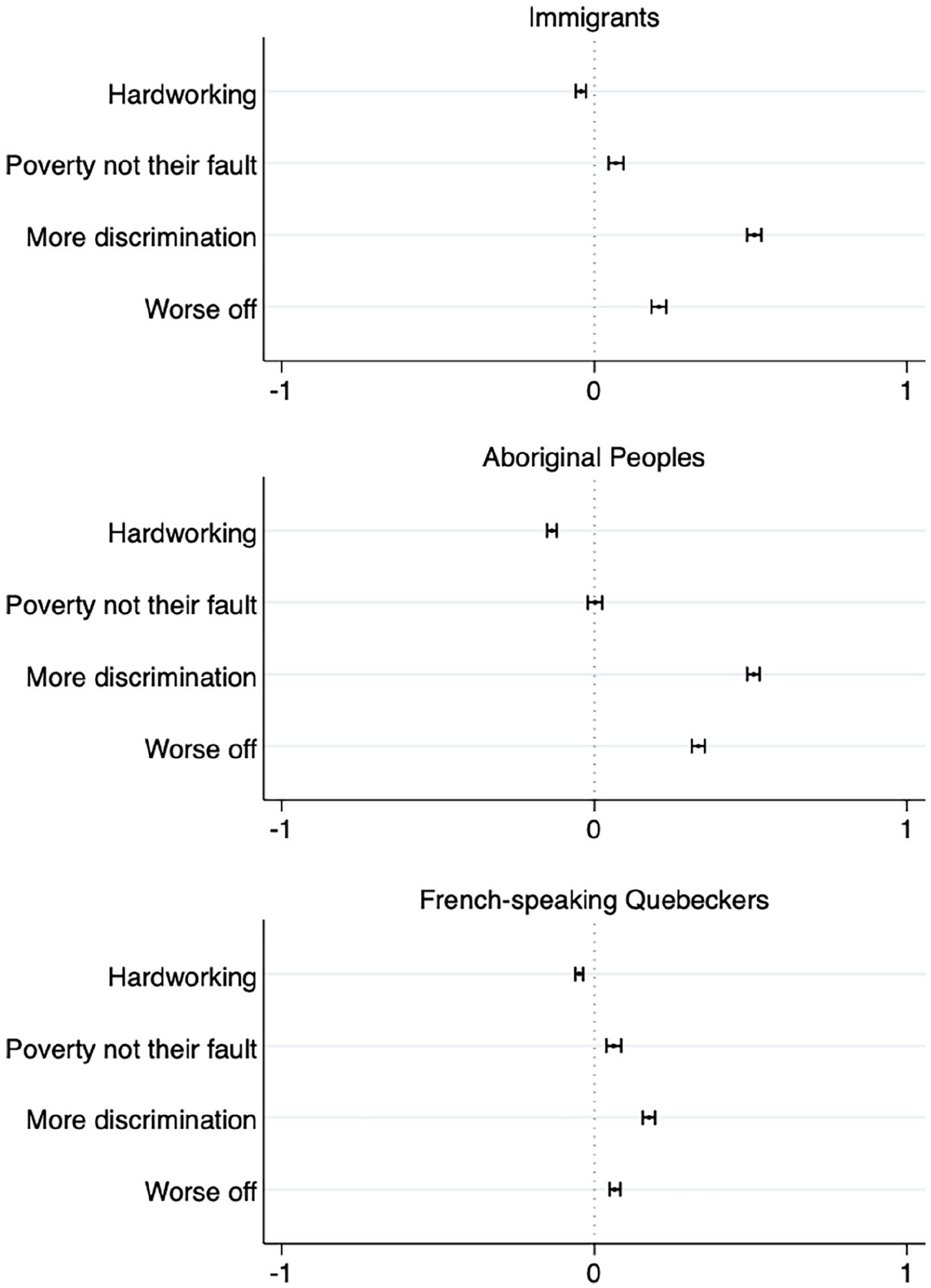
Difference Scores for Control and Need.
When we look at assessments of shared membership, however, the story is very different. Figure 2 presents the mean differences between each minority group and the English-speaking majority for the shared membership items. In almost every case, the minority is judged to be significantly lower on the shared membership index than the majority, and this difference is significant (p < 0.01). 21 In general, French-speaking Quebeckers are viewed somewhat closer to English-speaking Canadians compared with Aboriginal peoples and immigrants. Some differences between immigrants and Aboriginal peoples also emerge. Aboriginal peoples are less likely to be seen as contributing their ‘fair share’, whereas immigrants are more likely to be considered as grateful for the support they receive.
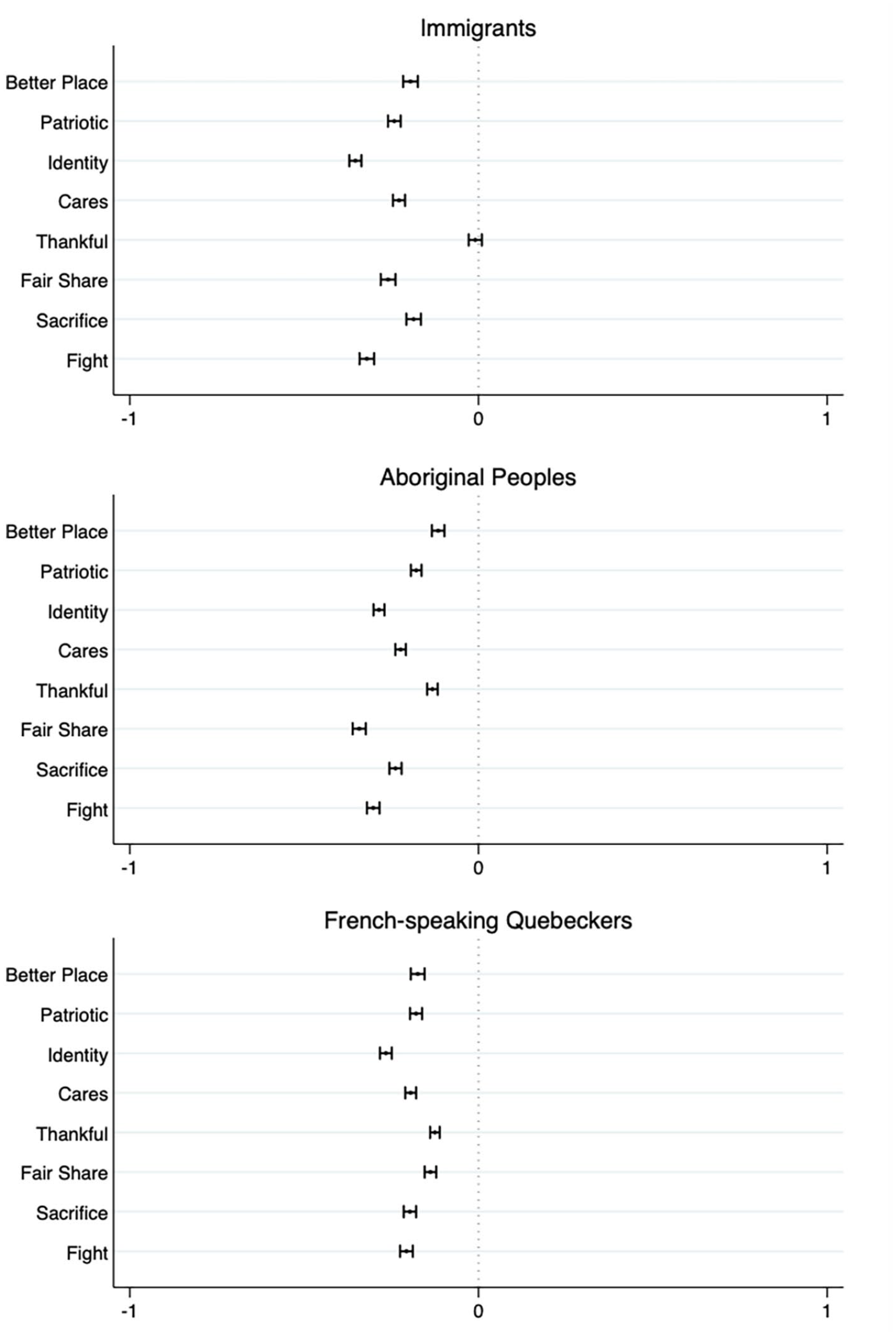
Difference Scores for Shared Membership Items.
When these eight items are combined into a single additive index of shared membership, Aboriginal peoples are viewed as least engaged in the larger Canadian community (mean = –0.23), followed closely by immigrant groups (mean = –0.22), compared with English-speaking Canadians. Notably, French-speaking Quebeckers are viewed more favourably on the shared membership dimension than either of the other two racialized minority groups (mean = 0.18, p < 0.01). 22
In sum, minorities are considered more likely to be in need and – on most measures – not responsible for their plight; but they are also judged to be less genuinely committed to the larger society. The question thus becomes, ‘How do these two conflicting grounds of deservingness judgements shape attitudes to redistribution?’
The Impact of Deservingness Judgements on Support for Redistribution
We next turn to the impact of membership perceptions on social solidarity. Figure 3 presents the effect of membership perceptions, alongside other measures of deservingness, out-group distance and national attachment. The effect sizes are based on a series of linear regressions that include controls. Figure 3 shows the point estimates and 95% confidence interval for each variable of interest. Full models are available in Supplemental Appendix C.
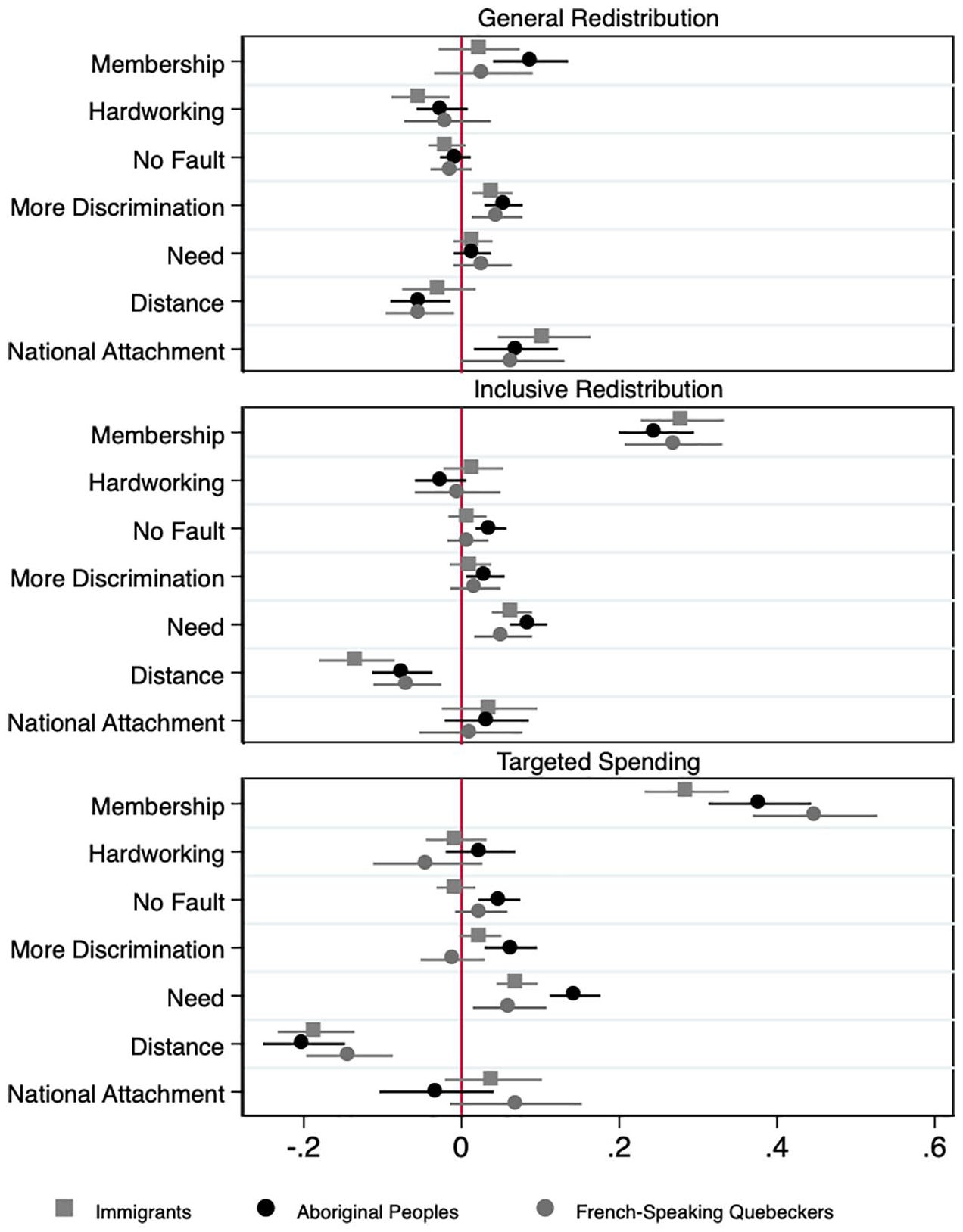
Effect of Deservingness and Identity on Redistribution.
The top panel of Figure 3 examines the impact of shared membership judgements on support for general redistribution. Notice that higher membership ratings do not decrease support for general redistribution. This is relevant for the debate on the so-called ‘progressive’s dilemma’. Some commentators argue that there is an inherent trade-off between the inclusiveness of a national identity and its motivational strength: the more we expand the boundaries of the ‘we’ to include minorities and newcomers, the weaker the resulting solidarity. Previous research has disputed this claim (Banting and Kymlicka, 2006), and our results also cast doubt on it. Those with more inclusive perceptions of membership do not show weaker levels of generalized solidarity, and in the case of membership perceptions of Aboriginal peoples, membership perceptions are actually positively related to higher levels of support for general redistribution.
The other results in the model are largely as expected based on past research. There is evidence that viewing immigrants negatively on the control dimension reduces support, while believing that minority groups face more discrimination tends to increase support. Negative out-group attitudes tend to reduce support for general redistribution as well, while those who feel more strongly Canadian tend to be more supportive. Controls in the model also perform as expected: French-speaking Quebeckers and visible minorities support more redistribution, while age, income and conservative partisanship reduce it.
As we noted earlier, even those who support a redistributive state sometimes wish to exclude minorities from these benefits. We therefore next turn to attitudes towards ‘inclusive redistribution’, which specifically ask about minorities’ access to redistributive programmes, to see how membership perceptions influence support for minorities’ inclusion. To do so, we use the same models, but importantly, add in support for general redistribution as a control. We do so because we want to isolate the effects of deservingness judgements on inclusive redistribution, above and beyond support for redistribution more generally.
The middle panel in Figure 3 clearly demonstrates that positive perceptions of shared membership increase support for inclusive redistribution. That is, respondents who see minority groups as committed to Canada are more supportive of redistribution towards these groups. The size of the effect for shared membership is quite substantial, with a one-unit increase on the comparative membership score increasing support for inclusive redistribution by about a third. This finding suggests that whether respondents perceive minority groups as committed to the Canadian community matters greatly in shaping support for the inclusion of these communities in redistributive norms. Importantly, this effect is present after controlling for out-group attitudes as well. 23 Clearly, solidarity requires more than the reduction in prejudice. We view these as related, but distinct, ways that intergroup attitudes shape solidaristic behaviour. As prejudice is reduced, it becomes more likely that people will see these groups as willing and committed members of a shared ‘we’. But this construction of a shared ‘we’ is not automatic and requires more than a decline in general xenophobic attitudes. While we cannot establish a clear causal order between these variables with the correlational data here, conceptually we see social distance and other measures of prejudice as characterizing out-group attitudes. Membership perceptions, by contrast, relate to how these groups fit within a larger sense of ‘we’, a sense of an inclusive in-group. Viewing minorities as part of an ethic of shared membership captures this process, and the empirical demonstration here shows how important it is for explaining inclusive redistribution.
When it comes to other measures of deservingness, the only variable that is consistently related to inclusive redistribution is one of our classic measures of need. When people see these groups as less well off, they tend to be willing to redistribute more. In contrast, the other measures of control and need are either insignificant or inconsistent across groups. What is important here is the consistent effect of shared membership, and its relative strength compared with control. In every case, the relationship between perceptions of shared membership and support for redistribution is significant. Furthermore, the size of the effect is larger than assessments of control and need. Critically, shared membership is not simply a reflection of either the level of xenophobia or the strength of national attachment of the respondents. Strength of national attachment has no effect, and while those who view each group as more distant are less likely to redistribute, this effect is small in comparison with the effect of shared membership.
Similar patterns emerge when attention shifts to targeted spending. The models are identical to those used to predict inclusive redistribution and mirror the results for inclusive redistribution. In each case, when the minority group is viewed as more committed to the shared community, respondents support spending that targets that group. Moreover, this effect is significant even after negative out-group attitudes are controlled for.
Figure 4 illustrates graphically the positive relationship between evaluations of shared membership, inclusive redistribution and targeted spending. It shows predicted levels of inclusive redistribution based on membership perceptions. 24 The left-hand side shows the effects of membership on inclusive redistribution. For each group considered here, support is highest when minority groups are assessed as equally committed to the community as English-speaking Canadians – that is, when they score 0 on the membership scale. A similar pattern emerges for targeted spending. In the case of immigrants, this translates into support for maintaining targeted spending on immigrant integration and multiculturalism at current levels (0.5 on the y-axis). In the case of Aboriginal peoples, survey respondents who viewed them equally as committed members supported increased targeted spending towards reconciliation above current levels. Interestingly, even when French-speaking Quebeckers are seen equally as members, respondents tend to think that current levels of targeted spending on preserving Quebec’s distinct culture are too high. What is most striking, however, is how support for targeted spending drops off for all three groups as perceptions of membership diminish in contrast to the majority reference group. If we look across the range of estimates on the membership scale, we can clearly see the strong positive relationship between membership evaluations and support for inclusive redistribution and increased spending. These effects are particularly strong in the case of spending for the two historic minority communities, where the slopes of the lines are substantially steeper.
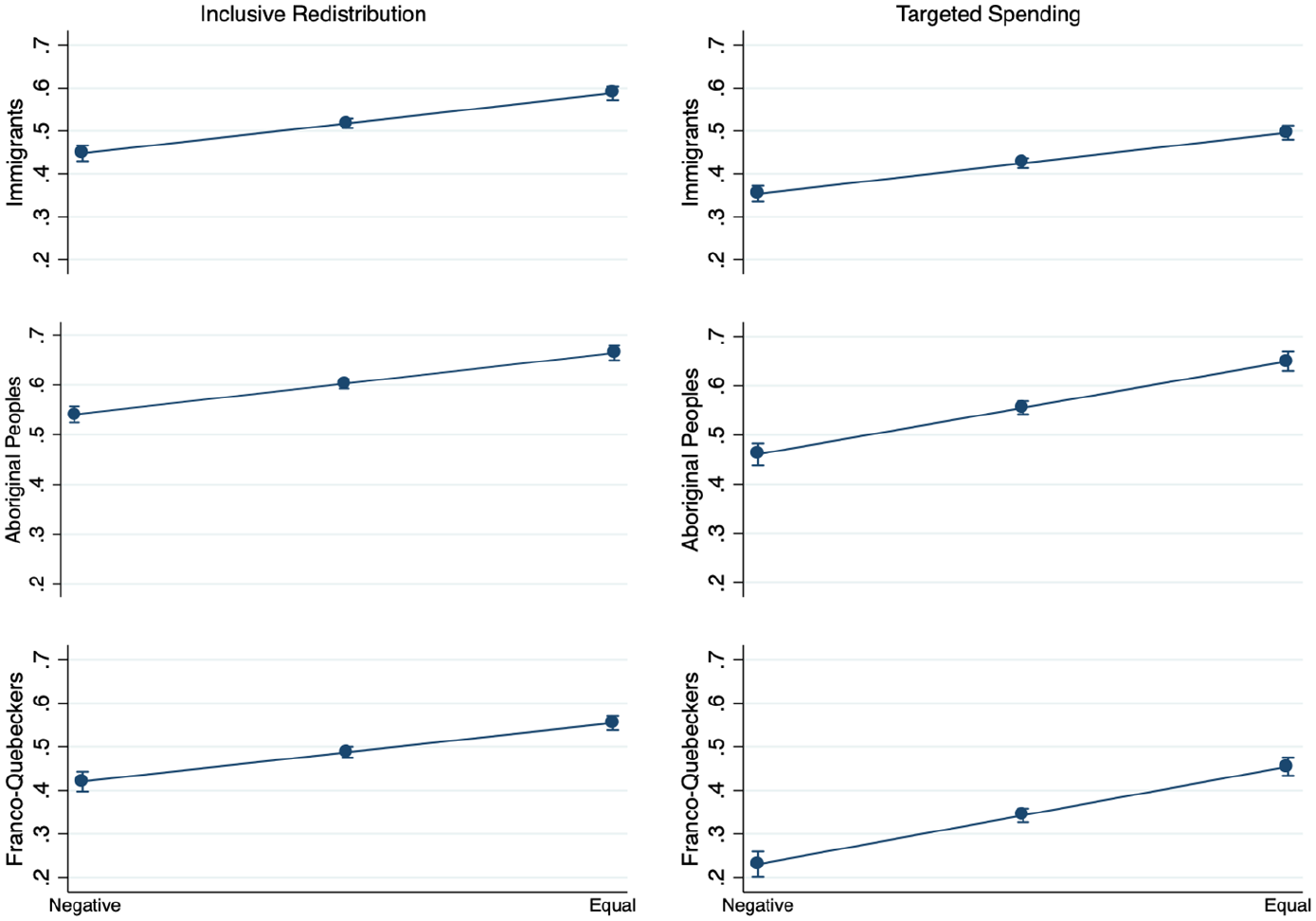
Predicted Levels of Inclusive Redistribution and Targeted Spending by Shared Membership.
In general, then, we see a strong positive relationship between seeing minority groups as committed members of society, and being willing to support their inclusion in general redistributive programmes as well as spending that targets their specific circumstances. This analysis makes abundantly clear that perceptions of shared membership do not reduce overall support for general redistribution, as some might fear. Instead, they have a powerful positive effect on support for including minority groups within redistributive frameworks and on spending that targets accommodating them within the larger national community. The size of this effect dwarfs more traditional explanations of deservingness and stands up to controls for both out-group animosity and national attachment.
Discussion and Conclusion
Perceptions of shared membership are central to judgements of the deservingness of minority groups in Canada. To be sure, beliefs about whether groups are in poverty and whether they themselves are responsible for their economic problems do find a place in our results. But perceived membership in the Canadian community appears to play a more consistent and critical role in shaping deservingness judgements. Moreover, there is a hierarchy in assessments of shared membership. Immigrants and Aboriginal peoples tend to be viewed as less a part of the Canadian community, with the French-speaking Quebeckers being closest to English-speaking Canadians. These minorities are seen as less part of ‘us’ – less committed to the Canadian community, less concerned about other Canadians, less willing to make sacrifices for them.
Such perceptions matter. Deservingness judgements rooted in perceptions of shared membership shape support for a redistributive state. In the case of all three minorities, there is a clear positive relationship between perceptions of shared membership and support for their inclusion in redistributive systems, as well as targeted spending on group-specific accommodations. Seeing minority groups as committed members of society increases willingness to support spending on programmes to address their unique needs. And, as we have shown, these more inclusive membership perceptions do not come at the cost of general support for redistribution in Canada.
Interestingly, the hierarchy in terms of support for redistribution differs from the hierarchy in assessments of shared membership. Both in the case of inclusive redistribution and targeted spending, there is greater overall support for redistribution towards Aboriginal peoples, followed by immigrants and French-speaking Quebeckers. There is also an interesting difference in the strength of the impact of membership judgements in the case of targeted spending. The effects are particularly strong for the two historic minority communities, evidenced by the substantially steeper slopes in the lines in Figure 4. Perceptions that these groups are committed to Canada matter more here.
We believe these findings have important implications for the debate on liberal nationalism, confirming some of its core assumptions, but also posing challenges to its normative vision. On the one hand, as liberal nationalists would predict, the perceptions held by the population about minorities’ commitment to the shared community matter for the resilience of public support for redistribution. This fundamental liberal nationalist premise that support for redistribution operates through commitment to a ‘we’ is clearly confirmed in our data. Assessments of deservingness are not just about perceived effort and need, but also about perceived attachment and loyalty to the wider society. As we noted earlier, previous studies focused on measures of the respondents’ own national identity: for example, on how a respondent would rate the importance of their national identity on a scale of 1 to 10. Such measures have not found any consistent effect on solidarity, and that is true of our own analysis: the strength of national attachment of respondents is not a significant factor in any of our analyses, except for general redistribution where the effect is consistently positive. 25 What does matter – and matters a lot – is a sense of shared ‘we-ness’ which generates a commitment to belonging together, acting together, governing a territory, preserving a patrimony, sharing a public life and supporting each other in times of need.
While this confirms a core empirical premise of liberal nationalism, it also raises a very difficult challenge for the normative vision of liberal nationalism. Contrary to the hopes of many liberal nationalists, perceptions of commitment to the larger society are subject to significant group bias. Immigrants and minorities are widely perceived as lacking the right sort of commitment to the ‘we’, and hence as less deserving of redistributive solidarity, even when they are seen as genuinely in need and not responsible for their disadvantage. To be sure, these ‘membership penalties’, or the negative assessments of out-groups based on membership criteria compared to some ideal, are not inherent or universal. There is in fact considerable variation in the majority’s perceptions of the membership-based deservingness of minorities, and where members of the majority see signs of a minority’s commitment to the larger society, they respond in a more solidaristic way.
The analysis here represents the first step in a larger research agenda. Three next steps are important. First, we need to turn to the question of what factors shape perceptions of shared membership of minorities, which this article has not attempted to analyse. A variety of factors are likely to be important. It is striking that Francophone Quebeckers are seen as more committed to the country than immigrants, even though the former have been more likely to contest their inclusion in Canada. Many commentators have argued that immigrants in Canada have benefitted from comparison with ethnonationalist minorities: immigrants are often presented in the media as willing joiners of the nation unlike the disgruntled old minorities (Winter, 2011; also Soroka et al., 2007). Yet our results suggest that newcomers face a membership penalty, and that a long history together seems to matter, even a history replete with political conflicts over the definition of the shared community as in the case of Quebec. Perceptions of Aboriginal peoples complicate this narrative, however. The leadership of Aboriginal peoples seeks to establish relations with Canada on a nation-to-nation basis. Yet, like immigrants, they are often perceived as more culturally different than the primarily white, Christian French-speaking community. This points to the importance of the ways in which perceptions of cultural difference, and larger processes of racialization, influence perceptions of membership.
Second, these issues also cry out for cross-national comparative analysis. In her analysis of British data showing that immigrants are perceived as less deserving, Kootstra (2017) finds that the most significant drivers of these deservingness judgements are identity, reciprocity and attitude – what we are calling the membership-based dimensions of deservingness – not control or need. This is preliminary evidence that the salience of membership-based deservingness may not be unique to Canada. Cross-national research is needed to not only establish how membership perceptions vary across contexts, but also to explore how they relate to other conceptions of national identity and redistribution. Third, we need to reflect on the normative and policy implications of these results. If deservingness judgements do rest in part on an ethic of shared membership, difficult problems arise for immigrants and minorities. How can immigrants and minorities – who almost by definition do not fit the usual expectations of membership – be seen as fulfilling the expectations of membership, and hence deserving of inclusion in the sharing community, and of support in times of need? In David Miller’s (2017: 73) words, ‘The corresponding problem . . . is how to ensure that those who are regarded at best as “marginal” members by those who place themselves at the core are included in the collective “we” when questions of public policy are decided’.
As we have seen, liberal nationalism suggests a twofold approach. On the one hand, native-born citizens must be willing to allow newcomers and minorities to join the imaged national community and must provide avenues by which they can do so. On the other hand, it is important that newcomers and minorities are perceived as willing to accept the responsibilities that arise from membership in an ethical community. At the conceptual level, the case of immigrants is perhaps more straightforward, since there are relatively well-defined and publicly accepted routes for immigrants to ‘integrate’. The case of national minorities such as French-speaking Quebeckers and Aboriginal peoples is more complicated. Their quest for self-government is often perceived by members of the majority as a form of disaffiliation or disengagement with Canada, if not actual disloyalty. A central task, therefore, is to explore how the quest for self-government can be presented as itself a form of engagement and contribution, perhaps tied to ideas of ‘nested nationality’, in which projects of Québécois and Aboriginal nationalism are situated within a larger narrative of Canadian nationalism. 26 Whether English-speaking Canadians are willing and able to see substate nationalisms in this light is an interesting question, but de-emphasizing the centrality of national identity in our understanding of shared membership may help. If the only question we ask Aboriginal peoples or Québécois is ‘how Canadian do you feel’, we are not likely to make progress. But there may be ways to render more visible the many forms of engagement, contribution and sacrifice that national minorities in fact undertake on a daily basis. How can governments and societies facilitate such mutual recognition of an ethos of membership? How can we reduce the prevailing biases and double-standards in assessments of membership? Clearly, answers to these questions will not be simple. But a focus on the underpinnings of deservingness may open more pathways forward than a narrow focus on measuring and modifying ‘identity’.
Supplemental Material
sj-pdf-1-psx-10.1177_0032321721996939 – Supplemental material for Shared Membership Beyond National Identity: Deservingness and Solidarity in Diverse Societies
Supplemental material, sj-pdf-1-psx-10.1177_0032321721996939 for Shared Membership Beyond National Identity: Deservingness and Solidarity in Diverse Societies by Allison Harell, Keith Banting, Will Kymlicka and Rebecca Wallace in Political Studies
Footnotes
Declaration of Conflicting Interests
The author(s) declared no potential conflicts of interest with respect to the research, authorship and/or publication of this article.
Funding
The author(s) received no financial support for the research, authorship and/or publication of this article.

Supplementary Information
Additional Supplementary Information may be found with the online version of this article.
Content Appendix A: Variable Information. General Support for Redistribution. Inclusive Support for Redistribution. Immigrants (Cronbach’s alpha = 0.83). Aboriginal Peoples (Cronbach’s alpha = 0.83). French-speaking Quebeckers (Cronbach’s alpha = 0.86). Appendix B: Correlations between Shared Membership Indices. Appendix C: Full Model Specification for Figures 3–5. Appendix Table 3a: Predicting Support for General Redistribution. Appendix Table 3b. Predicting Support for Inclusive Redistribution. Appendix Table 3c: Predicting Support for Targeted Spending.
Notes
Author Biographies
References
Supplementary Material
Please find the following supplemental material available below.
For Open Access articles published under a Creative Commons License, all supplemental material carries the same license as the article it is associated with.
For non-Open Access articles published, all supplemental material carries a non-exclusive license, and permission requests for re-use of supplemental material or any part of supplemental material shall be sent directly to the copyright owner as specified in the copyright notice associated with the article.
