




Abstract
Mature welfare states must increasingly handle growing fiscal pressures and a multitude of needs with smaller resources. Meanwhile, evaluations of policy outputs are characterized as ‘the weakest link’ in welfare state support, resulting in generalized political distrust. We assess the procedural fairness argument that citizens are not only concerned with welfare state outcomes but also assess the fairness of the processes of service delivery. The fairness perspective has usually been tested in cross-sectional studies, experiments or on the ‘input side’ of democracy. By contrast, we use primary three-wave panel data on evaluations and experiences with welfare state institutions. The random-effects within-between framework allows improved causal evidence that both outputs (service quality satisfaction) and procedural fairness (experienced voice opportunities) affect political trust. Crucially, however, perceived fairness mitigates detrimental effects of poor outcomes. This is because procedural voice matters, especially for the formation of political trust among losers.
Introduction
Mature Western welfare states have long faced slowly growing challenges and resource scarcity. Demographic change, persistent unemployment, international economic competition – to mention a few oft-debated ‘reform pressures’ – strain public finances while fuelling competition between legitimate needs. Recently, periodic shocks like the 2008 financial crisis and the 2015 refugee influx have contributed further to this situation.
Welfare state policies are changing in response (Beramendi et al., 2015). Reforms are complex and multidimensional, involving non-negligible retrenchment of ‘old’ social rights, but also significant ‘recalibration’ to address ‘new social risks’. Similarly, benefit schemes are redesigned to stimulate employment incentives, at the same time as the welfare state is increasingly seen as an instrument for ‘social investment’ in human capital (Morel et al., 2012; Ronchi, 2018). Moreover, welfare states have become more ‘dualized’ such that benefits remain reasonably intact for ‘insiders’, while ‘outsiders’ are denied full access due to non-standard employment (Emmenegger et al., 2012). Overall, while not all policy change is destructive, the totality of reform underscores how welfare states must handle an expanding set of needs and goals with smaller resources.
Scholars are increasingly examining how citizens’ political orientations respond to these transformations. For example, there is increasing interest in how citizens actually evaluate welfare state outputs. A powerful observation is that perceived output malperformance of welfare state services and benefits constitute ‘the weakest link in welfare state support’ (Roosma et al., 2013: 250). Citizens generally experience some divergence between their normative support for the welfare state and their more critical evaluations of its actual performance. Although these critical output evaluations rarely affect specific political orientations, such as party or policy preferences, they have important consequences for broader ‘democratic citizenship’ variables, including generalized trust in democratic institutions, processes and actors (cf. Kumlin and Haugsgjerd, 2017, for a recent overview). Of course, such orientations have long been considered essential for the stability and survival of democratic systems (Almond and Verba, 1963).
These observations in turn raise an important problem: how can political trust be maintained in an era of resource scarcity and consequential output-related dissatisfaction? We assess the procedural fairness argument that citizens are in fact not only concerned with outputs in terms of perceived service quality. Citizens also respond to various fairness aspects of the processes through which social protection and services are experienced. Fair processes may boost political trust independently of outputs, that is, controlling one for the other. More than this, however, output and process evaluations may interact, such that fair processes become especially important among those dissatisfied. If true, procedural fairness can mitigate the detrimental effect of welfare-state-related dissatisfaction. To test such arguments, we use primary individual-level panel data regarding citizens’ evaluations and experiences with welfare state institutions in Norway. This data set allows rich operationalization of public service evaluations. Crucially, it includes the key procedural fairness aspect of experienced ‘voice’ opportunities in encounters with welfare state institutions.
We contribute to the extant research in three distinct ways. First, an empirical contribution arises as research on the relationship between procedural fairness and political trust remains scarce (cf. Linde, 2011), despite important contributions in the past decade (for an overview, see Grimes, 2017). Studies on the ‘trust-as-evaluation’ approach, which predicts that political trust is driven by public satisfaction with political performance, have predominantly focused on output satisfaction. The few studies that do consider procedural quality as a driver of political trust focus primarily on the perceived fairness of input processes, either for the government in general (e.g. Linde, 2011; Ulbig, 2002) or for a single government agency or act (Carman, 2010; Esaiasson, 2010; Grimes, 2006). By relying on measures of output service evaluations, in combination with measures of perceived procedural fairness in contacts with a large range of welfare state institutions, we provide a different and more specific test of the procedural fairness hypothesis on the ‘output side’ of democracy.
A second and more theoretical contribution is to consider competing ideas about interactions between evaluated outcomes and fair procedures. If fairness matters especially among the dissatisfied, it functions as an equalizer that can maintain ‘losers’ consent’ in pressured welfare states. In this way, procedural fairness can reduce the negative impact of outcome dissatisfaction on political trust. On the contrary, the opposite argument has been made, that procedural fairness is mainly a regulator of trust among the satisfied and well-to-do. On this view, procedural fairness is something of a ‘luxury item’ that either contributes further to a trust gap between winners and losers (if procedures are good) or reduces trust to the level of losers (if procedures are poor).
Third, we make interrelated methodological contributions. Importantly, we provide improved causal tests of the relationship between perceived procedural fairness and political trust using three-wave individual-level panel data from Norway. These data also allow us to tap into evaluations of a much wider range of policy areas compared with the existing literature on welfare state performance, which has mostly relied on very few indicators. Furthermore, our analysis improves upon much past research on procedural fairness, which either uses experiments with uncertain external validity or struggles to assess causality in cross-sectional survey data. By contrast, we study effects of procedural fairness on political trust using a non-experimental but causally more rigorous strategy. Specifically, we employ an increasingly popular model that allows us to study the effect of procedural fairness between individuals and the effect of changes in procedural fairness over time within individuals in one integrated model (Bartels, 2008; Bell and Jones, 2015). This separation between variances is key, because it allows us to test our hypotheses from two different angles.
The following section discusses theory and hypotheses, highlighting first insights from research on government performance effects on political trust, and then research that focuses directly on various aspects of procedural fairness; the latter discussion closes by considering possible interactions between output and fairness evaluations. The ‘Methods’ section starts by considering the Norwegian case and later the data set and key measures. The empirical analysis follows. The concluding section summarizes the results and formulates possible implications for democratic legitimacy. Also, it discusses what in turn explains subjective evaluations and perceptions, together with the related needs for future research.
Theory and Hypotheses
Lessons from Research on Performance and Political Trust
We define political trust as a relational concept. It is a subjective evaluation of the relationship between a subject (A) and an object (B), where ‘A trusts B to do x’ (Hardin, 1999: 9). A defining feature of this relationship is the subject’s degree of uncertainty about the future behaviour of the object. Without such uncertainty, trust would not be necessary, as one could simply express support if one is sure about the outcome (Citrin and Stoker, 2018). Now, while trust is inherently about prospective uncertainty, there is also a retrospective evaluative component as the trustworthiness of the object may be evaluated based on past performance (Seyd, 2015; van Elsas, 2015). This ‘trust-as-evaluation’ approach implies that good performance (on various aspects) induces high levels of political trust (van der Meer and Hakhverdian, 2017).
Several strands of research have tested the trust-as-evaluation approach. The largest one has dealt with macroeconomic performance. Here, the most convincing evidence is found at the individual level, in that perceptions of government performance quite strongly predict political trust. Evidence for objective measures of government performance on political trust is more mixed (cf. van der Meer and Hakhverdian, 2017). Nonetheless, a recent overview (van der Meer, 2017) shows that especially macroeconomic changes within countries over time successfully explain much of the between-country variations in political trust.
A more recent literature suggests that citizens also consider welfare state-related policy outputs, outcomes and performance evaluations (e.g. Haugsgjerd, 2018; Kestilä-Kekkonen & Söderlund, 2016; Lühiste, 2014). A review chapter (Kumlin and Haugsgjerd, 2017) illustrates how macro-variables related to inequality and welfare generosity, as well as individual assessments of services, affect political trust. Connected to this, research shows that direct experiences with policies provide input for performance evaluations, as well as broader political orientations (Kumlin, 2004; Rothstein, 2009; Soss, 1999; Watson, 2014). Moreover, while welfare state performance evaluations have been identified as a predictor of political trust for some time (Haugsgjerd, 2018; Kumlin, 2004), such associations appear to have grown somewhat stronger in Europe after the 2008 financial crisis and the 2015 refugee spike. This is the case especially in Southern European countries that were hit hard by the crisis (Ellinas and Lamprianou, 2014; Torcal, 2017), but also appears to apply elsewhere on the continent (de Blok et al., 2020a).
Lessons from Research on Procedural Fairness
The results discussed above might suggest gloomy prospects for political trust in an era of welfare state challenges and change. If welfare states must satisfy more needs with smaller resources – and if contentious reforms, outcomes, negative evaluations hamper political trust – then the road ahead appears problematic.
But not so fast. Typical for the trust-as-evaluation literature is that government performance is measured in terms of outputs and outcomes, rather than in terms of process (but see Torcal, 2014 on the role of political responsiveness). For example, surveys ask whether citizens are satisfied with ‘the state’ of health care and educational systems (see, for example, the European Social Survey). Yet, there are reasons to expect that citizens pay attention to how the output came about, that is, the process. Procedural fairness theory was introduced as a counterargument to output-oriented theories. It predicts that people care about the decision-making and implementation process preceding the output (Lind and Tyler, 1988). This approach can help explain why citizens accept decisions, even though they do not benefit directly from them or otherwise assess outcomes as dissatisfactory. Perceptions and experiences of procedural fairness have been shown to affect attitudes towards institutions and outcomes (van den Bos, 2005). Such effects are assumed to be present in a multitude of domains of human and organizational behaviour (Lind and Tyler, 1988). It seems especially relevant when studying the practice of social welfare policies, which commonly entails complex procedures and frequent interactions between citizens and public employees.
There is little consensus on what makes processes be perceived as fair. Relatedly, the precise meaning of fair procedures likely varies between contexts (Tyler, 1988). Examples of suggested fairness aspects include the speed with which government agencies handle requests (Wilke, 1991), whether people are treated with respect (Rothstein, 2009), and whether authorities are impartial and non-corrupt (Rothstein and Teorell, 2008). In its simplest and earliest theorized form, however, procedural fairness is conceptualized as ‘experienced voice opportunities’ (Hirschmann, 1970). Voice involves having the opportunity to ‘kick up a fuss’ in any form of activity, with the intention of producing some form of change in service, management etcetera (p. 30). It is an important procedural value of citizens’ interactions with state authorities: a process will be perceived as more fair if citizens feel they ‘can exercise influence and communicate their views to public employees during the interaction process leading up to welfare state outcomes’ (Kumlin, 2004: 44; cf. Thibaut and Walker, 1975).
Voice opportunities can be both formal and informal (Kumlin, 2004). Formal voice opportunities are institutionalized situations in which a subject’s input can have a direct effect on the process or subsequent decision. The link between formal voice opportunities and procedural fairness is in this case rather clear. Informal voice opportunities, however, are not obviously, visibly or directly linked to actual decisions or changes (Kumlin, 2004). Rather, they concern the possibility to express one’s opinion to a public employee in the interaction process, regardless of one’s influence on real decisions or reforms. These informal voice opportunities also have the potential to generate system legitimacy, and may be as important as formal voice opportunities (Lind et al., 1990).
The value of procedural fairness has been tested in a variety of settings, and on several dependent variables. Among the most commonly studied contexts are organizational (e.g. the work by van den Bos, 2005) and judiciary (e.g. Tyler, 1989) settings, as well as electoral settings in which political decision-making is taking place (i.e. the input side of democracy) (Arnesen, 2017; Carman, 2010; Esaiasson, 2010; Esaiasson et al., 2016; Hibbing and Theiss-Morse, 2001). Less common is to study the fair process effect at the output side of democracy, in citizens’ direct interactions with street-level bureaucrats in their daily life (but see Lipsky, 1980; Soss, 1999). As noted by Rothstein (2009: 325), however, ‘citizens generally come into contact with the output side of the political system – with the administration, that is – far more frequently and intensively than they do with its input side’.
Recent studies focusing on the input side of democracy show that perceived process quality can foster political trust (e.g. Carman, 2010; see for an overview Grimes, 2017). There are two possible mechanisms underlying this relationship between perceived procedural fairness and political trust. First, how an authority treats its citizens can offer citizens a signal of its trustworthiness (Grimes, 2017). If citizens perceive that they are being treated fairly by public officials, they will believe that the political system in general is trustworthy and will, consequently, hold higher levels of political trust (Marien and Werner, 2018; Soss, 1999). Perceptions of procedural fairness can, therefore, function as a heuristic of the trustworthiness of institutions and actors. Alternatively, from the trust-as-evaluation perspective, procedural fairness can also directly affect trust when citizens evaluate government performance based on the quality of its policy implementation procedures.
Based on these mechanisms, we formulate two specific hypotheses. The first focuses on variation between individuals and predicts that an individual who perceives the procedures of welfare state services as more fair has more political trust, compared to other individuals (H1 – the cross-sectional hypothesis). The second hypothesis instead focuses on individual variation over time and predicts that an increase in the perceived procedural fairness of welfare state services is related to an increase in political trust (H2 – the dynamic hypothesis). Both these hypotheses express the theoretical expectation that perceived procedural fairness at the output side of democracy can foster political trust.
Procedural Fairness as a Moderator
Process perceptions may not only have a direct impact on political trust. Rather, these perceptions of procedural fairness may also interact with the output performance dissatisfaction in fostering generalized trust in political institutions. One common assumption is that citizens are first and foremost result-oriented but that fair procedures, as it were, soften the blow of not getting one’s desired outcome. Conversely, procedures perceived as unfair exacerbate the harmful influence of output dissatisfaction. Under this view, then, procedural fairness makes a larger difference for output ‘losers’ than for ‘winners’, that is, those who are satisfied with the outcome (cf. Brockner and Wiesenfeld, 1996).
This again brings us to two separate hypotheses on the moderation effect of procedural fairness. Our third hypothesis focuses on between-person variation where we expect that individual differences in welfare state services satisfaction have a smaller effect on political trust among people with more positive perceptions of procedural fairness (H3). We also study individual changes over time and predict that a decline in welfare state services satisfaction has a smaller effect on change in political trust if at the same time perceived procedural fairness was increasing (H4). Again, both the cross-sectional and the dynamic hypothesis of the conditional effect of procedural fairness would provide evidence for our theory, although from different angles.
The moderation expressed by H3 and H4 is, however, not self-evident. In fact, at least two other possibilities have been suggested. One is that procedural fairness is a rather universal human value. It therefore builds system legitimacy independently of outcomes and material self-interest, which implies no interaction at all. Yet, a different view is that it is only once outcome preferences are satisfied do people pay attention to non-material aspects like voice (Marien and Kern, 2018). Procedural fairness would be, as it were, a ‘luxury item’ that becomes interesting once a more primary need for a satisfactory outcome is fulfilled. If true, the interactions would run in the opposite direction of those expected under H3 and H4: the trust gap between those satisfied and dissatisfied with outcomes would grow with perceived procedural fairness.
Case, Data and Methods
The Norwegian case displays various features that are relevant when assessing the findings in a comparative perspective. At first glance, Norway seems like a special case, as it is typically regarded as the quintessential high-trust, high-generosity welfare state, one that has seen a remarkable economic development over several decades. Oil and gas revenues have resulted in unparalleled public savings and a persistently low unemployment rate.
On closer inspection, there are also features that are reminiscent of those seen elsewhere in Europe. Importantly, Norway’s generous welfare state is experiencing similar, if not identical, reform pressures and directions. This is indicated by, for instance, large reforms in pension, activation and family policy in the 2000s (Bay et al., 2010). Relatedly, our data were collected between 2014 and 2017, which coincided with a new macroeconomic discourse as the country experienced a sudden and unexpected structural shift due to falling oil prices beginning in 2014. As described by Haugsgjerd and Kumlin (2019), this downturn was heavily politicized and broadly covered in the media, quickly establishing a new national narrative where virtually all actors agreed on the need for economic adjustment – ‘omstilling’. Prominent in the political discourse were possible negative implications for welfare state policies. Overall then, while Norway’s economic situation is exceptional, its basic political discourse is occupied with welfare state challenges, scarcer resources and reform needs, similar to other rich welfare states.
Moving to public opinion, Norway is among the group of North European/Scandinavian countries where output performance satisfaction tends to be the highest (Roosma et al., 2013). It is also here that we see the strongest effects of public service satisfaction on political trust (de Blok et al., 2020a). Still, such effects are almost universally present across the European continent, where political trust became more strongly linked to public service satisfaction after the multiple crises experienced in Europe after 2008 (de Blok et al., 2020a). Thus, while the exact magnitude of welfare state performance effects is likely to vary, their very existence is a rather universal phenomenon, suggesting that our findings have relevance also elsewhere.
We rely on the three waves of the Norwegian panel study ‘Support for the Affluent Welfare State (SuppA)’ (Kumlin et al., 2017). The data capture citizens’ evaluations of experiences with a wide variety of welfare institutions, and various features of these experiences, across time (for an overview, see Supplemental Appendix A). This panel data set is an improvement in that extant work on welfare state performance has typically relied on cross-sectional rather than individual longitudinal panel data (but see Haugsgjerd and Kumlin, 2019). 1 Furthermore, the few existing panel studies do not study political trust but rather neighbouring concepts such as democratic citizenship or political participation (Watson, 2014). The relative lack of longitudinal individual-level analysis makes even well-controlled multivariate effect coefficients open for interpretation. Cross-sectional relationships could be, for example, due to unmeasured unit heterogeneity or reciprocal causation. Moreover, with respect to the procedural fairness literature, unlike existing cross-sectional studies (e.g. Marien and Werner, 2018), we are better equipped to make causal statements, and unlike experimental procedural studies (Arnesen, 2017; Tyler, 2013), our findings are set in the real world. All in all, this panel data set gives a unique opportunity to test our hypotheses.
Using a two-staged sampling procedure, a sample was drawn from TNS Gallup’s access panel among individuals residing in 61 strategically selected municipalities and/or city districts. 2 Response rates from the pre-recruited access panel were 50%–60%. This led to a final sample consisting of 5420 respondents between the ages of 18 and 75 years: 52% of these respondents participated in the first two waves and 29% participated in all three waves. Newly recruited members were also added to the second wave. The data were collected through an online survey. 3
Dependent Variable
Political trust is measured by an index of three items asking about trust in political parties, parliament and the government (4-point scales, Cronbach’s alpha: 0.82). 4 Our analysis is meant to capture whether evaluations of specific and typically local services are generalized, thus affecting political trust in a more general and/or national sense. Said differently, we deliberately focus on indicators of general/national trust, rather than on more specific local trust. Theoretically, generalization to the general/national level can occur through several mechanisms. First, according to a rational choice argument, citizens know that political responsibility for locally experienced services is spread in complex ways across Norway’s multilevel political system, where the national level is often partly responsible for regulating, funding, and monitoring local politics and policies. One may add here that local/regional services like elder and healthcare feature high on public sphere agendas also in national election campaigns. Relatedly, recent work on responsibility attributions indeed shows that citizens look towards the national level in most types of policy areas (de Blok et al., 2020b).
A second motor of generalization arises as some citizens may not separate clearly between trust at different levels. Perhaps exactly because responsibility is hard to assign, they develop a truly generalized tendency to (dis)trust all or most political actors and institutions. 5 Third, even citizens that do separate trust at different levels may not have equal information across levels, such that trust in one level affects another. This can involve both top-down generalization (national to municipal level) and bottom-up (municipal to national level) (cf. Weitz-Shapiro, 2008). 6 Overall then, we find theoretical and empirical arguments for the relevance of our dependent variable.
Independent Variables
To capture citizens’ outcome satisfaction from welfare state services, we use the mean level of their satisfaction with a large number of institutions and policy areas. Respondents were asked ‘How satisfied or dissatisfied are you with the following services in your municipality/county?’ for 18 types of services in total, covering a variety of services in the domains of healthcare, childcare, eldercare, education, as well as NAV (the Norwegian Labour and Welfare Administration), which administers a variety of services and benefits related to unemployment, sickness, pensions and family benefits. 7 This rich information allows encompassing measurement of citizen satisfaction with welfare state services. It stands in contrast to much past research which has often considered just a couple of services, typically ‘education’ and ‘healthcare’ as these are offered by the European Social Survey (for discussion, see Haugsgjerd and Kumlin, 2019). Answers ranged from very dissatisfied (1) to very satisfied (5). Those who had no direct or indirect experience (where indirect means via family members) with a service were coded as ‘missing’ for this variable. 8 In other words, the evaluations registered by our index only come from individuals who had directly or indirectly experienced an evaluated service in question. 9
We operationalize perceived procedural fairness by focusing on its simplest and most basic form: do citizens perceive that they were given a voice during their experiences. This is in line with the dominant approach in the procedural fairness literature; however, as a robustness check we also employed other types of operationalizations (see Supplemental Appendix D). 10 Respondents were asked: ‘If you now continue to think about those services you have used yourself during the past 12 months, to what degree would you say the following statements fit your own experience?’ For each statement, respondents could answer on a 4-point scale ranging from very poorly (1) to very well (4) (respondents could also indicate ‘not relevant’). To measure voice opportunities, we rely on the item ‘Employees were helpful in the sense that they listened to what I had to say’. Those who answered ‘not relevant’ were set to the median score (2.5) on the assumption that these respondents have ‘ordinary’ perceptions, that is, neither positive nor negative. 11
To control for alternative explanations of political trust (cf. Zmerli and van der Meer, 2017), we include a range of variables in our models: gender, age, level of education, immigrant status, political interest, income and whether they voted for a government party (‘home team’). This latter variable was motivated by findings on a partisan bias in political trust where government supporters align their perceptions of government performance with their levels of support (Hetherington and Rudolph, 2008). As such, support for a government party could be a confounding variable driving both performance perceptions and political trust.
Modelling Technique
On this panel data, we perform a multilevel linear regression (using the ‘xtreg’ command in Stata 13), including both between and within effects of general satisfaction with welfare state services and procedural fairness (level 1 variables). The novel random-effects within-between (REWB) framework for analysing nested/panel data (Bartels, 2008; Bell and Jones, 2015) allows us to separate these effects and combines the advantages of fixed and random effects models. Note that, following this framework, the within-person transformations are uncorrelated with the between-person random effects.
This approach has two advantages: first, while both the within and the between effects constitute a test of our hypotheses, they do so from different angles. The between-persons effect of procedural fairness entails the individual-level mean of procedural fairness, while the within-person effect of procedural fairness specifically grasps the variations from this mean in the respondent’s assessment of procedural fairness over time. Hence, the between-persons effect tells us whether procedural fairness on average is positively related to political trust on average by comparing between individuals (a cross-sectional angle), while the within-persons effect models whether a change in procedural fairness is linked to a change of trust (a dynamic angle).
A second advantage is that the within-effects are independent of any factors resulting from differences between individuals (so-called cluster-confounding) (Bartels, 2008: 10). When studying relationships between evaluations and attitudes, there is a serious threat of endogeneity problems. Perceptual biases, such as partisanship or a general positivity bias, often serve as a filter through which new information is selected and evaluated (Zaller, 1996). Accordingly, performance perceptions and fairness evaluations may not always correspond with actual performance or fairness because they can be coloured by one’s predispositions towards a political actor or institution (Esaiasson et al., 2016). It is now common practice to include various controls (including government support) when studying relationships between individuals, but this is not a perfect solution.
As argued, the within-individual effects in our models are unaffected by perceptual biases resulting from between-individual heterogeneity (including all time-invariant heterogeneity). As such, we are able to circumvent a large part of the endogeneity problems. At the same time, the within-effects only focus on changes in perceptions, scaled to the individual mean. Hence, we study whether a change in our independent variable coincides with a change in our dependent variable. This puts us in a better position to establish whether there is a causal effect.
These causal advantages notwithstanding, there is, however, still the possibility of reversed causality, that is, political trust to some extent also affects performance evaluations (including perceived fairness). Indeed, a recent study on the same panel data suggests such a reciprocal relationship (Haugsgjerd and Kumlin, 2019). Still, this complexity is not captured in our analysis. Rather, we use these past findings to buttress an assumption that estimates reflect in part a causal effect of evaluations on political trust, while making progress on the contrast and interaction between outputs and procedures.
Results
Direct Effects
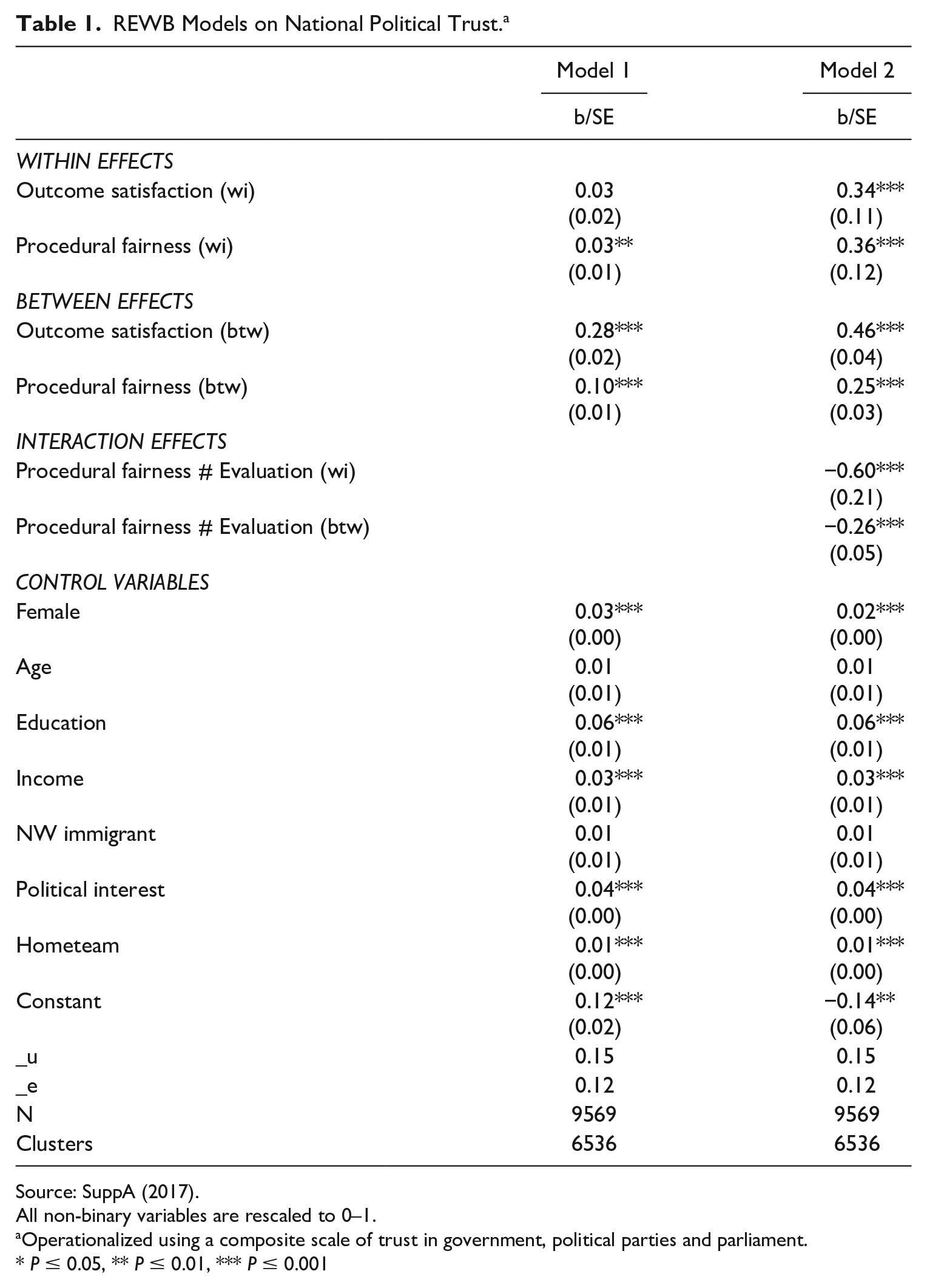
Table 1 presents the coefficients of the REWB estimation of our key predictor variables on political trust. For the sake of clarity, we discuss the results based on the cross-sectional and dynamic comparisons separately. Starting with the cross-sectional or between effects (marked ‘btw’), these tell us whether a predictor variable on average (individual mean across all waves) predicts political trust. These effects, therefore, concern average differences between individuals in their evaluations of procedural fairness and their levels of political trust. In line with previous research, we find that those who are satisfied with welfare state services overall also hold more trust compared with other individuals (Model 1). To be more precise, a person who is completely satisfied with the overall quality of welfare state services has (on average) 0.28 more trust compared with a person who is completely unsatisfied. As such, the between-person effect of overall welfare state satisfaction is equivalent to more than one-fourth of the total range of political trust at the cross-sectional level. At this level, we also find a positive and significant relationship between perceived procedural fairness and political trust (H1). Individuals who perceive the procedures as more fair compared with others also hold higher levels of political trust. This results in a difference of approximately 0.1 in political trust between a person who regards the procedures as utterly fair, compared with a person who does not. This positive relationship is visualized in Figure 1.
REWB Models on National Political Trust. a
Source: SuppA (2017).
All non-binary variables are rescaled to 0–1.
Operationalized using a composite scale of trust in government, political parties and parliament.
P ≤ 0.05, ** P ≤ 0.01, *** P ≤ 0.001
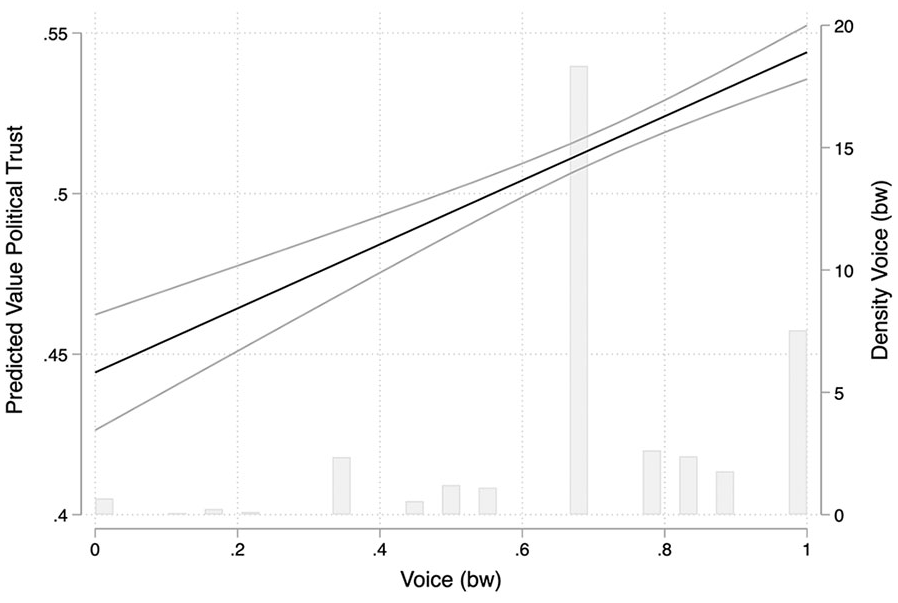
Between: Predicted Value of Political Trust per Level of Perceived Voice (95% Confidence Interval).
Next, we move to the dynamic or within effects (marked ‘wi’). These effects look at differences within individuals across time, where an effect is based on the deviation from the individual mean. In other words, a positive score on the within-person measure of procedural fairness indicates that the respondent perceived the procedure at time t as more fair than he or she had on average across all the waves. A positive effect then indicates that perceiving a process as more fair than one did in other waves is related to a higher level of political trust at that point. These within-effects are like fixed-effect coefficients in the way that they control for all variation originating from differences between individuals.
Model 1 shows that there is a positive within-effect of overall public service satisfaction on political trust, but it is not statistically significant. 12 For perceived procedural fairness, a significant positive relationship is observed at the within level. This suggests that an increase in perceived procedural fairness at time t (relative to other waves) is related to a higher level of political trust (in line with H2). In comparison with the cross-sectional results, the dynamic effects appear smaller (coefficient is 0.03). However, as can be observed from Figure 2, there is much less variation within individuals over time compared with the variation between individuals. The standard within-person deviation of political trust equals 0.07, which means that the effect of procedural fairness is equivalent to 44.44% of the typical wave-to-wave change in procedural fairness. Moreover, what is interesting is that the within-effect of procedural fairness appears to be a stronger predictor of changes in political trust than wave-to-wave changes in overall welfare state service satisfaction.
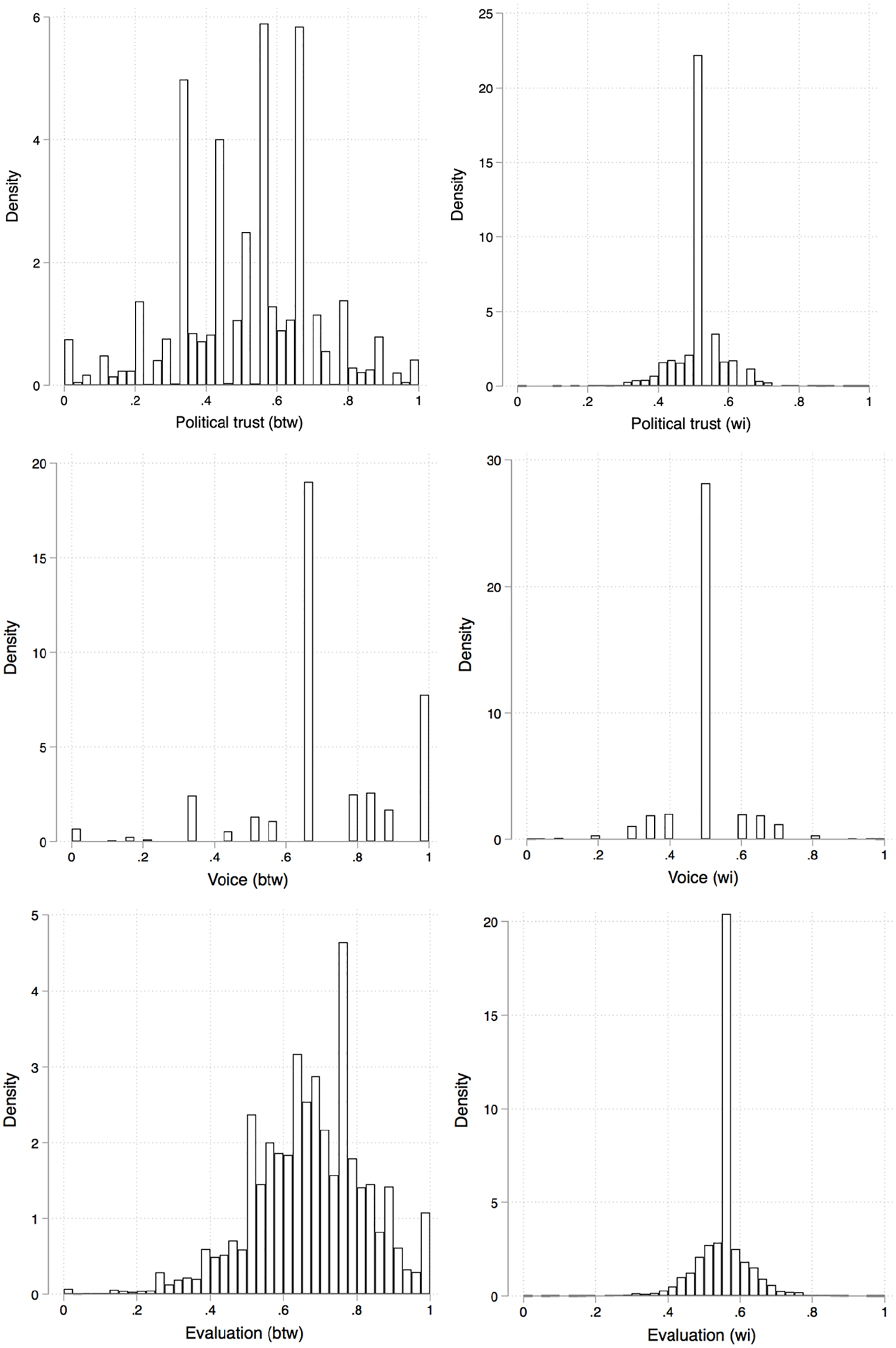
Within and Between Histograms for Political Trust, Voice and Overall Satisfaction.
Conditional Effects
To study the conditionality of the effects of welfare service satisfaction and procedural fairness, we include within- and between-interaction effects. Model 2 investigates the moderating effect of procedural fairness on the relationship between general satisfaction with welfare state services and political trust. Again, we first discuss the cross-sectional results and then the dynamic results.
When comparing between respondents, the product term of the interaction is significant and negative. To understand what this means, Figure 3 graphs the predicted level of political trust per level of outcome dissatisfaction for extreme and mid-values of voice. 13 In line with H1, we find that for all respondents, increased satisfaction with the overall quality of welfare services is related to enhanced political trust. However, the size of the effect of public service dissatisfaction strongly varies per level of perceived procedural fairness. Among people with more positive perceptions of procedural fairness (voice equals 1), individual differences in welfare state services satisfaction has a much smaller effect on political trust (in line with H3). The opposite is also true: among those who perceive the fairness of procedures as low (voice equals 0), welfare state service dissatisfaction has a much more detrimental effect on political trust. Furthermore, the perceived fairness of the process does not seem to make a difference for the degree of political trust among those who are utterly satisfied with the overall state of welfare services (outcome satisfaction equals 1).
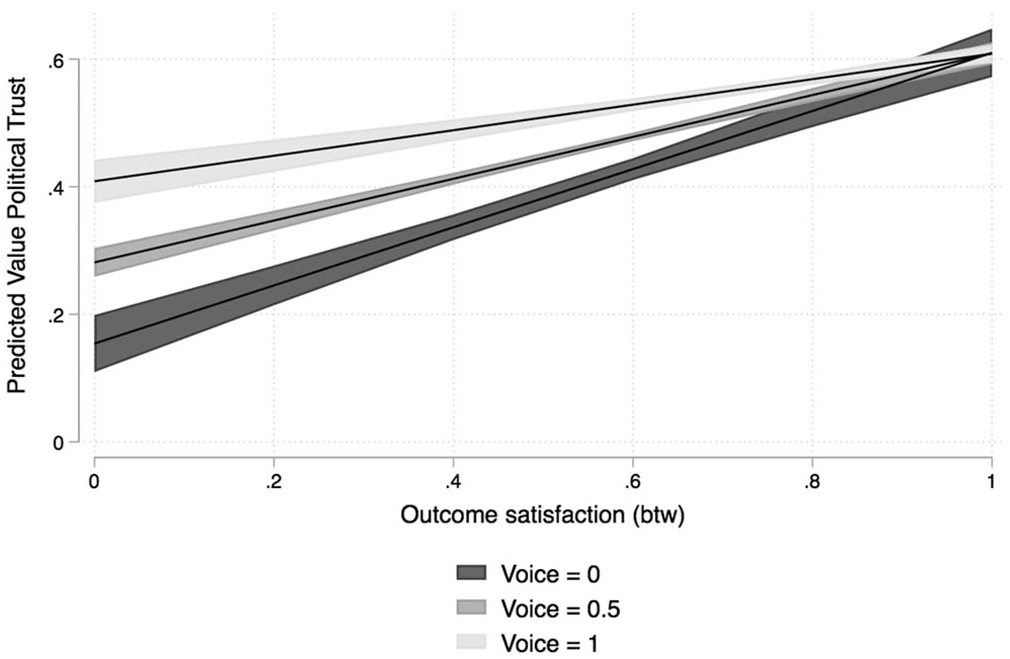
Between: Predicted Level of Political Trust per Level of General Satisfaction, for Three Values of Voice (95% Confidence Interval).
Next, the within-person interaction effect of perceived procedural fairness and overall public service satisfaction is also negative and significant. Figure 4 plots the predicted levels of trust per within-value of overall satisfaction for three levels of voice. 14 Both independent variables capture changes, where 0.2 refers to a decrease, 0.5 to no change over time and 0.8 to an increase. 15 Again, we see that a decline in welfare state services satisfaction has different consequences for political trust, depending on the changes in perceived procedural fairness. That is, when a decline in welfare state services satisfaction (indicated by a score lower than 0.5 on the x axis) coincides with a decline in perceived procedural fairness (i.e. voice equals 0.2), the largest decline in political trust is observed. When a decline in overall satisfaction coincides with an increase in perceived voice (i.e. voice equals 0.8), one’s level of political trust hardly changes. This is in line with H4. 16 In addition, among those who have become more satisfied with the overall quality of welfare state services (>0.5), changes in perceived voice hardly make a difference.
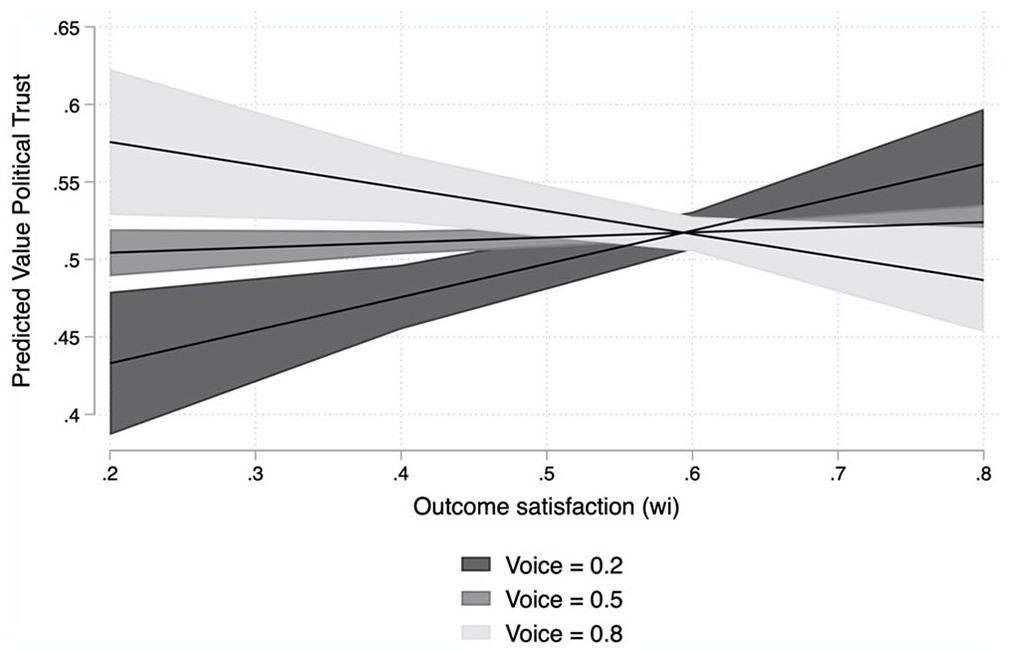
Within: Predicted Level of Political Trust per Level of General Satisfaction, for Two Values of Voice (95% Confidence Interval).
Discussion and Conclusion
Mature welfare states face growing fiscal challenges and intensified competition between legitimate needs and scarce resources. They are responding with a complex set of reforms including retrenchment, social investment and recalibration favouring improved protection of ‘new social risks’. Meanwhile, output dissatisfaction is characterized as ‘the weakest link’ in welfare state support, one which hurts generalized trust in democratic institutions, parties and politicians. We assessed the importance of one aspect of procedural fairness, that is, experienced voice opportunities in contacts with public services. Can procedural quality cushion the blow of welfare state output dissatisfaction? Our three-wave panel data allowed separation of within- and between-respondent variation, providing a stringent test of how outcome evaluations and procedural fairness jointly affect political trust.
The results show that both levels of, and changes in, experienced voice opportunities affect political trust controlling for evaluated outcomes related to service satisfaction. Interestingly, while the between-individual (i.e. ‘cross-sectional’) results suggest outcomes are more important, the causally more stringent within-individual analysis of change finds more convincing evidence for procedures as drivers of political trust. Crucially, we also found that perceived procedural fairness moderates detrimental effects of unfavourable outcomes. Thus, it is particularly losers (those dissatisfied with outcomes) who attach greater weight to procedural voice in the formation of political trust.
More generally, these findings suggest the procedures of welfare state institutions can play an important role for the political consequences of welfare state reform. Losers’ consent can be gained by improving the quality and perceived fairness of these procedures. Resource scarcity and growing challenges to the welfare state may not need to result in a decline in political trust, if governments invest in the processes of service delivery. Procedural interactions with street-level bureaucrats at the ‘output-side’ of democracy meaningfully shape citizens’ perceptions of the legitimacy of the general political system.
In addition, these results contribute to the literature on political trust by providing improved support for the trust-as-evaluation approach and by demonstrating the importance of procedural performance. Evidence for the trust-as-evaluation approach is largely based on cross-sectional comparisons. Our panel data allowed us to study dynamic variation to provide credence to a causal relationship between political performance and political trust. Moreover, work on the trust-as-evaluation approach has predominantly focused on output dissatisfaction as a driver of trust (Grimes, 2017). Our results suggest that citizens also care about the quality of the procedures and that this too affects their levels of political trust.
What answers do we need from future research? An obvious caveat is that we only studied one very affluent welfare state with a unique historical trajectory. That said, Norway has undergone similar reforms as those in other welfare states. Also, our primary data collection captured Norway at a time when the very foundation for its affluence was questioned due to falling oil prices. Finally, comparative studies suggest that welfare state performance evaluations are of relevance for political trust also in other European countries (de Blok et al., 2020a). In short, the results uncovered here may not necessarily be unrepresentative for other countries, but additional research is needed to demonstrate the generalizability of our findings.
Furthermore, on the generalization of our findings, this article focused mostly on perceived procedural fairness of welfare state services at the local level and citizens’ trust in national institutions of representation. While we present several arguments for why we believe local fairness evaluations affects trust in these specific institutions at the national level, we cannot make any claims regarding the effects of perceived procedural fairness of national institutions (Linde, 2011; but see Marien and Werner, 2018). Nor did we investigate the effects of local procedural fairness on trust in other state institutions, such as the police and courts (Tyler and Huo, 2003).
A further caveat is that we studied subjective evaluations. Are they meaningful reflections of ‘objective’ performance conditions and relevant facts about the functioning of the welfare state? When it comes to output evaluations, the answer is mainly affirmative so far according to a recent overview (Kumlin, in press). Based on cross-sectional and experimental evidence, public service evaluations seem at least partly ‘cognitive’ in nature (Schneider and Popic, 2018).
There is more unresolved debate concerning the nature and sources of procedural fairness evaluations. One ever-present possibility is that they reflect predispositions such as partisanship and other orientations. Indeed, Haugsgjerd and Kumlin (2019) show that outcome as well as fairness evaluations and political trust seem to affect each other over time. Moreover, fairness evaluations might reflect outcome satisfaction, rather than ‘objective’ procedural fairness (cf. Esaiasson et al., 2016). We have addressed this problem by simultaneously modelling fairness perceptions and general satisfaction with services, while also controlling for government support. This increases the likelihood that the remaining between-persons variation in procedural fairness does not simply reflect political predispositions or unfavourable outcomes. At the same time, we show that individuals do not attach the same weight to the fairness of a procedure. Rather, fairness builds especially ‘losers’ consent’.
In conclusion, then, future work is needed to determine the extent to which fairness perceptions reflect actual fairness aspects. To the extent that they do, our results imply a positive story about ‘losers’ consent’ in changing welfare states. Not only do experienced voice opportunities seem causally related to political trust, controlling for evaluated outcomes. Such opportunities also seem to reduce detrimental effects of poor outcomes. Thus, paying attention to procedural fairness in service delivery may constitute one avenue through which political trust can survive resource scarcity and widespread output dissatisfaction in changing welfare states.
Supplemental Material
sj-pdf-1-psx-10.1177_0032321721993646 – Supplemental material for Losers’ Consent in Changing Welfare States: Output Dissatisfaction, Experienced Voice and Political Distrust
Supplemental material, sj-pdf-1-psx-10.1177_0032321721993646 for Losers’ Consent in Changing Welfare States: Output Dissatisfaction, Experienced Voice and Political Distrust by Lisanne de Blok and Staffan Kumlin in Political Studies
Footnotes
Acknowledgements
The authors thank the anonymous reviewers for their helpful comments. In addition, they express their gratitude for the feedback received at various academic workshops, including the Workshop on Procedural Justice in Ghent (2019), the Workshop ‘Between Capitalism and Populism’ in Konstanz (2019), and research seminar of the Quality of Government institute in Gothenburg (2019) and the department of Sociology at Umeå University (2019). Special thanks are due to Peter Esaiasson, Marcia Grimes and Malcolm Fairbrother for their comments on earlier versions and also to Atle Haugsgjerd for fruitful discussions.
Declaration of Conflicting Interests
The author(s) declared no potential conflicts of interest with respect to the research, authorship and/or publication of this article.
Funding
The author(s) disclosed receipt of the following financial support for the research, authorship and/or publication of this article: This research has been supported by the Research Council of Norway (Project No. 301443) and the Netherlands Organisation for Scientific Research (through the NWO Top Grant 407-13-029).

Supplementary Information
Additional supplementary information may be found with the online version of this article.
Contents
Appendix A – Selection of welfare state services.
Figure A.1 – Percentage of direct and indirect welfare experiences.
Table A.1 – National political trust (excluding private and non-profit institutions).
Table A.2 – National political trust (direct experiences only).
Appendix B – Alternative dependent variable.
Table B.1 – National political trust (index on parliament and parties, no government).
Table B.2 – Alternative dependent variables: Trust in each institution separately.
Table B.3 – Correlations between trust in different institutions.
Appendix C – Mediation analysis national and local trust using SEM.
Table D.1 – REWB models for alternative measures for procedural fairness (see indicator at the top of the model).
Appendix E – Marginal effects of overall satisfaction per level of voice.
Figure E.1 – Between: marginal effect of general satisfaction with welfare services on political trust per level of voice (95% confidence interval) and histogram voice.
Figure E.2 – Within: marginal effect of voice on political trust per level of general satisfaction with welfare services (95% confidence interval) and histogram voice.
Appendix F – Separate models for winners and losers.
Table F.1 – REWB model for winner and losers.
Notes
Author Biographies
References
Supplementary Material
Please find the following supplemental material available below.
For Open Access articles published under a Creative Commons License, all supplemental material carries the same license as the article it is associated with.
For non-Open Access articles published, all supplemental material carries a non-exclusive license, and permission requests for re-use of supplemental material or any part of supplemental material shall be sent directly to the copyright owner as specified in the copyright notice associated with the article.
