




Abstract
The political representation of citizens of immigrant origin in Western Europe has received much attention in recent years’ political science research. While existing research has advanced our understanding of the drivers of citizens of immigrant origins’ descriptive representation, a lot less is known about its consequences for citizens of immigrant origins’ electoral participation. This article intends to address this gap in the literature by conducting the first cross-country comparative study of whether migrant-specific descriptive representation can attenuate turnout gaps between citizens of immigrant origin and native-origin citizens in 11 Western European democracies. Linking data on migrant-specific descriptive representation in national parliaments with survey data provided by the European Social Survey, results suggest that turnout gaps tend to be lower in countries where descriptive representation is high. However, this relationship is contingent upon citizens of immigrant origin who consider themselves to be in an ethnic minority position, in which they frequently experience discrimination. By contrast, there is no evidence that descriptive representation matters for turnout levels of non-marginalised citizens of immigrant origin. The study sheds light on the widely overlooked link between descriptive representation and the immigrant gap in turnout levels and opens up several avenues for future research.
Introduction
Citizens of immigrant origin (CIO) are well-known to have considerably lower levels of electoral turnout than the native majority population in Western democracies, mirroring several other inequalities of the immigrant society (e.g. Alba and Foner, 2015; Bird et al., 2011: chap. 2; Dancygier and Laitin, 2014; Messina, 2007: 197–200). Yet despite the implications and normative relevance of this phenomenon (e.g. Bloemraad, 2006: 6), existing research still struggles to fully explain the immigrant gap in turnout, possibly because explanatory models overlook key influence factors (Spies et al., 2019). One potential factor is CIOs’ descriptive representation 1 in decision-making assemblies. The dearth of systematic analyses of the link between descriptive representation and the gap in turnout levels is surprising given that lower participation levels among CIO groups in Western democracies are well-known to be accompanied by these groups’ descriptive underrepresentation in decision-making assemblies (Bird et al., 2011; Bloemraad and Schönwälder, 2013; Messina, 2007). Notwithstanding, levels of descriptive representation have been on the rise in several Western European democracies over the last two decades (e.g. van der Pas, 2016), which has led scholars of CIO representation wondering whether the rise in representation levels is merely symbolic or whether there are more tangible ramifications for the functioning of democracy, such as electoral participation (e.g. Bloemraad, 2013; Norris and Lovenduski, 1995; Pietsch, 2018).
The present study is the first to examine the link between CIOs’ descriptive representation and the immigrant gap in turnout levels, using a systematic cross-country multi-level analysis. Theoretical expectations are drawn from a synthesis of the US-centred literature on minority representation and turnout (e.g. Bobo and Gilliam, 1990; Gay, 2001) and the literature on immigrant-origin candidate effects in the European context (e.g. Arnesen et al., 2019; Geese, 2018). Drawing on these literatures, this article theorises that the outlook of improved descriptive representation is an important factor for the electoral mobilisation of CIO due to heightened expectations of minority-specific policy influence and more efficacious orientations towards political representation.
The empirical analysis links national-level data of descriptive representation across 11 Western European parliaments to individual-level data collected as part of the European Social Survey (ESS, 2016) between 2002 and 2016. The results of hierarchical multi-level logit regression models suggest that higher levels of descriptive representation are indeed systematically related to smaller turnout-level gaps between citizens of native origin (CNO) and CIO. Furthermore, this finding holds despite controlling for parties’ a priori incentives to nominate immigrant-origin candidates in places where immigrant turnout is already high and despite controlling for well-known individual-level precursors of voting participation. However, this relationship is limited to CIOs who consider themselves to be in an ethnic minority position, in which they frequently experience discrimination. By contrast, there is no evidence that descriptive representation affects turnout-level gaps between non-marginalised CIO and CNO.
The remainder of this article is structured as follows. The next section reviews the literature on immigrant turnout to identify research gaps that bridge this literature to scholarship on the consequences of CIOs’ descriptive representation. Thereafter, the ‘Descriptive Representation and the Immigrant Gap in Voter Turnout’ section discusses theoretical arguments and hypotheses derived from extant scholarship on CIO and minority representation, while the ‘Data and Variables’ section provides a description of data and methods. The ‘Statistical Model’ section formally introduces the multi-level logistic regression model used to analyse the data, the ‘Empirical Analysis’ section provides the empirical findings from this approach and the ‘Robustness Checks’ section presents the robustness checks. The final section summarises the empirical findings in the light of existing research and discusses important limitations of the present study, thereby highlighting where more research is needed to fully understand the link between CIOs’ descriptive representation and immigrant gaps in turnout levels.
Existing Research on Immigrant Turnout
Existing research on immigrant turnout can be broadly categorised as adopting two analytical approaches: immigrant-specific approaches and standard approaches (Spies et al., 2019). Immigrant-specific approaches typically start from the empirical observation that turnout-level gaps do not only exist between CIO and CNO, but that there are also notable turnout differences between different CIO groups (Messina, 2007: 197–203; Ramakrishnan, 2005). A key assumption here is that group-specific differences of culture, socialisation and discrimination have differential effects on turnout levels. CIO groups are assumed to fare better, for instance, the more social capital they possess within their ethnic networks (Fennema and Tillie, 1999); if they are second-generation rather than first-generation immigrants (Ramakrishnan, 2005: 74); the stronger their ethnic minority identity is (Rapp, 2018; Sanders et al., 2014a); the less frequently they have experienced discrimination in the host society (Sanders et al., 2014b; Schildkraut, 2005); and/or the higher the level of democracy is in their country of origin (Ramakrishnan and Espenshade, 2001).
According to standard approaches, by contrast, the same causes that explain CNOs’ turnout should apply in principle also to CIO (Sanders et al., 2014a; Spies et al., 2019). Given that there are hundreds of correlates of voting, the ultimate decision to vote can be reasonably conceptualised as the outcome at the end of a ‘funnel of causality’ (Wass and Blais, 2017). Social contexts and/or group-specific life experiences, like those typically considered by immigrant-specific approaches, are considered in this approach as more distant influence factors that affect the electoral turnout of citizens mainly through their effects on intermediate socio-economic (e.g. education and social status) and psychological resources (e.g. political interest, party identification, satisfaction with democracy). Put differently, socio-economic and psychological factors are thought to play the role of mediators between more distant influence factors and the decision to vote. The assumption is that once disparities in socio-economic and psychological resources are statistically accounted for, immigrant group-based turnout differences would disappear (Leighley and Vedlitz, 1999; Spies et al., 2019; Verba et al., 1993).
However, empirical evidence in this regard is mixed. Although most of the ‘usual suspects’ are commonly found to override immigrant group-specific variables in their influence on immigrant turnout (Leighley and Vedlitz, 1999; Sanders et al., 2014a; Spies et al., 2019), empirical evidence does not support the claim that group-specific differences would completely disappear once the right mediators proposed by standard approaches are controlled. In Finland, Wass et al. (2015) report, for instance, that the impact of socio-economic resources on turnout is weaker among voters with migration backgrounds. Spies et al. (2019) conclude in a study on Germany that although immigrant-specific variables add very little explanation to that of standard approaches, standard approaches nevertheless ‘cannot perfectly explain turnout differences between immigrant-origin and native voters’.
Consequently, there is a need for further research. The present study seeks to contribute to this endeavour by casting its spotlight onto an under-researched factor in the study of the turnout gap: the descriptive representation of CIO in national parliaments.
Descriptive Representation and the Immigrant Gap in Voter Turnout
It is widely considered a question of crucial normative importance whether marginalised minority groups’ descriptive representation is mainly symbolic, as Pitkin (1967) once famously posited, or whether descriptive representation has actually more tangible benefits for democratic practices and norms in general, such as electoral turnout (Bloemraad, 2013; Mansbridge, 1999; Norris and Lovenduski, 1995). Theoretically, descriptive representation is commonly thought to impact minority turnout due to an ‘empowerment’ effect. According to this logic, the prospect of descriptive representation enhances the perceived benefits of voting by increasing minority group members’ confidence in the electoral ability to advance a minority-specific policy agenda (e.g. Bobo and Gilliam, 1990). Yet, existing empirical work on the minority representation–turnout link is patchy as it is based on single-country studies (Martin, 2016) or two-country comparisons (Banducci et al., 2004) and mainly focussed on African American and Latino representation in the US (Barreto et al., 2004; Bobo and Gilliam, 1990; Rocha et al., 2010). The overall evidence is also limited as some studies report notable effects while others report non-findings (Fraga, 2016; Gay, 2001; Griffin and Keane, 2006; Swain, 1993).
The present article thus offers a fresh look at the descriptive representation–turnout link by conducting a cross-country comparative study in a world region that has been widely neglected by previous research on minority representation and turnout, namely, Western Europe. It furthermore draws on and contributes to the burgeoning European literature on the descriptive representation of CIOs, which has considerably advanced our understanding of the drivers of descriptive representation but remains widely silent about its consequences for immigrant turnout (e.g. Alba and Foner, 2015; Bird et al., 2011; Bloemraad and Schönwälder, 2013; Dancygier, 2018; Dancygier et al., 2015; Geese and Schacht, 2019; Pietsch, 2018).
Nevertheless, the literature on the descriptive representation of CIO provides plausible arguments under a similar ‘empowerment’ logic for why immigrant turnout levels should be linked to the migrant-specific composition of parliaments. In particular, studies that examine the relevance of candidate effects for CIOs’ party vote choices offer a supporting strand of evidence: European scholars of representation commonly explain rising levels of CIOs’ descriptive representation with the increasing interest of political parties in growing immigrant-origin voter markets (e.g. Alba and Foner, 2015; Bird et al., 2011; Bloemraad and Schönwälder, 2013; Dancygier, 2018; Geese and Schacht, 2019). From this perspective, candidates of immigrant origin are widely recognised as an important mobilisation resource to mobilise immigrant voters in large numbers (Latner and McGann, 2005; Sobolewska et al., 2013). Empirical evidence supports this argument, suggesting that cues encoded in candidates’ immigrant backgrounds raise the expectation among voters that minority interests receive better representation from these candidates than from native-origin candidates (Arnesen et al., 2019; McDermott, 1998). Moreover, since minority-related cues interact strongly with CIOs’ beliefs of ‘sociotropic discrimination’ and ‘linked fate’ perceptions, they should mobilise especially those immigrant groups that perceive themselves to be in a position of marginalisation and discrimination (McConnaughy et al., 2010; Sanders et al., 2014b). Corroborating this line of argumentation, recent empirical work indeed shows that immigrant-origin candidates are able to attract the votes of CIO, which in turn should incentivise political parties to nominate such candidates and advance CIOs’ descriptive representation (Geese, 2018; van der Zwan et al., 2020). Yet, while this literature casts its analytical spotlight on party/candidate vote choices, it has little to say about turnout effects, which come analytically before and thus should be separated from CIOs’ voting choice.
Nevertheless, this strand of literature can be reasonably linked to the US-centred literature on minority representation and turnout. After all, both literatures consider cues of anticipated policy responsiveness or, in the language of the US-centred literature, minorities’ perceived ‘empowerment’ as the main driver for minority voters’ electoral behaviour. Presuming that CIOs’ desire to express their political preference for descriptive representation at the ballot box (i.e. their party/candidate vote choice) is a core motivation for their electoral participation (Wass and Blais, 2017: 464–467), candidate mobilisation effects may be thus plausibly linked to CIOs’ descriptive representation in legislative assemblies.
Consequently, this article’s first expectation is that CIO are more likely to turn out to vote when levels of descriptive representation are higher, which in turn should shrink the immigrant gap in turnout levels.
H1. The immigrant gap in turnout levels becomes smaller as the level of descriptive representation grows.
Alongside this article’s interest in whether immigrant turnout gaps vary depending on levels of descriptive representation, it also seeks to understand whether this effect is uniform across all CIO. Scholars of representation commonly distinguish and pay special attention to CIO groups that can be classified as ethnic minorities. By definition, ethnic minority CIO self-identify with each other and in demarcation to the native majority population based on a common religion, language, race or memories of colonialisation and migration (e.g. Heath et al., 2013: chap. 2). They are more likely to be targets of migrant-specific discrimination and xenophobia, for instance, in labour and housing markets or in education and health systems, than CIO groups who do not self-identify as ethnic minorities (Alba and Foner, 2015; Dancygier and Laitin, 2014; Sanders et al., 2014a: 122). Given that these experiences may plausibly deepen the perceived socio-political distance from the native majority population and the political system more generally (Schildkraut, 2005; Skrobanek, 2009), turnout-level gaps should be especially pronounced for ethnic minority CIO (Sanders et al., 2014a). Nevertheless, turnout levels of ethnic minority CIO may also respond more strongly to descriptive representation than those of non-minority CIO, given that they can arguably expect to gain more interest representation from improved levels of descriptive representation in the national parliament (Arnesen et al., 2019; McDermott, 1998; Mansbridge, 1999). As already noted, minority-related cues encoded in candidates’ immigrant backgrounds should interact with CIOs’ perceived level of marginalisation in society (McConnaughy et al., 2010; Sanders et al., 2014b). Therefore, ethnic minority CIO rather than non-minority CIO should see the act of voting as a more attractive avenue when outlooks for descriptive representation in parliament are improved (Wass and Blais, 2017: 467). As a consequence, the effect of descriptive representation on the immigrant gap in voter turnout may be limited to ethnic minority CIO.
H2. The immigrant gap in turnout levels becomes smaller as the level of descriptive representation grows, but only for ethnic minority CIO.
However, establishing a statistical association between turnout-level gaps and descriptive representation leaves open the question of the directionality of the causal relationship. More specifically, it leaves open the question of whether descriptive representation influences turnout levels, or whether the effect works the other way around. After all, it is also plausible that parties may purposefully nominate immigrant-origin candidates in areas where immigrant turnout is already high to compete with other parties over the immigrant vote. Thus, descriptive representation may also be a reaction to higher levels of immigrant turnout. Although it is important to distinguish between these two modes of causality in theoretical and analytical terms, it is also crucial to recognise the possibility that both mechanisms may actually coexist. That is to say, there may be a ‘dance’ between the two variables, in which some level of immigrant turnout is necessary to raise parties’ willingness to provide for descriptive representation, which in turn may increase CIOs’ turnout levels. It is important to note, however, that with the data at hand, it will not be possible to fully account for this dynamic. Doing so would necessitate the availability of longitudinally trackable panel survey data rather than cross-sectional survey data like the ESS. Unfortunately, such data do not exist yet. This study thus focusses on the unidirectional effect of descriptive representation on turnout-level gaps, while at the same time acknowledging the necessity to control for the possibility that CIOs’ pre-existing turnout levels may have an effect on parties’ candidate offerings.
H3. The link between turnout-level gaps (H1 and H2) and descriptive representation remains visible even when controlling for CIOs’ turnout levels in the previous election t–1.
Data and Variables
The present study relies in its empirical part on a merged dataset of migrant-specific descriptive representation at the level of national parliaments and individual-level survey data provided by the ESS (European Social Survey, 2016). Conducted every 2 years since 2002, the ESS is the preferred data source for the present study given that it is the only cross-country European survey project that provides detailed information on citizens’ immigrant backgrounds. The merged dataset comprises 97,537 observations at the individual level in 11 Western European democracies between 2002 and 2016: Austria, Belgium, Denmark, France, Germany, Greece, Italy, Spain, the Netherlands, the UK and Sweden. The selection of countries and time periods follows from the availability of data on parliamentary descriptive representation. Table 1 gives an overview of countries, legislative periods, immigrant-origin members of parliament (IO MP) shares and corresponding ESS waves.
Country Selection and Corresponding ESS Waves.
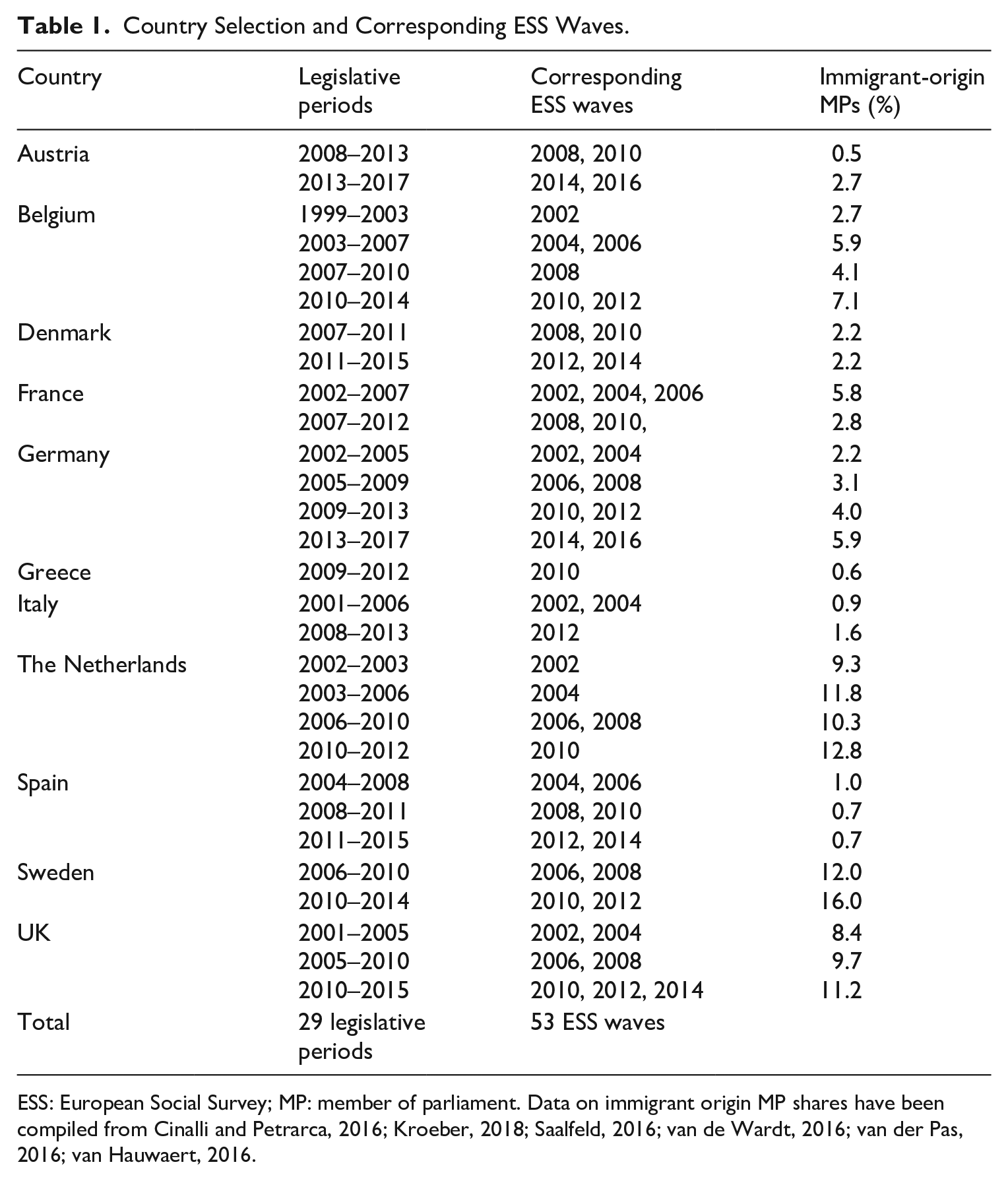
ESS: European Social Survey; MP: member of parliament. Data on immigrant origin MP shares have been compiled from Cinalli and Petrarca, 2016; Kroeber, 2018; Saalfeld, 2016; van de Wardt, 2016; van der Pas, 2016; van Hauwaert, 2016.
Electoral turnout in national-level parliamentary elections constitutes the dependent variables in this study. The ESS measures this variable in all countries and survey waves by asking respondents: ‘Did you vote in the last [country] national election in [month/year]?’ Respondents are offered a binary answer option, which is recoded such that values of 1 correspond to ‘yes’ and values of 0 correspond to ‘no’. Note that this operationalisation is based on citizens’ self-reporting of turnout, which is not unproblematic, given the possibility of misreporting due to social desirability (Karp and Brockington, 2005). According to Wass et al. (2017), however, overreporting rates in the ESS are only modest (p. 509). Furthermore, Karp and Brockington (2005) found no ethnic minority bias in their cross-country study on overreporting (p. 835). Since there is no prima facie evidence suggesting immigrant biases of overreporting to emerge in contexts of higher descriptive representation, it is unlikely that results will be systematically biased.
Individual turnout decisions are expected to be influenced by the interaction of two independent variables: descriptive representation, which is measured at the country-year level, and respondents’ immigrant-origin status, which is measured at the individual level.
CIOs’ descriptive representation is measured as the share of IO MPs in national parliaments. These data have been compiled from two different data sources. First, the Pathways project provides the data for Belgium, France, Germany, Greece, Italy, Spain, the Netherlands and the UK, as released in project reports (Cinalli and Petrarca, 2016; Saalfeld, 2016; van de Wardt, 2016; van der Pas, 2016; van Hauwaert, 2016). Second, data on the shares of IO MPs in the national parliaments of Austria, Denmark and Sweden are taken from Kroeber (2018).
Figure 1 provides a visual overview of how IO MP shares vary on average across the 11 countries under study. Darker colours represent higher average levels over all legislative periods per country. IO MP shares in national parliaments are highest on average in Sweden, the UK and the Netherlands. Belgium, France and Germany take middle positions, while particularly low levels of descriptive representation are observed in Austria, Denmark, Greece, Italy and Spain.
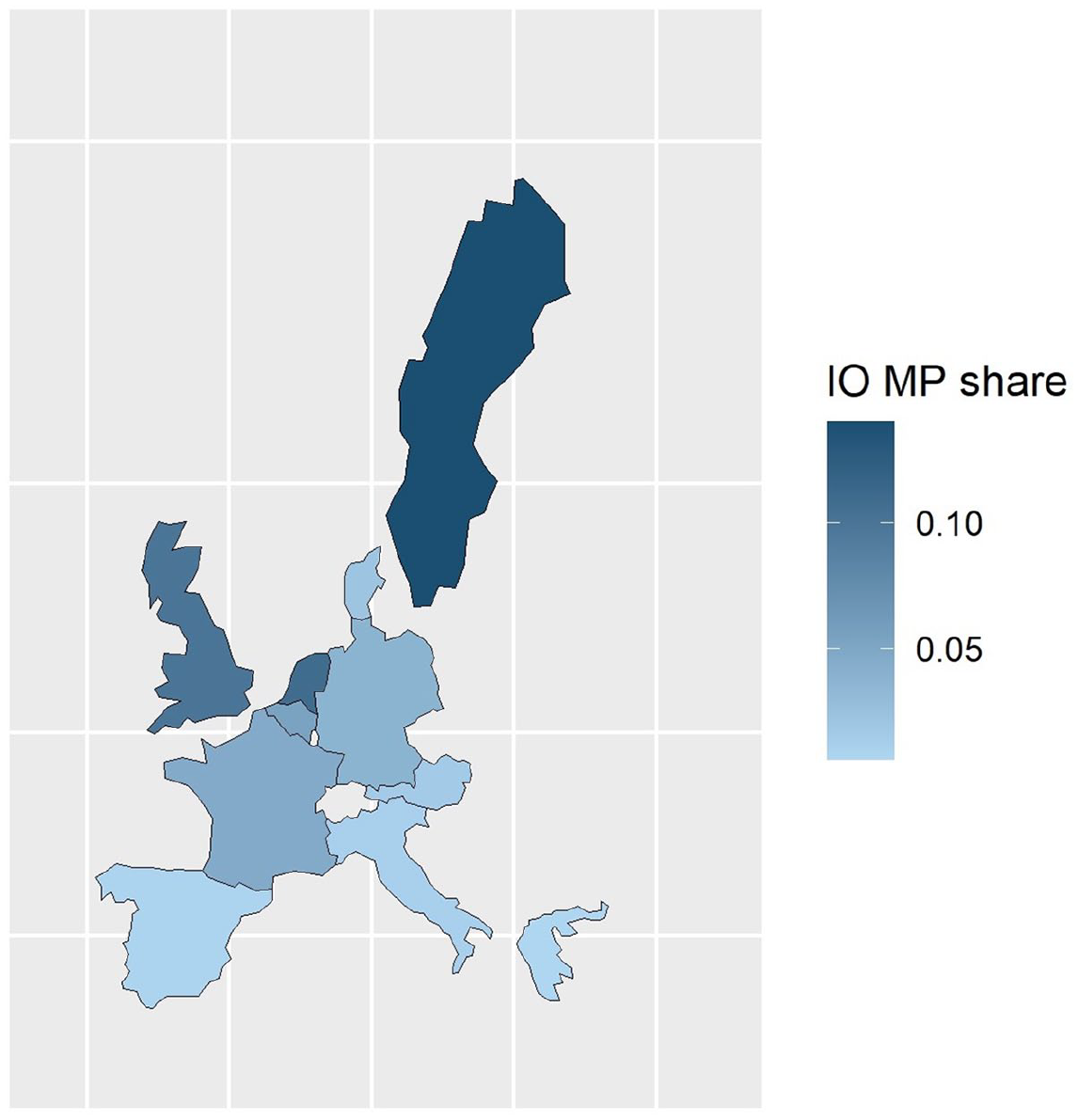
Levels of Migrant-Specific Descriptive Representation across Countries.
The second independent variable of main interest is the distinction between CNO, non-minority CIO and ethnic minority CIO in the ESS data. These target groups were identified in several steps. First, since the research interest of this article relates to turnout in national-level parliamentary elections, all non-citizens 2 were discarded from the dataset, because this group of people does not possess the right to vote. In a second step, CIOs were distinguished from CNO based on whether they themselves, or whether one of their parents were born outside the country of residence. 3 In a third step, ethnic minority CIOs were distinguished from non-minority CIO. Scholars of representation commonly rely on categories such as ‘non-Western’, ‘non-white’ or ‘visible minority’ to identify ethnic minority CIO based on biological markers or culturally distinct origins (e.g. Bloemraad and Schönwälder, 2013: 566). Heath et al. (2013: 15–17), on the other hand, argue convincingly that ethnic minority identities are essentially based on subjective self-perceptions in the sense of ‘imagined communities’. In accordance with this suggestion, ethnic minority CIOs are identified in the ESS data based on their self-identification as a member of an ethnic minority. 4 In sum, the chosen operationalisation of different immigrant origins across the 11 countries under study distinguish ethnic minority CIO from non-minority CIO and CNO.
To methodologically accommodate the ‘empowerment’ logic through which descriptive representation is theoretically assumed to impact individual-level turnout decisions, the two empirical data sources were linked to each other in such a way that voters’ reported turnout decisions match the elections in which IO MPs were running as parliamentary candidates. For illustration purposes, consider the 2009 General Election in Germany. The ESS data generally report voter turnout for the most recent election, such that, German voters were asked for their 2009 turnout decision only in 2010 when the fifth survey wave was conducted (the fourth wave was conducted in 2008). This survey wave was thus matched with the level of descriptive representation in the legislative period 2009–2013, which relates to MPs who were running as parliamentary candidates in the same (2009) election.
At the contextual level, the analysis controls for the possibility that the statistical association between descriptive representation and turnout-level gaps is in part driven by CIOs’ turnout rates in the previous election (t–1) as a potential precursor of descriptive representation in the current election (t) (H3). The turnout rate of CIOs in the previous election is estimated from ESS waves corresponding to the election year preceding the election year of the analysed ESS waves (see Table 1).
Control variables at the individual level recognise well-known precursors of electoral turnout (e.g. Wass and Blais, 2017). Political interest is measured on a 4-point Likert-type scale. 5 Satisfaction with democracy 6 and trust in the national parliament 7 are measured on 11-point Likert-type scales, with higher values indicating more trust/satisfaction. Individuals’ psychological closeness to a political party measures whether respondents feel close 8 to a party and how strong 9 this feeling of closeness is, ranging from 0 (‘no party closeness’) to 4 (‘strongest party closeness’). The analysis further accounts for standard socio-economic predictors of turnout, that is, a dichotomous variable for gender, 10 age 11 in years, educational attainment 12 in years of full-time education completed and a dichotomous variable for unemployment. 13 Another set of variables controls for influences of social capital, that is, 7-point Likert-type scales for attendance in religious services 14 and for the frequency by which other people are met (social contacts 15 ), and dichotomous variables for membership in a labour union 16 and for whether respondents live in a partnership 17 (married or non-married) with another person.
Table 2 displays mean values, standard deviations as well as min–max ranges for all variables considered in the succeeding analyses and robustness checks.
Descriptive Statistics.
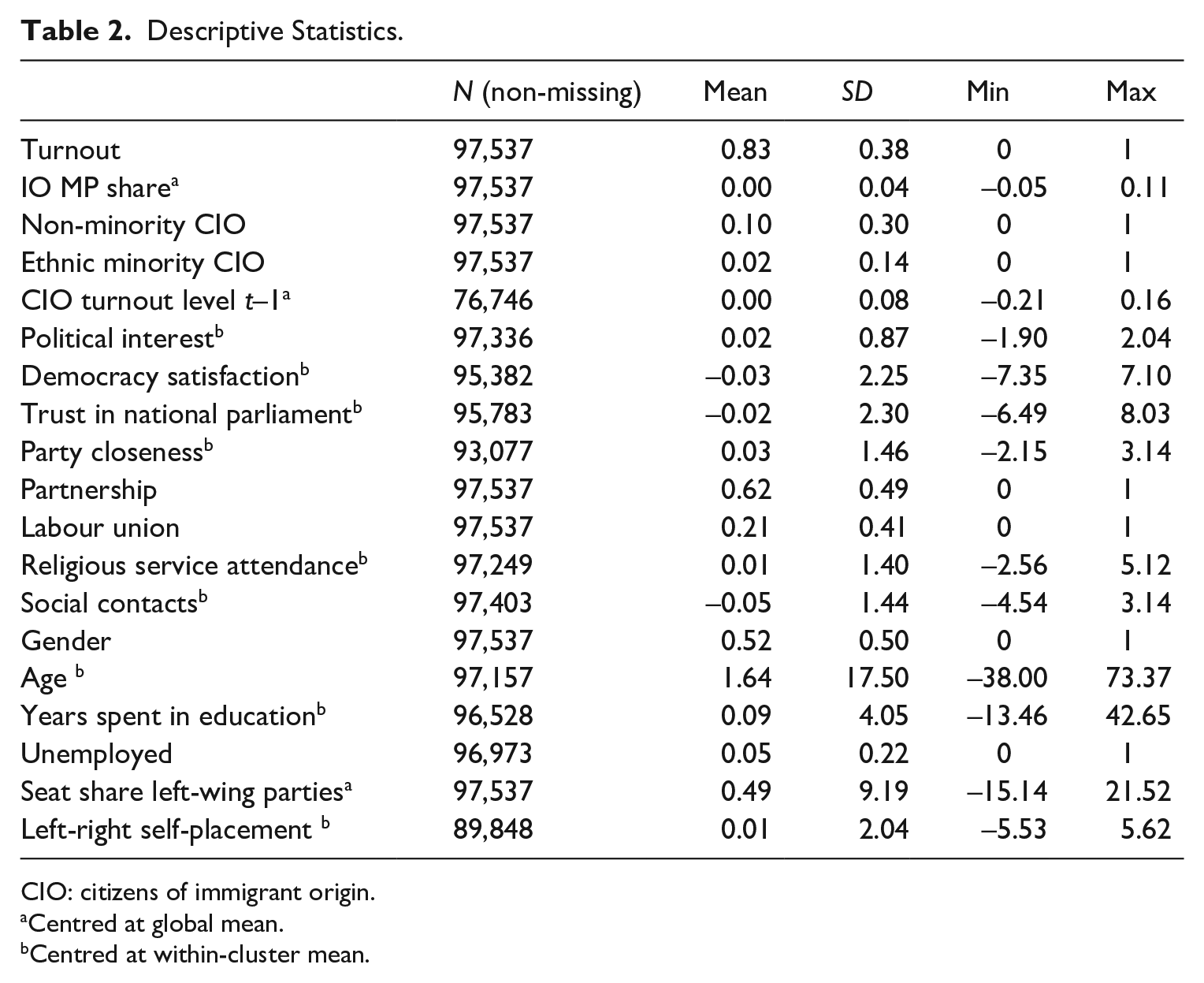
CIO: citizens of immigrant origin.
Centred at global mean.
Centred at within-cluster mean.
Statistical Model
Given the data structure and research question at hand, which is interested in how contextual variation at the country-year level interacts with individual-level variation to shape binary turnout decisions, hierarchical multi-level logit models are the preferred modelling choice (Gelman and Hill, 2007: chap. 14). Individual-level citizen observations (level 1) are clustered in 53 country-survey waves (level 2). Model specifications take this nested data structure into account. First, a random-intercepts, random-slopes model is estimated, considering level 1 and 2 predictors, but without any interaction effects

In a second analytical step, this model is extended by use of the cross-level interaction effect between descriptive representation and CIO, using the following specification

where
Furthermore, following suggestions of Enders and Tofighi (2007), all continuously coded explanatory variables are centred before being entered into the model estimations. That is, level 2 variables are centred at the grand mean, while level 1 covariates are centred at within-cluster means.
Empirical Analysis
The empirical analysis starts by exploring how immigrant gaps in turnout levels vary across the 53 ESSs. Figure 2 displays coefficient estimates of simple survey-specific logit models regressing turnout on the distinction between ethnic minority CIO, non-minority CIO and CNO (the reference group). Despite variation in the effect strengths and statistical significance of coefficients, CIO tend to have on average lower turnout levels than CNO across country-years. Moreover, in most country-years, ethnic minority CIO are less likely to turn out to vote than non-minority CIO. However, the magnitude of these effects varies considerably across and within countries. Immigrant-specific turnout-level gaps seem to be especially small in the UK compared to, for instance, Germany. On the other hand, Belgium and Spain exemplify that differences in turnout levels can also vary considerably within countries over time. The question arises to what extent descriptive representation explains these within-country and between-country turnout gap differences.
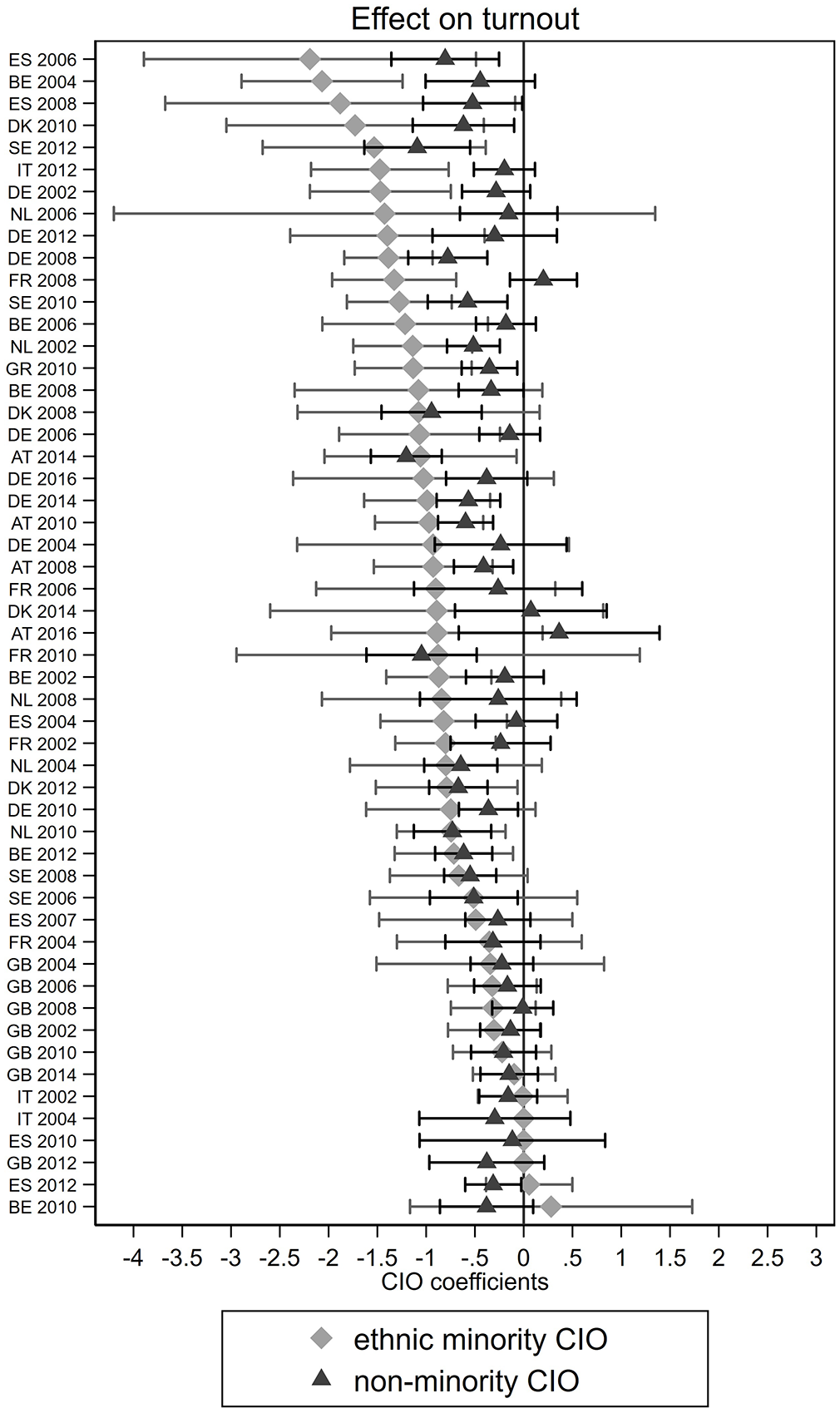
CIO Effects on Turnout across Country-Years.
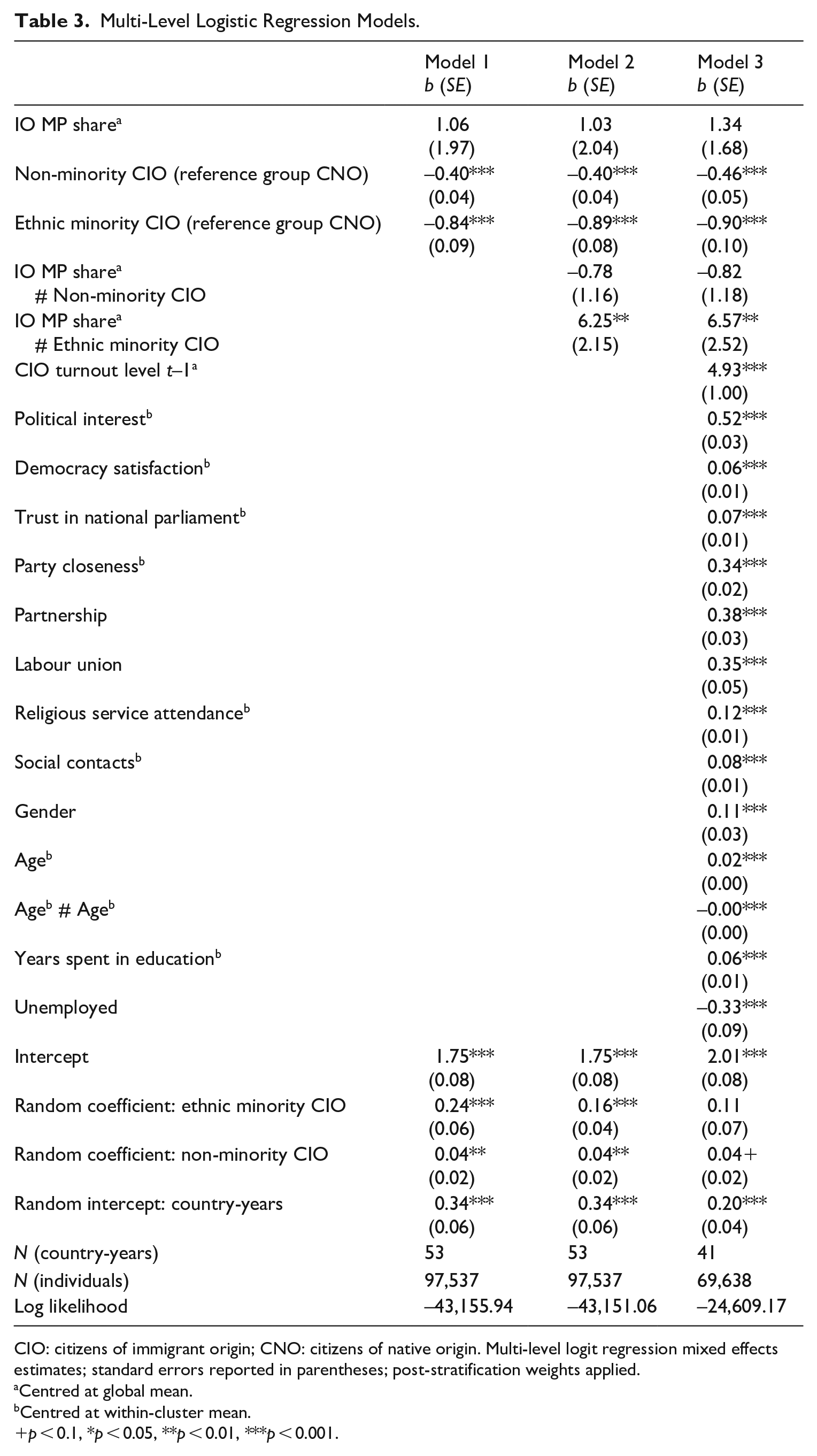
To pursue this question, Table 3 presents the results of the multi-level logit model estimations. The first model only considers the main two independent variables, IO MP share and CIO groups (CNO is the reference group) without their interaction. Results from this model substantiate impressions obtained from the survey-specific models (Figure 2). First, the immigrant gap in turnout levels is considerable across all country-years. Second, the turnout gap is even more pronounced for ethnic minority CIO than for non-minority CIO. Third, descriptive representation by itself, however, does not seem to show considerable effects on individual-level turnout decisions.
Multi-Level Logistic Regression Models.
CIO: citizens of immigrant origin; CNO: citizens of native origin. Multi-level logit regression mixed effects estimates; standard errors reported in parentheses; post-stratification weights applied.
Centred at global mean.
Centred at within-cluster mean.
p < 0.1, *p < 0.05, **p < 0.01, ***p < 0.001.
Model 2 explores whether descriptive representation has differential effects for different citizen groups by adding cross-level interaction terms to the regression equation. Statistically insignificant coefficients for IO MP share and the interaction term with non-minority CIO suggest that neither the turnout levels of CNO nor of non-minority CIO respond markedly to different levels of descriptive representation. By contrast, the positive and statistically significant interaction term for IO MP share * ethnic minority CIO suggests that this subgroup of CIO becomes more likely to turn out in contexts of high descriptive representation. This reveals that immigrant gaps in turnout levels are indeed affected by descriptive representation, but that this effect is limited to ethnic minority CIO. Model 3 18 demonstrates that this finding is also robust when contextual-level and individual-level control variables are included. First, adding contextual-level turnout levels of CIO in the previous election does not weaken the statistical relationship. While this finding does not rule out that there may also be a reverse influence in the sense that turnout at time t–1 affects descriptive representation at time t0, it does suggest that descriptive representation has an effect on the immigrant gap in turnout levels. Second, individual-level control variables are estimated to influence turnout levels in expected ways and in a statistically highly significant manner, while leaving the significance and effect strength of the interaction effects unaltered.
Based on model 3, Figure 3 displays marginal effect estimations to better understand the effect of descriptive representation on the immigrant gap in turnout levels. The plot shows how average turnout levels of the two CIO subgroups change relative to the turnout level of the native majority population depending on different levels of IO MP share. While the turnout difference between non-minority CIO and CNO does not seem to change as a function of descriptive representation, a more pronounced pattern can be seen for ethnic minority CIO. As can be seen, when IO MP share is at the lowest observed value (–0.05 below the mean), ethnic minority CIO are estimated to have the highest turnout-level gap relative to CNO, which amounts to –0.17. Conversely, when descriptive representation is at the highest observed value (0.1 above the mean), the turnout-level gap is smallest, estimated to extend to only –0.03. In other words, increasing descriptive representation from the lowest to the highest observed value is associated with an attenuation of the turnout gap between ethnic minority CIO and CNO by 14%.
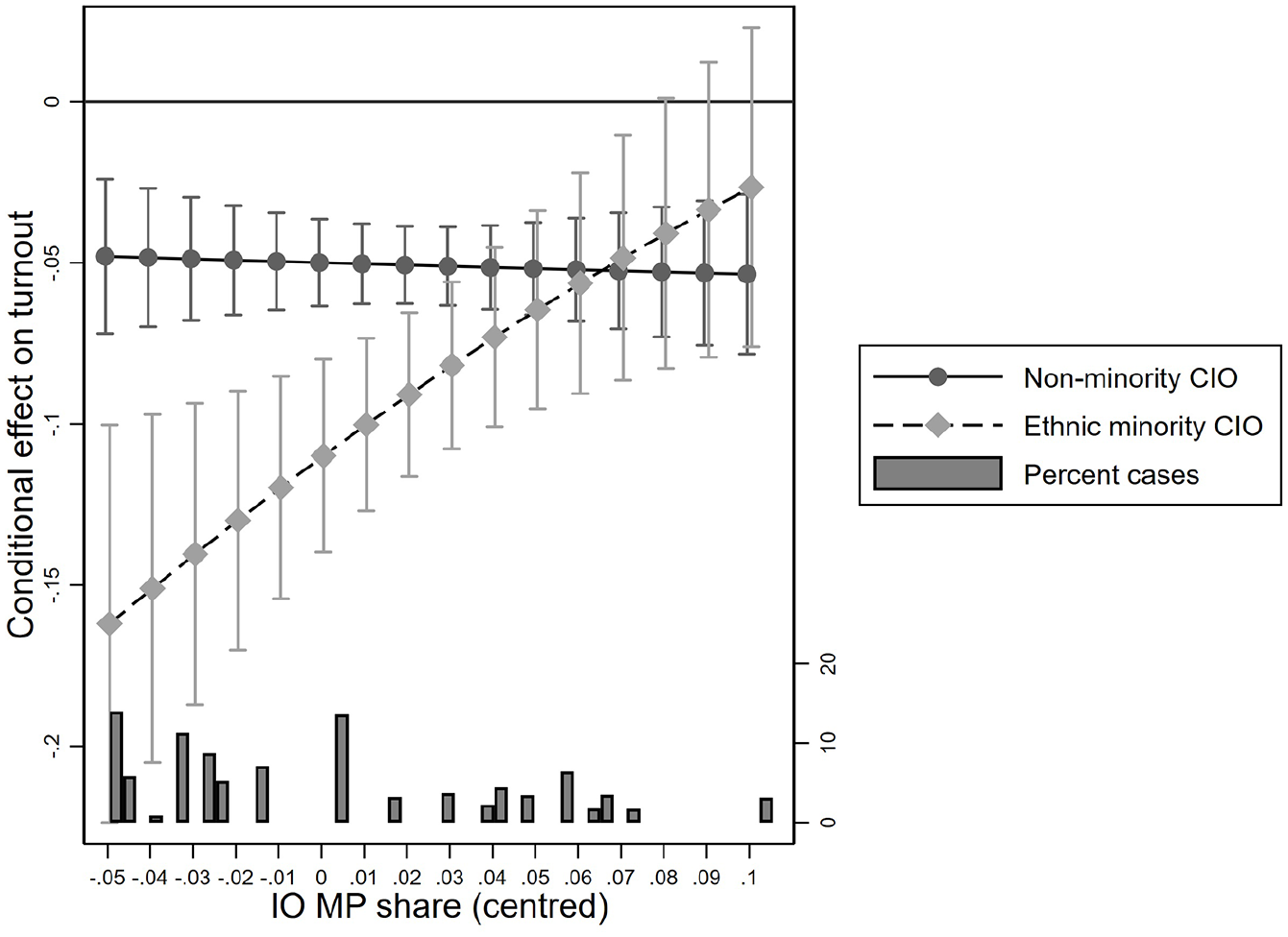
Marginal Effects of CIO on Turnout Depending on Descriptive Representation.
Robustness Checks
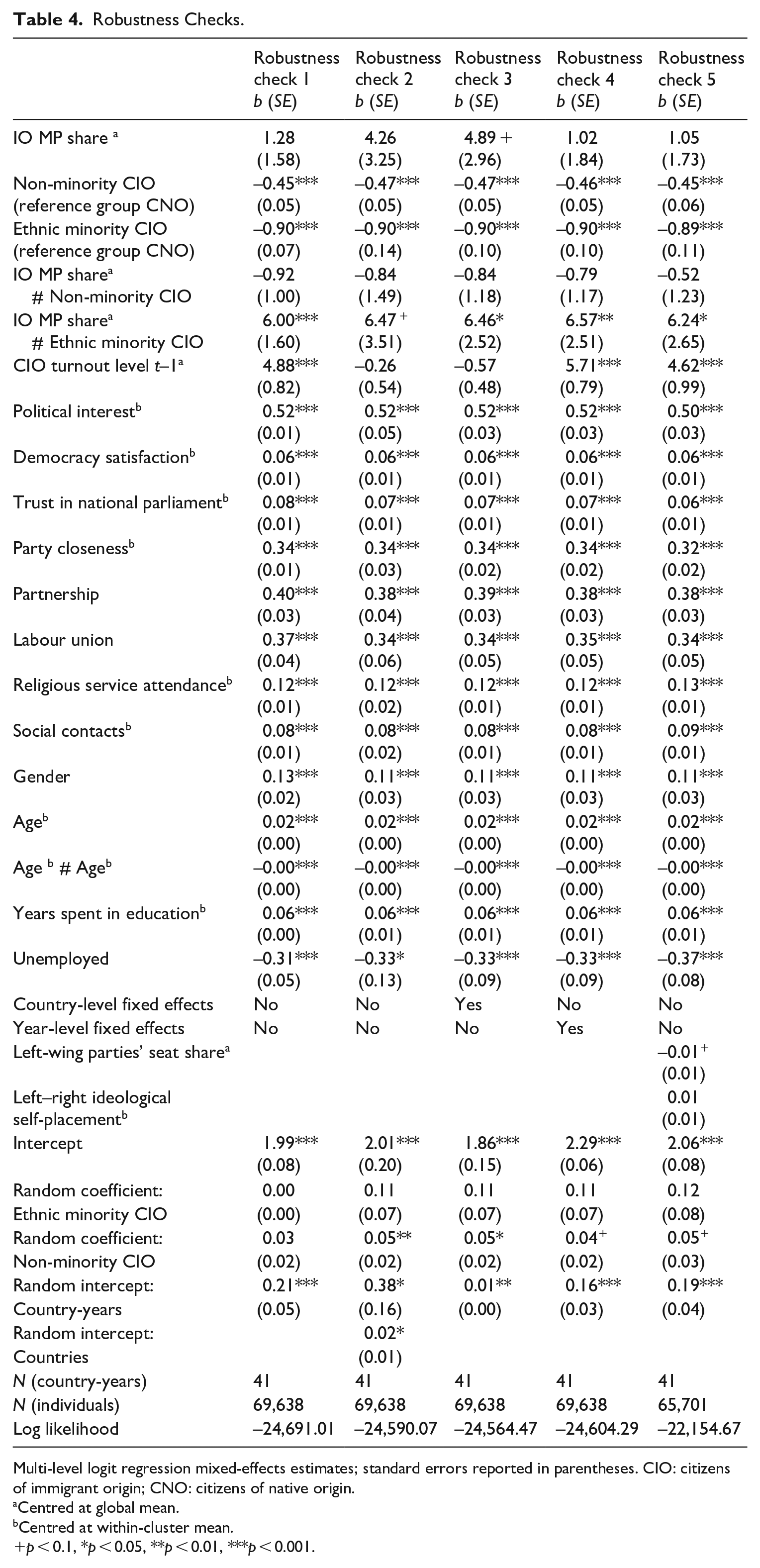
These findings are robust to a number of different model specifications, which are shown in Table 4. Robustness check 1 re-estimates model 3 without considering post-stratification weights in the estimation, which does not change the results notably. Robustness checks 2 and 3 consider the possibility that country-specific heterogeneity artificially drives presented results. Robustness check 2 re-estimates model 3 as a three-level multi-level logit model, in which individuals are modelled as nested within country-years (level 2) within countries (level 3), while robustness check 3 includes country-level fixed effects to specifically consider country-level variation. In both models, parameter estimates for the interactions between descriptive representation and CIO subgroups do not change considerably.
Robustness Checks.
Multi-level logit regression mixed-effects estimates; standard errors reported in parentheses. CIO: citizens of immigrant origin; CNO: citizens of native origin.
Centred at global mean.
Centred at within-cluster mean.
p < 0.1, *p < 0.05, **p < 0.01, ***p < 0.001.
Similarly, robustness check 4 takes into account that the results may be driven by time trends of CIO turnout, that is, the possibility that CIO turnout levels increase gradually over time and in parallel to CIOs’ descriptive representation rather than in response to it. However, controlling for year-level fixed effects does not alter the significance or the strength of the interaction effect, which further substantiates the main finding of this article.
Finally, robustness check 5 takes into consideration the potentially mediating effect of party ideology at the country and individual level. Given the well-known higher propensity of left-wing parties to nominate immigrant-origin candidates as compared to right-wing parties and CIOs’ tendency to electorally support left-wing parties (e.g. Bloemraad and Schönwälder, 2013), the correlation identified in this study may be an artefact of the seat strength of left-wing parties 19 and/or voters’ left-right ideological self-placement. 20 However, as can be seen from the model estimates, the inclusion of these variables neither adds much explanatory power to the model nor alters the interaction term. Therefore, it can be ruled out that the finding is just a reflection of changes in these variables.
Discussion and Conclusion
This article investigates the question of whether CIOs’ descriptive representation can help to attenuate immigrant gaps in turnout levels across Western European countries of immigration, thereby contributing to, and bridging, the burgeoning literatures on immigrant turnout, CIO and minority representation. While the former literature still struggles to fully explain immigrant gaps in turnout levels, the latter literatures increasingly raise concerns about the potential ramifications of minority representation for democratic norms and practices, such as electoral turnout. Drawing on the US-centred research on minority representation and turnout and on European research on the link between immigrant-origin candidates and CIOs’ vote choices, this article posits the theoretical expectation that higher levels of CIOs’ descriptive representation at the national level should be associated with smaller turnout-level gaps between CIO and CNO while considering the possibility that this relationship is limited to CIO with an ethnic minority identity.
Multi-level quantitative analyses of 53 ESS waves between 2002 and 2016 linked to macro-level data on CIOs’ descriptive representation across 11 Western European democracies support these expectations. Turnout-level gaps between ethnic minority CIO and CNO are estimated to shrink by 14% when the level of descriptive representation changes from the smallest observed value to the highest. This finding is particularly important as it represents the first quantitative evidence from a cross-country comparative study showing that CIOs’ descriptive representation is of relevance for immigrant gaps in turnout levels.
Thus, this article contributes to the reviewed literatures in several ways. First, this article adds a comparative perspective to the literature on the minority representation–turnout nexus, in which single-country studies and a strong US-centred focus have been the norm. Second, recent contributions in the field of CIOs’ representation have questioned the added value of descriptive representation for substantive representation (Bailer et al., 2021; Kroeber, 2018). However, this article suggests that CIOs’ descriptive representation has tangible effects for the functioning of democracy by attenuating immigrant gaps in turnout levels, which is a highly relevant political inequality in modern immigration societies. Third, this article should also increase scholarly attention towards CIOs’ political engagement by suggesting that descriptive representation constitutes an important contextual-level influence factor that has been widely overlooked in previous research.
The present study is not without its limitations, underscoring its contribution as constituting only a first step in a larger research agenda, preparing the ground for additional research in this field. First, it is important to keep in mind that this article’s analytical focus is on the macro-level influences of descriptive representation at the country-year level, which presumes a relatively high level of analytical abstraction. Most importantly, with the data at hand, it was only possible to grasp descriptive representation based on aggregate shares of immigrants in parliaments, which does not allow the identification of specific ethnic minority CIO groups, nor to link immigrants in the survey data and in parliaments based on similar immigrant descent. Moreover, there can be no doubt that the present study would have benefited from the availability of fine-grained and comparable cross-country candidate data, which is unfortunately not available at this point in time. In defence of this article’s approach, however, it can be argued that a higher level of aggregation should make for a tougher test of the hypothesised links, given that statistical correlations can be expected to be biased downwards if co-ethnic mobilisation was really the driving mechanism. Nevertheless, future research is called for to collect more fine-grained data (e.g. in national population statistics, at the level of candidates, and preferably also distinguishable below the national level, for example, at the district level) in order to be able to explore micro-level mechanisms driving macro-level empirical links.
Second, although this article’s findings suggest that turnout gaps can be attenuated by descriptive representation, turnout gaps still remain considerable even in contexts of high descriptive representation (i.e. 3% when descriptive representation is at the maximum). It is possible, of course, that descriptive representation levels in the analysed sample of cases may still be too low to completely nullify the turnout gap that separates ethnic minority CIO from CNO. However, it may also be the case that even higher levels of descriptive representation do not constitute a sufficient condition for closing the turnout gap. Moreover, turnout gaps between non-minority CIO and CNO remain visible in the analysed data, but are found to be unaffected by levels of descriptive representation.
Third, descriptive representation and turnout levels are likely to mutually affect each other dynamically over time. Because of lack of data availability alternatives at the time of writing this article, the analysis rests on cross-sectional survey data from the ESS, which limits the empirical focus of the study on the unidirectional effect of descriptive representation on turnout-level gaps. Uncovering the longitudinal dynamic between these two variables is a crucial research task for subsequent research. Future research would make an important contribution by collecting and exploring panel survey data on CIOs’ turnout decisions in relation to their descriptive representation.
Thus, there remain several open questions and substantial amounts of unexplained variance calling for future research.
Research Data
sj-do-1-psx-10.1177_00323217211067129 – Supplemental material for Does Descriptive Representation Narrow the Immigrant Gap in Turnout? A Comparative Study across 11 Western European Democracies
sj-do-1-psx-10.1177_00323217211067129 for Does Descriptive Representation Narrow the Immigrant Gap in Turnout? A Comparative Study across 11 Western European Democracies by Lucas Geese in Political Studies
Research Data
sj-dta-1-psx-10.1177_00323217211067129 – Supplemental material for Does Descriptive Representation Narrow the Immigrant Gap in Turnout? A Comparative Study across 11 Western European Democracies
sj-dta-1-psx-10.1177_00323217211067129 for Does Descriptive Representation Narrow the Immigrant Gap in Turnout? A Comparative Study across 11 Western European Democracies by Lucas Geese in Political Studies
Footnotes
Acknowledgements
Earlier versions of this article were presented in the Comparative Politics research seminar at the University of Bamberg. The author would like to thank Constantin Manuel Bosancianu, Monika Bozhinoska Lazarova, Thomas Saalfeld and Ulrich Sieberer, the participants of the research seminar and two anonymous reviewers for their excellent comments and feedback.
Declaration of Conflicting Interests
The author(s) declared no potential conflicts of interest with respect to the research, authorship and/or publication of this article.
Funding
The author(s) received no financial support for the research, authorship and/or publication of this article.

Notes
Author Biography
References
Supplementary Material
Please find the following supplemental material available below.
For Open Access articles published under a Creative Commons License, all supplemental material carries the same license as the article it is associated with.
For non-Open Access articles published, all supplemental material carries a non-exclusive license, and permission requests for re-use of supplemental material or any part of supplemental material shall be sent directly to the copyright owner as specified in the copyright notice associated with the article.
