




Abstract
A growing body of studies analyzes interest groups’ media visibility. Yet little is known about how the drivers of media access may vary across different interest group systems. This article focuses on two major mechanisms through which organizations can gain media visibility: media management efforts and the newsworthiness of elite actors. We hypothesize that media effort explains interest groups’ media access more strongly in competitive, pluralist interest group systems and that insider (i.e. “elite”) status does so more strongly in hierarchical, corporatist systems. We analyze surveys and media data on interest groups in the pluralist United Kingdom, the moderately corporatist Denmark, and the more strongly corporatist Finland. As hypothesized, media effort is most effective in the UK and weakest in Finland. However, we find only weak support for the insider status hypothesis: there is some evidence of the expected cross-country differences, but the effects are small and unrobust.
Introduction
Journalists frequently use interest groups as news sources, citing their views, describing their actions, and relying on their expertise on various issues. This media access 1 is important for interest groups because it helps them achieve their political goals and gain funding through visibility to potential members and supporters (e.g. De Bruycker, 2019; Grömping, 2019; Powers, 2016). The question of which interest groups gain media visibility has important normative implications for democracy because it affects how equally different societal interests are represented in political systems (Danielian and Page, 1994). Given the increased prominence of the media vis-a-vis other political arenas (e.g. Mazzoleni and Schulz, 1999), it is of particular interest whether the news media amplifies existing patterns of access to insider arenas or whether the media constitutes an alternative channel that is attractive to groups with little access to inside decision making (Aizenberg and Hanegraaff, 2020: 284; Binderkrantz et al., 2015). Another important normative point concerns whether more wealthy groups, which can allocate more resources to media management efforts, can secure a stronger media presence (e.g. Vesa et al., 2020).
A growing number of studies analyzes the patterns of interest group media access (e.g. Aizenberg and Hanegraaff, 2020; Andrews and Caren, 2010; Binderkrantz, 2012; Binderkrantz et al., 2017a; Danielian and Page, 1994; De Bruycker and Beyers, 2015; Grömping, 2019; Oehmer, 2017; Thrall, 2006). Different factors, such as group type and resources, have been emphasized to explain why some interest groups gain more media visibility than others (e.g. Andrews and Caren, 2010; De Bruycker and Beyers, 2015; Grömping, 2019; Oehmer, 2017; Thrall, 2006). However, studies looking at the drivers of groups’ media visibility have been mostly one-country studies. At the same time, country comparative studies have largely been descriptive (Binderkrantz et al., 2017a, but see Aizenberg and Hanegraaff, 2020) or have focused on a single type of interest group (Grömping, 2019). Our knowledge about how the drivers of media attention may vary between different interest group systems is therefore still limited.
Aiming to fill this gap, we draw on two classic explanations that political communication scholars have used to understand how political actors gain media visibility: media management efforts and the newsworthiness of political actors with elite status. The first perspective considers media access as a result of active information provision from political actors to journalists, who, because of their routines and economic imperatives, need a constant flow of prepackaged information (e.g. Berkowitz and Adams, 1990; Gandy, 1982; Lewis et al., 2008). Thus, the more effort interest groups put into targeting the media, the more media access they should be expected to gain. According to the second perspective, powerful actors in elite positions gain more media visibility because of their intrinsic newsworthiness and exclusive access to information (e.g. Bennett, 1990; Galtung and Ruge, 1965; Manning, 2001). This latter perspective would predict that insider interest groups that have regular access to policymaking arenas would have higher news access because of their privileged status (e.g. see Binderkrantz et al., 2015; De Bruycker and Beyers, 2015: 455).
This article advances the understanding of the drivers of interest group media access by asking the following: How do media effort and insider status affect the media access of organized interests in different interest group systems? We argue that the role of these different factors varies between countries with pluralist and corporatist interest group systems. Pluralist interest group systems, such as the United Kingdom and the United States, are competitive, fragmented, and relatively crowded (Lijphart, 2012). By contrast, in corporatist systems, such as those of the Nordic countries, group representation is more concentrated and less competitive, and select groups are institutionally integrated into policymaking (Christiansen et al., 2010; Siaroff, 1999). Based on these institutional differences, we hypothesize that groups’ media effort—that is, the extent to which they engage in media-directed efforts (such as press conferences)—matters more in competitive pluralist systems than in the less competitive corporatist systems. By contrast, we hypothesize that journalists’ tendency to grant access to insider groups is stronger in corporatist systems because corporatist systems institutionalize the insider status of key groups, and therefore, the status differences between insiders and outsiders are stronger and more transparent. Testing these hypotheses not only fills the abovementioned research gaps but also carries important normative implications regarding the democratic performance of different types of interest group systems.
To test our hypotheses, we study the factors affecting interest group media access in Denmark, Finland, and the UK. This research design allows for a comparison of countries placed differently on the pluralism–corporatism continuum. The UK is considered as a pluralist system, Denmark moderately corporatist, and Finland more strongly corporatist (e.g. Jahn, 2016; Vesa et al., 2018). Our dataset totals 1500 interest groups (i.e. membership-based organizations seeking political influence) and consists of observations of groups’ appearances in selected quality newspapers and surveys of groups in each country.
We find support for the argument that institutional settings matter: the effect of media effort on media access increases as we move from the corporatist to the pluralist systems. Media effort explains media access more strongly in the pluralist UK than in the two corporatist countries, and it has a stronger effect in the moderately corporatist Denmark than in the more strongly corporatist Finland. However, we find only weak evidence for the hypothesis regarding insider status. As expected, we do find that insider status matters the most in Finland, second most in Denmark, and the least in the UK; but its effect in Denmark does not differ significantly from its effect in the two other countries. Moreover, the difference between Finland and the UK regarding the effect of insider status is small and not statistically significant in every robustness check.
Our main contribution is to the comparative literature on interest group access. Earlier studies have shown how the mechanisms of groups’ access to policy-making venues (e.g. parliament or bureaucracy) vary between different interest group systems (e.g. Christiansen et al., 2018; Vesa et al., 2018). Our study is the first to demonstrate how the dynamics of interest groups’ competition for media visibility can vary across interest group systems. Simultaneously, our study also demonstrates the continuing relevance of the distinction between pluralist and corporatist interest group systems in explaining group access and behavior (cf. Dür and Mateo, 2016: 214).
Second, our findings should also be relevant for the broader scholarship on political actors’ media visibility. Comparative studies have shown that the media visibility of politicians is more equally dispersed in political systems that distribute power more evenly (Hopmann et al., 2011; Schoenbach et al., 2001; Vos and Van Aelst, 2018). Our study suggests that this basic principle may also apply to interest group systems as we find some—although weak—evidence that media attention may be more strongly slanted toward insider groups in (strongly) corporatist systems. Moreover, our findings suggest that political systems also matter for the extent to which political actors’ media visibility depends on their media efforts.
Literature Review
Interest groups obtain media access when they “successfully enter the news media by passing a threshold controlled by gatekeepers, the journalists” (Vesa, 2020: 5; see also Binderkrantz et al., 2017b: 310). Thus, media access is synonymous for media visibility, and it is commonly operationalized as a continuous variable indicating the number of news stories in which a group appears over a certain period of time (e.g. Binderkrantz et al., 2017a; Grömping, 2019; Oehmer, 2017). Interest group scholars have traditionally devoted most of their attention to how groups gain insider access to politics, but over the past decade, more studies have addressed the question of which groups gain media access and why. This reflects the increased political prominence of the news media in general and in the political work of organized interests in particular (e.g. Binderkrantz, 2005; Mazzoleni and Schulz, 1999; Van Aelst and Walgrave, 2016).
Two empirical results are particularly consistent across a number of studies: (1) interest group media access is highly skewed, with a small number of groups receiving a disproportionate level of attention and (2) group resources—such as finances or staff—are positively associated with their level of media access (Binderkrantz et al., 2015; Binderkrantz et al., 2020; Grömping, 2019; Oehmer, 2017; Thrall, 2006). In addition, a number of studies find economic groups—and business interests in particular—to be particularly well represented in the news (Binderkrantz et al., 2015; Danielian and Page, 1994; Oehmer, 2017). Furthermore, other studies have analyzed whether and how groups’ media effort (e.g. Andrews and Caren, 2010; Grömping, 2019; Oehmer, 2017), access to policymaking arenas (Binderkrantz et al., 2015), and policy positions (De Bruycker and Beyers, 2015) are associated with their media visibility.
Only a few studies have directly compared interest group media access in different countries. In a comparison of Spain, the UK, and Denmark, economic interests are found to be most prominent in all countries, but citizen groups have the largest share of media attention in the UK and the lowest in Denmark (Binderkrantz et al., 2017a). In a comparison of group media access at the level of policy area based on the same data, interest groups operating in Denmark are generally found to have a more prominent appearance in the news than groups operating in the UK (Binderkrantz et al., 2020). When comparing media access in the British and Dutch news media, a longitudinal study by Aizenberg and Hanegraaff (2020) confirms the more central role of noneconomic interests in the UK media. Finally, Grömping (2019) highlights the role of institutional constraints in explaining the degree to which groups are able to attract attention to, for example, instances of electoral fraud.
Thus, while studies of single countries have focused on the mechanisms of media access (e.g. media effort), the few existing cross-country comparative studies have mostly described differences in the aggregate patterns of media access. What is missing from the literature is a focus on how the mechanisms of media access may vary between different institutional settings. We aim to fill this gap by using a unique combination of media and survey data on interest groups across three countries with variation in their interest group systems. In doing so, we draw on political communication scholarship and focus on two classic explanations of how political actors obtain media visibility: organizations’ information provision to journalists (e.g. Gandy, 1982) and journalists’ tendency to follow the “trail of power” (e.g. Bennett, 1990). We discuss these mechanisms next, before constructing the comparative hypotheses.
How Media Effort and Insider Status Matter for Media Access
This article focuses on (1) the extent to which media attention is disproportionately directed at groups that are already privileged insiders in political systems and (2) the extent to which media access is related to the effort that groups put into obtaining the attention of reporters. Our point of departure is that mainstream journalistic gatekeeping is primarily based on three kinds of routines: “‘defensive’ routines such as fact-checking and objectivity (Schudson, 1978), the adherence to news values such as conflict, timeliness, or negativity (Galtung and Ruge, 1965), and economic considerations, such as deadlines and resource efficiency (Tuchman, 1978)” (Grömping, 2019: 457). Therefore, journalists are more likely to grant visibility to interest groups if they (1) can provide journalists with factual and objective information, (2) have characteristics or views or take action that fits news values and media logic, or (3) can help journalists meet deadlines and resource-efficiency demands.
How interest groups meet these criteria may depend on their active efforts at gaining media visibility; these media efforts entail activities such as issuing press releases, contacting journalists, holding press conferences, and publishing studies and analyses (e.g. Binderkrantz, 2005; Dür and Mateo, 2016). Thus, interest groups can try to push themselves to the media by providing journalists with information that is credible and easily usable to meet the requirements of objective and resource-efficient reporting. Moreover, the better the provided information fits news values such as negativity, conflict, and unexpectedness, the better chances the group has to attract journalists’ attention (De Bruycker and Beyers, 2015; Oehmer, 2017). The provision of these “information subsidies” (Gandy, 1982) increases organizations’ chances of gaining media access (e.g. Lewis et al., 2008). Indeed, studies have found a positive association between media effort and media access in Germany (e.g. Oehmer, 2017), the Nordic countries (Binderkrantz and Christiansen, 2014; Vesa et al., 2020), and among election monitoring groups (Grömping, 2019). However, a study focusing on local environmental organizations in North Carolina found that media effort was not associated with media access when other factors, such as resources, were held constant (Andrews and Caren, 2010).
Furthermore, studies have suggested that insider status is another major mechanism that increases interest groups’ media access (Binderkrantz, 2012; Binderkrantz et al., 2015; De Bruycker and Beyers, 2015: 455). This view takes its point of departure from the indexing hypothesis originally formulated by Bennett (1990). According to this argument, reporters “index” the range of voices and viewpoints in the news according to the range of views expressed in mainstream political debates. Following this reasoning, the groups that dominate the inside game of politics will also be predominant in the media arena (Thrall, 2006: 408). Insider groups that are regularly invited to government hearings and have strong contacts with policymakers are more attractive news sources for two reasons. First, because they have an elite status, they have intrinsic news value (Galtung and Ruge, 1965). Second, insider groups have access to “confidential information on policy processes” (De Bruycker and Beyers, 2015: 455; see also Manning, 2001). Indeed, in line with this, a study found that insider access to policymaking arenas overlaps with media access (Binderkrantz et al., 2015). In a similar vein, Thrall (2006) found that media access in the United States was heavily slanted toward resourceful groups that can be expected to occupy insider positions.
We extend this literature by suggesting that the weight of media effort and insider status varies between different interest group systems. Next, we will elaborate on this argument.
The Varying Role of Media Effort and Insider Status
The central claim of this article is that insider status is more crucial for interest group media access in countries with corporatist interest group systems, whereas media effort matters more in countries with a pluralist tradition. We draw on the common classification of interest group systems into pluralist and corporatist ones (e.g. Christiansen et al., 2010; Lijphart, 2012; Siaroff, 1999). Pluralist systems are characterized by a relatively wide range of interest groups competing for political access and influence. By contrast, in corporatist systems, the group system is more hierarchically organized and the interaction between groups and state actors is more institutionalized. A key instance of this institutionalization is the regular membership of select groups in public committees, boards, and the like (Christiansen et al., 2010; Fraussen et al., 2014). Thus, corporatist systems concentrate power by providing key groups with regular access to public decision-making processes (Eising, 2008: 1170).
The implication of these system-level differences is that insider status has an essentially different meaning in corporatist countries. In corporatist countries, select insider groups are institutionally integrated into policymaking (e.g. Christiansen et al., 2010). This means that these select insider groups—often large umbrella associations—have a high status, solid knowledge of the policy process, and continuous access to insider information, which makes them attractive sources for journalists (e.g. Binderkrantz et al., 2017a: 315, 2020: 717). In contrast, although some groups may also gain insider status in pluralist countries, this status is more volatile and less consequential (e.g. Lijphart, 2012). Thus, in pluralist countries, insider status is less of a sign of elite status that would make groups inherently attractive to journalists (see Galtung and Ruge, 1965).
This expected pattern is thus analogous to previous findings regarding cross-country differences in politicians’ media visibility. These studies have shown that politicians’ media visibility mirrors the distribution of power in the political system. For example, in political systems in which political power is more concentrated to the head of government, media visibility is more slanted toward the head of government than in systems that distribute political power more equally (Schoenbach et al., 2001; Vos and Van Aelst, 2018). Similarly, while all interest group systems have insiders and outsiders, the status differences between them are stronger in corporatist countries, where the position of insiders is institutionalized. Therefore, we should expect that media attention is more heavily slanted toward insiders in corporatist systems than pluralist ones.
Moreover, we expect that corporatist systems are also more transparent in terms of which groups have an insider position. Because a corporatist group system is hierarchical and relatively noncompetitive, the select insider groups are clearly the main representatives of certain interests (see Lijphart, 2012). These insider groups are thus likely to obtain a prominent position, becoming the placeholders for a specific constituency (Halpin and Fraussen, 2018: 727). Therefore, in corporatist systems, it is easier for journalists to know which groups are the most influential representatives of certain interests—the insider groups. Furthermore, the fact that the insider status of the select groups is institutionalized through formal procedures, such as committees, also increases the transparency of interest group influence (e.g. see Kanol, 2015). By contrast, in pluralist systems, insider status is less institutionalized, and by definition, the competition for the representation of the same interests is fiercer; thus, it is less clear—for journalists or any other observers—which group is the most influential representative of certain interests.
In sum, we should expect that groups’ media access depends on insider status more strongly in corporatist than pluralist systems.
H1. Insider status is more strongly associated with media access in corporatist systems than in pluralist ones.
By contrast, we expect that the role of media effort is more important in pluralist than corporatist countries. This is because pluralist interest group systems are both more competitive and more crowded. In the absence of institutional arrangements privileging select groups, pluralist systems are characterized by a more free competition between interest groups (e.g. Lijphart, 2012). This competitive nature of a pluralist interest group system can be assumed to affect the mechanisms of media access. When interest group politics is competitive, the groups that put more effort into this competition are likely to gain a larger slice of media visibility. This dynamic is reinforced by the more crowded character of the group system in pluralist countries (e.g. Binderkrantz and Pedersen, 2019: 83; Eising, 2008). With a less hierarchical group system and more groups competing for the same members, there are also more groups competing for scarce media attention. In effect, an individual group needs to put more effort into influencing the media to draw journalists’ attention. Thus, higher group density together with a lower and less robust hierarchy in the group system arguably makes the competition for media attention fiercer in pluralist than corporatist systems:
H2. Media effort is more strongly associated with media access in pluralist systems than in corporatist ones.
Data and Methods
To study whether and how the mechanisms of media access depend on the type of interest group system, we use a comparative research design, focusing on Denmark, Finland, and the UK. Finland and Denmark are considered as examples of corporatist countries, while the UK is considered as pluralist (Jahn, 2016; Lijphart, 2012; Siaroff, 1999). However, although both Denmark and Finland have corporatist systems, studies suggest that in the twenty-first century, corporatism has remained stronger in the latter (Jahn, 2016; Vesa et al., 2018). Thus, we expect larger differences between Finland and the UK than between Denmark and the UK.
Sampling and Surveying Interest Groups
We rely on an associational definition of interest groups and include groups with formal membership or comparable options for joining the association. Members can be individuals, business firms, institutions, or even other associations. With this definition as the point of departure, we constructed comparable samples of membership-based organizations seeking political influence in each country. Usable lobbying registers were not available in each country, so we relied on top-down sampling (Berkhout et al., 2018), constructing the sample by observing groups’ manifest activity. For each country, we used similar sets of data sources to search for politically active groups. In all three countries, we searched for groups by looking at their appearances in newspapers (see description below), oral and written evidence provided to parliament, and written responses to government consultations. Moreover, for Denmark and Finland, we looked at the memberships of public committees, and for the UK, we looked at meetings with ministries. Using these procedures, we found 884 groups in Denmark, 877 groups in Finland, and 1835 groups in the UK. The higher number of groups found in the UK is in line with the notion that interest group populations are more crowded in pluralist countries, and it is likely also a facet of the country’s larger general population compared with the two Nordic countries. The abovementioned groups were surveyed in Denmark in 2011–2012, in the UK in 2013–2014, and in Finland in 2015–2016. The response rates were 69% for Denmark (N = 610), 66% for Finland (N = 582), and 26% for the UK (N = 477). The groups that responded are roughly representative of the interest group samples in terms of group types in each country (see Online Appendix 2, Figure A). The higher response rates in the corporatist countries corresponds well with previous experiences (Binderkrantz, 2005; Marchetti, 2015) and may relate to the pluralism–corporatism distinction and the relatively well-structured group system in corporatist countries.
Because we relied on top-down sampling, all groups in our sample have at least some access to either the media or policymaking arenas. However, many groups appear in the different arenas only once or twice, while some groups appear multiple times, so there is considerable variation in insider status as well as media access. Yet, because we exclude “true outsiders” that lack any access, our data can be seen as a relatively conservative test for the main effect of insider status. However, this does not significantly hamper the testing of our hypotheses, as they concern country differences rather than the main effects of insider status and media effort within each country.
Dependent Variable: Media Access
The dependent variable measures media access and is a count of the number of news stories in which each group appeared. From each country, we selected two widely circulated newspapers with different (current or historical) political leanings on the left–right spectrum. For Denmark, we used Politiken and Jyllandsposten; for Finland, we used Aamulehti and Helsingin Sanomat; and for the UK, we selected the Guardian and the Telegraph. For each country, we studied these newspapers for a 1-year period in which there were no parliamentary elections. In Denmark, we analyzed newspapers published from 1 July 2009 to 30 June 2010; in Finland, 1 July 2013 to 30 June 2014; and in the UK, 1 July 2010 to 30 June 2011.
The groups’ appearances in the newspapers were identified in 2-week periods in the following manner. For the first 2-week period, we always coded the first section and business sections, and for the following 2-week period, we studied the front pages for Denmark and the UK and the first spread of the first section in Finland (because the front pages did not include journalistic content). Coders identified each interest group cited or otherwise mentioned in the news stories. The tone of media appearances was also coded, and (a few) clearly negative media appearances from the point of view of the groups, such as scandals involving their leaders, were filtered out because we conceptualize media access as a sign of success for the groups. Moreover, we filtered out a small percentage of appearances that clearly were not relevant for the political work of the group (e.g. anniversaries or obituaries).
Independent Variables
Our independent variables are based on the abovementioned group surveys. Full question wordings appear in Online Appendix 1 and descriptive statistics in Online Appendix 2 (Table A2). Media effort is calculated as the mean of five survey items. The items come from a list of questions about how often the surveyed interest groups performed different activities to gain political influence (scale 1–4; very often, fairly often, occasionally, never). We calculated the mean of the following activities: (1) placing ads in newspapers (or similar media); (2) writing letters to the editor; (3) issuing press releases and holding press conferences; (4) contacting journalists; and (5) publishing analyses and studies (Cronbach’s αs: DK = 0.834; FI = 0.796; UK = 0.779). 2 We reversed the scales before calculating the mean so that higher values indicate stronger media effort.
Insider status is a mean of four survey items, measuring how often the following happens to the organization (scale 1–4, very often, fairly often, occasionally, never): Our organization (1) receives draft legislation, draft orders, and so on for comment; (2) is represented in public councils, boards, committees, and so on; (3) is consulted when members of public boards, councils, committees, and so on are chosen; and (4) is contacted by public servants. Again, we reversed the scales so that higher values indicate higher insider status and then counted the mean of these four items (Cronbach’s αs: DK = 0.806; FI = 0.869; UK = 0.795). Our measure of insider status thus puts a great deal of weight on institutionalized forms of access (committees and consultations) and is therefore largely constructed around a corporatist definition of insider status. Therefore, we also ran robustness checks in which we only included the item measuring the frequency of being contacted by civil servants, which is arguably a more typical form of insiderness in the UK (see Online Appendix 2, Table M).
Staff advocacy is used as a control variable to account for the fact that groups with more resources tend to have better media access (e.g. Binderkrantz et al., 2015; Thrall, 2006). The groups reported the number of staff involved in political work (see the full wording in Online Appendix 1), and we log-transformed this variable to linearize relationships.
Economic group is a dichotomous control variable indicating whether a group represents organizational or individual members who have a role in the economic production of societies. Economic groups include trade unions, business associations, professional associations, and institutional groups representing public or semipublic institutions (e.g. schools). These are contrasted to citizen groups, which include identity groups representing various non-occupational groups of people (e.g. the elderly), leisure groups, religious groups, and public interest groups defending interests not selectively benefiting the group members (e.g. environmental groups). All groups were manually coded by the researchers using a classification scheme distinguishing between eight major group categories. Another researcher coded a random sample of 100 groups from each country to test for reliability. We obtained satisfactory Cohen’s kappa values, 0.91 for Denmark, 0.83 for Finland, and 0.76 for the UK.
To assess the risk of multicollinearity, we calculated correlations between the continuous independent variables (Online Appendix 2, Table A3). We observe positive and significant correlations between all continuous independent variables in each country, but the correlations are not so strong that we should expect multicollinearity to be a problem. The finding that insider status correlates positively with media effort is in line with the current wisdom that media strategies are not exclusively “weapons for the weak” but also used commonly by insider groups (Binderkrantz, 2005; Thrall, 2006). 3 This bivariate relationship can likely be partly explained by the fact that resources (size of staff involved in advocacy) correlate positively with both aforementioned variables.
Estimation
The dependent variable that measures media access is highly right-skewed, with a large number of small values and a few very large values. This reflects the high concentration of media access found in previous studies (e.g. Binderkrantz et al., 2017a; Danielian and Page, 1994; Thrall, 2006). To model this overdispersion, we use negative binomial regressions. Plotting the standardized deviance residuals against the predicted values (see Hilbe, 2011) shows a reasonably good model fit when compared with a Poisson model, for example.
We include interaction terms between country and insider status as well as media effort to assess the hypotheses. However, the interaction effects are challenging to interpret because the dependent variable has a different shape in the three countries, with varying mean and maximum values (Online Appendix 2, Table A2). To account for this, our robustness checks include models in which we standardized all continuous independent and dependent variables by dividing each by their country-specific standard deviations. This allows the relative strength of key independent variables to be compared across the countries. This transformed dependent variable has noninteger values and a large number of zeros, and it is right-skewed. Therefore, we use Tweedie regressions 4 with the transformed variables (Zhang, 2013). The Tweedie models are reported in Online Appendix 2 (Tables G–L). As an additional robustness check, we also ran each negative binomial model separately for each country (see Online Appendix 2, Tables B–D).
Findings
We estimated four models, adding independent variables in a stepwise manner (Table 1 5 ). This allows us to gauge the relation between insider status and media effort across countries, first separately and then when controlling for other factors possibly affecting media access. The models include interactions with the countries (with the UK treated as a reference category) and the other independent variables to allow for the testing of the hypotheses about country differences.
Negative Binomial Regressions Predicting Interest Groups’ Media Access in Denmark, Finland, and the UK.
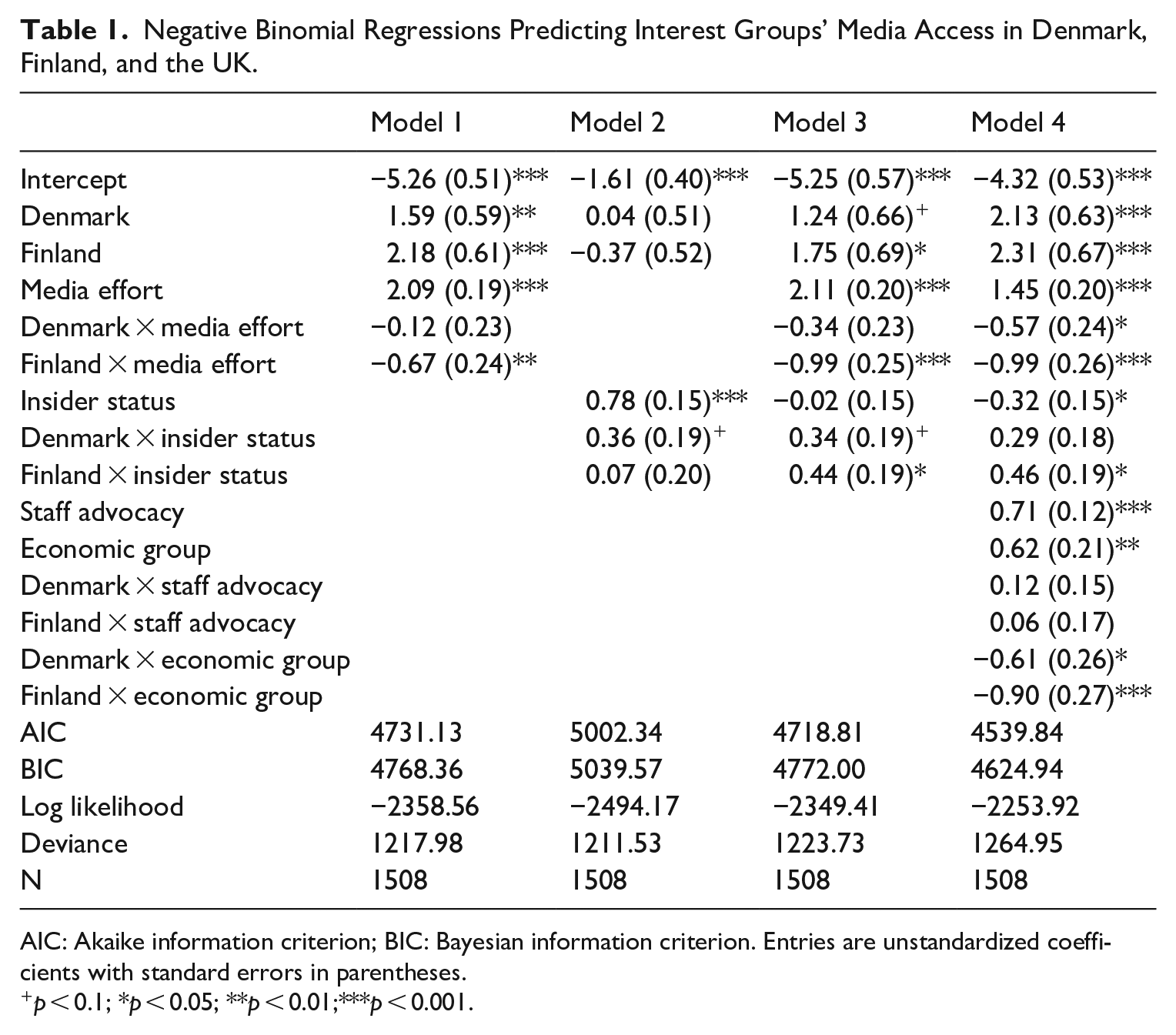
AIC: Akaike information criterion; BIC: Bayesian information criterion. Entries are unstandardized coefficients with standard errors in parentheses.
p < 0.1; *p < 0.05; **p < 0.01;***p < 0.001.
In H1, we hypothesized that insider status is more strongly associated with media access in corporatist systems than in pluralist ones. The significant, positive interaction effect between Finland and insider status in the full model is in line with this expectation (Table 1, Model 4). This positive interaction suggests that the effect of insider status is stronger in corporatist Finland than in the pluralist UK. However, although the interaction term for the moderately corporatist Denmark is also positive—suggesting a stronger effect there than in the UK—the interaction effect does not reach conventional levels of statistical significance (p = 0.111).
Two further observations also suggest that the evidence for H1 is weak. First, in Finland, the positive coefficient for insider status is not statistically significant in the full model, and the coefficient is close to zero in Denmark (Figure 1 and Online Appendix 2, Tables B–D). The small difference between Finland and the UK seems to be mainly related to the negative effect of insider status in the UK when controlling for other variables. However, this lack of significant main effects in the corporatist countries is not very surprising, as our research design provides a conservative test for the main effects of insider status, as we argued above. It is also important to note that there is a significant positive relationship between insider status and media access in both corporatist countries before we control for staff size (Online Appendix 2, Tables B and D, Model 3). Second, the interaction effects are not significant in the Tweedie models that we ran as a robustness test, even though the coefficients go in the hypothesized directions (Online Appendix 2, Table G, Figure I). In sum, the analyses provide only weak support for H1. 6
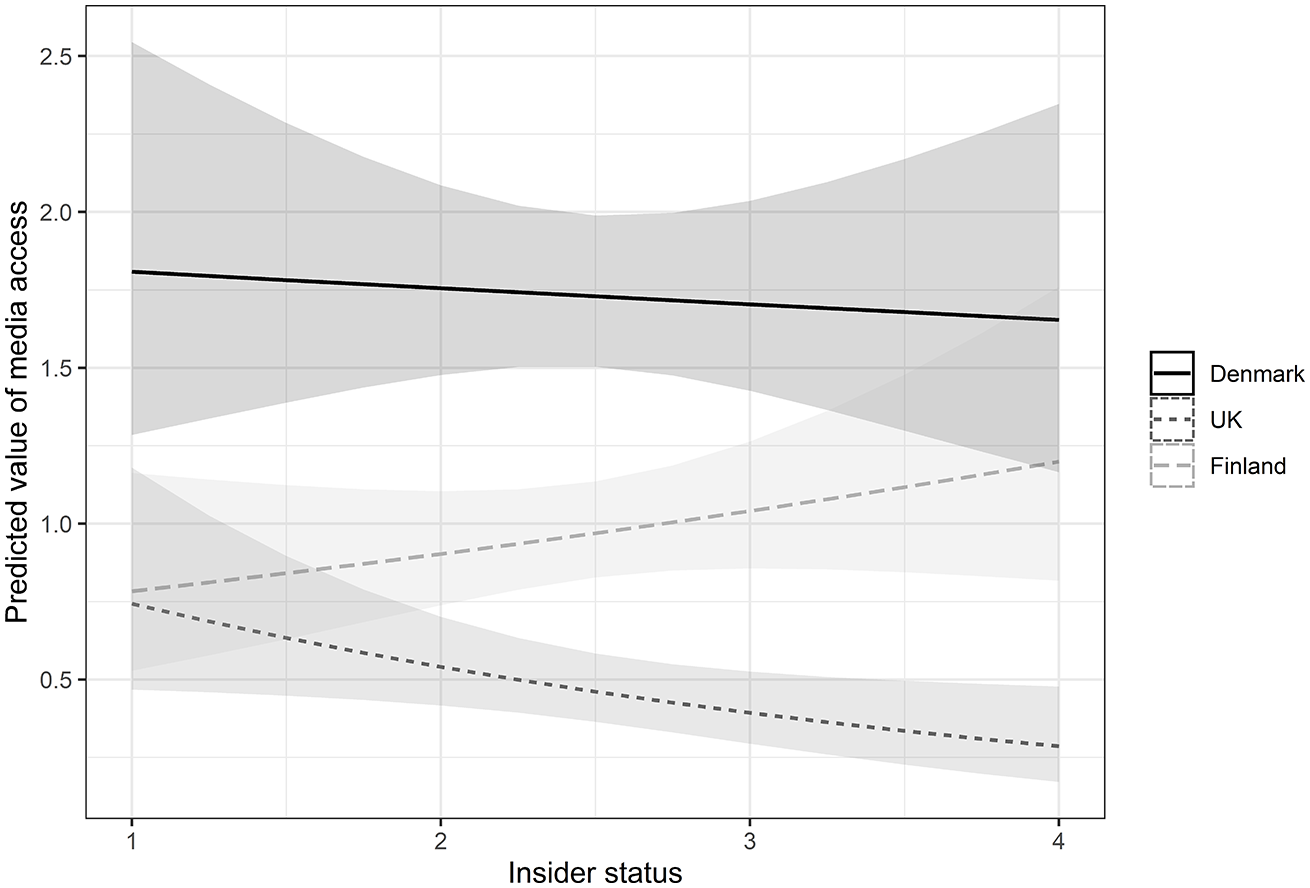
Predicted Values of Media Access Depending on Insider Status, Based on Model 4 (with 95% Confidence Intervals).
Before we test H2 about the association between media effort and media access, it is interesting to explore the level of media effort of different kinds of groups. Looking at simple bivariate statistics (Online Appendix 2, Table O), we find that media effort is slightly higher among citizen groups than economic groups in all countries, although the difference is statistically significant only in Finland (t-tests). 7 Citizen groups’ stronger reliance on media strategies is in line with previous studies (e.g. Dür and Mateo, 2016).
Next, we focus on H2, which asserts that media effort is more strongly associated with media access in pluralist systems than in corporatist ones. The results show a positive and substantial association between media effort and media access in all countries and across all models (see Online Appendix 2, Tables B–D, Figure E). In line with H2, we find statistically significant negative interaction effects in the full model, indicating that the effect of media effort is lower in both corporatist countries than in the pluralist UK (Table 1, Figure 2). The Tweedie regression analyses that we ran as robustness checks support this conclusion (Online Appendix 2, Table G, Figure H). Furthermore, as expected, the difference between the moderately corporatist Denmark and the pluralist UK is smaller than the difference between the more strongly corporatist Finland and the UK. In fact, the difference between Finland and Denmark is also statistically significant (p = 0.044) in the negative binomial full model. This suggests that in line with H2, media effort matters more in the moderately corporatist Denmark than in the more strongly corporatist Finland.
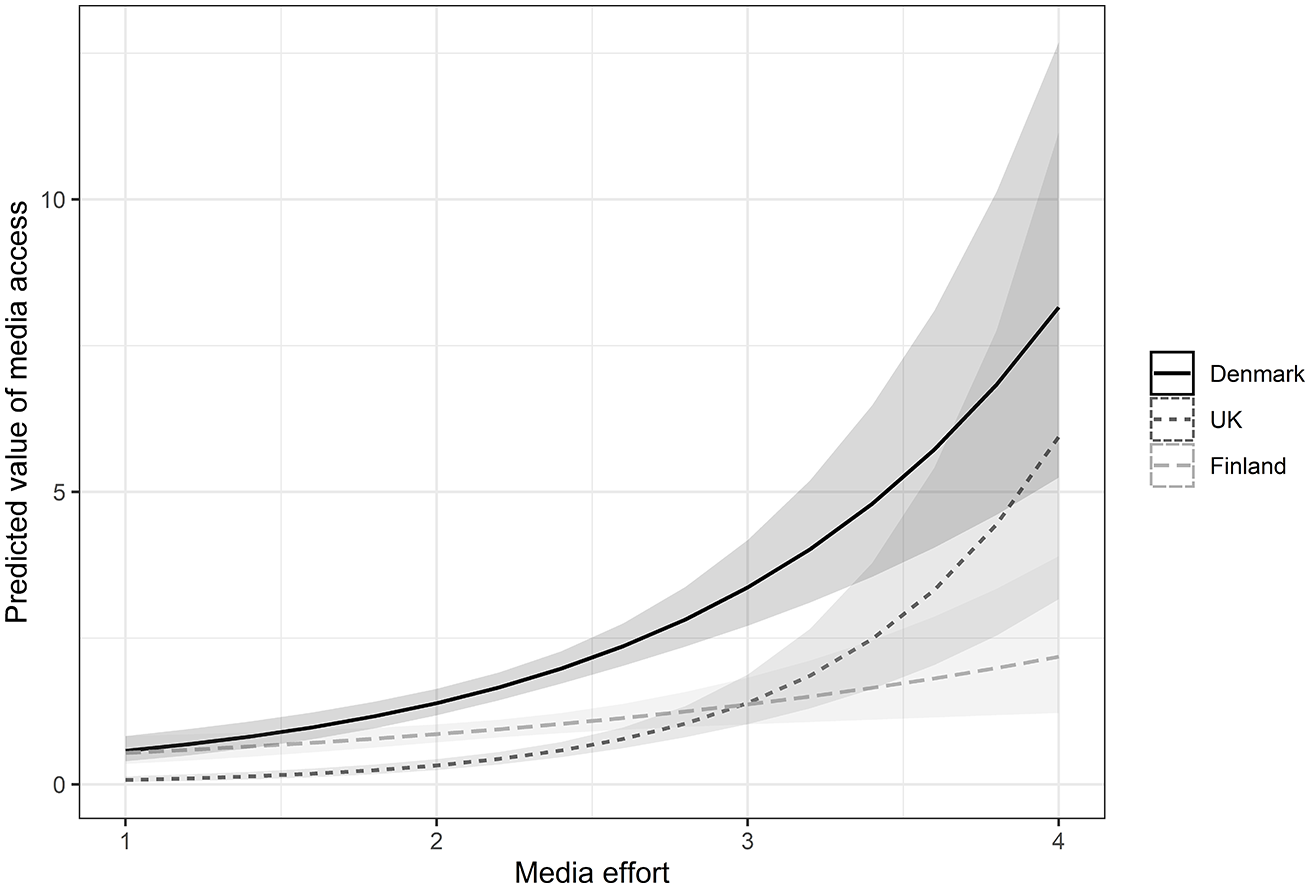
Predicted Values of Media Access Depending on Media Effort, based on Model 4 (with 95% Confidence Intervals).
As an additional test for H2, we compared the effect of media effort with that of other variables within each country, hereby relying on the standardized coefficients of the Tweedie models (Online Appendix 2, Tables J–L). The results show that in the UK, media effort has the strongest effect among all comparable (i.e. continuous and standardized) independent variables. In contrast, for the two corporatist countries, “staff advocacy” has a much stronger effect than media effort. Thus, in the corporatist countries, media effort explains media visibility less strongly than do the number of staff involved in advocacy. These observations imply that the relative weight of media effort is stronger in the UK than in Denmark and Finland.
As a final robustness test for H2, we included the utilization of media events (e.g. protests, demonstrations, and debate meetings) to the composite variable measuring media strategy. The results are consistent with the main results and point to even larger differences in the effectiveness of media effort between the UK and the two corporatist countries (Online Appendix 2, Table N).
In sum, the analyses lend support to H2, as media effort explains media access more strongly in the pluralist UK than in the two corporatist countries. Moreover, in line with the hypothesis, media effort has a larger effect in the moderately corporatist Denmark than in the more strongly corporatist Finland.
Conclusion and Discussion
This article has sought to increase our understanding of the drivers of interest groups’ media access by focusing on how groups’ media effort and insider status affect their media visibility in different interest group systems. We hypothesized that the role of these factors varies across corporatist and pluralist interest group systems. We used surveys and media data to explain interest group media access in three countries that place differently on the corporatism–pluralism continuum: the pluralist UK, the moderately corporatist Denmark, and the more strongly corporatist Finland.
We found support for the argument that the mechanisms of media access vary across different interest group systems. As hypothesized, media effort explains media access more strongly in the pluralist UK than in the two corporatist countries, and it has a stronger effect in the moderately corporatist Denmark than in the more strongly corporatist Finland. Moreover, as expected, we find that the association between insider status and media access is the strongest in Finland, second strongest in Denmark and the least strong in the UK, although the difference between Denmark and the two other countries is not statistically significant. However, the interaction effect between Finland and the UK is small, not supported by all our robustness checks, and is mainly related to the negative effect in the UK. In sum, we find support for the argument that media effort matters more in pluralist systems, which are more crowded and competitive and distribute power more equally between interest groups. By contrast, there is only weak evidence in support of the argument that insider status matters more in corporatist systems, where power is more concentrated.
Beyond the hypotheses, our findings suggest that media effort generally drives interest group media access more strongly than status differences. In all three countries, the groups that put more effort into influencing the media gain more media visibility than other groups. This is in line with classic studies of journalistic gatekeeping, which reveal journalists’ high dependency on sources that can provide them with a steady flow of prepackaged information (e.g. Gandy, 1982; Berkowitz and Adams, 1990). The finding is also in line with previous studies on interest groups’ media access (Binderkrantz and Christiansen, 2014; Grömping, 2019; Oehmer, 2017; Vesa et al., 2020). However, the finding about the stronger effect of media effort than of insider status must be interpreted with caution, as our data provide a relatively conservative test for the effect of insider status.
Our study compared three countries, and although we have found variation in the role of different factors across these countries, we are not able to point to the exact causes of these differences. First, the distinction between corporatism and pluralism simultaneously concerns the nature of the interest group system and the structure of the interaction between organized interests and decision makers. Second, the three countries—the UK, Denmark, and Finland—differ on a number of other dimensions, such as the media system, which may possibly also affect the relation between groups and the news media (Hallin and Mancini, 2004). Our conclusions should thus be seen as a starting point for wider comparative analyses including more countries as well as more detailed analyses of the relation between interest groups and journalists across different national settings. Another limitation of our study is that we only relied on quality newspapers to measure interest groups’ media access and left out other types of media outlets, such as tabloids.
Yet, our findings add to interest group scholarship by demonstrating the continuing relevance of the pluralism–corporatism distinction in explaining group behavior and patterns of access. Specifically, we have shown that also the mechanisms of media access may depend on the systemic differences. Moreover, the findings also add to the broader literature on political actors’ media visibility. The results suggest that the phenomenon where the distribution of politicians’ media visibility mirrors the distribution of political power (Schoenbach et al., 2001; Hopmann et al., 2011; Vos and Van Aelst, 2018) may also exist in interest group politics, although it must be emphasized that our evidence is weak and tentative in this regard. Moreover, we add to previous research by suggesting that the extent to which media effort drives media visibility can also vary across systems. We hope that this article has opened new avenues for scholars who seek to understand why some political actors have more media visibility than others.
Supplemental Material
sj-docx-1-psx-10.1177_00323217211064580 – Supplemental material for The Varying Mechanisms of Media Access: Explaining Interest Groups’ Media Visibility across Political Systems
Supplemental material, sj-docx-1-psx-10.1177_00323217211064580 for The Varying Mechanisms of Media Access: Explaining Interest Groups’ Media Visibility across Political Systems by Juho Vesa and Anne Skorkjær Binderkrantz in Political Studies
Supplemental Material
sj-docx-2-psx-10.1177_00323217211064580 – Supplemental material for The Varying Mechanisms of Media Access: Explaining Interest Groups’ Media Visibility across Political Systems
Supplemental material, sj-docx-2-psx-10.1177_00323217211064580 for The Varying Mechanisms of Media Access: Explaining Interest Groups’ Media Visibility across Political Systems by Juho Vesa and Anne Skorkjær Binderkrantz in Political Studies
Footnotes
Acknowledgements
The authors thank Helene Helboe Pedersen for commenting on an earlier draft of this article; Kim Mannemar Sønderskov and Reijo Sund for their advice with the statistical analyses; Anu Kantola for leading the KAMU-project; Mika Vehka for his research assistance; Anne Holli for giving access to her dataset on working group memberships in Finland; the student coders who coded the media data and assisted in conducting the surveys; and Arttu Malkamäki and Ted Chen for helping to modify plot appearances from R.
Declaration of Conflicting Interests
The author(s) declared no potential conflicts of interest with respect to the research, authorship, and/or publication of this article.
Funding
The author(s) disclosed receipt of the following financial support for the research, authorship, and/or publication of this article: This work was supported by the Academy of Finland under Grants 309934 and 320780; Kone Foundation under Grant 088880; the Finnish Government’s Analysis, Assessment and Research Activities under the KAMU-project; and the Independent Research Fund Denmark under Grant 0602-01212B.

Supplementary Information
Additional Supplementary Information may be found with the online version of this article.
Content Online Appendix 1. Wordings of survey questions. Media effort Insider status Staff advocacy Online Appendix 2. Additional tables and figures. Figure A: Response rates per group type in Denmark, Finland, and the UK (percentages). Table A2: Descriptive statistics. Table A3: Correlations between continuous independent variables. Table B: Negative binomial regressions predicting interest groups’ media access in Denmark. Table C: Negative binomial regressions predicting interest groups’ media access in the UK. Table D: Negative binomial regressions predicting interest groups’ media access in Finland. Figure E: Predicted value of media access depending on media effort based on Table 1 (with 95% confidence intervals). Figure F: Predicted value of media access depending on media insider status based on Table 1 (with 95% confidence intervals). Table G: Tweedie regressions predicting interest groups’ media access in Denmark, Finland, and the UK. Figure H: Predicted value of media access depending on media effort based on the Tweedie regressions reported in Table G (with 95% confidence intervals). Figure I: Predicted value of media access depending on insider status based on the Tweedie regressions reported in Table G (with 95% confidence intervals). Table J: Tweedie regressions predicting interest groups’ media access in Denmark. Table K: Tweedie regressions predicting interest groups’ media access in the UK. Table L: Tweedie regressions predicting interest groups’ media access in Finland. Table M: Negative binomial regressions predicting interest groups’ media access in Denmark, Finland, and the UK, using an alternative measure for insider status (contacts from public servants only). Table N: Negative binomial regressions predicting interest groups’ media access in Denmark, Finland, and the UK, using an alternative measure for media strategy (including mobilization tactics on top of conventional media tactics). Table O: Mean scores of media effort for different types of groups within the three countries.
Notes
Author Biographies
References
Supplementary Material
Please find the following supplemental material available below.
For Open Access articles published under a Creative Commons License, all supplemental material carries the same license as the article it is associated with.
For non-Open Access articles published, all supplemental material carries a non-exclusive license, and permission requests for re-use of supplemental material or any part of supplemental material shall be sent directly to the copyright owner as specified in the copyright notice associated with the article.
