




Abstract
Habit is among the most influential explanations for why people vote. Scholars have addressed the impact of individual disruptions to habitual voting, but analyses including several life events are rare. We combine two panel surveys, conducted in the UK during 1991-2017, to examine the impact of unemployment, retirement, changes in partnership status, moving and disability on voting. We distinguish between habitual voters, occasional voters and habitual non-voters. For all voter groups, turnout declines with divorce. For other life events, the impacts diverge across the voter groups. Overall, the findings suggest that social connections are the strongest underlying mechanisms explaining the changes. Although the results support the voting habit thesis, they also suggest that previous research has overstated the persistence of voting habits. The results revise some of the canonical findings by demonstrating that the impact of life events differs across people with different voting habits and across different life events.
Introduction
Considering voting as a habit is among the most influential and widely cited explanations for why some people turn out to vote while others abstain (e.g. Plutzer, 2002; Gerber et al., 2003; Aldrich et al., 2011; Coppock and Green, 2016). According to Harder and Krosnick (2008: 536-537), there are two different, but not mutually exclusive, mechanisms which explain the habitual nature of voting. First, those who become voters through early socialization experiences are also more likely to be recipients of voter mobilization messages and efforts later in life. Second, the act of voting is in itself self-reinforcing: it produces a sense of pleasure, which strengthens the individual’s self-image as a dutiful citizen, which provides an incentive to keep repeating the same behaviour.
Despite some competing accounts of voting behaviour (see e.g. Bendor et al., 2003), empirical findings primarily support the notion of voting as a habit (but see Dunaiski, 2021; Blais and Daoust, 2020; Hernæs, 2019). Gerber et al. (2003) concluded that the impact of habit on turnout is larger than that of age or education. Although Coppock and Green (2016) saw variation between different elections, they found overwhelming support for habitual voting. There is also empirical support for the developmental theory of voting, which describes political socialization as the primary driver behind voting habit formation (Plutzer, 2002). Dinas (2012) found that early voting experiences, in the election in which a voter is first eligible, are decisive for future electoral behaviour. ‘Get-out-the-vote’ campaigns also seem to help build voting habits in other voter groups besides first-time voters (Cutts et al., 2009). Others have looked at the influence of electoral context on voting habit formation. When competitiveness is low, habit formation among young voters with little voting experience may be negatively affected (Zagórski, 2021; Gorécki, 2013; see also Franklin, 2004). In a similar fashion, Aldrich et al. (2011) found that the early development of a voting habit requires psychological rewards and that electoral stability is conducive for strengthening habitual voting among inexperienced voters.
Previous scholarship has therefore demonstrated convincing support for the habitual voting model and produced a wealth of knowledge concerning the origins of the habit during early adulthood. However, this scholarship has primarily had a narrow focus on some particular type of life event, such as partnership status and residential mobility (e.g., Hansen, 2016; Bhatti et al., 2020; Dahlgaard et al., 2021), having a child or twins (e.g., Bhatti et al., 2019; Dahlgaard and Hansen, 2021), experiencing unemployment (e.g., Burden and Wichowsky, 2014), or on the timing of life events (Smets, 2016). Despite these important contributions, there remain unanswered some larger questions: How strong is the voting habit in the face of different types of life circumstances? What is the relative importance of different life events in disrupting habitual voting?
In the present study, we contribute to the vast literature on habitual voting by addressing the impact of several different life events in the same longitudinal analysis. We use two panel surveys, conducted consecutively in the United Kingdom during 1991 and 2017: the Understanding Society: the UK Household Longitudinal Study (UKHLS) and its predecessor the British Household Panel Study (BHPS). Combining the two panels allows us to utilize panel data comprising 27 waves with a representative sample of UK residents, spanning over seven British general elections during a 25-year period between 1992 and 2017. We investigate how unemployment, retirement, various changes in partnership status, residential mobility and disability affect the stability of turnout. This is not an exhaustive list of life events, but beyond data availability issues, we have two reasons for focusing on these events. First, previous research suggests all of these events matter for voting propensity; second, these events are mostly negative and thus could plausibly cause a decline in voting. The overall objective of the analysis is to subject the well-documented stability of the voting habit to an empirical test. While some potentially important factors fall outside our scope, those included are all likely to disrupt the voting habit. Methodologically, we follow the design used by Bhatti et al. (2020) in their study of voting together, which included matching observations and comparing groups of similar people in which one experienced the event while the other did not.
Another novel contribution our study makes is to examine the impact of the various life events by distinguishing between habitual voters, occasional voters and habitual non-voters. This distinction offers a more direct approach to examine the impact of life events on the actual voting habit by comparing it with non-habit and occasional voting. We find that for all voter groups, turnout decreases when a person gets divorced. For other life events, the impacts vary across the different voter groups. Relocating has a substantial negative impact on both occasional and habitual voters, but not on habitual non-voters. Retiring increases turnout among habitual voters, but has no impact on occasional or non-voters. Various changes in partnership status are particularly strongly related to changes in turnout, also among habitual voters.
Overall, the findings suggest that social connections are the strongest underlying mechanisms explaining the changes. Although the results partly support the voting habit thesis, they also clearly suggest that previous research has until now lacked a comprehensive analysis of multiple life events. Even though our results cannot capture the long-term dynamics of voting, they suggest that previous research may have overstated the persistence of voting habits. Most importantly, the results revise some of the findings in the literature by demonstrating that the impact of life events differs across people with different voting habits as well as across different types of life events.
Major life events and the habit of voting
For psychologists, much of animal and human behaviour revolves around habits. The traditional view within psychology has seen habits as the result of a learning process, whereby the individual repeats behaviour by linking a certain stimulus with a specific behavioural response (Cravens, 2013: 26-27). More recent research has further emphasized the importance of the context in which the learning occurs. A stable context, which is predictable, e.g., in terms of time and place, makes behaviour more automatic, significantly contributing to habit formation (Ouellette and Wood, 1998).
Although the electoral context may, at least for political scientists, look different from one election to another, from the more general viewpoint of human behaviour voting can be seen as more or less habitual behaviour, which occurs in a (reasonably) stable and predictable context in democratic societies. Political scientists have, however, often chosen a slightly different theoretical approach to habitual voting. From the perspective of political behaviour, the question of whether political attitudes and behavioural patterns are durable over an individual’s life span is among the most central and contested issues. There is a wealth of evidence to support the persistence thesis, which holds that political predispositions and behavioural patterns are acquired during adolescence and early adulthood through political socialization and thereafter remain stable during the life course (Sears and Funk, 1999). Party identification (PID) is perhaps the most heavily studied topic within the persistence thesis. It has been theorized and largely verified that PID consolidates over time, as attitudes crystallize and mature as a person becomes more politically experienced (e.g. Hobbs, 2019).
In contrast to the stability thesis, life-cycle theory 1 claims that individuals’ political behaviour is to some extent dynamic and that it responds to various life events, particularly to the transition from adolescence or early adulthood to adulthood (e.g. Highton and Wolfinger, 2001; Neundorf et al., 2013; Papageorgiou et al., 2019). Getting an education, settling down, building a career and a family increase the stakes a person has in politics and society, affecting personal incentives to engage in politics (see e.g. Neundorf et al. 2013: 96ff).
From a theoretical standpoint, the concept of voting habit is at the heart of this debate. Once voting habit is formed, does it stand up to challenges during the life course, or is it destabilized by significant life events? Hobbs (2019) proposed three mechanisms that could account for the ways in which life events may affect voting habit. Individuals who have experienced a (major) change in their lives could, as a result, (1) have altered political interests, (2) have decreased continuity in the social and personal contexts that informed prior choices and identities, and/or (3) be exposed to new social influences to introduce, inform and affirm political choices and identities. In other words, any significant life event may cause a person to rethink the perceived importance of politics, or to consider that their previous political predispositions may require updating. Facing unemployment, getting divorced, losing a spouse or experiencing health decline typically entail at least a temporary crisis in personal life circumstances. Anyone experiencing such challenging events may not consider following politics or getting engaged in elections to be particularly important during that time (see also Brody and Sniderman, 1977).
In a broader theoretical perspective, the various ways in which life events are likely to affect voting propensity can be understood through the standard resource model of political participation (Brady et al., 1995). As already argued, life changes preoccupy a person’s mind, leaving less time to think about politics. There are less resources for psychological engagement with politics. This is likely to contribute to diminished civic skills, when there is less effort to follow and understand politics. Altered surroundings and life circumstances, such as a new residential environment, may also significantly increase information costs, because a person is confronted with a new political context. Many life events, such as changes in partnership or employment status and residential mobility entail changes in social connections. For many, this means a disruption to those recruitment networks, which are crucial for political mobilization. Consequently, many life events have a potential impact on those resource-related mechanisms, which raise the costs of voting, and often diminish the expected benefits.
However, it is not the case that all life events only have negative impacts on turnout. A seemingly negative life event, such as divorce, might mark a significant improvement in life quality for someone who has been stuck in a dysfunctional marriage. Experiencing unemployment could make a person suddenly dependent on publicly funded social support and incentivize them to action, despite the loss of mobilizing factors such as social status and networks. Moreover, there are mixed findings about whether we should expect events in the personal sphere to affect political behaviour in the first place. There is a lot of evidence to suggest that the personal sphere is surprisingly unimportant for political choices. Instead, people tend to think altruistically about the bigger picture rather than personal concerns (e.g. Mutz, 1992; Egan and Mullin, 2012; Lewis-Beck and Whitten, 2013). If the personal is not perceived as being political, major life events might not have very little impact on voting behaviour.
The extant literature nevertheless suggests that even if the personal is not a primary driver of political attitudes, personal circumstances do have consequences for behavioural patterns. The data allow us to assess the impact of different types of life events, which arguably vary in terms of how ‘personal’ they are. Partnership status, i.e., whether one lives alone or not, is married, divorced or widowed, is a very personal matter, just like health. Employment and residential mobility are perhaps not quite as sensitive personal issues, but each of these factors might be consequential for political behaviour.
Partnership status
For any individual, living together or without a spouse is likely to have consequences for all aspects of everyday life. Much of the scholarly focus has been on the impact of divorce because it typically entails a major life change, with likely (negative) consequences for political behaviour, such as voting. While marriage is often considered as a societal norm and, indeed, a token of personal success, divorce is typically seen as an adverse life event. Divorce often involves economic stress, residential mobility and feelings of a loss of civic or societal status (Sandell and Plutzer, 2005: 134). Particularly in conjunction with moving to another community, young people who get divorced show significant drops in voting propensity (Sandell and Plutzer, 2005). Stoker and Jennings (1995) found that any changes in marital status, not only divorce, lowered turnout, although the magnitude depended on how politically active a person’s spouse was. Focusing on data from the UK, Denver (2008) also found that compared with those who are married, all other groups of potential voters could be linked with lower turnout during the past three decades. Findings therefore suggest a rather strong positive relationship between marriage and turnout, making divorce a plausible life event with habit-breaking potential.
However, not all marriages end in divorce and research has also looked into the effects of widowhood on turnout. Hobbs et al. (2014) found a significant nine percentage point drop in turnout attributable to widowhood. Additionally, they found that the magnitude of the impact of widowhood depends on the social surroundings of the widow(er), as well as on the level of the mobilizing impact of the deceased partner. Consequently, also in the case of widowhood, interpersonal effects and the broader social context seem to be the mechanisms behind lowered likelihood of voting.
In contemporary Western societies it is now common for couples to cohabit before marriage. In the UK, cohabitation was the second most common family type in 2018, with an 18 percent share among the various family types. It is also the fastest growing family type (Office for National Statistics, 2019). For voting behaviour, the impact of cohabitation is probably the same as that of marriage. Although marriage, as a societal institution, could lead to an increased sense of civic duty, cohabitation could have the same effect. Sharing a home and committing to a life together with one’s partner, whether through marriage or not, is going to expose both individuals to political discussion; a politically more active partner might have a mobilizing effect on the more passive partner. As recently demonstrated by Bhatti et al. (2020) and Dahlgaard et al. (2021), voting with someone else significantly raises turnout, suggesting that human relationships, regardless of legal form, activate voters. Consequently, we also look at the change in partnership status to cohabitation, and expect a positive impact on turnout.
Health
Personal health has received plenty of attention from political behaviour scholars in recent years. While a consistent measure of self-rated general health is unavailable, the data allow us to track the emergence of a disability, which usually has a similar effect on political behaviour as general health (e.g. Mattila et al., 2017). In our case, disability is defined and measured as related to person’s labour market position. It refers to a situation where a person is unable to work and is entitled to disability benefits because of a chronic and/or serious disability or health impairment.
Although poor health or disability may not depress political participation in other participation forms (Söderlund and Rapeli, 2015), health problems and health decline lower voting propensity by up to 13 percentage points, controlling for age (Mattila et al., 2017; Rapeli et al., 2020). Scholars have suggested a few different mechanisms that might explain the ‘health gap’ in turnout. First, poor health is likely to make the act of voting itself more difficult. Voting facilitation methods, which have been specifically designed to lower the costs of voting among people with disabilities, do not seem to work particularly well (Wass et al., 2017). Second, poor health is likely to consume psychological resources, which could otherwise be used for other activities such as political participation. In short, when facing serious health problems, politics may not seem that important. Third, poor health can make a person less able to maintain social connections (e.g. in the workplace, because of disability leave) and therefore also less likely to become a target for mobilization efforts to encourage turnout. In the case of disability, it therefore seems likely that even habitual voting might be affected. The obstacles to voting presented by disability are considerable, as they include both physical and mental challenges.
Employment
The impact of economic adversity on turnout is well-established. Traditionally, scholars have argued that economic problems, such as those related to unemployment, are associated with lower turnout because of a combination of diminished resources, loss of self-esteem, social position and mobilization opportunities (e.g. Rosenstone, 1982; Shah and Wichowsky, 2019). However, while personal economy and occupational status have received plenty of scholarly attention as predictors of turnout (e.g. Smets and Van Ham, 2013), (un)employment is much less studied (Cebula, 2017), although it is in many ways a central variable in determining a person’s social status, networks and other resources relevant for political action. Without the workplace, many people miss out on the opportunity to engage in political conversations with other people, gradually lose connection with surrounding society and a sense of belonging to it, and shift focus to surviving without a regular salary. Unemployment is therefore likely to have a negative effect on voting propensity.
However, recent scholarship has increasingly highlighted that economic adversity can also motivate action. County-level (Burden and Wichowsky, 2014) and State-level analyses (Cebula and Toma, 2006; Cebula and Meads, 2008) from the US have documented the positive impact of unemployment on turnout, strongly suggesting that economic hardship does not necessarily lead to depressed participation levels.
It is also possible to exit the workforce through retirement. Although it is a very different life event compared to unemployment, the impact on turnout could be similar. As Bhatti and Hansen (2012) have shown, the loss of social ties, and sometimes also spousal loss, contribute to a sharp and significant decline in voting propensity after the age of 60. They estimated the negative impact of retirement on turnout at around five percentage points, which is attributable especially to withdrawal from social life in the workplace. The magnitude of the impact is perhaps surprising, because retirement could also mean more free time and mental capacity to engage in politics. Regardless, retirement marks another point in the lifecycle which fundamentally alters those dynamics and which can influence the voting habit.
Residential mobility
Psychological research has argued for the significance of a stable context for habit formation and habit maintenance. Leaving familiar surroundings breaks that contextual stability, making residential mobility a factor that is likely to affect habitual voting. At least three mechanisms could be influential (see Hansen, 2016). Disrupted social ties are likely to diminish the feeling of doing one’s job as a good citizen for the surrounding community. Without close connections to one’s neighbourhood, there is no mobilizing impact of social norms and societal integration that would encourage a person to vote. Voting also requires knowledge of practical issues, such as where the polling station is and who to vote for. Residential mobility increases these informational barriers. Moreover, especially in the US context, moving might entail ‘convenience costs’, because one has to re-register as a voter.
Unsurprisingly, voter registration requirements in the US have been found to depress turnout among movers (Highton 2000). Looking at low-income individuals who moved to more affluent environments, Gay (2012) reported significant declines in turnout and speculated that severed social connections could be a stronger explanation. In a similar fashion, Hobbs’ (2019) analysis of the stability of party sympathies identified residential mobility as a key factor influencing political behaviour by impacting social connections and identities. Analysing validated turnout records, Hansen (2016) found that the distance of the move or registration requirements were not decisive for movers’ voting propensity, strongly suggesting that severed social ties were the primary reason.
Residential mobility is an example of a life event which can be very positive for the individual but which may have negative consequences for turnout. In the UK, registration requirements, the social disconnection and the extra stress caused by moving to new surroundings are likely to cause negative effects. Moving is also often connected to other negative (e.g. divorce or unemployment) or positive (e.g. getting married) life changes, which might lead to contradictory patterns regarding its impact on turnout.
The overall impression is that life events typically, but not always, cause various types of stress, which result in higher costs for voting and, subsequently, in decreased voting propensity. However, the very idea of habitual voting suggests that the impact should be quite modest, if not negligible, on habitual voters. Yet not everyone is a habitual voter; some people vote occasionally, some never vote. The literature on habitual voting has been surprisingly silent on differences between these voter groups and the varying impact of different types of life events. In the analysis that follows, we distinguish between these three groups to look for differential effects of life events on turnout. Based on the reviewed accounts of extant literature, we examine two generic assumptions. First, we assume that habitual voters and habitual non-voters are least affected by all types of life events. Second, we assume that occasional voters are most affected by all types of life events. Both assumptions are based on the idea that habitual voting and habitual non-voting are strong behavioural patterns which should be very immune to the various life events, unlike occasional voting, which we expect to be more significantly affected.
Data
We employ data from two panel surveys: the Understanding Society: the UK Household Longitudinal Study (UKHLS) and its predecessor the British Household Panel Study (BHPS). UKHLS data span from 2009 to 2019 (nine waves) and contain around 40,000 households, 8,000 of which were also included in the BHPS that spanned from 1991 to 2008 (18 waves). Combining UKHLS and BHPS, we produce panel data with 27 waves, covering the British general elections of 9th April 1992, 1st May 1997, 7th June 2001, 5th May 2005, 6th May 2010, 7th May 2015 and 8th June 2017.
Research design and methods
Our research design follows Bhatti et al. (2020), who examined how a voting partner affects turnout. Similarly to Bhatti et al. (2020), in order to allow for asymmetrical effects between different voter groups, we split the sample into three groups: 1) respondents who voted in both previous two elections (habitual voters, 68 % of observations); 2) respondents who voted in only one of the previous two elections (occasional voters, 18 %); 3) respondents who voted in neither of the previous two elections (habitual non-voters, 14 %). 2 In our data (N=43,056), around 10% of respondents changed groups between elections, whereas 90% remained in the same group.
As a critical reflection, it is important to note that our analysis is based on survey self-reports, both in terms of reports of life events and turnout. It is well documented that social desirability can affect the accuracy of self-reports of turnout (Ansolabehere and Hersh, 2012), but also of more private and sensitive matters (Eady, 2017). High social status, for example, has been associated with turnout over-reporting (Ansolabehere and Hersh, 2012). A similar social desirability effect is possible even in self-reports of, e.g., divorce or unemployment, where social status might be associated with under-reporting. However, as our analysis does not address the impact of social status on voting propensity, but the impact of life events, our findings are not particularly vulnerable to social desirability effects.
Distinguishing between voter groups, we assess the extent to which the effect of ‘Life event’ on current turnout depends on previous voting habits. For each voter group we match the respondents on ‘pre-treatment’ characteristics using ‘Life event’ as the treatment variable. ‘Life event’ is a generic term that is associated with the variables ‘Started cohabitation’, ‘Started living alone’, ‘Became disabled’, ‘Divorced’, ‘Became unemployed’, ‘Retired’, ‘Became widow(er)’ and ‘Moved to new address’. When matching the respondents, we employ the coarsened exact matching (CEM) algorithm (Iacus et al. 2012). We account for monthly income (we coarsen the variable into bins for every £100 spanning from £0 to 28,150/month), education (six categories), age (we coarsen the variable into bins for every three years spanning from 18 to 90 years of age), gender (two categories) and local authority (12 categories). Exact matching means that a person who is, e.g., female and has graduated from university, will only match an observation in the other cohort with the exact same characteristics; likewise, a person who is 18 years old will only match exactly with observations of 18-21-year-olds, since we coarsen age for every three years etc.
To compensate for the imbalance between the individuals who experienced the change (‘treated’) versus the others (‘control’ group) 3 the CEM algorithm assigns a weight of one to all observations that are matched in the ‘treated’ group and weights smaller than one to those observations belonging to the ‘control’ group. The closer the weights of the ‘control’ group are to one, the more exact the matching to the observations in the ‘treated’ group. CEM balances the mean and the quartiles of both the ‘treated’ and ‘control’ groups. Using the CEM weights we then run a logit model for each voter group, where the dependent variable is turnout in seven British general elections (0-Abstained and 1-Voted) and the main independent variable is ‘Life event’.
Main independent variable
The main independent variable ‘Life event’ is customized for life events pertinent to ‘Cohabitation’, ‘Partnership status’, ‘Disability’, ‘Widowhood’, ‘Unemployment’, ‘Retirement’ and ‘Residential mobility” (see online appendix B for details). We first investigate for potential two-way life changes. Taking ‘Cohabitation’ as an example, a person can live alone, then live with someone and then live alone again. We therefore construct two dummies. The first dummy ‘Started cohabitation’ takes the value of 1 when the respondent started living with someone before the current election, having lived alone during the previous election (‘treated’ group). The control group assumes the value of 0 for respondents living alone during both the previous and current elections. The second dummy ‘Started living alone” takes the value of 1 for respondents living alone during current election, having lived with someone during the previous election. The dummy takes the value of 0 for respondents living with someone during both the previous and current elections (‘control’ group).
For all other life events besides cohabitation, the regression analyses only consider one-way changes. This is because the number of cases in the opposite direction is very low for any meaningful statistical analysis (see online appendix C). For example, a person can become disabled, but there are only 100 cases in the data where a person returns to the non-disabled status. We generate one dummy variable, ‘Became disabled’, that takes the value of 1 when the respondent became disabled before the current election after reporting no disability in the previous election. The dummy assumes the value of 0 for respondents who were not disabled in both previous and current election. Similarly, the analysis considers the following dummies, which measure partnership status, unemployment, retirement, widowhood and residential mobility respectively: ‘Divorced’ (1: divorced in current election after being married in previous election; 0: being married in both previous and current elections); ‘Became unemployed’ (1: became unemployed in current election after being employed in previous election; 0: being employed in both previous and current elections); ‘Retired’ (1: retired in current election after being employed in previous election; 0: being employed in both previous and current elections); ‘Became widow(er)’ (1: became widow(er) in current election after being married in previous election; 0: being married in both previous and current elections); ‘Moved to new address’ (1: changed address in current election after living elsewhere in previous election; 0: lived in same address in both previous and current elections). It is also possible that the actual timing of the life events affects our results. For example, moving to a new location may have a different effect on voting depending on whether it happened two weeks or two years before the election. Unfortunately, we are not able to account for the exact timing of the event with our data.
Model specification
We run a logit model separately for each voter group (habitual-occasional-habitual non-voters) and for each life event. So, for example, in the case of unemployment, we run three logit models: one for habitual voters, one for occasional voters and one for habitual non-voters. In each of the models, where the outcome is turnout and the main independent variable is ‘became unemployed’, we apply the respective CEM weights and cluster the standard errors at the level of respondents. Following Bhatti et al. (2020), in each model we further adjust for potential between-elections changes in education, year of election and monthly income. The differenced variables capture changes between subsequent elections. The reason for differencing the year of election is because the UK elections were not all held after fixed periods; one took place after two years since the previous election, two after five years and four after four years. Therefore, the election year difference variable controls for the time period between consecutive elections. Inserting variables in the regression that capture changes between subsequent elections and running the analysis separately for each voter group, we thus ‘adopt the equivalent of a change score model which provides some protection against the effects of unobserved time-constant variables (Bhatti et al., 2020: 15)’.
One limitation of our study is that we do not control for electoral competition, which as Vowles et al. (2017) have shown, is also an important determinant of turnout. Unfortunately, our data does not provide variables to do this. Moreover, we control for the same differential variables that Bhatti et al. (2020) use in similar research to ours, with the exception of ‘marriage’ and ‘residential ability’ that play the role of the main independent variables in our research.
Results
Coefficient estimates of the main independent variables along with those of control variables are presented in Figures 1–8, separately for each voter group.
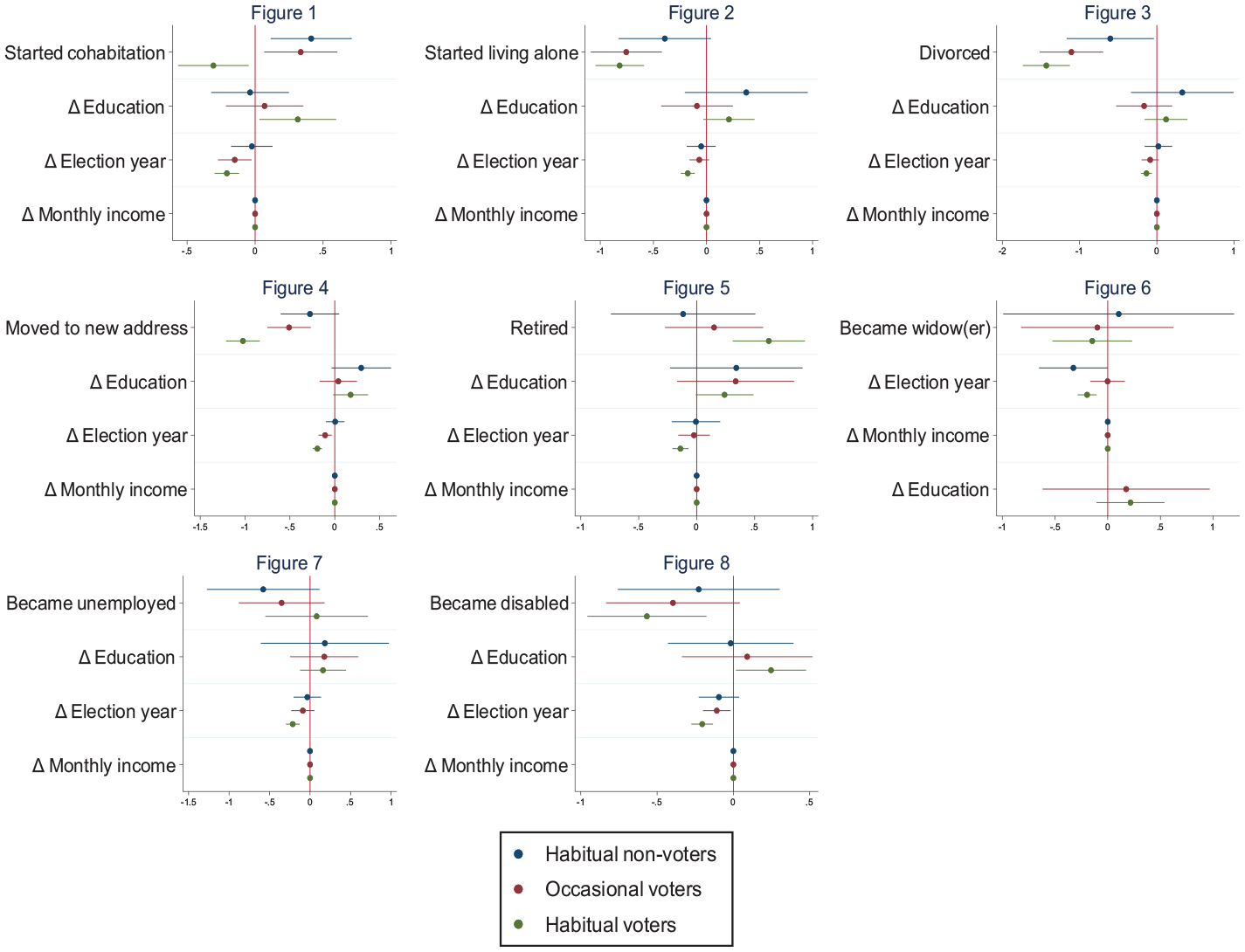
Impact of life events on groups with differing voting habits.
Figure 1 shows that for habitual non-voters and occasional voters the likelihood of turning out increased when they started living with someone after a period of living alone. It appears that living with someone motivates a voter who did not vote in any of the previous two elections, or only in one of them, to turn out to vote. This effect is larger when cohabitants go to polls together (Bhatti et al. 2020). However, contrary to the results reported in the case of occasional and habitual non-voters, cohabitation seems to have the exact opposite effect among habitual voters. Voters who voted in previous two elections are less likely to vote in the current election after living with someone compared to voters who lived alone in both the previous and current elections. This finding runs counter to general expectations, yet it might be explained by the fact that habitual voters are often middle-aged and busy with their professional and personal lives. It is also possible that when a habitual voter moves in with a non-habitual voter, it decreases the likelihood of turning out for the previously habitual voter. Lastly, starting to live alone after a period of cohabitation has a negative effect for both occasional and habitual voters, but not for habitual non-voters (Figure 2).
The findings regarding divorce and changing address conform to expectations (Figure 3 and Figure 4, respectively). Habitual, occasional and habitual non-voters who divorced are less likely to turn out to vote in the current election than voters who were married in both the previous and current elections. Occasional and habitual voters are also less likely to turn out when they move to a new address compared to voters who lived in the same address during both the previous and current elections. However, moving to a new address does not seem to have an effect on turnout in the case of habitual non-voters. The reason for this may be that the costs related to voting in the case of moving are tied to registering and familiarizing oneself with the political situation in the new location. If habitual non-voters did not engage in these activities in their former place of living, it is not clear why they would do so in their new location.
In regard to retirement (Figure 5), results show that habitual voters are even more likely to vote when they retire compared to voters who were still employed during the previous and current elections. This observation challenges the conventional understanding of the impact of retirement and contributes to the argument that retirement is not necessarily a negative event for political participation. It seems plausible that when people retire, they have more time to devote to politics. However, widowhood does not seem to have any statistically significant effect on current turnout for any of the three voter groups (Figure 6).
As shown in Figure 7, unemployment does not have a statistically significant effect on turnout for any of the three voter groups. Lastly, disability has a statistically significant effect on turnout in the case of habitual voters (Figure 8). Habitual voters who became disabled are less likely to go to the polls in comparison to habitual voters who were not disabled in both the previous and current elections.
To summarize, only cohabitation has a different effect on turnout for different voter groups. It was found that living with someone increases turnout for habitual non-voters and occasional voters but decreases turnout for habitual voters. For life events such as retirement and disability, for which a statistically significant effect was reported for habitual voters but not for occasional or habitual non-voters, one (technical) explanation could be that the latter two voter groups are much smaller in size compared to the former. Lastly, divorce appears to be an important life event as it affects all voter groups in the same direction.
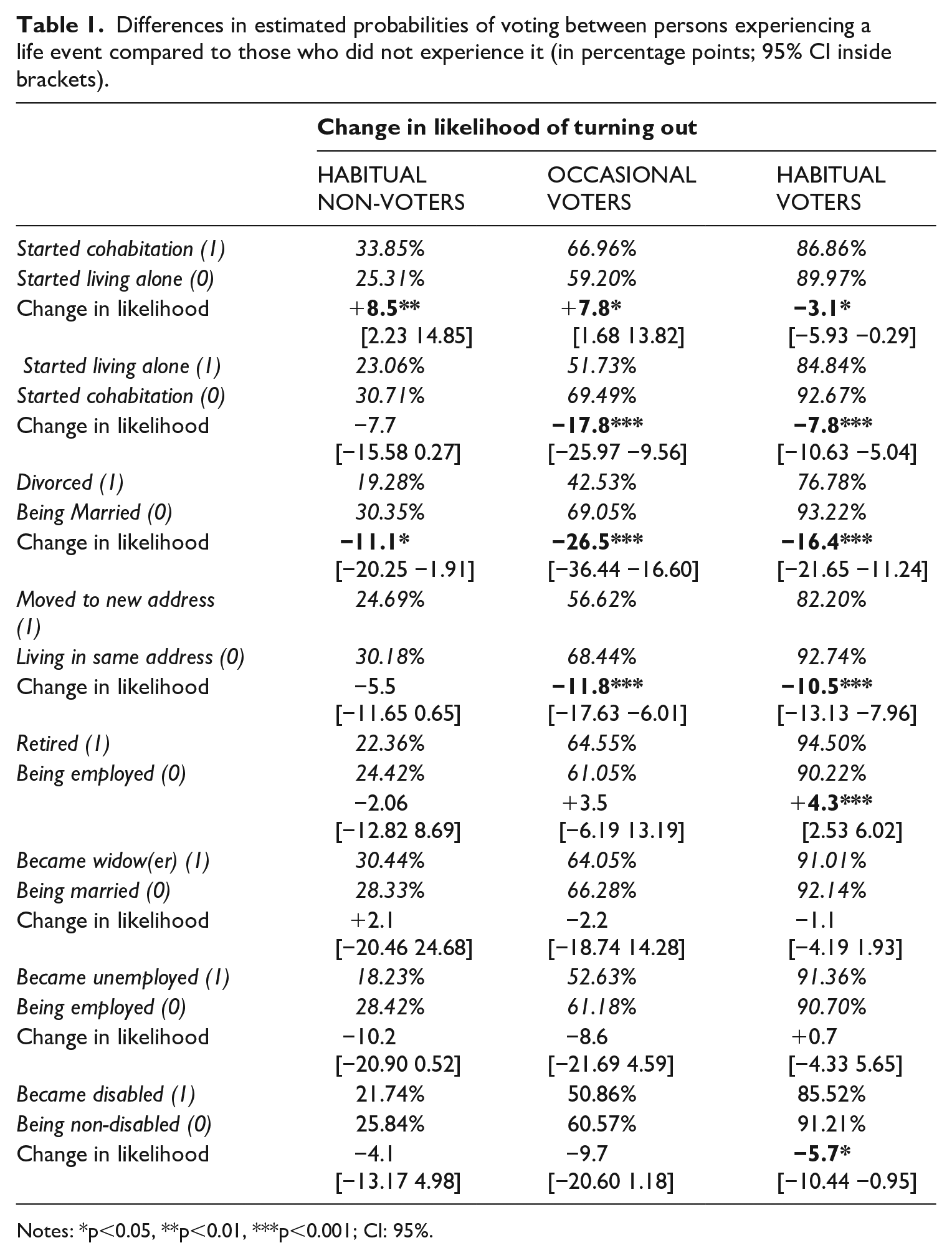
To estimate comparable size effects of ‘Change in status’ for each voter group, we also report changes in predicted probabilities of turnout in Table 1 (see online appendix E for full results).
Differences in estimated probabilities of voting between persons experiencing a life event compared to those who did not experience it (in percentage points; 95% CI inside brackets).
Notes: *p<0.05, **p<0.01, ***p<0.001; CI: 95%.
Table 1 presents differences in predicted turnout probabilities between the ‘treated’ and the ‘control’ groups for each life event in the three voter groups. Positive numbers indicate that the probability of turning out to vote is higher for voters experiencing the life change, whereas negative values indicate the opposite. For example, the positive value in the first row of Table 1, regarding habitual non-voters, indicates that voters who started living with someone before the current election after having lived alone during the previous election have an 8.5 percentage point higher probability of voting than those who lived alone during both the previous and current elections. The largest probability difference is observed in the case of divorce, which has the largest effect for habitual non-voters (-11.1 percentage points), occasional (-26.5) and habitual voters (-16.4). The case of occasional voters also marks the largest difference in estimated probabilities in Table 1.
Comparing predicted probabilities across the voter groups also reveals some significant patterns. There is only limited support for the assumption that occasional voters are more affected by life events than habitual voters and non-voters. Starting to live alone after a partnership and moving to a new address are the only two cases showing the expected pattern with a statistically significant effect. However, the finding that habitual non-voters are often less affected by events such as relocating, becoming disabled or losing a partner—because the voting habit is much weaker or non-existent in this group—is in keeping with the general logic of the voting habit thesis. The overall impression is nevertheless that habitual voters are not as immune to life events. Various changes in partnership status, moving and becoming disabled, all have a substantial negative impact on turnout among habitual voters. The results also demonstrate the importance of not only focusing on the negative impact of life events. Although life changes generally tend to increase stress and cause distraction, some are clearly conducive for turnout. As Bhatti et al. (2020) emphasized, there is a strong social component to the act of voting and entering cohabitation increases turnout among voter groups with a weak voting habit.
Conclusions
Our findings improve the understanding of habitual voting in three important ways. First, life events affect people differently, depending on the strength of their voting habit. In support of the voting habit thesis, life events often have the least effect on habitual non-voters, but this is only one side of the story. Habitual voters, who should be immune to life events, are also heavily affected by relocating, retiring and especially by various changes in partnership status. While these results do not suggest abandoning the notion of habitual voting, they function as a clear reminder that even strong habits can be affected by life events.
Second, changes in partnership status have the largest overall impact on the various forms of habitual voting, but especially on occasional voters. Largely in line with previous research, there is a significant positive effect of moving in with a partner and a similarly negative effect of both divorce and widowhood. While these events understandably have a substantial effect on occasional voters, their impact on habitual voters is also sizable and statistically significant. This highlights the significance of social connections and personal circumstances as important drivers behind disturbances in voting habits (see also Bhatti et al., 2020), although divorce and widowhood certainly have financial repercussion as well. While politics is not always very personal, voting habits nevertheless seem to be. However, the life events that affect voting habits do so in unequal strength and our findings suggest that the more personal the event, the larger the impact.
Third, while scholars routinely talk about ‘disturbances’ to the otherwise stable voting habit and refer to factors that raise the costs of voting, our findings also demonstrate how life events work in the other direction and lower the costs of voting. Starting a life under the same roof with another person has a positive and statistically significant impact even on those who regularly vote, increases turnout for occasional voters by about eight percentage points and slightly more for habitual non-voters. Retirement is another example: despite previous research suggesting the opposite, we find that retirement increases turnout for habitual voters, but does not affect voting in either direction for occasional and habitual non-voters. This exemplifies the differential impact of the same life event on groups with different voting habits. It seems plausible that for habitual and occasional voters, retirement means more leisure time and mental capacity to engage in politics, but for habitual non-voters, it means further withdrawal from social connections that could have had a mobilizing impact.
Overall, the core message of the study is that different life events have different impacts on the voting habit, depending on the habit and its strength. Although the findings demonstrate support for the robustness of habitual voting, most importantly they demonstrate a multitude of both positive and negative effects of different life events. These should not be dismissed as mere ‘disturbances’ to habitual voting, but as factors which significantly affect all types of voters in different ways, depending on type of voting habit. The habit of voting is a formidable but not unwavering force; the interplay between life events and the psychological drivers of turnout differs between individuals with different voting habits.
Our findings inform the broader scholarship on political behaviour by demonstrating that patterns of political behaviour could be more sensitive to changes in life circumstances and these changes should be accounted for in future studies when the data allow for this. Therefore, political behaviour might be more malleable than what has often been assumed. Moreover, the finding that social connections are key drivers of political participation suggests that also scholars of political behaviour should remember to consider people as primarily social creatures and perhaps focus more on the impact of human relationships. The close relationships people have – or do not have – with others seems to fundamentally define the context in which participation occurs.
So where does this study leave the debate on habitual voting? The main strengths of our analysis are the length of the observation period and the broad spectrum of different life events. However, some scholars argue that turnout persistence is an insufficient indicator because habitual voting is more than just repeated behaviour. Future research should include an attitudinal component by measuring political interest, attitudes toward voting (duty) and the psychological strength of the voting habit itself (Cravens 2020; Blais and Daoust 2020). The impact of life events on this deeply rooted, psychological disposition towards habitual voting still remains outside the empirical scope. Our findings suggest that the most intimate life events have the largest impact on habitual voting. The life events analysed here are those most commonly examined in the literature, but the significance of various life events will vary between individuals. There are undoubtedly many events which are consequential for voting behaviour but which have not yet been acknowledged. Additionally, life events are often inter-connected and cumulative. For example, when people enter into cohabitation or marriage, they might also relocate; many people move because of changes in unemployment, such as when they retire. A person might experience (at least) two different significant life events simultaneously, one with a likely mobilizing impact on turnout and the other with a demobilizing impact. Such interactions and cumulative effects of life events have remained outside of the scope of empirical accounts of the voting habit thesis. We encourage scholars to turn their attention in this direction.
Supplemental Material
sj-docx-1-psx-10.1177_00323217211064579 – Supplemental material for When life happens: the impact of life events on turnout
Supplemental material, sj-docx-1-psx-10.1177_00323217211064579 for When life happens: the impact of life events on turnout by Lauri Rapeli, Achillefs Papageorgiou and Mikko Mattila in Political Studies
Footnotes
Acknowledgements
We would like to thank the anonymous reviewers and the editor for valuable comments.
Declaration of conflicting interests
The author(s) declared no potential conflicts of interest with respect to the research, authorship, and/or publication of this article.
Funding
The author(s) disclosed receipt of the following financial support for the research, authorship, and/or publication of this article: This study received support from grant numbers 312676 and 312671 of the Strategic Research Council at the Academy of Finland, grant number 316239 of the Academy of Finland and the FutuDem centre of excellence, financed by the Åbo Akademi University Foundation.

Supplemental material
Supplemental material for this article is available online.
Notes
Author biographies
References
Supplementary Material
Please find the following supplemental material available below.
For Open Access articles published under a Creative Commons License, all supplemental material carries the same license as the article it is associated with.
For non-Open Access articles published, all supplemental material carries a non-exclusive license, and permission requests for re-use of supplemental material or any part of supplemental material shall be sent directly to the copyright owner as specified in the copyright notice associated with the article.
