



Abstract
Many commentators have suggested that the first 18 months of the Johnson government were characterised by a propensity to centralise power. However, few accounts have situated the administration in the historical context of the British state or systematically examined these centralising tendencies. This article attempts to address these omissions. First, through a critical assessment of the literature on authoritarian neoliberalism, the concept of ‘executive centralisation’ is developed within the context of the British state. Second, the article applies this revised framework to the early stages of the Johnson government. While a dominant executive is a long-standing feature of the British political system, it is argued that Johnson has pursued a multifaceted centralisation strategy facilitated by the context of Brexit and COVID-19. In identifying the role of consent in this process, the article augments scholarship on ‘authoritarian neoliberalism’ as a moment in neoliberal governance characterised by the ascendance of coercive governing strategies.
The measures taken by UK Prime Minister (PM) Boris Johnson to manage the two prevailing matters of his premiership to date – Brexit and COVID-19 – have led many commentators to express concern over a tendency to undermine parliamentary accountability and centralise power in the hands of the executive (see Russell, 2020). On Brexit, perhaps the most prominent early example was Johnson’s decision in August 2019 to suspend – or ‘prorogue’ – parliament for 5 weeks, just before Members of Parliament (MPs) returned from the summer recess. In anticipation of this strategy, legal proceedings against the government had been initiated by multiple parties, with the UK Supreme Court ultimately ruling the prorogation to be unlawful the following month (R (on the application of Miller) v the Prime Minister and Cherry and others v Advocate General for Scotland, [2019] UKSC 41). After the 2019 general election, the advent of COVID-19 provided yet more fertile ground for the assertion of the executive, with Johnson accelerating extant trends in the name of crisis management. Gaskell et al. (2020) have argued that the shortcomings of the UK’s response to the crisis can be explained by structural weaknesses at the centre of government as well as failings of decision-making. The British state ‘continues to lack coherence and hoard power and resources at the centre’, a pattern which has led to a raft of policy errors and inconsistencies in implementation (Gaskell et al., 2020: 532). This tendency has contributed to overconfidence in central government, an inability to respond to diverse needs, confusion over responsibilities and a ‘weak capacity to experiment’ (Gaskell et al., 2020: 531).
The view that the political system is weighted in favour of central government and the executive is well established in British politics. This has most recently been conveyed by proponents of the British Political Tradition (BPT), who argue that despite piecemeal reform, institutionally the British state remains highly centralised with power concentrated in Whitehall (Richards et al., 2019). Similarly, Jim Bulpitt (1986) posited an elite-driven model of British politics from the perspective of the political centre, which asserted that an inner circle at the heart of the executive – ‘the Court’ – was the salient actor driving the evolution of the British state. Beyond British politics, however, the concept of executive centralisation has been identified as central to scholarship on ‘authoritarian neoliberalism’. This body of work argues that in the aftermath of the 2007–2008 global financial crisis (GFC), a ‘qualitatively distinct’ phase of neoliberal governance emerged in which coercive and centralised governing practices were amplified (Bruff, 2014).
In this context, this article seeks to explore whether the strategy of executive centralisation evident in the early stages of the Johnson government represents a departure from, or a continuation of, governing practices in Britain. Scholarship focused on British politics and the BPT might view Johnson’s wielding of executive power as a continuation of the long-standing tendency towards centralisation in Whitehall. However, for scholars of authoritarian neoliberalism, this strategy might be understood as part of a more recent shift in governance. Rather than dismissing either of these perspectives, this article combines them to argue that Johnson has drawn on a lineage of governing strategies to strengthen the executive in the UK, facilitated by the context of Brexit and COVID-19. In so doing, it aims to augment both the framework of authoritarian neoliberalism and the concept of executive centralisation through the integration of insights from Jim Bulpitt and Stuart Hall. The analysis traces different processes of executive centralisation in Britain and explores the coercive and consensual elements of the Johnson government’s strategy.
The article is structured as follows. First, a critical review of the literature on authoritarian neoliberalism and executive centralisation is provided. Second, building on these critiques, the article explores the lineage of executive centralisation in Britain, drawing on Bulpitt’s work on centralisation and Hall’s concept of ‘authoritarian populism’. Third, using this adapted framework, the article demonstrates how the Johnson administration has built upon established governing practices in Britain and utilised the context of Brexit and COVID-19 to facilitate a further process of executive centralisation. This strategy is multifaceted, consisting of three components: internal centralisation, external centralisation and legitimation. Though this analysis is necessarily provisional, it aims to provide a distinct interpretation of the early stages of the Johnson government while also updating the concept of executive centralisation for contemporary application in the UK and beyond.
Authoritarian Neoliberalism and Executive Centralisation
In the initial exposition of authoritarian neoliberalism, Bruff outlined how the response of both national and supranational institutions – more specifically, the European Union (EU) – to the GFC, signalled the emergence of a new stage in the politics of neoliberalism. This new phase was characterised by three components: (1) the more immediate appeal to material circumstances as a reason for the state being unable . . . to reverse processes such as greater socioeconomic inequality and dislocation; (2) the deeper and longer-term recalibration of the kinds of activity that are feasible and appropriate for nonmarket institutions to engage in . . . and (3) the reconceptualization of the state as increasingly nondemocratic through its subordination to constitutional and legal rules (Bruff, 2014: 115–116).
For Bruff (2014: 116), the emergence of authoritarian neoliberalism did not represent a ‘wholesale break’ from pre-crisis governance practices; however, it did entail a qualitative shift in which ‘authoritarian tendencies . . . have come to the fore through the shift toward constitutional and legal mechanisms and the move away from seeking consent for hegemonic projects’. Bruff focused in particular on a series of financial conditionality and ‘surveillance’ mechanisms which were subsequently imposed on European nation-states, ‘all with little recourse to democratic and popular oversight in the countries concerned’ (Bruff, 2014: 124; see also Lapavitsas, 2019). These disciplinary mechanisms were ‘pre-emptively self-imposed’ by the institutions of the EU upon its own member states, in distinction from the debt relief packages historically provided by the IMF which were ‘reactively imposed on specific countries somewhere else in the world’ (Bruff, 2014: 124).
Building on Bruff’s framework, Tansel introduced the concept of executive centralisation to the wider framework of authoritarian neoliberalism. Analysing the case study of housing and urban regeneration policy in Turkey, Tansel (2019: 320) defined the concept as: a form of state restructuring whereby key decision-making powers are increasingly concentrated in the hands of the central government while democratic avenues to contest government policies are curtailed through legal and administrative reforms, and the marginalization of dissident social forces.
Although not necessarily an exercise of ‘brute coercive force’, executive centralisation is one means through which governments might seek to strengthen the state’s authoritarian pole by ‘reconfiguring state and institutional power in an attempt to insulate certain policies and institutional practices from social and political dissent’ (Bruff, 2014: 116). Tansel outlined the legal and administrative facets of executive centralisation, focusing in particular on how the governing AKP party accelerated the number of public–private partnerships through the Housing Development Administration. The direct proximity of the administration to the Prime Minister’s office (PMO), combined with legislative changes which empowered the state and disempowered regulators and other stakeholders, provide key examples of executive centralisation in this context (Tansel, 2019: 321–325). This particular institutional configuration facilitated the protection of capital flows, both foreign and domestic, into construction while limiting opportunities for democratic contestation and entrenching the neoliberal economic model.
Similarly, Cozzolino (2019) provides a longitudinal study of economic and finance policy in Italy over the period 1976–2015, identifying a pattern of legislative centralisation through the increased use of emergency legislation and decree laws by the executive, particularly throughout the 1990s and post-2008. This detailed account of the ‘marginalization of the policy-making function of the Italian Parliament’ evidences more systematic deployment of governing practices which seek to avoid scrutiny of economic policy. Moreover, Cozzolino identifies other methods of constitutional and parliamentary manipulation to usher through legislation, such as ‘abuse of the confidence question’. In such cases, new elections are proposed in the event of a negative vote on the bill. This not only raises the stakes of the bill’s passage, but also serves to ‘fast-track’ approval, reducing parliamentary time in which measures might be discussed, scrutinised and amended (Cozzolino, 2019: 346).
The work of Tansel and Cozzolino provides a number of insights into processes of executive centralisation. Tansel focuses primarily on the particular institutional configuration of a government agency in close proximity to the PM’s office – Cozzolino on the gradual marginalisation of parliament in economic policymaking. Both accounts are framed within Tansel’s broad definition, which focuses on the advancement of the decision-making powers of the political centre, and the limitation of opportunities for democratic contestation. These different examples illustrate the broad spectrum of mechanisms that might be deployed as part of a governing strategy of centralisation. However, in adapting this concept for application in the present article, it is important to situate executive centralisation within the context of broader conceptual debates within authoritarian neoliberalism, as well as to incorporate scholarship which identifies the particularities of the UK context. This serves to tailor the framework to the specific institutional set-up in Britain, accounting for key institutional differences between extant case studies of authoritarian neoliberalism and the present case. With this in mind, three points are worth highlighting in identifying the conceptual contributions of the article.
First, as noted by Cozzolino (2019: 338), while the authoritarian neoliberal framework attributes the growth of coercive aspects of neoliberal state management to the aftermath of the GFC, several accounts have observed that assertive executive power can be traced back to the coercive and violent origins of neoliberalism in the 1970s and 1980s (Fabry, 2019; Ryan, 2019). However, as recently clarified by Bruff and Tansel (2019: 235), while the 2008 crisis is posited as a ‘key juncture’ in the acceleration of coercive tendencies, this is not to suggest such practices were previously absent from neoliberal governance. Rather, the qualitative shift attributed to the post-2008 period is intended to identify how, and in what forms, neoliberal governments have increasingly relied upon coercive administrative practices for legitimation and protection in the aftermath of the crisis (Bruff and Tansel, 2019: 239). An awareness of this periodisation is also particularly pertinent to the British case, as a strong executive has long been identified as an institutional feature of the UK system (Flinders, 2010). In this vein, this article aims to contribute to both the British politics and authoritarian neoliberalism literatures through the analysis of the role and form of executive centralisation in British governance over time.
Second, and related, while Bruff (2014: 116) suggests that the advent of authoritarian neoliberalism involved a shift ‘away from seeking consent for hegemonic projects’, there are evidently times when the strengthening of the coercive pole is combined with a movement towards the mobilisation of consent. Hall’s famous analysis of Thatcherism demonstrated how authoritarian practices did not necessarily supplant the mobilisation of consent, but were ‘pioneered by, harnessed to, and to some extent legitimated by a populist groundswell from below’ (Hall, 1985: 116; see also Fabry, 2019: 169). It was for this reason that Hall (1985: 118) intentionally juxtaposed the terms authoritarian and populism: precisely to encapsulate the contradictory features of the emerging conjuncture: a movement towards a dominative and ‘authoritarian’ form of democratic class politics – paradoxically, apparently rooted in the ‘transformism’ . . . of populist discontents.
The deliberately paradoxical term captured the contradictory discourses through which Thatcherism established itself as out there ‘with the people’’, and the pillars of corporatist social democracy – the Labour Party and the trade unions – as ‘with’ the overbearing state (Hall, 1979: 18). In that regard, the coercive ‘rolling back’ of the institutions of social democracy and the ‘rolling forward’ of the architecture of neoliberalism was accommodated by a sustained process of consent generation (see Jessop, 2002). This emphasis on the interdependency of coercion and consent serves to reiterate the importance of Hall’s contribution in understanding the social foundations of governing practices under authoritarian neoliberalism and the means through which governments continually seek to generate consent for such practices.
Finally, the concept of executive centralisation might benefit from a more precise theoretical delineation between different modes and practices. For example, Tansel’s analysis of the institutional reconfiguration between the PMO and aspects of the administrative apparatus in Turkey provides an illustration of the assertion of the executive within central government. Cozzolino’s account, meanwhile, analyses the manipulation of the Italian parliament by the executive, focusing on the removal of scrutiny powers from an institution outside central government. The demarcation of different practices, some internal and others external to central government, might add conceptual precision to analyses of executive centralisation. Moreover, the need for more detailed theoretical delineation is matched by the need for closer inspection of how executive centralisation unfolds in different institutional and historical contexts. The cases discussed by Tansel and Cozzolino differ significantly from the UK and each other, as highlighted, inter alia, by the recent assertion of presidential supremacy in Turkey, and the installation, without a public vote, of another technocratic Prime Minister in the form of Mario Draghi in Italy. In situating the British case within the wider literature, acknowledgement of the distinction between processes of neoliberalisation in formally ‘authoritarian’ states and administrative reforms which seek to limit the ‘social and political space’ for contestation in formally democratic regimes is essential (Bruff and Tansel, 2019: 238–239). In focusing on the latter of these trajectories, it is important to consider the ’spectrum’ of practices through which the executive is strengthened and maintained in the British context and to identify how institutional factors facilitate or undermine government attempts to avoid scrutiny or contestation (Bruff and Tansel, 2019: 237).
Building on the analysis of Tansel and Cozzolino, the following section integrates the work of Bulpitt and Hall to clarify certain institutional features of the British state and to facilitate examination of executive centralisation and consent generation over time. In so doing, the article develops an augmented framework of executive centralisation tailored to the history of executive dominance in Britain which encompasses three components: internal centralisation, external centralisation and legitimation. This framework is then applied to assess the extent to which the first 18 months of the Johnson government represent continuity or change with previous administrations.
Bulpittian Centralisation and Authoritarian Populism
In their analysis of the British state, several critical scholars have nodded to centralisation as a long-standing institutional feature of the British political system which was utilised and entrenched by the Thatcher governments (Castree, 2010; Ryan, 2019). These accounts allude to Britain’s ‘power-hoarding’ constitution, which was traditionally said to operate on the principle that a government with a majority in parliament could act with little or no constraint. As noted above, one particular feature of this institutional set-up was the concentration of power in the executive and Cabinet, at the expense of the legislature (parliament) and local government (Flinders, 2010: 22–23). While this view has long been contested, particularly in light of the constitutional reform programme of the New Labour governments, 1 scholars have maintained that the piecemeal nature of reform in Britain ensured ‘adaptation’ and ‘accommodation’ to the old system (Richards et al., 2019: 337).
Jim Bulpitt was well aware of these institutional features, focusing in particular on the role of the political centre and centralisation. Outlining an alternative framework of territorial politics, Bulpitt (2008 [1983]) adopted a centre perspective which paid ‘careful attention to the location and nature of the centre’ as it changed and adapted over time. In this initial conceptualisation, the centre of government was broadly defined as ‘the central political institutions in the capital city’, including ‘not just civil service departments but the political executive, the legislature and the judiciary’ (Bulpitt, 2008 [1983]: 59). In his later work on Thatcherism, however, Bulpitt noted a deviation from the historical pattern of ‘reciprocal autonomy’, in which the centre had allowed the periphery autonomy in matters of ‘low politics’, with the centre becoming more assertive. In this context, Bulpitt (1996: 223–227) restricted his conceptualisation of the centre to (1) a location, the political centre of power (i.e. No. 10); (2) a principal actor, the Prime Minister and their closest colleagues and advisors; and (3) an ‘operational code’ or set of values, which bound these elements together. This elite-driven model of governing ‘statecraft’ maintained a focus on the centre, or the ‘Court’ as he termed it, but in a much narrower sense, with a particular focus on party-politics and electoral success.
These two conceptions illustrate the evolution of the centre over time, and the related difficulties of outlining a specific framework of centralisation. Examples of centralisation in the Thatcher period included management of the party, Cabinet and senior civil service, with the enforcement of strict discipline ensuring the Cabinet Office and Conservative Party Headquarters (CCHQ) formed a ‘fortress culture’ around the Prime Minister’s agenda (Bulpitt, 1986: 36). However, Bulpitt also identified patterns of centralisation with regard to external institutions, and the adoption, in his terms, of ‘a more interventionist/control strategy’ by the centre (Bulpitt, 1986: 38). The most prominent examples of this shift were interventions in local government, with profligate councils subject to rate-capping and ultimately the abolition of metropolitan councils across the country (Gamble, 1994: 124–125). Bulpitt (1986: 38) initially concluded this was a result of ‘panic ad hocism’ rather than driven by any particular ideology. However, in the latter stages of Thatcher’s premiership, he suggested that these reforms constituted a more concerted attempt to enforce fiscal prudence and limit the powers of local government to ensure that councils became more ‘respectful’ towards the centre (Bulpitt, 1989: 73). This more ‘coherent’ project arguably displayed similarities to the ‘coercive power model’ identified in Bulpitt’s (2008 [1983]) earlier work, with the centre using ‘coercion against peripheral interests, communities or governments’ to undermine those who sought to challenge its authority. These points are potentially illustrative of the underlying principles of executive centralisation in the Johnson era, particularly in light of the increase in possible sites of contention between the centre and periphery through the advent of devolution to the nations and regions of the UK.
While Bulpitt (1986: 21–22) understood the need for elites to maintain consent for coercive governing practices, as evident from the ‘winning electoral strategy’ and ‘political argument hegemony’ components of the statecraft framework, the work of Stuart Hall provides a more comprehensive account of the role of discourse and ideology in driving institutional change and legitimating the state as a mechanism to maintain particular social relations. Hall’s (1985: 116) central argument in his analysis of Thatcherism was that ‘the balance in the relation of force was moving – in that “unstable equilibrium” between coercion and consent which characterises all democratic class politics – decisively towards the “authoritarian” pole’. For Hall (1985), the strengthening of the coercive pole was not at the expense of consent, but was accompanied by the continual building of a ‘populist groundswell from below’. Consent was mobilised against the representatives of the social democratic consensus, most importantly the trade unions (the ‘enemy within’), the overbearing state, and Labour Party MPs and mobilised in favour of the more authoritarian practices of neoliberalism. As Hall (1981: 239) noted: other forces have a stake in defining the ‘people’ into something else: ‘the people’ who need to be disciplined more, ruled better, more effectively policed, whose way of life needs to be protected from ‘alien cultures’ and so on.
This enabled the right, before Thatcher’s victory in 1979, to construct an ‘authoritarian consensus’ (Hall, 1979: 2), which legitimised the rolling back of the institutional pillars of social democracy and the rolling forward of the centralising tendencies of neoliberalism. What distinguished authoritarian populism was that it retained the formal institutions of representative democracy while constructing ‘around itself an active popular consent’ (Hall, 1979: 15). For Hall, therefore, it was clear that even the coercive strengthening of the centre can entail the simultaneous mobilisation of consent within the wider political system.
Application of these concepts to post-referendum politics in Britain reveals a particularly interesting analytical moment, in that the Brexit mandate provided a novel means of consent which, by definition, bypassed the extant representative democratic institutions and strengthened the hand of the executive (Ward, 2021). In gradually realigning itself in accordance with the referendum mandate, the post-2016 Conservative Party once again centred ‘on the very nerve of consensus politics’ (Hall, 1979: 16) – as conveyed through the commitment of the British political establishment to European integration – and sought to position itself ‘out there “with the people”’, against this consensus (Hall, 1979: 18). While this process began under the May government, the parliamentary machinations which characterised the Brexit period intensified ‘anti-political’ sentiment that had developed over the past 25 years. Under Johnson’s leadership, prior to and throughout the 2019 general election, the Conservative Party sought to weaponise this disaffection, utilising it to secure the party’s largest majority since 1983 (Flinders, 2020).
Bulpitt and Hall’s work holds multiple merits for the present study. First, the adoption of a centre perspective to the study of executive centralisation in Britain allows for a more nuanced analysis of structure and agency over time. By placing the ‘Court’ at the heart of the analysis, Bulpitt established the state and political elites within it as independent strategic actors constrained by certain institutional features and defining objectives of the British polity. This provides advantages over accounts that treat the state as a function of economic and elite interests, as well as studies which focus exclusively on particular leaders or individuals (Copley, 2017: 694). Adapting this framework to the contemporary context, on one hand it is possible to see how executive centralisation under Johnson represents continuity, as it operates within the confines of established institutional constraints. On the other, the strategic reflexivity of the centre offers the potential for change as the executive retains agency to deploy new strategies and reform or reconfigure aspects of the institutional structure, as exemplified by the reforms of the Thatcher era. Second, Hall’s framework enables analysis of the coercive elements of executive centralisation to be complemented by consideration of the ‘legitimation’ strategy deployed by the centre to mobilise consent for government policy. Under Thatcher, this process centred on discourses of ‘law and order’ and ‘strong government’ (see Hall et al., 2013 [1978]). By establishing how the Johnson government has constructed popular consent, the article is better placed to understand the process which underpins the rolling forward of executive centralisation.
Drawing together these theoretical threads, the following section outlines an adapted framework of executive centralisation before applying this framework to the first 18 months of the Johnson government. It posits that under Johnson centralisation has occurred in two different, but interrelated, capacities, both internal and external to the political centre, with the first largely demonstrating continuation and acceleration of extant trends and the second demonstrating elements of novelty. Moreover, this process has required a legitimation strategy to mobilise consent for this programme of executive centralisation.
Executive Centralisation and the Johnson Government (July 2019–December 2020)
For the purposes of this article, the centre is conceived in similar strategic terms to ‘the Court’ (Bulpitt, 1986), but is located at the intersection of the PMO (No. 10) and the Cabinet Office (CO). Given that the PM is concurrently head of the government and the governing party, the party leadership is also included. This broad definition reflects the growth of the political executive since the Thatcher period, particularly through the CO, which coordinates implementation of the PM’s policy priorities (Mullens-Burgess, 2020). Internal centralisation refers to the coercive elements identified by both scholars of authoritarian neoliberalism and Bulpitt, and describes the gravitation of decision-making power and oversight towards the centre within central government. Though this has many manifestations, the process largely involves internal restructuring of central government departments, units and committees to enhance central control over policymaking (e.g. Tansel, 2019). External centralisation, on the other hand, describes the coercive strategy of the centre towards elements of the external political system (e.g. parliament; MPs; devolved and local government). In this capacity, such a strategy might involve (1) strict imposition of discipline through a narrow set of positions determined by the centre or (2) the avoidance of scrutiny or opposition from external institutions (e.g. Cozzolino, 2019). Legitimation, meanwhile, describes the centre’s mobilisation of consent to support the rolling back of avenues for dissent and the rolling forward of internal and external centralisation. It is important to note that these three components are often interlinked and there is not always a precise distinction between them. Rather, following Bruff and Tansel’s (2019: 237) emphasis on ‘practices, repertoires and spectrums’, this framework is proposed as a schematic through which to delineate and interpret the wider strategy of executive centralisation (see Figure 1).
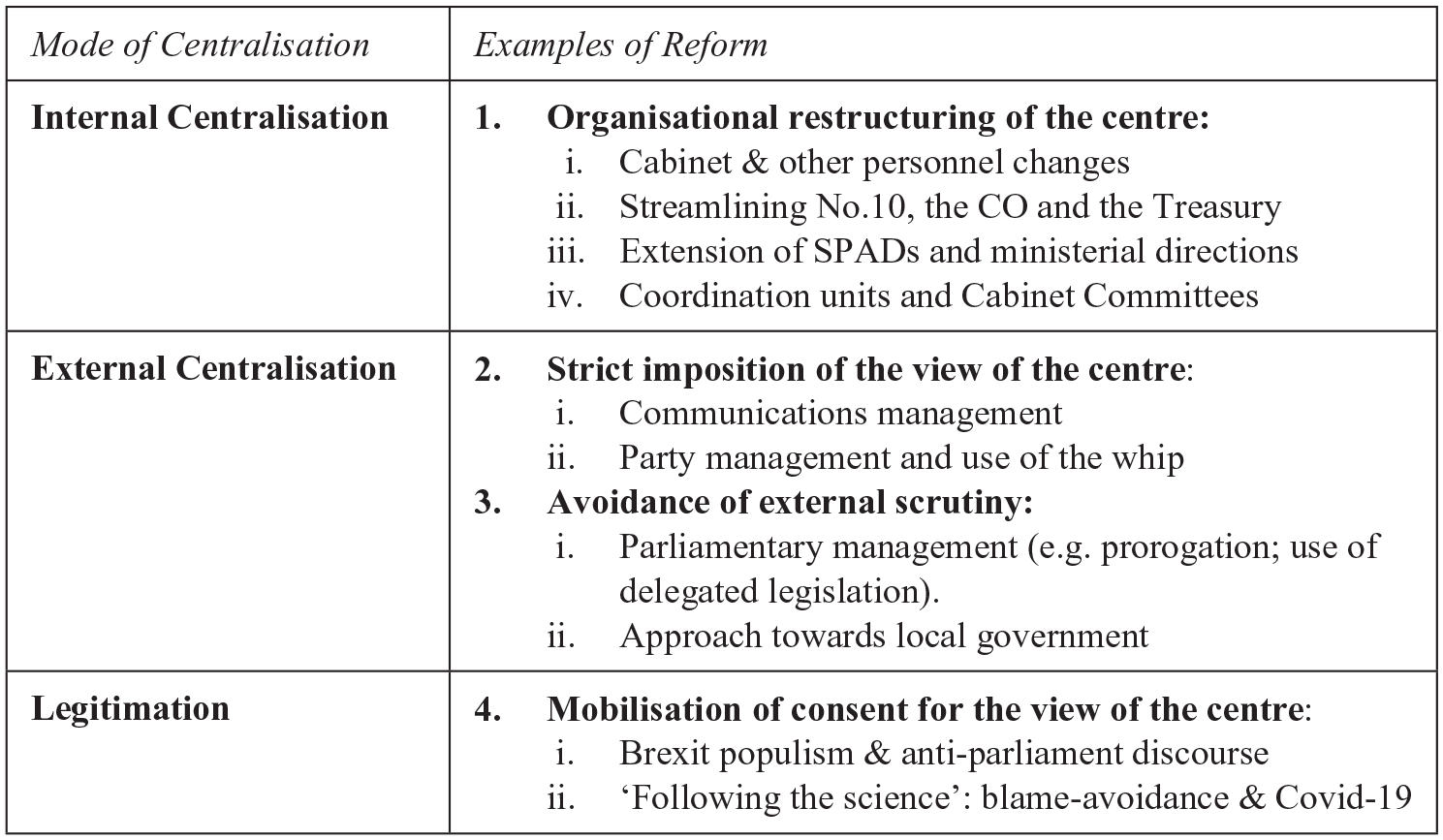
Modes of Centralisation Under Johnson (July 2019–December 2020).
The following analysis discusses these dynamics in relation to the Johnson government’s management of Brexit and COVID-19 in particular. As it focuses on the first 18 months of the administration, the argument is necessarily preliminary. A cross-section of examples of both internal and external centralisation are included, 2 although the analysis is weighted towards the latter as the principal means of centralisation in the government’s approach to date. It is argued that these seemingly disparate measures comprise a wider governing strategy of executive centralisation broadly characterised by continuity of internal centralisation and change in external centralisation.
Internal Centralisation
As noted above, scholars of British politics have identified a gradual strengthening of the centre through internal restructuring since at least the time of the Blair governments. A central tenet of New Labour’s governing strategy was an external emphasis on delegation, devolution and participation, while reforms within central government ‘paradoxically’ sought to strengthen central control (Flinders, 2010: 22–23). This process largely continued under the Coalition (2010–2015), resulting in the extension of powers and increased capacity of both No. 10 and the CO in terms of ministers and officials. In the post-2008 context, the influence of the CO was bolstered by the introduction of an extensive spending controls framework in conjunction with the Treasury as part of the wider implementation of cuts to public expenditure (Dommett and Flinders, 2015). In the aftermath of the 2016 EU referendum, the centre sought to maintain and extend its policymaking influence, with Brexit implementation providing the primary vehicle for the revival of central government recruitment and the extension of policymaking influence (Ward, 2021).
This trajectory was accelerated upon Johnson entering No. 10, primarily through the organisational restructuring of central government. Immediately after the 2019 election, Johnson sought to strengthen the centre through changes to both the line-up and structure of Cabinet. After securing a working majority of 87, the PM sought to oust ministers more resistant to aspects of the government agenda and further align No. 10 and the CO with the Treasury to strengthen the centre of government (Maddox, 2020). Brexit was a key consideration in this development, with Michael Gove, who had been charged with Brexit delivery as Chancellor of the Duchy of Lancaster from July 2019, also appointed CO Minister responsible for coordination of No. 10’s agenda across central government. Gove’s remit extended to a string of proposals for constitutional reform to which the Conservatives had committed in their manifesto, as well as plans for civil service reform (Conservative Party, 2019: 48). The appointment of a joint minister working across the CO and the Treasury – Lord Agnew – provided a means to streamline and formalise this relationship. This connection was bolstered by the creation of a joint unit of economic advisers working for both No. 10 and the Treasury, in a continuation of the expansion of advisors in No. 10 which has doubled since 2010 (Durrant et al., 2020: 17). The appointment of several Brexit supporting non-executive directors (NEDs) to the CO to provide ‘independent advice, support and scrutiny’, cemented the outlook of the department (gov.uk, 2020). Francis Maude, who was central to the implementation of the spending controls framework under the Coalition, was appointed to undertake another review of CO performance, demonstrating the firm commitment to continue and accelerate the internal centralisation of previous administrations.
Initially, there were also a series of measures which sought to extend the centre’s influence through the network of special advisers (SPADs) employed across Whitehall. SPADs provide politically informed support to ministers, which the ‘impartial’ civil service cannot. The overall number and profile of SPADs has increased gradually within Whitehall since the Blair governments; however, Johnson’s senior adviser Dominic Cummings sought to utilise this network to centralise control across government, undermining the autonomy of ministers to appoint their own advisers, and utilising the network to impose No. 10’s agenda on other departments (Durrant et al., 2020: 39). These reforms provoked much disquiet among influential advocates of internal centralisation, with indications that they were reversed on Cummings’ departure from No. 10 (Durrant et al., 2020: 7). Yet the furore surrounding Cummings arguably distracted from the wider trajectory in terms of SPADs and ministerial powers within departments. In a further departure from previous administrations, the reforms to SPAD operations were accompanied by an increase in the tendency for ministers to override official advice during the pandemic (Durrant, 2021). Though not directly an assertion of No. 10 and the CO, the restoration and extension of ministerial decree within central government departments represent a further internal assertion of power, particularly when viewed alongside the increased use of delegated legislation and so-called ‘Henry VIII powers’ which permit ministers to amend primary legislation without parliamentary scrutiny.
Internal centralisation was also evident through Johnson’s approach to central governance structures. Early indications suggested a reduction in the number of Cabinet Committees, sub-committees and taskforces, and introduction of a new format which separated strategy and operations in each policy area. This was modelled on management of ‘Brexit readiness’, through which the strategy committee was limited to a handful of Cabinet ministers and daily intensive meetings of the operations committee were seen to give the centre ‘a firm grip on delivery’ (Owen, 2020). In response to the pervasion of COVID-19 on government business in March 2020, the government announced several ‘new governance structures’ to coordinate the virus response, consisting of four implementation committees of a select few senior ministers and advisers, to feed into the daily COBR emergency meeting. Though these committees seemingly evolved into two Cabinet Committees – COVID-19 Strategy and COVID-19 Operations – their membership and functions were not disclosed, raising concerns about opacity of decision-making and the emergence of a ‘parallel governance structure’ (Public Administration and Constitutional Affairs Committee (PACAC), 2020: 6–7). The strategy/operations model, as well as the governance arrangements adopted under COVID-19, arguably further demonstrate a tendency to limit decision-making to a handful of senior ministers weighted towards No. 10 and the CO.
External Centralisation
For the purposes of this article, two different modes of external centralisation have been identified. The first is the strict imposition of discipline through a narrow set of positions determined by the centre. This is evident in the Johnson government’s approach to communications and party management. The second is the avoidance or neutralisation of scrutiny or opposition from external institutions. This is evident through management of parliament and devolved and local government.
Focusing on the first of these, the management of government communications was centralised at an early stage of the Johnson administration, concurrent to reforms to SPAD operations. Under these arrangements, all departmental communications were instructed to report to four ‘directors-general’ in the CO, who then liaised with the Cabinet Secretary and No. 10 Communications Director (Rutter, 2020). Internally, these changes sought to impose the centre’s message across government. Yet they also had considerable external implications, including the elevation of the PM’s office and the marginalisation of parliament, traditionally the first port of call for significant policy announcements. The advent of daily televised briefings, along with an increase in last-minute press leaks instead of parliamentary announcements, provided two of the most prominent examples of this tendency throughout the COVID-19 pandemic. This trajectory was subsequently institutionalised through the expansion of the position of No. 10 press secretary 3 (Rutter, 2020). Arguably, these reforms represent a natural progression from the centralised communications imposed by the Blair governments, but also with Theresa May’s use of direct television addresses to the public, particularly regarding Brexit negotiations (Ward, 2021: 13).
The second example of this mode of external centralisation was the strict imposition of whipping and party management to bind the party to the view of the centre. While disciplined party management has been a core feature of Conservative statecraft for decades, Johnson arguably accelerated this practice under cover of the Brexit mandate. The decision of the leadership to remove the whip from 21 MPs who voted to block a ‘No Deal’ Brexit in September 2019, and the subsequent demand that all 635 candidates standing at the 2019 election agree to Johnson’s deal, demonstrated early examples of coercive imposition of party discipline (PA Media, 2019). Further evidence of this approach was provided by the removal of the whip from long-standing MP Julian Lewis, who was perceived to have undermined No. 10 by standing against Johnson’s favoured candidate to chair the parliamentary Intelligence and Security Committee. This apparent ‘politicisation’ of an ostensibly bipartisan committee aroused further suspicion about the government dodging scrutiny (Judge, 2021: 286). Despite the institution of ‘hybrid parliament’ arrangements in the first months of the pandemic, a similar pattern of centralisation was evident after this system was replaced by the extensive use of proxy votes in the latter half of 2020, with party whips granted the power to vote on behalf of the vast majority of MPs (Russell et al., 2021).
Moving on to the second mode of external centralisation – the avoidance of external scrutiny or opposition – two examples are worth briefly discussing: management of parliament and management of local government. Brexit and COVID-19 have provided the context for successive tussles between the centre and parliament. A significant early sign that Johnson would seek to marginalise parliament was his decision to prorogue parliament for 5 weeks in August 2019. As no such suspension had lasted over 3 weeks since 1979, this move led many commentators to assert that the decision was ‘deeply unusual and worrying’, as it was clearly designed to prevent parliament scrutinising the government’s Brexit plans until after the 31 October deadline (Russell et al., 2019). After several legal cases were brought against the decision, the Supreme Court ultimately ruled that the prorogation was unlawful, and thus ‘null and of no effect’ (see R (on the application of Miller) v the Prime Minister and Cherry and others v Advocate General for Scotland, [2019] UKSC 41). However, it subsequently emerged that this decision scaffolded the development of an enduring ‘people versus parliament’ narrative prior to the December general election.
The dismissive approach towards parliament continued through the increased use of delegated legislation 4 and ministerial diktat in the enforcement of the COVID-19 lockdown, which has enabled the government to consistently evade parliamentary scrutiny. Johnson elected to rush through new primary legislation in the form of the Coronavirus Act 2020, rather than use existing emergency laws which might have afforded a greater role for parliament (PACAC, 2020: 9–13). The 2020 Act was used in conjunction with an obscure provision in the Public Health (Control of Disease) Act 1984, which permitted ministers to introduce measures ‘without any form of parliamentary approval or scrutiny’ (Ewing, 2020: 14–15). Not only has the use of ministerial decree increased, but as of January 2021 the vast majority (64.2%) of COVID-19 statutory instruments (SIs) laid before parliament breached the convention regarding time allotted for scrutiny 5 (hansardsociety.org.uk, 2021). These extensions of ministerial authority provided further evidence of Johnson’s willingness to avoid parliamentary scrutiny of government policy.
Finally, external centralisation was evident in the government’s approach towards local and devolved administrations. Due to the confines of the article, this discussion focuses on the former. 6 In a sense this aspect of the Johnson government’s strategy is most redolent of the ‘coercive power model’ outlined by Bulpitt, in which the centre seeks to intervene in and undermine local government. Early indications of this approach were evident through the conditions imposed on bailout packages for Transport for London and a series of other measures which sought to undermine the powers of the London Mayoralty (Savage, 2020). However, it was through the implementation of the tiered regional lockdown system in autumn 2020 that these tensions came into the open. The policy was met with resistance by regional leaders who were being placed in the highest tier, most notably mayor of Greater Manchester Andy Burnham, who criticised the lack of financial support for businesses and workers. While No. 10 conducted some consultation with local leaders, discussions were largely superficial, with leaders informed the measures would be imposed ‘regardless’ of their engagement (liverpoolcityregion-ca.gov.uk, 2020). In Manchester, talks ultimately collapsed over a £5 million gap in financial support, and the centre unilaterally imposed restrictions on the region without the consent of local leaders. Similar dynamics re-emerged at the end of the year as cases surged again, and many pupils were forced home from school in an attempt to contain the spread. In response to the new wave, several London councils asked schools to switch to online learning provision. Ministers in the Department for Education immediately responded by ordering the schools to remain open, under threat of legal action (Weale, 2020). This pattern of conflict with local government arguably demonstrated a return of the coercive and interventionist practices which characterised centre–periphery relations in the Thatcher era.
Legitimation
A key contention of this article is that the Johnson government has combined the rolling forward of executive centralisation with the mobilisation of consent for the view of the centre. In so doing, it has revived aspects of the authoritarian populism Hall identified in his analysis of Thatcherism, adapted to the context of the Brexit mandate. This shift was initially evident in what several scholars have branded ‘Brexit populism’, through which the government sought to align itself with the British public against the ‘establishment’ forces in Brussels and the Westminster parliament (Alexandre-Collier, 2020; Baldini et al., 2020; Flinders, 2020). The process of consent generation centred on the 2019 general election, in which Johnson capitalised on the construction of this anti-parliament narrative to secure a Conservative majority. While the following analysis appreciates the advent of the Covid crisis in early 2020 tilted the balance towards coercion and away from consent, it argues that the anti-parliament narrative established prior to the election helped to legitimate strict lockdown measures and avoid external scrutiny during the pandemic.
Although Johnson claimed repeatedly that he did not want a general election prior to the August 2019 prorogation, this manoeuvre provoked parliament to pass a bill mandating the PM request an extension to the Brexit negotiating deadline. Upon the passage of the so-called ‘Surrender Act’, Johnson reversed his position, calling for a snap election as the only means to end the ‘zombie parliament’ (Hansard HC Debates, vol. 667 col. 779–780, 25 September 2019). Between the months of September and December, when the election eventually took place, this discourse of Brexit populism reached its apotheosis. The Conservatives prepared the ground for the election by repeatedly stoking a ‘people versus parliament’ narrative, focusing their manifesto on MPs who had ‘devoted themselves to thwarting the democratic decision’ of the 2016 referendum, and compelling the public to ‘Get Brexit Done’ (Conservative Party, 2019: 47–48). This shift hardened opposition towards EU institutions throughout the Brexit negotiations, and provided fertile ground for Johnson to invoke a particular interpretation of the ‘nation’ against the EU ‘establishment’, emphatically securing consent from the electorate with an 87-seat majority (Baldini et al., 2020).
The anti-parliament discourse which preceded and continued throughout the election legitimised measures such as prorogation and the strict enforcement of discipline over MPs in order to deliver the ‘will of the people’ (Alexandre-Collier, 2020: 16). These tactics sought to combine the ‘Leave’ fortress culture at the centre of government with a strategy of Brexit populism outside the centre, reinforcing the Conservatives’ central message that the Brexit mandate must be implemented against the obstructive forces in Westminster. Moreover, this remoulding of the Conservative Party around the Brexit mandate tapped into deeper popular sentiments to create a ‘carefully calibrated statecraft strategy’ which mobilised disaffection with politicians and political institutions by aligning the Conservatives with the ‘democratically disaffected’ areas of the country – especially in England – that were characterised as ‘left behind’ (Flinders, 2020: 236). Johnson thus exploited the Brexit context to align the Conservatives with the ‘people’, homing-in on the discourse of the ‘nation’ to position himself on the ‘nerve of consensus politics’ (Hall, 1979: 16). This allowed the Conservative Party leadership to transmute Brexit into a broader legitimation strategy which appealed to popular discontents in different sections of society. Understood alongside the coercive aspects of internal and external centralisation, this strategy contained many of the hallmarks of Hall’s account of authoritarian populism. The Conservative Party repurposed the pent-up frustration and anti-political sentiment surrounding the failure to deliver Brexit and deployed it to justify rolling back avenues for contestation and rolling forward executive centralisation.
Despite the shift towards coercive measures stemming from the imperative to manage a public health crisis, the centre has manipulated elements of the people versus parliament narrative surrounding the election to legitimise centralisation in the management of COVID-19. In the months following the passage of the Coronavirus Act in March 2020, the government sought to evade scrutiny of its strategy by repeatedly framing it as an attempt to ‘create political opportunity out of a crisis’ (Walker, 2020). This not only pertained to the Labour Party, but also to backbench MPs who questioned the manner in which the government side-lined parliament in the implementation of lockdown measures.
Similar tendencies were evident in the government’s decision to unilaterally end hybrid parliamentary arrangements, despite concerns that doing so would disenfranchise shielding MPs and further limit scrutiny of government policy (Russell et al., 2021). The suggestion that MPs were neglecting their constituents and not fulfilling their duties properly under the hybrid system partly drew on the anti-parliament sentiments that underpinned the 2019 election. However, the episode also marked something of a reversal in the government’s discourse regarding parliament. The return of in-person only parliamentary proceedings was justified, somewhat disingenuously, through a more traditional Conservative defence of parliamentary sovereignty and the restoration of ‘effective scrutiny’ and ‘proper, full-blooded democracy’ (Hansard HC Debates, Vol. 676, Col. 726; 737, 2 June 2020). Despite a continued commitment to avoid parliamentary scrutiny in practice, this rhetorical departure from the pre-election anti-parliament position demonstrated an awareness on the part of the executive of the need to adapt the narrative in accordance with the context to continually channel popular discontents into the ‘populist common sense’ view of the centre (see Hall, 1979: 17).
Finally, the claim that the government was ‘following the science’ played a key role in legitimising the actions of the centre and constructing a narrative of blame avoidance for the government’s management of the pandemic. The adoption of this narrative alongside the institution of daily press briefings featuring key scientific advisors underpinned the government’s wider strategy to avoid blame and accountability for COVID-19 policy, with decision-making ostensibly driven by scientific rather than political factors (Flinders, 2021: 492–493). Similarly, objections to the centralised operation of NHS Test and Trace and other public health measures, as well to the operation of the tiered regional lockdown system, led to a series of clashes between the centre and periphery, with blame repeatedly attributed to uncooperative regions accused of obstructing the centre’s management of the pandemic (Gaskell et al., 2020: 530). Although these discourses did not contribute directly to consent generation in the manner of Brexit and the 2019 election, all have been deployed in a concerted effort to legitimise the rolling forward of executive centralisation in the management of the pandemic.
Conclusion: Enduring Executive Centralisation?
This article has drawn together a number of theoretical threads to provide a preliminary analysis of the Johnson government in Britain. It has argued that Johnson has pursued a multifaceted strategy of executive centralisation, consisting of two separate but interrelated components, which can be broadly characterised as internal and external to the political centre. These reforms and tactics have been supported by a legitimation strategy which has sought to mobilise consent for the reconfiguration of the institutional relationship between the centre and external institutions. While to some extent this strategy represents continuity with previous administrations, particularly with regard to the acceleration of extant trends of internal centralisation, Johnson’s approach towards external political institutions demonstrates elements of novelty, with the marginalisation of parliament and the undermining of local and devolved administrations providing key examples. To legitimate these measures, the centre has mobilised an authoritarian populist discourse tailored to the context of Brexit and COVID-19, facilitating the elevation of the executive and the demotion other aspects of the British political structure.
Reflecting on this analysis in light of the first half of 2021, the patterns outlined in the preceding discussion seem likely to endure. In terms of internal centralisation, the announcement in April of the re-establishment of the No. 10 Delivery Unit, initially introduced under Blair, aims to provide the PM and No. 10 with greater authority and oversight of policy delivery across government. In March, the extension of the Coronavirus Act powers for a further 6 months, along with the continued resort to proxy voting and delegated legislation, indicates a continued commitment to the side-lining of parliament (Russell et al., 2021). Novel forms of external centralisation are also evident through the announcement of several pieces of legislation in the Queen’s Speech, including the Judicial Review Bill and the Dissolution and Calling of Parliaments Bill. Both of these measures return powers to the executive from external institutions – the Supreme Court and parliament, respectively – with the apparent aim of avoiding scrutiny or opposition. While the government might well argue that these measures merely return the British political system to the pre-Blair status quo, when combined with legislation such as the Police, Crime, Sentencing and Courts Bill, which, inter alia, seeks to place limits on citizens’ ability to protest, a wider pattern of ‘illiberalism’ and executive assertion appears (Green, 2021).
While it is difficult to identify the broader purpose or direction of the Johnson government’s programme at this stage, two points emerge from this analysis for further discussion and research. First, it is evident that the Thatcher government’s programme of centralisation in the 1980s was driven by a desire to limit or remove powers from local councils and other sites that posed a threat to central government authority as part of its broader project to strengthen the central state and limit public expenditure (Gamble, 1994). In many respects, it seems Johnson has picked up this ‘strong state’ ethos and its accompanying preference for executive centralisation. However, the advent of devolution to the nations and regions of the UK has arguably altered public expectations of territorial governance, making it more difficult to conduct a programme of centralisation and maintain public support in the contemporary context. Owing to the more diffuse governance structure beyond the centre, the implementation of such a strategy potentially raises several tensions, as evident from the conflict over the tiered lockdown system and the backlash to Johnson’s remark that devolution was ‘Tony Blair’s biggest mistake’ (Brooks et al., 2020). Second, and related, one of the drivers of executive centralisation identified in other contexts is the reorganisation of government and public bodies as ‘market-like’ institutions. Certain aspects of internal centralisation which predate Johnson but have been continued and accelerated by him demonstrate similar trends in this regard. The introduction and extension of the role of NEDs in central government departments, for example, along with the continued push for embedded spending controls and market-like management, continue the legacy of ‘New Public Management’ reforms to transform government structures in the image of the market (Dommett and Flinders, 2015). In this regard there is clear continuity with Thatcher-era reforms of central government, and the extension of this process has contributed to the blurring of the boundary between politics and business, with patterns of outsourcing and ‘cronyism’ proliferating throughout the pandemic (Davies, 2020: 227; Geoghegan, 2020). While these points are necessarily conjectural, they might provide fruitful avenues for further research into the organising principles behind the Johnson government.
The framework of executive centralisation developed in this article was proposed as a repertoire or schematic through which to interpret the multifaceted approach adopted by the Johnson government in Britain. As noted above, the integration of both Bulpitt and Hall was intended to tailor this framework to the UK context, and to emphasise the continued role of consent in legitimating the shift towards coercive governing practices. This framework might be revised in future studies of British politics to account for the evolution of the centre over time, as well as to address conceptual or empirical discrepancies in the formulation. While an awareness of the institutional differences between cases is essential, this framework might also be adapted to other contexts to assess the modes and mechanisms of executive centralisation employed by neoliberal governments pursuing political and institutional reform.
In his discussion of authoritarian populism, Stuart Hall (1985) argued that the Thatcher governments initiated a seemingly contradictory strategy which mobilised ‘populist’ consent alongside the implementation of authoritarian reforms. Such a strategy entailed risks because it threatened to elevate the democratic aspirations of the ‘people’ while strengthening coercive state power. Applied to the contemporary context, this insight suggests that while Johnson may have initially pursued a strategy of executive centralisation, the need to repeatedly construct and draw upon consent presents opportunities for those opposed to such measures to challenge this approach. The 2016 referendum and its aftermath arguably represented a novel and powerful opportunity for the Conservative Party to bind ‘the people’ into this assertion of executive power. However, as the distance between that mandate and Johnson’s wider policy programme continues to grow, the government’s strategy may become more susceptible to a backlash from the parliamentary backbenches, local and devolved government leaders or even from the public at large.
Footnotes
Acknowledgements
The author(s) thank Dr David Bailey, Dr Sam Warner and Dr Peter Kerr for their helpful comments on an earlier draft of this paper. The author(s) are also grateful for the comments of two anonymous reviewers.
Declaration of Conflicting Interests
The author(s) declared no potential conflicts of interest with respect to the research, authorship and/or publication of this article.
Funding
The author(s) received no financial support for the research, authorship and/or publication of this article.
