




Abstract
Incumbent prime ministers who win re-election often reshuffle their cabinet ministers. These post-election cabinet reshuffles have important implications for policymaking and present a puzzle: why would prime ministers alter the ‘winning team’ that has just received an electoral mandate? Existing literature has largely overlooked post-election reshuffles, so offers few compelling answers. At most, a plausible but under-theorised and untested conventional wisdom suggests that electoral success increases prime ministers’ authority over their ministers. This article thus provides the first systematic study of post-election cabinet reshuffles in single-party governments. It argues that re-elected prime ministers use a temporary increase in their authority to pre-empt future leadership challenges by moving or sacking cabinet rivals. Larger election victories should thus produce larger reshuffles. However, analysis of post-election cabinet reshuffles in four ‘Westminster’ democracies since 1945 shows no support for this expectation, suggesting that further work is needed to understand these important political events.
Before the October 1974 general election, British Prime Minister Harold Wilson told his cabinet: ‘If we win I would not expect to make many changes in a winning team. Just catch up with your sleep . . . and be at your office desk on the Monday morning’ (Pimlott, 2016: 643). Wilson delivered on this promise – after winning the election, he made just one change to his cabinet. However, many incumbent prime ministers who win re-election take a different approach, reshuffling their cabinet in the immediate aftermath of the election. In fact, post-election cabinet reshuffles are a common phenomenon in many democracies.
Post-election cabinet reshuffles are significant political events. Like all cabinet reshuffles, they can have important consequences for prime ministerial influence (Indriðason and Kam, 2008; Kam and Indriðason, 2005), policy outcomes (Alexiadou, 2015), government popularity (Dewan and Dowding, 2005; Miwa, 2018), future election results (Martin, 2016) and parliamentary accountability (Thompson, 2020). Post-election reshuffles also have particular normative significance because they alter the ‘winning team’ that has just received a renewed electoral mandate. This appears to attenuate the role of elections as a tool for endorsing or removing the incumbent government. It is therefore important to understand why a prime minister would rearrange her cabinet immediately after voters have given it their backing.
However, despite their frequency and importance, political science has paid surprisingly little attention to post-election cabinet reshuffles. There is a growing body of research studying cabinet reshuffles in general (see Bäck and Carroll, 2020). But this work mostly either excludes post-election reshuffles (e.g. Kam and Indriðason, 2005) or includes them without discussing whether and how they might differ from midterm reshuffles (e.g. Huber and Martínez-Gallardo, 2008). A few studies do directly discuss post-election reshuffles, but only in passing, and without developing or testing any systematic theory for why they take place. Instead, this work typically repeats the vague untested conventional wisdom that electoral success increases prime ministers’ capacity to reshuffle their cabinet by enhancing their political authority (e.g. Allen and Ward, 2009: 248). We thus lack clear theoretical arguments or empirical evidence to explain why prime ministers carry out post-election cabinet reshuffles.
The goal of this article is therefore to elaborate and test a theoretical explanation for post-election cabinet reshuffles in parliamentary democracies. It applies particularly to single-party governments. Post-election reshuffles under multi-party governments should involve more complex considerations and inter-party bargaining. Focusing on single-party governments therefore produces clearer expectations and provides a theoretical foundation that can be adapted to other government types in the future.
In keeping with previous literature, I conceptualise cabinet reshuffles as a strategy used by prime ministers to manage potential challenges to their leadership from other ministers (Kam and Indriðason, 2005). But where previous literature has focused on variation in prime ministers’ incentives for conducting reshuffles, I offer a theory that focuses on their capacity to do so. In particular, I argue that electoral victory enhances prime ministers’ capacity to reshuffle their cabinets, by reducing the likelihood that sacked, demoted or unpromoted ministers can successfully challenge their position. Prime ministers exploit this capacity, even when their position is under no immediate threat, because they expect future challenges to emerge during their time in office. Post-election reshuffles thus represent prime ministers using a temporary increase in their authority to pre-empt future challenges to their leadership.
The article tests a key empirical implication of this theory. If post-election reshuffles are the result of electoral success heightening prime ministers’ authority, larger election victories should lead to larger reshuffles. I test this by analysing 63 post-election cabinet reshuffles since 1945 in four ‘Westminster’ democracies, where single-party governments have been common. However, the results do not support my theoretical expectations. There is no consistent relationship between election results and the size of post-election cabinet reshuffles in these cases. This null finding conflicts with my own theory and with conventional wisdom.
The article nonetheless makes an important contribution to the study of executive politics, for a number of reasons. First, it is the first focused study of an important but neglected political phenomenon: post-election cabinet reshuffles. Second, it articulates a clear theoretical explanation of this phenomenon which provides a foundation for future theoretical development and empirical testing. Third, the null results suggest that this is a topic which requires further attention, highlighting the continued lack of an empirically supported explanation for why post-election reshuffles take place.
The rest of the article proceeds as follows. I begin by summarising the treatment of post-election cabinet reshuffles in existing literature. I then outline a theory explaining post-election cabinet reshuffles. The following section details the research design with which I test that theory. The next section presents and discusses the results of my analyses, before I conclude by summarising and discussing the article’s argument and findings.
Existing Literature
Political scientists have recently paid increasing attention to cabinet reshuffles (Bäck and Carroll, 2020). Since Kam and Indriðason’s (2005: 327) complaint that this topic had been ‘little studied’, there has been a large growth in theoretical work explaining why political leaders reshuffle their ministerial teams (Allen and Ward, 2009; Bäck et al., 2012; Dewan and Myatt, 2007; Hansen et al., 2013; Huber and Martínez-Gallardo, 2008; Indriðason and Kam, 2008; Kam et al., 2010; Kam and Indriðason, 2005; Ono, 2012). This work has also become increasingly comparative, moving beyond parliamentary democracies to consider reshuffles and ministerial selection in presidential democracies and non-democracies (Camerlo and Martínez-Gallardo, 2017; Camerlo and Pérez-Liñán, 2015; Kroeger, 2020; Martínez-Gallardo, 2014; Quiroz Flores and Smith, 2011). These advances have been aided by increasingly ambitious data collection (Dowding and Dumont, 2009, 2015; Nyrup and Bramwell, 2020).
Despite these developments, existing literature still offers almost no coverage of post-election cabinet reshuffles: changes to ministerial appointments in the immediate aftermath of an incumbent government being re-elected. We thus lack clear theoretical arguments or empirical evidence to explain these important political events. Previous studies typically approach post-election reshuffles in one of three ways.
First, many studies of cabinet reshuffles simply exclude those which take place immediately after elections. This follows from the conventional approach of treating new elections as heralding the formation of a new government, even when the incumbent party or parties are returned to office. Studies taking this approach therefore focus solely on midterm cabinet reshuffles (Budge, 1985; Kam and Indriðason, 2005). This has quite reasonably been justified as a starting point that leaves for future work the question of how ‘analytically separate reshuffles are (or should be) from the wholesale formation and termination of governments’ (Kam and Indriðason, 2005: 331). But to date, this question has not been addressed with respect to post-election cabinet reshuffles.
A second approach has instead analysed post-election cabinet reshuffles along with midterm reshuffles, but without discussing at length how their dynamics and causes might differ. Most notably, Huber and Martínez-Gallardo (2008) explore the stability of ministerial appointments, both within and across the tenure of different cabinets. Their analysis includes a control variable for the loss or gain of government party seats, in order to ‘control for the impact of electoral change on portfolio turnover (rather than simply censoring ministers who “die” because of election results)’ (Huber and Martínez-Gallardo, 2008: 173). This implies that their analysis includes post-election reshuffles, but they do not discuss whether such reshuffles might differ from the others they analyse. Similarly, Indriðason and Kam (2008: 642–643) model the number of cabinet ministers affected in British and Australian reshuffles, and include post-election reshuffles in their analyses. A dummy variable for these reshuffles shows that they are typically larger than midterm reshuffles. The authors do not discuss this finding, though it fits with their earlier comment that elections may prompt cabinet turnover through the retirement or defeat of experienced ministers or the election of new potential ministers to parliament (Indriðason and Kam, 2008: 641).
Third, a very small number of studies do directly discuss post-election cabinet reshuffles. Some simply describe them, showing that they can be wide ranging in some countries (Allen, 2015; Dowding and Lewis, 2015: 55–56). Indeed, Fischer and Kaiser (2009: 32–33) show that post-election reshuffles are the main route by which German cabinet ministers leave office. Other studies actually offer explanations for why prime ministers typically reshuffle their cabinets after achieving re-election. These explanations are generally brief, under-theorised and untested. Nonetheless, they often share a common theme that offers a starting point for further theoretical development. Specifically, these studies tend to suggest that electoral success increases prime ministers’ capacity to reshuffle their cabinet, by enhancing their political authority. For example, Alderman and Cross (1987: 7) argue that ‘[a] fresh electoral mandate both enhances a Prime Minister’s authority and provides the occasion for a reorganisation of personnel’. In a similar vein, Allen and Ward (2009: 248) claim that ‘[w]inning an election obviously increases a PM’s authority, and thus their freedom to appoint and dismiss’. In this view, greater electoral success gives prime ministers more authority, allowing them to make larger changes to their cabinet.
This work appears to draw on a conventional wisdom about post-election reshuffles that has wider resonance among political observers. Historians, journalists, commentators and politicians frequently invoke the idea that (larger) election victories give prime ministers more freedom to reshape their cabinet. For example, during the United Kingdom’s 2017 general election, the press reported that Prime Minister Theresa May was considering a ‘sweeping cabinet reshuffle after the election’, but that ‘much depends on the scale of any victory and whether she has enough political capital to make big changes’ (Parker, 2017). This prediction seemed borne out when a surprise result saw the Conservative government lose their parliamentary majority, and May felt unable to make more than marginal changes to her cabinet (see Seldon and Newell, 2019: 260–261). This contrasts starkly with an earlier Conservative prime minister, Margaret Thatcher, who used her 1983 landslide election victory to address the fact that ‘There was a revolution still to be made, but too few revolutionaries’ (Thatcher, 1995: 306). Thatcher sacked her Foreign Secretary (and persistent critic), Francis Pym, and her authorised biographer claims that she was ‘At last . . . able to forge a Cabinet more or less as she wanted it, rather than as she reluctantly acknowledged it had to be’ (Moore, 2016: 66). This narrative is not solely found in the United Kingdom – when Australian Prime Minister Scott Morrison won re-election in 2019, coverage of the subsequent cabinet changes claimed he had ‘moved to stamp his authority on Cabinet’, in a story headlined, ‘It’s clear PM is in charge’ (Harris, 2019). Similarly, coverage of John Key’s 2014 post-election reshuffle in New Zealand claimed that his record of electoral success meant ‘he is at the zenith of his power. In National’s neck of the woods, he can just about do what he likes’ (Armstrong, 2014).
There is thus a plausible existing view that greater electoral success increases prime ministers’ scope for conducting post-election reshuffles. However, no scholars have yet theoretically developed or empirically tested this argument. The following section thus sets out a theory linking prime ministers’ electoral success to their ability to conduct post-election cabinet reshuffles.
Explaining Post-Election Cabinet Reshuffles in Parliamentary Democracies
Post-election cabinet reshuffles occur when there are changes in the allocation of cabinet positions in the immediate aftermath of an incumbent government being re-elected to office. This section offers an explanation for such reshuffles. It does so by building on earlier work that suggests election victory heightens prime ministers’ authority and thus their freedom to reorganise their cabinet (Alderman and Cross, 1987; Allen and Ward, 2009). That work draws on a wider argument that success and popularity enhance prime ministers’ de facto capacity to use their de jure powers like hiring and dismissing ministers (e.g. Heffernan, 2003). However, existing studies of post-election reshuffles do not explain the underlying mechanisms which are expected to drive this relationship. I thus go beyond previous work by developing a theory of post-election reshuffles which is explicit about the goals and actions of the relevant actors, from which testable empirical implications can be derived. As explained above, this theory applies primarily to single-party governments, expecting post-election reshuffles under coalition governments to be driven by more complex motivations and inter-party bargaining.
I begin by setting out some assumptions about the motives of prime ministers and ministers. In common with previous work, I assume that prime ministers are chiefly motivated by retaining office. They value office-holding intrinsically, but also instrumentally, as a route to achieving their policy objectives (Allen and Ward, 2009; Indriðason and Kam, 2020; Kam and Indriðason, 2005). Other cabinet ministers have very similar motivations. They wish to remain in the cabinet and would ideally like to progress to more senior positions – including prime minister – which offer greater prestige and influence. This creates a tension, where prime ministers delegate power to ministers who have disproportionate power in their given policy portfolio (Laver and Shepsle, 1994), and can then use this power to further their own policy goals and career. At its most severe, this tension can see ministers using their position to directly challenge the prime minister’s authority, pursuing unauthorised policies and manoeuvring to become prime minister themselves. Prime ministers thus face problems of both adverse selection (establishing which ministers to appoint) and moral hazard (monitoring ministers once they are appointed) (Kam and Indriðason, 2005).
Given these motivations, how can cabinet reshuffles help a prime minister achieve her goals? Kam and Indriðason (2005: 333) set out various ways in which reshuffles allow prime ministers to exert greater control over policymaking and to deter leadership challenges. Most simply, prime ministers can use their power to sack or demote rivals. This reduces their policy influence and thus their ability to undermine the prime minister. Second, rival ministers can be moved to ‘poisoned chalice’ portfolios which, while not technically a demotion, expose them to greater risk of political controversy. 1 Both of the above strategies can be based on ‘updating’, as the prime minister gains more information about ministers’ conduct in office (Kam and Indriðason, 2005: 333). Third, regular reshuffles can also deter self-interested overspending by ministers: if they do not expect to hold the same post in future, they will not enjoy the political benefits of this overspending, which will instead allow greater policy deviations by their successor (Indriðason and Kam, 2008). In short, cabinet reshuffles allow office-motivated prime ministers to undercut political rivals in their own party (Budge, 1985; Kam and Indriðason, 2005). 2
Given this strategic context, when do prime ministers choose to carry out cabinet reshuffles? Existing work on the timing of cabinet reshuffles largely emphasises variation in prime ministers’ incentives for holding them. Some work emphasises variation in the extent of the adverse selection and moral hazard problems facing the prime minister (Huber and Martínez-Gallardo, 2008; Kam and Indriðason, 2005). But these are largely a function of cross-national variation in political institutions, rather than variation over time within countries. Work also therefore links prime ministers’ incentives for reshuffling to time-varying political conditions. In particular, prime ministers have stronger incentives for holding reshuffles when unpopularity in the country or parliament increases the risk of challenges to their authority (Kam and Indriðason, 2005; Martínez-Gallardo, 2014). However, this perspective struggles to explain post-election cabinet reshuffles, which occur when prime ministers are likely to be at their most popular.
The theory outlined here thus turns from prime ministers’ incentives for reshuffling their cabinet, to also consider their capacity to do so. Of course, prime ministers nearly always have the formal power to select who serves in their cabinet and in what roles. 3 In practice, however, prime ministers face informal political constraints on how they use their formal powers (Heffernan, 2003). They may thus be deterred from carrying out reshuffles if they expect them to be politically costly. In principle, as explained above, reshuffles can strengthen the prime minister if they use them to sack or demote rivals. However, prime ministers also face the risk that ministers who resent being sacked or demoted may be pushed into challenging the prime minister’s leadership. This might mean directly triggering a leadership contest or simply undermining the prime minister’s position in preparation for a future contest. Prime ministers must thus judge whether conducting a reshuffle at any given point of time will strengthen their leadership as intended or inadvertently undermine it. In practice, therefore, prime ministers’ capacity to carry out reshuffles is shaped by their calculation of whether sacked or demoted rivals will be weakened or will instead be able to successfully challenge their leadership (see King and Allen, 2010: 265–266).
The central argument of this article is that electoral success shapes prime ministers’ calculation of the likely consequences of a cabinet reshuffle. This is because ministers hoping to launch leadership challenges depend on support from other members of parliament (MPs). 4 Their willingness to provide this support will crucially depend on the current leader’s electoral success. This is because winning and holding office is legislators’ primary motivation, without which they cannot hope to achieve any of their other political goals. Political parties are thus less likely to remove party leaders who are more electorally successful (Andrews and Jackman, 2008). Achieving re-election should therefore insulate prime ministers from leadership challenges by making such challenges less likely to succeed and, as a consequence, less likely to be mounted in the first place.
Given this, achieving re-election should affect the behaviour of both prime ministers and their ministerial colleagues in two ways, each of which makes reshuffles less costly for prime ministers. First, and most obviously, winning re-election makes it more likely that prime ministers will try to move or sack other ministers, because they expect the costs of doing so to be lower. In particular, it allows the prime minister to sack or demote rivals without fearing a leadership challenge in response. Second, it also makes it less likely that ministers will refuse to move from their current cabinet post. Of course, ministers have no formal power to refuse in this way, but they can force the prime minister to choose between keeping them in their current post or having to sack them. Electoral success reduces the likelihood of the latter approach triggering a leadership challenge, so makes it less dangerous for the prime minister and less attractive for the minister. Ministers are thus less likely to refuse to move post, and prime ministers are more likely to sack them if they do. Electoral success therefore enhances a prime minister’s capacity to reshuffle their cabinet.
Prime ministers who achieve re-election not only have a greater capacity to carry out reshuffles; they also have an incentive to do so. While they may not face any immediate cabinet management problems, the crucial point is that post-election reshuffles can be pre-emptive attempts to limit future problems of cabinet management. This is because prime ministers are not myopic – they know that over time the electoral ‘costs of governing’ (see Green and Jennings, 2017: Chapter 6) may increase the risk of challenges to their leadership (Andrews and Jackman, 2008). This process should increase prime ministers’ incentive to carry out reshuffles (Kam and Indriðason, 2005), while also increasing the costs of doing so. The period immediately after re-election thus presents a window of opportunity in which rivals can be sacked, demoted or moved to politically risky portfolios without the risk of a retaliatory leadership challenge. This reduces those rivals’ capacity, later in the government’s term, to exploit drops in the prime minister’s popularity and authority to further their own leadership ambitions. Post-election cabinet reshuffles thus allow prime ministers to exploit their temporarily heightened authority in order to pre-empt future problems of party management. These problems are highly likely to emerge, giving prime ministers a strong incentive to prioritise these motivations when re-constructing their post-election cabinet. 5
How can this theory of post-election cabinet reshuffles be tested? The central mechanism in the theory is that electoral success heightens prime ministers’ authority in the cabinet, and consequently their ability to move or sack ministers without facing leadership challenges. Given this, we can exploit the fact that re-elected governments vary in the scale of their electoral success. The theory set out here implies that this should lead to variation in the extent to which winning re-election heightens the prime minister’s authority, and in turn to variation in the expected size of any post-election reshuffle. In other words, prime ministers who are only narrowly re-elected should make smaller changes to their cabinet than those who are returned by a landslide, due to their weaker capacity for moving and sacking cabinet rivals. 6 This observable implication can be summarised in the following hypothesis:
Research Design
Case Selection
I test this hypothesis by analysing post-election cabinet reshuffles since 1945 in four ‘Westminster’ democracies: Australia, Canada, New Zealand and the United Kingdom. In particular, I analyse the 63 occasions on which a single-party government (or Australia’s Coalition) achieved re-election in these cases between 1945 and 2020. 7 These cases were identified using the ParlGov database (Döring and Manow, 2019).
There are a number of benefits to focusing on these four ‘Westminster’ cases. 8 First, these countries have similar rules and conventions surrounding the appointment and responsibilities of cabinet ministers (see Berlinski et al., 2009; Curtin, 2015; Dowding and Lewis, 2015; Kerby, 2015). This helps to ensure that I am studying genuinely comparable processes, avoiding conceptual stretching (Kam and Indriðason, 2005: 341). In all four cases, ministers are selected and dismissed by the prime minister, subject to various political constraints and – in some cases – party rules. 9 Most importantly, all four countries have a formal rule or a convention that ministers must sit in parliament. This clear eligibility rule makes it easier to take account of situations where elections force ministers to leave the cabinet because they have lost their seats or retired from parliament.
Second, the normative importance of post-election cabinet reshuffles is potentially greater in these cases, due to their tendency towards two-party politics. In particular, the prevalence of two-party politics heightens the sense in which elections present a choice between two rival teams – the sitting Cabinet, and the alternative ‘Shadow Cabinet’ of the main opposition party (see Eggers and Spirling, 2018). This makes it particularly important to understand why prime ministers would then alter the winning team that has received the public’s endorsement. Moreover, larger parties may encompass a broader ideological range, potentially making the intra-party allocation of cabinet posts more consequential in these cases than elsewhere.
Finally, focusing on these countries enables me to focus my analysis on single-party governments, which have typically been the norm in all four cases. 10 I focus on single-party governments because there are a number of ways in which coalition government might make the dynamics of post-election reshuffles more complicated. Most importantly, coalition government provides distinct motivations for cabinet-building, as parties use their ministerial appointments as a tool for ‘keeping tabs’ on each other (Fernandes et al., 2016; Lipsmeyer and Pierce, 2011; Thies, 2001). This is not accounted for by simply controlling for coalition government as a further constraint on prime ministers’ ability to carry out reshuffles (Budge, 1985). A further complication is that negotiating the continuation of an existing coalition after a general election may well involve the re-allocation of portfolios between as well as within parties (see, for example, Bäck et al., 2011). It thus seems sensible for the first empirical study of post-election reshuffles to leave these potential complications to future work, and focus instead on the more straightforward situation of re-elected single-party governments. 11
Dependent Variable
My dependent variable is the size of each post-election cabinet reshuffle. I measure this as the number of members of each pre-election cabinet who held a different cabinet post or no cabinet post at all within 2 months of the post-election cabinet being formed. This captures the underlying concept implied by my hypothesis: the extent to which prime ministers sack, demote or re-allocate sitting cabinet ministers shortly after achieving re-election. Data for calculating this variable came from a number of sources, listed in Online Appendix A.
Several specific measurement decisions should be highlighted. First, I focus solely on full cabinet ministers, excluding various tiers of lower ranked ministers (including those who attend meetings of the cabinet without being members of it). This focuses the analysis on the most senior and influential ministers. These are the most relevant to my theoretical expectations, as they pose a larger challenge to the prime minister’s authority. Second, this variable includes instances where ministers’ responsibilities were only partially changed, meaning they held onto some or all of their previous portfolio(s) while also taking on another. This captures the fact that redesigning portfolios can be just as important a political tool for the prime minister as altering the ministers who control them (see Sieberer et al., 2021).
Independent Variables
I use two different independent variables to capture the scale of incumbent governments’ election victories. The first is the percentage of parliamentary seats won by the governing party or parties. The second is the change in their percentage of parliamentary seats relative to the last general election, measured in percentage points. Using both independent variables captures the fact that parties might either assess election results by comparing them to governments’ typical performance, or to the party’s most recent performance, when evaluating how far their leader is an electoral asset.
Control Variables
My analyses also control for a number of other variables, which might be expected to influence the extent of post-election cabinet reshuffles. First, I control for the total number of ministers in the pre-election cabinet, expecting larger cabinets to see larger reshuffles. Second, I control for the number of ministers who are not available to the prime minister because they left parliament at the election, and so became ineligible for ministerial office. Departures of this kind occur when ministers either suffer electoral defeat or use elections as an opportunity to retire voluntarily. This directly increases the extent of ministerial turnover, but should also prompt wider changes as ministers move posts to replace their retiring or defeated colleagues. Third, I control for how long members of the pre-election cabinet had held their current position. This is measured as the median number of days since each pre-election cabinet minister became responsible for their portfolio(s), as of the date when the post-election cabinet was formed. I expect that the longer a minister has held a given post, the more likely they are to be moved to a different one, and thus the larger the scale of any overall reshuffle. Fourth, I control for how long members of the pre-election cabinet had continuously served in any cabinet role. Again, this is measured as the median number of days since each minister first entered the cabinet. This variable captures prime ministers’ potential incentive to ‘freshen up’ their cabinet’s public image by replacing longer serving ministers (Alderman and Cross, 1987). 12 Fifth, I include a binary dummy variable indicating cases where the incumbent prime minister had taken office since the most recent general election. We might expect larger post-election reshuffles from such prime ministers, if achieving re-election gives them their first electoral mandate as leader, and frees them to dispense with ministers that they had inherited from their predecessor. Finally, I also control for the fact that some parties allow the parliamentary caucus, rather than the prime minister, to elect the cabinet. 13 In these cases, the prime minister can still move ministers between different portfolios but is not able to sack them altogether. This should reduce the overall size of their cabinet reshuffles.
Table 1 reports descriptive statistics for all dependent, independent and control variables.
Descriptive Statistics.
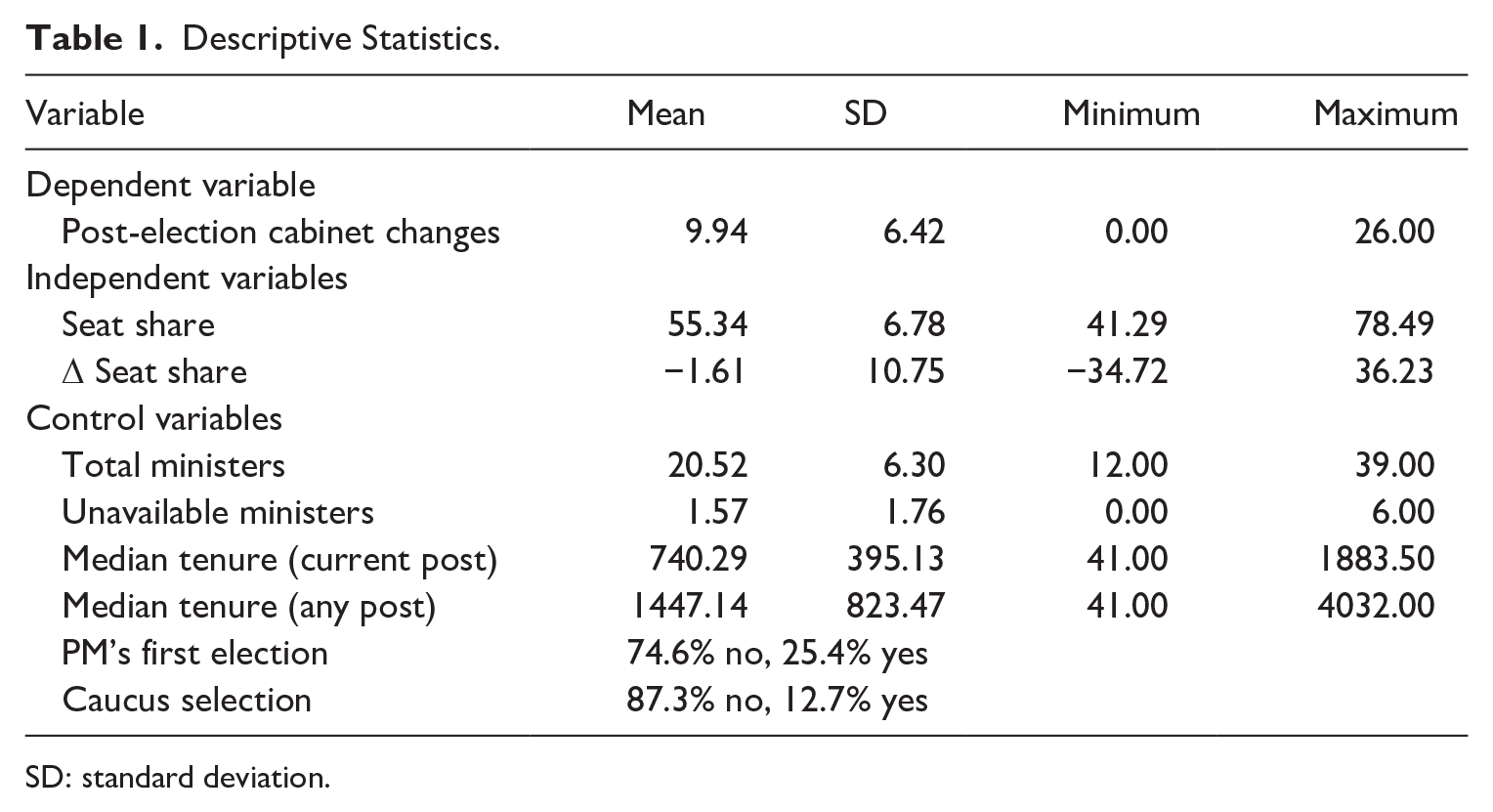
SD: standard deviation.
Model Choice
My unit of analysis is individual cabinets. Each observation represents an instance of an incumbent government being successfully re-elected. The dependent variable is the number of pre-election ministers holding a different position or no position in the post-election cabinet. It is thus a count – it can only take on discrete, non-negative values, including zero. It is also over-dispersed, with a variance larger than its mean. Given this, the following analysis uses a modelling approach appropriate for over-dispersed count variables: negative binomial regression (Hilbe, 2014: 133). 14
Results
The central hypothesis of this article is simple: if post-election reshuffles are the result of electoral success heightening prime ministers’ authority, larger election victories should lead to larger reshuffles. The following analysis tests this by analysing all instances of single-party governments achieving re-election in Australia, Canada, New Zealand and the United Kingdom between 1945 and 2020. In particular, it examines the relationship between the size of incumbent parties’ election victory and the size of any subsequent cabinet reshuffle.
Figure 1 presents the bivariate relationships between my independent variables and dependent variable within each of the four cases. It includes a linear regression line, with 95% confidence intervals. My theory suggests that these lines should generally have a positive slope. This would indicate larger election victories being associated with larger post-election reshuffles. However, the evidence in Figure 1 is mixed and not initially supportive of my expectations. Most of the slopes are either flat or negative. The only clear positive relationship is in the United Kingdom, where the governing party’s seat share (but not changes in their seat share) is associated with larger post-election cabinet reshuffles. However, these bivariate relationships cannot account for the influence of the various control variables described above. I thus turn to multivariate analysis, to explore the relationship between election results and post-election reshuffles when holding other variables constant.
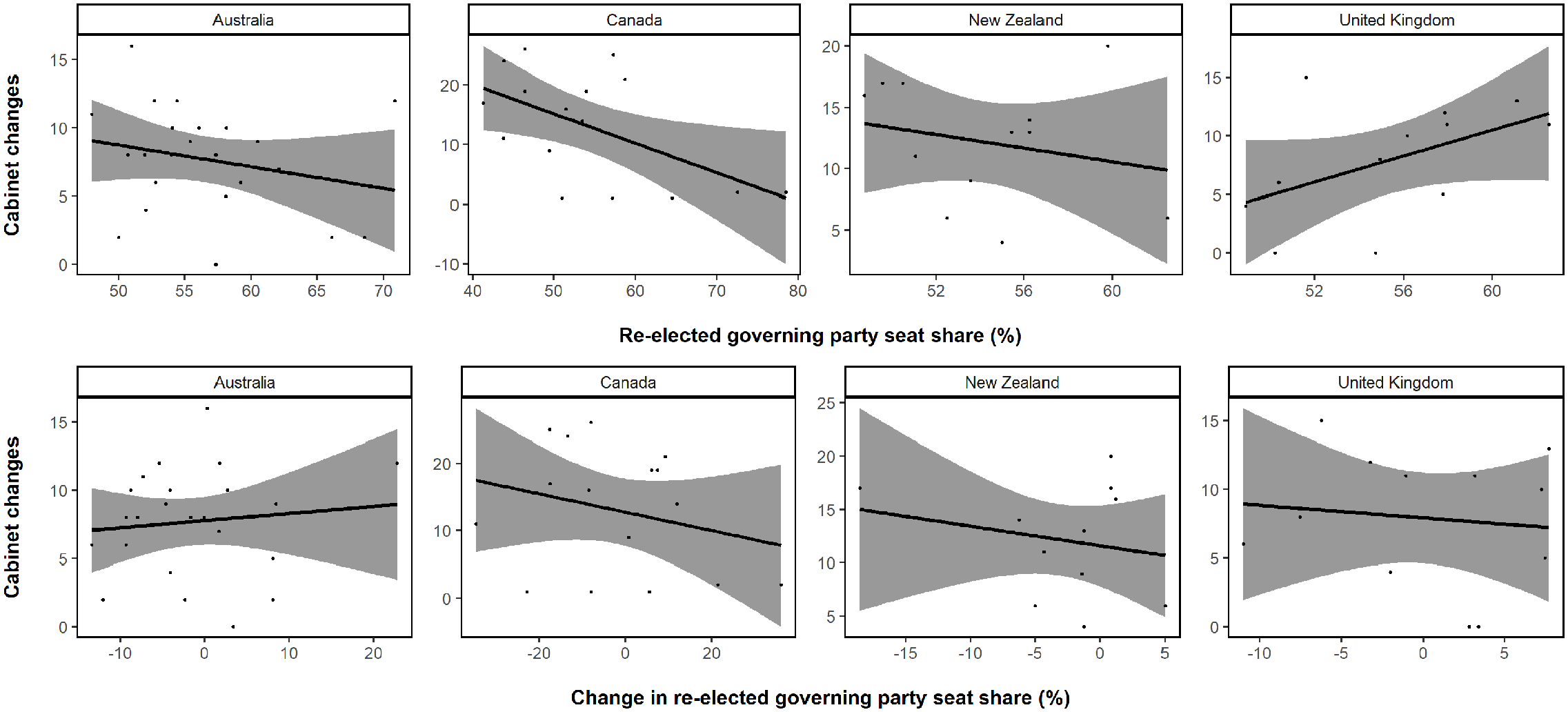
Bivariate Relationship between Size of Election Victories and Size of Post-Election Cabinet Reshuffles.
Table 2 shows the results of a series of negative binomial regressions modelling the size of post-election cabinet reshuffles as a function of the re-elected incumbent party’s seat share. Model 1 includes only the independent variable and a control variable measuring the size of the pre-election cabinet. Model 2 then adds a number of further control variables, as described above. Models 3 and 4 retain these control variables, but add, respectively, country or party fixed effects.
Negative Binomial Regression of Post-Election Cabinet Changes.
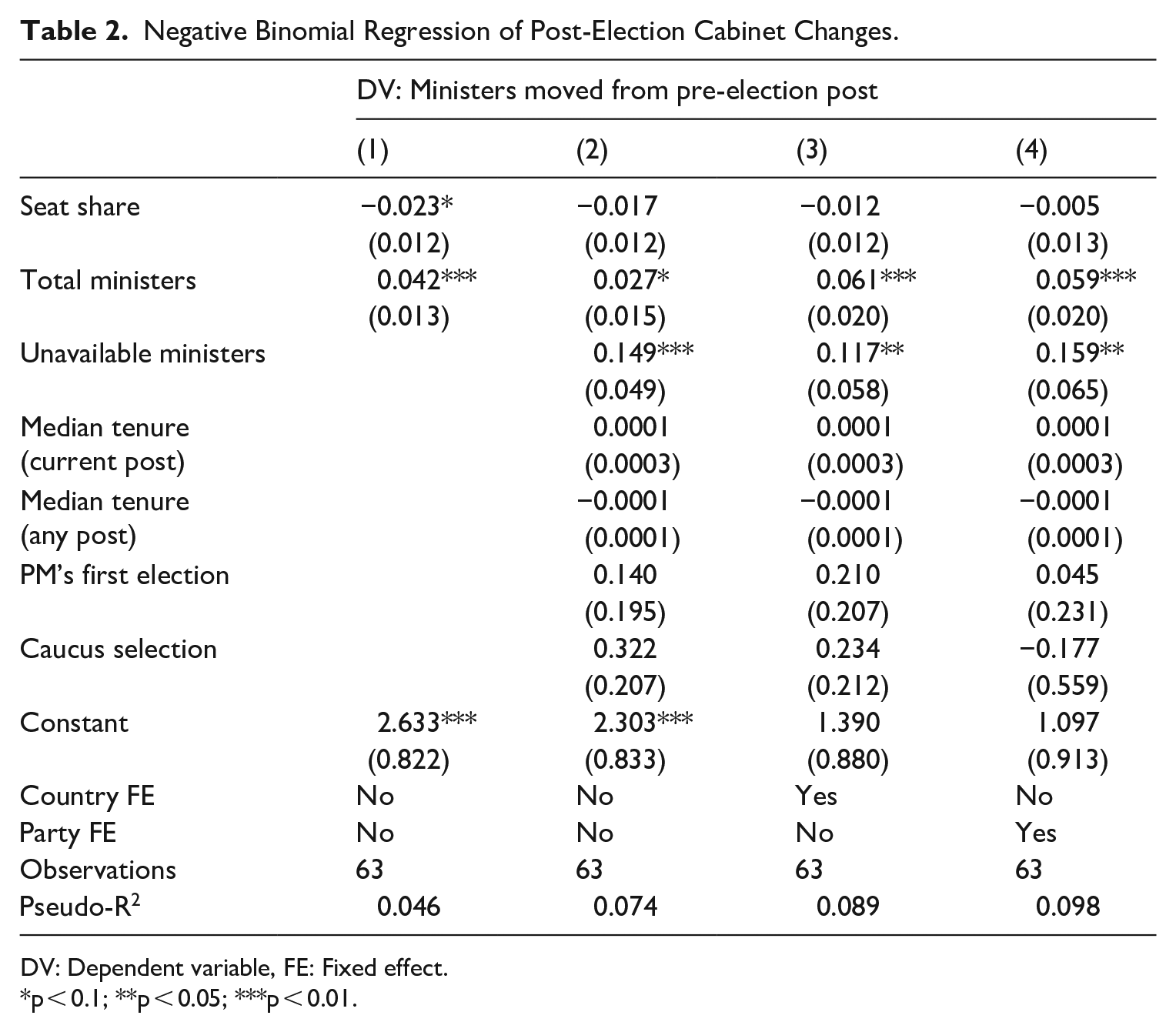
DV: Dependent variable, FE: Fixed effect.
p < 0.1; **p < 0.05; ***p < 0.01.
As with the bivariate patterns, these multivariate results do not support my expectations. My hypothesis suggested a positive relationship between re-elected parties’ seat share and the size of any post-election cabinet reshuffle. Table 2 shows no evidence of this. Instead, the seat share variable has a consistently negative coefficient. More importantly, the coefficient is statistically insignificant in all of the models which control for various features of the pre-election cabinet and wider political context. Rather than a positive relationship between prime ministers’ electoral success and the extent of their post-election cabinet reshuffles, this analysis suggests there is no consistent relationship.
Table 3 repeats the same models, but with an alternative independent variable: the change in the incumbent party’s seat share relative to the last general election, rather than the overall level. This captures the possibility that prime ministers gain authority over their cabinet by improving the party’s electoral position relative to the last election, rather than election victories in general. As before, the first model only controls for the size of the pre-election cabinet, before subsequent models add further controls and country/party fixed effects.
Negative Binomial Regression of Post-Election Cabinet Changes.
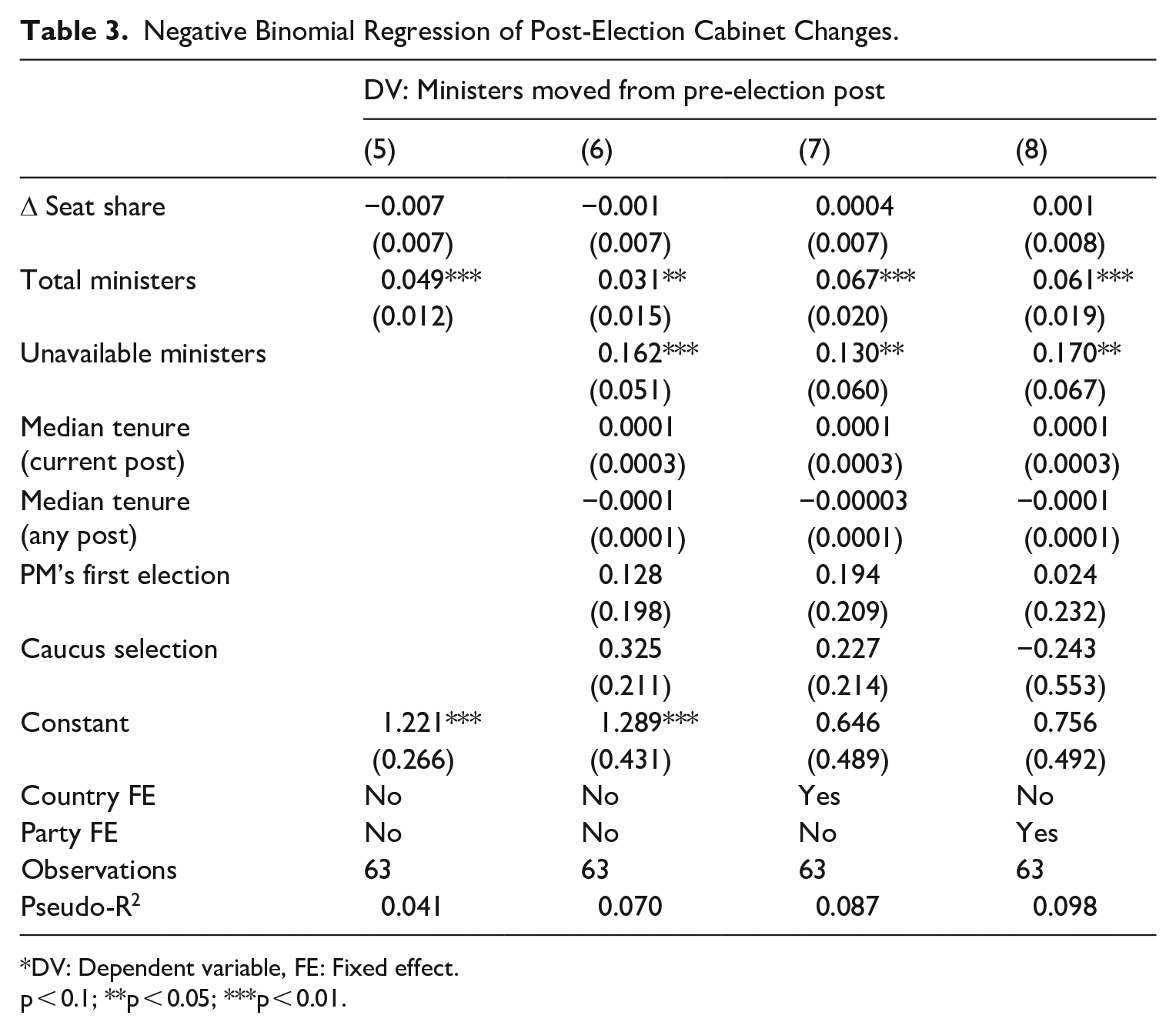
DV: Dependent variable, FE: Fixed effect.
p < 0.1; **p < 0.05; ***p < 0.01.
The results presented in Table 3 echo those from Table 2: they show no support for my hypothesis. As before, the models show a statistically insignificant relationship between parties’ electoral performance and the size of post-election cabinet reshuffles. The coefficients for the independent variable are substantively very close to zero and statistically indistinguishable from it. Again, this provides no evidence of the expected positive relationship. 15
Repeating these analyses with various alternative model specifications yields equally little support for my theoretical expectations. First, I have repeated them with an alternative broader calculation of the dependent variable which includes the number of ministers joining the cabinet, as well as those leaving it and moving within it. Second, I have used an alternative independent variable: incumbent parties’ (change in) vote share rather than seat share. Third, I have used an alternative operationalisation of my first independent variable – parties’ seat share – logging it to account for the possibility that the effect of election victories on cabinet reshuffles takes place at a declining rate. 16 Fourth, I have repeated the models without cases where cabinet ministers are elected by MPs, with prime ministers simply allocating portfolios among them. 17 None of these alternative specifications show consistently statistically significant coefficients for my independent variables. They thus offer no further support for my theory. The full results of all of these models are presented in Online Appendix B.
I find equally little support from an additional analysis which focuses on an alternative indicator of how far prime ministers use post-election reshuffles to manage powerful rivals (presented fully in Online Appendix C). My main analysis focused only on members of the cabinet, rather than more junior ministers, on the basis that they pose the greatest threat to the prime minister’s position. As an extension of the same logic, I have probed whether election results influence the probability of the prime minister moving either their finance minister or foreign minister, which are generally regarded as the most important portfolios after the premiership itself (Druckman and Warwick, 2005). However, I find no evidence that the holders of these portfolios are more vulnerable after larger election victories.
A final additional analysis, presented in Online Appendix D, probes whether my unsupportive findings are driven by the inclusion of prime ministers who retired soon after winning re-election. I have argued here that all prime ministers have an incentive to pre-empt future threats to their leadership. However, it is possible that prime ministers may disregard these problems if they expect to leave office voluntarily in the near future. If this were the case, it could negatively bias my estimates of the relationship between electoral success and the extent of cabinet changes. Online Appendix D thus repeats my main analyses, but excluding cases where the prime minister resigned voluntarily (i.e. unprompted by health or party management issues) during the subsequent parliamentary term. 18 As before, these alternative specifications show no clear support for my expectations.
However, these unsupportive results are not sufficient evidence to conclude that the size of election victories is not positively related to the extent of post-election cabinet reshuffles. Doing so requires us to distinguish between two kinds of statistical claim. The statistically insignificant coefficients presented in Tables 2 and 3 are unsupportive of my expectations because their confidence intervals include zero. This means I cannot reject the null hypothesis that there is no relationship between my independent and dependent variables. Importantly, however, this is different from actively ruling out the possibility of a meaningful positive relationship between the two variables. Doing so requires us to establish not only that the relevant confidence intervals include zero but that they also don’t include large, meaningful, positive relationships (Rainey, 2014: 1084). Following Rainey (2014), I have explored this by calculating 90% confidence intervals for the marginal effects of my independent variables.
Figures 2 and 3 thus show the marginal effects for governing parties’ seat share and the change in their seat share, respectively, from all my main model specifications. 19 Beginning with Figure 2, the largest positive value within any 90% confidence interval is a marginal effect of 0.16, from Model 4. To understand whether this is substantively meaningful, I compare it to the standard deviation of the relevant independent variable – re-elected governing parties’ seat share in parliament. Table 1 shows that the standard deviation is 6.78. This indicates that increasing governing parties’ seat share by one standard deviation would lead to at most just one additional minister being moved in a reshuffle. 20 Given that the average cabinet in the data consisted of between 20 and 21 ministers, this appears to be a very small effect indeed. Turning to Figure 3, the largest positive value that falls within any 90% confidence interval is 0.14, from Model 8. The standard deviation of this independent variable – the change in governing parties’ seat share – is 10.75. This suggests that increasing the change in governing parties’ seat share by one standard deviation would lead to at most somewhere between one and two ministers being moved. 21 This exercise shows that even the largest positive effects compatible with this data are substantively negligible. Taken together, therefore, these analyses do not just show a lack of evidence supporting my hypothesis; they also provide evidence against it. They show that it is very unlikely that there is a meaningful positive relationship between the size of election victories and the extent of post-election cabinet reshuffles in these cases.
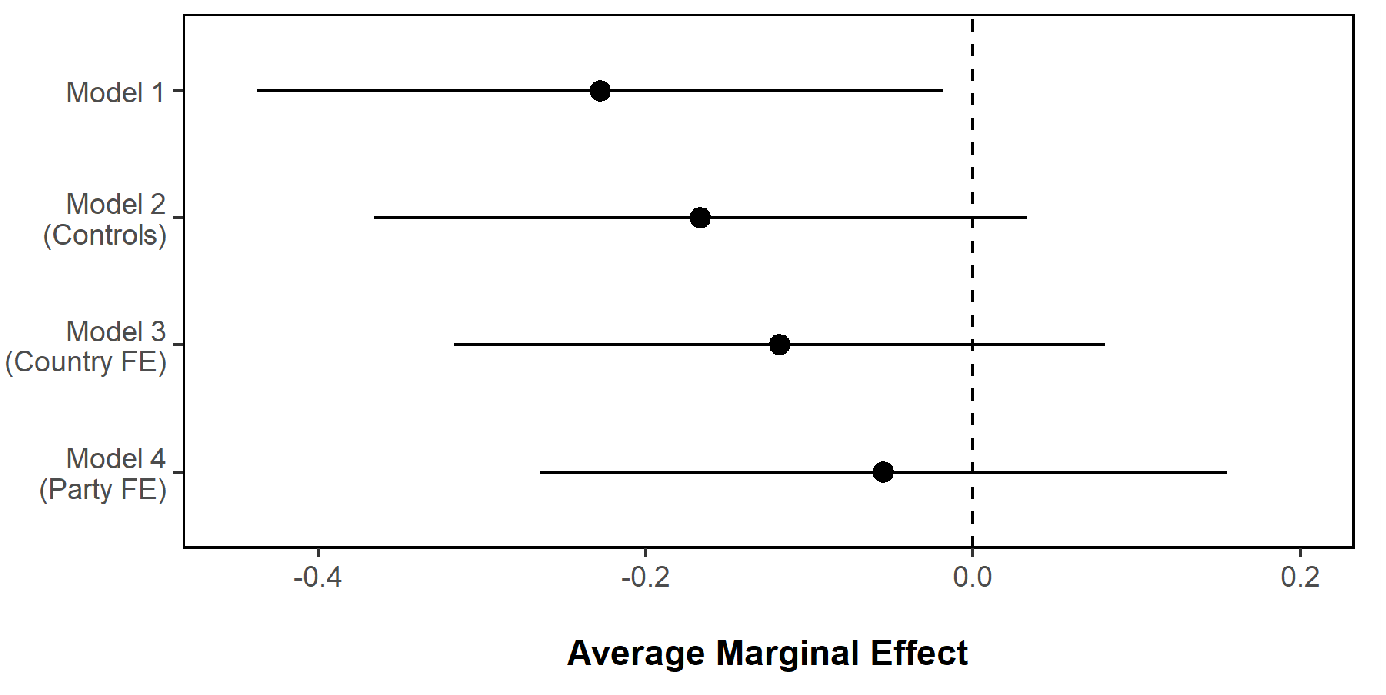
Marginal Effect of Government Seat Share on the Size of Post-Election Reshuffles.
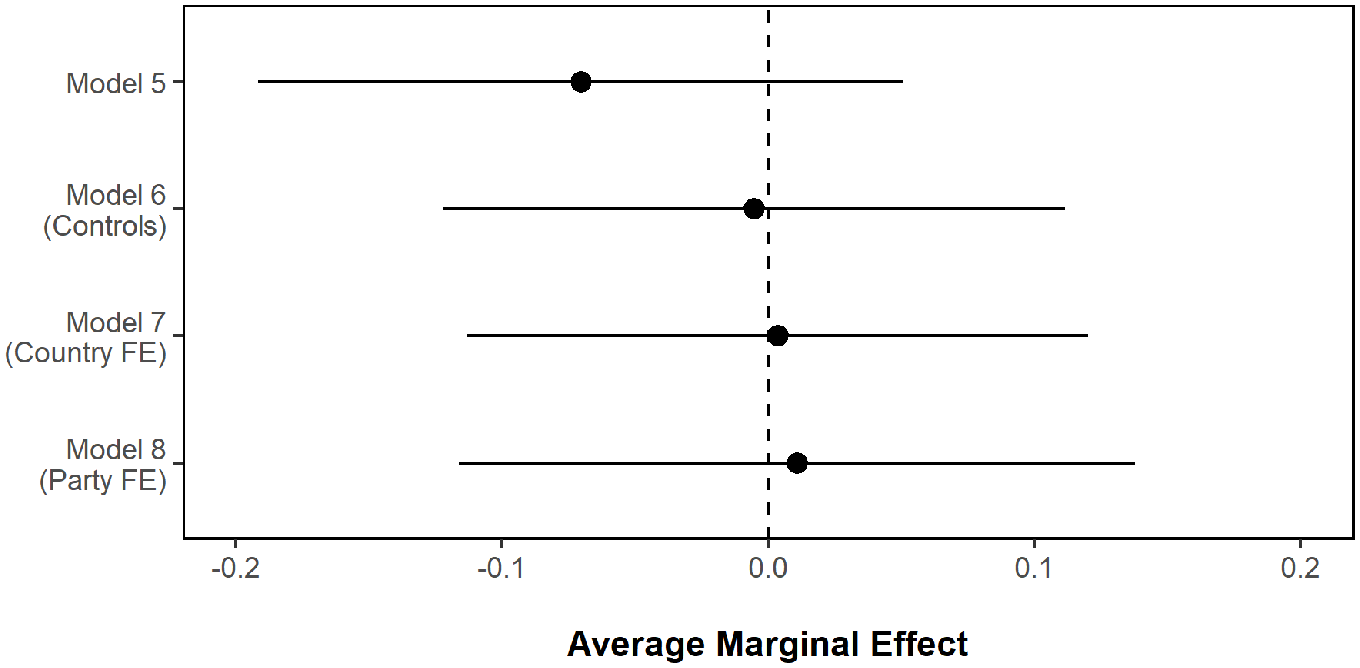
Marginal Effect of Δ Government Seat Share on the Size of Post-Election Reshuffles.
If the size of post-election cabinet reshuffles is not linked to the scale of the government’s election victory, what factors may drive it? One variable clearly stands out from the above analyses (including the alternative specifications thereof). There is a consistently positive and statistically significant relationship between the size of post-election cabinet reshuffles and the number of ministers who are no longer eligible to sit in cabinet because they have left parliament. This suggests that post-election reshuffles in these cases are at least partly driven by prime ministers’ need to replace those cabinet ministers who have retired from parliament or who have lost their seats. This contrasts with the theoretical explanation elaborated in this article, and suggests that post-election cabinet reshuffles may be an administrative necessity forced on prime ministers, rather than a political strategy deliberately wielded by them. It may be rare for cabinet ministers to lose their seat in parliament in an election that their party wins overall. But retirements are far from rare. Indeed, elections may offer a natural break point for ministers who are considering retirement from politics, allowing them to leave both the government and parliament simultaneously. The retirement and defeat of sitting cabinet ministers thus provide perhaps a partial explanation for post-election cabinet reshuffles. But the main message from these analyses remains clear: they show no support for the theory outlined and tested in this article.
Conclusion
When incumbent prime ministers achieve re-election, they often reshuffle their cabinet. Such post-election cabinet reshuffles are frequent events and have important empirical and normative implications. Despite this, they are under-studied in political science. Existing studies of cabinet reshuffles largely either exclude those which take place immediately after elections (e.g. Kam and Indriðason, 2005) or include them without considering how they might differ from midterm reshuffles (e.g. Huber and Martínez-Gallardo, 2008). A small number of studies do draw on a wider conventional wisdom that post-election cabinet reshuffles are a result of electoral success enhancing prime ministers’ authority over their colleagues (Alderman and Cross, 1987; Allen and Ward, 2009). However, such arguments have not yet been theoretically developed or empirically tested.
The contribution of this article has therefore been to articulate and test a theory of post-election cabinet reshuffles by single-party governments in parliamentary democracies. Building on existing studies of reshuffles, and conventional wisdom regarding post-election reshuffles in particular, I argued that election victories increase prime ministers’ capacity to sack or move their cabinet ministers. This is because electoral success reduces the likely support for leadership challenges from sacked or demoted ministers. The period shortly after winning re-election thus represents a window of opportunity in which prime ministers face lower costs for reshuffling their cabinet. They should exploit this opportunity in order to pre-emptively weaken rivals who may challenge their authority later in the government’s term.
My theory suggested a positive relationship between the size of incumbent parties’ election victory and the extent of any post-election cabinet reshuffle, due to larger victories conferring greater authority on prime ministers. However, this expectation was not supported by my analysis of post-election cabinet reshuffles in four ‘Westminster’ democracies since 1945. The extent of post-election cabinet reshuffles was not consistently related either to governing parties’ seat share or to the change in their seat share. Instead, the relevant coefficients were substantively close to, and statistically indistinguishable from, zero.
This null finding suggests that post-election cabinet reshuffles are not primarily driven by prime ministers using their temporarily enhanced authority to sideline cabinet rivals. This contrasts with the theoretical argument developed in this article. It thus also contrasts with the conventional wisdom on which that argument was based. Of course, these results do not mean that electoral success never influences prime ministers’ capacity to reshuffle their cabinet. But I have found no evidence of any general pattern linking election results to the size of post-election reshuffles in these cases. My theory thus appears to not provide a compelling generalisable explanation for why post-election reshuffles take place.
Nonetheless, the theory and evidence presented here make a valuable contribution to the study of executive politics. Most importantly, they represent the first study of post-election cabinet reshuffles, which has remained an important but neglected topic despite the growth of literature studying reshuffles more generally. As a consequence, this article provides a starting point for further empirical and theoretical development in future work. Empirically, scholars might develop alternative strategies for measuring the impact of elections on leaders’ authority and for capturing the motivations underlying any subsequent cabinet changes. They might also seek to test these arguments in a wider range of cases. These empirical efforts could go hand-in-hand with greater exploration of the theoretical arguments advanced here. In particular, scholars may wish to consider other factors which could complicate or offset the impact of electoral success on prime ministers’ cabinet-making decisions. Overall, therefore, future work should focus on uncovering the wider range of factors which might shape post-election reshuffles, assessing their relative importance and probing whether this assessment varies across different political contexts. These important goals might be pursued fruitfully by combining quantitative analysis of general patterns with qualitative analysis of specific reshuffles.
Supplemental Material
sj-pdf-1-psx-10.1177_00323217211049293 – Supplemental material for Why Change a Winning Team? Explaining Post-Election Cabinet Reshuffles in Four Westminster Democracies
Supplemental material, sj-pdf-1-psx-10.1177_00323217211049293 for Why Change a Winning Team? Explaining Post-Election Cabinet Reshuffles in Four Westminster Democracies by Thomas G Fleming in Political Studies
Footnotes
Acknowledgements
I would like to thank two anonymous reviewers for their helpful comments on earlier versions of this work.
Declaration of Conflicting Interests
The author(s) declared no potential conflicts of interest with respect to the research, authorship, and/or publication of this article.
Funding
The author(s) received no financial support for the research, authorship, and/or publication of this article.

Supplementary Information
Additional Supplementary Information may be found with the online version of this article.
Appendix A: Data Sources for Cabinet Appointments. Australia Canada New Zealand United Kingdom Appendix B: Results of Alternative Model Specifications. Table B1. Descriptive statistics of additional variables not reported in Table 1. Table B2. Negative binomial regression of post-election cabinet changes. Table B3. Negative binomial regression of post-election cabinet changes. Table B4. Negative binomial regression of post-election cabinet changes. Table B5. Negative binomial regression of post-election cabinet changes. Table B6. Negative binomial regression of post-election cabinet changes. Table B7. Negative binomial regression of post-election cabinet changes. Table B8. Negative binomial regression of post-election cabinet changes. Appendix C: Results of Models Using Alternative Dependent Variable. Table C1: Logistic regression of probability of finance minister being moved after election. Table C2: Logistic regression of probability of foreign minister being moved after election. Appendix D: Results of Models without Retiring (or Still in Post) Prime Ministers. Table D1: Negative binomial regression of post-election cabinet changes. Table D2: Negative binomial regression of post-election cabinet changes. References.
Notes
Author Biography
References
Supplementary Material
Please find the following supplemental material available below.
For Open Access articles published under a Creative Commons License, all supplemental material carries the same license as the article it is associated with.
For non-Open Access articles published, all supplemental material carries a non-exclusive license, and permission requests for re-use of supplemental material or any part of supplemental material shall be sent directly to the copyright owner as specified in the copyright notice associated with the article.
