




Abstract
Opposition to immigration has featured prominently in the “cultural backlash” to globalization in Western nations and was a key determinant of Britain’s Brexit referendum. In this article, we draw on theories of intergroup threat to examine the effect of “right-wing authoritarianism” on immigration attitudes in the UK. Previous research suggests that cultural aspects of immigration are especially important in shaping anti-immigrant attitudes. We use an original survey measuring attitudes toward immigration from differing skill levels and national origins. We find that right-wing authoritarianism is a much stronger predictor of immigration attitudes than other attributes. In addition, the effect of right-wing authoritarianism varies by immigrant origin, most strongly predicting opposition toward immigrant groups that may be perceived as culturally distant. We also find evidence that these effects are driven by the “aggression” component of right-wing authoritarianism, a facet of authoritarianism that captures a predisposition toward the enforcement of group norms.
Introduction
A wave of political upheaval surrounding responses to globalization has struck many Western political systems in recent years. Populist leaders and parties have risen in prominence, with opposition to immigration central to these movements (Shehaj et al., 2019). The Leave vote in the Brexit referendum in the UK has similarly been shown to have been fueled in large part by concerns about immigration (Clery et al., 2017; Langella and Manning, 2016; Meleady et al., 2017). With such far-reaching political implications, understanding the nature and origins of immigration attitudes is increasingly important.
Some research argues that economic conditions are the key to predicting anti-immigrant attitudes (e.g. Kuntz et al., 2017; Rodrik, 2018). However, Hainmueller and Hopkins’ (2014) review of the literature shows that sociotropic concerns, not personal economic circumstances, are most influential, and cultural rather than economic concerns tend to motivate immigration attitudes. Thus, many scholars have focused on identifying the individual attributes that affect sensitivity to intergroup threats, highlighting the importance of “authoritarianism” and “social dominance orientation” (SDO; Duckitt, 2006; Duckitt and Sibley, 2007). In particular, these traits are shown to influence which types of group prejudices are observed (Asbrock et al., 2010; Duckitt, 2006), as well as the types of outgroup threats that are most salient (Asbrock et al., 2012).
Here, we draw on the research on authoritarian values and theories of intergroup threat to examine how these factors are associated with attitudes toward immigration. Cultural threats are central in shaping attitudes toward immigration (McLaren and Johnson, 2007; Sides and Citrin, 2007). Individuals high on the measure of “right-wing authoritarianism” (RWA)—who value group norms, cohesion, and stability (Duckitt, 1989)—emphasize protecting the ingroup from perceived cultural threats (Duckitt, 1989; Feldman, 2003; Feldman and Stenner, 1997). Building on these literatures, we argue that a perceived need to protect the ingroup from potential cultural threats can serve as a key mechanism by which authoritarian predispositions manifest as hostility toward immigration.
To examine this, we focus on the extent to which individuals differentiate between types of immigration, arguing that this provides additional insight into the role that ingroup protection plays in the relationship between RWA and immigration attitudes. We use an original survey of British adults that measures hostility toward immigrants of differing regional and skill-level backgrounds. By more precisely measuring variation in responses to immigrants from these backgrounds, we can better understand the cultural and economic concerns behind authoritarianism’s effects on immigration attitudes.
We highlight several key findings. First, we illustrate that the differentiation made between low-versus-high-skilled immigrants is fundamentally distinct from the differentiation made across geographic origins. While respondents are broadly hostile toward low-skill immigration, those who differentiate the most between immigrants by origin are most strongly against immigration overall. Second, we find that RWA has an especially strong effect compared to other individual-level predictors. In particular, RWA more strongly predicts immigration attitudes than SDO or an explicit measure of prejudice. Most importantly, consistent with our argument that cultural threat plays a key role in the effects of authoritarianism, we find that RWA is the strongest predictor of the degree of importance placed on immigrants’ regional origins.
While RWA is typically used as a single measure, it is made up of three components: aggression, submission, and conventionalism (Duckitt et al., 2010; Funke, 2005). To better understand which aspects of RWA drive the relationships we see earlier, we examined the associations between these three components and attitudes toward immigration. While each of the components has an effect on immigration attitudes in at least some specifications, the most consistent effect comes from the aggression component, which focuses on the individual’s emphasis on enforcement of ingroup norms. Compared with the other components, aggression predicts higher opposition to low-skilled immigration and differentiates more strongly by origin, especially among high-skilled immigrant groups. We interpret this finding as supporting the argument that immigration—and especially immigration from groups often seen as culturally distant—activates authoritarian predispositions to protect the ingroup from perceived threats.
These findings have important implications for our understanding of the origins of the anti-immigrant attitudes associated with support for populist anti-globalization movements.
Authoritarianism and immigration attitudes
An extensive literature has examined the motivation behind immigration attitudes and the threats that motivate hostility to immigration. Studies focused on economic threats have examined income levels, sector of occupation, and sector presence in geographic areas, as determinants of hostility (e.g. Facchini and Mayda, 2009; Hainmueller and Hiscox, 2010; Hainmueller and Hopkins, 2015; Hanson et al., 2001; Sniderman et al., 2004). However, this work finds limited evidence for economic vulnerability as a driving cause, instead suggesting that the cultural effects of immigration are most salient in attitude formation (Hainmueller and Hopkins, 2014).
Another strain of research on variation in immigration attitudes has focused on core traits, values, personality, and ideology. Such individual-level factors may relate to one’s sensitivity to different forms of threat (e.g. Croucher, 2013; Stephan et al., 1998, 1999). Sensitivity to cultural threat is of particular interest, as it may contribute to overall immigration attitudes (Schoon and Anderson, 2017). As authoritarianism has been found to be a strong predictor of immigration attitudes (Cohrs and Stelzl, 2010; Golec de Zavala et al., 2017), an important question remains as to whether these observed associations are driven by sensitivity to cultural threat, with authoritarian values directing particular negativity toward groups perceived as threatening to the social order.
Measurement of authoritarianism originated with Adorno et al. (1950) and was further developed by Altemeyer (1981) with the creation of the RWA scale. Although there is some disagreement about how authoritarianism should be measured, there is consensus about the general characteristics of this trait. Authoritarianism is associated with an inclination toward emphasizing group norms, cohesion, and stability over individual needs and desires (Duckitt, 1989; Feldman, 2003).
As RWA captures a predisposition for upholding norms, and immigration can be perceived as a threat to the national culture (Newman et al., 2012), it follows that RWA would be associated with hostility toward immigration. While RWA has been found to predict intolerance and prejudicial views toward outgroups (e.g. Altemeyer, 1998; Ekehammar et al., 2004; Sibley and Duckitt, 2008), explicit attitudes of outgroup inferiority are distinct from an emphasis on protecting the ingroup from cultural threats. The perceived cultural effects of immigration are therefore likely to be important to this trait, and thus, RWA should be especially associated with negative attitudes toward immigration from groups that may be perceived as culturally distant.
Another trait suggested as a predictor of immigration attitudes, SDO, is designed to capture acceptance of hierarchy and the legitimacy of the dominant group (Henry et al., 2005). It has been used in recent research on the rise of populism, such as by Mutz (2018), as a measure of status threat to explain Donald Trump’s support in the US. Like RWA, SDO also influences prejudicial views (Danso et al., 2007; Sibley and Duckitt, 2008; Thomsen et al., 2008).
Previous work, however, shows that the two measures differ in their relation to prejudice and immigration hostility. Duckitt and Sibley (2010) show, for example, that RWA’s relationship with immigration attitudes is particularly sensitive to differences in cultural values, as well as perceived threats, such as crime or terrorism. In contrast, these authors find that SDO, with its emphasis on group equality, was predictive of concerns about immigrants with lower economic status. Thomsen et al. (2008) show that RWA predicts hostility toward immigrants who do not assimilate into the majority culture. SDO, they find, predicts hostility toward immigrants who do assimilate, as this blurs group boundaries.
In the next section, we describe the survey we use to examine the impact of RWA and other individual characteristics on attitudes toward immigration types differentiated by cultural and economic characteristics.
Research design
Measuring anti-immigrant attitudes
To better understand the relationships between immigration attitudes and individual traits, we surveyed a sample of 1102 British respondents. 1 We sought to balance both party affiliation and support for the Brexit referendum: 29% of our sample affiliated with the Conservative party, 33% with Labor, 20% did not declare any affiliation, and the remaining respondents were distributed among other parties. Of those in our sample who voted in the EU referendum, approximately 50% voted Remain and 50% Leave. The sample is 55% female and 45% male, with 46% having a university education or higher.
To measure economic and cultural immigration concerns, we asked our respondents to indicate their desire to change levels of immigration from groups that vary in skill level and geographic origin. By probing our respondents on a range of immigration types, we can better isolate the importance of economic and cultural factors to preferences for changes to immigration levels. We created a grid of choices based on skill level and regional origin, and our analysis below is based on the responses to the high-skilled and low-skilled grids. Existing research has assessed and contrasted attitudes toward immigrants based on these skill levels, as they may differ due to, for instance, potential labor competition, concerns such as burdening public services, or beliefs about the economic benefits of immigrants with needed expertise (e.g. Facchini and Mayda, 2009; Hainmueller and Hiscox, 2010).
Within each skill level grid, the participants stated whether they preferred more, less, or the current number of immigrants from several geographic origins across which individuals are likely to have different attitudes. The survey captures a range of possible perceptions through categories for “Western European,” “Muslim,” “Commonwealth,” “Eastern European,” “East Asian,” and “Sub-Saharan African” countries. Previous research suggests that Western Europe is likely to be seen as among the least culturally distant origins for immigration (Dustmann and Preston, 2007), while perceived cultural distance is likely greater for immigrants from Muslim countries (Richardson, 2004). In a recent analysis, Ford (2011: 1033) shows that attitudes toward immigrants in the UK are consistently more favorable when countries of origin are associated with White immigrants and have “stronger economic, cultural and political links to Britain.” Our categories overlap in this regard—with The Commonwealth, for instance, encompassing multiple categories—but overall grant us variation in perceptions of cultural and ethnic differences for immigrant groups. In addition, individual immigrant groups may differ in their perceived threat. Hellwig and Sinno (2017) find, for instance, that Muslim immigrants, to the UK, are seen to pose greater security and cultural threats, whereas respondents associated Eastern European immigrants more with crime and adverse economic impacts.
To generate a measure of the respondents’ overall attitudes toward immigration, we also asked them to place themselves on a scale from “fully in favor of a restrictive policy on immigration” to “fully opposed to a restrictive policy on immigration.”
Figure 1 describes the respondent sample in terms of their preference to increase, decrease, or maintain the current number of high- and low-skilled immigrants from different regions. For the high-skill category, few respondents want to decrease immigration levels from any group, and substantial numbers prefer to increase immigration. The pattern is reversed for low-skilled immigrants, with a very large amount wanting to decrease immigration levels and very few wanting an increase. In both skill-level categories, a large proportion prefers to maintain the current levels.
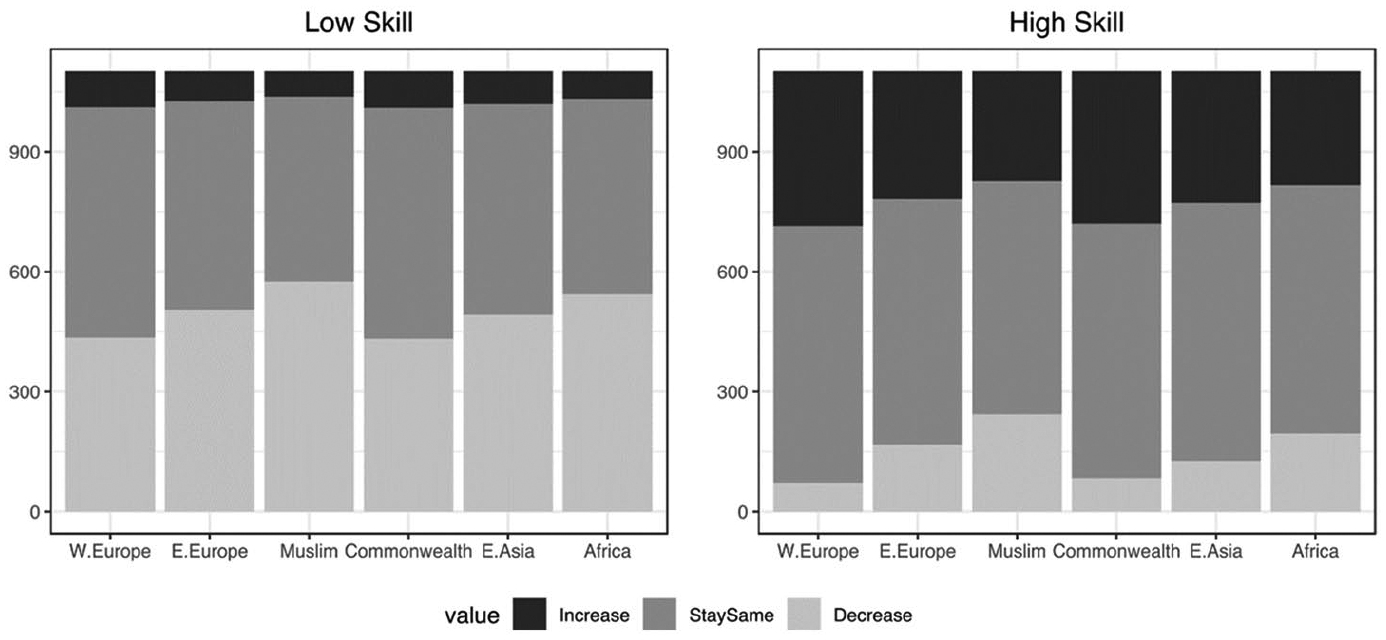
Attitudes Toward Immigrants of Different Skill Levels and Different Origins.
There is also a clear pattern regarding immigrants of different origins, with some groups consistently favored relative to others. Western European and Commonwealth immigrants are most favored on average, while Muslim and African immigrants are least favored. However, this variation is smaller than the difference between skill levels. The overall pattern of general hostility toward low-skill immigration is greater than the variation among different origins. However, our purpose is to hold this constant and look within skill levels to determine if differentiation across origins (and the cultural concerns they represent) results from systematic differences in the traits we examine.
To illustrate the relative impacts of skill and origin differentiation, we calculated measures for the amount of distinction each respondent made between the overall most and least preferred groups of each category. To create the measure of skill differentiation, we took the difference between the high-skill and low-skill means across all origins. To calculate the origin differentiation measure, we took the difference between the Western European and Muslim means across skill levels. 2
Figure 2 shows the overall measure of immigration attitudes, using the general question on attitudes toward restricting immigration, regressed separately on skill differentiation and cultural differentiation. This figure shows that an individual’s tendency to discriminate on immigrants’ cultural origins correlates positively with overall negative immigration attitudes. The tendency to discriminate against immigrants of lower skill levels has a much weaker correlation with overall preferences for reduced immigration. On the immigration opposition scale, the difference between exhibiting minimum and maximum skill-level distinctions is predicted to increase from .57 to .72, compared to a difference of .56 to 1.02 between the minimum and maximum origin distinctions.
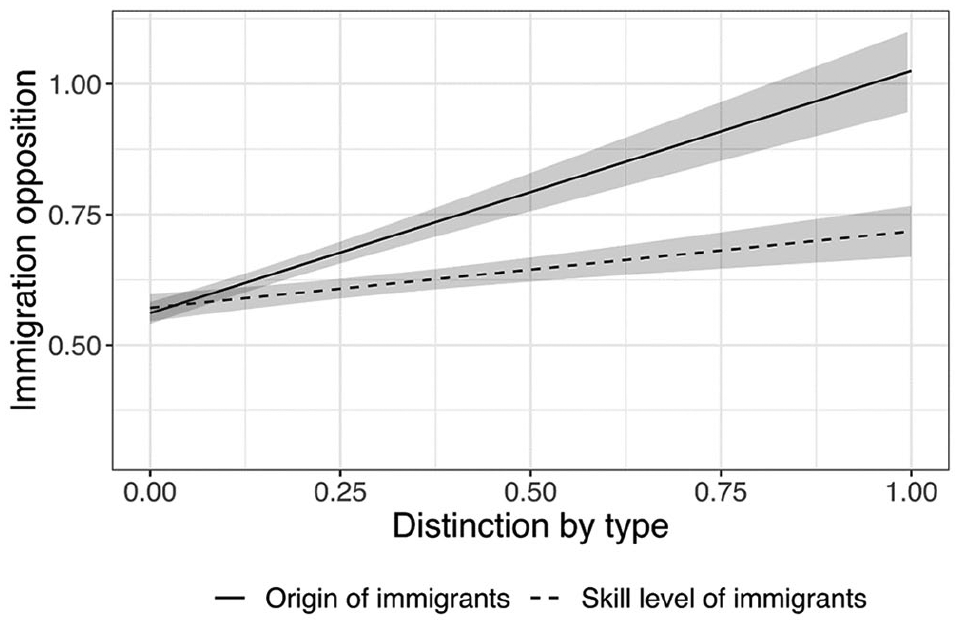
Opposition to Immigration by Skill and Origin Differentiation.
Measuring RWA and other predictors of immigration attitudes
In the following sections, we investigate how RWA and other factors correlate with opposition to immigration, focusing on the importance the respondents place on differences in skill level and geographic origin. To measure RWA, we used a slightly modified version of a 12-item RWA scale (Funke, 2005). We took the mean of all responses and then computed a min–max transformation (which we computed for all non-dummy independent variables; mean = 0.46, SD = 0.17, alpha = 0.84).
To distinguish the effects of RWA from SDO, we used the 8-item SDO-D scale as well. Here, we also took the mean of responses (mean = 0.37, SD = 0.21, alpha = 0.88). Although these represent different theoretical constructs, we find that RWA and SDO are correlated here at r = 0.55. See the online Supplemental appendix for a full correlation matrix of our dispositional measures.
As immigration attitudes have been linked to prejudicial attitudes, we included a measure of explicit prejudice. This allows us to determine whether RWA and SDO may be mediated by prejudice or have effects independent of prejudicial beliefs. Furthermore, it is important to understand the relative impact of prejudice compared to these other traits. We created a scale made up of the mean of three items used by the European Social Survey to capture explicit prejudicial beliefs (mean = 0.33, SD = 0.25, alpha = 0.76). The items included are the following: “Some races or ethnic groups are born less intelligent than others,” “Some races or ethnic groups are born harder working than others,” and “Some cultures are much better than others.”
To distinguish the effects of RWA and SDO from general ideological profiles, we included a measure of the self-placement of respondents on a “left-right” scale. While RWA and SDO can correlate with this scale (see, for example, Mirisola et al., 2007), the effects of authoritarian traits on immigration attitudes are more central and fundamental than those originating from a left–right division.
We included the following four controls for respondent demographics: age, gender, income, and university-level education (binary). These controls are commonly accounted for in the literature on immigration attitudes, with older, male, lower-income, and less educated respondents’ typically more opposed to immigration. Each of these also captures elements of respondents’ potential economic vulnerability to immigration.
Empirical analyses
We first regress overall attitudes toward restricting immigration on our predictor variables, as well as demographic control variables. Figure 3 displays predicted values for RWA, SDO, and left-right self-placement. The measure of explicit prejudice was excluded from the figure for clarity and because its coefficient was insignificant. RWA is by far the strongest predictor of support for a restrictive immigration policy.
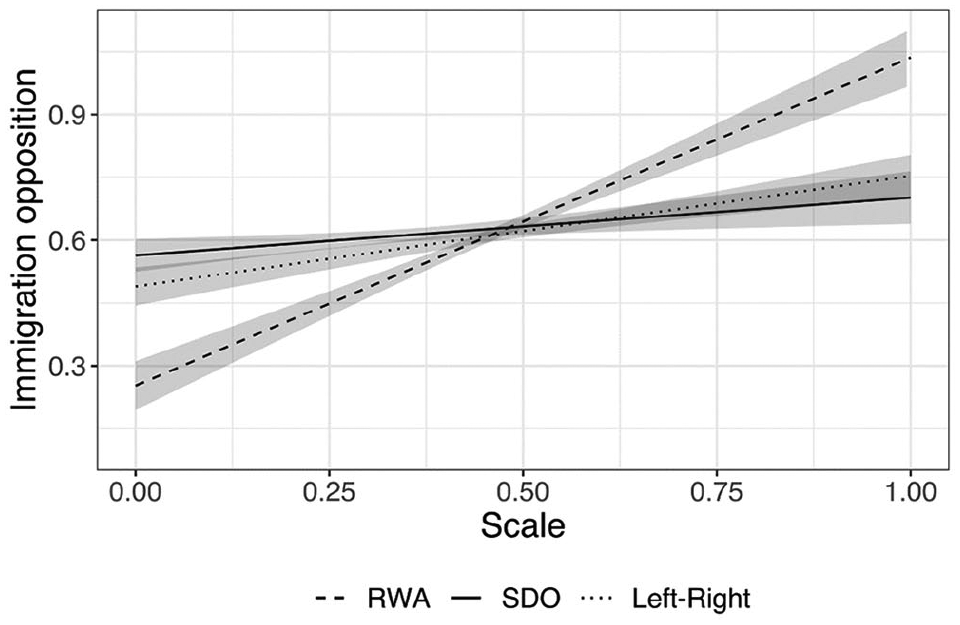
Predicted Levels of Opposition to Immigration by RWA, SDO, and Left-Right.
For our main analysis, we aim to understand more clearly the relationships between these predictors and the specific characteristics of immigrants, and thus disaggregate immigration attitudes into attitudes toward specific types of immigrant groups. Specifically, we disaggregate responses by skill and origin types.
To examine what factors are most important in determining immigration attitudes related to different skill levels and origin regions, we ran individual ordinal logistic regressions for each skill-origin combination. Figure 4 (top panel) displays the results for immigrants with low-skill levels, while Figure 4 (bottom panel) displays the results for immigrants with high-skill levels.
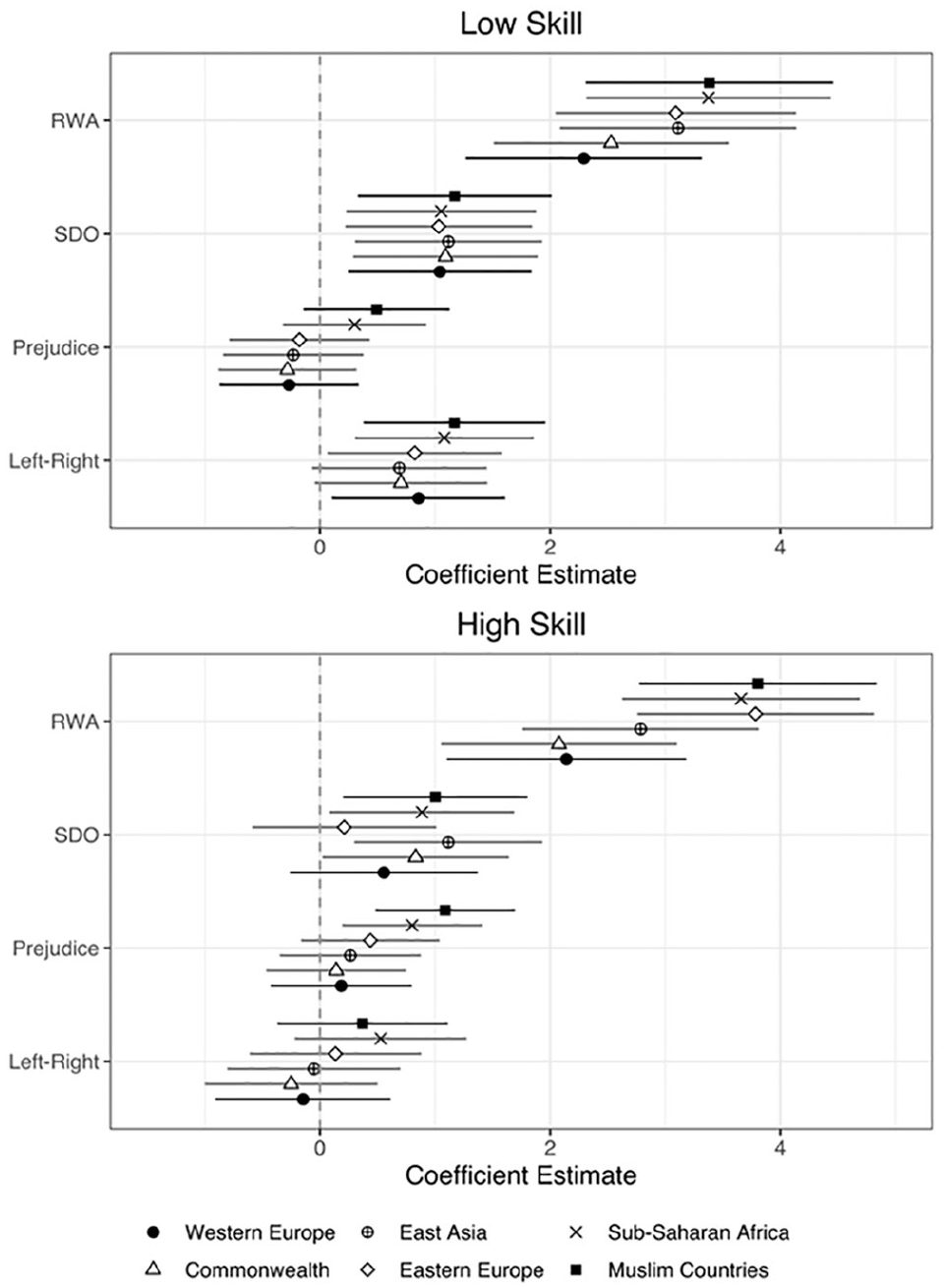
Ordered Logit Models for Low-Skill (Top) and High-Skill (Bottom) Immigrants.
Demographic variables are excluded from the coefficient plots, but are included in all models and described in the tables within the online Supplemental appendix. With the exception of age, which correlates with opposition to immigration, no demographic variables are statistically significant (at the p < 0.05 level) in models including RWA. Of all variables, RWA has the largest substantive effect.
Focusing specifically on the ideological and dispositional variables, we see important differences between the two skill-level conditions. The effect of prejudice is stronger in the high-skill condition, while right ideology has a greater effect in the low-skill condition. In both conditions, the range of effect sizes for RWA varies widely across immigration origin types. While a distinction across origins is present in both low- and high-skill cases, the difference is much larger within the high-skill category. Within that category, we see that RWA has the weakest effect for Western European and Commonwealth immigrants, while the effect is strongest for Eastern European, Sub-Saharan African, and Muslim immigrants, with East Asian immigrants in between. This implies that higher levels of RWA increase the hostility toward Eastern European, Sub-Saharan African, and Muslim immigrants much more than hostility toward those from Western European and Commonwealth countries.
It is noteworthy that these differences exist when controlling for an explicit measure of prejudice and that the differing effects of RWA do not appear to be based only on ethnic distinctions. The coefficient for Eastern European immigrants is comparable to that of sub-Saharan African and Muslim immigrants, especially in the high-skill condition. The effect for Commonwealth origin also tends to be comparable to Western Europe, though the prompt made clear that this label encompasses countries with predominantly non-European populations, using both Australia and India as examples. We interpret this result as consistent with our expectation that RWA’s effect on immigration attitudes depends on perceived cultural connections, which may include those between the United Kingdom and Commonwealth nations.
We also examined several alternate models (see the online Supplemental appendix for tables of all models, including alternate ones). In the analysis earlier, we have omitted party dummies from our models since party identification is likely to be endogenous to RWA and the other ideological and trait variables. If we include party dummies in the models earlier, we find statistically significant relationships (at the p < 0.05 level) for party support only in the high-skill condition and only for UKIP and Conservative supporters. Moreover, all the models without party dummies have better fit in the low-skill condition according to the Akaike Information Criterion (AIC). In the high-skill condition, most models have a better fit with party dummies included, but the differences are not substantial. Overall, the effects of party identification cannot be easily distinguished from the values behind these affiliations, and so those results should be read with caution. Nevertheless, the separate effects of party affiliation are sufficiently small such that including party dummies in our models does not impact the strong effects found for RWA.
As the ideological and trait variables (SDO, RWA, prejudice, and left-right) are partly interrelated, we also investigated whether these are more consequential in the absence of the others. Therefore, we examine models with the demographic variables and each ideological or trait variable separately. In all cases, these variables are statistically significant and their effect sizes are larger than in the main models. In addition, the other variables also exhibit some degree of the ordering for origin-based effects seen above for RWA, with larger differences in the high-skill condition. However, with this approach, RWA still demonstrates the strongest effect overall and the greatest differentiation based on origin. These findings suggest that some of the apparent effects of SDO, prejudice, and left-right self-placement derive from variance shared with authoritarian traits within RWA. In addition, when SDO is included without other ideological and trait variables, there are only modest and inconsistent differences between the two skill-level conditions. Thus, we do not find support for the contention that SDO has a particularly strong impact on attitudes toward low-skilled immigration.
As there are three ordinal choices for each type of immigration—increase, decrease, stay the same—we can distinguish more precisely the predicted effects for each level. Figure 5 focuses on the two most distinct types of immigrant groups in the results earlier, immigrants from Western Europe and immigrants from Muslim countries, and compares the effects of RWA in both the high-skilled and low-skilled conditions for each.
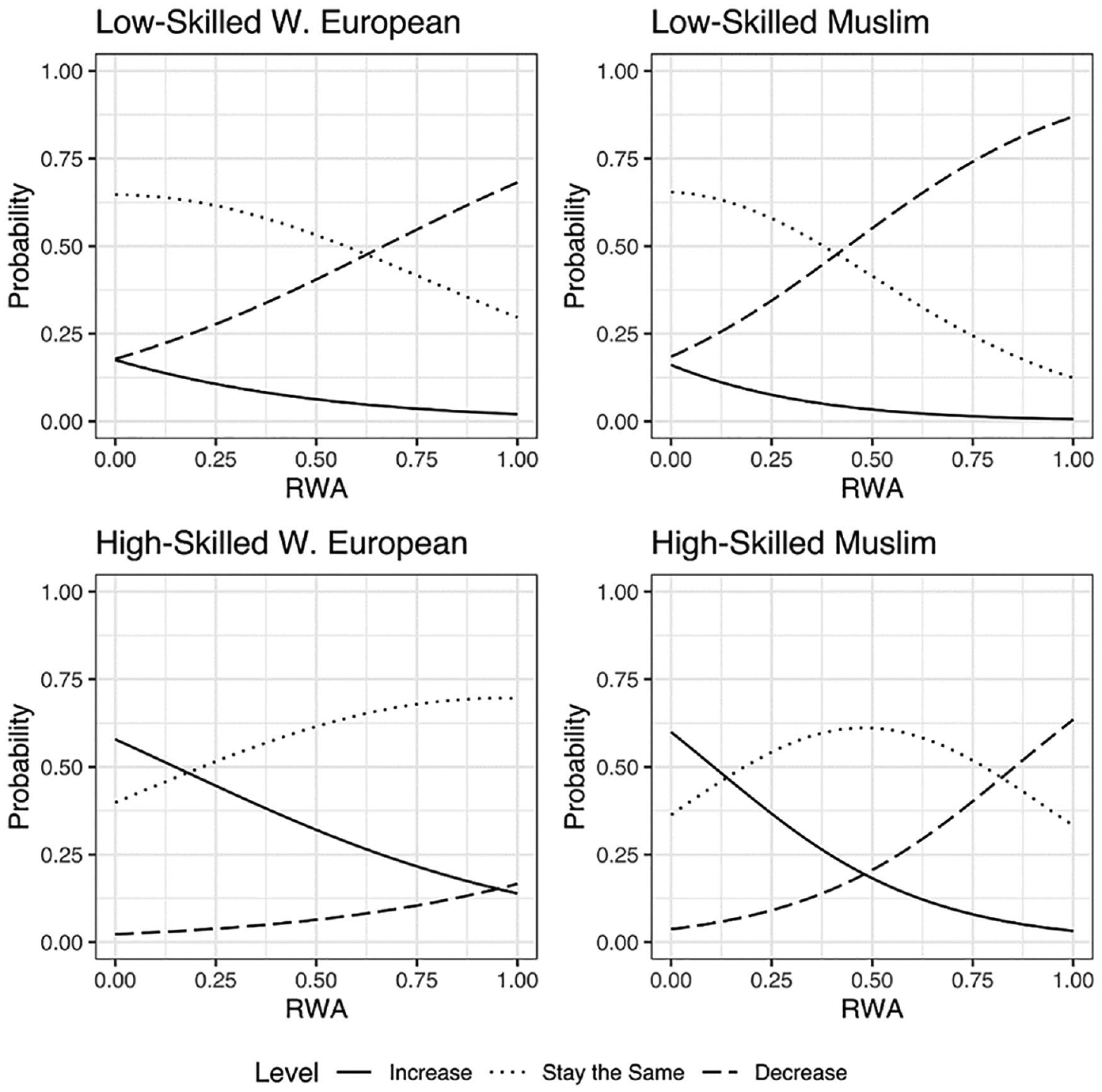
Detailed Predicted Probabilities for Desired Change to Immigration levels for Four Immigrant Groups.
Looking at the two low-skill populations, we see that the Western Europe and Muslim Country patterns are similar. Even among those low in RWA, few wish to increase low-skilled immigration, and most wish to keep levels the same. However, as the level of RWA increases, “stay the same” responses decrease in probability, while “decrease” responses become more likely. The difference between “stay the same” and “decrease” is larger when the immigrant population comes from Muslim countries. At the highest level of RWA, the probability of wanting to decrease low-skill Muslim immigration is around 87%, while it is around 68% for Western European low-skilled immigrants. These two plots corroborate the earlier results. Even low-RWA individuals are strongly opposed to low-skilled immigration, and as a result, the room for differentiation between origin is smaller for high-RWA individuals. That said, we do see that high levels of RWA greatly increase the likelihood one will wish to decrease the level of low-skilled immigrants, regardless of origin. Although respondents overall have negative attitudes toward low-skill immigration, RWA increases that opposition.
While the two low-skilled cases show a very similar pattern, the two high-skill cases diverge substantially. For high-skilled Western European immigrants, even at a very high level of RWA, few wish to decrease immigration. Increasing RWA is associated with a lower probability of support for increasing immigration and a greater probability of supporting “stay the same.” If the high-skilled immigrants come from Muslim countries, the pattern is very different. As RWA increases past its midpoint, both “stay the same” and “increase” responses become less and less likely, while “decrease” becomes most likely. At the highest RWA level, there is almost a 64% probability that a respondent would prefer to decrease high-skilled immigration if it originates from a Muslim country. In contrast, there is only about a 17% probability of preferring to decrease immigration from Western Europe. Thus, while high levels of RWA predict an overall hostility toward immigration, it is at high-skill levels that we observe the strongest effects of origin.
Analyzing the impact of dimensions of RWA
The above sections have demonstrated the importance of RWA for immigration attitudes. The RWA measure, however, encompasses several different components. Although the scale was originally designed to be unidimensional, with the items capturing multiple components, the measure can be disaggregated to understand better which aspects of authoritarianism are behind phenomena of interest (Funke, 2005)—in this case, the relationship between RWA and immigration attitudes.
Here, we examine the RWA scale’s three components: “aggression,” “conventionalism,” and “submission.” The aggression dimension taps into aggressive and punitive attitudes toward rule-breakers, deviants, and outgroups. It focuses on whether the individual believes that society needs tougher government and stricter laws. Conventionalism instead taps into traditional values and gauges beliefs about whether people should adhere to societal norms, for example, focusing on sex, marriage, and drugs. The submission dimension focuses on beliefs about whether individuals should submit to legitimate authorities and the importance of children learning obedience (Altemeyer, 1996; see also Funke, 2005). These three dimensions are associated with distinct sensitivities and responses to cultural threats (Duckitt et al., 2010).
We computed scales using the items for RWA’s three components, following Funke (2005). 3 Below, in Figure 6, we replicate the models in Figure 4, substituting the individual components for the full RWA scale. Although the components are only moderately correlated (aggression and conventionalism: r = 0.49, aggression and submission: r = 0.61, conventionalism and submission: r = 0.66), each component is included separately to capture both their individual characteristics and any variance shared between these components. We also provide a model including all components simultaneously in the online Supplemental appendix, along with a discussion of the differences between the two sets of findings.
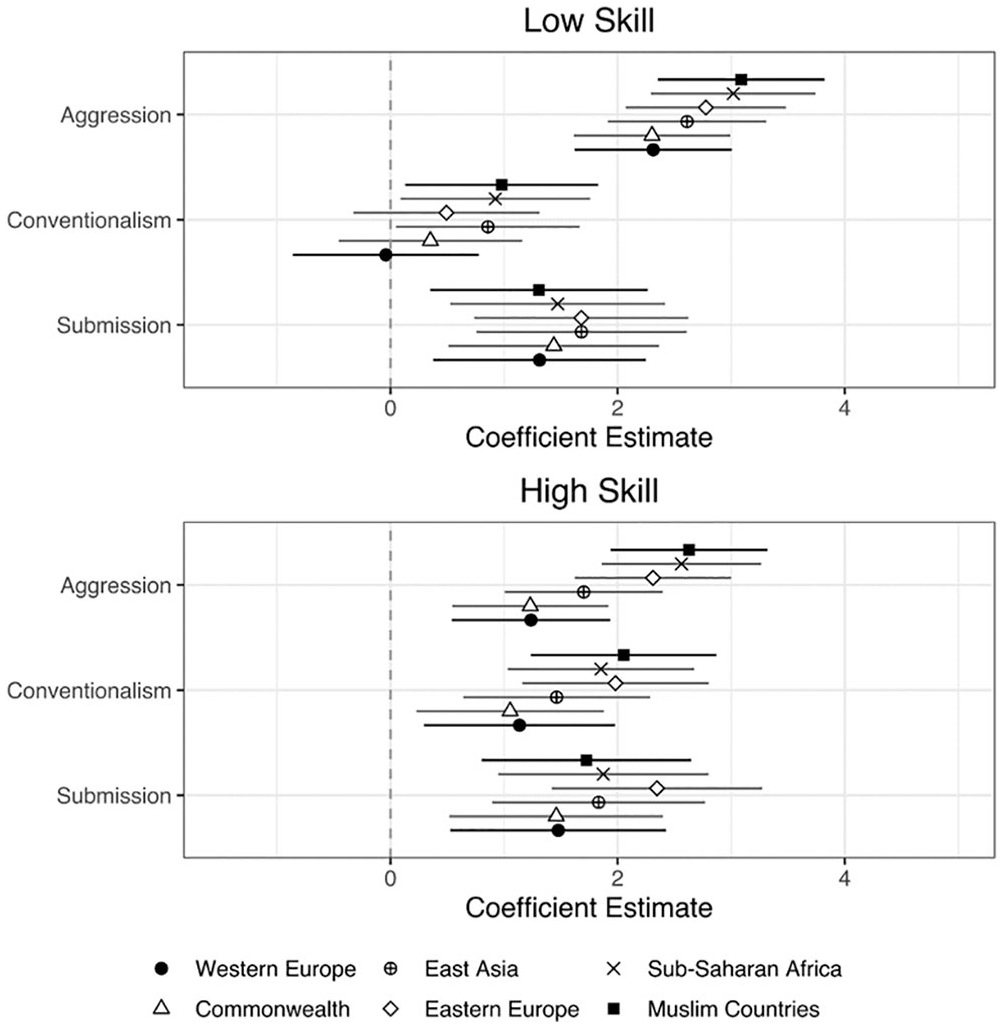
Ordered Logit Models with RWA Components.
In the low-skill condition, we see a similar ordering of coefficient magnitudes for both aggression and conventionalism, representing a preference for immigrant groups that may be perceived as culturally closer. However, with conventionalism, only half of the coefficients are statistically significant. Aggression is by far the strongest predictor here, and while the origin differentiation is present, this is much weaker than in the high-skill condition, as with the main RWA results. Submission shows significant relationships for all origin groups, contributing to a general opposition toward low-skill immigration, yet with no differentiation between the origins.
In the high-skill condition, we see that all three RWA components are associated with opposition to immigration from all groups. The submission component does not strongly differentiate between origins and does not present a preference order in line with the overall RWA scale ordering, as in the low-skill condition. Again, both conventionalism and aggression display differentiation on origin, with the effect for aggression slightly clearer than that present when using the overall RWA scale. Whereas conventionalism captures elements of attachment to societal norms, aggression focuses on the enforcement of those norms. That aggression is a strong predictor of origin differentiation is consistent with an emphasis on protecting the ingroup from cultural threats, given the association between this component and punitiveness toward rule-breakers and outgroups. The differentiation present for conventionalism indicates that traditional beliefs and attitudes are also relevant to preferences for immigrants by origin. Submission, which is related to obedience toward legitimate authorities, is consistently associated with opposition to immigration, but this does not vary by origin, perhaps due to a weaker emphasis on norm adherence in that component.
These findings indicate that the origin differentiation seen for RWA in the main analysis above is largely driven by the aggression component, albeit with strong support from conventionalism. Only aggression, similar to the overall RWA scale, strongly predicts opposition to low-skill immigration. Here, we see that conventionalism has the weakest effect. This contrasts with the high-skill condition, where all the components display strong associations with immigration opposition. On the whole, while these findings reinforce the value of the overall RWA measure, aggression captures a threat sensitivity to both culturally distant immigrants and low-skill immigrants not seen in the effects of the other components. The alternate results shown in the online Supplemental appendix, with all components included in the same model, further support this finding.
As we argue that individuals are likely more hostile toward immigration when they are predisposed to protect ingroup norms, the effect of the aggression facet of RWA is especially important. That the component most tied to enforcing norms and punishing rule-breakers is particularly associated with both overall opposition to immigration and differentiating between immigrant origins is consistent with our overall interpretation of the effects of RWA.
Conclusion
Understanding the sources of immigration attitudes has become especially important for understanding the changes taking place in many Western societies, including phenomena such as the UK’s Brexit referendum and the rise of populist anti-globalization movements. In this study, based on an original survey of UK citizens, we found support for the central role of authoritarianism in this dynamic. In predicting attitudes toward immigration, a common operationalization of this trait, RWA, has a far stronger substantive effect on immigration attitudes than other predictors, such as prejudice and SDO.
Most importantly, by separately measuring immigration preferences by different origin and skill levels, we can better understand the effects of RWA on immigration attitudes. This approach provides an insight into what aspects of immigration are causing a negative response from individuals high in authoritarianism. Not only does RWA strongly predict differences in overall attitudes toward immigrants, but the origins of immigrants—most notably Western Europe and Commonwealth compared to Muslim majority and African countries—are differentiated in the effects of RWA. We interpret this as consistent with the notion that RWA captures a sensitivity toward threats from a perceived cultural distance. That the diverse origin category of “Commonwealth” is perceived as similar to “Western Europe” suggests a need to separate further the types of cultural affinities that mitigate opposition to immigration.
Our findings are also important in light of the extant literature. In their seminal piece, Hainmueller and Hopkins (2015) found a “hidden American consensus” on immigration in the US, with very strong agreement on the type of immigrant favored by Americans and little variation due to education levels or party leanings. Although our results in the UK are consistent with this—we confirm that education levels and partisan leanings only weakly explain attitudes toward different immigrant groups—the strength of preferences varies substantially and systematically with levels of authoritarianism. Individuals exhibiting higher RWA, for whom protecting ingroup norms is crucial, are especially hostile to immigrant groups perceived as culturally distant. We find, for example, that an individual at the lowest levels of RWA would have almost a 60% probability of choosing to increase numbers of high-skilled immigrants from Muslim countries, while those at the highest levels of RWA have virtually no probability of holding this preference. Even if we assumed that individuals with high- and low-authoritarian predispositions share preferences for the ideal immigrant, the preferred immigration levels from specific immigrant groups vary dramatically between these groups.
Although research has shown that SDO’s effect is likely triggered by low-skill immigration (Duckitt and Sibley, 2010), we do not find strong differentiation in its effect by skill level. Even when RWA is not present in the model, there are small and inconsistent differences in the effects between the two skill levels for SDO. Thus, our findings within this sample do not add support to the notion that SDO is capturing a unique feature of immigration attitudes.
Examining the different components of RWA, we gain a further understanding of how authoritarianism relates to immigration concerns. While all components contribute similarly to overall hostility toward high-skill immigrants, the aggression component was most strongly predictive of overall hostility toward low-skill immigrants. We additionally find that aggression is the largest factor in discrimination between origins, although conventionalism also plays an important role. The findings for aggression, however, suggest that the enforcement aspect of authoritarianism is important for both overall immigration attitudes as well as preferences for culturally similar immigrants. We interpret this as support for the argument that the connection between authoritarianism and immigration is driven by traits associated with an emphasis on enforcement of ingroup norms. As the components of right-wing authoritarianism seem to differ in their relationship to immigration hostility, future research is needed to further refine authoritarian measurement scales.
Given the high intercorrelations between these components, it is important to interpret these findings with caution. While we argue that these findings help explain why RWA is associated with opposition to immigration, they also indicate that the aggregate measure is important. Our results do not suggest that components can be excluded, nor that only the aggression component should receive attention. Rather, our interpretation is that opposition to immigration and differentiation by origin are associated with adherence to norms, with the clearest effects present for aspects of authoritarianism emphasizing enforcement of norms. Future research into improved and more precise methods of measuring authoritarianism and its components will illuminate the contexts in which these traits most predict immigration hostility.
Another avenue for future research would be to examine the robustness of these findings using alternative ways of measuring immigration attitudes. A potential limitation of our study is that certain measures are likely to be influenced by social desirability bias. Some studies have shown that, for example, there are “distorting effects of real or perceived pressures to give a socially desirable response in surveys on attitudes towards African Americans and race-related issues” (Janus, 2010: 930). Studies have also shown that such social desirability bias is correlated with features such as educational attainment and political ideology, with highly educated individuals and liberals being more likely to conceal racially conservative views (see, for example, Gilens et al., 1998). If low-RWA respondents are more likely to conceal their anti-immigrant preferences or are more likely to want to appear as though they do not differentiate between immigrants by origin, the results may be biased. Given the potential effects of social desirability bias in surveys of immigration attitudes, experimental research is needed to manipulate whether respondents are exposed to a more culturally familiar or distant immigrant group. This approach is used by Claassen and McLaren (2020), who find results in line with ours, that authoritarian predispositions tend to become activated with culturally distinctive immigrant groups. They found, moreover, that this effect was particularly strong when respondents were confronted with immigrants originating from Muslim majority countries.
Finally, our findings are relevant to recent work emphasizing a shift in political dynamics in Western countries from an economic left-right division to one based more on divisions regarding authoritarianism (Dalton, 2018; Hetherington and Weiler, 2009; Scotto et al., 2018; Surridge, 2018). The connection to immigration as a cultural threat illuminates one pathway for how authoritarianism may contribute to the modern globalization divide facing many Western democracies. Hence, our findings illuminate which individuals are more likely to perceive immigration as a cultural threat, contributing to our understanding of how societies become less cohesive socially and politically due to globalization. These findings are also consistent with work focused on the broader impacts of globalization and economic crises on immigration attitudes (e.g. Kuntz et al., 2017; Rodrik, 2018). If economic disruption and high immigration levels provoke a backlash, our work contributes to explaining who is likely to react most negatively to immigration and the forms of immigration to which they may react.
One of the main challenges facing democratic societies of today is an increased “affective polarization” between groups, where supporters of one group or party are severely biased against, and may even hate, supporters of another group or party (see, for example, Iyengar et al., 2019; Mason, 2018). Such animosity between groups is likely driven by especially salient and moralized issues (Garrett and Bankert, 2020), which may be the case for perceived cultural threats associated with immigration. As polarization has been associated with political violence and democratic backsliding (e.g. Svolik, 2019), it is crucial that we better understand how authoritarian traits contribute to this divide.
Supplemental Material
sj-docx-1-psx-10.1177_00323217211032438 – Supplemental material for Authoritarianism and Immigration Attitudes in the UK
Supplemental material, sj-docx-1-psx-10.1177_00323217211032438 for Authoritarianism and Immigration Attitudes in the UK by Adam Peresman, Royce Carroll and Hanna Bäck in Political Studies
Footnotes
Acknowledgements
The authors would like to thank participants at several conferences for their comments, particularly Rob Johns and Paulo Serôdio. They would also like to thank the editor and the anonymous reviewers who offered helpful comments and suggestions during the review process.
Authors’ Note
Earlier versions of this article were presented at the 2018 Annual Conference of the Elections, Public Opinion and Parties (EPOP) group of the Political Studies Association, the University of Barcelona, and the 2019 Researching Brexit Conference.
Declaration of Conflicting Interests
The author(s) declared no potential conflicts of interest with respect to the research, authorship, and/or publication of this article.
Funding
The author(s) disclosed receipt of the following financial support for the research, authorship, and/or publication of this article: This work was supported by the British Academy/Leverhulme Small Research Grant SG163071 as well as the Swedish Research Council, grant number 2017-02609.

Supplementary Information
Additional Supplementary Information may be found with the online version of this article.
Figure A1: Ordered Logit Models with RWA Components (together).
Table A1: RWA Items.
Table A2: SDO Items.
Table A3: Sample Demographics.
Table A4: Correlation Matrix of Ideology and Immigration Attitudes.
Table A5: Immigration Opposition by Skill and Origin Differentiation (OLS).
Table A6: General Immigration Attitudes (OLS).
Table A7: Ordered Logit—High Skill —Demographics.
Table A8: Ordered Logit—Low Skill —Demographics.
Table A9: Ordered Logit—High Skill—Main Model.
Table A10: Ordered Logit—Low Skill—Main Model.
Table A11: Ordered Logit—High Skill—Party.
Table A12: Ordered Logit—Low Skill—Party.
Table A13: Ordered Logit—High Skill—RWA.
Table A14: Ordered Logit—Low Skill—RWA.
Table A15: Ordered Logit—High Skill—SDO.
Table A16: Ordered Logit—Low Skill—SDO.
Table A17: Ordered Logit—High Skill—Left-Right.
Table A18: Ordered Logit—Low Skill—Left-Right.
Table A19: Ordered Logit—High Skill—Prejudice.
Table A20: Ordered Logit—Low Skill—Prejudice.
Table A21: Ordered Logit—High Skill—Components.
Table A22: Ordered Logit—Low Skill—Components.
Table A23: Ordered Logit—High Skill—Aggression.
Table A24: Ordered Logit—High Skill—Conventionalism.
Table A25: Ordered Logit—High Skill—Submission.
Table A26: Ordered Logit—Low Skill—Aggression.
Table A27: Ordered Logit—Low Skill—Conventionalism.
Table A28: Ordered Logit—Low Skill—Submission.
Notes
Author Biographies
References
Supplementary Material
Please find the following supplemental material available below.
For Open Access articles published under a Creative Commons License, all supplemental material carries the same license as the article it is associated with.
For non-Open Access articles published, all supplemental material carries a non-exclusive license, and permission requests for re-use of supplemental material or any part of supplemental material shall be sent directly to the copyright owner as specified in the copyright notice associated with the article.
