




Abstract
Building on historical and discursive institutionalism, this article examines the agent-based dynamics of gradual institutional change. Specifically, using marriage equality in the United States as a case study, we examine how actors’ ideational work enabled them to make use of the political and discursive opportunities afforded by multiple venues to legitimize the process of institutional change to take off sequentially through layering, displacement, and conversion. We also pay special attention to how the discursive strategies deployed by LGBT advocates, religious-conservative organizations and other private actors created new opportunities to influence policy debates and tip the scales to their preferred policy outcome. The sequential perspective adopted in this study allows problematizing traditional conceptualizations of which actors support or contest the status quo, as enduring oppositional dynamics lead them to perform both roles in subsequent phases of the institutional change process.
Keywords
Introduction
Gradual institutional change analyses have allowed drawing a more flexible line between stability and transformation when examining how institutions evolve over time, particularly in the absence of major critical junctures or exogenous shocks (see Hacker et al., 2015; Mahoney and Thelen, 2010; Streeck and Thelen, 2005). Yet, the explanatory power of the theory has been undermined by lack of attention to the overlapping boundaries of the modes of change, a relatively static model of agency, and conceptual confusion regarding whether the modes of change are strategies used by actors, processes that unfold over time, or the outcomes of these processes (cf. Van der Heijden and Kuhlmann, 2017: 544–545).
Addressing these shortcomings requires investigating the agent-based dynamics underpinning various arenas and tiers of government and bringing to the fore the role of ideas. Not only do “ideas and discourses” matter for institutional change (Schmidt, 2010: 21), but also ideational work typically predates institutional transformation (Béland, 2007; Erikson, 2019). Due to the constitutive impact of ideas and discourses in the creation, maintenance and reform of institutions (Schmidt, 2010), actors strategically reframe problems and redirect solutions to influence both the process and the outcome of policy reforms (cf. Smith, 2018: 63). 1 Therefore, focusing on the introduction of marriage equality in the United States (US, henceforth), this article traces how the discursive strategies employed by change actors to (de)legitimize an existing institutional arrangement at multiple venues constitute a mechanism through which a sequenced process of gradual institutional change is set in motion to achieve specific policy outcomes.
Marriage can be conceived of as an institution as it embodies both formal legally enforceable rules—for example, rights and obligations related to financial benefits, parental rights, immigration status or medical decisions—and a broad array of informal arrangements. The latter include social norms about how intimate relationships, reproduction and children’s socialization should be organized (Lauer and Yodanis, 2010: 60) along with recurrent social practices—for example, family names, ceremonies, or rings. Since institutions are containers of moral values and templates (Hall and Taylor, 1996: 947) that determine which actions and behaviors are considered “right” or “wrong” (Hacker et al., 2015: 183; Streeck and Thelen, 2005: 9), authoritative decisions affecting the core values upon which the institution of marriage was founded, such as the adoption of marriage equality, can be regarded as an instance of institutional change (Mariani, 2020: 256).
Disputes on who is allowed to contract marriage belong to the so-called “morality policies,” that is, contentious public issues that induce value conflicts over “first principles” and battles between “right and wrong” (Engeli et al., 2012: 23–24). Sequenced gradual institutional change is particularly likely to be observed in the case of value-loaded issues. Morality policy innovation, due to its principled nature, will elicit a counter-response seeking not just to withstand the policy, but also to eradicate it altogether whenever it succeeds (Hollander and Patapan, 2017: 2). Morality policies are thus a fertile ground to examine how processes aimed at redefining policy problems and redirecting policy solutions through ideas and discourses are interactive and oppositional.
Combining historical and discursive institutionalism, our empirical analysis shows that the discursive strategies employed by proponents and opponents of marriage equality have sought to legitimize the process of gradual institutional change to take off sequentially in a progressive direction—through layering and displacement—and in a regressive direction—through conversion. Change has subsequently encompassed several outcomes, including the attachment of same-sex civil unions on top of traditional—that is, heterosexual—marriage, the replacement of laws codifying marriage exclusively as the union of opposite-sex couples with new legislation defining marriage as a gender-neutral institution, and a significant reinterpretation of the policy that undermines its implementation through numerous religious exemptions. Simultaneously, sequencing has shaped the frames used by actors to circumvent or activate vetoes at different venues to pursue their preferred outcomes. Our results also reveal that, throughout this sequenced process, opposing actors have not only adjusted their discursive strategies to their rivals, but also shifted roles as change and status quo agents.
The Role of Discourse in Sequenced Institutional Change
Institutional change is rarely an end point but tends to be the result of interlocked sequences, with actors pursuing it through different modes, even within the same context (Van der Heijden and Kuhlmann, 2017: 545; see also Barnes, 2008; Ellingsæter, 2014). Sequencing matters because “policies, once enacted, restructure subsequent political processes,” creating new politics that affect the identities, goals, and capabilities of social groups (Skocpol, 1992: 58). Each sequencing of modes of change will thus yield a specific sequencing of change agents (Van der Heijden and Kuhlmann, 2017: 545) or policy entrepreneurship (Mintrom and Norman, 2009: 661), with actors alternatively playing “offense and defense” (Hacker et al., 2015: 181) as they shift roles in their endorsement or contestation of existing institutional arrangements.
In examining sequenced gradual change, a full understanding of why one type of policy reform occurs rather than another and the direction it takes requires “a systematic analysis of ideational processes” (Béland, 2007: 20). Discourses “provide agents with reasons for action” (Fairclough and Fairclough, 2016: 195) and ideational abilities allow actors to participate in the creation and transformation of institutions (Béland, 2007). Hence, attention should be paid to “how, when, where, and why ideas and discourse matter” for stirring and legitimizing institutional change (Schmidt, 2010: 21). Given that meaning-making by collective actors is an interactive process (Kulawik, 2009), a dynamic model of agency is needed to trace how actors update or modify their discursive strategies in response to their opponents. In what follows, we discuss the role that change actors’ ideational work plays in setting in motion a sequenced process of gradual institutional change, focusing on layering, displacement, and conversion.
New institutions rarely replace existing arrangements wholesale, as actors advocating for change seldom have this capacity. Instead, layering is a common way through which gender-equitable reforms are enacted (Waylen, 2014: 219), with new rules being attached alongside existing ones through amendments or additions (Mahoney and Thelen, 2010: 15). During the process of layering, reform proponents need both material and discursive resources to persuade decision-makers (Rocco and Thurston, 2014: 46). In particular, by proposing ideas that do not challenge the core assumptions or beliefs underlying existing arrangements, change actors may be able to turn decision-makers’ attention to policy solutions that reconcile multiple goals (cf. Shpaizman, 2014: 1050), thus allowing old and new institutions to coexist. The introduction of new ideational templates is especially important when a polity is not ready for abrupt changes, as it may gradually call into question the old arrangements (Quack and Djelic, 2005: 256) and give change actors “an advantage in the subsequent battle of ideas” (Schmidt, 2010: 11).
Since layering is often the result of compromise among actors with different interests (Palier, 2005: 131), it is vulnerable to shifts and may be succeeded by displacement (Ellingsæter, 2014). This mode of institutional change is associated with major legislative revisions that substantially reform or remove existing institutions (Hacker, 2004). A successful displacement is likely to depend on the extent to which a policy issue enters the agenda not as a group demand but as a major social issue (Sainsbury, 2004: 70), which tends to require a good sense of timing and broad popular support. In this vein, institutional change through displacement is more likely the wider the consensus concerning the problem definition is (Erikson, 2019: 34). Gaining power from ideas is especially important for actors that seek the displacement of long-standing institutions but lack positional power in the policy process through either elected or appointed public offices (Schmidt, 2010: 18).
Displacement entails the defection of a growing number of people to a new institution while support for old arrangements is gradually eroded (Streeck and Thelen, 2005: 20), leading actors opposing the new rules to explore ways to redeploy them at the implementation stage. One way to make rules behave differently in consequential ways is conversion, wherein the new institution remains but its impact changes (cf. Hacker et al., 2015: 185). When the barriers to authoritative change are high but the new rules are ambiguous, alternative ideas on how to implement the policy may emerge, jeopardizing its unique interpretation, and eventually achieving its redirection (Barnes, 2008: 638; Hacker et al., 2015: 189), for example, through a low-profile paradigm shift that reshapes some of the policy’s core objectives (Béland, 2007). Such a shift in the absence of formal revisions is more likely to occur when those in charge of implementation are not the policy adopters as well as when the rules can be (re)interpreted to alter the impact of the policy in less visible venues such as bureaucracies, parapublic governing bodies (Hacker et al., 2015: 186), or non-state spaces (Euchner and Preidel, 2018).
Throughout this sequenced process, attention must be paid to both the political and discursive opportunity structures afforded by the context in which actors’ struggle for pushing or blocking reforms takes place (McCammon, 2013; Mahoney and Thelen, 2010). On one hand, the institutional setting provides actors with policy legacies upon which they can build their discursive strategies (Smith, 2018) and political learning about how to best promote their preferred policies (Vagionaki and Trein, 2019: 7–89). The vertical and horizontal divisions of power of the polity, including the degree of fragmentation of the policymaking process and the saliency of judicial review (Hollander and Patapan, 2017; Smith, 2018), also afford actors opportunities for “venue shopping” (Vickers, 2010). On the other hand, actors need to adapt their discursive strategies and underlying moral templates to a set of interdependent institutions, as the legitimacy of claims and the effectiveness of frames is likely to vary across venues (Mello, 2015), such as governments, legislatures, courts, ballot boxes, bureaucracies, or non-state arenas. Still, it should be noted that through their strategic engagement with institutions actors also seek to create new opportunity structures that help them further their aims (Chappell, 2000: 250).
Data and Methods
Our study of the interlocked sequence of modes of gradual institutional change focuses on the case of marriage equality in the US. Covering both the policy adoption and implementation phases, we examine the period comprised between 1993 and 2020, encompassing the first year in which the constitutionality of restricting marriage to heterosexual couples was questioned by a court up to the most recent state-level religious exemptions that thwart an effective marriage equality. Proponents of marriage equality have included Freedom to Marry, a national bipartisan organization founded in 2003, and other civil rights and LGBT legal organizations, such as the American Civil Liberties Union (ACLU, henceforth), Gill Foundation, Human Rights Campaign, National Center for Lesbian Rights, and the GLBTQ Legal Advocates and Defenders (GLAD, henceforth). They have faced the vocal opposition of the Catholic and Mormon hierarchy, Evangelical Protestant churches, and Religious Right organizations, such as the Family Research Council (FRC, henceforth), the National Organization for Marriage (NOM, henceforth), the Heritage Foundation, the Coalition for Marriage, and the Alliance Defending Freedom (ADF, henceforth).
Departing from the premise that there is no adequate causal explanation without an understanding of meaning-making dynamics by collective actors (Kulawik, 2009), we apply interpretive process tracing (IPT, henceforth) to uncover the interplay of institutional arrangements, agency and political discourse. IPT embeds discourses in their socio-historical context and explains their effects with the aim of exploring both “what happened” and “how it happened” (Vennesson, 2008: 233). In this vein, IPT places actors’ contextually specific “intersubjective meanings at the basis of the causal mechanisms that explain continuity and change in social institutions”, unveiling the micro-dynamics through which institutions are sustained or altered (Norman, 2015: 7). It also allows tracing the continuities and policy legacies in actors’ discursive strategies along with the characteristics of the institutional context that enable or constrain their deployment (Fairclough and Fairclough, 2016: 189; Smith, 2018: 65). Moreover, IPT is useful for studying processes wherein “the sequence in which events unfold over time is important for explaining outcomes” (Norman, 2015: 4), as is the case of changes in the institution of marriage.
While previous works have examined the frames used by LGBT and religious-conservative actors (see Fetner, 2008; Mello, 2015; Mucciaroni, 2011; Stone, 2016), this article delves into “the features of discourse which are relevant to the political processes or events under analysis” (Fairclough and Fairclough, 2016: 189) and the “foreground discursive abilities” through which agents seek to instill institutional change (Schmidt, 2010: 15). Specifically, we trace why certain frames are put forth by actors, which reasons and meanings actors give to their actions, how they seek to win over public opinion through the discursive struggle, and how feedback dynamics underpin frame entrepreneurship over time. We also assess the degree of effectiveness of the various discursive strategies deployed across multiple venues.
Our empirical analysis draws on a broad array of documents, including: interviews to key LGBT activists conducted between 2015 and 2016 by the Berkeley Freedom to Marry Oral History Project; publications issued by the LGBT and religious-conservative organizations under study; actors’ statements in newspaper articles—retrieved through a keyword search in the ProQuest US Newsstream database; and discourses found in legal documents of judicial cases—that is, transcripts of oral arguments and court rulings. The empirical analysis is presented in three distinct sections, following the sequence of gradual institutional change identified.
Layering Same-Sex Civil Unions (1993–2003)
Marriage equality gained salience as an alternative to traditional marriage in 1993 when Hawaii’s Supreme Court suggested in Baehr v. Miike that the state’s restriction of marriage to heterosexual couples might be unconstitutional. This ruling provoked an intense opposition campaign by religious-conservative actors, culminating in the passage of the Defense of Marriage Act (DOMA, henceforth) by the US Congress in 1996, which defined marriage as the union of a man and a woman, and in a popularly approved amendment to Hawaii’s constitution that allowed the legislature to ban same-sex marriage in 1998. Indeed, religious-conservative actors have recurrently moved policy decisions to the ballot box to mobilize public discomfort with LGBT rights (Fetner, 2008; Mello, 2015).
This notwithstanding, Baehr v. Miike (1993) afforded LGBT advocates important political learning opportunities. In Vermont, the second state in which they tried to win marriage equality through litigation, engaging in public education and political organizing helped create a favorable climate to their policy position and build sufficient political capacity to withstand the attacks from their opponents (Wolfson, 2017: 122). LGBT activists, though, only scored a partial victory, as the Vermont Supreme Court ruled in Baker v. Vermont (1999) that same-sex couples should enjoy the same rights as heterosexual couples but left out to the legislature how to recognize LGBT committed relationships. Given that no country in the world had yet adopted marriage equality, sodomy was still a crime in some states of the US, and Baehr v. Miike (1993) had led to a popular vote in favor of a constitutional ban, lawmakers opted for the electorally safer option of civil unions instead of marriage. As Figure 1 shows, in 2000 Vermont became the first of 12 states, the first of 13 states to introduce same-sex civil unions—called domestic partnerships in states like California or New Jersey—alongside heterosexual marriage, entailing the coexistence of the old and the new institutional arrangements.
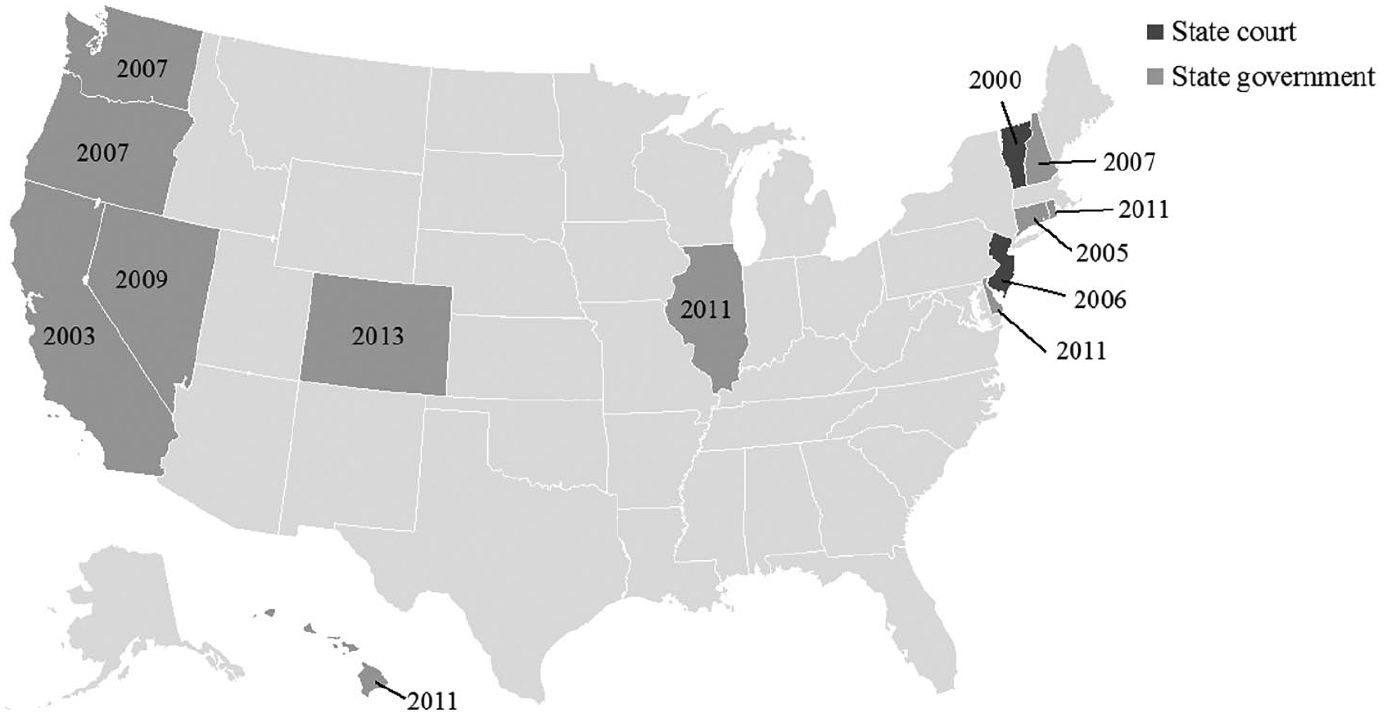
States with Same-Sex Civil Unions prior to Obergefell v. Hodges (2015).
Civil unions were not LGBT activists’ first choice, though. Being aware of the low public support for marriage equality, their advocacy campaign built on the “civil rights” (Stone, 2016) or “equal rights and benefits” frame. This frame originated in the battle for spousal rights—for example, social security death benefits and medical decisions for a partner—motivated by the unique status of marriage as the basis for the allocation of a wide host of welfare benefits (Chauncey, 2005) and exacerbated by the HIV/AIDS crisis of the 1980s and early 1990s. As pinpointed by Tim Sweeney, member of the Freedom to Marry board of directors, “We were so [. . .] inured to our own pain and lack of ability to say publicly, ‘You want to know why I want this? Because I love this guy.’ We had to say, ‘well, if he dies, his social security death benefit may allow me to stay in our rental unit’” (Sweeney, 2017: 25). While these discursive strategies contributed to persuading judges and lawmakers to grant some legal rights to same-sex couples through civil unions, they failed to make them see the need for displacing the traditional institution of marriage. For example, in justifying Connecticut’s adoption of same-sex civil unions, Governor Mary Jodi Rell claimed: “I have said all along that I believe in no discrimination of any kind, and this bill accomplishes that while at the same time preserving the traditional language that a marriage is between a man and a woman” (Yardley, 2005).
Nonetheless, change actors envisaged that civil unions would not only affirm LGBT people’s dignity, but also “further marriage momentum, because the state is essentially treating people as married,” as highlighted by Evan Wolfson (2017: 125), president of Freedom to Marry. Similarly, after Rhode Island adopted civil unions, Governor Lincoln Chaffee affirmed that “[w]e want to get on the path to full equality, and this is a step on the path” (Goodnough, 2011). Layering became then part of a strategic plan to win marriage equality nationwide called “Roadmap to Victory” and it served as a “stepping stone” to achieve two central goals (Wolfson, 2017: 126). First, gaining some form of legal recognition of same-sex couples in a critical mass of states, mainly through legislation and judicial rulings (Esseks, 2017). Second, dissipating fears and prejudices against same-sex relationships and growing a favorable opinion among citizens and politicians to “create the climate in which the litigation tool could succeed and we could get the law where it needs to be” (Wolfson, 2017: 80). Indeed, “counting states” to ensure that rulings are consistent with majoritarian national preferences is a common practice by the US Supreme Court (Hills, 2009), and previous rulings, such as Loving v. Virginia (1967), in which the high court struck down anti-miscegenation laws after 34 states repealed their interracial marriage bans, had shown LGBT activists the importance of creating a “drumbeat of inevitability” around marriage equality (Kendell, 2017: 59).
Religious-conservative actors also saw in civil unions the potential of becoming a building block toward marriage equality. They therefore engaged in “anticipatory countermobilization” (Dorf and Tarrow, 2014: 450), even before marriage equality was a real possibility. For the executive director of the Rhode Island chapter of NOM, Chris Plante, civil unions were “a Trojan Horse that will usher in same-sex marriage sooner rather than later [and] a clear path for the courts to redefine marriage without the vote of the people” (National Organization for Marriage Rhode Island (NOM-RI), 2011). In response to the “civil rights” frame of change agents, status quo actors started to discursively represent the LGBT community as a wealthy and elitist minority seeking “special rights.” This frame rested on the assumption that homosexuality is a choice (Cahill, 2007: 172–173; Stone, 2016: 462). As the Massachusetts Coalition for Marriage (2020) claimed on its website, “We do not believe that a person’s sexual behavior is comparable to other protected categories such as race or sex—characteristics that are inborn, involuntary, immutable, innocuous.”
Even though by 2004, 55% of Americans were still against marriage equality, public support for same-sex civil unions grew steadily over time, from 42% in 2000 to 49% in 2004 (Gallup, 2021). Likewise, acceptance of homosexuality broadened with increased exposure in both everyday life and the media to LGBT people who were coming out in record numbers, with self-reported contact boosting the likelihood of support for their rights by about 10 percentage points (Garretson, 2018: 47). In response to this burgeoning public support, status quo actors increasingly recurred to the “social consequences” frame (Mello, 2015: 6; Mucciaroni, 2011: 208). This frame elicited that traditional marriage needed to be safeguarded for the sake of children (Cahill, 2007: 161–162; Stone, 2016: 462), who “do better academically, financially, emotionally, and behaviorally” in opposite-sex couples, according to Peter Sprigg (2005), senior analyst at FRC. When the US Supreme Court stroke down state sodomy laws in Lawrence v. Texas (2003), the fear that legalizing same-sex unions would undermine the “fabric of society” and entail a slippery slope spread among religious-conservative organizations and public officers (Rom, 2007: 17). While Richard Lessner, senior analyst at FRC, claimed that “now [laws against] bigamy, incest, polygamy, bestiality, prostitution and anything else you can think of . . . are going to come under attack” (Landsberg and Glionna, 2003), US Supreme Court Justice Antonin Scalia stated that the Lawrence v. Texas decision left “on pretty shaky grounds state laws limiting marriage to opposite-sex couples” (Scalia, J., dissenting in Lawrence v. Texas, 539 U.S. 558, 17 (2003)).
Displacing Traditional Marriage (2004–2015)
While the term “civil union” entailed more dignity and sounded more marital than “partnership,” as noted by the president of Freedom to Marry, it also underlined “the absurdity of having two identical, parallel statuses that would then collapse, eventually, into one” (Wolfson, 2017: 124). LGBT advocates’ argument that civil unions established an unacceptable “separate but equal” system (Shaiko, 2007: 92; Wolfson, 2017: 181), increasingly resonated with judges and politicians alike. In 2004, when asked by the Massachusetts Senate if granting civil unions to LGBT couples would comply with the state’s Supreme Judicial Court ruling in Goodridge v. Department of Public Health (2003), 2 the court firmly rejected this possibility noting that “it continues to relegate same-sex couples to a different status. [. . .] The history of our nation has demonstrated that separate is seldom, if ever, equal” (Opinions of the Justices to the Senate 802 N.E.2d 565). In 2009, New Hampshire’s Governor John Lynch, formerly opposed to marriage equality, justified his support to a marriage equality bill because he heard “the very real feelings of same-sex couples that a separate system is not an equal system” (Office of the Governor, 2009).
The very same formulation of the concept of marriage equality was “a deliberate antidote to the ‘special rights’ rhetoric of gay rights’ opponents” (Smith, 2018: 72). Its ideational strength drew on two legacies. On one hand, the privileged status of married couples within the American legal system and social policy vis-à-vis non-married couples or civil unions (Chauncey, 2005) allowed LGBT activists to list the federal rights and benefits denied to them and to frame civil unions as a first, yet incomplete step toward full equality with opposite-sex couples (Smith, 2018: 73). On the other hand, as already discussed, the LGBT movement learnt from the Civil Rights Movement’s fight against separate systems on the grounds of race, borrowing its legal strategy to repeal anti-miscegenation laws. The “Roadmap to Victory” initial phase consisted of state-by-state innovation, targeting the jurisdictions most responsive to LGBT advocates’ claims. When in 2004, Massachusetts became the first state to allow marriage equality, cross-loading became a realistic prospect.
To block the policy from propagating nationwide, religious-conservative actors mobilized to pass state constitutional bans on marriage equality through popular vote. Up to 2003, these bans only existed in four states, but by 2012, they had been passed in 27 more states. Through the “judicial activism” frame, constitutional bans were presented as the only way to stop “overreaching” judicial elites (Mucciaroni, 2011: 206). As President George W. Bush claimed in his 2004 State of the Union address, “If judges insist on forcing their arbitrary will upon the people, the only alternative left to the people would be the constitutional process. Our Nation must defend the sanctity of marriage” (The American Presidency Project, 2004). To win these constitutional bans through popular vote in liberal states, like California’s Proposition 8, religious-conservative actors tested various messages in focus groups and surveys (Schubert and Fint, 2009) and chose a discursive strategy that coupled the “social consequences” and the “conflicting rights” frames. The latter took inspiration from the pro-life movement’s battle against reproductive rights, which succeeded in establishing religious liberty as legal doctrine (Lewis, 2017). 3 As explained by Frank Schubert and Jeff Flint (2009), founders of the consulting firm behind the Proposition 8 campaign, “We settled on three broad areas where this conflict of rights was most likely to occur: in the area of religious freedom, in the area of individual freedom of expression, and in how this new ‘fundamental right’ would be inculcated in young children through the public schools.” While LGBT advocates compared Proposition 8 with racial discrimination (Schubert and Flint, 2009), the “conflicting rights” frame sought to reassure moderate audiences that prohibiting marriage equality was not an act of bigotry (Anderson, 2015; Eckholm, 2012). Rather, it protected religious people’s rights from the “excessive” claims of LGBT couples (Mello, 2015: 4).
After the passage of Proposition 8 in California in 2008 and the adoption of civil unions instead of marriage equality in Connecticut (2005) and New Jersey (2006), change actors realized that a new discursive strategy was needed to make voters and lawmakers regard same-sex couples as equal to heterosexual couples. “Bedrock values,” such as civil rights were “getting in the way” of the other part of the case, namely, the “emotional connection, the personal, the local, the authentic stories” (Wolfson, 2017: 188). The results of extensive polling and message testing in focus groups showed that love, commitment, and family were ideas that resonated with the values of a much wider audience (Esseks, 2017: 37; Stone, 2016: 462). The new “love and commitment” frame was combined with messages emphasizing the so-called “Golden Rule”—that is, treating others as one would like to be treated. As explained by Thalia Zepatos (2017: 72), Freedom to Marry’s director of research, if heterosexual couples would not trade their marriage for a civil union, asking same-sex couples to do so was not fair. Ads featuring couples explaining the Golden Rule to their children at home directly responded to religious-conservative actors’ claim that parents would lose control of teaching values (Zepatos, 2017: 93), and in more conservative states “unlikely messengers” were recruited to deliver their personal journey narratives (Zepatos, 2017: 74), such as army veterans, religious leaders, or Republican politicians (Wolfson, 2017). Freedom to Marry also created an “opposition message response book” to counteract religious-conservative actors’ arguments (Zepatos, 2017: 92).
As Figure 2 shows, this discursive shift harvested its first victories in 2012, when four states adopted marriage equality through popular vote, the only political venue in which religious-conservative actors had never lost before. The “love and commitment” frame also resonated with legislators. After signing the bill that legalized marriage equality in Washington state, Governor Christine Gregoire (2012) stated that it was about telling same-sex couples “that a lifetime commitment matters. That their love matters. That their families matter.” Similarly, in explaining why his administration decided to no longer defend DOMA if challenged in court, President Barack Obama noted that he had “thought civil unions would be sufficient” but, as he heard from “incredibly committed” same-sex couples “the pain they feel that [. . .] they are still considered less than full citizens,” he realized “how much love they have in their hearts” and concluded that it was important “to go ahead and affirm that same-sex couples should be able to get married” (ABC News, 2012).
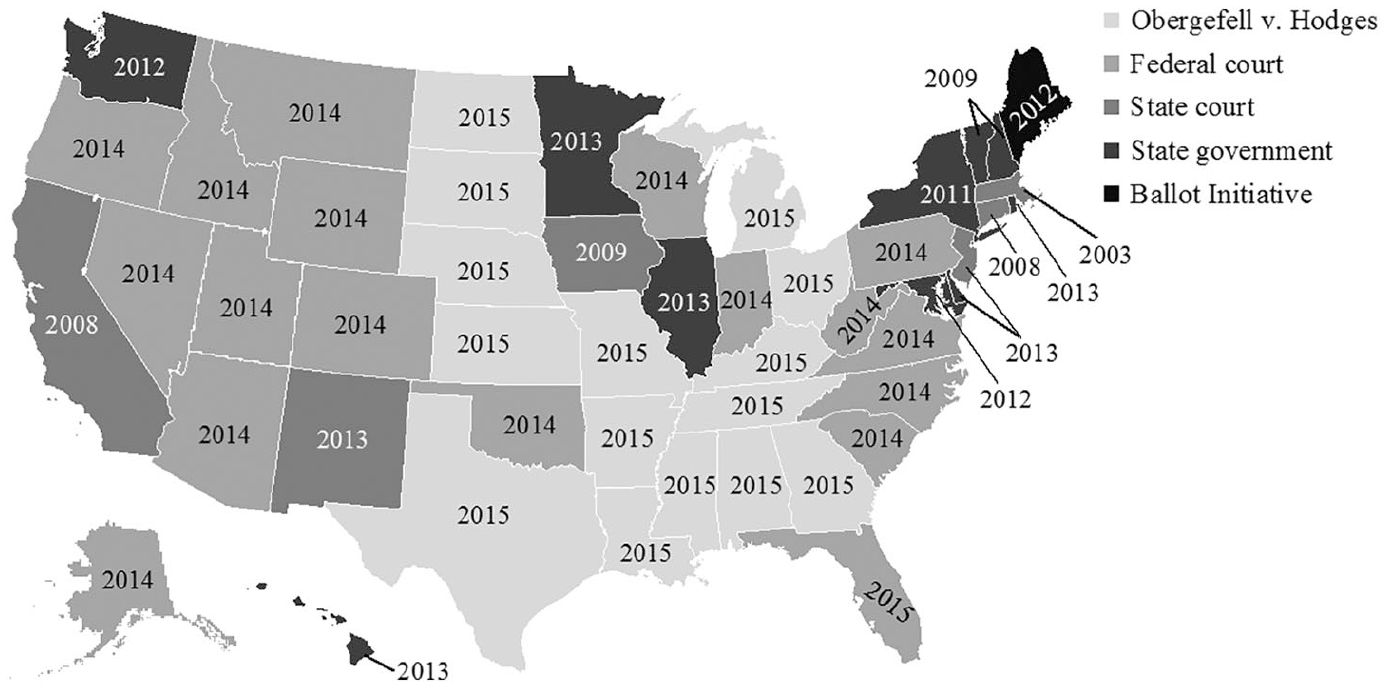
States with Marriage Equality prior to Obergefell v. Hodges (2015).
State-by-state victories at the ballot box, state courts and legislatures progressively displaced heterosexual marriage across the country 4 and challenging the constitutionality of DOMA gained momentum. In the words of Freedom to Marry’s president (Wolfson, 2017: 246), this critical mass of political and public support would signal to the US Supreme Court that “the country was ready, and it was time.” Indeed, the Americans in favor of marriage equality grew from 27% in 1996 to 50% in 2013 (Gallup, 2021). In United States v. Windsor (2013), LGBT advocates’ “equal rights and benefits” and “love and commitment” frames did not go unnoticed. According to the US Supreme Court, Section 3 of DOMA “rejected the long-established precept that the incidents, benefits, and obligations of marriage are uniform for all married couples,” placed same-sex couples “in an unstable position of being in a second-tier marriage” and “demean[ed] the couple, whose moral and sexual choices the Constitution protects” (United States v. Windsor, 570 U.S. 744, 18 and 23 (2013)). The verdict triggered a “tidal wave” (Esseks, 2017: 65) of lower federal courts’ rulings in favor of marriage equality in 2014, which eventually led to the 2015 US Supreme Court landmark ruling in Obergefell v. Hodges. By a 5-4 vote, the high court sustained that same-sex couples can exercise the fundamental right to marry on the same terms accorded to opposite-sex couples, making marriage equality available nationwide. The decision did not just extend the unique rights and benefits associated with marriage to same-sex couples. More fundamentally, it replaced the traditional definition of marriage based on religious beliefs and natural law accounts with a more egalitarian, secular view of the institution that recognizes a couple’s long-term commitment regardless of sexual orientation (Mariani, 2020: 257).
In response, religious-conservative actors redeployed the “social consequences” frame, claiming that the legalization of marriage equality weakened the stable opposite-sex, two-parent family environment in which children could thrive (Mello, 2015). As stated by the defense attorney during Obergefell v. Hodges (2015) oral arguments, “When you change the definition of marriage to delink the idea that we’re binding children with their biological mom and dad, that has consequences” (Transcript of Oral Arguments at 45, Obergefell v. Hodges, 576 U.S. 644 (2015)). However, this frame was ineffective in courts. Besides dismissing claims that allowing same-sex couples to wed would yield fewer heterosexual marriages, the US Supreme Court emphasized that same-sex couples “respect [marriage] so deeply that they seek to find its fulfillment for themselves. Their hope is not to be condemned to live in loneliness, excluded from one of civilization’s oldest institutions” (Obergefell v. Hodges, 576 U.S. 644, 28 (2015)).
Reinterpreting Marriage Equality through Conversion (2016-2020)
Although public support for marriage equality reached 67% in 2020 (Gallup, 2021), religious-conservative actors have not given in. In direct reference to the “love and commitment” frame that has harvested LGBT legal gains, John Bursch, the vice president of appellate advocacy at ADF, sustained that “eventually, it’s not love that wins. It’s truth that wins” (Wolf, 2020). The battle has moved from the federal level, where the major institutional reform was adopted, back to the state level, where marriage equality is implemented in practice. Both this shift in the key actors directing the institution and the ambiguity of the US Supreme Court ruling have triggered conversion through the reinterpretation of the policy. The high court explicitly emphasized that “those who adhere to religious doctrines, may continue to advocate with utmost, sincere conviction that, by divine precepts, same-sex marriage should not be condoned” (Obergefell v. Hodges, 576 U.S. 644, 21 (2015)). Therefore, the ruling left open the question of the constitutionality of state-level laws that recognize specific public and private actors’ right to religious objection in the provision of services to same-sex couples without directly challenging marriage equality. Exploiting this ambiguity, religious liberties have been pitted by religious-conservative actors against LGBT couples’ newly recognized right to marry.
“There is no way that religious liberty will be completely protected in this country as long as [Obergefell v. Hodges] stands,” warned NOM’s president Brian Brown (Dobner, 2015). As has been discussed, the “conflicting rights” frame is part of a long legal and political campaign to stem public intervention in a variety of areas, ranging from abortion to health care (Lewis, 2017). Through this discursive strategy, religious-conservative organizations have successfully managed to portray themselves as a threatened minority deserving exemptions from governmental coercion. “While marriage appears nowhere in the US Constitution, there are no fewer than three fundamental rights enshrined in the text of the First Amendment to safeguard religious liberty,” wrote a senior fellow at the FRC (Blackwell, 2015). Most prominently, given that barriers to formal revision are high, as the US Supreme Court ruling prevails over any other type of federal or state-level decision, such an ideational work has legitimized the reinterpretation of the new institution in restrictive terms by “capitaliz[ing] on the paradoxical power of victimhood” (Coker, 2018: 36).
In the past few years, exemptions on religious grounds for private and public actors have proliferated, yielding inequality in the distribution of the rights effectively afforded to same-sex and opposite-sex couples. As Table 1 summarizes, prior to Obergefell v. Hodges (2015) most of these exemptions were included in state-level marriage equality laws (Mariani, 2020), while a few were enacted either as a reaction to or as a preemptive measure against the tidal wave of court rulings supporting marriage equality. By 2020, three states have adopted legislation exempting religious organizations from providing services to LGBT couples and the clergy from solemnizing same-sex marriages, and one state has granted government officials the right to deny marriage licenses to same-sex couples. Although the US Supreme Court clarified in Pavan v. Smith (2017) that equal treatment also applies to parenting, in nine states state-licensed private and religious adoption and foster care agencies can now exclude same-sex married couples. Furthermore, two states explicitly exempt private businesses from providing services to LGBT couples, and four states allow medical professionals to refuse treating LGBT people, which might affect same-sex married couples’ access to fertility treatments or pediatrician care. It should also be noted that, since only 22 out of the 50 states have laws that prohibit discrimination based on sexual orientation in public accommodations (Movement Advancement Project (MAP), 2020), the reinterpretation of the new rules by businesses that serve the public has proliferated.
Exemptions for Private and Public Actors Restricting LGBT Couples’ Rights Adopted pre- and post-Obergefell v. Hodges (2015).
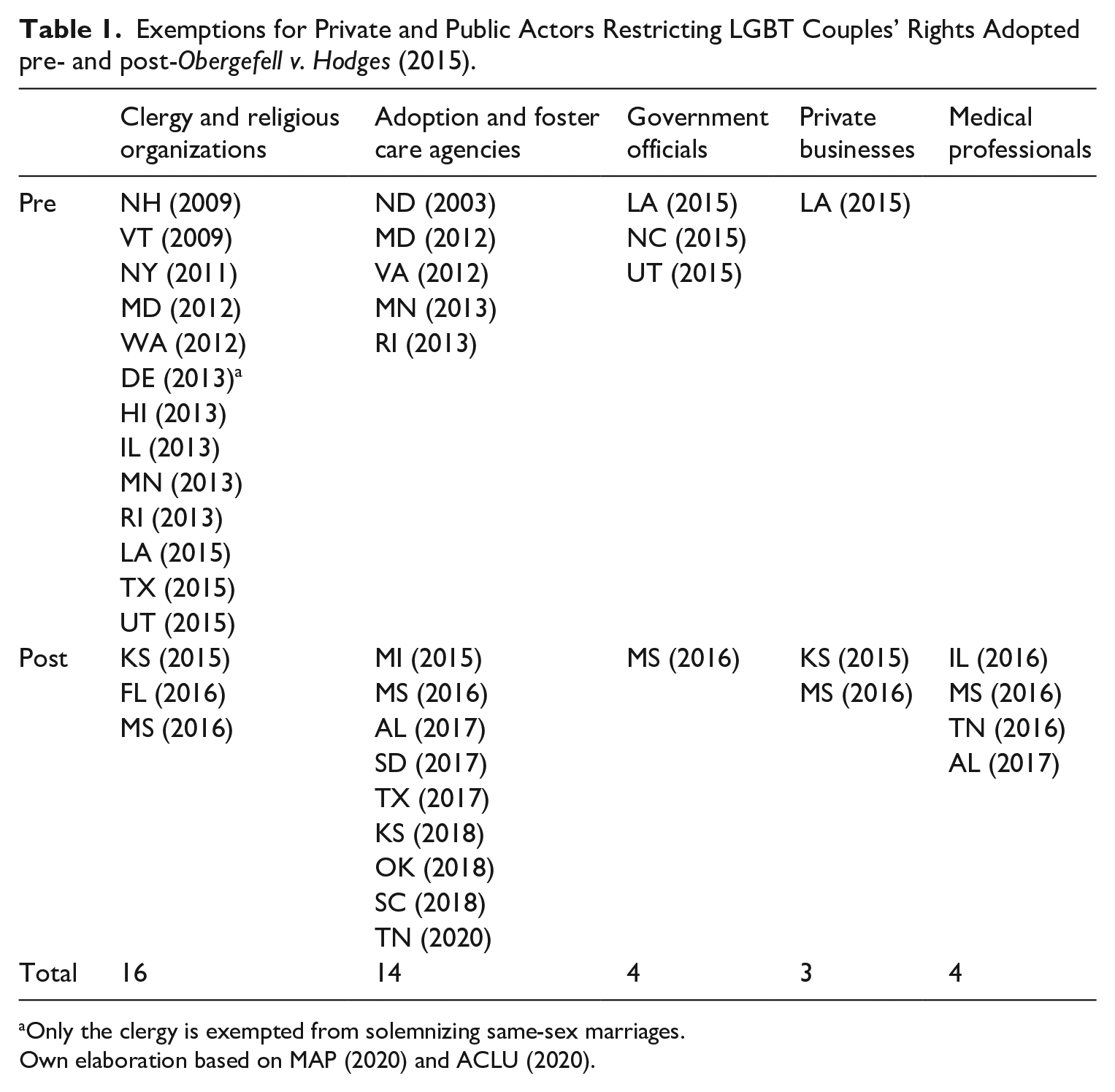
Only the clergy is exempted from solemnizing same-sex marriages.
Own elaboration based on MAP (2020) and ACLU (2020).
Although religious-conservative actors, such as the Heritage Foundation’s senior research fellow, Ryan T. Anderson (2015), portrayed Obergefell v. Hodges as “unadulterated judicial activism” that removed the discussion from the realm of democratic policymaking, 5 they are now seeking to exploit the ambiguity of the Obergefell v. Hodges (2015) ruling to have religious freedom reaffirmed by the judiciary. One of the most relevant cases that has made it to the US Supreme Court, Masterpiece Cakeshop, Ltd. v. Colorado Civil Rights Commission (2018), corresponds to a baker, who in 2012 refused to sell a wedding cake for a gay couple’s commitment ceremony. The couple’s lawyer redeployed the “equal rights and benefits” frame during the oral arguments, claiming that a ruling in favor of the baker would “constitutionally relegate gay and lesbian people to second class status” (Transcript of Oral Arguments at 73, Masterpiece Cakeshop, Ltd. v. Colorado Civil Rights Commission, 584 U.S.___ (2018)) and enable more businesses to discriminate on race, gender, ability, or religious grounds. Yet, this frame failed to persuade a majority of US Supreme Court Justices. In ruling in favor of the baker, the majority opinion stated that the decision did not imply a right for all businesses to discriminate on religious grounds. However, building on the ambiguity of the 2015 ruling, Justice Clarence Thomas noted that “in future cases, the freedom of speech could be essential to preventing Obergefell from being used to ‘stamp out every vestige of dissent’ and ‘vilify Americans who are unwilling to assent to the new orthodoxy’” (Thomas, J., concurring in Masterpiece Cakeshop, Ltd. v. Colorado Civil Rights Commission, 584 U.S.___, 14, (2018)).
Such a reinterpretation of marriage equality may also be gradually furthered due to the appointment of three conservative justices by President Donald J. Trump between 2017 and 2020. In November 2020, the newly conservative-leaning US Supreme Court heard the oral arguments in Fulton v. City of Philadelphia, a case dealing with a Catholic foster care agency that was denied a new contract by the City of Philadelphia because it objected to provide its services to LGBT couples on religious grounds. Employing their “conflicting rights” frame, religious-conservative actors’ lawyers claimed that freedom of religion entitled the foster care agency to obtain an exemption from Philadelphia’s anti-discrimination law. Moreover, they challenged LGBT advocates’ analogy with the Civil Rights Movement by arguing that, unlike the ruling that struck down interracial marriage bans in Loving v. Virginia (1967), Obergefell v. Hodges (2015) explicitly recognized the legitimacy of religious objections to marriage equality (Transcript of Oral Arguments at 39, Fulton v. City of Philadelphia, No. 19–123 (2020)). The lawyer for the City of Philadelphia, which has championed LGBT rights, sought to delegitimize the “conflicting rights” frame pinpointing that, rather than pitting religion against same-sex equality, religion will be pitted against religion if foster care agencies are permitted to claim “we won’t allow Baptists, we won’t allow Buddhists, or we’ll only allow those things” (Transcript of Oral Arguments at 82, Fulton v. City of Philadelphia, No. 19–123 (2020)).
Discussion
Our empirical analysis of marriage equality in the US has documented how modes of change can be simultaneously examined as processes, outcomes and actors’ strategies. As summarized in Table 2, the process of institutional change leading to policy outcomes such as the adoption of same-sex civil unions, marriage equality, and a significant redirection of the policy at the implementation stage has unfolded sequentially through layering, displacement, and conversion. LGBT advocates achieved institutional change by compromising on the more feasible layering before pushing for displacement, while religious-conservative groups have used conversion to undermine the new arrangements, taking over as change agents contesting the status quo. From this sequential perspective, each mode of change led to the next: layering lowered the barriers to displacement as it effected substantial change in public opinion, while the ambiguity of the new rules established through displacement paved the way for conversion. Throughout this process, LGBT and religious-conservative actors’ strategies have significantly built on ideational work, deploying frames to win over citizens’ and public officials’ support and to counteract their opponents’ frames. Actors’ discursive work is thus at least partially determined “by opposing movement interactions” (Fetner, 2008: 120), a dynamic also observed in the case of abortion (Mucciaroni et al., 2019). In doing so, LGBT and religious-conservative actors have sought to create new opportunities to achieve their preferred policy outcomes.
Sequenced Process of Institutional Change, Policy Outcomes and Actors’ Discursive Strategies.
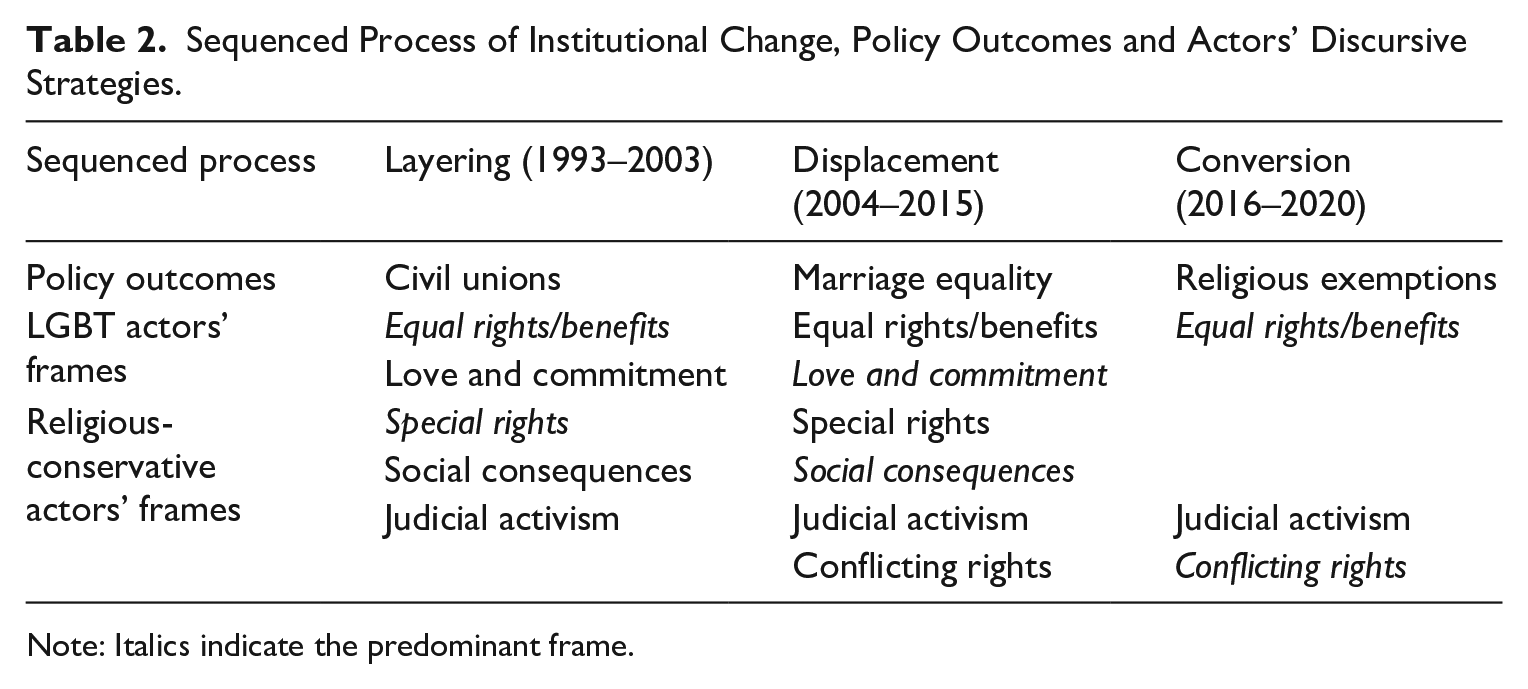
Note: Italics indicate the predominant frame.
First, in several states, the process of layering culminated in the introduction of civil unions for same-sex couples alongside heterosexual marriage as a result of change actors’—that is, LGBT groups—pursuing marriage equality in legislatures and courts. Their discursive strategy based on “equal rights and benefits” contributed to dissipate fears and prejudices against same-sex relationships and families but was insufficient to achieve marriage equality at the time. Yet, anticipating such a major shift in citizens’ and politicians’ position, status quo actors—that is, religious-conservative groups—already started mobilizing against marriage equality through their “special rights” and “social consequences” frames. Second, religious-conservative actors increasingly relied on the “judicial activism” and “conflicting rights” frames to lobby for state constitutional bans on marriage equality and to depict themselves as a minority group deserving exemptions from governmental coercion. However, change actors’ “love and commitment frame” resonated with voters and legislators alike, achieving the replacement of traditional marriage through state-level policy diffusion, substantiating courts’ rejection of status quo actors’ enduring “social consequences” frame, and eventually leading to displacement at the federal level. Third, while about 300,000 of the more than 500,000 same-sex couples in the US have wed since the 2015 US Supreme Court ruling and public support for marriage equality keeps rising (Wolf, 2020), organized opposition remains. Religious-conservative organizations have become at this stage the actors pushing for change, exploiting the discretion in interpretation afforded by the ambiguity of Obergefell v. Hodges (2015) concerning religious freedom. Their “conflicting rights” frame depicting religious groups as victims has contributed to undermining the implementation of marriage equality through state legislation that establishes exemptions on religious grounds for both private and public actors. Indeed, private actors like bakers, caterers, flower shops, funeral homes, or medical professionals have also become ideational entrepreneurs deploying this frame.
When pursuing layering and displacement, frames appealing to emotions have worked out better for LGBT advocates across all venues than those appealing to rights. These frames were a “major engine of change” (Wolfson, 2017: 185) that helped people “resolve the ‘values conflict’ (i.e. fairness vs tradition) in [LGBT couples’] favor” (Coles et al., 2005: 7); that is, they had a constitutive impact by replacing the popular definition of marriage before the institution itself was reformed. Implanting the idea that same-sex couples want to marry for the same reasons as anybody else, appealing to the Golden Rule, and portraying marriage equality as a matter of freedom to marry whoever one chooses could connect to the values system of conservative Democrats, Republicans, and older voters (Zepatos, 2017: 88). In contrast, religious-conservative actors’ emotional frames have garnered a dissimilar success across venues. The “social consequences” frame has been most effective with voters, whereas the “conflicting rights” frame has been increasingly influential on the reinterpretations of marriage equality by legislatures, executives and courts, thereby legitimizing the conversion of the policy. While seemingly secular, these frames are still value-loaded, as they “only make sense on the basis of an underlying moral judgment about homosexuality” (Mourão Permoser, 2019: 313–314). This choice of frames also seeks to legitimize religious groups as public actors and to enhance the influence of religion in the political arena (Vaggione, 2005: 239).
The specificities of the US institutional context have shaped both LGBT and religious-conservative actors’ discursive strategies, with several frames drawing on the policy legacies of the Civil Rights and the pro-life movements, respectively. Nonetheless, discursive shifts toward sameness and secularization have also been observed in other political contexts. In Spain, for example, Calvo and Trujillo (2011: 576) note that “a discourse based on sameness (and not difference) [. . .] was used to woo politicians, the media and society in general” toward approving marriage equality. Similarly, across European countries, the “anti-gender” groups mobilizing to revert progressive reforms in the fields of gender equality and LGBT rights present themselves “as the victims of political abuse, and members of a movement of resistance” that “defend the freedom of speech, thought and conscience” (Kuhar and Paternotte, 2017: 2). Finally, institutional contexts that offer multiple access points, such as the US, are likely to facilitate sequenced change due to the large number of venues wherein policy reforms may be pursued, diffused or blocked and in which actors can mobilize and counter-mobilize (Barnes, 2008; Hollander and Patapan, 2017). Nonetheless, other institutional features such as the degree of interdependence between the legislative and executive powers, the availability of popular referendums, and the saliency of judicial review may also facilitate sequenced change processes.
Conclusion
Taking stock of and contributing to the scholarship that combines historical and discursive institutionalism, this article has shown that, when departing from a dynamic model of agency that takes the role of ideas seriously, modes of gradual institutional change can be studied simultaneously as processes that unfold over time, often in a sequential fashion, as outcomes of these processes, and as strategies pursued by actors to steer, impede or undermine policy change. Ultimately, the discursive strategies employed by actors to (de)legitimize existing institutional arrangements and to create new opportunities that tip the scales to their preferred policy position allow explaining both why specific modes of change were observed and how they developed sequentially. Besides building on policy legacies and adapting to the targeted institutional venues, actors’ frames also respond to their opponents’ discursive strategies.
Furthermore, our empirical analysis pinpoints that traditional, static conceptualizations of agency should be problematized, particularly when studying gender-equitable institutional change. As Verloo (2018: 4) notes, extant research has suffered from “progress bias,” that is an almost exclusive focus on “gender + equality” actors’ efforts to achieve institutional or policy change, while the strategies of conservative actors have been mostly understood as resistance to gender-friendly reforms rather than as a proactive mobilization to transform existing institutions. By conceptualizing religious-conservative groups’ opposition to marriage equality as a deliberate effort to reinterpret and redeploy institutions in their favor, our study shows that the actors contesting the status quo in one stage may become the actors defending it in a subsequent phase of the institutional change process, and vice versa. We thus call scholars to use a more dynamic conceptualization of change and status quo agents.
Our research also highlights that, although policy change and institutional change studies have so far tended to talk past rather than to each other, combining these two strands of literature is a fruitful strategy to examine how gradual change unfolds. Indeed, paying attention to how contextual and institutional factors shape actors’ strategies allows furthering our understanding of the policymaking process (Bakir and Jarvis, 2018: 28). Simultaneously, deeper insights into institutional change processes can be gained by analyzing the role of policy entrepreneurs, that is, actors who mobilize ideas and steer reforms at various stages of the policy cycle (Gunn, 2017). Finally, our study calls attention to the role of private actors as ideational entrepreneurs in the adoption and implementation of value-loaded policies. As morality policy scholars have so far predominantly examined how governmental actors shape policymaking (Euchner and Preidel, 2018: 58), further research is needed on how private actors may do so in less visible and low-profile venues.
Footnotes
Acknowledgements
The authors are grateful to Kerman Calvo, Isabelle Engeli, Naomi Mezey, Georgina Waylen, Evan Wolfson, and the three anonymous reviewers for their valuable feedback on earlier drafts of the manuscript.
Declaration of Conflicting Interests
The author(s) declared no potential conflicts of interest with respect to the research, authorship, and/or publication of this article.
Funding
The author(s) received no financial support for the research, authorship, and/or publication of this article.
