




Abstract
When governments face severe political violence, they regularly respond with violence. Yet not all governments escalate repression under such circumstances. We argue that to understand the escalation of state violence, we need to pay attention to the potential costs leaders might face in doing so. We expect that the decision to escalate state violence is conditional on being faced with heightened threats and on possessing an information advantage that mitigates the expected cost of increasing state violence. In an environment where media freedom is constrained, leaders can deny or reframe an escalation of violations and so expect to reduce potential domestic and international costs attached to that decision. Using a global dataset from 1981 to 2006, we show that state violence is likely to escalate in response to increasing violent threats to the state when media freedom is curtailed – but not when the media are free from state intervention. A media environment that the government knows is free to sound the alarm is associated with higher political costs of repression and effectively reduces the risk of escalating state violence, even in the face of mounting armed threats.
Over recent decades, researchers have developed a better understanding of what types of countries torture, kill and disappear their citizens. Poor countries with a history of repression, ongoing war or violent opposition are likely to be more repressive. Countries with an independent judiciary and an electorate to hold political leaders to account have better human rights records (Bueno De Mesquita et al., 2005; Hill and Jones, 2014; Mitchell and McCormick, 1988; Poe et al., 1999; Zanger, 2000a). There is substantial variation between countries, but the level of state (non-)violence is relatively stable within countries, whether due to strategic calculations, government capacity or bureaucratic inertia (e.g. Davenport, 2007). Substantial changes in state-sponsored violations of physical integrity rights are relatively rare. Escalating violations is an important decision with potentially serious consequences for the government, the opposition and the stability of the country. Under what conditions do governments deviate from the status quo and step up violence against their population? We investigate how the potential costs of escalating repression shape the willingness of leaders to take this decision.
Research on state-sponsored violations of physical integrity rights has generally focussed on the benefit of such violence for the state. It is seen as a tool to contain threats, in particular violent opposition, what Davenport (1995) has referred to as the ‘law of coercive responsiveness’ (Carey, 2006; Davenport, 2007; Lichbach, 1987; Ritter and Conrad, 2016). Governments are most likely to escalate violence when faced with substantial threats to their rule (Carey, 2010). Yet some governments maintain rather than escalate repression under such conditions, as Indonesia did in the early 2000s (Boudreau, 2009; Human Rights Watch, 2002). Governments expect to benefit from repression in managing threats, but they also likely anticipate costs. We argue that this mixed response to threats is conditioned by the government’s capacity to manage the expected costs of repression. Cost management is shaped by the tactics of the opposition (whether it is violent or nonviolent) and importantly by control of the media and the flow of information. In our analysis, the decision to violate physical integrity rights in order to manage threats is viewed in combination with other policy choices, notably with the control of information; repression is not a discrete policy choice.
If governments fear accountability costs for ratcheting up violations of human rights in the form of a domestic or international backlash (Francisco, 1996; Lichbach, 1987), then that fear may be modified by the control the government has over the flow of information. Accountability for wrongdoing depends on a credible account of that wrongdoing. In a country lacking independent media, the government can modify and hinder the flow of information, reframe, vilify or exaggerate the violence used by the opposition, and obscure or justify its actions. A constrained press lowers the costs of escalating state violence and modifies how the government responds to threats.
A comparison of what took place in upper-middle-income Turkey in 2013 and in low-income Georgia in 2003 (World Bank, 2018) highlights the association between media freedom and the government’s response to escalating opposition. Freedom House classified both countries as partially free, with Turkey labelled a democracy and Georgia a semi-democracy according to Polity5 (Marshall and Gurr, 2020). Research on repression tells us that by level of income and democracy, Georgia should have been more likely than Turkey to ratchet up repression. But the opposite was the case when these countries faced massive opposition. In Turkey, extensive demonstrations and protests over Gezi Park were met with state-sponsored violence (Human Rights Watch, 2014). During that time, the Turkish government had already systematically constrained the media (Yılmaz, 2016). As a result, mainstream TV stations failed to report on the protests and the government’s violent responses (Oktem, 2013). The government’s control over the media likely facilitated the heavy-handed government response. Aytac et al. (2017: 64) highlight that ‘the decision of an elected government often boils down to its assessment of the degree to which it will be held accountable for high levels of repression’, which is hampered by state-controlled media.
In contrast, widespread protests in Georgia in November 2003 in response to disputed parliamentary elections culminated in a peaceful change in power, the Rose Revolution. Throughout this process, neither the old nor the new government significantly stepped up the level of violence (Fairbanks, 2004). Unlike other post-Soviet countries, Georgia had relatively free media that were able to report on government behaviour. Popular investigative programmes of the independent TV station Rustivi-2 ‘signalled to people that government figures could be held accountable without serious repercussions’ (Anable, 2006: 16). If they had wanted to increase violence, Georgian leaders likely knew that, unlike their Turkish counterparts, they would be less able to cover up or deny their repressive tactics.
The extent to which governments can or cannot control the content and flow of information about their activities provides an environment that can help explain different reactions to increasing dissent in Turkey and Georgia. Free media increase the likelihood of the government being held accountable and raise the expected costs of escalating repression. Constrained media, as in Turkey, facilitate the escalation of state violence, making it more likely that governments will ratchet up the violation of physical integrity rights when faced with increasing threats.
We examine whether a government’s response to substantial changes in domestic threats is conditioned by its control over the media environment. We accept the standard causal account of repression as a tool to manage threat and focus on increasing violent threats against the government as the most likely scenario for violent escalation by a government. We assess the different tactics of the opposition and include nonviolent dissent, to provide a more comprehensive test of challenges the government might face. Armed conflict and terrorism threaten overall stability and government survival, and have consistently been associated with state-sponsored repression (e.g. Hill and Jones, 2014; Piazza and Walsh, 2009; Shor et al., 2014). These extreme threats pose a particularly challenging test for a potentially modifying role of free media. When dealing with violent dissent by rebel or terrorist groups, governments could claim that the escalation of state-sponsored violence is proportionate and necessary to protect or restore security. The implication of our argument is that escalating violations in response to increasing violent threats is more likely in countries with limited media freedom as opposed to countries where the media are free to investigate and report on the government’s repressive policies.
Using a global dataset from 1981 to 2006, we capture the threat environment and assess government responses to both violent and nonviolent forms of growing political unrest to provide a more comprehensive test of challenges the government might face. We show empirically that the onset or intensification of armed conflict or terror attacks are not systematically associated with a heightened risk of escalating state violence. Instead, the response of governments is conditioned by the expected costs attached to repression. Where the freedom of the media is curtailed, the government is able to justify or even deny the increasing use of state violence. Where the media are free, however, the commonly observed repressive response to extreme forms of violent dissent is less likely.
While research on repression has been dominated by expected benefits of violent policies, our study examines expected costs. It shows how media constraints modify state responses to increasing security threats. 1 Our research provides further evidence for the important role a free and active press plays for the protection of the wider population and why journalists are often targeted by governments (Carey and Gohdes, 2021; Gohdes and Carey, 2017).
Escalating State-Sponsored Violence: A Risky Strategy
The International Covenant on Civil and Political Rights (ICCPR) is designed to protect human rights, including the right to physical integrity. Most states are parties to this treaty. The right to be free from torture, political imprisonment, disappearances and killing is widely accepted, though not consistently implemented (Hathaway, 2002). Once imposed, the level of repression usually remains relatively static (Carey, 2006; Davenport, 2007). As in other policy areas, periods of policy stability dominate and are ‘punctuated’ by change (Pierson, 2000).
Departing from the status quo and escalating violence can have negative consequences for the government domestically and internationally. Domestically, escalation may reduce public support for the government and strengthen resistance (Carey, 2006; Mason and Krane, 1989; Moore and Davis, 1998; Opp and Roehl, 1990; Rasler, 1996; Rost, 2011). For example, in Northern Ireland harsh British counterinsurgency measures triggered further protest and violence between 1969 and 1992 (Francisco, 1996; LaFree et al., 2009).
The naming and shaming and the aid literatures point to the international costs of state-sponsored violence (DeMeritt, 2012, 2016; Hafner-Burton, 2008; Meernik et al., 2012). The violation of physical integrity rights can bring reputational and material costs, such as economic sanctions or reduced foreign aid (Apodaca and Stohl, 1999; Dietrich and Murdie, 2017; Nielsen, 2013; Zanger, 2000b). The risk of negative attention is likely to be greater for a marked increase in repression than for maintaining the status quo. In short, escalating the violation of the fundamental right to physical integrity will come with the expectation of additional costs for governments. 2
Under what conditions might governments escalate state repression despite the risks attached to deviating from the status quo? The risks of escalation are likely outweighed by concerns of maintaining political stability in the face of serious security threats: Repression is usually higher when governments are faced with dissent, and particularly with violent dissent (Carey, 2010; DeMeritt, 2016).
While we know more about the correlates of levels of repression, we examine whether governments respond with escalating state violence when organized political violence against the state breaks out or intensifies. We concentrate on the impact of changes in extreme threats in the form of civil war and terrorist attacks on the propensity to escalate state repression. 3 Civil war is among the best predictors of repression and consistently associated with violations of physical integrity rights (e.g. Hill and Jones, 2014; Poe and Tate, 1994). Both transnational (Dreher and Schneider, 2010; Piazza and Walsh, 2009; Robison, 2009) and domestic terror attacks (Shor et al., 2014) have also been linked to increasing state repression. We extend the analysis to the costs of repression and the media policy correlates of escalating the violation of physical integrity rights.
Censorship and the Escalation of State-Sponsored Violence
The risk of facing domestic and international costs for intensifying state-sponsored violence depends on the availability of reliable information about the behaviour of the state and its repressive agents. Without such information, the government cannot be held accountable and is unlikely to pay a price for increasing violence (Grant and Keohane, 2005; Mitchell, 2012). When governments are under threat and can influence the available information, we argue that they expect to contain the costs of escalating state-sponsored violence. 4 Without a free press, the government can use its information advantage to deny or reframe the otherwise damaging escalation of state violence.
The symmetrical argument that press freedom contributes to better human rights protection is generally supported in the literature (Apodaca, 2007). A free press facilitates the flow of information about government policies, which could make repression too risky for the government. Whitten-Woodring (2009) shows that the positive impact of media freedom on levels of human rights is dependent on democratic institutions. Free media help overcome the collective action problem, influencing the repression–dissent nexus (Kim et al., 2015).
Free media enhance the flow of information about government activities. A government that cannot hide or rationalize its repressive policies is more likely to be held to account and to be punished for its wrongdoing. When journalists are free to investigate and report on government behaviour, the government is likely to be more sensitive to the domestic and international consequences of its actions. If decision-makers are worried about losing domestic and international support, they may choose not to increase state violence – even in the face of escalating threats. While international punishment for wrongdoing is not automatic (Nielsen, 2013), if the visibility, attention and information about the violation of basic rights is limited, then the expectation of being punished should be lower.
Media Control as a Tool for Denial or Reframing
All governments have an incentive to influence the visibility of controversial actions. As Durante and Zhuravskaya (2018) show, even governments with independent media strategically time unpopular actions, such as military operations, for when world attention is diverted by other events. While control over information is usually incomplete (Roberts, 2018), governments oftentimes limit the watchdog function of the press. Controlling the press provides an information advantage, which allows the government to deny or reframe its repressive measures as justified and proportionate to the actions of the opposition (Kim et al., 2015; Norris, 2014). As Hendrix and Wong (2013: 657–658) argue, rulers use torture because they expect a political benefit but if such abuses ‘are widely reported, they become political liabilities for the regime . . . [B]efore deciding to disregard international human rights norms in their actions, rulers assess the probability that their actions will be widely reported’. 5
When the government controls the media, two mechanisms make the escalation of repression more likely: the denial or the reframing of its escalating violence. First, by controlling the media, the government can disguise the escalation of repression. It can deny this turn in strategy, block key sources of information, or deny that the government is behind the escalating violence. For example, Chinese media blamed the protesters in Hong Kong in 2019 as the source of the escalating violence (Myers and Mozur, 2019).
Second, media control helps the government reframe its actions to make them appear excusable or justifiable. Particularly in the context of increased rebel violence or terror attacks, framing may involve vilifying or smearing the opposition, downplaying the government’s own violent strategies, exaggerating the violence of the opposition, shifting responsibility to other agents or packaging the repression as a proportionate and necessary response to protect the security of the public. Government-controlled media can assist in justifying wider repression that might not just be directed at perpetrators of the violent dissent. Growing violent opposition can be exploited by the government to target individuals and groups perceived to pose a threat, even if they are not directly involved in the rebel or terrorist attacks. The authorities can portray the targeted population in a way that justifies an increasingly violent response, for example, as a foreign-influenced out-group that threatens the nation and that requires a ‘firm response’ to avert or reduce the dangers these groups pose for the public. Presenting the targeted group in the media as particularly dangerous reduces the risk of negative repercussions for increasing the overall level of state-sponsored violence.
The development of social media might interfere with these mechanisms because it increases the potential sources and avenues for disseminating information and complicates state control. But this ‘new information age’ also enables governments to monitor these information flows and to flood the news environment with their preferred stories and interpretation of events (King et al., 2013, 2017). ‘Fake news’ can be distributed widely and impede an accurate assessment of government actions. For example, commenting on the Hong Kong protests in 2019, the Financial Times reported that ‘[a]fter an initial ban on any reports of the protests, the Communist party propaganda department has now ordered mainland media to flood the zone with reports emphasizing the violence of protesters and the supposed role of ‘hostile foreign forces’’ (Myers and Mozur, 2019).
Despite the rapidly evolving informational context produced by social media, governments have not abandoned efforts to control conventional media outlets and intimidate journalists (Freedom House, 2015). 6 Conventional outlets are still considered to play an important role. Not all sources of information are equal, nor are they equally circulated domestically and internationally. With controversial policies such as the use of violence, the quality of the evidence base is key. Leaders have most to fear from credible stories of government wrongdoing appearing in widely recognized outlets (Nielsen, 2013) and as a result they continue to invest effort in controlling both traditional and online social media. For example, Russia systematically hampered independent and critical reporting in 2015 to shape the portrayal of the country’s activities in Ukraine and Syria (Freedom House, 2015; Mejias and Vokuev, 2017).
We expect that under conditions of limited press freedom, governments anticipate a lower risk of an international or domestic backlash if they escalate the violation of physical integrity rights in the face of increasing violent opposition. Press freedom, or the absence of it, shapes the political costs of escalating repression and therefore conditions a government’s response to increasing violent dissent. This leads to the following hypothesis: Repression is more likely to escalate in the face of increasing violent dissent when press freedom is constrained.
Our study examines the widely supported argument that violent dissent leads to repression. We assess the impact of increasing violent threats on changes in government repression. Given the empirical pattern found in past research, we would expect that increases in such threats trigger increases in state coercion. But we argue that media freedom is likely to modify this relationship. Governments that can manipulate information about the threat and their behaviour, may anticipate a reduced risk of being held accountable for a repressive response. We test for the presence of the policy correlate of media control when governments escalate repression in the face of escalating violent threats.
Research Design
We analyse the escalation of repression with a global dataset from 1981 to 2006, with the country-year as unit of analysis. 7 Our dependent variable is an ordinal measure of changes in physical integrity rights violations. Change in repression has three categories to account for the ‘decrease’, ‘no change’ and ‘increase’ of repression from one year to the next. Our focus is the ‘increase’ of state repression, but we include the other two possible outcomes to model all government response options.
To construct this measure we use the 5-point Political Terror Scale (PTS) (Wood and Gibney, 2010). The PTS identifies the extent to which physical integrity rights violations affect larger sections of a country’s population, drawing on multiple sources. 8 This allows us to develop a widely accepted and easily comparable measure of substantial, general escalation in a cross-country set up. Change in repression includes changes of one or more ordinal points from any level. 9 Given the stickiness of the original PTS, a one-point change represents a substantial shift in human rights conditions country-wide. It captures changes in the overall repressive strategy at the national level.
Figure 1 graphs the three categories of changes in repression over time. Repression changes in about one third of our observations. 10 Most instances of escalation end at the intermediate category of physical integrity violations (PTS level 3, 38%). Governments that de-escalate tend to arrive at full respect of these physical integrity rights (PTS level 1, 24%).
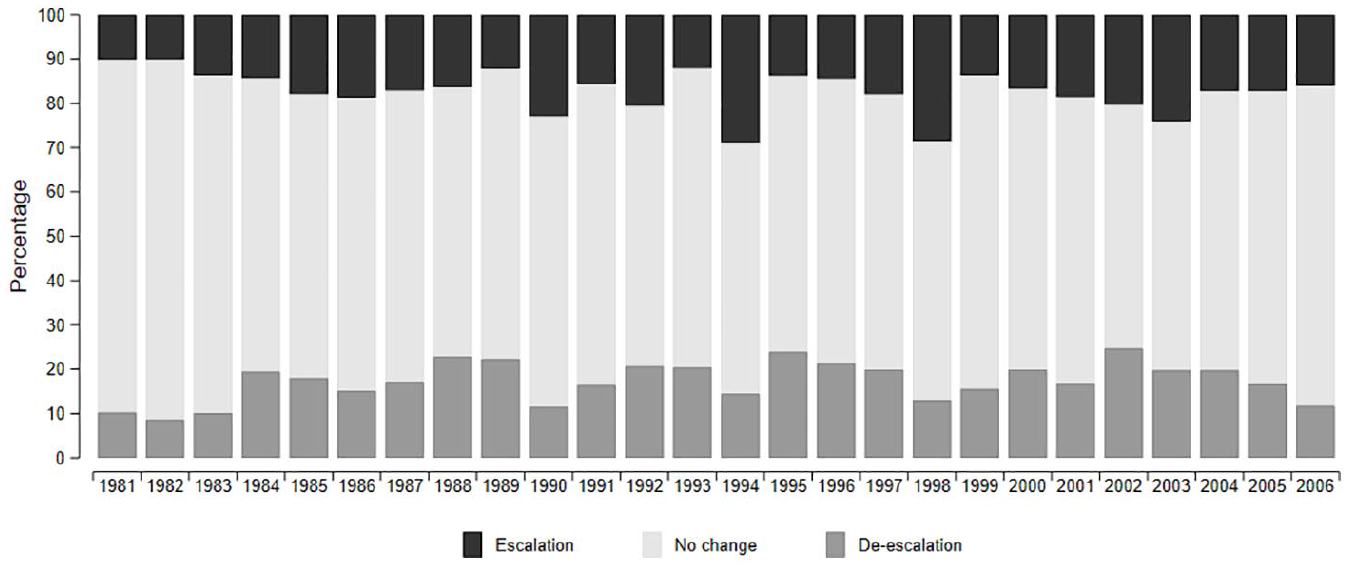
Distribution of the Dependent Variable ‘Changes in Repression’.
Our main independent variables are changes in organized dissent and media constraints. We operationalize changes in dissent in two ways: onset (Dissent onset) and intensification (Dissent ∆). These measures depict different stages of organized action against the government that are likely to affect the leader’s perception of threat intensity and the appropriate response to it. Onset represents the emergence of a new dispute, while intensification refers to the increase of an existing threat.
We code the onset of an armed conflict as a binary variable when clashes between the government and a rebel group generate at least 25 battle-related deaths for the first time, using the UCDP/PRIO Armed Conflict Dataset (Gleditsch et al., 2002). We measure intensification of armed conflict as a binary indicator when the number of battle-related casualties crosses the threshold of 1,000 battle deaths or when the same government faces additional sub-national conflicts with different rebel groups.
To code domestic terror attacks against the national government, including on governmental infrastructure, government officials and citizens, we use data from the Global Terrorism Database (GTD). We apply GTD’s (2016) conservative definition of terror attacks, which have to fulfil three criteria: (i) the intentional use of force to coerce, intimidate or convey a message to larger audience than the immediate victims; (ii) with political, economic, religious or social goal that (iii) takes place outside legitimate warfare activities. We code the onset of a terrorist campaign for the first year in which a domestic terror attack against the government takes place or after at least two consecutive years of no attacks. We code intensification when the number of terror attacks against the same government increases from one year to the next.
Mass opposition to the government can also be of a nonviolent nature. Systematic and organized mass movements pose a distinctive threat to the government and may alter the level of state violence (Chenoweth and Stephan, 2011). To assess whether the modifying effect of free media depends on the tactics of the opposition and applies only to extreme, violent events or to large-scale dissent more generally, we test for the conditioning impact of media freedom when governments are faced with nonviolent campaigns, using the NAVCO 2.0 data set (Chenoweth and Lewis, 2013). 11 We identify nonviolent campaigns onset as a binary indicator for the first year the campaign becomes active. The intensification of nonviolent campaigns is coded 1 when the campaign grows in number of participants, when new organizations become involved in the campaign, or when additional campaigns are initiated against the same government from one year to the next.
The variable constrained media captures the information advantage of the government and is based on the Global Media Freedom Dataset (Whitten-Woodring, 2009; Whitten-Woodring and Van Belle, 2017). We follow Whitten-Woodring and Van Belle (2017: 180–183) and construct a binary indicator. Countries are categorized as having constrained media when it is impossible to safely criticize the government and its officials, and when media outlets are (in-)directly controlled by the government. Media are coded ‘free’ if criticism of the government and its officials is common practice with no further consequences or with limited social, legal or economic costs.
We control for other factors that may affect the risk that repression escalates and that might be linked to media freedom. The government’s decision to extend violent policies may be related to the general political instability of the country or to multiple forms of organized opposition taking place simultaneously. We thus control for other forms of ongoing dissent with binary indicators for either Armed conflict, Terror attacks or Nonviolent opposition. If we excluded these violent and nonviolent campaigns from the analyses, we could not rule out that the decision to escalate repression was guided by these other forms of dissent (Gläßel et al., 2020).
Human rights violations are likely to continue the following year (Carey, 2006; Davenport, 2007), because, like other policies, they are bounded by past practice (Heclo, 2010; Pierson, 2000). We control for the extent to which the government has been using repressive policies by including the lag of the 5-point PTS (PTSlag). We also include regime type because it likely affects both press freedom and changes in repression. In addition, democratic countries are generally less repressive (Davenport and Armstrong, 2004; De Mesquita et al., 2005; Hill and Jones, 2014), and we expect they are also less likely to escalate repression. We control for the degree of democracy with the Xpolity measure, which excludes the dimension of Polity IV that overlaps with conflict (Hill and Jones, 2014; Vreeland, 2008). We recode the Xpolity variable, which ranges from -7 (autocratic) to + 7 (democratic), into a binary variable, identifying democracies for values 4 or higher.
We control for international costs of repression by accounting for countries that are dependent on aid from democracies, where democracy aid is coded ‘as the natural log of the sum total of aid received from democracies as a proportion of the recipient’s gross domestic product’ (Carey et al., 2015: 9). Such countries should be more sensitive to international condemnation and therefore likely to abstain from escalating repression. As richer countries are less repressive and more populous countries are more repressive (e.g. Poe et al., 1999), these factors might also affect the risk of escalation. Hence, we include the log of gross domestic product (GDP) per capita and population size with data from Gleditsch (2002).
We use a multinomial logit model as a government can sustain, increase or decrease the violation of physical integrity rights. Our dependent variable change in repression captures the entire range of this dynamic behaviour. We estimate the coefficients by comparing the outcomes ‘de-escalation’ and ‘escalation’ of repression with ‘no change’, our baseline category. This modelling strategy estimates the probability that a state will increase repression, our main outcome of interest, while accounting for alternative choices the government can make.
We lag all independent variables by one year, except those related to country characteristics, to avoid simultaneous influences from the outcomes we examine. Since the errors may vary systematically by country, we use robust standard errors clustered by country. To deal with autocorrelation in the dependent variable, we include cubic polynomials of the time since the last change in state repression (Carter and Signorino, 2010). We employ alternative modelling strategies, including linear regressions with country and year fixed effects, presented in the online appendix of the Supplementary Information. Table S1.1 in the online appendix of the Supplementary Information provides the summary statistics.
Results
Tables 1 and 2 show the multinomial regression results of dissent types and constrained media on changes in repression. The tables display coefficient estimates for the de-escalation and escalation of repression, with no change as the baseline category. Table 1 uses the onset of each dissent type (Dissent onsetlag) as the main independent variable, while Table 2 depicts the results for dissent intensification (Dissent △ lag ). We theorized that governments are more likely to escalate repression when faced with increasing violent threats, but that the costs of such escalation are conditioned by media freedom. To test for this hypothesized relationship, we interact each dissent type with Constrained medialag.
Multinomial Regressions of Dissent Onset and Constrained Media on Changes in Repression.
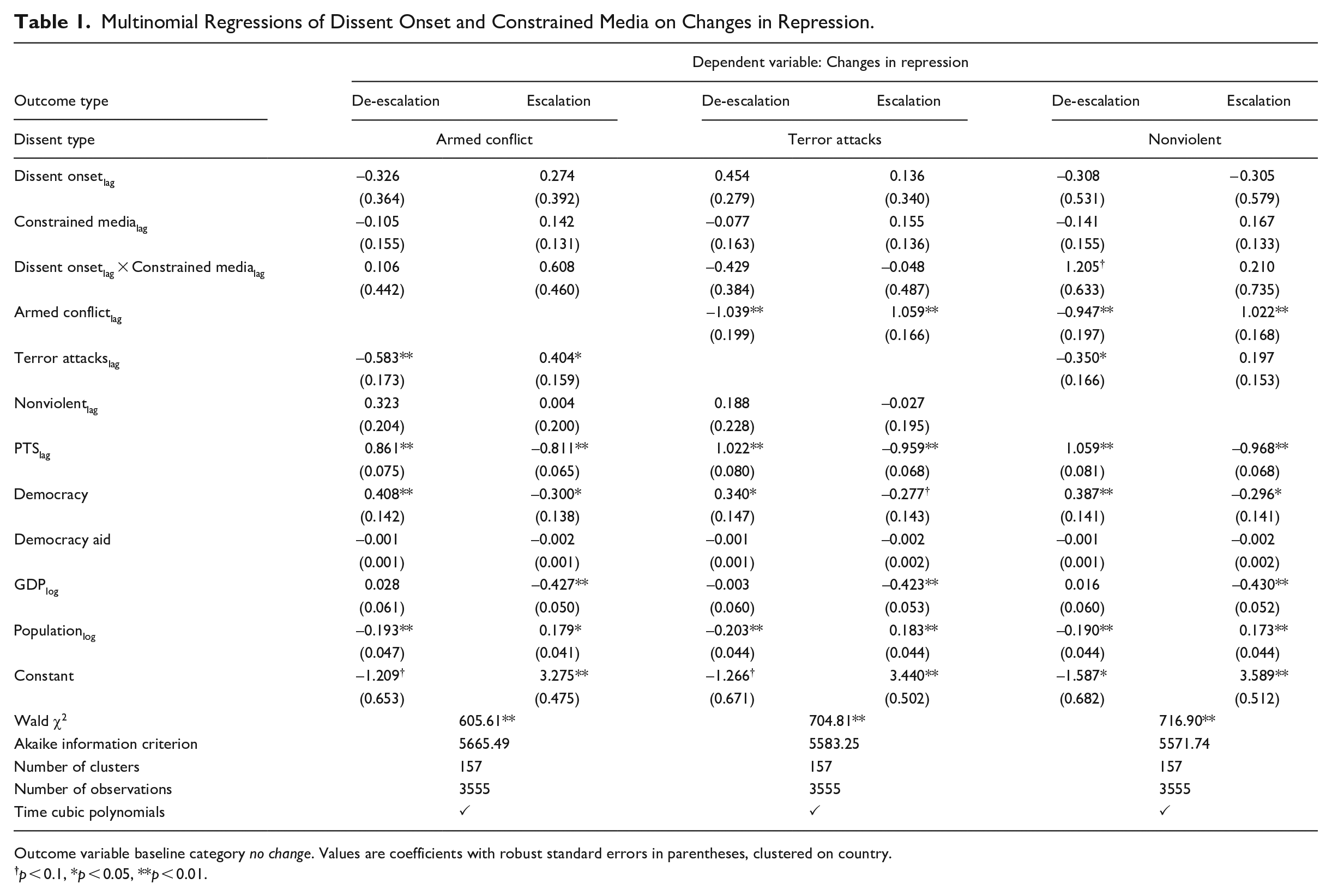
Outcome variable baseline category no change. Values are coefficients with robust standard errors in parentheses, clustered on country.
p < 0.1, *p < 0.05, **p < 0.01.
Multinomial Regressions of Dissent Intensification and Constrained Media on Changes in Repression.
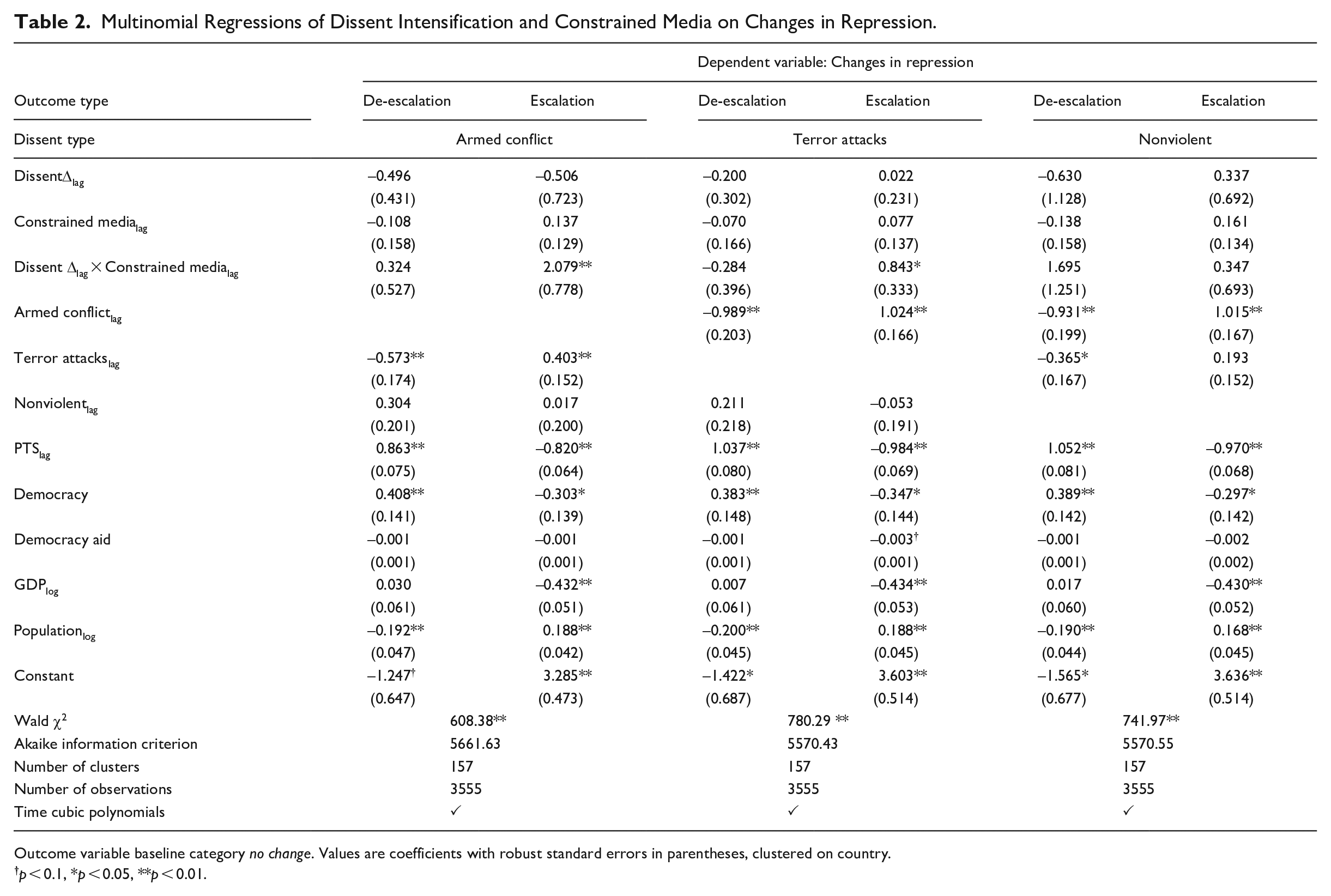
Outcome variable baseline category no change. Values are coefficients with robust standard errors in parentheses, clustered on country.
p < 0.1, *p < 0.05, **p < 0.01.
In Table 1, the coefficient estimates for the interaction terms of violent dissent onset and constrained media fail to reach conventional levels of statistical significance across outcomes. Governments do not seem to escalate the overall level of repression in response to the onset of armed conflicts or terrorist campaigns even when they are in control of the media. This finding qualifies current findings, which assume a consistent relationship between violent opposition and state repression. The otherwise relatively consistent repressive government response to particularly threatening forms of violent attacks does not seem to apply to substantive changes in overall repression when such attacks are first initiated. The coefficient estimate for the interaction term of nonviolent onset and constrained media is statistically significant for the de-escalation outcome, though only at the 10% level. Despite being in control of the media, governments seem to scale down repression at the start of nonviolent campaigns.
Table 2 shows the results for the impact of intensifying violent and nonviolent organized dissent on escalating repression. The coefficient estimates for the interaction terms of violent dissent intensification and constrained media are statistically significant for the escalation of repression. In an environment of constrained media, governments are more likely to respond to increasing violent opposition with escalating state violence, as we would expect from the literature. The coefficient estimate for the interaction term of nonviolent dissent intensification and constrained media fails to reach conventional levels of statistical significance. Rather than escalating repression, governments seem to maintain repression levels when confronted with greater nonviolent resistance.
Among the control variables, the presence of armed conflict or domestic terror attacks consistently increases the risk of escalating state repression and decreases the chances of de-escalation. Nonviolent dissent does not have a statistically significant impact on escalating state violence. PTSlag is robustly correlated with changes in repressive policies across model specifications. The coefficient estimates are positive for the de-escalation outcome and negative for the escalation outcome. The expected advantage of further escalating violence appears to be small when the government is already using repression. Past repression establishes the procedures for continuing violence, but it does not necessarily lead governments to further escalate repression.
The remaining control variables largely support previous findings on the levels of repression and are robust across model specifications. The coefficient estimates for Democracy are positive and statistically significant for the de-escalation outcome and negative and statistically significant for the escalation outcome. Democratic government are less prone to extend torture, killings and disappearances. The measure for democratic aid dependency fails to reach conventional levels of statistical significance in all models. Countries with a better economy are less likely to extend repressive measures as indicated by the negative and statistically significant coefficient estimates of GDPlog for the escalation outcome. Countries with large populations are systematically more likely to either continue with ongoing repressive policies or to increase them as shown by the estimates for Populationlog.
We calculate predicted probabilities to assess the substantive effects of the interaction terms between increasing violent and nonviolent dissent and constrained media (King et al., 2000). We present the substantive effects in two steps to visualize the comparison between our findings. First, in Figure 2, we assess the effect by evaluating government responses to dissent types at different levels of media freedom. In Figure 3, we examine the overall effect of the interaction between dissent type and media freedom.
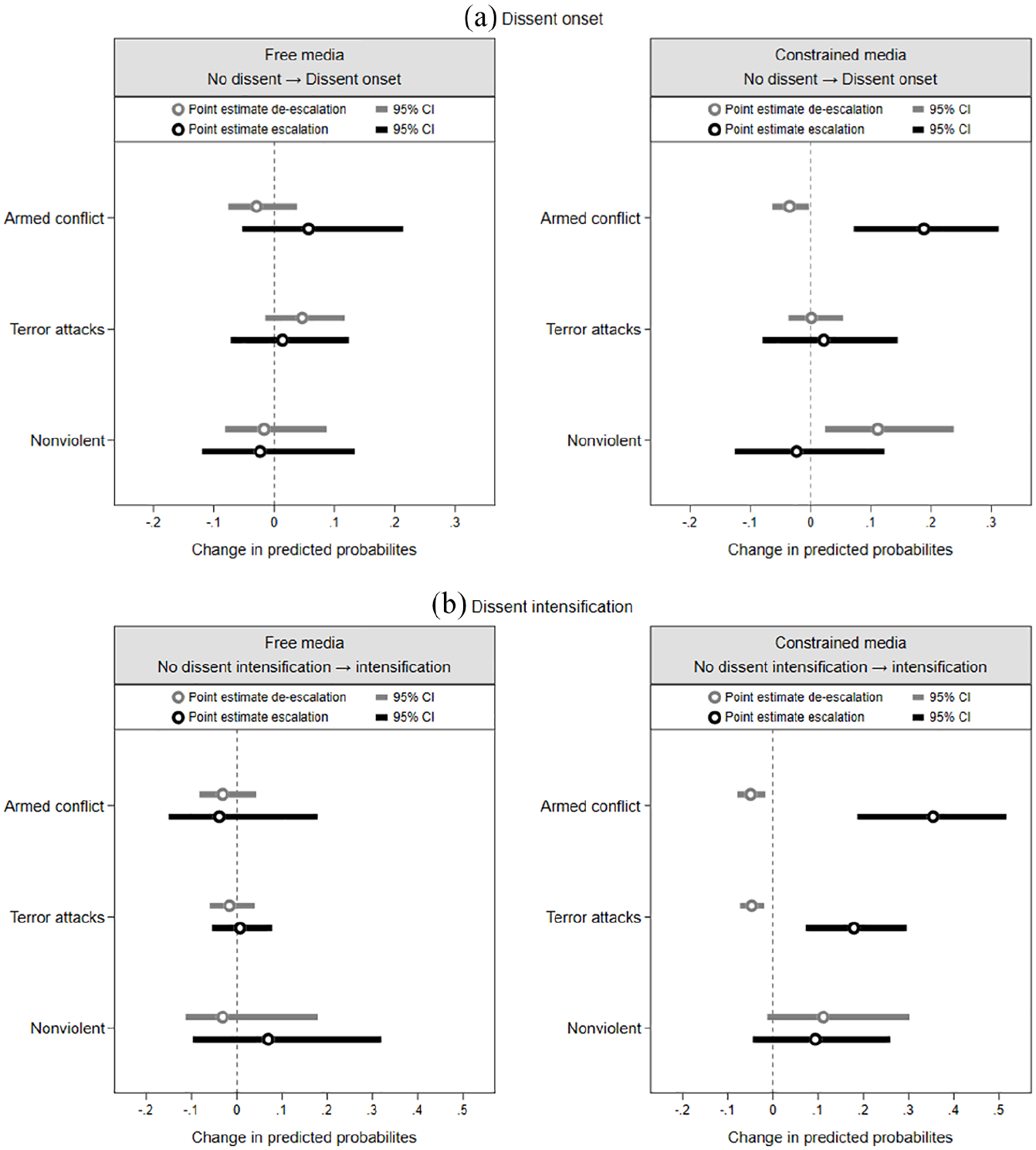
Substantive Effect (Partial Differences) of Dissent Types on Changes in Repression at Different Levels of Media Freedom. (a) Dissent Onset. (b) Dissent Intensification.
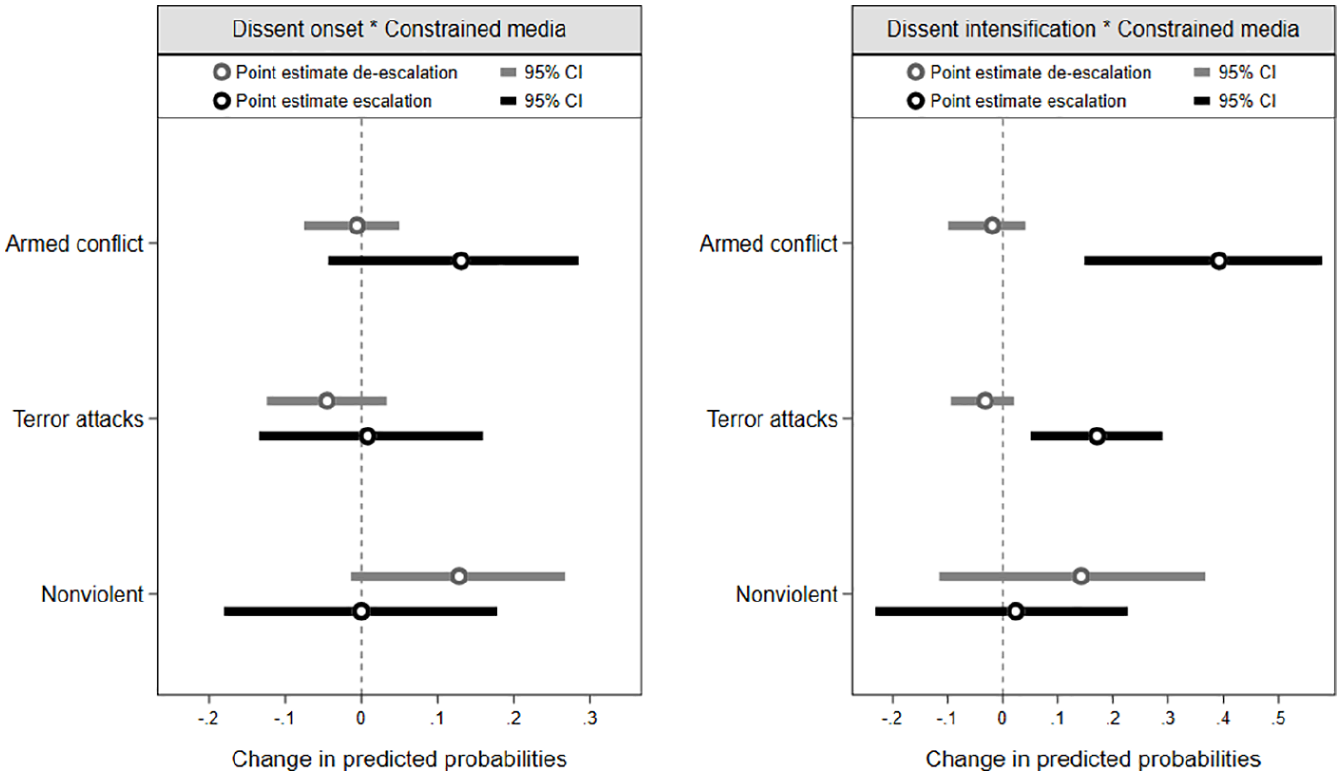
Substantive Effect (Double Differences) of Constrained Media and Dissent Onset (Left) as Well as Dissent Intensification (Right) on Repression.
Figure 2 visualizes the effect of dissent on changes in repression conditional on whether the media are free or constrained (partial differences). The panels display the change in the probability of de-escalation (grey bars) and escalation (black bars) of repression with point estimates and 95% confidence intervals. The two panels at the top visualize the effect of dissent onset on changes in repression (based on Table 1) when the media are free (left panel) and constrained (right panel). The two panels at the bottom present the same information for dissent intensification (based on Table 2).
Focussing on the two panels on the left, governments are unlikely to escalate human rights violations in response to increased threats when the media are free from state control. The confidence intervals around the point estimates for escalating repression under the scenarios of the onset and the intensification of the three forms of domestic threat contain the value zero. Where journalists can freely investigate and report, governments seem to stick to their policies, irrespective of how serious domestic threats become.
The two panels on the right in Figure 2 display how dissent influences repression when media freedom is constrained. They show that under constrained media, the effects of dissent on government violence depend on the nature of dissent. With media freedom curtailed, governments tend to extend repressive policies when attacked by rebel or insurgent groups. Both the onset and intensification of armed conflict are correlated with a higher probability of governments escalating repression (18% and 31%, respectively). Governments with control over the media are also likely to escalate repression in response to the intensification of terrorist attacks (panel on the bottom right in Figure 2), but not following the onset of terror (panel on the top right). When terrorist groups first become active governments seem to first wait and assess how the situation develops. Should attacks intensify, however, governments likely increase repression – but only if they control the media.
Faced with increasing nonviolent campaigns governments do not seem to escalate repression. This finding supports the argument that governments are aware of the repercussions of violence against protesters (Chenoweth and Lewis, 2013), as state violence can increase support for nonviolent movements (Sharp, 2005). Escalating state repression when faced with nonviolent dissent also usually lacks support among the wider population (Lupu and Wallace, 2019). Under such circumstances, instead of using force, governments may opt for using their power over media to publicly discredit the protest movements without provoking the material and political costs associated with extending repressive policies (Brechenmacher, 2017).
To gauge the size and statistical significance of the overall effect of the product term, we visualize double differences (Berry et al., 2010). Figure 3 shows the substantive effect of constrained media for dissent onset (left panel) and dissent intensification (right panel). Dissent onset and constrained media (left panel) do not seem to influence repressive policies. In contrast, when governments are faced with intensifying attacks by rebels or terrorist (right panel), they escalate repression levels in an environment of constrained media. Yet, they will not do so when confronted with growing dissent that is nonviolent. These findings qualify research that assumes a consistent and uniform relationship between violent opposition and state repression.
Robustness Checks and Alternative Explanations
Our main findings are robust to different specifications and controlling for possible alternative explanations, which we report in the online appendix of the Supplementary Information. First, we re-estimated our models using an alternative operationalization of constrained media. To reduce the impact of our outcome variable on short-term changes to media freedom, we replace our media measure with fixed country averages of constrained media. 12 An escalation of repression might itself limit media freedom. This country average captures the prevailing policy pattern of media conditions. The main findings hold when replicating the original multinomial estimations using the fixed country average of constrained media.
Second, we replicate our analysis estimating ordinary least squares (OLS) regressions on the 3-point change in repression scale 13 and binary probit regressions on the distinctive outcomes of ‘de-escalation’ and ‘escalation’. In the linear models, we include country and year fixed effects to control for idiosyncrasies and characteristics that may emerge from specific countries or specific years and that could influence the outcome variable. Our key findings remain robust to these alternative specifications.
Finally, we control for several potential factors that may affect governments’ decisions to change repressive policies. We include military personnel per capita (Correlates of War Project 2010) to account for the government’s ability to deploy repressive agents and presence of pro-government militias (Carey et al., 2013), which are associated with worse human rights violations (Mitchell et al., 2014). Our main results remain unaffected when we control for these measures of repressive capabilities. 14
Threats to the government can also emanate from within the ruling elite itself (Powell and Thyne, 2011). An attempted military coup d’état can provide an incentive for governments to increase repression, to ensure they have eradicated the threat and to deter further dissent. 15 Controlling for failed coup attempts does not change our findings. We account for major threats in neighbouring countries as these can influence the government’s decision to extend its repressive policies (Gleditsch and Rivera, 2017). Including control variables for armed conflict, terror attacks and nonviolent campaigns in bordering countries does not change our main findings. 16
Case Examples and Discussion
We use two cases, Venezuela and Ecuador, to briefly illustrate our argument. The case of Venezuela shows how governments can use their control over media to justify escalating state repression in response to increasing dissent. In contrast, in Ecuador, where the press reported freely on the government’s behaviour, state officials chose not to increase repressive policies despite growing violent threats.
Venezuela had a record number of members of their security forces murdered in 2016 (Venezuela Investigative Unit, 2017) and experienced escalating anti-government protests in 2017. A United Nations High Commissioner for Human Rights report estimates that anti-government protests increased by 157% compared with the previous year (Office of the United Nations High Commissioner for Human Rights (OHCHR), 2017: 5). While only some protests were violent, the government-controlled media portrayed a rising subversive threat that required an increasingly repressive response. In April 2017, President Maduro even warned on national television of a United States coup while broadcasting images of government loyalist marches ‘to defend the homeland’ (López and Watts, 2017). In response to growing dissent, and exploiting the control over the media, Venezuelans were exposed to ‘mounting levels of [government] repression’ as well as ‘increasing stigmatization and persecution of people perceived as opposing the Government of President Maduro’ (OHCHR, 2017: ii–iii). The case of Venezuela illustrates how the government used its ability to shape the public discourse, warning of the severity of the threat, in combination with escalating state violence.
In contrast, Ecuador in the late 1980s and early 1990s highlights the importance of free media in constraining government responses to increasing opposition. Between 1988 and 1992, Ecuador experienced a growing trend in terror attacks and fatalities. Foreign embassies were targeted in the capital city, while in the countryside, indigenous groups began occupying estates and prompting owners to recruit private guards (Brooke, 1991). Despite the variety of threats and the ‘unnerved propertied class’ (Brooke, 1991), the government did not escalate repression. Lower-level officials allegedly used torture, but the overall level of state violence did not change in response to the increasing terror attacks. There were no reports of politically motivated killings, disappearances or imprisonments, with the exception of two disappeared Colombians in 1988 (United States Department of State, 1989, 1992, 1993). These disappearances were reported on TV and radio programmes, prompting government investigations and the arrest and charging of the responsible police officers (United States Department of State, 1992: 582, 1993: 392). By monitoring the activities of state agents, the media, which operated freely and represented a wide diversity of views (United States Department of State, 1989: 547), contributed to maintaining the level of human rights protection despite increasing terror attacks.
If escalating repression was based simply on its calculated benefits, then the government’s information advantage and ability to manage repression’s political costs would not matter for explaining changes in physical integrity rights violations. The example from Ecuador and the results from our multivariate analyses show that governments facing intensifying violent threats seem more likely to refrain from ratcheting up repression when reporters can investigate and report freely. In contrast, media-controlling governments as in Venezuela expect to curb the political costs of escalating repression. Decision-makers can place their preferred stories, shape how rebel or terror groups are portrayed, frame escalations as a proportionate state response and make monitoring of its compliance with international human rights norms more difficult.
Conclusion
Violent threats are usually followed by state repression, as summarized in the ‘law of coercive responsiveness’ (Davenport, 2007: 7). This relationship is less straightforward when we focus on the government’s response to dynamic changes in threats and the media environment. A free press can help to hold governments to account, making it more politically risky to ratchet up state violence. Our study shows that even when the government is faced with growing terror attacks and armed conflict, escalating state repression is less likely when journalists can investigate and publish their reports freely.
Our findings highlight the importance of examining the political costs of repression for political leaders, the policy correlates of physical integrity violations and the role of the press in ensuring accountability. Governments are sensitive to the flow of information and the possibility that domestic or external actors can impose political costs for human rights violations, such as torture and extrajudicial killings when they are more visible (Hendrix and Wong, 2013). An information advantage allows governments to excuse or justify their use of violence. They shift responsibility or they can frame their policies and targets in a way that makes increasing violence appear proportionate and appropriate, and it reduces the perceived likelihood of being held accountable. Media control can lower the perceived political costs of increasing repression and make such escalation more likely, as our findings show. The conditional relationship between intensifying violent dissent and media control helps explain variation in responses to violent domestic threats and why some decision-makers are willing to increase repression, while others are not, despite rising domestic threats. Control of the media reduces the anticipated costs of ratcheting up repression. Our results suggest the importance of a free media as a constraint on a government’s use of coercive force and that violations of physical integrity rights are not a discrete policy, but part of a policy package. While limiting media’s ability to do its job may not be as shocking as the violation of physical integrity rights, it may facilitate the latter.
In analysing media constraints, we have investigated perhaps the most obvious of complementary policy correlates for repression. Accountability for contentious decisions and the attendant political costs can also be managed in other ways. Work on regional patterns of violations suggests that governments mimic neighbouring states and attempt to hide their non-compliance in a crowd of non-compliers, governments impose restriction on civil society organizations as well as the media or use proxies to implement repression (e.g. Bakke et al., 2020; Bell et al., 2019; Carey et al., 2015; Simmons, 2009). Furthermore, our focus is at the country-level and national strategies of repression. Escalating dissent may involve substantial policy changes at the local level that are not picked up in our study. State agents at different levels and organizations might have very different accountability-evading measures available to them (Carey and Gohdes, 2021). The degree of complementarity of these measures is worth investigating.
We still have only a limited understanding of why repression de-escalates and governments respect human rights in previously repressive contexts, for example, after the end of an armed conflict or after the termination of a highly repressive regime (Carey and González, 2021). In order to secure respect for human rights, particularly under volatile conditions, we need a better understanding of possible measures that can foster the de-escalation and prevent the re-escalation of state violence. Protecting media freedom and the independent monitoring of government policy are likely to be central to such efforts.
Supplemental Material
sj-pdf-1-psx-10.1177_00323217211020243 – Supplemental material for Media Freedom and the Escalation of State Violence
Supplemental material, sj-pdf-1-psx-10.1177_00323217211020243 for Media Freedom and the Escalation of State Violence by Sabine C Carey, Belén González and Neil J Mitchell in Political Studies
Footnotes
Acknowledgements
The authors thank the editor and the reviewers for their helpful comments. Earlier versions of this project were presented at the ISA Convention 2016, at the 2016 workshop ‘Violent and Nonviolent Tactics in Conflict’ at Peace Research Institute Oslo (PRIO), at the University of Heidelberg and at the ETH and University of Zurich. They are particularly grateful to Stefanie Bailer, Charles Butcher, Lars-Eric Cederman, Scott Gates, Kristian Gleditsch, Adam Scharpf and Hannah Smidt for their valuable feedback.
Declaration of Conflicting Interests
The author(s) declared no potential conflicts of interest with respect to the research, authorship and/or publication of this article.
Funding
The author(s) disclosed receipt of the following financial support for the research, authorship and/or publication of this article: This project received funding from the European Research Council under the European Union’s Seventh Framework Programme (FP7/2007-2013)/ERC Grant Agreement no 336019.

Supplementary Information
Additional Supplementary Information may be found with the online version of this article.
Contents S1 Summary and descriptive statistics S1.1 Summary statistics Table S1.1. Summary statistics S1.2 Distribution of changes in repression Table S1.2.2. Distribution of changes in repression Table S1.2.3. Frequency of changes in repression by regime type Table S1.2.4. Frequency of changes in repression by PTS value S1.3 Frequency of constrained media by regime type Table S1.3.1. Frequency of media freedom by regime type S2 Alternative estimations S2.1 Ordinary least squares (OLS) and probit regressions Table S2.1.1. Fixed effects (country) linear regressions (OLS) of dissent and constrained media on changes in repression Table S2.1.2. Fixed effects (country and year) linear regressions (OLS) of dissent and constrained media on changes in repression Table S2.1.3. Probit regressions of dissent and constrained media on the de-escalation in repression Table S2.1.4. Probit regressions of dissent and constrained media on the escalation in repression S2.2 Models including a control variable for military personnel Table S2.2.1. Multinomial regressions of dissent onset and constrained media on changes in repression, with control variable for military personnel per capita Table S2.2.2. Multinomial regressions of dissent intensification and constrained media on changes in repression, with control variable for military personnel per capita S2.3 Models including a control variable for pro-government militias (PGMs) Table S2.3.1. Multinomial regressions of dissent onset and constrained media on changes in repression, with control variable for pro-government militias (PGMs) Table S2.3.2. Multinomial regressions of dissent intensification and constrained media on changes in repression, with control variable for pro-government militias (PGMs) S2.4 Models including a control variable for coup attempts Table S2.4.1. Multinomial regressions of dissent onset and constrained media on changes in repression, with control variable for failed coup attempt Table S2.4.2. Multinomial regressions of dissent intensification and constrained media on changes in repression, with control variable for failed coup attempt S2.5 Models including a control variable for armed conict in neighbouring country Table S2.5.1. Multinomial regressions of dissent onset and constrained media on changes in repression, with control variable for armed conict in neighbouring country Table S2.5.2. Multinomial regressions of dissent intensification and constrained media on changes in repression, with control variable for armed conict in neighbouring country S2.6 Models including a control variable for terrorism in neighbouring country Table S2.6.1. Multinomial regressions of dissent onset and constrained media on changes in repression, with control variable for terrorist attacks in neighbouring country Table S2.6.2. Multinomial regressions of dissent intensification and constrained media on changes in repression, with control variable for terrorist attacks in neighbouring country S2.7 Models including a control variable for nonviolent campaigns in neighbouring country Table S2.7.1. Multinomial regressions of dissent onset and constrained media on changes in repression, with control variable for nonviolent campaign in neighbouring country Table S2.7.2. Multinomial regressions of dissent intensification and constrained media on changes in repression, with control variable for nonviolent campaign in neighbouring country S2.8 Models with an alternative measure of constrained media Table S2.8.1. Multinomial regressions of dissent onset and constrained media (fixed averages) on changes in repression Table S2.8.2. Multinomial regressions of dissent intensification and constrained media (fixed averages) on changes in repression S2.9 Models excluding all control variables Table S2.9.1. Multinomial regressions of dissent onset and constrained media on changes in repression, without control variables Table S2.9.2. Multinomial regressions of dissent intensification and constrained media on changes in repression, without control variables Figure S2.9.1. Substantive effect (double differences) of constrained media over the range of dissent onset (left) and intensification (right) based on Tables S2.9.1 and S2.9.2
Notes
Author Biographies
References
Supplementary Material
Please find the following supplemental material available below.
For Open Access articles published under a Creative Commons License, all supplemental material carries the same license as the article it is associated with.
For non-Open Access articles published, all supplemental material carries a non-exclusive license, and permission requests for re-use of supplemental material or any part of supplemental material shall be sent directly to the copyright owner as specified in the copyright notice associated with the article.
