




Abstract
Large-scale efforts to measure the democratic nature of polities across space and time are most useful when they reflect the variety of conceptions of democracy developed by political theorists. Traditionally, the attention of political theorists as well as political scientists focused on what it means for the people to rule, to the neglect of the equally important question of who the relevant people should be. In recent years, however, an increasing number of political theorists have tackled the problem of defining the demos and offered a wide range of answers. The article argues that empirical democracy measurement projects should take into account the variety of conceptions of the demos debated today instead of assuming consensus on this dimension. It also discusses how this can be done systematically. The arguments are developed with reference to the most ambitious and comprehensive democracy measurement project yet: Varieties of Democracy (V-Dem).
Introduction
Interest in the spread, causes, consequences and decline of democracy is intense and shows no sign of abating. It is accompanied by strong demand for sources of information that can help researchers compare levels of democracy across space and time. The demand is met by an array of datasets that provide democracy indicators in a standardized format. Nearly two decades ago, Munck and Verkuilen (2002) were able to identify and assess nine systematic measurement projects devised by scholars of democracy, and since their exercise further measures have been developed and made available to users.
Several of these democracy datasets are attempts to operationalize concepts developed by political theorists, with the work of Robert Dahl being particularly influential. Until recently, however, there has been a major imbalance in the amount of attention that political theorists have given to two different but equally important dimensions of democracy, understood as rule by the people: most efforts were devoted to spell out what it should mean for the people to rule, while the question of who the relevant people should be was attracting much less attention. If we decompose the Greek word δημοκρατία into δῆμος (the commons, the people) and κράτος (power, rule), we obtain two handy labels for these dimensions: the demos problem and the kratos problem. In 1970, Dahl (1970: 60) himself pointed at the imbalance: ‘Strange as it may seem to you, how to decide who legitimately make up “the people” – or rather a people - and hence are entitled to govern themselves in their own association is a problem almost totally neglected by all the great political philosophers who write about democracy’. Nearly 40 years later, Robert Goodin (2007: 41) could still write that ‘[v]irtually all democratic theorists find they have surprisingly little to say on the topic’. But things have changed considerably since then. An increasing number of political theorists stress that the assessment of the democratic nature of a polity depends on how the people are defined, in addition to whether and how they govern themselves. 1 If the imbalance of attention is being rectified in political theory, political scientists’ efforts to measure democracy empirically need to be reconsidered too, instead of implicitly or explicitly assuming a consensus on the demos question that does not exist. In this article, I argue that such a reconsideration is necessary and offer some suggestions for doing it in a systematic way.
I approach this task by discussing a specific measuring project: the Varieties of Democracy (V-Dem) datasets released from 2014 onwards (Coppedge et al., 2011, 2020). I focus on this project for two reasons. First, its methodological rigour as well as breadth and depth of expertise (it is designed and managed by over 50 scholars worldwide and relies on the input of more than 3000 country experts) is rapidly making V-Dem a standard point of reference in political science and beyond. Second, and most importantly, because the V-Dem project is already exceptionally sensitive to the diversity of positions on the nature of democracy found among political theorists and it offers a sophisticated approach to handling this diversity in empirical research. The starting point of the V-Dem project is the recognition that scholars of democratic theory disagree on what exactly democracy entails: ‘There is no consensus on what democracy writ-large means beyond a vague notion of rule by the people’ (Coppedge et al., 2019b: 4). 2 Accordingly, users of V-Dem data are not forced to accept a single definition of democracy, but they can and should combine indicators in a way that maximizes the fit between their preferred conception of democracy and the empirical data available to assess its trends, antecedents and effects. The V-Dem project team made extensive use of the work of political theorists to identify five broad understandings of democracy, which it labelled the Electoral, Liberal, Participatory, Deliberative and Egalitarian conceptions. Each of these conceptions is reflected in separate indices that result from the aggregation of over 400 fine-grained indicators, with both the aggregated and disaggregated data being available to users. Crucially, this theoretical breadth and depth do not come at the expense of coverage, since whenever possible the data cover every country in the world since 1789.
The key argument of this article is that, given that political theorists are as divided on the demos problem as they are on the kratos problem, any exercise that aims for comprehensiveness, such as V-Dem, is incomplete if it does not provide users with information on how well polities meet the criteria postulated by different conceptions of the demos. To mention just one example that is discussed at length later, the information provided in the V-Dem dataset allows users to decrease the democracy score of a polity whose autonomy is limited by another polity, for instance because it is subject to colonial rule, but not to decrease the democracy score of the polity that imposes such limitations on other polities, for instance because it is a colonial power. From the perspective of influential conceptions of the demos, this is a significant lacuna. But, crucially, it is a lacuna that can be addressed by developing additional indicators to complement the current framework.
The article is structured as follows. The next section identifies a range of answers given to the question of defining the demos in contemporary political theory. The subsequent section considers whether and how the V-Dem coding framework relate to such answers. Finally, the article discusses how V-Dem and similar large-scale data collection projects could be strengthened by the inclusion of additional indicators focused on the demos problem.
The Demos Problem in Political Theory
Over the past 20 years, the question of ‘who should be the people’ has given rise to one of the most intense debates in the field of political theory. I do not aim to adjudicate between alternative conceptions of the demos, but rather to emphasize that alternative conceptions exist. Hence, in this section, I will schematically present five answers to the demos question that have attracted significant attention among political theorists.
A few caveats. First, the five approaches to defining the demos examined here are arguably the most prominent, but they do not exhaust the full range of positions. 3 Second, the arguments are complex, with participants sometimes offering more precise, nuanced or qualified defences of positions sketched by previous authors. The following overview will focus on the broad features of each approach and neglect more fine-grained distinctions. Third, the following discussion skirts the more philosophical question of the establishment of political authority and the role played by consent, and focuses on a more concrete question that matches the aim of the V-Dem project: given that a state or polity is in existence, how do we assess its democratic credentials? Specifically, how philosophically legitimate are the boundaries of its demos? A final caveat concerns the scope of the analysis. The V-Dem project considers only the democratic nature of ‘large and fairly well-defined political units’, mostly states, and refers to them as ‘polities’ (Coppedge et al., 2011: 252). This excludes smaller communities, transnational movements and international organizations from its purview. This article limits the scope of the argument in a similar way, while noting that several participants in the demos debate stress that the democratic quality of transnational and intergovernmental organizations, and international politics as a whole, can and should be assessed as well. 4 The focus on states adopted here should not be seen as a rejection of such arguments. The similarities and differences between the relevant constituencies across state and non-state context remains an important topic of research, as demonstrated, for instance, by the on-going debate about demoi-cracy in the European Union (Bellamy, 2019; Cheneval et al., 2017; Nicolaïdis, 2013). Let us now consider the five answers. 5
The Agnostic Position
One of the earliest attempts to grapple with the demos question was made by Joseph Schumpeter (1942) in chapter 20 of Capitalism, Socialism and Democracy. This book is most famous for giving a minimalist answer to the kratos problem (Ingham, 2016), but it also discusses the problem of who the people are. In essence, Schumpeter denied the validity of the question itself, by arguing that analysts of democracy should not pass judgement on the composition of the demos, but accept as given whatever demoi history has produced. From this perspective, the demos simply consists of those who have voting rights and who, de facto, rule. Given that Schumpeter essentially thought that de populis non disputandum est, we can call this the agnostic position, as it does not necessarily amount to a normatively defined ‘principle’.
The Nationality Principle
While several versions of nationalist theory exist, they share the contention that the boundaries of demos should coincide with the boundaries of nations, understood as collectives of individuals sharing a national identity. In identifying national identities, some nationalists privilege ‘objective’ factors, such as language, whereas other nationalists stress their ‘subjective’ nature, maintaining that ‘a nationality exists when its members believe that it does’ (Miller, 1993: 6). But even subjectivist nationalists such as David Miller (1993: 7) maintain that [n]ational divisions must be natural ones; they must correspond to real differences between peoples. This need not, fortunately, imply racism or the idea that the group is constituted by biological descent. The common traits can be cultural in character: they can consist in shared values, shared tastes or sensibilities.
This argument implies that each ‘national community’ can establish its own membership criteria – ethnic, civic and so on – provided that all members identify with a ‘public culture’ that is external to each person taken individually. For a nationalist, then, a country possesses a properly constituted demos when its citizens or residents share a national identity, whichever specific criteria for identity are applied in the country in question. A country where this is not the case would not qualify as fully democratic, insofar as it fails to foster national self-determination through measures such as assimilation, secession or autonomy for territorially concentrated minorities, or in other ways.
The Legal Subjection Principle
A prominent strand of thinking identifies the concept of democracy with the concept of collective self-rule, that is, autonomy. Laws are democratically legitimate when those expected to comply with them are also their authors. In the words of Dahl (1998: 78, emphasis removed), ‘[t]he citizen body in a democratically governed state must include all persons subject to the laws of that state except transients and persons proved to be incapable of caring for themselves’. Some authors have endorsed the general principle but added qualifications and specifications. For instance, Eva Erman (2014) argues that subjection to laws generates entitlements to equal influence in decision-making only when it is not merely ‘over time’ but also ‘systematic’, hence distinguishing the case of the businesswoman who visits a polity on a long-term basis from a long-term resident alien. The general implication of the principle is that a mismatch between the authors of and subjects to the law compromises the democratic nature of the polity.
The Coercion Principle
Another approach also starts from the ideals of individual autonomy and equal standing but concludes that the exercise of political power is democratically legitimate if it conforms to the collective will of those exposed to it, irrespective of whether they are expected to comply with laws or not. To gain a right to participate in the decision-making of a state, it should be enough to be subject to the coercion of that state. The task then becomes to identify the circumstances under which individuals are subject to coercion. Such assessments can be controversial, as shown by the debate on whether measures that states take in order to control access to their territories, that is, border control, should be considered coercive or not. For Arash Abizadeh (2012: 14), border control is intrinsically coercive towards outsiders, as it involves the threat and actual use of physical force, and therefore ‘particular boundaries can and must be legitimized as the outcome of democratic procedures that include those whom the boundary picks out as outsiders’. Miller (2010) retorts that border control is not coercive. Other decisions that states can take, such as initiating military action against other polities, are more obviously coercive, and will be discussed later.
The All-Affected Principle
Several authors have argued that all those whose fundamental interests are affected by the exercise of political power should be entitled to participate in decisions on its use. David Held argued that globalization undermines a key assumption of traditional democratic thought – a ‘symmetrical’ and ‘congruent’ relationship between ‘decision-makers’ and ‘decision-takers’ – and that democracy is challenged by ‘the divergence that sometimes exists between the totality of those affected by a political decision and those who participated in making it (however indirectly) within a democratic state’ (Held, 1995: ix). Other prominent political theorists, such as Daniele Archibugi (2008), Robert Dahl (1970), John Dryzek (2006), Robyn Eckersley (2000), Rainer Forst (1999), Archon Fung (2013), Robert Goodin (2007), Johan Galtung (1981), Jürgen Habermas (2006), Jan Aart Scholte (2008), Ian Shapiro (2003), Iris Marion Young (2000), Jeremy Waldron (1999), Mark Warren (2017) and Michael Zürn (2000), endorse the idea that democracy requires that people significantly affected by a decision should be able to take part in reaching that decision.
The all-affected principle typically leads authors towards a more expansive conception of the demos than the legal subjection and coercion principles, because individuals can be significantly affected also by decisions that do not coerce them or are not legally binding on them. Indeed, one of the all-affected principle’s most forceful defenders, Goodin (2007), noted that its logical implication may well be that, at least in principle, virtually everyone should have a vote on virtually everything, virtually everywhere in the world. As that is wildly impractical, Goodin discussed arrangements that might approximate that ideal in some practice that is feasible, considering that for the foreseeable future ours will continue to be a world of territorially defined states. The arrangements could take the form of a global authority entitled to adjudicate complaints from people and peoples in one jurisdiction whose interests are affected by activities in other jurisdictions in which they had no vote. This authority could invalidate a decision taken by a state or order it to compensate affected interests that had no say on it.
A Continuing Debate
The scholarly debate on the strengths and weaknesses of these five approaches to defining the demos is intense and far from concluded. A few examples of contestation must suffice. Dahl (1989: 120–122) dismissed the Schumpeterian agnostic position as deeply counterintuitive, as it would be unable to deny that a regime such as the Apartheid system practised in South Africa was undemocratic. Against the nationality principle, Goodin (2007: 48) argued that [i]t is arbitrary, from a moral point of view, to whom we happen to feel sentimentally attached or with whom we happen to share a common history or ancestry. What makes those factors matter, in ways that justify constituting our demoi around them, is the way that those factors lead to people’s interests being intertwined.
Abizadeh offers objections to all alternatives to his preferred coercion principle. He regards the nationality principle as indeterminate, since [a]ny attempt to specify once and for all the members of a distinct cultural group, and the set of features that constitute its boundaries, faces the insurmountable problem that further difference can always be found within, and similarity across, the collective boundaries that were supposed to mark off difference
moreover, he regards the legal subjection principle as perverse because it implies that ‘a state could legitimately deny political rights to persons over whom it exercises coercive power by doing so either lawlessly or without imposing legal obligations on them’; and he rejects the all-affected principle because ‘there is no intrinsic connection between effects on one’s interests in general and a right of democratic say’ (Abizadeh, 2012: quotations at p. 5 and p. 12, respectively). In response to Abizadeh’s own coercion principle, Valentini (2014: 792–793) points out that, if we are interested in the ability of people to lead their lives in pursuit of their conceptions of the good, that is, their autonomy, then we should take into account that this ability is affected not only coercion but also non-coercive interventions; hence, people should be entitled to have a say on the latter. Moreover, it has been argued that the difference between being coerced and being affected is a matter of degree and should lead to different levels of participatory entitlements (Koenig-Archibugi, 2012).
As noted earlier, this is not the place to adjudicate between arguments for and against solutions to the demos problem, and these examples of contestation are presented merely to illustrate the fact that each principle has defenders and critics among influential political theorists. The debate is still in full swing and no consensual resolution is in sight. This suggests that different conceptions of the demos are likely to remain part of the theoretical landscape for quite some time in the same way as the conceptions of democratic rule included in the V-Dem project. As with those conceptions, empirically oriented scholars cannot simply wait and see if political theorists converge around one solution to the demos problem, but need to make decisions here and now, and these decisions will inevitably affect their research and findings. But before we consider how useful the existing V-Dem framework is in helping researchers to tailor the empirical data to their preferred conception of the demos, we need to consider the more general question of the relationship between conceptions of democratic rule, such as those emphasized by the V-Dem project, and the approaches to defining the demos that have been just summarized.
The Relationship between Demos and Kratos in Democratic Theory
The discussion so far has highlighted that researchers using the concept of democracy face a choice not only between understandings of what it should mean for the people to rule (the Electoral, Liberal, Participatory, Deliberative and Egalitarian conceptions prioritized by V-Dem, or other possibilities) but also a choice between understandings of who the relevant people should be (the agnostic position, and the nationality, legal subjection, coercion and all-affected principles highlighted here, or other possibilities). But is there an intrinsic relationship between the two choices? Can we even go as far saying that there is a 1:1 correspondence between answers to the demos question and answers to the kratos question? Or are they rather conceptually independent, in the sense that the choice of, say, liberal democracy over participative democracy does not prejudice a person’s choice between, say, a nationalist and an all-affected approach to identifying the demos?
Miller argues that the two dimensions are intrinsically related. He distinguishes between ‘liberal democrats’, for whom democracy is mainly instrumentally valuable as a means to protect people’s interests and personal autonomy, and ‘radical democrats’, for whom democracy is intrinsically valuable as a way of practicing collective autonomy and self-government. Miller and the V-Dem project conceive liberal democracy in similar ways, while his radical democracy has much in common with what V-Dem calls participatory and deliberative democracy. Crucially, Miller argues that the reasons that make democracy valuable to liberal democrats leads them to look favourably not only on a specific set of political institutions, but also on the principle of affected interests as a criterion for identifying the people. By contrast, the intrinsic value attributed to democracy by radical democrats leads them to emphasize sympathetic identification, underlying agreement on ethical principles, interpersonal trust and the existence of stable relationships as delimitation criteria for the demos. To the extent that in the modern world these criteria are realized principally within nation-states, radical democrats are naturally inclined to favour the nationality principle. Miller (2009: 226) notes that, because radical democrats expect more from the demos, in terms of the quality of its procedures and the ensuing decisions, they are less likely to accept arguments for expansion that involve diluting the characteristics of the membership. Or, to put the point the other way round, those who advocate highly inclusive forms of democracy – democracy at the global level, for example – should be ready to concede that this may come at the price of a relatively thin form of democracy, standing well towards the liberal end of the spectrum.
In a similar vein, Kymlicka (2001: 324) posits a close link between the two dimensions when he argues that ‘territorialized linguistic/national political units provide the best and perhaps the only sort of forum for genuinely participatory and deliberative politics’.
The alternative interpretation of the relationship between conceptions of the demos and conceptions of the kratos is that there is no intrinsic connection between them – the two dimensions are orthogonal. For instance, Bartelson (2009) argues that the close identification of ‘community’ with the nation – what he calls the ‘nationalization of community’ – is the result of historically contingent and reversible developments, and that there is no inherent tension in the notion of ‘world community’ (see also Abizadeh, 2005). In an empirical survey of the impact of international organizations on democracy, Koenig-Archibugi (2018) places demos and kratos features on two distinct branches of the ‘concept tree’ aiding the assessment.
There is no reason to expect that a consensus on the relationship between the demos problem and the kratos problem will emerge any time soon. It is thus preferable not to commit a democracy measurement exercise to a single interpretation of that relationship, and instead enable individual users to ‘mix and match’ according to their own understandings. In other words, V-Dem’s approach of presenting users with a menu for choice can be usefully extended not only to the choice between demos principles, but also to different answers to the demos/kratos correspondence question.
The Demos Problem and V-Dem
I will now consider the decisions explicitly or implicitly made by the V-Dem project team regarding the problem of defining the demos. The first thing to note is that the project rejects extreme versions of the agnostic position. In contrast to other democracy datasets (see the critical assessment by Paxton, 2000), V-Dem attaches much importance to whether suffrage is actually extended to all adult citizens. For instance, the aggregate indices produced by the project penalize polities where female citizens do not have political rights. Moreover, the V-Dem Egalitarian Democracy Index includes indicators that capture the equality among social groups (ethnicity, language, race, religion, etc.) and among socioeconomic classes in relation to respect for civil liberties and political power.
While these are significant achievements, the indicators provided in V-Dem are not sufficient to enable researchers to assess to what degree a polity is congruent with the demos principles surveyed in the previous section. The question such indicators would address in relation to a specific polity at a specific point in time is the following: How many people should be included in the polity’s demos according to a normative principle but are actually excluded from its political decision-making? To see what is missing in V-Dem, it is useful to draw a distinction between people residing in the ‘core’ territory of the polity and people living elsewhere.
With regard to the first group, all of V-Dem’s high-level indices incorporate information on the ‘share of population with suffrage’, and the Codebook specifies that ‘[t]he adult population as defined by statute is defined by citizens in the case of independent countries or the people living in the territorial entity in the case of colonies’ (Coppedge et al., 2019c: 43, emphasis added). The coding scheme thus introduces an important distinction between independent countries and colonies. For colonies, the exclusion of residents from political participation rights is conducive to a lower democracy score. For independent countries, however, the V-Dem team made a different decision, because only citizens are taken into account in calculating the percentage of ‘population’ with suffrage. This suggests that, while the V-Dem team rejects the agnostic position that some citizens (notably women or racial groups) can be excluded from suffrage without loss of democracy, it accepts the agnostic position that no loss of democracy occurs when governments of independent countries exclude residents from suffrage because they do not meet the citizenship criteria determined by the governments themselves. Given that resident noncitizens are affected by decision made by the political authorities of a country, are expected to comply with the laws they create, and are subject to their coercive powers, we have to conclude that the V-Dem’s scoring criteria for independent countries are consistent with the agnostic position on defining the demos and do not put users in a position to assess congruence with the principles of legal subjection, coercion or affectedness. 6 Blatter et al. (2015) have discussed the problems raised by such a choice in some depth. 7
I will now consider how V-Dem deals with people who live outside of the ‘core’ territory of the polity being assessed. The unit of analysis in V-Dem is the ‘country’ or ‘polity’, understood as an ‘effective governance unit’ (Coppedge et al., 2019a). The project aims to capture the sovereignty of those units, that is, ‘the degree to which a polity is able to govern itself in its domestic and foreign policies, free from interference from other polities (aside from treaty agreements and regular international-system constraints)’ (Coppedge et al., 2011: 255). A polity can be non-autonomous, semi-autonomous or autonomous, depending on the degree to which it is subject to the rule or constraints of an external political actor in domestic and/or international affairs. This information is valuable from the perspective of the legal subjection, coercion and all-affected principles. 8 But it is highly relevant also to assess the nationality principle, since external rule is typically ‘alien rule’ that prevents the self-governance of nationally defined communities.
Most relevant for our purposes is that the information provided in the V-Dem dataset allows users to decrease the democracy score of a polity whose autonomy is limited by another polity, 9 but not to decrease the democracy score of the polity that imposes such limitations on others. The absence of an indicator capturing the ‘interfering’, as opposed to being ‘interfered’ with, appears to reflect an assumption that is not discussed explicitly in the publications accompanying the V-Dem dataset: a polity should be regarded as more or less democratic depending on its relationship with its citizens, as defined by its own laws, but not in relation to ‘outsiders’. To be clear, this may well be an assumption that data users might wish to defend and apply in their own analysis. What matters for our purposes is that it is not the only possible assumption that can be derived from theoretical attempts to answer the demos question.
Why would the fact that a polity limits the autonomy of other polities be relevant for the assessment of its democratic credentials? Let us consider the implications of the various inclusion principles discussed earlier. A government that limits the de jure sovereignty of another polity typically imposes legal obligations on the residents of the latter polity. When those residents have no opportunity to participate in the making of the relevant laws, the actions of the autonomy-limiting governments contravene the legal subjection principle as well as the coercion and all-affected principles. Based on those principles, it is not only the non-autonomous or semi-autonomous polity that displays a democratic deficit, but also – and perhaps especially – the autonomy-limiting polity.
A government that uses or threatens coercion against another polity may not claim to be imposing legal obligations on the residents of the latter and – if so – it would not violate a narrowly defined legal subjection principle. But its actions would presumably contravene the coercion and all-affected principles. According to the former, a government that applies coercion on individuals without granting them participatory entitlements compromises its own democratic credentials regardless of whether it regards those individuals as citizens or not. 10 Finally, the all-affected principle would mandate participatory rights under a wide range of conditions beyond legal subjection and coercion.
The coercion and all-affected principles are sometimes interpreted as requiring the expansion of demoi beyond the limits of existing states, whereas the nationality principle is sometimes interpreted as justifying existing boundaries or even requiring the formation of smaller polities (Miller, 2009). However, the absence of an indicator in V-Dem that identifies interfering (as opposed to interfered) polities is problematic from the perspective of the nationality principle as well. A consistent application of the nationality principle would regard as democratically deficient not only polities under the control of nationally different external actors (‘alien rulers’), but also the polity controlled by the dominant national group itself, such as a colonial metropole.
In sum, the fact that V-Dem does not capture the extent to which a polity legislates over, coerces, affects or exercises ‘alien rule’ over other polities limits its usefulness for the application of all principled approaches to the demos considered above. By implicitly assuming that a polity can be more or less democratic only in relation to its citizens as defined by the power-holders themselves, the V-Dem project seems to privilege an agnostic position of a Schumpeterian kind, as opposed to enabling users to choose alternative approaches to defining the demos. The next section discusses how this limitation can be overcome.
Incorporating Varieties of the Demos into V-Dem
Both the Colonial Office and the Colonial Governments have been caught in the ever-present struggle of our nation to resolve the dilemma of being autocratic abroad and democratic at home.
British Commissioner F. D. Corfield (1960), cited by Doty (1996: 106).
In the previous section, I have argued that the indicators currently included in the V-Dem dataset do not allow for a comprehensive assessment of a polity’s democratic credentials that would be based on plausible alternative conceptions of who should be part of the demos. In this section, I examine the information requirements that stem from the approaches to the demos summarized earlier. For each demos-defining criterion, I provide a general question followed by a discussion of what kind of empirical data might be most useful to answer it.
When discussing the questions resulting from the legal subjection, coercion and all-affected principles, I focus on the polities’ relationship with people who live outside their core territories, that is, the territorial units that provide the yearly observations of the V-Dem dataset. The reason for this focus is that in recent years other authors have already made an effort to develop indicators that capture the democratic inclusion of long-term immigrants across a number of countries (Arrighi and Bauböck, 2017; Blatter et al., 2017; Caramani and Strijbis, 2012; Schmid et al., 2019). For instance, the Immigrant Inclusion Index developed by Blatter et al. (2017) is based on a theoretically sophisticated combination of information on access to citizenship and alien enfranchisement, with both de jure and de facto components. The political rights of noncitizen residents and their ability to become citizens are highly relevant from the perspective of the legal subjection, coercion and all-affected principles. Given space constraints, however, the remainder of this article is devoted to indicators of congruence with those principles that have received less scholarly attention so far.
For selected indicators, I provide an illustration of cross-national empirical variation, relying on existing datasets that have been collected for a different purpose. The figures contrast the variation among states on the relevant demos variable with their variation on one of the existing V-Dem high-level indices. Each demos variable is matched with a V-Dem high-level index following the logic summarized in an earlier section (‘The relationship between demos and kratos in democratic theory’). For instance, in consideration to the affinity between deliberative democracy and cultural similarity posited by Miller (2009), a potentially demos-identifying variable capturing strength of national identification is paired with the V-Dem Deliberative Democracy Index. Similarly, in view of Miller’s argument that liberal democrats attach special importance to enabling affected people to protect their interests, a variable capturing the all-affected principle – compulsory jurisdiction of the International Court of Justice – is paired with the V-Dem Liberal Democracy Index. The pairings are chosen merely for illustrative purposes and do not imply an endorsement of the argument that there is an intrinsic link between certain demos conceptions and certain kratos conceptions: as noted earlier, it seems preferable to leave the users of data to combine them in the way they find most compelling. But showing the position of states along two dimensions is useful to visualize a general point: knowing how and how much the people rule in a polity is often not sufficient to assess how and how much the boundaries of the people conform to a normative conception of the demos. The figures suggest that the demos dimension is not only conceptually but also empirically distinct from the kratos dimension, and thus requires a distinct set of indicators.
A further caveat is that the additional indicators mentioned in the following are not intended to be used ‘off the shelf’ and transferred into a democracy database as they are: they are merely illustrations of what kind of information might be used to answer the relevant questions. Developing and collecting indicators for the demos dimension will require the kind of carefully designed systematic combination of pre-coded factual indicators and evaluative indicators provided by country experts that the V-Dem project has successfully applied to the measurement of the electoral, liberal, participatory, deliberative and egalitarian features of polities (Coppedge et al., 2019b).
Indicators of Congruence with the Nationality Principle
The key question resulting from the nationality principle is the following: Does the polity limit the ability of nationally defined groups to govern themselves? An affirmative answer would result in a lower democracy rating for the polity. Some situations are relatively clear-cut, such the domination of colonies by colonial metropoles, or the de facto control exercised by the Soviet Union over its eastern European satellites. However, in many cases, it is difficult to establish whether a specific group counts as a ‘nationally defined group’ for the purposes of the nationality principle. For the past 200 years, the relationship between subjective and objective national traits has been intensely debated by nationalist thinkers, but there is still no commonly agreed formula for identifying a national group. One way of assessing compliance with the nationality principle might be to determine whether ethnic minorities are subject to discrimination. But this approach seems problematic, because evidence of discrimination per se does not provide information on whether the members of discriminated groups perceive themselves as victims of violations of national rights rather than just victims of abuses of their civil and political rights. It may be more promising to focus on evidence of societal demands that are explicitly framed in terms of national self-determination.
For instance, it can be argued that the existence of large separatist movements in a country is sufficient (although probably not necessary) to indicate that part of the population does not accept the existing boundaries of the demos. Such an indicator would capture the perceptions and actions of agents, rather than external judgements of national affiliation. For illustrative purposes, Figure 1 shows the V-Dem electoral democracy index for the year 2000 for two groups of polities: those with and those without at least one secessionist movement active in that year. 11 If country specialists confirm that a secessionist movement reflects a broader dissatisfaction with the boundaries of the demos of a country, researchers endorsing the nationality principle may decide to ‘downgrade’ the democracy score of that country.
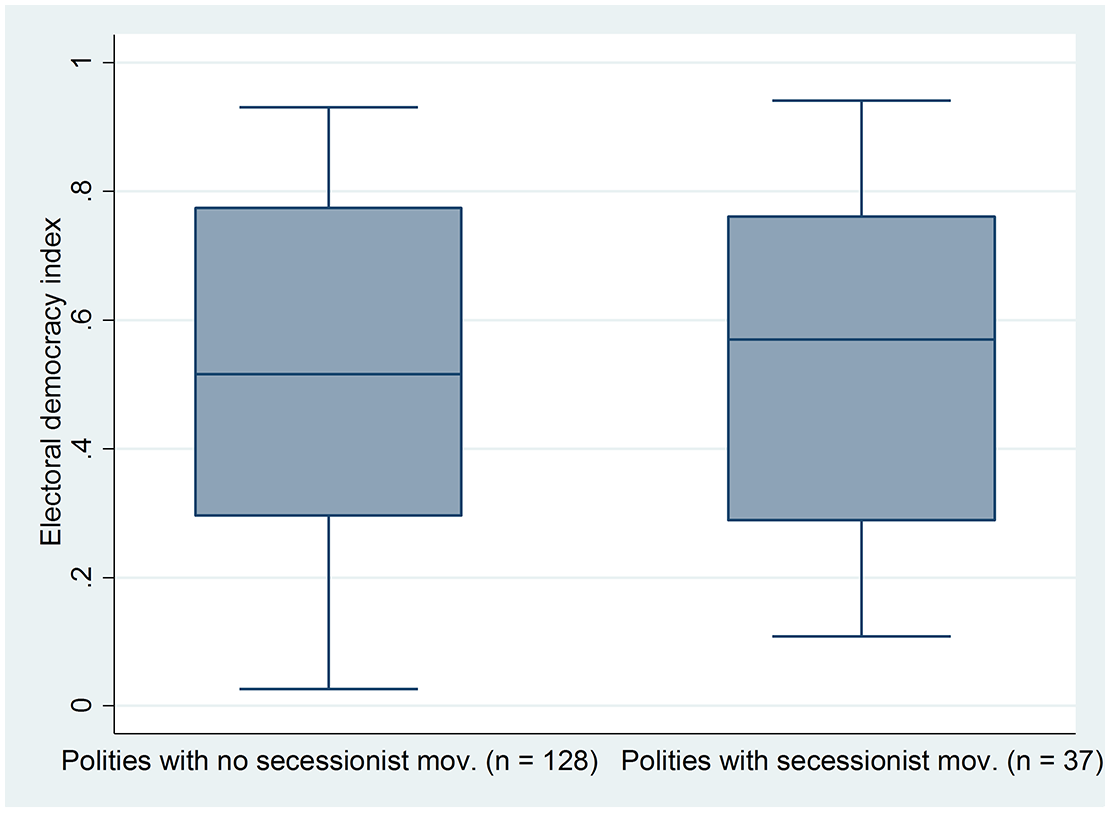
V-Dem Electoral Democracy Index in Polities With and Without Active Secessionist Movements, 2000.
Some researchers may wish to employ a broader measure of national identification, for instance by focusing on how many people fail to identify with the nation-state they live in, regardless of whether they want to form a separate nation-state or not. In their discussion of various empirical measures of national identity, Miller and Ali (2014) argue that liberal nationalists should privilege those measures that capture the strength of identification and attachment with a nation, rather than measures capturing pride or uncritical support. Figure 2 shows, for 47 countries with data, the proportion of respondents to a representative survey who do not see themselves as citizens of the nation-state in which they reside, in comparison with each country’s V-Dem deliberative democracy index for 2007. 12 An important limitation of this measure is that it does not distinguish between reasons for national non-identification that are problematic for the nationality principle and reasons that might not be, such as responses by guest workers who expect and are expected to return to their home country within a short period of time.
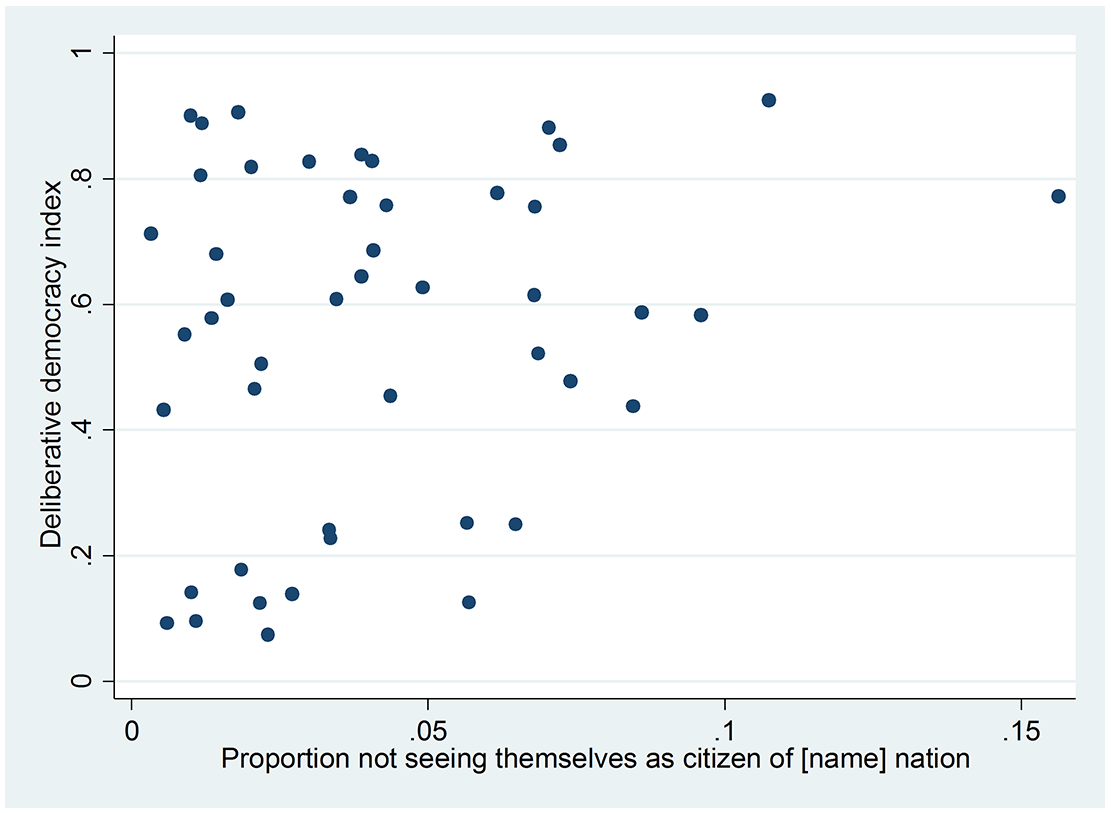
V-Dem Deliberative Democracy Index and Proportion not Seeing Themselves as Citizen of the Nation, 2007.
Indicators of Congruence with the Legal Subjection Principle
The key question resulting from the legal subjection principle is: Does the polity impose legal obligations on people without providing them with opportunities to participate in making the relevant laws? An affirmative answer should result in a polity receiving a lower democracy score than if the answer had been negative. For the reason noted earlier, the discussion will focus on situations where polities impose legal obligations on people outside of their core territory. The most prominent instance arguably concerns states that exercise colonial rule by creating laws that colonial subjects are expected to follow. To illustrate how states may be distributed along this variable, Figure 3 shows the scores of the V-Dem Electoral Democracy Index for two groups of countries in 1950: those without colonies in that year and those with at least one colonial possession. 13 The boxplots suggest that a researcher who endorses the all-subjected principle might wish to decrease the overall democracy score of several colonial powers, even when they attained relatively good scores in the V-Dem electoral democracy index. An illustration based on three countries is presented at the end of this section.
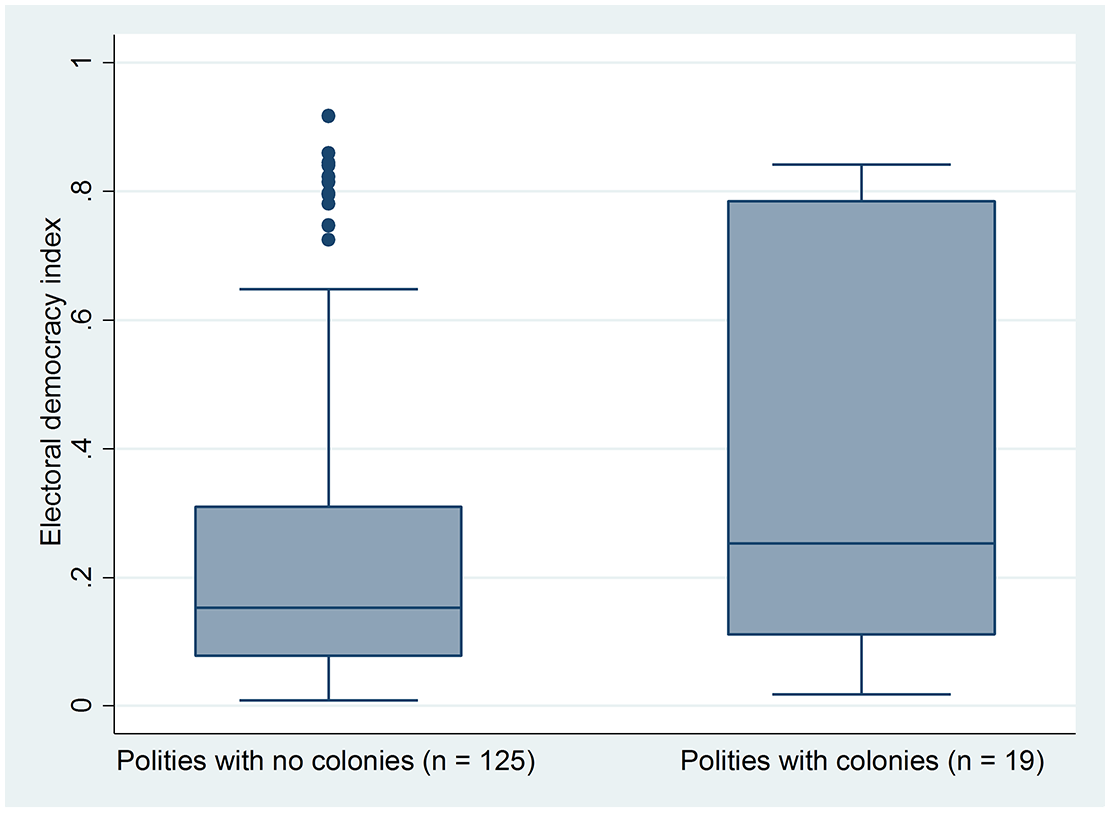
V-Dem Electoral Democracy Index in Polities With and Without Colonial Possessions, 1950.
A less conspicuous way in which polities can impose legal obligations on people in another polity is by claiming that their laws have extraterritorial effects. As noted by Parrish (2013: 231), ‘[e]xtraterritorial laws are in tension with democratic principles because they impose obligations on individuals who have had no formal voice in the political process’. Goodin (2016) shows that claims of extraterritorial jurisdiction are common in the international system. One example he provides is that several, but not all, states assert a ‘passive personality’ principle, whereby the state’s criminal law is applicable to crimes committed by anyone outside the state’s territory when the victim is a citizen of the state. More generally, there is significant variation in the extent to which states claim extraterritorial effects for their laws (Clopton, 2013) and this variation could be captured by standardized empirical indicators, which would help assess how much a state departs from the legal subjection principle.
Indicators of Congruence With the Coercion Principle
The key question deriving from the coercion principle is the following: Does the polity exert coercion over people outside its territory without providing them with opportunities to participate in decisions about it? What should count as coercion is not straightforward. As noted earlier, some authors regard border controls as coercive while others reject this argument. There is less controversy about the coercive nature of other decisions. Colonial rule is in tension not only with the legal subjection principle but also with the coercion principle. But the coercion principle leads to a broadening of the democracy assessment to the initiation of military action against other polities. Researchers who adhere to the coercion principle would assign a lower democracy rating to polities that initiate such military action without offering participation or at least consultation opportunities to people in the target polity (Archibugi, 1997).
For illustrative purposes, Figure 4 compares the distribution of V-Dem liberal democracy index in 1975 in two groups of countries: those that initiated at least one militarized dispute in that year and those that did not. 14
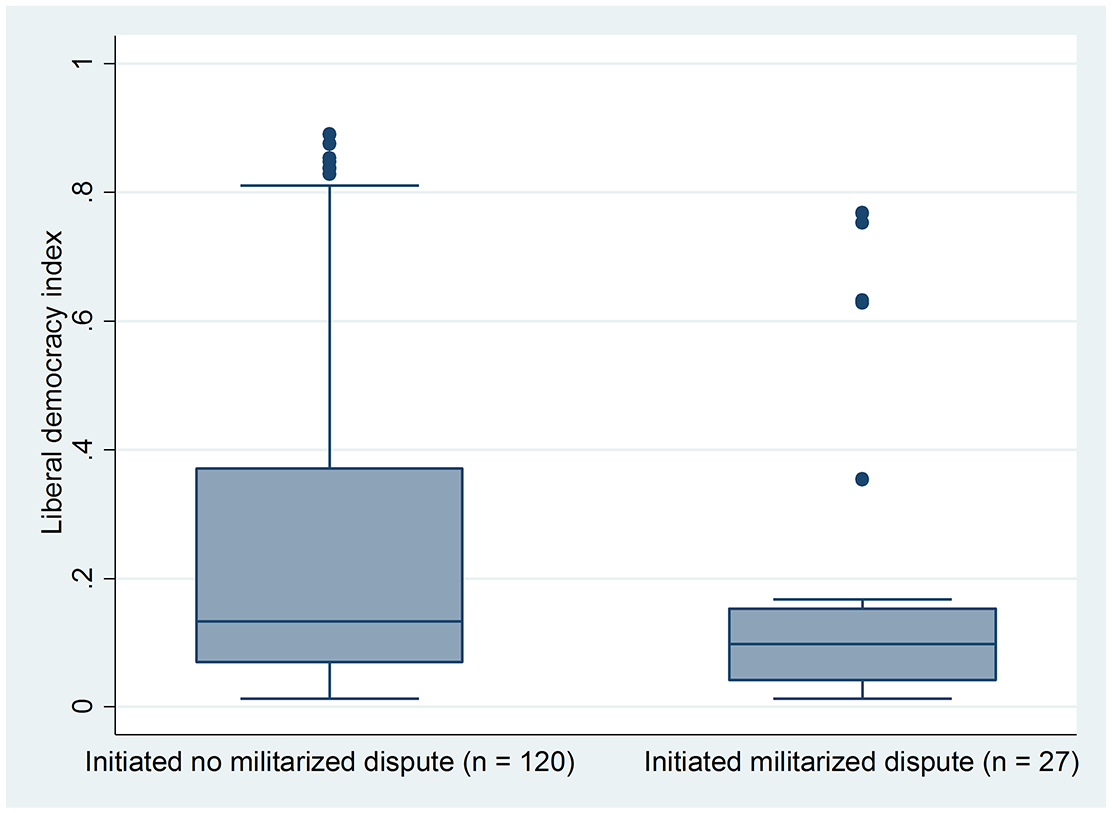
V-Dem Liberal Democracy Index in Polities that did or did not Initiate a Militarized Dispute, 1975.
Establishing whether a state has provided opportunities for the target polity to influence its potentially coercive policies is less straightforward. A suitable measure could combine three types of information. First, whether a state has made a general commitment to solve disputes through peaceful means, and specifically through arbitration or adjudication, which offer all parties the opportunity to justify their claims (Archibugi, 1997). Second, whether a state involved in a dispute with another state accepts to submit that specific dispute to binding arbitration or adjudication, that is, promises in advance that it will accept the decision that is produced. Third, whether the state in question complies with the arbitration or adjudication decision. Some basic information on all three conditions is already available in existing cross-national, longitudinal datasets. 15 However, ideally, a consistent application of the coercion principle would reward states for abstaining from any form of military or economic coercion unless it is authorized by a body in which the population of the target state is in some way represented, such as the United Nations. This suggests that the actual coding would need to be based on a careful reading of the history of the foreign policy of each country.
Indicators of Congruence With the All-Affected Principle
The key question resulting from the all-affected principle is: Does the polity affect significantly the interests of people in another polity without providing them with opportunities to participate in its decision-making? An affirmative answer should result in a lower democracy rating. Since coercing someone and imposing legal obligation on someone generally affects their interests, the indicators mentioned in the previous subsections are relevant for the all-affected principle as well. But there are many other ways in which one polity can in principle affect people in others, which makes it more difficult to answer the question. As noted earlier, some proponents of the all-affected principle look for ways to approximate that ideal in some practice that is feasible in a world of territorially defined states. Specifically, Goodin argues that one way of moving closer to the ideal is to have a supranational authority entitled to adjudicate complaints from people and peoples in one jurisdiction whose interests are affected by activities in other jurisdictions in which they had no vote. This authority could invalidate a decision taken by a state or order it to compensate affected interests that had no say on it.
The global institution that comes closest to such an authority in the real world is probably the International Court of Justice (ICJ). The ICJ provides a mechanism through which governments can try to change other states’ decisions that directly affect them. Therefore, researchers endorsing the all-affected principle might want to assign a higher democracy score to states that have accepted the compulsory jurisdiction of the ICJ (as per Art 36, para. 2 of the Statute). Figure 5 shows the V-Dem liberal democracy index for two groups of states in 2000: those have accepted the optional clause on compulsory jurisdiction of the ICJ and those that have not. 16 While liberal democracies are more likely to accept the compulsory jurisdiction of the ICJ, several have not. A researcher committed to the all-affected principle may want to reduce the democracy rating of the latter group. It should be noted that access to the ICJ is restricted to governments, while supporters of the all-affected principle may favour transnational institutions that are accessible to individuals, such as the European Court of Human Rights or (through national courts) the European Court of Justice (Keohane et al., 2000). But these are not available in every region of the world, and certainly not at the global level.
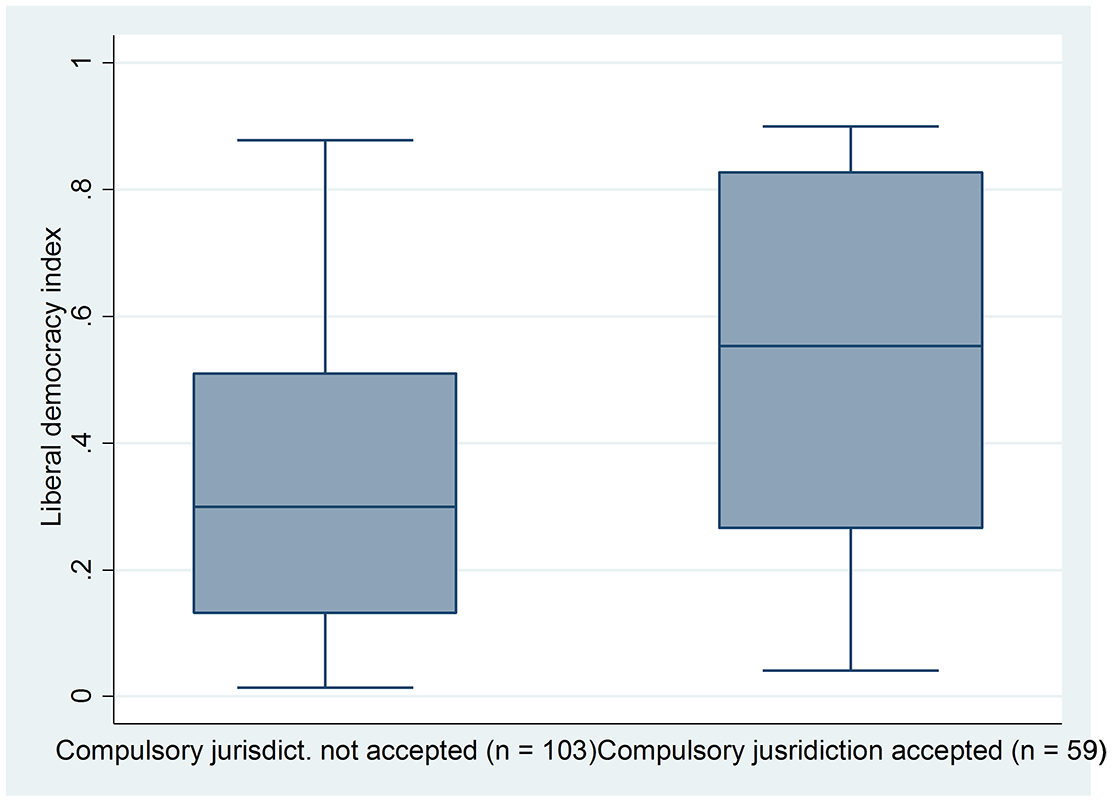
V-Dem Liberal Democracy Index in Polities that did or did not Accept the Compulsory Jurisdiction of the International Court of Justice, 2000.
An area where states unambiguously affect each other’s populations are decisions that impact global environmental commons. States that ratify international treaties aimed at protecting the global environment and comply with their treaty obligations arguably take into account external interests to a larger extent than states that do not ratify or do not comply. One attempt to measure commitment and compliance in climate policy are the indices developed by Bättig and Bernauer (2009). Their policy output index measures extent of political, legal and administrative commitments to the UN-based climate change mitigation process over the period 1990–2005. Figure 6 compares country scores in the V-Dem egalitarian democracy index in 2005 with scores in the climate output index. The graph suggests that researchers who endorse the all-affected principle may want to reduce the democracy scores of some states that do relatively well in equalizing politically relevant opportunities and resources among citizens, on the basis of the fact that they are less willing to commit themselves to respecting core interests of outsiders. Again, this quantitative indicator is merely illustrative, and any actual coding would need to be supported with in-depth research.
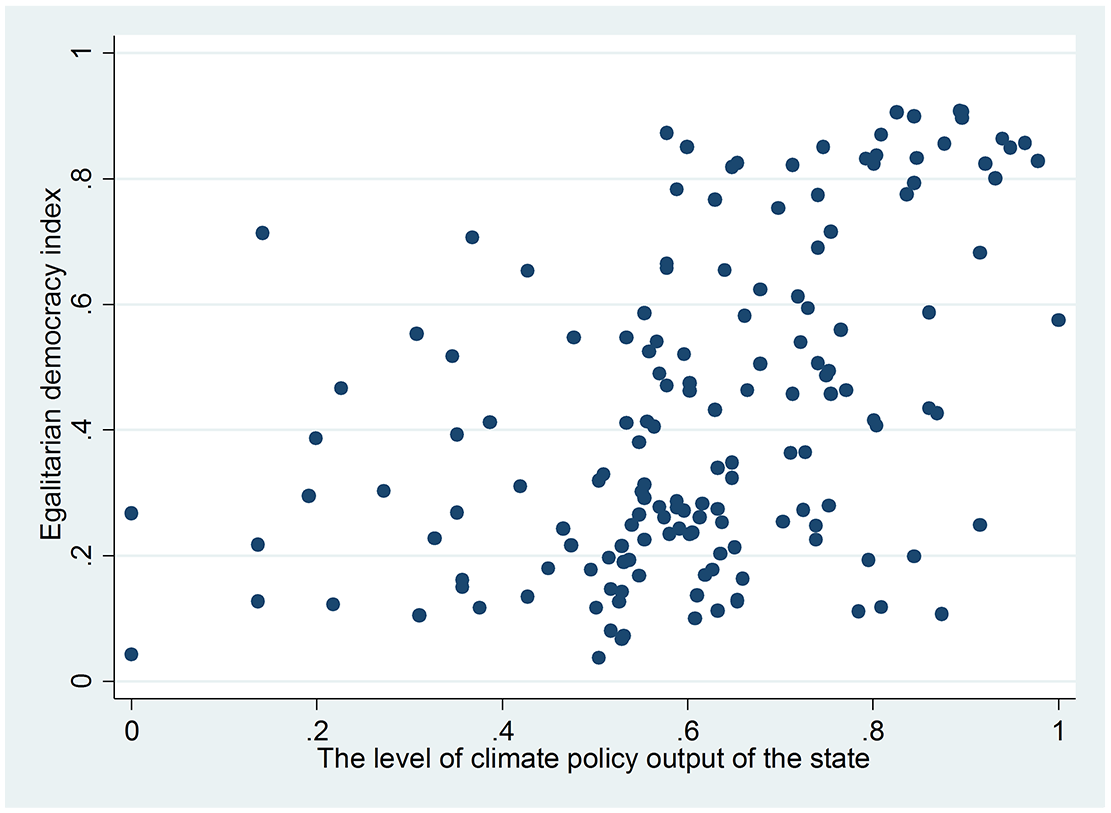
V-Dem Egalitarian Democracy Index and Index of Cooperative Behaviour in Climate Policy, Defined in Output Terms, 158 States, 2005.
An Illustration
The following is a brief illustration of the implications of using demos indicators in the calculation of democracy scores. Consider the Electoral Democracy Index, which has special importance because it is the foundation of all other high-level indices provided by the V-Dem project. For the year 1950, Belgium and Norway score .84 on that index, while Switzerland scores .64. The lower score for Switzerland compared to the other two countries is mainly the result of women being excluded from suffrage until 1971: one component of the Electoral Democracy Index – the percentage of adult population with suffrage – is 100% for Belgium and Norway but 50% for Switzerland. 17 By construction, the scores provided by V-Dem do not take into account that, in 1950, Belgian political institutions exercised formal authority over other territories: the colonies of Belgian Congo and Ruanda-Urundi. As noted earlier, most demos principles may lead researchers to conclude that the exclusion of the population of the colonies from elections in Belgium should affect the Electoral Democracy Index of that country. The most straightforward way of addressing this is to recalculate the percentage of population with suffrage so that the denominator includes the sum of the adult population of Belgium, Belgian Congo and Ruanda-Urundi, as opposed to Belgium only. The resulting value of 45% can then be used to recalculate Belgium’s Electoral Democracy Index for 1950, which drops from .84 to .53. 18 This is lower than the scores for the colony-less countries of Norway and Switzerland in the same year, and indeed close to Switzerland’s score for 1850.
This exercise also shows that, like the calculation of the existing V-Dem indices, the inclusion of a wider range of demos-specific indicators cannot be a mechanical process but involves several theory-driven decisions. A few examples must suffice. First, some researchers may decide to take into account the degree to which the colonial centre regulates the affairs of the controlled territories. Belgium’s colonies scored 3 (indirect rule with strong interference in internal affairs) on an index of colonial domination ranging between 0 (no colonial domination) to 4 (direct rule) (Ziltener et al., 2017). If, in consideration of this non-total degree of domination, a researcher decided to weigh the electoral disenfranchisement of colonial subjects as three-fourths instead of fully, they might assign Belgium the slightly higher score of .56 on the Electoral Democracy Index for 1950. Second, researchers may prefer to give a greater weight to the share of adult population with suffrage in the construction of the Electoral Democracy Index, for instance to stress the equal importance of the demos and kratos problems. Third, the status of people in colonies is likely to affect scores not only in relation to the Electoral Democracy Index but also to the other indices developed by the V-Dem project, such as Egalitarian Component Index, given the way in which colonial relationships are intertwined with a range of racial and other hierarchies and inequalities beyond formal suffrage exclusions (Getachew, 2019).
Conclusion
These are my principles. If you don’t like them, I have others. Groucho Marx
The general approach of the V-Dem project could be described as Marxist – after Groucho, not Karl. More than any previous attempt to code political regimes for many countries, the V-Dem project pays close attention to what a broad array of political theorists have written on the nature of democracy. Instead of imposing a single democracy principle on its users, V-Dem – like Groucho – gives them a choice. However, I have argued that even V-Dem has not gone far enough in incorporating the insights of recent political philosophy, which after years or rather centuries of neglect is increasingly asking the question of how and where the boundaries of the demos should be drawn.
In presenting the main responses to the demos question and their implications for measuring the democratic quality of polities, I have not tried to single one response out as superior to all others. It seems wise to adopt in relation to them the same position that the V-Dem team has adopted in relation to the conceptions of democracy that underlie its coding framework: it is unrealistic to expect a consensus view to emerge in the foreseeable future. The aim of this article has been different: to increase awareness among political researchers that making assumptions about the demos is inevitable, and that it is better to address such assumptions explicitly and systematically than to leave them implicit. As the last section of the article has tried to show, developing empirical indicators reflecting a variety of demos principles is not only desirable but also feasible. As democracy can be described as an ‘unfinished journey’ (Dunn, 1992), so can be the measurement of it.
Footnotes
Acknowledgements
The author would like to thank Luka Bareis for excellent research assistance and Seebal Aboudounya, Benjamin Faude, Eunjeong Park, McKenzie Ratner, Theresa Squatrito, Ulrich Sedelmeier and Olivia Nantermoz for their comments on previous versions of the article. The reviewers for Political Studies greatly helped him improve it – thank you! He remains solely responsible for its shortcomings.
Declaration of Conflicting Interests
The author(s) declared no potential conflicts of interest with respect to the research, authorship and/or publication of this article.
Funding
The author(s) received no financial support for the research, authorship and/or publication of this article.
