




Abstract
Most legislation neither affects nor interests citizens equally. But should this variation in interest and affectedness impact who gets to influence policy reforms? This article examines US public opinion on this issue using a national survey experiment varying both the policy outcome (a bill’s passage/failure) and the type of constituency input granted by elected representatives (none/constituency surveys/targeting interested constituents/targeting affected constituents). It then compares reactions across treatment groups, examining the impact of outcome favourability as well as external and internal political efficacy. Results suggest that granting constituents explicit policy influence consistently affected perceived responsiveness in the expected manner, but that the different consultation procedures had more varied effects on decision acceptance. Furthermore, where the procedures impacted decision acceptance, they pushed the reactions of both the pleased and the displeased towards more muted responses. Finally, similar ‘cushion effects’ were present when external and internal political efficacy were incorporated into the analysis.
Keywords
Should citizens have equal say in policy-making decisions, or is it okay for elected representatives to grant special influence to certain groups? This article investigates the American public’s thoughts on this question by examining perceived responsiveness and decision acceptance in the face of different decision-making processes. In doing so, it focuses on two deviations from an equal-influence ‘median-voter’ approach to representation (see Bochsler and Hänni, 2017): the first granting special influence to interested constituents, and the second granting special influence to constituents who would be disproportionately affected by the reform if it were passed.
Research broadly suggests that people prefer elected officials who put the policy stances of their constituents ahead of their own preferences and those of their party (Lapinski et al., 2016; Wolak, 2017). The preferred target of this substantive constituency representation is much less clear, however: while citizens are broadly committed to procedural democratic equality and fairness (e.g. Bøggild and Petersen, 2016; Doherty and Wolak, 2012), there are good reasons to suspect that they do not necessarily want their representatives to reflect median opinion on every policy. Intra-constituency variation in policy interest and affectedness seem especially likely to shape beliefs about the ‘correct’ distribution of democratic influence – but the direction of these potential effects is less clear. Interest in a policy might be welcomed as a marker of healthy political involvement, or it might be treated sceptically as a sign of pernicious emotional and/or partisan attachment. Similarly, policy-affected groups might be thought to deserve extra input – due to the outsized impact the reform would have on these groups – or less input – due to a perceived conflict between the self-interest of affected citizens and the interests of the broader collectivity (see Kevins and Robison, Forthcoming).
To the extent that individuals care about the policy influence of interested and affected constituents, then, different approaches to consulting constituents may either increase or decrease decision acceptance. Yet, despite a long line of research on abstract preferences towards how democracy should work (e.g. Goldberg et al., 2020; Hibbing and Theiss-Morse, 2002) and on reactions to decision-making processes (e.g. Esaiasson et al., 2019; Van Den Bos et al., 1997), our understanding of these effects is limited. Studying reactions to different consultation procedures thus gives us an opportunity to better understand citizens’ ‘intuitive political theory’ (e.g. DeScioli and Bokemper, 2018) as well as the potential influence of these intuitions on patterns of unequal representation (e.g. Soroka and Wlezien, 2008).
To that end, this article presents the results of a survey experiment fielded in the United States using Qualtrics’ Internet panels (quota sampled to reflect the general population’s age and gender distributions). The experiment centres around a hypothetical income tax reform: picking up on conservative claims for greater ‘fairness’ in the American federal tax system, the bill would increase the tax burden on the bottom quartile of the income distribution and pass the tax savings onto other taxpayers. The treatments then allow us to compare reactions to policy outcomes emanating from different consultation procedures, whereby elected representatives either (1) do not explicitly consult the population (the control group); (2) give equal weight to their constituents’ preferences, using polling (i.e. constituency surveys) to decide how to vote; (3) give special weight to the views of constituents interested enough in the bill’s fate to attend a town-hall meeting; or (4) give special weight to the views of constituents who would be disproportionately impacted by the bill if it were to become law.
This approach allows us to study reactions to constituent input and influence, with the ultimate goal of exploring representational preferences. The article thus builds most directly upon research examining citizens’ normative democratic preferences (e.g. Bengtsson and Mattila, 2009; Rapeli, 2015; Wojcieszak, 2014) and their specific procedural preferences (e.g. Dixon et al., 2016; Esaiasson et al., 2017; Skitka et al., 2003). Following past work, the article then unpacks the role of three factors that might shape reactions to these decision-making procedures and the policies that emerge from them: outcome favourability, and external and internal political efficacy (e.g. Coffé and Michels, 2014; Esaiasson et al., 2019; Landwehr and Steiner, 2017).
Results suggest that all three of the consultation treatments increased perceived levels of democratic responsiveness, regardless of whether or not individuals agreed with the final policy outcome. Crucially, however, we see far more varied effects when we look at the determinants of decision acceptance. On one hand, although polling-based median-voter representation increased perceived responsiveness as expected, it had no discernible impact on decision acceptance. On the other, targeting interested or affected citizens increased decision acceptance among respondents presented with their unfavoured policy outcome; yet the affected consultation treatment also decreased decision acceptance among respondents presented with their favoured policy outcome. Similarly, external and internal political efficacy shaped reactions to several consultation measures, but the direction of these effects varied based on whether respondents were told that the bill had passed or failed. Taken together, these findings suggest that different approaches to providing constituents with voice and policy impact shape decision acceptance in fundamentally different ways.
Responsiveness, Decision Acceptance and Consultation Procedures
Recent years have seen increased calls for elected officials to turn away from self-interested, elite-centred policy making and to (re)connect with ‘the people’ (e.g. Sheets et al., 2015). This position is not simply limited to populist corners, either; it is echoed in a broad popular preference for representatives who reflect the policy preferences of their electorates (e.g. Carman, 2007; Lapinski et al., 2016). Yet, as work on democratic theory makes clear, there is no single, obviously correct way for representatives to reflect the wishes of their constituents. Some theorists, for example, highlight the importance of median-voter representation, with the implication that all citizens should have their voice weighted equally (e.g. Shapiro, 2015, 2017). Others, however, caution against a singular focus on procedural democratic equality, underlining that issues of substantive equality should also be taken into account. Adopting an affect-based approach to democratic influence, for example, would suggest that the distribution of policy influence should mirror the extent to which individuals would be impacted by a given policy decision (e.g. Bengtson, 2020; Brighouse and Fleurbaey, 2010); yet it may well be that citizens take a stance exactly contrary to this ‘principle of affected interest’ – with a large stake in a policy outcome perhaps instead associated with (democratically problematic) self-interested biases.
Underlying these debates is the question of which constituents elected representatives should be targeting when they set out to reflect public opinion (Bengtsson and Wass, 2010; Eulau et al., 1959): must officials focus on representing the policy position of their constituencies as a whole, or might it be at times more appropriate to focus on certain subsets of the constituency? Although research on this topic is limited (for an exception, see Kevins and Robison, Forthcoming), three related bodies of literature provide some insights on this question.
First, a long line of studies have explored citizens’ ideals and normative conceptions about how democracy should work. Such work typically reflects theoretical distinctions between representative, direct and ‘stealth’ (i.e. technocratic) democracy (e.g. Hibbing and Theiss-Morse, 2002; Rapeli, 2015). Mixed findings in this literature, however, make it hard to draw firm conclusions about which normative conceptions of democracy dominate in which contexts (cf. Bengtsson and Mattila, 2009; Font et al., 2015; Webb, 2013). Further complicating matters, research suggests that these sorts of democratic ideals are often quickly abandoned in practice, as individual reactions are influenced by the policy- and group-related considerations tied to a given case (e.g. Harbridge et al., 2014; Sullivan et al., 1993).
Second, a related body of literature focuses on citizens’ concrete procedural preferences. Findings from these studies have been more consistent than the research on abstract preferences, suggesting that opportunities for personal involvement improve decision acceptance and perceived fairness in a range of contexts (e.g. De Cremer and Tyler, 2007; Knudsen et al., 2015). These results are also echoed in work looking at perceptions of procedural justice, which finds that voters react more positively to policy processes and outcomes that provide room for public input (e.g. Dixon et al., 2016; Hibbing and Alford, 2004; Van Den Bos et al., 1997). Yet, the same body of literature also highlights that this preference for consultation is conditional: on one hand, reactions to consultations are often shaped by whether or not the process generates a decision that one agrees with (see, for example, Esaiasson et al., 2019; Werner, 2019); on the other hand, procedural considerations, such as the transparency of the processes alongside the range of opinions incorporated into the discussion, also seem to play an important role (e.g. Bøggild and Petersen, 2016; Porumbescu and Grimmelikhuijsen, 2018). This latter distinction in particular underlines the importance of studying reactions to different types of public consultations (see Nabatchi, 2012).
At the same time, individuals will of course vary in their reactions to different consultation measures, and existing work suggests that political efficacy may be an important source of heterogeneity. Key here is a third body of literature, centred around individuals’ willingness to participate in direct democratic procedures. Investigating the potential link between efficacy and attitudes towards direct citizen participation, however, requires us to distinguish between external efficacy – the feeling that citizens have influence over political decisions – and internal efficacy – one’s sense of personal political effectiveness (see, for example, Pollock, 1983). Research suggests that both types of political efficacy may help to shape abstract attitudes about democracy, though these effects likely move in conflicting directions (e.g. Carman, 2006; Dalton et al., 2001).
External efficacy is typically associated with a preference for the standard representational model of democracy, as it suggests greater faith in the functioning of the political system in its current form; correspondingly, lower external efficacy is correlated with increased scepticism about traditional politics and has been tied to a preference for increased citizen involvement (e.g. Bengtsson and Mattila, 2009; Coffé and Michels, 2014). Internal efficacy, by contrast, is associated with greater confidence in the ability of other citizens to participate in politics (e.g. Campbell et al., 1954; Finkel, 1985). Consequently, high levels of internal efficacy appear to push individuals towards favouring more deliberative democratic procedures, and to prefer a stronger link between elected representatives’ congressional votes and the political stances of their constituents; low levels, in turn, are associated with greater scepticism about participatory democracy and increased support for a ‘trustee’ model of governance – wherein representatives follow their own judgement rather than public opinion (e.g. García-Espín and Ganuza, 2017; Landwehr and Steiner, 2017). To the extent that these attitudes spill over into decision acceptance, then, external and internal political efficacy are likely candidates for explaining variation.
Drawing these works together suggests several hypotheses. At the most basic level, several studies (e.g. Esaiasson et al., 2019; Landwehr and Harms, 2019; Skitka et al., 2003) have found that getting what one wants is a, if not the, major factor shaping how decisions are received. From this perspective, process characteristics may well shift perceived responsiveness regardless of the policy outcome – but decision acceptance is likely to be profoundly shaped by whether or not one likes the final decision (see, for example, Esaiasson et al., 2019; Werner, 2019). Outcome favourability is therefore likely to be an important driver of decision acceptance.
Yet, decision acceptance is unlikely to simply be a function of getting one’s way: despite the structuring effect of outcome favourability, past work suggests that fairness considerations are nevertheless likely to play an important role. As highlighted above, research on the impact of consultation measures highlights both a general preference for ‘just’ procedures and more positive reactions to the decisions that emanate from them (e.g. Dixon et al., 2016; Doherty and Wolak, 2012). Key factors here include participation, transparency and inclusion: citizens tend to respond more positively to decisions when (1) they are invited to actively participate in the process, (2) the decision-making process is clear and (3) a broad array of opinions are heard out – for example, with no groups excluded from attendance (e.g. Gangl, 2003; Porumbescu and Grimmelikhuijsen, 2018).
Building from this literature, I investigate whether citizens simply reward politicians for consulting their constituents, or if different approaches to granting constituents input and influence will shape decision acceptance in different ways (see Nabatchi, 2012). Past research most clearly suggests that reaching out to interested constituents should elicit more positive reactions, as this process combines participation, transparency and inclusion. The implications of this literature are less clear, however, with regard to the other two measures. Consulting affected constituents deviates from the openness principle, as it expressly excludes most citizens from voicing their opinion; yet the focus on affected constituents may be viewed as an acceptable justification for targeting a narrow constituency subgroup for representation. Polling, in turn, lacks a participatory component and may thus be viewed less favourably than traditional (in-person) consultations; yet it also reflects a procedurally equal treatment of all constituents, regardless of their interest in the bill or the degree to which they would be affected by it. Comparing levels of decision acceptance in the control versus the three consultation treatment groups will thus allow us to explore the relative weight that the public assigns to these considerations.
At the individual level, studies examining the consequences of political efficacy on abstract democratic preferences (e.g. Coffé and Michels, 2014) suggest that low external efficacy will induce more positive reactions to participatory consultative measures. All else being equal, then, to the extent that the various consultation measures shape decision acceptance, these effects should be conditional upon external efficacy, with higher (lower) external efficacy decreasing (increasing) decision acceptance relative to the control. High internal efficacy, in turn, reflects a stronger sense that both oneself and other citizens more generally can meaningfully contribute to the proper functioning of democratic institutions. It has consequently been tied to greater support for participatory processes and a delegate – rather than mandate – model of representation (e.g. Landwehr and Steiner, 2017). High (low) internal efficacy should therefore induce greater (lower) decision acceptance among respondents in the interested, affected and polling consultation treatments, relative to the control.
Experimental Setup
I assess these hypotheses using an experiment centred around a hypothetical tax bill that aims to increase the federal income taxes paid by the bottom quarter of the income distribution and to pass the savings onto other taxpayers. The bill thus takes up a recurring theme among certain conservatives, including prominent figures such as John McCain, Mitt Romney and Larry Kudlow, which suggests that low-income Americans do not pay their fair share of federal taxes. 1 In light of recent debates in the United States (ranging from the Occupy Wall Street movement to discussions about the 2017 Tax Cuts and Jobs Act), the distribution of the tax burden is likely to be a salient issue across the political spectrum – whether for concrete (monetary-related) or symbolic (fairness-related) reasons (e.g. Ballard-Rosa et al., 2017). The controversial nature of the proposal, in turn, should increase personal investment in the issue and a sense of implication in the policy debate (e.g. Becker et al., 2010).
The experimental design most closely replicates that of Esaiasson et al. (2017), which examined the relative influence of (hypothetical) Swedish politicians’ attempts to listen to constituents, to explain their actions to them and to adapt their decisions to the will of the majority (see also Esaiasson et al., 2015). In the present study, however, each of the treatments (apart from the control) includes listening and excludes explanation. Instead, the moving parts here centre around the group of citizens that politicians are listening to and, subsequently, adapting to when casting their congressional vote: their constituency as a whole (via district polling), interested constituents in their district or affected constituents in their district.
At the start of the experiment, respondents were presented with an introductory vignette laying out the policy scenario, the precise wording of which was as follows: A number of commentators and politicians have argued that Americans on the low-end of the income distribution don’t pay their fair share of federal taxes. Politicians in the House of Representatives are considering a bill that would change the way taxes are collected in the US. If passed, it would increase taxes on Americans in the bottom 25% of the income distribution and decrease taxes for everyone else. The government would ultimately collect the same amount of money, but the reform would mark a considerable shift in the tax burden: those in the bottom 25% would see their taxes go up by 10%, with every extra tax dollar collected leading to about 33 cents in tax savings for other taxpayers. In short, if this bill were passed: Americans in the bottom 25% of the income distribution would see their federal tax bills go up All other Americans would see their federal tax bills go down slightly The federal government would collect the same amount of taxes overall
On the same survey page, respondents were then asked about ‘the current state of opinion among citizens’ – namely, whether they thought that most Americans favour or oppose such a proposal. Respondents’ personal positions on the bill were then recorded (again on the same page) via an item asking them to rate their ‘desire to see such a bill passed’, ranging from 0 (‘strongly opposed’) to 10 (‘strongly in favour’), where 5 indicates ‘don’t care either way’.
Several features of the vignette are worth noting at this point. First, the size of the disproportionately affected group is fixed at one-quarter to reduce the possibility that the perceived size of the affected group might vary across respondents. Second, both the gains and the losses implied by this reform are expressed in the same form – money – thereby bracketing the risk that different weights might be ascribed to different sorts of benefits/losses (e.g. monetary gains for some constituents being traded off against potential personal security losses for other ones). Finally, the vignette explicitly holds the size of the government budget constant, so as to remain neutral vis-à-vis the government’s size and its ability to redirect the collected funds to other goals.
The experiment itself then employs a 2 × 4 factorial design, with random assignment. The first design feature alters whether respondents are informed that the bill (1) passed or (2) did not pass – which, in combination with a respondent’s previously recorded personal stance towards the bill, allows us to control for the effect of outcome favourability. The second design feature alters the consulted group and, relatedly, the type of adaptation undertaken by elected representatives: (1) none (control); (2) constituency opinion representation, via polls (polling); (3) representation targeting interested constituents (interested); and (4) representation targeting affected constituents (affected). In all but the control group, respondents are told that House representatives listened to their constituents – either indirectly via surveys (in the case of polling) or directly via consultations (with interested and affected) – and then adapted their stance to align with the relevant (sub-)constituency. The explicit focus on adaptation here is essential for investigating how individuals react not just to constituent input but also to constituent influence (see Ulbig, 2008). This requires a stylised description of the impact of the consultation on the policy process, with an explicit link drawn between constituent opinion and the representatives’ votes on the bill. Although this necessarily reduces the experiment’s external validity, it is crucial for assessing reactions to the different types of representation that underlie the consultation treatments.
Using common democratic practices as their starting point, the three included consultation procedures are thus intended to encapsulate contrasting approaches to constituency representation. Key here is the question of who elected representatives should be targeting for substantive representation on a given policy question (cf. Bengtson, 2020; Bochsler and Hänni, 2017; Eulau et al., 1959). The polling treatment allows us to assess the possibility that citizens think the answer to this question is ‘all of their constituents’; it uses real-world trends among elected representatives seeking to follow public opinion (e.g. Belot, 2019) to get at the median-voter approach to policy making (e.g. Downs, 1957). The remaining two treatments then reflect two relatively widespread approaches to in-person consultations, representing (increasingly narrow) sub-constituency groups. The interested treatment elicits ‘town hall meetings’, the classic approach to public consultations in the United States: technically open to all, but in practice usually attended by a non-representative subset of the constituency (e.g. Griffin et al., 2015). The affected treatment, in turn, references a consultation targeting the group directly tied to the issue area – as occurs, for example, with events like Seniors Town Halls and Veterans Fairs (see Kevins and Robison, Forthcoming). 2
The relevant text, presented on the page following the introductory vignette, read as follows: [Control:] In the end, House representatives held a vote on the proposed tax reform and it [passed/did not pass]. [Polling:] To decide whether or not to support the proposed tax reform, House representatives conducted polls in their respective districts, inviting constituents to voice their opinion on the bill. Each politician then voted for or against the proposal according to whether most of their constituents supported it. In the end, the bill [passed/did not pass]. [Interested:] To decide whether or not to support the proposed tax reform, House representatives held consultations in their respective districts, inviting constituents with strong thoughts on the bill to voice their opinion on it. An average of about 250
3
people per district turned out to make their opinion heard, and each politician then voted for or against the proposal according to whether most of those constituents supported it. In the end, the [bill passed/did not pass]. [Affected:] To decide whether or not to support the proposed tax reform, House representatives held consultations in their respective districts, inviting constituents who would be most affected by the bill – those in the bottom 25% of the income distribution – to voice their opinion on it. An average of about 250 people per district turned out to make their opinion heard, and each politician then voted for or against the proposal according to whether most of those constituents supported it. In the end, the bill [passed/did not pass].
Respondents were therefore presented with one of eight symmetrical variants. Note, however, that as a result of this symmetry, one of these scenarios involves a rather implausible outcome: namely, the combination of consulting affected constituents and the House nevertheless passing the bill. As it appears prima facie unlikely that affected constituents would be in favour of the bill’s passage, results from this specific treatment group must be treated with caution.
After reading about the final outcome of the vote, respondents were asked whether they were ‘satisfied with the outcome of the vote’, ‘trust the elected politicians who participated in the vote’ and whether they felt that ‘[i]t is important to comply with the decision’. These three questions are standard items used to measure decision acceptance (see, for example, Esaiasson et al., 2017). Potential answers ranged from 0 (‘completely disagree’) to 10 (‘completely agree’). Responses are highly correlated (Cronbach’s α = 0.87) and are combined into a single additive scale (rescaled to range from 0 to 10) for ease of presentation.
The next page of the survey then posed three follow-up questions designed to assess perceived responsiveness (see Esaiasson et al., 2015). Specifically, respondents were asked to think about the politicians in the scenario they had just read about and to state whether those politicians had ‘found out about the wishes of citizens’ (listened), ‘tried to accommodate the wishes of citizens’ (accommodated) and ‘explained their policy to citizens’ (explained). The survey thus precisely replicates Esaiasson et al.’s (2015, 2017) measure of ‘perceived responsiveness’ – but since the explained item is not directly relevant to the treatments, I also confirm below that the findings are unaffected by the question’s inclusion. Possible answers once again ranged from 0 (‘not really’) to 10 (‘very much so’). In line with existing work, these items are combined into an additive scale (Cronbach’s α = 0.917), again rescaled to range from 0 to 10.
Finally, the survey included several additional items necessary for the analysis. External and internal efficacy are measured using the standard multi-item battery of questions (e.g. Marx and Nguyen, 2018). For external efficacy, I use agreement with the statements ‘Public officials don’t care what people like me think’, ‘Those we elect to Congress lose touch with the people pretty quickly’ and ‘Parties are only interested in people’s votes, but not their opinions’. The measure of internal efficacy, in turn, is based on agreement with the statements ‘I am confident in my own ability to participate in politics’, ‘I personally find it easy to take part in politics’ and ‘I could take an active role in a group involved with political issues’. In all cases, potential responses range from ‘completely disagree’ (0) to ‘completely agree’ (10), with the battery presented on the fourth page of survey questions (four pages prior to the experiment). External and internal efficacy scores for each respondent were then constructed using factor analysis (Cronbach’s α = 0.85 in both cases), after recoding answers so that higher scores always indicate higher levels of efficacy.
Data and Methods
The survey experiment was embedded in a Qualtrics LLC Internet survey fielded in July 2018 via their American panel. Survey responses were collected from 2221 respondents, 4 with a quota-sample designed to reflect census demographics on the gender and age distributions of the adult population.
The study population consists of respondents who disapprove of the idea to increase the tax burden of the poorest 25%. The analysis focuses on this subset to reduce the number of moving parts and to ensure appropriate sample sizes across the treatment groups. In line with Esaiasson et al. (2017), the original intention was to examine only the respondents who took a stance on the policy when presented with the initial vignette; accounting for outcome favourability necessarily requires the exclusion of individuals who did not take a position on the bill (i.e. those who selected ‘don’t care either way’ – 13.5% of the sample in this study). Stances on the bill, however, are skewed towards disagreement: the majority of respondents declared that they were opposed to it (65.8%) – including among Independents (66.1%) and Republicans (58.2%). At the same time, most respondents believed that their personal position on the issue (whether pro- or anti-bill) aligned with majority opinion in the United States (85.7%).
Since alignment between the policy outcome, personal stance and perceived majority opinion is likely to impact perceived representation and decision acceptance (see, for example, Ulbig, 2008), the analysis focuses on the 1290 respondents who were (1) opposed to the bill and (2) asserted that the majority’s preferred outcome aligned with their own. This ensures that potentially relevant considerations are held constant. Unfortunately, the distribution of responses in the sample makes a similar approach with regard to pro-bill, majority-aligned respondents impossible, as only 358 individuals fall into this category.
Of the respondents included in the final analysis, 46.7% identified as Democrats (including 9.0% that lean Democrat), 17.4% as Independents and 35.9% as Republicans (including 7.8% that lean Republican). Treatment group sizes range from 146 (Control – disliked outcome) to 172 (Polling – disliked outcome as well as Interested – preferred outcome), with a mean of 159.7 and a standard deviation of 8.9. The censored sample is also more or less equally split in terms of the bill’s outcome: 49% of respondents were faced with their favoured outcome, while 51% were presented with their unfavoured outcome.
The data analysis, in turn, has two components: a series of ordinary least squares (OLS) regressions, presented in Appendix 1, and a corresponding set of figures, illustrating per-group mean responses with confidence intervals (set at 83.5%) to allow us to easily see statistically significant differences at the p < 0.05 (i.e. 95% confidence) level (for details on the calculations behind this, see Bolsen and Thornton, 2014). 5
Appendix Table 1 presents an overview of the sample demographics, comparing the pre-censored and censored samples, while Online Appendix Table 1 provides the same breakdown across each of the treatment groups. Regressions conducted on the censored sample indicate that none of the treatment groups predict respondent characteristics (e.g. age, gender, race, partisanship, self-placement on the income spectrum) in a statistically significant manner. The analysis is therefore conducted without controls in the models (see Mutz, 2011).
Results
I begin by considering whether the consultation measures impacted perceptions of politicians’ representational behaviour (see Esaiasson et al., 2017). This first step in the investigation allows us to assess the extent to which respondents processed the key information in the experimental texts. Did each of the consultation types elicit an increased sense of democratic responsiveness, regardless of whether or not a respondent was presented with their preferred policy outcome?
To answer this question, Figure 1 compares perceived responsiveness (mean = 4.00, standard deviation = 3.13), broken down by whether the policy outcome aligned with respondent preferences; Appendix Table 2, in turn, presents the regression output from the related model. Recall that responses range from 0 (‘not really’) to 10 (‘very much so’). Note also that figures include information on statistical significance levels, alongside exact predicted values, all of which are derived from the associated regression results.
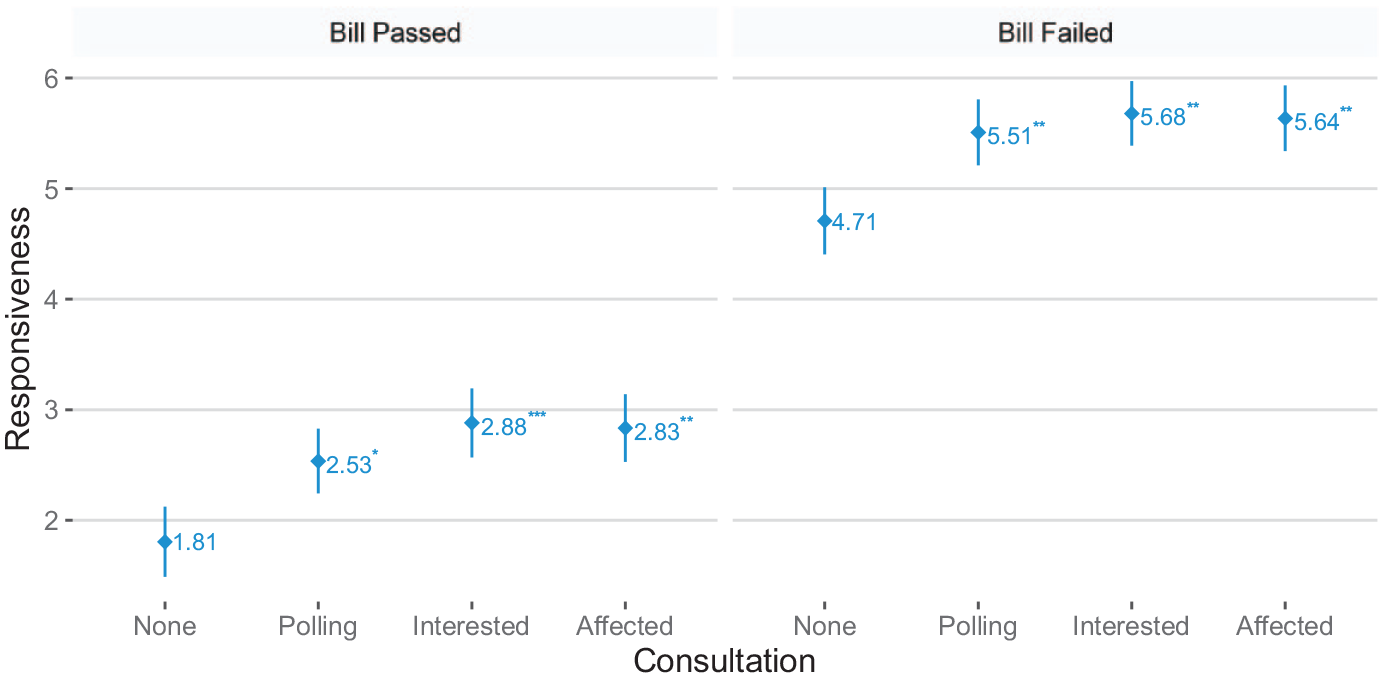
Perceived Responsiveness, by Bill’s Passage and Consultation Treatment. Figures Include Predicted Values with 83.5% Confidence Intervals to Visualise Significance at the p < 0.05 level. +p < 0.10; *p < 0.05; **p < 0.01; ***p < 0.001.
In line with H1a, results suggest that the various consultation measures are indeed correlated with higher perceived levels of responsiveness: we see a clear, statistically significant effect of each of the consultation treatments relative to the control. Two additional points are worth noting here as well. First, the effect sizes of the different consultation measures are not statistically distinguishable from one another; in other words, in no instance did one type of consultation increase perceived responsiveness more than another type of consultation. Second, while outcome favourability did not affect whether or not a consultation increased perceived responsiveness, it did shift the corresponding baseline level: when the bill passed, mean reactions ranged from 1.8 (control) to 2.9 (interested); whereas when the bill failed, those values range from 4.7 (control) to 5.7 (interested). (Recall that the sample only contains respondents who were opposed to the measure and believed that most other citizens also opposed to it.)
The results thus suggest that the consultation measures had the expected impact on perceptions of democratic responsiveness. But to what extent, and under what conditions, did they also shape decision acceptance? Figure 2, alongside the regression results in Appendix Table 3, provides a first cut at answering this question. Here again, responses are broken down both by the consultation treatment and the fate of the proposed reform – that is, whether a respondent’s initial preferences vis-à-vis the bill aligned with the final outcome (i.e. the bill failed) or conflicted with it (i.e. the bill passed).
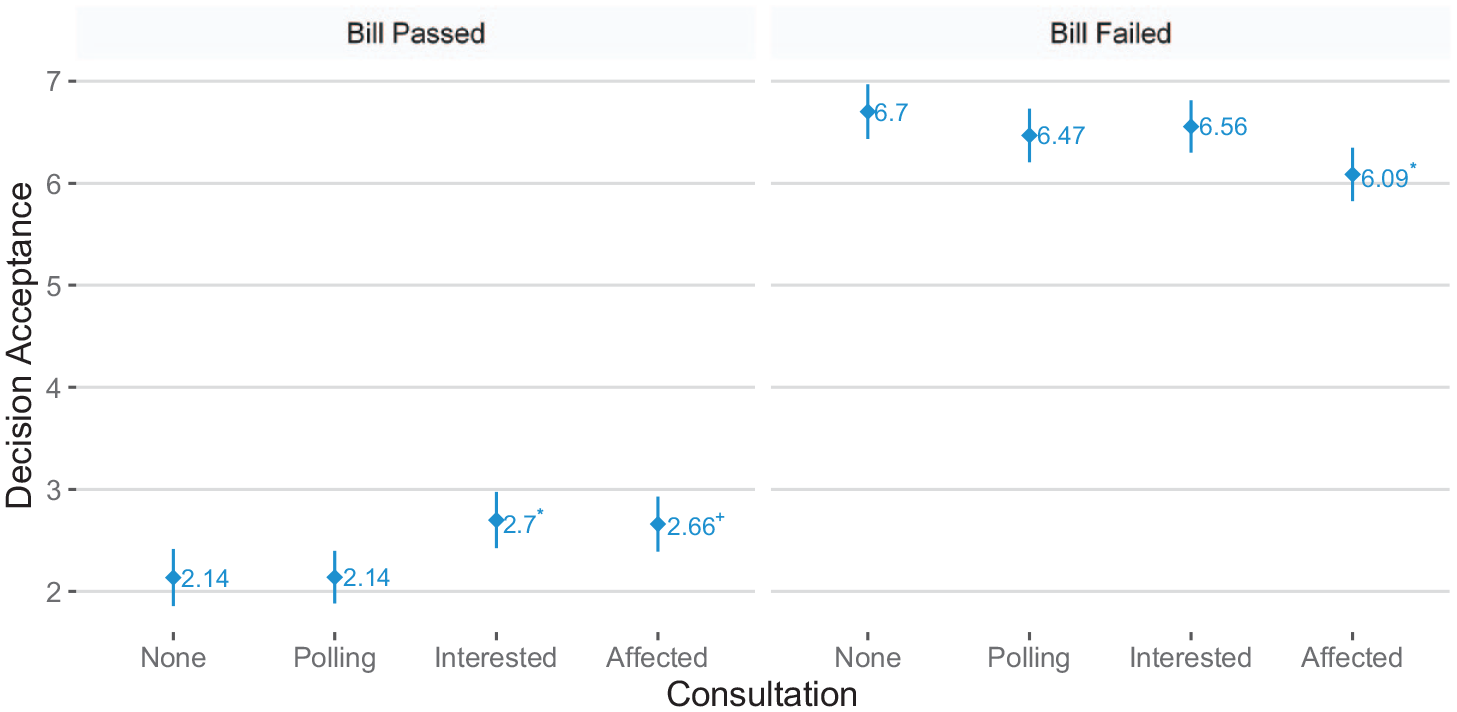
Decision Acceptance, by Bill’s Passage and Consultation Treatment. Figures Include Predicted Values with 83.5% Confidence Intervals to Visualise Significance at the p < 0.05 level. +p < 0.10; *p < 0.05; **p < 0.01; ***p < 0.001.
Two major findings emerge from this analysis. First, we see that outcome favourability is indeed a central feature shaping decision acceptance (mean = 4.49, standard deviation = 3.17), but that its effects do not always reflect expectations. As is clear from the two panels, whether or not an individual was presented with their preferred outcome appears to be the major dividing line among respondents: mean decision acceptance in the face of a disliked outcome wavers between 2.1 and 2.7, whereas the equivalent range for a preferred outcome is between 6.1 and 6.7. Yet, contrary to H1b, consultation measures did not matter solely for those respondents who were presented with their preferred outcome, as the interested and affected conditions increased decision acceptance (relative to the control) among individuals presented with their disliked outcome (though the affected treatment effect only nears statistical significance; p = 0.062).
Second, and relatedly, we see substantial variation based on the consultation type. Respondents presented with their disliked outcome (i.e. the bill’s passage) were more likely to accept the decision when interested constituents had been consulted, relative to both the control (p = 0.047) and the polling treatment (p = 0.039) groups; we find no evidence of such an effect, however, among respondents presented with their preferred outcome (i.e. the bill’s failure). At the same time, although consulting affected constituents shaped reactions regardless of outcome favourability, the direction of these effects varied based on whether the bill passed or failed: we see near-significant positive effects for those told that it had passed, relative to both the control (p = 0.062) and the polling treatment (p = 0.053); and more negative reactions among respondents told that the bill had failed, relative to both the control (p = 0.023) and the interested treatment (p = 0.077).
Even though all three of the consultation treatments increased perceived responsiveness in the expected manner, we thus see a fundamentally different pattern when it comes to decision acceptance. Here, consultation procedures seem to have the potential to taper the effect of outcome favourability, pushing decision acceptance towards the middle of the response spectrum – though this is only the case with a subset of the in-person consultation measures. Tying these results back to the study’s hypotheses, this suggests only partial support for the expectation that consulting interested constituents would increase decision acceptance (H2a), as this effect is present only where respondents were faced with their disliked outcome. Similarly, we note partly contrasting evidence (with variation based on outcome favourability) regarding the expectation that consulting affected constituents would increase decision acceptance (H2b). Finally, we find no evidence to support the expectation that polling constituents impacted decision acceptance (H2c). This suggests that when it comes to decision acceptance, citizens may indeed value the direct participation offered by more traditional, participatory consultations over a simple focus on tracking constituency opinion via surveys.
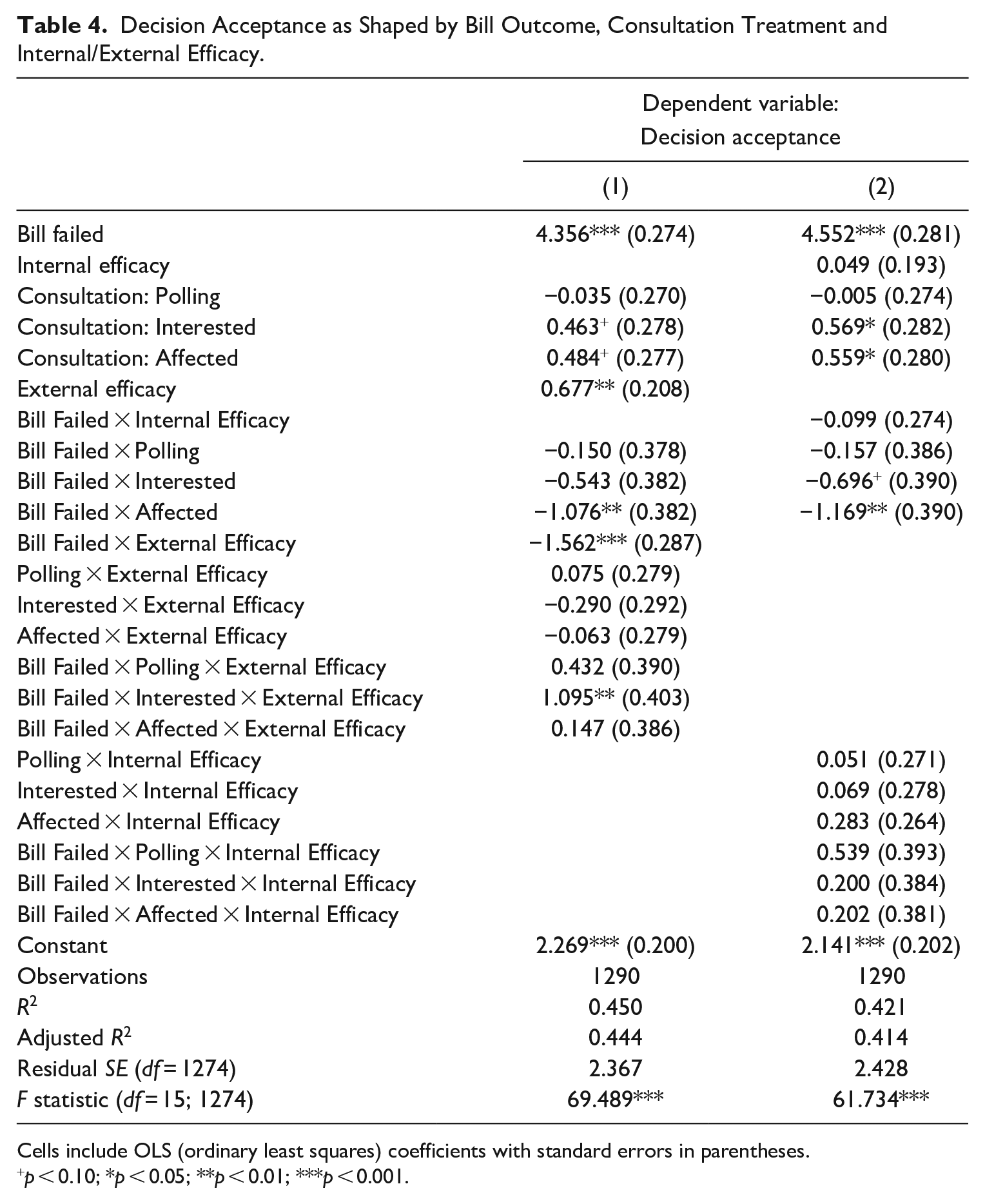
It is as yet unclear, however, whether the average treatment effects uncovered so far hide variation based on respondents’ levels of political efficacy. To shed light on the remaining hypotheses, I conclude by examining whether external and/or internal efficacy may be shaping how respondents reacted to the consultations. Turning first to the potential impact of external efficacy, Figure 3 plots predicted responses between the 5th and 95th percentiles of efficacy values (see also Appendix Table 4, Model 1, and Appendix Figure 1, Panel A), excluding extreme scores from the figure (though not the underlying regression) to provide a more representative view of typical effects. The panels contrast responses from each of the three consultation treatments with the control, with effects broken down by whether respondents were told that the bill had passed or failed.
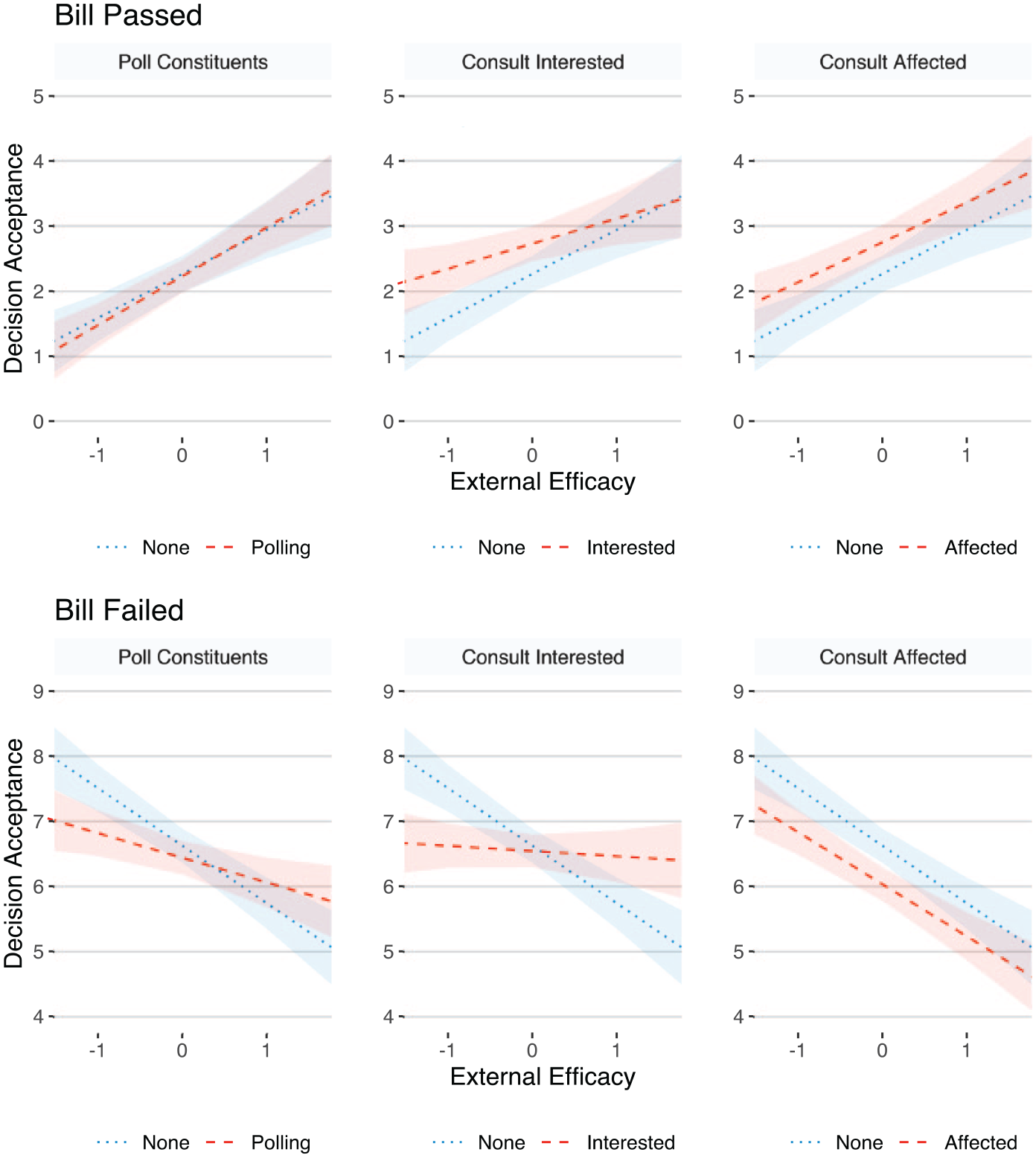
Decision Acceptance, by Bill’s Passage, Consultation Treatment (Relative to the Control) and External Political Efficacy (Illustrated between the 5th and 95th Percentiles). Figures Include Predicted Values with 83.5% Confidence Intervals to Visualise Significance at the p < 0.05 Level.
Results highlight that external efficacy and outcome favourability interact to shape decision acceptance: both in and out of the control group, greater external efficacy was broadly associated with higher decision acceptance when the bill passed and lower decision acceptance when it failed. Yet, we only find one instance where low external efficacy individuals presented with a consultation measure expressed greater decision acceptance relative to the control group (as per H3): namely, when respondents in the interested treatment group were told that the process resulted in their disfavoured outcome (i.e. the bill’s passage). Indeed, for respondents presented with their favoured outcome (i.e. the bill’s failure), we find that the interested and polling treatments in fact had the opposite effect, with low external efficacy respondents expressing lower levels of decision acceptance relative to the control. Overall, these results suggest the broad importance of external efficacy, but only limited support for H3: its effects on respondents presented with the interested treatment move in different directions based on outcome favourability, its effects on the affected treatment group are more or less equivalent to those found in the control group and its effects on the polling treatment group are only visible when respondents were presented with their preferred outcome.
Figure 4 repeats the exercise but with internal efficacy (see also Appendix Table 4, Model 2, and Appendix Figure 5, Panel B). Findings suggest that internal efficacy also had a rather widespread effect on decision acceptance; unlike with external efficacy, however, this relationship was not present in the control group. Unpacking the results further, we note that both the affected and polling treatments reduced decision acceptance among low internal efficacy individuals presented with their favoured outcome (i.e. the bill’s failure). Among respondents informed that the bill had passed, by contrast, we see only one clear effect: the affected treatment increased decision acceptance among higher internal efficacy respondents. Overall, these findings suggest only modest support for H4: although internal efficacy does not appear to have shaped responses to the interested consultation, it is associated with increased decision acceptance among respondents in the polling and affected treatment group. Once again, however, these effects differed according to whether the individual was presented with an outcome that aligned with their pre-existing policy preference.
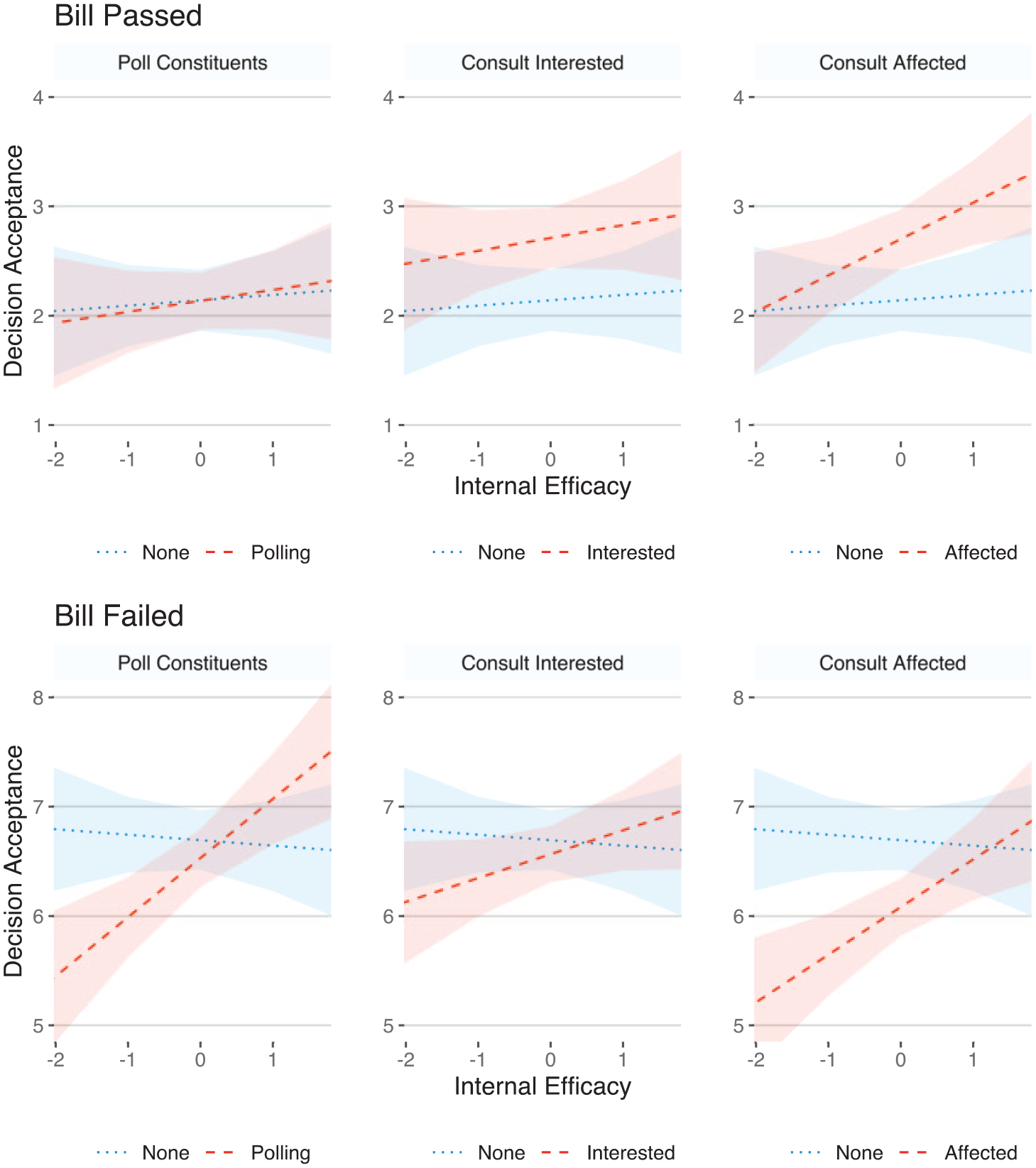
Decision Acceptance, by Bill’s Passage, Consultation Treatment (Relative to the Control) and Internal Political Efficacy (Illustrated between the 5th and 95th Percentiles). Figures Include Predicted Values with 83.5% Confidence Intervals to Visualise Significance at the p < 0.05 Level.
Finally, I confirm the robustness of the results in several ways. Online Appendix Table 2 repeats the above analysis on perceived responsiveness, but with the explained item excluded from the index (due to the lack of related text in the experimental vignette, as mentioned above); as the regression results make clear, however, this change has no discernible impact on the findings. Given the central role of income quartiles in the vignette, Online Appendix Tables 3 through 8 then reproduce all of the analyses presented in this study, but add in a control for respondents’ self-placement of either their personal or household income; this allows us to control for whether a respondent may have self-identified as belonging to the policy-affected group (the baseline income category in the regressions). Once again, we do not see any changes to the results presented in the main analysis.
Conclusion
This article set out to explore citizens’ ‘intuitive political theory’ (DeScioli and Bokemper, 2018) around questions of consultation and representation. To do so, it employed an original survey experiment designed to compare how individuals react to granting input and policy influence to different (sub-)groups of constituents. In particular, the study focused on consultation procedures whereby elected representatives (1) gave equal weight to their constituents’ preferences, using polls to decide how to vote; (2) gave special weight to the views of interested citizens or (3) gave special weight to the views of citizens who would be disproportionately impacted by the bill if it were to become law. The three treatments thus present a range of constituency outreach measures – reflecting, respectively, commissioned polling, open town-hall meetings and targeted consultations (see Belot, 2019; Kevins and Robison, Forthcoming) – with the goal of disentangling preferences around who elected officials should be representing. In line with past work, reactions to these processes were then broken down by outcome favourability and political efficacy (e.g. Coffé and Michels, 2014; Esaiasson et al., 2019; Landwehr and Steiner, 2017).
Findings from this analysis suggest that all of the consultation procedures broadly increased perceived responsiveness in the expected manner: respondents did not discriminate between the three consultations presented to them, regardless of whether the measure focused on the constituency as a whole, interested constituents or affected constituents, and the effects of these consultation procedures were not contingent on whether or not an individual agreed with the final policy outcome (though outcome favourability did shift the baseline level of perceived responsiveness). Importantly, however, this pattern was not reflected in a generalised increase in decision acceptance. Instead, we find that shifts in decision acceptance depended on a combination of outcome favourability and consultation type. What is more, rather than broadly increasing or decreasing decision acceptance, the measures that did matter – consulting affected constituents and, to a lesser extent, interested ones – appear to have pushed respondents towards more middling responses. Similar ‘cushion effects’ were present in the analyses looking at external and internal political efficacy, though once again with considerable variation based on outcome favourability and consultation type.
Taken together, these results highlight the value of analysing different sorts of consultation measures alongside one another (see Nabatchi, 2012) and focusing on concrete processes and policy outcomes rather than abstract preferences (see Esaiasson et al., 2017). In contrast to most existing studies that look at concrete cases, however, this article placed the link between elected representatives and their constituents at the centre of its analysis. In doing so, it set out to disentangle procedural effects tied to representatives consulting their constituents from those tied to representatives targeting certain types of constituents for consultation and (substantive) representation. This approach thus helped us to unpack citizens’ representational expectations (Bochsler and Hänni, 2017; DeScioli and Bokemper, 2018) and the types of representation they want their elected representatives to provide (Bengtsson and Wass, 2010; Eulau and Karps, 1977). Results suggest that even though all of the consultation measures – whether targeted or open, direct or indirect – increased perceptions of democratic responsiveness as expected, their impact on decision acceptance was far more heterogeneous. This latter finding, coupled with the mix of negative and positive effects on decision acceptance once outcome favourability is taken into account, suggests that granting constituents input and influence may not always shift public opinion on legislative outcomes in the expected direction. Instead, the form and target of the consultative procedure will matter deeply.
The present study thus provides some initial indications as to how citizens may react to different sorts of consultation measures, but the conclusions we can draw from it are nevertheless limited in several ways. First, the scope of outcome favourability’s impact on reactions may have been exaggerated in this study due to the policy issue highlighted in the vignette: respondents were predominantly opposed to the bill and also believed (likely correctly) that most Americans would similarly be opposed to it. Future work centred around a less off-putting policy is therefore crucial, and it would also make it possible to examine potential variation between respondents taking different stances on the bill (something that cannot be assessed here). Second, as noted above, the symmetrical setup of the experiment generates one unlikely combination: affected constituents expressing a preference for the bill’s passage, despite such an outcome going against their own material interests. Due to the implausibility of this scenario, we should be hesitant about drawing any strong conclusions from that particular combination. Finally, although survey experiments can help us to tease out the mechanisms driving reactions to constituent input and influence, they also raise concerns tied to external validity (see, for example, Gaines et al., 2007). Whether reactions would be similar in a real-world setting is thus an open question – particularly since the link between constituents’ opinions and their elected representatives’ voting patterns is never as clear or direct as described in the experimental text.
Future studies addressing these limitations would therefore be especially useful, as would research extending these investigations to more novel forms of deliberative democracy (see, for example, Knobloch et al., 2020; Wojciechowska, 2019). Studying reactions to deliberative mini-publics is likely to be a particularly valuable application: most existing work on the topic focuses on the deliberative process, rather than on how non-participants react to the initiative (e.g. Gastil, 2018; Muradova, 2020) – yet the broader public’s reactions to these assemblies will likely be an essential factor shaping politicians’ willingness to implement assembly decisions (e.g. Michels and Binnema, 2019; Pogrebinschi and Ryan, 2018). Relatedly, extending this article’s analysis to other sorts of democratic innovations and issue areas would also help to determine the extent to which the trends uncovered here are generalisable to other consultation measures and policy proposals. In doing so, it may be particularly instructive to explore different varieties of policy affectedness – for example, tied to personal security or freedom instead of money – and to compare reactions to consulting different sorts of policy-affected groups. The present study thus provides several signposts for future analyses, while also helping to direct attention towards novel representation-related questions.
Supplemental Material
Online_Appendix_956327 – Supplemental material for Input from Whom? Public Reactions to Consultation Measures
Supplemental material, Online_Appendix_956327 for Input from Whom? Public Reactions to Consultation Measures by Anthony Kevins in Political Studies
Footnotes
Appendix 1
Decision Acceptance as Shaped by Bill Outcome, Consultation Treatment and Internal/External Efficacy.
| Dependent variable: | ||
|---|---|---|
| Decision acceptance | ||
| (1) | (2) | |
| Bill failed | 4.356*** (0.274) | 4.552*** (0.281) |
| Internal efficacy | 0.049 (0.193) | |
| Consultation: Polling | −0.035 (0.270) | −0.005 (0.274) |
| Consultation: Interested | 0.463 + (0.278) | 0.569* (0.282) |
| Consultation: Affected | 0.484 + (0.277) | 0.559* (0.280) |
| External efficacy | 0.677** (0.208) | |
| Bill Failed × Internal Efficacy | −0.099 (0.274) | |
| Bill Failed × Polling | −0.150 (0.378) | −0.157 (0.386) |
| Bill Failed × Interested | −0.543 (0.382) | −0.696 + (0.390) |
| Bill Failed × Affected | −1.076** (0.382) | −1.169** (0.390) |
| Bill Failed × External Efficacy | −1.562*** (0.287) | |
| Polling × External Efficacy | 0.075 (0.279) | |
| Interested × External Efficacy | −0.290 (0.292) | |
| Affected × External Efficacy | −0.063 (0.279) | |
| Bill Failed × Polling × External Efficacy | 0.432 (0.390) | |
| Bill Failed × Interested × External Efficacy | 1.095** (0.403) | |
| Bill Failed × Affected × External Efficacy | 0.147 (0.386) | |
| Polling × Internal Efficacy | 0.051 (0.271) | |
| Interested × Internal Efficacy | 0.069 (0.278) | |
| Affected × Internal Efficacy | 0.283 (0.264) | |
| Bill Failed × Polling × Internal Efficacy | 0.539 (0.393) | |
| Bill Failed × Interested × Internal Efficacy | 0.200 (0.384) | |
| Bill Failed × Affected × Internal Efficacy | 0.202 (0.381) | |
| Constant | 2.269*** (0.200) | 2.141*** (0.202) |
| Observations | 1290 | 1290 |
| R 2 | 0.450 | 0.421 |
| Adjusted R2 | 0.444 | 0.414 |
| Residual SE (df = 1274) | 2.367 | 2.428 |
| F statistic (df = 15; 1274) | 69.489*** | 61.734*** |
Cells include OLS (ordinary least squares) coefficients with standard errors in parentheses.
p < 0.10; *p < 0.05; **p < 0.01; ***p < 0.001.
Acknowledgements
The paper benefitted from feedback provided at Aarhus University’s Department of Political Science, the Annual Meeting of the American Political Science Association (Boston, USA), the Annual Meeting of the Dutch and Flemish Political Science Association (Leiden, The Netherlands), the Annual Meeting of the European Political Science Association (Belfast, Northern Ireland), Tilburg University’s Department of Sociology and the Utrecht University School of Governance. I would also like to thank Peter Achterberg, Kimberly Gross, Carsten Jensen, Matthew Levendusky, Monika Mühlböck, Tim Reeskens, Joshua Robison, Eline Severs, Barbara Vis, the Editors at Political Studies and the anonymous reviewers for their helpful comments.
Declaration of Conflicting Interests
The author(s) declared no potential conflicts of interest with respect to the research, authorship, and/or publication of this article.
Funding
The author(s) disclosed receipt of the following financial support for the research, authorship, and/or publication of this article: This research was funded by the European Commission’s Horizon 2020 Programme via a Marie Skłodowska-Curie Individual Fellowship (Grant No. 750556).

Supplementary Information
Supplemental material for this article is available online.
Data and R script file are available at the Loughborough University Research Repository.
Notes
Author Biography
References
Supplementary Material
Please find the following supplemental material available below.
For Open Access articles published under a Creative Commons License, all supplemental material carries the same license as the article it is associated with.
For non-Open Access articles published, all supplemental material carries a non-exclusive license, and permission requests for re-use of supplemental material or any part of supplemental material shall be sent directly to the copyright owner as specified in the copyright notice associated with the article.
