




Abstract
How do institutions adapt and reform themselves in response to new challenges? This article considers the role of ideas and posits that the concept of ‘dilemma’ – clashes of beliefs played out through power relations and practices – offers a complementary tool to understand institutional change. It draws on the 2014 appointment of a new Clerk to the UK House of Commons – in which conflicting beliefs about the House of Commons administration opened a dilemma for key parliamentary actors – as a token case study to highlight the value of the concepts of beliefs, practices and dilemmas. It further broadens out these findings to consider the value of a wider interpretive approach for understanding how institutions may adapt and change. In doing so, it makes (1) a theoretical contribution by exploring the role of ideas in causing institutional change and (2) an empirical contribution through its analysis of parliamentary administration, an understudied area.
Keywords
How do institutions adapt and reform themselves in response to new challenges? This question has been discussed and debated across many types of institutions and with lots of different theoretical and analytical viewpoints (Hay, 2002; Thelen, 2009). In this article, we offer an original contribution to this discussion by exploring the value of an interpretive approach to explaining institutional change. We do this by focusing on how beliefs, traditions and practices shape change, specifically making use of a case study in the form of the appointment of a new Clerk of the UK House of Commons in 2014. We focus on this case for two reasons. First, legislatures have seen considerable institutional change and challenge in recent years. In our case study institution, for instance, we can also look to procedural innovations following COVID-19 (House of Commons Procedure Committee, 2020) and a failure to deal adequately with complaints of sexual harassment and bullying (Cox, 2018; House of Commons Commission, 2018c). And second, it builds on an understudied area of political science, namely the internal governance of legislatures (see Judge and Leston-Bandeira, 2018; Stirbu, 2011; Yong, 2018). As such, we hope to offer new empirical findings on parliamentary organisation.
While our case study on parliamentary change is timely and original, this article’s core contribution comes from the use of our token case to argue for the complementary value of interpretive approaches in explaining institutional change more generally. In particular, we point to the role of ‘dilemmas’ as a key concept through which institutionally situated actors interpret and untangle divergent beliefs. The clash of beliefs, as framed by particular dilemmas and played out in practices, can explain subsequent institutional change and political outcomes. This article therefore strengthens interpretive scholarship, which has sometimes found it difficult to explain the role of ideas in causing or facilitating change (Geddes, 2019; Glynos and Howarth, 2008; Hay, 2011). We make our argument in the following four sections. First, we consider existing approaches to understanding institutional change and specifically identify how this has shaped debates about parliamentary change. Second, we draw on interpretive theory to explain how ‘dilemmas’, defined as a clash of situated actors’ beliefs, practices and traditions, explain change. Third, we apply our framework to the recruitment for the Clerk of the House of Commons in 2014, which highlights how ideational dilemmas cause change. Fourth and finally, we summarise the contribution of our case study to broader debates about institutional change.
Understanding Institutional Change in Parliaments and Beyond
Historically, the study of institutions focused on how institutions persist, rather than how change occurs (Thelen, 2009: 474). The application of the ‘new institutionalisms’ that have emerged since the 1990s (Hall and Taylor, 1996) has aided a move towards understanding institutional change, with the development of concepts such as ‘punctuated equilibrium’, whereby stable institutions change gradually but, following some kind of (usually exogenous) shock such as a revolution, may change more significantly (Krasner, 1984); or ‘critical junctures’, in which a confluence of factors lifts the normal constraints of action for actors within an institution (Collier and Collier, 1991). Analysis of change using the new institutionalist approaches has also been criticised, however, for relying on exogenous shocks or events or, as with their theoretical predecessors, being unable to explain change more generally owing to their approach focusing on institutional stability (Gorges, 2001). To overcome these weaknesses, Kathleen Thelen and colleagues have proposed a focus on the importance of incremental and endogenous changes to institutions through, for example, the removal of old and addition of new rules, layering new rules alongside other rules, or the changing impact or application of existing rules (Mahoney and Thelen, 2010; Streeck and Thelen, 2005). Meanwhile, other scholars have looked at introducing a greater explanatory role of ideas to institutionalist analyses, sometimes labelled ‘constructivist’ (Hay, 2006) or ‘discursive’ (Schmidt, 2008) institutionalism, or incorporating ideas into existing theories of new institutionalism (Schmidt, 2010). Some scholars have taken this a step further and adopted an ‘interpretive’ approach (Bevir and Rhodes, 2003), which replaces institutions with ideas as the central category for analysis. We place ourselves in this tradition and outline the approach to explaining institutional change in the next section. Before doing so, we want to examine how debates about institutional change have affected explanations of parliamentary change.
B. Guy Peters (2011: 60) argues that studies on parliaments have produced primarily ‘descriptive studies of institutional dynamics’, suggesting that the theoretical insights gained from new institutionalisms or interpretive scholars have not become embedded in parliamentary-focused research (see also Geddes, 2020: 15–23). Turning specifically to perspectives on parliamentary change, we find that the debate focuses on ‘reform’ rather than institutional change 1 and is largely marked by two views: an ‘attitudinal’ perspective, promoted by Philip (now Lord) Norton (1983, 2000, 2013) and popularly known as the ‘Norton View’; and a ‘contextual’ perspective, promoted by Alexandra Kelso (2003, 2009) and colleagues. It is worth summarising these in order to understand approaches to change in representative institutions. 2
The ‘Norton View’ posits that a ‘change of attitude’ by MPs is a ‘necessary albeit not sufficient’ condition for reform (Norton, 1983: 60). Norton adds that this ‘does not reject structural changes but argues rather that an attitudinal change is a prerequisite to effective structural and procedural change’. Political will is crucial because MPs already possess all the powers necessary to change executive–legislative relations and sometimes use that power – or the threat of that power – to defeat the government in Parliament (Cowley, 2002; Norton, 1980) and achieve parliamentary reform (Norton, 1983). Norton (2000: 13) identifies three conditions necessary for reform: One is a window of opportunity. This usually comes at the beginning of a Parliament, before ministers and MPs get bogged down in dealing with a mass of public business. The second is a reform agenda. MPs may favour change but they need a coherent set of proposals to unite behind. Third, there has to be leadership: this may come from the backbenches but may also come from the Leader of the House . . . or a combination of both (Norton, 2000: 13).
It is important to note that Norton does not say that change will occur if these conditions are met; nonetheless, they have been used to explain the introduction of departmental and cross-cutting select committees in 1979 and reforms to committees in 2010 (Norton, 2013).
Other scholars, however, have argued that the Norton view does not convincingly explain the lack of reform even when conditions were met. Challengers to the attitudinal view have proposed a ‘contextual’ perspective. They argue that ‘it is the political context within which these MPs operate that is frequently the stumbling block to reform, a context characterised by an executive mentality and partisanship’ (Kelso, 2003: 68). For example, Flinders (2002: 30–31) previously argued that ‘the supremacy of parliament over the executive is thwarted by the latter’s tight party management and procedural control of the House’s timetable’ and that, in this context, reforming parliamentarians will face significant difficulty in enacting changes. The ‘executive mentality’ arguably forms part of a broader British Political Tradition (Hall, 2011; Judge, 1993) alongside the importance of political parties in structuring parliamentary life (Kelso, 2003; Power, 2007; Wright, 2004) and is particularly incisive in explaining the stability of parliamentary structures. Kelso (2009; see also Armitage, 2012) draws on historical institutionalism to argue that actors tend to abide by the rules set by institutions which become entrenched over time, and this ‘path dependency’ means that institutions act in the future as they have done in the past. So, how do proponents of a ‘contextual view’ explain change? According to Wright (2004: 871), ‘it is a matter of exploiting cracks and getting wedges into doors’; meanwhile, Kelso (2009; see also Armitage, 2012) proposes that change may occur as a result of exogenous shocks or critical junctures (as identified above).
The ‘contextual’ approach, therefore, emphasises structural explanations of institutional change by drawing on historical institutionalism; meanwhile, the ‘attitudinal’ approach highlights the role of individuals to ensure that change takes place and reforms can be enacted. While both approaches to explaining reform give us insights to analyse parliamentary change, we want to take the debate a little further and draw on interpretive insights to the social sciences to do so. Specifically, we propose that parliamentary change can be understood through the articulation and adjudication of ideational dilemmas. In taking this approach, we suggest two benefits. First, specifically regarding the debate across parliamentary studies, we integrate both actors and context in explaining change, which legislative scholars have hitherto neglected somewhat. Second, our approach provides a further way by which we can understand and analyse institutional change more generally and contributes to issues regarding the explanatory power of ideas in political science. We return to these wider benefits in the final section of the article; first, we want to summarise and apply the interpretive approach.
The Interpretive Approach
We begin from the starting point that people’s interpretations of social and political worlds do not arise in a vacuum. Rather, realities are constructed through people’s experiences of and engagement with what they perceive of the world. This point has been articulated by many constructivists and interpretive scholars across philosophy, the arts and humanities, and the social sciences (Bevir and Blakley, 2018; Wagenaar, 2011; Yanow, 2004). As Mark Bevir and R.A.W. Rhodes (2003: 18) point out, this has significant implications for the study of politics: We can understand and explain practices and actions adequately only by reference to the beliefs and desires of the relevant actors. Hence to study political life adequately we have to engage in the interpretation of the beliefs and desires of those we study (Bevir and Rhodes, 2003: 18).
This means that we must take seriously individuals’ interpretations of the world – including their beliefs, values and interests – in order to explain their behaviour. This leads us to ‘focus on the meanings that shape actions and institutions and the ways in which they do so’ (Bevir and Rhodes, 2003: 17). For example, parliamentarians’ attitudes to how they interpret ‘accountability’ necessarily changes how they engage with select committee work or parliamentary questions. Individuals are not given these beliefs; they are constructed, learned, shared and debated over time. In this way, ideas and beliefs become basic explanatory blocks of analysis. 3
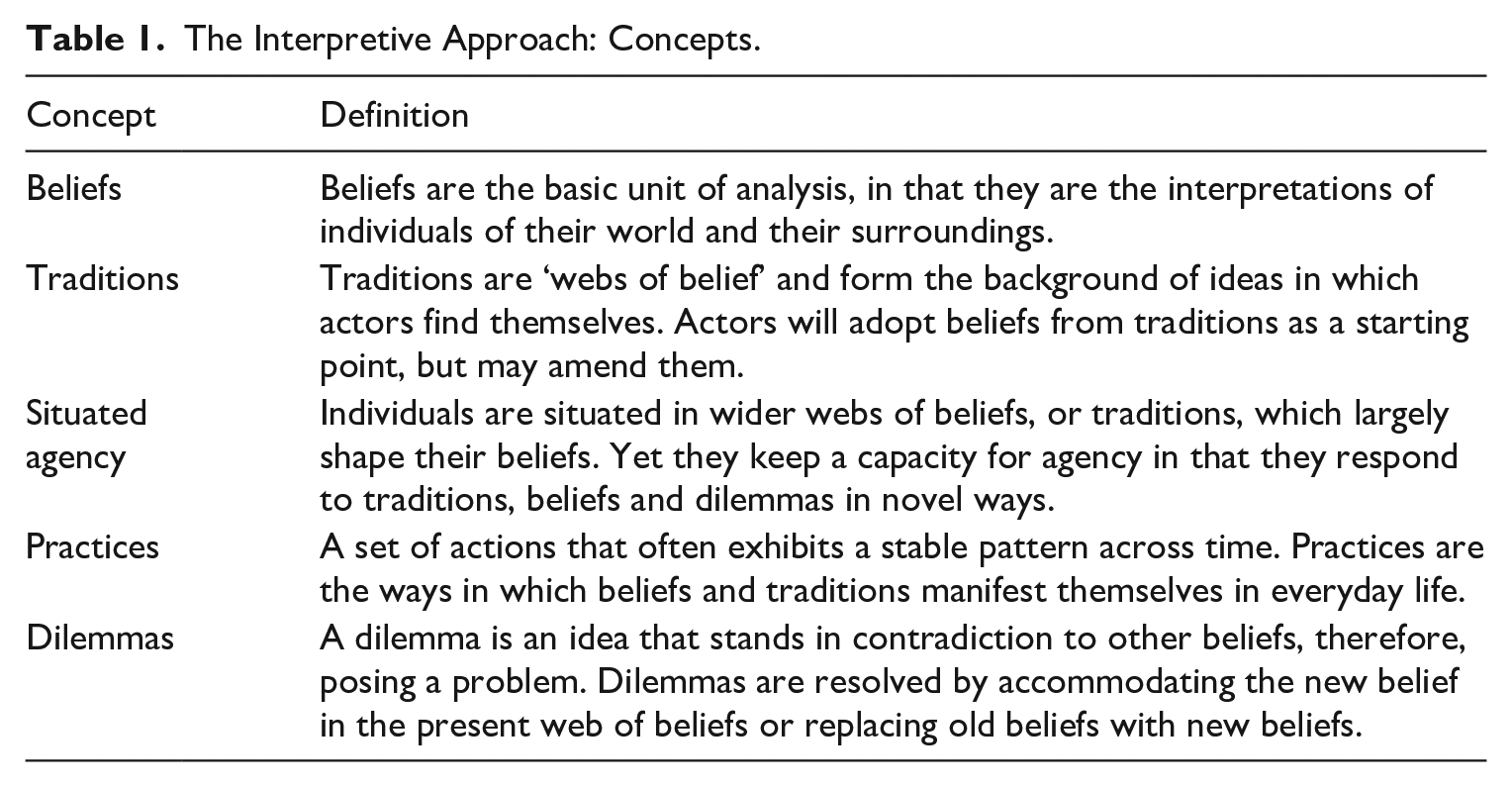
No single belief can be understood in isolation; they are shaped by other values, ideas and interpretations of events. We refer to these wider webs of belief as ideational traditions on which individuals draw to shape organising perspectives, to make cognitive shortcuts or as guides for interpreting subsequent events and phenomena. For example, some argue that there is a dominant ‘British Political Tradition’ that explains political outcomes in the UK and includes the sovereignty of Parliament, a strong executive, an adversarial political culture and an elitist conception of participation in politics (Hall, 2011). The concept of tradition may echo notions of episteme, social structure or paradigms, used pervasively in the social sciences. We prefer ‘tradition’ because we maintain people’s ability to amend, change or transform their ideational backgrounds. In other words, individuals have a capacity for agency in that they can respond to ideas, values, traditions and practices in independent and novel ways (what Bevir and Rhodes (2010: 74) have called ‘situated agency’). That said, traditions are also very ‘sticky’ and, therefore, exert a significant influence over actors.
In our approach, beliefs and traditions play a significant explanatory role, and they often play out through people’s actions. Some of these become regular and may exhibit a pattern; they are rituals or routines. We label these types of behaviour practices. They are the ways in which beliefs and traditions manifest themselves in everyday life and may include diverse activities such as an MP’s weekly routines, the spectacle of the State Opening of Parliament or the appointment process for a new Clerk of the House of Commons. 4
This leaves us with one all-too-important question: how do beliefs, traditions and practices change? For this, we identify the concept of dilemmas from Bevir and Rhodes (2003, 2010). Dilemmas come about through tensions between two or more beliefs that individuals may have or the practices to which they lead. Crucially, a dilemma depends entirely on people interpreting beliefs to be in some degree of tension which actors feel the need to resolve. In this way, dilemmas pit two or more beliefs against each other and prompt questions over the webs of beliefs of individuals. Dilemmas can cause individuals to discard or amend their existing beliefs or to try to accommodate new beliefs in a wider tradition. This is how traditions and practices change over time. Agency is important here; a dilemma arises only after people interpret beliefs in conflict with each other. A clash of beliefs leads to a dilemma, which in turn can lead to institutional change. The precise nature for how dilemmas lead to change has been subject to discussion (Hay, 2011). In our view, and as developed elsewhere (Geddes, 2019), dilemmas play out through power and practices (see also Boswell et al., 2019; Pike, 2020). We argue, first, that power is a force that mediates a rupture of contesting beliefs, practices and traditions; it sharpens, blurs, strengthens, weakens, links or dissociates ideas. Power relations between actors set boundaries for dilemmas and frame how a dilemma arises. And we argue, second, that dilemmas are mediated through practices where beliefs and traditions play out and intersect and where situated actors use their resources to push for, or resist, change. Therefore, our analysis of dilemmas must be closely linked to the practices of actors and the power relations between them in conjunction with their ideational context (for a more detailed theoretical discussion, see Geddes, 2019). We use our case study, below, to explain the interaction of practices, power and dilemmas.
In sum, we can explain institutional behaviour through a focus on ideas, beliefs and passions of actors and how they interpret institutions, conventions and procedures. We must also look to wider institutional traditions in which those ideas and beliefs arise and change in response to dilemmas. We summarise the key concepts – italicised in the above paragraphs – in Table 1 for reference.
The Interpretive Approach: Concepts.
The interpretive approach sits alongside a growing range of research that values similar philosophical roots to study representative institutions (e.g. Crewe, 2005; Leston-Bandeira, 2016; Rai and Spary, 2019). Specifically regarding parliamentary change, the approach asks scholars to consider the dilemmas that MPs, clerks and officials face, and how these dilemmas are interpreted and then framed and play out through established (or novel) practices and power relations. In this way, we highlight the contribution of an interpretive approach to understanding parliamentary change. However, we use parliamentary examples as a way to identify possible wider lessons for understanding institutional change through an interpretive lens, given the many places and contexts within which these approaches have been applied across political science (by Bevir and Rhodes or otherwise). What we seek to offer with our interpretive focus is an additional form of explanation alongside other, perhaps institutionalist, ways of thinking. In order to demonstrate the value of our approach, we turn to our case study.
In our case study, we explore the appointment of a new Clerk to the UK House of Commons in 2014–2015 and explore it through a narrative analysis that draws on parliamentary debate, key documents and media coverage. We draw on this specific parliamentary case for three reasons. First, it allows us to explore parliamentary change in a broader way, rather than focusing only on executive–legislative relations, which has been the predominant focus of studies on parliamentary change and reform. This case study allows us to a wider range of institutional actors with different interpretations over the role of Clerk. Second, and relatedly, this example draws attention to otherwise overlooked institutional aspects of legislatures. It is one of the few pieces of research that analyses the administration of the House of Commons. Third, while events took place in 2014–2015, the reverberations are still felt many years since and remain highly salient given (1) the way that the Speaker at the time, John Bercow, had been drawn into further controversies around his authority, (2) the organisational reforms that have taken place since and (3) continuing questions over the way that authorities in Parliament have handled complaints of bullying and harassment.
To be clear, our case study remains exactly that: one case. As such, we offer a token explanation of institutional change (Dowding, 2016: 36–57, 2020). That is to say, we use our case study as evidence to test our above theoretical framework to support the complementary value of interpretive approaches, specifically dilemmas, to studying the political world. It is a token explanation, in that we deploy dilemmas as a way to highlight the complex ways in which political ideas operate, in significant detail, in this case. We believe that, in doing so, it allows us to show how dilemmas can be applied and studied, and thereby contributing to wider debates to understand institutional change.
Case Study: Appointing a New Clerk of the House
At 12:37 p.m. on Wednesday, 30 April 2014, the Speaker, John Bercow, announced to the House of Commons that he had received a letter from the Clerk and Chief Executive of the House, Sir Robert Rogers (now Lord Lisvane), in which Rogers indicated his intention to retire. As the Speaker read out the letter, Rogers was sitting at the Table directly in front of him. In line with convention, Rogers did not speak while his letter was read out, but showed a hint of emotion when MPs responded with a spontaneous and sustained outburst of applause – a contravention of the rules of the chamber, to which Rogers was the principal adviser. The Speaker noted, ‘it may be unparliamentary, but it bears eloquent testimony to the esteem in which Robert is held’ (HC Deb, 30 April 2014, c829).
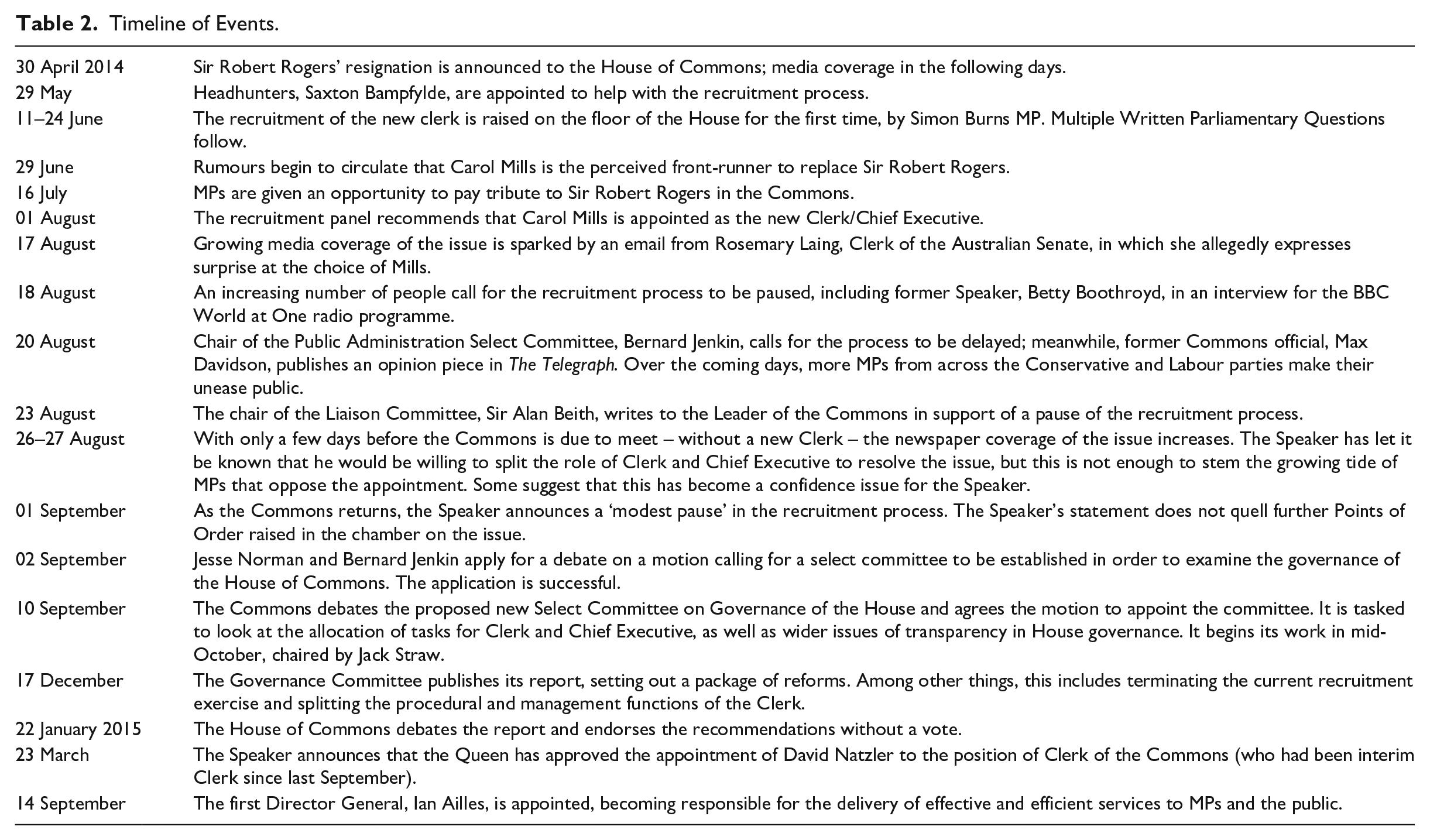
This statement marked the beginning of a dilemma for the House. The process of appointing Rogers’ successor divided MPs into two camps: those who wished to see the Clerk to prioritise procedure (the historic half of the job) and those who wanted to prioritise the management of Parliament (the managerial side of the job that was becoming more prominent). The dilemma brought the Speaker’s authority into question as MPs sought, successfully, to pause and then terminate the recruitment process. The previously under-explored issue of internal governance was scrutinised by a specially formed select committee, and on its recommendations, the role was divided into two posts. It was not until March 2015 that a new Clerk was appointed and September 2015 when the inaugural Director General took up his post (for a full timeline of events, see Table 2). Contrasting beliefs over the role of Clerk of the House of Commons had led to a dilemma that reverberated across Parliament, raising questions over: how Parliament is run as an institution; the relationship between MPs and officials; and the authority of the Speaker. As such, this dilemma is important because it, first and specifically, shows how this debate led to wide-ranging governance reforms, some of which are ongoing and unresolved, and, second and generally, demonstrates the way that a clash of beliefs and practices can lead to institutional change. It is to this dilemma we now turn.
Timeline of Events.
The Roots of a Dilemma: How to Find a Clerk
The role of Clerk of the House of Commons has an unbroken history dating back to 1363 (Marsden, 1979). The Clerk is appointed by the monarch (following a recommendation by the Speaker, conveyed by the prime minister) and cannot be dismissed by MPs or government, reflecting the placeholder’s impartiality. By 1990, the post had evolved to include management of the House of Commons Service (with the title formally amended to ‘Clerk and Chief Executive’ in 2000) (Evans and Nincovic, 2017). Three reviews of House of Commons administration between 1990 and 2007 considered the issue of splitting the role of Clerk and Chief Executive, and all recommended against such a move (House of Commons Commission, 1990, 1999, 2007b). Thus, the roles remained combined, and by the time of Rogers’ retirement, he was responsible for some 1700 staff and expenditure of over £200 million per year through the Chief Executive part of the role (House of Commons Governance Committee, 2014a). In general, the post of Clerk is not high-profile outside Parliament, but within it, the role is steeped in constitutional importance. This constitutional importance has historically vastly overshadowed the chief executive part of the role: in 2014, the postholder was generally known as ‘The Clerk of the House’ or simply ‘The Clerk’. This is not just semantics but a critical point: while the postholder served as chief executive as well as Clerk, this was not, in general, recognised by MPs. Conservative MP (at the time), Julian Lewis, reflected this view in the Commons in September 2014: In our minds, the Clerk is rightly associated with being the top procedural officer. That is what I have always regarded him as. Had anyone asked me before the dispute began to describe the functions of the Clerk, I would not have had the faintest idea that he was in a position to overrule everybody else on management matters (HC Deb, 10 September 2014, c1043).
The recruitment for Rogers’ successor in 2014 made MPs aware of the post’s dual nature, in turn exposing clashing ideas about how the postholder should operate. That such a dilemma occurred in 2014 for the first time, despite the dual nature of the role being in place for approximately two decades, was the result of a new recruitment process. From the late eighteenth century, the appointment of the Clerk had typically consisted of a promotion for the Clerk Assistant, the second-most senior post, and one usually held by a career clerk, unlikely to have extensive (or any) experience outside Westminster. Historically, this was viewed as a positive, rather than negative, attribute, and it was questioned whether any external candidate could compete: It would be a strange thing indeed, in modern times, if any outsider could be found of comparable stature; the waiting candidate would be, by now, the world’s leading authority on Constitutional Law and Parliamentary procedure, as well as a man [sic] already known intimately – and trusted – by Members of the House (Marsden, 1979: 197).
Indeed, external candidates did not even have an opportunity to apply, as the Speaker chose between two internal candidates recommended by the retiring Clerk. In 2007, a review of House of Commons administration recommended changes to the appointment process for the role: The method of appointment for the Clerk of the House/Chief Executive should, in future, be by means of competition, open to the (inevitably limited) group of suitably qualified candidates with a Selection Board similar to those employed for Permanent Secretaries to Government Departments (House of Commons Commission, 2007b: 26).
This recommendation was ‘noted’ by the House of Commons Commission (2007a: 3). On the retirement of Malcolm Jack as Clerk in 2011, a recruitment panel was appointed to ‘trawl’ internally for a replacement (HC Deb, 4 May 2011, c677; HC Deb, 30 June 2011, c1106; HC Deb, 2 September 2014, c197W). External candidates remained excluded, however, and the Clerk Assistant (Robert Rogers) was duly appointed: the clerkship appearing to take precedence over managerial responsibilities. Nonetheless, the election of Bercow on an explicit reform mandate in 2009 had raised the potential of conflict with the Clerk. Changing the practices and culture of an institution, as Bercow set out to do, by necessity would mean doing things differently; in contrast, a large part of the Clerk’s role is to enforce rules determined by precedent (ConservativeHome, 2009). While this conflict would later become clear under Rogers’ eventual successor (HC Deb, 9 January 2019, c372), Rogers has insisted that he supported the Speaker’s wish to modernise the House of Commons (Wintour, 2014).
Soon after Rogers’ retirement was announced, it became clear that Bercow was seeking to take an opportunity to make a diverse appointment, in line with his previous decisions (e.g. he appointed Rose Hudson-Wilkin as Speaker’s Chaplain, the first woman, and first person of colour, to hold this post, and Kamal El-Hajji as the first BME Serjeant-at-Arms (Boffey, 2011; UK Parliament, 2018; HC Deb, 7 January 2016, c 439). 5 The Mail on Sunday described the Speaker as undertaking a ‘worldwide search’ for a new chief executive, who would combine business experience with constitutional expertise and drive forward his ‘controversial plans to commercialise the Palace of Westminster’ (Owen, 2014). The post was advertised externally and headhunters were employed, both for the first time. The emphasis of the job description shifted considerably towards the managerial side of the job, and media reports suggested an external candidate was favoured – though ‘very much against tradition’ (Owen, 2014; see also Oborne, 2014). It was clear that these changes had been driven by the Speaker personally; for example, it is not clear whether the job description was agreed by the House of Commons Commission. John Thurso, the Liberal Democrat MP who acted as Commission Spokesperson, later said, ‘what I thought we had decided did not come out in the final document’ (House of Commons Governance Committee, 2014e). Indeed, the Commission later agreed that ‘in future, all aspects of recruitment of a Clerk/Chief Executive would be explicitly agreed in advance by the Commission’ (House of Commons Commission, 2014).
In the immediate weeks after Rogers’ resignation, the Speaker’s wish to appoint an external candidate prompted MPs to raise concerns in the chamber (e.g. HC Deb, 19 June 2014, c726W; HC Deb, 23 June 2014, c49W), most notably from known critics of Bercow (e.g. Simon Burns MP in HC Deb, 12 June 2014, cc717-18; HC Deb, 19 June 2014, c1269; HC Deb, 23 June 2014, c49W). By July, however, concerns appeared to have spread beyond the usual suspects. When the House of Commons paid tribute to Rogers, Sir Peter Tapsell, the Conservative MP who was the then Father of the House, described the outgoing Clerk as ‘a man of immense scholarship, steeped in a life dedicated to the rules, practices and conventions of this House’ and warned that ‘any Clerk of the House who was not so equipped would leave the Speaker of the day hopelessly floundering in a crisis’ (HC Deb, 16 July 2014, c892). From the backbenches, Conservative MP, Jacob Rees-Mogg, also argued that the House wanted a Clerk that is ‘steeped in the history’ of Parliament (HC Deb 16 July 2014, c903).
A Clash of Beliefs: Attempts to Appoint an Outsider
On 1 August, news broke that Carol Mills, Director of Parliamentary Services in the Australian Parliament, was to be appointed as Clerk. Almost immediately, the prime minister was urged by Conservative MPs to block the appointment (Owen and Carlin, 2014). In mid-August, an email leaked from the Clerk of the Australian Senate, Rosemary Laing, which described Mills as ‘without parliamentary knowledge or experience’ (Watt, 2014a). The issue exploded: former Speaker Baroness Boothroyd (a crossbench Peer) told the BBC that Mills was ‘totally out of her depth. She has no experience, she has no knowledge of the constitutional role of a parliamentary clerk’ (BBC Radio 4, 2014). A range of other commentators (Richards, 2014), former parliamentary staff (Davidson, 2014) and MPs (Duncan, 2014; Norman, 2014a, 2014b) added their voices. Importantly, the dilemma was no longer just about Mills, but reflected two additional concerns. First, the Speaker was perceived to have gone beyond his authority, even by his supporters. Sir Alan Duncan, a Conservative MP and long-standing ally of Bercow warned him: ‘your recommendation is starkly at odds with the view of the House’ (Duncan, 2014). Second, there was a broader debate about the administration of the House of Commons. As noted, for Bercow, creating a modern House of Commons Service required someone with management experience and, quite simply, someone that looked and felt different from the previous Clerk – such as a comparatively young Australian woman replacing an older man who had worked in the same institution for 42 years. 6 Bercow was not alone in seeking a more diverse and efficient House of Commons Service (e.g. comments made by MPs in tributes to Rogers on 16 July (HC Deb, 16 July 2014, cc886-905); or Points of Order raised on 1 September (HC Deb, 1 September 2014, cc61-6)). On the other side were those that believed the Clerk should focus on procedural duties, as summarised in Baroness Boothroyd’s comments, for example, and an opinion piece in The Daily Mail by Conservative critic of the Speaker, Jesse Norman (2014a). Liberal Democrat MP, David Heath, later pithily summed up the feeling of the time between ‘two camps in respect of where the responsibility should lie, which might be described as the chief executive-ites and the Clerk-ites’ (HC Deb, 22 January 2015, c450).
Beyond the Clerk: Governance of the House
With tempers high on the first day after the summer recess, the Speaker was heckled by Conservative MPs as he announced a ‘modest pause in the recruitment process’; (HC Deb, 1 September 2014, c1). The scope of the dilemma expanded when two Conservative MPs (Jesse Norman and Bernard Jenkin) secured a debate on the establishment of a time-limited select committee to examine not just the role of Clerk but also the governance of the Commons (Backbench Business Committee, 2014). The debate showed that the concerns went beyond Conservative MPs: Norman noted ‘widespread concern among Members in all parts of the House that the process governing the appointment of the next Clerk of the House was seriously flawed’ (HC Deb, 10 September 2014, c1014). Norman listed a number of facts he said were ‘not in dispute’, including that Mills ‘was not qualified for the specifically constitutional and procedural functions exercised by the Clerk’ and that she ‘was, in effect, recruited for a job that did not then exist as such, that of chief executive of this House’ (HC Deb, 10 September 2014, c1015). Norman’s speech also emphasised the reframing of the dilemma: it was no longer simply about the appointment of the Clerk but instead a wider issue about ‘the proper governance of this House’, which is ‘a matter of enormous public importance’ (HC Deb, 10 September 2014, c1016). During the debate, several MPs highlighted frustrations with the current governance system and called for the administration to be made fit for the twenty-first century. A member of the recruitment panel, Labour MP and Chair of the Public Accounts Committee, Margaret Hodge, argued that the row arose because MPs downplayed the importance of the chief executive role and noted that the House ‘overspent massively on the building of Portcullis House [the parliamentary building housing MPs offices, which opened in 2001], yet managing capital projects seems less important than who is sitting in a chair in the Chamber’ (HC Deb, 10 September 2014, c1033). The debate highlighted a clash between traditions and the perception of Parliament as separate to usual workplace practices and ideas around what modernisation and professional skills meant in a building that exists as both the home of the legislature and a royal palace.
These contrasting beliefs came out in the evidence to the select committee that was quickly established after the Commons debate (for further examples, see House of Commons Governance Committee, 2014b). Several MPs appearing in front of the committee argued that while Parliament’s primary purpose as a legislature had not changed, the institution itself had become broader in its activities. Failures on the managerial side prevented Parliament from fulfilling its primary purpose, thus putting the chief executive of the role on an equal or higher footing than the Clerk role. Hazel Blears, a Labour MP and former cabinet minister, made this point to the committee: I agree [. . .] we do Parliament, and that is really important. Parliament now does lots of other things: education, outreach, visitors, engaging the public. All of those are essential for us to have the confidence of the public. If those services do not work well, and people can’t get in and they can’t get a good visit or see Parliament working, we can do all the procedural stuff first class, but we will continue to erode the public’s confidence in Parliament (House of Commons Governance Committee, 2014c, Q289).
Blears’ party colleague, Angela Eagle MP, agreed that the chief executive part of the job had become increasingly more important and was linked to the core purpose of the institution: There is the potential to pay much more attention to the CEO part of the job in this complex service, which has to be delivered in changing times when the place needs to modernise in all sorts of ways. It needs to make itself relevant in an anti-politics age, and reach out to an electorate that is increasingly sceptical and baffled by how we do things in this place (House of Commons Governance Committee, 2014c, Q264).
Other witnesses, however, rejected these arguments. Another Labour MP, Margaret Beckett, sought to demonstrate a commitment to the traditional idea of the Clerk’s role: What strikes me very strongly from quite a lot of the evidence is that, in a whole variety of ways, a lot of people seem to have lost sight of what this place is actually for. We are not here to run the most efficient IT or catering service; we are here to facilitate the operation, and scrutinise and challenge the operation, of Government. We are the legislature. We are not just some other institution about which management is the most important thing. We have a core purpose (House of Commons Governance Committee, 2014d, Q712).
She added that she was ‘horrified that it is even suggested’ that the supplementary services, while important, were ‘of equal importance’ to the constitutional role (House of Commons Governance Committee, 2014d, Q723). These views appeared to be commonly held on the other side of the House. Conservative MP Alan Duncan concurred, ‘it is the Clerk who should be supreme, because we are a Parliament first’ role (House of Commons Governance Committee, 2014d, Q489).
In December 2014, the committee reported, calling for the ‘paused’ recruitment process to be ‘terminated’ and the creation of a new post of Director General of the House of Commons, reporting to the Clerk of the House (who remains Head of the House Service) (House of Commons Governance Committee, 2014a: 73–78). The House agreed to the recommendations in January 2015, and three months later, David Natzler – the internal candidate previously rejected in favour of Mills – was appointed as Clerk; a further six months later, Ian Ailles, an external candidate, was appointed as Director General (UK Parliament, 2015). While the role had been changed, the subordinate nature of the Director General role made it clear that in the clash of clerks-as-procedural-guardians against clerks-as-managers, the former had succeeded. Indeed, the result was widely viewed as a defeat for the Speaker (Holehouse, 2015; Pitel, 2014). Bercow (2020: 217–219), however, while describing the outcome as a ‘compromise’, has argued that, because the Clerk/Chief Executive role was divided, he achieved his overall objective. Mills returned to Australia, where she is now a director for the Institute for Public Policy and Governance at the University of Technology, Sydney (Whale, 2020).
Explaining Change Through Beliefs, Practices and Traditions
The resignation of Sir Robert Rogers and the subsequent row about the role of the Clerk was a ‘rude surprise’ in the language of Rhodes (2011: 245). Many MPs reported that they had expected Rogers to stay longer in post, and it is apparent that little thought or preparation had been given to either the recruitment process or any potential changes to the role (HC Deb, 14 July 2014, c892). The uncertainty created by the resignation did not automatically mean that a dilemma needed to arise. Rather, a number of actors defined it as such. The previous subsections indicate that a range of factors were at play. Clearly, as discussed at length above, beliefs over the role of Clerk mattered. However, two further points are worth exploring: first, the governing traditions in the House of Commons and, second, the practices of the actors involved (in particular, the style of the Speaker). We cover each in turn.
First, the dilemma was informed and shaped by different traditions in the House of Commons over governance arrangements. As the summer progressed, MPs’ concerns went wider than the specifics of the recruitment for Rogers’ successor into a more general concern about the administrative structures of the House, which required drawing on governance traditions to make their points. The Speaker’s wish for an external candidate reflected a wish from some MPs for greater managerialism and professionalism in running House services (e.g. Labour MPs Peter Hain (HC Deb, 01 September 2014, c62) and Hazel Blears (HC Deb, 01 September 2014, c63)), particularly in the context of proposals for a major rebuilding programme within the parliamentary estate (Meakin, 2019). Other legislatures have faced similar pressures: the National Assembly of Wales, for example, rebranded its ‘Clerk’ role as ‘Clerk and Chief Executive’ in 2007, a move that Diana Stirbu (2011: 6) reported as viewed by staff as a move away from ‘a traditional procedural focus towards a more managerial, corporate governance focus’. Mills has herself suggested that there was opposition to her appointment from existing Commons staff: I had to ring from Dubai on my stopover because they still hadn’t confirmed a hotel room for me. It was stuff like that which just made me think: ‘people are not here to make it easy’ (Mills, quoted in Whale, 2020: 3819).
Other MPs noted caution about wide-ranging reforms that would lessen the focus on the procedural aspects of the role (e.g. Conservative MP, Crispin Blunt, HC Deb, 1 September 2014, c63). The arguments of many MPs demonstrated the competing beliefs present in the dilemma: they supported change in theory, but believed that reforms needed to respect the history and traditions around the role of Clerk. This was often linked to scepticism about claims that reforms entailed ‘modernisation’ (e.g. HC Deb, 10 September, c1018). This demonstrates how any reform proposals were bound to create a clash of competing beliefs, informed by longer traditions over the role of Speaker and Clerk, and more general voices that opposed Speaker Bercow’s wider reform agenda. Bercow himself has noted how the row broadened out, due to personalities and politics, arguing that most MPs did not have strong feelings about the role of the Clerk itself but that ‘the political reality was that several people on the government benches were adamantly opposed’ to his plans, in addition to MPs who, ‘for ideological or personal reasons, were hostile to me and determined to prolong the row’ (Bercow, 2020: 218; see also, Whale, 2020: 3844). As such, the dilemma about appointing a new Clerk was also about the practices, personalities and power relations of key individuals, and brings us to our final theme.
It should come as no surprise that the first sources that criticised the recruitment process were long-standing media critics of the Speaker (e.g. The Daily Mail, The Mail on Sunday, Guido Fawkes blog). Bercow (2020: 218) has argued that ‘most of the media had no understanding of or interest in the merits of the arguments’ and instead viewed the issue ‘purely in personality terms’. Similarly, other MPs noted that opposition was led by parliamentarians with a history of difficult relationships with Bercow. Labour MP Natascha Engel suggested that the row was used ‘as a Trojan horse to pursue a personal vendetta against the Speaker’ (HC Deb, 10 September 2014, c1031). Mills has suggested that the Coalition government’s representative on the recruitment panel, Andrew Lansley, the Conservative MP and Leader of the House, was opposed to her appointment (Whale, 2020: 3845).
While an early source of debate was the allegedly deteriorating relationship between Rogers and Bercow (Watt, 2014b), the wider issue of accountability of the Speaker became an issue. MPs frequently used Points of Order to raise the issue, but this proved inadequate, especially when Deputy Speakers were in the chair (e.g. HC Deb, 2 September 2014, c191). Moreover, while the Speaker chairs the House of Commons Commission, he does not speak for it, posing an accountability problem when the Speaker personally identifies with an issue. 7 The power relationship between MPs and the Speaker mattered, with the latter viewed as acting beyond his authority. Bercow has reported that he was ‘advised’, although he does not give the source of the advice, that appointing Mills ‘would simply not be acceptable to the House’ (Bercow, 2020: 218). Publicly, Bercow was reminded by a predecessor, Baroness Boothroyd, that he was a servant, not master, of the House (Coates, 2014). Elsewhere, Sir Alan Duncan MP warned that ‘the Speaker is now being asked to do far too much and may, indeed, have changed the nature of the speakership, without the authority of the House, to do things in the way he chooses’, (House of Commons Governance Committee, 2014d, Q493). This dilemma thus raises broader questions about the role of the Speaker, specifically around his powers to act on behalf of the House (Judge and Leston-Bandeira, 2018; Kelso, 2007; Norton, 2017).
Discussion
The appointment of a new Clerk became a dilemma over contrasting beliefs over the role of Clerk of the Commons, which clashed through everyday practices between different actors on the floor of the House and behind the scenes over the second half of 2014. Through these events, it became clear two wider sets of traditions that had previously coexisted uneasily within the House of Commons – namely between the need to improve managerial capacity and the belief that the constitutional part of the Clerk role must maintain primacy – could no longer be sustained. The recruitment process acted as a flashpoint, challenging MPs to engage with beliefs and traditions that usually operate subconsciously, causing a dilemma. The dilemma in turn forced MPs make a conscious decision about the future governance of their legislature leading to the appointment of a Director General of the House of Commons. This was an example of significant institutional change. Crucially, however, it is the actual dilemma, rather than its outcome, that highlights the value of the interpretive approach. It is through the clash of the beliefs that institutional change occurred. This was not an instance of key actors changing their beliefs: instead the dilemma involved the adjudication between the two different beliefs and demonstrated the power of the traditional view of the Clerk as procedural guardian (over the managerial role). Indeed, it is only through understanding how actors drew on beliefs and traditions – mediated through practices and power relations – that we can understand why the dilemma was resolved as it was, and why institutional change took place. The interpretive lens thus helps us understand the events of 2014 in a clearer light.
Furthermore, while the recruitment of a new Clerk was the root of the dilemma, this analysis has shown how the dilemma highlighted a wider clash of traditions over the purpose of the House of Commons Service and its management: demonstrating how a specific issue around one post engulfed Parliament in a much wider debate about governance of the legislature. Furthermore, the episode of 2014 had much wider repercussions. For example, it is notable that the Commission had agreed the recruitment process for the next Clerk ahead of Natzler’s announcement of his planned retirement (House of Commons Commission, 2018b). Natzler was succeeded by his Clerk Assistant, a male career official from the House of Commons Service, Dr John Benger (HC Deb, 5 February 2019, c169) in March 2019. While the job was open to external candidates, it required ‘detailed knowledge and expert understanding of the practices and procedures of the House of Commons’. In contrast, the 2014 job description had required only ‘awareness’ of such practices and procedures (House of Commons, 2018; HC Deb, 10 September 2014, c1021). Only internal candidates were shortlisted, and the final selection was again reported as a defeat for the Speaker’s reform agenda, as he was said to have favoured the sole woman candidate shortlisted (Black Dog, 2019). This therefore highlights the legacy of the 2014 recruitment on the House of Commons’ administrative structures, which continue to change (Executive Committee, 2016; House of Commons Commission, 2018a).
Why does this matter? We posit the broader implications of our article in the final, concluding section.
Concluding Remarks
This article has explored a detailed case study around the recruitment of Clerk of the House of Commons as a token explanation to highlight the value of an interpretive approach in explaining institutional change, as well as drawing attention to the study of parliamentary administrations more generally. We close with two brief comments: first, the specific value of this article on understanding parliamentary change; and second, the wider implications for using interpretive approaches to understanding institutional change.
First, our token case study draws attention to new ways of understanding parliamentary change. This is increasingly important given the number of pressures that legislatures are facing. In the UK, for example, the MPs’ Expenses Scandal of 2009 created a significant dilemma through the subsequent crisis of confidence in Parliament (Russell, 2011); Brexit has arguably placed a number of practices, procedures and institutional relationships under strain between Parliament, government and judiciary; progress has been slow on the long-running refurbishment of the Palace of Westminster (Meakin, 2019); the House is under considerable challenge to change its processes to protect its staff following allegations of widespread bullying and harassment (Cox, 2018); and, most recently, the global health pandemic of Coronavirus/COVID-19 poses considerable challenges for procedural innovation in the House of Commons (House of Commons Procedure Committee, 2020), as it does across all political institutions. While the UK Parliament has not been standing still in recent years, and continuing to face significant pressures, parliamentary studies of institutional change have not kept up. We therefore use our case study as a way to draw attention to a new, additional way to understand change in representative institutions.
Second, in addition to our specific contribution to understanding parliamentary change, this article seeks to open space for further debate on how institutions change. We argue that the concept of ‘dilemmas’ is a useful analytical tool in the interpretive armoury to contribute to explanations of the political world. As other scholars have pointed out, understanding the relationship between political ideas and political change has been somewhat unclear in interpretive scholarship (e.g. Geddes, 2019; Glynos and Howarth, 2008; Hay, 2011). We have identified how dilemmas can be used to understand institutional change, and applied it in one token case to illustrate its application. In doing so, we suggest that dilemmas are a clash of beliefs between situated actors that play out through power relations and practices, which subsequently inform political outcomes. This allows us to add depth to the value of interpretive approaches, and also brings forward an additional way to look at and explain institutional change across a variety of approaches discussed at the outset of our article.
Footnotes
Acknowledgements
We would like to thank our colleagues for their feedback on earlier drafts of this article, especially members of the Political Studies Association Parliaments Group. We also want to thank the two reviewers for their helpful comments in improving this article and the guidance from the editorial team at Political Studies. We retain full responsibility for the views published here and the errors contained within.
Declaration of Conflicting Interests
The author(s) declared no potential conflicts of interest with respect to the research, authorship and/or publication of this article.
Funding
The author(s) received no financial support for the research, authorship and/or publication of this article.
