




Abstract
The 2016 European Union referendum campaign has been depicted as a battle between ‘heads’ and ‘hearts’, reason and emotion. Voters’ propensity to trust their feelings over expert knowledge has sparked debate about the future of democratic politics in what is increasingly believed to be an ‘age of emotion’. In this article, we argue that we can learn from the ways that historians have approached the study of emotions and everyday politics to help us make sense of this present moment. Drawing on William Reddy’s concept of ‘emotional regimes’, we analyse the position of emotion in qualitative, ‘everyday narratives’ about the 2016 European Union referendum. Using new evidence from the Mass Observation Archive, we argue that while reason and emotion are inextricable facets of political decision-making, citizens themselves understand the two processes as distinct and competing.
Introduction
Politics seems to be becoming increasingly emotional. In a context of 24-hour news cycles and social media, we are told that instant reaction takes precedence over considered judgement (Davies, 2018). Citizens are thinking fast when they should be thinking slow (Kahneman, 2011). People are trusting their feelings and emotions instead of evidence and facts (Crouch, 2017). These narratives circulate in mass media (e.g. Blair, 2016; Gorvet, 2016; RC, 2019), intensifying the perception that we are living through an ‘Age of Emotion’ (e.g. BBC Radio 4, 2018). Feelings of anger, fear, nostalgia and resentment are understood to be particularly powerful and disruptive for established democratic norms. Indeed, supporters of Donald Trump, Brexit and nationalist parties across Europe are often perceived to be drawing upon these negative feelings in place of expert knowledge (Crouch, 2017; Kluger, 2016; Rachman, 2016). This growing reliance on emotions is generally understood to have negative consequences for the health of democracy. As well as being associated with nativist attitudes and support for populist parties, the strengthening of citizens’ emotional attachments to group identities reduces opportunities for collaboration and compromise and increases intolerance and political cynicism (Hobolt et al., 2018; Iyengar et al., 2019).
The European Union (EU) referendum campaign was frequently described in emotional terms, as a conflict between reason and resentment, fear and hope, heads and hearts. In its aftermath, commentators worried that voters had abandoned rationality in favour of passion (e.g. Hewitt, 2016). Such interpretations caused a dilemma for political scientists, used to explaining the decline of voters’ partisan attachments to parties in terms of the triumph of rational modes of behaviour – particularly voting on valence issues, such as party competence (Clarke et al., 2004; Dalton and Wattenberg, 2002; Sarlvik and Crewe, 1983). As John Curtice (2018) put it: Brexit has stirred up a degree of political passion of which, in the wake of the long-term decline in the strength of party identification, voters had long since seemed incapable. Perhaps the decline in party identification has always been more a consequence of a growing inability of parties to secure the affection, loyalty and commitment of voters than, as widely assumed, the emergence of a more rational, sceptical electorate that was no longer willing to invest emotionally in a political party or cause.
Yet, this is not as novel as recent discussions would suggest and Brexit is certainly not the first time public debate has invoked the binary between emotion and rationality. Abortion and capital punishment are examples of issues framed in similarly emotional terms from earlier periods of British political history (Brooke, 2011; Langhamer, 2012). Within political science, an ‘affective turn’ has been underway since at least the early 2000s (Hoggett and Thompson, 2002, 2012; Prior and van Hoef, 2018). Individuals’ inherent emotional dispositions have been used to explain their attachment to opinions, identities and political parties, alongside their immediate emotional reactions to circumstances and events (Marcus, 2000). Where political scientists had previously contrasted affective cues (feelings) to cognitive cues (thoughts), greater attention has recently been paid to the interaction between feelings and thoughts, in understanding how affective mood mediates our judgements. Indeed, contrary to popular interpretations of the EU referendum, Marcus (2003) observes a shift from the conventional wisdom that the intrusion of affect into decision-making undermines rational consideration (Janis and Mann, 1977), to a more functional view of emotion that serves as a helpful heuristic for context-contingent decisions.
While political scientists have become increasingly aware of the role of emotions in political life, they have tended to treat them as stable signifiers of easily recognised experiences. Most studies of emotion rely on either large scale public opinion surveys to aggregate and explain the relationship between feelings and individual attitudes (e.g. Miller, 2011), or survey experiments to observe their impact on micro-level political behaviour (e.g. Huddy et al., 2015). Such methods allow scholars to make generalised knowledge claims, but they are less good at reflecting the ‘unruliness and unpredictability’ of feelings, or their capacity to circulate between individuals, among groups and throughout populations (Ahmed, 2004; Hoggett and Thompson, 2012: 3; Jupp et al., 2016).
Political sociologists have begun to address these concerns by examining the social context of emotions and analysing individuals’ emotional experiences. Kleres and Wettergren (2017) show how specific emotions, such as fear, hope and guilt, motivate and orient the strategies of climate activists; Holmes (2004) demonstrates the ambiguous effects of anger in feminist politics; Manning and Holmes (2014) stress the role of affinity in shaping people’s interpretations of politicians and political parties. Yet, while these accounts examine the political effects of specific emotions and show how emotional norms are negotiated in different ideological contexts, they cannot tell a wider story about the changing role of emotion in public life. In order to do this, we need to understand how people experience their own emotions and those of others, how they weigh the idea of ‘emotion’ against that of ‘reason’ and how these feelings-about-feelings fit into the stories they tell about politics. We must, therefore, listen to citizens’ own voices as they describe and narrate the everyday politics of emotion.
In this article, we argue that we can learn from the ways that historians have approached the study of both emotions and everyday politics. From historians of emotion, we take our concern for the specificities of emotional norms, or ‘regimes’ (Reddy, 2001), in different historical contexts. From historians of everyday politics comes our interest in ‘vernacular’ modes of understanding (Lawrence, 2019), which treat citizens as experts in their own lives, and pay close attention to how they narrate their experiences, via close reading of archival sources. We use new evidence from the Mass Observation (MO) Project to examine the complex ways in which emotions featured in citizens’ reflections on the Brexit debate and on their own decision-making processes. We read this material for evidence of the vernacular understandings of the role of emotion in public life in the specific context of the referendum, and use this to reflect on the wider emotional regimes within which such accounts are produced.
Two contradictory storylines emerge from these sources. On the one hand, respondents asserted that they were happy to rely on their emotions – their ‘gut feeling’ – as an apolitical source of knowledge, in a context in which other sources of information could not be trusted. On the other, they condemned emotional voting by others as uninformed, uneducated, deluded, sentimental, irrational and thoughtless. We show that while much of the emotion in these accounts was produced socially, in the interactions between citizens and communities, it was understood to be personal and individual. This perception of privateness meant emotions were simultaneously understood as a dangerously irrational and selfish element in public life and also markers of political authenticity and steadfastness. These contradictory popular understandings of the role of emotion in political decision-making have important implications for normative arguments about the need for more ‘rational’, ‘slow-thinking’ in contemporary democracies. Not only is it impossible to separate feeling from reason, but our understandings of political legitimacy involve a complex negotiation between the two. Indeed, these kinds of argument are themselves part of the ‘emotional regime’ within which citizens weigh their own decision-making processes against those of others.
Political Emotion and the Emotional Politics of Brexit
As we have seen, political scientists have recently begun to turn from ‘cold’ voter calculus to emotion in explaining why and how citizens engage with politics (Marcus, 2000; Neblo, 2007), given that the likely impact of one vote is minimal, and the costs of participation are likely to exceed the benefits (Groenendyk, 2011). Emotional attachments to political parties and group identity are the missing ingredient in such collective action problems. Partisan identification and social-psychological models of political participation have all emphasised the importance of citizens’ feelings, though without explicitly focusing on the role of emotion in public life (Fishbein, 1967; Whitely and Seyd, 1996). Emotion has been especially important in a context where citizens proved to be ‘innocent of ideology’ and to lack information and knowledge of government institutions and policy issues. Affective intelligence theory suggests that citizens draw upon their emotions in choosing which cues, heuristics and information should inform their decision-making (Marcus, 2003). Anxiety encourages individuals to seek more information, while anger leads them to close off new sources of information and rely upon pre-existing attitudes. Likewise, hope and enthusiasm are associated with higher levels of campaign interest and participation, while anxiety and anger have been shown to affect political tolerance (Marcus, 2000).
Various studies highlight the role of emotion specifically in shaping citizens’ attitudes towards the EU and European integration. Vasilopolou and Wagner (2017) found that voters who reported feeling angry with the EU were less receptive to cost–benefit considerations, less nuanced in their opinions about integration and – unsurprisingly – more likely to want to leave the EU than citizens who reported feeling anxious. Verbalyte and von Scheve (2018) draw similar conclusions based on their study of Eurobarometer data, which show a correlation between negative emotions and Euroscepticism. Clarke et al. (2017) analysed voters’ emotional reactions to the EU alongside their cost–benefit calculations about the economy and immigration and found that the former had a significant impact on their vote at the referendum. Using qualitative evidence, Andreouli and Nicholson (2018) found their focus group members approached the economy through pragmatic and rational cost–benefit considerations, whereas political factors like sovereignty were subject to emotion and ‘bias’. This work highlights the important role emotions play in voters’ decision-making and attitudes towards Europe. Yet, the majority of these studies analyse emotion in relation to other variables, rather than looking at citizens’ feelings on their own terms.
One of the core assumptions in the public discourse of the referendum was that Leave was the emotional choice and Remain the rational one. During the campaign, prominent Remainers reinforced the idea that they were less comfortable with or practised at emotional politics, warning of the consequences ‘If emotion trumps over reality’, and also arguing that ‘Remain must not cede passion or patriotism to the other side’ (John Major and David Miliband, both quoted in Hewitt, 2016). Although Leave campaigners, in turn, characterised their opponents as ‘Project Fear’, because this ‘fear’ was seen to align with (or, perhaps, respond to) economic calculation, it was discredited as an authentic feeling. Remain campaigners later reflected that they had ‘lacked some of the authenticity and optimism of the Leave campaign’ (Osborne, 2016).
This core assumption was reflected in analyses of the referendum’s outcome. For David Marsh (2018), the Remain campaign lost because it relied on the arguments of experts about the economy and made little attempt to engage with the ‘emotional’ issues of immigration and sovereignty. Anand Menon (2017) argues that abstract empirical evidence about the relationship between gross domestic product (GDP) and EU membership did not resonate with voters’ personal and everyday experiences, whereas the ‘intuitively plausible simplistic thinking’ of Brexiters gave them a significant advantage. David Manners (2018) makes a similar argument, suggesting that critical political psychology approaches highlight how ‘the long term privatisation of public life and the feeling of neo-liberal alienation and insecurity that accompany such processes’ motivated underemployed, undereducated, and wealthy neo-liberal ruling classes to vote for Brexit. Remain is thus presented as the rational choice, which could be overcome only by an appeal to voters’ irrational impulses.
Finally, thinking about the aftermath of Brexit on British politics, Hobolt et al. (2018) argue that affective polarisation is occurring. People are becoming emotionally attached to Leave and Remain positions in a similar fashion to partisan identities in the USA. This affects their political identities, how they differentiate themselves from alternative groups, and perhaps most importantly, their evaluative biases, perceptions of the world and decision-making processes. Quoting Achen and Bartels (2016: 267) they suggest: ‘people use their partisanship to construct “objective facts”’. Leavers are less willing to listen to Remainers and vice versa, while both groups are likely to interpret information on the basis of their emotional attachment to each identity. Such accounts feed back into media analysis (BBC HardTalk, 2018; Gorvet, 2016), themselves becoming part of the emotional regime which structures citizens’ perceptions of the role emotion is playing in public life.
The study of political emotion is not, then, a new field. Yet, there is a tendency in these accounts to treat the individual as the unit of analysis and emotion as a set of fixed biological and cognitive processes, which operate largely outside the realm of personal control or social influence. Emotion thus becomes an additional independent variable which can be measured and added into existing models. Such positivist treatments of emotion are curiously out of line, not only with work on the history, philosophy and social theory of emotions (Ahmed, 2004; Holmes, 2004; Kounine, 2017; Nussbaum, 2013; Scheer, 2012), but also with recent psychological thinking (Feldman Barrett, 2017), all of which understands emotions to be socially created and culturally contingent. Moreover, even the very category of ‘emotion’, and its place in public and political life should be understood as culturally, historically and ideologically contingent (Dixon, 2013; Langhamer, 2016).
What is missing from both existing political studies of emotion and accounts of the emotional politics of Brexit are the voices of citizens themselves. We may be able to explain why certain individuals are more prone to certain voting decisions, or how particular groups of emotions can motivate political action, but this tells us little about what that means to the individuals concerned, whether they perceive their own decision-making as emotional, or how that sits with their views on the political legitimacy of emotions more widely. As Manning and Holmes (2014: 709) recently suggested, more ‘empirical work is required to qualitatively flesh out the role of emotions in people’s deliberations about politics . . .’. The rest of this article addresses this space by contributing a new account of how people understood the role of emotion in the specific context of the EU referendum.
We approach the emotional politics of Brexit in two ways. First, we look at the position of emotion in qualitative, ‘everyday narratives’ about the referendum. We then use these accounts to reflect on how they were socially constructed and the cultural system they sustained within the context of the EU referendum. Unlike existing political studies of emotion, such as those which use affective intelligence theory (e.g. Marcus, 2000, 2003), our unit of analysis is not the individual but the ‘emotional regimes’ in operation during the referendum. Emotional regime is a concept developed by William Reddy (2001) which refers to the established norms for acceptable emotional thought and expression created by different states and societies. Reddy’s emphasis on norms fits with Arlie Hochschild’s (1979) concept of ‘feeling rules’, which refer to the social conventions that shape how people express their emotions in different contexts. We have adopted a similar approach – not to show how one dominant emotional regime has been replaced by another – but to explore how the EU referendum grew out of the particular emotional context of early twenty-first-century Britain, and the tensions it exposed between contradictory yet overlapping understandings of emotion. We identify the shared norms, values and everyday narratives about emotion as a source of political knowledge, which cannot be captured by other methods. By focusing on ‘everyday’ narratives, we are able to show that people do not passively receive and internalise norms and values about emotion. Rather, they actively construct emotional regimes by embracing, rejecting, adapting and complying with established norms and values (See Beattie et al., 2018; Stanley, 2016).
Using MO to Identify Emotional Regimes
We find evidence of these emotional regimes in the records of the MO Project. MO is a social research organisation, which deployed a variety of methods to obtain information about everyday life in Britain between 1937 and 1955. MO restarted in 1981 and has continued ever since to issue ‘directives’ containing open-ended sets of questions to a panel of ca. 1000 volunteer writers every 3 or 4 months. Numerous historians and social scientists have demonstrated that MO materials can be used as evidence of popular understandings of various aspects of everyday life including race (Kushner, 2004), social class (Savage, 2010; Sutcliffe-Braithwaite, 2017) and formal politics (Clarke et al., 2018).
In 2016 and 2017, 408 respondents were asked to submit their anonymous reflections on the EU referendum and Brexit, creating a uniquely rich resource. These discursive accounts provide evidence of how citizens interpreted the referendum campaign, the EU and their own subjective responses to both. It also highlights the shared cultural understandings of both the political issues at stake and the emotional atmosphere of the campaign that were in circulation. They can thus be read as evidence of the emotional regimes surrounding ‘Brexit’ as a political and cultural moment.
Indeed, the very existence of MO is testament to a particular emotional regime, which shaped British politics from the interwar years. Established in the aftermath of the Abdication Crisis of 1937, it was, from its inception, concerned with recording and understanding public emotions and played an influential role in shaping the norms of post-war democratic culture (Highmore, 2001). Claire Langhamer (2016) has shown how MO’s attention to the feelings of ‘ordinary people’ was inscribed into the political culture of post-war reconstruction, and identifies an emerging ‘right to feel’, which developed alongside other rights discourses and soon became central to political and cultural life: . . . in the decades after 1945 emotion came to matter a great deal within public as well as private worlds, as dominant emotional styles shifted from those rooted in self-discipline to those that celebrated self-expression. We see evidence for this shift in the changing self-representations of politicians and within an everyday political culture which increasingly used feeling to unify the nation and to exclude others from it. We see it too in the field of journalism and in a growing obsession with taking the ‘mood’ of the nation. It is also apparent in the pervasiveness of psychological ways of thinking within the developing welfare state, as well as in the permissive legislation of the 1960s in which the right to feel and to act on one’s feelings gained a measure of legal sanction. Even the economy was not immune to the advance of feeling. A turn towards ‘emotional capitalism’ harnessed emotional labour, imposed emotional burdens and claimed to valorise emotional intelligence (Langhamer, 2016: 9).
The shift from a political culture of restraint, to one of self-expression (epitomised in the ‘Diana moment’ of 1997) is a familiar story. While politicians have long cast their enemies and outsiders as overly emotional, it is only relatively recently that they have been expected to display their own emotions as a marker of personal authenticity (Dixon, 2015; Francis, 2001). What Langhamer’s work points to is a corresponding assumption that emotion confers political legitimacy. The use of what she terms ‘feelings-evidence’ became an increasingly legitimate form of social knowledge, over the decades after 1945.
In line with MO’s standard approach, the Brexit directives were framed in emotional terms, asking about ‘hopes’ and ‘fears’ twice and ‘feelings’ six times. It is, therefore, not surprising to find that Observers responded in these terms. Moreover, as a group, they are arguably more practised in expressing themselves in such terms than the ‘average’ citizen, and more likely to be dutiful, engaged, reflexive and critical (Hinton, 2010: 18). It also must be emphasised that MO is not representative of the population. Older women from the south-east of England are over-represented in the panel, as are people of the Left. In the case of Brexit, this cuts two ways. The left-liberal bias means that we would expect to find more Remainers in the panel, but its age profile would tend towards Leavers. These would be significant disadvantages if we were using these accounts to explain the referendum result. Unlike other analysts, however, we are not interested in measuring how citizens’ feelings affected their decision-making. Rather than reading the responses as representative of certain demographic categories, then, we follow Clarke et al. (2018) in using the responses to establish the common understandings, expectations, feelings and judgements circulating at the time of the referendum. These accounts provide windows to the cultural resources and everyday episteme individuals use to make sense of the world and their place within it. They help us to understand how the idea of ‘emotion’ functioned during the debates, and how citizens of all political persuasions weighed, deployed, disavowed and rejected it as a source of moral and political legitimacy.
Heads and Hearts
During the referendum campaign, a repeated refrain circulated in news reports that voters would have to choose between their heads and their hearts (e.g. Hewitt, 2016). Despite the prevalence of this trope among commentators, Observers rarely articulated a distinction between ‘head’ and ‘heart’. Indeed, only one put it in those precise terms: ‘My head says we should stay in, whilst my heart calls for me to come out’ (S2083, see Appendix 1). A handful of other Leave voters described placing questions of personal and collective identity, the need for control, and expressions of resentment above material or political considerations. One explicitly said that he had voted ‘Regardless of the economic issues’, adding that he ‘would rather be a poor little Englander than a poor and oppressed vassal of the EU’ (B5790). Another explained that she ‘came to resent the feeling that we no longer had the power or the ability to live our own lives and determine our own future, without interference or direction from “Europe”’ (F3409). In her view, this ‘loss of sovereignty [. . .] easily outweighed all pro-Europe arguments’ (F3409). The association between strong emotions and voting Leave was underlined by a library assistant from Birmingham, who explained that although she ‘was actually 50/50’, she ‘lacked the passion to leave’, adding, ‘if you are going to make such a decision you should really want it and I didn’t’ (D3644).
Most voters, though, did not attempt to separate their strong feelings (for either Leave or Remain) into those that came from the ‘head’ and the ‘heart’. ‘Feeling’ was deployed in ways that encompassed both organs and combined them into a form of political intuition. For instance, some Remain voters invoked a ‘feeling’ of political unity with the EU, which they were unable or unwilling to justify with detailed political arguments. Yet, they also indicated that a level of reasoning underpinned this position: I had heard various people on the TV and radio giving their points of view and how it would affect them and I just had this feeling that I would be happier to remain than to leave. I felt if we were just on our own how could get any help from anyone? (J1890).
A 35-year-old self-employed writer from Renfrewshire admitted she did not have great knowledge of the workings of the EU but noted that ‘it feels better to be part of something; contributing to something bigger, than peering in from the outside’ (J4793). A 68-year-old retired family court adviser wrote that she ‘voted to remain in the EU, and continue to feel strongly that this is what we should do. [. . .] We should be part of Europe and I feel sad that this will change’ (T2004).
A similar dynamic can be seen in the way Leave supporters described their feelings about sovereignty. A 26-year-old administrative assistant explained that it made her ‘feel uncomfortable that people in their millions are governed and controlled by a force we have no say over’ (S6115), while a 53-year-old locksmith ‘felt its [sic] wrong to pay someone in Brussels to tell me what I can and can’t do’ (R3546). Likewise, an engineering works manager from Malmesbury described that he wanted ‘to regain what I felt was a sense of destiny, rather than being forced to accept the resolve of unelected people in Europe’ (S5915). A retired banker from Southwick resented . . . the increasing way in which the EU was imposing its laws upon us. I wanted us to regain our sovereignty and take control of our own laws. Our forebears fought wars to prevent German domination of Europe, but this now seems to be happening surreptitiously [. . .] the feeling has strengthened bearing in mind the way in which we are being treated by the EU leaders (S3035).
These are arguments grounded in what Langhamer (2016) calls ‘feelings-evidence’. Observers were drawing on their perceptions and personal experiences to make sense of Britain’s relationship with Europe and the rest of the world. Contrary to popular belief, they did not think in terms of choosing between their heads and hearts, but employed their feelings in ways that encompassed both emotion and reason. This is only surprising from the relatively recent psychological perspective that separates emotions from rational and moral judgements, rather than more nuanced pre-Victorian notions of ‘affections’ and ‘moral sentiments’ (Dixon, 2013). Yet, our findings also highlight the dissonance between Observers’ experiences of and beliefs about feelings. In the following sections, we identify two common yet distinct and contradictory motifs that respondents drew upon when articulating their feelings-about-feelings during the referendum campaign: ‘gut feeling’ as a higher or more legitimate source of knowledge; and emotion as an accusation. We take these as evidence of two overlapping emotional regimes. Both, in their separate ways, show the persistence of a popular belief that thought and feeling should be distinct, while simultaneously underlining that they are not.
Gut Feeling
We were struck by how many Observers reported relying on their ‘gut feelings’ or ‘gut instincts’. Again, this had been present in media commentary on the campaign (e.g. Evans-Pritchard, 2016; Jenkins, 2016). It is also consonant with academic understandings of emotions as simultaneously corporeal and mental (Feldman Barrett, 2017; Scheer, 2012). But what does it tell us about the way Observers understood and represented their decision-making processes?
The recourse to ‘gut feeling’ was particularly prevalent among Remain voters and tended to align with the arguments for political unity made on the basis of a more general ‘feeling’, which we examined above. For instance, a community health worker from West Bridgford explained that her ‘gut feeling is that it’s better to be a part of something and to try to influence changes from within’ (T4715). A pharmacist from Solihull explained how she had ‘no real knowledge of whether Britain is better off in Europe’ but had a ‘gut feeling that we should not be alone’ (V3773). Similarly, a waitress and student from Cheshire described how ‘my gut reaction is that we should stay in the EU, I feel that we work better together and we as a nation have a responsibility not just to look after number one’ (B5702). A 43-year-old charity funding development worker from Bolsover, whose ‘gut instinct’ was similarly that the UK should stay, explained that this was partly a matter of wanting to ‘vote the opposite’ to Leave campaigners like Nigel Farage and Boris Johnson, who were ‘like throwbacks to the 1950s in their attitudes and values. They feed my gut instinct’ (W3994).
This trope was far more prevalent than that of balancing head and heart and was often attributed to having insufficient information to make a purely cognitive decision. A 50-year-old administrator from Birmingham outlined the problem: I find it difficult to write about this topic. There is so much conflicting information coming from politicians and the media that I find it hard to know what to think [. . .] I voted to remain in the European Union last June. It was not a particularly issue-driven decision; rather it was my first gut reaction [. . .] Although I have typically felt more British than European, I am interested in many different aspects of European culture, and also conscious of (and embarrassed by) the UK’s reputation for xenophobia and isolationism (B3227).
Despite noting his inability to think about the issues, his response could also be read as an attempt to set aside his personal identity in favour of wider moral and political concerns. The interaction between consciousness and embarrassment also indicates the complex mix of cognition and emotion in play. This relationship also operated in the other direction. A 36-year-old scriptwriter from Ramsbottom who ‘thought A LOT about it and was obsessed with the news coverage’, explained that she ‘thought about why did I vote to Remain’ and concluded that ‘It was always my gut instinct . . . I liked being part of the EU, part of something bigger. I liked being in the EU queue at the airport and feeling we were connected’ (S5688).
While we encountered the recourse to ‘gut feeling’ more frequently among the responses of Remain voters, it was also used by Leavers. One 69-year-old retired nursery teacher repeatedly and helplessly suggested that she had no option but to rely on ‘gut feeling’ in the face of a deluge of contradictory information: . . . after the initial arguments I was fairly drawn to the idea of Brexit but determined to keep an open mind. Since then I watched and read until I have reached saturation point. Is anything clearer than it was? Of course not [. . .] apparently there are ‘facts’ to consider but amazingly these can be totally different depending which camp you belong to. Everything else is conjecture. Nobody can actually predict the outcomes. So how do we decide? Gut feeling probably (M3408).
Her account of the questions and arguments she was weighing speaks of a highly emotive public debate as well as a complex web of prior assumptions and associations: Will we all be Muslim citizens in two generations if we remain in? Will we be blown up or raped in the streets by foreigners if we stay in? So many questions and no solid answers. What can we rely on? Our vision of the country we hold dear? Common sense? Gut feeling? [list of problems, including schools, NHS, housing, low wages, bankers, decline of traditional values, bureaucracy]That’s my attempt to fall back on my vision for a future Great Britain together with good old fashioned gut feeling but I’m not sure about the common sense bit (M3408).
The way in which this respondent responds to information overload by creating her own, seemingly authentic form of expertise, drawn from her ‘feelings-evidence’ (Langhamer, 2016), is particularly explicit. Moreover, her linking of a ‘vision of the country we hold dear’, ‘Common sense’ and ‘Gut feeling’ in opposition to threats from imagined ‘foreigners’ (and particularly Muslims) illustrates Sara Ahmed’s (2004: 118) point about the way that ‘reading of others as hateful’ it is able to ‘produce’ or to ‘animate an imagined ordinary subject, to bring that fantasy to life, precisely by constituting the ordinary as in crisis, and the ordinary person as the real victim’.
These claims about ‘gut feelings’ on both sides enable us to unpick some of the feeling rules or social norms of the emotional regimes that clustered around membership of the EU–from being ‘part of something’ to besiegement. More widely, though, it is worth asking what the recourse to ‘gut feeling’ was doing as a form of argument. It could, for instance, be read as a performance of political modesty, disavowing specialist knowledge.
1
This was particularly resonant when Observers recorded their doubts about the ability of ‘ordinary’ citizens to make such an important decision. In the absence of ‘correct’ answers, gut feeling was represented as an apolitical, morally neutral source of knowledge, which could not be disputed: I have no knowledge of the pros and cons, not having exhaustively studied the merits of the matter but, like most people in this country am dependent entirely on the propaganda showered upon us by the various activists. So, I shall decide my own feelings, whether supposedly intelligent or not (W1382).
In some cases, it is difficult to know whether such claims were defiant or apologetic. One 42-year-old National Health Service manager wrote simply: ‘Don’t care. Will vote, but it’s an uninformed instinctive thing rather than a careful and rational choice’ (D5157), but then sent an updated response after the result explaining that she was ‘an IN voter’ who could ‘see only benefits to membership of the EU’, and that ‘nothing the Remain camp said (or insinuated) changed my mind’. It is not clear whether this was a typing error, or a declaration of independence from influence of any kind. She was not alone in asserting that ‘No politician of whatever persuasion will make me change my mind’ (G226). Such statements can be read as claims to personal authenticity, pitched against politicians, the media, and other citizens. This aligns with Langhamer’s point that emotional claims can be used as a tool for subversion and resistance – especially when feelings and perceived cultural expectations are in conflict. Expertise becomes embodied within the individual because the veracity of emotion is difficult to dispute (Langhamer, 2019).
For Ahmed (2004: 13–14), emotions can be understood to be better than thought when they are represented as a form of intelligence. Moreover, ‘good emotions’ can be cultivated when they are defined against unruly emotions. While the Leave vote may have been characterised as driven by hateful, fearful and nostalgic impulses, Remain voters were – as we will see below – perceived as spoilt and wilful children, unable to restrain their emotional outbursts.
The embodiment of expertise raises questions about the body and sensation and indeed the location where decision-making takes place. Movement between gut feeling and gut instinct in the preceding quotes of this section imply these are relatively fluid and unstable categories. Both Ahmed (2017) and Åhäll (2018) explain that sensation is important precisely because it leaves individuals ‘with an impression that is not clear or distinct’ (Ahmed, 2017: 22). This lack of clarity – the sense that something is not right and the bodily movements that accompany such sensations – is arguably what makes emotion so powerful in shaping intersubjective relations and judgements.
Emotion as an Accusation
Although many Observers justified their votes on the basis of emotional or instinctive claims, they also worried that others were doing the same. Some tried to be reflexive about this, for instance, one noted the need to respect that as she was voting emotionally, other people could be feeling as emotional on the other side, yet still noted that despite her own feelings, she was also seeing it rationally and could not understand how anyone could not take account of the ‘facts’ when voting (B5567). Many more expressed fear that others, less informed or rational than themselves, would vote through prejudice or fear. In line with the dominant media narrative, these people tended to be Remainers expressing fear of the emotions stirred up by the Leave campaign. They often portrayed Leave voters as uneducated, either unwilling or unable to understand and engage with expert arguments, and therefore more susceptible to lies: As a nation we seem to be rejecting reason and logic and facts to feed our own sense of injustice (L5604). . . . the main determinant that I saw was an educated view versus an uneducated view. The uneducated view believed all the Leave party lies and a small picture (M5015). I’m dreading the ignoramus masses (the sort who would vote to bring back hanging [. . .]) voting with their little Englander brains and their clichés, immigration, take back control, border control, loadsa money to spend by opting out of the EU (B1771).
They thus reinforced the dominant (though discredited) idea of emotion as a base impulse, which can overwhelm the higher functioning of reason: I know I am sane and luckily all my friends and family are sane too. I also knew that a lot of people were angry or indifferent – those people did exactly what I expected them to (G4566).
Conversely, a ‘correct’ vote could be used as a proxy for assessing the rationality of others. One woman noted that shared support for Remain had cemented her friendships and even ‘made me see my in-laws in a more favourable light as [. . .] knowing that they had voted remain made me see them as rational and considerate at least for some aspects in life!’ (H5845).
Leave voters were aware of the emotional charges against them. Some broadly accepted this interpretation and sought to distance themselves from other Leavers. One, for instance, noted that a ‘politically savvy’ friend had voted Remain on the basis of ‘valid arguments’ and ‘(admittedly boring) facts’, in contrast to his own ‘jingois[m]’ and ‘hope’. Yet, also claimed that he ‘voted based on the information (or misinformation) I had at the time, and not because of misplaced patriotism or ignorant racism, so my conscience is clear’ (N5744). Others sought to counter such arguments in their entirety. A retired lecturer in Chester described the ‘temporary hostility’ in her family, and the ‘bitter and disappointed’ attitude of Remainers, who ‘continue to think that folk who voted to leave are racists and uneducated and that we voted out of ignorance’. Yet, she went on, ‘I have yet to meet anyone who I know that voted to leave who is either racist or uneducated. Why can’t the remainers accept a democratic result?’ (B5725).
Such anger and exasperation at Remainers’ public expressions of emotion in the aftermath of the result was widespread and aimed to puncture the entitlement of those used to getting their own way. One retired nursery teacher saw calls for a second referendum (appropriately, given her profession!) as ‘temper tantrums’ (M3408), while a young administrative assistant described them as ‘toddlers throwing toys out of the pram’ (S6115). The impression of the unruliness of others’ emotions could not be clearer.
Managing Feelings During an Exceptionally Emotional Time
So far, we have highlighted two prominent yet contradictory storylines emerging from these everyday responses to Brexit. On the one hand, in a context of perceived lack of information, panellists asserted that they were happy to rely on their emotions – their ‘gut feeling’ – as an apolitical source of knowledge. On the other, they condemned those they perceived to be trusting emotions as uninformed, uneducated, deluded, sentimental, irrational and thoughtless. People placed very different values on emotion as a source of knowledge, which led them to feel uncertain about whether or not they should express their feelings during this particularly emotional moment. Reading through these files, we were struck, above all, by the emotional strain of the referendum. Many experienced the prolonged campaign and its aftermath as something of an onslaught: ‘It seems to be an issue that is never resolved; evokes very powerful emotions in some people and leads to many fruitless hours of discussion and argument’ (S3779). While many tried to avoid explicit discussion about Brexit, they also found that it pervaded daily life: ‘One year on there is a nasty atmosphere everywhere. There’s uncaring, snide remarks, rudeness, prickly self-defence and general outrage and huffiness about nothing’ (S6115).
A common theme, especially among Remain voters, was concern about ‘how much anger the campaigning is bringing up’ (G2776). Unsurprisingly, the murder of Jo Cox MP stood out as ‘a particularly dark moment’, which seemed to ‘reveal something about the mood of the country at that point, which was bordering on hysterical’ (V5924). The referendum in general, and Leave campaign in particular, were blamed for stirring up ‘fear and hatred’ and ‘unleash[ing] potent forces’ (J2891). The febrile atmosphere caused some Observers to fear that ‘we are verging on Civil War’ (S1399). Others felt this had effectively already happened: ‘the legal wrangling in the press, on social media and in the streets has been tantamount to creating a civil war’ (H5724); ‘I no longer live in a country I live in a battlefield’ (A1427). One Leave voter, angered by pro-EU marches issued it as a provocation: ‘I don’t fancy their chances . . . [sic] Civil war anyone?’ (B5790). There seems little doubt that the EU referendum was experienced – and, crucially, narrated – as an exceptionally emotional moment in national life. This was often seen as a problem; evidence that the nation was ‘hysterical’ or heading towards dangerous divisions.
While the idea of being ‘too emotional’ was frequently used as an accusation against others (predominantly Leavers in relation to the campaign and vote itself, and Remainers in its aftermath), some Observers were also surprised by the strength of their own emotions. Remainers in particular described feeling unexpected ‘grief’ at the result: I don’t think grief is too strong a word for what I felt in the aftermath: I cried daily for a while, and felt quite destabilised by what had happened – unexpectedly so . . . (H6109). I’m exhausted by thinking and talking about the subject. [. . .] I was dismayed beyond belief by the result. I’ve raged, questioned, debated, analysed but still can’t come to terms with it (R5682). It felt [. . .] as though a rug had been pulled from under us. It was very tempting to feel torrents of rage towards people who hadn’t bothered to think through what Brexit would/will involve . . . (D996).
This final description of being tempted to feel rage suggests a level of control over the decision to feel, which is clearly a part of the way this 90-year-old Remain voter constructs her self-image in opposition to those who ‘hadn’t bothered to think’. Yet, she also draws on the depth of her own emotions to legitimate her claim to speak. Even in cases where Observers described being overtaken by uncontrollable feelings, this could involve a considerable amount of ambivalence and negotiation. There is, for instance, no single ‘authentic’ emotion in this deeply conflicted account: I don’t like feeling that English people are being pushed out of belonging together. I don’t like it because that’s how people get into right-wing / nationalist extremism. I’m really not like that and I feel uncomfortable for having these feelings. But if I feel that way, what is that making someone less rational feel like? (T4715).
Emotion here is figured as uncontrollable and dangerous. Yet, also as somewhat artificial in that it can run contrary to what someone is really like. In this case, the attraction of populist emotion has disrupted the writer’s identity as a rational Remain voter, and she consequently reaffirms that identity by distancing herself from emotions she feels uncomfortable for feeling and draws a clear distinction between herself and ‘someone less rational’.
The question of whether to express or suppress emotion weighed heavily on many Observers. For some, this was a question of self-control: ‘this subject and anything relating to our “government” has me frothing at the mouth and on the whole I generally avoid talking about politics as I become like a cross between Citizen Smith and the Hulk’ (G4296). For others, it was a matter of self-preservation. One Leave voter, who described himself as ‘liv[ing] in a pro-EU bubble’, reported ‘hav[ing] to watch what I say in public gatherings’. He went on: ‘The atmosphere is oppressive and one has a feeling of impending violence [. . .]. I have personally been threatened with having my throat cut at a music gig [. . .] there is a feeling of lines being drawn I feel’ (B5790). Leave voters were more likely to report self-suppression on the grounds that ‘People can get quite heated about it’; ‘Everyone is very judgemental about whether you were “in” or “out”. It just makes me want to hide my views even more’ (H1543). They also believed this was a shared experience: ‘people are not talking about the EU because they don’t want to get into a possibly acrimonious debate’ (W663). A 48-year-old railway signalling driver in Crewe explained he ‘never talked about this with anyone’ as ‘Life is too short as it is and in any case my social media feed was in chaos’. He added his suspicion ‘that people with reasonable views just kept their heads down and stayed out of the bun fight’ (K5262).
Reports about discussions (or the lack of them) between family members were common: Rarely does a child express shame as I did to my father when he suggested he voted leave [sic]. We stick to sport and his grandchildren as safer topics now (O4521). . . . friends mostly ages 60 -80 years all said that they had voted to leave, all said that they have upset their children but, as I, said that they had their grandchildren in mind (L1991). . . . whereas I used to avoid political discussion with [my parents], I now remind them constantly that the mess in this country is their fault [. . .] they have condemned their grandchildren and great grandchildren to uncertainty and probably penury [. . .] they actually said, ‘Well then they’ll know what it was like for us in the 1930s!’ I couldn’t believe my ears. To have been through such hardship and then want to visit that upon innocent future generations is beyond my understanding’ (W1813). I have an aunt and uncles who are all fervently pro-EU, so I have to watch myself, that I don’t say anything that would upset them. Mostly I just smile and nod and say I’m bored of the whole thing (B5342).
As this latter quotation suggests, some Observers implicitly acknowledged a hierarchy of right to speak, based on strength of feeling. One Remainer noted that it was only her own ‘lack of passion or identity as a European’, which had ‘prevented [her] falling out with any of [her] family, all leave voters’ (D3644). Others felt that those with stronger views bore a greater responsibility to manage the emotions of others. One elderly Remainer who described herself as ‘astonished’, ‘shocked’ and ‘angry’ about the result, also noted that ‘when I am with friends I suspect might feel that Brexit is the right way forward I don’t mention the subject! I would be in danger of upsetting them with my strong opinions!’ (R2144). In contrast, campaigners on both sides were castigated for expressing their own emotions without considering those of others. Nigel Farage’s ‘whooping triumphalism’ was described as ‘incredibly insensitive’, whereas Bob Geldof ‘stick[ing] his fingers up’ at Farage ‘felt like a personal insult to each and every person who will vote Leave’ (B5342).
The relationship between individual and collective responsibility for emotion was a constant negotiation, and plenty of people described feeling ‘shame’ or ‘embarrassment’ for the actions of others. One noted that she ‘felt at first ashamed of what “we” had done’, before slipping into sadness that ‘other people had taken’ her previously unappreciated European cultural identity from her. She then was able to find solace in a shared experience: ‘because I live in London, I did feel at least “together” in my outrage and grief’ (H1609). Leave (and even one Remain) voters also expressed their joy in the sheer wilfulness of the public expression of emotion: It’s so gratifying and brilliant to see people who feel exactly as I do, so much pent-up anger at the Metropolitan elite who have controlled us for so long. I still don’t think anything will change (B5342). I admire the actions of the masses of people who took this rare–indeed perhaps unique–opportunity to stick two fingers up to the establishment, even though they could not know in fact the realities of the issue they were voting on or the fearful consequences (B2710). What shocked me most about the referendum is that so many people actually had the guts to vote leave rather than stick with what they know (N5744).
Emotion was, then, as Ahmed (2004) suggests, experienced collectively. Perhaps paradoxically, the perception that the Leave vote was an emotional impulse rather than a reasoned choice lifted it above the realm of ‘normal’ politics. Its very wilfulness worked to confirm its status as the authentic and incontestable will of the people – despite the narrowness of the result. Dramatically different responses had to be managed within both personal relationships and public discourse; this interaction created a heightened sense of public mood and bound individuals together in intensely solidaristic or painful relations.
Conclusion
Politics in Western democracies is commonly described as becoming increasingly emotional. In this article, we have aimed to develop a better understanding of how citizens perceive the role of emotions in political decision-making by adopting an historical approach that analyses the position of emotion in qualitative, ‘everyday narratives’ during the specific context of the 2016 EU referendum. Through a close reading of responses to MO directives, we have seen that the perceived turn to emotions prompted a great deal of uneasiness, not only from commentators, but among citizens themselves. While many were happy to trust their emotions as apolitical and morally neutral sources of political intelligence, others explained that they were (more or less reluctantly) relying on ‘gut feeling’ in the absence of disinterested and trustworthy sources of information. This was not, then, a competition between ‘head and heart’, so much as an attempt to weigh a series of competing truth claims.
While these conclusions underline the extent to which reason and emotion are inextricable facets of political decision-making, they also show that citizens themselves understand the two processes as distinct and competing. Mass Observers condemned those they perceived to be trusting emotions as uninformed, uneducated, deluded, sentimental, irrational and thoughtless. This illustrates that the emotional regime of early twenty-first-century Britain is infused with the ideal of mind/body dualism, in which base instincts should be suppressed in favour of pure reason, even when this runs counter to lived experiences. Moreover, Observers tended to reflect ‘classical’ psychological frameworks, which depict emotions as a set of fixed dispositions, residing within individuals (Feldman Barrett, 2017). Indeed, it is the perception that emotions come from within that gives them their power. When political discourse is believed to be inherently suspect and immune to ‘pure’ reason, then personal feelings appear to be the only authentic source of political wisdom. Finally, while much of the emotion in these accounts was produced socially, in the interactions between citizens and communities, it was primarily understood to be personal and individual. This perception of privateness made emotions seem to be simultaneously a dangerously irrational and selfish element in public life and also markers of political authenticity and steadfastness.
It is difficult to establish general conclusions from this material about how emotions affected voting decisions during the referendum. Instead, it provides evidence of the shared sense that this was an exceptionally emotional moment, in which feelings carried both greater power and greater danger than usual. Both Leave and Remain supporters described the strain of managing their own feelings, and those of others, as well as navigating the space between them – whether diplomatically or otherwise! Mass Observers’ repeated recourse to ‘gut feeling’ suggests there is something historically distinctive about the Brexit debate, which has more to do with information overload than any kind of affective zeitgeist. 2
Most significantly, we have shown that citizens were caught between competing ‘feeling rules’ and norms in an emotional regime that both valorises individual feelings and maintains the belief that they are separate from, and inferior to, reason. This created the discomfiting sense of a divide, not only between irreconcilable views, but between unbridgeable (because fixed and individual) emotional responses. As one Remainer in Newcastle explained, ‘it is a result which makes no sense to me and which can make no sense to me. [. . .] It is that gulf of understanding between me and the people around me that is the most frightening thing’ (J5734).
Everyday understandings of emotion, and its relation to reason, are messy. We have shown that the emotional regimes of Brexit were structured around binary distinctions between feeling and thinking, instinct and calculation, passion and knowledge, even as citizens’ own lived experiences spoke of a far more nuanced set of interactions and negotiations. But it is in this messiness that changing notions of political legitimacy are to be found. In order to fully understand the politics of the present moment, we argue that we must learn from the methods of History. And that means listening to citizens’ voices in specific contexts, in all their contradictory complexity.
Footnotes
Appendix 1
Respondent Information.
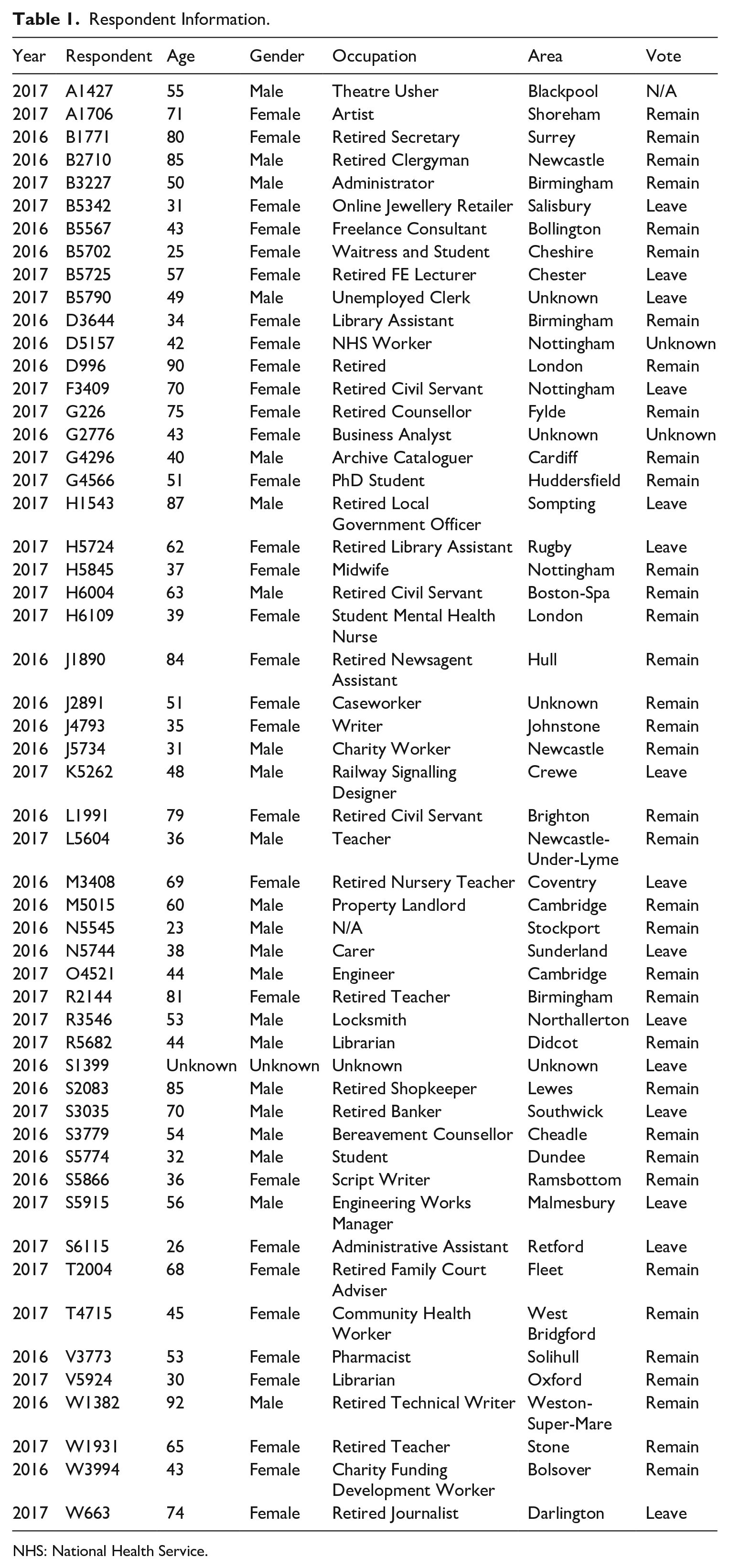
| Year | Respondent | Age | Gender | Occupation | Area | Vote |
|---|---|---|---|---|---|---|
| 2017 | A1427 | 55 | Male | Theatre Usher | Blackpool | N/A |
| 2017 | A1706 | 71 | Female | Artist | Shoreham | Remain |
| 2016 | B1771 | 80 | Female | Retired Secretary | Surrey | Remain |
| 2016 | B2710 | 85 | Male | Retired Clergyman | Newcastle | Remain |
| 2017 | B3227 | 50 | Male | Administrator | Birmingham | Remain |
| 2017 | B5342 | 31 | Female | Online Jewellery Retailer | Salisbury | Leave |
| 2016 | B5567 | 43 | Female | Freelance Consultant | Bollington | Remain |
| 2016 | B5702 | 25 | Female | Waitress and Student | Cheshire | Remain |
| 2017 | B5725 | 57 | Female | Retired FE Lecturer | Chester | Leave |
| 2017 | B5790 | 49 | Male | Unemployed Clerk | Unknown | Leave |
| 2016 | D3644 | 34 | Female | Library Assistant | Birmingham | Remain |
| 2016 | D5157 | 42 | Female | NHS Worker | Nottingham | Unknown |
| 2016 | D996 | 90 | Female | Retired | London | Remain |
| 2017 | F3409 | 70 | Female | Retired Civil Servant | Nottingham | Leave |
| 2017 | G226 | 75 | Female | Retired Counsellor | Fylde | Remain |
| 2016 | G2776 | 43 | Female | Business Analyst | Unknown | Unknown |
| 2017 | G4296 | 40 | Male | Archive Cataloguer | Cardiff | Remain |
| 2017 | G4566 | 51 | Female | PhD Student | Huddersfield | Remain |
| 2017 | H1543 | 87 | Male | Retired Local Government Officer | Sompting | Leave |
| 2017 | H5724 | 62 | Female | Retired Library Assistant | Rugby | Leave |
| 2017 | H5845 | 37 | Female | Midwife | Nottingham | Remain |
| 2017 | H6004 | 63 | Male | Retired Civil Servant | Boston-Spa | Remain |
| 2017 | H6109 | 39 | Female | Student Mental Health Nurse | London | Remain |
| 2016 | J1890 | 84 | Female | Retired Newsagent Assistant | Hull | Remain |
| 2016 | J2891 | 51 | Female | Caseworker | Unknown | Remain |
| 2016 | J4793 | 35 | Female | Writer | Johnstone | Remain |
| 2016 | J5734 | 31 | Male | Charity Worker | Newcastle | Remain |
| 2017 | K5262 | 48 | Male | Railway Signalling Designer | Crewe | Leave |
| 2016 | L1991 | 79 | Female | Retired Civil Servant | Brighton | Remain |
| 2017 | L5604 | 36 | Male | Teacher | Newcastle-Under-Lyme | Remain |
| 2016 | M3408 | 69 | Female | Retired Nursery Teacher | Coventry | Leave |
| 2016 | M5015 | 60 | Male | Property Landlord | Cambridge | Remain |
| 2016 | N5545 | 23 | Male | N/A | Stockport | Remain |
| 2016 | N5744 | 38 | Male | Carer | Sunderland | Leave |
| 2017 | O4521 | 44 | Male | Engineer | Cambridge | Remain |
| 2017 | R2144 | 81 | Female | Retired Teacher | Birmingham | Remain |
| 2017 | R3546 | 53 | Male | Locksmith | Northallerton | Leave |
| 2017 | R5682 | 44 | Male | Librarian | Didcot | Remain |
| 2016 | S1399 | Unknown | Unknown | Unknown | Unknown | Leave |
| 2016 | S2083 | 85 | Male | Retired Shopkeeper | Lewes | Remain |
| 2017 | S3035 | 70 | Male | Retired Banker | Southwick | Leave |
| 2016 | S3779 | 54 | Male | Bereavement Counsellor | Cheadle | Remain |
| 2016 | S5774 | 32 | Male | Student | Dundee | Remain |
| 2016 | S5866 | 36 | Female | Script Writer | Ramsbottom | Remain |
| 2017 | S5915 | 56 | Male | Engineering Works Manager | Malmesbury | Leave |
| 2017 | S6115 | 26 | Female | Administrative Assistant | Retford | Leave |
| 2017 | T2004 | 68 | Female | Retired Family Court Adviser | Fleet | Remain |
| 2017 | T4715 | 45 | Female | Community Health Worker | West Bridgford | Remain |
| 2016 | V3773 | 53 | Female | Pharmacist | Solihull | Remain |
| 2017 | V5924 | 30 | Female | Librarian | Oxford | Remain |
| 2016 | W1382 | 92 | Male | Retired Technical Writer | Weston-Super-Mare | Remain |
| 2017 | W1931 | 65 | Female | Retired Teacher | Stone | Remain |
| 2016 | W3994 | 43 | Female | Charity Funding Development Worker | Bolsover | Remain |
| 2017 | W663 | 74 | Female | Retired Journalist | Darlington | Leave |
NHS: National Health Service.
Acknowledgements
The authors wish to thank Kirsty Pattrick, Jessica Scantlebury and the Trustees of the Mass Observation Archive, University of Sussex, for their help, advice and permission to use materials. We are also grateful to all those who have commented on versions of the paper at conferences and seminars during 2019 and for the opportunity to present at the Interpreting Brexit workshop at Berkeley. We are particularly grateful to Rhodri Hayward and Claire Langhamer, who have each provided thoughtful commentaries. Finally, the suggestions of the editor and anonymous reviewers have been invaluable in improving the paper.
Declaration of Conflicting Interests
The author(s) declared no potential conflicts of interest with respect to the research, authorship and/or publication of this article.
Funding
The author(s) received no financial support for the research, authorship and/or publication of this article.
