




Abstract
This article examines the role of results forecasts and exit polls in BBC general election night broadcasts from 1955 to 2017. Despite the substantial role played by academics in results programmes, in devising forecasts and analysing results as they emerge, academic literature on election night broadcasts is scant. This article charts the development of election night forecasting over time and its implications for the structure and content of election night broadcasts. It draws on a unique new data set of verbatim transcripts of the first hour of every BBC election night broadcast from 1955–2017 to quantify the attention paid to forecasts and exit polls and assess how they frame discussion of the likely outcome and its potential political consequences. The article concludes that the function of election night broadcasts as ‘the first draft of psephology’ merits closer attention for both the political narratives and the academic research agendas they generate.
Introduction
Within the extensive international literature on elections, considerable attention has been paid to the role and influence of television coverage (Ansolabehere et al., 1993; Banducci and Karp, 2003; Nimmo, 1970; Semetko, 1996), including the significance of specific televised campaign events, such as leaders’ debates (Blais and Perrella, 2008; Coleman, 2000; Drake and Higgins, 2012; Pattie and Johnston, 2011). Understandably, the primary focus of such research has been on television content during campaigns, how it is consumed and employed by voters, and whether it shapes political opinions and, therefore, ultimately influences vote choice (Ansolabehere et al., 2011; Beckett, 2016; DellaVigna and Kaplan, 2007; Wring et al., 2017). In contrast, literature focussed on the final broadcast event of any election, the results programme itself, is far more limited. A small body of work on exit polling, which has become a core feature of election night broadcasts since the 1970s, provides a partial exception (e.g. Bishop and Fisher, 1995; Brown and Payne, 1975, 1984; Curtice et al., 2011; Curtice and Firth, 2008; Levy, 1983; Traugott and Price, 1992). However, these accounts overwhelmingly focus on the technical issues associated with the design of exit polls and their accuracy, rather than on the part they play in relation to broadcasting coverage. The significance of election night broadcasts as events in themselves has received scant attention.
On one level, election result programmes are designed with the simple purpose of conveying and explaining the results to the electors (Lauerbach, 2013; Orr, 2015; Ross and Joslyn, 1988). Yet, for those engaged in them, such broadcasts constitute a unique and complex broadcasting context, creating opportunities and risks that go beyond simple reporting of establishing which party proves victorious and why. On election night, political actors react to individual constituency results and to the emerging evidence of the overall performance of their own, and rival, parties. The narratives which emerge on election night can frame the legacy of an incumbent or outgoing government and provide, or diminish, political capital for parties and leaders immediately after the election (Cathcart, 1997; Hale, 1993; Mendelsohn, 1998). In addition to politicians, election night broadcasts typically involve journalists, academics and other commentators in a process of framing, shaping, contesting and reinforcing these narratives. Importantly, this process takes place in ‘real time’, in response to rolling information about outcomes in individual constituencies, before any detailed analysis of the final national results or of post-election survey data is possible. Just as journalists provide ‘the first draft of history’, election night broadcasts can be seen to offer ‘the first draft of psephology’.
This instant, televised analysis is likely to carry significant weight in how election outcomes are interpreted, particularly in the short term. Explanations that emerge from election night broadcasts can become important points of departure for scholarship in the weeks and months that follow, sometimes becoming a focus of academic controversy. An example from the 2017 UK General Election provides a useful illustration. Early in the BBC election night broadcast, with just two constituency results declared, the BBC’s Political Editor, Laura Kuenssberg, told lead presenter, David Dimbleby, that a view was emerging that higher turnout among younger voters was a key factor in Labour’s unexpectedly good performance. References to the role of younger, youth or student voters were repeated at regular intervals in the hours that followed, helping shape a view that a ‘Youthquake’ had taken place and was central to understanding the election outcome. Yet, this claim has subsequently become the source of significant academic controversy. Prosser et al. (2018) drew on British Election Study data to describe the youthquake as a myth, while others responded to reassert the case that turnout among younger voters had increased (Sturgis and Jennings, 2019) and that the youth vote had made a significant and discernible difference (Sloam and Henn, 2019; Stewart et al., 2018).
In this article, we explore how the production of on-the-night results forecasts, a long-standing focus of academic engagement in election nights, shapes the structure and content of television broadcasts. The first part of the article summarises the limited available literature on election night broadcasts and charts how election night forecasting methods for UK general elections have developed since the 1950s, particularly with respect to exit polling. In the second part of the article, we set out how we created an original new dataset, comprising verbatim transcripts of the first hour of every BBC election night broadcast from 1955–2017, and how we coded and analysed the data to chart how changing approaches to forecasting relate to programme content over time. In the final part of the article, we report our findings. We quantify the attention paid to forecasts and exit polls and assess how they frame discussion of the likely outcome, as well as some of potential consequences for those engaged in the broadcasts. We also document how live discussion of projections draws on the ‘legacy’ of past forecasts, which may be used by participants to express scepticism or support for their likely credibility. The article concludes that the function of election night broadcasts as ‘the first draft of psephology’ merits closer attention, for both the political narratives and the academic research agendas they generate.
Election Night Broadcasts and Exit Polling: An Overview
While election night broadcasts draw heavily on academic input, and are likely to shape scholarly debate, they have only rarely themselves been the subject of research. Indeed, in the case of the UK, only the iconic broadcast coverage of the 1997 General Election has received significant attention. Cathcart’s (1997) account of that election provides the most comprehensive analysis of UK election broadcast content, detailing the events of election night from 10 pm through to 6 am. However, as the blurb to his book underlines, Cathcart’s is a journalist’s account, aimed at ‘recapturing the mood of an astonishing night’, rather than scholarly analysis. The 1997 election is also the focus of Marriot’s (2000) account of the unique nature of election night broadcasts in connecting the ‘centre’, in the form of the BBC studio, to the ‘periphery’ of a multiplicity of outside broadcast locations (such as election counts, party headquarters and party leaders’ homes). In a slightly different vein, Lauerbach (2007, 2017) evaluates, respectively, the purpose of UK election night broadcasts in comparative international perspective, as well as the manner in which losing candidates negotiate defeat in televised coverage, again using the case of 1997. Cathcart (1997) aside, these studies have tended to analyse relatively small sections of the broadcast, in one case restricted to a single interview, with Conservative candidate Michael Portillo (Lauerbach, 2017). Marriot (2000) offers some comparisons with the 1992 election broadcast, but otherwise very little has been written about how election night programming has developed over time. The principal exception is provided by Crick’s (2018) biography of David Butler, which captures many details of how the BBC’s election night coverage evolved from 1950 to 1979, albeit from the particular standpoint of Butler’s role in them. Consideration of election broadcasts beyond the BBC is also rare, although Glaister (2019) provides an account of Sky’s coverage of the 2017 General Election.
The modest US literature on election night broadcasts exhibits differences of emphasis to that relating to UK elections. One long-standing US concern is whether the broadcasting of projections and outcomes influences turnout or candidate choices in close election results – a scenario that is only feasible in cases such as US presidential elections, where polls are still open in some states while results are being declared from others (Sudman, 1986; Tuchman and Coffin, 1971). In light of the controversies generated by the premature calls made by television networks in their coverage of the 2000 presidential elections, Mitofsky and Edelman (2002) provide a comprehensive account of how exit polling takes place on election nights from the perspective of those conducting the analysis. A handful of studies have used textual data, derived from broadcasts, to examine issues such as the role of myth and ritual in election night television (Ross and Joslyn, 1988) and whether the content of election night broadcasts has changed over time (Patterson, 2004). As with the UK literature, these isolated US studies restrict their analysis to one or two elections, although they also analyse broadcasts on the three principal networks: ABC, CBS and NBC.
While the content of UK election night broadcasts has received limited academic attention, the methods used to produce results forecasts for them has been exceptionally well documented (Brown et al., 1999; Brown and Payne, 1975, 1984; Curtice et al., 2011, 2017; Curtice and Firth, 2008; Fisher et al., 2010; Payne, 1992, 2003; Rallings and Thrasher, 1993). The sophisticated methods which have underpinned exit polling are detailed in full in this literature and are not our primary concern in this article. Instead, we focus here on how exit polling evolved as an extension of early BBC attempts at election night forecasting and briefly explain how methodological innovations and technological advances have enabled researchers to respond to the considerable challenges of producing on-the-night forecasts.
Election night forecasting has been a feature of BBC coverage of UK general elections since 1950, when David Butler used the principle of uniform national swing (UNS) to project the national outcome based on a handful of initial constituency results (Crick, 2018). In practice, predicting the final outcome in this way took the form of a rolling forecast, which generally began some way wide of the mark but became increasingly accurate as more constituency results were declared. However, from the 1960s, the core forecasting assumption in the UNS model was increasingly undermined as increased geographical concentration of support for the Conservatives and Labour, as well as the growth of support for other parties, rendered constituency swings more variable.
The availability, from 1969 onwards, of Census data for parliamentary constituencies (based initially on the 1966 Sample Census) enabled the development of new approaches to election forecasting. For the 1970 General Election, an experimental approach was adopted of surveying voters as they left polling stations in a single ‘bellwether’ constituency, Gravesend in Kent, deemed to be most socio-demographically typical in Great Britain. The Gravesend survey was, in effect, a proto-exit poll, and this approach was extended in February 1974, when three so-called ‘straw polls’ were conducted in marginal constituencies, as people left polling stations. The 1974 elections saw a step-change in the statistical methods used, based on ridge regression and utilising a range of independent variables, including Census data (Brown and Payne, 1975). For the October 1974 election, a ‘How did you vote?’ poll was carried out in 155 constituencies and used as the basis for a more sophisticated projection model devised by Clive Payne and others. For the first time, a full projection of the number of seats won by each party was presented prior to the first actual result being declared. The October 1974 forecast was to prove highly inaccurate, predicting a Labour majority of 135, compared to an actual Labour majority of just 3, with Brown and Payne (1975) suggesting that the model was badly skewed by the inclusion of a national opinion poll of questionable value. Nonetheless, Payne’s approach was repeated, with some refinements, at the 1979 General Election, when it correctly forecasted a Conservative majority. The same technique produced an almost perfect projection of the seats won by the three main parties in 1983 and thereafter became the established forecasting method through to 2001 (Brown et al., 1999; Brown and Payne, 1984; Payne, 2003).
The term ‘exit poll’ was first used in the BBC’s 1992 election night programme (at which Payne and his colleagues failed to predict a Conservative majority) and has since become an established feature of election night, with broadcasts opening with exit poll predictions when polls close at 10 pm. In 2005, Payne’s leadership of the exit poll operation passed to John Curtice, and significant changes were again made to the methods used. From 2005, David Firth’s proposal was adopted that, rather than trying to derive constituency-level results from estimates of national votes shares, exit polling should focus on measuring changes in vote shares from the previous election in key constituencies. The 2005 General Election also saw BBC and ITV pool their resources (with the addition of Sky in 2010) commissioning a single exit poll and thereby enabling a much larger number of polling places to be sampled. In 2015 and 2017, the three broadcasters continued to commission the exit poll jointly. The record of the exit poll team in producing highly accurate estimates in 2005, 2010, 2015 and 2017, the latter three of which were elections with extremely close outcomes, has won widespread praise within and beyond academia.
The significance of exit polls in shaping the experience of election night broadcasts, for both viewers and participants, is well captured by Curtice et al. (2017: 29): ‘[. . .] the exit poll forecast is watched by millions. It dominates the headlines until the actual outcome of the election becomes apparent a few hours later’. Both academics and broadcasters are acutely aware of the implications of the profile of exit polls and the manner in which they frame the most widely watched initial hours of election night broadcasts. Exit polling methods have long been subject to some of the most rigorous, open and combative peer review (see Brown and Payne, 1975, for instance). When exit polls have proved remarkably accurate, notably in 1983, 2010, 2015 and 2017, their architects have always admitted that a degree of good fortune was involved. As those involved in producing them are keen to stress, exit polls for UK general elections pose particular methodological challenges. Under first-past-the-post (FPTP), votes do not translate in a consistent way to seats, as they do under proportional representation. Projections become far more difficult when a larger share of the vote is taken by parties other than Labour or the Conservatives. Whatever the method, analysis has to be undertaken at great speed, increasing the risk of error. Nonetheless, where forecasts and exit polls have subsequently been interpreted as being some way wide of the mark, the academics involved in them have inevitably found themselves on the defensive, particularly at elections where pre-election polling also came to be seen as flawed (Brown et al., 1999; Payne, 1992; Rallings and Thrasher, 1993).
This pattern gave rise to Payne’s (1992) law of election forecasting, which proposed that ‘a bad forecast is remembered forever, good ones are soon forgotten’. The 1992 exit poll, which initially projected the most likely outcome as a hung parliament with Labour as the largest party, cast a shadow over exit polls at subsequent elections, resulting in a tendency for politicians and commentators to be more sceptical in their reactions and for the BBC to be more cautious in its claims. This tendency was very much in evidence in 2010, when the projection of a fall in the number of Liberal Democrat seats was initially met with disbelief from several quarters. Once the remarkable accuracy of the 2010 exit poll became apparent, with a further surprise exit poll projection in 2015 also proving its detractors wrong, scepticism about the 2017 exit poll was clearly more muted. As Curtice et al. (2017: 29) note with respect to the 2017 exit poll, ‘the forecast, even though surprising, was accepted as an initial basis for discussion of the expected outcome and its implications’.
Data Collections and Methods
To examine how these developments in election night forecasting have interacted with the structure and content of BBC election night programming, we produced verbatim transcripts of the first hour of each broadcast from 1955 to 2017. No recording of the BBC broadcasts of the 1950 or 1951 General Election results has survived, meaning that 1955 is the earliest programme available (Crick, 2018). The textual data were initially generated through two principal methods, designed to generate transcripts as efficiently and cost-effectively as possible. For the elections that took place from 1955–2010, the data were mined from user-uploaded YouTube videos of BBC coverage, from which YouTube automatically generated a transcript for each election (YouTube, 2018). For the 2015 and 2017 elections, transcripts were available from ‘Box of Broadcasts’ and generated from the BBC’s own subtitles that accompanied the programmes.
As with many studies that analyse text, the data generated were rich and extensive but needed considerable cleaning to produce reliable findings. The transcripts generated from YouTube contained missing sections of text, large numbers of inaccuracies in spelling or word identification and provided no differentiation between the speakers. These issues were expected, not least because of the poorer audio quality of the older broadcasts (YouTube, 2018). Nonetheless, our experience was consistent with assessments that auto-generation offers enormous scope to produce transcripts far more cheaply than manual transcribing and with limited loss of quality (Novotney and Callison-Burch, 2010). The auto-generated transcripts provided the substantial base of text to work from, with small missing sections hand-transcribed from the broadcast recordings. The first hour of each transcript was then carefully cleaned by checking it against the broadcast to produce verbatim scripts in a consistent format. The initial 2015 and 2017 transcripts were of a better quality than those captured via YouTube but also required cleaning and formatting in a similar way. Limiting our study to the first hour of each election night transcript maintained the longitudinal design of our study, while keeping the exercise of cleaning the data manageable (even after restricting our focus to the first hour of each broadcast, the transcripts amounted to a combined total of approximately 150,000 words).
While our data are extensive and original, they also have some limitations. First, by reducing the broadcasts to written text, we exclude consideration of the visual elements of the broadcasts. The interplay between the visual and audio elements of the broadcasts is often evident in the transcripts, particularly with respect to the graphics used to communicate exit polls, forecasts and results. Nonetheless, we recognise that visual imagery provides a layer of ‘text’ that is absent from our analysis. Second, our transcripts relate only to BBC election night coverage, despite the airing of simultaneous broadcasts on ITV since 1959 and on Sky since 1992. Our sole focus on BBC coverage can be justified on several grounds, beyond the pragmatic consideration of keeping the task manageable. BBC coverage provides the longest possible timespan and, despite growing competition, has sustained its position as the most widely watched programme. Estimates for 2015 and 2017 suggest that the average audience for the duration of BBC1’s election night coverage was over 4 million, about 4 times that of ITV and more than 10 times that of Sky (Press Gazette, 2017; The Guardian, 2015). Comparing rival broadcasts would enable fuller consideration of the narratives that emerge from election night, including from the competition between them – an issue that has repeatedly been highlighted in US studies (Bohn, 1980; Frankovic, 2003; Marriot, 2007). However, in the UK case, rivalry between the broadcasters to be the first to call an election has never been as intense as it is in the US, as underlined by the recent practice of the three main UK broadcasters pooling their resources to produce a joint exit poll. The extent to which UK broadcasters vary in how they integrate exit polls into their programming, and the manner in which they do compete in their results coverage on election night, would certainly merit research, but is beyond the scope of this study.
Having generated verbatim transcripts of the first hour of every BBC election night broadcast from 1955–2017, we undertook thematic analysis of the textual data to compare the role of forecasts and exit polls in election night coverage over time. In order to test a series of hypotheses relating to the role of exit polling in election night coverage, the transcripts were coded using the qualitative data analysis software, NVivo. Using NVivo enabled us to work collaboratively as researchers on the coding and analysis of the data and provided for efficient data management and analysis, which was invaluable given the volume of textual data employed. An initial coding structure was devised by examining a subset of four transcripts from different decades to develop a base framework of inductive codes that related specifically to our data. This initial coding structure was then revised, formalised and refined through an iterative process as each transcript was fully coded, including the addition of any election-specific codes. We coded our data simultaneously by descriptive, attitudinal and explanative codes, to provide a multileveled analysis (see Saldana, 2013). This facilitated the analysis of different groups of actors, such as contrasts between Conservative and Labour politicians, or between journalists and academics. Once coding was complete, individual codes were abstracted into broader substantive themes that structure our findings (see Punch, 2014). The coding framework was particularly important in enabling us to use NVivo to quantify the overall attention paid to forecasts and exit polls and to capture what types of actors (e.g. journalist, politician, academic) took part in these discussions. As such, the software was invaluable in assisting us to summarise and visualise the data, a task that is frequently challenging in qualitative studies (Silverman, 2014).
Our analysis was guided by four hypotheses, or ‘testable propositions’, used to code and interrogate the data. These hypotheses were as follows:
Hypothesis 1. The development of exit polls from 1970 onwards will be associated with a progressive frontloading of election night broadcasts with discussion of the likely result and its consequences. We expect to see this trend for two reasons. First, in contrast to forecasts based on UNS, exit polls enable a predicted outcome to be broadcast before any results are available. Second, competitive pressures to capture and retain viewers early in the broadcast will strongly incentivise discussion of results forecasts.
Hypothesis 2. Where an exit poll predicts a close result, it will generate speculation early in the broadcast about potential governing arrangements, including the viability of a minority government, possible inter-party deals and coalitions. We derive this proposition from the observation that, as relatively rare occurrences in Westminster elections, the potential prospect of a ‘hung parliament’ can be expected to generate speculation about outcomes other than the single-party majority governments that FPTP is expected to deliver.
Hypothesis 3. An exit poll that is surprising or confirms a tight race will result in more conditional analysis (‘if’ statements) than one that confirms a widely expected and clear outcome. We advance this hypothesis on the basis that journalists, politicians and commentators will instinctively be more cautious in how they react to an exit poll that predicts a close outcome or one that contradicts pre-election polling. We also expect briefings from the exit poll team to be more heavily caveated in these circumstances and for this to translate into direct advice to broadcasters to present the projections cautiously.
Hypothesis 4. Election night coverage will provide confirmation of Payne’s law of exit polling, as evidenced by (a) analysis of the current exit poll being more cautious and sceptical if preceding ones had ‘failed’ and (b) ‘failed’ exit polls being mentioned far more than any other past exit poll. This final hypothesis simply represents an operationalisation of Payne’s law, outlined above, so that it can be tested using our data and methods.
Results and Discussion
Our first hypothesis, that the development of exit polls has been associated with the frontloading of election night broadcasts with discussion of projections, is borne out by the data. Figure 1 charts the proportion of the first hour of each BBC election results broadcast since 1955 that has been devoted to discussing various forms of prediction and projection, as well as their potential consequences, for parties, leaders and government formation. In addition, each data point is colour-coded to indicate the relative accuracy of the forecast made in that broadcast. We discuss the significance of the track record of the individual projections below in relation to Hypothesis 4, since these are likely to explain why the tendency towards frontloading broadcasts with discussion of projections is not linear.
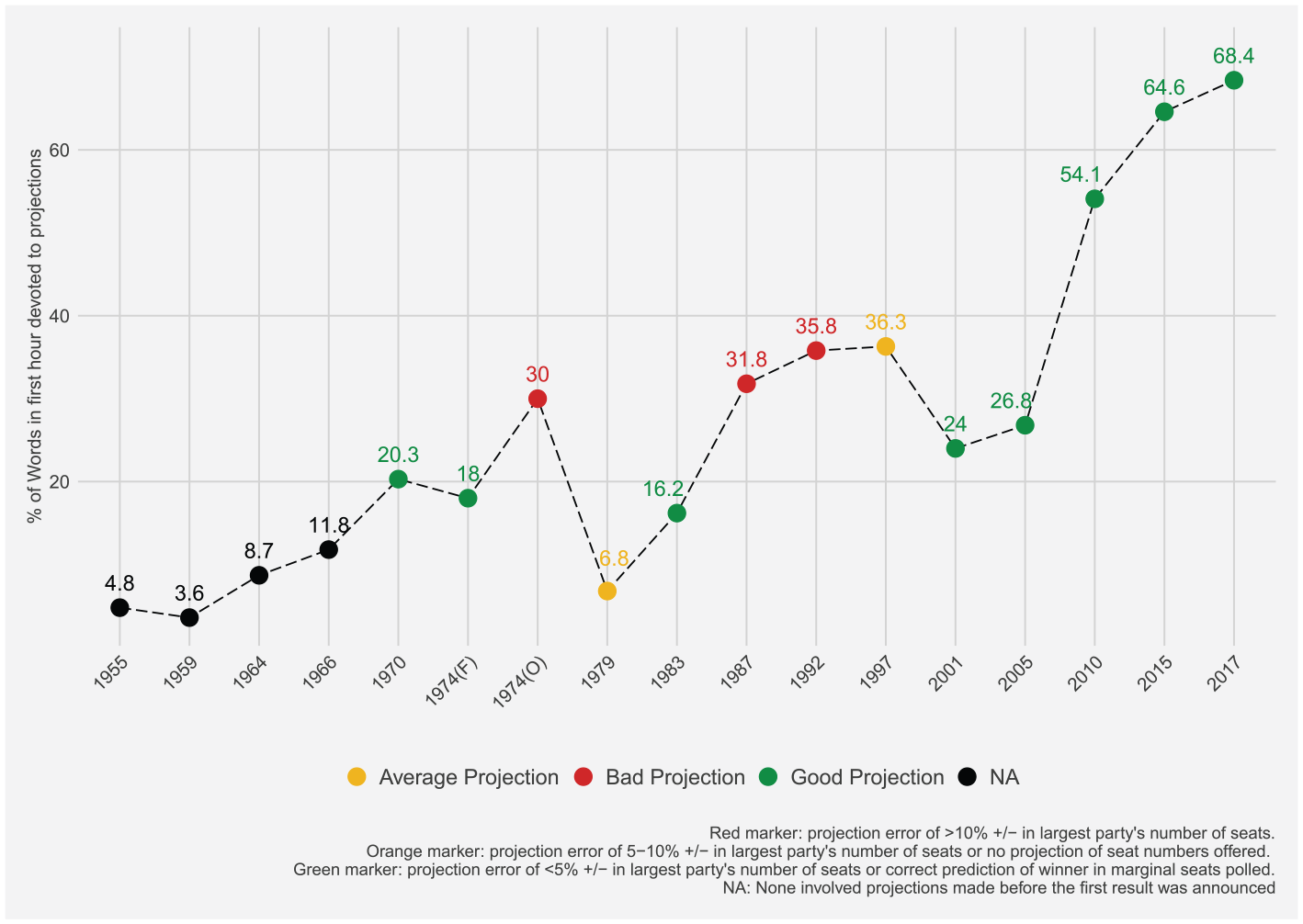
Percentage of First Hour of BBC Election Results Programme Spent Discussing the Projected Result/Exit Poll and Its Potential/Likely Consequences, 1955–2017.
The graph shows a very clear and substantial increase over time in the early attention to projections, albeit with some very notable fluctuations. From 1955–1966, the rolling forecasts made on the basis of initial results made up only a modest proportion of the first hour of the programme, since very few constituency results were declared at this early stage of the broadcast. By contrast, the early experiments with exit polling in the 1970 and the two 1974 general elections were presented and discussed in some detail, thereby resulting in a substantial increase in the time given over to discussing the predicted result, compared to previous broadcasts. The step-change in the methods used for the October 1974 election, and the BBC’s decision to present a full seat projection early in the broadcast, resulted in almost one-third of the first hour of the coverage being devoted to discussing the predicted result. Despite a dramatic dip in the early attention paid to the forecast in 1979, high-profile seat projections became a staple of election night broadcasts thereafter, with around 20 of the first 60 minutes of the broadcasts devoted to them in 1987, 1992 and 1997. There was a slight dip in the attention paid to the exit polls in 2001 and 2005, when only about 15 minutes of the broadcasts focussed on the initial forecast. However, discussion of exit polls dominated the opening 60 minutes of BBC election night broadcasts in 2010, 2015 and 2017. In these broadcasts, between a half and two-thirds of all discussion in the first hour focussed on the seat forecasts (derived from the exit poll) and their implications. Despite the notable fluctuations, which we discuss further below in relation to Hypothesis 4, there has been a 10-fold increase from 1979 to 2017 in the attention to seat forecasts (and their consequences) in the first hour of election night broadcasts.
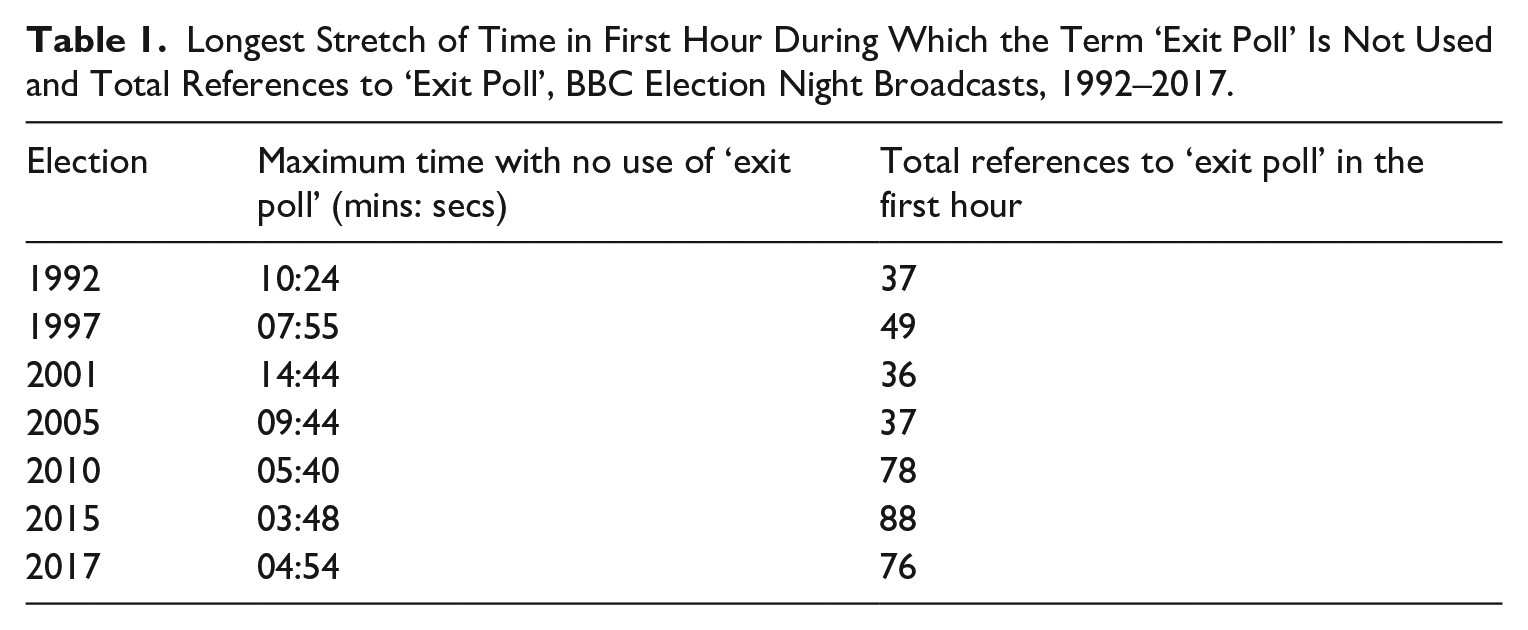
Two other measures of the extent to which the first hour of election night broadcasts have become dominated by the discussion of exit polls are shown in Table 1. The second column of the table documents the maximum amount of time which passes in election night broadcasts from 1992 to 2017 without the phrase ‘exit poll’ being uttered. The third column simply provides a count of the number of times ‘exit poll’ is used. It is not possible to present data for earlier elections because seat forecasts produced from 1974–1987 were not described as ‘exit polls’ and diverse set of terms was used to refer to them. Again, the table underlines that discussion of exit polls has become more intensive over time and, particularly, in the three election night broadcasts from 2010–2017. In 2015, viewers of the BBC’s coverage from 10 to 11 pm would have heard 88 references to the exit poll, and it was not until 10.47 pm, when coverage switched to the first declaration from Houghton and Sunderland South, that more than 3 minutes passed without direct reference being made to it. By contrast, viewers in 2001 were spared any discussion of the exit poll from 10:45 to 11.00 pm, with the result from Sunderland South prompting a prolonged discussion of the 48% turnout rather than what the 64% Labour vote share implied about the prospect, or otherwise, of another Labour landslide.
Longest Stretch of Time in First Hour During Which the Term ‘Exit Poll’ Is Not Used and Total References to ‘Exit Poll’, BBC Election Night Broadcasts, 1992–2017.
The frontloading of election broadcasts with discussion of projections/exit polls has also occurred alongside an equally clear, and closely related, shift. Figure 2 shows the extent to which senior politicians were engaged in the first hour of election night broadcasts from 1955 to 2017. Prior to 1983, politicians rarely appeared in the first hour of a BBC election night broadcast. As the figure shows, the proportion of the words spoken by politicians in the first hour of the BBC broadcasts had never risen above 5% from 1955–1979. The peak, such as it was, had been in 1964, the only instance where the early part of the broadcast has ever included brief interviews with both of the two main party leaders. In 1979, the only politician who spoke in the first hour of the broadcast was Margaret Thatcher, pursued by journalists on the way to her count in Finchley.
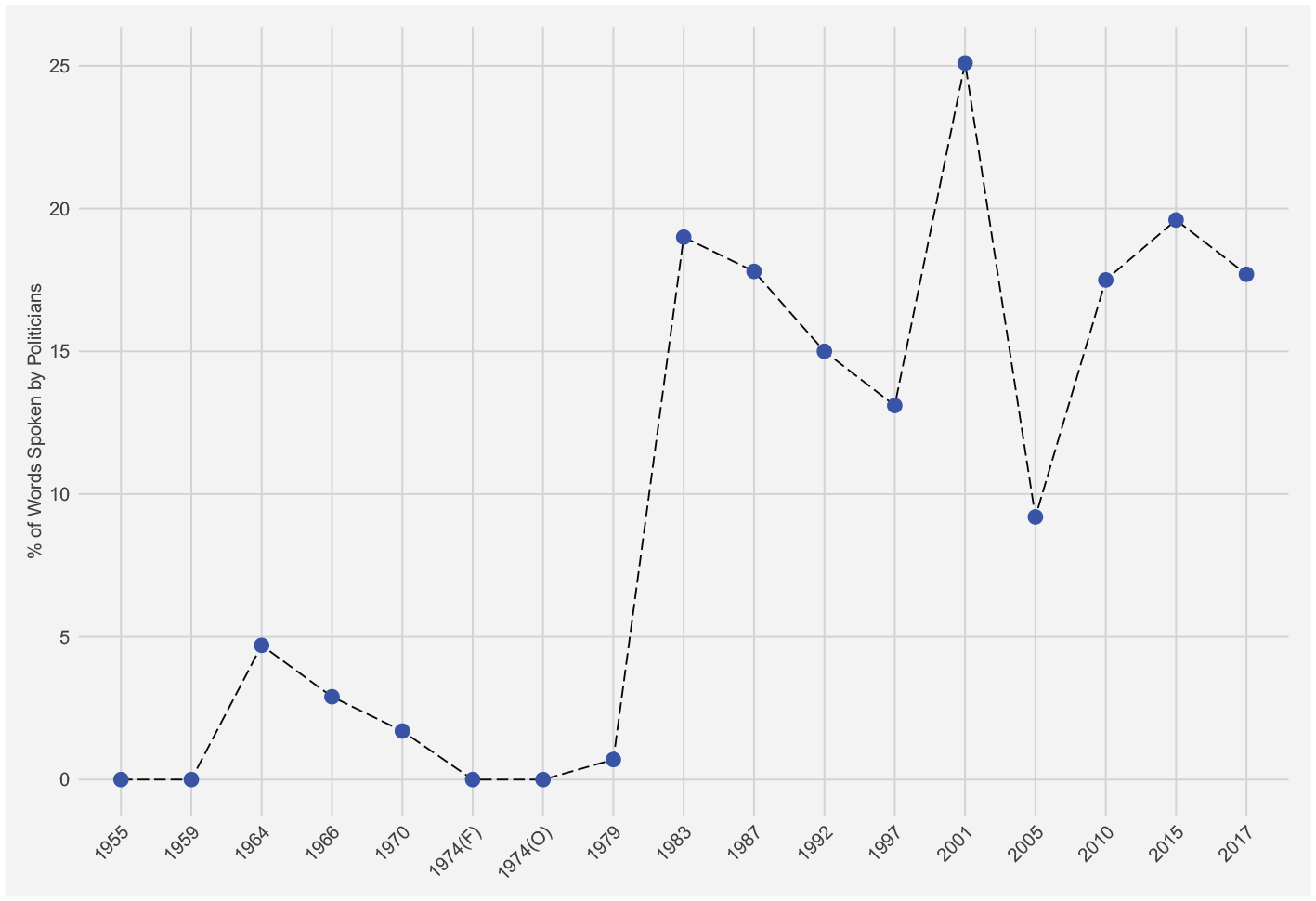
Percentage of Words in First Hour Spoken by Senior Politicians in Interviews with BBC Presenters/Reporters, 1955–2017.
However, in 1983, there was a shift change. It became a standard feature for senior politicians to be asked to react to the projection/exit poll early in the programme. Politicians were asked to respond to an initial seat projection immediately after polls closed, with a rotating cast of senior political figures appearing in the studio or via outside broadcasts throughout the night. Since 1983, this format has been retained, with the proportion of words in the first hour spoken by senior politicians never falling back into single figures. 1 The hook for these interviews has, of course, been the seat projection or exit poll. An established format for questions to senior politicians, first used by BBC interviewers in 1983, has been present in every subsequent election night broadcast. In an opening question, the politician is asked for their reaction to the exit poll, which generally elicits a cautious, sceptical, or sometimes hostile, response. After a brief exchange, the interviewer then shifts to ask them for their reflections on the campaign or, in instances where a party appears to have performed less well than expected, about the future of its leader. To illustrate, the following exchange took place between Robin Day and Lord Young, Secretary of State for Employment, early in the 1987 broadcast:
Lord Young, do you have the smell of defeat in your nostrils?
Good Lord, no. It is after all, of the two, of the three polls, we’ve had during this election campaign, this shows us at the lowest point. Yet, I find that slightly odd. But the night’s young and we shall see: 86, I think, would be a very satisfactory result for us; minus 17, the other way, obviously wouldn’t, but let’s see what happens.
David Dimbleby said Mrs. Thatcher’s future might be in doubt if the majority was, as predicted, only 26. Do you think that it’s so?
Oh nonsense. No. In ’51 we won the 16 majority and carried on for a full parliament. In ’74, Labour won with four and carried on for full parliament, and I quite know one thing that Margaret Thatcher will carry on and put the policies through with any majority we get.
There is a clear association between the foregrounding of exit polls on election night and the greatly increased presence of politicians in the early parts of broadcasts. Figure 3 plots the relationship between these two variables for all election night broadcasts from 1955–2017. While there are several notable outliers, the overall relationship is reasonably strong and is statistically significant (r = 0.64, significant at the 0.01 level). Just as importantly, the plot reveals a number of distinct clusters. The first hour of all election broadcasts from 1955–1966 contained minimal discussion of projected outcomes and were characterised by the virtual absence of politicians. From 1970–1974, broadcasts paid far more attention to projections, but continued to largely exclude politicians during the early parts of the programme. After the 1983 broadcast again foregrounded seat projections much more prominently, each of the three election broadcasts from 1987 to 1997, as well as the 2005 programme, devoted around 20 minutes of the first hour to projections/exit polls, with senior politicians occupying 13%–19% of the airtime. Finally, there is a further decisive shift from 2010. The three election broadcasts from 2010 to 2017 were all dominated in their early stages by exit poll considerations, while retaining a level of input from senior politicians at 18%–20% of the initial hour.
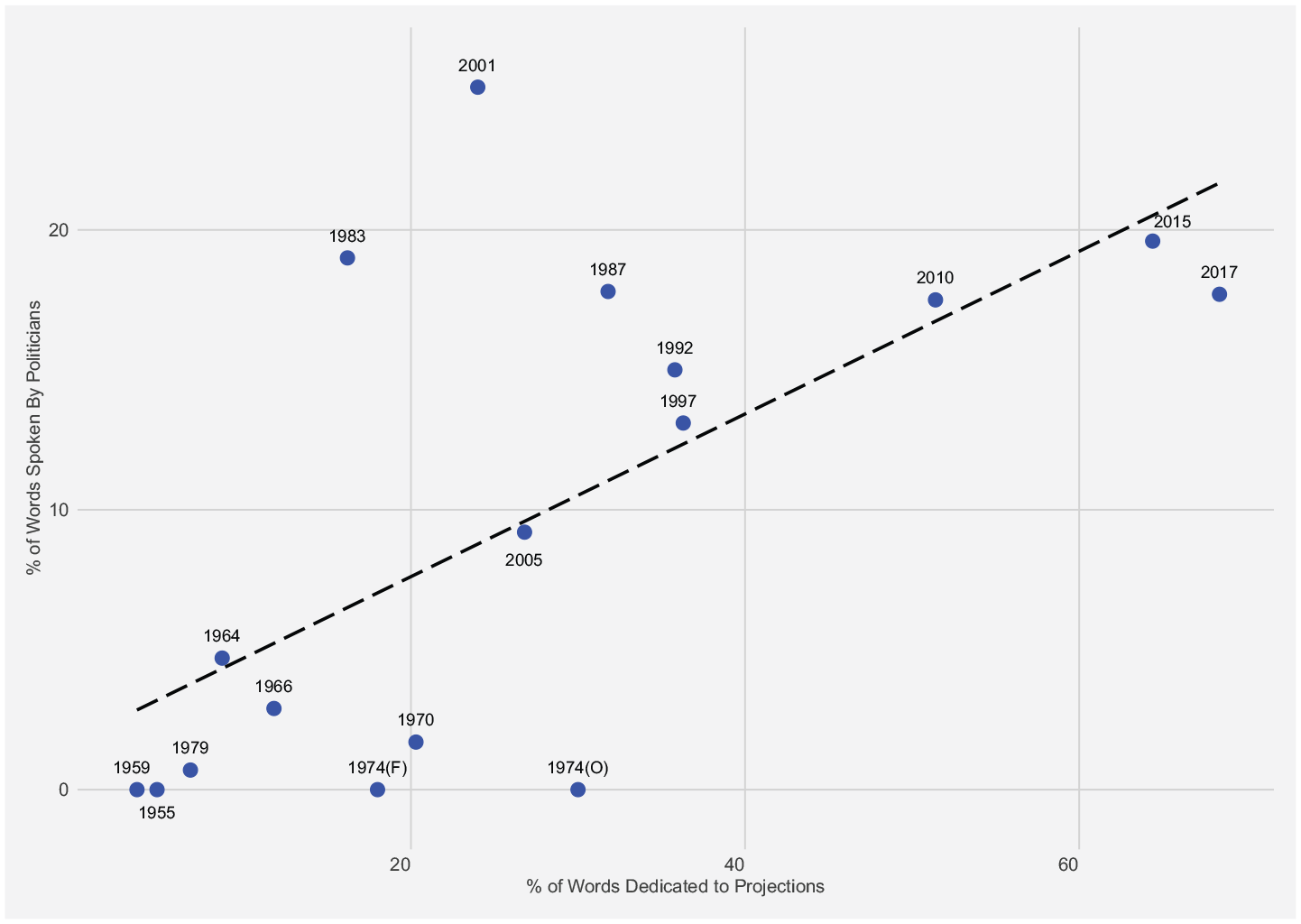
Relationship Between Percentage of First Hour Spent Discussing Exit Polls and Percentage of Words Spoken in First Hour by Politicians, BBC Election Broadcasts, 1955–2017 (r = 0.64; p < 0.01).
There is also clear evidence in the transcripts to support our second hypothesis, that exit polls which predict a close result will generate speculation early in the broadcast about potential cross-party governing arrangements. Table 2 lists four key terms that are typically used in discussions of governing arrangements in the absence of a single-party majority: ‘hung parliament’, ‘coalition’, ‘minority government’ and ‘deal’. (Instances of the use of ‘deal’ refer exclusively to discussion of deals between political parties.) Since seat projections based on on-the-day-polls were first used in October 1974, they have predicted a close outcome, defined here as a majority of 30 or below, on six occasions: 1979, 1987, 1992, 2010, 2015 and 2017. Table 2 shows that it was overwhelmingly in these years that, during the first hour of the election broadcasts, the possibility was raised of a hung parliament or minority government requiring a possible coalition or deal between political parties. For example, the use of ‘hung parliament’ is only found in the initial 60 minutes of seven broadcasts. These include all six elections where projections predicted tight outcomes, as well as 2005, when Labour’s majority was down very substantially from 1997 and 2001 and correctly projected at 66 (it should be noted, however, that ‘hung parliament’ was very rarely used in any British political debate before the late 1970s). ‘Coalition’ also only appears in the transcripts for the same set of elections, with the exception of 1979 – although its use in 2015 and 2017 is inflated by retrospective references to the Conservative–Liberal Democrat coalition from 2010–2015. ‘Minority government’ is less frequently used, with October 1974, 1987 and 2010 being the only instances where the term is used. Tellingly, none of the election broadcasts from 1955 to February 1974 include any of the four terms within the first hour. Although the 1964 election produced a tiny Labour majority and the February 1974 election resulted in no overall majority for any party, these possibilities were not flagged early in the broadcasts, due to the absence of exit polls or comprehensive seat projections.
Frequency of Terms Relating to Arrangements Other Than Single-Party Majority Governments in the First Hour of BBC Election Broadcasts, 1955–2017.
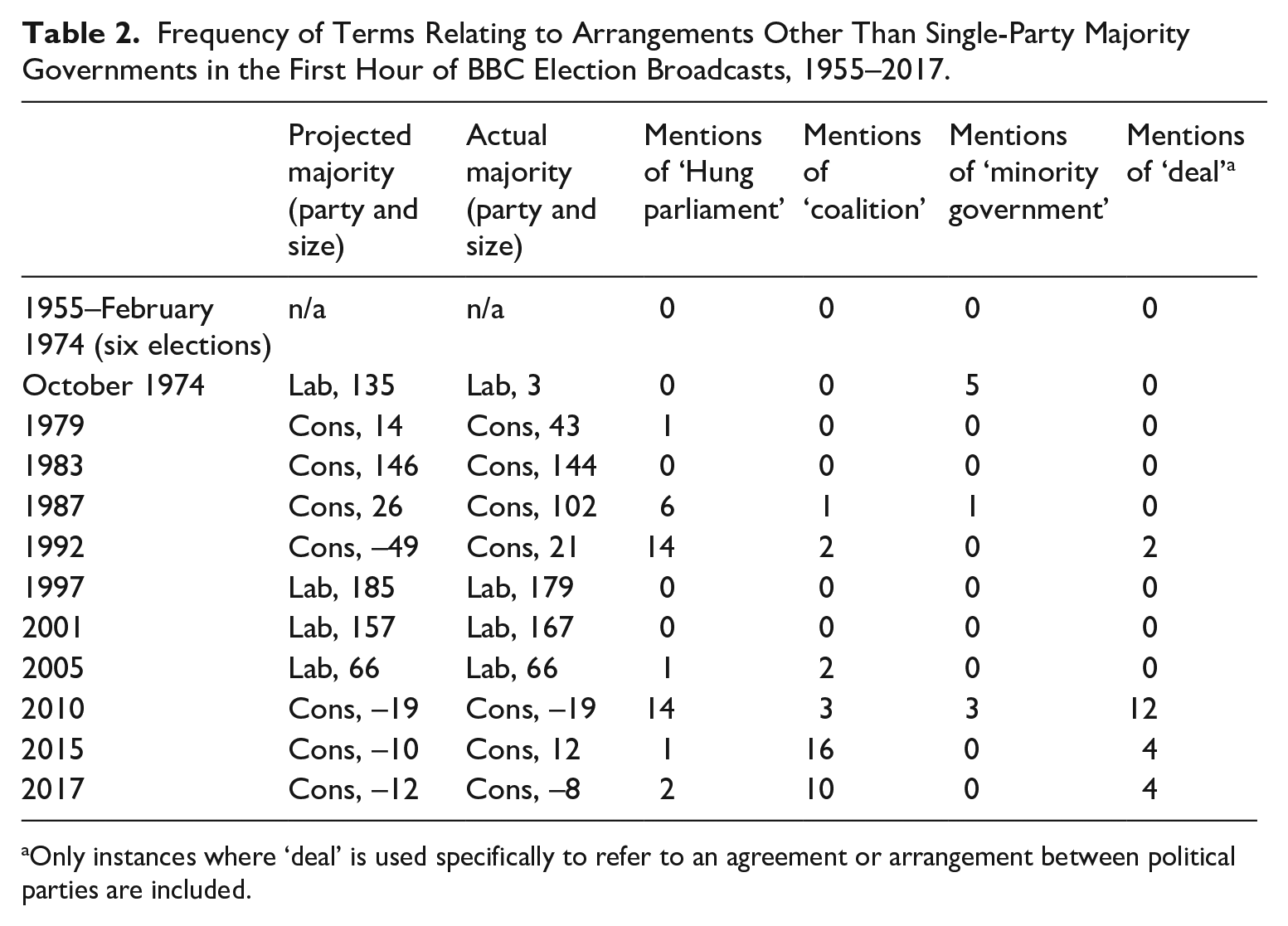
Only instances where ‘deal’ is used specifically to refer to an agreement or arrangement between political parties are included.
Importantly, the transcripts also show that the effect of exit polls in close contests can go beyond generating discussion of possible governing arrangements. Television coverage of the exit poll can provide an opportunity for party representatives to make overtures, or set out expectations, to potential partners. This dynamic was clearly evident during the first hour of the 2010 broadcast when senior Labour figures were asked if they could govern with the Liberal Democrats. In each case, they stressed the two parties’ areas of common cause, particularly with respect to electoral reform. Harriet Harman’s view, expressed a matter of minutes after the exit poll was released, was that: We need to follow the constitutional conventions to get that strong and stable government to take us through the recession, but I think it’s been clear that there is a general feeling that we need to change the voting system.
The same sentiments about how Labour could find common ground with the Liberal Democrats on electoral reform were expressed in 2010 by Peter Mandelson and Alan Johnson in response to the exit poll and before a single constituency result had been declared. In a similar way, in 2017, a representative of the Democratic Unionist Party (DUP) was more than ready to set out his party’s stall for a possible arrangement with the Conservatives, on live television, in response to the exit poll: I’m not going to pre-empt the outcome, but what I will say is we will be serious players if there is a hung Parliament. We will go in and we will talk to whoever, it looks like that is the Conservatives, will be the largest party. We will talk to them [. . .] I think there is a lot of common ground on which we can work. Obviously, we will want to get the best deal for Northern Ireland itself (Geoffrey Donaldson, DUP, on what the party’s negotiating stance would be in a hung parliament).
No such process of pitching for coalition partners, or for possible deals with the likely largest party, was evident in the broadcasts from the 1964 or February 1974 elections, both of which produced very tight outcomes. The structure of these programmes was such that no forecast of a close contest was made early on and politicians did not feature until much later in the broadcast. Conversely, in 1987 and 1992, when initial BBC projections gave a misleading impression of the possible outcome, ultimately pointless discussions opened up about the options for Labour forming a government with the support of the Alliance/Liberal Democrats. Without the projected result pointing to such a potential outcome, such discussions clearly would not have commenced on live television.
There is very mixed evidence in relation to our third hypothesis that exit polls that predict a surprising or close result will generate more conditional analysis than ones that confirm a widely expected and/or clear outcome. Figure 4 shows the number of uses of ‘if’ in the transcript for the first hour of each election broadcast. There is a clear increase over time in the use of such conditional statements. Moreover, exit polls which suggested close outcomes in 2010, 2015 and 2017 were all associated with a higher usage of ‘if’ in the first hour of the programme. However, it also appears that exit polls that predict landslides can be associated with widespread caution among those responding to the forecast, as is evident in 1997.
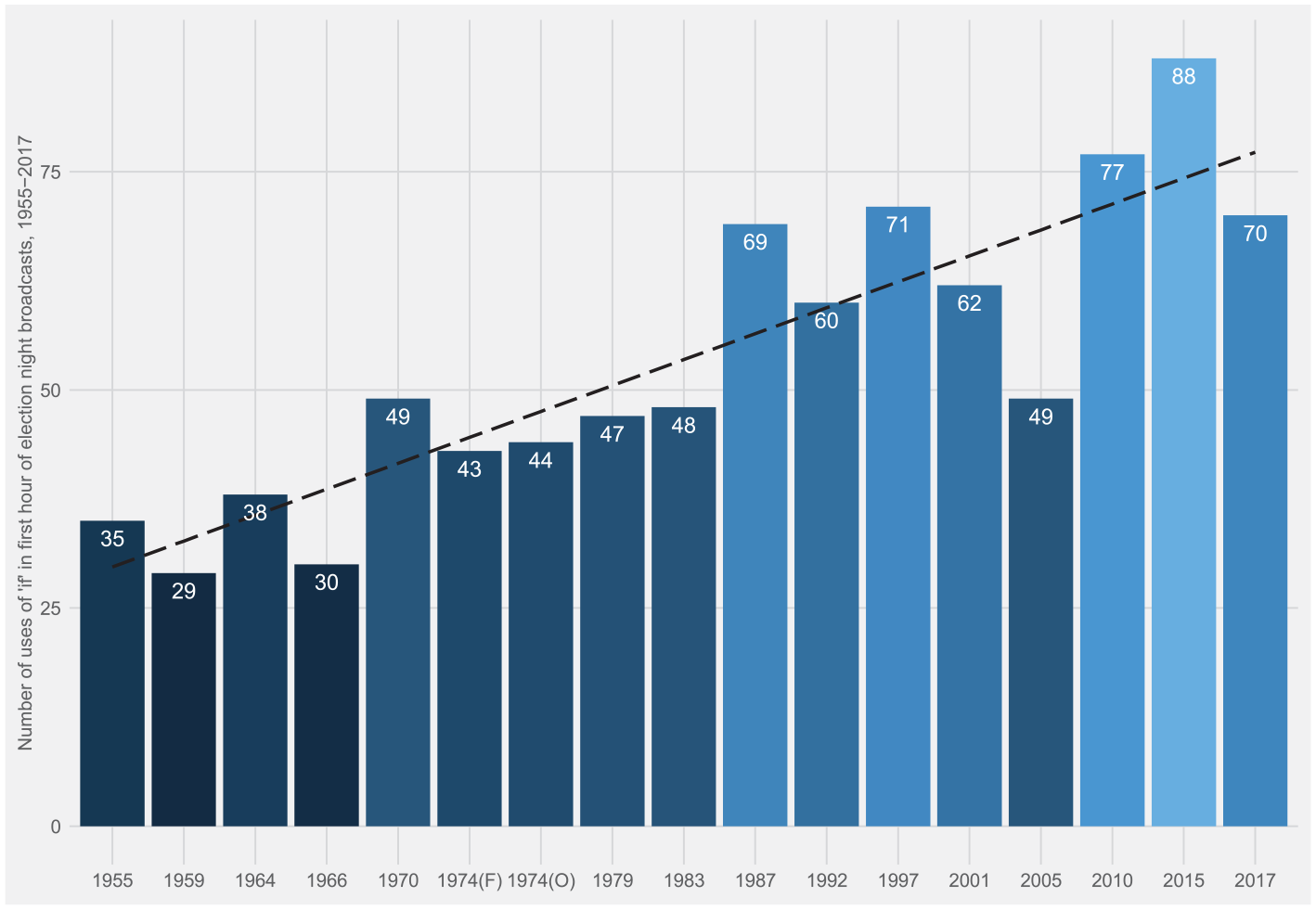
Number of Uses of ‘If’ in First Hour of Election Night Broadcasts, 1955–2017.
Figure 5 provides further evidence to suggest that there is no clear link between the closeness of the predicted result and the use of conditional statements in relation to the projection. This figure lists the five words most frequently used in conjunction with ‘exit poll’ (and its pre-1992 equivalents) in the first hour of each BBC election night broadcast from 1970 to 2017. In every broadcast from 1997 onwards, the word ‘if’ was consistently used more frequently than any other in relation to the ‘exit poll’. Although this tendency is arguably stronger in 2010, 2015 and 2017, when exit polls suggested tight outcomes, the tendency to err on the side of caution is also apparent in 1997, 2001 and 2005, when comfortable Labour majorities were projected. Indeed, the more evident contrast is between the consistent conditionality used to discuss exit polls in the 1997–2017 broadcasts and the relative absence of ‘if’ statements used to discuss projections in the 1970–1992 programmes. The inaccuracy of the 1992 exit poll projection would provide a potential explanation for the more conditional treatment of exit polls in subsequent broadcasts. As such, our findings in relation to our third hypothesis may actually provide evidence with respect to our fourth hypothesis, Payne’s law, discussed in more detail below.
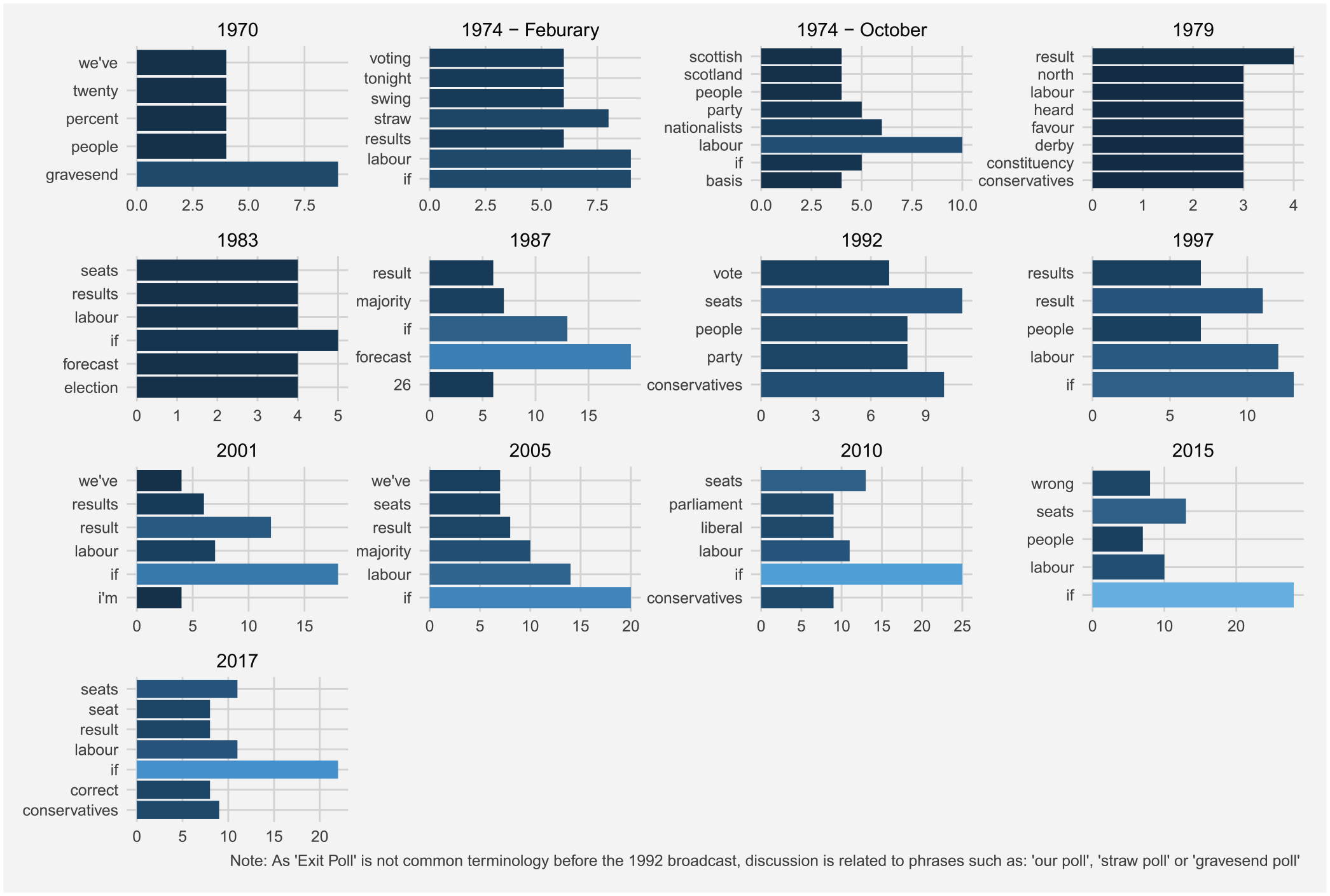
Frequencies of Top Five Words When Discussing Exit Polls, 1970–2017.
While conditional statements about exit polls pepper the transcripts of election broadcasts since 1997, they do not always imply caution or reservation. For example, conditional statements about exit polls do not preclude senior politicians from making bold claims, which they sometimes later regret. In 2015, Liberal Democrat Peer, Paddy Ashdown told BBC presenter, Andrew Neil, ‘If this exit poll is right [. . .] I will publicly eat my hat on your programme’. In a slightly different vein, a relatively common technique among politicians is to express initial caution or scepticism about the exit poll, and stress the need to wait for the results, but to anyway proceed to make confident statements about what the exit poll shows. For example, speaking to presenter Jeremy Vine in 2015, Michael Gove, a senior Conservative cabinet minister said: Well first of all, Jeremy, I think it’s an unwise politician who doesn’t treat exit polls with a certain degree of caution [. . .] If it is if it is correct I think what it does show is a clear rejection of Gordon Brown and I think it shows that Labour would have lost their legitimacy to govern because if those are the results are correct they will have had the worst result since 1931 [. . .] It would be an unprecedented vote of confidence in David Cameron’s leadership.
As noted above, a clear tendency since 1983 has been for interviewers to use seat projections to pose hypothetical questions about whether a party leader should resign or if a party will face a leadership challenge. While such questions are generally framed as being conditional on the accuracy of the exit poll, they can also place immediate pressure on a party leader long before the result of the election is known. For example, in 2015, Labour’s Harriet Harman was asked about the future of Ed Miliband as party leader, ‘if the exit poll turns out to be right’, just minutes after the poll had been released. Conversely, in instances where the exit poll confirms what was widely expected, questions about the future of party leaders have been framed with no conditional element whatsoever. In 1983, Roy Hattersley was asked whether for Labour ‘it might have been a different story with a different leadership?’ on the basis of a projection alone. Similarly, the outcome of the 1997 General Election was essentially assumed, on the basis of the exit poll, when Jeremy Paxman asked the Conservatives’ Michael Portillo, ‘Do you think that on the basis of this likely outcome John Major could continue as leader?’.
Finally, there is sufficient evidence in our data to support Payne’s law of exit polling that ‘a bad forecast is remembered forever, good ones are soon forgotten’. However, there are also grounds to suggest that good forecasts are remembered too, particularly if produced in the context of a tight election. The first support for Payne’s law is provided in Figure 1 and helps to explain some of the fluctuation. The most wayward pre-results forecasts were made in October 1974, 1987 and 1992. In each case, the error in the prediction of the winning party’s seat total was above 10%. The significantly lower profile given to the forecast in 1979 is almost certainly a product of the failure of the October 1974 forecast, which overestimated, by 132, the size of the Labour majority (rather than the 135-seat majority projected for Labour, there was a Labour majority of just 3). It is also likely that the shortcomings of the 1987 and 1992 forecasts prompted a reluctance to give greater prominence to the exit polls conducted from 1997 to 2005.
However, the chart also suggests that successful projections or exit polls at preceding elections were associated with editorial decisions to give greater weight to them in subsequent coverage. Although presented in a cautious manner, the ‘straw polls’ conducted in 1970 and February 1974 proved highly accurate in predicting not only the results in the constituencies in question but also the outcome of the election nationally. The decision to lead with a full seat projection in the October 1974 broadcast was in part informed by this success (Brown and Payne, 1975). Similarly, the 1983 projection remains one of the most accurate of all time and was followed by a substantial increase in the discussion of the projection in 1987. After 1992, exit polls become increasingly accurate. Both the 1997 and 2001 exit polls correctly predicted Labour landslides, albeit with relatively high errors in the projected vote shares. The 2005 exit poll predicted Labour’s parliamentary representation to within 0.3%. This performance undoubtedly bolstered confidence to lead the 2010 broadcast with a substantial focus on the exit poll. The remarkable accuracy of the 2010 exit poll, and the subsequent success of the 2015 and 2017 exit polls, have been associated with a growing focus on them in the early part of the broadcasts.
Further evidence for Payne’s law is provided by the references made in broadcasts to previous projections or exit polls. Politicians asked for their response to an exit poll will generally express caution, and sometime cynicism, often with reference to the failures of past polls. The 1992 exit poll has evidently become the ‘go to’ example in such instances and is cited more frequently than any other past projection. Direct references to the 1992 exit poll are rare in the 1997 and 2001 broadcasts (a likely consequence of the widespread expectation of a Labour landslide in both instances). However, the spectre of 1992 is raised on several occasions in the first hour of both the 2005 and 2010 broadcasts, underlining how long that exit poll has lived in the political memory. In 2005, Professor Tony King reminded viewers with respect to the exit poll that ‘famously in 1992 it was completely wrong’, while Liberal Democrat MP, Menzies Campbell, said that ‘all politicians should have 1992 engraved on the heart, because of course the exit polls proved to be wrong’. Liberal Democrat MPs were also keen to point to the experience of 1992 when they were asked about the exit poll in 2010, with Danny Alexander referencing the 1992 exit poll as evidence that they are ‘notoriously unreliable’ and Ed Davey expressing scepticism about the ‘BBC’s, record on exit polls’ on the grounds that ‘in 1992 you were over 60 seats out’. Aside from 1992, only the 1987 projection was cited more than once across all the transcripts as grounds for scepticism towards exit polls. Moreover, on the second of the two occasions on which 1987 was invoked, it was bracketed with 1992: ‘Both in 1987 and in 1992 we were served up exit polls which predicted Labour governments and, in the event, there was a Conservative government’ (Stephen Dorall, Conservative MP, appearing in the 1997 BBC election night broadcast).
However, there are also grounds to suggest that good forecasts are not necessarily soon forgotten and can help displace the memory of less accurate ones. In the 2015 election night broadcast, multiple references are made to the accuracy of the 2010 exit poll, and none at all to the inaccuracy of its 1992 equivalent. Notably, not a single one of these reminders of the success of the 2010 exit poll was provided by a politician. Instead, they came from a combination of BBC presenters and independent pollsters, most memorably from lead presenter, David Dimbleby who introduced Professor John Curtice as ‘the architect, the king of exit polls [. . .] the person who has done all the sophisticated work that worked in 2010’. We therefore suggest that Payne’s law should be supplemented with a second law of exit polling, namely that ‘The sustained success of exit polls will increase confidence about their accuracy and result in less scepticism being expressed about them’. We admit that this formulation is rather less snappy than his original.
Conclusion
Election night broadcasts present a unique challenge for presenters, politicians, pundits and psephologists alike. In distinctive ways, all of these election night participants are required to offer their interpretations of rapidly evolving events, basing their assessments on partial and imperfect information. This experience is just as much atypical for politicians, whose engagements with the media otherwise tend to be far more scripted, as it is for psephologists, who would generally want to undertake considered, and lengthy, analysis of the available data before seeking to draw conclusions about an election outcome.
Nonetheless, it is evident from our analysis that academic innovations in election forecasting have helped shape election night programming in the UK. Further research could potentially build on these findings by examining the nature of the relationship between the exit poll team and the broadcasters over time. One such avenue for inquiry could be the role that broadcasters have played in developing psephological methods and capacity, for instance, by providing computing power generally unavailable to academics in the 1950s or 1960s, or simply through the act of bringing together the leading figures in the study of UK elections with a major polling agency to undertake the exit poll. We would also suggest that there is considerable scope for comparative international research to examine how exit polling has developed in the context of different electoral systems and contrasting broadcasting environments.
Clearly, the tendencies we observe at more recent UK elections for both exit poll projections and politicians to become more central to the first hour of BBC broadcasts are unlikely to be products of developments in exit polling alone. The general elections of 2010 and 2015 had long been anticipated to be close and pre-election polls in 2017 indicated that the race was tightening. In such contexts, it seems plausible that election night broadcasts would give greater weight to exit poll projections and to their potential consequences, if proved correct. At the same time, our initial analysis of an uncorrected transcript for the BBC’s 2019 election night broadcast suggests that it did not depart significantly from the patterns we identified for proceeding elections. In 2019, the exit poll confirmed pre-election expectations of a Conservative majority. Yet, the longest period in the first hour of the broadcast in which the phrase ‘exit poll’ is not used is 6 minutes 30 seconds. In addition, 17 of the first 60 minutes are taken up with interviews with politicians, in which the exit poll provides the basis for discussion of the implications of the election outcome. Unlike 2015 or 2017, the 2019 exit poll did not force broadcasters to rip up anticipated scripts and provided less scope for fresh, competing narratives to emerge. Nonetheless, it again demonstrated the powerful role of election night broadcasts in establishing an initial interpretation of the election result, for instance, with respect to the reasons for Labour’s heavy defeat and the loss of its ‘red wall’ seats in former industrial towns.
Finally, our analysis of election night transcripts should also provide some comfort for academics. Rather than simply confirming the harsh realities of Payne’s (1992) law of election forecasting, we find some counter evidence to suggest the memory of good forecasts does live on and bad ones are eventually forgotten. Indeed, based on the cumulative record of exit polls since 2005, and the subsequent references to them, there are strong grounds to suppose that a previous run of good forecasts can be uppermost in the minds of those invited to react to an exit poll in the early hours of election night. After the experiences of 2010 and 2015, senior politicians seem less likely to promise to eat their hats if the exit poll proves correct.
Footnotes
Acknowledgements
The authors would like to thank Isla Glaister of Sky News for providing historical information about the seat forecasts used in BBC election night broadcasts. We are grateful to Kenn Rushworth and Jack Nagy for their assistance in cleaning up transcripts of the BBC broadcasts. We would also like to thank the two anonymous referees for their very helpful comments on our original submission.
Declaration of Conflicting Interests
The author(s) declared no potential conflicts of interest with respect to the research, authorship and/or publication of this article.
Funding
The author(s) disclosed receipt of the following financial support for the research, authorship and/or publication of this article: The research for the paper was partially supported by a North West Doctoral Training Centre studentship.
