




Abstract
While it has long been assumed that smaller communities are more prone to particularistic politics, the relationship between state size and clientelism remains strongly undertheorized. Departing from the assumption that face-to-face contacts, overlapping role relations, stronger monitoring mechanisms, and the enhanced power of single votes contribute to the emergence of patron–client linkages, this article provides an in-depth case study of clientelism in Malta, the smallest member state of the European Union. The analysis reveals not only that patron–client linkages are a ubiquitous feature of political life in Malta, but also that the smallness of Malta strongly affects the functioning of clientelism by eliminating the need for brokers and enhancing the power of clients versus patrons. In addition, clientelism is found to be related to several other characteristics of Maltese politics, among which the sharp polarization between parties, extremely high turnout rates, profound executive dominance, and the incidence of corruption scandals.
“Min mhux magħna, kontra tagħna”
(those who are not with us, are against us)
Introduction: State Size and Patron–Client Linkages
While academic studies of patron–client linkages have strongly augmented in recent decades, scholars continue to have a rather limited understanding of the causes of clientelistic politics. When seeking to explain the presence or absence of patron–client relations, existing publications usually point to factors like economic development and modernization, cultural traditions, or political regimes (Hicken, 2011; Kitschelt, 2000; Kitschelt and Wilkinson, 2007; Stokes, 2005). Size is rarely taken into account as an explanatory variable, one reason for which is the fact that clientelism can be observed in polities of all kinds of shapes and sizes. Yet by making two original arguments, this article aims to highlight the effects of state size on the presence and characteristics of patron–client linkages. In the first place, it argues that clientelistic relationships are particularly likely to emerge and persist in small societies, due to the direct, face-to-face contacts between citizens and politicians, the enhanced opportunities to monitor clientelistic exchanges, and the increased significance of individual votes. Second, and as evidence of the importance of size effects, the article argues that the manifestation and operation of clientelism in smaller settings is different from large ones. While clientelism in large countries predominantly occurs on the basis of hierarchical party organizations, intricate broker networks, and formal institutional channels, in small societies there is a direct, unfettered, and reciprocal relationship between patron and client, resulting in a stronger position of clients vis-à-vis patrons.
This article develops these arguments on the basis of an in-depth case study of a single country: the Republic of Malta. Located in the middle of the Mediterranean Sea, Malta was the site of Jeremy Boissevain’s classic works on clientelism and patronage (Boissevain, 1965, 1974), but due to its smallness has not figured in many later publications on clientelism or broader comparative politics. As an island country with a population of approximately 420,000, subdivided into 13 electoral districts with roughly 25,000 registered voters each, Malta constitutes a perfect case for the purpose of this article. Various publications have highlighted peculiarities of Maltese politics, among which its rare single transferable vote (STV) electoral system, record-breaking voter turnout levels, and sharp polarization between political parties and their supporters (Baldacchino, 2002; Cini, 2002; Hirczy, 1995; Mitchell, 2002; Zanella, 1990). The analysis conducted in this article will highlight the relationship between these phenomena and pervasive clientelism, and also discusses how clientelism has contributed to profound executive dominance and recurring corruption scandals in Malta.
The article starts off with a discussion of relevant existing literature, on the basis of which three mechanisms through which smallness can be expected to stimulate clientelism are formulated. Building on these mechanisms, this section also discusses two distinct features of clientelism that can be expected in small societies. Subsequently, the case of Malta is introduced, and the research design and methodology of the analysis of clientelism in Malta are outlined and motivated. In the ensuing analytical sections of the article, the various ways in which smallness stimulates the establishment and maintenance of patron–client linkages in Malta are discussed, and it will be shown how clientelism can be linked to other features of Maltese politics. This article concludes by proposing a new framework for understanding the ways in which smallness mediates and reinforces clientelistic politics. This conclusion also puts the Maltese case into broader perspective, by making a brief comparison with similar cases in Europe (such as Cyprus and Iceland) and other small (island) states around the globe in which comparable trends may be observed.
Theory: The Existing Literature on Clientelism and State Size
While there has been quite some ambiguity and discussion about the terms “clientelism,” ‘patronage,’ and “patron-client relations” (or “linkages”), several recent studies have sought to provide clear definitions of these concepts (Hicken, 2011; Kitschelt and Wilkinson, 2007; Piattoni, 2001; Stokes, 2007). This article adopts Simona Piattoni’s (2001: 4) conceptualization of clientelism, and hence defines it as “the trade of votes and other types of partisan support in exchange for public decisions with divisible benefits.” Whereas clientelism entails the exchange of political support for a wide array of potential benefits, in the case of patronage the benefit provided by the patron is a job in the (semi-) public sector. Clientelism and patronage can be grouped together with phenomena such as nepotism, cronyism, and pork-barrel politics under the umbrella term of particularistic politics, which refers to any actions of politicians that cater to specific (groups of) voters (Kitschelt, 2000; Piattoni, 2001). This can be contrasted with universalistic politics, which refers to political actions that apply to all members of society and therefore do not discriminate between citizens.
The concept of patron–client linkages first arrived into political science through the studies of anthropologists and sociologists, who observed these phenomena in small Southern European and Mediterranean societies, as well as developing countries in non-Western parts of the world. As a result, initial publications in comparative politics dealing with the concept focused on such societies as well (Eisenstadt and Lemarchand, 1981; Schmidt et al., 1977; Scott, 1972), and there still is a strong tendency to regard clientelism as the antithesis to industrialized, modern, and Weberian democracy. Various studies have indeed found empirical evidence of a link between economic development and clientelism (Kitschelt and Wilkinson, 2007), but the mechanisms by which underdevelopment facilitates clientelism (or rather, development eradicates clientelism) remain underspecified (Hicken, 2011: 299). Some studies have pointed to interesting variations of this link, such as the finding that clientelistic exchanges appeal primarily to poor instead of wealthy voters (Weitz-Shapiro, 2012).
The long-prevailing tendency to regard clientelistic exchanges as inefficient, corrupt, or even dangerous (Hicken, 2011: 302) has traditionally induced academics to regard clientelism as antithetical to democracy. However, the recent experience of many “third wave” democracies, which have been found to combine democratic institutions with pervasive patron–client networks and other “informal politics” (Helmke and Levitsky, 2004; cf. Van de Walle, 2003), has led scholars to reconsider the link between democracy and clientelism (Kitschelt, 2000). As a result, recent scholarship focuses more on the ways in which clientelism operates within the contours of a formally democratic framework (Aspinall, 2013; Grzymala-Busse, 2008; Stokes, 2005). While there is some evidence that patron–client linkages are likely to disappear as democracies consolidate and citizens gain trust in democratic institutions and procedures (Keefer, 2007), the experience of long-standing democracies like India, Italy, and Japan provides counterevidence to this assumption. 1
Mechanisms and Outcomes
In the present study, state size and smallness are conceptualized in purely demographic terms, meaning that a small society or state is defined as having a limited population size. 2 State size does not figure among the traditional explanatory variables of clientelism, but various studies have argued that clientelism is more likely to emerge and persist in smaller societies. Sociologists in particular have long observed that clientelistic relationships are more likely to exist in smaller groups. In his classic volume The Social System, Talcott Parsons (1951: 508) for instance argues that “[s]maller and simpler organizations are typically managed with a high degree of particularism in the relations of persons in authority to their subordinates.”
Leaving Parsons’ functionalist assumption aside, three specific mechanisms can be imagined to explain the link between size and clientelism (see Gerring and Veenendaal, in press). In the first place, small settings have higher levels of social intimacy and cohesion, and politicians and citizens are likely to know and interact with each other in multiple social roles (Ott, 2000; Tsai, 2007; Veenendaal, 2014; Wood, 1967). The blurring of professional and private relationships means that politicians have a stronger temptation to favor their personal relations, while constituents might exert greater social pressures on politicians to provide them with material largesse. Whereas the greater access of citizens to politicians in small societies has often been hypothesized to facilitate political representation, constant face-to-face contacts also enable citizens to directly ask their representatives for personal favors, thus increasing the likelihood of clientelistic arrangements (Veenendaal, 2013, 2015).
As a second mechanism, smallness can be assumed to increase the capacity of both patrons and clients to control and supervise clientelistic transactions. According to Medina and Stokes (2007: 76–77), clientelistic exchanges are easier to monitor in smaller societies, as a result of which they have a greater impact. A similar argument is made by Oppenheimer (1996), who shows that the population size of US states has a strong effect on the representational link between citizens and politicians, in the sense that particularistic exchanges are more common in smaller states (cf. Crespin and Finocchiaro, 2013). In contrast to large, impersonal settings in which compliance with clientelistic agreements is a perennial problem, direct contact between citizens and politicians in small societies strengthens the opportunities of both patrons and clients to monitor the extent to which clientelistic obligations are met. Given the smaller size of the electorate, politicians can more easily control the political participation of individual citizens. In similar fashion, citizens have greater opportunities to scrutinize the extent to which politicians actually deliver on their promises.
As a third mechanism, the increased value of individual votes in small societies could provide a powerful incentive for the establishment of patron–client linkages. In smaller electoral districts, it is statistically more likely that only one or a few votes will determine the results of an election. This is not only an explanation for higher turnout levels in smaller constituencies (Riker and Ordeshook, 1968), but also means that there are greater incentives for politicians to allocate targeted benefits to individual voters. In small and intimate societies, the political preferences of individual citizens are generally known, as a result of which politicians can quite accurately estimate the size of their political support before an election. Consequently, politicians are not only aware of the extra number of votes they need in order to win, but are also likely to know which voters they should target in order to achieve this. Aware of the power and value of their vote, citizens know that they can ask for something in return for their support. The result is that in smaller settings, both voters and politicians in have additional incentives and leverage to establish clientelistic exchanges.
In addition to explaining the presence of patron–client linkages, size can also be expected to influence the specific nature or manifestation of clientelism. In the first place, whereas clientelism in larger societies commonly depends on complex hierarchical networks between patrons, brokers, and clients, the direct and unfettered communication between politicians and citizens in small communities eliminates the need for such networks. This means that in small societies there may be no need for brokers, who in larger countries play a key role in establishing and maintaining clientelistic linkages (Stokes et al., 2013). In addition, while extensive clientelistic networks in larger countries often depend on strong and powerful party “machines” (Stokes, 2005), the direct links between citizens and politicians in small communities eliminate the need for such complex party organizations.
In the second place, while much of the literature on clientelism in larger societies tends to portray clients as dependent, passive, or weak actors in relation to much more powerful patrons, in small settings the close connections, overlapping public and private roles, and influential single votes of individual citizens can be expected to enhance the position of clients vis-à-vis their patrons. This means that clientelism in small societies is likely to be more demand- than supply-driven, underlining the agency and power of individual clients (cf. Auyero, 1999). The persistence of patron–client networks in small settings is therefore to a large extent the result of conscious pressures exerted by voters, with politicians facing strong inducements to comply with their demands. In Figure 1, the three mechanisms that explain the connection between state size and clientelism and the two particular features of clientelism in small states have been graphically presented.
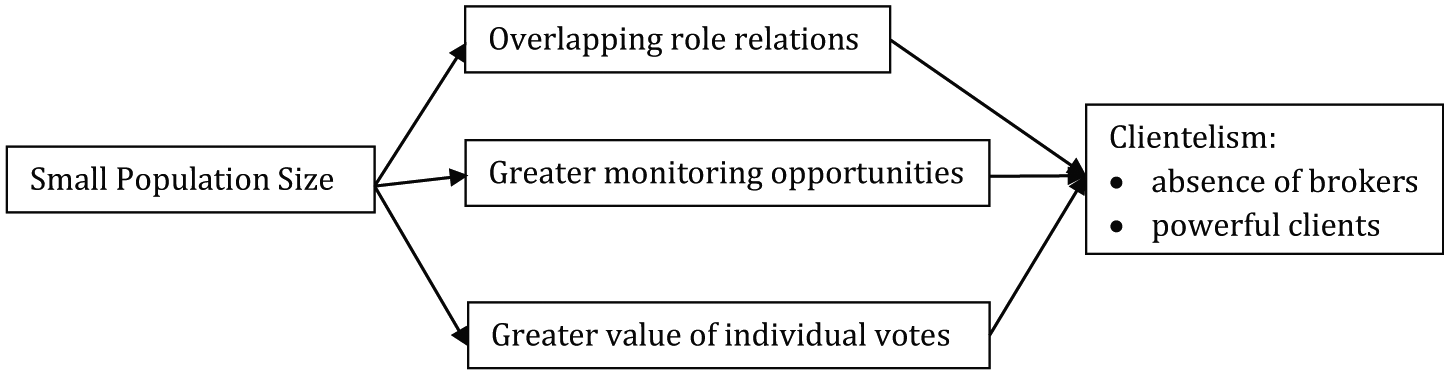
Overview of Expected Causal Mechanisms.
Case study publications on small (island) jurisdictions around the globe confirm the notion that smallness fosters clientelism. Initial publications listed the tendency to clientelism and conflicts of interest as a major disadvantage of small societies (Lowenthal, 1987; Wood, 1967), and widespread patronage has created oversized, partisan, and ineffective bureaucracies in virtually all small island nations (Chittoo, 2011; Sutton, 2007). In-depth contemporary studies of small states in Africa, the Caribbean, Europe, and the Pacific indeed reveal that direct contacts between citizens and politicians foster patron–client linkages in small settings (Corbett, 2015; Corbett and Veenendaal, 2018; Duncan and Woods, 2007; Seibert, 1999). Yet most of these case studies treat clientelism as an idiosyncratic element of politics in the case(s) under investigation, and hardly link it to broader theoretical discussions about the repercussions of state size. Their insights also have not been incorporated into the mainstream clientelism literature, in which small states tend to be overlooked. Whereas the present analysis also focuses on a single case, it does so with the explicit purpose to explore and examine how smallness may foster patron–client linkages.
Research Design: A Case Study of Malta
The Maltese archipelago consists of three inhabited islands (Malta island, Gozo, and Comino) located in the middle of the Mediterranean Sea, with a total population of approximately 420,000. Since the territorial size of Malta is only 316 square kilometers, the country is among the most densely populated in the world. After having been ruled by a series of foreign powers, among which Phoenicians, Moors, Normans, and Sicilians, in 1530 the islands were bequeathed to the Catholic Order of Saint John, and were ruled as a theocratic oligarchy for the next 250 years. Following a brief French occupation between 1798 and 1800, the islands became part of the British empire and were ruled as a crown colony until independence was attained in 1964. Catholic rule and British colonialism have both left a strong mark on Maltese politics, and language, religion, and sovereignty questions have historically acted as political fault lines. The first political parties were formed around these cleavages (Boissevain, 1965: 8–11; Frendo, 1991), and the two parties that contemporarily dominate Maltese politics, the Labor Party (PL—Partit Laburista) and the Nationalist Party (PN—Partit Nazzjonalista) also have their origins in these identity-related questions. The Church historically plays a very dominant role in Maltese society and politics, and in the 1920s and 1960s openly clashed with elected politicians in a fierce power struggle, in which it almost acted as a political party in its own right (Fenech, 2012; Koster, 1984).
Contemporary Malta is governed as a unitary parliamentary republic with a largely ceremonial president as head of state. There is a high degree of political centralization, and the state has historically assumed a very dominant role in the economy and society of the archipelago. Elections are held once every 5 years under the rare STV system, for which the country is divided into 13 electoral districts that each elect five MPs. 3 While STV is a proportional system, in practice Malta has always had a strong inclination toward a two-party system and single party governments, and in recent decades only the PL and PN gained parliamentary seats. 4 Elections in Malta are traditionally very competitive, in the sense that only a few thousand votes determine which party is elected into the government. This competitiveness is one of the reasons for record-breaking turnout levels (usually around 95%), without compulsory voting laws (Hirczy, 1995). A final characteristic of Maltese politics is the strong polarization between parties, which in the 1960s and 1980s briefly turned into open violence, posing a threat to the stability of the country (Baldacchino, 2002: 197–198; Howe, 1987; Zanella, 1990: 208).
In the following analysis, Malta is treated as a single representative or typical case, with the aim to probe the theorized causal mechanism between smallness and clientelistic politics (Seawright and Gerring, 2008: 297–299). The aim of this study and other typical case studies is to examine specific processes within the case that may explain the hypothesized causal link. In terms of its population size Malta is comparable to other small states (Crowards, 2002), but its high population density and person-oriented electoral system make it particularly suitable for an examination of the link between size and clientelism. The present analysis of politics in Malta is based on 1 month of field research conducted in November 2017, during which three types of data were gathered. In the first place, 23 semi-structured interviews were held with politicians, journalists, academic, and non-governmental organization (NGO) representatives, who were selected with the aim to obtain variation in professional and political views. 5 Second, I joined two individual Maltese MPs (one from each party) during several events at which they engaged with voters in their districts, among which house visits and consultation hours. The “shadowing” of these politicians (cf. Fenno, 1978) has given me great insights into the content, dynamics, and nature of interactions between politicians and citizens. 6 Finally, a content analysis of secondary literature, (online) newspaper articles, and official documents was carried out for the purpose of triangulation.
In the following sections of this article, I will use fragments of the data that I collected in Malta to illustrate or support the analytical narrative. While respondents obviously have different opinions, perspectives, and political convictions, all of the presented findings reflect the information I received from a (wide) majority of informants, cross-checked with other data sources.
How Smallness Stimulates Patron–Client Linkages in Malta
Combined with its high population density, the smallness of Malta has created a strongly interconnected society, in which people constantly meet and engage with each other in various social roles (Sultana and Baldacchino, 1994: 16). As Baldacchino (2002: 198) argues, “among themselves, the Maltese develop an intricate knowledge of the partisan affiliations and loyalties of friends, family, and acquaintances, effectively mapping a network of potential influence, patronage, and obligation.” Within this densely networked society, politicians are in constant and direct contact with their constituents, with whom they frequently also have a personal relationship. Voters and politicians continuously meet and communicate with each other in a remarkable variety of settings, meaning that private and professional relationships easily become blurred, and permitting citizens to use their personal relationship with a politician to raise any political questions or requests that they might have. As a Maltese minister indicated during an interview: I mean when you are with your family, even walking or going to a restaurant, at times there are people who come to you and would like to talk to you, not just to say hello, but also to maybe point some issues or problems that they have.
As expected, therefore, the smallness of Malta produces a constant blurring of private and professional relations between citizens and politicians. The small dimensions of the Maltese society entail that direct contact is a powerful norm in Maltese politics, and there is a strong expectation among citizens that politicians will engage and interact with them. Citizens commonly approach politicians whenever they see fit, sometimes putting a strain on the private life of politicians, who will meet voters everywhere they go. On the other hand, politicians also offer various opportunities for direct interaction to their constituents, for example, through house visits and consultation hours, or by attending specific public and private events. And in addition to face-to-face contacts, digital tools like e-mail, Facebook, and WhatsApp have offered new avenues of communication, that can be used by both politicians and voters. It is important to emphasize, therefore, that the direct contact between citizens and politicians is initiated from both sides. Asked about the most important ways of reaching out to voters, a government minister answered: Well, house visits, I think it’s still the most powerful. You have social media today and I think it’s being more used by candidates and even by the political parties. Telephone calls also, you know. You might send messages on mobile and e-mails.
Interviews and discussions with Maltese politicians point to a strong perception that no politician can be elected without personally reaching out to voters. In the words of Wolfgang Hirczy (1995: 263): [c]andidates go to great lengths in building their personal network of supporters, “nursing” prospective constituencies for months before the election, holding public meetings, conducting house-to-house calls and seeking to establish themselves—or to reemphasize an already established position—as local patron, doing favors and trying to win friends.
Reaching out to voters and addressing their concerns is generally not only seen as a necessity, but also as a virtue. As one politician said: I am a very accessible person—phone, Facebook, e-mail […]. If I can assist, why not. It’s not being a politician, it’s being a human.
When asked about the content of these direct interactions, virtually all interviewees indicated that personal issues and requests dominate. During the house visits that I joined, the personal situation of constituents was the central topic of discussion, ranging from people’s housing, jobs, taxes, health care, and pensions to really personal issues like disease, loneliness, or relations within the family. And during the consultation hours (called “constituency clinics”) that I attended, voters queued outside the building to talk to their MP about all types of personal quandaries that were on their mind. While many of these issues obviously connect to broader policy debates, they were almost invariably raised from the perspective of the individual. As a Maltese journalist indicated: These are very micro issues that are concerned with the individual. An individual does not speak to you about the policy on building heights. An individual will be speaking to you about the fact that they are trying to get a permit to build two floors on their roof.
And this is also the experience of Maltese politicians, as for instance a former prime minister highlights: It is not about policy, it’s about personal needs. So, the family, the children, their jobs, their husband, their wives, their grandfather, their elderly, who are unable to keep living on their own and they need to be placed in some kind of government institution, all sorts of issues.
As expected therefore, the closeness between citizens and politicians certainly offers ample opportunities for the establishment of patron–client connections.
Because of smallness, density, and interconnectedness, Maltese politicians are able to obtain a great deal of information about individual voters, and often know precisely where their supporters live. Political candidates need only between 3000 and 4000 votes to be elected, and they can quite accurately estimate the size of their support in their district. Interviews revealed that both parties make use of so-called “street leaders,” who keep track of political preferences of voters in each bloc or street (Boissevain, 1965: 24; Hirczy, 1995: 258). According to an NGO spokesperson: In villages that are very tight-knit, there are people on both sides of the parties—called street leaders—who would know “ok, number 61 votes Labour, he votes Nationalist …,” and they have databases. I used to campaign with one party when I was a student, and I remember there was this computer. If someone called, they would ask “ok what’s your ID number?” And they would put it in and generally you could see which party they vote for.
The lack of political anonymity means that politicians are able to penetrate the private lives of citizens to a great extent, and are therefore able to monitor the behavior of (potential) clients. According to Baldacchino (2002: 197), “the presence, if not control, of the party is supreme and complete.” However, as a result of the STV voting system, most of the electoral competition in districts actually occurs between candidates of similar parties, with split-ticket voting (or panachage) being extremely rare. This strong intra-party competition means that individual candidates still have to run their own campaigns, and have to make sure themselves to meet with voters within their districts.
As anticipated in the theoretical section, the direct contacts and the blending of private and professional relationships enable citizens to exert great pressures on their politicians. In the first place, while districts are small, politicians still have a hard time meeting the voters’ expectation of face-to-face contact. Whereas some politicians, especially those that are in government, can afford to hire some staff members to deal with voters’ requests, some voters still expect to meet the politicians in person, as one minister says: I have a twelve men and women team of customer care, and they are meeting dozens of people every day. People sometimes are frustrated, and they are sms-ing me. I am telling them “we will set up a meeting.” Customer care people are calling them. They come here they think they will meet the minister, but they meet the customer care team. They are annoyed, and say “I voted for you, I have to see you.”
During the consultation hours that I attended, some voters exerted pressure very bluntly, and one of them stated, for example: “I voted for [X], so now s/he has to do something for me.”
In addition to the expectation of face-to-face meetings, politicians are also expected to be able to deal with all kinds of issues that voters raise, ranging from public concerns to really private matters. This means that the politician is expected to play many different roles. As one politician remarks about his previous function in office: I used to have around 3 nights dedicated for house visits […] and throughout the weeks I used to have dedicated slots for meetings with people. People being literally normal citizens, who come to me with issues, with problems seeking help, from requests for jobs to guidance about things that are deeply personal for them. And the politician has to be the confessor—the priest who listens, the lawyer, the psychologist, the psychiatrist, the social worker. All things wrapped up into one.
These roles were also on display during the house visits and consultation hours that I attended. The two politicians whom I joined generally assumed quite paternal postures, providing a listening ear and seeking to comfort voters whenever necessary. Voters, on the contrary, did not hold back in expressing their complaints, dissatisfaction, grieves, or worries, apparently looking actively for the politician’s attention and care.
In the end, therefore, direct contact mostly takes the form of voters asking for personal help, favors, and services from politicians. But because politicians know many voters personally, the pressures to fulfill these requests can be formidable, which clearly points to a type of clientelism in which the clients dominate. As one politician argued: The danger of succumbing to that pressure in a small community like ours is enormous, because remember, these are the people you meet every Sunday when you go to church, whom your wife meets if she goes shopping in a supermarket. And you’re constantly bombarded by all of this, so this is a downside that creates enormous risks.
The secondary literature and the data I gathered indicate that most politicians are willing to fulfill requests of individual voters, thereby establishing a clientelistic relationship. This analysis therefore corroborates Mitchell’s (2002: 43) conclusion that “clientelistic practices and systems of patronage are what make Malta’s political system functional.” While the benefits, favors, and services allocated to voters are very diverse, my observations and interview material indicate that public sector jobs assume a very prominent place in the patron–client link.
7
Voters may approach ministers to ask for a job in the civil service, but they also ask MPs to contact ministers or other employers on their behalf. In addition to jobs, housing, building permits, and medical treatments often become the subject of clientelistic exchanges. In the latter two cases, voters may ask politicians to write letters or call on their behalf in order to see if they can move up on the waiting list, or make sure that their case is adequately taken care of. Because split-ticket voting is quite uncommon in Malta, the fiercest electoral competition in districts occurs between candidates from the same party. In contrast to other countries, this means that individual candidates rather than political parties act as providers of patronage. In the words of one politician: In the end you are not fighting to try and convince someone from the opposite party to vote for you, but you try to convince people from your party not to vote for X but for you. So I can offer you this, I can give you a fridge, a washing machine, and this is what’s happening.
While powerful party organizations and the use of street leaders as brokers might give the impression of party-organized clientelism, the smallness and particularities of the STV system in Malta entail that clientelistic linkages remain in fact very person-oriented, and most clientelistic exchanges occur directly between voters and politicians.
How Clientelism Relates to Other Aspects of Maltese Politics
Now that the influence of smallness on clientelism in Malta has been explained, this section will discuss how clientelism informs or relates to several other aspects of Maltese politics, among which (1) high levels of participation, (2) profound polarization, (3) executive dominance, and (4) frequent corruption scandals.
Participation
While turnout figures have been dwindling somewhat in recent years, participation in Maltese elections still commonly exceeds 90%, in the absence of compulsory voting. Several studies have sought to explain these extraordinary turnout figures (Hirczy, 1995; Zanella, 1990), and have pointed to the STV system,
8
power concentration, partisanship, competitiveness, and closeness between citizens and politicians as drivers of participation. This analysis corroborates these findings, but also adds and emphasizes the influence of patron–client linkages. Due to the fact that personal connections with politicians are such an important factor in obtaining benefits, goods, or services, it matters a great deal to individual voters which politicians and parties win the elections. Coupled with the lack of political anonymity, the prevalence of particularistic politics means that the stakes of individual citizens in election results can be very high: a victory of a favored politician or party can entail several years of (privileged) access to state services, while a defeat can translate into years of exclusion, neglect, or—in the worst case—victimization. As one prominent Maltese politician mentions: At the end of the day you are determining your life for the next five years. So people feel the need to go out to vote, even to keep their jobs in some cases. Because they were given a job by political patronage.
The same sentiment was voiced in stronger terms by another politician: Because it’s Russian Roulette, it’s do or die. If my party is in, I am going to get the favors. It is easier for me to get what I need. If my party is not in, I am finished. So we have to vote.
As discussed above, the smallness of electoral districts enables politicians and parties to assemble a great deal of information about individual voters. On election day, parties and candidates can actively monitor which voters have already cast their ballot, and which ones have not. As one minister explains: Political parties in our electoral system are able, according to the law, to have the data of who voted and who not. So when you go and vote, they are taking you off the list. In every polling booth, all parties have a representative […] and they are taking note. So all the political parties in Malta, that very same night when the election closes, know whether [name] went out to vote or not.
While the two most recent elections have been less close, Maltese elections tend to be highly competitive, meaning that at the district level only a few votes can make the difference, while on the national level the difference is traditionally less than 10,000 votes. Because of this closeness, parties will go to great lengths to make sure that all their supporters cast a ballot. According to one NGO spokesperson: They will phone you up [sic], on the day of election, 12 o’clock, saying you haven’t voted yet. They know; they have the list of the people who did not vote. They are inside, and they phone you up. At 3 o’clock in the afternoon again; at 6 o’clock they phone you up again.
In his account of the 1987 elections, Stephen Howe (1987: 264) describes how: Nationalists carried the sick from hospital beds to the polling stations, encouraged emigrants to return home for election day from as far away as Australia, and bused whole convents of nuns to the polling places, while the Labour Party chartered planes to fly sympathizers from their jobs in Libya and worked on a flock of 20,000 new voters, promising jobs for everyone.
While the vote is legally secret, some politicians and voters have found creative ways to circumvent the law, and to give or obtain “proof” of whether certain voters fulfill their part of the clientelistic exchange. Some interviewees pointed to voters requesting assistance when casting their ballot as the most typical strategy used in this regard. As one interest group representative said: For example, you can always say that you cannot read or write and that you need assistance in filling out your vote. And there would be a representative of the electoral commission, which are representatives from political parties, and they would help you to fill your vote. So they know how you voted.
Various studies assert that strong monitoring mechanisms increase the likelihood of clientelistic voting (Medina and Stokes, 2007; Nichter, 2008), and the smallness of Malta definitely strengthens politicians’ opportunities to monitor the participation of citizens. As the following quote from a journalist underscores, there is an awareness among citizens and politicians that elections play an important role in sealing the clientelistic connection: People feel directly invested, because that’s when that transaction is completed, you know. The transaction is happening, and therefore, personal stakes are very high […]. If it is so clientelistic, and so transactional, people have a lot at stake in, for example what MP’s are elected.
Polarization
As mentioned above, Maltese politics has always been remarkably polarized, and in the 1920s, 1960s, and 1980s tensions occasionally turned into political violence. Polarization has centered on issues like language, religion, and ideology, but some scholars note that regardless of its specific content, Malta has a penchant for tribal politics. Pika (hostility) and partiti (factions) are central to Boissevain’s analysis of Maltese politics, and have remained so in later analyses (Cini, 2002; Howe, 1987). This would explain why polarization has remained a core feature of politics in Malta, even as ideological or programmatic differences between the parties have gradually faded (Cini, 2002: 12–14). Most interview respondents in fact struggled to name any major differences between the contemporary PL and PN, but nevertheless stipulated that levels of polarization remain quite high. As one journalist puts it: Everything here is a zero-sum game. So there is essentially […] almost no space for independent critical thinking. You belong to one tribe and if you don’t belong to that tribe, it must be that you are against it. You can’t be neutral, you cannot be neutral. There is no space for that, and if you start behaving in a way that criticizes both political parties, for example, then you must be mad.
My fieldwork in Malta occurred just in the aftermath of the assassination of Daphne Caruana Galizia, a prominent but also very divisive anticorruption journalist. Her killing sparked new levels of polarization, as the opposition held the government responsible for creating the environment in which this murder could happen, and accused the government of frustrating subsequent investigations of the attack.
Smallness and clientelism may constitute another foundation of polarization and tribal politics. Because patron–client linkages and other forms of particularistic politics entail that the state does not treat all citizens on an equal basis, it matters a great deal to individual voters which politician or political party is in power. As Hirczy (1995: 260) argues, “[t]he stakes in the election include not only the control of government and thus the power to implement their policy agenda, but also the perquisites of office and patronage benefits.” If so much is at stake, voters may come to see an election victory of the opposition as an existential threat, that needs to be prevented at any cost. Moreover, individual voters may reap benefits from exhibiting strong partisan affiliations, as demonstrating loyalty to the party might increase their chance of obtaining favors. Finally, tribal politics weakens the position of supposedly neutral or impartial institutions, which face strong pressures to join a side, or are broadly seen as belonging to one side, as evidenced by former prime minister Dom Mintoff’s famous stipulation that “those who are not with us, are against us.” As will become clear in the next section, polarization therefore also contributes to the all-powerful position of the Maltese government.
Executive Dominance
Various studies have shown that Malta is a very centralized state, in which power is traditionally concentrated in the hands of government. Executive dominance is a feature of most small island states, in which government typically controls a disproportionally large section of the job market (Baldacchino, 1997). In the Maltese context, executive dominance further raises the stakes of election outcomes, strengthening both participation and polarization. Election victories translate into a party’s near-total control of the state apparatus, while a defeat leaves the other party and its supporters almost completely powerless. As a Maltese journalist phrased this notion: Here you can see also that elections are perceived as a complete takeover of power. So in a normal democracy, you’re choosing the prime minister or a powerful person, you’re choosing a cabinet, you’re choosing members of parliament. But the civil service, for example, does provide continuity. Local municipalities provide continuity, federal government provides continuity, the police provide continuity. Here, the perception is that if a government is switching from Labour to Nationalist, that everything is going to change.
Clientelism and patronage are linked to executive dominance, because partisan appointments amplify the control of the party in power, weakening (semi-) public institutions that are supposed to function in an impartial or neutral manner.
One result of this exacerbated winner-take-all context is that in Malta, “the government of the day and the state are coterminous” (Mitchell, 2002: 57; cf. Pirotta, 2012), in the sense that many state institutions are subjected to partisan interests. As a spokesperson of an NGO remarked during an interview: Our major concern is the influence government has on deciding bodies everywhere; on boards, on every aspect of a citizen’s life, you know. I mean […] you would need to apply for a planning permit, but the people deciding are people the government put on the board […]. So it’s just like a vicious circle, where people sometimes feel they can’t get out of. And for us that is really worrying; I mean the fact that the system of governance […] was ripe for abuse. If you really want to abuse the system […] it is extremely easy. And you get to a point where you look around and you say “ok, the government controls everything.”
In addition to allocating public sector jobs as part of a strategy to satisfy political supporters or recruit new ones, interviewees indicated that political appointments can also be used as a tactic to weaken or subjugate institutions that may pose constraints on executive power. Constitutionally, many high-profile public positions in Malta are either directly or indirectly appointed by the government, among which, for example, also judges. Several respondents indicated that frequent turnover of top positions may be used as a strategy to curtail their independent functioning, as the following quote underscores: It’s our prime minister […] or rather his government who appoints the new police commissioner. And that commissioner gets changed nearly every year. We’ve had five commissioners in 4 years, and it is not well for the institution. You have certain people being appointed as police commissioner, and you question their credentials. The same applies with the judiciary, and it is ultimately the whole institution that is going to be questioned.
In sum, the vast and virtually unchecked powers of the Maltese executive increase people’s dependence on the government, further amplifying the position of the party in power.
Corruption
While several recent corruption scandals related to the Panama Papers have received ample attention even in international media, corruption has in fact always been a feature of Maltese politics (Mercieca, 2012; Mitchell, 2002; Pirotta, 2012). This can be related to executive dominance, and the relative weakness of the media and other watchdog institutions that could inform voters about corruption cases and hold the relevant politicians accountable. In addition, the smallness of Malta creates very close connections between politicians and business elites, increasing the likelihood of favoritism in matters like public tenders or procurement. Because establishing and maintaining patron–client linkages is costly, politicians also run the risk of becoming financially dependent on business elites who might ask for concessions or favorable treatment in return for their support. However, many Maltese politicians are themselves also business owners, and revelations about the ownership of offshore shelf companies by high-ranking politicians in the current administration sparked widespread outrage, but has not resulted in the resignation of these officials.
If perhaps not a direct cause of corruption, this analysis suggests that clientelism certainly constitutes an important explanation of the culture of impunity vis-à-vis corrupt officials. By increasing people’s social and economic dependence on the politicians in power, clientelism diminishes the ability and willingness of citizens to hold politicians accountable. It might therefore be the case that people condone corruption as long as it doesn’t affect their personal position, or actually improves their situation. As one journalist expressed this sentiment: The people don’t care if the media say: listen we have a corrupt minister. You know, they would tell you “okay, fine, we have a corrupt minister, but we’re fine, we’re happy.” And I think the problem is that in Malta, we have not yet reached a situation where people can think freely.
In an extremely polarized environment in which neutral institutions are hard to find, corruption scandals are likely to become just another flashing point of partisan antagonism, especially if both parties have had their share of corruption scandals in the past. Moreover, the smallness and interconnectedness of Maltese society may also stifle people’s willingness to voice criticism of corrupt behavior, because of an awareness that one might need connections sometime in the future (Mercieca, 2012: 126). 9
While the European Union has long remained seemingly indifferent toward corruption scandals in Malta, in the aftermath of the assassination of Daphne Caruana Galizia several investigations into political corruption were launched or announced. In particular, the citizenship-by-investment program that has resulted in the sale of Maltese (and therefore EU) passports to wealthy Russian tycoons has alarmed EU officials (Rettman, 2018). It remains to be seen if this external pressure will have any effects on curbing corruption (cf. Pace, 2017).
Conclusion: Toward a New Framework Linking Smallness and Clientelism
On the basis of an in-depth analysis of politics in Malta, this study has aimed to analyze the extent to which state size can be regarded as a cause of clientelistic politics. By pointing to three distinct effects of smallness, among which (1) constant direct contact and overlapping role relations between citizens and politicians, (2) increased opportunities for control and monitoring, and (3) the increased value of individual votes, the causal pathways from smallness to clientelism were exposed and discussed. In addition, the analysis has revealed that smallness produces a distinct form of clientelism, in which brokers and other intermediaries are largely absent, and clients assume a much more powerful and demanding role vis-à-vis their patrons. Finally, the analysis has connected clientelism to several other noteworthy features of Maltese politics, among which high participation, polarization, executive dominance, and corruption.
These findings have a number of important implications for the broader literature on clientelism and patronage. In the first place, by highlighting the various ways in which smallness reinforces the likelihood of clientelistic exchanges between citizens and politicians, the analysis has foregrounded state size as a variable mediating the emergence and persistence of patron–client linkages. While contemporary studies of clientelism struggle to explain why clientelistic politics emerge in some countries and not in others, the present analysis suggests that state size should be considered as a potential explanatory variable. The strongest evidence of a link between state size and clientelism is the observation that clientelism in small societies functions in markedly different ways compared to the larger states that continue to dominate the literature. Most conspicuously, the case of Malta shows that in small communities clientelism should not exclusively be seen as an electoral strategy employed by parties and politicians, but at least to the same extent as an exchange relationship that is actively pursued and sustained by voters.
While idiosyncratic factors like population density and the STV system might further enhance the likelihood of patron–client linkages in Malta, evidence from other small states appears to strongly confirm the effects of size on clientelism. In terms of population size, within Europe Cyprus and Iceland can be regarded as comparable cases. In both countries, dense social networks, overlapping public and private roles, and constant direct contact produce patron–client networks (Faustmann, 2008, 2010; Kristinsson, 2001, 2012). In addition, while perhaps less extreme than in Malta, executive dominance and political polarization also characterize Cypriot and Icelandic politics, with Baldur Thorhallsson (2010), for example, finding that Iceland lacks the consensus culture of other Nordic countries. While more comparative research is needed to study these similarities and differences in more detail, it certainly appears the case that the size-related characteristics of clientelism in Malta can also be observed elsewhere (cf. Corbett and Veenendaal, 2018).
In the end, this analysis portrays Malta as having a very tribal political system, in which two socio-political groups fiercely compete for control of a powerful state apparatus. According to some scholars, competition and polarization are so strong that they have impeded on the formation of a national Maltese identity (Baldacchino, 2002). Yet, despite its limitations, it should also be remarked that analogous to most other (small) island nations, Malta has unquestionably remained democratic and politically stable. Whereas polarization between parties (and the Church) have at several moments brought the country on the brink of civil war, democratic institutions ultimately survived. And as long as each party and its followers have a realistic chance to win back the government, the system is likely to endure.
Supplemental Material
PSX828275_Supplemental_material – Supplemental material for How Smallness Fosters Clientelism: A Case Study of Malta
Supplemental material, PSX828275_Supplemental_material for How Smallness Fosters Clientelism: A Case Study of Malta by Wouter Veenendaal in Political Studies
Footnotes
Acknowledgements
I would like to thank the three anonymous reviewers for their useful comments and suggestions. In addition, I am grateful to Godfrey Baldacchino, Lino Briguglio, Dominic Fenech, Stefano Moncada, and Roderick Pace for accommodating me at the University of Malta, and for generously sharing their expertise on Maltese politics with me. Finally, I wish to thank Steven van der Plas and Ruben Tavenier for assisting me with transcribing interviews.
Funding
The author(s) disclosed receipt of the following financial support for the research, authorship, and/or publication of this article: This research has been sponsored financially by the Netherlands Organization for Scientific Research (NWO; grant number VENI-451-16-028), and is part of a larger research project on political stability in small states.
Supplemental material
Additional supplementary information may be found with the online version of this article.
Notes

Author Biography
References
Supplementary Material
Please find the following supplemental material available below.
For Open Access articles published under a Creative Commons License, all supplemental material carries the same license as the article it is associated with.
For non-Open Access articles published, all supplemental material carries a non-exclusive license, and permission requests for re-use of supplemental material or any part of supplemental material shall be sent directly to the copyright owner as specified in the copyright notice associated with the article.
