




Abstract
By employing individual-level data on MPs in 15 countries and 73 national and local assemblies, this article examines the conditions under which individual MPs are responsive to interest organizations. We show that MPs’ political values influence their responsiveness: MPs with more egalitarian and socially open values are more responsive to interest organizations. Moreover, MPs’ conceptions of democracy also matter in that more negative views of popular political involvement in democratic decision making are linked to lower responsiveness to interest organizations. Reliance on established ties with groups in society as well as support for technocracy have differential effects for responsiveness toward “old” and “new” interest organizations characterized by diverse social bases. These findings have important implications for democratic practice since they show how MPs are not all equally responsive to organized citizens as well as how different types of factors matter for responsiveness to “old” and “new” types of interest organizations.
Keywords
Introduction
Citizens routinely organize collectively to influence political representatives (Giugni and Grasso, in press). Scholarship has investigated the outcomes of such efforts primarily in two distinct research traditions: research on interest groups and that on social movement outcomes. Research on interest groups has focused mainly on the impact of lobbying activities on policy-making in the various stages of the legislative process (e.g. Baumgartner et al., 2009; Dür and De Bièvre 2007; Klüver, 2013; Mahoney, 2008; see Hojnacki et al., 2012 for a review; Richardson, 2013), including how interest groups influence how MPs from different parties cast their votes in parliament (Fellowes and Wolf, 2004; Giger and Klüver, 2016) and how interest groups perceive their own level of influence on representatives (Newmark and Nownes, 2017). Works on social movement outcomes have inquired into the circumstances under which protest activities lead to policy changes (e.g. Amenta, 2006; Amenta et al., 1992; Andrews, 2001; Burstein, 1998b [1985]; Gamson, 1990 [1975]; Giugni, 2004; Meyer, 2005; see Amenta et al., 2010 for a review). Other works have examined both types of actors as well as political parties (Burstein and Linton, 2002). Yet, while these strands of literature yield important insights into the political effects of organized groups in society, we still know little about the individual-level mechanisms of responsiveness and how certain features of MPs, such as their values and democratic conceptualizations, impact on their responsiveness to interest organizations (Burstein, 1999). This has important implications for making sense of democratic practice and the avenues to solve the crisis of responsibility and responsiveness currently afflicting advanced democracies (della Porta, 2015).
While scholars have recently started to examine policy-makers and political representatives’ views about protest activities (Gilljam et al., 2012; Marien and Hooghe, 2013; Uba, 2016; Wouters and Walgrave, 2017), research on the individual-level factors conditioning how MPs respond to interest organizations is still sparse. We aim to contribute to redressing this state of affairs by examining the following research question: What are the individual-level mechanisms underlying MPs’ responsiveness to interest organizations? To answer this question, we focus on various characteristics of MPs and examine the responsiveness of politicians to interest organizations from an individual-level perspective. To this end, we follow Burstein’s (1999) approach which groups social movement organizations and interest groups under the more general category of interest organizations as distinct from political parties on the basis that the latter have a special legal status, whereas the former does not. This distinction is particularly relevant when studying elites’ responsiveness. Whereas political parties are specifically organized to represent citizen interests democratically in parliamentary assemblies through the representative link, interest groups and social movement organizations do not have immediate access to parliaments and legislative chambers and, as such, need to target party representatives in order to have an impact on policy-making (Giugni and Grasso, in press). Therefore, when analyzing the individual-level mechanisms that impact MPs’ responsiveness to interest organizations, we consider these two types of organizations as very similar for the purposes of this specific type of investigation. This focus on interest organizations allows us to bring together the insights from two bodies of literature that have tended to talk past each other, namely the literature on social movements and that on interest groups, allowing us to develop on the insights from both fields.
Beyond the specific focus on how MPs view and deal with interest organizations, our study speaks to broader concerns about the impacts of organized citizen participation in the public sphere. This is an important area of investigation given the current “democratic deficit” in advanced democracies (Norris, 2011). In this respect, the literature on social movement outcomes has increasingly shifted focus on the targets of protest. These works look at both state (Luders, 2006, 2016; Skrentny, 2006) and non-state targets (Balsiger, 2016; King, 2016; King and Pearce, 2010). This literature has shown that we should not only study who participates in politics and why but also how the targets of interest organizations, that is, policy-makers perceive them. Studies of democratic responsiveness have mainly focused on the conditions under which political elites respond to shifts in public opinion and react to citizens’ preferences as captured by opinion polls (Burstein, 1998a; Page and Shapiro 1983, 1992; Soroka and Wlezien, 2010), including looking at whose preferences are most influential in shaping policy decisions (Gilens, 2005), often providing mixed evidence (Burstein, 2014; Manza and Cook, 2002). Following the way paved by Burstein (1998b [1985]) among others, in this article we aim to broaden the scope of these forays by inquiring into the conditions under which representatives are responsive to interest organizations in their everyday work “between elections” (Esaiasson and Narud, 2013). Moreover, we do so by following a comparative approach providing added value through generalization of the implications of our study beyond specific national contexts.
Mechanisms of responsiveness
Why are some policy-makers more responsive to interest organizations? We can draw on different strands of literature for insights on this question. To start with, the literature on the political consequences of the actions of social movement organizations tends to emphasize the incentivizing function of disruption and the way in which making claims on representatives can disrupt governing institutions to such an extent that powerholders might yield concessions to appease those petitioning them for change (Piven and Cloward, 1979). In addition to disruption, Andrews (2001) stresses two further mechanisms explaining why policy-makers might respond to interest organizations such as social movements: persuasion and negotiation. On the one hand, interest organizations might succeed in persuading policy-makers about the need for policy change. On the other hand, MPs might be persuaded through a process of negotiation. In terms of deliberative theory, while persuasion can be seen as the outcome of a deliberation process, negotiation is more akin to bargaining. Moreover, Lohmann (1993) noted how taking into account the claims of organized citizens can be seen as a rather an instrumental attitude by elected officials aimed at preserving their power. Within a representative democratic set-up, interest organizations should not have a direct impact on public policy, since representatives should in theory bear the interests of the majority of citizens into account in making decisions, and not prioritize the needs and demands of particular interests or minority groups (Krehbiel, 1991; Lohmann 1993). However, some representatives may give more attention to some interest organizations than others as they might see this as a useful means to preserve power. While this could be seen to undermine democratic principles and the quality of democracy at least under more popular conceptions (Mair, 2006), it might nonetheless allow politicians to preserve their power and, as such, provide an incentive for this type of behavior whereby particular interests and specific interest organizations have greater access to the corridors of power than others. For example, representatives might perceive that only those citizens that organize themselves in advocacy groups with large sources of funding would effectively have the resources and ability to punish them if they did not action the requested policy changes and, as such, that the costs of not listening to some interest organizations are higher than those of not listening to other, more disorganized groups of constituents.
On the other hand, social movements could be seen to only have an indirect effect on policy, and organizational activities that respond to the electoral concerns of elected officials are especially likely to have an impact since responding only to minority concerns could risk representatives not being re-elected (Burstein and Linton, 2002). Burstein (1999) has stressed three ways in which interest organizations in general and social movement organizations more specifically can have an indirect impact on public policy and representative’s willingness to change public policy through public pressure: by changing the public’s preferences, that is, attracting public opinion to their cause, increasing public concern with regard to the issues raised by the movement, and changing the legislator’s perception of the public’s preferences or of the issue’s saliency in the public space. These mechanisms rely on electoral adaptation in the sense interest group organizations may be able to impact on public opinion or representatives’ perceptions of public opinion to such an extent that representatives need to address the claims of the interest organizations in policy making in order to win re-election.
Zooming in to how these dynamics might play out at the individual level, in terms of those characteristics of MPs that might influence their responsiveness, recent scholarship on the impact of the political participation of organized groups of citizens on policy-makers provides some clues to develop new theorizing on the individual level. In this respect, a number of recent studies stand out for having studied elites’ attitudes toward different types of political action, most notably protest activities. Gilljam et al. (2012) examined representatives’ attitudes toward controversial noninstitutionalized forms of citizen protest in Sweden and found in particular that representatives to the right show lower protest acceptance than those to the left and that representatives with more protest experience show higher protest acceptance. Also focusing on Sweden, Uba (2016) studied protests against school closures in Sweden and found that personal background was key for understanding policy makers’ responses. The study by Marien and Hooghe (2013) investigated the perceived effectiveness of different forms of political participation by both citizens and representatives. They found that MPs tend to consider taking part in elections as the most effective means to influence political life, while they see that boycotting, Internet discussions, and illegal protests are the least effective. More recently, Wouters and Walgrave (2017) have shown that Belgian politicians rely on certain features of protest, such as the demonstrators’ worthiness, unity, numerical strength, and commitment, as cues about what the public want. At the same time, however, they found no evidence that elected officials’ predispositions moderate the effects of the protest features.
Inspired by the results of these rare individual-level studies looking at political elite responses to social movements and perceptions of effective political activism, we develop new theorizing with respect to how responsiveness toward interest organizations at the individual level is more likely to be activated depending on certain characteristics of MPs. This leads us to advance eight hypotheses on the impact of these individual characteristics. To begin with, we expect that MPs with more egalitarian and socially open or more leftist and libertarian values will be more inclined to be responsive toward interest organizations, including protest groups, relative to MPs who have more rightist and authoritarian values (H1) and who instead prioritize law and order (Kitschelt and Hellemans, 1990). Left-libertarians tend to have a preference for “politics from below” as well as supporting the activities of social movement organizations (Grasso and Giugni, 2016, in press). We may therefore hypothesize that policy-makers with stronger left-libertarian values should be more prone to support interest organizations and therefore to be responsive to them as the latter represent such “bottom-up” collective efforts that they value on the part of organized citizens to impact on policy-making and democratic governance. Left-libertarians also tend to have a more participatory stance toward political participation, politics and democracy (Grasso, 2016). Specifically, they are more sensitive to a participatory and deliberative conception of democracy (della Porta and Rucht, 2013). As such, we argue that more left-libertarian attitudes will stimulate MPs to be more open to all sorts of organized groups of citizens, specifically since this type of attitude underscores a belief in popular political involvement in democratic practice of all groups, not just specific ones (Mair, 2006). We therefore expect that this will apply both in general terms and also for the specific interest groups across worker’s, women’s and environmental organizations since research on ideological affinity has shown how representatives are more likely to react to issues raised within their political camp (Adams and Somer-Topcu, 2009; Green-Pedersen and Mortensen, 2010; Spoon et al., 2014). Hutter and Vliengenthart (2016) have recently applied this idea to analyze when political parties respond to protests reported on in the media showing how partisan characteristics condition the effect of protest on parliamentary activity. Moreover, we hypothesize that MPs who more greatly rely on established ties with groups in society will be more likely to be responsive based on the self-interest argument about electoral adaptation and their desire for re-election (H2). In addition, we expect that greater party attachment on the part of MPs and a higher tendency to tow the party line will make them less likely to seek external advice for their policy initiatives and, as such, to be less responsive to interest organizations (H3).
Just as with ordinary citizens, politicians have different views about the democratic process (Dahl, 1989; Schumpeter, 1952). This comprises a number of different aspects. One such aspect is representatives’ conceptions of democracy and the desirability of public engagement in decision making (Mair, 2006). Politicians and ordinary citizens alike display different degrees of political cynicism with respect to the established institutional channels of representation. For example, some think that the state today is unable to solve the most pressing problems. As such, representatives’ cynicism about politics, politicians and the democratic process may also impact their responsiveness levels. We expect that greater cynicism with respect to the established institutional democratic channels will lead to greater responsiveness since MPs will be more likely to want to look for solutions outside of the corrupt or “careerist” usual suspects and therefore look to external interest organizations for inspiration and suggestions in their policy-making (H4).
Representatives also differ in their views about citizens’ involvement in politics and more specifically about the desirability of their involvement in decision-making. Some are closer to a participatory or even deliberative conception of democracy and believe that citizens should be included as much as possible, whereas others believe that too much citizen involvement is potentially destabilizing (Mair, 2006). As such, we expect more negative views of popular political involvement in democratic decision making to be linked to lower levels of responsiveness to interest organizations on the part of MPs (H5). Moreover, different views may arise as to the extent to which decision-making should be delegated to experts and independent agencies. With respect to this aspect, we further expect MPs who are more supportive of technocracy to be more responsive as they will be more inclined to take on external, evidence-based opinions for the development of their policies and their decision-making that rely less on ideological convictions or patronage of specific groups (H6).
We expect all these variables to have similar effects across our six dependent variables capturing diverse dimensions of responsiveness with the exception of our expectation for differential effects with respect to reliance on groups in society, where we theorize that responsiveness to “old” workers’ organizations should be more closely linked with this factor, whereas we would expect the two “new” types of organizations to be less so given the more fluid social bases of new social movements (H7). Moreover, we also expect that responsiveness to “old” workers’ organization should not be positively associated with support for technocracy relative to responsiveness to environmental organizations or women’s groups as “new” types of organizations, which tend to place greater emphasis on the relevance of evidence-based expert and scientific knowledge for supporting political campaigns (H8). These latter two hypotheses for differential effects across different types of issue-specific measures of responsiveness allows us to test whether different types of characteristics and attitudes apply equally across different types of interest organizations with different types of beneficiaries or not. In this way, our analysis allows us to assess whether the factors affecting MP responsiveness vary across the distinction between “old” (labor) organizations and “new” (women’s, environmental) organizations and, within the latter category, between “subcultural” (women’s) and “instrumental” (environmental) organizations (Kriesi et al. 1995). As such, we are able to grasp in part whether MPs pay specific attention to certain issues, an aspect that is at the core of the agenda-setting approach to the study of social movement outcomes (Walgrave and Vliegenthart, 2012).
Data and methods
To test our hypotheses, we analyze survey data from the PARTIREP project. The PARTIREP team has coordinated a survey among members of parliament in 15 countries and in 73 statewide and substate parliaments. The survey, conducted between March 2009 and December 2010, covers a wide range of countries with different cultural contexts and political systems. 1 In this study, we examine data from all 15 countries included in the project: Austria, Belgium, France, Germany, Hungary, Ireland, Israel, Italy, the Netherlands, Norway, Poland, Portugal, Spain, Switzerland, and the UK. It should be noted that the sample size vary across countries, ranging from a low 34 in Ireland to a high 749 in Switzerland. 2 Since we deal with hierarchically embedded data (individual respondents in countries), we run multi-level regression analysis and, more specifically, random-intercept models with country as level-2. Between-country variation is thus taken into account in the random effects. The multi-level modeling also allows us to adjust the analysis to the fact that we deal with unbalanced samples. All the models are set at the same number of cases (N = 1729) in order to be able to compare across models.
The PARTIREP survey includes a number of questions which allow us to operationalize our measures of interest. Given that responsiveness is a complex concept, we operationalize it through six different but related dependent variables. First, we examine MPs’ responsiveness to interest organizations in terms of their subjective assessments of the desirability of involving interest groups in decision-making more often. The survey question asked, “To what extent do you agree or disagree that the following are desirable?” To involve interest groups in society more often in decision-making, where the variable is coded 1 for “not at all desirable” and 4 for “very desirable.” Second, we examine responsiveness in more objective terms, with respect to the regularity of self-reported contact with interest organizations. The survey question asked, “In your role as a Member of Parliament, how often in the last year have you had contact with the following groups, persons, or organizations?” workers’ organizations and trade unions, women’s organizations, environmental organizations, youth organizations, elderly organizations, and ethnic minorities’ organizations. The variable is coded 1 for “almost never” and 5 for “almost every week.” We created a mean scale of contact with these six interest organizations (Cronbach’s alpha = 0.78), where higher values signal greater frequency of contact. 3 Third, we examined responsiveness in terms of the self-estimated percentage of initiatives derived from interest or action groups, in other words a more specifically behavioral reflection of responsiveness. The survey question asked, “Of the initiatives (e.g. bills, written and oral questions) which you personally raised in Parliament in the last year, roughly what proportions of these did you respectively derive from the media, from interest groups, from within the party, from meeting with individual citizens, and from your personal experience? Could you please give a rough estimate in percentages?” Interest and action groups. The response was a numeric answer indicating the self-assessed percentage.
In addition, we wanted to analyze three measures of responsiveness with a more issue-specific character, allowing us to assess whether the characteristics and values of MPs discussed in our theoretical framework impacted differently on responsiveness toward three different types of interest organizations or whether their effect was uniform, allowing us to generalize our explanations for MP responsiveness to interest groups to a whole variety of groups. Here, we examined the regularity of contact with three specific organizations. The survey question asked, “In your role as a Member of Parliament, how often in the last year have you had contact with the following groups, persons, or organizations?” We created three separate variables for each of workers’ organizations and trade unions, women’s organizations, and environmental organizations. Each variable was coded 1 for “almost never” to 5 for “almost every week.” Appendix 1 shows the mean values of the six dependent variables across countries.
With respect to the independent variables, first we operationalize the political attitudes of MPs in terms of their left-libertarian values. To do so, we use the following survey question: “People hold different views on political issues. What do you think of the following?” Larger income differences are needed as incentives for individual effort, government should play a smaller role in the management of the economy, people who break the law should be given stiffer sentences, immigrants should be required to adapt to the customs of our country, and government should make sure that films and magazines uphold moral standards. The variable is coded 1 for “right-authoritarian” to 5 for “left-libertarian.” All the items were reverse coded so that higher values mean a more left-libertarian ideological position, and we created a scale combining them (Cronbach’s alpha = 0.75).
Second, we operationalized MPs’ self-interest and political reliance on established ties with groups in society through their responses to a survey question asking: ‘To retain their seat in Parliament, Members of Parliament often face hard choices. How would you choose to allocate your limited resources? Would you choose to spend more effort and money on achieving the goal on the left-hand side, would you choose to spend more effort and money on the goal on the right-hand side, or would the allocation of resources to both goals be about equal?’
The variable is coded 1 for “to seek out groups in society that haven’t supported you in the past” to 5 for “to retain the support from the groups in society that have supported you in the past.” We reverse coded this variable for ease of interpretations so that positive effect would mean greater reliance on groups in society for their political support.
Third, we operationalized the extent of MPs party attachment and sense of party discipline through their self-assessment of the extent to which their opinion differed from that of the party through the survey question asking “How often, in the last year, would you say you have found yourself in the position that your party had one opinion on a vote in Parliament, and you personally had a different opinion?” The variable is coded 1 for “about once a month” to 4 for “(almost) never.”
Fourth, we assess the impact of the extent of MPs’ cynicism toward the established institutional channels of the democratic process through a question asking: ‘It is often stated that voters have lost trust in politics and politicians. Listed below are a few statements that are very commonly heard in this regard. Regarding each of these commonly heard statements, could you indicate whether you personally agree or disagree?’
The state no longer possesses the capacity to solve society’s most pressing need; political parties are not offering really different options to the people; parties make too many promises on which they cannot deliver; most politicians are out of touch with people’s concerns; politicians let their own position on political issues be determined by the campaign advisers and the polls; politicians are more concerned with the clash of persons than with the confrontation of ideas; and special interests have too much influence on public policies. Where the variable was coded 1 for “strongly disagree” to 5 for “strongly agree.” We combined all seven items into a scale (Cronbach’s alpha = 0.73).
Fifth, we captured the effect of the extent of MPs negative views of citizens’ involvement in decision-making through a survey asking: “In recent years, different views on voters’ distrust of politicians and political parties have inspired widely diverging suggestions for reform. Of each of the following directions that reform could take, could you indicate how desirable you consider them?” To create more opportunities for citizens to set the political agenda; to increase the number of deliberative events, where groups of ordinary citizens debate and decide on a particular issue. The variables is coded 1 for “very desirable” to 4 for “not at all desirable.” We reverse coded the items so higher values meant more negative views of citizens’ involvement and combined them into a scale (Cronbach’s alpha = 0.54). 4
Sixth, we assess the impact of MPs support for greater technocratic influence in policy-making through a question asking: “In recent years, different views on voters’ distrust of politicians and political parties have inspired widely diverging suggestions for reform. Of each of the following directions that reform could take, could you indicate how desirable you consider them?” To delegate more decision-making to experts and independent agencies. The variable is coded 1 for “not at all desirable” to 4 “very desirable.”
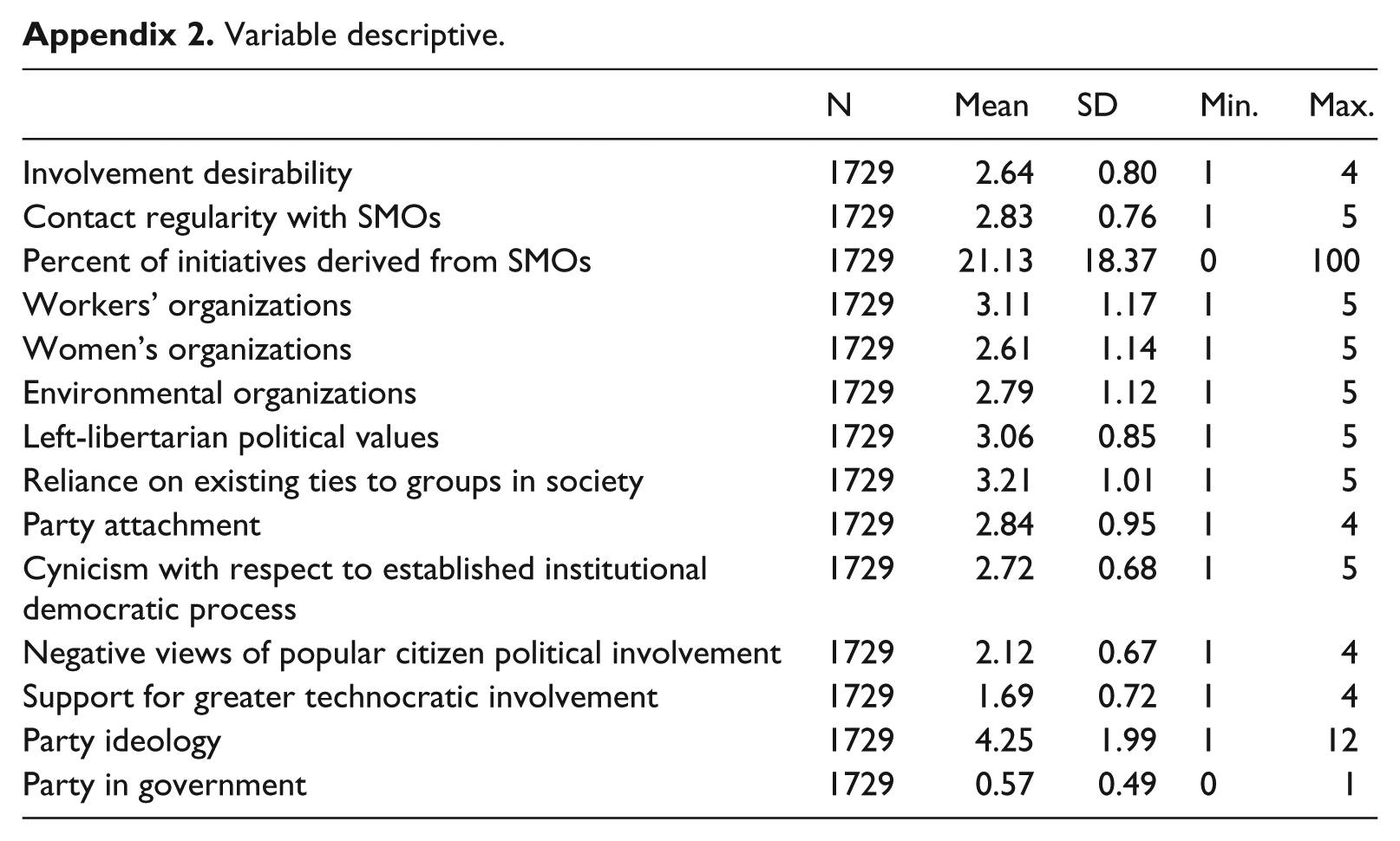
Finally, we include two controls variables. First, party ideology is a categorical variable including 12 ideological orientations controlling for the party position of MPs. This is an important aspect to be taken into account, as we may expect MPs that are ideologically close to certain interest organizations to be more responsive to them. Moreover, having contacts with certain interest organizations might be a party strategy. Second, we also include a dummy variable coded 0 if MPs are members of a party in opposition and 1 if they are members of a party in government. Appendix 2 provides summary statistics for all the variables included in the analysis.
The Effect of MPs’ characteristics on Their Responsiveness to Interest Organizations
We test for the effect of the various characteristics of MPs on their responsiveness to interest organizations by means of multi-level regression analysis taking into account between-country variation with the random effects. We present the findings concerning the potential effects of political attitudes and values in two separate tables. The first shows responsiveness to interest organizations in general, while the second refers to issue-specific responsiveness across “old” (labor and trade union) and “new” (women’s and environmental) interest organizations. The two hypotheses referring to differences across types of organizations are discussed when we address the specific factors at hand.
Table 1 shows the results for the three general indicators of responsiveness. Confirming H1, MPs who display left-libertarian values tend to have more regular contacts with different types of organizations. Left-libertarian values, however, are not associated with MPs stating that it is desirable that interest groups in society become involved more often in decision-making, nor with them estimating that a higher share of the initiatives they raised in the parliament are derived from interest and action groups. This may suggest that the interpretation of these items specifically addressing interest and action groups rather than interest organizations more generally could signal the protection of group interests over more majoritarian, grassroots-type coalitions which the egalitarianism of left-libertarians leads them to prefer according to the literature, leading them to shy away from affirmative responses in this respect.
Effects of selected variables on three general indicators of responsiveness.
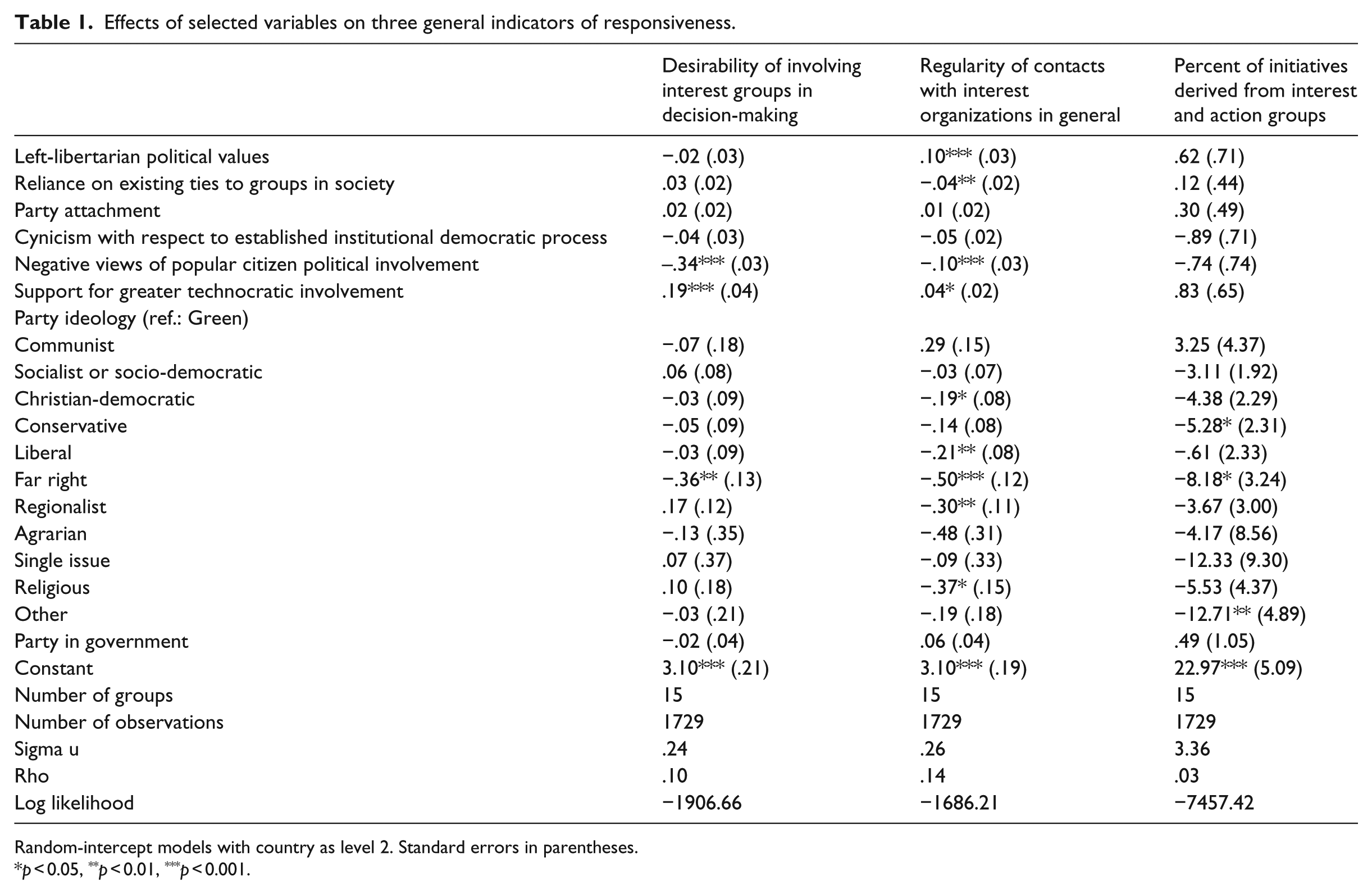
Random-intercept models with country as level 2. Standard errors in parentheses.
p < 0.05, **p < 0.01, ***p < 0.001.
The findings from Table 2 for the three issue-specific indicators of responsiveness largely reflect those pertaining to the more general indicator of regularity of contacts with interest organizations, attesting to the fact that there is strong consistency of the effect of left-libertarian values on responsiveness across different types of organizations, both “old” and “new.”
Effects of selected variables on three issue-specific indicators of responsiveness.
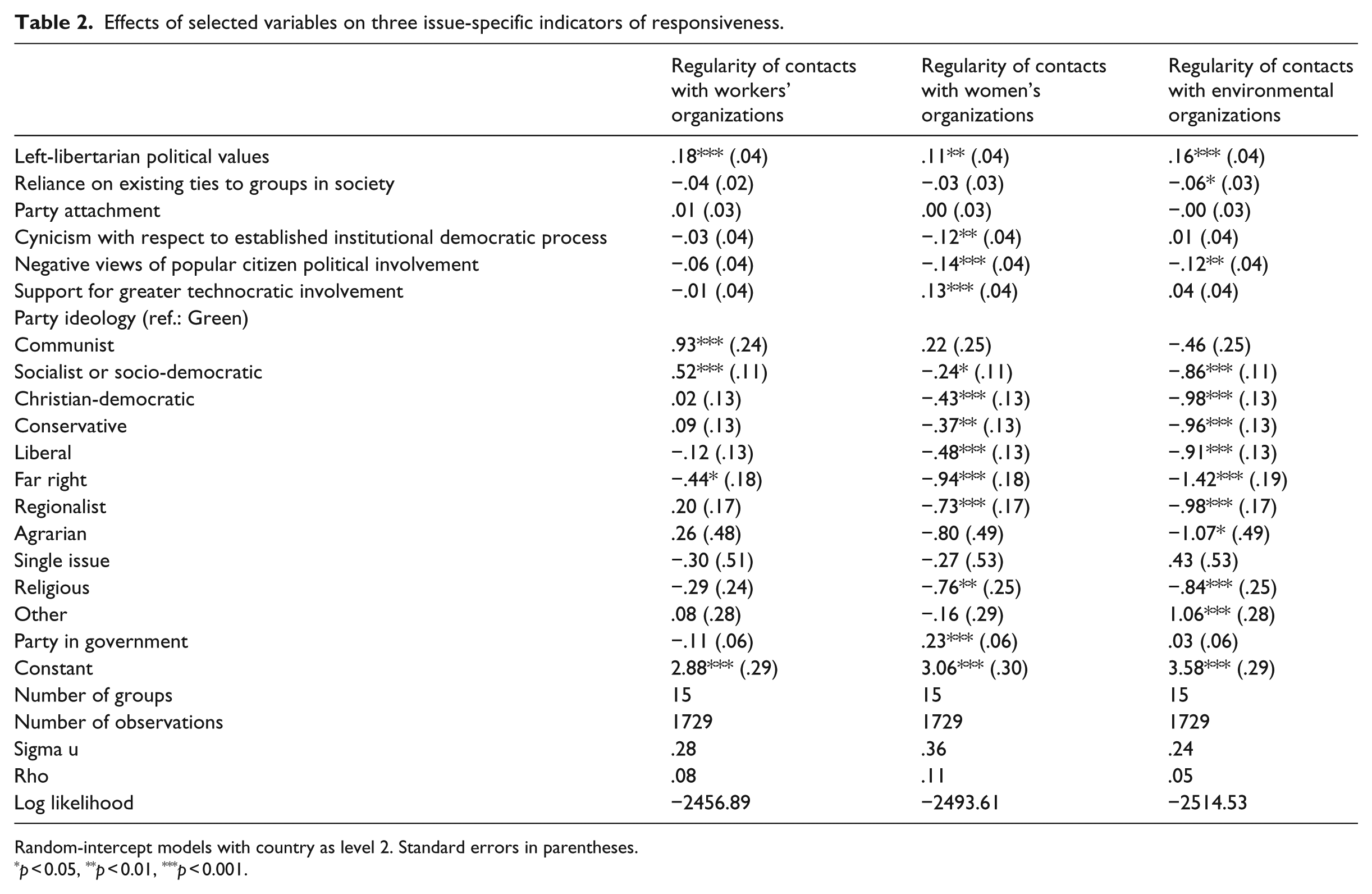
Random-intercept models with country as level 2. Standard errors in parentheses.
p < 0.05, **p < 0.01, ***p < 0.001.
Moving on to testing H2, on the three general measures of responsiveness, we observe a negative effect of reliance on groups in society on contact regularity with interest organizations. In contrast to our hypothesized relationship, MPs who are more reliant are in fact found to be less responsive to interest organizations in terms of contact regularity. Given the fact there is no significant effect on the other general indicators, this would seem to suggest that closer ties with specific groups in society would make them MPs less responsive with respect to other interest groups and therefore lead them to spend on average less time in contact with interest organizations. This finding shows that MPs who already have solid social bases in society are less likely to be open to other interest organizations. Our second hypothesis is therefore not confirmed.
Moving on to testing H3, we find no effect of party attachment on responsiveness on any of the general or issue-specific measures. This suggests that this MP characteristic does not influence the extent to which they are responsive to any kind of interest organization. Thus, contrary to our third hypothesis, having a different view than the own party does not seem to lead to a higher degree of responsiveness by MPs.
Testing for H4 also does not yield significant effects of MP cynicism with regards to the established institutional channels of the democratic process with the exception of a negative effect on responsiveness to women’s organizations. To this extent, we do not find evidence that MPs become more responsive to external organizations as a result of their disillusionment with established democratic channels.
Moving on to testing for H5, we find that with MPs with more positive view of citizens’ involvement are more likely to say that it is desirable to involve interest groups in decision making as well as reporting higher contact regularity on the general measure and also with the two “new” types of organizations (women and environmental). This confirms our fifth hypothesis and shows that MP responsiveness is closely linked to how positively they view citizen involvement in politics and, as such, that responsiveness to interest organizations in general is linked to a deeper belief in popular conceptions of democracy and the positive influence of organized citizen engagement in the democratic running of the state.
Testing for the impact of favorable attitudes toward greater technocratic involvement in government, we find a positive effect on two of the three general measures of responsiveness. Specifically, we observe a strong effect on the subjective measure of involvement desirability and a weaker but still significant effect on regularity of contacts with interest groups. Furthermore, there is also a significant effect on one of the more specific measures of responsiveness, namely regularity of contacts with women’s organizations. This partly supports H6.
Further examining the results for the issue-specific indicators, we had hypothesized a differential effect for different types of organizations in H7 in that here we would find that MPs’ responsiveness to workers’ organizations would be more closely linked to their reliance on groups in society relative to responsiveness to “new” environmental and women’s organizations with more fluid social bases. We find some confirmatory evidence in that MPs who are less reliant on groups in society are more likely to be responsive to environmental organizations. As such, we find evidence of some differential effects of MP attributes for their responsiveness to different types of “old” and “new” organizations, supporting H7.
Finally, our findings also provide evidence supporting H8 concerning the impact of support for technocracy on “old” and “new” organizations. If we look at the three specific measures of responsiveness, we observe a significant effect of this variable on regularity of contact with women’s organizations, providing partial confirmation for H8.
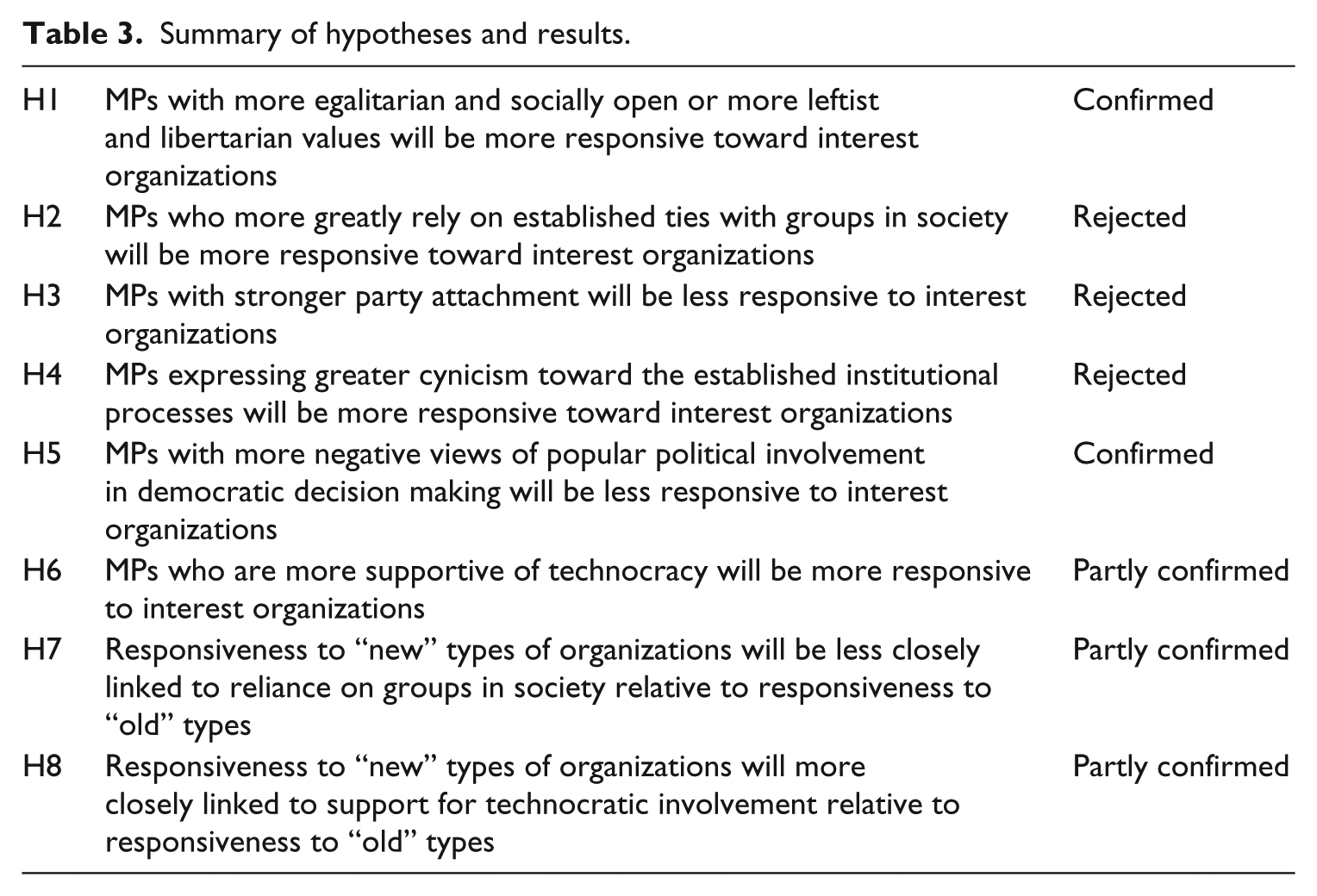
Table 3 summarizes the eight hypotheses and the results. It is important to note that the effects we found above for our variables of interest are net of the effect of the party position of MPs as well as of their being members of a party in government rather that in opposition. Thus, those MPs who are more left-libertarian, who have more positive views of popular citizen political involvement, or who are more supportive of greater technocratic involvement are also more likely to be responsive to interest organizations, depending on the specific indicator we focus upon.
Summary of hypotheses and results.
Discussion and Conclusion
Knowing which conditions lead MPs to be responsive is of crucial importance for understanding the relationship between citizens and their representatives in democratic societies. While there is a wealth of studies about how representatives respond to elections, our knowledge about other forms of democratic responsiveness is more limited (Esaiasson and Narud, 2013). Interest organizations have an important role to play for democratic practice and our study has shown that there are important individual-level mechanisms linking the responsiveness of MPs to interest organizations. We found evidence that some MP characteristics have a differential impact on responsiveness to different organizations, for example, with respect to support for greater involvement of experts in decision-making and in the result that MPs with lower levels of reliance on established ties with groups in society were more likely to be responsive to environmental organizations. Most importantly, we found evidence across types of organizations that MPs with stronger egalitarian and socially liberal political attitudes were more likely to be responsive to interest group organizations. This reflects existing accounts in the literature which have stressed that the left is closer to the social movements (Della Porta and Diani, 2006). Some have framed that in terms of the “civil rights coalition” being closer to the claims and interests of civil society actors—of which social movements are part—than the “law-and-order coalition” (Della Porta, 1999), therefore facilitating the political impact of social movements. This result also appears to conform to Gilljam et al.’s (2012) findings that representatives to the right show lower protest acceptance than those to the left.
We also found a strong and consistent effect of MPs’ support for popular citizen involvement in the political process on their responsiveness across indicators. These effects were consistent across both different types of general as well as issue-specific indicators of responsiveness indicating that more leftist and socially liberal MPs that have a popular conception of democratic engagement, seeing the involvement of organized groups of citizens in decision-making as a beneficial and desirable thing, are most likely to be responsive. These findings, in turn, suggest that these aspects are critical if we are to resolve the crisis of responsibility and responsiveness currently afflicting advanced democracies (della Porta, 2015). They show that if constituents and organized groups of citizens want to be heard by their representatives they should consider electing and targeting more leftist and socially tolerant representatives who have been shown by this analysis to be more likely to listen to the demands of organized groups of citizens. This is also true of those representatives who feel that the involvement of citizens in policy-making is something which is intrinsically valuable and necessary for healthy democratic government.
Our findings also have a number of important implications for the study of the impact of organized collective efforts to influence policy-making and more generally for the role of citizens in the democratic process. We contribute to the study of the conditions under which interest organizations may gain access to the institutionalized political arenas. In this way, our study provides insights on the role of citizens in the democratic process. Whereas popular democrats think that citizen involvement is not only beneficial but crucial for vibrant democracies, elitist democrats see popular involvement at best as purely useful for legitimating elite decision making and at worse potentially destabilizing (Mair, 2006). Our analysis suggests that MPs who are more likely to subscribe to the popular view are more likely to be responsive and, as such, that cultivating this ethos within political parties and parliaments will be critical in the future to resolve the crisis of responsiveness and responsibility currently afflicting advanced democracies, and particularly so since the wake of the Great Recession (della Porta, 2015). This is consistent with the notion of associative democracy as supplementing both representative democracy and market economy (Hirst, 1994). As such, knowing the conditions under which policy-makers become more open toward and reliant upon organized groups in civil society, as well as the mechanisms leading to such openness and reliance, could provide incentives toward a stronger role of the latter in the public affairs.
While our study made several important innovations as highlighted above, it also has limitations which can be addressed further in future studies. We focused on MPs in different countries as well as their political attitudes and values, but future research should also look at other targets. This approach holds the promise for further unveiling the underlying mechanisms through which interest organizations may bring about policy change by providing more detailed answers to the question of why policy-makers or other targets respond positively to their claims and activities. Future works could also study more thoroughly and analyze systematically the impact of the attitudes and perceptions of elite actors on the activation of mechanisms of responsiveness. They could additionally take into account the impact of the context on the ways in which MPs think of interest organizations and deal with them. Our analysis has focused on the individual-level characteristics, but future research could examine how the activation of individual-level mechanisms of responsiveness may vary also depending on differential contextual characteristics.
Footnotes
Appendix
Variable descriptive.
| N | Mean | SD | Min. | Max. | |
|---|---|---|---|---|---|
| Involvement desirability | 1729 | 2.64 | 0.80 | 1 | 4 |
| Contact regularity with SMOs | 1729 | 2.83 | 0.76 | 1 | 5 |
| Percent of initiatives derived from SMOs | 1729 | 21.13 | 18.37 | 0 | 100 |
| Workers’ organizations | 1729 | 3.11 | 1.17 | 1 | 5 |
| Women’s organizations | 1729 | 2.61 | 1.14 | 1 | 5 |
| Environmental organizations | 1729 | 2.79 | 1.12 | 1 | 5 |
| Left-libertarian political values | 1729 | 3.06 | 0.85 | 1 | 5 |
| Reliance on existing ties to groups in society | 1729 | 3.21 | 1.01 | 1 | 5 |
| Party attachment | 1729 | 2.84 | 0.95 | 1 | 4 |
| Cynicism with respect to established institutional democratic process | 1729 | 2.72 | 0.68 | 1 | 5 |
| Negative views of popular citizen political involvement | 1729 | 2.12 | 0.67 | 1 | 4 |
| Support for greater technocratic involvement | 1729 | 1.69 | 0.72 | 1 | 4 |
| Party ideology | 1729 | 4.25 | 1.99 | 1 | 12 |
| Party in government | 1729 | 0.57 | 0.49 | 0 | 1 |
Acknowledgements
The data employed in this paper were collected as part of the PARTIREP project by the PARTIREP MP Survey research team. The PARTIREP project was funded by the Belgian Federal Science Policy [BELSPO—grant n° P6/37]. Neither the contributors to the data collection nor the sponsors of the project bear any responsibility for the analyses conducted or the interpretation of the results published here. We would like to thank the participants and researchers in this project and in particular Stefaan Walgrave. We are also grateful to Frédéric Varone, four anonymous referees, and the Editors of Political Studies for their insightful comments. Earlier versions of this research were presented at the LIVEWHAT Project’s International Conference in Geneva, 14–16 October 2015, the ESA Research Network Social Movements Midterm Conference, Universidad Complutense de Madrid, 19–20 February 2015, and at the ResponsiveGov MoveOut Workshop at the University of Leicester, 16–17 June 2014. The authors are grateful to all those who provided feedback at these presentations. All remaining errors are our own and the usual disclaimers apply.
Funding
The author(s) received no financial support for the research, authorship, and/or publication of this article.
