



Abstract
The use of firearms by the police in Germany lacks systematic research, despite its significance for understanding police work and accountability. This paper examines police firearm use through exploratory research, official statistics, and civil society data sources, contextualising findings within international police research. Unlike the United States, German research shows significant gaps and relies mainly on limited official statistics. Civil society initiatives attempt to fill these gaps, but their coverage remains incomplete. The paper analyses discrepancies between data sources, identifies research gaps and concludes that systematic research programmes and improved data transparency are essential for evidence-based policy and accountability.
Introduction
Police use of firearms represents one of the most consequential manifestations of state power, raising fundamental questions about the area of conflict between public safety and the protection of individual rights. Two cases, the fatal police shootings of Michael Brown in Ferguson, Missouri, in 2014 and Mouhamed Dramé in Dortmund, Germany, in 2022, exemplify how police use of firearms can lead to societal protests, debates and expose relevant (research-)questions. These cases share parallels while also highlighting differences: Both incidents relate to young Black men: Brown, an 18-year-old African-American, and Dramé, an adolescent Senegalese asylum seeker. In both cases, the deaths caused significant public discourse about police conduct and potential racial discrimination in law enforcement. However, the contextual circumstances differed. The shooting in Ferguson by a police officer took place after an alleged shoplifting incident (Bonilla and Rosa, 2015), while the case in Dortmund began as a mental health intervention; Dramé was in a mental health crisis and had been psychiatrically committed 2 days before the incident (Ibrahim and Kattenberg, 2024). In both cases, the use of firearms was found to be justified in court. In Ferguson, a grand jury declined to indict the officer who fired the shot, determining he acted in self-defence. The Dortmund case was heard in court, where five officers were acquitted at first instance. The court recognised an alleged self-defence situation (‘Erlaubnistatbestandsirrtum’) because there were indications that Dramé may have fled from the pepper spray that had been used on him prior, which the officers interpreted as an assumed attack on them.
These cases highlight several critical aspects of police use of firearms. First, they demonstrate how quickly situations can escalate, raising questions about de-escalation- and alternative intervention strategies. Second, they show the challenge of balancing officer safety with proportionate use of firearms, particularly in cases involving mental health crises or perceived threats. Third, both cases underline the importance of transparency in police operations. Since the use of force by the state in a democracy is bound by fundamental rights and proportionality, it is subject to extensive oversight, a form of accountability and transparency referred to internationally as police accountability (Walker and Archbold, 2018).
The societal impact of these shootings extends beyond individual tragedy. Both cases evolved broader protest (such as Black Lives Matter, BLM) and discussions about institutional racism and police training. The question of the extent to which racist or other threat stereotypes can possibly influence the perception of danger takes place in social and criminological discourse, but less so in legal disputes in individual cases. The cases of police use of firearms emphasise the imperative for empirical research regarding police use of firearms, specifically concerning tactical decision-making processes, de-escalation strategies, and the potential influence of implicit bias. This paper examines existing empirical data, statistical evidence, and the current state of research regarding police use of firearms in Germany. But at first, the international state of research and established international databases are presented.
Regarding public statistics and private databases on police firearm use, the USA, in particular, plays a central role, where various official and unofficial statistics and data collections exist. The FBI maintains the Uniform Crime Reporting (UCR) system with its Supplementary Homicide Reports (SHR, Kaplan, 2021), which record police-related fatalities as “justifiable homicides”. Additionally, the FBI is developing the National Use-of-Force Data Collection. 1 The CDC-operated National Vital Statistics System (NVSS) mandatorily collects data from death certificates 2 , while the National Violent Death Reporting System (NVDRS) gathers additional data on a voluntary basis from law enforcement agencies. 3 These official statistics are supplemented by private databases such as those maintained by The Washington Post 4 , The Guardian 5 , or Fatal Encounters (a crowdsourced database) 6 , which often report higher case numbers than official counts. Other countries employ different approaches: In Australia, specialised investigators (State Coroners) examine cases of fatal police shootings and publish detailed reports (Office of the State Coroner, 2016). In England and Wales, the Independent Office for Police Conduct (IOPC) serves as an autonomous oversight body, publishing comprehensive annual reports on police-related deaths (IOPC, 2023). Similar independent complaint authorities exist in Denmark (Den Uafhængige Politiklagemyndighed, 2023), Norway (The Norwegian Bureau for the Investigation of Police Affairs, 2025), and New Zealand (Independent Police Conduct Authority, 2024). Internationally, particularly in the USA, there is both extensive official data collection and reporting as well as comprehensive civil society monitoring.
International research on police use of firearms primarily focuses on three key influencing factors: legal regulations, ethnic disparities, and mental illness. Studies indicate that different regulations regarding police armament and documentation requirements have a measurable impact on the frequency of firearm deployments (in England, Wales and Norway, police armed with a firearm is the exception; Albert, 2022; Home Office for England and Wales, 2024). The possession or presence of a firearm is a key factor influencing police use of firearms (DeGue et al., 2016: 174; Jennings et al., 2020; Porter, 2023; Worrall et al., 2018). Beyond that, extensive research examines the potential overrepresentation of ethnic minorities (Black and Hispanic people) as victims of police firearm use, particularly in the United States. Although findings vary and must consider the influence of regional prejudices and demographic factors (Buehler, 2017; DeGue et al., 2016; Edwards et al., 2019; Fagan and Campbell, 2020). Another research focus lies on the increased prevalence of mental illness among individuals against whom firearms are used (Frankham, 2018; Kesic et al., 2012), including the investigation of the so-called “Suicide by Cop” (SbC; the alleged intentional provocation of lethal police force to achieve one’s own death) phenomenon (Dewey et al., 2013; Kesic et al., 2012; Lord, 2012; Mohandie et al., 2009). The risk of being shot by the police is particularly higher if the person is both mentally ill and black. This highlights the relevance of intersectional perspectives on police use of firearms (Saleh et al., 2018). The current state of research highlights the complexity of police use of firearms. In the following, the limited studies and data available in Germany will be discussed.
Current state of research on police use of firearms in Germany
Lorei et al. (2023a: 86) state that there’s “relatively little research available on the subject” of “the use of firearms by the police”. This especially applies to the German police (Schmitz et al., 2025). In Germany, the police force operates under a standardised equipment protocol where every officer is equipped with a firearm as part of their basic gear. This armament policy exists within a strictly regulated framework governed by both state and federal police acts. With about 250,000 officers in service, this represents a significant armed presence in German law enforcement (Lorei et al., 2023: 88). 7 Regarding the frequency and types of use, the existing debate in the scientific community refers much to the Conference of Interior Ministers’ annual statistics of firearm use in German policing (see below), edited by the Institute for Police Technology (PTI) of the German Police University (DHPol).
Research on the accuracy and effectiveness of police firearm use in Germany (Lorei and Balaneskovic, 2020) shows a clear correlation with distance. At very close range (up to 1.5 m), officers achieve a 100 % hit rate. This accuracy remains relatively high at distances up to 3 m, with about three-quarters of shots hitting their target. However, beyond this distance, hit rates decline. The data also reveals that multiple shots are often necessary for effectiveness. Above all, in real scenarios, there is a lower hit rate compared to shooting training. The reason for this is the “dynamic nature of such situations” (Lorei et al., 2023: 95).
A particularly concerning aspect of police firearm use in Germany involves interactions with individuals perceived as mentally ill. According to the civil society monitoring CILIP, media reports in 2024 indicated the presence of mental illness or psychological emergencies in 13 out of 22 fatal cases of police use of firearms (59 %). In 2023, such indications were reported in 7 out of 10 fatal cases (70 %). 8 In this context, the study of Behn (2021) on the special subject of SbC is relevant with regards to empirical research in Germany. Behn analysed 90 police and judicial cases from Lower Saxony (2008-2017) using a mixed-methods approach to categorise and evaluate SbC incidents. The study reveals that in cases of suicide by cop in Lower Saxony, the “typical assailant” was “male” (86 %), often perceived as “psychiatrically impaired” (52 %), “under the influence of intoxicating substances” (57 %), and most incidents occurred in smaller cities, with 25 cases classified as clear suicide by cop, 54 as suspected cases (Behn, 2021).
Research into the so-called “shooter bias” also examines the unconscious factors that influence the decision to use firearms. An article by Stelter et al. (2023) examines shooter bias through three studies among German police and civilian samples. The methodology employed a “first-person shooter task” where participants had to make rapid decisions about whether to shoot or not shoot targets of different ethnicities (perceived as “Arab” vs “White”) who were either armed or unarmed. At first, both police and civilians showed faster reactions to “armed Arab targets” compared to “armed White targets”. Both groups displayed comparable levels of shooter bias. Police performed better overall in terms of accuracy and speed, but still exhibited the same biased patterns as civilians. While both groups showed anti-Muslim/anti-Arab attitudes in self-reports (with police showing a bit higher levels), these explicit attitudes did not correlate with actual shooting behaviour in the task (Stelter et al., 2023: 7).
Although there is little research on the use of firearms by the police in Germany, there are numerous other research approaches that are indirectly relevant. For example, there are analyses on the phenomenon of police violence from the victim’s perspective (Abdul-Rahman et al., 2019), on de-escalation strategies as a topic in German police training (Lorei et al., 2023b), on argumentation and forms of dealing with bodycams (Lehmann, 2020), as well as studies on working conditions, motivation, attitudes and experiences of violence among police employees, which are the subject of controversial debate in Germany (Schiemann, 2022).
Especially regarding police misconduct, research shows the current system of ‘police investigating police’ – which is also relevant in the context of officer-involved shootings (OIS) – is fundamentally flawed. According to Derin and Singelnstein (2024), the solution requires a two-track approach: establishing independent investigative bodies within the criminal justice system specifically for police misconduct, while simultaneously creating external oversight mechanisms to address structural issues, following successful models from countries like Denmark and Northern Ireland.
Official data collection and reporting: PTI/DHPol-statistic
In Germany, there is only one official statistic on police firearm use. Although this may seem limited, it remains the only officially recorded data on police use of force. 9 This statistic is published by the Institute for Police Technology (Polizeitechnisches Institut, PTI) of the German Police University (Deutsche Hochschule der Polizei, DHPol) and commissioned by the Standing Conference of Interior Ministers (Innenministerkonferenz, IMK). 10 The PTI/DHPol statistic covers all types of firearm use by the German state police forces, ranging from firearm discharges against animals to the lethal use of firearms against individuals. 11 The PTI/DHPol statistic has been compiled since 1974 under IMK mandate but has only been publicly released upon request since 1984. It is disseminated to a broader audience through CILIP, which publishes it in its journal and online (Schmitz et al., 2025). 12 Since 2025, it has been published by the IMK on its own website. 13
Notably, the methodology used to compile these statistics lacks transparency. While the DHPol has collected firearm use data under IMK mandate, the specific procedures for data gathering, verification, and reporting remain undocumented in publicly accessible sources, preventing independent assessment of the statistics’ comprehensiveness and reliability. The PTI/DHPol statistic provides only brief information on the number of cases, the consequences for the person who is shot (injured/killed), and the justification for the use of firearms. The cases themselves are not described in detail and do not include further information such as the initial reason for the police intervention, the legal consequences, the demographic factors of those involved, or the location of the incidents.
The PTI/DHPol statistic is divided into four categories, of which only Category 1 (‘Firearm Use Against Persons’) and Category 3 (‘Unjustified Firearm Use’) are relevant to this analysis. The first category, ‘Firearm Use Against Persons,’ includes warning shots, firearm discharges against objects, and a subcategory also named ‘Firearm Use Against Persons.’ This subcategory represents a narrower definition of firearm use against persons, primarily based on the exclusion of warning shots and firearm discharges against objects. From 1984 to 2023, it is observable that during the 1990s, there was a peak in ‘Firearm Use Against Persons’ in a broader sense. This peak declined and has remained at a stable level since around 2006. A closer examination reveals that the increase in the 1990s was primarily driven by a higher number of warning shots rather than by firearm use against persons in a narrower sense. Consequently, it also becomes evident that the proportion of firearm use against persons in a narrower sense has increased in recent years due to a declining rate of warning shots (Figure 1). Category 1 ‘Firearm use against persons’ from 1984 to 2023.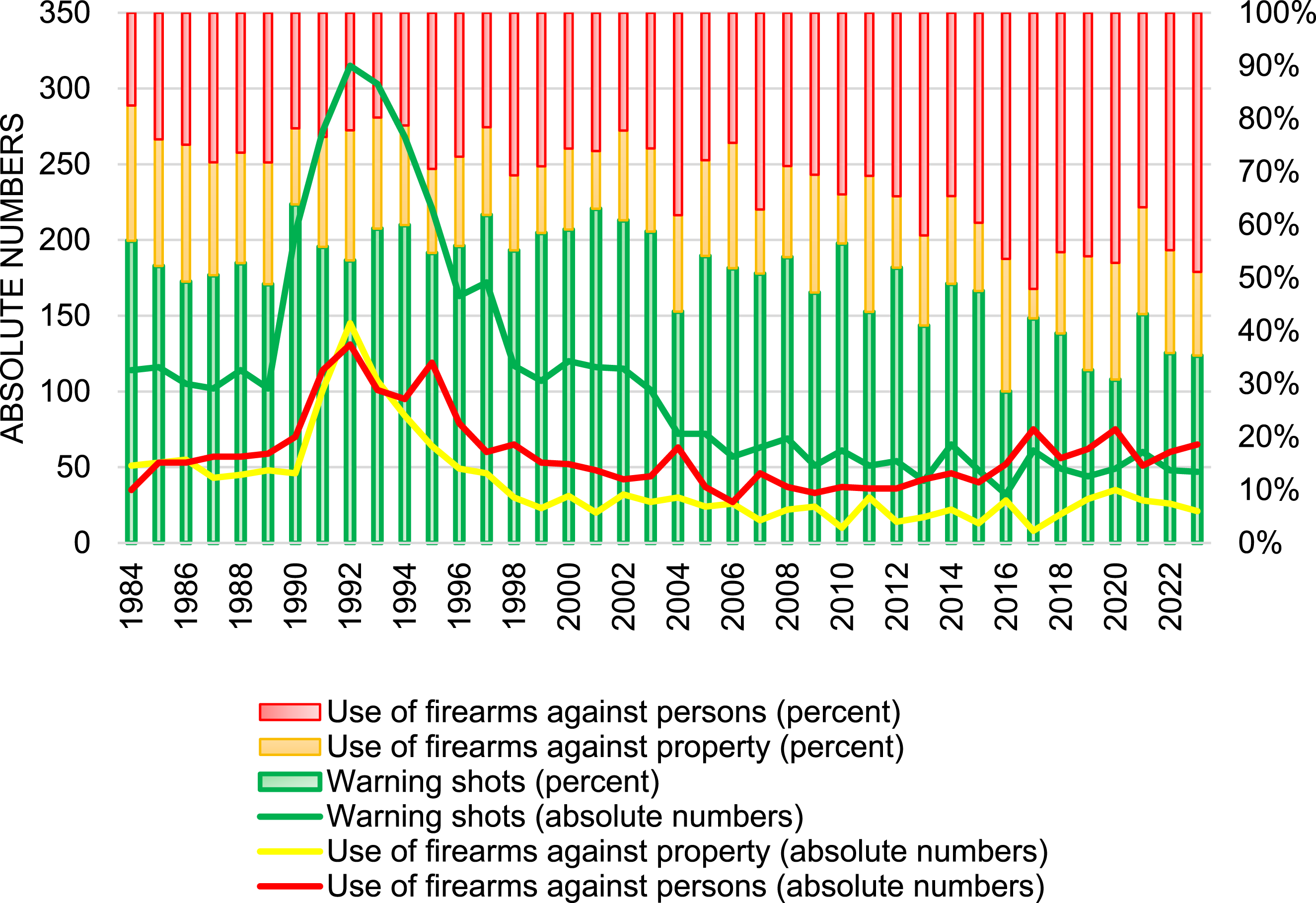
Within the broader category of firearm use, cases resulting in injuries or death represent only a small proportion. Over the past 10 years, only 9 % of all discharges in Category 1 have resulted in fatalities, while 25 % have led to injuries. The majority of discharges (66 %) had no physical consequences for the subject. A similar trend can be observed in the consequences of firearm use (Figure 2). It shows that firearm use against persons in a narrower sense has resulted in a relatively stable trend, while the rate of injuries follows the same pattern as the firearm use against persons line. Consequences of the use of firearms against persons in a narrow sense.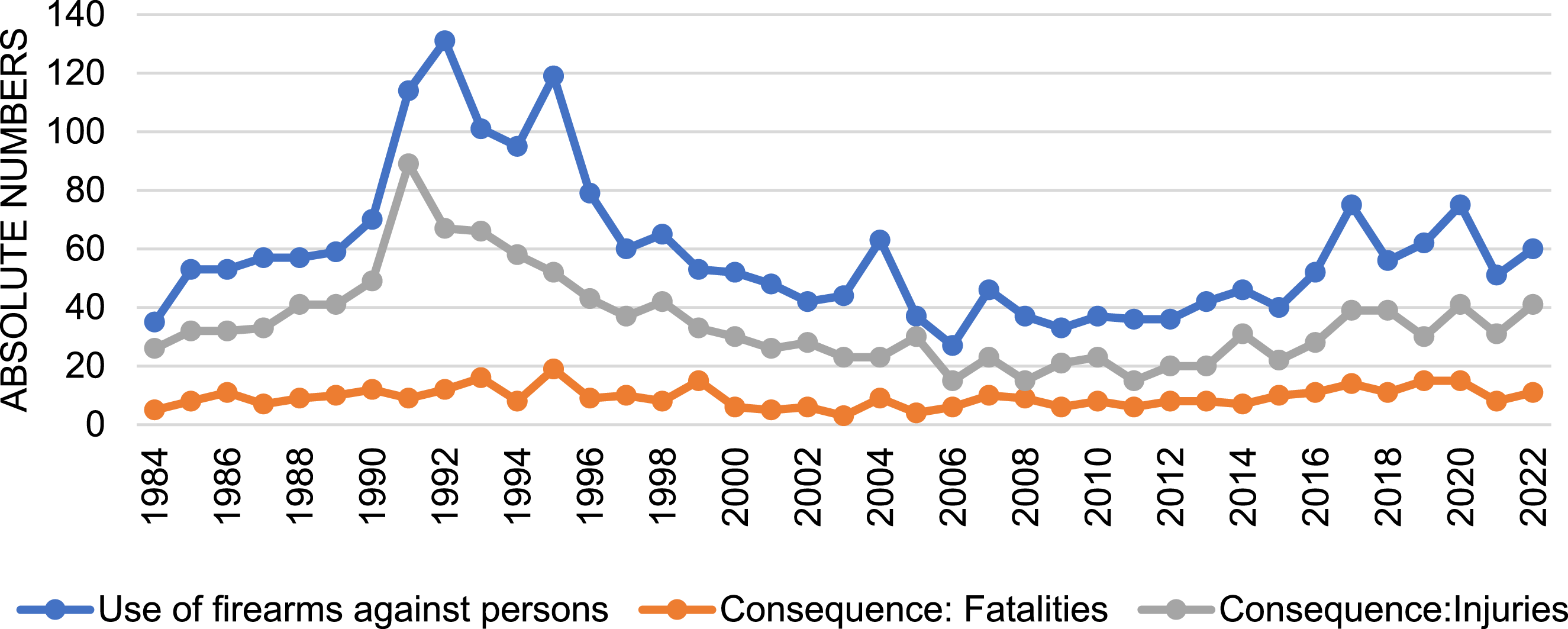
As seen in Figures 1 and 2, the time span from 1984 to 2023 shows that firearm use against persons in a narrow sense has remained relatively stable compared to warning shots, which peaked mainly in the 1990s. Within this relatively stable trend, it becomes clear that the number of deaths does not follow a consistent pattern and does not simply reflect changes in firearm use against persons. Instead, larger annual variations are mostly related to warning shots or non-lethal shootings. The number of people killed by police gunfire has remained below 20 per year in almost every year. On average, since 1984, 9.55 people have been killed annually by police gunfire, while 35.98 have been injured. This corresponds to 0.12 killings and 0.46 injuries per million inhabitants per year. 14 The overall trend in the lethal use of firearms by the police appears relatively stable; however, this does not imply an absence of annual fluctuations. The highest recorded number of cases so far is 19, while the lowest is 3. With a variance of 12.60, the data shows a considerable degree of dispersion, further supported by a standard deviation of 3.55. However, this variation does not indicate a clear trend but rather reflects annual differences, which, given the relatively low number of cases, could be attributed to specific contextual factors in individual years.
The given reasons for justification include self-defence (under criminal law or police law) and a set of other specific reasons under police law, such as preventing a crime or an escape from prison. To simplify, in the following, the terms ‘Group 1 justifications’ will refer to cases of self-defence, while ‘Group 2 justifications’ will refer to cases justified under police law. Self-defence accounts for 66 % of the justifications for firearm use against persons in the past 10 years. Whether this is due to such situations occurring more frequently or because police officers perceive no other option than shooting when under attack, compared to other cases, remains unclear. At the same time, cases justified by self-defence were 4.3 times more likely to result in the death of the subject and 2.8 times more likely to cause injuries over the past 10 years (2014–2023). Overall, these situations occurred more frequently than ‘Group 2 justifications’ and led to a higher likelihood of death or injury.
In summary, the data shows the development of police use of firearms since 1984. It indicates that the overall use has been decreasing over time and has remained relatively stable since 2006. However, this decrease is primarily due to a reduction in warning shots. The number of shootings against persons, especially deadly shootings, has remained stable over time, with yearly variations. Most of these shootings are considered justified, primarily due to self-defence in response to an attack on the police officer. These cases also have higher instances of deadly use of force. Beyond these numbers, most of the details remain unreported and lack transparency (Schmitz et al., 2025). The PTI/DHPol statistics fall significantly behind international standards, in which countries like the USA, England, and New Zealand provide publicly accessible use-of-force databases (Schmitz et al., 2025b). Recording incident-specific variables, including demographics, situational context, and outcomes of disciplinary proceedings, would align German practices with established accountability frameworks.
Civil society monitoring and alternative data sources: CILIP
We know of several data collections on police violence in the USA that are either specific to the use of firearms by the police 15 or include such cases 16 . The idea behind these civil society data collections is to develop transparency about these cases and to make them available to the public.
In Germany in 1978, a group of journalists and activists founded a magazine called CILIP (‘Bürgerrechte und Polizei’/Civil Rights and Police. From the beginning, they published the statistics, here called PTI/DHPol statistics, annually in their magazine and took a critical view of OIS (CILIP, 1979; Takagi and Takagi, 1979). Since 1982, they have also started to evaluate (even retrospectively) media reports on OIS in order to count the cases for themselves and to provide more information (CILIP, 1982). All cases since 1984 are available on a website run by CILIP. 17 In 23 of the last 40 years of documentation, the number of fatal OIS counted by CILIP and the PTI/DHPol statistics differed, sometimes leading to an overcount by CILIP and sometimes to an undercount. However, the differences are very small (only in 2 years there were four and five fewer cases counted by CILIP, in the other years the difference is smaller or zero). For the period 1984-2023, the results are generally close (PTI/DHPol Statistic: 382 cases, CILIP: 384 cases). The differences are due to the methodological problems of the two counting systems. Due to the anonymous sampling of the PTI/DHPol statistics, it is not clear which cases are counted, and which may be missing. On the other hand, the CILIP collection obtains its information from media reports. This may result in missing cases or incorrect information about the outcome. Media reports also create problems in the cases they cover: information about the dynamics of the situation, the people involved or the outcome may be wrong or missing. 18 The cases covered give insider information for example about where they happened, what is known about the person who was shot, giving a small summary of the case, the police unit involved, if the person who was shot was armed, and if a police officer was injured or killed. The team also tries to find out if there is any evidence that the person who was shot was experiencing a mental health crisis.
First analyses of the cases from 2014 to 2023 show that in almost every case there was information about possible weaponisation (only 4 % of the cases had no information). Only 2 % of the people who were shot were not weaponised. The most common weapon used was a knife (55 %), followed by firearms (25 %, which includes imitation firearms) and other (15 %, which could be an iron bar or a screwdriver, for example). Of the 114 cases, only one fatal OIS was against a woman, all others were against a man. Evidence of a mental health crisis is given in media reports in 36 % of cases.
These findings are consistent with international research that shows that it is predominantly male individuals who are armed and often in a mental health crisis who are the subject of lethal OIS. There is not enough information in the CILIP data, or in the underlying media reports, to understand possible racial disparities.
Discussion
The use of firearms by police is a critical aspect of law enforcement that requires careful examination, especially considering the limited data available and the societal implications of such incidents. The PTI/DHPol-statistic provides summary data on the number of cases of police firearm use each year. It is observable that the number of people killed by police firearm use does not follow a clear trend but fluctuates between years, while warning shots have decreased over the past decades. We also know that the number of injuries corresponds to the broader category of firearm use against persons. Additionally, most cases are categorised as justified.
However, there is more that we do not know than we do. We do not know where these incidents occurred or the circumstances that led to them. We do not know who was involved, how the dynamics of the situations evolved, or what distinguishes these cases from other police incidents. We do not know the reasons for the higher rates in some years. We do not know how the police, the state prosecutors, or even the courts handle these cases and how the justification for firearm use is determined. The lack of data in the official statistics becomes even more evident when compared to statistics from other countries. The various official U.S. statistics, which themselves are criticised (Alpert, 2016; Zimring, 2016b), at least partially offer insights into the individuals involved, their demographic factors, and the locations of the incidents. There are also statistics from other European countries that provide more information and could serve as a role model. The British statistic, published by the Independent Office for Police Conduct, includes brief descriptions of cases in its annual report where civilians have died due to police firearm use (as well as other deaths resulting from police use of force). The Netherlands even commissions scientists to analyse police firearm use.
In Germany, there are no comparable processes or (judicial) case analyses. The process of establishing police commissioners in the federal states has not yet been completed. To date, these positions have mostly been attached to the state parliaments and lack real investigative powers of their own (Töpfer and Peter, 2017). As a result, investigations into police firearm use are conducted by the police themselves, albeit usually by a different department. Whether this type of investigation—where the police investigate their own use of firearms, including lethal cases—is compatible with the fair trial principle is currently the subject of a complaint before the European Court of Human Rights (Roesner, 2024).
The limited data available in Germany align with international research findings. The individuals who are shot are predominantly male and armed. Official statistics also show that in most cases, the use of force is legally justified as self-defence. Initial assessments suggest that individuals with mental health issues may be disproportionately affected. Furthermore, research on “shooter bias” indicates that threat stereotypes could influence the perception of imminent danger and self-defence situations. This raises the question of whether similar dangerous situations might lead to different outcomes depending on the role of such stereotypes, including the perception of a knife as a highly dangerous weapon.
The legal responsibility of an individual officer for their actions is certainly an important aspect. However, it would be inappropriate to hold the individual solely accountable for what may be systemic issues. A comprehensive examination must consider the organisational and structural factors that influence police behaviour. These include training, operational protocols, and institutional culture. Additionally, societal conditions could play a significant role. Societal prejudices, stigmatisation, and social inequalities could influence the behaviour and perceptions of police officers.
In addition to potentially influencing (implicit) attitudinal dispositions, structural factors or characteristics and behaviours of the person being shot, there are other relevant questions. To what extent is the respective situation significant, how static or dynamic is it? What role does (nonverbal) communication play? Are there differences between situations indoors or outdoors, in cities or in the countryside? Are there differences in policing strategies compared to other countries? Which de-escalation strategies are successful, especially in situations involving people with knives in exceptional psychological situations where firearms are not used? 19
The available data in Germany is far from sufficient to address these questions comprehensively. With the increasing societal interest in the legitimacy of such operations, the high number of fatal police shootings in 2024, and the pending decision of the European Court of Human Rights concerning the issue of investigations, further insights and better data access are indispensable. Research is therefore needed in this matter. Many of the questions raised could be addressed, for instance, through analyses of judicial case files or problem-centred interviews.
Concluding remarks and recommendations for future research and institutional practice
Our analysis reveals fundamental gaps in German police firearm statistics that impede democratic accountability and evidence-based policy development. Building on recent position statements by German criminologists calling for systematic reforms (Schmitz et al., 2025b), we propose concrete improvements. Crucially, criminology should play a relevant role in data collection and analysis. Given the magnitude of fatal incidents, German criminology should collaborate with public institutions and civil society organisations to enrich official statistics through systematic media analysis and supplementary documentation systems. This collaborative approach is essential for achieving the transparency necessary for professional policing in a democratic society.
The most immediate improvement would be integrating variables already collected in the Police Crime Statistics (Polizeiliche Kriminalstatistik, PKS) into police firearm use statistics. The PKS, Germany’s primary criminal statistics documenting reported offenses and suspects, already contains relevant demographic and spatial data despite its well-known methodological limitations and selection biases. Offense under investigation, demographics of offender and victim, date, and federal state require minimal additional effort while substantially enhancing analytical capabilities. Beyond these readily available PKS data, accountability-oriented documentation must include critical variables currently absent from official statistics: precise incident timing (day and time), location types (public space or residential building), incident circumstances and causes, officer characteristics (rank, special unit affiliation, previous firearm deployments), comprehensive victim information (injury severity, time of death, armament status, mental state, substance use), and the complete judicial aftermath including outcomes of investigations, prosecutions, and convictions or acquittals (Schmitz et al., 2025b).
Institutional reforms are equally critical. The recent publication of statistics by the Standing Conference of Interior Ministers requires formal regulation to ensure continuity through fixed responsibilities, uniform standards, and binding release deadlines with consideration of centralised collection mechanisms to address federal fragmentation. Above that, public institutions should support research access to case files (§ 476 StPO; Code of Criminal Procedure) through standardised approval procedures. Additionally, video data (if available) must become accessible under strict privacy protocols. These reforms benefit all stakeholders: police fulfill accountability obligations while developing evidence-based strategies; researchers generate insights for improved training and de-escalation; and civil society exercises informed democratic oversight. Without such comprehensive reforms, Germany will continue to lack the evidence base required for both scientific investigation and public debate on this critical aspect of state power.
Footnotes

Funding
The authors received no financial support for the research, authorship, and/or publication of this article.
Declaration of conflicting interests
The authors declared no potential conflicts of interest with respect to the research, authorship, and/or publication of this article.