



Abstract
The Proceeds of Crime Act 2002 significantly impacted the pluralisation of policing by creating new policing roles in the public and private sectors. The private sector role in particular has, however, received little academic attention, in part because it has not been fully conceptualised, presenting significant challenges to research despite extant literature suggesting it is crucial to address money laundering, fraud and organised crime. The research presented here will address this challenge by: (1) Conceptualising the private sector roles created by POCA; and (2) Presenting a new methodological tool to identify those who carry out the role.
Keywords
Introduction
When it was enacted in 2003, the Proceeds of Crime Act 2002 (POCA) created three new policing roles; The Accredited Financial Investigator (AFI) and the Financial Intelligence Officer (FIO) in the public sector, and; The Private Sector Financial Investigator (PSFI) who works in the private sector.
The AFI and FIO roles were well defined within the POCA: • The AFI is an individual who “has achieved accreditation in accordance with s three of the POCA 2002” (Rees et al., 2011) to investigate money laundering. AFIs are empowered to attend court; apply for investigative orders; seize, detain and forfeit cash; restrain assets; and apply for the confiscation of assets believed to be the proceeds of crime post conviction. They can, under s 453 of the POCA, work for a variety of public bodies including the police, the National Crime Agency (NCA) and His Majesty’s Revenue and Customs (HMRC). • The FIO is an individual who completes a more limited amount of training under s3 of the POCA to allow them to “gather and develop intelligence from a variety of sources…and support to those working in the intelligence field and those managing live incidents and investigations” (College of Policing, 2023). They are not able to attend court or apply for orders, and their training is focussed on the gathering, handling and disseminating of sensitive intelligence such as that provided under the Suspicious Activity Report (SAR) regime. They can be employed by the same range of public bodies as the AFI.
The PSFI role, however, was not defined in POCA. Instead, this role has had to be conceptualised by reflecting on the requirements the POCA placed on the private sector under Part 6 of POCA (Duties) and the way in which the private sector has chosen to respond. The PSFI role has thus very recently been conceptualised as follows: • The PSFI works in the private sector to investigate money laundering in response to the sector specific requirements under Part 6 of POCA (Duties). They do not hold legislated powers. They often have access to sensitive intelligence provided by public bodies, and disseminate intelligence about suspicions of money laundering to public bodies under the SAR regime (Perry, 2025)
This article will build upon this conceptualisation by presenting a new methodological tool that can be used to identify PSFIs in the regulated financial services sector of England and Wales. These steps are necessary to facilitate research into the role of the PSFI.
In doing so, this paper will address the significant challenges that have, to date, been caused by the lack of conceptualisation which has led to the role being given multiple different titles across the private sector despite doing the same work and responding to the same legislative requirements. Put simply, the AFI and the FIO can be easily researched as they have a common name regardless of the organisation which employs them. The same has not been true for the PSFI until now.
While it is a limitation of this research that it does not have the power or influence to be able to replace those disparate titles, it will present a methodological tool that can be applied across the regulated financial services sector in England and Wales to identify PSFIs. This sector has been chosen as it is directly impacted by the sector specific requirements of the POCA that created the need for the role, and as the main employer of PSFIs.
Being able to identify the PSFI to facilitate research into who they are and the work they do is an important development of criminological theory around the pluralisation of policing and the discipline of financial investigation.
This article will proceed as follows: firstly with a review of the literature around the evolutions in the policing of financial crimes and, more specifically, who may be best placed to conduct those investigations and how this impacts the POCA. The paper will then explain the remit of the PSFI role as it exists alongside its legislative partners (the AFI and FIO) and the variances between the roles as an important part of fully conceptualising the role of the PSFI. Then, the paper will build on this by presenting a new methodological tool for identifying PSFIs in the regulated financial services sector through focussing on the core facets of the role. Finally, it will move to a discussion of how this can be used to facilitate further research and why this is needed.
Literature review
The role the private sector plays in policing is one that has, to date, lacked critical research. This is not to say that the academy has failed to recognise the increasing role the sector must play; indeed Reiner (2010) pointed to the “growing body of work advocating a ‘new police science’” which largely embraced the idea that security and its administration was no longer (and should no longer be) the remit solely of “the state” (Johnston and Shearing 2003). This perspective is well summarised thus; “policing (an activity) must be distinguished from the police (a specific type of institution” (Reiner, 2010).
A seminal work on pluralisation (Button, 2019) speaks to “the impotence of the modern state to address some of the most basic demands of citizens” and “where the police have not had the resources and expertise…leaving a gap for other sectors to fill” (p. 51). Turning to the current state of financial crime, recent research has painted a deeply problematic picture of the police response to fraud (Button, 2021, 2022) lending urgency to discussions around the private sector role in addressing the threat.
Financial investigation as a tool has frequently been discussed as being vital to combat organised crime (Brown et al., 2012; European Commission 2021; FATF 2020, 2021, 2023; HM Government 2011, Home office 2013; HMIC 2004; Levi and Maguire 2004; Murray 2013; Wood 2017). More recently, it has been called on to address illicit finance (Royal United Services Institute, 2023) and its ability to purchase power and influence. Indeed, the creation of the POCA was largely justified by a need to address the threat organised crime posed to the UK.
Acknowledging the “specific manifestations of organized crime activity to which the private (and particularly the financial) sector has developed an active response” research has explored the impact this has on who should own investigations into organised crime, concluding shortly after POCA was enacted that “responsibility…remains primarily in the hands of public sector law enforcement” (Levi and Maguire, 2004). Discourse on this subject remains though, and is indicative of the private regulated financial services sector in fact now having a much larger degree of responsibility for tackling, and the abilities to tackle, the threat of organised crime (FATF 2020, 2021, 2023).
An emerging library is now recognising roles that investigate financial crime in the private sector such as “private investigators (or detectives), investigators working for forensic accountants, in-house private investigators and in-house public investigators (non-police)” (Button et al., 2023) and corporate investigators (King 2020; Meerts 2019, 2020) who focus on financial crimes committed against employers. Button and Meerts both recommend further research into private sector investigators “to better understand this aspect of private policing that has largely avoided academic scrutiny” (Button, p. 17) and it is by conceptualising the private sector element of the roles created by POCA that this research will contribute to this aim which is, as the literature shows, sorely needed and vitally important.
The roles of the AFI, the FIO and the PSFI
FIOs, AFIs and PSFIs have much in common; all use sensitive intelligence to develop investigations and transactional analysis of banking data to further those investigations, via the wealth of information held by the regulated financial services sector about their customers, as part of their role within “an investigative discipline concerned with exploring the finances that relate to criminal activity” (FATF, 2023: 109). There are, however, differences in the day to day work of each role, and these will now be discussed.
The differences between the AFI and the PSFI
The biggest difference between the roles in terms of day to day activities is that AFIs attend court to obtain legal orders (with applications based on intelligence often provided to them by PSFIs) while PSFIs receive those orders, and use the intelligence they contain to develop investigations; in reality though, these are two sides of the same coin, as AFIs and PSFIs will both work with similar intelligence that is often sensitive in nature and must be acted on and shared within legal limits. The issue of attending court is, therefore, something of a red herring in how it makes the roles different.
It is salient to note that the intelligence provided to AFIs by PSFIs (via the SAR regime under POCA and the Terrorism Act, 2000, or via public private partnerships using the Crime and Courts Act, 2013 or the Criminal Finances Act, 2017) will also be used by PSFIs to develop money laundering investigations; the act of disclosing intelligence around customer activity is often not the end of their investigation and simply a part of the process of managing the risk that is posed by an individual who is suspected of criminal activity.
The researcher has chosen to mention the court system to address it head on as it is often referred to as a blocker to acknowledging the peer level between the PSFI and its public sector partner the AFI. As is shown here though, there is reason to believe this is not of itself a major difference in the work they do but is a variation in how intelligence is handled and used; the act of handling intelligence for the purposes of investigating is the same.
AFIs are employed within a range of public sector organisations who are designated under POCA. A recent study showed that the police forces of England and Wales employ 498 AFIs, and other organisations (including HMRC, the Serious Fraud Office and the Department for Work and Pensions) employ 194 (Perry, 2025). PSFIs work within the regulated financial services sector of England and Wales which includes banks, building societies, insurers and investment firms. Due to the current disparity in titles discussed earlier, it is not possible to quantify the number of people employed as PSFIs.
The differences between the AFI and the FIO
Their day to day tasks are largely the same; both work on similar investigations and have powers to obtain financial intelligence (via the SAR regime and other databases). The difference is that AFIs also have powers to apply for legal orders and conduct confiscation investigations and FIOs do not.
To the first difference, as has already been explained this is not a significant differentiator in the work, especially as the legal order applications AFIs present at court are often written by FIOs; they simply stop short of stepping into the box. The second point is more significant. A fully accredited AFI is able to restrain and forfeit assets suspected of being the proceeds of crime in certain circumstances, and do much of this work post conviction whereas an FIO is primarily concerned with pre conviction investigations and has no legal powers to detain or forfeit assets. Significant though it may be, the researcher suggests that the confiscation powers should be seen as an additional task some AFIs can also do (acknowledging that not all AFIs complete this part of their accreditation), and that it does not change the fact that much of the day to day work investigating money laundering is the same in both roles.
It should also be noted that the FIO role is often seen as a precursor to becoming an AFI, and in some public bodies individuals are expected to work in one role before progressing to the next. This position could be somewhat misguided though in how it fails to acknowledge the specific value inherent in the FIO role and the desire of some people to specialise only in pre investigation work with no wish to be involved in the often administrative heavy world of confiscation; a focus on the specific career paths available to the FIO might be preferable.
FIOs are employed by the same range of employers as AFIs. The police employ 206 FIOs, whereas the other organisations designated under POCA employ 379 (Perry, 2025) which is an interesting reversal of the balance for employing AFIs and likely recognises the different value presented by the FIO. Cross sectoral functions.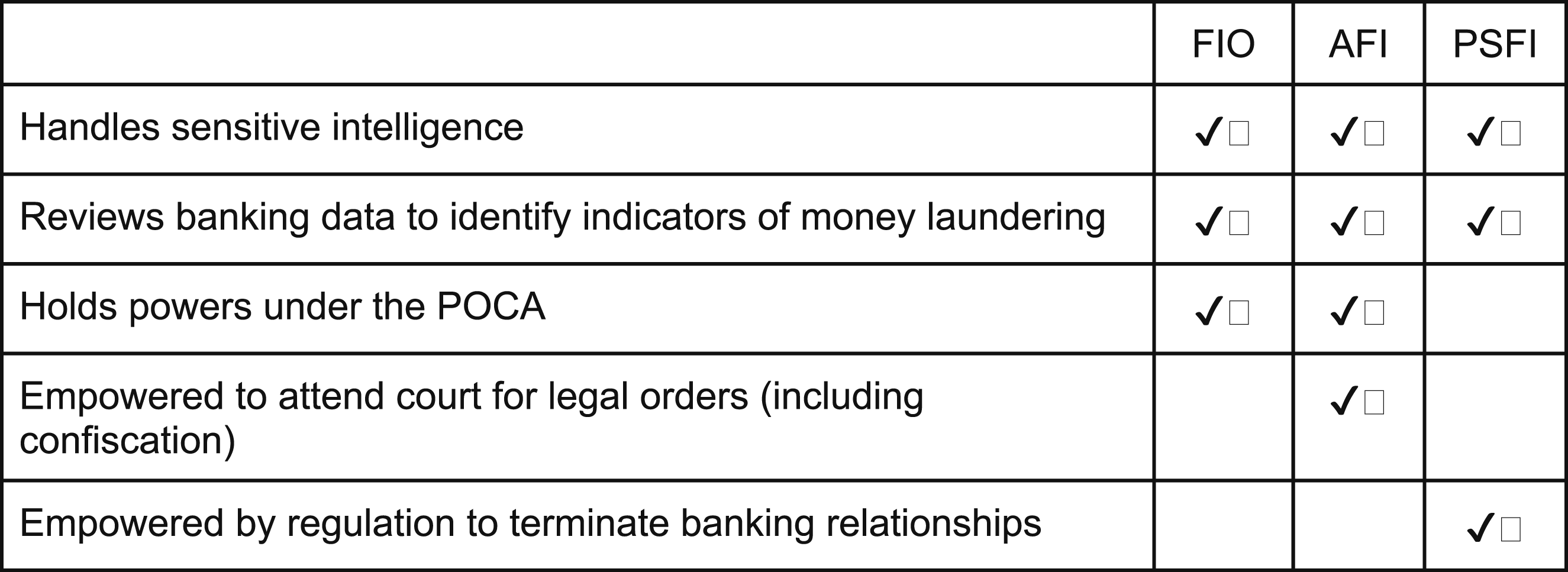
By way of summary, the following figure provides a perhaps more succinct visualisation of all three roles (Figure 1):
Having now fully conceptualised the role of the PSFI, this paper will present the methodological tools which can be used to identify PSFIs in the financial services sector.
Identifying the PSFI; a new methodological tool
To “build reliability and validity, thus ensuring rigor” in qualitative research a well defined and structured methodology is essential. Clearly articulating how a population is identified is commensurate with “methodological coherence” and appropriate sampling (Morse et al., 2002). In line with this, merely conceptualising the PSFI (as this paper has done so far) would not be sufficient to allow for further research into this population which was consistent and had generalisability. A methodological tool is, therefore, required to facilitate this.
This tool utilises the core facets of a person’s role to identify them (or discount them) as a PSFI. The core facets of the PSFI role are as follows: (1) Their work primarily concerns investigations “into the financial affairs related to a criminal activity, with a view to: identifying the extent of criminal networks and/or the scale of criminality; identifying and tracing the proceeds of crime, terrorist funds or any other assets that are, or may become, subject to confiscation; and developing evidence which can be used in criminal proceedings” (FATF, 2023). (2) They regularly use sensitive intelligence to develop investigations; and (3) They carry out transactional analysis of banking data to further investigations into suspected criminal activity.
All three facets are required to identify a person as a PSFI.
The reasons for identifying the core facets are two fold. Firstly, it is important to the generalisability of the sample population. Using this tool means that concerns around qualitative research being “non-replicable” (Westmarland, 2011) are robustly addressed. This tool means it will be possible for future research to replicate sample populations across different organisations with a strong degree of reliability.
Secondly, as the aim of this paper is to conceptualise a role that aligns with its policing partners in the public sector (the AFI and the FIO) and those are well described by legislation, it was necessary to draw out the core facets of the role to differentiate them from other investigative, and financial crime related, roles in the private sector (such as fraud analysts).
The facets were identified using a blend of the researchers empirical knowledge (which will be discussed in the next paragraph) and a review of the core facets of the AFI and FIO roles set out in POCA, and elaborated on in the literature (this was done in the sections above).
The researchers’ empirical knowledge was gained through their work as a PSFI at a UK high street bank between 2016 and 2021 and as an AFI and FIO for Thames Valley Police (2010–2016, and 2008–2010 respectively). The researchers’ empirical knowledge is recognised as an important part of constructing research that will stand up to challenges of reliability (Poggenpoel and Myburgh, 2003 in Chenail, 2011) and in this particular scenario it allowed the researcher to have a knowledge of the various teams within the regulated financial services sector who work in fraud and money laundering investigations, and to be able to assert that not all of these individuals are PSFIs.
Banks in the UK have multiple teams dedicated to identifying, investigating, preventing and reporting financial crimes and money laundering. Many of these teams however work in a more operational fashion (being process driven with daily targets) which would appear to be more aligned with fraud analyst or crime desk roles in the police. This knowledge was therefore an important element in creating the tool described above which focuses on the core facets of roles that would meet the criteria for being a PSFI.
Conclusions and discussion
This research has presented a practical tool that will allow research to be conducted into a key criminological role; the PSFI.
In contextualising the role amongst its cross sectoral policing partners and within the organisations where it operates this research brings our combined knowledge of who the PSFI is up to the level of what is known about the AFI and the FIO; a levelling of the academic field in terms of researching the POCA, the investigation of organised and financial crimes, and the discipline of financial investigation.
Research into policing roles outside of the traditional public sector is a growing endeavour, especially in terms of who investigates financial crimes (Button 2002, 2019; Button et al., 2023; Murray 2013; Scott and McGoldrick 2018) and the increasing part that the private sector must play if the threat is to be adequately addressed. Without an appropriate language with which to facilitate the discussion though, a gap remains in our knowledge of how organised and financial crimes are being managed within the regulated financial services sector, and the part that this contributes to policing strategies. The research which has been presented here has provided that terminology by defining what the PSFI does and how they can be identified.
By using the terminology in the new conceptualisation of the role and this new methodological tool to identify them, it is now possible for research to be conducted across the regulated financial services sector into the PSFI and the work they do.
This development also brings value to research which seeks to quantify the policing roles that exist because of the POCA. To date, although it has been possible to research those within the public sector, a series of challenges has existed in terms of expanding this into the private sector, specifically “the variation in role descriptions in the private sector...corporate security concerns (where disclosing staffing data could be sensitive from a competition perspective), and an inability to ensure that all the organisations who might employ people to investigate money laundering in the private sector would be included in the research (unlike in the public sector where a list of such bodies is available to ensure that all have been considered)” (Perry, 2025).
Although the methodological tool which has been presented here cannot, on its own, overcome the latter challenges it does contribute towards addressing the first, and this is a significant step in expanding our ability to research the way in which policing is happening and those who work in policing roles. The name PSFI is unlikely to be adopted across the regulated financial services sector, however academia now possesses a conceptualisation and a methodological tool that makes this unnecessary (or at least no longer a significant barrier).
This new methodological tool combines terminology, contextualisation, and definitions of core facets to enable research into the PSFI and, by natural expansion, into the POCA. This was based upon the use of objective and empirical approaches to knowledge, through reviewing legislation and the researchers work related experience respectively, which acknowledges the way in which these can be merged to create new methodological tools.
This also has significance for raising visibility of the policing careers which are available outside of traditional policing agencies, or the public sector as a whole. The literature has been critical of the training and professional development for AFIs (Bullock 2009; Chave 2017; Hughes 2021; Kennedy 2007;) and the lack of defined career paths for Non-Constables who work in the police more generally (HMIC, 2004). The researcher suggests that this conceptualisation of financial investigation as a true cross-sectoral discipline could be used to provide those career options and drive improved learning. There would appear to be an extremely versatile set of work opportunities for those who enjoy the discipline of financial investigation but wish to diversify on methodologies and criminological typologies. Being clearer about the cross-sectoral career paths in the discipline of financial investigation, and in doing so by encouraging the decoupling of policing and police, also brings about the potential to attract different knowledge to policing. Often, technical knowledge that is extremely relevant to financial investigation is gained in the banking sector or the worlds of law and accountancy (Benson and Simpson, 2015) so encouraging research which can normalise the existence of policing roles in the private sector may be beneficial to cross sectoral movements.
In summary, this paper has conceptualised a role and presented a new methodological tool with which to identify it, which can be used to further research into a range of criminological topics that are of significant value to extant policing, and to addressing the challenges and developments impacting policing today.
Footnotes

Ethical considerations
This study was approved by the Research Ethics Committee at University of Portsmouth (reference FHSS, 2021- 045) on June 25, 2021. The research was also conducted in accordance with the ethical framework suggested by the British Society of Criminology.
Funding
The authors received no financial support for the research, authorship, and/or publication of this article.
Declaration of conflicting interests
The authors declared no potential conflicts of interest with respect to the research, authorship, and/or publication of this article.
Data Availability Statement
All data generated or analysed during this study are included in this published article and supplemental material.