



Abstract
This study explores the leadership development curriculum across four municipal police services in Canada, utilizing thematic analysis to identify key themes in leadership training. With an emphasis on training design and delivery, this study reveals differences in leadership training between Central and Western Canadian municipalities by analyzing the curriculum of four municipal police agencies.
Introduction
Over the past century, the responsibilities of police officers have seen a substantial expansion, mirroring the complex challenges encountered in our modern society (Coleman and Cotton, 2010). Police personnel have always been responsible for enforcing the law and deterring crime, but now they are often required to operate as mediators, counsellors, and negotiators (Buhrig, 2023; Huey et al., 2017; Morgan, 2022). The increased demands placed on frontline officers has resulted in the introduction of enhanced training for newly hired recruits, better equipping them for the difficulties they will encounter in law enforcement (Buhrig, 2023).
For police supervisors, the situation is quite different because the decentralized structure of government in Canada has resulted in the authority of policing standards being delegated to each province; however, none of the policing standards across Canada have addressed training standards for police supervisors. The absence of standardized training protocols for police supervisors raises significant concerns about the consistency and effectiveness of leadership development within law enforcement agencies, particularly in the complex and dynamic environment in which they function. Despite the lack of standardized training for police supervisors, in 2013, the Police Sector Council developed the Competency-Based Management Framework (CBMF) that is utilized by many law enforcement agencies in Canada to identify and select officers for promotion (Public Safety Canada, 2022). The Competency-Based Management Framework (CBMF) has been nationally validated and includes 14 leadership competency domains for all levels and ranks (Public Safety Canada, 2022). In the absence of supervisor training standards, should law enforcement agencies aim to map their training outcomes to the CBMF competencies, since the framework suggests that competencies are a useful tool to identify core policing activities and a measure of the effectiveness of police training (Public Safety Canada, 2022)? This study aims to explore the leadership training curriculum of four municipal police agencies in Canada to answer the following question(s): (1) How is leadership cultivated in police organizations in Canada? (2) How do current police leadership training programs thematically align with competency frameworks?
Literature review
Policing has evolved significantly in recent decades. While crime prevention and investigation remain core functions, police officers are now routinely expected to respond to a wider range of social issues and are often required to be social workers, negotiators, and mental health specialists (Buhrig, 2023). This expansion in responsibility reflects the broader demands placed on policing organizations, which are also expected to manage complex and nuanced issues such as cybercrime and terrorism (Flynn and Herrington, 2015; McLeod and Herrington, 2016). In this dynamic landscape the role of the frontline supervisor has become especially critical since these leaders are responsible not only for guiding officers in complex operational settings but also for shaping team morale and the well-being of their officers (Farr-Wharton et al., 2021; Simmons-Beauchamp and Sharpe, 2022).
Despite the challenging role facing sergeants, very little is known about how police agencies develop leadership at the entry-level, where the effects of leadership are likely the most visible. If police agencies are to meet the demands of modern policing, they must ensure that newly promoted leaders are adequately prepared for their roles. This review first explores how police leadership has been approached in academic literature, with particular attention to the emergence of transformational leadership theory as a recurring framework in scholarship. It will then explore the landscape of internal and external leadership development programs in policing and then highlight notable gaps in the existing literature.
Police leadership research
Over the last few decades there has been an abundance of research in various industries that has explored the efficacy of leadership theories such as authentic leadership, servant leadership, relational leadership, and transformational leadership. The public sector is no exception, and police leadership has drawn significant interest from scholars, with many studies exploring what effect leadership has had on subordinates (performance, morale, well-being). Originally introduced by Burns (1978) and later expanded by Bass (1985), transformational leadership focuses on leaders’ ability to inspire, motivate, and foster individual growth in employees and has emerged as a dominant framework for leadership studies in policing. For instance, in North America, Can et al. (2017) found that leaders with attributes associated with transformational leadership (clear communication, fairness, honesty, and cooperation) had a positive impact on officer’s self-esteem and perceived social support. Sarver and Miller (2014) collected data from 161 police chiefs in Texas and found that transformational leaders who were energetic, confident, and open-minded were associated with higher effectiveness as leaders. Similar results were found in Asian studies, where researchers found that transformational leaders fostered relationships, motivation, and fair treatment in Cambodia (Chhoun and Yat, 2025). In a separate study, Shim et al. (2015) found that transformational leadership was positively correlated with higher levels of organizational commitment in South Korean police officers.
While transformational leadership remains a dominant framework in police leadership literature, some scholars have questioned its practical applicability in policing environments. Cockcroft (2014) cautions against blindly adopting transformational leadership models since these approaches overlook the hierarchical and procedural nature of police culture which suggests that alternative leadership styles (like command-and-control) are still needed for operational policing. Whereas Densten (2003) found that leadership in policing is not monolithic and that different ranks exhibit distinct leadership behaviours and abilities to elicit extra effort from subordinates. These critiques indicate that although transformational leadership offers a useful lens, its applicability may be limited across all levels and units within police agencies. Furthermore, other studies have also reinforced the need to examine leadership beyond senior ranks. For example, Engel (2001) found that the supervisory style of patrol sergeants directly influenced officer behaviour, particularly decision making. This helps demonstrate that even though there is a need for effective leadership at the frontline level, much of the academic and training literature remains disproportionately focused on senior-level leadership.
In the North American context, police leadership training tends to fall into two broad categories: external programs and internal programs (often called in-service training programs). External training programs are typically delivered by outside organizations such as academic institutions or police colleges for a fee. Internal training programs, or in-service training, are cost-effective and easy to implement since they are developed and delivered internally by the police agency in short, modular formats or through online learning (Huey, 2018). Unfortunately, there is an absence of literature that has explored in-service training programs; in fact, Huey (2018) had abandoned her systematic review due to lack of useable data and that there is an absence of both internal or independent evaluations of police training courses or programs
This lack of available research on in-service training is particularly concerning given that many municipal agencies rely on internally delivered programs to prepare and develop newly promoted sergeants. As Schafer (2009) pointed out, leadership development tends to occur later in an officer’s career and often after they have already assumed a leadership role. The problem is that supervisors can easily become set in their ways and become resistant to change if training opportunities do not exist early in their development (Schafer, 2009). Furthermore, Murphy’s (2022) dissertation included numerous interviews with Canadian police leaders and noted that most formal leadership development opportunities in Canada are limited, therefore there is an over-reliance on international programs based in the USA. Murphy (2022) also critiques the value of these international programs by pointing out that Canada is different from the US, and has it own unique challenges.
While some agencies may offer internal leadership development programs, these efforts are rarely coordinated across police services. Paoline and Gau (2018) challenged the notion of a singular police culture and suggested that differences in supervisory behaviour and internal norms often shape leadership practices within and between departments. This complexity indicates that standards for police leadership training could support more consistent expectations and behaviours across police agencies. One of the few studies that explored internal police leadership training programs was conducted by Drodge and Murphy (2002), who examined the Royal Canadian Mounted Police’s (RCMP) leadership framework and determined that the RCMP sought to embed transformational leadership competencies across the organizations, starting from cadet training and through to senior command.
In terms of external police training programs, the Canadian Police College (CPC) offers external leadership training in their Executive Development Program (EDP), but this program is reserved for senior and executive ranks (Canadian Police College, 2025). In the United States, external programs such as the FBI National Academy and the University of Chicago Crime Lab leadership training also focus on mid-to senior-level officers and teach strategic leadership and organizational change (Salley, 2005; University of Chicago Crime Lab, 2025). Research in Australia, Europe, and Asia also tends to explore leadership training at higher ranks of policing agencies, focusing on transformational leadership as a key competency for leaders tasked with organizational change and innovation (Herrington and Pearson-Goff, 2013; Neyroud, 2010). Collectively these findings reinforce the notion that leadership training is often directed at higher levels within policing organizations, overlooking the entry-level ranks.
Gaps in the literature
When considered in totality, the literature reveals three major gaps in the current research: limited study of entry-level police leadership training, a predominant focus on external training programs, and an absence of research on internal (in-service training programs) at the municipal level. This lack of research is particularly significant since entry-level supervisors play a critical decision-making leadership role in dynamic operational contexts where transformational leadership competencies may have less relevance than practical, operational, team-focused skills. This suggests that there is a need for greater attention to how police leadership is cultivated at the entry level, particularly in the Canadian municipal policing context. Without focused research on how leadership is developed at the entry-level, it is difficult to gauge whether police agencies are adequately preparing sergeants for the demands of modern policing. As a result, this study distinguishes itself from existing research by exploring what municipal police agencies have been delivering in their in-service training programs to cultivate leadership in their organizations.
Methods
This study was conducted using reflective thematic analysis within a constructivist framework. Within this lens, the researcher affirms the social construction of knowledge in the policing context, an environment where social norms and cultural settings shape organizational practices and training programs (Filstad and Karp, 2021). In this project, police organizations were viewed as social entities that use their leadership training programs as a mechanism to construct meaning for leaders, or, to put it simply, to cultivate leadership. While reflexive thematic analysis is often associated with an inductive approach, Braun and Clarke (2019) acknowledge that it can also be used deductively, particularly when the research is informed by existing frameworks. The framework informing this study was the Police Sector Council Competency-Based Management Framework, which was developed in 2013 (Public Safety Canada, 2022). The CBMF encompasses various domains of competencies, such as behavioural, investigative, and leadership, and frequently serves as a guide for promotional competitions in Canadian municipal police agencies. Additionally, a deductive approach was implemented because the researcher is an active member of law enforcement and has previously participated in one of the leadership development programs included in this study. Although he is no longer an employee of that agency, he has formed opinions about the program from a participant perspective and utilized the CBMF to guide theme development of the data (curriculum) obtained from the four municipal police agencies and limit any potential for bias. Although a deductive approach was implemented, patterns in the data were observed and allowed them to be placed in categories that were analytically constructed based on knowledge and experience (operational, administrative, and engaging leadership).
The police agencies
To provide a framework for understanding the organizational scope and complexity of the different agencies, the police agencies were categorized by size (based on the number of members in the organization). A small agency is one with 500 or fewer members; a medium-sized agency consists of 501 to 1500 members; and a large agency has over 1500 members. The anonymized police agencies in this study will be referred to as Agencies A, B, C, and D. Agency A and Agency B were classified as large, Agency C as medium-sized, and Agency D as small.
The training programs
The training programs included in this study were mandatory for constables who have been placed on a promotional list and prior to being promoted into a sergeant role, were required to complete this training. All four agencies utilized in-service training programs (internal) to deliver their leadership training programs, with most programs lasting 1 week (Monday to Friday—4 or 5 days). Agency A was an outlier in this regard; their leadership training program was 2 weeks long (10 days). The lecturers or instructors for almost all sessions were police officers from within the organization; the only exception was Agency A, which had an external subject matter expert deliver one session in their program.
The analysis
For the initial step in thematic analysis was familiarizing with the data, which were the four leadership training curricula from Agencies A through D, and the initial focus was to understand the content. Since a deductive approach was implemented, attention was paid to how the data aligned with the coded themes from the CBMF. During this initial review, two key points emerged: firstly, at times it was challenging to align some of the class content with codes without physically attending the class and hearing the content being delivered. The second aspect that became evident was that the researcher’s dual role of researcher and practitioner was an asset for this project since most of the courses utilized police jargon and acronyms that would not be comprehensible to an outsider who did not have intimate knowledge of police operations.
Next, the data was coded and labelled into different segments that aligned with the conceptual framework (the leadership competencies from the CBMF). The 14 leadership competencies from the CBMF are as follows: Change Management (1), Decision Making (2), Financial Management (3), Human Resource Management (4), Information Technology Management (5), Strategic Management (6), Community Relations & Media Management (7), Fostering Relationships (8), Interactive Communication (9), Organizational Awareness (10), Ethical Accountability (11), Public Accountability (12), Public Safety (13), Valuing Diversity (14). It is worth noting that two codes/competencies did not appear in any of the course content delivered by Agencies A through D: change management, and strategic management (1, and 6). This could likely be a result of the leadership program being focused on entry-level leaders, and the competencies not observed seem to be more suited for senior or executive levels of leadership. During the coding process, most of the data (curriculum) appeared to directly align with multiple codes (see Figure 1). (a) Agency A Training Curriculum: Leadership competency codes by day and session (b) Agency B Training Curriculum: Leadership competency codes by day and session (c) Agency C Training Curriculum: Leadership competency codes by day and session (d) Agency D Training Curriculum: Leadership competency codes by day and session.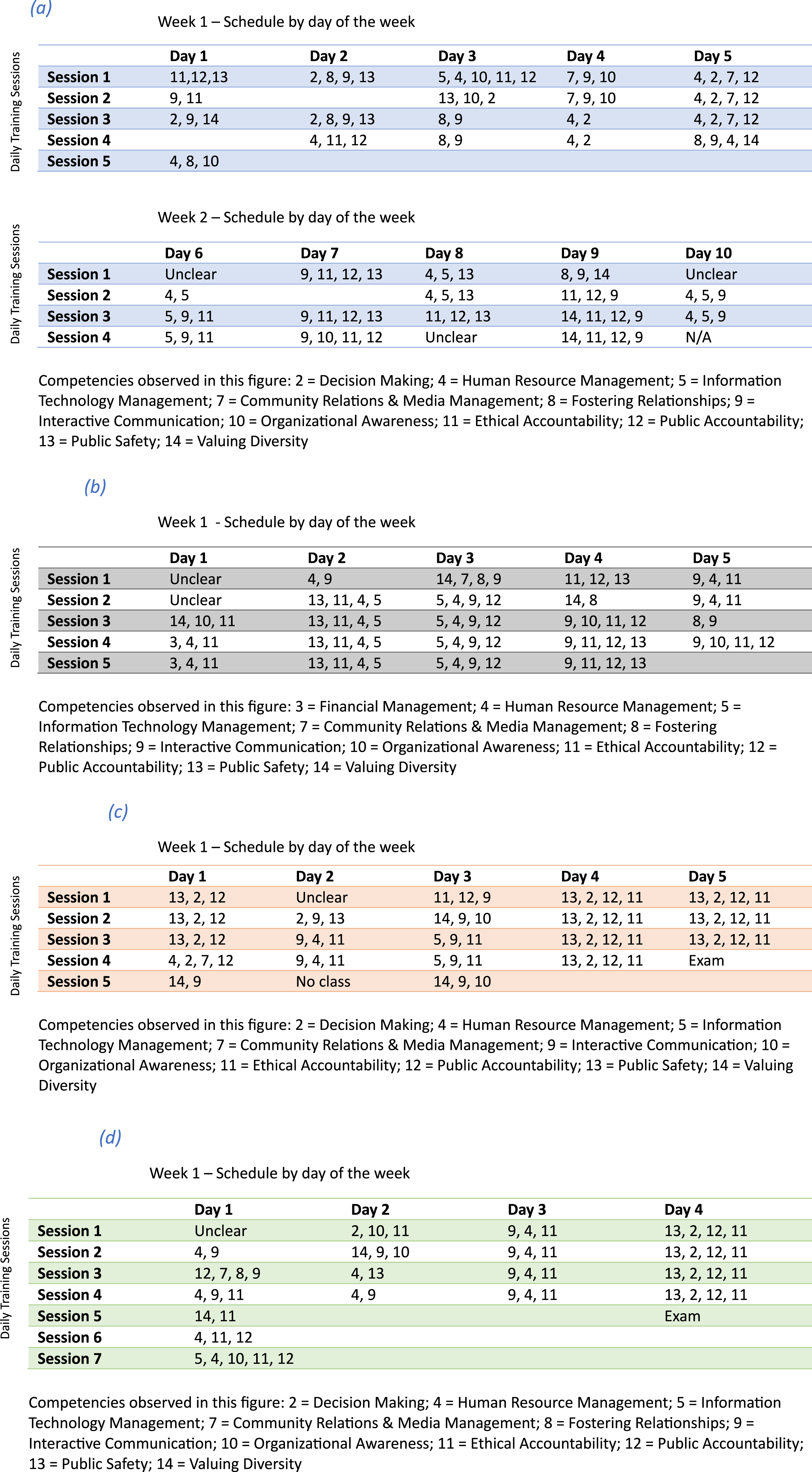
Figure 1 contains tables that represent the curriculum of each Agency A to Agency D. The names of each class or session have been removed to protect the anonymity of police training techniques. What has replaced the name of each class/session in the figure are the coded leadership competencies from the CBMF that were observed in the curriculum documents of the anonymized training session. The numbers contained in the spaces are the intended leadership competencies the agency intended to develop in each course (a CBMF legend is attached below each figure for ease of reference). Although the number of sessions varied between agencies throughout the day, the number of training hours for each agency was consistent (approximately 8am – 4pm).
After several data coding iterations, the coded data was organized into broader themes that aligned with the research question, “How is leadership cultivated in Canadian police agencies”? Three broad categories of themes were developed by focusing on how these codes or segments of data likely aimed to develop the leadership skills of the training program participants: administrative, operational (hard skills), and leadership (soft skills). These categories were not derived from the language of the curriculum itself but were applied interpretively to help organize and make sense of the competencies emphasized in training. While these categories differ from traditional leadership models such as transformational, servant, or strategic leadership, they reflect a functional lens to describe practical responsibilities at the entry level of leadership of policing. The relationship to broader leadership typologies is further considered in the discussion section.
Once equipped with these three themes, the initial framework was revisited and grouped into these three themes, with the caveat that some of the competencies would fall into multiple categories (e.g., interactive communication aligns with all themes). In total, six competencies were associated with the administrative theme, eight with the operational theme, and eight with the leadership theme. Once defined, these three distinct themes were described as administrative leadership, operational leadership, and engaging leadership. Flynn and Herrington (2015) suggested that leaders should possess a combination of management skills, leadership skills, and personal skills, so it was hypothesized (H1) that each agency would dedicate approximately one-third of their curriculum to each theme of leadership from the competency framework (33%) if they intended to cultivate well-rounded and balanced leaders. The Training Curriculum by Leadership Theme (operational, engaging, administrative). Note: Each cell shows the overarching leadership theme (Operational, Engaging, Administrative) identified for that training session. “Unclear” indicates sessions where coding was not possible; “N/A” = no session scheduled; “Exam” = evaluation day; “blank space” = training break. (a) Agency A (b) Agency B (c) Agency C (d) Agency D.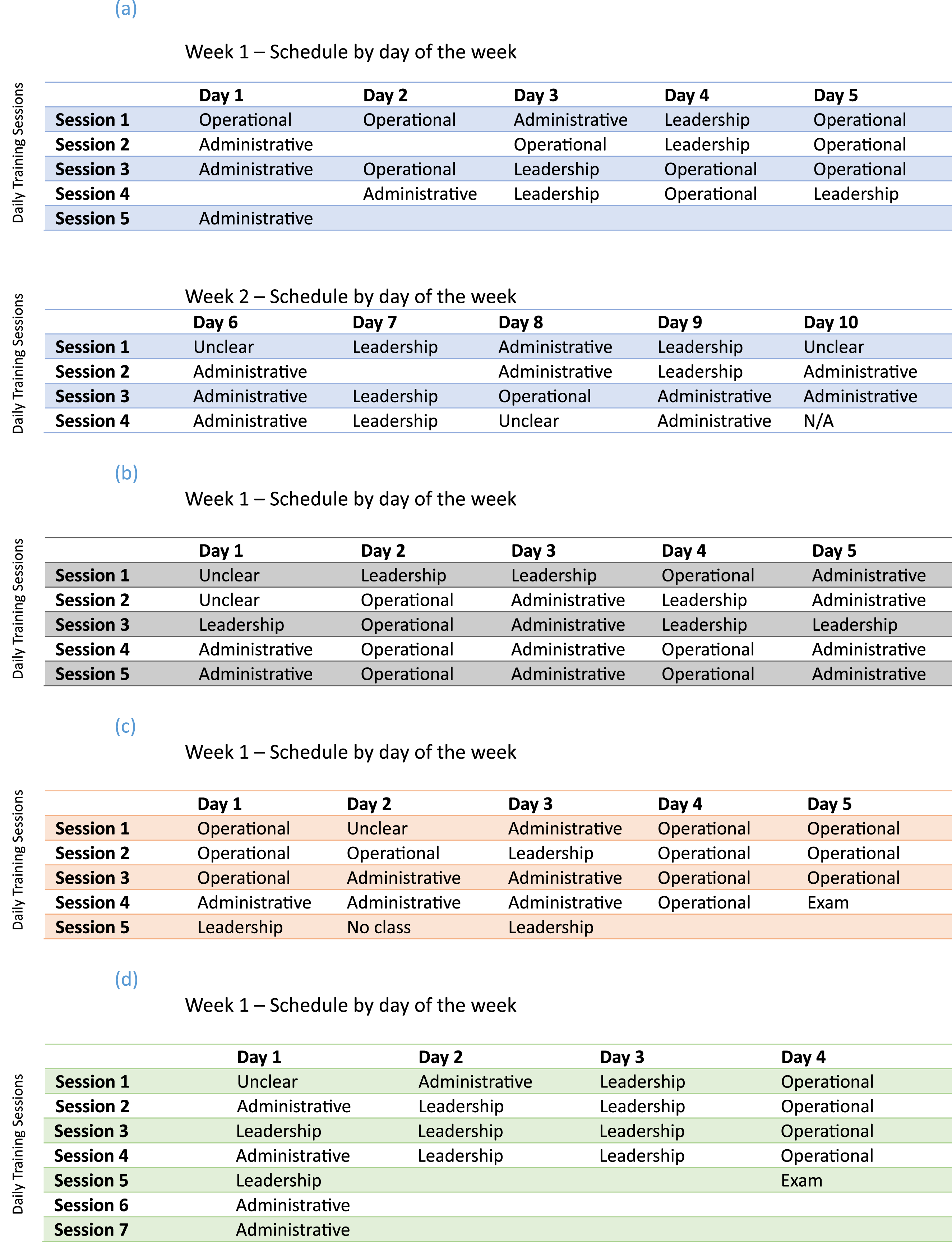
Findings
Agency A provided the longest training program, with a total of 39 in-class sessions spread over 2 weeks. The distribution of the development courses provided seemed balanced between all three themes (aligned with H1). Of the classes provided, 35.9% (14 sessions) were primarily focused on developing administrative leadership, while 25.6% focused on operational leadership (10 sessions) and engaging leadership (10 sessions). The remaining five classes were difficult to code due to ambiguity, but they represented 12.3% of the curriculum.
Agency B’s training program consisted of 25 in-class training sessions spread over 1 week. The breakdown of development courses for Agency B was like Agency A, with 40% of the sessions focusing on developing administrative leadership (10 sessions). Operational leadership was the next most prevalent theme, with 28% of sessions (seven classes) focusing on operations and tactics, followed by engaging leadership with 24% (six classes). The content ambiguity of two in-class sessions made coding difficult, but those represented only 8% of the curriculum.
Over the course of 1 week, Agency C’s training program delivered a mix of in-class and practical training sessions, with a total of 21 classes. The development of operational leadership was a major focus of Agency C’s training program, accounting for 52.4% of the curriculum and 11 classes. The development of operational leadership was the sole focus of all the practical training sessions that were not delivered in a classroom. Administrative leadership training represented 28.6% (six sessions) of the curriculum, and engaging leadership development represented a dismal 14.3% (three sessions). Only one session, accounting for 4.7% of the curriculum, posed a significant coding challenge.
Over the course of 4 days, Agency D’s training program also provided a mix of in-class and practical training sessions, with a total of 19 classes. Unlike many other agencies, the primary focus of the curriculum was on developing engaging leadership, with 47% of the sessions (nine) directed at this theme. Like Agency C, all in-person practical sessions concentrated on developing operational leadership but accounted for only 21% of the curriculum (four sessions). Administrative leadership accounted for 26.3% of the curriculum (five sessions). Only one session, accounting for a mere 5% of the curriculum, proved to be challenging to code.
When additional demographic factors are considered, the study’s findings become quite intriguing. Geographically, Agencies A and B are adjacent municipalities in Central Canada, and both happen to be the largest municipal police agencies in this study. In Western Canada, Agencies C and D, are also adjacent municipalities and were the smallest municipal police agencies in terms of membership (number of officers). Knowing these differences highlights the inconsistency in training between and within provinces. Both Agency A and Agency B had a relatively balanced distribution of training that aligned with each of the three themes (H1), and both of their curricula slightly favoured administrative leadership. This suggests that regionally, in Central Canada, in-service training programs for large agencies relatively consistent in their development across the various domains of the leadership competency framework.
Conversely, in Western Canada, there were significant differences in the training focus between Agencies C and D. Agency C focused more than half of their training sessions on developing operational leadership, whereas Agency D focused almost half of their training sessions on developing engaging leadership. It is noteworthy that these two agencies (C & D) incorporated practical operational training sessions, a feature absent in Central Canada. Agency D stood out in several aspects of this study: it was the smallest agency, had the shortest training duration (4 days), and centred its curriculum on developing engaging leadership. In this regard, Agencies C and D did not conform to H1, and law enforcement agencies in Western Canada sought to focus on the cultivation of leadership that favoured operational or engaging themes. A key factor that may be impacting the differences between regions is the size of the agencies; smaller agencies have less resources (people) and less ability to hold lengthy training sessions since their officers may be required sooner for work related tasks, whereas larger agencies do not suffer from these limitations.
Discussion
This study explored how newly promoted sergeants in Canadian municipal police services are developed by analyzing the curriculum content of four different in-service training programs. Using a deductive approach grounded in a leadership competency framework, training content was categorized into three themes: administrative, operational, and engaging leadership. The three categories were generated to reflect the practical groupings of competencies observed in police training, but the categories also align with broader leadership typologies found in the literature. For instance, administrative leadership overlaps with elements of transactional leadership, where structure, accountability, and procedural oversight are emphasized. Operational leadership shared characteristics with autocratic leadership typologies given its focus on command, decision-making, and task execution. Engaging leadership resembled transformational or servant leadership models since it focused on interpersonal and relationship-building skills. While these categories were not direct equivalents, these groupings serve as a practical lens through which the content of police leadership training could be interpreted and situated within broader leadership theories.
Although transformational leadership dominates the academic literature in police leadership research (Bass, 1985; Can et al., 2017; Chhoun and Yat, 2025; Sarver and Miller, 2014), this emphasis was not reflected in the training curriculum reviewed. Instead, findings revealed numerous inconsistencies in how leadership is conceptualized and developed at the entry-level. For instance, transformational leadership competencies were most reflective of the engaging leadership theme, where the focus of training was on interpersonal skills; however, Agency D, was the only police service that focused on this. Conversely, Agency C placed an overwhelming focus on operational leadership and paid little attention to engaging leadership. This contrast aligns suggests that the operational demands and command-style decision-making common in policing may limit the applicability of transformational leadership across all ranks. The training focus in Central Canada (Agencies A & B) offered a more balanced approach, covering all three themes, which indicates alignment with broad leadership development principles encouraged by researchers (Flynn and Herrington, 2015) and national training institutions like the Canadian Police College (Drodge and Murphy, 2002).
Huey’s (2018) study highlighted the lack of empirical research on in-service police training, particularly at the municipal level, and this study may represent one of the first efforts in Canada to explore in-service police leadership training, offering an initial look into how leadership development was approached in Canada. This is significant given that the most time-sensitive leadership decisions occur at this entry level of leadership, where training has direct implications for organizational culture, team performance, and public service delivery (Farr-Wharton et al., 2021; Simmons-Beauchamp and Sharpe, 2022). External training programs presented in the literature review often promoted transformational leadership competencies, but those programs are generally reserved for mid-to-senior ranking officers. Since this study found that many agencies did not prioritize transformational leadership competencies, it may be challenging for some sergeants to build those skills since external training opportunities are often limited to higher ranks and municipal agencies primarily rely on internal-service training.
These findings carry both policy and practical implications. From a policy perspective, the observed regional variation suggests that local priorities and resource availability may be shaping how in-service training programs are designed and delivered. However, as the previous section demonstrated, this means that there may be limited access to training that supports the development of transformational or engaging leadership competencies, giving credibility to the argument for the existence of provincial or national leadership standards. Policymakers should consider including such standards in future iterations of provincial policing standards in various regions within Canada. At a local municipal level, this study could help inform realignment of leadership training curriculum to ensure that newly promoted sergeants are prepared for their new leadership roles.
From a practical standpoint, this study found that agencies in Western Canada incorporated practical in-person operational training sessions, whereas agencies in Central Canada only implemented in-class sessions. The content and duration between programs also differed significantly between agencies; however, due to the reliance on in-service training in the municipal policing context, there is limited knowledge on the efficacy of these programs since there is an absence of independent evaluations (Huey, 2018). Rather than treating these differences as isolated practices, there is an opportunity for municipal agencies to support cross-agency knowledge exchange with not just each other but also academic researchers to create consistent evidence-based training models across jurisdictions.
In sum, this study contributes to a growing but still limited body of research on police leadership by examining how entry-level leaders are trained through in-service training programs. Unlike many studies that focus on theoretical models or senior leadership ranks, this research offers insight into how leadership is taught and prioritized for newly promoted sergeants. The findings highlight a notable difference between what is taught versus what is emphasized in leadership literature. By mapping training content against a validated competency framework, this study illustrated that observable behaviours and role-specific competencies for each rank in the policing hierarchy may offer a more practical and grounded approach to developing leaders.
Limitations
Although the findings of this study are insightful, the data sample was limited to only four municipal law enforcement agencies from two provinces. The findings could provide a clearer picture of the municipal policing leadership training landscape if the number of participant agencies were larger and more representative of other provinces. The study suffers from another limitation: there was no direct interaction with participants. The inability to interact with participants or attend courses in person limited the ability to develop a more fulsome understanding of leadership development. Future research in this area should obtain ethics approval to allow for more engagement with participants and training programs delivered by police agencies. Lastly, this current study is grounded in the overarching assumption that the competency framework serves as an effective benchmark to gauge the quality of the training design or the potential for cultivating leaders. However, one of the intended uses for the framework was not to solely rely on abstract theory but to use a tool already in use within the policing environment to better understand how competencies are being addressed in training.
Conclusion
This study examined how the leadership training programs of four different police agencies aligned their leadership development curricula to the leadership competency framework through a thematic analysis approach. The findings revealed various degrees of alignment across the agencies, with common themes of administrative leadership, operational leadership, and engaging leadership appearing in the training. Larger agencies in Central Canada offered a more balanced curriculum across all three themes, with a subtle emphasis on administrative leadership. In contrast, smaller agencies in Western Canada showed less balance, with a noticeable skew towards either operational or engaging leadership themes.
Ultimately, the findings of this study highlight the inconsistency in police leadership training in Canada and highlight the need for discourse regarding standards for leadership development. This disparity in leadership training focus can leave newly promoted police sergeants underprepared in key areas, impacting their overall effectiveness in leading teams. Future research is necessary to explore how law enforcement agencies in Canada could implement a more comprehensive, balanced training model to address this problem.
Footnotes

Funding
The authors received no financial support for the research, authorship, and/or publication of this article.
Declaration of conflicting interests
The authors declared no potential conflicts of interest with respect to the research, authorship, and/or publication of this article.