



Abstract
Rural police officers work in environments that can be described as isolated and remote. Because of this, the experiences that they have and challenges that they face are different to those of metropolitan based officers. This research aimed to identify and organize the relevant empirical studies exploring the challenges faced by rural police officers. A thematic analysis of the 17 included papers identified patterns of unique challenges created by the rural environment, local communities, and relationships with police structures. These challenges impact on both the work life and the ‘off-shift’ life of the rural officers. From these, future solutions can be identified.
Introduction
Policing as an occupation consists of many inherent risks and stressors. Police officers are exposed to largely unique stresses such as exposure to trauma and violence, high levels of public scrutiny, and the emotional toll of enforcing the law (Anderson et al., 2002; Violanti et al., 2017). Importantly, however, many stresses frequently reported by police officers are not specific to policing. Often it is stressors such as excess workload, work hours impinging upon home life, and inadequate support that are frequently reported by police officers as their most challenging work-related stresses (Duxbury et al., 2021). These stresses can be exacerbated for police officers stationed in rural locations particularly as they are often underfunded, under resourced, and understaffed (Ricciardelli, 2018). By better understanding the unique challenges faced by rural police officers, future research will be placed to explore and develop targeted strategies to support them in their work.
Notwithstanding the difficulties in defining ‘rural’ (see Oliver and Meier, 2004; Nel and Stevenson, 2014), there are several aspects of rural policing that suggest different challenges are faced by officers compared to those who work in urban environments. The most salient is the size and isolation of rural jurisdictions. According to the United States (US) National Census, 97% of the United States’ geographic landmass is considered rural, with fewer than 20% of the population living within these areas (Ratcliffe et al., 2016). This means rural officers have to cover large areas (Ricciardelli et al., 2020) often with little to no additional support or backup (Buttle et al., 2010). Expansive areas that are distant from population centres often experience reduced infrastructure quality, resulting in many rural jurisdictions containing radio blackout zones, adding to the isolation and amplifying risk (Ricciardelli, 2018; Wooley and Smith, 2022). The small size of rural communities often creates a “fishbowl effect” where rural officers are expected to be both a member and a servant of the communities that they live in (Bartol et al., 1992; Oliver and Meier, 2004; Wu and Wen, 2020). Within these communities, police officers are often highly visible and are expected to maintain the identity of a police officer, even while off duty and while on leave. For these reasons, Ricciardelli (2018) identified that 37% of rural officers in Canada reported being unable to take breaks during their shift and 46% being unable to take annual leave. The high visibility of rural police officers may also extend to their family members. Buttle et al. (2010) noted that spouses are often treated as police staff and are expected by the public to collect reports on the behalf of the officer.
Specifically considering the range of unique challenges faced by rural police officers, Yarwood and Cozens (2017) usefully highlighted how these challenges could be categorized as being related either to their work (occupational) or their personal life. Occupational impacts often described specific to rural policing include those that impede on the ability of officers to complete specific tasks, such as long travel distances, lack of proper equipment or resources, inferior technology, and in some instances overlapping jurisdictions, e.g., Native American, federal, and local lands (see Wells and Falcone, 2008). Challenges to the personal lives of rural police officers reflect any impact on their mental or physical health that might not otherwise be present in urban police officers. Some unique challenges for rural police officers may impact on both areas of the officers’ lives. For example, isolation may cause undue stress to an officer and increase the difficulty in responding to callouts, as they may need to travel large distances.
It is critically important that unique challenges to police officers in rural locations are well understood as these challenges result in heightened stress and occupational burnout in areas already difficult to resource and staff. Houdmont et al. (2021), for example, found that 30% of rural officers described the job as either very or extremely stressful, with 44% of officers displaying signs of minor psychiatric distress or disorder. Similarly, Lee and Wu (2024) found that rural police officers scored comparatively higher for anxiety, depression, and PTSD than their urban counterparts. These challenges and resulting emotional difficulties invariably lead to decreases in staff recruitment and retention Wooley and Smith (2022).
This research aimed to contribute to current evidence by collating relevant empirical studies that identify challenges to police officers in rural areas. We acknowledge that there are several commentaries which constitute reviews of rural policing challenges (e.g., Wooley and Smith, 2022), however, we are unaware of any rigorous review of what empirical studies exist and the extent to which these studies are generalizable given how they define rural policing and/or challenges. The purpose of this review, therefore, was to identify and organize relevant research evidence that specifically examines the unique challenges faced by rural police officers. By identifying potential challenges, targeted strategies to support rural officers in their work can be identified.
Method
Search strategy
The search strategy for this review was developed in collaboration with a research librarian at the University of Canterbury. A methodology based on the Preferred Reporting Items for Systematic Reviews and Meta-Analyses Scoping Reviews (PRISMA-ScR; Tricco et al., 2018) was chosen for the current study, as it utilizes transparent procedures to find, evaluate, and synthesize the results of relevant work. The focus of this review is the challenges faced by rural police officers in a rural context.
A search of the following databases was conducted in August of 2024: Embase, Medline, PsycINFO, Scopus, and SocINDEX. These databases were selected based on their inclusion in previous similar studies, specifically Purba and Demou (2019) and Cheung and Li (2023), both of which studied police wellbeing and workplace stress. These five databases cover a range of disciplines, allowing for a broad capture of stress, wellbeing, and occupational barriers. This research had two key components for inclusion: rural police and occupational challenges. Both components can be divided down to two key sub terms. Rural police can be broken down to mean (1) police (e.g. police, police officer, policeman, policemen, policewoman, cop, cops, law enforcement or policing): and (2) rural (e.g. rural, farm, or small community). Occupational challenges can be broken down to mean (1) job-related (e.g. organization, occupation, operation, work, job, or career): and (2) challenges (e.g. stress, burnout, tension, pressure, strain, fear, anxiety, challenge, barrier, obstacle, or risk). Initial searches found an abundance of irrelevant papers primarily focussing on climate change and schoolteachers. Because of this, an additional search component removing these results was added to the search criteria. To ensure relevant results, proximity operators between both rural and police and between job and challenge were added. The final utilised searched terms were as followed across each database was. 1. (police or “police officer” or policeman or policemen or policewoman or cop or cops or “law enforcement” or policing) W/150 (rural* or farm* or “small community”) AND 2. (organization* or occupation* or operation* or work* or job* or career) W/10 (stress* or burnout or tension or pressure* or strain or fear* or anxiet* or challenge* or barrier* or obstacle* or risk*) AND NOT 3. (“climate change” or “global warming” or teachers)
Study eligibility
For an article to be included in the review it had to meet several requirements. It had to: (a) be written in English; (b) be published during or after the year 1990; (c) be a peer reviewed journal article; (d) focus on rural environments or small rural communities, and (e) address direct challenges to police officers and their job. Articles were excluded if they: (a) focussed on policy or legislation; (b) focused on crime rates of an area, or (c) focussed on a non-police occupation. The year 1990 was selected to give us a broad net to find relevant papers on a potentially limiting topic. Similarly, we placed no limitations on country of interest to give us a broader net and to allow for greater generalisability. Given the focus on peer reviewed empirical research (qualitative or quantitative), literature reviews, commentaries, dissertations, and grey literature (e.g., police agency reports) were not included in this review. No hand search of references was conducted.
Several excluded studies focussed on challenges to police adjacent occupations, such as Canadian mounted guards (Murphy, 1991), game wardens (Forsyth and Forsyth, 2009), school liaisons (Spencer et al., 2024), and nonsworn community policing groups (Giwa, 2018). Other studies, such as Skubby et al. (2013), included rural police within the sample, but did not differentiate police officer experiences from other included groups within the sample (e.g. rural nurses and paramedics). These were excluded as we were unable to identify police specific impacts. Studies that discussed the mental health impacts on rural police officers but do not discuss the sources of these impacts (e.g., Gibbs et al., 2024; Lee and Wu, 2024; Wu and Wen, 2020) were excluded. The aim of this study was to identify the specific challenges to rural officers, therefore, included studies must highlight one or more sources of stress within their results.
Study selection
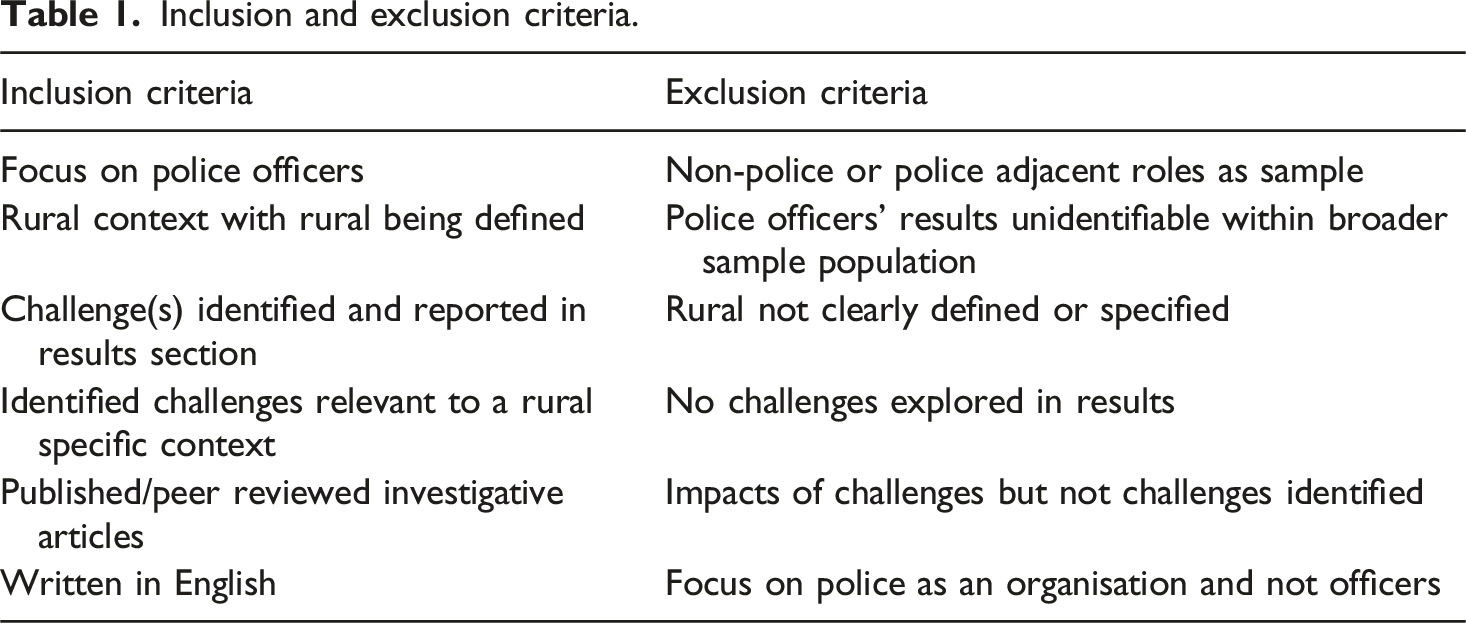
Inclusion and exclusion criteria.
Screening and reviewing
The results of the study selection process are outlined in Figure 1. The initial search produced 3801 articles. After duplicates were removed the titles and abstracts of the remaining 3585 articles were screened. Based on the inclusion and exclusion criteria (outlined in Table 1), 3531 papers were removed. The full text of the remaining 54 papers were reviewed, which resulted in the exclusion of a further 37 papers. The most common reason for exclusion, as shown in Figure 1, was that the paper did not examine any specific challenges that rural officers faced (n = 21). This left a total of 17 papers for full analysis. Flowchart representation of the PRIMSA-ScR screening and review process.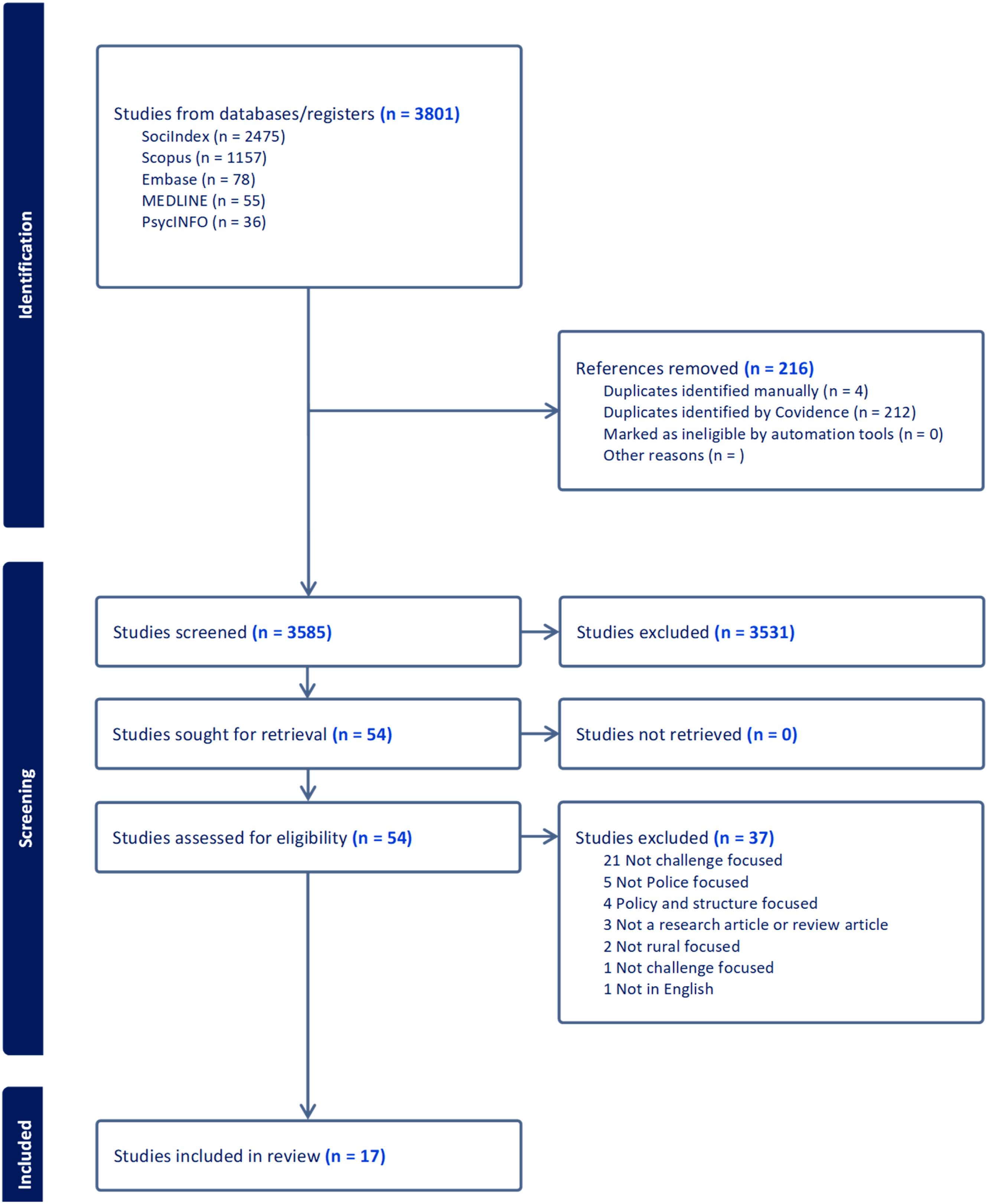
Data analysis
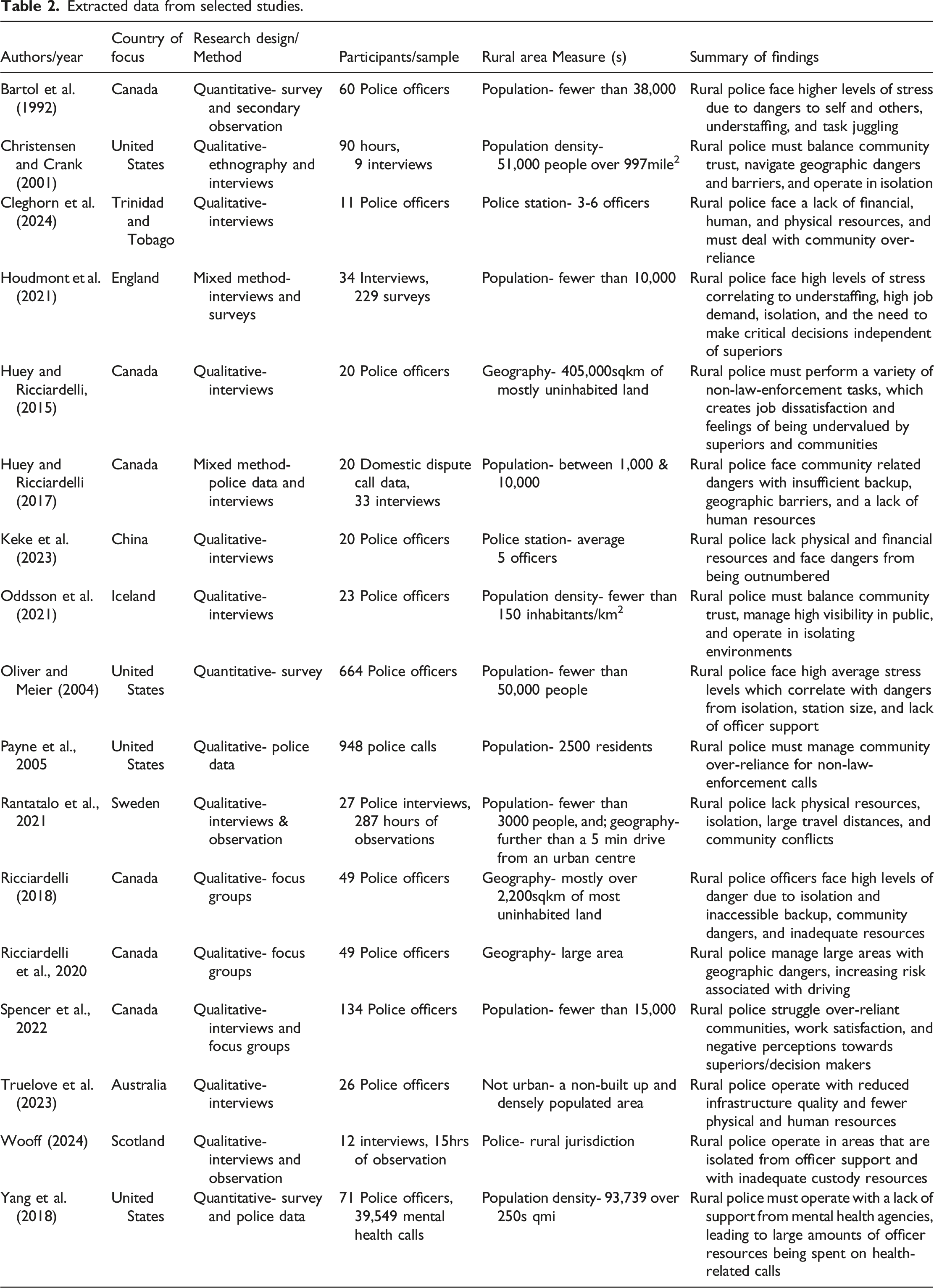
Extracted data from selected studies.
When considering what constituted a challenge to a rural police officer, any general challenge to policing, or any experience that is likely shared with urban officers, was not discussed. For example, police officers in Spencer et al. (2022) discuss the issue of ineffective youth justice treatment facilities. While rural officers often cite this as a challenge in their work, this is not something that is mutually exclusive to rural officers, as urban police officers will likely have similar experiences. However, in contrast, the experience of dealing with no backup (e.g., Ricciardelli, 2018) is a uniquely rural experience, or is experienced in a way that is unique to officers in rural areas and was, therefore, captured within the themes. Challenges that are rural are, therefore, those which are created by the unique contexts of working in isolated and remote communities and areas.
Results
General study characteristics
The majority of the identified studies came from North America (n = 10), with four from the United States and six from Canada. The other studies each focussed on China, Sweden, Australia, Trinidad and Tobago, Scotland, Iceland, and England. Every paper except for one (Bartol et al., 1992) was published after the year 2000 with the majority being published in the last 15 years. 12 of the studies utilized a qualitative research methodology, three used quantitative methods, and two used a combination of qualitative and quantitative methods. The sample sizes of the studies ranged from nine rural police officers who were interviewed (Christensen and Crank, 2001) to a survey of 664 rural police officers (Oliver and Meier, 2004). The largest overall sample size, however, was 948 records of police data collected over 2 years (Payne et al., 2005). Our first finding was that, to our surprise, there is relatively limited empirical research evidence relating to rural police challenges.
Defining rural
In order to compare the identified studies, we first needed to understand how rural has been defined. The most common way of defining rural was through population methods. Seven studies described a rural population as a community with a fewer than 10,000 people, however, Oliver and Meier (2004) defined rural as fewer than 50,000 people. Three studies used population density to define rural with two from the United States (Christensen and Crank, 2001; Yang et al., 2018) and one from Iceland (Oddsson et al., 2021). To illustrate the difficulty in comparing studies, Yang et al. (2018) utilized a location with fewer than 374 people per square mile, Oddsson et al. (2021) used fewer than 388 per square mile (when converted from kilometres), and Christensen and Crank (2001) utilise fewer than 51 people per square mile. Three studies defined rural using police protocol or policy, either by police station size (e.g., five or fewer officers) or by police area classification. A further three studies defined rural area as being geographically expansive and sparse, with the largest size being described as 405,000 km2 of mostly empty land (Huey and Ricciardelli, 2017). The final paper defined rural as a ‘non-urban area’ (Truelove et al., 2023). Our second finding is that the definition of rural used within studies of police challenges has been variable.
Thematic analysis to identify rural police officer challenges
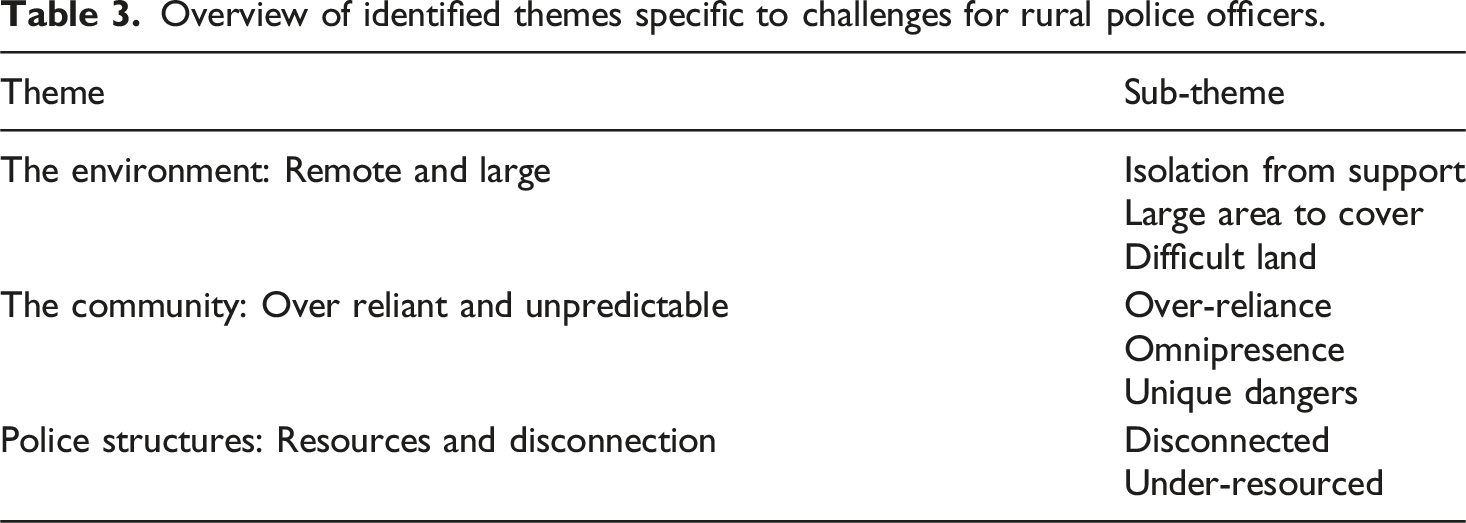
Overview of identified themes specific to challenges for rural police officers.
The environment: Remote and large
The general description of rural environments, contributing to police officer challenges, was that they are isolating, difficult to navigate, and require traveling large distances.
Isolation from support
Several studies suggested that the large geographic areas that rural officers’ police means that they may operate out of remote towns that lack accessibility. These geographic barriers cut officers off from support services; both support from other police officers and from other important services, such as mental health facilities. Ricciardelli (2018) and Houdmont et al. (2021) identified that rural officers may be waiting for several hours for support to arrive from the next nearest police station, which may be hundreds of kilometres away. When responding to a call that requires backup, officers must choose between waiting for the support and risking the safety of the victim, or going in to help but risking their own safety (Ricciardelli, 2018). Houdmont et al. (2021) noted that 80% of surveyed rural constables in England stated that they felt consistently exposed to stress due to the lack of backup available to them, with 75% suggesting that this creates fears for their safety. Oliver and Meier (2004) stated that lack of backup and the feeling of isolation were highly associated with increased levels of perceived stress.
Isolation from police support can become apparent following an arrest. Several studies noted that rural stations often lack sufficient infrastructure, usually due to their size and age, for holding detained individuals. Additionally, holding an individual in custody requires an officer to monitor the detainee. This requires officers working in isolation to remove themselves from their community to watch the detainee. This means that either the arrested individual needs to be transferred to a larger metropolitan custody suite by the rural officer, or the rural officer must wait in the station until support arrives; something that requires a lot of time due to the large geographic distance isolating officers from their support (Wooff, 2024). An officer in Rantatalo et al. (2021) shared a story where, near the end of their shift, they were asked to drive to a rural station (3 hours away) to pick up an individual in custody and bring them back. This meant that the officer finished work near 3am, only a few hours before they were expected to go back to work. This anecdote highlights how isolation from support can create increased work for officers.
Geographic isolation also creates barriers to support from non-police entities as well. Spencer et al. (2022) notes that isolation from other services may create vulnerability within the community. While this vulnerability creates the need for officers to fulfil many non-police roles (which will be discussed later), it also leaves officers feeling unequipped to handle certain callouts. For example, Yang et al. (2018) identifies that only 51% of rural officers in rural Virginia (United States) were satisfied with the available options for resolving mental health callouts in their area. This highlights the lack of mental health facilities or services available in rural areas to aid the police.
Large areas to cover
Most studies referred to the variety of challenges that police officers face when expected to cover large geographical areas particularly when receiving multiple emergency calls (Spencer et al., 2022). A common challenge was that rural police officer response times are potentially much slower. Ricciardelli et al. (2020) noted that rural officers in Canada feel obligated to arrive at the scene of a crime in a timely manner, even if this means that police officers increase their driving speeds, increasing the risk of crashing or causing harm (Christensen and Crank, 2001). Driving at excessive speeds contributes to “more officers [being] injured or killed in police motor vehicle accidents than any other thing in [policing]” (Ricciardelli, 2018. p663). Rantatalo et al. (2021) described police officers commonly driving until 3am (hours after their shift had officially ended), highlighting the strain that long distance driving can cause rural officers. These large distances also means large mileage, which puts an increased toll on police vehicles, wearing them down and increasing the danger that these large drives create (Huey and Ricciardelli, 2017; Ricciardelli, 2018).
The large distances that officers are required to cover potentially impedes on their ability to follow up and investigate serious offences. Truelove et al. (2023) reported that this results in offenders being far more likely to effectively avoid detection and arrest. Additionally, incidents that require the police to follow up with witnesses or view the location of the offence force officers to travel for long time periods which is even more challenging if witnesses turn the police away or fail to show up at all (Rantatalo et al., 2021).
Difficult land
Most studies described the rural terrain as being potentially difficult to navigate and this creating unique challenges for police officers (Ricciardelli et al., 2020). Exposed mountainous, winding, and/or unsealed roads create slower response times and add to the danger that driving poses. Due to their roads being used less frequently and being more isolated from infrastructural hubs, rural roads are often left unrepaired and greatly aged (Keke et al., 2023). This means that many rural roads are often outdated, unsealed, and dangerous (Ricciardelli et al., 2020). Some areas within a rural officer’s jurisdictions may even be completely unreachable via roads and instead require boats, planes, helicopters, or snow vehicles to access (Huey and Ricciardelli, 2017; Ricciardelli, 2018). Additionally, rural roads are often adjacent to farmland or wilderness areas which creates the risk of large animals walking onto them, creating unforeseeable obstacles for officers to avoid (Christensen and Crank, 2001; Ricciardelli et al., 2020). Exposure to extreme weather may also provide unique challenges for police officers, as some areas face temperatures so cold, that vehicles may not restart once turned off (Ricciardelli, 2018). This unpredictability of roads, weather, and livestock further increases the dangers that rural roads pose to officers.
Due to the reduced infrastructure of rural areas, many locations lack adequate reception for either phone or radio. Being required to respond to potentially violent incidents without being able to communicate effectively causes unique stress for officers (Huey and Ricciardelli, 2017; Ricciardelli, 2018). Additionally, blackout zones also prevent effective information sharing, meaning that officers may be responding to situations relatively blind (Ricciardelli, 2018; Wooff, 2024).
The community: Over reliant and unpredictable
Results from the included studies identified that police officers in rural locations may experience challenges due to the community’s over reliance upon them, the sense of being omnipresent, and the unique dangers specific to local demographic.
Over reliance
Several of the qualitative studies reported quotes from police officers that suggest that the lack of alternative services and high visibility of police officers in rural environments means that individuals within these communities often go to them for support for their problems, even if the problem is not a police matter (Bartol et al., 1992; Cleghorn et al., 2024; Spencer et al., 2022). Issues such as arguments, broken fences, and neighbourly disagreements, or uniquely rural problems such as farm animals on the road may all get brought to the attention of the police to resolve (Cleghorn et al., 2024; Oddsson et al., 2021). Payne et al. (2005) reported that a large portion of rural police calls had nothing to do with law enforcement, such as calls to solve problems or to resolve family issues. They reported that the most common call made to the police, making up 14% of all calls received, were about locals needing assistance with animals.
Mental health support services are often scarce in rural environments (Gamm et al., 2010). A number of the identified studies, from all countries, reported that rural police officers consequently spend large amounts of time responding to mental health rather than crime related issues (Cleghorn et al., 2024; Houdmont et al., 2021; Wooff, 2024; Yang et al., 2018). Yang et al. (2018) found, for example, that rural police officers within their sample spent more time responding to mental health related calls than any other call type.
A number of the studies outlined how this overreliance upon rural police officers can create other challenges within the community. Police themselves may become more cynical and dissatisfied regarding their roles as they are not performing tasks that they joined the police to do (Huey and Ricciardelli, 2015; Spencer et al., 2022). Additionally, as explored in Yang et al. (2018) and Payne et al. (2005), attending these calls can lead police officers to feel unproductive and unresponsive to other emergency calls.
Omnipresence
Almost all of the studies described rural police officers needing to be omnipresent and the challenges that this creates, not least the efforts required to build trust and minimise distrust among community members (Rantatalo et al., 2021). Establishing and maintaining a strong relationship with the community is important for ensuring that a rural police officer can rely on their social capital for assistance when they need it most (Cleghorn et al., 2024; Oddsson et al., 2021). This highlights how, in rural areas, the community rely on the officer to keep them safe and maintain peace, while the officer relies on the community to help them to do this job effectively.
This omnipresence challenges rural police officers to make decisions that maintain their community’s respect. Oddsson et al. (2021) noted that rural police officer must balance choosing to follow ‘what the law says should happen’ against the use of warnings and longer-term preventative measures that ensure that the community continues to respect the officer. Several studies noted that if a rural police officer were to be deemed too strict or too lenient this may cause the community to lose respect for the officer; something that is detrimental to the officer’s non-police life within the community (Christensen and Crank, 2001; Houdmont et al., 2021; Payne et al., 2005; Wooff, 2024).
Unique dangers
Many studies reported on the presence of unique dangers experienced by police officers in rural communities. As indicated within other rural police officer themes, these include extreme weather and hazardous roads, isolation and limited backup, and dangerous wildlife. The high level of environmental remoteness and close proximity to extensive farmland means that the unique issue of large animals wandering onto the road is common (Christensen and Crank, 2001; Ricciardelli et al., 2020). However, much like in Payne et al.’s (2005) discussion of nuisance calls, these areas are also home to many large dogs. The presence of a “rampant big dog” (Ricciardelli, 2018: p425) can be disarming for officers, as their presence can be just as intimidating as any other weapon. In addition, the presence of firearms is something that threatens all police officers, regardless of location, however, as highlighted by Huey and Ricciardelli (2015), the commonality of hunting and fishing as a hobby or necessity in rural areas increases the rate of weapon ownership (see also Lynch et al., 2018; Woldoff et al., 2017).
Police structures: Disconnection and under-resourced
Police officers are reliant on the support from the policy makers and leaders of their organisation. High levels of perceived organizational support have a significant effect on police officer’s motivation and work engagement (Gillet et al., 2013). Rural police officers, however, often report feeling a lack of organizational support (Spencer et al., 2022). This is often reflected in rural stations being under-resourced, both in terms of staffing and equipment, and rural officers being disconnected from their organization.
Disconnected
Many of the identified studies reflected that the isolation of rural police officers from decision-makers, other police officers, and support staff means that they are, in effect, disconnected from the police as an institution (Houdmont et al., 2021; Oliver and Meier, 2004; Spencer et al., 2022). This may lead to metropolitan based policy makers and staff having little understanding of the experiences of rural police officers, leading to unheard pleas, decrease in relevant support and decisions, and limited ability of non-rural police to relate to the emotional impact of rural staff (Cleghorn et al., 2024; Huey and Ricciardelli, 2015).
Being disconnected from other police officers and being required to work alone creates a barrier for officers being able to talk about their feelings or experiences (Houdmont et al., 2021). Rural police officers working on their own have no immediate access to any colleagues, and talking to officers in urban areas is unlikely to create any understanding, as their experiences are so different and unique. The geographical disconnection from their superiors and colleagues also means that rural police officers may be forced to make critical decisions independently. Houdmont et al. (2021) found that over 80% of surveyed rural police officers reported that the need to make critical decisions on their own was a significant source of stress. In addition, the limited accessibility of colleagues or superiors often results in rural police officers questioning their decisions (Oliver and Meier, 2004). Spencer et al. (2022) found that rural police officers had little to no confidence in their leaders and that they often questioned whether superiors understood their context and circumstances.
Under-resourced
Almost every identified study indicated that rural police officers report being under-resourced or under-staffed. Most studies also described rural police officers lacking confidence in these resourcing issues being resolved (e..g, Spencer et al., 2022). Rural police officers often cite a lack of up-to-date equipment as being a key stressor in rural areas. Ricciardelli (2018) highlighted that rural stations are often operated at minimal levels of resourcing. This was highlighted by an interviewed officer stating that they have “vehicles that can’t be fixed because they don’t have the money” (p432). To further highlight this issue, Cleghorn et al. (2024) stated that as well as rural police officers having limited access to a working vehicle at times, they did not even have access to a printer in their station. In addition, police in rural jurisdictions may have reduced permissions to access some police tools, such as fingerprinting (Keke et al., 2023).
The most identified restriction for rural officers noted, however, is the limited amount of CCTV video surveillance in their areas. This is a consequence of lack of connection to policy makers, the large areas that rural police cover, and the difficulty of the terrain to install effect video coverage. Cleghorn et al. (2024) discusses that rural officers felt as though policy makers falsely viewed their stations as slow paced and as not needing access to such equipment, contributing to the sentiment from rural police that they are undervalued (Huey and Ricciardelli, 2015).
Staffing shortages is another stressor frequently reported by rural police officers. For example, 89% of rural police officers in Houdmont et al. (2021) attributed high levels of job stress to insufficient staffing in their area. The large area that rural police officers are expected to police means that these areas require larger numbers of police officers, not fewer (Bartol et al., 1992; Rantatalo et al., 2021). Wooff (2024) identifies that the thinly stretched rural resources increase the necessity that officers use warnings and diversion tactics, as formal action requires long hours of manpower. Being under-resourced means that officers feel ill-prepared to adequately protect and serve their communities.
Discussion
This goal of this review was to collate and examine existing empirical studies that identify unique challenges to police officers in rural areas. Our first finding was that there is surprisingly little empirical data available, and the majority of existing studies have used qualitative research designs with small sample sizes. Our second finding of most use to researchers is that the definition of rural has varied considerably among studies. Notwithstanding the definition variations, we identified through the thematic analysis of 17 identified studies, three broad themes that we believe captured the essence of the unique challenges for rural police officers: the environment - remote and large, the community - over reliant and unpredictable, and police structures - disconnection and under-resourced. We believe that there are two key discussion points relating to these findings – how they intersect and how they combine to impact the rural police officer. The impact of these unique challenges, and their intersectionality, is evident in rural police officer’s work and personal lives (Ricciardelli, 2018). Challenges to their work consist of barriers to perform their job or conflicts that create tension within their career. Personal challenges consist of mental or physical health risks. Some challenges may impact both. In describing intersectionality of the themes and stresses they create, we aim to provide research ideas, pose practical solutions, in order to support rural police offices into the future.
Many of the identified (sub)themes interconnect. We believe that there is no current research on whether exposure to certain themes, or combinations of these themes, or whether chronic or long-term exposure to these themes causes greater levels of stress to rural police officers. It is apparent that the experience of some challenges (themes) may exaggerate others. The theme that appeared to intersect the most with other challenges is isolation from support. Isolation from support appeared to be, from our examination of the studies, worsened by the large areas that rural officers must cover and the difficult land between the officers and assistance. Isolation from support from non-police entities appears to create increased over-reliance from the community. By having access to fewer community resources and services, the rural police officer must fill more roles and responsibilities. The experience of unique dangers appears worsened by the isolation from support, as the high rate of ownership of firearms and large dogs means that any callout has the potential to be dangerous, increasing the opportunity for rural officers to need support (see Ricciardelli, 2018). Isolation from support appears to emphasize the under-resourcing of rural police, as officers may need to wait for several hours to receive proper resource support (human or material resources) to respond effectively (Houdmont et al., 2021). This is highlighted in Wooff’s (2024) analysis of police holding cells in rural Scotland. Isolation from support and unique dangers present in rural communities both increase and highlight the need for omnipresence of the police. Being surrounded by numerous potential dangers from the locals and being isolated from help further increases the trust that the police must have in their community and the trust the community have in their police officer (Cleghorn et al., 2024; Oddsson et al., 2021).
From intersections between isolation from support and other challenges, it appears that by reducing the geographic barriers between rural police and other police and non-police services, officers would be better placed to be safe and keep their communities safe. The best way to do this is to decrease the distances to support, mostly by increasing the number of non-police-based services in the towns and environments that officers’ police. Alternatively, increasing the mobility of metropolitan based services by increasing the range that they are required to operate in and making them more prepared for long distance transport would decrease the time spent on negotiating resources and time spent preparing to travel (see Christensen and Crank, 2001).
Difficult land and large areas intersect to increase the necessity for officers to be more resourced, not less. Driving on poorly maintained roads for hours at a time increases both the mileage and the strain on police vehicles, which increases the need for the vehicles to be in good repair. Additionally, policing areas that are inaccessible via car and instead require a boat or snow vehicles means that officers must be properly resourced and equipped with access to these forms of mobility. Reducing these challenges would mean reducing the size of rural police jurisdictions, which would require more police stations to divide the land over more staff. Alternatively, increasing the mobility of officers would decrease these geographic barriers.
Over-reliance creates excessive jobs that officers must attend or be prepared to attend, which worsens the effects of under-resourcing for rural officers. These ‘nuisance’ calls create more work for officers, meaning that more staff is needed to complete them and more resources are needed to be properly equipped to handle the wide range of jobs. However, the intersection between over-reliance and under-resourcing also goes the other way. Over-reliance from the community leads rural officers carrying out more non-police roles than law-enforcement roles. The lack of relevant police jobs attended by rural officers is seen by the superiors of police, which undermines the value of rural police in their communities. This contributes to the disconnect between rural constables and policy makers, which in turn contributes to rural officers being under-resourced. Therefore, a potential way to address the challenges of resourcing is to bridge the connection between rural police and policy makers. Increasing the amount of time police leaders spend in rural areas would give them firsthand experience to see the necessities of rural police officers. This would allow for decision makers to better equip rural staff, reducing the level of under-resourcing.
Limitations
While studies were collected using the PRISM protocol, the use of only five databases means that it is possible that relevant studies may have been missed, and a search of more databases may have yielded more studies. Additionally, we acknowledge the limitations and the subjectivity in defining rural across different countries of varied sizes. We also note that, despite following the thematic analysis methodology, the qualitative nature of the analysis leaves potential for subjectivity and bias in the identified themes. This is potentially compounded by the studies mostly having small sample sizes. This is likely due to the very nature of the subject and the difficulties inherent in establishing large samples of rural police officers to report on their challenges. It appears that, in most studies, the samples were limited to those who self-selected to participate. Larger samples and different research methodologies would make it more likely that the results (themes) would be generalizable. We do note, however, at this point that the studies came from a range of countries and rural environments notwithstanding the different definitions of rural used.
Conclusion
The examined research suggests there are several aspects of policing rural environments that pose unique challenges to rural police officers. We conclude that the environment that rural officers’ police is expansive and, at times, difficult to navigate. This creates geographic barriers between officers and support services, backup, and the callouts they are expected to attend. We believe that the tightknit communities that they police to be over reliant on their local officer, causing them to attend many jobs that are not law-enforcement related. Additionally, the traditionally self-sufficiency of locals is typically associated with higher rates of weapon-ownership, causing increased necessity for officers to proceed with caution to even the most innocuous jobs. Lastly, we suspect that, due to urban biases, decision makers potentially lack consideration for rural environments, leading to a disconnect between constables and superiors, and suggesting that rural staff are less properly resourced than their metropolitan counterparts. The impact of these challenges is a potential increase in stresses and physical health risks (through dangers to the officer) and a reduced capacity to effectively and swiftly carry out their duties.
Footnotes

Funding
The authors received no financial support for the research, authorship, and/or publication of this article.
Declaration of conflicting interests
The authors declared no potential conflicts of interest with respect to the research, authorship, and/or publication of this article.