




Abstract
We examined if experienced officers use less and lower levels of force than less-experienced officers due to differences in reasonability-of-force assessments. Officers observed body-camera videos involving use-of-force, indicated their course of action, and the extent to which several factors were relevant in determining appropriate use-of-force. Experienced officers were more likely to use verbal commands and less-experienced officers were more likely to use less-lethal and lethal force. This was mediated by available force mitigation opportunities, nearby weapons, and the subject’s likelihood of escape. Results inform the skills involved in and training that reinforces expert use-of-force decision making performance.
Introduction
Scenarios involving the use of force (UoF) often require officers to make rapid, appropriate UoF decisions under dynamic and stressful conditions. Research has sought to identify factors that contribute to officers’ ability to select an appropriate UoF option and officer experience has emerged as an important factor in this research. Judgments and decisions among experienced—compared to less-experienced—individuals are more precise, efficient, and successful (Ericsson et al., 1993; Klein et al., 2017; Larrick and Feiler, 2015). As such, research has sought to understand and identify the skills involved in expert UoF selection to create training that reinforces those skills among law enforcement officers (Boulton and Cole, 2016; Mangels et al., 2020; Suss and Ward, 2018; Ta et al., 2021; Ta-Johnson et al., 2023; Ward et al., 2011; Zimmerman, 2008).
Many studies have reported a link between officer experience and UoF such that experienced officers are less likely to use force than less-experienced officers, and when force is used, experienced officers are more likely to use lower levels of force than less-experienced officers (Bayley and Garofalo, 1987; Cubitt and Nix, 2023; McElvain and Kposowa, 2004; McLean et al., 2023; Paoline and Terrill, 2004, 2007; Prenzler et al., 2013; Rydberg and Terrill, 2010; Terrill and Mastrofski, 2002). More experienced officers were less likely to recommend the use of empty hand tactics compared to no force. However, no study has examined the mechanism(s) underlying this link. Although previous research has speculated that the link between experience and UoF selection may be due to the ability of experienced officers to better predict when force is not needed and when it is appropriate to escalate to higher levels of force (Crawford and Burns, 1998), no study has examined this empirically. Thus, it is still unclear why force selection varies by officer experience. We address this gap in the literature in the current study. First, we sought to replicate previous findings showing that experienced officers use less and lower levels of force than less-experienced officers. Second, we tested if officers’ reasonability for selecting a particular force option mediates the link between officer experience and force selection.
This paper makes important contributions to the UoF literature. Replicating the finding that experienced officers use less and lower levels of force than less-experienced officers will further validate and bolster confidence in this finding. Assessing the mechanism(s) that underlie the link between experience and UoF selection allows for greater insight pertaining to the specific skills that mark expert performance in UoF decision making. This knowledge is fundamental to the development of effective training interventions that facilitate expert selection of force among police officers (Boulton and Cole, 2016; Suss and Ward, 2018; Zimmerman, 2008). Finally, inappropriate UoF by police officers continues to occur and is deleterious to police-community relations. More research addressing police training in appropriate UoF selection is essential in the process of repairing police-community relations and public trust in law enforcement.
Background literature
Having more experience in a given domain is connected to making more accurate and appropriate judgments (Ericsson et al., 1993; Klein et al., 2017; Larrick and Feiler, 2015). Due to their depth of domain knowledge, experienced officers—compared to less-experienced officers—pay attention to different kinds of information and therefore evaluate situations differently, are better able to explicitly depict the events of a situation, and generate more predictions about what might unfold in the future (Zimmerman, 2008).
Recent work has highlighted differences between experienced and less-experienced officers in critical-incident situations. Using semi-structured critical-decision-method interviews to examine officers’ decision-making processes in live role-play scenarios, Boulton and Cole (2016) found that experienced tactical officers demonstrated greater adaptability to changing circumstances than did novice tactical officers. Using still images of staged encounters to elicit officers’ perceptions and responses to incidents, Huhta et al. (2023) found that experienced officers identified more tactical themes related to situation awareness—and discussed those themes in greater detail—than did police trainees. Other research has examined training- and experience-based differences in officers’ gaze behavior. For example, using video stimuli, Heusler and Sutter (2020) found that tactical officers fixated on a subject’s hands and waist (i.e., from where a weapon may be produced) longer than patrol officers. Murray et al. (2024) recorded officers’ gaze behaviour during an extended live role-play scenario and then used visual-search variables to cluster officers into two groups, based on their scanning efficiency. Officers with more efficient scan patterns—who, as a group, also had more tactical and military training—demonstrated better attentional control and better outcome performance than those with less efficient scan patterns. Finally, Huhta et al. (2022) recorded officers’ gaze behavior while they examined still images of staged encounters. Officers with special-unit (e.g., tactical) experience spent less time fixating on the environment compared to the target (e.g., subject), while trainees who had not yet completed tactical training fixated on the subject’s hands later than did trainees who had completed tactical training and the officers with special-unit experience.
Regarding UoF, studies have found that experienced officers generally use less force than less-experienced officers, and when force is used, experienced officers are more likely to use lower levels of force than less-experienced officers (Bayley and Garofalo, 1987; Cubitt and Nix, 2023; McElvain and Kposowa, 2004; McLean et al., 2023; Paoline and Terrill, 2004, 2007; Prenzler et al., 2013; Rydberg and Terrill, 2010; Terrill and Mastrofski, 2002). Experienced officers hold less favorable attitudes toward using force (Kop and Euwema, 2001) and are less likely to have been investigated by internal affairs for a UoF incident (McElvain and Kposiwa, 2004). Experienced officers are also “...more likely to emphasize verbal strategies for engaging with citizens” whereas less-experienced officers are more likely to emphasize gaining physical control (Mangels et al., 2020: p. 301). Paoline et al. (2021) suggests that these attitudinal and behavioral UoF decision making patterns exhibited by experienced officers are influenced by officer mindset which is shaped by experience. Less-experienced officers have also been found to be more likely to draw and point their firearms as a means of establishing control, although this was not exclusive to less-experienced officers in Cubitt and Nix’s (2023) study. Less-experienced officers also emotionally react to scenarios involving UoF as more threatening, more intense, and with a lower level of confidence and control than experienced officers (Ta et al., 2021) which is consistent with less-experienced officers’ propensity to use greater force. Moreover, less-experienced officers also experience more cognitive load during scenarios involving UoF than experienced officers (Ta-Johnson et al., 2023). Given that experienced officers generate potential courses of action more effectively, efficiently, and rapidly than less-experienced officers (Hine et al., 2018; Suss and Ward, 2018), less-experienced officers may not have enough cognitive capacity to quickly predict when force is not needed and when it is appropriate to escalate to higher levels of force.
Although there is ample evidence to support the link between greater experience and use of less and lower levels of force, there has been a lack of studies that have examined the mechanism(s) or mediators underlying this link. However, research has previously suggested that a potential mediator underlying this link is the ability of experienced officers to better predict when force is not needed and when it is appropriate to escalate to higher levels of force (Crawford and Burns, 1998). Put another way, experienced officers may be better able to assess the justification or reasonability-of-force selection given the circumstances at hand than less-experienced officers, and that this difference contributes to UoF selection differences across police experience. Reasonability-of-force selection is determined by factors including the severity of the crime at hand, whether the subject poses an immediate threat to the safety of officers or others, and whether the subject is actively resisting arrest or attempting to evade arrest (Harmon, 2008; MacDonald, 1990). These factors are also known as Graham Factors—named after the US Supreme Court case which established a rational and transparent method to objectively evaluate alleged excessive UoF by a law enforcement officer (Graham, 1989). Under these guidelines, the reasonability-of-force selection is determined by what an average police officer would do in the same context rather than what hindsight would indicate as the appropriate action (Goode, 2017). As individuals with greater experience can identify and process cues to make more appropriate inferences at a faster rate than individuals with less experience, it is possible that reasonability-of-force assessments in a given scenario would mediate the link between officer experience and UoF.
The current study
We used data from a force de-escalation training project funded by the Bureau of Justice Assistance in which a sample of experienced and less-experienced officers observed a series of police body-worn camera (BWC) videos and then indicated the course of action they would take if they were the responding officer in the scene. Officers also rated the subject’s level of resistance, level of threat, and indicated the extent to which several factors were relevant in determining the appropriate level of force they would use. Officer responses were then coded for mentions of UoF, specifically verbal commands, less-lethal force, and lethal force.
Summary of hypotheses predicting individual and relative force selection.
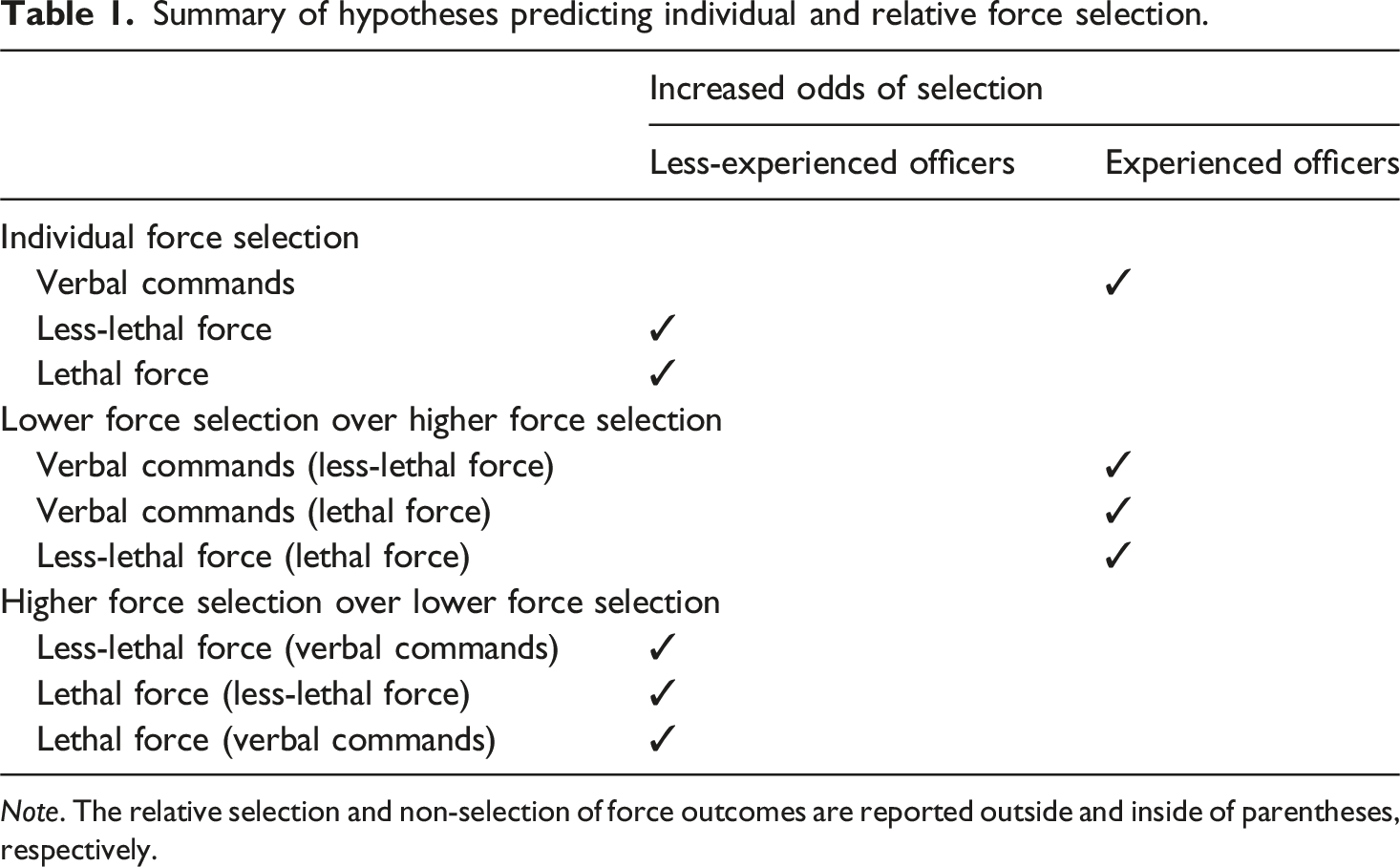
Note. The relative selection and non-selection of force outcomes are reported outside and inside of parentheses, respectively.
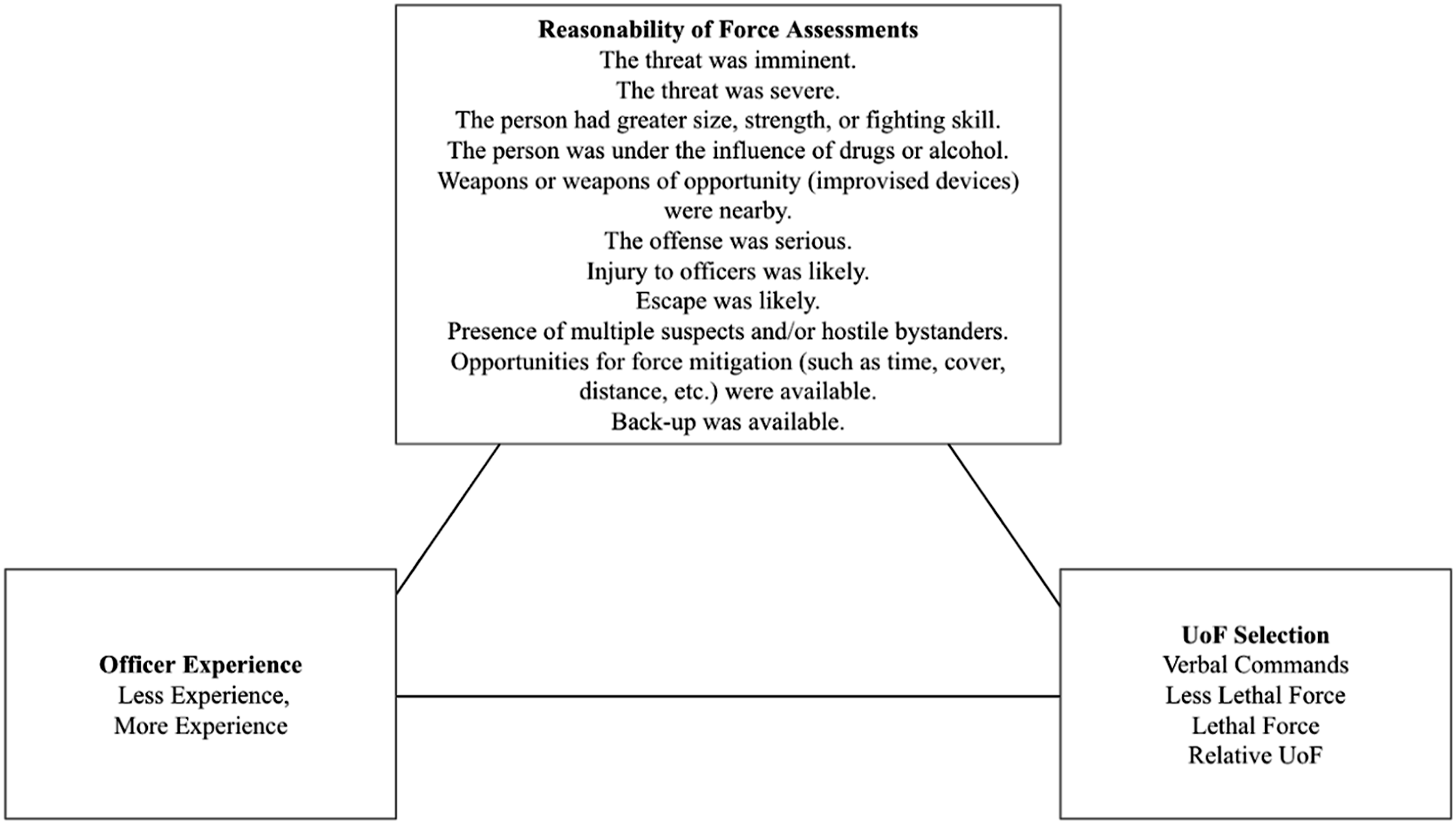
Reasonability-of-force assessments as mediators of the relationship between officer experience and each UoF selection outcomes.
Method
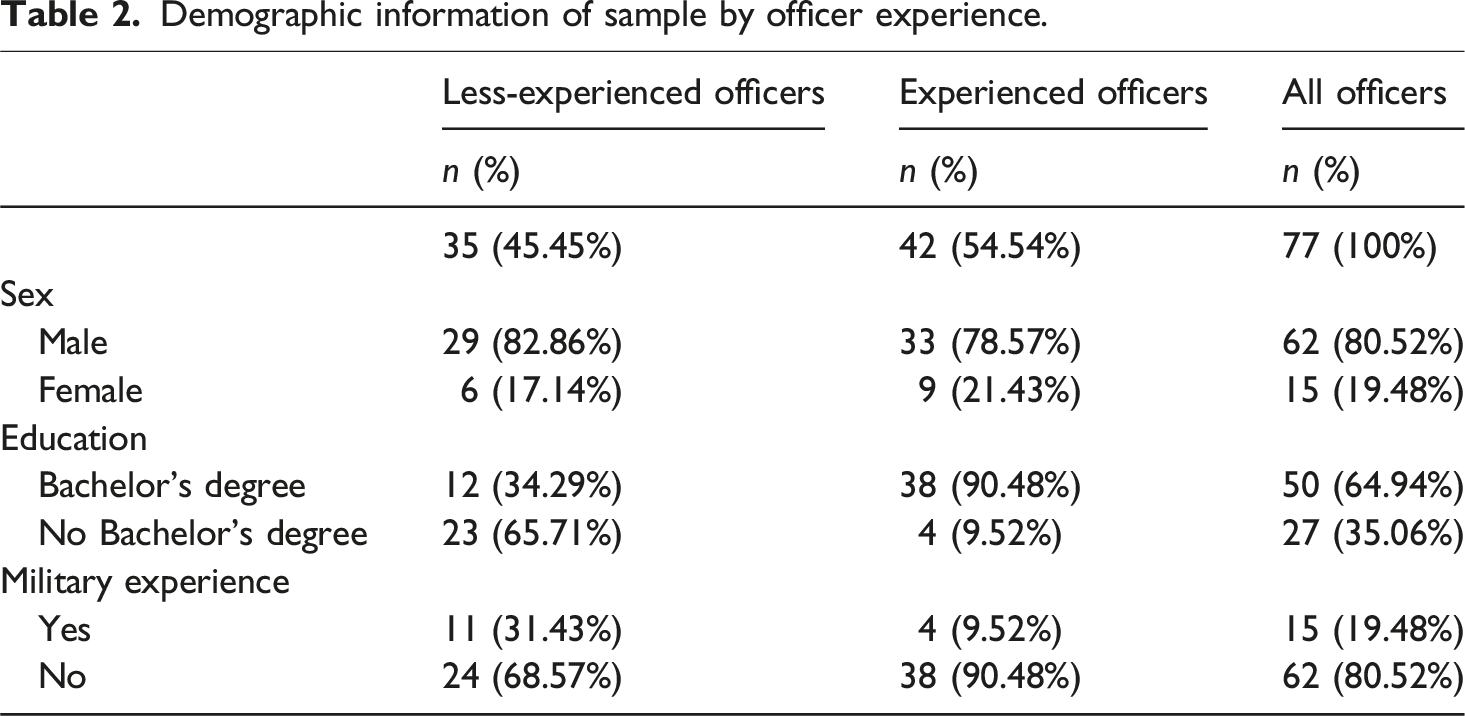
Participants
Demographic information of sample by officer experience.
Procedure of original study
Officers participated in a series of decision-making exercises via Qualtrics on desktop computers or laptops and were provided with headphones if they opted to complete the exercises in a group setting. After providing demographic information, officers observed five BWC videos, each depicting different police-citizen encounters in the USA. Prior to observation, officers were provided with a briefing and scenario description of each BWC video. Each video was temporally occluded at three different decision points. At each decision point, officers were asked the following question: If you were handling this situation, what would you do in the next few seconds? (Describe specifically what you would do if you were actually on scene). They were then prompted to type their response in the provided text box. The observed decision points were consistent across all scenarios and officers.
At the end of the third (i.e., final) decision point, officers rated the greatest level of resistance displayed by the subject in the BWC footage they had just watched and the degree to which the subject was a threat to the officer and other people. Officers also indicated the extent to which the following factors were relevant in determining the appropriate level of force: (1) the threat was imminent; (2) the threat was severe; (3) the person had greater size, strength, or fighting skill; (4) the person was under the influence of drugs or alcohol (5) weapons or weapons of opportunity (improvised devices) were nearby (hereafter referred to as “nearby weapons”); (6) the offense was serious; (7) injury to officers was likely; (8) escape was likely; (9) presence of multiple subjects and/or hostile bystanders; (10) opportunities for force mitigation (such as time, cover, and distance) were available (hereafter referred to as “available force mitigation”); and (11) backup was available.
Officers also answered additional questions that were not relevant to the current investigation. All survey questions, BWC videos, briefings, scenario descriptions, and decision point descriptions can be found at https://osf.io/wujkz/.
Procedure of current investigation
Officer responses were coded for force selection. In the first round of coding, an initial set of trained research assistants evaluated officer responses and coded them for force selection including verbal commands (n 1 = 330, n 0 = 716), less-lethal force (n 1 = 329, n 0 = 717), and lethal force (n 1 = 154, n 0 = 892). Less-lethal force included restraints (e.g., cuffs), less-lethal weapons (e.g., canine, oleoresin capsicum, stun gun, taser), and weaponless tactics (e.g., soft and hard hand control techniques). Lethal force included drawing one’s weapon, shooting one’s weapon, shooting a shotgun, and providing lethal cover. Codes were dichotomized such that a response was coded as 1 or 0 to indicate the selection or non-selection, respectively, of each force option.
Given that each response could include the selection of multiple force outcomes, responses were further coded to indicate the selection of a force option over another force option. This enabled us to compare the relative selection of higher and lower force outcomes between less-experienced officers and experienced officers. Because responses from experienced officers were expected to more frequently reflect the use of lower force levels over higher force levels, responses were further coded for: (a) selecting verbal commands over less-lethal force; (b) selecting less-lethal force over lethal force; and (c) selecting verbal commands over lethal force. Moreover, as responses from less-experienced officers were expected to more frequently reflect the use of higher force levels over lower force levels, responses were further coded for: (d) selecting less-lethal force over verbal commands; (e) selecting lethal force over less-lethal force; and (f) selecting lethal force over verbal commands. Outcomes reflecting the relative selection of one force option over another will also be abbreviated as “Force Selection (Force Non-selection)” for brevity. For example, the selection of verbal commands over less-lethal force would be abbreviated as “Verbal Commands (Less-Lethal Force)”.
In the second round of coding, a separate set of trained research assistants evaluated officer responses and coded them for relative force selections over another. Any coding discrepancies were resolved through discussions among the entire coding team until 100% agreement was met.
Results
Logistic mixed-effects models
The data were structured at the response level such that each row captured a single response to an individual question that was nested within a specific decision point, video, and officer. As such, a series of logistic mixed-effects models were conducted to predict UoF outcomes while accounting for the nested nature of the data. Officer experience was entered as a fixed effect and UoF selection was entered as the dependent variable. Officer gender, education level, and military service history were entered as covariates, as well as the subject’s resistance level, threat level, the specific decision point that each response corresponded to (decision points 1, 2, or 3), and the specific BWC video that each response corresponded to. Officers were included as random intercepts. All analyses were conducted using lme4 in RStudio (version 4.3.2; Bates et al., 2015).
The first set of models predicted the selection of each force action individually. Consistent with our expectations, less experienced officers—compared to experienced officers — had significantly lower odds of selecting verbal commands, OR = 0.51, SE = 0.31, p = 0.03. They also had significantly greater odds of selecting less-lethal force, OR = 2.01, SE = 0.29, p = 0.02, and lethal force, OR = 4.84, SE = 0.32, p < 0.001, than experienced officers.
The second and third set of models predicted lower force selection over higher force selection, and higher force selection over lower force selection, respectively. Regarding lower force selection over higher force, less-experienced officers demonstrated significantly lower odds of selecting verbal commands over less-lethal force, OR = 0.50, SE = 0.25, p = 0.004, and lethal force, OR = 0.37, SE = 0.29, p < 0.001, compared to less-experienced officers. Experience did not predict the selection of less-lethal force over lethal force. Regarding higher force selection over lower force, less experienced officers demonstrated significantly greater odds of selecting less-lethal force over verbal commands compared to experienced officers, OR = 2.59, SE = 0.33, p = 0.003. Less experienced officers also showed significantly greater odds of selecting lethal force over less-lethal force, OR = 4.13, SE = 0.35, p < 0.001, and verbal commands, OR = 4.82, SE = 0.37, p < 0.001, compared to experienced officers. All full model results are reported in the supplementary. We re-ran the analyses to determine whether the results were influenced by the simultaneous selection and non-selection of (a) verbal commands and less-lethal force, (b) verbal commands and lethal force, and (c) less-lethal force and lethal force. All results remained consistent except less experienced officers now demonstrated significantly lower odds of selecting less-lethal force over lethal force, OR = 0.32, SE = 0.45, p = 0.01.
Mediation analyses
A series of mediation analyses using lavaan in R (Rosseel, 2012) were conducted to determine if officers’ reasonability-of-force selection assessments mediated the relationship between officer experience and UoF selection (Figure 1). Covariates from the logistic mixed-effects models were also entered into the mediation models as covariates. For each mediation model, the indirect effect indicates the degree to which the predictor (officer experience) is linked with the potential mediating variable (reasonability-of-force assessments) as well as the degree to which the mediator is linked with the outcome (UoF selection). The direct effect indicates the degree to which the predictor is linked with the outcome controlling for the mediator, and the total effect indicates the degree to which the predictor is linked with the outcome not controlling for the mediator. Mediation is present when the indirect effect is significant. Inconsistent mediation occurs when corresponding indirect and direct effects have opposite signs and indicate that the direction of a given relationship depends on whether it is mediated by a given variable (MacKinnon, 2012).
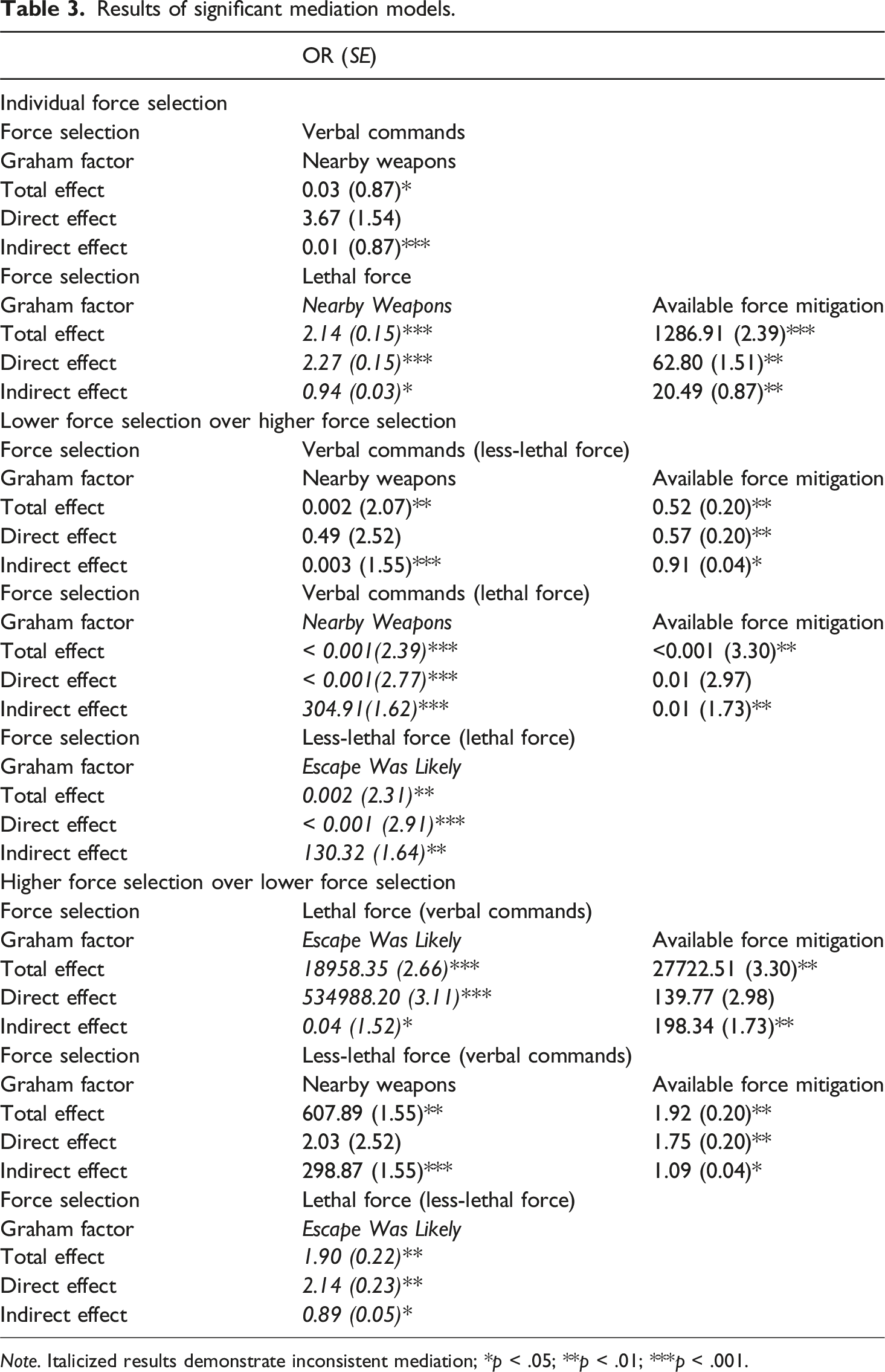
As summarized in Figure 2, three reasonability-of-force selection assessments significantly mediated the link between officer experience and UoF outcomes: nearby weapons, available force mitigation, and the subject’s likely escape. The significant mediation models are reported and grouped by those predicting: (1) individual force selection; (2) lower force selection over higher force selection, and (3) higher force selection over lower force selection (Table 3). Significant reasonability-of-force selection mediators of the link between officer experience and UoF. Inconsistent mediation is indicated with an asterisk (*). The relative selection of a force option over another is reported outside and inside of parentheses, respectively. Results of significant mediation models. Note. Italicized results demonstrate inconsistent mediation; *p < .05; **p < .01; ***p < .001.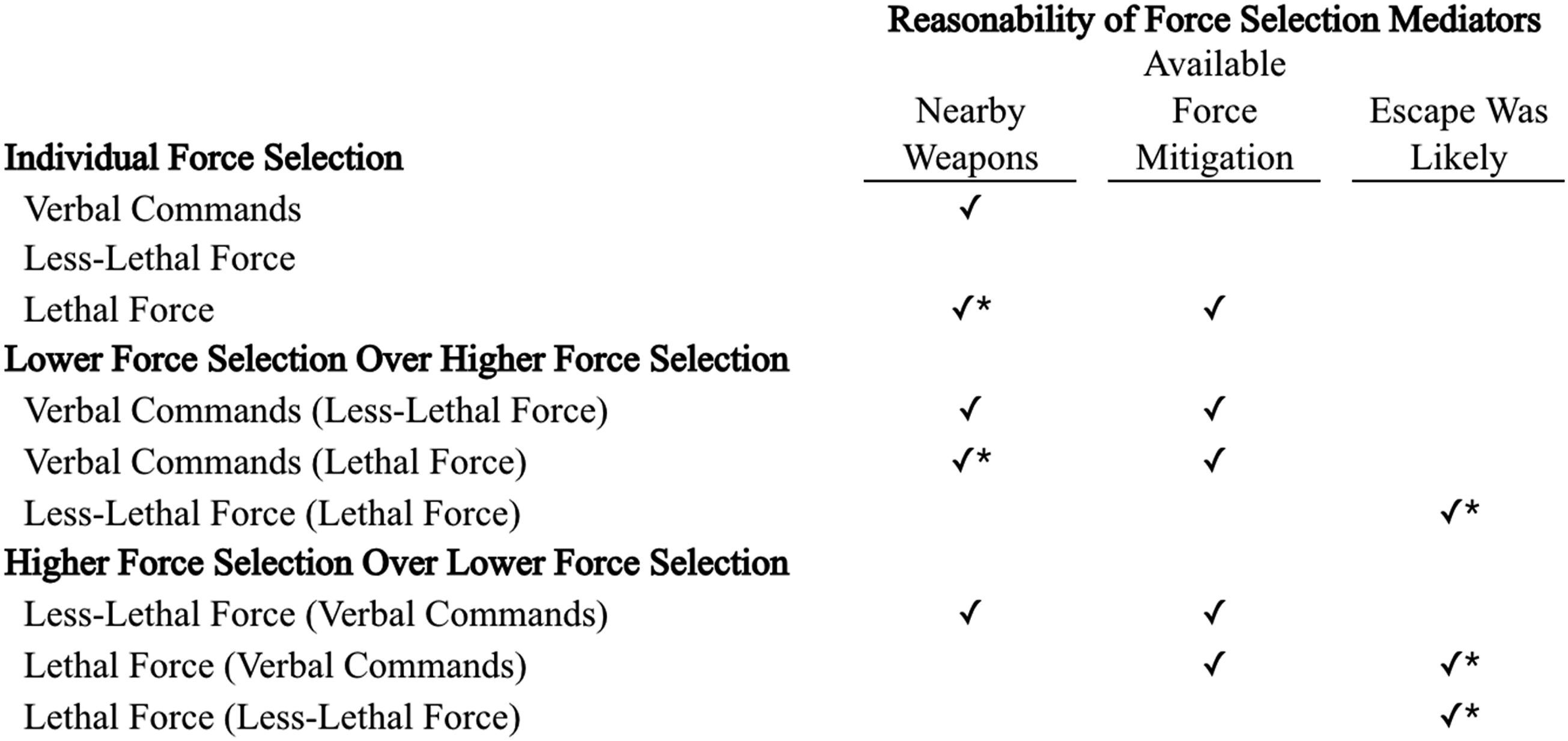
Individual force selection
Nearby weapons and available force mitigation were rated by experienced officers as more relevant in determining the appropriate level of force which, in turn, increased the odds of selecting verbal commands and decreased the odds of selecting lethal force, respectively.
Nearby weapons also inconsistently mediated the link between officer experience and selecting lethal force across two distinct pathways. In the first path, the indirect effect indicated that more experienced officers exhibited greater odds of selecting lethal force when nearby weapons were a relevant factor in determining the appropriate level of force. In the second path, the direct effect indicated that greater officer experience directly decreased the odds of selecting lethal force rather than indirectly influencing the selection of lethal force via nearby weapons.
Lower force selection over higher force selection
Nearby weapons and available force mitigation were rated by experienced officers as more relevant in determining the appropriate level of force which, in turn, increased the odds of selecting verbal commands over less-lethal force. Nearby weapons and the subject’s likely escape also inconsistently mediated the link between officer experience and selecting verbal commands over lethal force and selecting less-lethal force over lethal force, respectively, through two distinct paths. In the first path, the indirect effects indicated that experienced officers exhibited lower odds of selecting verbal commands and less-lethal force over lethal force when nearby weapons and the subject’s likely escape, respectively, were a relevant factor in determining the appropriate level of force. In the second path, the direct effects indicated that greater officer experience directly increased the odds of selecting verbal commands and less-lethal force over lethal force rather than indirectly influencing it via nearby weapons and the subject’s likely escape, respectively.
Higher force selection over lower force selection
Experienced officers rated available force mitigation as more relevant in determining the appropriate level of force which, in turn, decreased the odds of selecting less-lethal force and lethal force over using verbal commands. The same pattern also emerged for nearby weapons mediating the link between officer experience and the selection of less-lethal force over verbal commands. Last, the subject’s likely escape also inconsistently mediated the link between officer experience and selecting lethal force over verbal commands and less-lethal force. In the first path, the indirect effects indicated that officers with greater experience exhibited higher odds of selecting lethal force over verbal commands and less-lethal force when the subject’s likely escape was a relevant factor in determining the appropriate level of force. In the second path, the direct effects indicated that greater officer experience directly decreased the odds of selecting lethal force over verbal commands and less-lethal force rather than indirectly influencing it via the subject’s likely escape.
Discussion
We examined the link between officer experience and UoF selection and took a data-driven and exploratory approach to assess whether officers’ reasonability of selecting a particular force option mediated this link. Experienced officers were more likely to use verbal commands whereas less-experienced officers were more likely to use less-lethal force and lethal force. Experienced officers were also more likely to use verbal commands over less-lethal force and lethal force, and more likely to use less-lethal force over lethal force compared to less-experienced officers. This is consistent with previous studies showing that experienced officers generally use less and lower levels of force than less-experienced officers (Bayley and Garofalo, 1987; McElvain and Kposowa, 2004; Paoline and Terrill, 2004, 2007; Rydberg and Terrill, 2010; Terrill and Mastrofski, 2002).
While experienced officers were more likely to use less and lower levels of force, our results also reveal a more complex link between officer experience and UoF selection. UoF by experienced officers–specifically verbal commands and lethal force–was mediated by nearby weapons and available force mitigation. Nearby weapons pose a threat because “If a suspect wishes to seek harm against the police or another individual, they will most likely use their hands, either empty or with an object” (Huhta et al., 2022: p. 8). Subjects possessing or having access to nearby weapons during an encounter can be perceived as posing a threat to the safety of officers and the public. Elevated threat perception would increase the likelihood of using force or higher levels of force in general. Subjects in possession of a weapon are also more likely to have force used against them (McCluskey et al., 2005; Paoline and Terrill, 2007; Sun and Payne, 2004; Terrill and Mastrofski, 2002). In other words, the results suggest that experienced officers were more likely to use force when nearby weapons were present and relevant. In addition, when force mitigation opportunities were available, experienced officers were more likely to use verbal commands and less likely to use lethal force.
These results are consistent with literature on the markers of expert officer performance. Compared to officers with less experience, experienced officers can provide more accurate assessments of a situation and produce a greater number of predictions about what might occur (Zimmerman, 2008). They can also identify important cues and process information about a situation more rapidly than less-experienced officers (Boulton and Cole, 2016; Persky and Robinson, 2017). Experienced officers are more likely to select less and lower levels of force because they may be better able to identify a variety of ways to de-escalate potentially heated situations and mitigate the UoF. The ability to efficiently identify whether weapons are nearby or whether there are nearby objects that could be used as a weapon also provides them with valuable information to appropriately guide their decision-making for the situation at hand–whether it ultimately involves using force or not.
Notably, the use of less-lethal force by experienced officers was not mediated by nearby weapons or available force mitigation. This could suggest that situations in which nearby weapons or available force mitigation opportunities are relevant call for the use of either the lowest or highest level of force. On the other hand, the use of less-lethal force could be more complicated than verbal commands or lethal force and is therefore mediated by other factors that were not captured in the current study. Moreover, our measure of less-lethal force use encompasses a wider range of force options compared to verbal commands and lethal force. This may have introduced more error and yielded a more complex UoF measure that prevented any mediation effects from being detected.
Last, UoF by experienced officers–specifically less-lethal and lethal force–was mediated by the subject’s likely escape. Although experienced officers were more likely to use less-lethal force and not use lethal force, they appear to be more likely to use lethal force and not use less-lethal force when the subject’s escape was likely. Acts of resistance, such as escaping, remove an officer’s ability to control or regulate an encounter and this may subsequently facilitate the use of force or higher levels of force to regain control of the situation. The presence of subject resistance is a strong predictor of ensuing UoF (McCluskey et al., 2005; McCluskey and Terrill, 2005; Paoline and Terrill, 2004, 2007; Schuck, 2004; Terrill, 2003; Terrill et al., 2008). Subject resistance is an important aspect to consider for gaining a comprehensive understanding UoF selection, given that “...any inquiry concerning how officers use force is augmented by the inclusion of suspect resistance” (Terrill, 2003: p. 58).
Overall, differences in UoF selection between experienced and less-experienced officers appear to be a function of three reasonability-of-force factors: the officer’s assessment of whether force mitigation opportunities were available, whether any weapons were nearby, and the subject’s resistance. These factors persistently emerged as mediators and this pattern of results strongly implicates their role underlying UoF selection differences across officer experience. Another commonality across these factors is their connection to situations in which force is more likely to occur. Officers are more likely to use force when a subject is in possession of a weapon (Johnson, 2011; McCluskey et al., 2005; Paoline and Terrill, 2007; Rydberg and Terrill, 2010) and when a subject does not comply with officer commands (Johnson, 2011; McCluskey and Terrill, 2005; Rydberg and Terrill, 2010; Terrill et al., 2008). Force can also be more likely if force mitigation opportunities are not available. At first glance, this may indicate that factors increasing the likelihood of an officer using force against a subject influence how experienced and less-experienced officers make decisions regarding UoF. However, other reasonability-of-force assessments that were examined in this study have also been previously connected to situations in which force is more likely to occur (i.e. the seriousness of the offense, availability of back-up; Bolger, 2015) but did not emerge as mediators. As such, it is not clear what distinguishes these three reasonability-of-force assessments from the others in UoF decisions across officer experience. Further research is needed as the current study cannot answer this question. What is clear is that reasonability-of-force assessments contribute to the underlying UoF selection differences between experienced and less-experienced officers, specifically those pertaining to the availability of force mitigation, nearby weapons, and subject resistance.
To our knowledge, this study is the first to empirically examine and find evidence for the mediating role of reasonability-of-force assessments on UoF selection differences across officer experience. This opens a new pathway for researchers to assess and understand the skills and processes involved in expert UoF decision making. The results also contribute evidence-based insights for police UoF training to develop interventions that reinforce the fundamental processes involved in expert UoF decision making. For example, training could focus on cultivating skills that enable officers to more efficiently and effectively identify force mitigation opportunities, identify and eliminate potential weapons/weapons of opportunity early in an encounter, or gain better control of a resistant subject and decrease the likelihood of escape. The relevancy of various reasonability-of-force assessments could also be manipulated in training scenarios. Because experts are not always aware of or able to articulate the tacit knowledge that is fundamental to their decision making (Evans, 2008; Klein, 2017; Rolfe, 2005; Taylor et al., 2013), this could also be used to increase officers’ awareness of the underlying processes involved in their UoF decision making and how various factors (such as the subject’s likelihood of escape or whether there are nearby weapons) impact their UoF selection in different ways.
Strengths, limitations, and future directions
Our study has many strengths. We used an open-response format to collect officer responses regarding what they would do next if they were the officer on scene. As such, there were no constraints on how long or descriptive responses had to be. All officers in our study assessed the same scenarios at the same decision points which enabled a robust comparison of UoF differences between experienced and less-experienced officers. Rather than simply recording the highest level of force that was used in an encounter, all uses-of-force mentioned in a given response were recorded. This allowed us to capture the range of force outcomes an officer would use or would consider using in an encounter. Additionally, as we captured officers’ UoF selection(s) at multiple time points across each scenario, we were able to control for any possible time effects on officers’ UoF selection. We also controlled for officer gender, education level, military service history, subject resistance, and threat level.
Our study also has a number of limitations. Although officers observed a series of real BWC footage of different police-community member interactions, they are not necessarily representative of all scenarios that officers may encounter involving UoF. Thus, it is possible that our results may not generalize across all types of encounters. Future research should incorporate not only a larger volume of BWC footage but also a broader range of footage capturing diverse types of police-community encounters. Doing so would also increase the base rates of specific force types, thereby enabling researchers to examine distinct categories of force (e.g., restraints, less-lethal weapons, etc.) with greater statistical power. We were also not able to statistically control for other relevant officer characteristics such as age (e.g., Anderson and Gustafsberg, 2016; Paoline and Terrill, 2007) or race (e.g., Fridell, 2017), or other situational variables that may influence police behavior and decision-making such as threat imminence (e.g., Engel et al., 2020; Kahn et al., 2017) and threat physicality (e.g., Fridell and Lim, 2016; Terrill et al., 2016). Although threat imminence and physicality are similar to overall threat level and subject resistance (i.e., variables that were statistically controlled for in the current paper), respectively, they slightly differ in important ways. Subject resistance refers to the subject’s compliance with lawful authority whereas threat physicality refers to the physical danger posed by the subject’s attributes or actions. Threat level refers to overall severity or seriousness whereas threat imminence refers to how immediate and urgent the danger is. Moreover, we were not able to statistically control for department-level factors (e.g., department culture) in our analysis due to organizational tempo since our sample of experienced and less-experienced officers were from different agencies. Future research can address these issues by including videos depicting a wider variety of encounter types involving UoF, prompting officers to rate perceived threat imminence and physicality for every scenario and decision point, and collecting additional officer demographic information including age and race. Last, future research should also recruit a more representative sample of officers or recruit officers encompassing a broad range of experience levels from a single department to reduce potential confounding influences associated with departmental differences in culture, training, and organizational structure.
Conclusion
Overall, the present paper advances our understanding of the mechanisms that underlie differences in UoF decision making between experienced and less-experienced officers. By demonstrating that reasonability-of-force assessments—specifically assessments of nearby weapons, availability of force mitigation opportunities, and the subject’s likelihood of escape—mediate these differences, the findings offer critical insights into the cognitive and situational factors that influence expert police decision making. In addition to contributing to the broader literature on police expertise and UoF, the current paper also informs the development of targeted training interventions aimed at cultivating the specific assessment skills that underpin expert performance. Finally, these findings lay important groundwork for future research to further elucidate the pathways through which experience shapes appropriate and effective UoF decision making.
Supplemental Material
Supplemental Material - Reasonability-of-force assessments mediate the link between police experience and use-of-force decision making
Supplemental Material for Reasonability-of-force assessments mediate the link between police experience and use-of-force decision making by Vivian P. Ta-Johnson, Brian Lande, Joel Suss, Amelie Motzer, Zuzana Smilnakova, Isabella Swafford, Isabel Krupica, Sophie Rasof, Esther DeCero, Carolynn Boatfield, Xinyu Wang, Lauren Wright, Ceanna Loberg, Wiktoria Pedryc, Nilufar Imomdodova, Xianru Yu, Matías Fonolla in The Police Journal.
Footnotes

Funding
The authors disclosed receipt of the following financial support for the research, authorship, and/or publication of this article: This study is supported by the Bureau of Justice Assistance (BJA-2016-VI-BX-K005).
Declaration of conflicting interests
The authors declared no potential conflicts of interest with respect to the research, authorship, and/or publication of this article.
Data Availability Statement
The data that support the findings of this study are available on reasonable request from the corresponding author.
Supplemental Material
Supplemental material for this article is available online.
References
Supplementary Material
Please find the following supplemental material available below.
For Open Access articles published under a Creative Commons License, all supplemental material carries the same license as the article it is associated with.
For non-Open Access articles published, all supplemental material carries a non-exclusive license, and permission requests for re-use of supplemental material or any part of supplemental material shall be sent directly to the copyright owner as specified in the copyright notice associated with the article.
