



Abstract
Hate crime has an extremely detrimental impact on victims and minority communities. Despite this, the policing response is oft criticised and investigations are characterised by high levels of victim withdrawal. Consequently, offenders are rarely prosecuted. This exposes victims to elevated risk of repeat victimisation and undermines trust in communities with historically limited confidence in the police service. This study reports on a randomised control trial testing whether Secondary Reassurance Contact (SRC), a follow up from a neighbourhood police officer not connected with the investigation, can reduce victim withdrawal of support for a prosecution (attrition) in hate crime investigations. Findings indicate that SRC results in a 12–15% reduction in victim withdrawal. The practical implications are considerable and if scaled nationally SRC may result in tens-of-thousands fewer victims withdrawing support for hate crime investigations each year. SRC therefore offers police decision-makers a tangible and deliverable option to improve hate crime outcomes and to bolster confidence amongst minority communities.
Introduction
There is limited international consensus on what constitutes ‘hate crime’ (Garland and Funnell, 2016). However, a focus on groups with specific characteristics is consistent across efforts in most jurisdictions to legislate in this sphere (Chakraborti, 2014). In England and Wales the legalistic definition of hate crime, is any criminal offence which is perceived, by the victim or any other person, to be motivated by hostility or prejudice towards someone based on- race, religion, disability, sexual orientation or transgender identity (CPS, 2022). The law in the UK enables enhanced redress for example aggravated sentences, for offences motivated by or demonstrative of ‘hate’ towards these specific groups.
Definitional difficulty (Garland, 2012) and a normative desire to apply hate crime laws to a broad set of practical circumstances has resulted in a number of individual efforts by police forces in England and Wales to operationalise the recording and investigation of hate in often isolated and unique ways (BBC, 2021; Garland and Hodkinson, 2014). The College of Policing (2020) have sought to achieve uniformity by way of national guidance intended to guide forces in the identification, recording and investigation of hate crime. Translating this to practice has not proven to be straightforward with the advocated approach being subject to legal challenge and subsequent amendment (Lloyd, 2022).
Impact
Despite lack of clarity in this area it is posited that hate crime, with its basis in bias, has a considerably more detrimental impact on victims than equivalent non-bias based offending (Iganski, 2001). Victims of hate crime report considerably elevated feelings of loss of confidence, vulnerability, and psychological and physiological side-effects of victimisation (Allen and Zayed, 2022; Williams and Tregidga, 2014). Further, hate crime has a deleterious impact on the wider community (Hall, 2005). It constitutes a ‘signal crime’ (Innes, 2014) impacting negatively on broader perceptions of crime and feelings of safety (Shirlow et al., 2013). Others who are not directly impacted but share the characteristics that were the basis for the targeting of the victim may feel a sense of fear and vulnerability (IACP, 1999). In this way hate crime may be considered pervasive beyond those directly targeted and their associates. Despite this invasive impact on individuals and communities hate crime is grossly underreported (Pezzella et al., 2019) which perhaps limits both understanding of such offending and adequacy of the response.
Minority communities in particular, with habitually lower levels of trust and confidence in the police (Barrett et al., 2014; Madon et al., 2017), are disproportionately impacted by hate crimes. Improving the policing response to hate crime is considered key to securing trust and confidence in those communities that are disproportionately impacted (Chakraborti, 2009a). This is of particular importance given deteriorating public confidence in policing (Brunt, 2023) and frequent discontent at the state response to issues that disproportionately impact minority communities (Bowling et al., 2008).
Victim attrition
The majority of case attrition in the criminal justice lifespan occurs during the police investigative process (Murphy et al., 2022). This is in large part owing to the concept of ‘victim withdrawal’ that is victims deciding that they no longer wish to support the progression of a case through the criminal justice system (Hohl and Stanko, 2015). The literature speaks to prevalence of victim withdrawal amongst non-hate crime types (Davies and Westcott, 2006). There is however a particular preponderance of withdrawal amongst crime types that are inherently personal and intrusive, to include rape (Hansen et al., 2022), other serious sexual offences (Dalton et al., 2022) and domestic abuse (Cretney and Davis, 1997; Sleath and Smith, 2017).
Victims of hate crime report feeling let down by police insensitivity or lack of progression following initial reporting (Williams and Tregidga, 2013). Bowling (1999) found that inaction, failing to keep the victim informed and not appearing to care, were common causes of victim dissatisfaction in hate crime investigations. Hate crime investigations currently take more than twice as long to complete as comparable non-hate crime offences (Allen and Zayed, 2022). Consequently, victims that report hate crime are less satisfied with the response than victims of crime generally and additional focus on responding to the needs of victims is advocated (Walters et al., 2016). With extended periods of investigation and dissatisfaction with the service provided, comes elevated risk of victim attrition with victims withdrawing their support for the investigation (Burman and Brooks-Hay, 2021; Hudson and Paterson, 2020).
Hagerlid and Granström (2023) identified this inability to secure victim ‘cooperation with the investigation’, oft linked to limited trust amongst minority communities, as a key problem with hate crime investigations. Consequently, victims withdrawing support for an investigation by retracting the allegation made, refusing to provide evidence or declining to attend court are prevalent reasons for unsuccessful hate crime prosecutions (Walters et al., 2017).
Responses to secure victim support
Policy makers and law enforcement have, following a range of reviews, sought to find solutions to minimise the risk of victim withdrawal during the investigative process (Hohl and Stanko, 2015; McGuire et al., 2021). This has predominantly drawn upon a victim-centred approach that seeks to promote the needs of the individual victim above, or at least to achieve parity with, the aims of the criminal justice system in achieving prosecutions and convictions (McPhee et al., 2022).
This focus on enhancing victim support and catering for individual victim needs throughout the investigative process are most apparent in the spheres of domestic and sexual abuse. Independent Domestic Violence Advisers (IDVA) are provided in domestic abuse cases. They sit outside of the investigation and their core role is to support and advocate for the victim (Safelives, 2024). McPhee et al. (2022) found that in cases where IDVA support was available arrest, charge and conviction were more likely. Albeit, Ross et al. (2022) found adverse consequences to include repeat victimisation, increased harm and lower conviction rates following IDVA provision at court only. Perhaps this indicates the perils of viewing victim-centred support as a means to support victims at the end of the process only, rather than throughout the criminal justice life course.
Similarly, Independent Sexual Violence Advisers (ISVA) were implemented as a policy response to support victims in sexual offence cases. ISVA support to victims is considered essential to secure their ongoing support and progression of cases to conviction (Hester and Lilley, 2015). Victim-centric approaches, as exemplified by IDVA and ISVAs, with overt focus on responsiveness to individual victim needs, rather than the requirements of the criminal justice system, are considered vital to indirectly secure victim support for prosecution (HMICFRS, 2021) and optimal opportunity for criminal justice outcomes (Hester and Lilley, 2018).
Secondary responder programmes are follow-up visits by police (often in conjunction with support agencies) to victims subsequent to their having reported a crime. They aim to offer support to victims in the immediate aftermath of offending (College of Policing, 2015). In the context of domestic abuse, this approach was found to increase victim reporting and uptake of services, perhaps indicative of increased victim satisfaction and confidence (Davis et al., 2008; Petersen et al., 2022).
Victim support- positive outcomes and deterrence
Victim support for the investigative process has consistently been demonstrated to be a key predictor of case progression (Anders and Christopher, 2011; King and Growette Bostaph, 2024) and positive criminal justice outcomes (McFadzien et al., 2020). Inability by law enforcement to secure victim support for hate crime investigations is therefore extremely limiting when it comes to achieving positive criminal justice outcomes for example conviction. It may go some way to explaining why charge and conviction rates for hate crimes are particularly low (Chakraborti, 2018). This is problematic as such outcomes may be key to prevent harm to the victim or others who share the characteristics that have been targeted by the perpetrator. By limiting the viability of prosecution in hate crime cases, preventative incapacitation (Robinson, 2019) is somewhat undermined. This is of particular import in cases perpetrated by ideologically motivated offenders rather than those who may have committed hate-based offending in specific contextual situations (Iganski et al., 2011). Inability to exert legal control over motivated offenders in such cases may place victims at risk given elevated levels of repeat victimisation in the context of hate crime (Corcoran et al., 2016).
Similarly, victim support for prosecution is a key determinant of suspect arrest (Richards and Harinam, 2020). This is of relevance to the concept of specific deterrence (Maxwell et al., 2002; Sherman and Berk, 1984) generated predominantly from the certainty of punishment (Grogger, 1991). Arrest is perhaps the most obvious and visceral representation of this certainty. Nagin (2013) suggests that more specifically it is certainty of ‘apprehension probability’ that is the likelihood of being caught, rather than necessarily certainty of suffering subsequent legal sanction, that serves to deliver deterrence. With certainty of apprehension being key to prevention and victim support for prosecution being crucial to facilitate said apprehension, it is apparent that bolstering victim support is necessary to deter future hate crime victimisation.
Importance & gaps in the evidence-base
Recorded hate crime has seen considerable increase in recent years (Home Office, 2022). It is posited that societal changes to include COVID (Olajide, 2022), internet access (Chan et al., 2016) and terrorism (Hanes and Machin, 2014) have driven hate crime prevalence. Of note a number of factors of particular contemporary relevance to include economic instability and political capitalisation on anti-immigrant sentiment serve to fuel hate crimes (Chakraborti, 2018). In England and Wales, 93% of hate crimes reported do not result in a suspect being charged or summonsed to court and victim withdrawal of support is by some way the most common outcome in cases that do not progress via the criminal justice system (Home Office, 2023). It is considered that this failure to secure victim support, a key predictor of arrest and prosecution means that victims are at risk from further offending, especially given elevated levels of repeat victimisation with hate crimes.
It is noted that despite increasing prevalence and high levels of victim attrition, there is limited empirical research that directly tests specific police responses to hate crime. The majority of the hate crime literature considers: the broad policing challenges against the historical context (Chakraborti, 2009b); public attitudes towards hate crime (Bacon et al., 2021); descriptive work detailing how various guises of hate crime manifest (King and Sutton, 2013) and police officer and force perspectives on dealing with hate crime (Trickett and Hamilton 2016).
There has to date been no empirical assessment of tactics adopted by the police in an effort to secure victim support for investigation and prosecution. Consequently, potentially analogous empirical research is drawn upon. This is derived predominantly from efforts to secure victim support in the context of domestic abuse and sexual offences. This dearth of empirical assessment of specific interventions applied to hate crime is perhaps reflective of the comparative infancy of hate crime scholarship in the UK (Chakraborti, 2009b). This gap in the literature is remiss and Walters et al. (2016) suggest that given few hate crime interventions are evidence-based, researchers should work to undertake robust evaluations of programmes in this space.
Criticism of the police response to hate crime suggests that failure to secure victim support is in part because victims oft do not feel listened to, do not consider their report is being taken seriously and are not treated with due empathy. This manifests in the perception of the criminal justice system as ‘slow, intimidating and incomprehensible’ (Chakraborti, 2018). Key then to ensuring victim satisfaction is a timely and appropriate response that demonstrates that the matter is being taken seriously (Williams and Tregidga, 2013). Kielinger and Paterson (2007: 203) noted that police services need “to be aware of the connection between improving the quality of their investigation and providing reassurance to the individual victims of hate incidents”. Put simply, the policing response must take steps to reassure victims, secure their support and by extension optimise opportunities to identify and deal with offenders (Iganski et al., 2005). If realised, this would further bolster victim confidence by addressing another prominent frustration amongst hate crime victims: failure by the criminal justice system to bring offenders to justice (Chakraborti, 2018).
Intervention
Given limited extant evidence on effective means for police to prevent victim withdrawal of support for hate crime investigations, we sought to address this gap. Upon reviewing potentially analogous interventions utilised in relation to other crime types, secondary responder programmes in the context of domestic abuse were noted to increase victim reporting and uptake of services, perhaps indicative of increased victim satisfaction and confidence (Davis et al., 2008; Petersen et al., 2022). Consequently, we resolved to test whether a similar secondary response following report of hate crime served to increase victim satisfaction and accordingly reduce victim withdrawal of support in the investigative process.
Methodology
This study was undertaken within the UK’s largest police service, the Metropolitan Police Service (MPS). A randomised control trial (RCT) method was used. Sample size was determined by way of a priori power analysis (Vo and James, 2012), using G*Power (Faul et al., 2009). In line with convention this aimed to ensure statistical power >.8, at significance level p < .05 (Lacey 2012; Vo and James 2012). Based on this sample size n = 250 was determined.
All hate crimes reported on South West Basic Command Unit (SW BCU) were identified from the application of a hate crime flag on the MPS crime recording system (CRIS). 250 reports were randomly assigned to treatment (secondary reassurance contact) or control (no secondary reassurance contact/ordinary service). This was done using a random number generator to randomly assign treatment/control to the rows 1-250 of an excel spreadsheet. As cases entered the experiment by way of a ‘trickle flow’ process (Ariel et al., 2022) they were added to the spreadsheet in chronological order to said numbers 1-250. Consequently, they were assigned to the treatment/control condition randomly associated with that number. In this way 125 case were assigned to each condition. These cases were drawn from the period October 2022 – January 2023.
If a case was assigned to receive secondary reassurance contact it was referred for a visit to the relevant neighbourhood policing team corresponding with the victim’s home address. Referral was achieved via CRIS notification (code added to bring crime to the attention of neighbourhood policing teams with relevant geographical responsibility) and follow-up via email to the relevant officers. Officers completed the contact and noted completion on the CRIS.
Variables
Independent variable
The piloted intervention (coined ‘secondary reassurance contact’ (SRC)) was contact from a local neighbourhood police constable or Police Community Support Officer (PCSO) with geographic responsibility for the area that the victim lived in. This took place either in person or via phone depending on the circumstances and victim wishes. This was distinct and separate from any contact from officers investigating the reported offence. This form of contact in these circumstances does not habitually take place within the MPS. Ordinarily the only contact a victim receives is from the officer investigating the reported offence. Evidence suggested that key to maintaining victim support is demonstrating an understanding, supportive approach that is flexible to victim need (Farrell and Lockwood, 2023). This is what the SRC aimed to do. To recognise what had happened to the individual, to acknowledge the impact and to demonstrate that the police service took it seriously and was committed to assist.
Given the broader impact of hate crime on the community and the inherent link with trust and confidence we sought to situate delivery within pre-existing neighbourhood policing teams (Longstaff et al., 2015) embedded within communities. The officers delivering the SRC were given loose guidance that primarily focused on provision of reassurance to victims. A conscious decision was made not to be overly prescriptive regarding the format or content of the SRC. This endeavoured to ensure the contact was victim-led, responsive to victim need and to allow officers to use their discretion to bring their local contextual knowledge and relationships to bear. It is accepted that this limits the ability to speak to the precise mechanism behind any effect.
Dependent variable
The aim was to determine whether the SRC impacted on victim attrition. Did the victim remain supportive of the investigation throughout? Victim attrition was considered to have occurred when a case concluded with ‘outcome codes 14 or 16’- this is when a case is closed on the basis that the victim does not support police action. Where a case was closed using any other outcome code, the case was counted as there not having been victim attrition. Outcome codes referenced are determined by the Home Office (see Table 2.1 in Home Office (2023) for details). Outcome codes for specific offence investigations were derived from the MPS crime recording system (CRIS). This allowed for binary coding of each case as ‘victim attrition’ or ‘no victim attrition’.
CRIS was used to monitor and extract the following: (1) Whether or not SRC had been delivered for each case in the treatment group. If contact was not made an escalation process was followed through the relevant officer’s supervisory structure. (2) Whether or not SRC had not been made for each case in the control group. (3) The outcome code for each case.
This data was then used to conduct the analysis detailed below.
Implementation
Senior agreement and buy-in was considered necessary to signal organisational importance and to facilitate effective implementation. Initial discussions were undertaken through the SW BCU Hate Crime Improvement Group and agreed with the neighbourhood strand Senior Leadership Team. It was considered that buy-in and understanding of the officers delivering this pilot and their supervisors was key to effective implementation. Officers and supervisors were briefed via email and this was followed with a number of online, interactive sessions.
The following are relevant points from officer briefing: • Officers were not briefed prescriptively regarding how they should approach the contact or what they should discuss. The aim was to test the effect of the contact itself. It was also considered that this allowed the officers to adapt to the specifics of the case and victim. The only suggested actions were completion of risk assessment and support referrals, if this had not already been completed. • It was suggested that in person contact was preferable but that the wishes of the victim should be followed so some contact was likely to take place by phone. This was considered preferable to insisting on in person contact as in some cases it may be contrary to victim’s wishes or place victims in unintended difficult situations/danger. • Whilst separate from any ongoing investigation it was considered prudent to give some direction on what neighbourhood officers should do if a victim wished to provide a statement etc. This was included in the briefing.
Briefings and launch were timed to coincide with National Hate Crime Awareness Week in order to build momentum.
Treatment delivery
The intention was to deliver SRC to 125 cases, 50% of the total sample. Treatment was considered to have been delivered if officers recorded on CRIS that they had spoken to the victim in person or over the phone. ‘Not treated’ included when officers did not endeavour to make contact and when they did try to contact the victim but could not make contact in any way that the victim could conceivably have been aware of. ‘Treated’ and ‘not treated’ were defined in the same way for both treatment and control groups.
Treatment fidelity
In the treatment group 60% of non-excluded cases were treated. The pilot failed to deliver the treatment in 40% of cases. Of the non-excluded cases in the control group there was 98.4% fidelity. Incorrect contact or treatment cross-contamination occurred in less than 2% of cases.
Analysis
Exclusion criteria
Sample post-exclusion.

Analytical approach
The failure to deliver treatment to 40% of the treatment condition cases causes considerable issues in drawing causal conclusions. Consequently, due consideration was given to the optimal analytical approach to mitigate against incomplete treatment delivery.
‘Intention-to-treat’ analysis (ITT) involves analysis of all cases in their intended treatment/control group, irrespective of whether they received the relevant treatment. The strength of this approach is that it maintains the benefits of randomisation- namely the equivalence of groups and mitigation of confounding variables. It has particular use in medical trials when subsets of patients with certain characteristics may be more likely not to comply with treatment. It demonstrates what is likely to happen in practice. However, it involves analysing the 40% of treatment cases where a SRC wasn’t delivered (and to a much lesser extent the <2% control cases where it was) within the intended group. This involves including cases to assess whether the intervention had an effect when there is no conceivable mechanism explaining how it could given the intervention wasn’t actually delivered. This likely underestimates any magnitude of treatment effect in the case that SRC was effective at delivering improved outcomes.
Conversely ‘As-treated’ analysis (AT) includes all cases but they are analysed as per the treatment they actually received. The weakness of this approach is that it works contrary to the randomisation process, the basis of the RCT. Equivalence of groups is compromised. Whilst there are no obvious differences between cases where treatment should have been delivered and was, and those where it should have been delivered but wasn’t, there is no way to know for sure. Using this method may conceivably, in certain cases introduce bias and give the impression of causation where none exists (McCoy, 2017). Results should therefore be interpreted with caution.
Lee et al. (1991) detail the significant benefits of ITT when compared to a treatment analysis. However, of importance, this study isn’t analogous to assignment of a medication. In that case non-compliance often relates to subject/patient decision-making. Patients who comply with treatment regimens and those who do not may differ with regard to certain characteristics that also impact the outcomes measured (Smith et al., 2021). A significant confounding factor skewing the results obtained. However, in this study, when non-compliance was explored it overwhelmingly related to officer implementation that is officers not attempting the SRC, rather than trying to deliver it and being unable to contact victims or victims declining the contact. The vast majority of cases that were not treated, despite being randomised to treatment condition, had little to do with victim choice. This reduces (but does not eliminate) the likelihood of differential characteristics between compliant/not compliant cases when compared to other contexts.
Hernán and Robins (2017) discuss the risk of failing to identify significant effects by over-reliance on ITT in pragmatic trials when poor adherence to treatment condition is attributable to a factor that could be readily controlled in a clinical setting for example easily treatable side-effects. It is arguable that this is analogous to officer compliance in the case of SRC: in a fully operational setting officer compliance can be mandated at a force policy level. Another point of differentiation between this and a medical context (as well as many others) relates to defining whether or not treatment has been delivered. It may be problematic to utilise treatment analysis where treatment is a matter of degree for example number of doses, with partial compliance. That is not the case in this study with SRC constituting a singular, discrete, easily measurable contact.
In summary, it can be said that ITT assesses the impact of assigning a secondary reassurance contact and AT the impact of receiving it (Smith et al., 2021). The aim of this study was to assess the impact of receiving the contact and for the reasons detailed above AT is not considered wholly inappropriate. ITT will be reported and analysed given it is the preferred default method as it reduces bias and reports what actually happened from assignment (Lee et al., 1991). AT will also be reported as it speaks to any impact of actually receiving a SRC (Ellenberg, 1996). Gyani et al. (2023) discuss the validity of this approach to optimise robustness where treatment fidelity is weak but can be readily improved in an operational environment.
Analytical methods
Intention-to treat.
Results
Intention-to-treat
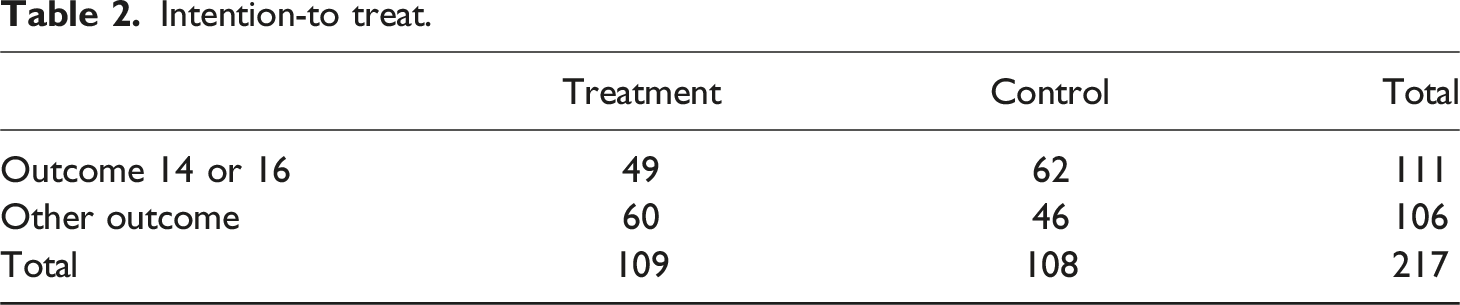
Intention-to-treat outcomes are as per Table 2. A chi-square test of independence was performed to examine the relationship between secondary reassurance contact and recording of outcome 14 or 16. Chi-Square statistic is χ2 (1, N = 217) = 3.367, p = .066. and the corresponding Cramer’s V = 0.12, which indicates a small effect size.
Absolute risk of victim attrition in the treatment group is 0.45. Amongst those assigned to control group the absolute risk is 0.57. The Relative Risk is 0.78. The risk of victim attrition is reduced by 22% in the treatment group relative to the control.
As-treated.
As-treated
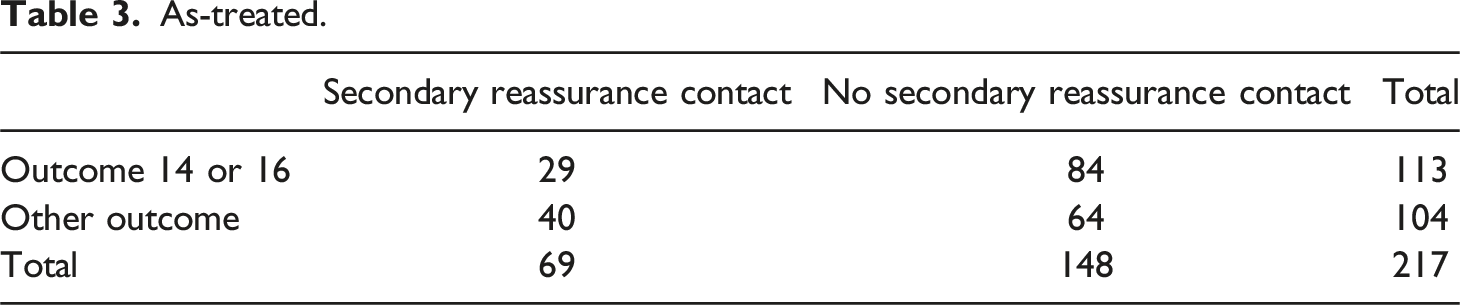
As-treated outcomes as per Table 3. A chi-square test of independence was performed to examine the relationship between secondary reassurance contact and recording of outcome 14 or 16. Chi-Square statistic is χ2 (1, N = 217) = 4.09, p = .043 and the corresponding Cramer’s V = 0.14, which indicates a small effect size.
Absolute risk of victim attrition in those who received secondary reassurance contact is 0.42. Amongst those who did not receive victim contact the absolute risk is 0.57. The Relative Risk is 0.74. The risk of victim attrition is reduced by 26% in the treatment group relative to the control.
Based on this it is estimated that NNT is 6.8. For every 6.8 cases that received secondary reassurance contact, instead of the business as usual response it is anticipated that one fewer case would suffer from victim withdrawal.
Discussion
Limitations and areas for future research
Before considering the policy implications of the findings, it is important to recognise the limitations of this study and to consider how future endeavours may seek to address these. The primary limitation is the poor compliance within the treatment group. It must be acknowledged that this and subsequent marginal failure to reach significance with ITT analysis mean that the internal validity of the findings must be treated with caution. Consequently, future studies seeking to augment these findings may benefit from a concerted focus on implementation, perhaps running a pre-trial phase to embed the practice and drawing on the implementation literature (Fixsen et al., 2005; del Pozo et al., 2024).
It should also be highlighted that this study is based on a small sample of hate crimes drawn from one area, within a single police force, over a short time-period. It cannot therefore be assumed to have external validity and to be generalisable. Larger replications across geography and time would be beneficial to give police leaders and policy-makers confidence that the findings would hold true when applied elsewhere.
Similarly, given this study was not prescriptive about the specific approach officers took when conducting a SRC it cannot speak, to any degree of specificity, on differential effects of differing approaches for example contact in person versus contact by phone etc. This may mean that the outcome differs dependant on the approach of the officers tasked with delivering SRC. Future efforts may wish to be more prescriptive with a view to testing whether different mechanisms of delivery have differential impact. It may also be possible to test SRC in a much more granular way. This could include assessing differential impact on different forms of hate crime for example racial, disability etc. The form of the SRC itself could also be built upon and tested for example joint deployment with third sector support groups etc. By testing various iterations, it may be possible to speak to optimisation of the SRC in a way this study cannot.
Finally, this study tests whether SRC reduces victim withdrawal. As mentioned reducing victim withdrawal is not considered an end in its own right. Rather, it is considered a proxy for victim satisfaction with the police response and as a mechanism to improve criminal justice outcomes. Future studies may seek to test the relationship between SRC and satisfaction directly. This would require a direct survey or similar with hate crime victims. This was not possible with this study. Similarly, the impact of SRC on charge (or other positive outcome) rates could be assessed. Given the relative rarity of suspects being charged it was not possible to do this meaningfully within the limits of this study. A much larger number of cases than were available in this study would be needed to achieve suitable power in order to detect any effect.
Implications
Limitations notwithstanding, it is considered that there are considerable implications for policy and practice from the findings of this study. There was a negative association between SRC and victim withdrawal that is SRC was associated with victims remaining supportive of the police investigation. This association was statistically significant in the as-treated analysis and only marginally failed to reach significance in the intention-to-treat analysis despite poor treatment delivery. The effect size was meaningful. Within the sample, victims withdrew support for the investigation when a case was assigned a SRC in 42–45% of cases. Comparatively, victims withdrew support for hate crime investigations in the case of business as usual in 57% of cases. This is a reduction of victim withdrawal of between 12 and 15 percentage points with SRC.
This effect size has practical significance. 145,214 hate crimes were recorded in England and Wales in 2022-23 (Home Office, 2023). If SRC was scaled nationally and similar effects were noted across geographies, a 12-15 percentage point reduction would equate to approximately 17,425-21,782 fewer victims withdrawing support for hate crime investigations each year. When considered in the context of the literature, this insight may be instructive for policy makers when considering potential implications for trust and confidence amongst minority communities and the potential implications for improving victim experience and criminal justice outcomes in relation to hate crime.
Findings estimate that for every 6.8-8 victims of hate crime that receive a SRC, one additional case would retain victim support that would have been withdrawn were it not for SRC. Against the backdrop of competing demands so prevalent in the context of contemporary law enforcement (Ludwig et al., 2017), this provides some insight into the potential resources required from police forces to deliver this service and the return on that investment.
On the subject of cost-benefit, it is worth noting that during this trial SRC was completed using existing processes and without additional budget that is officers completed SRC within their ordinary working hours. Therefore, when considered alongside the reduced victim attrition it could be argued that SRC represents a cost effective and efficient use of police resources to maintain victim engagement in hate crime investigations. Whilst it is conceivable that the failure to deliver SRC to such a high proportion of the treatment group may be indicative of insufficient capacity, it is of note that since this trial was conducted the policing area in question is now delivering SRC for hate crime as part of business as usual. This has seen close to 100% delivery based on full incorporation into staff daily working routines and an updated computer system that enables direct tasking. Nonetheless adequate capacity is something that police leaders must consider if seeking to further test or implement SRC.
Conclusion
This study sought to begin addressing a gap in the extant evidence-base, namely whether direct police practices could serve to reduce the considerable victim attrition in hate crime investigations. Not only is this failure to secure victim support indicative of low levels of trust in policing amongst vulnerable minority communities but it is well documented in the solvability literature as a barrier to identifying offenders and bringing them to justice. The specific practice assessed is secondary reassurance contact (SRC), an additional victim contact by neighbourhood officers intended to reassure the victim and demonstrate that the police are taking the report seriously.
This study found that there is a 12–15% reduction in victim attrition in hate crime investigations when a SRC is made by a police officer/PCSO outside of the investigation. This may offer police leaders and policy-makers an evidence-base on which to increase victim satisfaction with the policing response and by extension to ameliorate low levels of trust in policing within minority communities. Further, SRC may provide a practical means, within the gift of police leaders, to increase positive criminal justice outcomes bringing more offenders to justice. To this end, findings that SRC serves to reduce victim attrition can reasonably be described as promising. Whilst further research is required to bolster the internal and external validity of findings, this study should as a minimum justify further exploration of how SRC may be optimised and whether it may also serve to reduce victim withdrawal in other crime types that suffer from high attrition levels.
Footnotes
Declaration of conflicting interests
The author(s) declared no potential conflicts of interest with respect to the research, authorship, and/or publication of this article.
Funding
The author(s) received no financial support for the research, authorship, and/or publication of this article.
