




Abstract
Modern policing is faced with a rapidly changing landscape which continues to present new challenges and opportunities to policing (NPCC, 2015). With limited resources, it is hoped policing education will support police services to deal with these challenges through embedding evidence-based practices (Mitchell and Lewis, 2017). The large number of new recruits from the police uplift provides an exciting opportunity to incorporate these practices into operational policing (Lum and Koper, 2017; Pepper et al., 2020). The purpose of this study was to investigate evidence-based research projects produced by student police officers and explore whether they provide knowledge that is relevant and embedded into policing practice. Using qualitative methods data was gathered from key informants and graduates from the University of South Wales' five established police partners in England and Wales. The findings identified that knowledge from the projects was being disseminated within the police organisations, and that student police officers were informally applying evidence-based knowledge they had gained from their research projects in their day-to-day operational policing roles, and some were transferring this knowledge as tutors and supervisors. This study concluded that research projects produced by student officers can have a direct impact and contribution to policing practice and policy. However, to capitalise on this opportunity police services would benefit from developing formalised processes to embed this knowledge into practice.
Keywords
Introduction
Following Neyroud’s (2011: 5) suggestion that the ‘police need[ed.] to move from acting professionally to becoming professional’, the College of Policing introduced a new framework for police education in England and Wales in 2018 known as the Policing Education Qualification Framework (PEQF) (College of Policing, 2020). One of the objectives of the PEQF was to assist police services embed evidence-based practices and support them to deal with the range of challenges they face in modern policing (Mitchell and Lewis, 2017). The Police Constable Degree Apprenticeship (PCDA) is one of the entry routes into policing in England and Wales. To complete the 3-year programme PCDA student officers are required to produce a 10,000-word evidence-based research project (dissertation) on a topic related to operational policing. In August 2023 the University of South Wales (USW), in collaboration with their five established police partners, conducted a study using qualitative methods to explore whether USW’s student officers were producing evidence-based knowledge that was relevant to their employer and if so, was this knowledge being embedded into practice.
Within the USW PCDA Professional Policing Practice programme, several touchpoints have been woven in to ensure the quality and ethical integrity of the research projects. These include the involvement of police partners at the proposal stage in year two where students are encouraged to choose a topic that will consider a policing problem as well as link in with organisational priorities. Students then present their proposal topics and receive verbal feedback from their employer, lecturer and peers. This includes suggestions for potential data sources and points of contact within their organisation. The written proposal is then submitted as a summative assessment and ensures that students are given detailed feedback that they can feedforward into their evidence-based research projects. As part of completing the proposal, students are asked to give early consideration to the ethical implications of their research projects. The USW ethics policy and process for undergraduates is followed, which includes written approval from an appropriate staff member to use any (non-open source) data from the police service.
Moving forward into year three, students are supported through protected learning time which includes seminars and lecturers around the writing process and regular touchpoints which support them as they progress. Dissertation supervisors are allocated to each individual and assist with regular one-to-one meetings alongside a review of draft chapters enabling the student to work on any feedback given. Following submission of their research project and prior to completing the programme, students complete an end point assessment where they present their research project to a panel of representatives from USW, their organisation and an independent assessor. A discussion follows the presentation where the student is asked questions by each panel member. This allows for the student to demonstrate they have met the learning outcomes and for the quality of the research project to be checked and verified.
Policing education
A key objective of introducing the academic qualifications/entry routes into policing is to prepare new police officers to deal with complex issues. Given the range of demands on modern-day policing and the ever-changing landscape, innovative technology and new approaches have been introduced to deal with the challenges (NPCC, 2015). The Policing Vision 2025 - reinforced by the more recently published Policing Vision 2030; APCC et al., 2023) - states that the police service will embed consistent, professional practice that is ethically based and informed by a shared understanding of public value; emphasising the importance of police legitimacy (NPCC, 2015). The police service plays a crucial role in creating a fair, just and peaceful society, that adds to the quality of citizens lives. According to Jackson and Sunshine (2007) the public look to the police to defend community values and moral structures and expect their intervention when those values and structures are felt to be threatened. It is significant to note that police officers serving the public every day have an enormous amount of discretion available to them and it is important for them to use this to make ethical decisions and support the notion of policing by consent (Wilson, 1968).
The Policing vision 2025 is closely aligned to democratic policing norms, which if applied correctly will support the continuous development of a democratic society (NPCC, 2015). According to Geiger (1958) Dewey believed democracy in society and democracy in education are inherently linked. Flanagan’s assessment of policing (Home Office, 2008) and Neyroud’s (2011) review of police leadership and training recommended a move away from training towards education for new police officers. The policing education programmes apply the concept of ‘learning by doing’ through blended learning in the workplace, but they also incorporate academic learning and promote a learning environment to develop critical skills through the collaboration with Higher Education Institutions (HEIs).
A qualification in Professional Policing is a key component to recognising and standardising the profession of policing (Neyroud, 2011; QAA, 2022). Hough and Stanko (2018) encouraged a shift from a teacher-centred focus to a more learner-centred approach that enabled the student police officers to become active learners and develop critical thinking skills. Introducing HEIs means that student police officers should become more central in the learning process and more in control of their learning (Bovill and Bulley, 2011), however this does mean they have different styles of learning to navigate.
The initial police learning phase is an essential element of the student police officers’ education because this is where the foundations of knowledge are learnt about the law, which is obviously a vital requirement to become an operational police officer. Traditionally this has been delivered in a more transmissive and didactic style, where ‘gaining knowledge’ is when you can memorise and store information that can be used later (Hooks, 1994:5).
‘Story telling’ is recognised to be an important method of sharing knowledge with student police officers and if police education was only facilitated by people with an academic background this is something that could potentially be lost. However, ‘story telling’ has also been recognised as a way police culture can be transmitted to others (Van Hulst, 2013). It is important to acknowledge the influence educators can have on the reproduction of culture (Bernstein, 2000); Lave and Wegner (1991) caution about the potential for ‘professional cloning’ and a narrowing of perspectives if there is an absence of external input. Neyroud’s (2011) recommendation to move away from police training being delivered ‘in house’ encouraged a culture of learning, although in 2012 Macvean and Cox suggested that the transfer of negative culture was still taking place during police training. More recently Casey’s (2023 p. 19) independent review of the Metropolitan Police highlighted that ‘deep-seated and long-standing cultures’ had allowed wrongdoing to persist throughout the organisation and had prevented change; suggesting an inability to embed an organisational learning structure had contributed to this.
Through introducing HEIs to police education and training, there was an expectation that critical and reflective thinking would be encouraged. It was assumed the range of teaching styles would provide an open learning environment that would challenge negative behaviours (HMIC, 2002). A national review of the PCDA programme carried out by the College of Policing between 2016 and 2019 suggested benefits such as a deeper knowledge and understanding, critical thinking, time management and writing skills (College of Policing, 2020).
HEI’s are starting to encourage students to take more control over their educational experience, for example research engaged learning (McLoughlin and Lee, 2008). It is believed this approach can assist with student motivation and support them to develop skills, whilst acknowledging the value they can contribute as learners (Bransford et al., 2000). Jackson et al. (2007) believe creativity should be encouraged in higher education, otherwise students will lack originality and innovation to take forward into the workplace.
Evidence-based practice
Evidence-based practice is embedded within the curriculum of the policing programmes, PCDA student police officers’ study the concept throughout their programme and apply it when producing their evidence-based research projects (Rogers et al., 2022). As identified by Pepper et al. (2020) student police officers are well placed to adopt and promote evidence-based practice and new recruits provide an excellent opportunity to incorporate these practices into everyday use and contribute to the wider acceptance of the approach (Lum and Koper, 2017).
As new threats emerge it is more important than ever for the police to adapt and develop their skills and knowledge. The application of evidence-based practices within policing can support the police to respond to these challenges in the most efficient and effective way, through utilising the best available evidence to inform policy and practice (College of Policing, 2021; Selby-Fell, 2020; Sherman, 1998). Evidence-based practice can strengthen police accountability, improve police-public relations, utilise limited resources efficiently and enhance the democratic policing model (Pepper et al., 2020). If the police exercise their authority using fair procedures, the police will be seen as genuine by the public and they will be willing to cooperate and are more likely to obey the law. Mitchell and Lewis (2017) are of the opinion that the police have an ethical obligation to their communities to use evidence-based practice.
Whilst research-engaged teaching is identified as an effective form of learning in higher education there can be challenges. In some settings there have been difficulties with students shifting from the traditional teaching model, coupled with some trainers/educators having a lack of understanding having been conditioned from previous education and training, where knowledge was acquired from the transmission from teachers (Johnson and Johnson, 1991; Schoenborn et al., 2013).
It is intended through their education that police officers will be empowered to produce and contribute to knowledge, whilst influencing change within their organisation/profession (QAA, 2022). The evidence-based research projects produced by student officers is an example from the PCDA programme where police officers can identify a problem and go on to construct and apply their own knowledge, potentially adding to the body of knowledge within their respective police services and the sector. Research-engaged learning is recognised to support students to learn through active engagement in research (Kuh et al., 2010) but Lees et al. (2016) cautions this type of partnership approach requires a shift within HEIs and is not necessarily straightforward to adopt and resource.
Pracademic
The Subject Benchmarking Statement for policing (QAA, 2022) refers to student police officers as ‘producers’ (Neary and Winn, 2009) and discusses how they will be equipped with the knowledge and skills to generate new ideas and make them happen. The evidence-based research projects combine inquiry-based and problem-oriented learning with practice, but the concept of ‘students as producers’ allows them the opportunity to take this a step further.
The police’s drive for evidence-based policing raises the profile and demand for those with the skills to implement such approaches. Whilst acknowledging academia and policing can potentially be conflicting worlds that differ in their opinion about what constitutes knowledge (Canter, 2004), Huey and Mitchell (2016) suggest ‘pracademics’ (practitioner-academics) have the potential to staddle these two worlds and ensure research has both academic rigour, and relevance to the organisation. It is also proposed a pracademic offers benefits such as improved access to the field, an increased opportunity for knowledge exchange and dissemination within organisations, plus the potential to shape policy (Huey and Mitchell, 2016).
However, pracademics also bring some challenges, such as researching for internal purposes only (Brown, 1996), narrowing the focus on policy-oriented research and losing research independence (Davies, 2016). It has also been recommended that pracademic research experience is not always valued within organisations and there can often be structural and cultural resistances (Hallenberg and Cockcroft, 2017; Huey and Mitchell, 2016).
Methodology
The aim of this study was to investigate evidence-based research projects produced by student police officers and explore whether they provide knowledge that is relevant and embedded into policing practice in the Southwest region and Dyfed Powys Police.
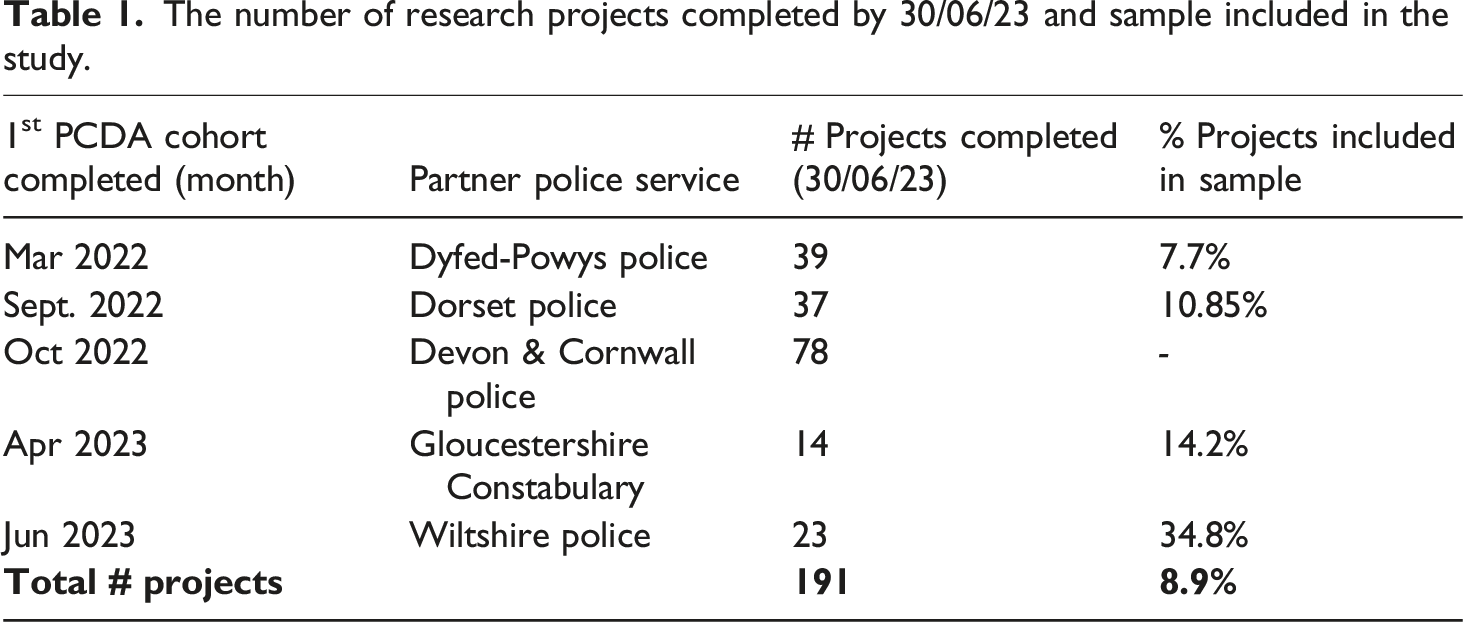
The number of research projects completed by 30/06/23 and sample included in the study.
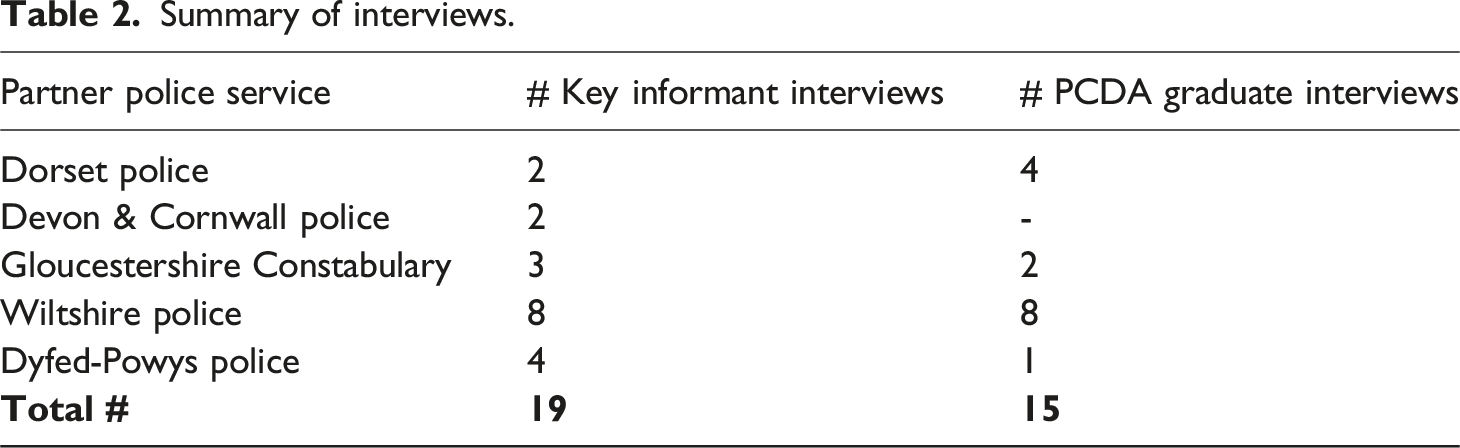
Summary of interviews.
As data collection took place during the height of the summer some potential research participants (and lecturers) were on leave and unavailable for interviews during the data collection period. Another challenge was coordinating interviews with the PCDA graduates around their operational policing commitments. Therefore, the study was limited to participants who were available at the time of the data collection period.
It is worth noting that at the time of the data collection the five partners were at different stages of implementing the PCDA programme; Dyfed-Powys Police had their first PCDA cohort complete their programme in March 2022, whereas Wiltshire Police’s first PCDA cohort started 15 months later, and this cohort completed their programme 2 months prior to this study taking place. Another variation in the sample was the range of research projects that had been completed by 30 June 2023 that were available for review, this ranged from Devon and Cornwall Police having 78 research projects completed, compared to Gloucestershire Constabulary who had 14 by this date.
Key informants included dissertation supervisors (lecturers) from USW, plus police officers and staff from partner organisations, which included positions such as Apprenticeship Consultant, Demand Management Lead, Evidence Based Policing Lead, Head of Learning and Development, Head of Improvement and Change, Chief Superintendent for Force Operations and the Crime and Communications Centre, HMICFRS Liaison Officer, PEQF Sergeant, Force Innovation Lead, Research Officer and Head of Performance, Quality and Business Intelligence.
The data collected for this study did not intend to be statistically representative. Purposefully selecting projects assisted with exploring PCDA research projects that were believed to have provided evidence-based knowledge. These projects were then investigated further to establish their relevance (if any) to the respective organisation and whether the knowledge had been embedded into practice (Patton, 1990).
Findings
Evidence-based knowledge
Example of research topics and current role from one PCDA cohort.
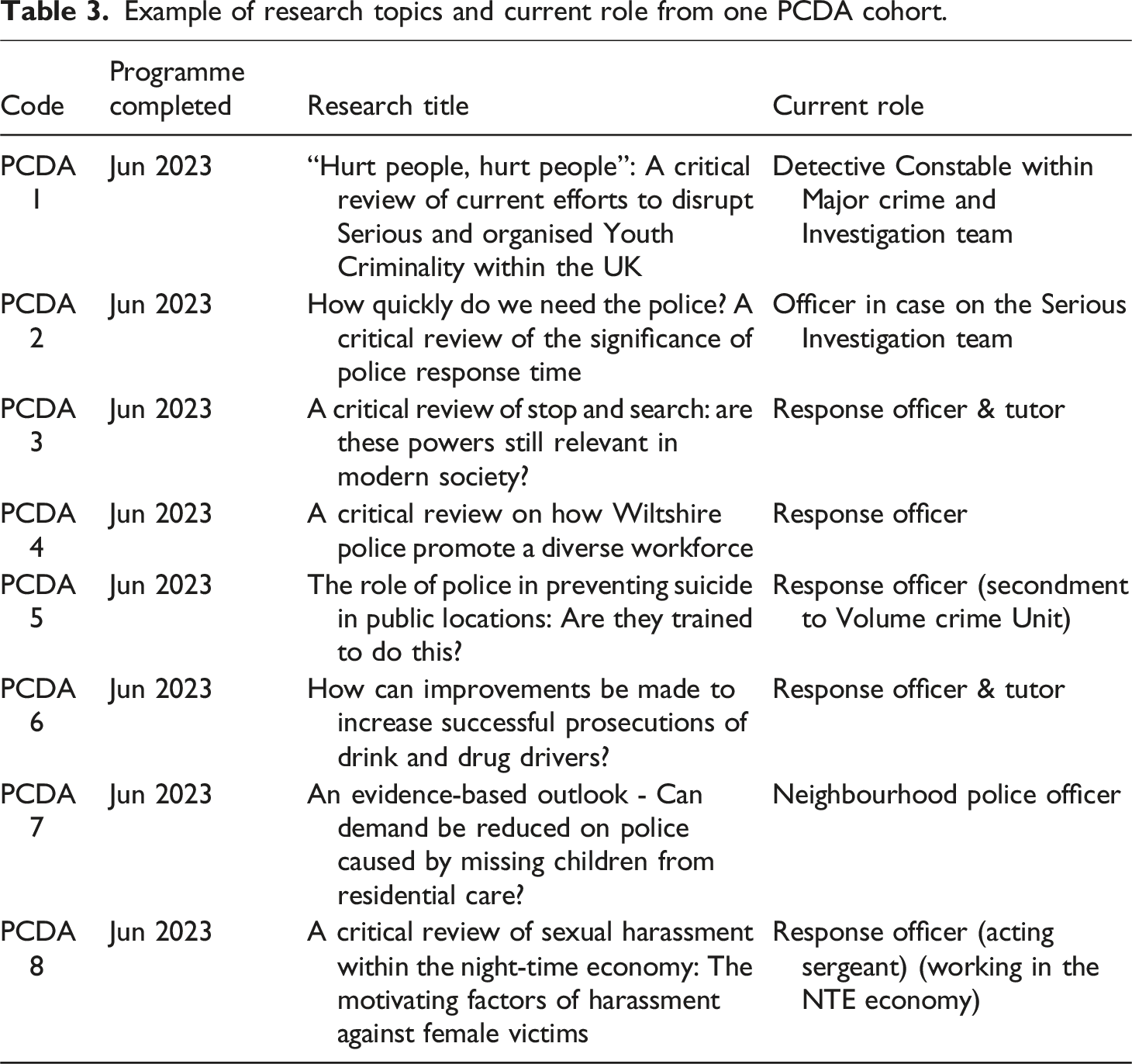
It was also identified that several of the PCDA graduates who participated in the study were informally transferring their knowledge (and good practice) to those they are now tutoring or supervising, as can be seen from the sample in Table 3.
One of the graduates who is now working within a Major Crime and Investigation Team has been applying the learning gained from their research project through the way they approach and interview child suspects. This officer now takes the lead in interviewing child suspects within the Major Crime and Investigation Team and has been asked by their supervisor to share the findings and recommendations from their research with the team.
A PCDA graduate who researched the topic of sexual harassment in the NTE studied the behaviours of perpetrators and identified there was a lack of consistency in relation to policing the NTE, due to the different shift patterns. When delivering briefings (as acting sergeant) to a shift who were working in the NTE the graduate reminded them about signs of suspicious behaviour, and encouraged the police officers to complete the ‘observation vigilant form’ when these types of behaviours were displayed, to ensure a flow of information between shifts and appropriate intelligence was gathered.
Use of force forms was studied by one PCDA graduate, and they identified that there was sometimes a gap between force policy and practice in relation to the period of time it took to complete forms following an incident. The research also identified that data collected on emergency workers and ‘use of force’ was not disaggregated so it was not possible to monitor trends based on the emergency service. The study recommended the development of nationally recognised ‘use of force’ forms for standardisation purposes. This is an example of a research project that potentially has national implications that may be of use or interest to the College of Policing.
However, not all graduates felt their projects were appreciated by their employer. Finishing their project and completing their programme was an anticlimax to them, especially after they had dedicated a lot of their own time. Some graduates stated recognition from senior officers would have made them feel more valued. Although, it is worth noting that the cohorts included in this research were amongst the first from their organisations and therefore, police partners would have been in the initial stages of establishing systems for the newly introduced programmes.
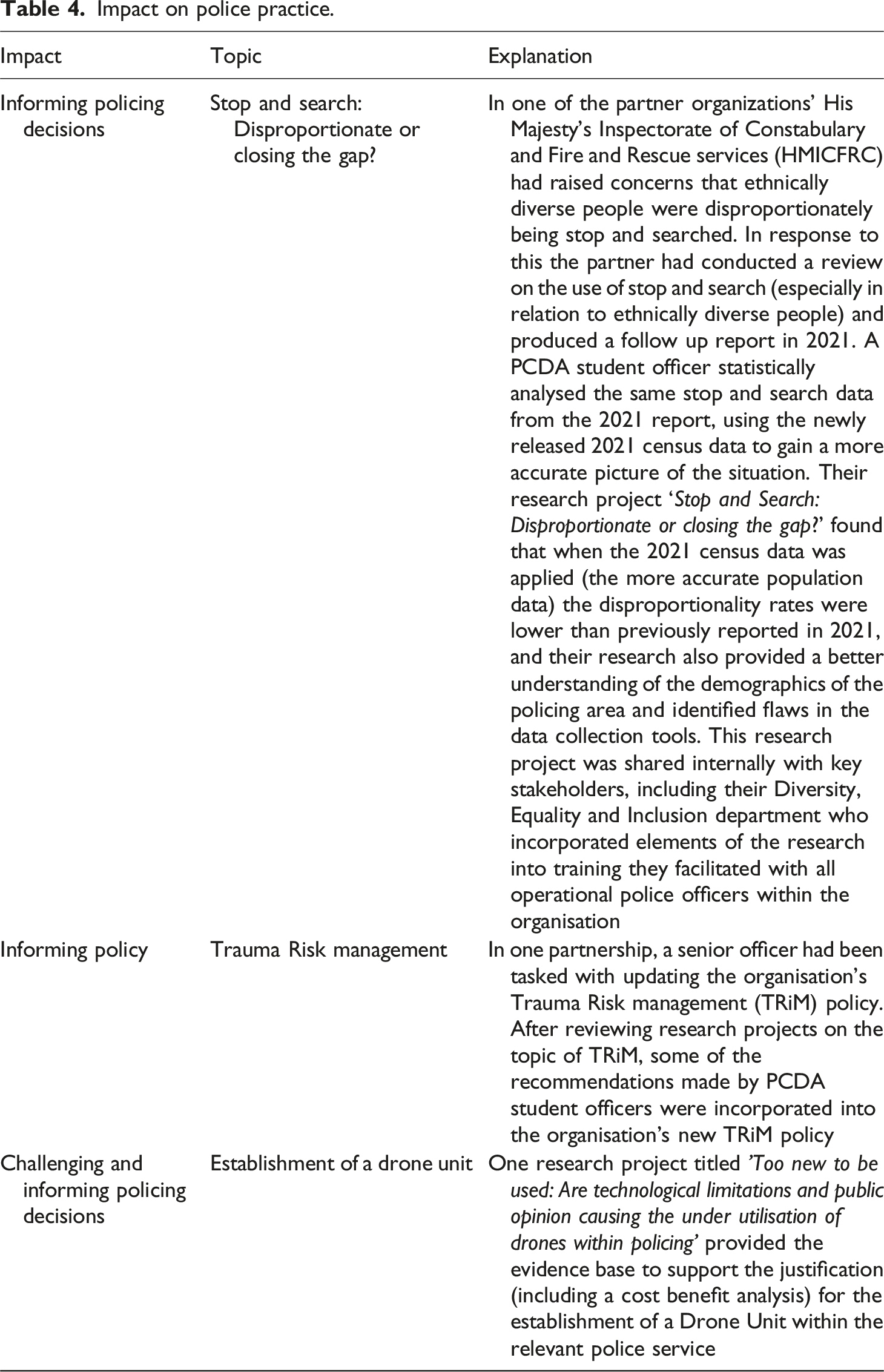
Impact on police practice.
Dissemination of knowledge
The dissemination of knowledge produced by the evidence-based research projects was evident within the police partner organisations. Partners had developed libraries on their intranet where the research projects were accessible to all employees within the organization. Some partners shared the summary of the projects (abstracts) in the form of journals and newsletters, whilst others arranged Flip-side (Focus on Learning Innovation and Problem solving) events which aimed to share knowledge, understanding and best practice across the organisation. The events could be in the form of presentations, workshops, or informative videos. Research participants also suggested podcasts or ‘bite sized’ recordings as an alternative way to communicate the key messages from the evidence-based research projects.
Discussion
The findings provide two key areas for discussion, firstly the relevance and value of the research projects and strategies for improving how this knowledge could be embedded into policing practice.
Relevance and value
This research has demonstrated that evidence-based research projects produced by PCDA student officers can provide evidence to inform and challenge policing policies, practices, and decisions (College of Policing, 2021; Selby-Fell, 2020; Sherman, 1998).
Value to graduates
PCDA graduates appreciated the value of the programme, identifying how they had benefited both professionally and personally from it. Some officers were proud to share that they were the first graduates in their family. It is suggested the research projects are a product that captures the standard of critical thinking practitioners that can be produced from the programme. The blended learning approach provided an educational experience both inside and outside the ‘classroom,’ enabling the student police officers’ professional practice to be informed by their learning (Healey et al., 2014; Hough and Stanko, 2018; Pepper et al., 2020). One graduate recognised “it has been a hard 3 years, but I’m glad I have a degree, it has made me a better officer.” Another stated “I definitely feel like from my dissertation and from the whole 3-year course that I do look at things a lot more critically now. I don’t take things on face value.”
Value to police services
The involvement of employers at the proposal stage and the end point assessment (where student officers present and ‘defend’ their research) meant projects were relevant to the organization. Furthermore, allowing ‘student choice’ ensured the research projects were of value to both the employer and graduate (Bovill and Bulley, 2011). The philosophy of adopting a learner-centred approach for the research projects appealed to the student police officers and promoted a positive learning experience. The student police officers also appreciated being recognised for their policing experience, rather than exclusively being treated as a student and taught in a didactic style (Bransford et al., 2000; Hough and Stanko, 2018).
As the curriculum for the programme is stipulated by the College of Policing there has been limited scope for student officers to choose the subjects they study, but the evidence-based research topic provides an opportunity for students to research areas of interest to them, as well as the organisation. It is suggested if student officers can choose their own research topics (within parameters) they will become more invested in their project because they feel more in control (Bovill and Bulley, 2011). One graduate stated “I think whilst … a lot of us like protested about doing this, I think from everyone I've spoken to out of the whole three years, this bit [research project] was the most enjoyable.” Allowing student officers to choose their research topic means they are more likely to study a topic that will be useful to develop their career, as highlighted by one of the graduate participants “[the research project] was in a topic I was interested in, and it has helped me further my career.”
Embedding knowledge into policing practice
‘Student police officers as producers’ offers a model for change and allows them to be innovate, share their knowledge, and develop networks that support career aspirations (Healey et al., 2014; QAA, 2022). The adoption of evidence-based practice within policing presents an opportunity to influence wider policies and improve the effectiveness of the service, whilst ensuring limited finances and resources are utilised efficiently (Mitchell and Lewis, 2017; Rogers et al., 2022; Wall et al., 2017). However, it is acknowledged that pracademics can often face challenges when working in well-established structures and hierarchies within their organisations and are not always valued (Hallenberg and Cockcroft, 2017; Huey and Mitchell, 2016; Wall et al., 2017). As Canter (2004) highlighted the police often value experience-based knowledge more than research-informed knowledge, especially when that knowledge is being shared by a police officer who has limited policing experience.
However, the findings from this study demonstrated how the knowledge gained by the PCDA graduates from their projects was being used in their current roles but this had all taken place informally and organically in the workplace. In the future documenting these cases will only become increasingly difficult as the large number of recruits from the police uplift transition through the programmes, unless processes are established.
Whilst there is clear evidence that knowledge from the projects was being disseminated within organisations, it is suggested police services would benefit from developing formalised processes to embed knowledge into practice because as Brown et al. (2018) states, knowledge does not automatically translate into practice.
The findings from this research indicate the involvement of Subject Matter Experts (SMEs) - or those responsible for a specific topic - could be key to achieving this. Identifying these individuals early at the proposal stage would allow student officers to be guided through their evidence-based research projects to ensure they are useful and add value to the organisation. This may also assist with making the student officers feel valued by their organisation (Hallenberg and Cockcroft, 2017; Huey and Mitchell, 2016). However, it is appreciated that resources are limited, and a SME may not always have the capacity to support student officers for the duration of their research project, in which case an alternative could be sharing the recommendations from the projects directly with SMEs.
The collaboration between police services and HEIs offers the opportunity for good quality projects to be produced when they are underpinned by academic and practical expertise (Wall et al., 2017). Student police officers’ can benefit from the guidance of their dissertation supervisor and a SME from their organisation. Introducing SME to student officers not only supports their development but also their networking and develops utility for the organisation. It also provides an opportunity for SMEs to implement recommendations made from the projects. It is clear the more stakeholders are integrated in the development of the projects, the more likely research projects will be of good quality and have impact (Lees et al., 2016; Wenger-Trayner and Wenger-Trayner, 2019).
Conclusion
The policing education programmes aim to develop professional practice, evidence-based policing, critical thinking, and reflective practitioners. It is hoped they will assist police services embed evidence-based practices and support them to deal with the range of challenges they face in modern policing (Mitchell and Lewis, 2017). The professional and critical thinking practitioners that can be produced from the PCDA programme is apparent from the quality of the research projects reviewed as part of this study.
The evidence-based research projects may be a useful resource to key stakeholders when force policies are being reviewed or developed. This was apparent from the example where recommendations from some projects were incorporated into one partner’s updated TRiM policy. It is suggested the more PCDA student officers and graduates can see their work is being acknowledged, shared and in certain cases implemented into practice, the more likely they will feel valued and motivated.
From this study, it is evident that the PCDA research projects can embed evidence-based practices, support the career paths of new police officers and assist the development of the workforce. The use of evidence-based practices has the potential to use limited resources efficiently, strengthen police accountability and improve the service provided to the public (College of Policing, 2021; Selby-Fell, 2020; Sherman, 1998). It is suggested the research projects offer police services the opportunity to continue to improve efficiency, effectiveness, and continuous development (Mitchell and Lewis, 2017; Rogers et al., 2022; Wall et al., 2017).
Footnotes
Declaration of conflicting interests
The author(s) declared no potential conflicts of interest with respect to the research, authorship, and/or publication of this article.
Funding
The author(s) received no financial support for the research, authorship, and/or publication of this article.
