




Abstract
This article investigates police leaders as role models. The importance of observing several role models in partial use is demonstrated. It also shows how established role models might result in reinforcement of the police leadership culture, exemplified through first-line managers that are legitimized by being ‘good coppers’. Those that inspire others when rocking the boat are limited. Instead, role modelling is about holding on to their positive experience as first-line managers and continuing to fight for their ‘profession’ in silos. The lack of role models for upwards and sideways leadership represents a challenge for the future development of police leadership.
Introduction
The purpose of this article is to investigate the role of police leaders as role models and how their role modeling behaviors influence what is legitimized and learned as good police leadership. Police leaders, by virtue of their position and visibility, significantly influence both the police culture and the public’s trust and perception of the police force. Understanding the dynamics of role models in police leadership is therefore critical for developing effective and ethical leadership practices within law enforcement. Research to date is informative but limited in scope. Systematic literature reviews by Pearson-Goff and Herrington (2013) and De Moura et al. (2023) underscore the importance of police leaders as role models, linking this to legitimacy, ethical behavior, and trustworthiness. They note that police leaders are often perceived as “good coppers” by their subordinates (Rowe, 2006; Schafer, 2010; Silvestri, 2006). Effective police leaders are perceived as understanding their responsibility as role models, leading by example and demonstrating expected behaviors (Densten, 2003; O’Leary et al., 2011). Previous studies also highlight that police leaders are often seen as role models whose behaviors and values are emulated by their subordinates (Filstad et al., 2018; Karp et al., 2018). This research sheds light on how role models can shape the identity and actions of future police leaders, fostering a culture of integrity and professionalism that is essential for the legitimacy and efficacy of policing (Filstad and Karp, 2021; Posner, 2021). Nevertheless, how this manifests in various leadership practices remains unexplored.
This study contributes to the existing body of literature on role models by providing a nuanced understanding of how police leaders function as role models and the mechanisms through which they influence others. While the literature has generally been vague in defining role models and the specific processes through which they inspire and motivate (Dasgupta, 2011; Gartzia et al., 2021; McIntyre et al., 2011), this research clarifies these aspects within the context of police leadership. It builds on the concept of “multiple contingent role models” (Filstad, 2004) and explores how observational learning (Bandura, 1986) and the visibility of role models (Dasgupta and Asgari, 2004) impact leadership development in policing. Additionally, it examines the importance of both formal and informal relationships in role modeling, as well as the diverse attributes that make certain individuals effective role models (Gibson, 2004; Lockwood and Kunda, 1999).
Police leaders typically advance through ranks and seniority, often recruited internally and climbing the career ladder from first-line operative leaders to senior positions (Charman, 2017). This trajectory is critical for those being led (Pearson-Goff and Herrington, 2013), as police leaders usually have an operational background, being “foremost among equals” (Karp et al., 2018: 438) before assuming managerial roles (Filstad, 2022a; Pearson-Goff and Herrington, 2013). Police tradecraft and the concept of being a good copper, or at least being closely involved in policing practice rather than leadership, often dominate their socialization into the role of legitimate role models, starting as first-line managers and extending to higher leadership levels (Filstad, 2022a). Role models shape cultural norms and expectations within organizations (Posner, 2021), and in the police, the behaviors exhibited by role models among police leaders often influence how police leadership is learned, developed, and reinforced (Charman, 2017; Filstad et al., 2018).
As previously stated, this study investigates the role of police leaders as role models and how their role modeling behaviors influence what is legitimized and learned as good police leadership within the Norwegian Police Services (NPS). Drawing on international police leadership literature, we aim to extend the relevance of our findings beyond the Norwegian context, examining the use of role models in a broader scope. While the legitimization of good police leadership and the lessons derived from role models may exhibit context-specific variations, particularly outside the Western world, our objective is to contribute new knowledge that highlights the importance of who is perceived as positive role models by observers and the consequent impact on what is learned. The implications of these learnings are critical, as they influence the development and/or reinforcement of police leadership and the broader policing culture.
The article is structured as follows: First, a literature review is presented, discussing relevant theories and previous research on role models and police leadership. Second, the methodological choices and context of the study within NPS are outlined. This is followed by a presentation of the results and a discussion of the findings. The article concludes with remarks on the implications of the study and suggestions for future research.
Literature
A role model emerges when one person chooses another that they admire and seek to emulate because of their skilled behaviours, specific attributes and personal style (Bucher and Stelling, 1977; Fisher, 1988; Posner, 2021), and role modelling contributes to the person’s own identity construction (Shapiro et al., 1978). Gibson (2004) defines a role model as ‘a cognitive construction based on the attributes of people in social roles an individual perceives to be similar to himself or herself to some extent and desires to increase perceived similarity by emulating those attributes’ (137).
A role model can be symbolic or can involve someone demonstrating practical behaviours, resulting in observational learning (Bandura, 1986; Lockwood and Kunda, 1999). Total role models are extremely rare (Filstad, 2004; Gibson and Cordova, 1999), because no single person possesses every desired qualification and/or observing all the behaviours of others is impossible, or the observer does not fully have the skills, motivation or self-efficacy needed for observational learning. Acknowledging the need for several role models exemplifying different behaviours, accomplishments and competences constitutes the differences in leading by example and the motivation for ‘seeing is believing’ (Dasgupta and Asgari, 2004) that the observer can achieve the same legitimacy as the role models when finding his or her own path as a police leader.
The literature has been somewhat vague in defining what a role model is when defining specific mechanisms through which certain types of individuals are thought of as role models to motivate and inspire others (Dasgupta, 2011; Gartzia et al., 2021; McIntyre et al., 2011). For instance, it is unclear whether contact must be formal, sustained, or face to face to benefit from role models (Dasgupta and Asgari, 2004) or whether a close relationship more consistent with mentoring processes is necessary (Downing et al., 2005; Gibson, 2004). Gibson and Cordova (1999) find that total role models are extremely rare, because no single person possesses all the qualifications, but instead individuals choose role models by selecting the features that best suit their own interest.
Filstad (2004) introduces the term ‘multiple contingent role models’, recognizing the importance of identification when it comes to who we use as role models, but also avoids the theatrical idea of role models when relying on the one hero or idol. The link to observational learning becomes evident, as does how individuals learn from observing the behaviours of others, in what Bandura (1986) calls vicarious learning. Bandura (1986) identifies four key processes of role modelling through observational learning: (1) attention, where individuals actively attend the behaviours of the model, (2) retention, where the observed behaviour is remembered, (3) reproduction, where the observer must be capable of reproducing the behaviour and (4) motivation, where others are motivated to imitate the behaviours based on perceived consequences of the behaviour. Observing positive consequences can increase learning, while negative consequences might decrease it (or show what not to imitate). Reciprocal determinism acknowledges the importance of environmental conditions and how they influence who individuals learn from. This means that whether someone is perceived as a positive role model needs to be considered in accordance with expectations and ‘acceptance’, for instance, in the case of leaders in the police.
Newer research on role modelling has also highlighted the importance of motivation (Morgenroth et al., 2015). The observers’ perceptions and the types of attributions for role model success shape whether the role model is effective or not (McIntyre et al., 2011). They reveal how vital it is to raise the visibility of role models who embody representations of the possible and call for further research to understand how role models can reinforce expectancy by changing perceptions of one’s own success (Gartzia et al., 2021).
Police leaders as role models socialize new ones and established ones’ act as potential role models for each other and in relation to different police districts and leadership levels. Police leaders are also role models in relation to the public. The police are visible, uniformed and seem to have pride associated with the uniform and a strong sense of an ‘us’ feeling, as well as the idea that police look out for each other and ‘stand together’ when the ‘storm’ comes, according to the literature that describes police cultures with a strong commitment, collectivism and identification with the police mission (Christensen and Crank, 2001; Cockcroft, 2020; Filstad 2022b; Paoline, 2004). What characterizes the police culture will influence it as to the kind of police leadership that is expected.
Learning to lead in a policing context takes the form of paying attention to and imitating (or not) how other police leaders behave, such as, for example, observing how someone who is a role model for them interacts with others, handles challenging situations, manages time and demonstrates empathy, grace, resilience and similar qualities (Posner, 2021). Hence, role models play an important part in informing people how to act (Filstad, 2004), as seeing might inspiring someone into believing ‘me too’ (Dasgupta, 2011; Dasgupta and Asgari, 2004). Social learning theory argues that it is easier for people to learn behaviour by observing (Bandura, 1986), preferably through collective participation and practice (Lave and Wenger, 1991; Newell et al., 2009; Nicolini 2013). Understanding who the observers are, as well as who they have access to as role models and what they have learned about leadership through role modeling, can provide important new insights into how police leaders are utilized as role models and their influence on police leadership development. This, in turn, contributes to the broader literature on role models in general and role modeling within the police context in particular.
The study
The study is part of a larger research project on Norwegian police leadership and implementation of the police reform that was undertaken during the period 2016-2022. I have utilized my personally collected data in this research project.
An inductive, qualitative, and exploratory study was conducted in the Oslo Police District (OPD) from 2018 to 2022. OPD was chosen because it is the largest police district in Norway, with approximately 3000 police officers, prosecution lawyers, and civilian employees. Located in the Norwegian capital, OPD’s size, diversity in crime operations and prevention, substantial internal leadership training, numerous leadership groups across all levels, high policing competence, and extensive experience in crime prevention, investigation, intelligence, and counter-terrorism were crucial considerations for my field studies.
Most of my observations were conducted during patrols, leadership meetings, briefings, interviews, and both internal and external meetings involving leaders and employees responsible for intelligence, crime prevention, and investigations. Earlier research (2016-2018) aimed to be representative of all 12 Police Districts in Norway, with data collected in six of these districts. Decisions on which police districts to include were based on size, geographic differences, and local conditions. Each observation and interview in these districts lasted 1 day. In OPD, the time spent with each informant ranged from 1 day to 1 week, and with some informants being observed for up to 35 working days.
Empirical methods employed in this study.
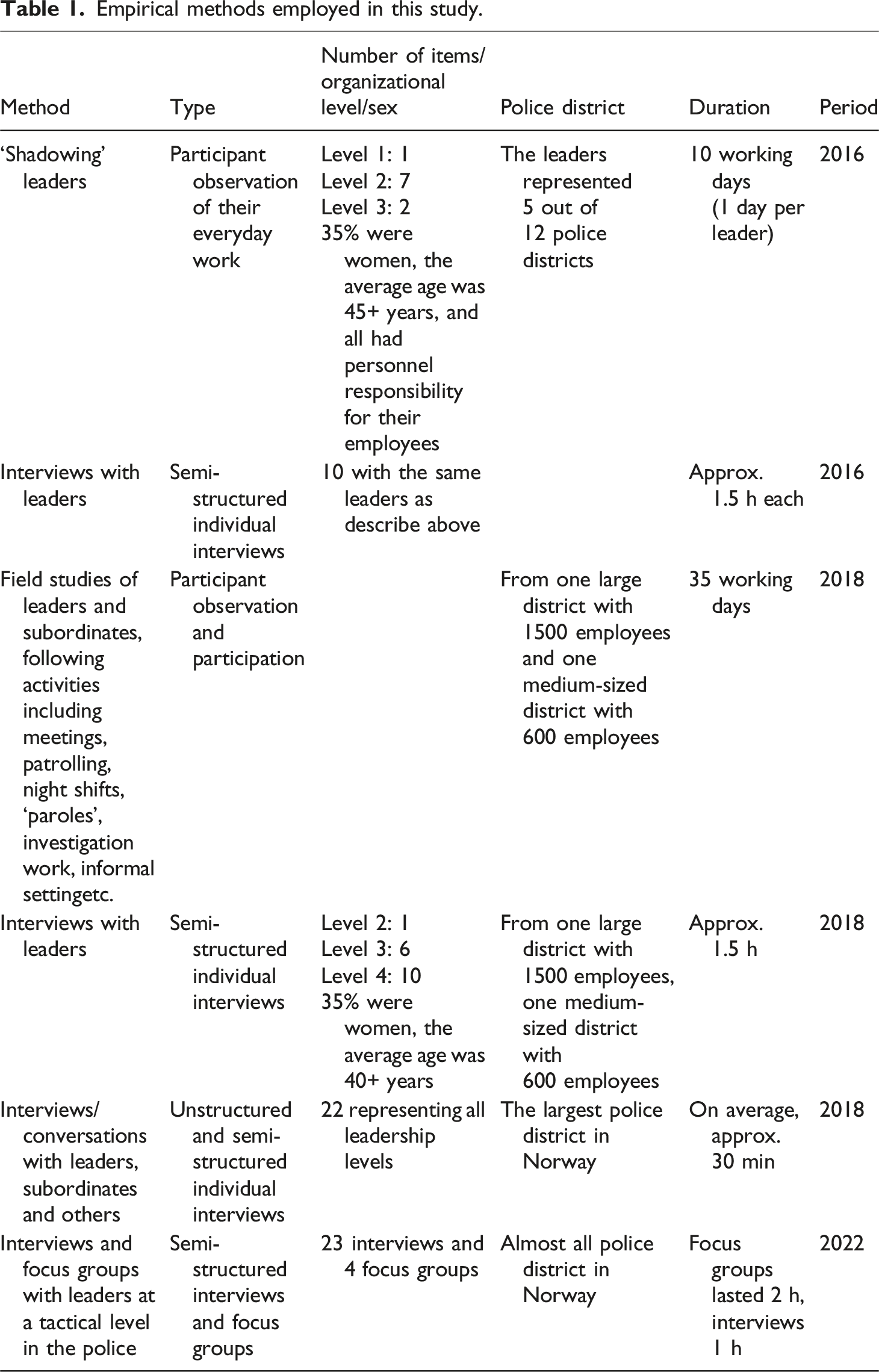
The research employed reflective processes, where openness in interpretation and induction of possible findings do not necessarily follow a logical progression (Czarniawska, 2007). We cannot expect to fully understand actions, situations, and behaviors (Feldman and Orlikowski, 2011). Instead, my aim was to observe and discuss with my informants the unfolding of what I analyzed to be police leaders’ role modeling and how leaders and employees learn and are influenced by police leaders role models. I believe I captured various observational learning processes and how police leaders as role models influence these processes. However, this presented some analytical challenges. To address these, I conceptualized the patterns and used open and axial coding, which led to more focused questions for the informants based on my observations.
Inductive studies, especially with the lack of theory and research on role modeling in police leadership, required reflective processes to understand what was happening. I did not know exactly what I was studying until I had completed and analyzed a significant amount of data. Identifying patterns related to role modeling themes was essential.
Field studies and observations, though time- and resource-consuming, provide the best data to understand phenomena—in this case, police leaders as role models. Bridging the gap between theorizing and lived experience, observations highlight the details of organizational life (Orlikowski, 2010). However, it is challenging to observe not only leaders’ interactions but also how they learn from and are influenced by other police leaders in their behavior and leadership. Sometimes, similarities in behaviors and leadership styles due to observational learning are evident, while other times, interpretations vary. These variations were reflected and analyzed based on interviews and informal talks.
Combining observations and conversations allowed flexibility to ask structured questions and debrief, interpret, and discuss observations. By being as open as possible, without prior interpretations, I described the different relationships observed between police leaders, including new versus experienced, female versus male leaders, and higher-ranked versus subordinate leaders. I noted how they influenced each other, worked together, shared knowledge, discussed leadership development, and recruited new leaders. These observations related to what they described as important qualifications for being a good role model.
Interview questions supplemented my observations, focusing on who they identified with, who inspired them, what they learned from other leaders (avoiding the term role model), their leadership development, challenges they faced, and situations where they felt isolated as leaders. All interviews and observation notes were transcribed and imported into Nvivo, where I identified categories and organized the data accordingly to ensure open and axial coding (Strauss and Corbin, 2008).
I analyzed the data using reflexive methodology, a qualitative method suitable for leadership research (Alvesson and Sköldberg, 2000). Reflexive methodology involves shifting between different perspectives and levels of analysis, using four analytical perspectives: raw data, interpretations, context analysis, and deconstruction and pluralism. The data sets considered were: i) interviews with normative and descriptive elements, ii) descriptive observations of actions and interactions with some normative perspectives, and iii) researchers’ interpretations and reflections.
The results, encompassing how police leaders perceive themselves as role models and the learning processes of other leaders and employees, were analyzed and will be presented in the subsequent results and discussion section.
Results and discussion
The data focus on the role of police leaders as role models and how their role modeling behaviors influence what is legitimized and learned as good police leadership. Exploring how police leaders viewed themselves as role models, as well as how police officers perceived their leaders to be role models, the data confirm that being a role model is important. What that means as well as how police leaders learn to be role models is, however, left to the individual police leader to figure out. We find that, on a superior and symbolic level, related to the police mission, being a role model is about fairness, ethical behaviours and demonstrating positive values in a uniform and trustworthy way. Metaphorically, when putting on the uniform or taking on police leadership, the ideal and symbolic role model with expectations concerning personal traits, styles and behaviours becomes quite evident, but is also somewhat contradictory when played out in the ‘real life’ of police leadership. This is especially so because role modelling, as well as the legitimacy of police leaders, is dominated by being a good copper/demonstrating the policing tradecraft they are leading and thus responsible for.
This confirms police officers’ socialization into the police force and how they are integrated into one police culture at the Norwegian Police University College. They learn important values, ethics, communication skills and how to wear the uniform and what it symbolizes to the wider audience. The police culture and good role models for how to learn and develop as a ‘good copper’ are consistent and transparent throughout their bachelor’s education in policing, with somewhat straightforward expectations of police leaders being good role models. Police leadership is, however, less clear in how they are role models as police leaders per se and how role modelling might need to change dependent upon the leadership level.
Norwegian police leaders for the most start as first-line managers and build their leader career by climbing the ladder to higher leadership levels internally. As first-line managers they are role modelling good policing at the same time as being leaders and hence, we would expect some differences in how they describe themselves as role models. These variations are difficult to find. Instead, they explain their own behaviours as role models in accordance with their perceptions of subordinate expectations, as a question of ‘walking the talk’. How the symbolic element of role modelling meets the reality of policing and how everyday practice influences role modelling behaviours among police leaders is therefore interesting.
The symbolic meets policing practice
We find that experience helps people to be good role models, in that they focus on being role models for their employees, not necessarily for other leaders or when leading upwards in the police. Instead, other behaviours become evident in leading upwards, such as loyalty, not rocking the boat, being politically correct, etc., which I find to be the more symbolic type of role modelling, which might be contradictory to how they seek to perform as role models to other leaders on the same or lower leadership levels and police officers. Here, when leading their own department/practice/subordinates, they strongly emphasize the importance of being positive role models through being visible, relational and directly involved, and thus, the possibility of observational learning and being good examples.
On all three leadership levels, engaging in small talk, getting to know employees, having good dialogues and being informal seem to form a pattern. So does the importance of being role models through guiding and taking the lead with regard to attitudes, values, and behaviours. The interviewees explain: The most important thing for me is that they understand that my expectation of them is not higher than the expectations I have for myself. Also, that I follow up on my words, and am not a talkative person that does not follow up through actions. I want to be in front as a good example. Yes, I think I can say that I’m a role model, but I also have sides that I must be aware of. Especially that I work too much, the awareness of important boundaries as a leader and as a role model. My employees have the most important role. I try to facilitate, so they can do the best job possible. I support them and guide them, so they are engaged in their work. I’m very proud of them and want them to succeed. I enjoy it very much when people come in all excited about solving a task, to be part of that satisfaction, that’s fantastic. Therefore, I’m often present and talk with those who have been out on operations.
Being a good leader by providing an example of good policing is what they first and foremost think about as role models. My observations add to what that means, in that most of them aim at being visible, available, close to policing practice, walking around and engaging in small talk. These communicative, oral and preferably face-to face interactions are important characteristics of the police culture (Filstad et al., 2018; Filstad and Karp, 2021), as opposed to feeling ‘left in the dark’ through e-mails, reports or other forms of written communication channels. Not being as available, visible and able to communicate face to face or by phone as they would want to is what causes a bad conscience on their part, especially at higher leadership levels. It also has consequences for observation learning from others and their access to role models.
The chiefs of police that I observed spent a substantial amount of time being available and participating in meetings, patrols, etc., with police officers and their first-line managers. In terms of those leading first-line managers, they admitted to sometimes being too close and at the same time, arguing that the closeness was important, which was a difficult balance to achieve. Many of them pinpointed He was a fantastic leader – extremely caring. He was always familiar and used the time to ensure that he had the necessary overview over different cases. I have had him as a role model for my own leadership and I miss having him around. I would never dare to be a leader myself if it was not for X. He encouraged me to undertake leadership myself and to apply for the mentor program for female leaders in the police. That was crucial for me.
I find that ‘histories’ of being good role models repeat themselves and that the same qualifications related to the expectations of subordinates and thus, being close to practice and ‘walking the talk’, leading by example and demonstrating being a ‘good copper’ are what legitimize police leadership. Police leaders learn the ropes through observational learning from established police leaders (and/or the highlighted best leader they ever had) formally and informally to help them navigate within the organization’s leadership culture. Leading and inspiring by example and emulating the behaviours expected of subordinates, processes which other authors argue describe police leadership culture internationally (Densten, 2003; Masal, 2015; O’Leary et al., 2011), and ‘demonstrating’ being a good copper, or at least understanding what that involves (Charman, 2017; Pearson-Goff and Herrington, 2013; Silvestri, 2006), are confirmed in this study. The ‘being foremost among equal’ (Karp et al., 2018) ‘sticks’ with police leaders with the consequences, especially at the middle-manager level, that they do not lead upwards or sideways (because their loyalty is towards their subordinates within their department and thus the tradecraft they are responsible for within the police). There is more limited access to, or a lack of, role models among police leaders that demonstrate 360 degrees of leadership, or behaviours towards subordinates that behave badly, in addition to those who make decisions that do not necessarily serve the interest of all. Here, the individual police leader mostly relies on their own experience and judgement on how to solve difficult situations. One of them explains: For me it’s easier to be more direct now. It took me many years to learn to come directly into conflicts and take the battles before they developed into something bigger. Dare to speak out and stand by it. It is demanding but absolutely necessary when being a leader at this level.
Role models in police leadership – the danger of choosing just one (tradecraft)
Police leaders’ actions as role models are related to their policing ‘tradecraft’ (i.e. investigation, patrol, intelligence, crime prevention etc.), and this is demonstrated by the extent to which they lead upwards. Or in other words, their inward (local) orientation of good policing, such as, for instance, investigation, tends to lead to an outwards orientation of the professionality of police investigation towards the public. Balancing the inwards and outwards representation of police investigations is a continuous challenge for police leaders, as one of them explains: I think I’m a good role model, but at the same time it’s hard to say for sure because the question is, are you brave enough for your department? Are you brave enough for the goals that are set? Are you brave enough to produce good police work for the public? That’s what it is all about, and it’s probably something you can struggle with the most. Otherwise, I think I’m in good control of everything that’s going on, both in my department and in terms of the results we deliver to the public.
Self-confidence as leaders, as a result of experience and mastery, I find, makes it easier to learn through the observational learning of other leaders. Who they use as role models is influenced by their self-esteem in terms of achieving the same as the role model and their motivation if they recognize themselves in the role model (Bandura, 1986; Gibson and Cordova, 1999; Lockwood and Kunda, 2000). There is one area in which they are especially critical of their own leadership, and that is being brave enough. Police leaders are loyal and their loyalty to the police mission, in terms of overall decision making, might be problematic in relation to their local loyalty and tradecraft (Filstad, 2022a). Upwards, they seldom question decisions and priorities. Instead, they fight for their tradecraft, resulting in silos of leaders within leadership groups, especially on different middle-manager levels. Consequently, examples of police leaders demonstrating silos in intra-professional cooperation instead of crossing knowledge boundaries between the different tradecrafts are evident in my study.
The idea of silos hindering intra-professional cooperation between operative and intelligence staff in crisis management is also a crucial challenge in another study of the NPS (Hoel and Filstad, 2023). The braveness of intra-professional cooperation relates to what I have discussed as local loyalty, because subordinates expect and are used to leaders fighting for them. On the one hand, the braveness of ‘rocking the boat’ and questioning priorities might hinder their leadership career, while downsizing their own tradecraft if necessary for the greater good might result in less legitimacy in the eyes of subordinates. Balancing the two is therefore challenging, and this is where the need for role modelling examples to learn from is perhaps most crucial for police leaders (Karp et al., 2018). I observed several meetings and behaviours of police leaders where their ‘loyalty’ was not balanced, and they therefore exhibited a lack of honesty about their own leadership practices. In these ‘cases’, their subordinates claimed that their leader is loyal upwards to ensure their own career, leaving their subordinates ‘out in the dark’, as one of them explained.
Police leaders do not necessarily acknowledge being role models for other leaders at the same level, due to mainly being concerned about their own ‘silo’. But they also highlight the lack of having access to and learning from other leaders through practical work (Filstad et al., 2018). Given that people need to learn from several role models through observation, shared practices, conversations and similar aspects (Filstad, 2004; Gibson, 2004) in adopting their own leadership, colleagues from the same or higher leadership levels might be negative role models when representing other tradecrafts. This may be due to early dismissal, the price being considered too high or the idea that such goals are too far off and unrealistic to achieve for themselves. In addition, when using role models at higher leadership levels, the danger is that they will choose only ones within the same tradecraft, because they will use role models that they identify with (Filstad, 2022b; Shapiro et al., 1978).
An individual may observe what a role model does and choose not to act in that way, either because it is far beyond what they can achieve or because they consider the observed behaviour to be negative. They might also think that the price to pay as a consequence of such actions is too high. One example of the latter occurred during my field studies, when a police leader gave an interview in an attempt to be heard in connection with the consequences of the police reform and express frustration at the fact that there have never been fewer patrolling police officers in Oslo. Because of the reaction of the Police Directorate and the commotion about the lack of loyalty from other employees, another person might consider the consequences of such an action to be too great, especially as it did not lead to increased staffing. From the observational learning perspective, the process of assessing the actions of other people and their consequences is referred to as vicarious experience (Bandura, 1986). The observed action becomes role modelling. An individual considers whether they have the capabilities to act in the same way and are motivated enough to face the consequences, depending on how important the case is for that person. Finally, they assess the fairness. Will the consequences for them be the same as for the role model, i.e. will everyone be treated fairly? If the consequences of the police leader’s interview are positive, they receive a large amount of positive feedback internally, and they are promised more resources for their department, the individual might consider whether they could successfully complete the same task.
Role models for reinforcement or ways forward
Due to police leaders mostly shifting between the symbolic (loyalty outwards) and their own leadership practice (loyalty downwards towards subordinates), exposure to alternative behaviours by police leaders is limited. This is especially the case because, in the police leaders’ own words, they are not good at learning from other leaders in their everyday practice (Filstad et al., 2018). Two of them explain: I’ve thought about... how I sit together with lots of people who have worked in the police service for many years with similar mindsets, and we don’t participate in discussions where different views are expressed. I think that would have been better for the police service. So, if I can say something else – then I’ve seen here that when people gain a new competence, it leads to good developments. However, it’s no use if only a couple of people understand it; it must be a group of people.
Police leaders’ homogeneity and the limitation that they only have experience of being leaders in the police are challenges of which they are aware. The recruitment, socialization and education of police leaders have traditionally postulated police leadership as special and somewhat incomparable to leadership in other organizations. As such, the police leadership culture is described as an echo chamber, with the consequences of providing role models that represent reinforcement of the existing situation as opposed to developing the future of police leadership. The newer generation of police leaders have a wider experience of leadership education from other universities, but being able to influence and develop police leadership takes time. In addition, the socialization of new leaders and who they chose as role models might moreover represent the ‘establishment’ of not rocking the boat related to a police culture strong on loyalty. It is, however, crucial that there are role models for leaders who are brave in being constructive but critical, challenging what loyalty means for developing further, and encouraging new leaders in being innovative and not having to adapt to police leadership in a conforming way. Role models are important in learning and developing police leadership, not to replicate the old ways, but instead in acting as examples and social constructions of leadership that represent various styles and diversity, for instance as more women are now police leaders or the police rely more on other professions in fighting crime. Finally, with changing expectations of police leadership among a generation of police officers or other professions, and new challenges within crime, the importance of role models needs to be addressed and acknowledged beyond the symbolic levels, and thus, embedded in the practice of police leadership.
Some concluding remarks
The role of police leaders as role models and how they influence what is legitimized and learned as good police leadership is important to how police leadership is developed in the police force. How police leaders use other leaders as role models, what they observe and how this influences their development and/or reinforcement of own police leadership are important knowledge of our understanding of what constitutes police leadership. It can also be added that role modelling behaviours also is about having access to positive role models as examples of how to lead. However, the findings suggest that leading by example tends to reinforce the symbolic element as well as loyalty, with few role models among police leaders that ‘rock the boat’ and address important issues that will develop and change police leadership. The same can be said about middle managers, where intra-professional cooperation tends to ‘fail’ due to leaders fighting for their own tradecraft and examples of silos in leadership groups are therefore common. However, role models that foster intra-professional cooperation are not entirely absent, and I would argue that the police leadership culture is changing due to more leadership training and courses as well as a greater focus on the importance of leadership in meeting the increased and more complex challenges of crime prevention and investigation. However, it takes time to ‘provide’ role models that represent new behaviours and diversity (reflecting the greater number of female police leaders, but also to some extent because leaders from other professions than policing are being recruited). More diversity among role models that the observer can identify with is crucial, so that new leaders can be motivated by the ‘me too’ belief and can accomplish similar goals to the role model with the same desired consequences for their own leadership.
Because the police leaders’ culture is still quite homogenic, with the danger of being an echo chamber, most leaders have learned leadership and been socialized through their experiences of success as first-line managers. Hence, when the symbolic aspect of being a role model is embedded as leading by example in practice, this relates to the needs and wants of their subordinates, demonstrated by the leader being a good copper. Role modelling behaviours including being relational and close to practice, walking the talk and covering the backs of their subordinates are many positive examples of good leadership. Moreover, their subordinates are satisfied with their first-line managers. The challenge is the established homogeneity over diversity and whether demonstrating being a good copper is needed in the future of police leadership. Addressing these issues and acknowledging that other leadership levels foster other forms of leadership depending upon their responsibilities, as well as expectations for intra-professional and inter-professional cooperation, are important. So is the acknowledgement of police leaders as role models and how they can reinforce, develop and/or challenge existing practices in the best interest of the future of police leadership.
The need for future research on police leaders as role models and how they influence what kind of police leadership is learned in practice is critical. Instead of solely relying upon research arguing that police leaders need to be role models based on different qualifications, there is a call for more knowledge developed through qualitative studies in different police forces. Further research also needs to provide insights into the increased diversity in policing and how that might foster further diversity as opposed to homogeneity when it comes to recruiting, training and developing future leaders in the police.
Footnotes
Declaration of conflicting interests
The author(s) declared no potential conflicts of interest with respect to the research, authorship, and/or publication of this article.
Funding
The author(s) received no financial support for the research, authorship, and/or publication of this article.
