




Abstract
We analyse gender differences in police decision-making under conditions of time pressure and uncertainty. 290 student-candidates from a Police College in Spain, equally distributed between females and males and aged 18 to 25, completed three vignettes in which different scenarios, frequently encountered by police officers in their daily duties, are sequentially represented. Females and males did not differ in the amount of time and information they used before making a decision, in the adequateness of said decision, or in the perceived difficulty of the scenarios. However, females expressed less confidence than males in their own decisions. The results are discussed in relation to stereotype threat.
In an intervention they broke my nose. After a while, a female colleague approached me to tell me that I had earned her respect because I had suffered that physical mishap in a tough performance. I didn’t understand why I had to earn respect by having my nose broken. She would never have had that attitude with a man. Isabel Rodríguez-Aranda, National Police (Spain) agent since 1998 El Independiente, 8th March 2018 (https://www.elindependiente.com/politica/2018/03/07/existe-machismo-en-policia/)
Introduction
Although women have been able to join most of the European police forces for decades, in 2020 their presence represented only 20% of their members, with strong contrasts between nations (Eurostat, 2019). This fact has led various governments to introduce positive action measures (Molina, 2022). This is consistent with societal aspirations for equality, but also with evidence that a greater presence of women in the police improves the effectiveness of police forces and their relationships with the citizens they serve (Silvestri, 2015). On the other hand, it may lead to situations where male police officers perceive that females are unfairly promoted based on gender rather than skills and experience (Drew and Sanders, 2020).
Still, studies on general decision-making reveal differences based on gender. For example, it has been reported that women tend to use all the information available in the environment, weighing benefits and consequences, while men select the information that supports their goal-oriented decisions (Byrne and Worthy, 2016). Women have also been found to be more willing to seek support in decision-making situations (Tamres et al., 2002), to prefer interpersonally oriented decision-making styles (Delaney et al., 2015), to make less risky decisions (Villanueva-Moya and Exposito, 2021), and to require more time and effort to make decisions (Evans and Hampson, 2015).
Assuming that gender differences in decision-making in other domains apply to the police may be a simplistic conceptualization (Rabe-Hemp, 2008), and few studies have analysed gender differences in policing. For example, it has been reported that female police officers tend to use less force than males (Lonsway, 2003), including less use of their firearm (Stepler, 2017), and that they are more likely to base their decisions on caring strategies, such as empathy (Schuck, 2014). However, actual behaviour and people’s perceptions should be differentiated. For instance, research suggests that the general population overestimates the gender difference in risk tolerance (Roszkowski and Grable, 2005), and that male police officers have concerns about the capabilities of female officers, especially in relation to skills and physical strength (Chu and Tsao, 2014).
It is often argued that the underestimation of female police officers’ abilities, especially by their male counterparts, is part of the hypermasculine culture prevalent in most police forces (Alexander, 2019). A culture that pressurises officers to conform to a macho stereotype (Workman-Stark, 2017) and value physical elements over the social service aspects of policing (Cochran and Bromley, 2003). One of the many negative consequences of these extended views is that discrimination and sexual harassment are frequently reported by female police officers (Angehrn et al., 2021), whose experience can be often described in terms of “banter, bullying and harassment” (Cunningham and Ramshaw, 2020: 26). Not surprisingly, evidence suggests that many female officers feel they need to constantly modify their behaviour to prove their capabilities (Haarr and Morash, 2013).
This paper extends recent research in this domain by focussing on irrevocable critical situations where police officers must make snap high-stake decisions under conditions of uncertainty. Prior research has shown that the police manage such situations by seeking out additional information and updating their assessments based on their previous experience; if uncertainty persists, it is reduced by relying on standard operating procedures or by purposefully deferring the execution of their plan (van Den Heuvel et al., 2014). However, research on gender differences in these situations is surprisingly limited. To the best of our knowledge, Shortland et al.’s (2020) is the only previous study addressing this issue. From a sample of 96 British senior police officers, they found that female officers were slower to assess the situation, though male officers showed higher tendency to make avoidant decisions. However, it should be noted that only 26% of their sample was female, and they had substantially less military experience than their male counterparts – which the study found had an impact on decision-making.
As other authors, Shortland et al. (2020) approached the analysis of these scenarios through the use of vignettes, a form of naturalistic research with proven efficacy in the analysis of decision-making in critical settings. Our research follows the same general methodology, though with two important novelties. First, we use a framework of vignettes that, unlike previous works, allows the identification of the ‘right’ answer regarding the trade-off of expeditious action versus accurate action–the appropriateness of acting immediately or waiting for more information depends on the specific scenario. Furthermore, in our study waiting constitutes a conscious decision rather than indecision because participants must select the option to wait (rather than just take a longer time to act as in prior research). Based on the literature, we hypothesised that decisions would be taken later and considered more difficult, and less self-confidence would be perceived in women, compared to men.
Materials and methods
Participants
Our sample consisted of 290 student-candidates at the “Duque de Ahumada” Guardia Civil College in Valdemoro (Spain). Guardia Civil is one of the two Spanish national police forces; like the Gendarmerie in France and the Carabinieri in Italy, it depends doubly on the Ministries of the Interior and Defense (Boletín Oficial del Estado (BOE), 2022). The sample was equally distributed between men and women, with an age range of 18 to 25 years for both genders (M = 21.52, SD = 1.62 for males; M = 21.96, SD = 1.53 for females). Guardia Civil does not publish gender-split statistics on the previous qualification of its candidates, who generally must be between 18 and 40 years old and have completed compulsory secondary education or its equivalent. The access requirements for both men and women include theoretical-practical knowledge tests, psychotechnical exams, and psychophysical attitude tests. In the latter, although each of the exercises to be performed is the same for both genders, the required scores to consider that each exercise has been passed are different.
The College invited all students to voluntarily participate in a study on “the factors that influence decision-making in police scenarios”, informing them of the main characteristics of the study and providing the researchers’ email address for more information. Male participants were accepted until the number of female participants was equalled. It should be noted that, assuming an alpha significance criterion of 0.05 (two-tailed), a standard power criterion of 80%, and a medium effect size of 0.50, our sample almost trebles the minimum sample size of 53 participants per group recommended by the free software GPower (Faul et al., 2009; release 3.1.9.7.).
Design and procedure
The study adopts a fully crossed quantitative design based on the online application of real-life policing vignettes. The participants were gathered in the College theatre and completed their participation on their mobile phones. Through the Qualtrics platform, participants were presented with a brief welcome and thank you message, the participant information sheet, and the consent form, which they had to sign electronically to proceed with the survey. This asked participants to indicate their gender (male, female, non-binary, other) and their age; This was followed by three vignettes asking them to make a decision under conditions of uncertainty (see below), followed by a short debriefing statement. The total time used by the participants was between 15 and 20 min.
Materials
The research used the DISPUTE (Decision-making Immersive Scenarios in Police Uncertain Tactical Environments; submitted) framework. DISPUTE consists of three written vignettes developed by the authors through interviews with three experts (Guardia Civil officers with teaching duties at the College) and represent a sample of situations that police officers regularly encounter in which, in the absence of sufficient information, they must choose between taking a risky action or waiting. Best practice in the design and implementation of vignettes was followed, including that situations must appear plausible and real to participants; they contain sufficient context for respondents to have an understanding but are vague enough to leave participants to define the situation in their own terms; and they are internally consistent and not too complex (Barter and Renold, 2000).
Each vignette includes a first screen in which a context is briefly presented (e.g., in vignette 3 the participant attends a call for possible intimate partner violence), followed by another in which a conflict is presented (there is no certainty of that the address to which the participant goes is the one implicated, and no one responds to the calls); they must then decide whether to intervene or wait for possible additional information. Participants who decide to wait are provided, some seconds later, with another piece of information (a neighbour confirms that the address is the one where the screaming was heard, although they still do not answer the calls), after which they must again decide between acting or waiting. The cycle is repeated a third time, after which the exercise ends and the participant is asked to indicate, on a scale of 1 to 5, how difficult the situation seemed to them, and how confident they are that their decision was the correct one.
In vignette 1, officers are on duty at a checkpoint in a residential area, when information arrives about possible violent incidents in a nearby commercial centre. In vignette 2, whilst participants are on duty at a yacht club during a yellow alert for gusts of wind and strong waves, they are informed that a young person has fallen into the sea and the rescue services may arrive too late; they are challenged to jump into the water and try to rescue the person. It should be noted that, according to the experts’ judgment, the most appropriate moment to act is after the second piece of information in vignettes 1 and 3, while in vignette 2 the most appropriate decision is not to act.
Ethics
The researchers obtained the approval of their university´s ethics board. The study was conducted in compliance with the Declaration of Helsinki of 2013 (Seventh revision, 64th Meeting, Fortaleza) and the Spanish Organic Law 3/2018, of December 5, Protection of Personal Data and Guarantee of Digital Rights in accordance with the Regulation (EU) 2016/679 of the European Parliament and of the Council, of 27 April 2016. Participants did not receive any reward for participating in the study.
Analysis
SPSS version 28 was used for data analysis. For each dependent variable, the combination of three vignettes, three decision points per vignette, and 290 participants yielded 2610 data points; technical issues and early dropout of participants resulted however in 2136 data points. Performance between vignettes and genders was compared using Chi-Square and the Mann-Whitney U test (normality was analysed using the Shapiro-Wilk test, with all p < .001). Effect size was measured with Cramer’s V and r.
Results
Action time
Action time distribution (n, (%)).
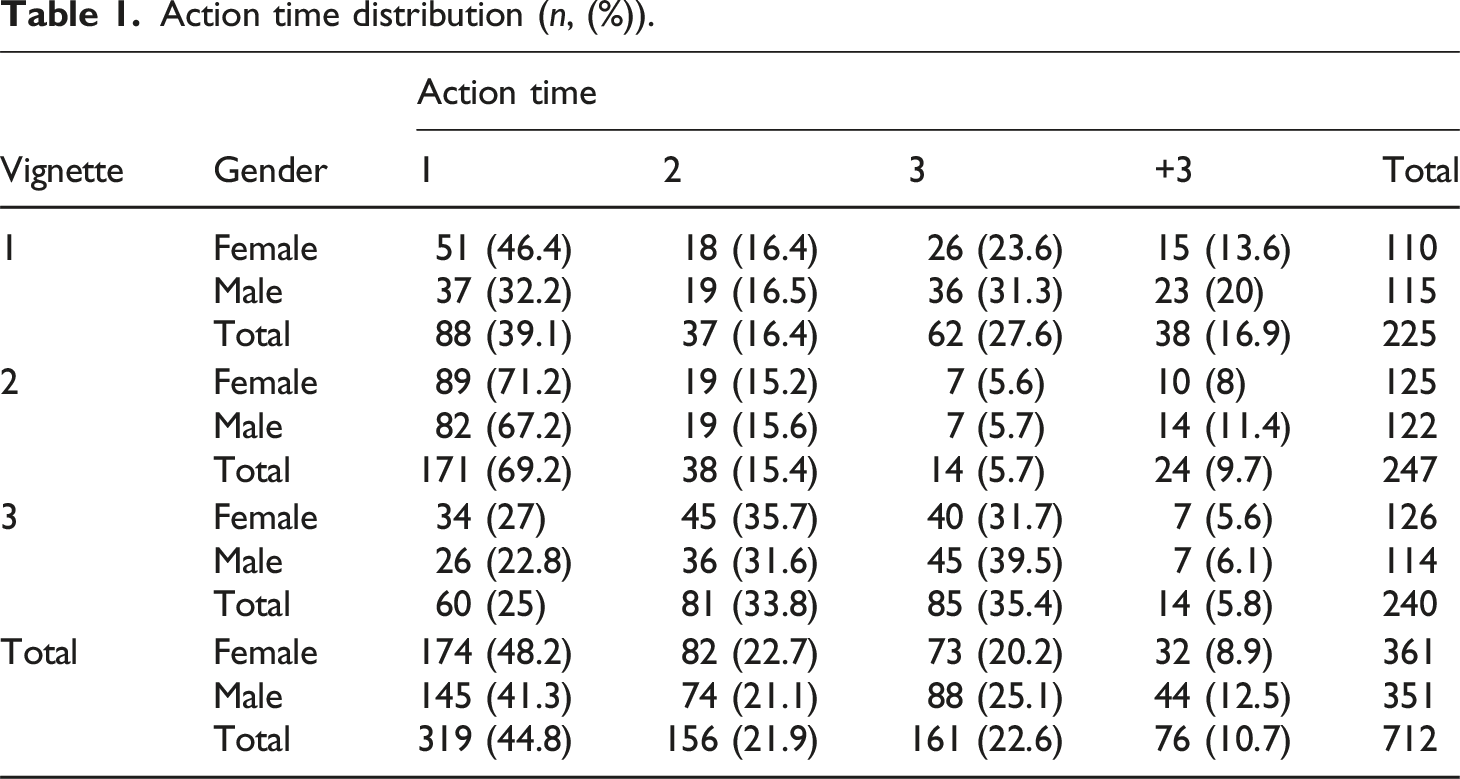
No statistically significant difference was found between females and males, neither for the total set (χ2(3) = 6.200, p = .102, Cramer’s V = 0.09) nor for any of the vignettes (χ2(3) = 5.443, p = .142, Cramer’s V = 0.16 for vignette 1; χ2(3) = 0.917, p = .821, Cramer’s V = 0.06 for vignette 2; χ2(3) = 1.765, p = .623, Cramer’s V = 0.09 for vignette 3). According to the experts, participants made the right decision only in 24% of the trials (n = 171); percentages were 27.6% for vignette 1, 9.7% for vignette 2, and 35.4% for vignette 3. Vignette 2 obtained significantly less correct decisions than vignettes 1 (U = 22830.5, p < .001, r = 0.23) and 3 (U = 22022.5, p < .001, r = 0.31), with no significant difference between 1 and 3 (U = 24877.5, p = .069, r = 0.08). There were no differences between females and males for the total set (χ2(1) = 3.526, p = .060, Cramer’s V = 0.07; females 21.1%, males 27.1%) nor for any of the vignettes (χ2(1) = 1.656, p = .198, Cramer’s V = 0.09, females 23.6%, males 31.3%, for vignette 1; χ2(1) = 0.850, p = .357, Cramer’s V = 0.06, females 8%, males 11.5%, for vignette 2; χ2(1) = 1.536, p = .211, Cramer’s V = 0.08, females 31.7%, males 39.5%, for vignette 3).
Perceived difficulty
Overall, participants perceived the vignettes as of medium difficulty (Mdn = 3, IQR = 2, Min. = 1, Max. = 5). However, vignette 1 was found as significantly less difficult than vignettes 2 (U = 15784, p = .008, r = 0.14) and 3 (U = 15723, p = .001, r = 0.16), with no difference between 2 and 3 (U = 20183.5, p = .991, r < 0.00). Once more, no gender differences were found neither in the total set (U = 43281, p = .910, r < 0.00) nor in any of the vignettes (U = 4017, p = .282, r = 0.08 for vignette 1; U = 4307, p = .133, r = 0.11 for vignette 2; U = 4779.5, p = .318, r = 0.07 for vignette 3).
Confidence
Participants expressed generally high confidence in their decisions (Mdn = 4, IQR = 1, Min. = 1, Max. = 5). Confidence was higher for vignette 2 than 3 (U = 25815.5, p = .035, r = 0.10), with no other significant differences. Females revealed less confidence in their decisions for the whole set and for all vignettes, though statistical significance was not reached for vignette 1 (U = 50589.5, p < .001, r = 0.17 for the total set; U = 5767.5, p = .258, r = 0.08 for vignette 1; U = 5274.5, p < .001, r = 0.27 for vignette 2; U = 5880, p = .023, r = 0.15 for vignette 3).
Discussion
Our study sought to evaluate gender differences in policing scenarios demanding snap decisions under time pressure and uncertainty. Based on the literature, we assumed that females would perform worse in speed of action, perceived difficulty, and confidence in their decisions, as compared to males. This hypothesis was tested through the completion of the DISPUTE vignettes by a fairly large sample of students from the Guardia Civil school.
Contrary to our hypothesis, women did not differ from men in action time or perceived difficulty, which can be considered contrary to the numerous studies that suggest riskier behaviour in men (e.g., Stepler, 2017). It should be noted that, contrary to other works (e.g., Shortland et al., 2020), in our study faster action is not associated with better or worse results. According to the judgment of the experts, the individuals should wait until an appropriate threshold of available information – and not beyond it. This was accomplished in only about one fourth of the trials, which may evidence inappropriate training, lack of experience, or simply the inherent difficulty of the scenarios depicted. In any case, a key point for this paper is that female participants performed as well (or rather, as badly) as their male colleagues. In fact, it could be argued that by more accurately recognising the likelihood of their poor performance, they showed a higher level of self-awareness than their male colleagues.
However, and as suggested in our hypothesis, we found a strong effect of gender on decision-making confidence, with females showing significantly less confidence than males. This result may be at least partly explained by stereotype threat, defined as the situation “when a person is aware of a negative stereotype about their social group and is concerned about confirming it” (Villanueva-Moya and Expósito, 2021: 706). The concept has been popular in psychology since the seminal study by Steele and Aronson (1995) and, whilst they focused on ethnic stereotypes, it has also been analysed in relation to a variety of domains, from the use of healthcare services by LGTB people (Fingerhut and Abdou, 2017) to teachers’ perceptions of migrants’ academic performance (Froehlich et al., 2018) or the challenges of military veterans in their transition to the workplace (Shepherd et al., 2020), amongst others.
In experimental conditions, stereotype threat has been linked to more disadvantageous risk decisions by women (e.g., Schmader et al., 2008). In this regard, the police culture is widely described as masculine and conservative, and little welcoming to those who do not fit male norms (Westmarland, 2017; Workman-Stark, 2015). Faced with this, female police officers tend to constantly perceive themselves on trial (Archbold and Schulz, 2008). The fact that gender differences in confidence were especially prominent for vignette 2 is illustrative, since it is the only scenario with a particularly high demand for physical abilities (rescuing people from the sea). In line with the stereotype threat, this may challenge female officers’ perceptions of their own physical limitations in such a task.
The literature abundantly illustrates the negative correlates of stereotype threat, including worse performance in difficult tasks (Drace et al., 2020), lower aspirations (Davies et al., 2005), higher work exhaustion and exit intentions (Van Veelen and Derks, 2021), and reduced social cohesion of the groups they work in (Grover et al., 2017). Our findings add to this evidence and suggest the need to implement stereotype interventions in the police. In this regard, ingroup role model interventions (e.g., Kortland and Kinias, 2019), self-affirmation interventions (e.g., Martens et al., 2006), teaching about stereotype (Johns et al., 2005), or mindfulness (e.g., Jarunratanakul and Jinchang, 2018), are some of the approaches whose success has been reported.
Our paper presents the strength of comparing relatively large samples of young police officers with a similar level of professional preparation and no practical work experience. This allows us to control for possible confounding variables like exposure to different organizational cultures or professional trajectories of varying durations, among others. Additionally, the use of scenarios based on real and everyday police events increases the validity of our conclusions. On the other hand, although our results illustrate the outcome of decision-making, they do not reveal the processes that lead each participant to that outcome–therefore they make it impossible to check whether, as Byrne and Worthy (2016) argue, women and men differ in the amount and type of information they use when making decisions. Future work with qualitative methodology (post-decision-making interviews) may shed more light on this point. Similarly, the limited number of scenarios used does not allow for a deeper exploration of the possible influence that the level of physical activity required in each one exerts on the decision-making process. Future experimental work manipulating this aspect – and relating it to participants’ physical self-concept – may contribute to our understanding of the topic.
Footnotes
Acknowledgements
The authors wish to express their gratitude to the Guardia Civil “Duque de Ahumada” Youth Guards College’s direction and staff for their support in data collection; to the three Guardia Civil officers who acted as subject matter experts (Captain Daniel Calvelo-Vázquez, Lieutenant David Galán Ruíz-Poveda, and Lieutenant Beatríz Maestro-Pimentel); and to the student candidate Úrsula Da Silva, for her valuable contribution to the development of the vignettes.
Author contributions
Ricardo Tejeiro: Conceptualization, Methodology, Formal analysis, Writing Draft. José Luis González: Investigation, Resources, Review and Editing. Ian Schermbrucker: Review and Editing.
Declaration of conflicting interests
The author(s) declared no potential conflicts of interest with respect to the research, authorship, and/or publication of this article.
Funding
The author(s) received no financial support for the research, authorship, and/or publication of this article.
Ethical statement

Data availability statement
The data that support the findings of this study are available on request from the corresponding author. The data are not publicly available due to privacy or ethical restrictions.